Silver Helix (1)
*
“Hell is empty and all the devils are here.”
― William Shakespeare, The Tempest
*
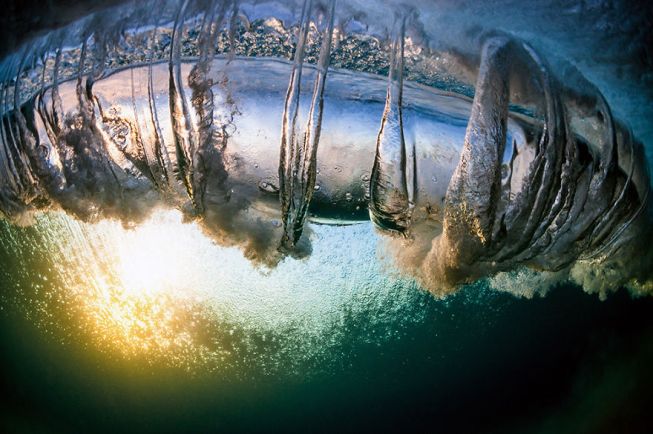
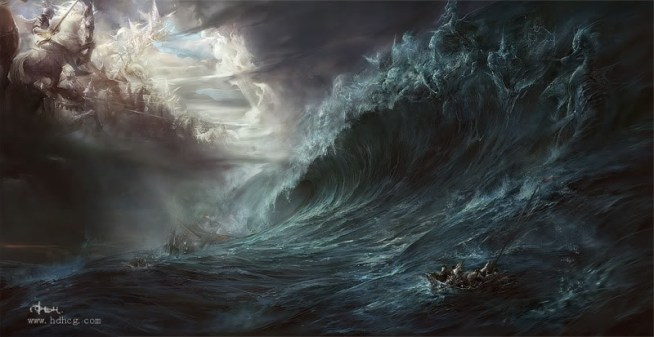
There was once a wave in the ocean, rolling along, enjoying the warmth of the sun and the swiftness of the breeze.
It smiled at everything around it as it made its way toward the shore.
But then, it suddenly noticed that the waves in front of it, one by one, were striking against the cliff face, being savagely broken to pieces.
‘Oh God!’ it cried. ‘My end will be just like theirs. Soon I, too, will crash and disappear!’
Just then another wave passing by saw the first wave’s panic and asked:
‘Why are you so anxious? Look how beautiful the weather is, see the sun, feel the breeze…’
The first wave replied:
‘Don’t you see? See how violently those waves before us strike against the cliff, look at the terrible way they disappear. We’ll soon become nothing just like them.’
‘Oh, but you don’t understand,’ the second wave said.
‘You’re not a wave. You’re a part of the ocean.’ (2)
*
*
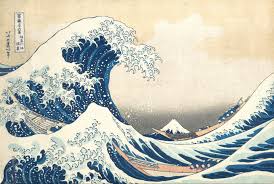
Katsushika Hokusai’s Under the Wave off Kanagawa, also called The Great Wave has became one of the most famous works of art in the world—and debatably the most iconic work of Japanese art. The Great Wave is part of the legendary series Thirty-six Views of Mount Fuji. (3) “The preeminence of The Great Wave —said to have inspired both Debussy’s La Mer and Rilke’s Der Berg—can be attributed, in addition to its sheer graphic beauty, to the compelling force of the contrast between the wave and the mountain. The turbulent wave seems to tower above the viewer, whereas the tiny stable pyramid of Mount Fuji—Japan’s sacred, national symbol of Beauty, Spirituality and Immortality–sits in the distance. The eternal mountain is envisioned in a single moment frozen in time.
*
Hokusai characteristically cast a traditional theme in a novel interpretation. In the traditional meisho-e (scene of a famous place), Mount Fuji was always the focus of the composition. Hokusai inventively inverted this formula and positioned a small Mount Fuji within the midst of a thundering seascape. Foundering among the great waves are three boats thought to be barges conveying fish from the southern islands of Edo.” Nonetheless, “Hokusai has arranged the composition to frame Mount Fuji. The curves of the wave and hull of one boat dip down just low enough to allow the base of Mount Fuji to be visible, and the white top of the great wave creates a diagonal line that leads the viewers eye directly to the peak of the mountain top.”(4)
*
To the Japanese eye, accustomed to reading from right to left—the great claw of a wave appears almost to tumble into the viewer’s face, the surging breakers may seem to swamp the boaters, even Mount Fuji appears fragile, about to be engulfed by the uncontrollable energy of the water, and still the humans in their tiny boats “doomed” to perish in the sea do not look panicked! On the contrary, they look like hanging to their rows in full discipline. It looks like they are experienced and know how to cope with such a situation. (5)

Jennifer Rundlett, a fellow blogger, sees “through” its art “the many trials of life and how overwhelming we often find them, being so focused battling our problems, and trying not to be consumed by them”, whereas “the wave is pointing our eye to [Mount Fugi] the focal point or meaning….that beauty and immortality is in how we ride out these storms.” (6)
*
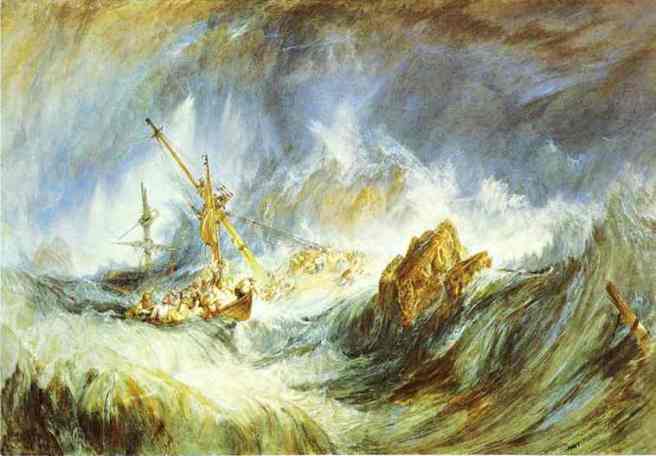
This Japanese painting brought to my mind an English Romanticist, William Turner’s famous seas, stormy skies, sinking ships and tempests studies, with a very different theme to Hokusai’s.
*
The power of the storm versus man’s inabilities was a main theme in Turner’s work. Dreadful catastrophe was a common theme in English romantic art period and Turner specifically painted themes of shipwreck a number of times throughout his life, exploring the effects of an elemental vortex. The romantics had taken a liking to natural phenomena and shipwreck became a popular subject. 19th century Britain specifically was very familiar with shipwreck as it was a period of great English shipping. … The craftsmanship of these ships did not deter the fact that the man made vessel was still at the mercy of the wind.
*
*
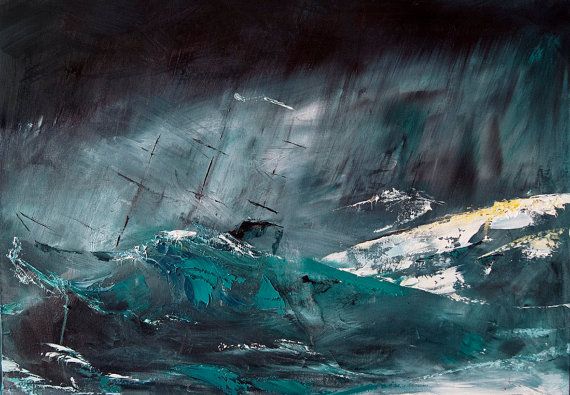
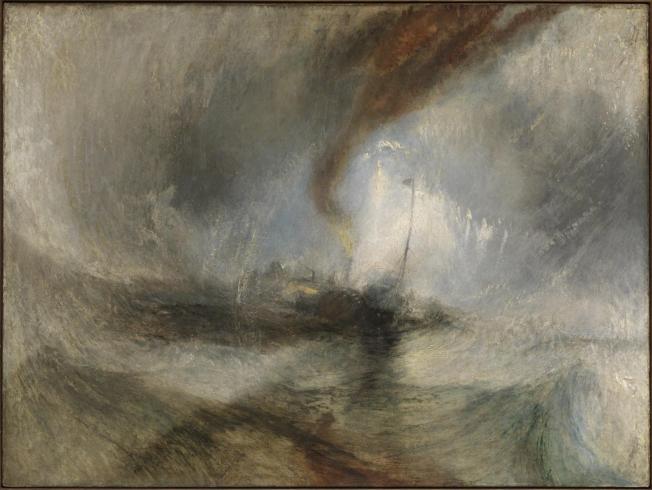
Let us have a good look at Turner’s most famous storm painting: The Snow Storm – Steam-Boat off a Harbour’s Mouth (1842), http://www.tate.org.uk/art/work/N00530 Snow Storm – Steam-Boat off a Harbour’s Mouth shows a ship off the English coast struggling to persevere through a storm. The steam-boat resides in the center of the vortex. Turner’s untamed brushwork creates a swirling composition of chaotic colors and lighting. The swirling storm creates a composition that leaves the eye to circle around the canvas repeatedly. The black of the wind and the waves of the sea create a circle around the doomed ship. Through the windy peephole, the viewer can see the helpless ship at the mercy of nature’s violent motion. One can imagine the ship swaying to and fro as its crew desperately tries to take control of the sail and stay afloat. In this context the vessel can be interpreted as a symbol of mankind’s futile efforts to combat the forces of nature.
*
*
In Snow Storm – Steam-Boat off a Harbour’s Mouth Turner uses a muted color palette. Pale blues and deep browns cover the canvas in swirling motions. Though the palette is predominately neutral, which usually creates a calming tone, the swirling motions and lighting create the chaotic effect Turner was going for. He wanted to simulate the true nature of a storm at sea. The bright white of the sail draws the eye directly to the ship, even amidst the swarming colors around it. Turner creates a pocket of light amidst a dark and shadowy canvas to illuminate the ship. Since he lights the ship in such a way, all focus is immediately drawn to the ship. The shadowing swirling winds only emphasize the ship more. The focus is relentlessly on the plight of the ship. This painting clearly invokes fear in a man or keeps him in his place as the weaker. Here the emphasis is on the raw, merciless force of Nature and Man’s frailty and helplessness. (7)
*
It is famously said that Turner conceived this image while lashed to the mast of a ship during an actual storm at sea to get a better account of the wind and ocean and what the ship must’ve felt like in the midst of it. This seems to be nothing more than fiction, but the story has endured as a way of demonstrating Turner’s full-blooded engagement with the world around him, and is stunningly dramatized in the famous Mast scene of the mesmerising, highly maginative and richly detailed 19th century period biopic Mr Turner (2014) https://www.youtube.com/watch?v=lYN6HwLSvyg
*
Khalil Gibran makes ample use of the “storm/sea/wave” imagery in “The Prophet” and explains how we all are “travellers” and “navigators” in the sea of life, our “pain being the breaking of the shell that encloses [our] understanding”. (8)
*

*
For an auditory raw, rough storm experience, let us not forget Aretha Franklin’s duet with Joe Ligon in the old time gospel “I’ve Been In The Storm Too Long ” https://www.youtube.com/watch?v=YUujg0BTIjk&list=PLkGwJ-k-JlPEDnwXWd5RDpNmjbUa0fi6y
“I’ve been in the storm… too long, Lord too long
mmmmm… I’ve been in the storm… too Long, Lord too long
Lord, please let me…have a little more time, I need a little more time to pray
Oooh…I’ve been in the storm too long…”
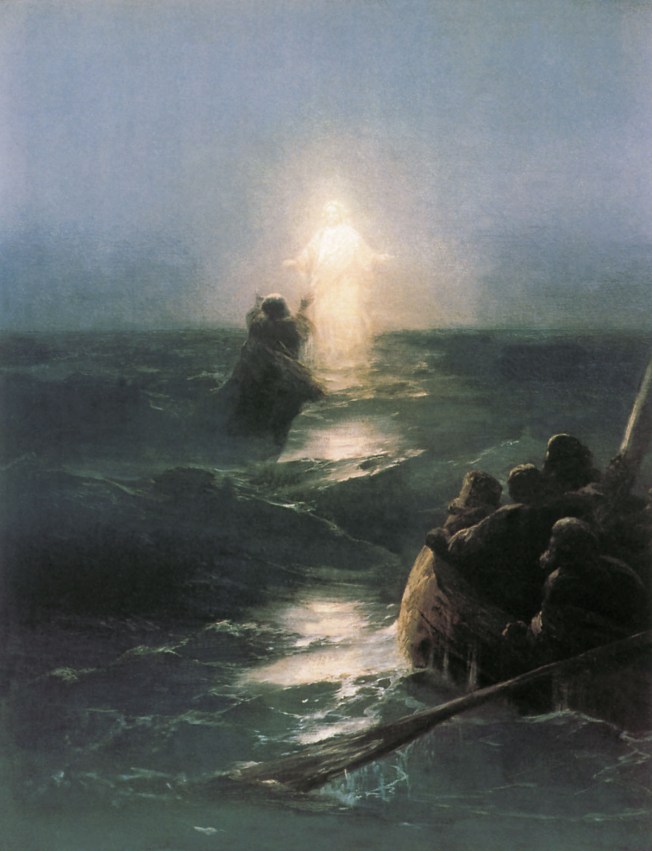
Jesus walks on water, by Ivan Aivazovsky (1888)
*
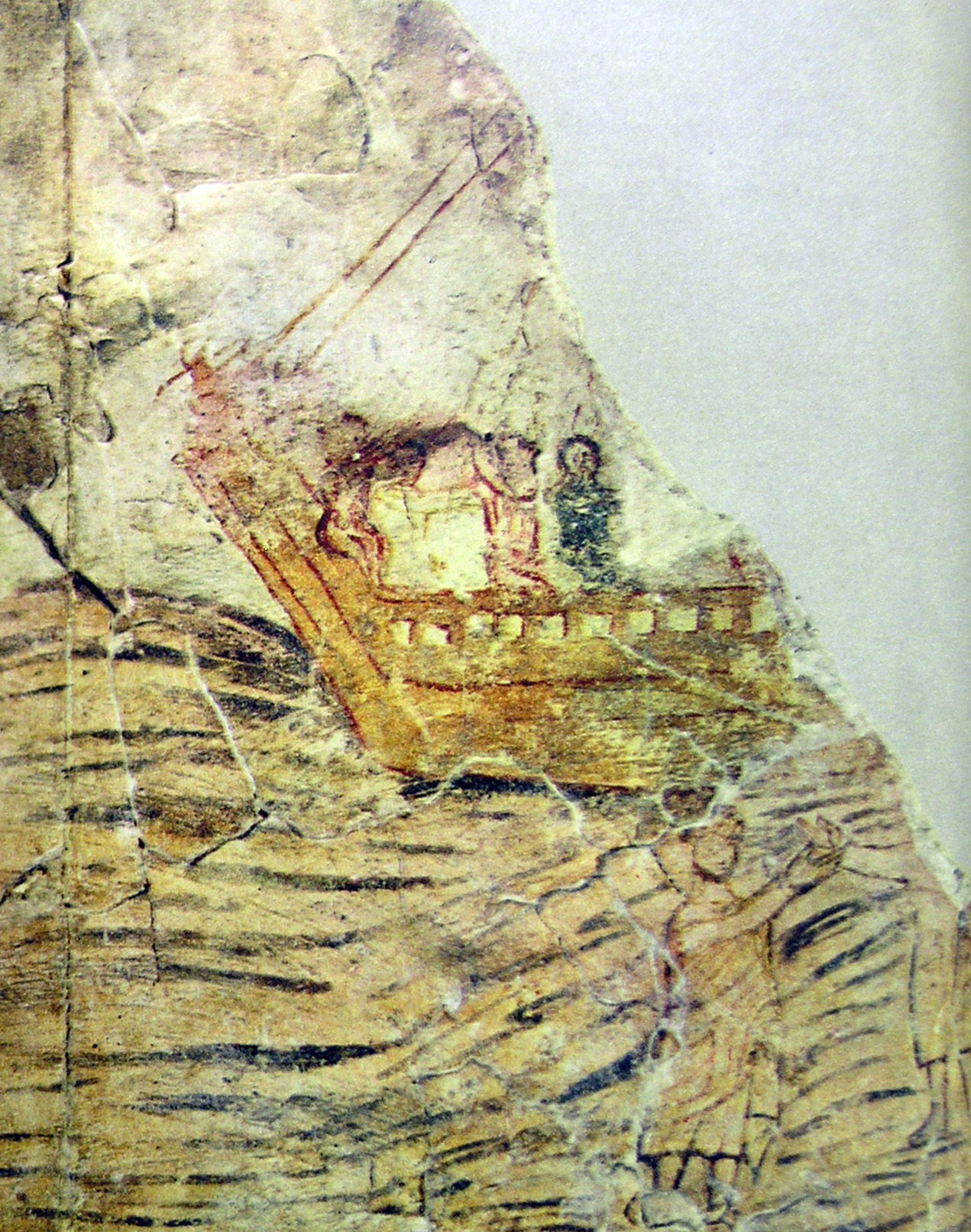
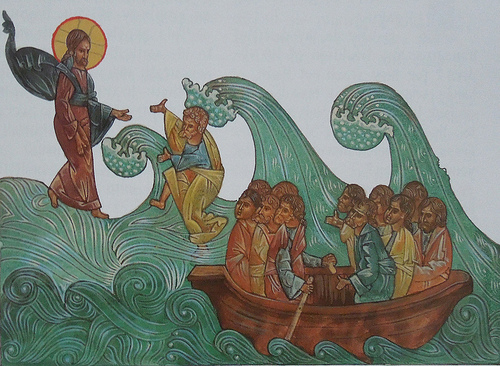
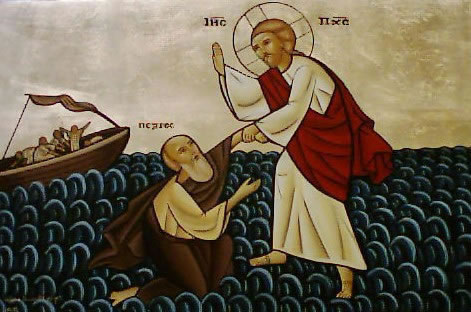
Yet, whether competent or helpless, I personally want to bring God in all these “storms”. So that I can walk on the water, towards Him, and when I see “the wind boisterous, … [am] afraid; and beginning to sink”, I can cry “saying, Lord, save me.” And He immediately will stretch forth His hand, and catch me, and say unto me, ‘O thou of little faith, wherefore didst thou doubt?’ (Matthew 14:29-31, KJB) And He will still the storm–within and without my mind–to a whisper and hush the waves of the ‘sea’ (Psalm 107:29) and (Mark 4:39).
*
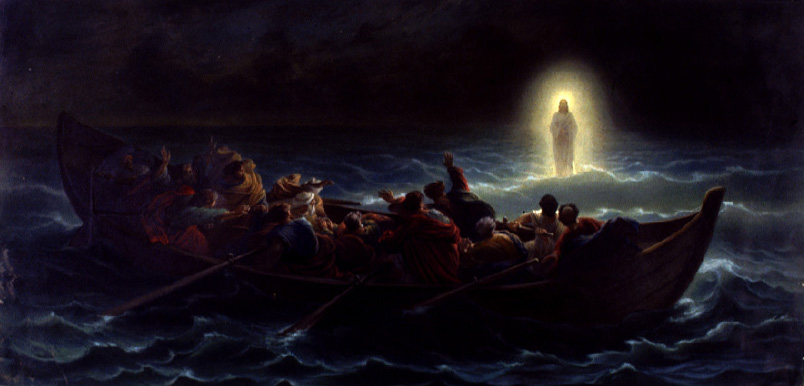
Christ walking on the sea, by Amédée Varint
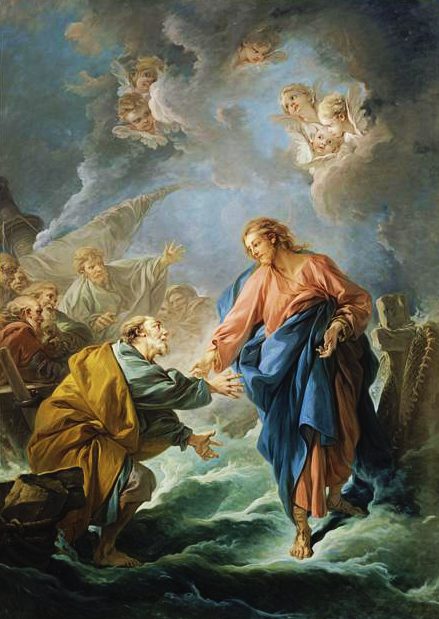
François Boucher Cathédrale Saint-Louis (1766) Versailles
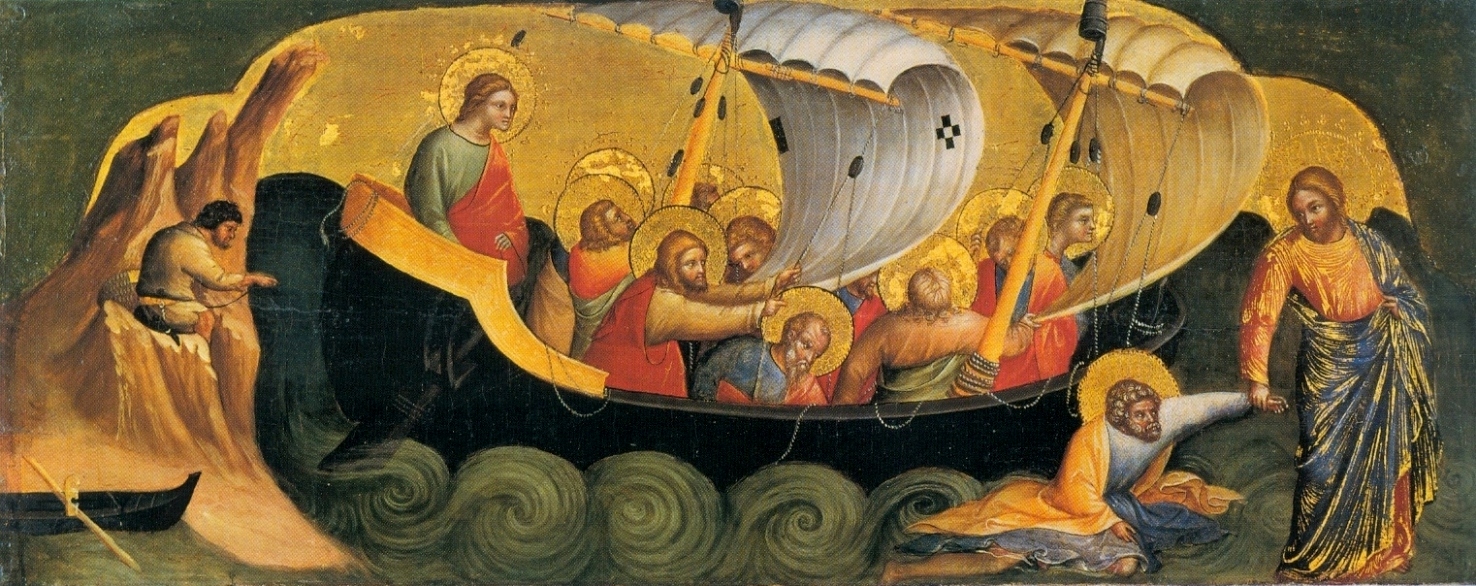
Walking on water, by Veneziano, 1370.
*
Sources:
- “I Capture The Majestic Power Of Ocean Waves”, amazing collection of underwater vortex and wave photographs at http://www.boredpanda.com/moments-in-the-ocean-images-created-from-water-light/
- “The missing rose” by Serdar Ozkan, cf. Paulo Coehlo’s blog http://paulocoelhoblog.com/2014/03/21/30-sec-read-you-are-not-a-wave/
- For the full collection, go to http://Source: https://en.wikipedia.org/wiki/Thirty-six_Views_of_Mount_Fuji
- The Metropolitan Museum of Art at http://www.metmuseum.org/toah/works-of-art/JP1847 For more analysis, watch Thompson, curator of the Hokusai exhibition at the Museum of Fine Arts, Boston, delving into the story behind this world famous print at https://www.youtube.com/watch?v=dbPHPfVw6zQ
- https://www.khanacademy.org/humanities/art-asia/art-japan/edo-period/a/hokusai-under-the-wave-off-kanagawa-the-great-wave and http://www.artic.edu/aic/collections/artwork/24645 and http://www.artelino.com/articles/the-great-wave.asp
- For more details, go to her inspirational blog site, dedicated to sharing with insights of God’s love through meditations using art and music, at https://jrundlett.wordpress.com/2014/03/09/new-perspectives-god-given-problems/
- http://www.artble.com/artists/joseph_mallord_william_turner/paintings/snow_storm_-_steam-boat_off_a_harbour’s_mouth
- Lebanese-American artist, poet (1883 – 1931), chiefly known in the English-speaking world for his 1923 book The Prophet, an early example of inspirational fiction, including a series of philosophical essays written in poetic English prose, and the third best-selling poet of all time, behind Shakespeare and Lao-Tzu or Lao-Tze.