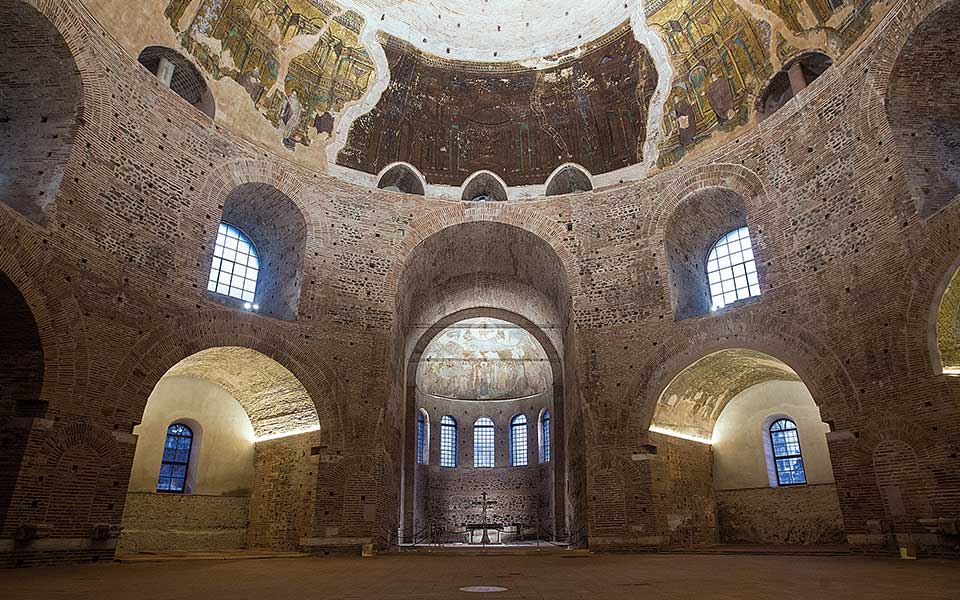
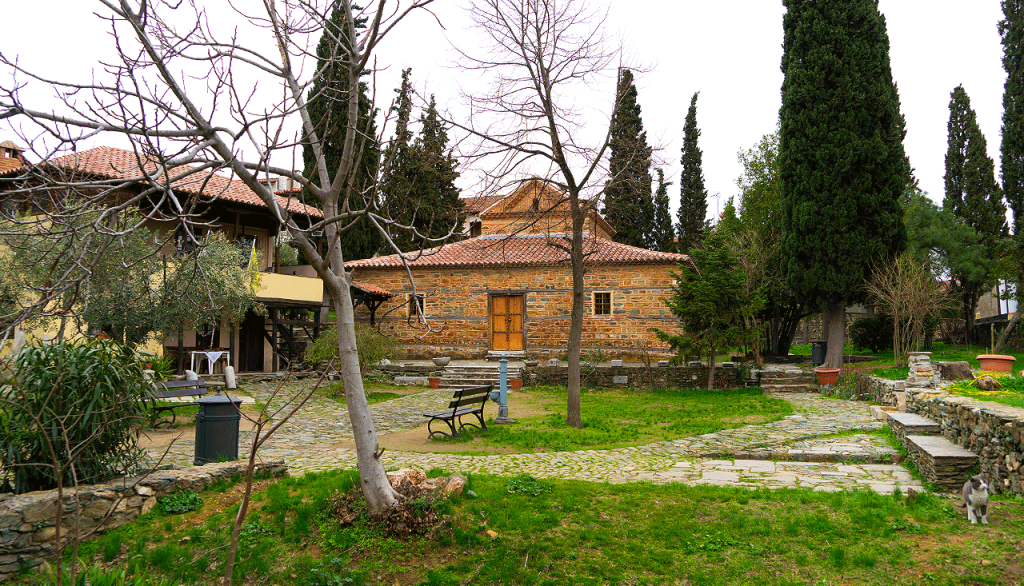
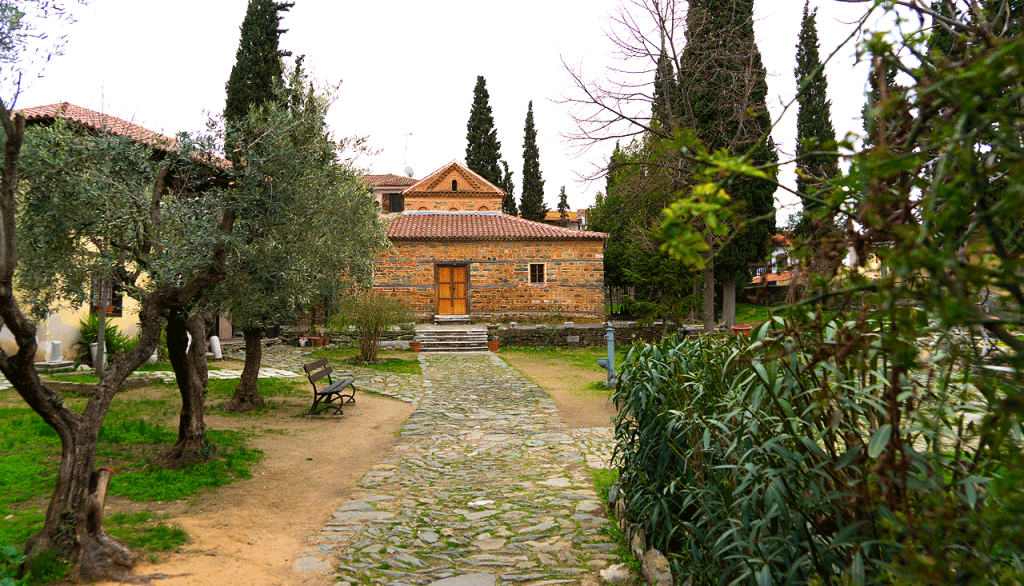
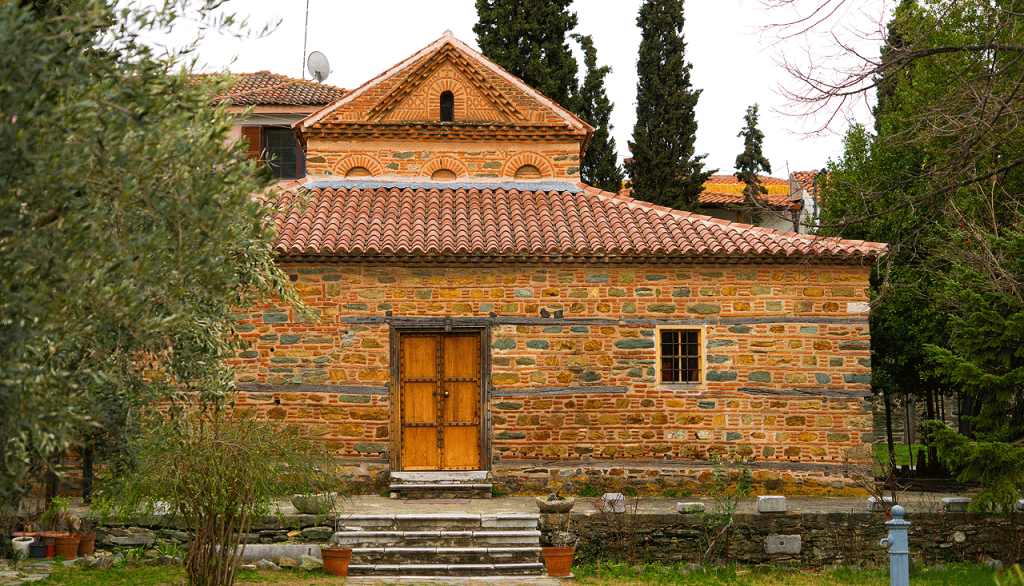
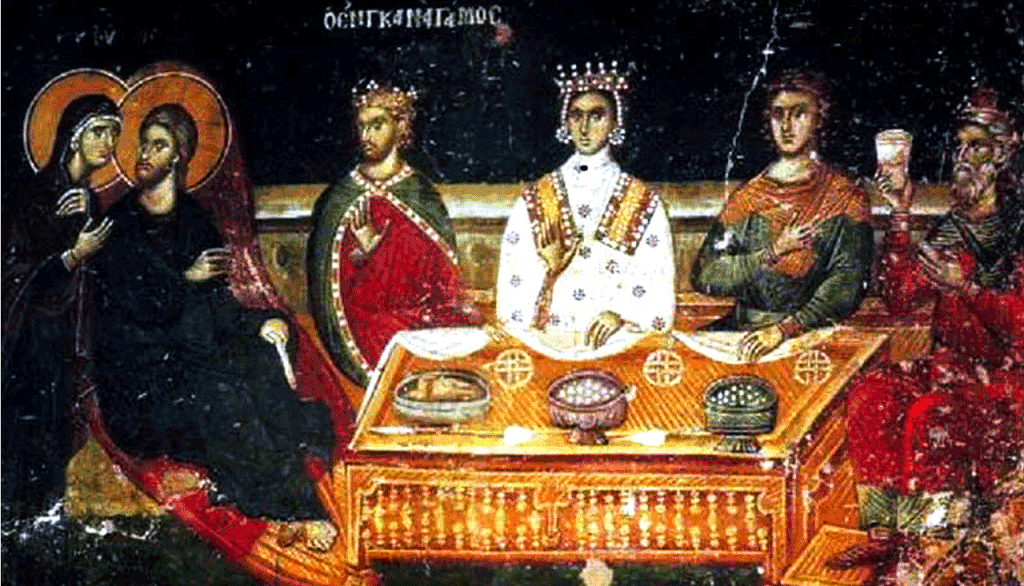
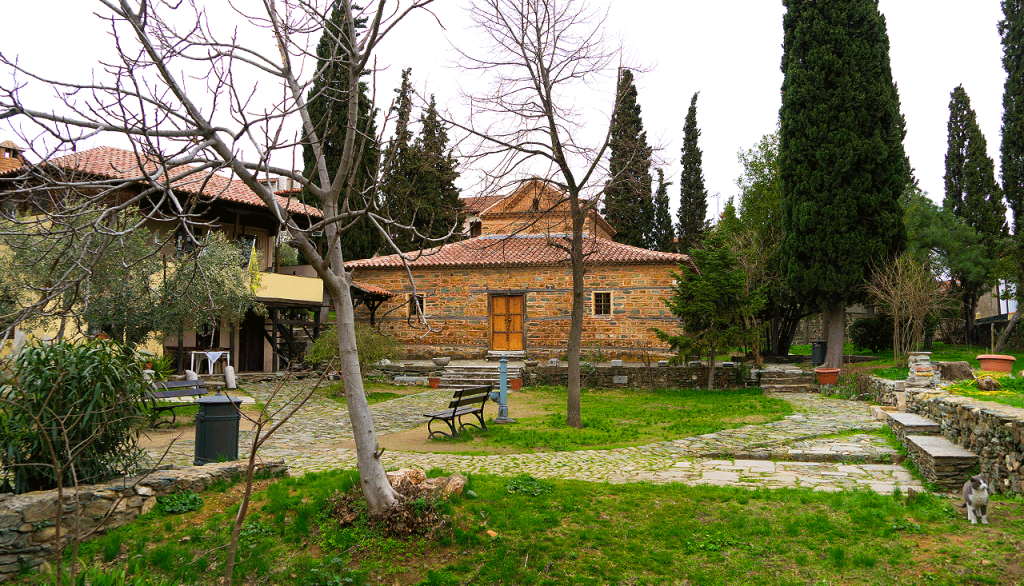
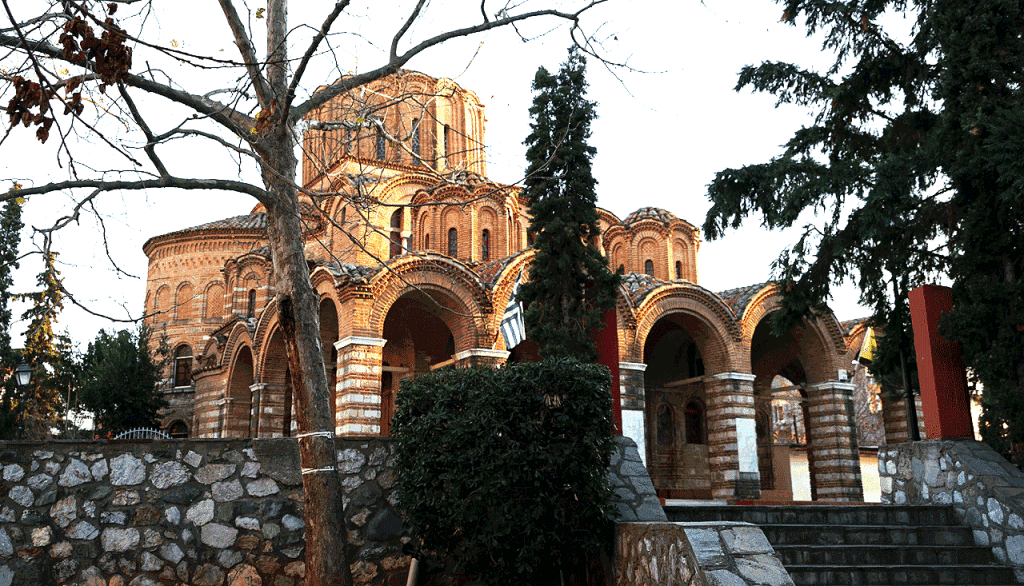
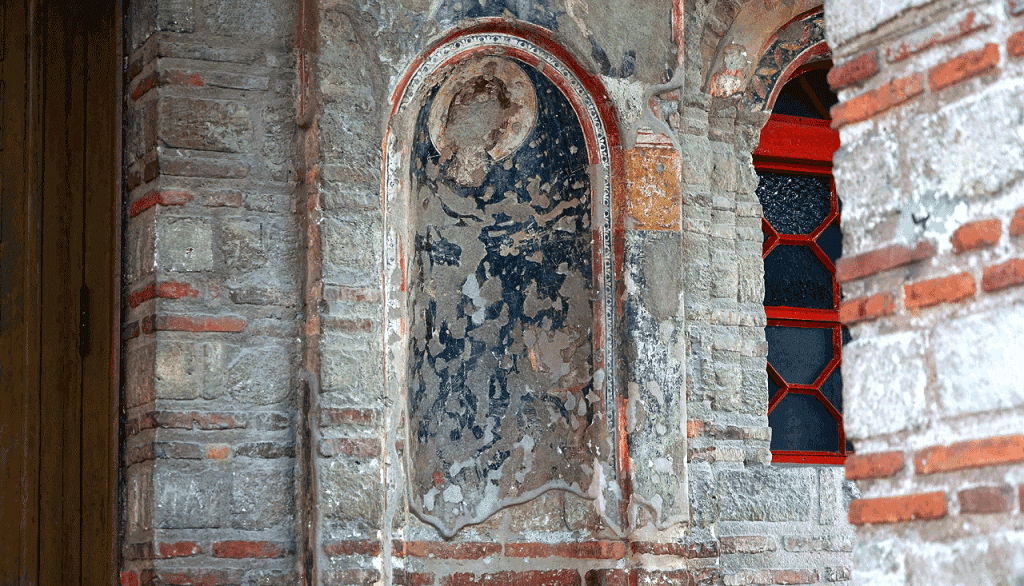
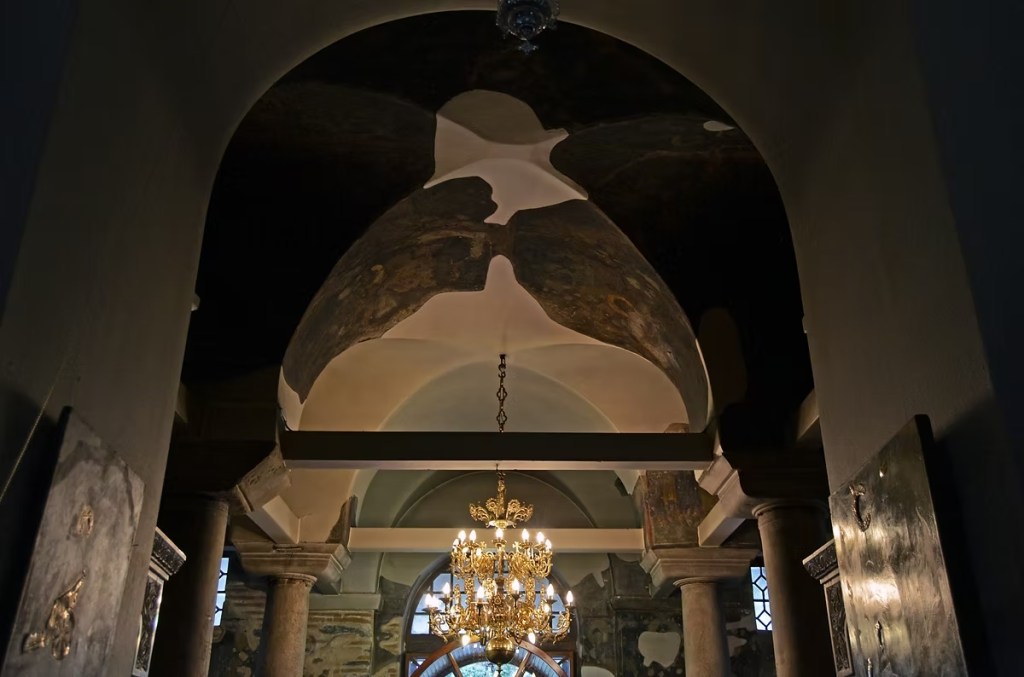
Friday the 12th, part 2. Panorama monastery is very beautiful. Set up in the hills above Thessaloniki, one can see the bay. Indeed, we can see over to the place (1) where St. Paisios rests. We venerated Elder Symeon’s tomb (2).
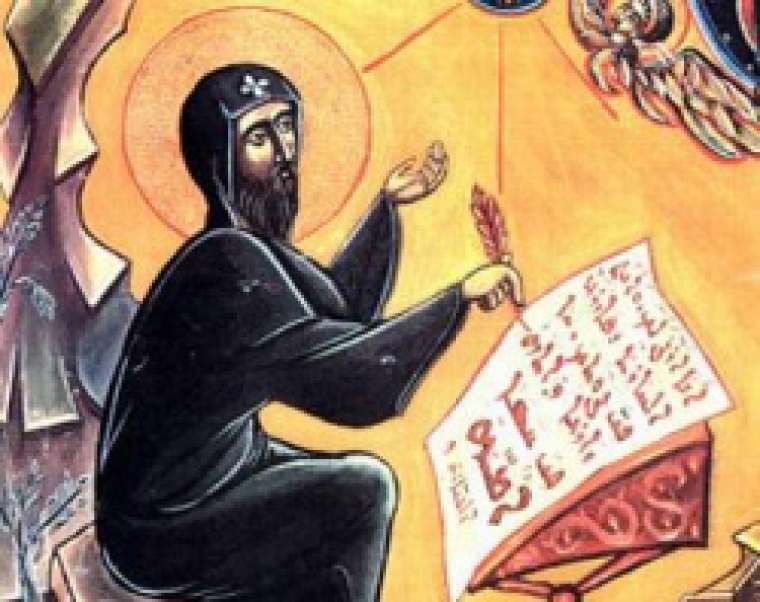
We had two hours of great wisdom. Followed by the blessing from the Hegumenos I. Our discussions were focused on the teachings of St. Simeon the New Theologian, sharing mystical experiences centred on humility.
The teachings of St. Simeon the New Theologian draw heavily from the Desert Fathers. Direct experience of God is something to which all Christians should aim and indeed aspire. The teachings which I read many years ago from St. Symeon the Theologian came flooding back, and the discussion made me want to revisit the books which were formative in my embrace of Orthodoxy. Indeed, the power of the Holy Spirit to change lives is real, and to change individuals, to transform them, and to transform situations in which we find ourselves sometimes feeling rather hopeless.
A theme which, at this time, post-Pentecost days, has been realised in many churches where young people are beginning to return to the church. There is a revival of hope.
The conversation echoed a previous thought about the need for solitude of one‘s self within that space where God exists. If one wants to become a channel of divine grace to others, but this is God’s grace. It is nothing to do with ourselves. It is not ours.
We are nothing, but God makes us something. It’s simply a yes to God in all circumstances. St. Simeon the Theologian emphasises the need to listen to the advice of your spiritual father.
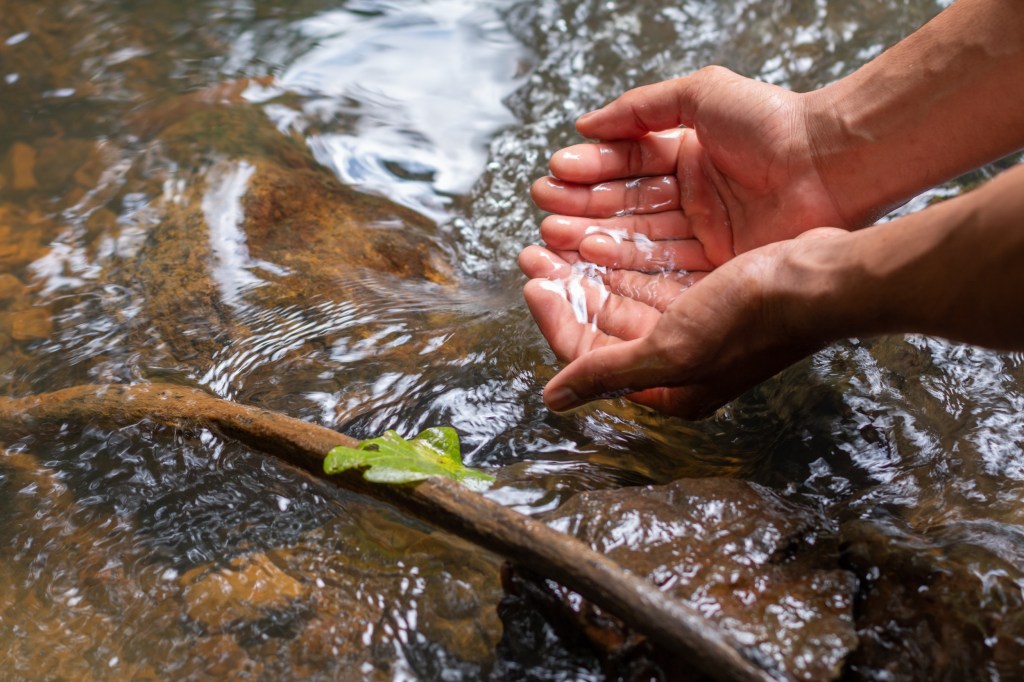
The priest Lev Gillet, in his book, called Encounter at the Well, discusses the situation that our Lord found himself in with a Samaritan woman. Christ, wearied by his journey, asks for some water at Jacob’s well. The martyr St. Philoumenos, who was a priest at the well, was with us in the evening in the form of little prayer cards, those magnetic ones which you attach to your fridges, which we had received earlier in the week from a priest.
We were able to give these to the children. The T family came to greet us, to share their love amongst us, to take a blessing and to sing for us. It was like refreshing water on a hot day.
We Christians thirst for God, and we receive him in fellowship, amongst others who are like-minded. He gives abundantly of His life and of His life-giving spring. The evening concluded with a late meal with M, E, G or J, depending on what you wanted to call him, and A. It was a joyous conclusion to a day of deep discussion, shared experiences, and surprising connections that we made.
Although we should not be surprised by those connections, since we have the same Lord, we have the same Christ, and because in His great love and humility for us, He calls us His friends. Amen.
*
(1) Souroti, the Monastery of St. John the Theologian.
Thursday the 11th, Part 2. In the evening, we met with M at the restaurant. It was a joyful meal together with discussions about the Church and about Christ and His love. This brought us together in fellowship.
And, of course, we must all do the work of Christ whilst it is still day. Or, as Father Seraphim Rose said: “Hasten to do the will of God, it is later than you think.”
The little monastery that we visited in the morning still conjured dreams in our souls.Of Paradise.
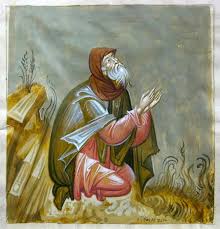
As Abba Isaiah of Sketis says to his monks, those who are beginning their journey must cultivate the soil. And indeed we are to labour in the vineyard.
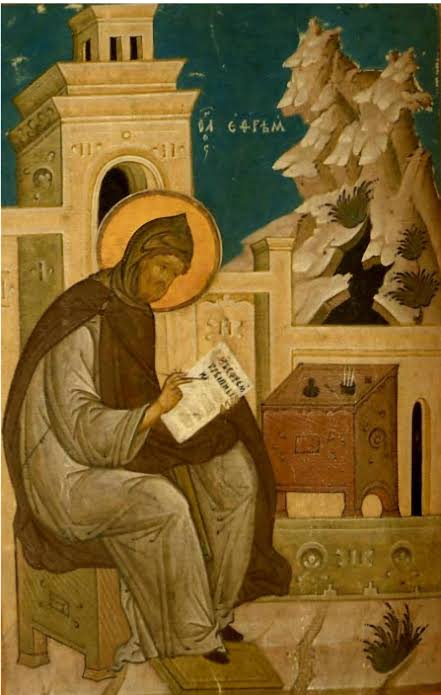
Saint Ephraim the Syrian writes in Hymns of Paradise, number 5, verse 15:
Thursday the 11th of June, the Feast of St. Luke Symferoupol and the revelation of Axion Estin by the angel Gabriel.
The journey to St. Kyriaki monastery was quite eventful. St. Kyriaki monastery is where a number of our Antiochian nuns found themselves.
At one point in the journey, engrossed as we were, in deep conversation and with the Paraklesis of St. Luke Symferoupol providing the background ison to our talk, we took a wrong road. My fault, I’m afraid, as I was the co-pilot, supposed to be directing the way.
The sign Local Road did not really do justice to the rather barely marked track that we found ourselves on in this huge field. However, Sat Nav came to the rescue and revealed to us the way that we should go. We needed a U-turn.
U-turns can be life-saving in a religious and a spiritual point of view, from sin and death and the roads which lead to destruction, to the way that leads to Paradise.
A reliable source told me how beautiful this place was, and indeed there was no hyperbole from that source.
This beautiful monastery, which is really a hidden gem amidst the beautiful countryside, reminded me of the Hymns of Resurrection from St. Ephraim, also a Syrian.
In his Hymn to the Resurrection, chapter 15, verse 10, he writes this:
“Let us summon and invite the saints,
the martyrs, apostles and prophets,
whose own blossoms and flowers
shine out like themselves –
such a wealth of roses they have,
so fragrant are their lilies:
from the Garden of Delights do they pluck them,
and they bring back fair bunches
to crown our beautiful feast.
O praise to You from the saints who are blessed.”
Sister T told us how the nuns came to be there, and it reminded me of another verse from St. Ephraim the Syrian, verse 12, in the same poem:
“Receive our offering, O our King,
and in return grant us salvation;
give peace to the land that has been devastated,
rebuild the churches that were burned,
so that when deep peace has returned,
we may plait you a great wreath,
with flowers and people to plait it,
coming in from all sides
so that the Lord of Peace may be crowned.
Blessed is He who has acted and is able to act.”
*
For those of you who missed it, the story of the Sisters of War and St. Kyriaki monastery in Veria can be read here
Even though it is is 31C, it is raining. One of our friends said, “you have brought the rain with you from Manchester.” Indeed, but I drank from the fountain of Christ’s Mercy.
St Efraim the Syrian writes:
“Thanksgiving be to Him who caused a stream to flow forth
in the mouths that had been closed,
so that they might give praise without end, through the Son,
to the worshipful Father.”
Nisiben hymns 69
The evening was spent in conversation with Sister A and S at C’s house. The conversation was pastoral in nature, and the conversation revolved around the vicissitudes of life that we all suffer. Set within that larger framework of God’s divine plan.
It is a blessing to share one another’s burdens and to focus on our faith, our common heritage, within a world which often has taken the wrong direction and that is searching for answers. St Paul, in his letter to the Galatians in chapter 6 v. 2, writes, “Bear one another’s burdens, and so fulfil the law of Christ.” So, in acceptance of these words, we were indeed bearing one another’s burdens, and in so doing, fulfilling that law of Christ, to love God and to love one’s neighbour.
St Porphyrios says, “Christ is everything.” So, we should not add or subtract anything to our Christian faith, since, by adding, we compromise, and by subtracting, we fall short of that perfection which God calls us to. C.S. Lewis calls this “Mere Christianity.”To Wormwood, his nephew, in the Screwtape Letters, he says, what we must do is to keep them in the state of mind I call ‘Christianity and …’, you know, ‘Christianity and Crisis’, ‘Christianity and the New Psychology’, ‘Christianity and the New Order.’” To add to that, perhaps ‘Christianity and Politics.’
The horror of the same old thing is one of the most valuable passions we have produced in the human heart. It creates an endless source of heresies. Pure Christianity, with nothing added and nothing taken away, we find in the monasteries.
C.S. Lewis writes again: “just as we pick out and exaggerate the pleasure of eating to produce gluttony, so we pick out the natural pleasantness of change and twist it into a demand for absolute novelty.”
Original, authentic and unadulterated Christianity does not need nor seek approval of the world, or indeed embrace its passing fads and fashions and fantasies. It remains steadfast to apostolic order, to true doctrine and to the living tradition.
Any movement that is required is impelled by the action of the All-Holy Spirit. Amen.
“Now the enemy’s philosophy is nothing more nor less than one confirmed attempt to evade this very obvious truth. He aims at a contradiction.
The good of one’s self is to be the good of another. This impossibility he calls love. He is not content even himself to be a sheer arithmetical unity.
He claims to be three as well as one, in order that this nonsense about love may find a foothold in his own nature.” C. S. Lewis, The Screwtape Letters.
Loving others is that impossible contradiction that we live as Christians.It requires on our part effort, time, perseverance and patience. These four virtues, cultivated by a little hope, will bring forth fruit.
Today the tenth is the feast of St. John Maximovich, who planted the seed of love in the New World, and indeed also in the eastern world, of which his fruit can be seen today in the USA and in the UK, and in many parts where he was present.
The growth of Orthodoxy is witnessed amongst our young people. It was on this day in 1993 that we, Pilgrims to Orthodoxy, met Patriarch Ignatius IV of thrice-blessed memory. We met him in Paris with these virtues and with equal hope, and he greeted us with “Welcome home.”
Home is more than a place. It is a people. It is being among others in that “arithmetical nonsense” where three are one, and one is three.
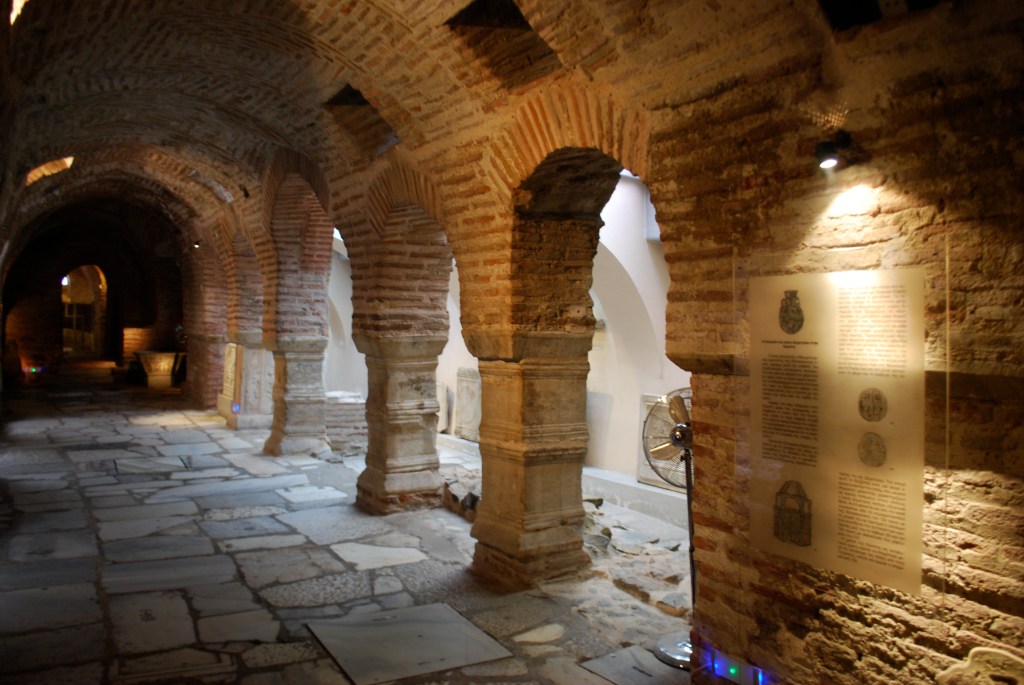
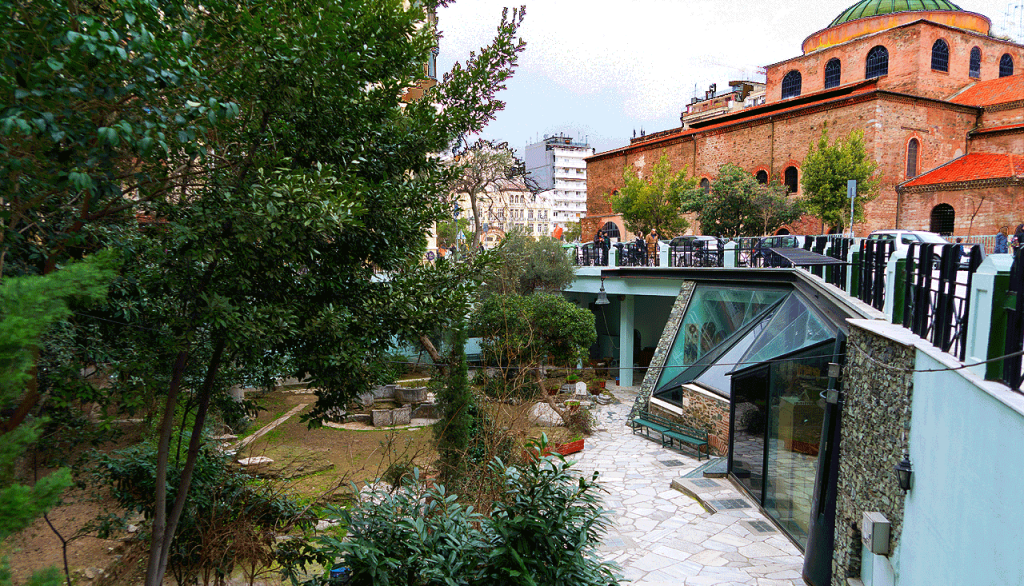
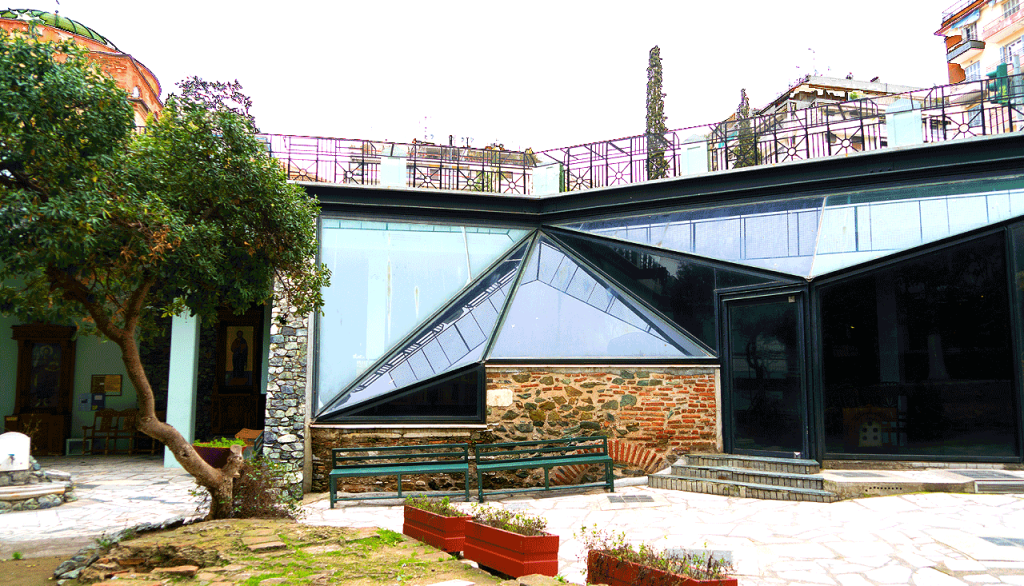
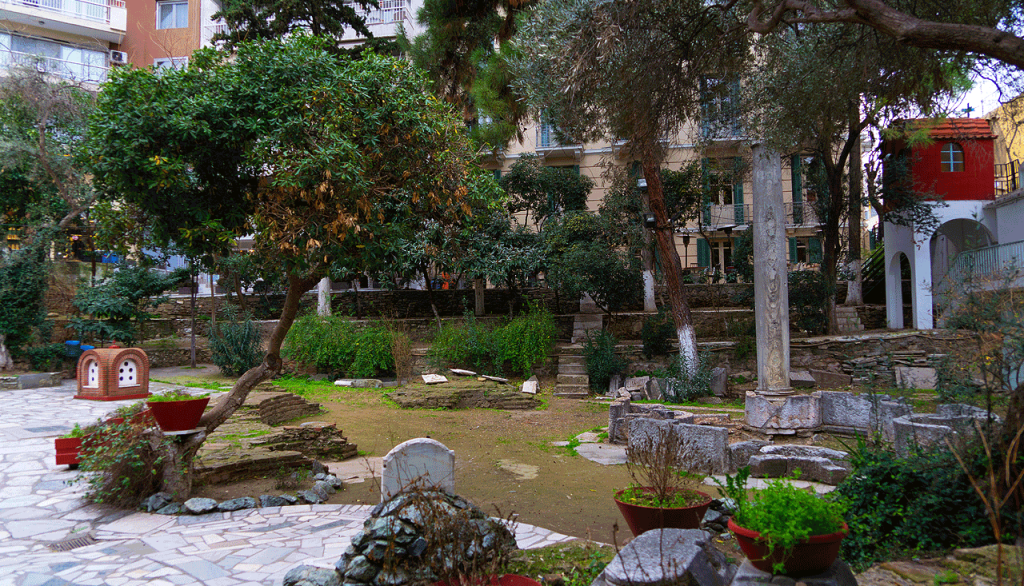
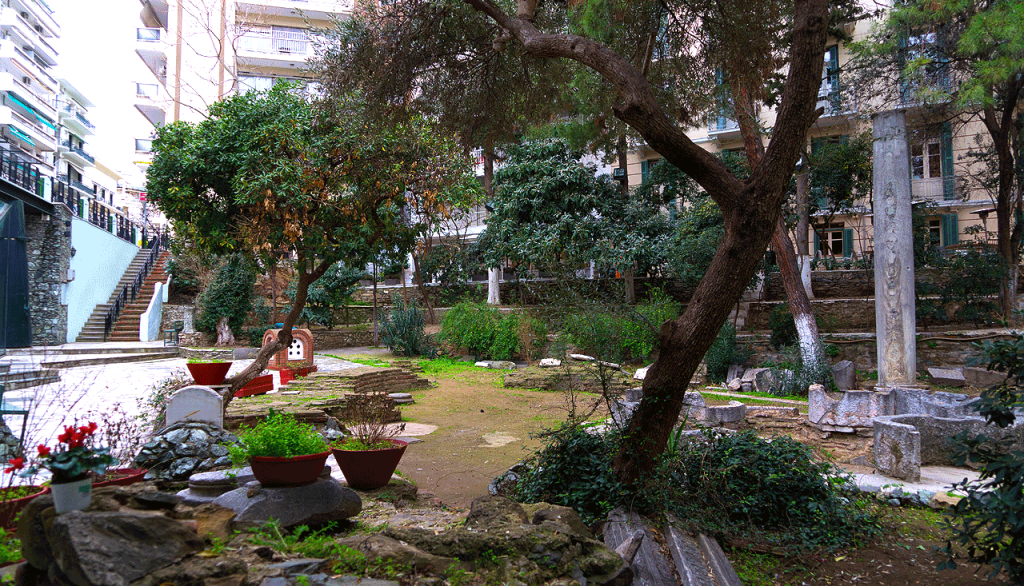
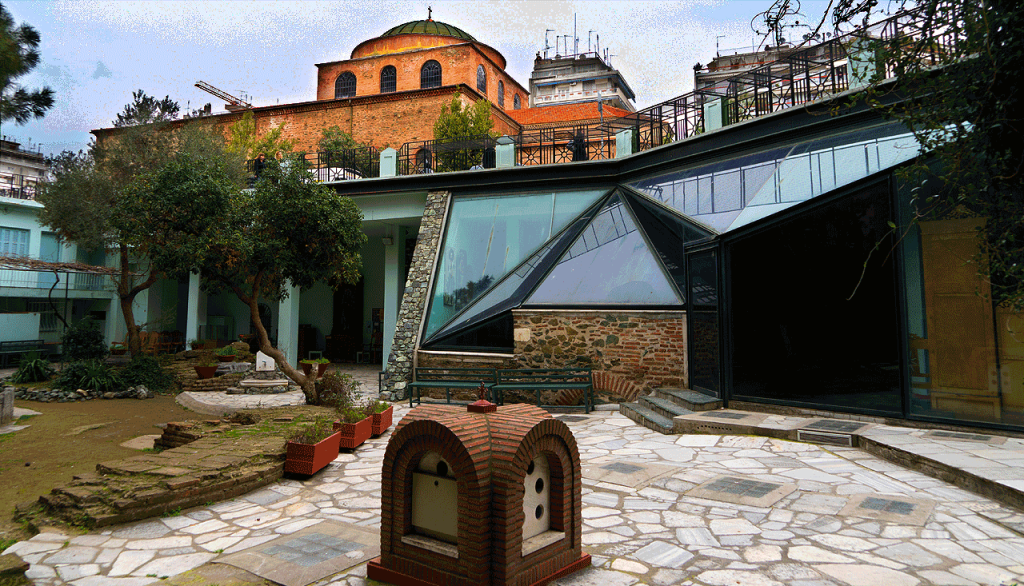
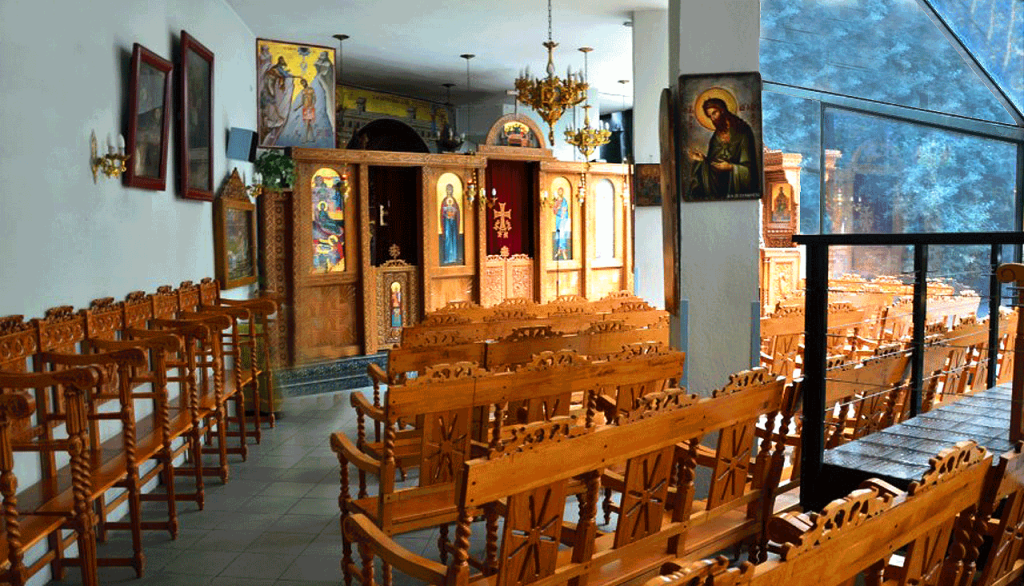
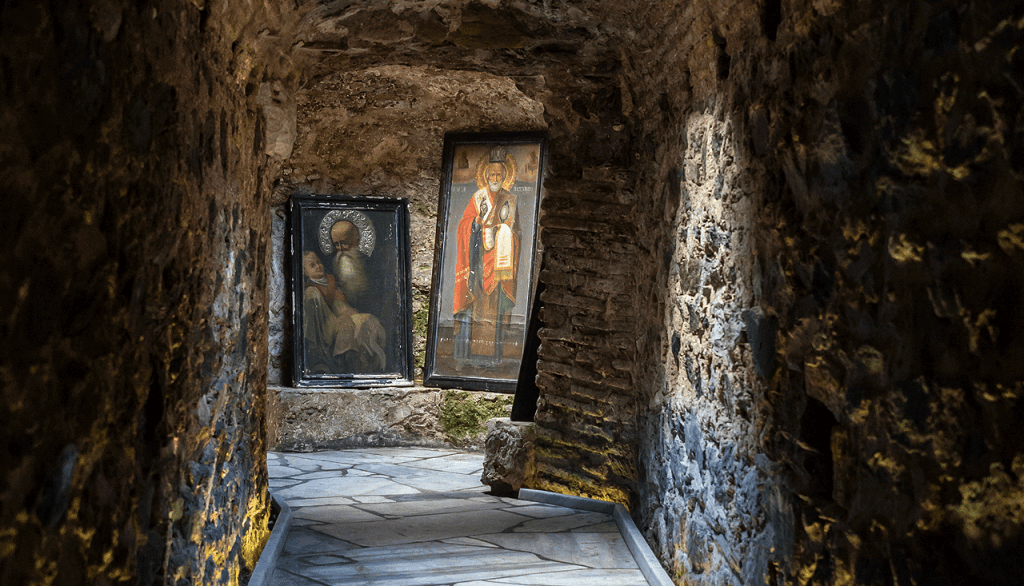
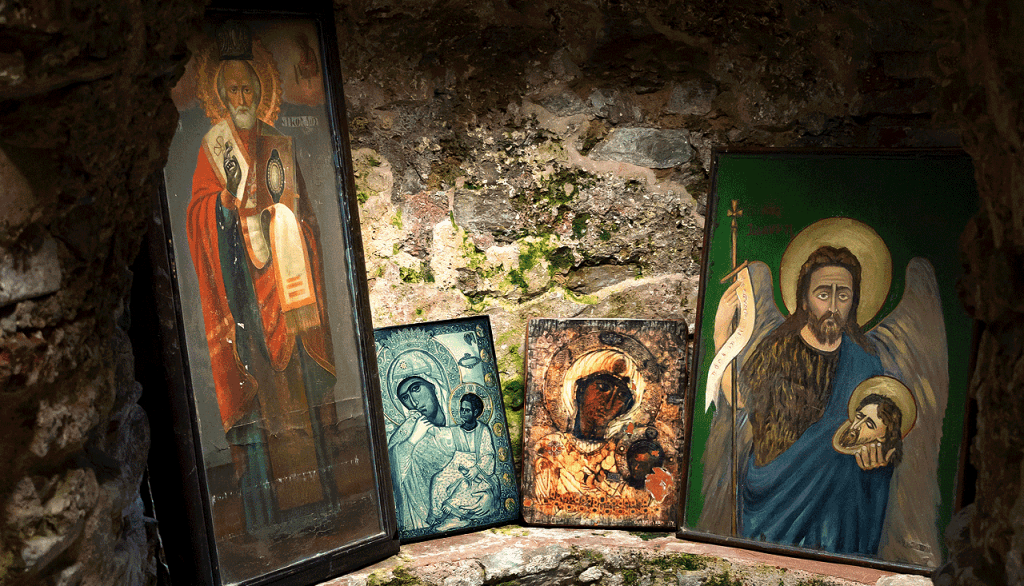
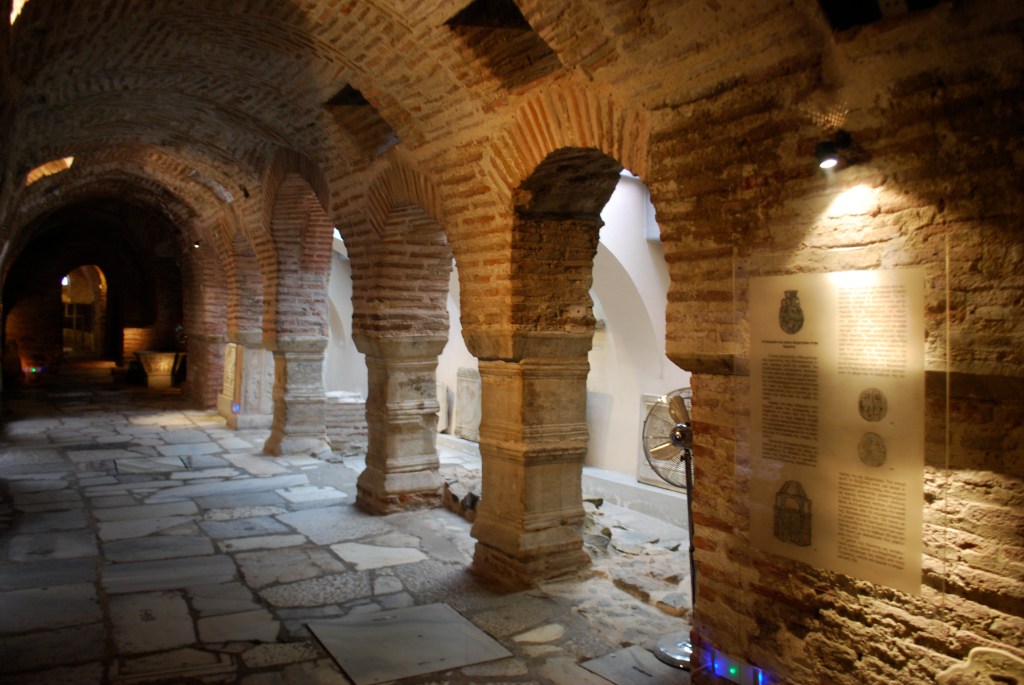
The resolute and formidable cost of being a Christian, in the early days of the Byzantine Empire, was evidenced today in the Catacombs (1) and the Baptistry of St. John the Baptist, which we visited today, next to Hagia Sophia Church. Burials, liturgies and prayers were carried on side by side in these underground chambers. These Catacombs were connected to one another, to other catacombs of St Demetrius and Hagia Sophia. There was no separation, not even in death.
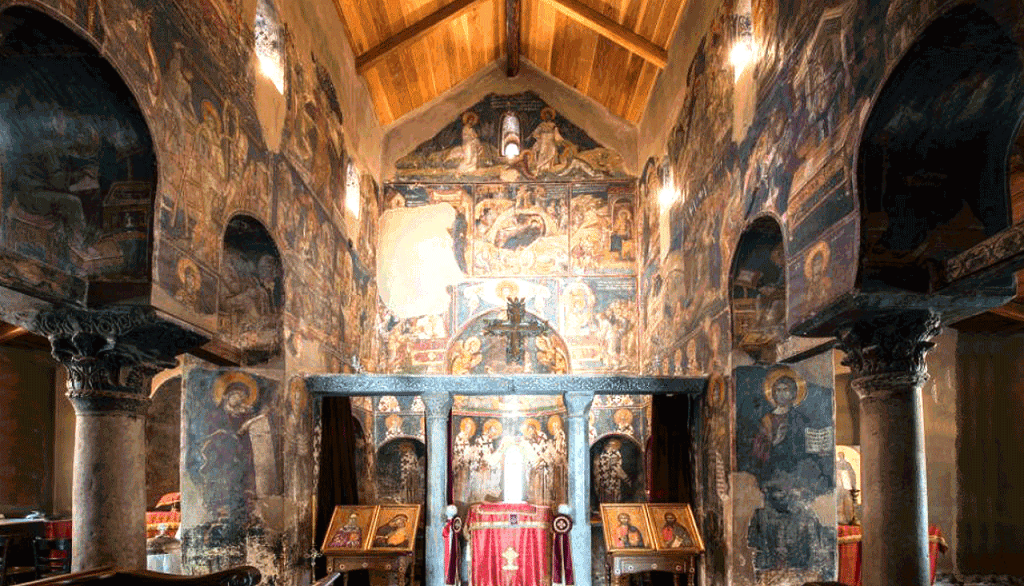
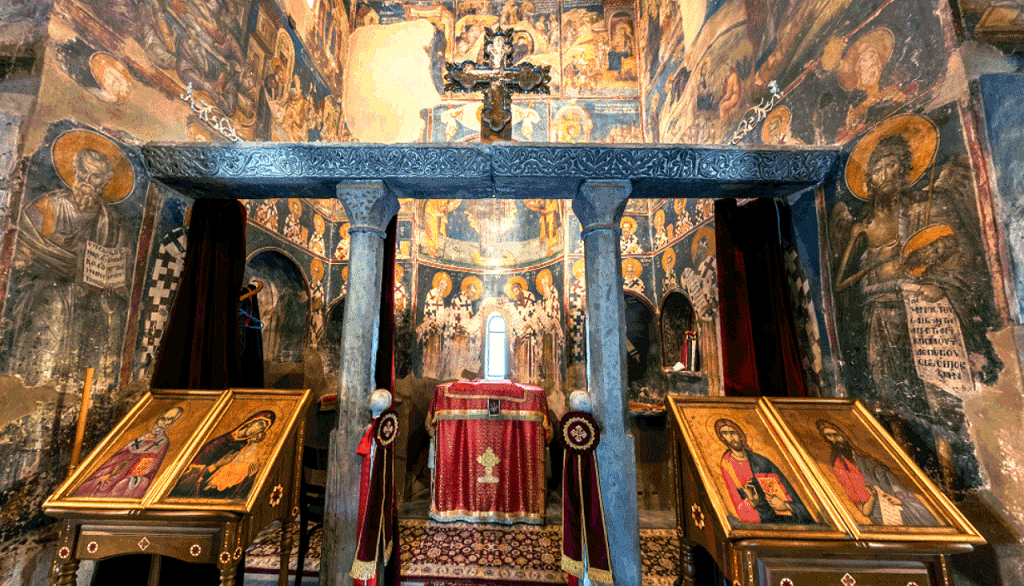
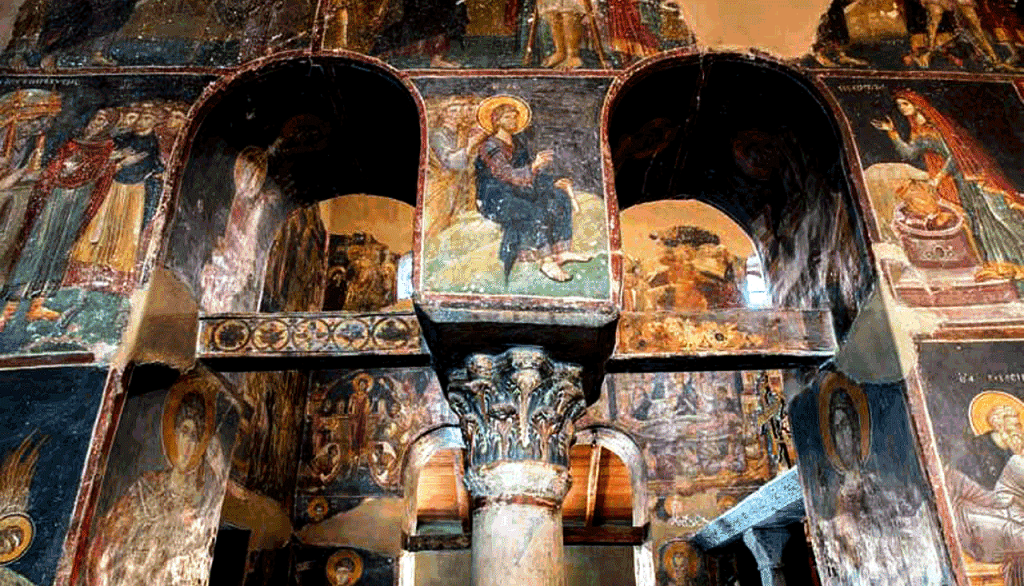
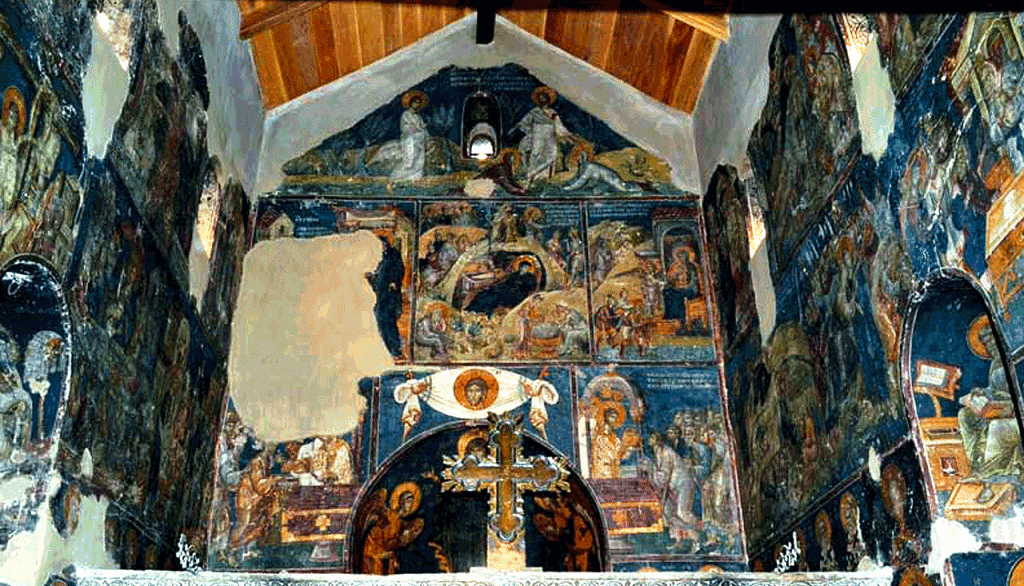
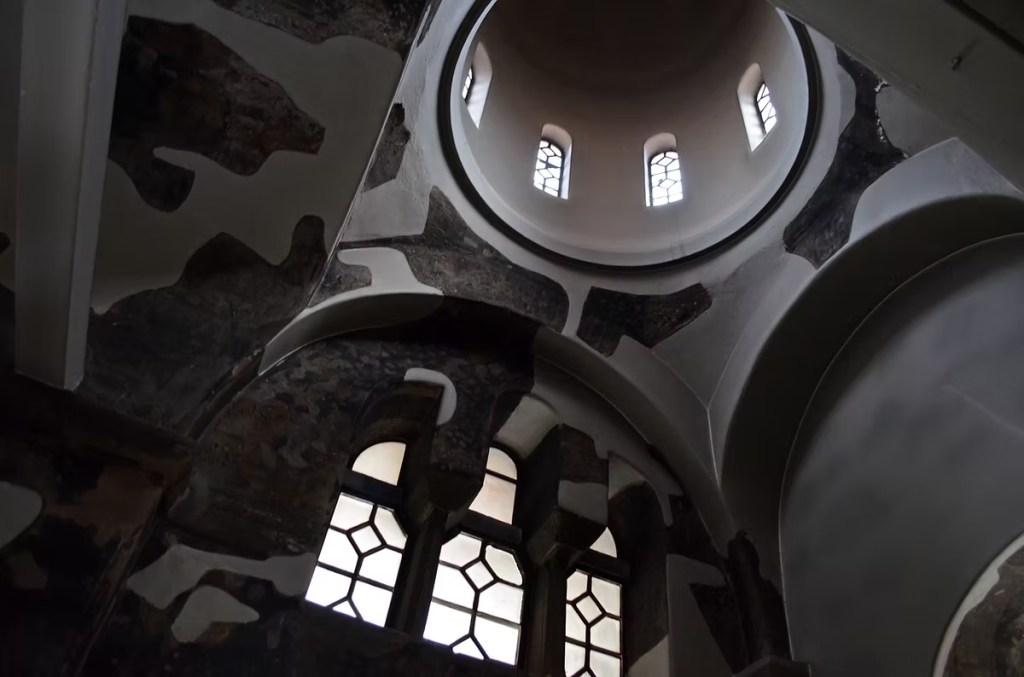
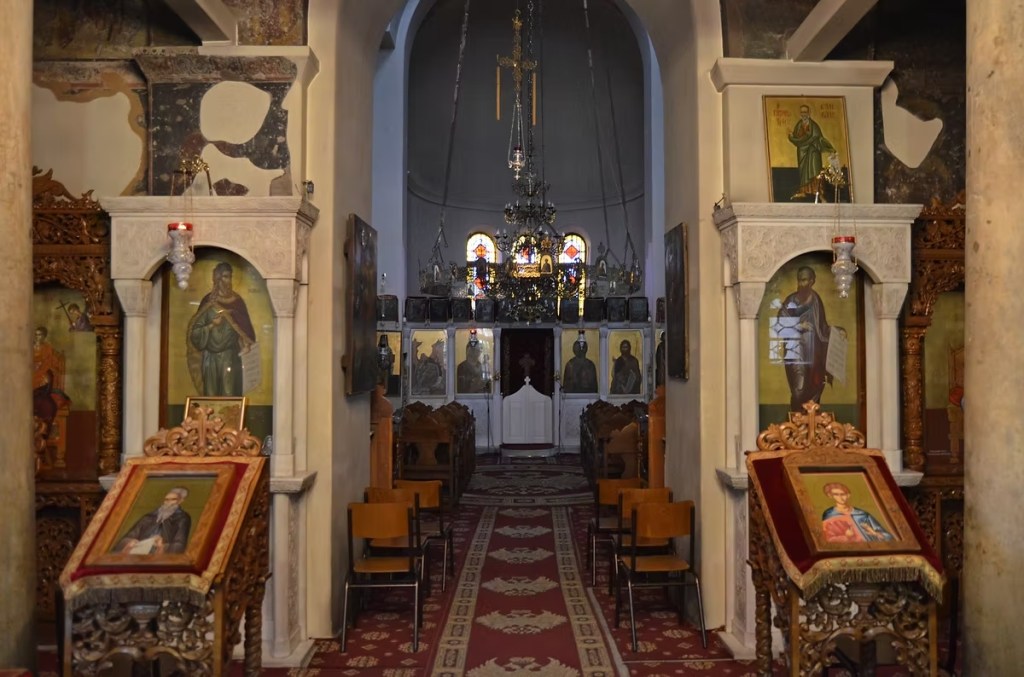
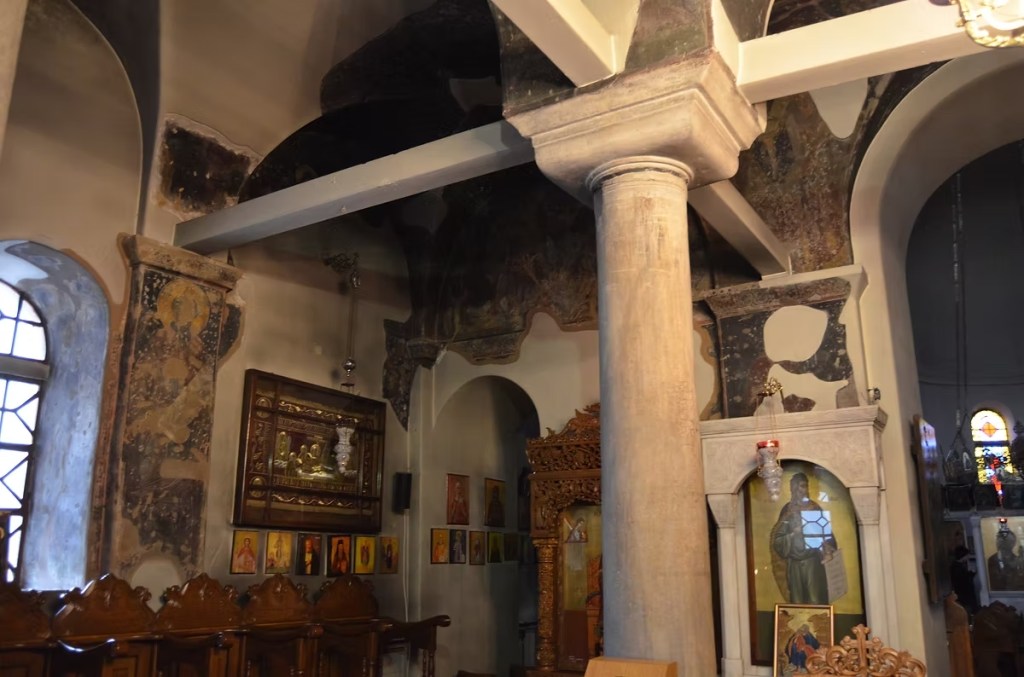
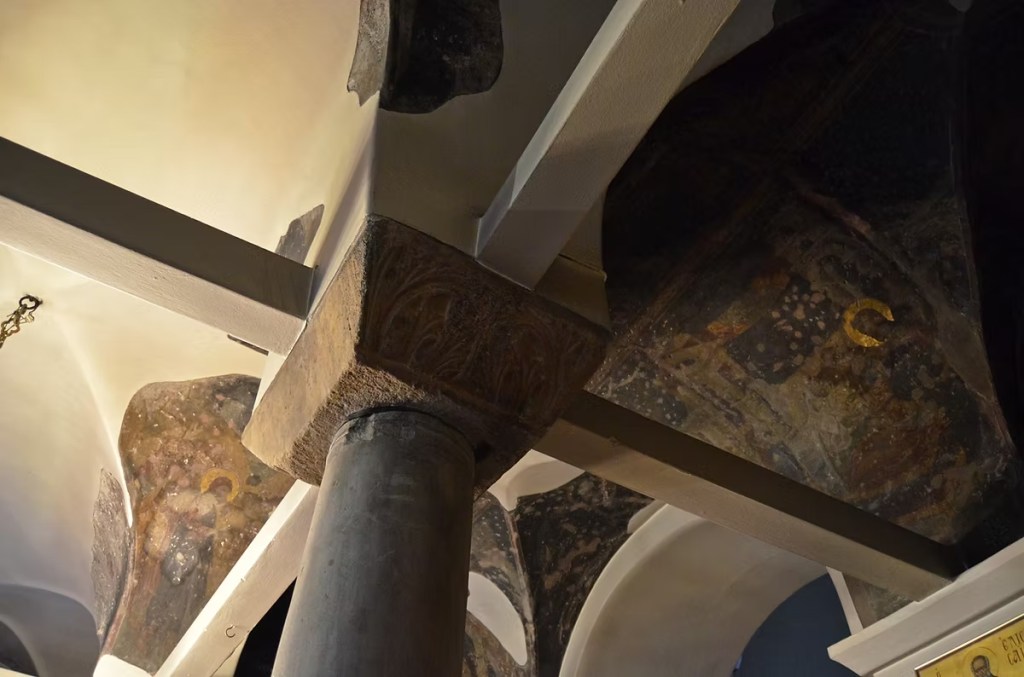
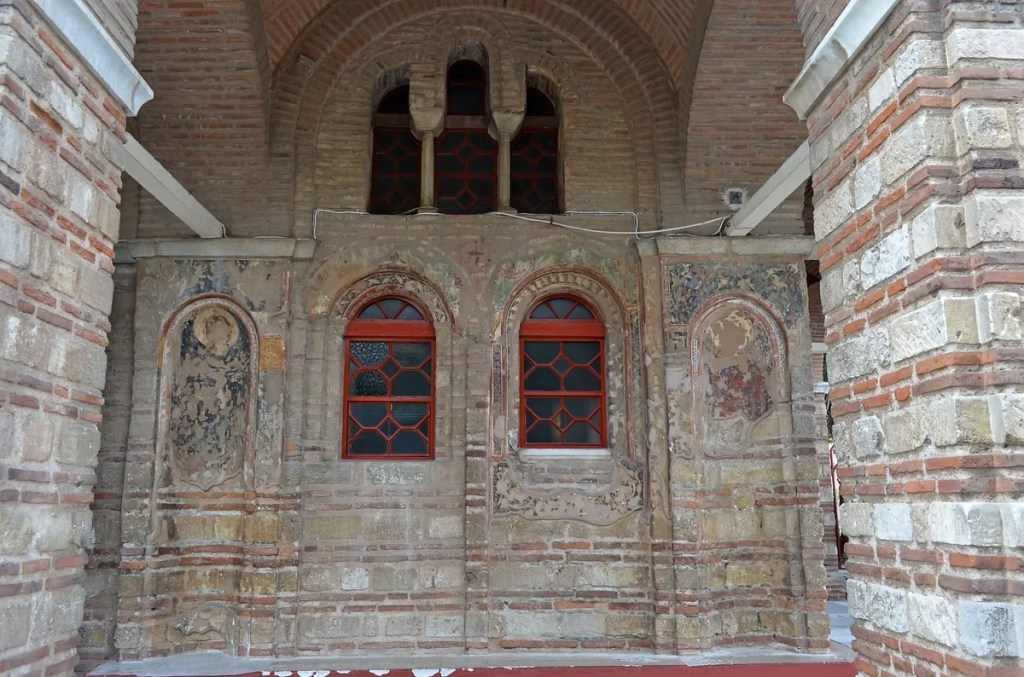
Earlier on in the day, we visited the churches of St. Nicholas Orphanos (2) and St. Elias, both early 14th-century Byzantine churches with the most beautiful ancient frescoes. At St. Nicholas’s church, there was a constant stream of visitors. Listening to the accents, we heard English, Romanian and German, and like us, they were leaving names of their loved ones to be remembered at the Holy Liturgy.
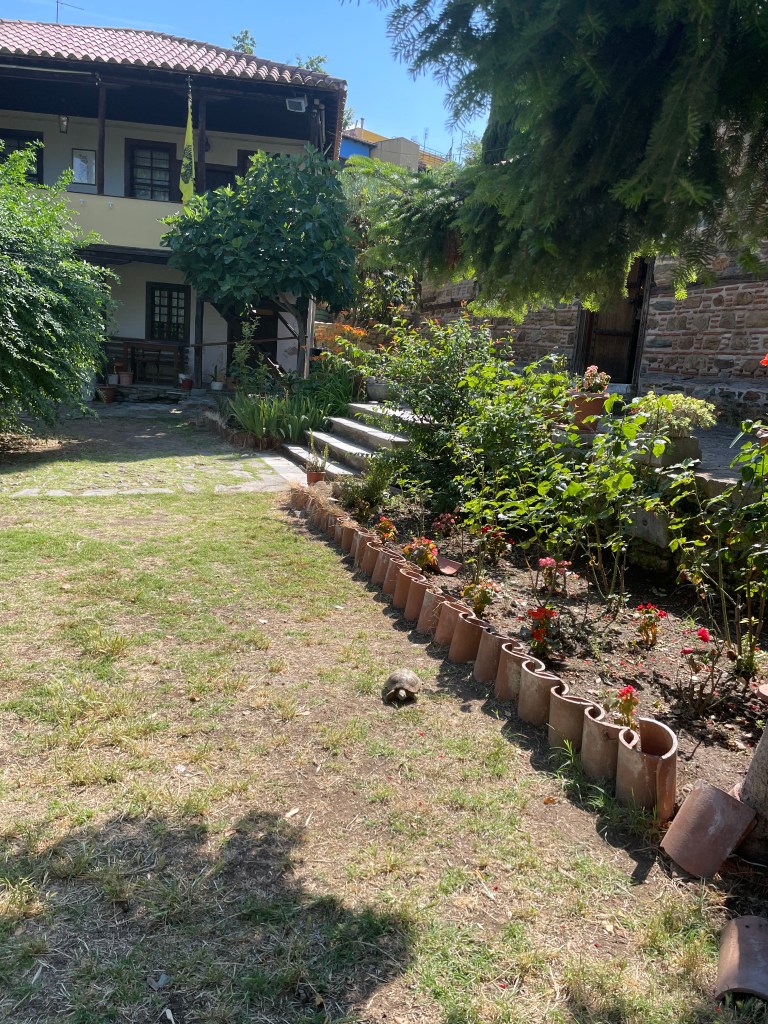
We also met F., an elderly lady who looked after the St. Nikolaos Orphanos gardens. She asked for a blessing and also that we may remember her son, N.
At St. Elias’s church (3), the parish priest gave us gifts. May he be blessed.
Our Lord is recorded as saying to the Pharisees that if his followers are silenced, even the stones will cry out, and indeed, they do.
Walking in the midday heat, in a rason*, carrying a bag, takes its toll on the body, especially when you have age on your side. But it was a price well worth the experience of visiting prayer-soaked places of worship.
A living metaphor for my morning travels was the lovely tortoise we saw in the grounds of St. Nicholas’s church. Slow and resolute in her circumambulation of the church, carrying her home wherever she went. We saw her and followed her until it was time to make our own way back home.
*
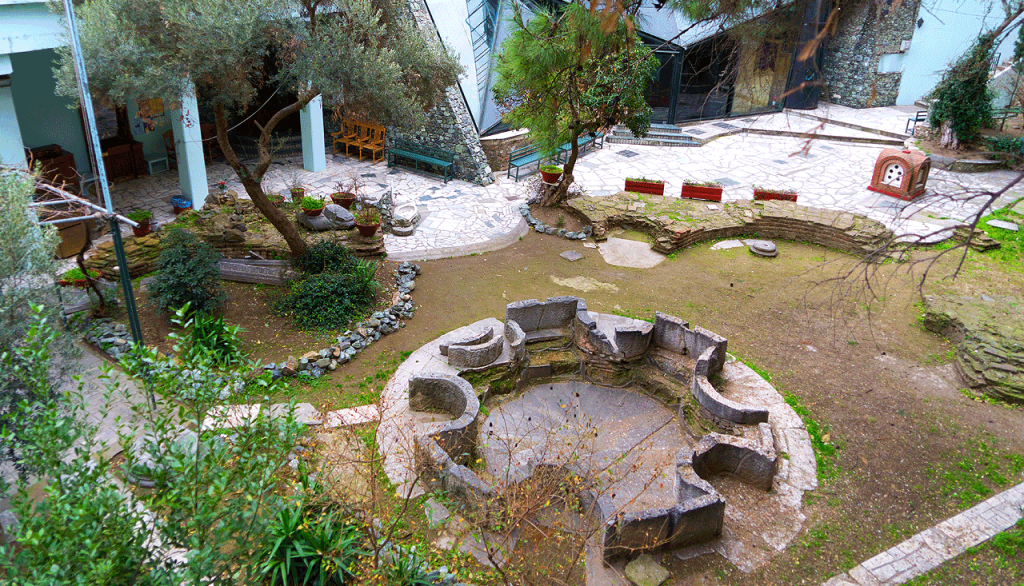
(1) Catacombs of St. John the Baptist
The Catacombs of St. John the Baptist are located south of the Church of Hagia Sophia, underneath the street. Entering the gardens of the catacombs, one can see the ruins of the nymphaeum, a spring dedicated to the nymphs, as well as the thermal baths dating from Roman times. The nymphaeum was converted into a holy water spring during the Christian times, and an underground worship place was built there, in honour of St. John the Baptist.
This Catacomb belongs to the greater secret communication system of Thessaloniki, which has not been fully explored yet! Actually, it consists of numerous catacombs and tunnels, used by the first Christians to practice their worship. One can reach them through the Temple of Saint John the Baptist, hence the name. There are also remnants of the early Christian church.
(2) Church of Agios Nikolaos Orfanos
The church of Agios Nikolaos Orphanos is located at the district of Ano Poli Thessaloniki, near the eastern walls, between the streets Apostolou Pavlou and Irodotou. It used to be the catholicon of a Monastery, from which a small part of the entrance of the propylon.
We encounter the name Agios Nikolaos Orphanos in two patriarchal documents, in 1635 and 1638, of the Monastery Vlatadon, which was its metochi already from the period of the Turkish Occupation, and to historical sources of 1745.
The origin of the name has intrigued a lot of researchers. For some the name Agios Nikolaos Orphanos is related to the name of the founder of the church which belonged to the family of Orphanos. But it is also related to Saint Nicholas, who showed great care for widows and orphans (Orfanos meaning orphan).
The present day view accepts as the founder of the church the Serbian king Milutin, who had developed intense building activity in Thessaloniki. To this view lead us wall paintings in the church with Agios Georgios Gorgos and Clement of Ochrid, saints that were specially honored in Serbia. The close relations of Milutin with Thessaloniki is due to the fact that he was married to the Byzantine princess Simonis, daughter of empress Irene Palaiologina, who lived in the city.
Nowadays, the church has the form of an oblong, wooden-roofed hall, which is surrounded on three sides with a portico. The portico on the east ends in two chapels.
At the interior of the church the marble screen dates from the period the church was founded, while the capitals date from the Early Christian period.
The church’s excellent wall paintings, frescoes, are true masterpieces and are the best preserved compared with the ones in other churches of Thessaloniki. They date from 1310-1320. Among them, apart the ones dealing with the life of Christ, of particular interest are the themes of Akathist Hymn and the lives of Agios Nikolaos and Agios Gerasimos Ioardanitis.
(3) Church of Prophet Elijah (Profitis Elias)
The church of Prophet Elijah, at some point the catholicon of a monastery, is at a close distance from the basilica of Agios Dimitrios and is one of the most important examples of church architecture from the Palaeologan period (1261-1453) in Thessaloniki.
Its dedication to Prophet Elijah is a more recent one and is because of a corruption of the Turkish name of the mosque Serayli Camii or because the church is built on a hill, where they usually build churches dedicated to the Prophet. According to the most prevalent view the church was initially dedicated to Christ, as it is evident by the numerous Christological scenes that are depicted at the narthex. It is possible that it is identified with the well-known in the sources Monastery of Akapniou.
Its architectural type, four-columned, cross-in-square church with semi-circular conches on the northern and southern side (side choirs), is unique in Thessaloniki. This type is called Athonite triconch. Easy and west of the choirs, four compartments are added. The two eastern ones are the sacristies, and the two western chapels. These are roofed by domes of smaller dimensions than the huge central one. On the west there is the so-called “liti”, that is spacious narthex, necessary for the funational needs of the catholicons of the monasteries. In the years 1956-1961 there were restoration works at the dome, the portico, the chapels and some Turkish additions were removed.
At the interior some wall paintings of the 14th century (1360-1370) still survive, where scenes from the Life of Christ dominate, as well as isolated saints.
* The rasson (also spelled rason, exorasson, or ryassa) is the voluminous, wide-sleeved outer cassock worn by priests, deacons, and monks in the Eastern Orthodox and Eastern Catholic churches.
Tuesday the 9th, the 2:15 alarm heralds a new day. Well, not quite because it was still dark outside, but my chauffeur arrived on time for the drive to Manchester Airport. Terminal 2.
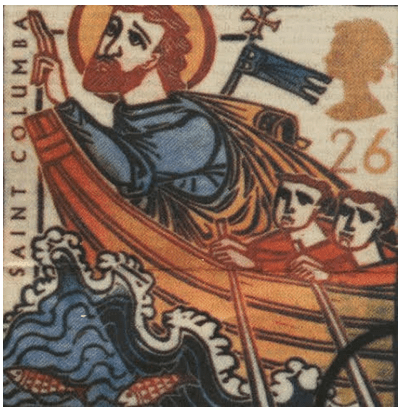
Terminal is such a sad word for the launchpad to new adventures. The 9th is St. Columba’s Day, and indeed, he launched many saints into the British Isles and the island from his “runway” on Little Iona. Such a little place, and beauty is often the doorway, the gateway to Truth. St. Columba wrote, “Alone with none but Thee, my God, I journey on my way”.
As always, I say the Jesus Prayer for all those who are on board the plane. Mums, dads, babes in arms, the elderly, the flight attendants, and of course the pilot. The heavenly flight attendants were also there, the angels attending us and helping us on our way. In our spiritual need, they also care for our safety. Each of us has a guardian angel. We shouldn’t forget it.
And as we land, the temperature is reversed. The 13 degrees of Manchester becomes the 31 degrees of Thessaloniki. There to meet me at the airport is another chauffeur. How can it be that we are in the same world and yet the temperature is so different?
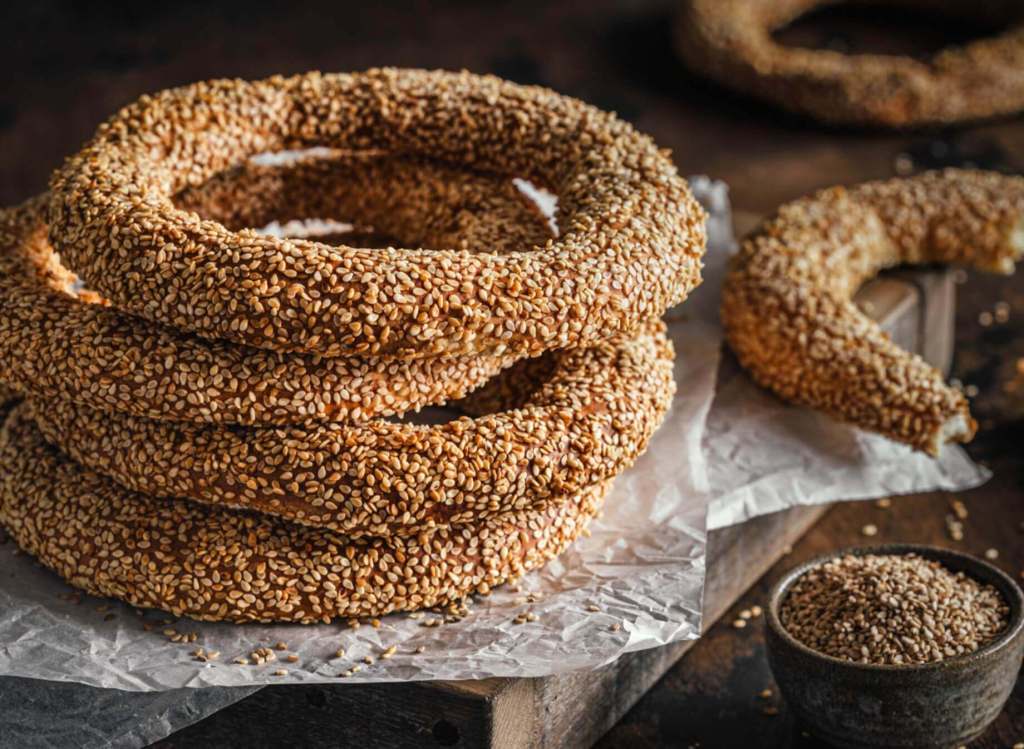
Watermelon, strawberries, and koulouri* form the basis of the light meal. It is a refreshing repast in the heat of a Greek summer. Simple food, not unlike St. Columba, who recommended bannocks, barley cakes, vegetables, fish, and water for his monks on the Holy Island.
A siesta was called for and indeed received. Possibly not what the monks did in their own typikon on Iona. Father B, who was also tired and weary from his travels, also gave in to that captive host, Ypnos**.
… Unexpectancy …
In fact, Father B was suffering from high temperatures. So the first aid team brought medication from the pharmacy. He and Presbytera will return tomorrow and not remain here. So as the Scottish poet wrote, the best-laid plans of mice and men often go awry. However, the short time of renewal, of seeing one another again, was enough to cement those little stones which we compose within the church and then to the restaurant for a meal.
Such love and friendship is the conduit for the Holy Spirit. And it is the condiment also, as Jesus says, the salt of the earth. Even in unforeseen circumstances, as St. Paul writes to Timothy in chapter 4, verse 2, be ready in and out of season, whether the time is favourable or not. Each of us, who are called to Christ, drinks of that rich fountain of his mercy. St. Ephraim the Syrian writes, “Thanksgiving be to Him, who caused a stream to flow forth in the mouths that had been closed so that they might give praise without end through the Son to the worshipful Father.”
My love and prayers to all, especially for travellers. Amen.
*A koulouri (pronounced koo-LOO-ree) is a traditional Greek street food consisting of a circular bread ring encrusted with toasted sesame seeds. Crunchy on the outside and soft on the inside, it is often referred to in English as a Greek sesame bagel.
** In Greek, hypnos,“ύπνος” (pronounced ýpnos) translates to sleep. It can be used literally to describe the resting state or figuratively, such as referring to the eternal sleep of death.
The taxi driver was surprised to learn that I had never been to Mount Athos. He used his komboloi prayer beads with great alacrity as he drove me to the airport. Whether out of faith or stress I cannot say. I gave him a tip and he kissed my hand. Again I am not sure if these two events were concomitant.
I have passed through the checks and security. Indeed one kind lady official seeing me with my rasson( cassock) ushered me into the fast priority lane. The irony is that my flight is delayed by more than one hour. Nevertheless, it was considerate of her and I am not sure if the same level of respect would be offered in Manchester.
Passing through the shops I saw some traditional Cypriot crafts including icons and “ancient ” vases. My curiosity was aroused when I saw some loaves of bread. I couldn’t resist picking one up to discover that it was made of pottery/ ceramics!
Recognising the fake from the real, the false from the true is a matter of discernment and one which we should seek, especially in spiritual matters since it is a gift of the Holy Spirit. 1 Corinthians 12: 10
Traveling light : Luke 22:35 “Then Jesus asked them, “When I sent you without purse, bag or sandals, did you lack anything?” “Nothing,” they answered.”
The packing is almost completed. One can just imagine what it would be like for Britain’s largest family with 22 children. Of course they are from Morecambe. I recall years ago when Pilgrimage to Orthodoxy met with his Beatitude Ignatios ( of thrice blessed memory) in Paris I took a small case for the weekend. On the coach to meet with his Beatitude from the hotel I asked one of our brethren where was his case, he pulled out a tooth brush from his top pocket with the words: ” here it is !” Some of you know him. He now has the longest beard in the Archdiocese! Once again I find myself in that waiting period but making the most, quietly, of the time here amongst new friends.The reception staff ,one Cypriot one Romanian, last evening talked with me about monasteries in Cyprus and Romania. It was a joyful conversation. They said “why don’t you come and live here in Cyprus father? ” I replied with a wry smile” I don’t think my Archbishop or my people would like it!” Such are the vagaries of the English language that a word can have more than one meaning which can be confusing but sometimes revealing! It is important not only that we travel light, but perhaps more importantly that we travel with the Light of Christ , bringing it to all He has given us to meet. Be a traveling light!
After every trial comes a blessing. I went to collect the icon of St Amphilochios. Ioanna had it ready and gave it as a gift. She was so pleased I had introduced her to this saint who she didn’t know that she offered to paint an icon for our Parish. Dimitri from church kindly translated my thankyou letter.I bought some more komboskini and crosses and blessed them on the relics of St Lazarus. As I was praying with my hand on the relics for some of our people I felt a surge of energy through my fingers and joy.
As it was my last full day, I went to my favourite cafe and had prawns with chips and a glass of local white wine. No Octopus! Sophia( I named her) the cat spotted me ( ah here is the clerical guy) sat at my feet pleading once more for the prawns tail ends. Yet again I gave in to her petition.I have so many gifts that I needed to distribute some of them otherwise my suitcase would be too heavy I was given a rose cordial and some basil from my visit to Nicosia.Together with an icon of the Mother of God of Patmos I gave them to the daughter of a priest Pater Makarios who fell asleep in the Lord in 2019.
As I was about to leave the church I saw the Russian lady who I met on the first day in church. We sang some hymns together in Russian and Greek…..others started quite spontaneously joining in with usI shared the last of my icon cards, St Dimitrios to a lady whose son just happened to be called…
Yesterday, I heard two familiar pieces of music on the radio. It took me back to when I studied music at school. There, as part of preparations for our examinations we followed the music scores of Bach’s Brandenburg Concert #3 and Schubert’s Fifth Symphony whilst listening to vinyl L. P. recordings of these works. It was both a duty and joy to follow and listen under the observations and instructions of a good teacher. Over and over again, our small group of pupils would listen to the recordings until we became so familiar that we knew them off by heart for the exam to follow. Some years later, I was pleased to hear these works played in concert by a live Orchestra. That initial schoolboy learning process was transposed into wonder as I witnessed each member of the Philharmonic playing their part under the conductor for the audience’s delight.
In an Orchestra, breath and hands on musical instruments bring sound to notes, as breath gives voice to words in praise of God and hands bring mercy and kindness to others. Just as music is the fuel to stir emotions, Christian love is the engine to move faith and hope into action. Our Christian life too, often starts with listening and following the scores (the Bible/the Liturgy/the Church Fathers), paying attention to the Teacher and Conductor of our life (Christ), and then working together (in fellowship)for the benefit and joy of others(evangelism).
Theme: Working together in Harmony
Luke 15:25
“Now his older son was in the field. And as he came and drew near to the house, he heard music and dancing.
When one desert father told another of his plans to “ shut himself into his cell and refuse the face of men, that he might perfect himself,” the second monk replied, “ Unless thou first amend thy life going to and fro amongst men, thou shall not avail to amend it dwelling alone.”
Many arrived and adjusted themselves to a listening mode in the auditorium.
The orchestra entered, settled themselves, tuned up and looked intently for the Conductor’s command.
Sound and silence became a dialogue.
Both the ones who played and those who listened melded into a dynamic organism;
a heartbeat giving life to a body.
The union of loving strings buzzed as bees in a hive,
To shrive the withered minds and weary limbs,
And having worked the nectar and shared the pollen from the hours of practice and rehearsal,
Produced the honey for those seated to taste.
The audience feasted on the abundant sweet notes
And were swept along and above to a higher form;
from their mundane routine to another dimension.
They were moved, transported to the land
Of awe filled tears,
Where harmony is the currency,
Where sunshine sparkles
and dances on the ears.
Beads of infinity permeate the throng in this communion song;
Inspiring first emotion, then empathy, followed by wonder and finally joy.
Such joy as can never be captured but glimpsed-only glimpsed,
In a gilded moment, felt in the heart,
digested in that part
of the mind which is forever a child’s laugh or first remembered summer.
As food is energy to the body so is music nourishment for the soul.
Such provision was encouraged by a ministering angel’s smile, sent
In order for us to repent from worldly guile.
We are drawn into that scented circle, inexorably and imperiously drawn
By that mysterious sound that claims and wraps our tender frame.
“But why so little music in the Gospels?”
“Hosannas” with palms endorse a King
And older Psalms, of course, to sing!
But where is the chorus for our dreams?
Only for the Prodigal it seems!
Was music not given by God to grace the mind of all,
make glad the heart, to heed the call?
Is there not harmony at the centre of the Universe?
Or is it that our lives in Christ should rehearse
for heaven;
reverse the ego’s trend and blend to be
a sounding board with others in that greater symphony.
Epilogue
A Harmony with Thee
Glory be,
Viva Vivaldi,
Not I but we,
Was blind now see,
Oh Mystery,
Oi Agioi kai Angeloi,
In unity
with The Holy Trinity.
A tree is known by its fruit; a man by his deeds. A good deed is never lost; he who sows courtesy reaps friendship, and he who plants kindness gathers love.