“Born in 1923 into a Church of England family, I grew up in the 1930s in a firmly
Protestant environment, in which there was sharp antipathy to anything which
seemed to have even the slightest whiff of “catholic”, not excluding personal piety.
The main services in my local parish church, and many others, were strongly
Book of Common Prayer, sung matins plus hymns and sermon at 10.30 am, and
similarly evensong at 6.30 pm. There was a said Holy Communion at eight am, but this was quite outside my experience until I was prepared for confirmation in 1938 at the age of fourteen.
When I returned from the war in the mid-1940s, changes were developing, as
gradually the Parish Communion at nine am became the main service, and sacramental religion came into my life. I had grown up with an understanding of
heaven as some strange, distant, ethereal and uncertain place somewhere beyond
the outermost reaches of space. It was a long time before I saw a new understand
ing of “… in Remembrance of Me”, that remembrance was not the mental recall
ing of a past event but a present living reality, and God was not the superior,
spiritual, moralistic (almost) “Father Christmas” figure I had imagined. Of
course it was stated to be essential to believe in the Holy Trinity, but little
insight into the supernatural was given, and it remained remote, the preserve of
the theologically educated…
My developing spirituality was driven onto the rocks with the publication of
“Honest To God”, a book written by a bishop of the Church of England in 1963,
the burden of which is “our image of God must go, God is dead and to go on
worshipping and believing as our forefathers is an obstacle to man’s progress
and development”: naked humanism. As this spread throughout the church I lived
the next thirty years struggling to remain faithful to what I had been taught, not
least that the Church of England was one of three “branches” of the One, True,
Holy, Catholic and Apostolic Church, alongside Rome and Orthodoxy, neither
of whom, of course, subscribe to the “branch” theory of the Church. I found
many obstacles in my path, but here I mention just a few, very briefly.
Distressed, I approached my parish priest, not long returned to the diocese
(Blackburn) after some years on the staff of Canterbury Cathedral. He said to me,
“Well, perhaps we should give a bit more thought to Christ’s Divinity”, and walked
away. In 1986 the Durham Affair caused a storm of controversy, when Canon David Jenkins was named as the next Bishop of Durham. He was an academic theologian with a considerable reputation, and traditional believers were outraged. For this purpose I simply quote one of his publicised beliefs, “There is nothing certain in the New Testament which is of any importance”, in an attack on its historic events, particularly the Virgin Birth. All history is unreliable.
At a local deanery discussion group the clergyman taking part asserted, and not as devil’s advocate, “Ah! But you must remember (!) that Christ could have
been mistaken about himself, about Who He was”. And so on and so on.
In 1993, six months after the vote in the General Synod in favour of ordaining
women in the priesthood, following long years of strife in the Church, I encountered Fr J., and that is how I came to join the Pilgrimage to
Orthodoxy, and two years later I was received into the Orthodox Church of
Antioch. I learned Truth such as I had only glimpsed in the Church of England,
and especially that in the Divine Liturgy we are truly worshipping with the whole
Body of Christ in the very courts of heaven. I was free of the individualism –
my prayers, my communion, my life, my understanding of truth, every man his
own theologian – rife in the Protestant religion, and I became much more at
ease, no longer in a defensive state of mind and spirit, in my God-given
individuality. Heaven is not somewhere “out there”. I am persuaded that those
who refuse to venerate the Mother of God (that truly would be a leap too far
towards Rome!) are often found not to unshakably believe in the Incarnation and
the real and actual bridge it gives between earth and heaven.”
+Barnabas D.
***
“Dear Friends in Christ, Christ is Risen! Today, on behalf of our God-blessed Orthodox Community, I drove to the little graveyard at Coppul to say the Memorial Prayers at the grave of our much beloved Barnabas. As I walked into the cemetery, the autumn sun came out from behind the clouds and lit up Barnabas’s grave.
It is difficult to think that he was taken to be with the Lord four years ago, on 10th October 2017. We miss him still; but at the same time the Living Memory of the Church, the Holy Spirit, makes him ever present in our minds, hearts and souls. Of course, as a co-founder of our Church, he will be remembered at every Holy Liturgy, but those who knew him have been granted a special honour. There are some people who touch our lives so deeply and whose lives are a testimony to faith, that they never really leave us. One such is Barnabas.
He combined those rare qualities of humility and humour. His humour was joyful and ever childlike; his humility, as well as his faith, was serious and saintly. I see him now recounting to non-Orthodox visitors who came to our Church how he became Orthodox and inviting them to taste the spiritual depths too- indeed, one of our present parishioners did just that.
As a soldier and bold ambassador of Christ, Barnabas was on the front line. Like his saintly patron, he was a good man, full of the Holy Spirit, bearing witness in that little martyrdom which is Orthodoxy in the West. He was our treasurer and held posts in the formation of our Deanery- the precursor to our Archdiocese. Ever reliable, ever ready to serve, his youthful enthusiasm poured itself out in helpfulness to others.
In the later years, when he was confined to his home, a group of us from Church used to visit him and take him the Holy Mysteries. Even when he was frail, his hospitality overtook his bodily weakness; he wanted to minister to us, not us to him: “Can I make you a cup of tea? Would you like a biscuit?”
At his departing, God granted to those from our Community who were gathered at his bedside the vision of angels – a confirmation, as if we needed it, that this man lived a holy life and was going to his heavenly reward.
May your memory be eternal, our dearly beloved brother. Christ is Risen! I hear Barnabas now replying in full volume, ” He is Risen indeed !” Amen.”
Fr. J.H.
***
“Adding to your wonderful words, I remember how energetic Barnabas was during baptisms. One thing in particular I still can hear in my ears: he used to say with a very firm and loud voice, “Seal”, when you have been anointing people with the Holy Chrism. When I now take part in baptisms, I remember this, and following Barnabas, I respond in a firm and loud voice.
…
What a blessed soul and what a blessing to have known him!
I too remember his loud affirmation “Seal!” during chrismation in baptisms.”
D.
***
“He once told me how he spent especially the last years of his life: in unceasing prayer! Praying for all he had known, alive and departed: in gratitude and thanksgiving for all who had helped him in The Way and for forgiveness for all he had disappointed.
May your memory be eternal, dear Barnabas, and may we follow your example, just as you followed Our Lord, bearing His Cross!”
***
C.
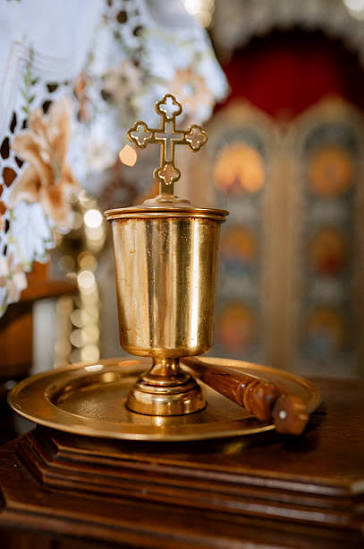
*** a chrismatory—a container for the Holy Chrism (Άγιο Μύρο) used in Chrismation


