A few days spent in the company of an elderly relative living with dementia became an unexpected invitation to contemplation.
“An aged man in but a paltry thing” indeed (W. B. Yeats, “Sailing to Byzantium”). “
“The brain — is wider than the Sky … deeper than the sea … just the weight of God…” (Cf. Emily Dickinson).
What a beautiful perception of disconnection, especially when old age is combined with dementia and psychiatric disorders. The senses still perceive something even if they do not connect…
“O, let me not be mad, not mad, sweet heaven! Keep me in temper; I would not be mad!” (King Lear’s prayer beforehis descent into madness, Act I, Scene 5)
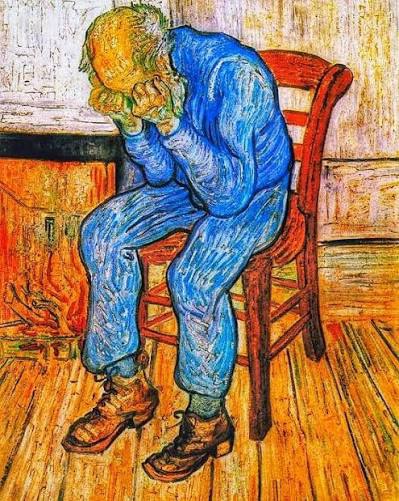
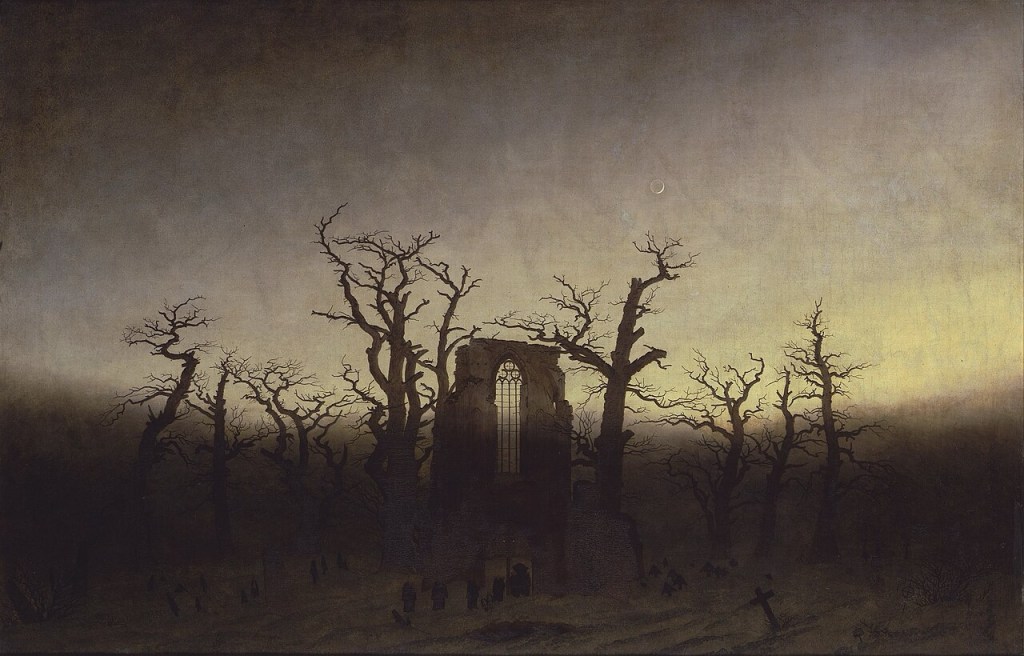
Two paintings, a piece of music, and a prayer accompanied that journey.
Vincent van Gogh – At Eternity’s Gate (1890)
*
Caspar David Friedrich – Abbey in the Oakwood
Come, O true Light.” — St Symeon the New Theologian
“… Come to us, who lie in hell,
… Come, you who have lusted and lust
my suffering soul
come, you alone
to me alone
because, as you see
I’m alone!…
Come, you who set me apart from everything
and you made me unique on earth…”
Only afterwards did I realise that those few days had become an unexpected continuation of “The Talk That Prepared Me”. It is one thing to speak about courage in the presence of suffering; it is another to discover whether one can quietly remain beneath the Cross.
Beyond the Cross, the path continues.
(*) Robert Schumann’s Geistervariationen (“Ghost Variations”) was the last work he completed. He composed it in February 1854, shortly before his suicide attempt and subsequent admission to a psychiatric asylum, where he spent the final years of his life.
The title had already been chosen for me: “Courage in Conflict: Saint Mary Magdalene the Myrrh-Bearer and Equal to the Apostles, and the Righteous Martyr Maria Skobtsova.” Their memory fell this week on this Monday 20/7 and this Wednesday 22/7 in the Antiochian calendar.
At first, I approached the task as I usually do. I gathered books, reread familiar passages, arranged notes and searched for a thread that might hold everything together. It seemed like another talk to prepare.
It was not.
The longer I lived with these two women, the less I found myself able to speak about them. Instead, I found myself becoming quietly unsettled by them.
Mary Magdalene remained beneath the Cross. (Matthew 27:55–56, Mark 15:40–41, and John 19:25)
How many times have I read those words without really stopping there?
Mary could not change anything. She could not shorten Christ’s suffering by a single moment. She simply remained.
Then, “while it was still dark” (John 20:1), she returned once more to the tomb, only to hear the risen Lord speak her name.
“Mary.” (John 20:16)
And then those mysterious words:
“Do not cling to Me.” (John 20:17)
For reasons I cannot fully explain, I found myself lingering there…
A few pages later I was walking the streets of occupied Paris with Mother Maria.
There was another darkness.
Another kind of Cross.
Another way of remaining.
A knock at the door.
Another frightened face.
Another meal.
Another act of mercy that no one would remember.
Someone once asked her whether she was afraid.
“I am afraid… but one must do what love requires.”
I had read that sentence many times.
This time I could not read past it.
Somewhere during this week I realised that I had been measuring courage far too easily.
It is one thing to admire the faithfulness of the saints.
It is another to recognise how little I know of such love in the ordinary circumstances of my own life.
Most likely I shall never stand beneath a literal Cross or walk voluntarily into a concentration camp.
Yet hidden Calvaries are closer than we imagine.
They lie behind the doors of ordinary homes, where love quietly bears what cannot easily be changed; where a husband or wife chooses patience once more; where parents continue to hope for a child who seems to have lost the way; where sons and daughters care faithfully for ageing parents; where forgiveness is offered again before yesterday’s wounds have fully healed.
As I was contemplating all this, another question slowly emerged.
What about my own hidden Calvary?
Not the heroic one I shall probably never be asked to carry.
The ordinary one.
The conversation that requires patience one more time.
The disappointment that asks not to become bitterness.
The neighbour who is difficult to love.
The quiet sacrifice that no one notices except God.
Then, this haunting question which He still asks His disciples throughout the centuries .
“Will you remain?”
Will I remain? …
If I do…I shall find Him exactly where Mary Magdalene and Mother Maria found Him. Waiting for me! For all of us.
I realised that I had spent years admiring extraordinary acts of courage while often overlooking the countless opportunities for faithfulness hidden within an ordinary day.
Now I have begun to understand that courage is not only found in great moments.
It is found in remaining.
Remaining beside a Cross.
Remaining beside another person’s suffering.
Remaining faithful when nothing seems to change.
Remaining with Christ when He appears absent.
Remaining with another human being when every instinct whispers that it would be easier to walk away.
Perhaps this is why Mary Magdalene and Mother Maria began to dwell together in my nous.
Not because their lives resembled one another.
They did not.
One stood in a garden outside Jerusalem.
The other walked the streets of occupied Paris.
Yet both discovered that love does not retreat before fear.
Both remained.
The more I reflected on them, the more another question quietly followed me.
Mary Magdalene recognised the risen Lord when He spoke her name.
Mother Maria recognised Him in every suffering face.
Most people saw strangers.
She saw Christ.
Most people saw danger.
She saw Christ.
Most people saw burdens.
She saw Christ.
I found myself wondering how often Christ has stood before me unnoticed because I was looking for someone more extraordinary.
One of my spiritual father’s sayings has come to my mind many times since giving the talk:
“Courage is the necessary ancillary of all the virtues.”
The older I become, the truer those words seem.
Without courage, forgiveness remains only an intention.
Without courage, patience soon gives way.
Without courage, generosity stays safely within the imagination.
Every virtue eventually asks us to give something of ourselves.
Perhaps that is why courage matters so much.
Not because it makes heroes of us.
But because it allows love to become real.
…
The talk has now been given.
The questions afterwards have ended.
Life has returned to its familiar rhythm.
What has remained are two women.
I cannot help wondering whether their quiet proximity in the Antiochian calendar has something to teach me.
Not because their lives were similar.
But because each, in her own way, refused to let love retreat before fear.
Long after we have finished speaking about the saints, they continue, patiently and almost imperceptibly, to speak about us.
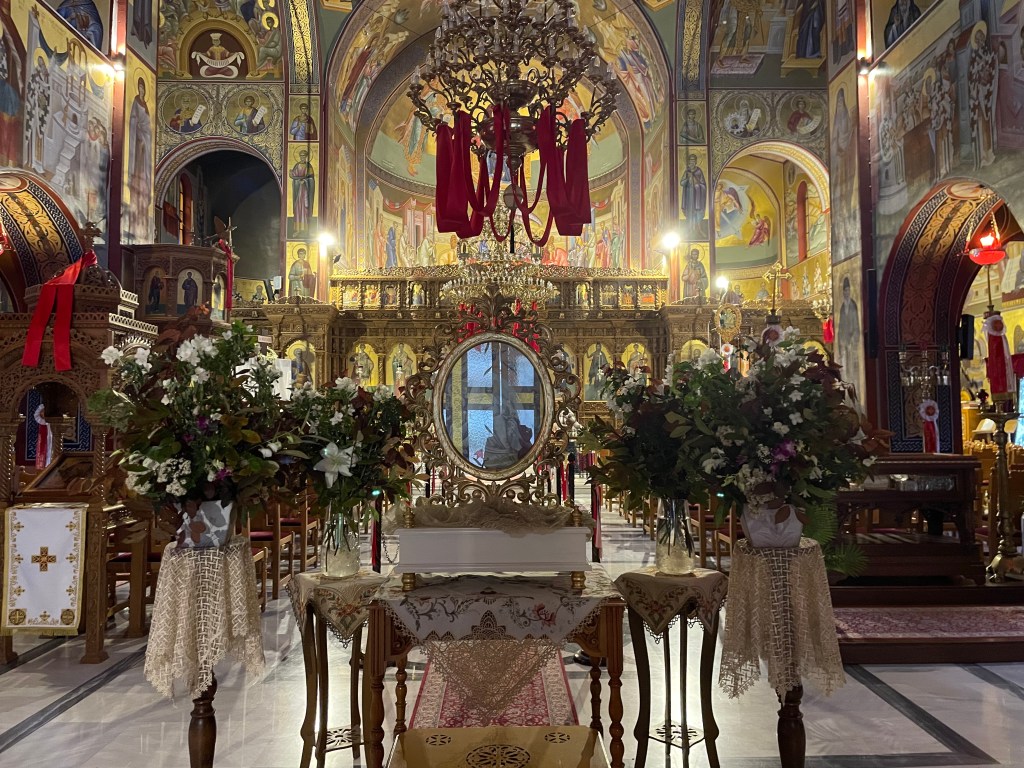
Thursday the 11th of June, the Feast of St. Luke Symferoupol and the revelation of Axion Estin by the angel Gabriel.
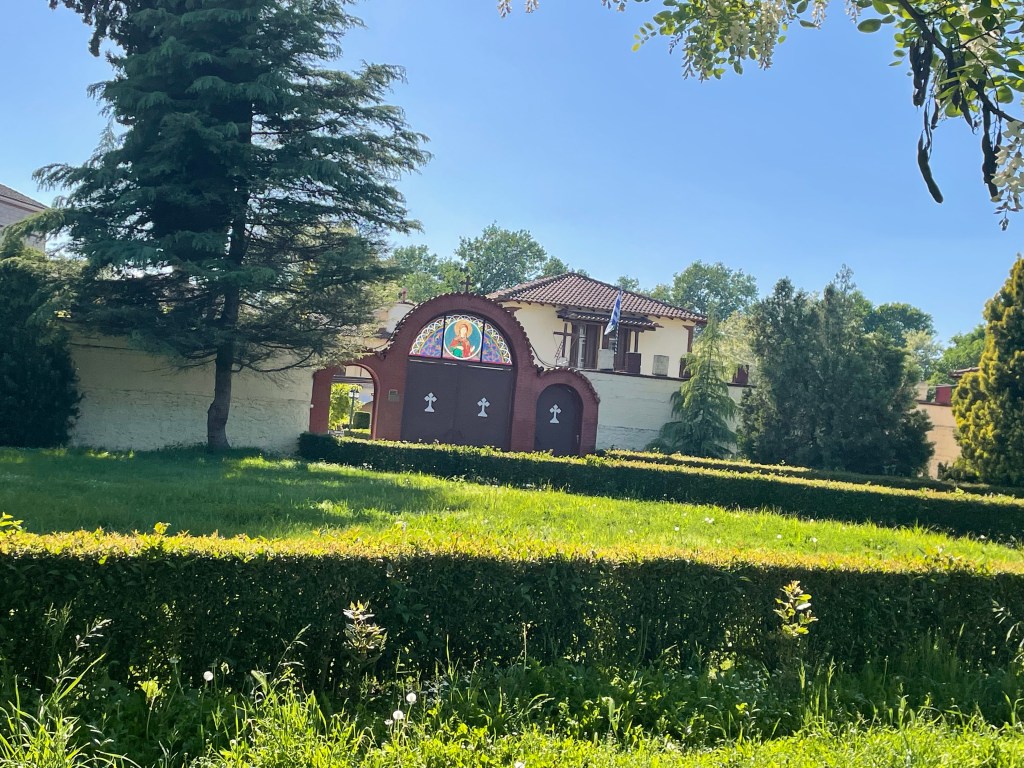
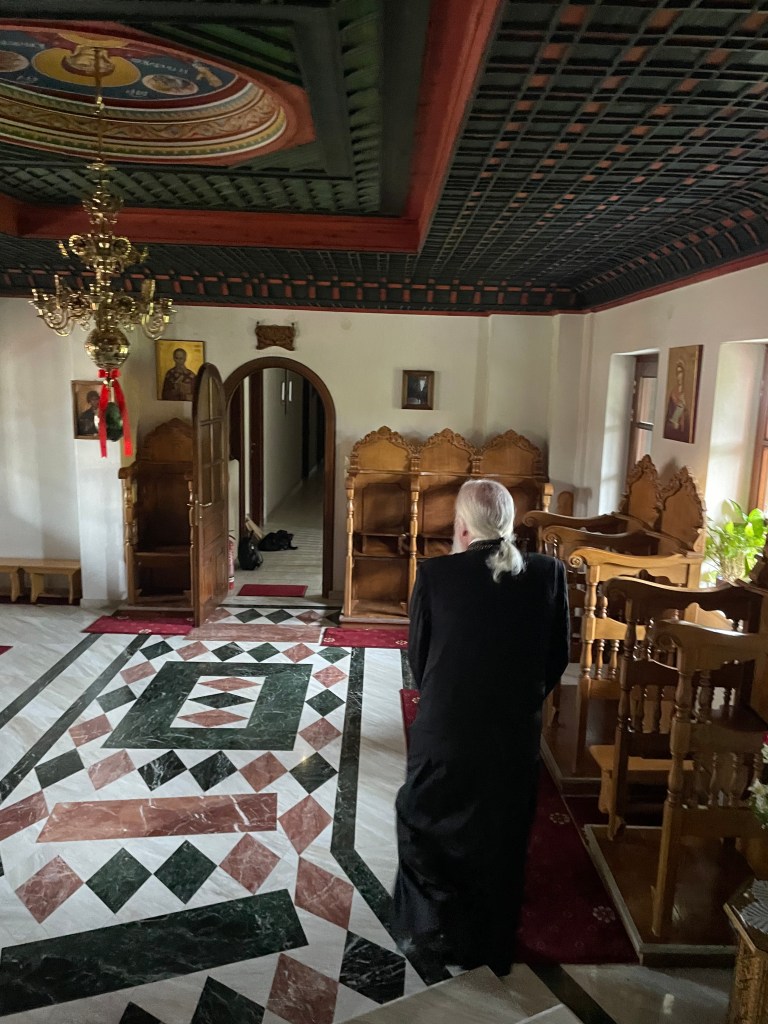
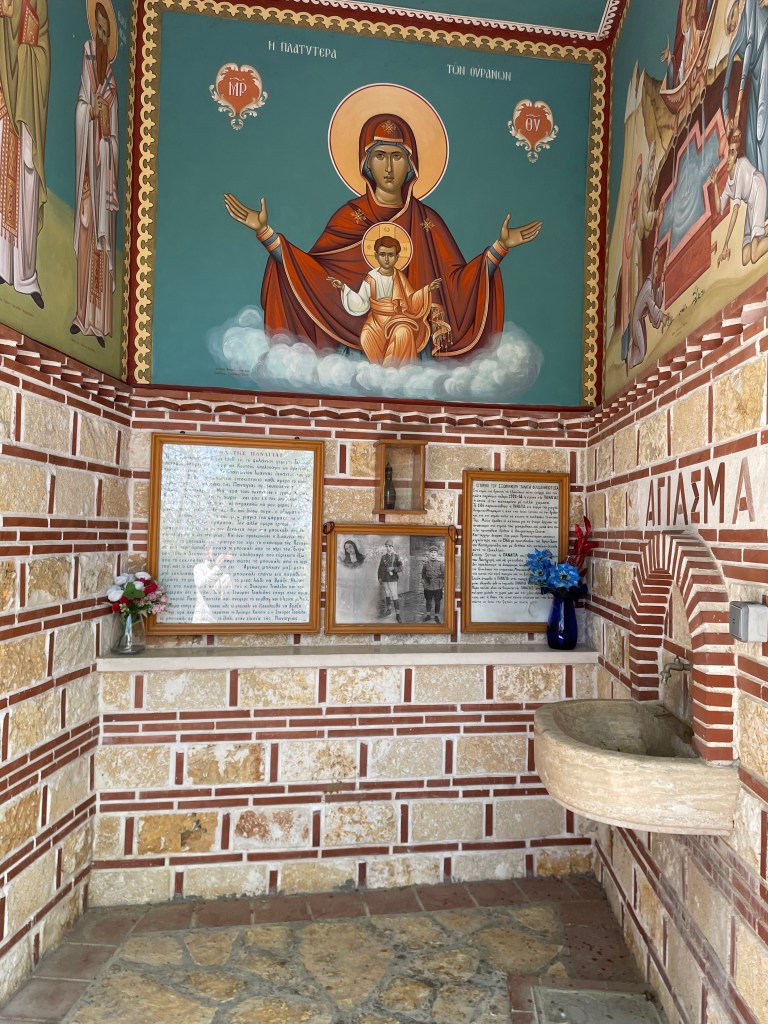
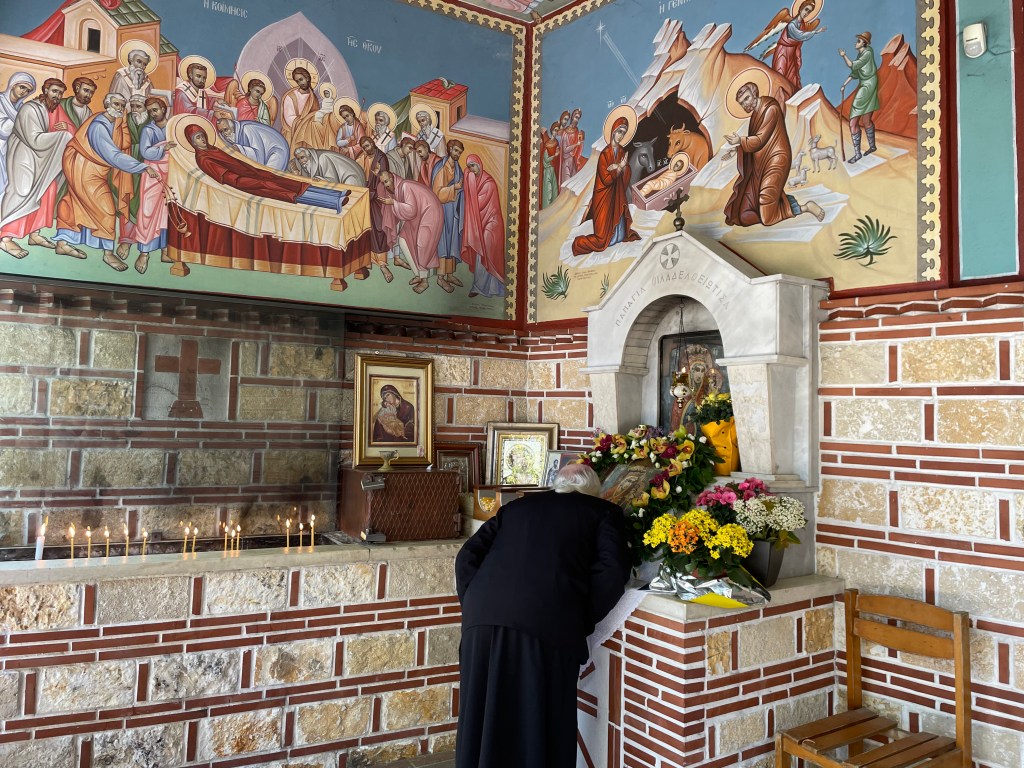
The journey to St. Kyriaki monastery was quite eventful. St. Kyriaki monastery is where a number of our Antiochian nuns found themselves.
At one point in the journey, engrossed as we were, in deep conversation and with the Paraklesis of St. Luke Symferoupol providing the background ison to our talk, we took a wrong road. My fault, I’m afraid, as I was the co-pilot, supposed to be directing the way.
The sign Local Road did not really do justice to the rather barely marked track that we found ourselves on in this huge field. However, Sat Nav came to the rescue and revealed to us the way that we should go. We needed a U-turn.
U-turns can be life-saving in a religious and a spiritual point of view, from sin and death and the roads which lead to destruction, to the way that leads to Paradise.
A reliable source told me how beautiful this place was, and indeed there was no hyperbole from that source.
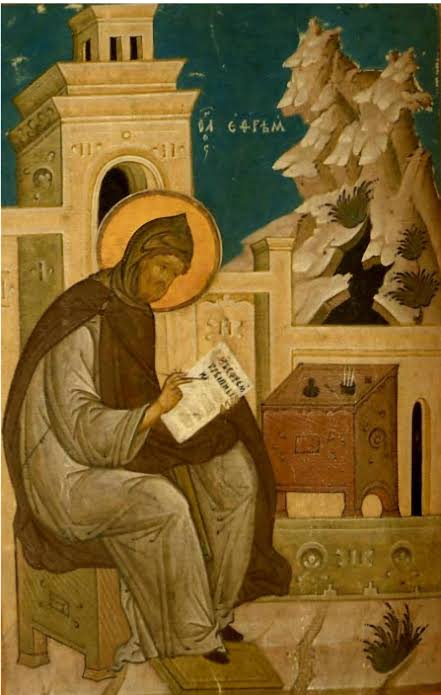
This beautiful monastery, which is really a hidden gem amidst the beautiful countryside, reminded me of the Hymns of Resurrection from St. Ephraim, also a Syrian.
In his Hymn to the Resurrection, chapter 15, verse 10, he writes this:
“Let us summon and invite the saints,
the martyrs, apostles and prophets,
whose own blossoms and flowers
shine out like themselves –
such a wealth of roses they have,
so fragrant are their lilies:
from the Garden of Delights do they pluck them,
and they bring back fair bunches
to crown our beautiful feast.
O praise to You from the saints who are blessed.”
Sister T told us how the nuns came to be there, and it reminded me of another verse from St. Ephraim the Syrian, verse 12, in the same poem:
“Receive our offering, O our King,
and in return grant us salvation;
give peace to the land that has been devastated,
rebuild the churches that were burned,
so that when deep peace has returned,
we may plait you a great wreath,
with flowers and people to plait it,
coming in from all sides
so that the Lord of Peace may be crowned.
Blessed is He who has acted and is able to act.”
*
For those of you who missed it, the story of the Sisters of War and St. Kyriaki monastery in Veria can be read here
“Dedication to Christ is the joy of life,” Mother Maria will answer me, instantly solving the questions about the smiling faces of the women in their cassocks. The thriving convent she now runs once languished with only two very old nuns.
The Sisters found refuge from the war in Syria. An old bond brought them here
I had heard a lot, but I couldn’t separate the legend from the truth. I had to wander the plain of Veria. To forget myself for a while in the blooming peach trees – the ones that filled Instagram at the end of March – to pass, full of curiosity, the heavy iron door of the Monastery of Agia Kyriaki. And to face the truth in the bright faces of women of all ages.
In the monastery’s mansion, Arabic coffee awaited me with treats from Aleppo. Yes, from Syria. The nuns pronounce Greek with small – I would say charming – grammatical errors that testify that their mother tongue is different.
Gerasimi is a graduate of Fine Arts. She elaborately decorates the candles for the Resurrection – their sale is a significant source of income for the small monastery.
“God’s Will”
The war in Syria brought here, to Loutro Imathias, an entire sisterhood of nuns from Aleppo. Aleppo, which was also called Veria during the Byzantine Empire. Luck, fate or divine providence?
For my interlocutors, everything is “God’s will”. And one name is constantly on their lips: Paul! The missing Metropolitan of Aleppo.
On Holy Monday 2013, Paul of Aleppo, returning to Syria from Alexandretta in Turkey, decided to go to a village to try to free locals for whom the rebels were demanding ransom. He was accompanied by the Jacobite bishop Yuhanna.
On the way, the two hierarchs were ambushed. Their driver was murdered and they were kidnapped. Everyone then thought that the kidnapping was the work of ISIS jihadists. The State Department rewarded the kidnappers with 5 million dollars. After all, Paul was the fleshly brother of the Patriarch of Antioch and All the East John.Thirteen years since then, the fate of the two archpriests continues to be unknown. But back to the Monastery of Agia Kyriaki, Pavlos is so “present” in all the stories!
“Missing Father” – “He encouraged me to go to the School of Fine Arts.” “He wanted us to study first and then become a nun.” “He showed me the way to iconography.” “He insisted that we learn Greek, the language of the Fathers.” This is what the sisters say of Metropolitan Pavlos of Aleppo, whose fate has been unknown since 2013, when he was kidnapped.
Emiliani and Iliani were taught the art of needlework in Ormylia, the women’s monastery of Simonopetra. Monks from Simonopetra on Mount Athos are still their spiritual leaders today.
Ten were the first nuns – from the Monastery of the Annunciation of the Theotokos in Aleppo – who found refuge here. “Like Noah who landed his sea-swept ark on Ararat,” I will hear one evening.
All from families of old Romans, that is, citizens of the Byzantine Empire who gradually became Arabic-speaking.
Most from the Valley of the Christians, a natural valley, as large as Kos, near the border with Lebanon.
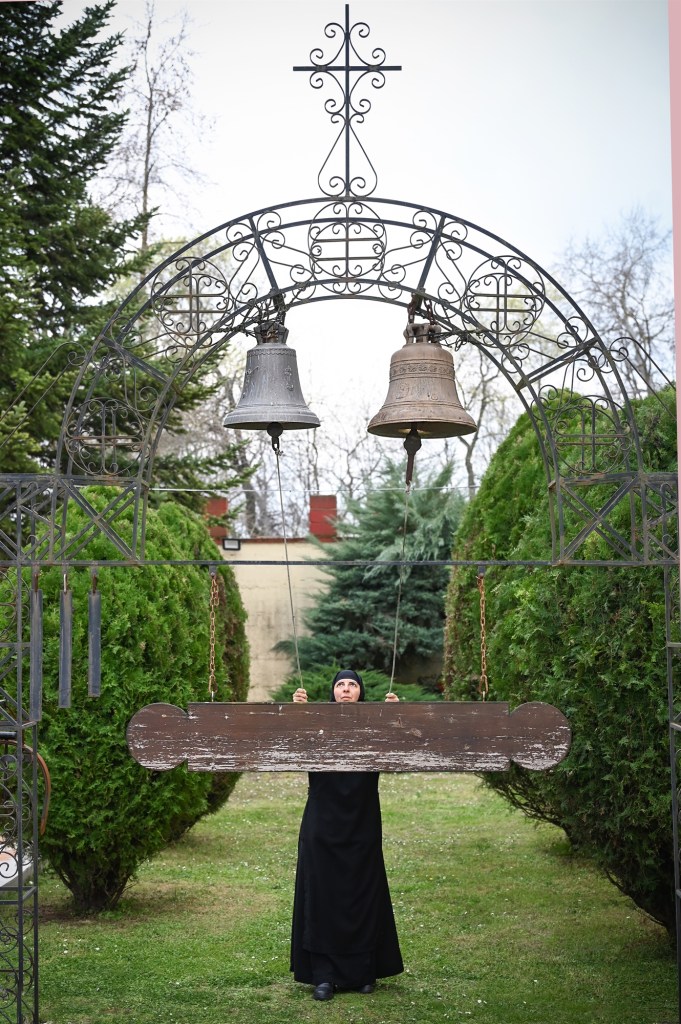
Philothei rings the monastery bells. For centuries, events in monasteries have been announced by rhythmic metal or wooden sounds that lead the brotherhoods to the Katholicon, a chapel, or the refectory.
Every time they went to distribute medicine and food, the locals would exclaim: “For the sake of Deir el Bisara” – “the nuns of the Annunciation are coming!”
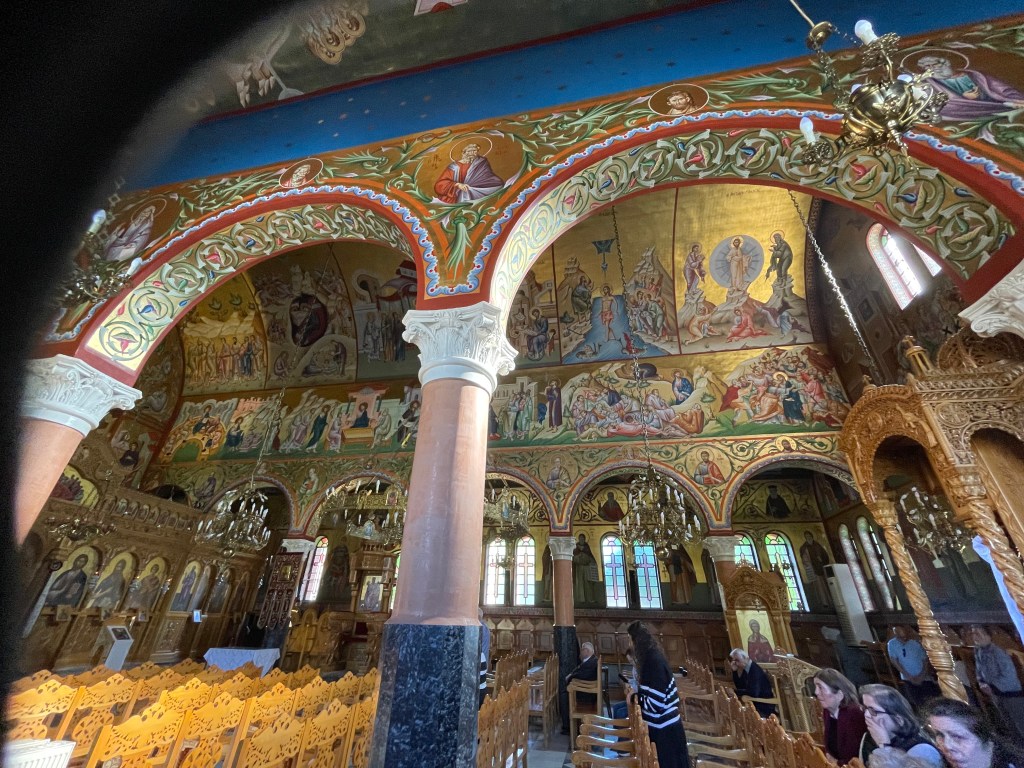
A liturgy in two languages – The Arabic psalms, in the monastery church, are “married” with invocations in Greek: “Lord of Hosts, have mercy on us”. With pilgrims from Alexandria and Veria recognising the same prayer in different words and rejoicing.
But how did the nuns of war find their way to the humble and then unknown Agia Kyriaki?
The current Metropolitan of Veria Panteleimon, in the early 1990s, served as a hieromonk in Thessaloniki. And he had the Syrian Pavlos as his deacon. A graduate of the famous Theological Seminary of Balamand and the Polytechnic University of Latakia – who was then completing his doctorate in theology, while also studying Byzantine music. Paul then became a monk on Mount Athos, where he studied iconography under the most famous iconographers of Athos.
Sister Nikodimi studied Dentistry in Syria. In Greece, she obtained a master’s degree in psychological support for children with cancer and chronic diseases.
Over the years, the hieromonk became the metropolitan of Veria and the deacon the metropolitan of Aleppo. And during the war, he asked his counterpart in Veria for shelter for his spiritual daughters.
One of the photographs of the Metropolitan of Aleppo before his kidnapping in Syria
The Sisterhood
Thirteen years since then, the sisterhood has thrived and now numbers twenty nuns and four novices.
Hieronymi shows the fruits from the sisterhood orchard to Stavros Theodorakis. The monastery’s “development” plan is to create new cells for the nuns and an orchard with fruit trees and gardens with medicinal herbs. Apple, apricot, and cherry trees have already been planted, and once the cold weather passes, sage, verbena, rosemary, and oregano will follow, on terraces.
And at my Lenten table they serve makhlouta* with red lentils, cumin, and vegetables from the sisterhood’s vegetable garden.
Next to me, the reader, standing, commemorates Pavlos in the present tense.
As if he is absent for a while and they are waiting for him to return.
* Makhlouta means “mix” in Arabic, and that’s exactly what this soup is: a mix of beans and grains, simmered slowly.
We visited a monastery, where a young British man who wanted to become a catechumen “accidentally” met a British Orthodox priest who was visiting the same morning and “happened” to be a parish priest very near this young man’s hometown. Last but not least, they had booked the same return flight to the UK that Saturday! So, this young man had his first 3 catechesis lessons that morning!
The nuns of war.
From Aleppo to …
Years ago, it was a deserted monastery with only two nuns. But in 2013, the war in Syria brought here a sisterhood from Aleppo. These nuns have experienced the war, and each has a moving story to share. This monastery is now vibrantly alive, full of radiant Joy and warm Love.
All of the sisters have studied at Syrian universities – from Fine Arts to Economics – all come from old Christian families, and most of them have postgraduate degrees in Theology, which they have studied in Greek Universities. Pavlos, the Metropolitan of Aleppo, their spiritual Father, asked them to come here.
This is a monastery where Arabic hymns and psalms mingle along with Greek prayers. But what is most amazing and I have never encountered before in any other monastery I have visited, is their joy and love. This radiant Joy and love are a fruit of their obedience to their spiritual father in everything, and especially to his word. This is what a sister told us: “The most important thing is that Joy in a person, being joyful, is a decision. When we are not joyful in this life, it is a sin against God and His love.
When I was in Thessaloniki, I can’t remember because it’s just one, visiting from one monastery to another, and the spiritual fragrance of those places is filled with the living Christ. I met a Gerontas. I won’t tell you his name because I know some know him, but some believe he is a saint already. And when you are next to a saint, you know it. Remember, Orthodoxy is very physical. I wanted to be near him, because you could feel holiness. He told us a story about a woman from Canada. She was Chinese. And she had a dream of this face, of this Geronda. She had this dream every night for four years in Canada. Four years. Every night, this Geronda would come in her dream and say, “Come see me. I don’t have so much time.” She didn’t know who he was. She didn’t know where he lived. So she went and had a car, and she went on a tour of monasteries in northern Greece. Until she arrived at this particular monastery, where Gerontas lived, “Ah, here you are”. (And then, this Gerontas made particular arrangements for her to be properly catechised and baptised back in Canada with a priest next door to her own house!) You see, there are some hidden Christians.
This Gerontas goes and secretly baptises people in Turkey. There are secret Christians. There are people who want to become Christians. Many Muslims, rather than going to Greece, go to Romania, perhaps.
Other little miracles happened during my stay in Thessaloniki. I asked Gerontas for a word. It’s a tradition in Greece to say, “Give me a word.” Do you have this tradition? He didn’t say anything. He took a sweet out of his pocket and gave it to me. And I knew what he meant. He said, Give, feed people with the sweetness of Christ. You see, he doesn’t speak English. And I don’t speak very much Greek, so he just gave me a sweet. Simplicity is the beauty of Orthodoxy.
This same Gerontas shared with us another monastery miracle. Many years ago, on Mount Athos, a small boat with monks and doctors met another small boat with some Italian students. One of them was so impressed with the holiness of the Fathers that he swapped boats and followed them to their monastery pilgrimage. Years passed by, communication continued between this Gerontas and this Italian student, miracles happened to his family with Gerontas’ prayers, including saving his father’s life from cancer, and now this Gerontas visited him in Italy and made arrangements for his catechism and baptism, again next door, by an Orthodox Italian hieromonk, a former Uniate priest and now a member of Gerontas’ synodeia.
We are all born with a set of keys in our hands… And it is up to us to decide what to do with these keys. It is up to us to decide who will do the driving.
I have watched people grab the wheel of their life. Struggle to keep the car on the track. Get stressed with the route, with the destination, with the angles, the curves, and the hills. Get stressed with the fuel, get confused with the maps. I have watched them get angry with their fellow passengers, fall ill from trying so hard and get lost amidst so much care and such stress.
But I have also met others. Humble people. People who sit in the back seat. People who, day by day, try to do their best but do not worry. Day by day, they do their best, and then, they let go… They sit in the back seat and let God be God. Let God do the drive…
I will tell you the truth. I envy these humble people and want to become one of them…
Homily on MATTHEW 14:22-34 — 9th Sunday of St Matthew
A Homily and a favourite Poem
“At that time, Jesus made the disciples get into the boat and go before him to the other side, while he dismissed the crowds. And after he had dismissed the crowds, he went up into the hills by himself to pray. When evening came, he was there alone, but the boat by this time was many furlongs distant from the land, beaten by the waves; for the wind was against them. And in the fourth watch of the night he came to them, walking on the sea. But when the disciples saw him walking on the sea, they were terrified, saying, “It is a ghost!” And they cried out for fear. But immediately he spoke to them, saying “Take heart, it is I; have no fear.” And Peter answered him, “Lord, if it is you, bid me come to you on the water.” He said, “Come.” So Peter got out of the boat and walked on the water and came to Jesus; but when he saw the wind, he was afraid, and beginning to sink he cried out, “Lord, save me.” Jesus immediately reached out his hand and caught him, saying to him, “O man of little faith, why did you doubt?” And when they entered the boat, the wind ceased. And those in the boat worshipped him, saying, “Truly you are the Son of God.” And when they had crossed over, they came to land at Gennesaret.”
The Gospel writer presents us with a vivid scene on the Lake of Gennesaret. Peter sinking beneath the waves is a picture that resonates with our own condition when we are overcome with anxiety, guilt, sin, overwork, doubt and grief. We become immersed in the conditions that surround us, unable to focus on anything else. The waves seem to be too high and we begin to sink under the waves of pressure.
Peter may have had in mind the Psalm when in his panic and despair he cries out to Christ:
Psalm 69:1-2
Save me, O God! For the waters have come up to my neck. 2 I sink in deep mire, Where there is no standing; I have come into deep waters, Where the floods overflow me.
We see that our Lord, after he had dismissed the crowds goes up into the hills to commune with His Father. After prayer he goes to the Lake of Galilee but His disciples had already gone fishing and it was dark, the fourth watch of the night,3.00 am.-6.00a.m. It is in the middle of the night when fear may overcome us. There was a strong wind that caused a storm on the waters. He walks on the water towards the disciples boat. His disciples thinks it is a ghost and they are terrified. We notice here how the storm outside, had entered into them and they cry out with fear. It is then when they were at their most vulnerable that Christ speaks His words of reassurance:
“Take heart, it is I, have no fear.”
When we find ourselves battered without and within by the storms of life then Christ will come to us bidding us to take courage and trust in Him.
Peter immediately responds:
“Lord, if it is you, bid me come to you on the water.” The “if” signals a doubt in the mind of the apostle.
One word from our Lord,“Come!” So Peter jumps out of the boat, but he takes his eyes of faith from the Lord Jesus Christ and is more concerned about the surrounding turmoil and prevailing storm and begins to sink beneath the waves. This is precisely what often happens to us. We lose focus, we are distracted, we take our eyes from Him Who is the Lord over all Creation and we are embroiled, consumed, overwhelmed by the condition(s) in which we find ourselves.
Peter cries out: “Lord, save me!” and the Saviour does just that, despite his lack of faith, extending his arm for Peter to grasp. How speedily this vision takes us to the Icon of the Resurrection in which our extends His arms and brings Adam and Eve out from Hades. This is what Christ does for us, but we also can extend that saving “hand” of friendship, that word of comfort to others whose faith is weak, who feel lost; those that are sinking under the waves of anxiety. We see how Christ immediately comes to the rescue.
The miracle here is not that Our Lord Jesus walked upon water, but that His word and action is immediate towards His disciples! The One who made the Heavens and the Earth, the Sea and all that is therein, is Lord over all nature. He who multiplies five loaves and two fish to feed 5000 can walk upon the waters, can turn water into wine, can calm the storm, can cause a multitude of fish to be caught. The real miracle is that Christ knows our needs and responds to them immediately. He is with us always even unto the end of the age and His hand supports us and saves us now and unto eternal life.
Lord save us!
And when they entered the boat, the wind ceased. And those in the boat worshipped him, saying, “Truly you are the Son of God.”
Christ is indeed our Saviour and the Son of God
The poem “Footsteps in the Sand “so eloquently illustrates the nature of our loving and saving Lord Jesus Christ:
One night I dreamed a dream. As I was walking along the beach with my Lord. Across the dark sky flashed scenes from my life. For each scene, I noticed two sets of footprints in the sand, One belonging to me and one to my Lord.
After the last scene of my life flashed before me, I looked back at the footprints in the sand. I noticed that at many times along the path of my life, especially at the very lowest and saddest times, there was only one set of footprints.
This really troubled me, so I asked the Lord about it. “Lord, you said once I decided to follow you, You’d walk with me all the way. But I noticed that during the saddest and most troublesome times of my life, there was only one set of footprints. I don’t understand why, when I needed You the most, You would leave me.”
He whispered, “My precious child, I love you and will never leave you Never, ever, during your trials and testings. When you saw only one set of footprints, It was then that I carried you.”
At that time, as Jesus walked by the Sea of Galilee, he saw two brothers, Simon who is called Peter and Andrew his brother, casting a net into the sea; for they were fishermen. And he said to them, “Follow me, and I will make you fishers of men.”Immediately they left their nets and followed him. And going on from there he saw two other brothers, James the son of Zebedee and John his brother, in the boat with Zebedee their father, mending their nets, and he called them. Immediately they left their boat and their father, and followed him. And he went about all Galilee, teaching in their synagogues and preaching the gospel of the kingdom and healing every disease and every infirmity among the people.
*
In the days before Satnav and Google, on the way to a Church wedding, I was driving my car. The friend in the car in front said: “Follow me, I know the way!”
Well it transpired that he did not know the way and did not know even the correct church where the wedding was taking place. Trying to keep up with him was so difficult, he was overtaking, driving fast, the traffic lights changed and he didn’t wait, and if that was not enough, there were road diversions complicating the journey further. In the end, knowing the priest who was taking the wedding I called him and he gave clear and concise directions to the correct Church. Knowing the way is important, following the right person is critical!
In the Gospel for the second Sunday of St Matthew we read how Christ calls the first disciples. We see how these simple fishermen responded immediately to the call. Such a call was irresistable, courageous on their part and ultimately life changing for them. Christ does not choose the learned scholars and philosophers of His day who are wise in their own eyes but countrymen who knew what hard work involved. They possessed an appetite for common sense, a shrewd judgment, a forthright spirit and sound application to the task. These fishermen, “am ha-aretz”( people of the land) become all wise not because of their intellect but because of their will to follow and accompany Christ in His mission.
Follow me! I recall at University having to learn the Greek verbs for the New Testament. The Greek verb akoloutheo ( to follow) occurs over 80 times in the New Testament. It is one thing to believe in Our Lord Jesus Christ, it is another to follow Him. Someone on interview, was asked what leadership skills they had? The person answered “Well I’m not sure about leading people, but I am a quick learner and a good observer.” Christ invited and called many others to follow Him, some obeyed the call, others like the rich young man could not. He has called us. It is relatively safe to believe in Christ but following Him intrudes on our time, our lifestyle and our will.
The problem today is that not many people know where they are going, so they follow their own inclinations, whims, passions and amusements. Our Lord knew where He was going, to the bosom of the Father and He wanted to take others with Him. He came to lead us to heaven. The world has many would be leaders but their way is confused and compromised by their ideology by materialistic values and by a wong destination. “The road to hell” is is said, “is paved with good intentions”. Hell is full of good meanings, but heaven is full of good works.”Only Christ knows the Way to the Father because He is the Way the Truth and the Life.
Before Peter and Andrew, James and John could become leaders and apostles they first had to be followers and disciples. Christ says to them “I no longer call you servants but friends.” God has called us to follow Him but like the lost sheep we offer wander off and go our own way. Without the will to follow we can become self satisfied, calling ourselves Christians in name only, doing our own thing. We become nouns rather than verbs.
“Not he who says Lord, Lord (noun) will enter the Kingdom of Heaven, but he who does ( verb) the will of my Father in heaven.”
We may not consider ourselves worthy of this calling and we may fall into despair when we fall into sin, both of which are tricks of the evil one. Was Saul the persecutor of the Christians worthy when he was called? Was Simon Peter worthy when he denied knowing Christ? It is through God’s mercy, forgiveness and grace and our repentance, that we are made worthy. God’s love is so all-searching that He chooses the weak, the misfits, the eccentrics, the poor, the outcast to do His will. At an ordination of a priest, the Bishop will cry out “axios” (worthy) and the people are invited to reply “axios”! The priest is not worthy in and of himself, no one is worthy before a Holy God but Christ releases the potential in us and equips us for the ministry He has chosen for us:
Ephesians 4:11-13
11And He Himself gave some to be apostles, some prophets, some evangelists, and some pastors and teachers, 12 for the equipping of the saints for the work of ministry, for the edifying of the body of Christ, 13 till we all come to the unity of the faith and of the knowledge of the Son of God, to a perfect man, to the measure of the stature of the fullness of Christ;
We do not follow Christ by our own power but with the power of the Holy Spirit. The young man I was following in my car to the wedding did not know the way but thanks be to the Father, Christ the Bridegroom is in the driving seat to bring us to the great Wedding Feast.
We are called to be members of the Body of Christ. Whether we are “casting our nets in other directions” or “mending our broken ones”, Christ wants us to follow Him. He will not abandon us because He is the good shepherd Who looks after the lost.
The Invitation
Luke 14:15-18; The Parable of the Great Supper: Now when one of those who sat at the table with Him heard these things, he said to Him, “Blessed is he who shall eat bread in the kingdom of God!” Then He said to him, “A certain man gave a great supper and invited many, and sent his servant at supper time to say to those who were invited, ‘Come, for all things are now ready.’ But they all with one accord began to make excuses.
I rang your door bell but there was no answer.
I rang the Church bell but you decided to stay in bed.
I e-mailed you but there was no response.
I texted you but you were busy.
I put it on Facebook(!) but it just provoked an argument.
I put posters up but you did not like the design.
I advertised in the local press but you only looked at the headlines.
I called you but it went to recorded message.
When you were a baby your God parents brought you to Church to be baptised.
When you were in love your partner brings you to Church to be married
When you die your friends and family will bring you to Church for your funeral.
When are you going to accept the invitation for yourself?
So what is missing from CH_ _CH?
“Christianity, if false, is of no importance and, if true, is of infinite importance. The one thing it cannot be is moderately important.” — C.S. Lewis “God In The Dock”
Archimandrite Gregorios Estephan, Abbot of Holy Dormition of the Theotokos Monastery, Bkeftine, Lebanon
A most poignant, sobering and timely warning. Your prayers and your thoughts.
A few excerpts:
We ask with honesty, was there no other way or a dispensational solution, taking into account all the health measures, to face this pandemic, without closing the Churches and surrendering to a collective spiritual suicide?
…
Going to Church during pandemics, temptations, hardships and persecutions does not mean that we are tempting God as if we are inviting something to befall us, but rather, by this, we are saying to Him that we walk with Him in Faith, revealing that what we need the most is to be with Him during these very afflictions, united with Him in His Body and Blood, in order to confront this pandemic and the dangers of disease, as well as all of the other catastrophes awaiting us. When Christians, during major persecutions and communism, risked their lives to go into the catacombs and gather around the Lord’s table, it was an expression of their loving Christ more than themselves, an expression of their knowledge that true life exists within this Eucharistic table, and not in their bodies.
…
Today also, if we do not stand up to this current pandemic by prayer, supplication and repentance, and more importantly, by holding Divine Liturgies, and receiving the Body and Blood of Christ which frees us from eternal death, what should we confront it with? By running away and isolating oneself?
…
The Church faced the consequences of sin through such firm Faith and by strengthening piety in the souls of her members. … Christians, in prisons and mines during exile, perceived in depth their great need to partake of the Body and Blood of Christ, so their priests used to celebrate the Divine offering on the breasts of the faithful; the breast of the faithful became an altar for God.
…
We are in a time when we need the Body and Blood of Christ, more than at any other time, in order to be nourished and to receive the strength to resist every evil and disease. Although we know that, by God’s permission, we can fall sick due to this pandemic, but the faithful who becomes ill and continues his struggle in the Church and his participation in its Mysteries, is like a soldier in the battle arena resisting all evil, not by his own strength, but by the power of the salvific gift of Redemption. Does the one who partakes of the Body and Blood of Christ, knowing that it is the true food for eternal life, think of bodily death anymore? The death of such person therefore resembles the death of Martyrs.
…
Why is everyone silent in front of all these evils and perversions that are afflicting the Church of Christ and disorienting its mission of the salvation of mankind? Do those speaking with such an unlawful enthusiasm in support of the Church closures have such a zeal for the purity of the Orthodox Faith? Would they be as zealous in applying the Church Canons as they are to submit to the laws of the nations?
…
The end of the world will come, not when the antichrist becomes strong, but when the Church becomes weak (Archbishop Sergei Baranov).
If the strength of the Church exists in her Mysteries, and especially in the Mystery of the Eucharist, then her weakness, rather her death, is found in the interruption of these Liturgies.
…
We must also consider that since the Church has surrendered so easily because of this pandemic, even unto the closing of her doors, what is she going to do when the Antichrist comes? Do any of us ask this question?
The interruption of these Liturgies, although temporary, is nothing but a sign among the signs of the end of times. Concerning the latter days, Saint Ephraim the Syrian (of the fourth century) reveals that: “the Churches will pathetically weep for the holy services will cease to take place in them and there will no more be Eucharistic oblations”[9]. The Church of Christ which is ever strong and victorious over Satan, sin and death, and concerning which the Lord promised that the gates of Hades shall not prevail over her, is submitting that simply? Does not this reveal its weakness and the fragility of its earthly journey?
For the complete article by Archimandrite Gregorios Estephan, Abbot of Holy Dormition of the Theotokos Monastery, Bkeftine, Lebanon, go to Orthodox Ethos, a website by Father Peter Heers I wholeheartedly recommend for all its podcasts, interviews and articles
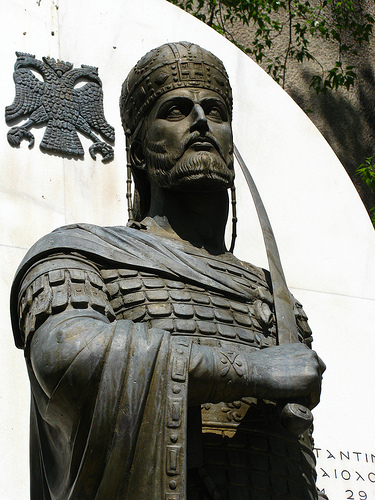
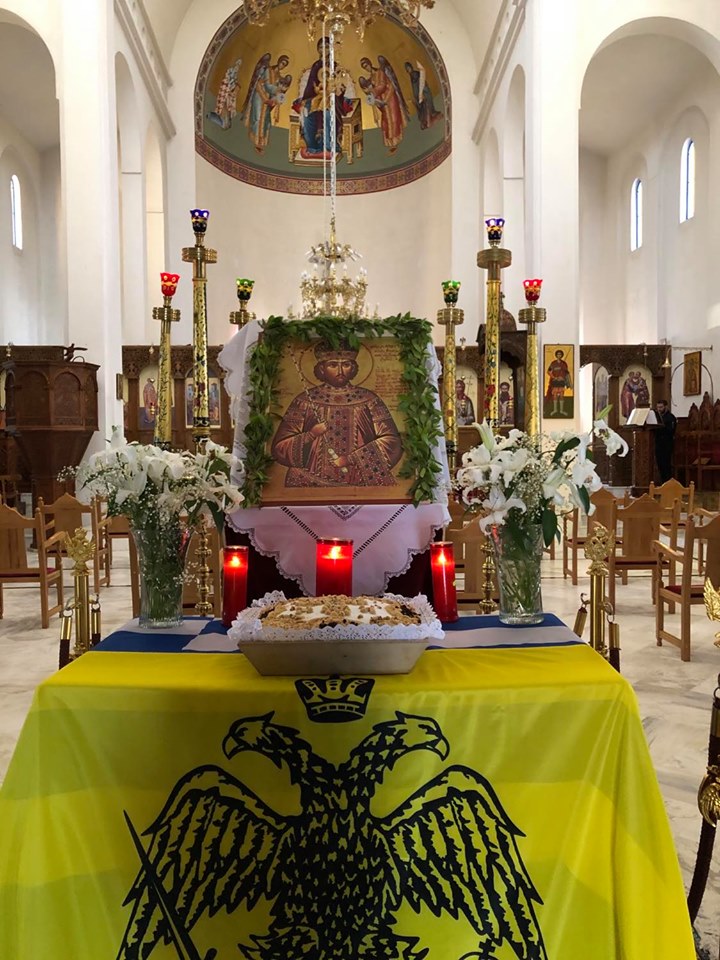
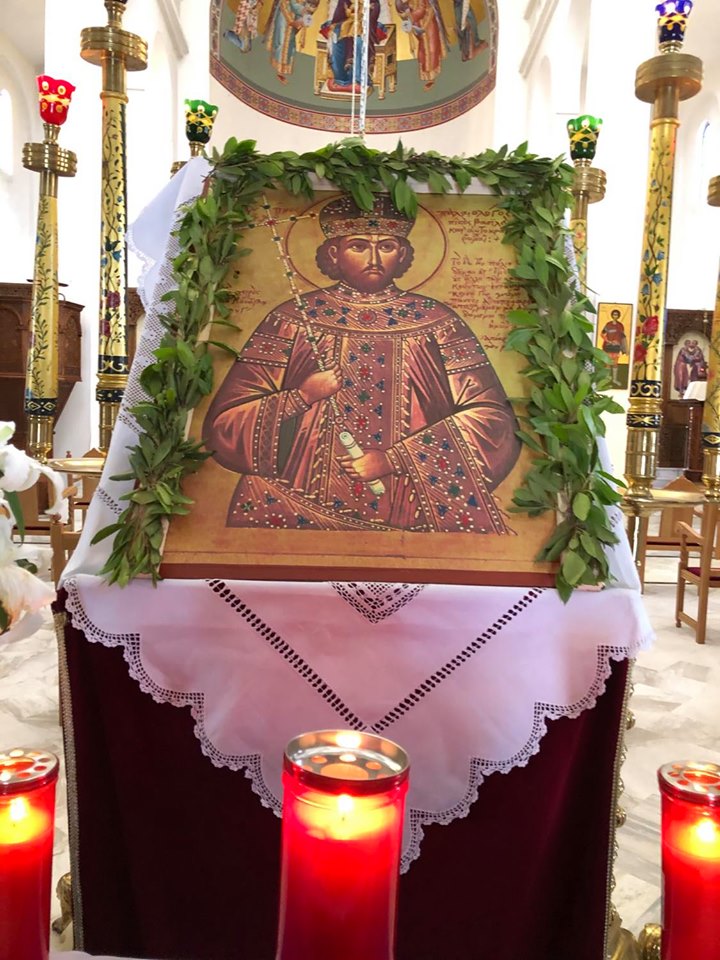
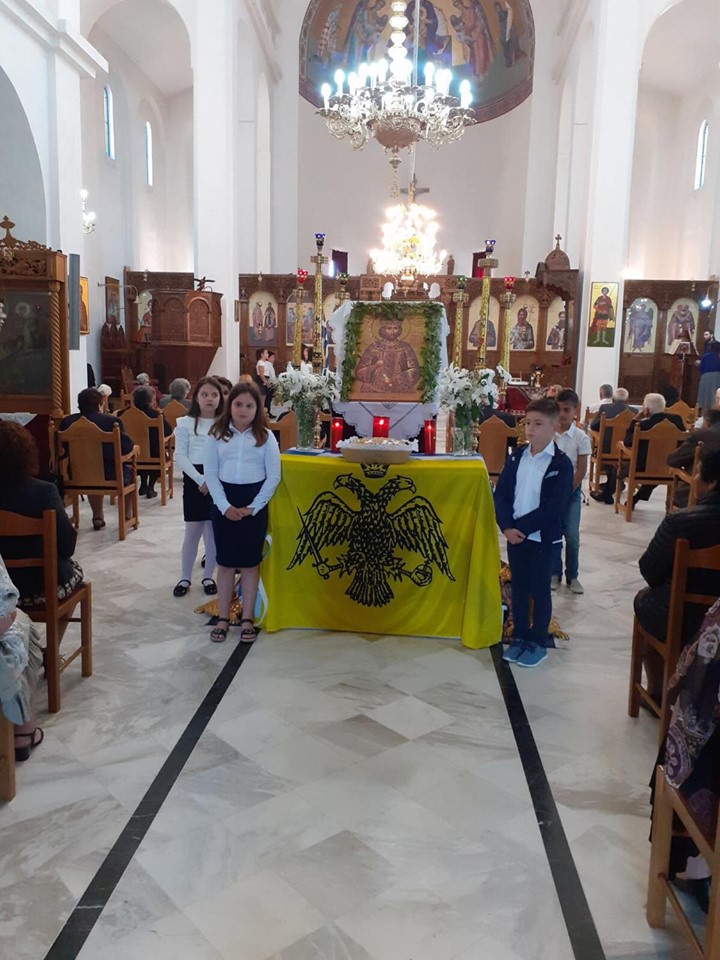
Constantine XI Palaiologos (Gr: Κωνσταντίνος ΙΑ’ Δραγάσης Παλαιολόγος, also Dragases ), was the last reigning emperor of the Palaiologos Dynasty as well as the last of the Roman Emperors. Born in 1404 AD in Mystras, he ruled from 1449 until his death on May 29, 1453, at the Fall of Constantinople.
Constantine was the son of Emperor Manuel II. He was trained as a soldier and in 1441 conquered the Morea Peninsula of Greece. It had long been under the Frankish principality of ‘Achaia’ Constantine was crowned Emperor January 6, 1449 AD succeeding his brother. A little less than five years later in 1453 AD he was killed during the final assaults by the Turkish Sultan, Mehmed II on Constantinople. Constantine, with some 8,000 Greeks, Venetians, and Genoese, had faced 150,000 Turkish besiegers under the Sultan, and after almost two months of heroic defense, directed by the emperor, the city and the empire fell. Constantine died fighting with the last of his men. Going back to Augustus and the ancient Roman Empire, he was the 138th and last Roman Emperor.
Orthodox in general do not consider Constantine XI a saint, though there are some who incorrectly, personally consider him so because of their love of the Byzantine (Roman) Empire. However, the last Emperor has never been recognized as a Saint due to his heretical beliefs and his compromising of the Faith in order to gain material aid from Latin lands. When the Empire was in need, he sought Latin military aid by reaffirming the heretical statements of the Council of Florence. And it is said that he defiled the Church of Agia Sophia the day/night before the Fall with a blended Divine Liturgy and Latin mass. In attempting to preserve an earthly Empire, he lost a Heavenly Kingdom. In contrast, there is Tzar Lazar of Serbia, who gave up an earthly Kingdom for the Heavenly. The Faith is always more important than earthly possessions. May our Compassionate Lord forgive him and all his transgresions. (Orthodoxwiki)
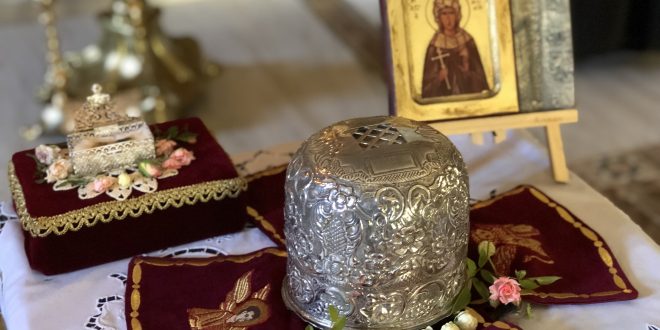
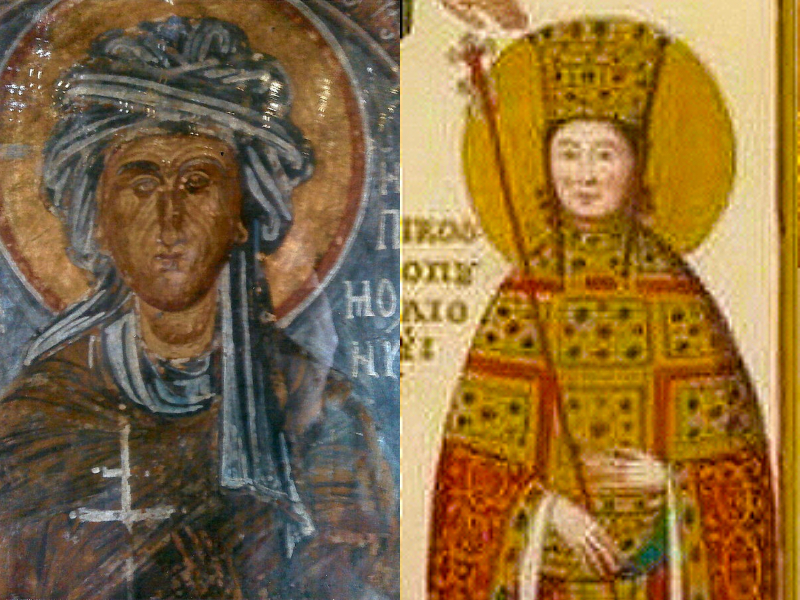
St. Ipomoni, Born as Helena Dragaš. Before becoming a nun and assuming the name Ipomoni, Helena was the mother of Constantine XI Palaiologos. She lived a monastic life for over 25 years, after entering into the habit after the death of her husband. She died 1450AD and is commemorated by the church May 29. The relics of her skull and her icon are found at the Monastery of St. Patapios, Loutraki of Korinthos, Greece.