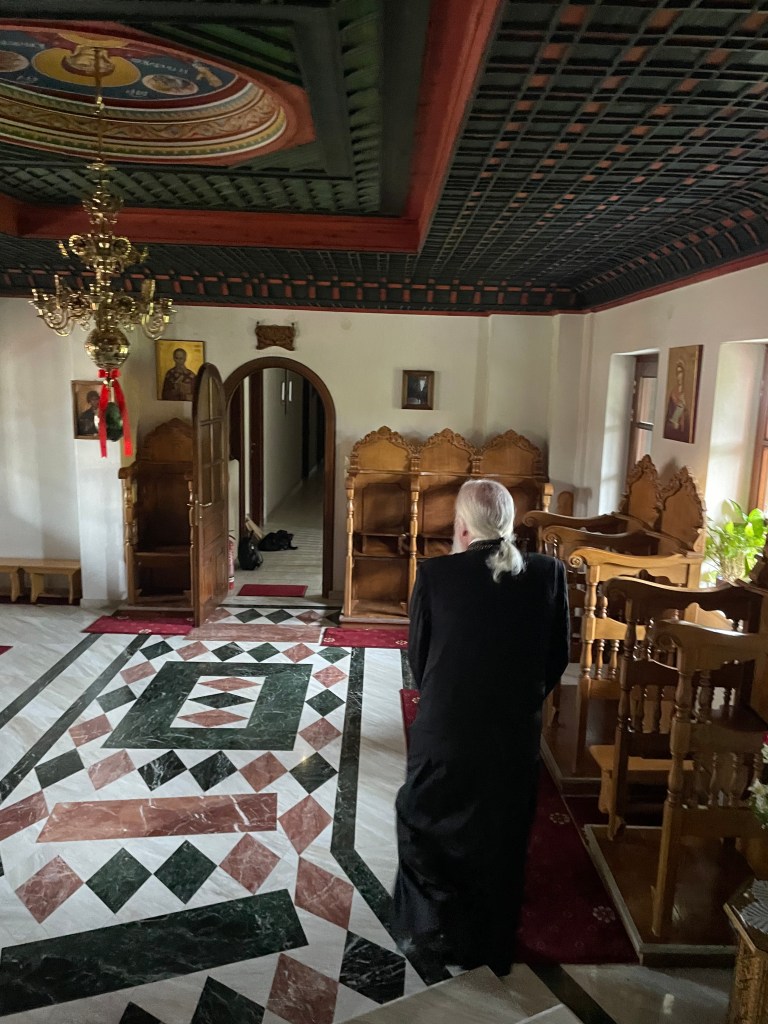
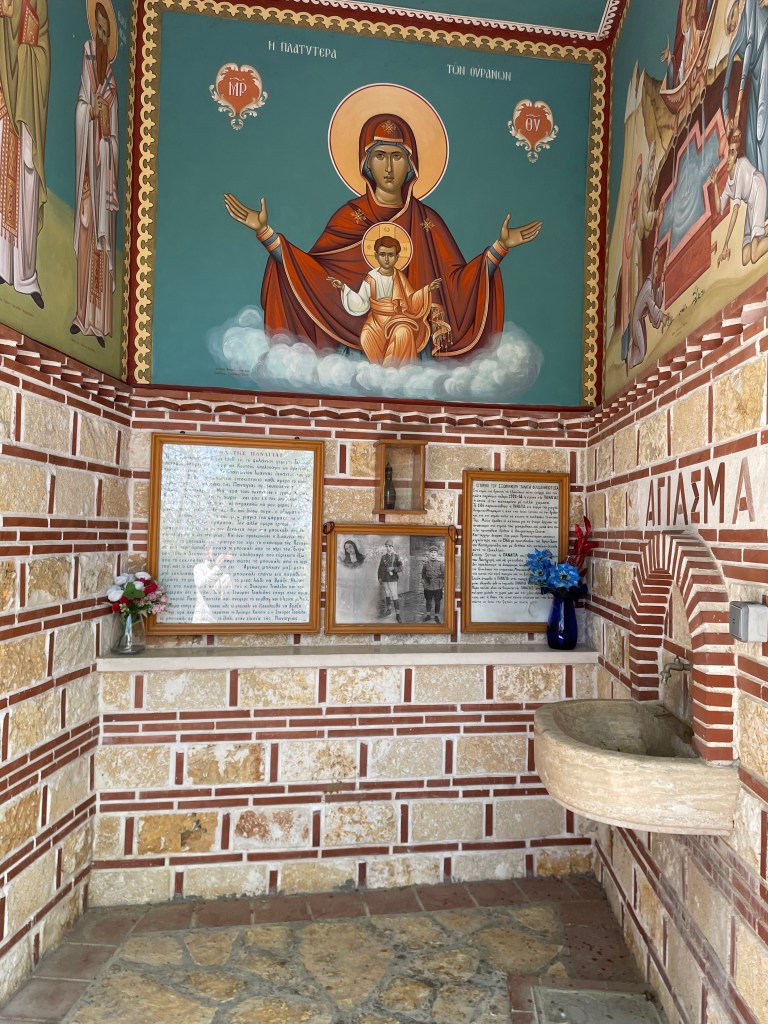
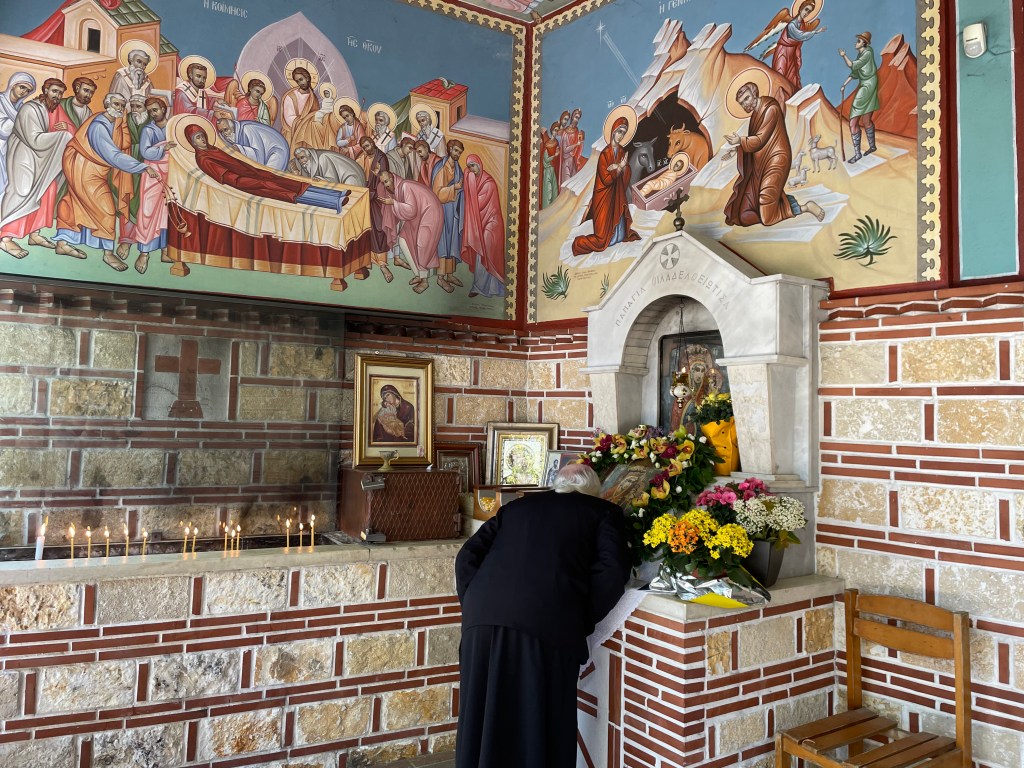
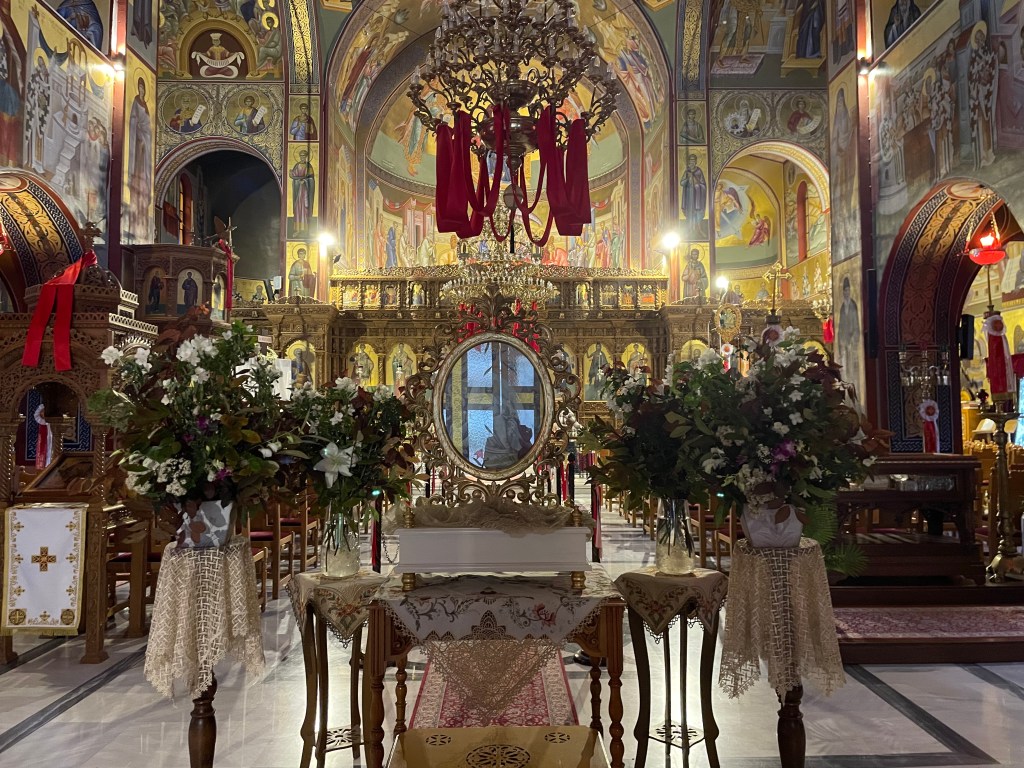
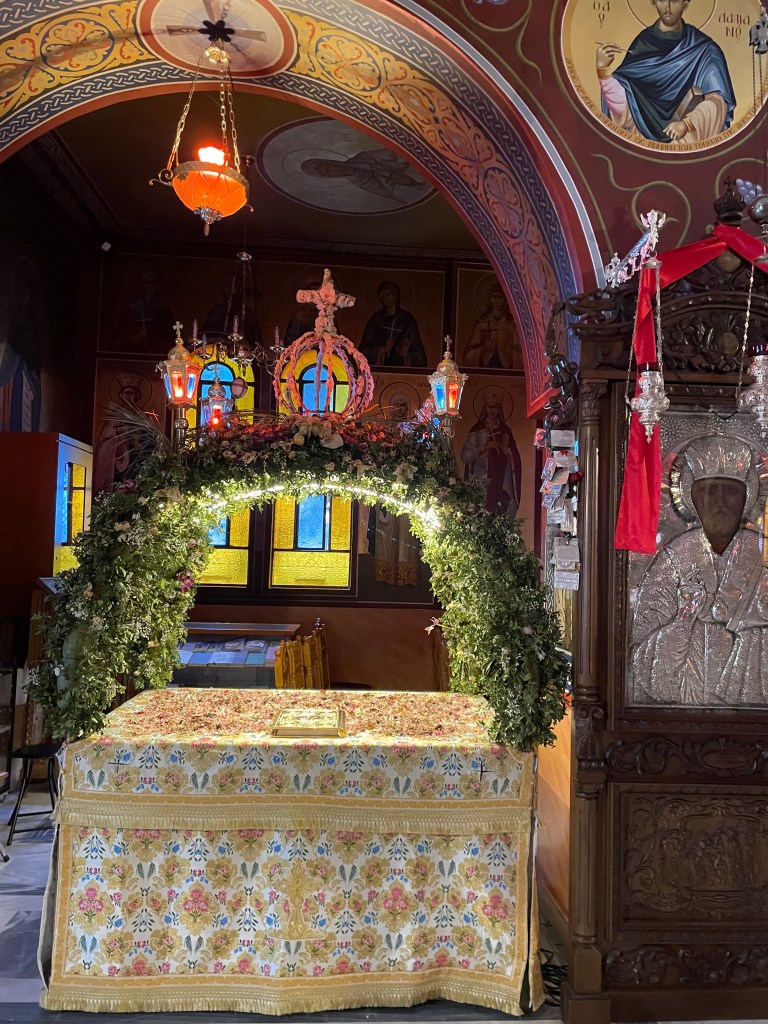
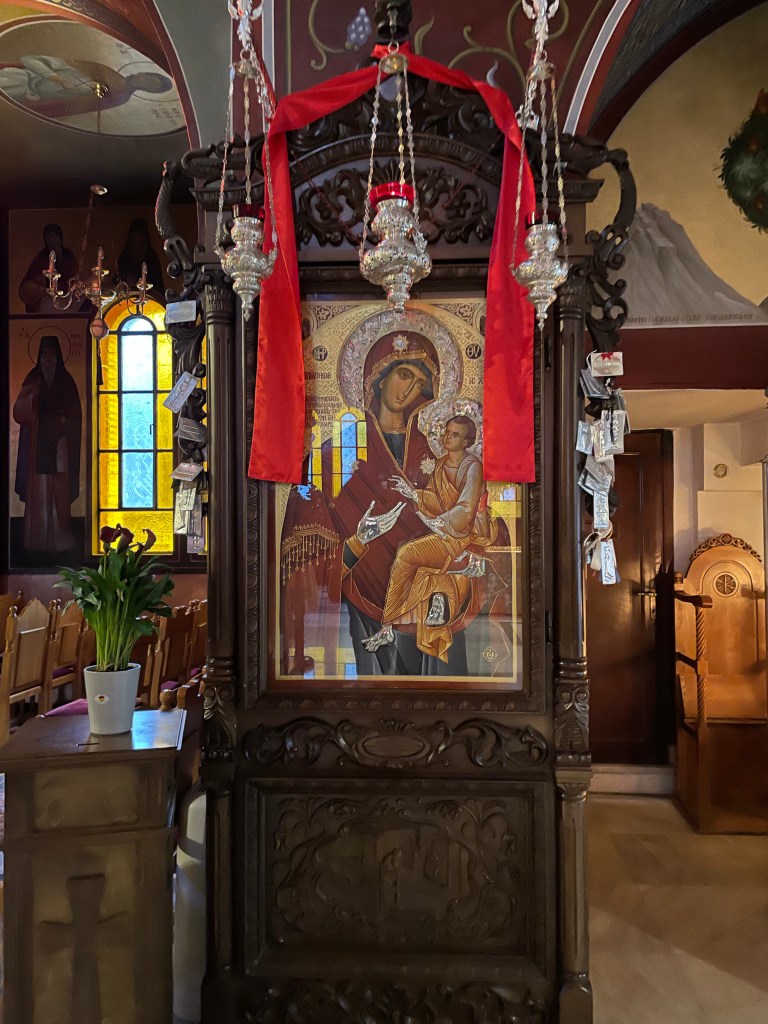
Thursday the 11th of June, the Feast of St. Luke Symferoupol and the revelation of Axion Estin by the angel Gabriel.
The journey to St. Kyriaki monastery was quite eventful. St. Kyriaki monastery is where a number of our Antiochian nuns found themselves.
At one point in the journey, engrossed as we were, in deep conversation and with the Paraklesis of St. Luke Symferoupol providing the background ison to our talk, we took a wrong road. My fault, I’m afraid, as I was the co-pilot, supposed to be directing the way.
The sign Local Road did not really do justice to the rather barely marked track that we found ourselves on in this huge field. However, Sat Nav came to the rescue and revealed to us the way that we should go. We needed a U-turn.
U-turns can be life-saving in a religious and a spiritual point of view, from sin and death and the roads which lead to destruction, to the way that leads to Paradise.
A reliable source told me how beautiful this place was, and indeed there was no hyperbole from that source.
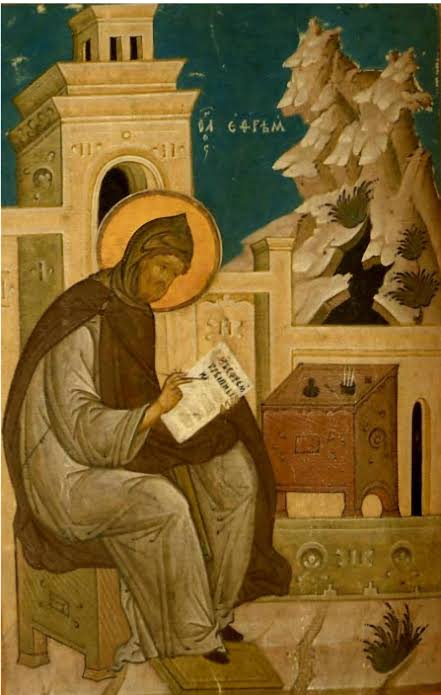
This beautiful monastery, which is really a hidden gem amidst the beautiful countryside, reminded me of the Hymns of Resurrection from St. Ephraim, also a Syrian.
In his Hymn to the Resurrection, chapter 15, verse 10, he writes this:
“Let us summon and invite the saints,
the martyrs, apostles and prophets,
whose own blossoms and flowers
shine out like themselves –
such a wealth of roses they have,
so fragrant are their lilies:
from the Garden of Delights do they pluck them,
and they bring back fair bunches
to crown our beautiful feast.
O praise to You from the saints who are blessed.”
Sister T told us how the nuns came to be there, and it reminded me of another verse from St. Ephraim the Syrian, verse 12, in the same poem:
“Receive our offering, O our King,
and in return grant us salvation;
give peace to the land that has been devastated,
rebuild the churches that were burned,
so that when deep peace has returned,
we may plait you a great wreath,
with flowers and people to plait it,
coming in from all sides
so that the Lord of Peace may be crowned.
Blessed is He who has acted and is able to act.”
*
For those of you who missed it, the story of the Sisters of War and St. Kyriaki monastery in Veria can be read here
“Dedication to Christ is the joy of life,” Mother Maria will answer me, instantly solving the questions about the smiling faces of the women in their cassocks. The thriving convent she now runs once languished with only two very old nuns.
The Sisters found refuge from the war in Syria. An old bond brought them here
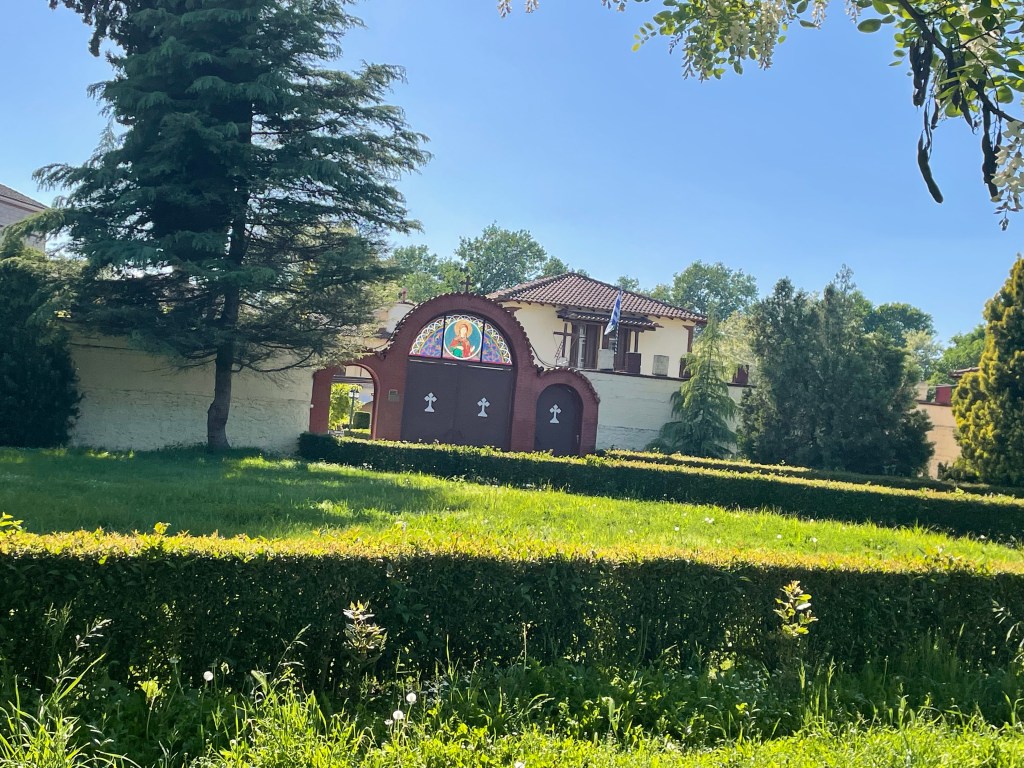
I had heard a lot, but I couldn’t separate the legend from the truth. I had to wander the plain of Veria. To forget myself for a while in the blooming peach trees – the ones that filled Instagram at the end of March – to pass, full of curiosity, the heavy iron door of the Monastery of Agia Kyriaki. And to face the truth in the bright faces of women of all ages.
In the monastery’s mansion, Arabic coffee awaited me with treats from Aleppo. Yes, from Syria. The nuns pronounce Greek with small – I would say charming – grammatical errors that testify that their mother tongue is different.
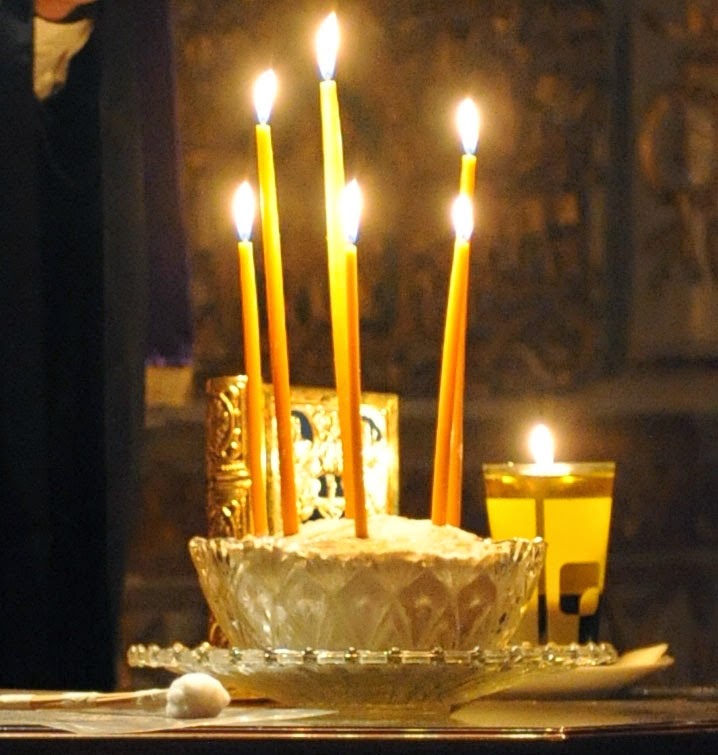
Gerasimi is a graduate of Fine Arts. She elaborately decorates the candles for the Resurrection – their sale is a significant source of income for the small monastery.
“God’s Will”
The war in Syria brought here, to Loutro Imathias, an entire sisterhood of nuns from Aleppo. Aleppo, which was also called Veria during the Byzantine Empire. Luck, fate or divine providence?
For my interlocutors, everything is “God’s will”. And one name is constantly on their lips: Paul! The missing Metropolitan of Aleppo.
On Holy Monday 2013, Paul of Aleppo, returning to Syria from Alexandretta in Turkey, decided to go to a village to try to free locals for whom the rebels were demanding ransom. He was accompanied by the Jacobite bishop Yuhanna.
On the way, the two hierarchs were ambushed. Their driver was murdered and they were kidnapped. Everyone then thought that the kidnapping was the work of ISIS jihadists. The State Department rewarded the kidnappers with 5 million dollars. After all, Paul was the fleshly brother of the Patriarch of Antioch and All the East John.Thirteen years since then, the fate of the two archpriests continues to be unknown. But back to the Monastery of Agia Kyriaki, Pavlos is so “present” in all the stories!
“Missing Father” – “He encouraged me to go to the School of Fine Arts.” “He wanted us to study first and then become a nun.” “He showed me the way to iconography.” “He insisted that we learn Greek, the language of the Fathers.” This is what the sisters say of Metropolitan Pavlos of Aleppo, whose fate has been unknown since 2013, when he was kidnapped.
Emiliani and Iliani were taught the art of needlework in Ormylia, the women’s monastery of Simonopetra. Monks from Simonopetra on Mount Athos are still their spiritual leaders today.
Ten were the first nuns – from the Monastery of the Annunciation of the Theotokos in Aleppo – who found refuge here. “Like Noah who landed his sea-swept ark on Ararat,” I will hear one evening.
All from families of old Romans, that is, citizens of the Byzantine Empire who gradually became Arabic-speaking.
Most from the Valley of the Christians, a natural valley, as large as Kos, near the border with Lebanon.
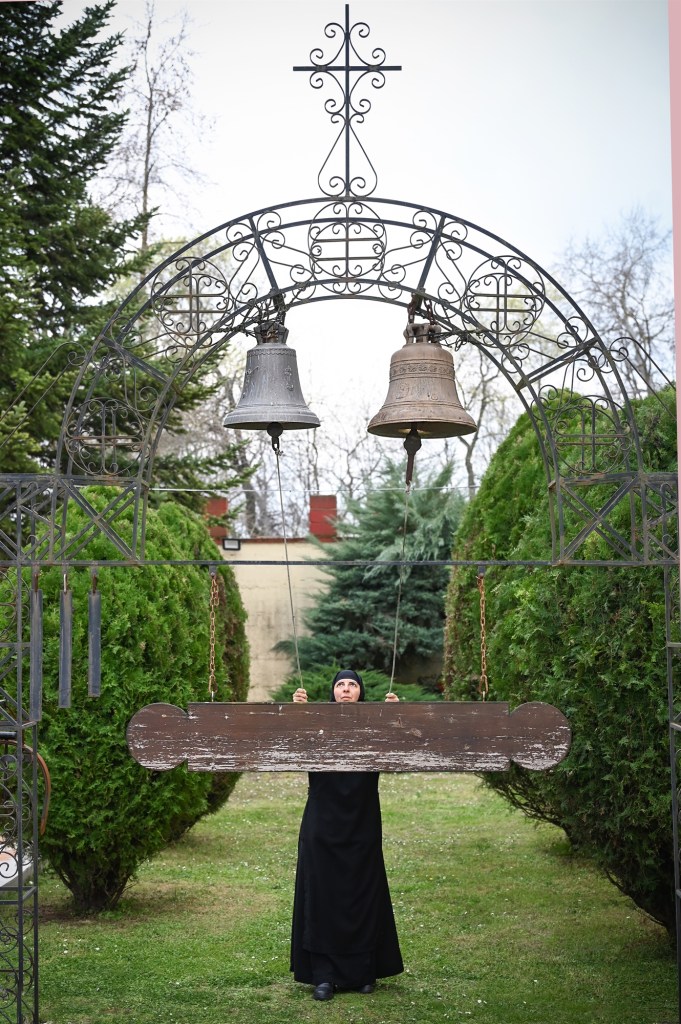
Philothei rings the monastery bells. For centuries, events in monasteries have been announced by rhythmic metal or wooden sounds that lead the brotherhoods to the Katholicon, a chapel, or the refectory.
Every time they went to distribute medicine and food, the locals would exclaim: “For the sake of Deir el Bisara” – “the nuns of the Annunciation are coming!”
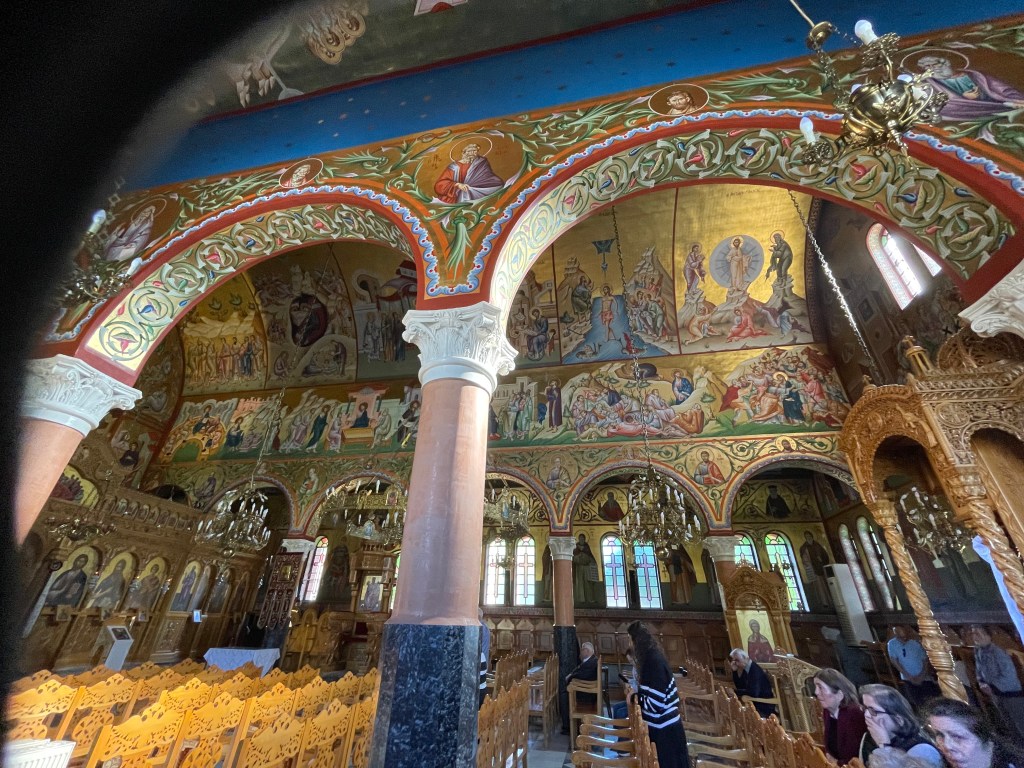
A liturgy in two languages – The Arabic psalms, in the monastery church, are “married” with invocations in Greek: “Lord of Hosts, have mercy on us”. With pilgrims from Alexandria and Veria recognising the same prayer in different words and rejoicing.
But how did the nuns of war find their way to the humble and then unknown Agia Kyriaki?
The current Metropolitan of Veria Panteleimon, in the early 1990s, served as a hieromonk in Thessaloniki. And he had the Syrian Pavlos as his deacon. A graduate of the famous Theological Seminary of Balamand and the Polytechnic University of Latakia – who was then completing his doctorate in theology, while also studying Byzantine music. Paul then became a monk on Mount Athos, where he studied iconography under the most famous iconographers of Athos.
Sister Nikodimi studied Dentistry in Syria. In Greece, she obtained a master’s degree in psychological support for children with cancer and chronic diseases.
Over the years, the hieromonk became the metropolitan of Veria and the deacon the metropolitan of Aleppo. And during the war, he asked his counterpart in Veria for shelter for his spiritual daughters.
One of the photographs of the Metropolitan of Aleppo before his kidnapping in Syria
The Sisterhood
Thirteen years since then, the sisterhood has thrived and now numbers twenty nuns and four novices.
Hieronymi shows the fruits from the sisterhood orchard to Stavros Theodorakis. The monastery’s “development” plan is to create new cells for the nuns and an orchard with fruit trees and gardens with medicinal herbs. Apple, apricot, and cherry trees have already been planted, and once the cold weather passes, sage, verbena, rosemary, and oregano will follow, on terraces.
And at my Lenten table they serve makhlouta* with red lentils, cumin, and vegetables from the sisterhood’s vegetable garden.
Next to me, the reader, standing, commemorates Pavlos in the present tense.
As if he is absent for a while and they are waiting for him to return.
* Makhlouta means “mix” in Arabic, and that’s exactly what this soup is: a mix of beans and grains, simmered slowly.
We visited a monastery, where a young British man who wanted to become a catechumen “accidentally” met a British Orthodox priest who was visiting the same morning and “happened” to be a parish priest very near this young man’s hometown. Last but not least, they had booked the same return flight to the UK that Saturday! So, this young man had his first 3 catechesis lessons that morning!
The nuns of war.
From Aleppo to …
Years ago, it was a deserted monastery with only two nuns. But in 2013, the war in Syria brought here a sisterhood from Aleppo. These nuns have experienced the war, and each has a moving story to share. This monastery is now vibrantly alive, full of radiant Joy and warm Love.
All of the sisters have studied at Syrian universities – from Fine Arts to Economics – all come from old Christian families, and most of them have postgraduate degrees in Theology, which they have studied in Greek Universities. Pavlos, the Metropolitan of Aleppo, their spiritual Father, asked them to come here.
This is a monastery where Arabic hymns and psalms mingle along with Greek prayers. But what is most amazing and I have never encountered before in any other monastery I have visited, is their joy and love. This radiant Joy and love are a fruit of their obedience to their spiritual father in everything, and especially to his word. This is what a sister told us: “The most important thing is that Joy in a person, being joyful, is a decision. When we are not joyful in this life, it is a sin against God and His love.
When I was in Thessaloniki, I can’t remember because it’s just one, visiting from one monastery to another, and the spiritual fragrance of those places is filled with the living Christ. I met a Gerontas. I won’t tell you his name because I know some know him, but some believe he is a saint already. And when you are next to a saint, you know it. Remember, Orthodoxy is very physical. I wanted to be near him, because you could feel holiness. He told us a story about a woman from Canada. She was Chinese. And she had a dream of this face, of this Geronda. She had this dream every night for four years in Canada. Four years. Every night, this Geronda would come in her dream and say, “Come see me. I don’t have so much time.” She didn’t know who he was. She didn’t know where he lived. So she went and had a car, and she went on a tour of monasteries in northern Greece. Until she arrived at this particular monastery, where Gerontas lived, “Ah, here you are”. (And then, this Gerontas made particular arrangements for her to be properly catechised and baptised back in Canada with a priest next door to her own house!) You see, there are some hidden Christians.
This Gerontas goes and secretly baptises people in Turkey. There are secret Christians. There are people who want to become Christians. Many Muslims, rather than going to Greece, go to Romania, perhaps.
Other little miracles happened during my stay in Thessaloniki. I asked Gerontas for a word. It’s a tradition in Greece to say, “Give me a word.” Do you have this tradition? He didn’t say anything. He took a sweet out of his pocket and gave it to me. And I knew what he meant. He said, Give, feed people with the sweetness of Christ. You see, he doesn’t speak English. And I don’t speak very much Greek, so he just gave me a sweet. Simplicity is the beauty of Orthodoxy.
This same Gerontas shared with us another monastery miracle. Many years ago, on Mount Athos, a small boat with monks and doctors met another small boat with some Italian students. One of them was so impressed with the holiness of the Fathers that he swapped boats and followed them to their monastery pilgrimage. Years passed by, communication continued between this Gerontas and this Italian student, miracles happened to his family with Gerontas’ prayers, including saving his father’s life from cancer, and now this Gerontas visited him in Italy and made arrangements for his catechism and baptism, again next door, by an Orthodox Italian hieromonk, a former Uniate priest and now a member of Gerontas’ synodeia.
Homily on MATTHEW 14:22-34 — 9th Sunday of St Matthew
A Homily and a favourite Poem
“At that time, Jesus made the disciples get into the boat and go before him to the other side, while he dismissed the crowds. And after he had dismissed the crowds, he went up into the hills by himself to pray. When evening came, he was there alone, but the boat by this time was many furlongs distant from the land, beaten by the waves; for the wind was against them. And in the fourth watch of the night he came to them, walking on the sea. But when the disciples saw him walking on the sea, they were terrified, saying, “It is a ghost!” And they cried out for fear. But immediately he spoke to them, saying “Take heart, it is I; have no fear.” And Peter answered him, “Lord, if it is you, bid me come to you on the water.” He said, “Come.” So Peter got out of the boat and walked on the water and came to Jesus; but when he saw the wind, he was afraid, and beginning to sink he cried out, “Lord, save me.” Jesus immediately reached out his hand and caught him, saying to him, “O man of little faith, why did you doubt?” And when they entered the boat, the wind ceased. And those in the boat worshipped him, saying, “Truly you are the Son of God.” And when they had crossed over, they came to land at Gennesaret.”
The Gospel writer presents us with a vivid scene on the Lake of Gennesaret. Peter sinking beneath the waves is a picture that resonates with our own condition when we are overcome with anxiety, guilt, sin, overwork, doubt and grief. We become immersed in the conditions that surround us, unable to focus on anything else. The waves seem to be too high and we begin to sink under the waves of pressure.
Peter may have had in mind the Psalm when in his panic and despair he cries out to Christ:
Psalm 69:1-2
Save me, O God! For the waters have come up to my neck. 2 I sink in deep mire, Where there is no standing; I have come into deep waters, Where the floods overflow me.
We see that our Lord, after he had dismissed the crowds goes up into the hills to commune with His Father. After prayer he goes to the Lake of Galilee but His disciples had already gone fishing and it was dark, the fourth watch of the night,3.00 am.-6.00a.m. It is in the middle of the night when fear may overcome us. There was a strong wind that caused a storm on the waters. He walks on the water towards the disciples boat. His disciples thinks it is a ghost and they are terrified. We notice here how the storm outside, had entered into them and they cry out with fear. It is then when they were at their most vulnerable that Christ speaks His words of reassurance:
“Take heart, it is I, have no fear.”
When we find ourselves battered without and within by the storms of life then Christ will come to us bidding us to take courage and trust in Him.
Peter immediately responds:
“Lord, if it is you, bid me come to you on the water.” The “if” signals a doubt in the mind of the apostle.
One word from our Lord,“Come!” So Peter jumps out of the boat, but he takes his eyes of faith from the Lord Jesus Christ and is more concerned about the surrounding turmoil and prevailing storm and begins to sink beneath the waves. This is precisely what often happens to us. We lose focus, we are distracted, we take our eyes from Him Who is the Lord over all Creation and we are embroiled, consumed, overwhelmed by the condition(s) in which we find ourselves.
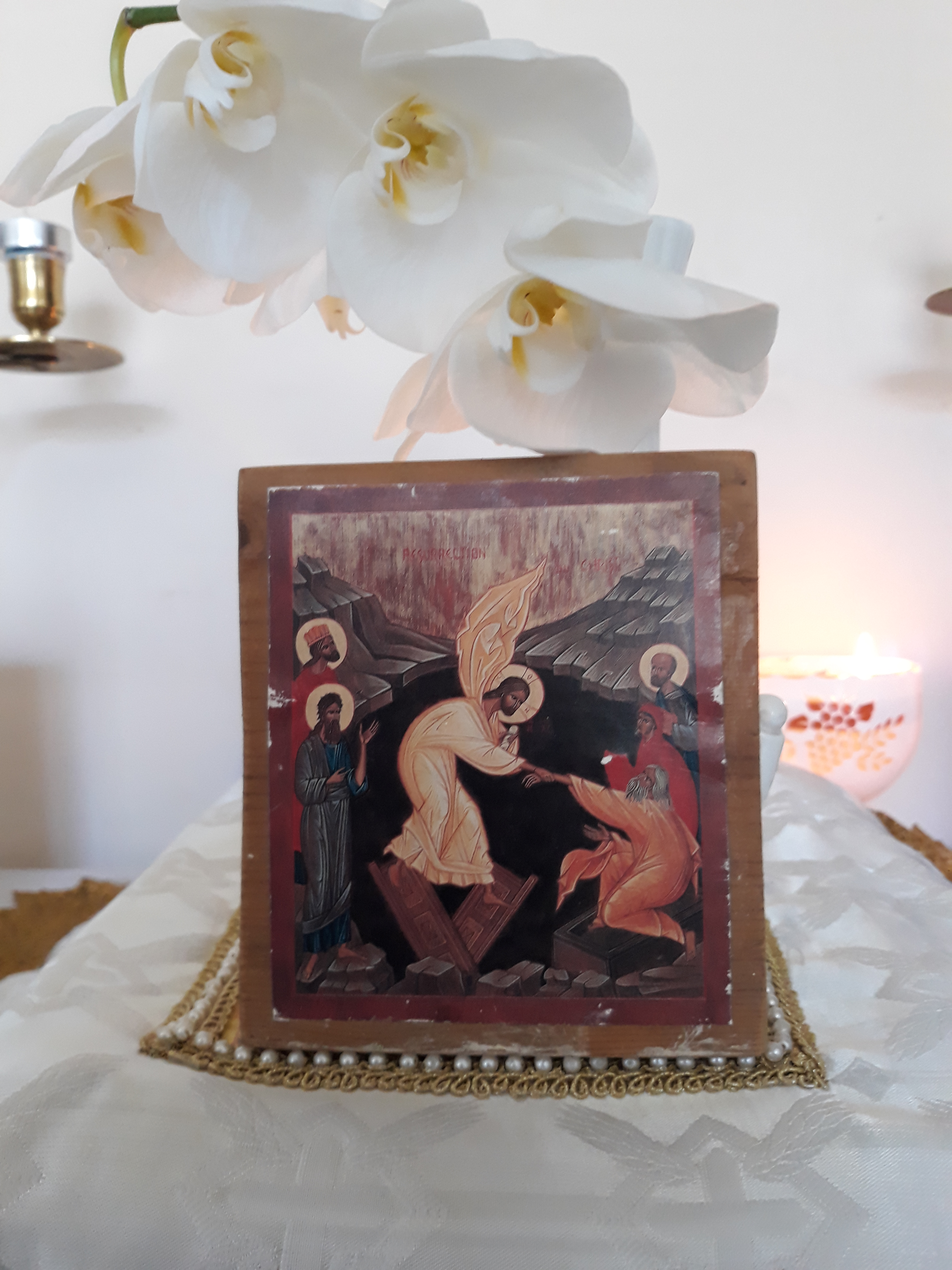
Peter cries out: “Lord, save me!” and the Saviour does just that, despite his lack of faith, extending his arm for Peter to grasp. How speedily this vision takes us to the Icon of the Resurrection in which our extends His arms and brings Adam and Eve out from Hades. This is what Christ does for us, but we also can extend that saving “hand” of friendship, that word of comfort to others whose faith is weak, who feel lost; those that are sinking under the waves of anxiety. We see how Christ immediately comes to the rescue.
The miracle here is not that Our Lord Jesus walked upon water, but that His word and action is immediate towards His disciples! The One who made the Heavens and the Earth, the Sea and all that is therein, is Lord over all nature. He who multiplies five loaves and two fish to feed 5000 can walk upon the waters, can turn water into wine, can calm the storm, can cause a multitude of fish to be caught. The real miracle is that Christ knows our needs and responds to them immediately. He is with us always even unto the end of the age and His hand supports us and saves us now and unto eternal life.
Lord save us!
And when they entered the boat, the wind ceased. And those in the boat worshipped him, saying, “Truly you are the Son of God.”
Christ is indeed our Saviour and the Son of God
The poem “Footsteps in the Sand “so eloquently illustrates the nature of our loving and saving Lord Jesus Christ:
One night I dreamed a dream. As I was walking along the beach with my Lord. Across the dark sky flashed scenes from my life. For each scene, I noticed two sets of footprints in the sand, One belonging to me and one to my Lord.
After the last scene of my life flashed before me, I looked back at the footprints in the sand. I noticed that at many times along the path of my life, especially at the very lowest and saddest times, there was only one set of footprints.
This really troubled me, so I asked the Lord about it. “Lord, you said once I decided to follow you, You’d walk with me all the way. But I noticed that during the saddest and most troublesome times of my life, there was only one set of footprints. I don’t understand why, when I needed You the most, You would leave me.”
He whispered, “My precious child, I love you and will never leave you Never, ever, during your trials and testings. When you saw only one set of footprints, It was then that I carried you.”
Archimandrite Gregorios Estephan, Abbot of Holy Dormition of the Theotokos Monastery, Bkeftine, Lebanon
A most poignant, sobering and timely warning. Your prayers and your thoughts.
A few excerpts:
We ask with honesty, was there no other way or a dispensational solution, taking into account all the health measures, to face this pandemic, without closing the Churches and surrendering to a collective spiritual suicide?
…
Going to Church during pandemics, temptations, hardships and persecutions does not mean that we are tempting God as if we are inviting something to befall us, but rather, by this, we are saying to Him that we walk with Him in Faith, revealing that what we need the most is to be with Him during these very afflictions, united with Him in His Body and Blood, in order to confront this pandemic and the dangers of disease, as well as all of the other catastrophes awaiting us. When Christians, during major persecutions and communism, risked their lives to go into the catacombs and gather around the Lord’s table, it was an expression of their loving Christ more than themselves, an expression of their knowledge that true life exists within this Eucharistic table, and not in their bodies.
…
Today also, if we do not stand up to this current pandemic by prayer, supplication and repentance, and more importantly, by holding Divine Liturgies, and receiving the Body and Blood of Christ which frees us from eternal death, what should we confront it with? By running away and isolating oneself?
…
The Church faced the consequences of sin through such firm Faith and by strengthening piety in the souls of her members. … Christians, in prisons and mines during exile, perceived in depth their great need to partake of the Body and Blood of Christ, so their priests used to celebrate the Divine offering on the breasts of the faithful; the breast of the faithful became an altar for God.
…
We are in a time when we need the Body and Blood of Christ, more than at any other time, in order to be nourished and to receive the strength to resist every evil and disease. Although we know that, by God’s permission, we can fall sick due to this pandemic, but the faithful who becomes ill and continues his struggle in the Church and his participation in its Mysteries, is like a soldier in the battle arena resisting all evil, not by his own strength, but by the power of the salvific gift of Redemption. Does the one who partakes of the Body and Blood of Christ, knowing that it is the true food for eternal life, think of bodily death anymore? The death of such person therefore resembles the death of Martyrs.
…
Why is everyone silent in front of all these evils and perversions that are afflicting the Church of Christ and disorienting its mission of the salvation of mankind? Do those speaking with such an unlawful enthusiasm in support of the Church closures have such a zeal for the purity of the Orthodox Faith? Would they be as zealous in applying the Church Canons as they are to submit to the laws of the nations?
…
The end of the world will come, not when the antichrist becomes strong, but when the Church becomes weak (Archbishop Sergei Baranov).
If the strength of the Church exists in her Mysteries, and especially in the Mystery of the Eucharist, then her weakness, rather her death, is found in the interruption of these Liturgies.
…
We must also consider that since the Church has surrendered so easily because of this pandemic, even unto the closing of her doors, what is she going to do when the Antichrist comes? Do any of us ask this question?
The interruption of these Liturgies, although temporary, is nothing but a sign among the signs of the end of times. Concerning the latter days, Saint Ephraim the Syrian (of the fourth century) reveals that: “the Churches will pathetically weep for the holy services will cease to take place in them and there will no more be Eucharistic oblations”[9]. The Church of Christ which is ever strong and victorious over Satan, sin and death, and concerning which the Lord promised that the gates of Hades shall not prevail over her, is submitting that simply? Does not this reveal its weakness and the fragility of its earthly journey?
For the complete article by Archimandrite Gregorios Estephan, Abbot of Holy Dormition of the Theotokos Monastery, Bkeftine, Lebanon, go to Orthodox Ethos, a website by Father Peter Heers I wholeheartedly recommend for all its podcasts, interviews and articles
Elder Parthenios of the Monastery of Saint Pavlos: Αn orthodox message from the Holy Mountain
“Christ is Risen! Truly He is Risen!
The abbot of the Holy Monastery of Saint Pavlos, father Parthenios, speaks to you. I am in the monastery of Saint Pavlos since 1954 till now, with the help of our God, Virgin Mary and all of saints. Till now, we are blessed of God and we all celebrated the Holy Easter, with all of our happiness and love, the Risen of our Lord. This year it was the only year, since I came in the Mount Athos (Holy Mount), that we celebrated alone. Because all of the previous years we had with us more that 100-150-200 visitors, only in our Monastery. Together all the Monasteries of the Holy Mount had approximately 5,000 visitors, who have come every year, to honor the Holy Easter, the Risen of our Lord!
It was hard for me, that this was the year that we glory alone the God. Because of the measures they took, they left us alone with only few workers who are regular here. I am telling you that, with a lot of father’s love, I am in pain, in grief. Because all the faithful men who used to come here with us, were our consolation, to praise all together to the most important event, the Easter. All together we were chanting the pray of “Christ is Risen”, full of joy. Perhaps, God allowed this temptation to be penetrated, for our sins. Maybe He wants to activate us, cause the people got away from the Lord’s path and doing nonsense.
Our Churchs, all over the country, in Athens, in Thessaloniki and other where were like a cemetery. All the people were isolated in their houses; even the churches have closed their gates. What happened? What happened?
Unfortunately, our politicians trying to do their best. These are human measures, we cannot blame them. On the other hand, I am sending them a message. These measures are not enough. I am begging our politicians and our ecclesiastical authority, to shout at people to open the churches for the public, to go out on the roads, to take with them the holy icons and go for a litany, in order to beg our almighty God to obviate that temptation. The governors of this time cannot save us. Only the powerful God, He is the one who can save us. Open the doors of the churches, take the people outdoors, get the icons out, and get down on your knees, like the Ninevites did, to beg the God, His omnipotence, to quash this temptation. Otherwise, I don’t know where we will end up.
Please, do not be delusional, only God can save us, only our Lady Virgin, only the Saint Apostles and all the Saints together. Also can save us our pray and faith to God. “What did save the world?” “Our faith”!
Let all these thoughts of lukewarm and oligopolies, behind. We are Christians and I refer to the politicians who prepare to seal up/chip the people, but this will be their biggest scandal, because they not do justice to Christians. We, the Christians, strongly believe in His Almighty, we are baptized; we are anointed by the Holy Oil in the sealing of God. “Seal donation of the Holy Spirit, amen.”
Anyone who is not baptized, has the freedom to be sealed by the government, it is their decision. But do not force us, the Christians. Whatever you want to do against us, the God will be the Victor!
The God says: “Just as someone will confess in front of other people that he believes me, so I will do for him too, in front of my Father who live in the sky.” “Just as someone denies that he loves me, in front of the people, so I will do for him too.” Do not believe what the Zionists and Masons, the devils say; they do not believe in anything. On the other hand, we strongly believe in the real God. Whatever it takes, we confess Jesus Christ the Crucified we lean on Him our hopes, in his All-powers, nowhere else.
Many happy returns! Christ is Risen! Truly He is Risen!
Our Lord has beaten the world. He says: “Don’t be afraid! I have been beaten the world for you!” That is our confession and our faith! Thank you so much!
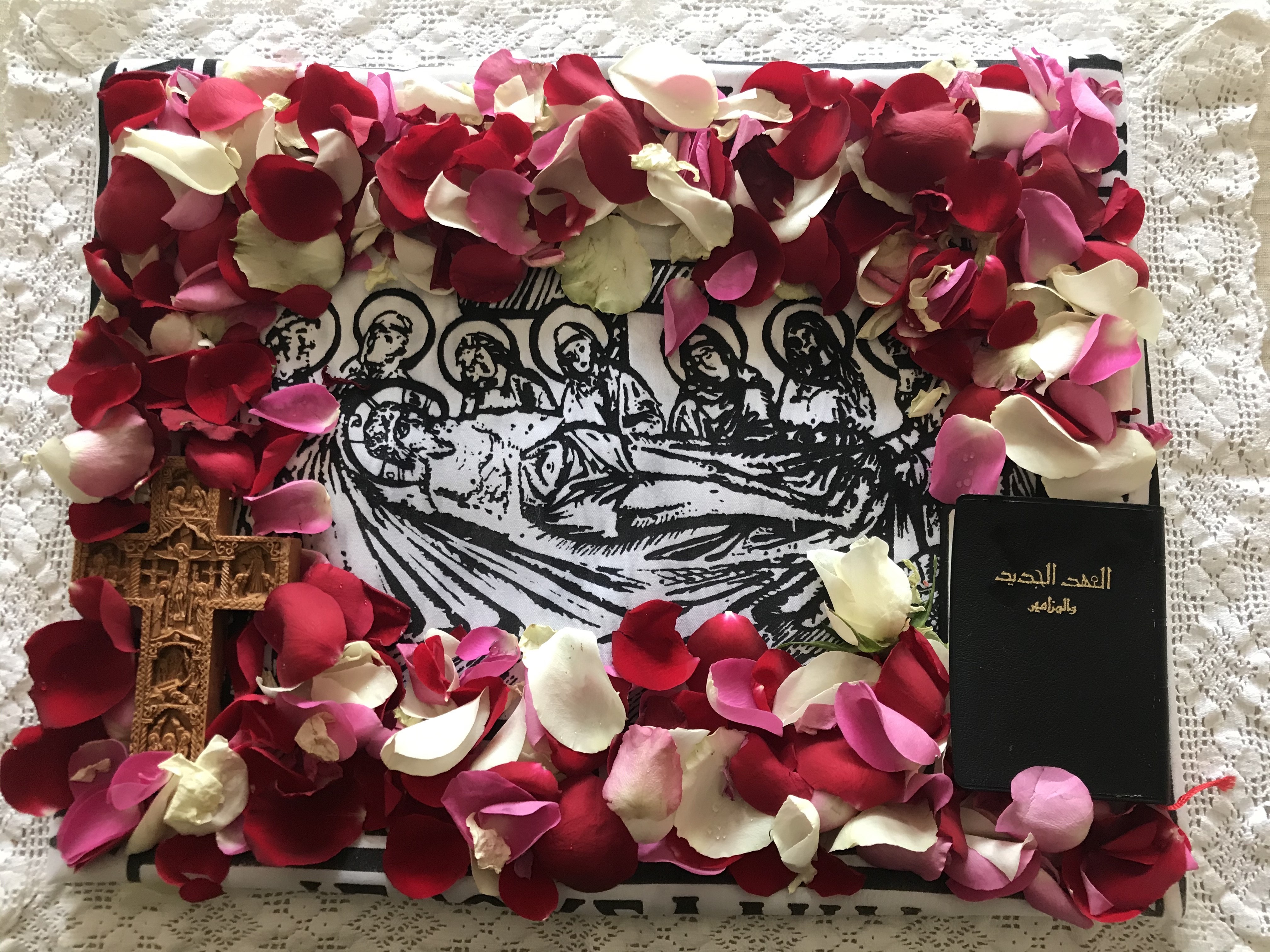
Holy Week Highlights — a photoblog. Christ is Risen!
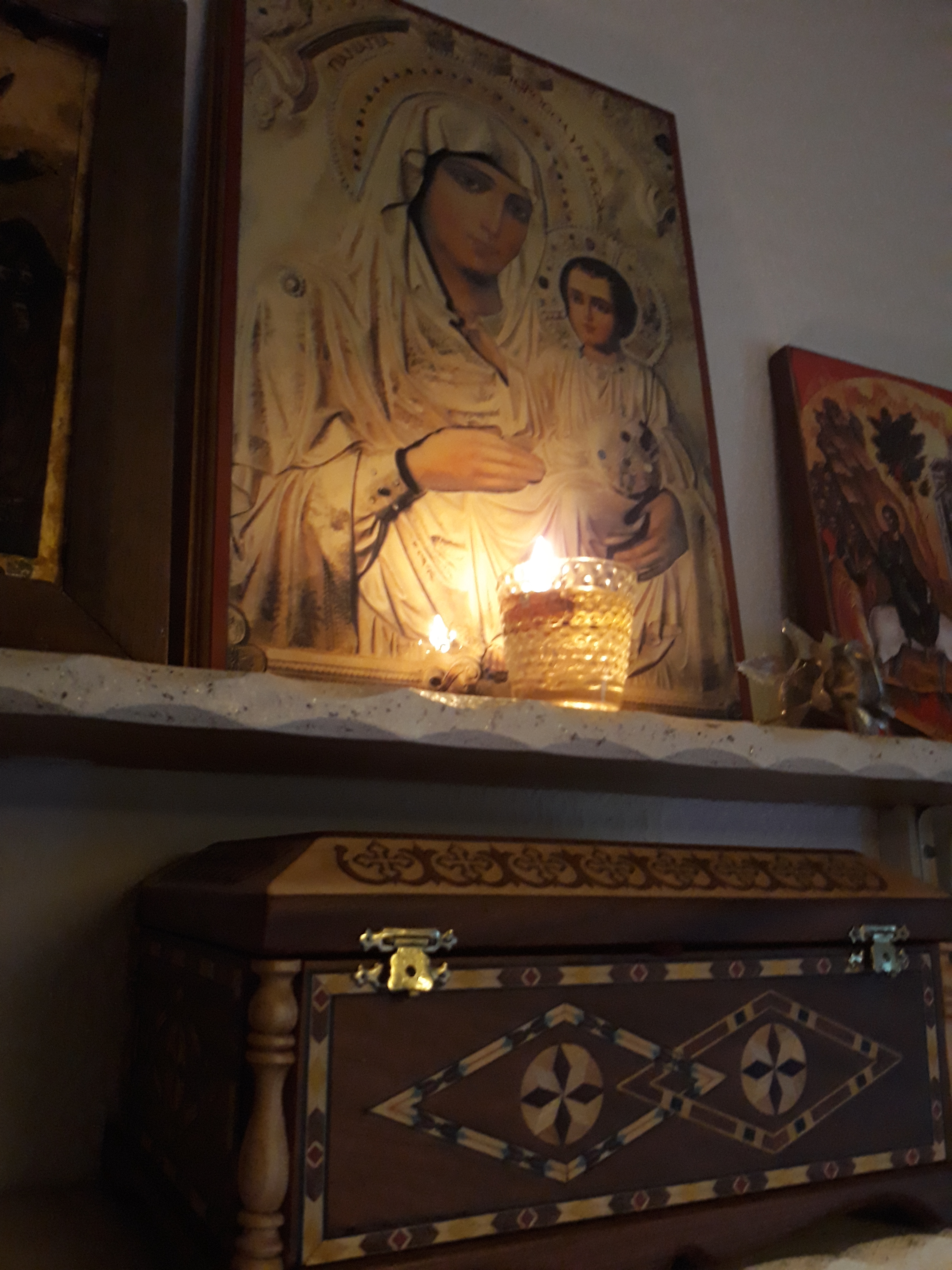
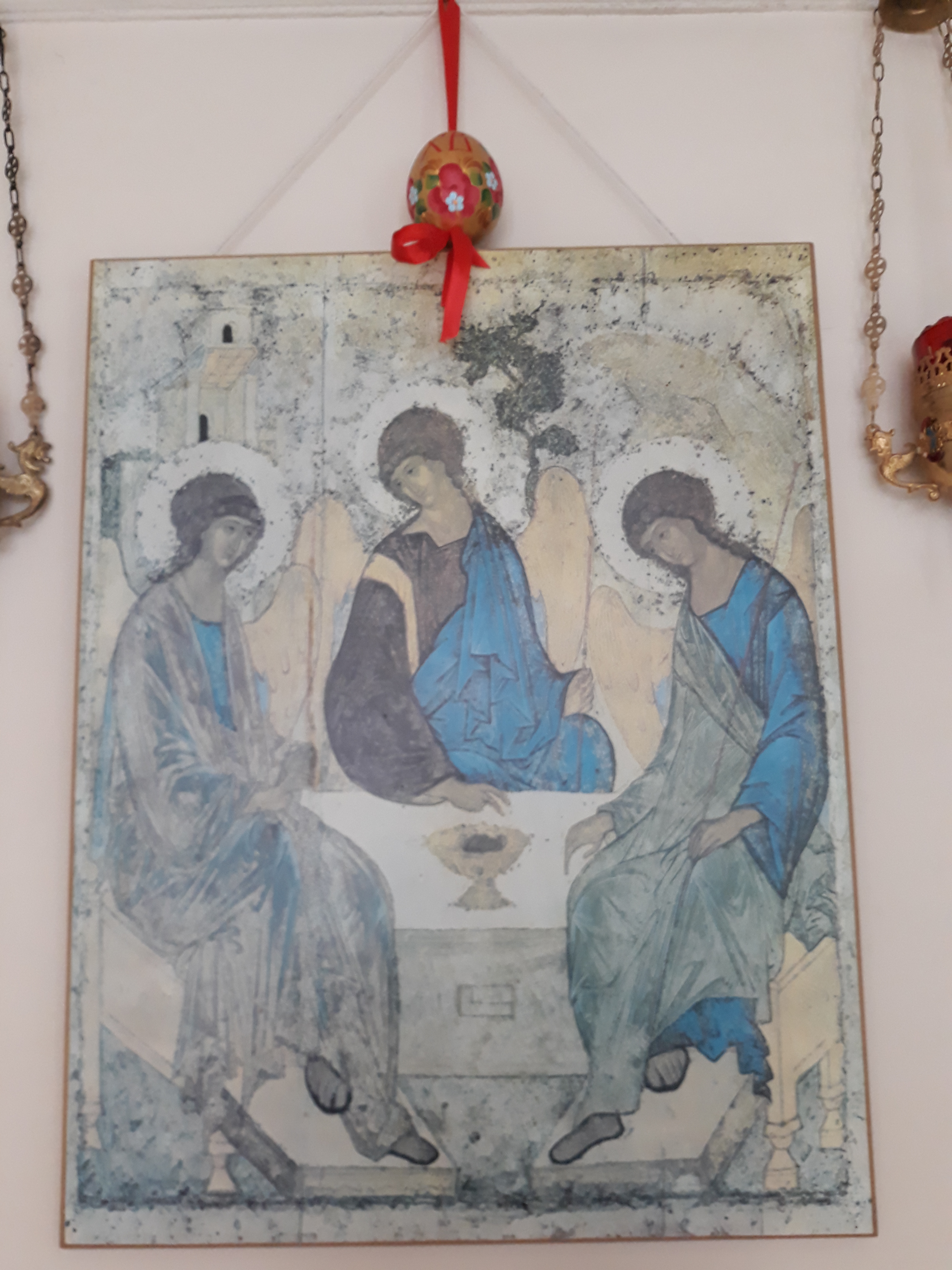
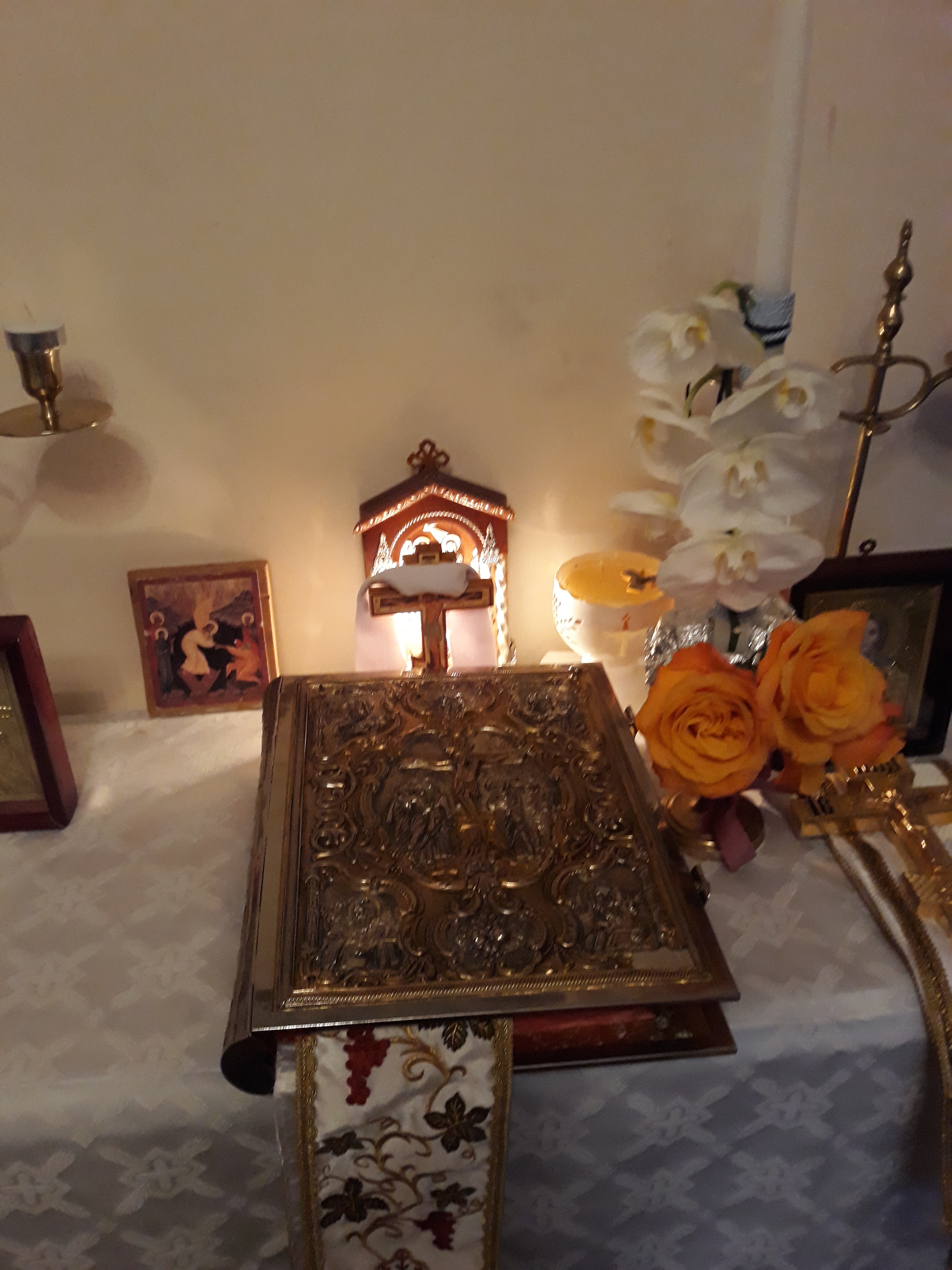
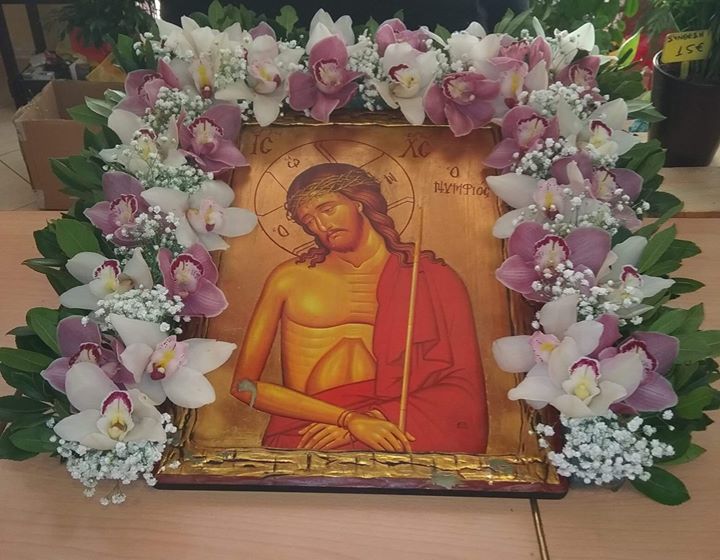
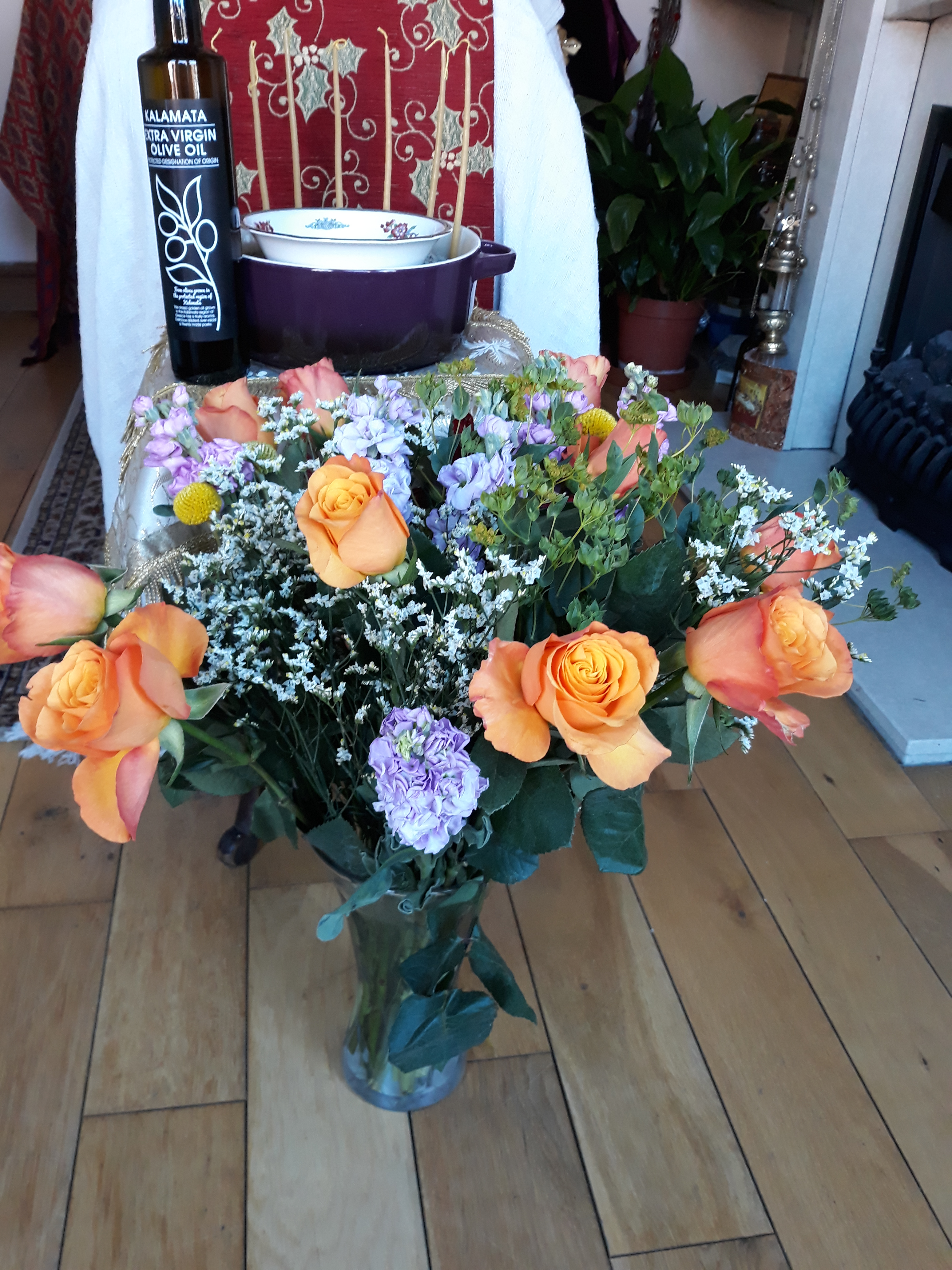
The Saints are delighted with the flowers! I eventually found the card. Thank you dearest sisters. I am overwhelmed, and all the saints in my icon corner are smiling.
Bleeding Crucifix today, on Holy Thursday, now in Athens, in Holy Andreas Chapel, Nursing Home Care
Dear friends in Christ- Amidst the chaos of this pandemic and the disturbance to normal life, the most noticeable aspect of this most unusual period is the silence.
You may recall those signs at school, ” SILENCE- EXAMINATION IN PROGRESS”; such a silence that we are experiencing at this present time is also a test of what we have learned as Christians.
The lockdown has changed even the way the earth moves and there is a reduction of seismic noise because of the lack of human activity. Silence for some is difficult and they look for distractions. However, silence is not simply an absence of noise, it is the opportunity and context for noetic prayer.
“Prayer,” as Metropolitan Antony Bloom said in his book Courage to Pray, “is an end to isolation- it is living our life with someone. “
“Compel yourselves in silence, the mother of all godly virtues. Keep silent in order to say the Prayer( of Jesus); for; when someone speaks, how is he able to escape idle talk, from which comes every evil word, which weighs the soul down by the responsibility for it:”
Elder Ephraim of Philotheou Monastery, Mount Athos, “Counsels from the Holy Mountain”
The Yoke of Christ
Matthew 11:29:” Take my Yoke upon you and learn from Me, for I am gentle and lowly in heart, and you will find rest for your souls.”
There is no humility of wisdom in argument,
Let the soul be softened by sorrow,
For mysteries are revealed to the humble
And joy the portion of those who follow.
Let not anger consume the foolishness of pride
But let the grace of discernment be your diet.
Not every quiet man is humble,
But every humble man is quiet.
Meekness is not passive gentleness
It is the strength of contentment through new birth
The imitation of Christ is our Heavenly task
The Blessing, the inheritance of the earth!
Reflections on the Beatitudes and on the words of St. Isaac the Syrian
To the Glory of God!
“I give praise to your holy Nature, Lord, for you have made my nature a sanctuary for your hiddenness and a tabernacle for your holy mysteries, a place where you can dwell, and a holy temple for your Divinity.” St. Isaac the Syrian
*
“If you are praised, be silent. If you are scolded, be silent. If you incur losses, be silent. If you receive profit, be silent. If you are satiated, be silent. If you are hungry, also be silent. And do not be afraid that there will be no fruit when all dies down; there will be! Not everything will die down. Energy will appear; and what energy!” St. Symeon the New Theologian
Dear brothers and sisters, during this Great and Holy Week the Daily Punstynnik Diary to Remember the Little things will be suspended and hopefully resumed after Pascha in order to concentrate on silence and prayer. Let us thus now dive into this holy silence and let this week’s church services and events speak to us, as they can only do! I wish to all of you a blessed Holy Week!
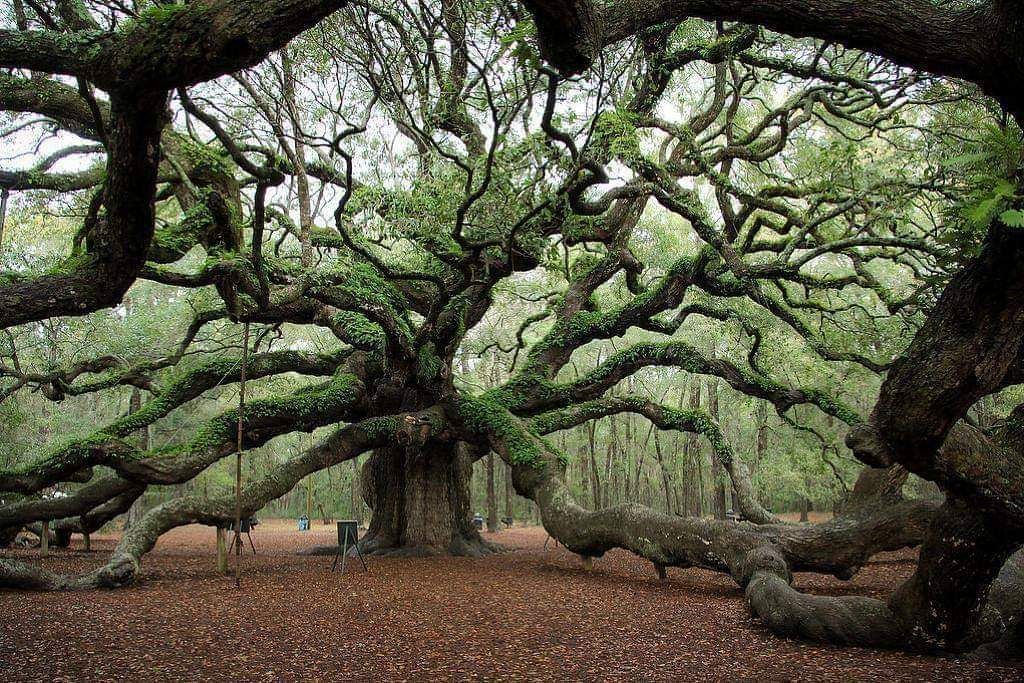
I love trees. Trees are magnificent in their audacious grandeur; sown in the dark soil they seek the light.
The trees which were bare a month ago are now in full bloom. Spring has come with all its glorious plenary pulchritude. We thank God for such beauty. Trees offer shade and colour; they even take our carbon dioxide and exchange it for oxygen. Trees are the lungs of the world.
The newly glorified Saint Amphilochios of Patmos (1888-1970) said: ” Whoever does not love trees, does not love God.”
In these hard times, it is a temptation to become despondent; but this spirit comes from the evil one. Our lives are hidden in Christ (Colossians 3:3) like the roots in the soil. Our faith can defy the weight of oppression like the sap which defies gravity through capillary action. Our lives can extend to all like the branches. If we have the will, with that awesome synergy which is Christ’s gracious dialogue with us, through His mercy and our hard work, we may bloom in holiness and bear fruit that will last.
Hearts of Oak
Theme: Despondency
John 15:5 “I am the vine, you are the branches. He who abides in Me, and I in him, bears much fruit; for without Me you can do nothing.”
Luke 6:44: “For every tree is known by its own fruit.
“When despondency seizes us, let us not give in to it. Rather, fortified and protected by the light of faith, let us with great courage say to the spirit of evil: “What are you to us, you who are cut off from God, a fugitive for Heaven, and a slave of evil? You dare not do anything to us: Christ, the Son of God, has dominion over us and over all. Leave us, you thing of bane. We are made steadfast by the uprightness of His Cross. Serpent, we trample on your head.”
St. Seraphim of Sarov
“It was said of Abba John the Dwarf that one day he said to his elder brother, ”I should like to be free of all care, like the angels who do not work, but ceaselessly offer worship to God. ”So he took leave of his brother and went away in the desert. After a week he came back to his brother. When he knocked on the door he heard his brother say,” Who are you?” before he opened it. He said,” I am John, your brother.” But he replied,” John has become an angel and henceforth is no longer among men.” Then John besought him, saying,” It is I.” However, his brother did not let him in but left him there in distress until morning. Then, opening the door, he said to him, “You are a man and you must once again work in order to eat.” Then John made a prostration before him, saying,” Forgive me.”
I hear Lord, there was once a Tree planted here in this place
A Tree so fine and so splendid, a Tree full of beauty and grace.
“Who planted this Tree of Life Lord here in this garden?
It’s said that its fruit was so sweet and had the gift of peace and pardon
Who tended this Tree in its youth Lord when it was growing into the light?
When the gales blew and the storms raged in the middle of the night.
Who first saw this Tree bud and blossom into flower
As the sap of its spirit gave joy to each hour?
Who watered this Tree Lord when it was parched and dry
When some men ate of its labour and others wagged heads and passed by?
Who cut down its branches where the birds of the air made a nest?
Didn’t they taste of its fruit Lord, did not they know it was best?
Who cut the Tree down to the ground Lord whilst it was rich in finest full bloom?
There must have been more than one axe Lord, to bring about such a doom.
But look Lord I see a young sapling springing from out of its roots
And what wondrous a sight to behold Lord, there are thousands and thousands of shoots!
What is this Garden called Father, is it Eden, what mystical name please impart?
“The Tree is my Son, my young gardener and the garden my child is your heart.”