A few days spent in the company of an elderly relative living with dementia became an unexpected invitation to contemplation.
“An aged man in but a paltry thing” indeed (W. B. Yeats, “Sailing to Byzantium”). “
“The brain — is wider than the Sky … deeper than the sea … just the weight of God…” (Cf. Emily Dickinson).
What a beautiful perception of disconnection, especially when old age is combined with dementia and psychiatric disorders. The senses still perceive something even if they do not connect…
“O, let me not be mad, not mad, sweet heaven! Keep me in temper; I would not be mad!” (King Lear’s prayer beforehis descent into madness, Act I, Scene 5)
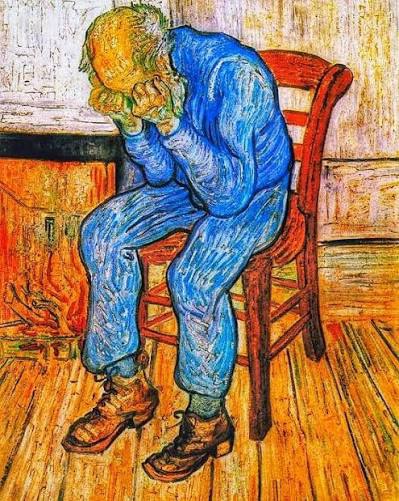
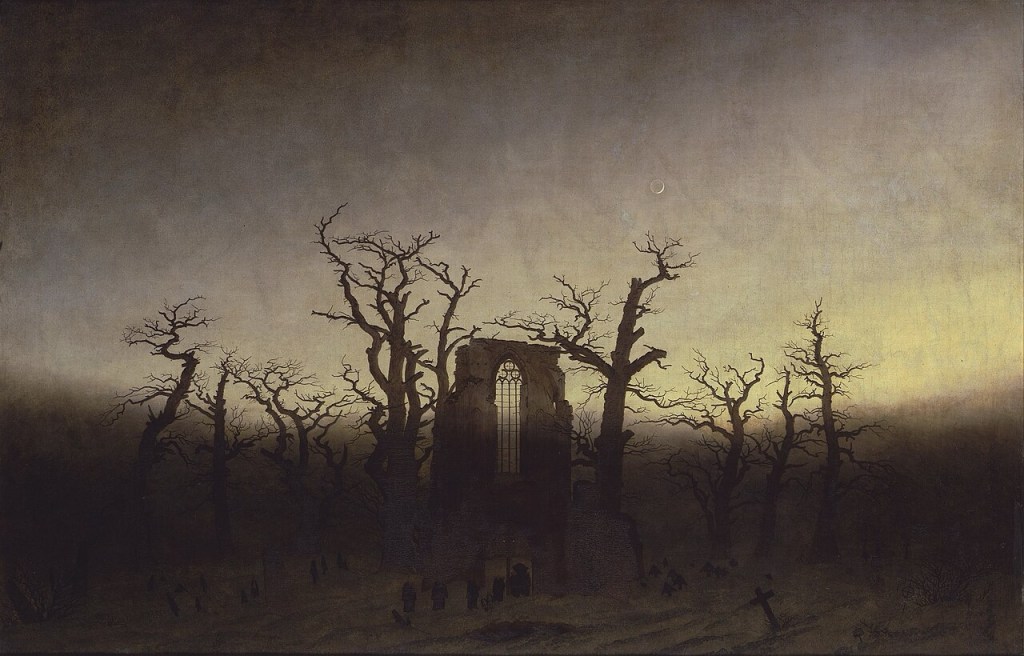
Two paintings, a piece of music, and a prayer accompanied that journey.
Vincent van Gogh – At Eternity’s Gate (1890)
*
Caspar David Friedrich – Abbey in the Oakwood
Come, O true Light.” — St Symeon the New Theologian
“… Come to us, who lie in hell,
… Come, you who have lusted and lust
my suffering soul
come, you alone
to me alone
because, as you see
I’m alone!…
Come, you who set me apart from everything
and you made me unique on earth…”
Only afterwards did I realise that those few days had become an unexpected continuation of “The Talk That Prepared Me”. It is one thing to speak about courage in the presence of suffering; it is another to discover whether one can quietly remain beneath the Cross.
Beyond the Cross, the path continues.
(*) Robert Schumann’s Geistervariationen (“Ghost Variations”) was the last work he completed. He composed it in February 1854, shortly before his suicide attempt and subsequent admission to a psychiatric asylum, where he spent the final years of his life.
Even though it is is 31C, it is raining. One of our friends said, “you have brought the rain with you from Manchester.” Indeed, but I drank from the fountain of Christ’s Mercy.
St Efraim the Syrian writes:
“Thanksgiving be to Him who caused a stream to flow forth
in the mouths that had been closed,
so that they might give praise without end, through the Son,
to the worshipful Father.”
Nisiben hymns 69
The evening was spent in conversation with Sister A and S at C’s house. The conversation was pastoral in nature, and the conversation revolved around the vicissitudes of life that we all suffer. Set within that larger framework of God’s divine plan.
It is a blessing to share one another’s burdens and to focus on our faith, our common heritage, within a world which often has taken the wrong direction and that is searching for answers. St Paul, in his letter to the Galatians in chapter 6 v. 2, writes, “Bear one another’s burdens, and so fulfil the law of Christ.” So, in acceptance of these words, we were indeed bearing one another’s burdens, and in so doing, fulfilling that law of Christ, to love God and to love one’s neighbour.
St Porphyrios says, “Christ is everything.” So, we should not add or subtract anything to our Christian faith, since, by adding, we compromise, and by subtracting, we fall short of that perfection which God calls us to. C.S. Lewis calls this “Mere Christianity.”To Wormwood, his nephew, in the Screwtape Letters, he says, what we must do is to keep them in the state of mind I call ‘Christianity and …’, you know, ‘Christianity and Crisis’, ‘Christianity and the New Psychology’, ‘Christianity and the New Order.’” To add to that, perhaps ‘Christianity and Politics.’
The horror of the same old thing is one of the most valuable passions we have produced in the human heart. It creates an endless source of heresies. Pure Christianity, with nothing added and nothing taken away, we find in the monasteries.
C.S. Lewis writes again: “just as we pick out and exaggerate the pleasure of eating to produce gluttony, so we pick out the natural pleasantness of change and twist it into a demand for absolute novelty.”
Original, authentic and unadulterated Christianity does not need nor seek approval of the world, or indeed embrace its passing fads and fashions and fantasies. It remains steadfast to apostolic order, to true doctrine and to the living tradition.
Any movement that is required is impelled by the action of the All-Holy Spirit. Amen.
Somereflections on “hiding” and “hiddeness” in God, on holy obedience, on the force of the preposition ‘in’, and lovely, amplifying words by George Herbert, my favourite metaphysical poet(1593 – 1633), in his poem‘Colossians 3:3’
Eothinon VII
Mode grave
“Ἰδοὺ σκοτία καὶ πρωΐ… Lo, darkness and early dawn. And why, Mary, are you standing by the grave, your mind full of darkness? Why do you seek where Jesus has been laid? But see the disciples running together, see how they have realised the Resurrection from the grave clothes and the napkin, and have remembered the Scripture concerning this. With whom and through whom we too have believed and sing your praise O Christ, the Giver of Life.”
*
“For you have died, and your life has been hidden with Christ in God.” (Col 3:3)
*
It is probably my first ever Sunday Holy Liturgy at about 02:00!! Other than Easter Sunday of course. Only “one worth comes to mind with the chanting,…ethereal! I meant word but indeed it is worth in the true sense of a noun … the level at which someone or something deserves to be valued or rated.”
I feel surrounded by angels, not monastics. These sisters never sleep! They pray all the time and they are hidden from the world.
I kneel to receive the blessing of Gerondissa Mariam before Holy Communion and she tells me that she has read my note and gives me her blessing to come as often as I want, unconditionally… What a gift!Such undeserved mercy and graciousness!
Inside the church, other than the sisters and the priest, it is only the five of us, fellow pilgrims. How strange for a Sunday Holy Liturgy even in a monastery, let alone a parish in the world, to be so “empty” at the Sunday Holy Liturgy!
After the dismissal of the Liturgy, silently we retire to our cells for some rest and hesychia, and then proceed to the morning common meal where we eat while listening to a sister reading Saint Gregorios Palamas’ homily on Nestor. Then Gerondissa Mariam takes the floor and offers a homily on the mystery of holy obedience to our spiritual father: (Just in case, we had missed that key point in all the sisters’ words yesterday: that Holy Obedience is the “one thing needful … that good part which shall not be taken away” ,Luke 10:41–42).
“St Nestor first received the blessing from his spiritual father, St Demetrios in the prison “bath-house” where he was chained, and then contested and defeated Lyaeus. This is so revealing of the power of holy obedience. St Demetrios blessed Nestor and in fact told him that he would be victorious but would then be martyred. Receiving the Saint’s blessing and sealing himself with the sign of the precious Cross, Nestor presented himself in the arena, and prayed, “O God of Demetrios, help me!” –“Ο Θεός του Δημητρίου βοήθει μοι”, uniting his will with that of his spiritual father, and ultimately with God’s Will.
Straightway he engaged Lyaeus in combat, and much to everyone’s surprise, the stripling novice smote Lyaeus with a mortal blow to the heart, leaving the former boaster lifeless upon the earth, and defeating the previously undefeated imperial champion. Nestor thus stroke a blow against idolatry. Many of the spectators believed that “the God of Dimitrios” had, indeed, helped him. This infuriated Galerius, who must have suffered considerable loss of face, and he ordered the decapitation of the young man. See the fruit of holy obedience? This we must all imitate!”
Our morning common meal comes to an end, prayers are said, and all nuns swiftly disappear back to their cells to pray, other than the very few ones whose obedience are the guests. No visitors yet, as the monastery gates are still closed and will open up only much later in the afternoon.
If yesterday it was the silence of the monastery which struck me, that true hesychasm, today it was the mystery of its hiddeness which permeated me.Certain experiences are so difficult to express in words.
The rest of the morning is spent in silent strolls, the Jesus prayerand quiet conversations with a few nuns around us, “pondering the mystery of “hiddeness” in our heart” (Luke 2:19). A different ‘spiritual surgical procedure’ in the “Antechambers of paradise”.
St. Paul says that “our true life is hid with Christ in God” (Col. 3:3). Such a rich verse that apophatically speaks of theosis, true mysticism!The sisters humbly admit that these lines are beyond their understanding.
It is this preposition “in” that makes all the difference. I don’t believe that there is a God, intellectually; I believe in God empirically. I believe you….or should I say …I believe in you. What force this has! “I believe in one God ….”
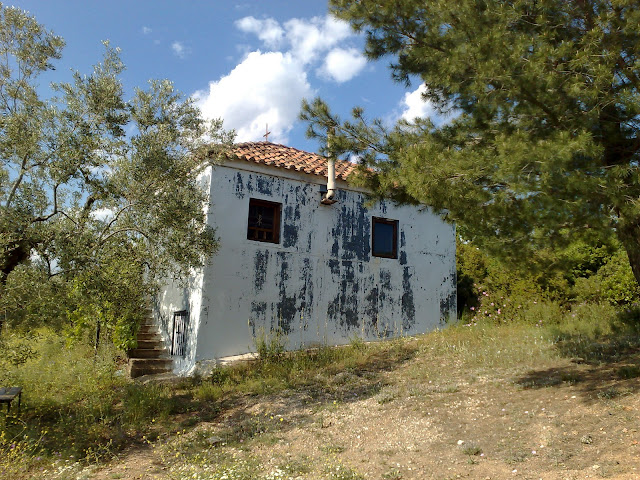
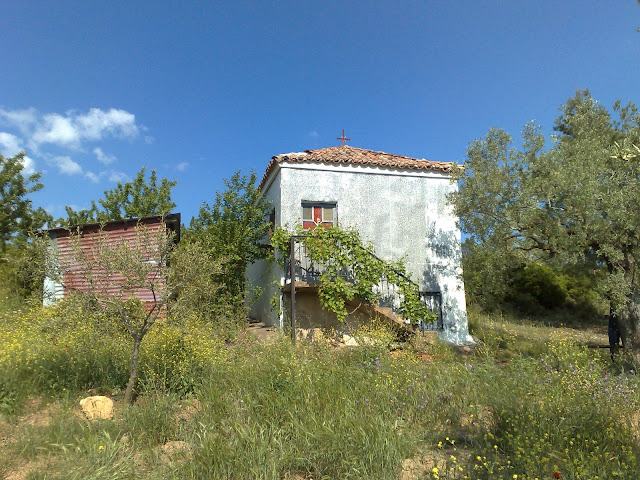
+ Gerondas Gregorios’ cell outside the monastery
Let us now see how George Herbert, a favourite metaphysical poet of mine, expands these Bible words ‘Our life is hid with Christ in God’, taken from St. Paul’s letter to the Colossians and how these words are themselves hidden within this poem. Pay attention also to how he personalises the words– ‘our’ is changed to ‘my’.
Colossians 3:3′
My words and thoughts do both express this notion, That Life hath with the sun a double motion. The first Is straight, and our diurnal friend, The other Hid, and doth obliquely bend. One life is wrapped In flesh, & and tends to earth: The other winds towards Him, whose happy birth Taught me to live here so, That still one eye Should aim and shoot at that which Is on high: Quitting with daily labour all My pleasure, To gain at harvest an eternal Treasure.
Isn’t this beautiful? As in many of his poems, Herbert uses pattern and shape to explore his theme. The expanded line runs diagonally through the poem, creating a tension which is only resolved in the final line. Double meanings help to create the tension. On the one hand, we live our everyday, earthly lives. On the other hand, we live our eternal, heavenly lives. Our life ‘wrapt in flesh’ pulls us down to earthly things: the upward movement ‘winds towards Him’. Christ himself experienced a double motion. Not only did he come down to earth from heaven in his human birth, but he was raised to heaven in his resurrection.
As in other poems by Herbert, ‘sun’ and ‘Son’ are punned. The movement of the sun is used to shine light on the movement of the Son of God. For the sun has a double motion – we are most familiar with its daily east to west motion, ‘our diurnal friend’. However the sun moves annually from west to east, and this pattern was illustrated by an oblique or diagonal band around the globe. ‘It doth obliquely bend’.
There is a hidden quality to the ways in which people live out their faith in God, for there is a hidden quality in the way God is active in the lives of people. We do not always recognise God’s purposes and ways of working in the world. We do not see the whole until the end, but for Herbert, the treasure to be found during earthly and eternal life is Christ.
The day is coming to a close. At long last, the monastery is full of pilgrims, even if briefly. Vespers follow, coffee, and social time for everybody. Then obediences for us in the kitchen, washing and tidying. The kitchen seems to be always the busiest area in any “home” 🙂
I had never thought one can really “bend”, transcend Time until I spent last week together with my little Abouna. Together, we drove hundreds of miles, visited a number of Holy monasteries, met Gerondas, received holy words, but most importantly, for me at least, we transcended Time into Kairos, ie. made a Leap unto God’s Saving Time, God’s Providence for our salvation.
How many dimensions exist in reality? And which dimension were we travelling together with Abouna?! Which dimension is Love? Fifth? This ‘travelling’ has probably been one the most liberating, healing experiences ever in my life, especially since I was so stressed, worked out and nearly burnt out in my obediences the last twelve months. Though the truth is that I was really stressed, worked out and burnt out by my own mind.
“Time is relative; its only worth depends upon what we do as it is passing.” as Einstein wisely pointed out to us. And “ there are only two ways to live your life. One is as though nothing is a miracle. The other is as though everything is a miracle”. And: “God does not play dice with the universe.” Or with our lives. How true all these! And all this I experienced first-hand during these four days together with Abouna.
God is indeed the master of time and circumstance: “And He changes the times and the seasons; He removes kings and raises up kings; He gives wisdom to the wise And knowledge to those who have understanding.” Daniel 2:21
“The Lord gave us chronos time, calendar time, that we may turn it into kairos time, salvation time, time filled with opportunities for us to respond to God’s gracious invitation to the Kingdom”. ~Fr. Anthony Coniaris
Little did I understand those quotes and how literally they are to be taken before I became Abouna’s chauffeur, guide, interpreter and secretary for four days and a witness to how God scandalously intervenes in our lives and plans and provides the precise timing, reversals, cancelations and interruptions so that we meet the “right” people in the “right” place! I became a witness to all these miracles, but also to Abouna’s ease at this “normal”, swimming, flying, floating in Kairos.
***God has a way of surprising us and altering our plans.The visit to St Dimitrios shrine was full of such delightful God- intervening surprises.***
Indeed, a plethora of details is to follow, but let it suffice for the time being to say that this 4 days’ intensive course into Abouna’s daily time ‘management’ have drastically changed my experience of Time, and hopefully this ‘meta-noia’ will last. The list of my obediences after his visit is the same, or even longer, but I somehow have “more” Time, and I certainly have more Joy and Gratitude and Thanksgiving.
Time and stress seem to have loosened their grip on me. “Therefore do not worry about tomorrow, for tomorrow will worry about its own things. Sufficient for the day is its own trouble.” (Matthew 6:34) I have also, immediately—in obedience— started taking two half days off for hesychia and have resumed my Byzantine chanting lessons which I had sadly given up before summer because “I had no time …”. And I feel that this is only the beginning in this so post-quantum, and yet so ancient, and so St Porfyrios, and indeed all the saints’ experience of flying in Kairos:
“Poor people… We live, we read books […] and yet we remain in a relaxed state, recklessly living without Christ. Christ is different. When He comes to a person, entering his soul, the soul changes. A soul [that knows Christ] lives everywhere: on the stars, in the spiritual world, in the Universe. Life without Christ is not real life. … Christ is the new life. Christ is everything. He is joy. He is life. He is the light, the true light, allowing a person to rejoice, to fly, to see everything and everyone. … Love Christ and prefer nothing to His love. He is the source of life, He is everything. Everything most beautiful is in Christ.”
Glory to God for all things! Vignettes from our 4 days together to follow soon …
Creation is groaning … Another young wild horse of Petala found dead yesterday, after losing habitat
Abouna’s Feedback on my Reflection
*** God it seems bends time in order for those who seek Him to receive His grace . Time is not really measured in monasteries. Of course there are set times for worship and work but one does not sense time passing.***
***
“May it be blessed
I think this is a most clearly distilled profile of our time with Christ. I don’t think it is in any way an alternative diary but a complementary (with an e) account of our joint experience. I too found this to be so true.
Indeed in my first day’s diary I think I mention so many blessings in such a short time. I find St Porphyrios words so poignant for they dispense our lived experience in Christ in such a lyrical way.
The people that we met were so lovely. The Christian soul is often seen in the eyes. I wrote to Theologos and said when I met his family heart spoke to heart and spirit to spirit.
William Blake in his poem “Eternity” wrote
“He who binds to himself a joy Does the winged life destroy; But he who kisses the joy as it flies Lives in eternity’s sun rise.”
Homily on MATTHEW 14:22-34 — 9th Sunday of St Matthew
A Homily and a favourite Poem
“At that time, Jesus made the disciples get into the boat and go before him to the other side, while he dismissed the crowds. And after he had dismissed the crowds, he went up into the hills by himself to pray. When evening came, he was there alone, but the boat by this time was many furlongs distant from the land, beaten by the waves; for the wind was against them. And in the fourth watch of the night he came to them, walking on the sea. But when the disciples saw him walking on the sea, they were terrified, saying, “It is a ghost!” And they cried out for fear. But immediately he spoke to them, saying “Take heart, it is I; have no fear.” And Peter answered him, “Lord, if it is you, bid me come to you on the water.” He said, “Come.” So Peter got out of the boat and walked on the water and came to Jesus; but when he saw the wind, he was afraid, and beginning to sink he cried out, “Lord, save me.” Jesus immediately reached out his hand and caught him, saying to him, “O man of little faith, why did you doubt?” And when they entered the boat, the wind ceased. And those in the boat worshipped him, saying, “Truly you are the Son of God.” And when they had crossed over, they came to land at Gennesaret.”
The Gospel writer presents us with a vivid scene on the Lake of Gennesaret. Peter sinking beneath the waves is a picture that resonates with our own condition when we are overcome with anxiety, guilt, sin, overwork, doubt and grief. We become immersed in the conditions that surround us, unable to focus on anything else. The waves seem to be too high and we begin to sink under the waves of pressure.
Peter may have had in mind the Psalm when in his panic and despair he cries out to Christ:
Psalm 69:1-2
Save me, O God! For the waters have come up to my neck. 2 I sink in deep mire, Where there is no standing; I have come into deep waters, Where the floods overflow me.
We see that our Lord, after he had dismissed the crowds goes up into the hills to commune with His Father. After prayer he goes to the Lake of Galilee but His disciples had already gone fishing and it was dark, the fourth watch of the night,3.00 am.-6.00a.m. It is in the middle of the night when fear may overcome us. There was a strong wind that caused a storm on the waters. He walks on the water towards the disciples boat. His disciples thinks it is a ghost and they are terrified. We notice here how the storm outside, had entered into them and they cry out with fear. It is then when they were at their most vulnerable that Christ speaks His words of reassurance:
“Take heart, it is I, have no fear.”
When we find ourselves battered without and within by the storms of life then Christ will come to us bidding us to take courage and trust in Him.
Peter immediately responds:
“Lord, if it is you, bid me come to you on the water.” The “if” signals a doubt in the mind of the apostle.
One word from our Lord,“Come!” So Peter jumps out of the boat, but he takes his eyes of faith from the Lord Jesus Christ and is more concerned about the surrounding turmoil and prevailing storm and begins to sink beneath the waves. This is precisely what often happens to us. We lose focus, we are distracted, we take our eyes from Him Who is the Lord over all Creation and we are embroiled, consumed, overwhelmed by the condition(s) in which we find ourselves.
Peter cries out: “Lord, save me!” and the Saviour does just that, despite his lack of faith, extending his arm for Peter to grasp. How speedily this vision takes us to the Icon of the Resurrection in which our extends His arms and brings Adam and Eve out from Hades. This is what Christ does for us, but we also can extend that saving “hand” of friendship, that word of comfort to others whose faith is weak, who feel lost; those that are sinking under the waves of anxiety. We see how Christ immediately comes to the rescue.
The miracle here is not that Our Lord Jesus walked upon water, but that His word and action is immediate towards His disciples! The One who made the Heavens and the Earth, the Sea and all that is therein, is Lord over all nature. He who multiplies five loaves and two fish to feed 5000 can walk upon the waters, can turn water into wine, can calm the storm, can cause a multitude of fish to be caught. The real miracle is that Christ knows our needs and responds to them immediately. He is with us always even unto the end of the age and His hand supports us and saves us now and unto eternal life.
Lord save us!
And when they entered the boat, the wind ceased. And those in the boat worshipped him, saying, “Truly you are the Son of God.”
Christ is indeed our Saviour and the Son of God
The poem “Footsteps in the Sand “so eloquently illustrates the nature of our loving and saving Lord Jesus Christ:
One night I dreamed a dream. As I was walking along the beach with my Lord. Across the dark sky flashed scenes from my life. For each scene, I noticed two sets of footprints in the sand, One belonging to me and one to my Lord.
After the last scene of my life flashed before me, I looked back at the footprints in the sand. I noticed that at many times along the path of my life, especially at the very lowest and saddest times, there was only one set of footprints.
This really troubled me, so I asked the Lord about it. “Lord, you said once I decided to follow you, You’d walk with me all the way. But I noticed that during the saddest and most troublesome times of my life, there was only one set of footprints. I don’t understand why, when I needed You the most, You would leave me.”
He whispered, “My precious child, I love you and will never leave you Never, ever, during your trials and testings. When you saw only one set of footprints, It was then that I carried you.”
Yesterday, I heard two familiar pieces of music on the radio. It took me back to when I studied music at school. There, as part of preparations for our examinations we followed the music scores of Bach’s Brandenburg Concert #3 and Schubert’s Fifth Symphony whilst listening to vinyl L. P. recordings of these works. It was both a duty and joy to follow and listen under the observations and instructions of a good teacher. Over and over again, our small group of pupils would listen to the recordings until we became so familiar that we knew them off by heart for the exam to follow. Some years later, I was pleased to hear these works played in concert by a live Orchestra. That initial schoolboy learning process was transposed into wonder as I witnessed each member of the Philharmonic playing their part under the conductor for the audience’s delight.
In an Orchestra, breath and hands on musical instruments bring sound to notes, as breath gives voice to words in praise of God and hands bring mercy and kindness to others. Just as music is the fuel to stir emotions, Christian love is the engine to move faith and hope into action. Our Christian life too, often starts with listening and following the scores (the Bible/the Liturgy/the Church Fathers), paying attention to the Teacher and Conductor of our life (Christ), and then working together (in fellowship)for the benefit and joy of others(evangelism).
Theme: Working together in Harmony
Luke 15:25
“Now his older son was in the field. And as he came and drew near to the house, he heard music and dancing.
When one desert father told another of his plans to “ shut himself into his cell and refuse the face of men, that he might perfect himself,” the second monk replied, “ Unless thou first amend thy life going to and fro amongst men, thou shall not avail to amend it dwelling alone.”
Many arrived and adjusted themselves to a listening mode in the auditorium.
The orchestra entered, settled themselves, tuned up and looked intently for the Conductor’s command.
Sound and silence became a dialogue.
Both the ones who played and those who listened melded into a dynamic organism;
a heartbeat giving life to a body.
The union of loving strings buzzed as bees in a hive,
To shrive the withered minds and weary limbs,
And having worked the nectar and shared the pollen from the hours of practice and rehearsal,
Produced the honey for those seated to taste.
The audience feasted on the abundant sweet notes
And were swept along and above to a higher form;
from their mundane routine to another dimension.
They were moved, transported to the land
Of awe filled tears,
Where harmony is the currency,
Where sunshine sparkles
and dances on the ears.
Beads of infinity permeate the throng in this communion song;
Inspiring first emotion, then empathy, followed by wonder and finally joy.
Such joy as can never be captured but glimpsed-only glimpsed,
In a gilded moment, felt in the heart,
digested in that part
of the mind which is forever a child’s laugh or first remembered summer.
As food is energy to the body so is music nourishment for the soul.
Such provision was encouraged by a ministering angel’s smile, sent
In order for us to repent from worldly guile.
We are drawn into that scented circle, inexorably and imperiously drawn
By that mysterious sound that claims and wraps our tender frame.
“But why so little music in the Gospels?”
“Hosannas” with palms endorse a King
And older Psalms, of course, to sing!
But where is the chorus for our dreams?
Only for the Prodigal it seems!
Was music not given by God to grace the mind of all,
make glad the heart, to heed the call?
Is there not harmony at the centre of the Universe?
Or is it that our lives in Christ should rehearse
for heaven;
reverse the ego’s trend and blend to be
a sounding board with others in that greater symphony.
Epilogue
A Harmony with Thee
Glory be,
Viva Vivaldi,
Not I but we,
Was blind now see,
Oh Mystery,
Oi Agioi kai Angeloi,
In unity
with The Holy Trinity.
A tree is known by its fruit; a man by his deeds. A good deed is never lost; he who sows courtesy reaps friendship, and he who plants kindness gathers love.
I am pleased to report that Kimberly the Cucumber, Tom the Tomato plant and Kristian the Capsicum Chili Pepper are flourishing. Kimberly has many flowers and the small cucumbers are beginning to develop, Tom is growing taller and taller every day and producing many cherry tomatoes and Kristian is, at last, turning from green to yellow, which, I am reliably informed, he should! The one thing in common with all these plants is that they have all needed some physical support to grow with bamboo garden canes. The cucumber has tendrils, so she wound herself to the cane without any help, the other two have required a little assistance to be tied with string to their main support.
We humans too need all the help and support to grow in the spiritual life.
The Nail
Trisagion: Holy God, Holy Mighty, Holy Immortal, have mercy on us.
Philippians 4:13
I can do all this through him who gives me strength.
Luke 22:32
“But I have prayed for you, that your faith should not fail; and when you have returned to Me, strengthen your brethren.”
The matchstick strikes brief heat and light
The nail stays firm with its great might,
The matchstick though is small and frail
Unlike the large and sturdy nail.
But when we place them side by side
The nail assumes parental pride,
The matchstick from the nail will take
Its strength and so it will not break.
Good God above whose hallowed name
Invests His strength to gird our frame,
Holy God, Holy and strong
Stay close to us our whole life long.
You cannot destroy the passions on your own, but ask God, and He
will destroy them, if this is profitable for you.
One of my parishioners was kind enough to bring me some strawberries and raspberries yesterday from her allotment. Setting apart her own hard work, which is considerable, she had been reflecting on the Wisdom of Creation, especially God’s economy and His timing for the ripening of the fruits. The vegetables, nuts and fruits ripen at various times of the year, giving us an excellent sufficiency and supply, dispersed over many months.
I have many pots of flourishing Basil on my window sill; all at different stages of growth. I am able to give these little gifts to others as a small offering back to God. His economy, from Greek oikonomia,- “management of a household,”is indeed a mysterious outpouring of grace.
Throughout this pandemic, the beauty of Creation has been a constant source of comfort and encouragement. Sadly, human economics is often motivated by greed, power and self interest, but despite this, we see how God replenishes the earth.
Worldly economy is driven by pride, but simpler values and needs are seen in times of crisis. The Great Wall of China could not contain the coronavirus, but Christ builds human bridges of love to care for others who are sick.
As King David observed in writing the Psalm:
“The earth is the Lord’s and the fullness thereof.”
God is humble, loving and plenteous in mercy. What a wonderful world we would have, if we followed His example and obeyed His commands.
Building Castles in the air
Reflections on a walk in the City of London
Luke 3:5:”Every valley shall be filled
every mountain and hill brought low;
The crooked places shall be made straight
And the rough ways smooth;”
Soaring glass houses in the London skies
Shrink the deserted souls of EC 1.
There grow commercial plants that fertilize
The f.t. index by a deal well done.
Pretty palaces where the cool, jet set
Drive in darkened windows on alloy wheels;
Which rotate around the secret text and debt
In guarded boardrooms and brunch- type meals.
Life is wealth for such giants of the air
Served by tube and Liverpool Street station;
The stocks and bonds without guilts and care
For the needs of the poor and their own salvation.
God sees the hearts of these important men
Who dispense numbers from their golden towers.
He writes history’s balance sheet with His pen
New Babel falls by mans’ own fallen powers.
Yet in the shadow of Goliath’s feet
Lies a sacred stone of royal David’s line;
St. Botolph’s within the good Bishopsgate
Where wounded souls are healed through bread and wine.
High life soon stumbles and submits to grief
Let white flags of surrender be unfurled,
Your treasure be beyond the hand of thief
Walk humbly in the graveyard of the world.
As abba Macarius was returning to his cell from the marsh carrying palm-leaves, the devil met him with a sharp sickle and would have struck him but he could not. He cried out, “Great is the violence I suffer from you, Macarius, for when I want to hurt you, I cannot. But whatever you do, I do and more also. You fast now and then, but I am never refreshed by any food; you often keep vigil, but I never fall asleep. Only in one thing are you better than I am and I acknowledge that.” Macarius said to him, “What is that?” and he replied, “It is because of your humility alone that I cannot overcome you.”
The poem was written shortly before the Bank Crisis and great economic recession of 2007-8.
There is nothing quite like receiving a hand written letter. They have substance and form, they have shape and content. People who write letters take the trouble and the time to choose a card, to buy a stamp, to write in their own hand and post the letter. Sometimes it is interesting to decipher their own idiosyncratic style! I recall a teacher at school who taught all his pupils to write in calligraphic “copper plate” English Roundhand. One always could detect who had been taught by this teacher in their first year at Secondary (High )School! Letters, like teachers leave a lasting legacy for the recipient too.
Cards and letters today are often reserved for Birthdays, Anniversaries, Christmas and Pascha (Easter); but how nice it is to receive a note of thanks or a note of encouragement-it lifts the spirit. I received two such cards last week. Writing thank you is so important because first and foremost we are called to be Eucharistic creatures.Whilst e mails and texts are convenient and efficient, they lack a certain permanency.
Some years ago I knew a dear lady who lived in the Parish where I served as priest. She was born in Holland, her father was French and her mother Polish. She had lived in England for many years. Eccentric in a most delightful way, she was kind and considerate of others always writing copious thank you notes to them. She was a voracious reader of poetry and philosophy; speaking fluently in four languages she would regale visitors with amazing stories from her remarkable life. Bedridden now in old age, she loved the trees and the birds outside her cottage. On one pastoral visit, she said to me, “Father, I would like you to have these letters, you may find them of interest.” She thrust three yellow envelopes into my hand.
On reading them, I discovered they were thank you letters, one such read… thank you O….. (name),for the beautiful flowers which you placed in our room and the delicious cake which you baked for us, signed………….Winston and Clementine Churchill.
I have spoken about my love of trees before, but today apart from their intrinsic beauty in creation, let us thank God for that which they provide us: protection, physical and spiritual formation, recreation, habitation and education.
Without trees
Without trees, there is no shade.
Without trees, no icons are made.
Without trees, no barbecue for heat.
Without trees, there is no fruit to eat.
Without trees, there is no home for birds.
Without trees, no paper for these words.
My children, I don’t want Paradise without you. Whoever plants a tree, plants hope, peace, and love and has the blessings of God. Consider all people to be greater than yourself, though they may have many weaknesses. Don’t act with hardness, but always think that each person has the same destination as we do. Through the grace of God I consider all people to be saintly and greater than myself.