A Life Given Away

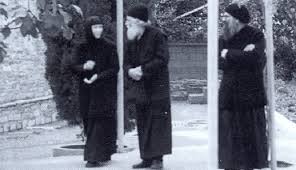
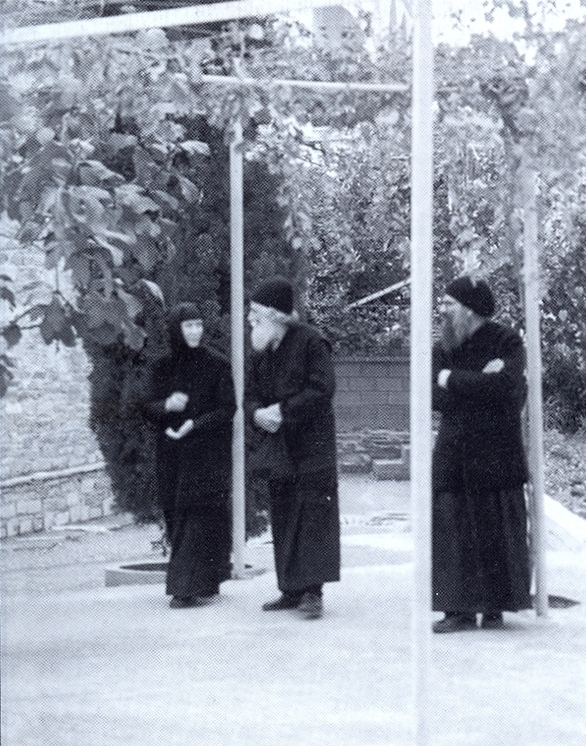
+Gerondissa Euphemia, St. Paisios in the middle and +Gerondas Gregorios, St John the Forerunner monastery, Metamorfosi, Chalkidiki

On the Priest Who Carries Us Until We Find Our Way Home

A Meditation on Priesthood with Father Lev Gillet and Elder Gregorios Papasotiriou, through Memories from My Own Life and Family

“I live for you. I belong to you, because I belong to Jesus Christ. I recognise your right to place your hand on me and to consider me as your servant. Whoever you may be, you who need me in this moment, you are, in the very instant you speak to me, the soul more important to me than any other. You have a right to my entire capacity for devotion and love. I consecrate myself to you”. (Lev Gillet, “Be My Priest,” in Serve the Lord with Gladness: Basic Reflections on the Eucharist and the Priesthood)

*

There are many ways of speaking about priesthood. We can begin with what a priest does: he celebrates the Divine Liturgy, hears confessions, teaches, baptizes, comforts the suffering, visits the sick and accompanies the dying.

Father Lev Gillet begins somewhere deeper.

In Be My Priest, his meditation on priesthood, the priest is understood first in relation to Christ. Christ is the source and model of priesthood, and the priest is called, in Him and through Him, to become what Gillet calls “a priest for all.” 

This leads to three movements which seem to contain much of Gillet’s vision:

Belonging to Christ.
Emptying oneself.
Belonging to everyone.

They are not three independent virtues. One leads into the next. The priest belongs to Christ; because he belongs to Christ, his life is no longer something he possesses entirely for himself; and because he has ceased to guard that life as his own possession, Christ can give it to others. 

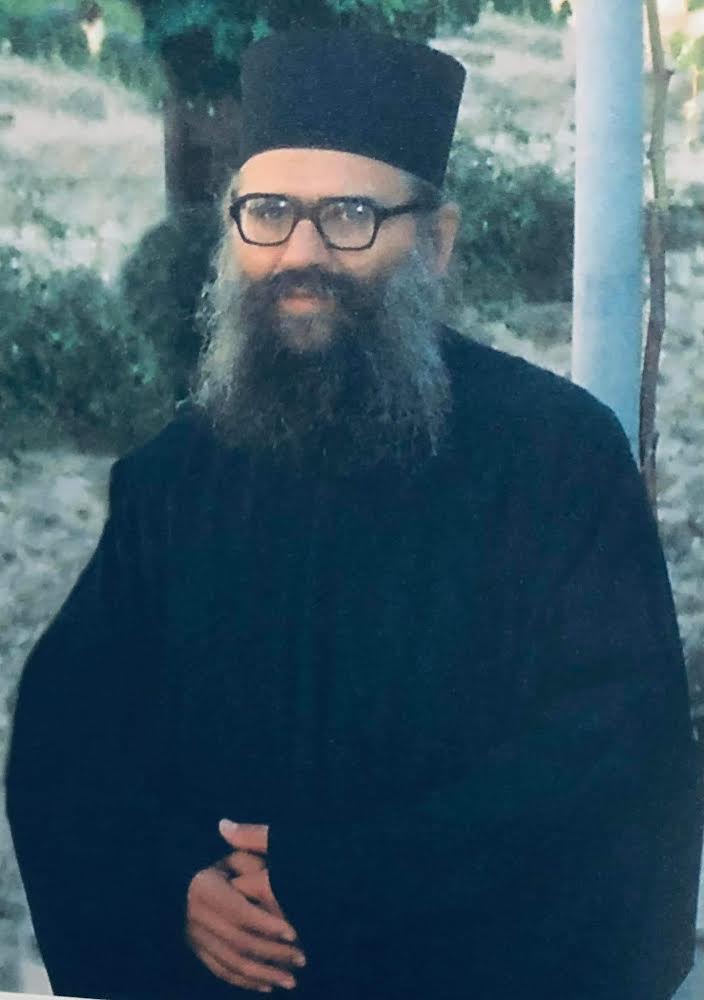
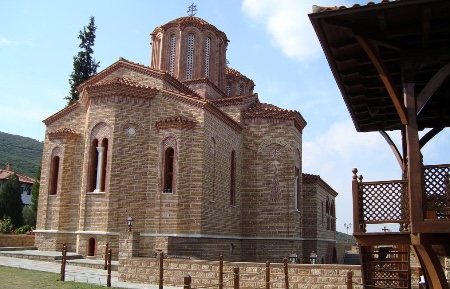
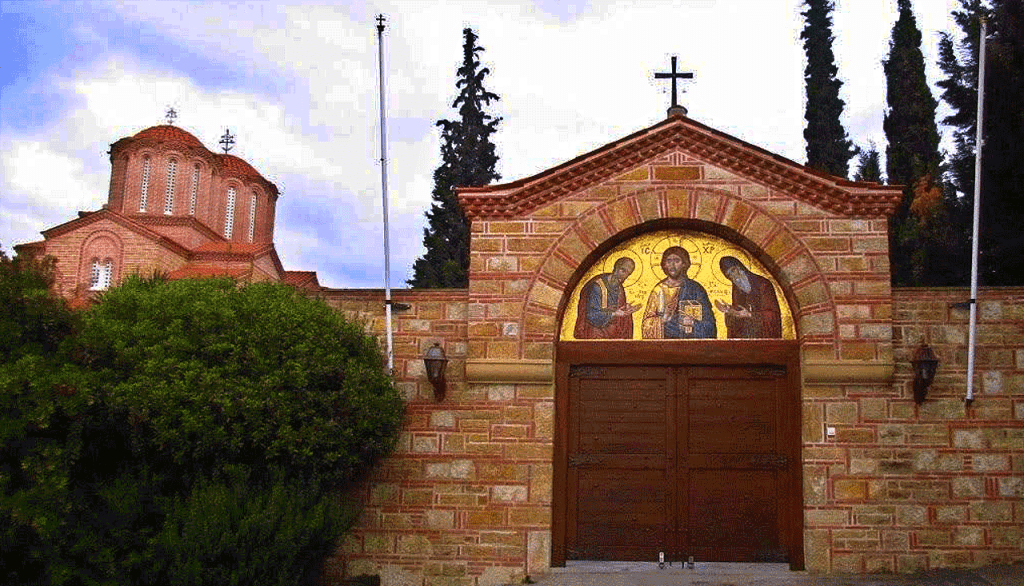
When I read Gillet now, I find myself thinking of someone I knew long before I encountered these words: the late + Elder Gregorios Papasotiriou, my spiritual father in Greece and the spiritual father and confessor of the Holy Monastery of St John the Forerunner at Metamorfosi in Halkidiki.

I do not want to write his biography here. Others knew him longer and can tell much more. I want instead to place some memories of him beside Gillet’s meditation and allow each to illuminate the other.

For I think Elder Gregorios taught me something about Gillet’s priesthood before I knew that Gillet had put it into words.


I. BELONGING TO CHRIST

Whose Are You?

Gillet takes us behind the visible activity of priesthood to a more fundamental question:

Whose are you?

“Before pastoral work, before preaching, before the offering of oneself to other people, there must be what our earlier meditation called “the fundamental surrender: I am Christ’s.” 

That sounds simple until it becomes concrete.

For if I am Christ’s, Christ acquires a claim not merely upon my religious activity but upon my plans, my preferences, my future — even upon the good and holy things I might have chosen for myself.

This is where the early life of Elder Gregorios becomes important.

His own desire was for hesychia. From around 1970 he lived in a small cell at the then-ruined dependency of Dionysiou Monastery at Metamorfosi. His inclination was towards prayer, solitude and the hidden life.

There was nothing spiritually inferior in that desire. Quite the contrary.

But his spiritual father was St Paisios.

And St Paisios cut off his will.

Elder Gregorios was not simply to remain in the solitude he loved. He was to go among people. He was to become a priest and spiritual father, to hear confessions, to guide souls and to carry the burdens of others. In time, and under the direction of St Paisios, the monastic community at Metamorfosi grew around him.

He obeyed.

Gillet’s question, “Whose are you?”, therefore becomes very concrete.

If the answer is I am Christ’s, then even my preferred form of holiness cannot finally belong to me.

The issue is no longer simply:

What good thing would I like to offer God?

It becomes:

What does God wish to do with the life I have already given Him?

This is why obedience is so central here. Elder Gregorios did not surrender something sinful. He surrendered something beautiful: the hidden life of prayer he genuinely desired.

And this gives greater depth to Gillet’s understanding of belonging. To belong to Christ is not merely to believe in Him, love Him or work for Him. It is to allow Him to redirect a life. 

Elder Gregorios wanted hesychia.

Christ, through obedience, gave him souls.

The life he offered to God was returned to him filled with other people.


II. EMPTYING ONESELF

“A Life of Obscurity and Silence”

The second movement follows naturally from the first.

If the first question is Whose am I?, the second is:

What happens to my life because I am His?

Gillet’s answer is kenosis — self-emptying.

One counsel associated with his meditation is strikingly austere:

“Live a life of obscurity and silence; seeking no awards.” 

This is important because self-emptying can itself become romanticized. A person can secretly become attached to the image of himself as sacrificial, holy or indispensable.

Gillet strips that away.

Obscurity means that much of the priest’s real work may never be seen.

Silence means that much of what he carries cannot be spoken about.

And “seeking no awards” means that even the fruits of his labour cannot become his possession.

This is the setting in which I first came to know Elder Gregorios.


Strasbourg

I was in my first year at university.

Outwardly, everything was going extremely well. I was doing very well academically, and there seemed to be a promising future ahead.

Inwardly, things were very different.

I had become strongly influenced by existentialist philosophy. The Christianity I remembered from childhood and school had become something distant rather than a living experience of God and the Church. My actual life was far removed from the life of the Church.

And despite my outward success, I was not happy.

During that first year I travelled to Strasbourg with a university choir for an international choral festival. For about a month we worked on major choral works with choirs from around the world. Between rehearsals and performances there were meals, coffee and long conversations.

Some members of the Greek group began to realise that beneath the surface something was wrong.

Eventually they said to me:

“We don’t think you are well. When we return to Greece, we want you to meet our spiritual father. He will help you find your way.”

I have never forgotten those words.

Something else happened in Strasbourg. I even discovered a beautiful French poem about a soul which wanders away from God and eventually returns to Him!

I kept it.

I did not yet know how closely its story would come to resemble my own.

When we returned to Thessaloniki, I went to the meeting that had been arranged with Elder Gregorios at Metamorfosi.

He had before him a young woman with almost no experience of the spiritual life and very little idea of where she was going.

And he understood that.

He did not try to transform everything at once.

He proceeded with extraordinary tenderness and discernment: gradually, step by step. There was guidance and correction, but also patience. There were messages when we could not meet. Above all, there was prayer.

And there were tears.

People who had known me before Strasbourg and encountered me again during my second year at university could hardly recognise the change.

But much of what produced that change was invisible to me.

This is where Gillet’s “life of obscurity and silence” ceases to be an attractive spiritual phrase.

The spiritual child remembers the conversation.

God knows what happened afterwards.

The spiritual child leaves the monastery.

The spiritual father remains.

He prays.

He remembers the name.

He carries before God a person who may not yet know how to carry herself.

That is a hidden form of kenosis. The priest gives time, attention, prayer and often tears, without being able to guarantee what the other person will eventually do with them.

And in my case, that question would become painfully real.


III. THE FREEDOM TO LEAVE

The Prodigal Daughter

After several years, I reached a point at which Elder Gregorios’s guidance seemed too difficult.

I did not want to obey.

Eventually, I chose my own way.

And he let me go.

This is perhaps one of the most important things I can say about his spiritual fatherhood.

The man who taught us the seriousness of obedience respected my freedom enough to allow me to disobey him.

He did not pursue me in order to force me back. He did not use spiritual authority to overcome my freedom.

He let me leave.

I have often thought since then of the father in the parable of the Prodigal Son.

The father does not believe that the son is making a good choice. He does not bless the departure as though all choices were equally life-giving.

But neither does he imprison his son in the house.

He allows him to go.

This helps us understand something essential in Gillet.

If the priest is becoming “a priest for all,” that does not mean that he possesses all. The person to whom he gives himself remains free.

The earlier meditation expressed the implication starkly: the priest cannot demand a particular outcome, force gratitude, guarantee fidelity or prevent departure. “The gift remains a gift.” …

That is a severe form of self-emptying.

It is one thing to give oneself to someone who responds exactly as one hopes.

It is another to give oneself, to pray and suffer for another person — and then to allow that person to walk away.

Elder Gregorios let me go.

But he did not cease being my spiritual father.

He prayed.

He waited.

I know that he suffered.

And this distinction matters enormously. Respect for my freedom did not mean indifference to what I did with that freedom.

He would not compel my return.

But he would pray for it.


IV. THE RETURN

Eventually came what I can only describe as my own return of the prodigal.

I began to understand that my earlier repentance had not gone as deeply as I had imagined.

This time I was prepared to accept that repentance might hurt.

I returned to Elder Gregorios.

But he did not simply receive me with unqualified reassurance.

He welcomed me, certainly. Yet in a sense he also “played it tough.”

There was love underneath it, but there was gravity too.

He needed me to understand that I could not simply come back because things had become difficult, receive consolation, and then begin the same cycle again.

Something far more serious was involved.

My soul.

And here I began to understand what he meant by obedience.

He was not trying to make me obedient to Elder Gregorios.

He wanted me to become obedient to God.

That distinction changes everything.

The false spiritual father needs the other person’s obedience because it confirms his own authority.

The true spiritual father can allow the person to leave because the person does not belong to him in the first place.

This brings us back to Gillet’s first question:

Whose are you?

The answer is not:

I belong to my spiritual father.

It is:

I am Christ’s.

The task of the spiritual father is therefore not to insert himself permanently between Christ and the soul. It is to help the soul offer itself freely to Christ.

Elder Gregorios could respect my freedom when I left precisely because obedience without freedom would not have been the obedience he was trying to teach me.

And when I returned, he could be demanding for precisely the same reason.

He was not interested in winning me back for himself.

He wanted my return to God to be real.

We do not play with our souls.

The years that followed were difficult. There was suffering. But I accepted it differently because I had begun to understand that repentance was not simply regret for something that had gone wrong. It meant a reorientation of life.

And alongside the suffering there was grace.

There were also experiences which I can only describe as miracles.

The spiritual father had waited.

But the destination of the journey was never the spiritual father.

It was Christ.


V. “I BELONG TO YOU”

We now reach the third movement in Gillet’s meditation.

The priest belongs to Christ. Belonging to Christ empties him of the instinct to preserve his life entirely for himself. Therefore Christ can give him to others.

At this point Gillet becomes startlingly personal:

“I live for you. I belong to you, because I belong to Jesus Christ.” 

And then comes an even more daring sentence:

“I consecrate myself to you.” 

These words could easily be misunderstood.

“I belong to you” does not mean you belong to me.

That reversal would destroy Gillet’s meaning.

The priest’s belonging moves outward. He gives himself; he does not acquire the other person.

And “I consecrate myself to you” means something stronger than professional availability. Consecration is an offering. The person Christ places before the priest becomes, at that moment, someone for whom his priesthood must be spent.

This helps me understand something Elder Gregorios used to tell us.

He would say that the spiritual father carries the sins of his spiritual children and that he will have to give an account before the Judgement Seat of the Lord for the souls entrusted to him — provided that the spiritual child, on his or her part, lives in obedience.

I did not fully understand the weight of those words when I first heard them.

I understand them better now.

The spiritual father is not merely someone from whom I obtain religious advice.

A soul has been entrusted to him.

Therefore:

I live for you.

I belong to you.

I consecrate myself to you.

Not because you have become mine.

But, in Gillet’s decisive phrase:

“because I belong to Jesus Christ.”

That final clause protects the whole relationship.

The priest belongs to the spiritual child in Christ, and therefore he must never make the spiritual child belong to himself.


VI. DISCERNMENT

This also helps explain another dimension of Elder Gregorios: his discernment.

Sometimes it appeared in very small things.

I remember once travelling to the monastery during a particularly confused and busy period. I had left without my driving licence and was driving a different car. There had been delays and complications.

When I eventually arrived, the Elder was waiting.

There was something almost amused in his manner — certainly a smile — as he challenged me about what I had done.

How could I have come without my driving licence?!

Nobody had told him.

I remember incidents like this with affection because they were not dramatic. His discernment did not always announce itself solemnly. Sometimes it came with humour.

But at other times discernment carried an enormous responsibility.

And the most powerful example I remember concerns my father.


VII. MY FATHER

My father was an excellent doctor and a deeply compassionate man. He genuinely loved his patients.

Yet precisely because he had spent his life so close to illness and suffering, he struggled with questions of faith. He found it difficult to reconcile some of what he had witnessed with belief in God. Like life after death …!

He remained outside the sacramental life of the Church.

After retirement, however, he began searching more seriously. He took up Scripture and studied it systematically, volume after volume.

Still, doubts remained.

Then, as he grew older and his health deteriorated, he began experiencing terrible recurrent nightmares.

Dark figures pursued him.

The episodes became so violent that he would wake suddenly or fall from bed and injure himself. We put mattresses and cushions around the bed to protect him.

Naturally, we looked for medical explanations.

Medication? Polypharmacy? Age? Illness?

My father was not a naturally fearful man. He had been an athlete, a champion and was courageous. Yet the experiences continued.

Nobody understood what was happening.

One day at the monastery I mentioned this to one of the older sisters, + Sister Akylina, may her memory be eternal!

By then Elder Gregorios himself was seriously ill and spent most of his time secluded in his cell. Access to him was limited; only certain sisters would disturb him when something important arose.

The sister listened to me.

Suddenly she became very serious.

“Wait here.”

She went immediately to Elder Gregorios.

A short time later she returned with his message.

The dark figures pursuing my father, the Elder said, were demons.

And then came the part that left me stunned.

My father must confess.

He must receive Holy Communion.

He must return to the sacramental life of the Church.

If he did not, Elder Gregorios warned, what he was now seeing in his dreams he would encounter after death.

I was horrified at the thought of repeating this to my father.

Not because I did not believe the Elder.

Because I knew my father.

He was a highly educated physician, accustomed to scientific reasoning, and capable of questioning far less extraordinary religious claims.

How could I tell him this?

But the sisters insisted.

They would pray.

The Elder would pray.

But I had to deliver the message.

Eventually I found the courage.

I told my father.

And something happened that I had not expected.

He did not argue.

He listened carefully …

And after a few weeks … he obeyed.

He confessed.

He received Holy Communion.

He returned to the sacramental life of the Church.

And he was immediately delivered from what had been tormenting him!


VIII. “I CONSECRATE MYSELF TO YOU”

It is here that Gillet’s words acquire, for me, their greatest weight.

“I consecrate myself to you.” 

If we hear this merely as affectionate language, we miss its severity.

Consecrating oneself to another soul means that the priest cannot simply offer what is pleasant.

Sometimes he must comfort.

Sometimes he must remain silent.

Sometimes he must wait for years.

Sometimes he must allow the prodigal to leave.

But if he discerns danger, love may require him to speak.

The message sent to my father was not reassuring. It was frighteningly direct.

Yet if Elder Gregorios truly believed that a soul was in danger, what would love have required?

Silence would have been easier.

But Gillet’s “I consecrate myself to you” leaves little room for the easier response.

The person before the priest — or, in this case, the person whose suffering had been brought to the door of his cell — has become his concern.

This is what makes discernment inseparable from spiritual fatherhood.

To see is not enough.

The priest must accept responsibility for what he sees.

And this returns us to Elder Gregorios’s own conviction that the spiritual father will answer before Christ for the souls entrusted to him.

His warning to my father was therefore not, as I understand it, an exercise of spiritual power.

It was an exercise of spiritual responsibility.


IX. TENDERNESS AND SEVERITY

My own story and my father’s story might at first appear very different.

In my case, Elder Gregorios let me go.

In my father’s case, he sent an uncompromising warning.

But I think the same principle lies beneath both.

Neither of us was coerced.

I was free to leave.

My father was free to reject the message.

Both of us had to choose.

This is why tenderness and severity are not necessarily opposites in a spiritual father.

There is a tenderness that comforts.

There is also a tenderness that refuses to lie.

There is a love that waits at the door for the prodigal.

And there is a love that sees someone approaching danger and cries out.

Gillet’s words help keep these forms of love in their proper order:

“I live for you. I belong to you, because I belong to Jesus Christ.” 

Not:

You belong to me.

That distinction is everything.

Elder Gregorios could not force me to return because I belonged to Christ.

He could not force my father to confess because my father belonged to Christ.

But precisely because he himself belonged to Christ, he could pray, wait, warn, correct, suffer — and refuse to treat the salvation of another person as something unimportant.


X. GIVEN TO ALL

Gillet calls the priest, with Christ and through Christ, to become “a priest for all.” The phrase sounds universal, but its meaning is intensely particular.

“Everyone” never arrives all at once.

Everyone arrives as one person at a time.

A confused university student.

A spiritual child who refuses obedience.

A prodigal who eventually comes back.

A man tormented at night.

A nun carrying an urgent message into a cell.

Another confession.

Another family.

Another person asking for prayer.

Another soul.

This is how the universal priesthood of love becomes concrete.

And this is why the movement from belonging to Christ to belonging to everyone requires self-emptying in between.

Without self-emptying, “belonging to everyone” could become influence, popularity or spiritual power.

Gillet means something different.

The priest belongs to everyone precisely because he has ceased to make himself the center.

His task is not to gather people around himself.

It is to give himself to them in such a way that they can belong more completely to Christ.

This, I think, is what Elder Gregorios tried to do with me.

He did not want my obedience to terminate in him.

He wanted it to pass through him towards God.


XI. THE FINAL OBEDIENCE

There is one further dimension of self-emptying.

In youth and strength, sacrifice often takes the form of activity: travelling, standing, serving, hearing confessions, keeping vigil, receiving people, losing sleep.

Old age and illness demand another kind of obedience.

They demand that the person who has spent his life being available accept that he can no longer be available in the same way.

Elder Gregorios became seriously ill.

His world contracted.

The man who had received so many people became increasingly hidden in his cell.

There is something remarkable about this when placed beside Gillet’s counsel:

“Live a life of obscurity and silence; seeking no awards.” 

Early in life, Elder Gregorios had desired obscurity.

Obedience brought him out of it and gave him to people.

At the end of life, illness returned him to obscurity.

But he did not cease to belong to people.

My father’s story occurred during precisely this period.

A sister entered the cell.

She carried the suffering of someone who was not even present.

The Elder listened.

He discerned.

He sent a message.

The door closed.

There was no public ministry.

No sermon.

No recognition.

Yet somewhere outside that cell, an old man changed direction and returned to Confession and Holy Communion.

Perhaps this is what “a priest for all” finally looks like.

Not necessarily a man surrounded by crowds.

Sometimes simply an old and sick priest in a cell, still allowing one more soul to make a claim upon his prayer.


XII. A LIFE GIVEN AWAY

Looking back, I see a circle which I could not have seen when I first went to Metamorfosi.

A young Gregorios wanted hesychia.

St Paisios asked him to surrender his preference.

He obeyed.

A young university student returned from Strasbourg, not knowing where she was going.

Someone had told her:

“Our spiritual father will help you find your way.”

He did.

Then she refused his guidance and left.

He respected her freedom.

He prayed.

He waited.

She returned.

And instead of making himself the object of her obedience, he tried to teach her that obedience ultimately belongs to God.

Years later her father, nearing the end of his earthly life, received another difficult message from the same spiritual father.

He too was free.

And he too obeyed.

Now Gillet’s three movements no longer seem to me like three headings.

They describe a single life:

Belonging to Christ.
Emptying oneself.
Belonging to everyone. 

And perhaps Gillet’s most extraordinary sentence contains all three:

“I live for you. I belong to you, because I belong to Jesus Christ.” Holy_Cross_Lev_Gillet_Meditatio…

Because I belong to Jesus Christ.

Everything depends upon those words.

Because without them, I belong to you can become possession.

Without them, obedience can become control.

Without them, spiritual fatherhood can become attachment to a personality.

But because the priest belongs first to Christ, he can give himself without possessing.

He can guide and still leave the other person free.

He can allow the prodigal to depart and still wait for the prodigal’s return.

He can welcome without trivializing repentance.

He can warn without making another person’s soul his property.

He can carry another person before God while knowing that the person belongs to God alone.

And eventually he must surrender even the fruits of his priesthood.

The earlier meditation expressed the whole movement very simply:

Christ takes the priest to Himself, empties him of himself, and gives him back to the world. Holy_Cross_Lev_Gillet_Meditatio…

That, I think, is what I witnessed.

Elder Gregorios wanted the hidden life.

He gave that desire to God.

God gave him people.

And over the years, his time, prayer, tears, discernment, strength — and eventually even his weakness — became available to those people.

Not so that they might belong to him.

But so that, through his priesthood, they might rediscover to Whom they had always belonged.

Perhaps that is what a spiritual father finally does.

He carries us for a while.

He waits when we wander.

He calls us back when necessary.

But he never makes himself our destination.

He helps us find our way

Home.

***

The Joyous Pustinik Comes Back — Day 4, Part 2

Friday the 12th, part 2. Panorama monastery is very beautiful. Set up in the hills above Thessaloniki, one can see the bay. Indeed, we can see over to the place (1) where St. Paisios rests. We venerated Elder Symeon’s tomb (2).

We had two hours of great wisdom. Followed by the blessing from the Hegumenos I. Our discussions were focused on the teachings of St. Simeon the New Theologian, sharing mystical experiences centred on humility.

The teachings of St. Simeon the New Theologian draw heavily from the Desert Fathers. Direct experience of God is something to which all Christians should aim and indeed aspire. The teachings which I read many years ago from St. Symeon the Theologian came flooding back, and the discussion made me want to revisit the books which were formative in my embrace of Orthodoxy. Indeed, the power of the Holy Spirit to change lives is real, and to change individuals, to transform them, and to transform situations in which we find ourselves sometimes feeling rather hopeless.

A theme which, at this time, post-Pentecost days, has been realised in many churches where young people are beginning to return to the church. There is a revival of hope.

The conversation echoed a previous thought about the need for solitude of one‘s self within that space where God exists. If one wants to become a channel of divine grace to others, but this is God’s grace. It is nothing to do with ourselves. It is not ours.

We are nothing, but God makes us something. It’s simply a yes to God in all circumstances. St. Simeon the Theologian emphasises the need to listen to the advice of your spiritual father.

The priest Lev Gillet, in his book, called Encounter at the Well, discusses the situation that our Lord found himself in with a Samaritan woman. Christ, wearied by his journey, asks for some water at Jacob’s well. The martyr St. Philoumenos, who was a priest at the well, was with us in the evening in the form of little prayer cards, those magnetic ones which you attach to your fridges, which we had received earlier in the week from a priest.

We were able to give these to the children. The T family came to greet us, to share their love amongst us, to take a blessing and to sing for us. It was like refreshing water on a hot day.

We Christians thirst for God, and we receive him in fellowship, amongst others who are like-minded. He gives abundantly of His life and of His life-giving spring. The evening concluded with a late meal with M, E, G or J, depending on what you wanted to call him, and A. It was a joyous conclusion to a day of deep discussion, shared experiences, and surprising connections that we made.

Although we should not be surprised by those connections, since we have the same Lord, we have the same Christ, and because in His great love and humility for us, He calls us His friends. Amen.

*
(1) Souroti, the Monastery of St. John the Theologian.

(2) Elder Symeon Kragiopoulos tomb in the monastery. I have posted in the past about this holy elder I had the privilege to meet in my life. I owe him so much! https://orthodoxcityhermit.com/2017/10/01/his-eyes-a-flame-of-fire/

About his life and teachings, visit https://pemptousia.com/2016/07/a-man-of-god-father-symeon-krayiopoulos/

https://pemptousia.com/2016/07/the-silent-assemblies-of-father-symeon-krayopoulos/

https://pemptousia.com/2016/07/father-symeon-a-servant-of-the-holy-mystery-of-confession/

https://pemptousia.com/2016/07/the-center-of-theology-of-father-symeon-krayiopoulos/

https://pemptousia.com/2016/07/father-symeon-he-never-advertised-never-proselytized/

https://pemptousia.com/2016/08/father-symeon-krayopoulos-are-you-afraid-of-death/

Confronting Demons: An Encounter with Elder Gregory

From a speech by the blessed Elder Gregory, my first spiritual father, from the Holy Hermitage of the Holy Forerunner. In the photograph above, he is on the right, at the monastery of the Holy Forerunner, together with St. Paisios in the middle and Mother Euphemia on the left.

“I will mention an incident that made an impression on me. Here, when I was hearing confessions, a Mother came with her little child, a teenager, just fifteen years old. The child was thoughtful, and his Mother told me that he was sick and that they had read exorcisms on him, that he had been put under a magic spell. The child came in, and when he came, he sat next to me and told me that his whole body was in great pain and that he was suffering greatly.

Of course, I did not say anything because he was experiencing internal turmoil. I told him to go out for a walk, to go outside for a little while, with the thought of going inside the Temple, inside the Church. He accepted, agreed, and we entered the outer Narthex.

He was quite comfortable there; a pilgrim stood before him, but he did not approach the icons. He looked at the icons, somewhat scared. I told him to make a bow to them, but he did not accept. The devil does not bow, of course; the one who was inside him began to react. I told him, “Make your cross,” and he did not do it correctly; he made some hasty movements, as if he were playing the guitar; this was not a cross he made! “Make your cross correctly, my child”, I told him, but he did not make a cross on himself at all, and I thought of a multitude of Christians who go to church regularly and do not make their cross correctly. The cross has great power; we will talk about the Cross another time. The devil trembles a lot at the Cross.

I took the child, and we walked inside the Church (internal narthex, pronaos). When we reached the main Church, the middle part, he was so scared, so agitated that he wanted to leave. “Why did you bring me here for a walk? Didn’t you tell me we were going for a walk? What did you bring me here for?” “Was this the walk?” 

Of course, it was not the child that was talking; it was the demon that was talking. He was very agitated when I put him inside the main church. I don’t know what he would do if I put him inside the sanctuary, the altar area. The devil wasn’t worried outside; he was worried inside the church. The demon is very afraid of the holy relics.

I had an icon of the Virgin Mary with me, and I sneaked it in unnoticed. As soon as I put it on, he started to get agitated, to burn, to sweat. How agitated the demon gets with just an icon of the Virgin Mary! And how bad you do to yourselves, those of you who don’t wear the Holy Cross on you. All Christians must have the Holy Cross with them.

The poor little child then asked me for water. I went into the sanctuary and, along with the water, I added a little holy water. He wouldn’t drink it at all! “No”, he said to me, “give me some water from the tap to drink”. The demon understood that I had put holy water together with plain water in the glass.  That is why it is a very good habit for those of you who, after their morning prayer, drink a little holy water and then go to work.

From this torment of the sick child, we sometimes wonder, my brothers, if these poor children who have demons inside them suffer so much here, in this life, what will happen when they go up there….”

You do understand, don’t you? 

These are a few thoughts I wanted to tell you, my brothers, and sometimes we wonder”.

Born for Eternity

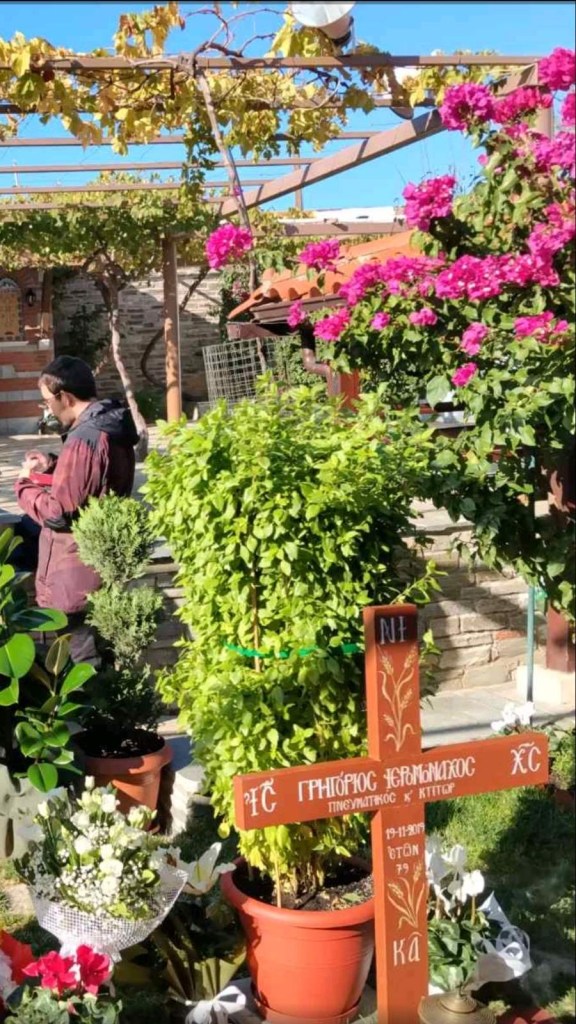
+ Father Gregorios, 19 November, 2019 — 6th year Memorial service

Memory Eternal, dearest Father!

“Love in Christ is a sacrificial Love, a self-sacrificing, self-denying Love, Agape. You sacrifice everything for the person you love, “your neighbour”. By “our neighbour”, we mean every person as God’s Image, even our enemy. By “love” we do not mean that we should do whatever the other person wants us to do, but to love him with Christ’s burning and flaming Heart, for his salvation” (+ Elder Gregorios Papasotiriou)

*

This is how we have always felt his love! For years, Gerondas Gregorios of blessed memory offered his prayers with tears and his never-to-be-forgotten spiritual guidance. My rebirth in Christ ((John 3:4), my new life literally started with his guidance about 40 years ago. I feel so unworthy of such a blessing!

*

“Father Gregorios, born Dimitrios Papasotiriou, was born on February 16, 1940 in Paleokomi, Serres, to pious parents, Alexios and Efthymia.

From his childhood, he was characterized by an inclination for life in Christ and very early he felt the divine call for the priesthood and complete dedication to the Lord through the monastic calling. Thus, after completing his studies at the Theological School of Aristotle University of Thessaloniki, he came to the Holy Metropolis of Kassandria, where he was ordained a deacon and priest by the blessed Metropolitan Synesios Visvinis. During his stay in Polygyros, the Elder, together with other fathers under the guidance of Fr. Spyridon Trantelis (later Metropolitan of Lagadas), formed a group that served the people of God, as well as the children of the Polygyros boarding school for boys, with much love and self-sacrifice.

From his student years, the Elder particularly loved Mount Athos. He visited it very often and was particularly associated with the Holy Monastery of Saint Dionysios and the blessed Hegumen Fr. Gabriel, who became his spiritual father for a number of years. However, the main turning point in the Elder’s spiritual journey was his acquaintance with Saint Paisios the Athonite. He became connected to him with an unbreakable spiritual bond, becoming his disciple and striving throughout his life to imitate his holy life. In fact, Saint Paisios also became his godfather during the monastic tonsure of Elder Gregory in the cell of the Holy Cross in the year 1977.

In the year 1970, the flame of hesychia led Father Gregory to the then dilapidated Metochion of the Holy Monastery of Saint Dionysios in Metamorphosis, Chalkidiki, where, with the blessing of the local Bishop, he settled in a monastic cell-barn next to the Church of the Holy Forerunner.

This place from then on became the arena of his great ascetic struggles and the base for his priestly-pastoral ministry here in Chalkidiki. Only God knows his ascetic labors and efforts in order to serve the people of God with the pilgrimages, the preaching, the confession, the holy services, the vigils, the divine Liturgies. Saint Porphyrios, who attended a divine Liturgy in 1974, commented: “When Father Gregory serves the Holy Liturgy, all of God is within him and all of Father Gregory is within God.”

With the encouragement or rather the command of Saint Paisios, the life of the Monastery begins in 1975. The Holy Monastery of Dionysios grants the necessary area for the construction of the Holy Hesychasterion. The blessed Abbots Fr. Gabriel and Fr. Charalambos supported Elder Gregory with great love, foreseeing that the now deserted place of the old Metochion would be transformed into a spiritual oasis. Then the first group of spiritual children of the Elder was established, which formed the nucleus of the later sisterhood. The first Abbess was Eleni Paschaloglou from Rodolivos, Serres – herself a spiritual child of Elder Gregory -, later Elder Ephemia, who passed away to the Lord almost five months after the Elder’s “fallen asleep” after 45 years of sacrificial ministry in the Monastery.

The life of Father Gregory is henceforth spent in material and spiritual labours for the construction of the Hesychastirion, for the guidance of the Monastics, but also in his great offering as a priest, preacher and above all a spiritual father to the people of God. The Elder who abhorred worldly prominence and loved humility and obscurity, is now becoming well known as Father Gregory the Spiritual Father. Hundreds of souls found the path to salvation with him, thousands rested under his rock, countless were helped by his spiritual guidance.

The blessed Elder suffered from many illnesses throughout his life, which he bore with great patience and a doxological disposition as if someone else were suffering. Especially the last few years were a cross of painful trials and a life of patience, because the pain and illnesses reached their peak.

The good God, wanting to rest the good shepherd and His faithful steward, called him to Himself after a sudden stroke on November 19, 2019. The funeral service and burial were held on November 21, the day of the Feast of the Entrance into the Temple of Our Most Holy Lady the Theotokos and Ever-Virgin Mary, the birthday of the Monastery, when 45 years ago Saint Paisios gave the blessing and the command to Father Gregory to begin the great work for which he sacrificed his life.” (Ραδιοχρηστότητα, by his spiritual son and priest Father Nikolaos at St. Palnteleimon, Mesimeri )

May we have his prayers! “Kai sta dika mas.” “And to our own!”  May we be reunited with you dearest Father in Heaven in God’s Kairos!

Monastery Diaries: Back into the Mother’s Womb

Such silence and peace at the Monastery of St John the Forerunner, Chalkidiki! Another colour and spiritual hue in the rich tapestry of monastic visits

For years, here, Gerondas Gregorios of blessed memory offered his prayers with tears and his never-to-be-forgotten spiritual guidance. My rebirth in Christ ((John 3:4), my new life literally started here about 40 years ago.

Off to my next pilgrimage, then, on this year’s three-day public holiday for Thessaloniki: 26 Sat, +St. Demetrius, 27 Sun and 28 Mon: Ohi, national holiday. I can’t wait!

Back in 2019, I undertook the same pilgrimage of mine, and precisely on the same dates and days!

More recently, my own spiritual father visited this monastery just last year.

May it be a refreshing and strengthening experience in His Mercy!

Gerondas Gregorios of Blessed Memory 10 “Commandments”

+ 19/11/2019

Gerondas Gregorios Papasotiriou, Spiritual Father and Founder of the Saint John the Forerunner Monastery at Metamorfosi, Chalkidiki–This list was compiled by some of his spiritual children in his memory on the day of the memorial.

  1. Orthodoxy equals Orthopraxy— we should always seek virtue by engaging in a spiritual battle against our passions.
  2. Paradise is not earned “from the armchair” [Greek idiom, meaning without any effort],
    but requires hard work. “The Kingdom of Heaven suffereth violence, and the
    violent take it by force.
    ” (Matthew 11:12)
  3. We should endure with patience sorrows, trials, injustices, and insults.
  4. We should study the Gospel and the lives of the Saints so that we can see our spiritual poverty and wretchedness.
  5. We should also pray alone “ Lord Jesus Christ have mercy on us”, “ Most
    Holy Theotokos save us”, “ Holy Saints of God pray/ intercede for us”.
  6. We should chant to dissipate our melancholy and spiritual idleness/acedia.
  7. Whatever we do, we should do it with all our heart. Life without a heart is not
    really life. We become robots if we have a mind, a sharp brain, and are very
    clever, yet do not have a heart; then we have nothing.
  8. We should attend Church as often as we can and we should receive Holy
    Communion after Confession, and if that is not possible, when we have peace in our heart.
  9. We should prepare before Confession so that when we go to the Sacrament,
    we should confess our own sins, and not those of others, without idle words,
    with self-knowledge, and real repentance.
  10. We should tolerate and forgive others so that God also forgives us.

End of an Era

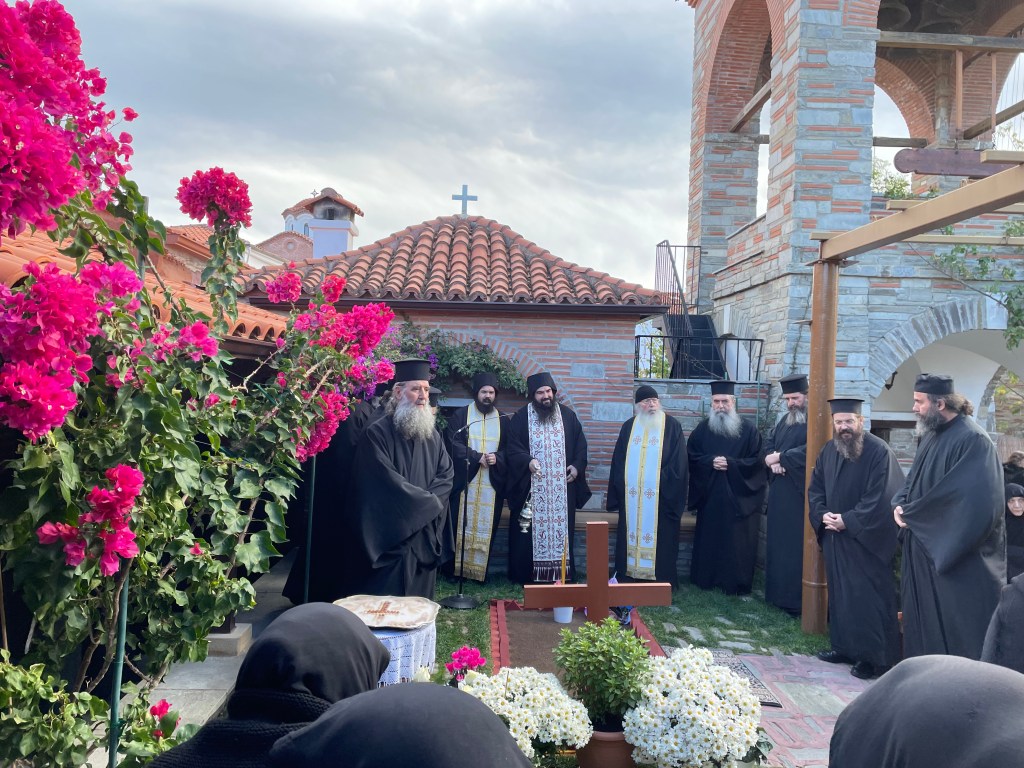
Elder Gregorios 40 Day Memorial Service

Day 4. Washing your face

overlooking the sea from the Monastery of St Arsenios in the mountains

Monasteries are places of healing and light. The Monastery of St Arsenios is one such place.

N.b.This is as close as I came to Agion Oros in the distance!

Another little miracle enabled us to meet Theologos and Vaiga with children again . We were joined by a priest from Germany Fr Victor with his Presbytera and children. The usual courtesies were extended to us, loukoumi, coffee and biscuits along with the necessary water!

Geronda Theoklitos joined us and he afforded us a great deal of his precious time even though he had many confessions to hear.. It was a true blessing to meet him.God it seems bends time in order for those who seek Him to receive His grace . Time is not really measured in monasteries. Of course there are set times for worship and work but one does not sense time passing.

I told Geronda of the mutual ministry we have at our parish and he quoted a greek proverb
“Το ‘να χέρι νίβει τ’ άλλο και τα δυο το πρόσωπο” which when translated goes something like : ” The one hand washes the other hand and both wash the face “. I suppose we have similar saying” many hands make light work.”Washing the feet is an act of service and humility, but washing the face brings cleansing and refreshment.He gave another word:St Anthimos of Chios: “ εκείνο το ´γιατί κι εκείνο το ´εγώ´ που έχομεν, αυτά μας απομακρύνουν απο τον Θεό και μας χωρίζουν απο αυτόν» — «this “why” and this “I” which we have, these distance us from God and separate us from Him.”


The proximity of hospitality and holiness is palpable in Orthodox monasteries. Faith ,food and fellowship are inseparable. For some visitors monasteries are places not only of refreshment but of healing where quiet can replenish the soul and regenerate the spirit. It is most important for Orthodox Christians to renew their spiritual batteries. Such peace was abundant at Panorama monastery. Sister S shared the typicon and structures of monasticism and we glimpsed the evening service before heading back to Thessaloniki. I think words alone cannot convey the experience of visiting monasteries. For those who truly seek God then they are places where His energies are to be found…in abundance!


– “The orthodox monastics are like the lighthouse. The lighthouse has to be always on the rocks by the sea. Do you want them to go and live into the city and be added to the other street lights? They can not become a lantern and be placed into the city’s roadside. The orthodox monastic is like a remote lighthouse, that stands high on the rocks, directing the ships of this world with their flashes, and upon the open seas the ships are orientated in order to reach their destination, which is God.” Saint Paisios of Mount Athos from the book: Spiritual Awakening

Day 3 Thursday :the Angelic Habit

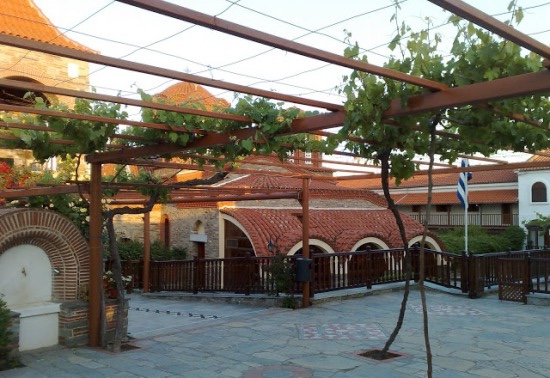
Monastery of St John the Forerunner at Metamorfosi

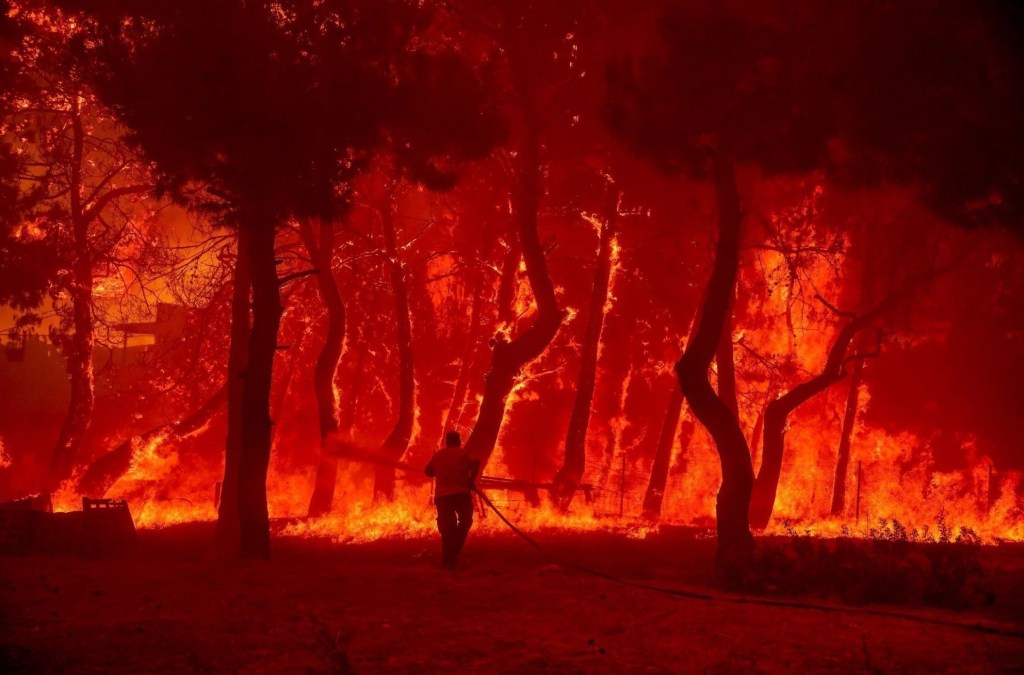
The drive from Thessaloniki to Halkidiki was furnished by olive trees but to remind us of the fragile nature of our planet there was the faint smell of smoke in the air. (*) As St Paul says in Romans 8″ creation is groaning “. Our first visit on the itinerary was the Monastery of St John the Forerunner at Metamorfosi. Although it has a strict typikon we were allowed to sing a glorious trilogy of apolytikia and Kyries. We were joined by Baia and Theologos.

… and four of their ten children.. Konstantinos overheard my English tones and introduced me to his wife Marina and mother Gabriela who lives in London. A most interesting exchange of spiritual experiences ensued. Gabriela studied at Lancaster university at the same time as I was studying by Post Graduate certificate of education at St Martin’s college now University of Cumbria ( Lancaster campus)and having been brought up in the middle east she is looking forward to Dmitry’s ordination to the diaconate in September in Arabic. Two priests joined us with their families for monastic hospitality “metrio cafes parakalo ” the most delicious cake, loukoumi and much needed water. It was after all 37c.

On to Ormilia monastery where Marta and Alexandra have stayed. We venerated the tomb of the founder Geronda Emilianos. K. said she wanted me to meet a nun who spoke better English than me ” if that’s possible” K. added with playful wit, ” This is Mother P. I was not at all offended or diminished by K. words, especially when I learned that mother P was born and brought up five miles from where I was born.

Ormylia monastery, Holy Convent of the Annunciation


We were in the company of people from Cyprus who had connections with our parish, a Belgian priest and a Serbian priest whose Metropolitan and Professor respectively sit on the same International Commission as me.Lunch time beckoned it was 4.00 after all. A wonderful local cafe near K’s beach house where we were joined by Nikos. We made the short journey to K’s beach house where we met the Romanian family who were staying there. You can’t get much closer to the sea! If you rolled over in bed you would be splashing in the gentle waves!

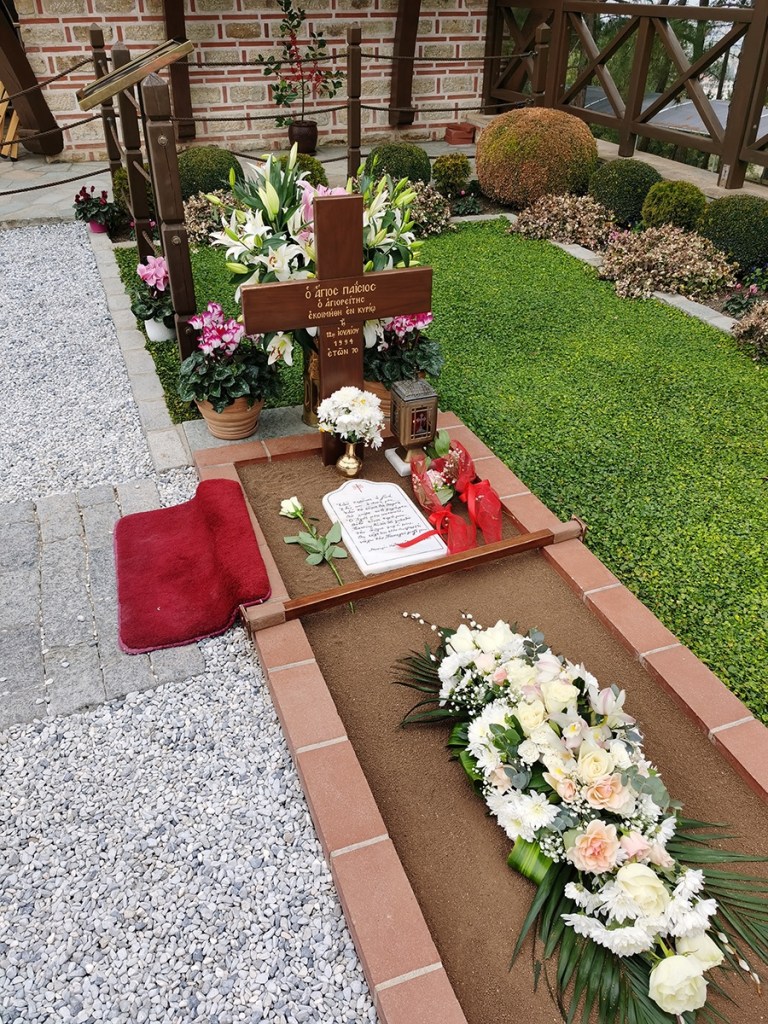
On to St Paisios Monastery where we met friends of Sayedna. We joined the queue to venerate the tomb of St Paisios. A little boy repeatedly took the blessing from priests in the queue. The light of joy shone in the eyes of the faithful, reflecting the Light of Christ. Everyone we met today, those wearing the angelic habit and those who were faithful Pilgrims were happy. God is glorified in his saints.

St. Paisios’ tomb
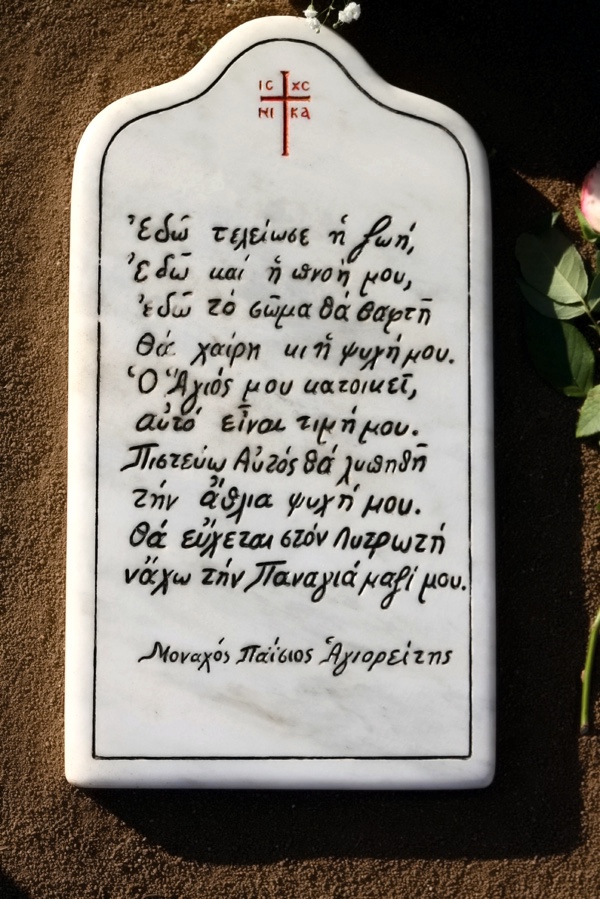
St. Paisios poem above his tomb

Above his tomb, inside the monastery yard, on a marble plaque is found a humble poem written by himself:

“Here life has come to an end

Here my breath has stopped.
Here the body will be buried,
And my soul will rejoice.
My Saint dwells here, [St. Arsenios of Cappadochia]
And that is my honour.
I believe he will pity

My miserable soul

He will pray to the Saviour

To have the Virgin Mary with me.”


“God wants us, above all, to be happy and to enjoy inner peace. God is not a tyrant who pesters and intimidates us, but instead he wants us to be free.”St. Paisios

(*) Due to fires raging all over Greece at the time of this pilgrimage

Dadia National Park

A Holy Warning

Elder Parthenios

Elder Parthenios of the Monastery of Saint Pavlos: Αn orthodox message from the Holy Mountain

“Christ is Risen! Truly He is Risen!

The abbot of the Holy Monastery of Saint Pavlos, father Parthenios, speaks to you. I am in the monastery of Saint Pavlos since 1954 till now, with the help of our God, Virgin Mary and all of saints. Till now, we are blessed of God and we all celebrated the Holy Easter, with all of our happiness and love, the Risen of our Lord. This year it was the only year, since I came in the Mount Athos (Holy Mount), that we celebrated alone. Because all of the previous years we had with us more that 100-150-200 visitors, only in our Monastery. Together all the Monasteries of the Holy Mount had approximately 5,000 visitors, who have come every year, to honor the Holy Easter, the Risen of our Lord!

It was hard for me, that this was the year that we glory alone the God. Because of the measures they took, they left us alone with only few workers who are regular here. I am telling you that, with a lot of father’s love, I am in pain, in grief. Because all the faithful men who used to come here with us, were our consolation, to praise all together to the most important event, the Easter. All together we were chanting the pray of “Christ is Risen”, full of joy. Perhaps, God allowed this temptation to be penetrated, for our sins. Maybe He wants to activate us, cause the people got away from the Lord’s path and doing nonsense.

Our Churchs, all over the country, in Athens, in Thessaloniki and other where were like a cemetery. All the people were isolated in their houses; even the churches have closed their gates. What happened? What happened?

Unfortunately, our politicians trying to do their best. These are human measures, we cannot blame them. On the other hand, I am sending them a message. These measures are not enough. I am begging our politicians and our ecclesiastical authority, to shout at people to open the churches for the public, to go out on the roads, to take with them the holy icons and go for a litany, in order to beg our almighty God to obviate that temptation. The governors of this time cannot save us. Only the powerful God, He is the one who can save us. Open the doors of the churches, take the people outdoors, get the icons out, and get down on your knees, like the Ninevites did, to beg the God, His omnipotence, to quash this temptation. Otherwise, I don’t know where we will end up.

Please, do not be delusional, only God can save us, only our Lady Virgin, only the Saint Apostles and all the Saints together. Also can save us our pray and faith to God. “What did save the world?” “Our faith”!

Let all these thoughts of lukewarm and oligopolies, behind. We are Christians and I refer to the politicians who prepare to seal up/chip the people, but this will be their biggest scandal, because they not do justice to Christians. We, the Christians, strongly believe in His Almighty, we are baptized; we are anointed by the Holy Oil in the sealing of God. “Seal donation of the Holy Spirit, amen.”

Anyone who is not baptized, has the freedom to be sealed by the government, it is their decision. But do not force us, the Christians. Whatever you want to do against us, the God will be the Victor!

The God says: “Just as someone will confess in front of other people that he believes me, so I will do for him too, in front of my Father who live in the sky.” “Just as someone denies that he loves me, in front of the people, so I will do for him too.” Do not believe what the Zionists and Masons, the devils say; they do not believe in anything. On the other hand, we strongly believe in the real God. Whatever it takes, we confess Jesus Christ the Crucified we lean on Him our hopes, in his All-powers, nowhere else.

Many happy returns! Christ is Risen! Truly He is Risen!

Our Lord has beaten the world. He says: “Don’t be afraid! I have been beaten the world for you!” That is our confession and our faith! Thank you so much!

Source: Enomeni Romiosini

How Can the Coronavirus Pandemic Birth God Within Us?

coronavirus-pandemic

In so many ways… Let us explore here just one, with the help of +Elder Aimilianos of blessed memory, should we eventually catch coronavirus despite our best efforts to protect ourselves and our beloved ones:

“We get sick and we suffer for different reasons, but often it’s because we have sinned, voluntary or involuntary, or because we have wandered away from God. But, if you are sick, don’t be afraid and don’t worry because sickness is a great gift from God. The sick are God’s special children.

The sick are under God’s special protection. They have God’s special blessing. They have God’s love. They are in His embrace, whereas someone who has health might not be.

The sick person, the suffering person, the person with illness is in a privileged place, or a potentially privileged place, with respect to God. Those who have never known sickness, and those who have never known suffering, often have a lack of empathy; and often their heart is narrow and small and restricted, and not able to open up and embrace the suffering of others because they just don’t know it.

The sick, on the other hand, are often the most loving and understanding and compassionate people that you will ever meet, and they are the ones who will have boldness before God in their prayers for others.

So don’t be afraid of your illness. Leave it to God. Do what the doctors tell you. When you take your medication, you receive Christ. It’s not bad, or a sign of a lack of faith, to take your medication. When you take your medication, you are receiving a blessing, you are receiving Christ Himself.

Do what the doctors say, take your medications, go for your tests, but have no anxiety. Sometimes what’s worse than being sick is being afraid of getting sick. Leave it to God. Whatever God gives you is best for you. God never gives you a Cross without first weighing and measuring it very carefully to make sure that the Cross will result in your spiritual growth.

So don’t think it’s random, don’t think it’s chance, don’t think it’s too much. It’s been very carefully weighed and very carefully measured, so that it will result in spiritual growth and spiritual benefit.

As much as the body wastes away, that much is our life in God renewed. God cannot be born within us without birth pangs. And the suffering that we experience, whether it’s emotional suffering or physical suffering, these are the birth pangs, the travail, the suffering in our life that will enable God to be born and to grow within us.

So we should feel pity for the person who has not tasted involuntary pain because that person is not likely to impose upon himself a sufficient amount of voluntary pain. So feel pity for the person who does not know involuntary pain because they’re not going to inflict it on themselves. They’re going to want to stay in their comfortable place, their comfort-zone, and they’re going to resist all kinds of change.

Sickness is a visitation from God, a divine visitation. Sickness humbles us, it teaches us, it reshapes us, it awakens us to reality, it enables us to see what is truly important and of value. It is not a punishment, but a divine visitation for our correction and education.

—Elder Aimilianos of Simonopetra Monastery

From: A lecture entitled, “Blessed are the Pure in Heart: Reflections on the Spiritual Nature of Suffering,” by Father Maximos Constas, Patristic Nectar Publications (2017).