How Romanians React to Foreigners

from-romania-with-love-1-728

Suzana Monastery Retreat  II, or An Anthropological ‘Field Trip’ Insights,  and Communism Jokes 😃

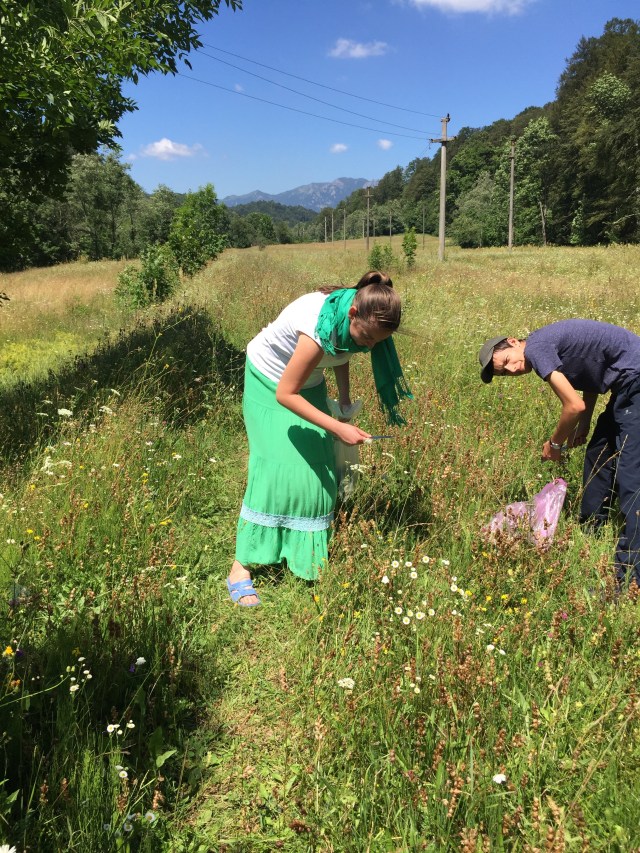
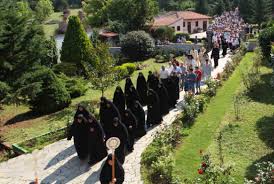
Doamne Ajuta! I am obviously not the only pilgrim at Suzana Monastery, but I am the only pilgrim who is NOT Romanian. I am immediately spotted and ‘targeted’ , especially by a group of Romanian students who belong to an Orthodox youth organization and do volunteer work at the monastery in the summer. They are here to help with the housekeeping, farming and agriculture. And with chanting.

How to ‘annoy’ a Romanian (1)

Mistake Bucharest for Budapest.

Never ask a Romanian if he lives in Budapest. That’s the capital sin, the perfect way to end a potentially interesting conversation. Yes, Budapest is a capital city, and there’s a big chance you’ll nail it with this guess — but only if you’re speaking to a Hungarian! We’re so tired of hearing, “Good evening, Budapest!” every time an international act has a concert in Bucharest. Metallica did it, Lenny Kravitz did it. And many others. But they had bodyguards. You, on the other hand, will be alone in front of an outburst of anger.

*

The Romanian hospitality, warmth, enthusiasm and curiosity about anything Greek, or foreign for that matter, AND Orthodox CANNOT be exaggerated! This group of students at Suzana Monastery instantly become my ready interpreters and eager translators, my willing tutors for Romanian chanting and they are so full of questions about my job, my studies, my travels, my pilgrimages, my adopted country UK, my home country Greece and its Saints, especially St. Paisios, about everything, to the point of collapse!

*

I may be on a pilgrimage in Romanian monasteries, but St Paisios’ the Athonite, my patron Saint‘s, presence is strongly felt all over Romania. Plenty of icons of his and books with his services and spiritual counsels in all monasteries and churches I have been so far! Esp. on the 12th of July the faithful all over in Romania were holding Vigils and praying Akathists and Supplication canons, asking for his prayers. Wherever I go, the moment Romanians realise that I am Greek and my home town is near Souroti, they start asking for my telephone number and email, so that I can make arrangements and help them go and venerate his tomb. 

How to ‘annoy’ a Romanian (2)

Ask us about vampires.

In 1897, the Irish writer Bram Stoker published a Gothic novel entitled Dracula. His story made Transylvania more famous than any tourism promotion campaign ever could. By using some historical facts, he linked Vlad Tepes, the Voivode of Wallachia, to his main character, Count Dracula, the vampire. Unfortunately, that means foolish tourists now come to Transylvania expecting to see garlic hanging by doors or people walking around with wooden stakes in their pockets. Transylvania is a peaceful, hilly area with many traditional houses and fortified churches. The real threat back then wasn’t exsanguination, but impalement — the Voivode Vlad’s favorite method of execution. And that isn’t fiction.

Their energy is indomitable, even when our conversation lasts for hours while standing after very long services outside the church at dusk until midnight and …! Their effusion is so contagious and there is no end to the exchange of telephone numbers, emails and addresses for the planning of future pilgrimages in Romania and Greece and exchange of Saints! These ‘buzzing bees’ with bright eyes and brighter smiles are to follow me everywhere from now on (when they are not busy with their obediences) yet their ‘buzzying’ mysteriously does not interfere with the silence that invades me. It surely has to do with their kindness, love and purity in Christ.


If you have never experienced the intensity of Romanians’ love and hospitality, you may think I exaggerate. To give you just another example, while waiting for the bus to Bucharest from Thessaloniki, I sat at a nearby café and took out my Byzantine chanting textbook to practice! Yes, one has to be very careful with these diatonic genus and Greek:  A    Β     Γ   Δ     Ε Ζ     Η, Greek:       Πα Βου Γα Δι Κε Ζω Νη, English:     Pa Vou Ga Di Ke Zo Ni, [Re Mi   Fa Sol La Si   Do], [D   E     F   G   A   B   C ]

Can you imagine a Romanian in love with you, if that is their normal ??!!

Suddenly a Romanian interrupts me and ‘blurts’ out how excited she is for meeting me, and that she is returning back to Bucharest together with 4 Romanian musicologists, who were on a Byzantine chanting conference in Thasos, and pretty soon I am surrounded by 4 (even) more effusive, enthusiastic Romanians, reciting to me Homer in ancient Greek, hugging me and chanting Ti Ipermaho / Τῆ Ὺπερμάχῳ/ To Thee the Champion Leader, in Greek again with stunning voices right in the middle of the street (!) with tears in their eyes. What a people! Can you imagine a Romanian in love with you, if that is their normal ??!!

How to ‘annoy’ a Romanian (3)

Leave food on your plate.

Mark my words: If invited to a Romanian’s home for lunch or dinner, fast for a day or two before the visit. We are known for being a welcoming nation, and one of our favorite ways of showing it is through food. Here are a few appetizers so you don’t starve before the first course is ready. Some eggplant salad, salted roe, homemade smoked bacon with onions, and stuffed boiled eggs with mayo. Come on, try them all! Do you like the smell of our meatball soup? Here comes the clay pot full of sarmale, next to a steaming polenta and a jar of cream. You have to taste this! It’s our traditional course. You’ve finished everything? Don’t worry, there’s plenty more! The pork roast seasoned with garlic is almost ready.

*

Doamne Ajuta! Nothing best encapsulates the warmth of the Romanian heart, the warmth of their love, politeness, gentleness and hospitality, other than this greeting of theirs, ready to be offered at any time of the day, and on any occasion. So, rather than wishing someone ‘Good Morning’, or a ‘Safe Journey’, lay people and priests bless each other continuously, “Doamne Ajuta”, for surely where He is present, the journey or the job is bound to be blessed too. Such fresh and pure, innocent, child-like faith, feels refreshingly ‘simple’ compared to the Russian anguish, sinfulness and repentance.

*

Such warmth and hospitality, even when very poor, even when they want to share with you, their ‘raw’ cottage cheese, natural sour cream and bizarre non-homogenized boiled water-milk concoction straight from the monastery’s cows (!), their mamaliga, their beans puree and their boiled cabbage. (Can you imagine, again the Romanians’ soaring child-like enthusiasm when steaks or ice-cream show up in a surprise at our monastic (!) dinner?) Here, at a monastery, we have to boil water at the wood stove so that we can have hot water to wash the dishes. No hot bath to be sure. We have to sleep under kilimia, rough peasants’ rugs, becoming prey to very hungry fleas. And still, the poorer you are, the eager to share, and especially the more hospitable especially when it comes to basic human needs, such as sleep, company, food.

How to ‘annoy’ a Romanian (4)

Confuse Romanians with Gypsies.

The official name of the Gypsy ethnic group is Romani, and even though Wikipedia states they are “not to be confused with Romanians, an unrelated ethnic group and nation,” misplaced associations are still often made. There are Gypsies all over the world — one million in the United States, 800,000 in Brazil, and many others in Europe, including Romania. They originated in India and left sometime between the sixth and eleventh centuries. Confusing Romanians with Romanis only makes you sound ignorant.


All Romanians I have encountered so far, be it at the UK, be it in Romania or in Greece, anywhere, are true cosmopolitans, intelligentsia and artists, men and women of culture and refinement, often very poor but with a wealth of education, so eager to contribute to the whole world community of Arts and Sciences, so enthusiastic to learn and to connect, curious yet so courteous, well-mannered and pious (in the good sense of the world).

*

Sometimes this poverty of theirs may surface in a certain ‘ugliness’, dirtiness, slovenliness, chaos, and carelessness in their kitchens, bedrooms, living rooms and common areas. We have to surround ourselves with beauty—that is a Christian virtue., but not one that I have encountered in Romania, with the exception of their churches and monasteries. Yet one feels so privileged, honoured and blessed to just be with them! Romanian homes are often less than orderly and clean according to a western European standard, their appearance follows a pretty weird and slovenly fashion (if one may call such an ‘invention’ fashion), completely lacking any finesse and style, but just a look at their bright smiles and sparkling eyes and a companionship with their fascinating personalities ‘compensates’ immensely. Who cares about clothes and looks, when in company of such kind and refined people, refined in all tastes that truly matter, refined in spirit and soul and heart, in the company ultimately of true aristocrats? Besides, none of us would have been any the better, after such an aggressive Communist regime and persecution, followed by a ruthless dictatorship, just in recent times.

How to ‘annoy’ a Romanian (5)

Tell us a breeze can’t make you sick.

We Romanians are so convinced that a cool breeze or draft of air can make you sick that we even have an expression for it: Te trage curentul. (“You’ll be pulled by the draft.”) Take the bus on a hot summer day, and you’ll probably see the windows open on only one side of the vehicle, or not at all. Craving a breath of fresh air, you move your hand in the direction of the window. But even before you touch the handle, you’ll hear a panicked voice say, “Are you trying to get us all sick?” To anyone else, this doesn’t make sense, but the logic behind this Romanian belief goes like this: The current of cool air will make your ears hurt and your nose run. Don’t even try to argue about this. You’ll only make yourself hotter.

*

Romanians laugh a lot , especially at the face of danger, and can always appreciate a good joke. Like when I peppered sugar on my steak! Yet, I am not the only one in trouble with a foreign language. The residing priest told us that while at the States, he was invited at Arizona monasteries, and he made a homily there how Jesus was carried by a monkey (!), not donkey 😃

“Humor was a way of rebellion and survival at the same time; an escape of the mind and soul, a way of coping with all those absurd and restrictions imposed by a communist regime who did not care about its own people. Humor was a way of standing up or fighting back, a form of active resistance against a criminal regime; at that time the political jokes served as a catalyst of the constant state of discontent Romanians felt towards the things they did not agree or even hated… towards what was happening with our country. ”

Like:

Have you noticed that at every petrol station there is now a doctor and a policeman on duty? The doctor gives the first aid to those who faint when they see the price, and the policeman interrogates the ones who fill up about where they got the money from. 

A patient is hospitalized at the Insane Asylum. ‘Why are you here?’, another patient asks. ‘I wanted to cross the Romanian boarder’, says the first. ‘But for something like this they do not send you to an asylum!’, replies the other. ‘Yes, but I wanted to escape to Soviet Union!’

A citizen said the chief of the Communist Party is an idiot. For saying this, the citizen was sentenced to spend 25 years and 3 months in prison. Everybody was wondering why 25 years and 3 months. In the end, they old find out the answer: 3 months for insulting a citizen of the Socialist Republic of Romania; 25 years for revealing a state secret.  


For those who lived in Romanian during communism time, this system is very different from anything you could read in the some idealistic books. Some of the quotes show extremely well how people really felt about such an oppressing system:

Is communism a science? No, if it were a science, they would have   tested it on animals first.

An old gypsy man on his dying bad. Instead of sending after the priest, he asks for the local chief of communist party. ‘I would like to join the Party’, says the dying man. ‘Why would you do this?’, asks the communist. ‘You lived your whole life free as the wind and now you want to join the Party?’. ‘Well, you see, if somebody has to die, I would be much happier if that guy were a communist’, answers back the dying man. 

*

Last but not least, Romanians are not just ‘special’, but unique! (in their own opinion of course) Stereotypes, ethnophyleticism, ethnic superiority/ inferiority complexes and xenophobia deeply vex my spirit.Sadly, even here, in a monastery, I have to ‘defend’ English people and ‘their’ Orthodoxy from some Romanians. I do not know how good an ‘ambassador’ I am, but I am trying my best. And all of Romanians I have encountered think that St Philothei, the Righteous Martyr of Athens (sic!) is Romanian! Not that Greeks are any better. We consider St Efraim the Syrian (sic!) to be Greek! Of course!

How to ‘annoy’ a Romanian (6)

Refuse homemade beverages.

Romania has one of the oldest winemaking traditions in the world. The country once had so many vineyards it’s believed Dionysus, the god of wine, was born in southeast Romania in a region then called Thracia. As proud successors of the Thracians, Romanians practice winemaking as a popular hobby, so you’ll probably be offered some garage-made wine. Or tuica, a strong fruity beverage. Even if you have reason for concern, do not ask about hygienic conditions or quality control. We take great pride in everything made with our own hands, so turning it down would be a serious insult. Take a sip, two, three, and worry not. We all drink homemade alcohol, and no one has died of it. So far.

Go here for Part I

Go here for Part III

To Be Continued …

Sources for the jokes: How to piss off a Romanian   and Romanian Communist jokes

Suzana Monastery Retreat I


SONY DSC


Part A: How the little city hermit became a bird, a fountain, a tree and a pearl!


Deep peace of Christ, silence, hesychia, these are the words that come to my mind when I remember Suzana monastery and my three-day retreat there this summer. Also, self-emptying, kenosis. But above all, silence!


Only through poetry can such silence be conveyed, so I will paraphrase a favourite poet of mine, Rumi, to convey to you what I experienced here.


I had begged the Wise One to tell me
 the secret of my existence, my calling in this world.
 Gently, gently, He whispered at Suzana monastery “Be quiet,
the secret cannot be spoken,
 It is wrapped in silence.”


I ground myself, strip myself down, to this overpowering Silence. I feel spiraling into a void of silence where a hundred voices thundered messages I longed to hear.


At its unfathomable bottom I encounter a vast fullness, the Spark of LIFE and LOVE, a secret passage to the WAY which wandering talk blocks, a dimension where HE was waiting for me, for my soul to shake.


I was carrying so much baggage while seeking the signs of the Way.


But at Suzana* monastery, I am ‘forced’ to stop, open up, surrender to this thundering silence, be invaded by ‘It’, and 
stay there until I Saw, until I looked at this blinding Light 
with infinite eyes.


This overpowering Silence kidnaps me to the core of Life. There is a sacredness in it. Silence is indeed the language of God, and all else is poor translation.


This is exactly what I experience when I am trying to write a poem, how I feel especially when I finish a poem. A great silence overcomes me and I wonder why I ever thought to use language.

suzana6

Silence is indeed the sea, and speech is like the river. The sea is seeking you: don’t seek or walk into the river. Don’t turn your head away from the signs offered by the sea. Listen to the ocean.


The sound of Waters and the sound of Silence is a motif in Suzana monastery. At least for me. Everywhere the sound of waters reaches you, so overwhelmingly that I often feel the need to stay in my ‘cell’ and not even venture out.


Just listening to that sound was so overwhelming! The very moment I set my foot on this monastery, the sound of Living waters immobilized me, an ocean wave, a mighty river in flood, a cascading waterfall, a fountain of benediction, a Life- Giving spring, welling up to Eternity.


Isaiah 43:19

19 Behold, I will do a new thing,
Now it shall spring forth;
Shall you not know it?
I will even make a road in the wilderness
And rivers in the desert.


John 7:38

38 He who believes in Me, as the Scripture has said, out of his heart will flow rivers of living water.”


Kenosis is also another state I suffered there:

“And they shall build the old wastes,

they shall raise up the former desolations,

and they shall repair the waste cities,

the desolations of many generations.” (Isaiah 61:4)


I needed so desperately such ‘Decluttering’ in my life, a Relentless Focus, a Subtraction, Becoming ‘poor’, an Unburdening, a Curtail, a Reduction and Emptying, Until my rebellious bones sore.


suzana1

This silence, this moment, every moment, this silence brought all what I needed. I sat quietly, and listened for a voice which told me ‘Be more silent.’ ‘Die’ and be quiet. Maybe quietness is the surest sign that you’ve ‘died’. My old life was such a frantic running from silence. Suzana monastery moved me, even for a little, outside the tangle of fear-thinking.


In the end, I became a pearl!


“And since I have wandered in thee, pearl,

I will gather up my mind

And by having contemplated thee,

Would become like thee,

In that thou art all gathered up into thyself;

And as thou in all times art one,

One let me become by thee!” (St Ephraim, The Pearl)


This very old, poor, secluded, fairy-tale monastery, surrounded by forests, mountains and springs, and steeped in holiness, is most certainly God’s special Providence for my tired, exhausted self.


I feels like coiling in a virginal womb, unwinding time, beholding


“The memory of the glory that I had when I was entirely with You and entirely in You, before time and temporal illusions.


When I, too, was a harmonious trinity in holy unity, just as You are from eternity to eternity.


When the soul within me was also in friendship with consciousness and life.


When my soul also was a virginal womb, and my consciousness was wisdom in virginity, and my life was spiritual power and holiness.


When I, too, was all light, and when there was no darkness within me.


When I, too, was bliss and peace, and when there were no torments of imbalance within me.


When I also knew You, even as You know me, and when I was not mingled with darkness.


When I, too, had no boundaries, no neighbors, no partitions between “me” and “you.” (St. Nikolai Velimirovich, Memories – Prayers By the Lake XXX)


Even the very fact that I cannot not speak Romanian, just barely understand it, is an added blessing, an extra ‘precaution’, a ‘just in case’ … Speaking all too often impoverishes, drenches us. As St. Seraphim of Sarov wisely urges us, “Keep away from the spilling of speech”.


Hesychia, Deep peace of Christ wrapped me in green leaves like a tree;

I breathed like a tree in the quiet light!


* Suzana Monastery is a Romanian monastery about 5.5 to 6 hours away from Rasca monastery in Bucovine, North Moldavia, where Fr. Seraphim Aldea was tonsured as a monk in 2005. After my retreat here I have a slightly better, more ‘intimate’ understanding of ‘Romanian’ Orthodoxy and Fr. Seraphim’s calling to found the first Orthodox monastery, Mull monastery, in the Hebrides in over a millennium. In a sense only a Romanian hieromonk would be really equipped, spiritually, emotionally, as well as intellectually, to undertake such a huge task! Glory to God for everything!


Continue to Part II

Romanian Monasteries Pilgrimage —Suzana Monastery

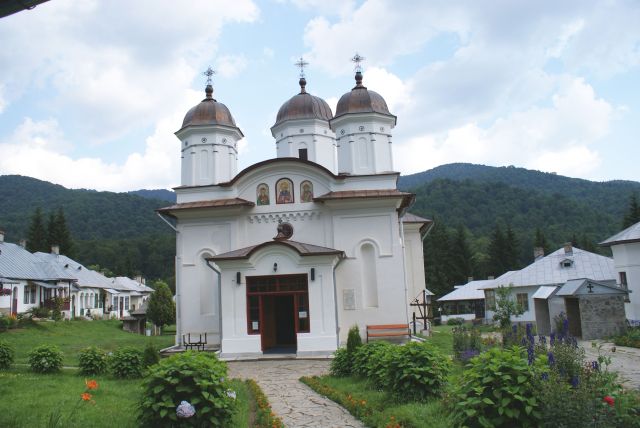
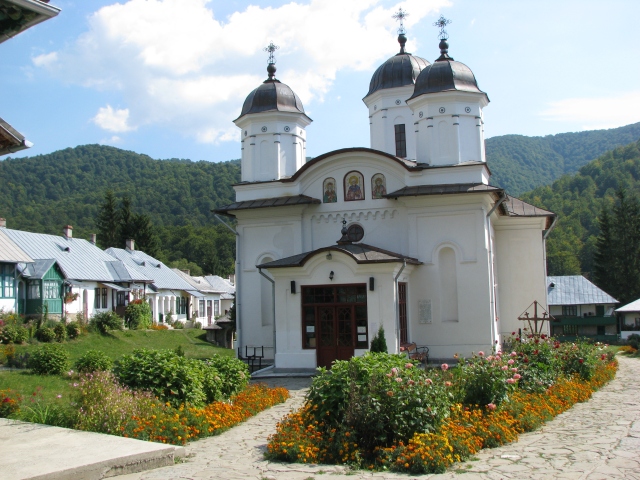
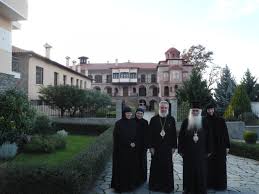
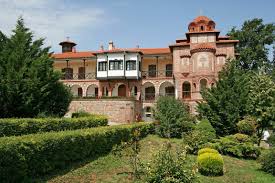
My next stop:  Suzana Monastery. The Suzana Orthodoxe Convent, hidden in a forest of beeches on the road of Valeni-Cheia gladdens the hearts of those who visit by the tranquillity that reigns here. This monastery now has 62 nuns who share in community prayer and work. I am invited to stay 3 days here. Lets see now how I can survive in a place where no one speaks English and I understand (little) their native language but cannot speak it!

IMG_0759IMG_0670IMG_0642IMG_0551IMG_0529IMG_0472

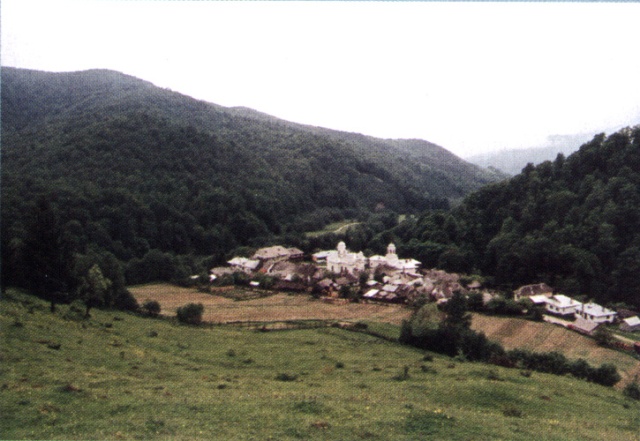
The Suzana Monastery of nuns took refuge along the Teleajenului stream, some 40 km from Valenii de Munte, at the highest point of the foot of Bobul Mare. The waters of the Teleajenul, Stanca and Iepurasul come together at this monastery in the form of a cross and run off together as a single stream. From above, the settlement looks like a tiny village, a cluster of houses stuck together, as if they were afraid of flying away in a storm. The houses are attractive and well kept.


A few stories with some elderly nuns

AT THE MONASTERY, EVERYTHING HAS A PURPOSE…”Leave us be, says an elderly nun, as we have no time for posing in magazines. We have a lot of work.” She then disappears into the abbey to announce the arrival of some…guests. Out comes the Mother Superior …”Please, do come into the living room and have a syrup drink.” A homemade syrup made of caramelized sugar is brought in with glasses of water.

“Our monastery is not very well-off,” says the Mother Superior. “We work hard, there are few young nuns and quite a number of very old nuns who need our constant care like young children …”

Someone knocks on the door. A nun curtseys and kisses Mother Superior’s hand. Snatches of words, choked by timidity: “Mother Superior…the bell…blessed.”


The girls come to the monastery from places you cannot even imagine, from all over the country. They come from Sighetul Marmatiei, from Moldova. But they do not all stay here, some cannot get used to life in a monastery. First they must learn about order. The monastery has its own rules, its own system, and none can do as she pleases. And then these girls have to be taught some skill, to be useful, and they learn to weave carpets”.

HOW LADY ARSICU SURVIVED THE STORM. Suzana Arsicu, the monastery’s founder, raised a church of beams. The wealthy woman was from Sacele, in Ardeal, and this was her way of thanking God for having saved her from a storm. She was the monastery’s first Mother Superior.


The church, whose Patron Saint was St. Nicholas (Dec 6), lasted one century and was replaced by another. At that point the church council decided to change its patron to the Mother of God whose anniversary is celebrated in summer, on the 15th of August, and the monastery can be more easily reached during that season than during the winter religious festival with the snows. On the eve of the dedication, however, the sky got covered with clouds, the streams overflowed from their beds and flooded the valleys. The torrent took everyone who came for the feast by surprise, washing away all their bags, their habits, their books and their holy paraphernalia. They all escaped unharmed, and instead of holding a dedication they held a mass, to thank God for having averted the danger. They then decided that they would not change the patron Saint for the church, and celebrate on December 6, the anniversary of St. Nicholas.


Today’s church was raised between 1880-1882, during the time of a Mother Superior named Natalia Perlea. She kept the same patron, and no one has ever thought again of changing him. The monastery has another tiny church, Paraclisul, built during the time of Mother Superior Tomaida Perlea.

THIS IS MY HOME. The story of a nun: “This cannot really be called a community life, as we have little work in the field where we might meet. It is more of a solitary life. Each nun receives a house for which she is responsible. Some have novices, and when these become nuns in their own right, they take over the house. There are two or three nuns to every house. There is enough space.


The monastery courtyard is wide open, but the buildings are stuck together in such ways that the space is compact, built to last. This house and that one over there are the settlement’s oldest, dating back to around 1860. That over there is a guesthouse. It does not have a lot of rooms. From time to time officials come here and then can be befittingly received. The nuns put people up in their homes. All of them rent out rooms. But if there were some sort of organized tourism it would be difficult to keep the visitors and the monastery’s daily routine apart. There would be people coming and going in the courtyard, in the church. If we had a guesthouse separate from the monastery, things would be different.

The green house is mine. This house in which I have received you is the abbey, as the inscription shows above the door, but the green one is mine.”


NOTHING IS POSSIBLE WITHOUT HARD WORK. “I came to the monastery in 1940. Now I am 79 years old. In 1990, I offered to step down. I told them: “Perhaps you want a younger nun.” But what would a younger nun do with such a burden on her shoulders? It is a great responsibility.

The nuns earn a little money from their icons and candles…The money does not go far, as everything is expensive these days. The church walls were painted, and look how they are peeling . A company from Bucharest did the job, but they did not scrape off the old paint.

Other than that, there are some hayfields that are in the care of the people. Half belongs to them and half to the monastery. We grow potatoes as nothing else grows around here because of the weather. It rains, it is chilly…And the fruit does not last long here because of the rain.” Two nuns put aside the forks with which they were gathering grass and begin talking. The man with the scythe watches them silently.

“We used to have seven cows, but now we have five. There is a lot of work, but everything requires toil. Now we bring everything we need to the monastery by car, but for a long time we even carted things on our backs.

The work would be impossible without the help of people of means, who make contributions.” These people of means paid some workers whom the Mother Superior met at a dinner at the Archbishop’s. “Now we have some craftsmen building paths, and only when this work is finished can we send for someone to cut the grass, which has grown very long.

PEOPLE WANT TO COME STAY WITH US. The oil painting in the church is the work of Master Petre Nicolau, an apprentice of Gheorghe Tattarescu. The monastery also owns a collection of icons painted on wood and glass, numerous old books and other religious objects. The icons are finished with gilded silver.
An 18-year-old nun leads a group of children around the man-made miracles. There is not enough light, and the nun who serves as guide and is wellgrounded in modern civilization explains that the neon bulb is 60 watt while tha starter is only 20. “They need to be the the same to light properly.”
The children have written their comments in the 48-page guest book at the entrance: “This monastery is truly special,” “I visited this beautiful monastery,” “I enjoyed this visit so much as I saw very old and special things”. Mother Superior Singlitichia Marin mentions, “We must get another guest book, a real one.
For the time being the monastery has no priest. There is a priest who comes to hold services, but he is not employed permanently. He is a young priest, too young. A priest who serves at a monastery of nuns should be older. One will eventually be hired, as the need becomes evident. This is another problem that requires resourcefulness.”
On major holidays we hold services from 7:30 p.m. to around midnight. People come from town, from Valeni, even from Ploiesti, to get married or to baptize their children. At first we were criticized, and were asked why we allow people from outside the parish to come here. I replied: “What should I do? Turn them away at the gates of the monastery? The church cannot do this. You do something to encourage them to come to you, so that they no longer want to come here.” After that no one said anything anymore.”
INSIGHT, Summer 2001

Part A

For more photographs, go here

Romanian Monasteries Pilgrimage — Mânăstirea Pissiota

Most hospitable next stop: Mânăstirea Pissiota!

Romanian Monasteries Pilgrimage Mânăstirea Pissiota Orthodox city hermit pilgrimage

Romanian Monasteries Pilgrimage Mânăstirea Pissiota Orthodox city hermit pilgrimage

Romanian Monasteries Pilgrimage Mânăstirea Pissiota Orthodox city hermit pilgrimage

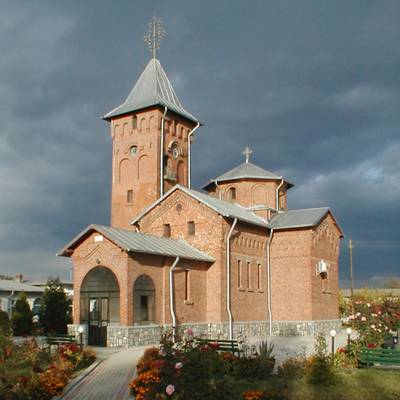
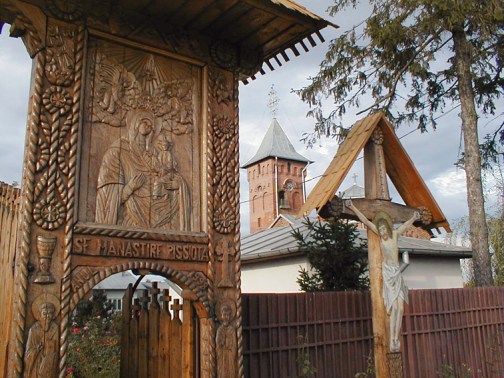
The monastery of Pissiota, located in Poienarii Burchi, was built between 1928 and 1929 by Nicolae Pissiota (1860-1940), a great man of culture, and his wife, Zoe Pissiota (1868-1940), on the estate bought from the family of General Gheorghe Angelescu (1850-1923), an important name in the 1877 war.

Romanian Monasteries Pilgrimage Mânăstirea Pissiota Orthodox city hermit pilgrimage

The first record of the village of Poienarii Burchi dates back to 21st September 1594, on the former „Poeana” estate of Lady Stanca, the wife of Michael the Brave. The village was dedicated by Lady Stanca to the Simonopetra monastery of Mount Athos, in 1594. The original document is kept at the Archives of the State in Bucharest.

Romanian Monasteries Pilgrimage Mânăstirea Pissiota Orthodox city hermit pilgrimage

The engineer Nicolae Pissiota, of Macedonian origin, born in Greece and settled in Walachia, had a huge fortune that allowed him to build this place of worship. The church was designed by the architect Ioan Giurgea – a harmonious combination between Italian Renaissance style and the Byzantine elements that are specific to Romanian churches.

Romanian Monasteries Pilgrimage Mânăstirea Pissiota Orthodox city hermit pilgrimage

Romanian Monasteries Pilgrimage Mânăstirea Pissiota Orthodox city hermit pilgrimage

Romanian Monasteries Pilgrimage Mânăstirea Pissiota Orthodox city hermit pilgrimage

Famous names were called to decorate the church: Costin Petrescu (1877-1954), the one that painted the interior frescoes of the Romanian Athenaeum, or the Cathedral of Alba Iulia, and his apprentice, Gheorghe Eftimiu.

The portraits of the patrons and of the Patriarchs Miron Cristea and Justinian Marina were done by the painter Vasile Rudeanu (in 1956). The iconostasis is carved in rosewood and cherry wood, brought from Greece, creating a balance between sensitivity and detail, influenced by Italian art.

The furniture was carved of oak wood, with ethnic motifs, by the sculptor Anghel Dima, in 1928, the author of Mihai Eminescu’s sculpture in front of the Romanian Athenaeum. The floor is made of red Carrara marble; underneath the church lie the marble crypts where the patrons and their families are buried. Inside the church there are icons and silver icon lights, in Brancoveanu style, as well as triodyons, Pentecostarians and hymn books.

Romanian Monasteries Pilgrimage Mânăstirea Pissiota Orthodox city hermit pilgrimage miraculous icon

Romanian Monasteries Pilgrimage Mânăstirea Pissiota Orthodox city hermit pilgrimage

Romanian Monasteries Pilgrimage Mânăstirea Pissiota Orthodox city hermit pilgrimage

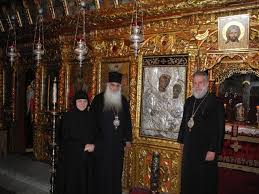
The defining religious element in the Holy Monastery of Pissiota is the Icon of the Holy Virgin with the Child – miracle-working icon. The icon is painted on oak wood, against a background of Byzantine brocade, signed by the famous painter Gheorghe Eftimiu, the apprentice of the great Costin Petrescu.

For two decades after the opening, between 1928 and 1948, the monastery was a monk monastery. In 1948, the Patriarch Justinian Marina transformed it into a monastery of nuns, and this is how it remained until 1962, when it was discontinued. In 1993, after 31 years in ruin, the monastery resumed its community life.

Currently, the monastery is inhabited by 23 nuns and a priest; prayer is in harmony with work, as there are tailoring workshops where priestly vestments and clothes are made, allowing people to add the little money they have for the restoration of the monastery.

Abbess Monahia Ioana Irina Calin


Pilgrimage to Mikrokastro Mother of God Monastery

This post has been long due, since Mikrokastro Mother of God Monastery has been my refuge and retreat since 2014, ever since I discovered it, or better ever since our Holy Lady revealed herself to me there.  A most  holy place, a ‘thin’ place I keep returning, especially when badly in need of spiritual nourishment, in times of trials, adversity, tribulations and temptations. This is a place where the Mother of God comforts all her children, a place where its peace invades you and the fellowship of the nuns warms you.


a1a2a4a5a8

a11a15a16a17

Part A: A brief history of the Monastery of the Mikrokastro Mother Of God


The Holy Monastery is dedicated to the Assumption of the Mother of God. According to historians, the main church of the monastery is estimated to have been founded 200-250 years ago. The iconography in the church was completed in 1797 (about 200 years ago), as is shown by the inscription that still exists on the west wall of the church.

a7


The history of this place started with a small chapel in the nearby village of Mikrokastro, but its propitious geographical position as a passing place on the journey from Kozani to Kastoria helped the site become a place of worship. This was mainly due to the presence of the Holy Icon of the Eleoussa Mother of God on the icon screen; it is not known when or under what historical and religious circumstances this Icons was found here.


The miracle-working power of the Icon contributed to the place quickly becoming the most important place of worship in Western Macedonia. According to the inscription mentioned above, the church’s frescoes were painted by iconographers from Kopessovo in Epirus, who, despite Western influence, tried to remain loyal to the Byzantine tradition following the standards of the Konstantinos Palaiologos era. The more popular manner of the depictions does not diminish the sweetness of the facial expression or the comforting feeling instilled in the souls of the faithful.

a9a10a12a13a14

a19


The icon screen of the convent is one of the most beautiful in the region and was made by skilled craftsmen either from the local area or Epirus. The miracle-working Icon of the Mother of God found in and belonging to the monastery dates back to either the 12th or the 13th century according to modern methods of dating holy icons.


The plenty votive offerings to the Mother of God helped the property of the Monastery to increase, and this property was taken care of by workmen inhabiting the area. In 1820 this place of worship was characterized as a Holy Monastery for reasons of prestige because of the presence of the Holy Icon, since it never had a monastic brotherhood. It only had an Abbot appointed by the Bishop of Siatista and an administration Committee.


This Holy place played an important religious and national role supporting the nation’s struggle for independence in 1821, offering hospitality and a hiding place to revolutionaries of the independence struggle, maintaining an ammunition store, paying the salary of the village teacher, and strengthening the inhabitants’ faith so that they could resist the pressure of Islamic proselytism.


The monastery participated in the historic events of 1878, offering moral and material support, in the Macedonian struggle during the years 1904-1908, in the war of liberation in 1912, in the relief of the victims of the Asia Minor disaster, in the epic struggle of 1940-1941 and its climax, i.e. the historic Fardikampos battle in March 1943. The monastery “offered soul, blood and money” offering the sacrifice even of its priest.


After the war, the bishop of Sisani and Siatista, Iakovos Kleomvrotos, (later to become Bishop of Mytilini), a powerful personality of the clergy, realised that the Holy Monastery was a more suitable place for spiritual and social activity than mountainous Siatista.


In 1952 he founded a School of Agriculture here for the farmers’ sons of the area, which, after functioning for two years, closed and was given to the Swiss Red Cross with a view to founding a hospital for local children suffering from glandular problems. In this building a primary school was also set up. In this way, hundreds of local children were helped.


Other buildings at the same location include the boarding school of the School of Housekeeping, which was used as a guest house and later as a home for the elderly. In addition, another building was erected in which his successor – Bishop Polykarpos – founded an orphanage.


Bishop Antonios was elected in 1974, and he showed great interest in the restoration and peopling of the monasteries in the region. In 1981 the position of the Abbot fell vacant and Father Stephanos Renos took over. With the moral, spiritual and material support of the Bishop as well as the contribution of the faithful and well-known donors, Father Stephanos Renos did great renovation work and added new buildings, a guest house and chapels.


In 1993, by a presidential decree, the Holy Monastery was turned into a monastery for women, and some time later the first monastics entered the monastery.


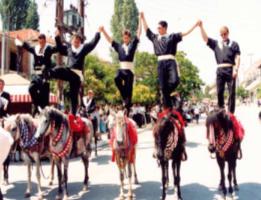
Two noticeable customs have been preserved since the years of Turkish domination. The first is the custom of Horseriding. On the 15th August, a religious festival day, the young men from Siatista armed and riding ornate horses came to the festival to venerate the Mother of God and under the unsuspicious eyes of the Turks the leaders of the struggle talked about the issues concerning the revolution, and the hope of freedom for the enslaved Greeks was strengthened. This custom has been preserved until today and has been incorporated in the whole festive religious atmosphere.

a18


eleousa Mother of god orthodox city hermit pilgrimage retreat mikrokastro horse ridingeleousa Mother of god orthodox city hermit pilgrimage retreat mikrokastro horse riding

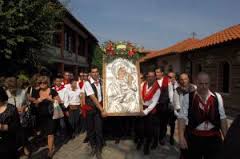
The second custom is the carrying in procession of the icon of the Mother of God That is, apart from extraordinary events such as insect epidemics, droughts and illnesses, during which the inhabitants of the area carried the icon in procession around the area to ward off evil, the inhabitants of Siatista have been taking the same icon in procession regularly for centuries now. In all weathers and accompanied by many people of all ages, they cover a three-hour distance on foot holding the icon in their hands until they arrive in their town, where the icon is solemnly received and taken to the cathedral and a prayer is chanted. After this, the Icon is taken to every house and flat. This event witnesses the fact that neither the Mother of God’s grace nor the people’s faith have diminished.

a3

icon procession mikrokastro eleousa Mmother of god orthodox city hermit pilgrimage retreat mikrokastro


The grace of the Mother of God has gathered peace-loving and pious women who have offered themselves to life-long service in the monastery, vowing to find salvation through the basic virtues of monastic life: obedience, chastity, lack of property, prayer, charity, and at the same time trying to achieve the moral elevation of local inhabitants.

The small sisterhood has devoted itself to a struggle for inner order, the restoration of buildings, the organization of worship, tree-planting on the land belonging to the convent, hospitality and spiritual outreach to visitors. The sisterhood sows with patience, cultivates the seeds of the virtues referred to in the Gospel with assiduity, re-baptizes the faithful in the genuine spiritual concepts of the Orthodox Church and the Holy Fathers, interprets the Gospel, comforts the sad and turns the beautiful stone-built monastery into a safe harbour, where people struggling in life can find shelter and relief.


Contact Information:

Mikrokastro, Siatista, Greece

Tel no: +30 24650 71307

To be continued …

Part B: Lessons from the Monastery and Miracles at Mikrokastro Mother Of God to follow soon


Keep Your Mind in Hell


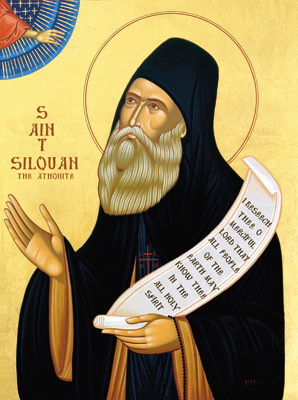
icon_st_silouan_athonite.jpg

… and Despair Not

Not for the faint-hearted!

“No one on this earth can avoid affliction; and although the afflictions which the Lord sends are not great, men imagine them beyond their strength and are crushed by them. This is because they will not humble their souls and commit themselves to the will of God.”


These words seem to sum up soberingly D. Balfour’s tumultuous life, and indeed in so many respects ours…


SPEECHLESS! “It seems ludicrous to rate a book like this according to a certain amount of stars…I searched for it after reading the book I Know a Man in Christ — a great book about our holy and blessed Elder Sophrony, which mentions this correspondence with the amazing Englishman David Balfour. I imagine that the only reason why anyone would be interested in this book would be to learn about this incredible spiritual friendship. (No! There are so many more reasons to want to study this book) And this book does allow for that — and much more besides. I’ve read letters of spiritual direction before. These letters go way beyond that. They give insights to the Elder and to St. Silouan which are simply impossible to convey otherwise. And this David Balfour — he went from Catholic hieromonk to Orthodox hieromonk to British Army major and intelligence officer to diplomatic interpreter to midlife husband and father to Oxford Byzantine scholar in old age. A biography of him wouldn’t go amiss, although I don’t think we’ll see one. And underlying his whole life is the gaining and the losing and the eventual regaining of that inestimable treasure, the Holy Orthodox Christian faith and Holy Grace. Not for the faint of heart.” (D. Kovacs )


Not for the faint of heart.” Most certainly!


What an intense book which can be read on so many levels! A heart-rending spiritual biography of a brother in Christ struggling for his faith and the salvation of his soul amidst staggering trials, temptations and tribulations! A sobering warning too to all of us to be deadly serious with our faith and never forsake our obedience to our spiritual father at any cost! Hell indeed broke loose when Balfour decided to disobey St. Silouan and use his own mind instead for his life-decisions! To give you just one example: After converting to Orthodoxy and becoming an Orthodox hieromonk, Balfour disobeyed St Silouan’s ‘suggestion’ to move to France, and then to England, and went to Greece instead. Things went well at first, but with the outbreak of the Second World War, Balfour was forced to flee Greece and started wandering all over Europe, while undergoing a very dark period of disobedience, disillusionment, doubt and eventual loss of his faith, to the extent that he decided to shave his beard and defrock himself in Cairo, Egypt! I cannot even begin to imagine how traumatic all this experiences must have been for him!

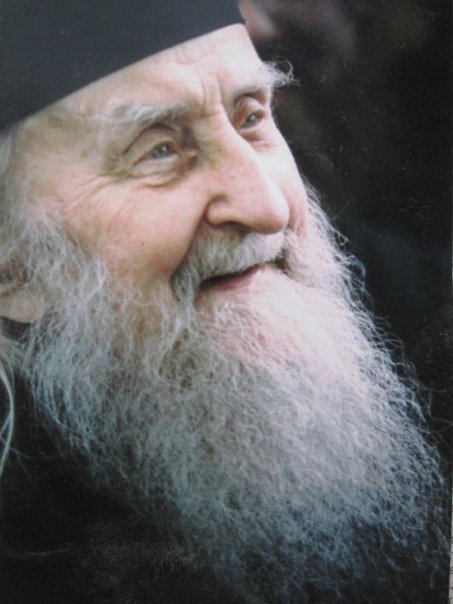
elder-sophrony


What a most sobering book! “For Whom the Bells Toll” indeed. How often have I betrayed the Lord and disobeyed my spiritual father in the past! How dire the consequences of my disobedience have always been! Indeed, how fragile our faith is, how precarious our decision to follow the Lord at any cost like a true disciple, how unpredictable our falls and how uncertain our salvation until the very last moment of our life!


Striving for Knowledge of God: Correspondence with David Balfour is a treasury of wisdom distilled from Fr. Sophrony’s reading of the Fathers of the Church, from his conversations with St. Silouan, and from his own experience. Since most of these letters were written to someone new to the Orthodox Church and to Orthodox monasticism, they are of greatest interest to anyone contemplating converting to Orthodoxy.


In particular, the correspondence touches and elaborates on the difference between Eastern Orthodox and Western thought, in both Christian and philosophical writings. Thus Fr.Sophrony mentions Schleiermacher, Spinoza and Kant, and St John of the Cross (The Dark Night of the Soul). He dedicates a few pages to the concepts of the heart and prayer. In Eastern Christianity, he argues, the spiritual heart is not an abstract notion but is linked with our material heart and has its physical location. In opposition to the Western search for some visionary mystical experience, Fr.Sophrony advocates the prayer of repentance, which is the basis of all spiritual life.


As a reply to Balfour’s doubt over the importance of specifically Eastern ascetic and dogmatic traditions, Fr.Sophrony asserts the organic integrity and integrality of ascetic life, dogma and the Church. Criticising Schleiermacher in connexion with this issue, he writes:


“There are three things I cannot take in: nondogmatic faith, nonecclesiological Christianity and nonascetic Christianity. These three – the church, dogma, and asceticism – constitute one single life for me.” – Letter to D. Balfour, August 21, 1945.


“If one rejects the Orthodox creed and the eastern ascetic experience of life in Christ, which has been acquired throughout the centuries, then Orthodox culture would be left with nothing but the Greek minor [key] and Russian tetraphony.” – Letter to D. Balfour.


Fr.Sophrony also warns against attributing to intellectual reasoning the status of being the sole basis for religious search:


Historical experience has demonstrated that natural intellectual reasoning, left to its own devices, fatally arrives at pantheistic mysticism with its particular perception of reality. If this takes place in the soul of the Christian who does not want to reject Christ (as in the case of Leo Tolstoy), he arrives at Protestant rationalism or at spiritualism, which stands mystically close to pantheism… I am convinced that the rejection of the Church will lead to the rejection of the Apostolic message about Сthat which was from the beginning, which we have heard, which we have seen with our eyes… and our hands have handled (1Jn.1:1) [148].
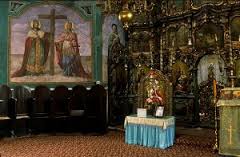


On a more general level, these letters are full with profound theological and spiritual insights. What a most blessed golden ‘chain’ of Grace and Sainthood! Elder Sophrony, already under consideration for glorification, was ordained to the diaconate by St Nicolai (Velimirovic) of Zicha and became a disciple of St Silouan the Athonite. Can you imagine? All these Saints were also ‘connected’ with the greatest probably Saint of our century, St. John Maximovitch! St. Nikolai Velimirovich is often referred to as Serbia’s New Chrysostom. St. John Maximovitch, who had been a young instructor at a seminary in Bishop Nikolai’s diocese of Ohrid, called him “a great saint and Chrysostom of our day [whose] significance for Orthodoxy in our time can be compared only with that of Metropolitan Anthony (Khrapovitsky). … They were both universal teachers of the Orthodox Church.”


Coming back to the book, of all theological concepts touched upon in this book, the one which most interests me  is the concept of Godforsakenness, as outlined by Fr.Sophrony, who worked out a distinction between two types:The first one is when man deserts God: To the extent that we live in this world, to that same extent we are dead in God. The second one is when God hides from man: a horrific state of Godforsakenness. When man has no more life in this world, i.e. cannot live by this world, the memory of the divine world draws him there, yet despite all this darkness encompasses his soul. He explains: these fluctuations of the presence and absence of grace are our destiny until the end of our earthly life. Fr.Sophrony saw suffering as a necessary stage in ascetic development: Divine grace comes only in the soul which has undergone suffering.


“We must have the determination to overcome temptations comparable to the sorrows of the first Christians. All the witnesses of Christ’s Resurrection were martyred. We should be ready to endure any hardship.”


“The most important thing in the spiritual life is to strive to receive the grace of the Holy Spirit. It changes our lives (above all inwardly, not outwardly). We will live in the same house, in the same circumstances, and with the same people, but our life will already be different. But this is possible only under certain conditions: if we find the time to pray fervently, with tears in our eyes. From the morning to ask for God’s blessing, that a prayerful attitude may define our entire day.”


“Whoever gives up his cross cannot be worthy of the Lord and become His disciple. The depths of the Divine Being are revealed to the Christian when he is crucified for our Savior. The Cross is the foundation of authentic theology.”


Not for the faint of heart, indeed!

Princess Turned Nun

Princess Turned Nun: Life of Princess Ileana of Romania then Mother Alexandra
Ileana as a young woman

Princess Ileana

Ileana as a young woman

‘But I felt I had to stand on my own feet and learn the hard way, for the hard way is the only way. I know from bitter experience where it leads to, to lean on others. It is only when one has learned to stand on one’s own feet, when one has found a solid foundation, that it is wise or good to accept help.’ (I Live Again)

Here’s an unconventional life:  A princess, great-grand daughter of Queen Victoria of England and Czar Alexander II of Russia, twice divorced (!), founder of the European equivalent of the Girls’ Scouts, gives up her pampered princess life to found and direct the first English-language Orthodox monastery in rural Pennsylvania.  Although she passed away in 1982, her life still inspires, serving as a testament to the attractiveness of the ascetic life that Orthodox theology encourages.  Her worldly name was Princess Ileana of Romania, but her tonsured name was Alexandra, eventually she became known as Mother Alexandra as the igoumeni, Abbes, Mother Superior of the Monastery of the Transfiguration in Ellwood City, Pa.

Princess Ileana

    Princess Ileana of Roumania as a teen

a real beauty in body and soul Princess Ileana of Romania

A real beauty in body and soul Princess Ileana of Romania

principesa Printesa_Ileana_de_Romania

Ileana of Romania as a young child

Ileana of Romania as a young child

Princess Ileana Red Cross

Ileana with her work in the Red Cross during the War

In my opinion, Princess Ileana’s story is a A Blessed Life of Extremes on so many levels. I have personally found Bev. Cooke’s narrative chronicle Royal Monastic: Princess Ileana of Romania: The Story of Mother Alexandra, a most fascinating account of the life of one of the twentieth centuries most unheralded, yet fascinating, persons. Mother Alexandra, formerly Princess Ileana of Romania, lived through two world wars, the communist takeover of her country, and finally saw its liberation. She lived a life of royalty and privilege, yet knew poverty, encountered opulent materialism, yet lived as an Orthodox nun founding a monastery in Pennsylvania in the later years of her life, married twice (!), yet became nun! Mother Alexandra’s experiences were varied and deep to the extent few others can claim. She was, by birth, related to some of the most powerful and historically significant people in modern history, yet never sought celebrity status. If you seek an inspirational biography, read this thrilling tale of love and loss, danger and rescue, sacrifice and reward. For all her shortcomings and ‘falls’, Mother Alexandra’s life stands in so many ways as a beacon of faith and holiness for women of all times and nations to follow. 

Life & Adventures: Birth and early life

Ileana was born in Bucharest on 5 January 1909, the youngest daughter of Queen Marie of Romania and King Ferdinand I of Romania. Although it was rumored that Ileana’s true father was her mother’s lover, Prince Barbu Ştirbey, the king admitted paternity. Ileana had four older siblings: CarolElisabeth – later Crown Princess of Greece, Princess Maria – later Queen of Yugoslavia – and Nicholas. Her younger brother Mircea was also claimed to be the child of Prince Ştirbey even though the king also claimed to be his father.

Girl Guiding

Before her marriage, Ileana was the organizer and Chief of the Romanian Girl Guide MovementLater Princess Ileana was involved in Guiding in Austria and served as president of the Austrian Girl Guides[1][2] from 1935 until Girl Guiding and Scouting were banned in 1938 after the Anschluss.

Other achievements

Ileana was the organizer of the Girl Reserves of the Red Cross, and of the first school of Social Work in Romania.

She was an avid sailor: she earned her navigator’s papers, and owned and sailed the “Isprava” for many years.

Before King Michael’s abdication

Marriage

In Sinaia on 26 July 1931, Ileana married the Archduke Anton of Austria, Prince of Tuscany. This marriage was encouraged by Ileana’s brother, King Carol II, who was jealous of Ileana’s popularity in Romania and wanted to get her out of the country.[3] After the wedding, Carol claimed that the Romanian people would never tolerate a Habsburg living on Romanian soil, and on these grounds refused Ileana and Anton permission to live in Romania.[3]

After her husband was conscripted into the Luftwaffe, Ileana established a hospital for wounded Romanian soldiers at their castle, Sonneburg, outside Vienna, Austria. She was assisted in this task by her friend Sheila Kaul. In 1944, she and the children moved back to Romania, where they lived at Bran Castle, near Brasov.[4] Archduke Anton joined them but was placed under house arrest by the Red Army. Princess Ileana established and worked in another hospital in Bran village, which she named the Hospital of the Queen’s Heart in memory of her beloved mother Queen Maria of Romania.

After exile

After Michael I of Romania abdicated, Ileana and her family were exiled from the newly Communist Romania. They escaped by train to the Russian sector of Vienna, then divided into three parts. After that they settled in Switzerland, then moved to Argentina and in 1950, she and the children moved to the United States, where she bought a house in Newton, Massachusetts.

The years from 1950 to 1961 were spent lecturing against communism, working with the Romanian Orthodox Church in the United States, writing two books: I Live Again, a memoir of her last years in Romania,[5] and Hospital of the Queen’s Heart, describing the establishment and running of the hospital. [For an introduction to her memoir go here and for the full text here.]

On 29 May 1954, Ileana and Anton officially divorced and she married secondly in NewtonMassachusetts, on 20 June 1954, to Dr. Stefan Nikolas Issarescu (Turnu-Severin, 5 October 1906 – Providence, 21 December 2002).

In 1961, Princess Ileana entered the Orthodox Monastery of the Protection of the Mother of God, in Bussy-en-OtheFrance. Her second marriage ended in divorce in 1965. On her tonsuring as a monastic, in 1967, Sister Ileana was given the name Mother Alexandra. She moved back to the United States and founded the Orthodox Monastery of the Transfiguration in Ellwood City, Pennsylvania, the first English language Orthodox monastery in North America. She was the third female descendant of Queen Victoria to become a Mother Superior in a convent of her own foundation. She served as abbess until her retirement in 1981, remaining at the monastery until her death.

She visited Romania again in 1990, at the age of 81 in the company of her daughter, Sandi.

In January 1991, she suffered a broken hip in a fall on the evening before her eighty-second birthday, and while in hospital, suffered two major heart attacks. She died four days after the foundations had been laid for the expansion of the monastery.

book tour photo I live again

Ileana on book tour with memoir “I Live Again”

For more photographs about this extraordinary woman and her amazing story of courage and conviction go here.

An Associated Press article about Mother Alexandra

FORMER ROMANIAN PRINCESS FINDS LIFE IS RICHER AS A NUN


motheralexandra motheralex2

“I did my duty as princess. And now I’m doing my duty as a nun.”
The Rev. Mother Alexandra

By Marcia Dunn
Associated Press Writer

ELLWOOD CITY—Her family jewels are gone and her castle is property of the Communist state, but Romania’s Princess Ileana believes her life is blessed in far greater, grander ways.

The princess, 79, has found peace as the Rev. Mother Alexandra, one of 12 nuns who share food, work and prayer at an Orthodox monastery in rural Western Pennsylvania.

“One’s objects stand in the way,” she said. “I’m freer and richer spiritually, and mentally, too, I hope.”

The nun of 27 years has long since buried her royal roots as founder of The Orthodox Monastery of the Transfiguration, the, first English-speaking Orthodox monastery in the United States.

But vestiges of those days remain, even at the monastery.

Portraits of her parents, Romania’s King Ferdinand and Queen Marie, hang in the living room of the A-frame house she shares with another nun.

Gold and silver icons dating back to the 15th century fill a corner of her bedroom. Antique icons also decorate the monastery’s small, candlelit chapel as do crosses and triptychs, some of which she brought from Europe.

A small, gold container on a bed stand holds her most precious possession, a handful of Romanian soil snatched during her escape from Russian Communism in World War II. She wants it buried with her.

“There’s a big gap between then and now. So much has happened in between,” Mother Alexandra said.

“It’s been different so many times over,” she said. “But you see, one lives day by day, doesn’t one? So that really it becomes a sequence of its own and you take it as it comes. Thank God, I always had a really strong faith that carried me through everything.”

She refuses to compare her regal and- religious lifestyles.

“There is no, point,” she said. “I did my duty as a princess. And now I’m doing my duty as a nun.”

Her superiors, nonetheless, are impressed by her example.

“As a person, as an individual, I have admiration because even not having a position, she could have had a social life, which would be much more in keeping with other people of her background,” said Bishop Nathaniel Popp, 47, head of the Romanian Orthodox Episcopate of America.

“Instead of saying she was a princess who became a nun, I think it was more she was a nun coming through the life of a princess,” he said.

Although just a child during the German invasion of World War I, Princess Ileana accompanied her mother, the queen, from hospital to hospital, administering to Romania’s wounded and hungry. By World War II, her parents were dead, her older brother, Carol, had ascended the throne, one sister had become queen of Yugoslavia and another queen of Greece.

Princess Ileana lived in a castle near Vienna, wife of an archduke of Austria and mother of six.

Fearful of the Nazi regime, Princess Ileana and her family moved in 1944 to Romania. There, she set up hospitals and did what she could for her suffering compatriots despite Russia’s growing threat.

On Dec. 30, 1947, her nephew, King Michael, forced by the Communists to abdicate. The next week, Princess Ileana and the rest of the royal family were exiled.

Princess Ileana immigrated with her family to Switzerland then Argentina before settling in 1950 in the United States, a move that ultimately led to divorce. To support her children, she sold her diamond and sapphire tiara, lectured about life behind the Iron Curtain, and wrote the autobiography “I Live Again.”

In 1961, after her children were grown, the 52-year-old princess became a postulant. She ended a second marriage to do so.

“In my heart, I have always wanted to become a nun,” she said. “But there was so much to be done in Romania when I was young.”

Princess Ileana took the monastic vows of stability, obedience, poverty and chastity in 1967 and, with that profession, became Mother Alexandra. Later that year, she put up a trailer on 100 acres of farmland outside Ellwood City and began building an English-speaking monastery for Orthodox women of all ethnic backgrounds.

Even though she has stepped down as the monastery’s abbess, Mother Alexandra’s work goes on. She oversees construction of a new complex to accommodate more activities and the growing number of women drawn to the cluster of redwood buildings on a hill.

Her royal background, surprisingly, has helped her cope with the austerity of monastic life: two-hour prayer sessions three times a day, black habits and headdress, renunciation of the temporal world and ail its trappings.

“As a royal person, you have to be very disciplined,” she said. “From the beginning of your life, you are a public person. You belong to the country. Your own personal amusement does not play any part. Your duty comes first.

From that point of view… I’ve watched the other sisters, the struggles they have I don’t. For me, it isn’t difficult.

What is difficult for her is dealing with the strangers who periodically show up at monastery, hoping for a glimpse of a real-life princess.

“It’s my cross I have to bear,” she said, sighing.

To her sisters in spirit, she is just another nun.

“We live quite equally here,” said the Very Rev. Mother Christophora, the monastery’s abbess.

“Each of us has a background and a past. It’s there and you think about it occasionally,” said the 34-year-old abbess, a former alcoholism counselor from Lopez, Sullivan County. “But most of the time, we’re just getting along, surviving, loving our faith. Of course, that’s the way it should be. We should leave our past behind.”

“Mother Alexandra is a nun, sure. She’s in the garden, in the flowers, digging like everybody else,” said the Rev. Roman Braga, 65, the monastery’s chaplain.

Although she treasures her secular past, Mother Alexandra has no desire to resurrect it by visiting Romania, even if she could. Her passport, British because of her House of Hanover ancestry, is stamped: “You have no right to return.”

“I couldn’t bear to see everything that my parents did, we all did and worked for, destroyed,” she said.

Still, there are times, especially around Romania’s National Day on May 10, when her heart longs for the land she left behind.

“I’ll always be homesick,” she said. “I think that’s an illness of which one is never cured. You accept it like one accepts anything else.

“Besides, what I’m homesick for doesn’t exist anymore. That’s the tragedy.”

Source: Greek American Girl

Monastic Tonsure


tonsure.jpg

Every monastic calling is a falling asleep, like that which Adam underwent. God does this to us, and simultaneously pierces our side, next to our heart. This is the meaning of the corresponding verse [Genesis 2 :21] God takes our heart, our will, our dreams, our hopes, our everything and He offers us His Church as the New Eve. He is telling us that from now on, our body and our future is owned by the Church!
Gerondas Aimilianos

Genesis 2 :21
And the Lord God caused a deep sleep to fall on Adam, and he slept; and He took one of his ribs, and closed up the flesh in its place. 22 Then the rib which the Lord God had taken from man He made into a woman, and He brought her to the man.


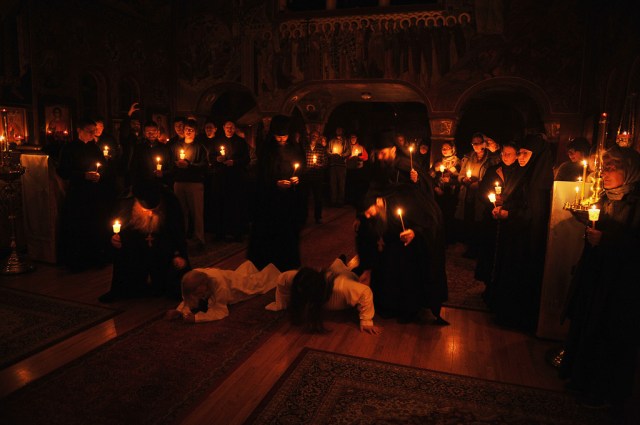
On Friday March 30 2012 after the Matins service Riassaphore monks Laurence and Dionysios were tonsured to the Lesser Schema by Archimandrite Luke. At the end of Matins they entered the Altar were they received the blessing of the Abbot and then proceeded to venerate the holy icons. During the First Hour they put on white gowns as one does when they are to be baptized and when the service finished they were led by the hieromonks of the monastery to the middle of the Church were they prostrated themselves to the ground three times during which the choir sung the sessional hymn after the Third Ode of the Canon from the Prodigal Son “Thy fatherly embrace hasten to open to me, for like  the prodigal have I spent my life. Disdain not a heart now impoverished O Savior, Who hast before Thine eyes the inexpressible riches of Thy mercies. For to Thee, O Lord, in compunction I cry: Father, I have sinned against Heaven, and before Thee”.
When they reached the front of the ambon the Abbot signaled them to get up and read the prayers of the tonsure and  exchanged in a dialog questions and answers as to the purpose of coming to the  monastic life.  Below are some of the exchanges that took place:

Question: Why hast thou come hither, Brother, falling down before the Holy Altar and before this Holy Assembly?
Answer: I am desirous of the life of asceticism, Reverend Father.
Question: Of thine own willing mind comest thou unto the Lord?
Answer: Yes, God helping me, Reverend Father.
Question: Not by any necessity, or constraint?
Answer: No, Reverend Father.
Question: Dost thou renounce the world, and the things belonging to the world, according to the commandment of the Lord?
Answer: Yes, Reverend Father.
Question: Wilt thou endure all the strain tribulation belonging to the monastic life, for the Kingdom of Heaven’s sake?
Answer: Yes, God helping me, Reverend Father.

Fr. Laurence was tonsured with the name of St John  of St. Fransisco and and Fr. Dionysios received the name of St. Seraphim of Sarov. May our Lord help the newly tonsured monks to live steadfastly their monastic vocation  by a “pure and virtuous life” so that their life becomes a light to the world.

Archimandrite Luke counseled the newly tonsured monks to become imitators of the lives of the saints whose names they received and to struggle in humility enduring all afflictions for the salvation of their souls. At the end of this very moving service everyone went up to the newly tonsured monastics and greeted them with the traditional greeting, “What is your name father?” to which they replied  “sinful monk John and Seraphim” and all wished them many years and God’s blessing in their struggles.

Source: Holy Trinity Monastery


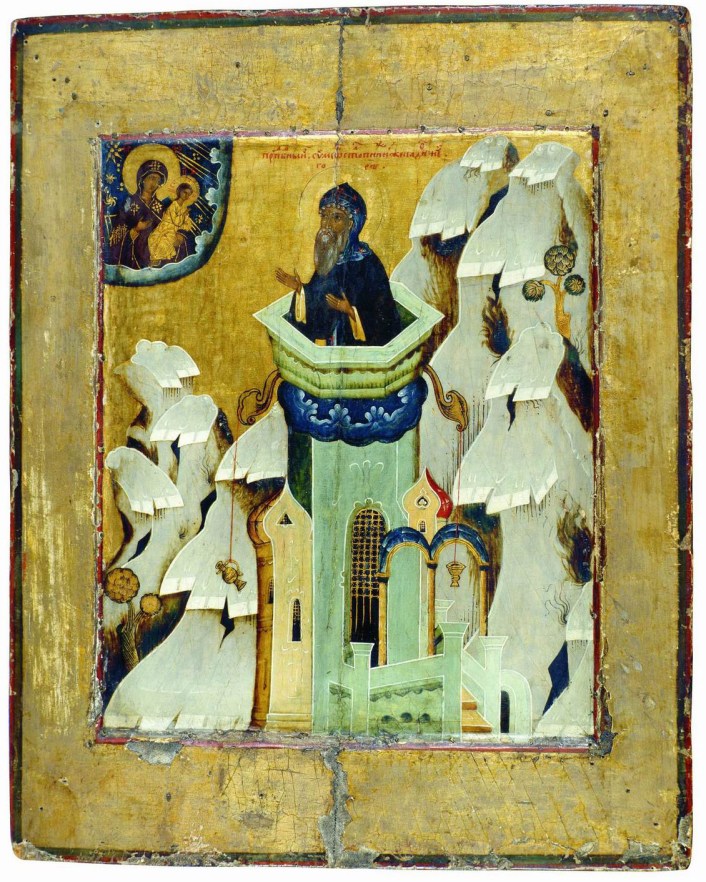
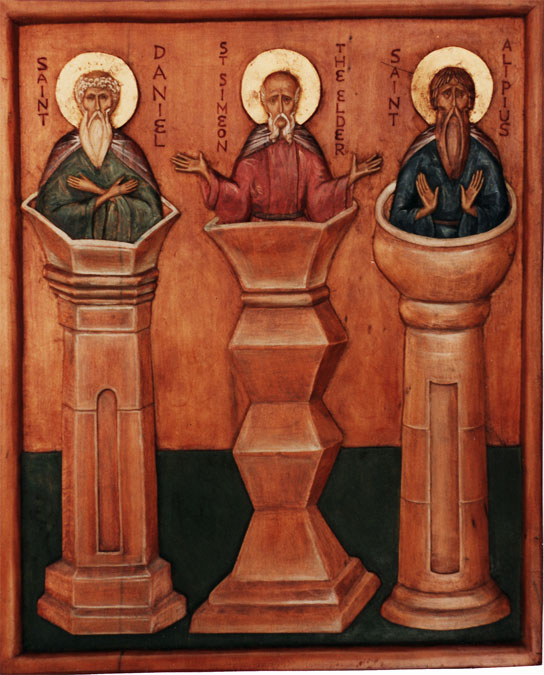
Pillars To Heaven: Stylites in the Levant

stylitis14

CIS:E.445-1965

stylitis20stylitis18

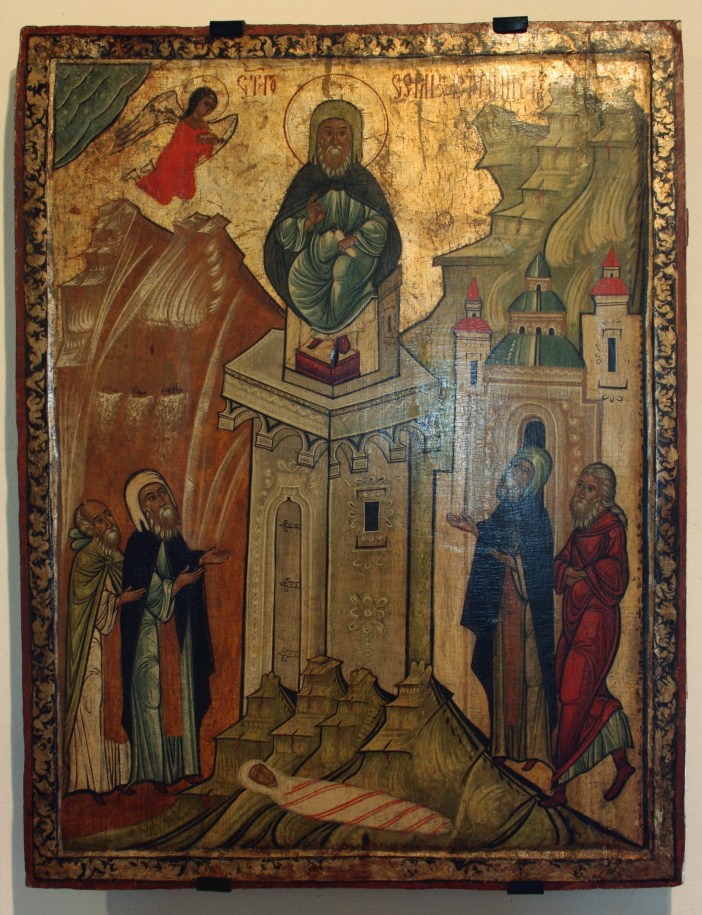
St. Symeon Stylites

By Lord Alfred Tennyson


Altho’ I be the basest of mankind,

From scalp to sole one slough and crust of sin,

Unfit for earth, unfit for heaven, scarce meet

For troops of devils, mad with blasphemy,

I will not cease to grasp the hope I hold

Of saintdom, and to clamour, morn and sob,

Battering the gates of heaven with storms of prayer,

Have mercy, Lord, and take away my sin.

Let this avail, just, dreadful, mighty God,

This not be all in vain that thrice ten years,

Thrice multiplied by superhuman pangs,

In hungers and in thirsts, fevers and cold,

In coughs, aches, stitches, ulcerous throes and cramps,

A sign betwixt the meadow and the cloud,

Patient on this tall pillar I have borne

Rain, wind, frost, heat, hail, damp, and sleet, and snow…(1)

stylites34

Interview About Stylites (2)

stylitis11

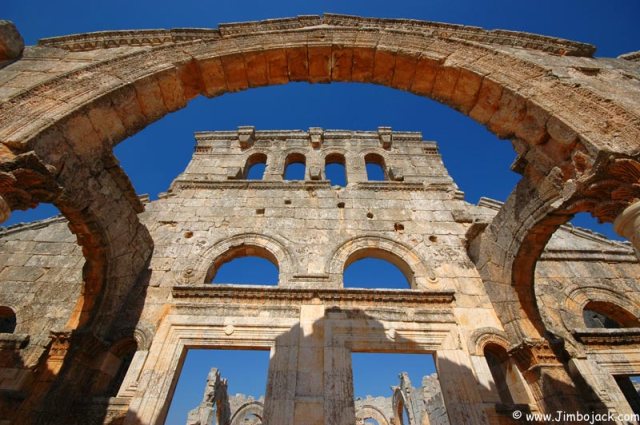
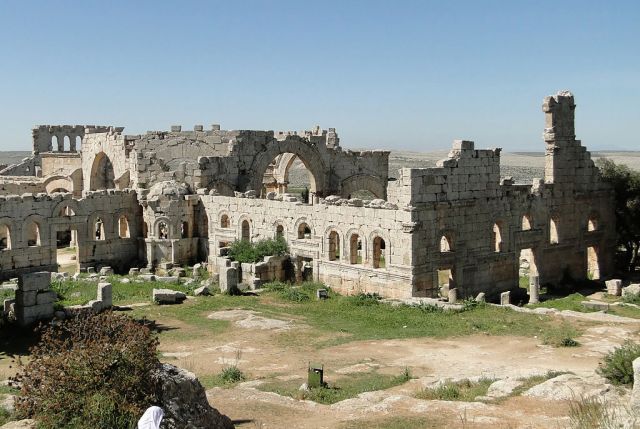
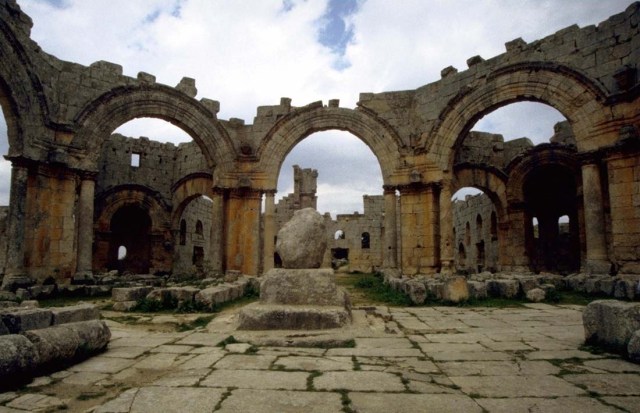
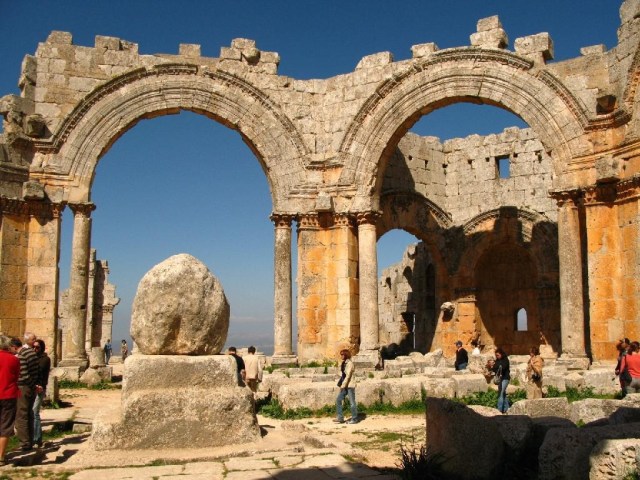
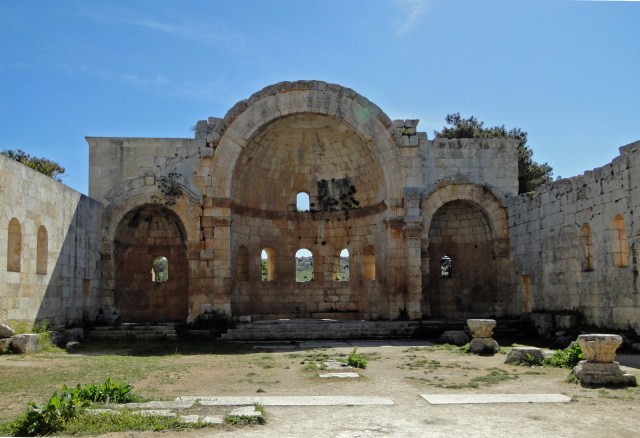
Qala’at Si’man. Ruins of the Basilica of St. Simeon the Elder, Deir Sim’an, Syria (3)


RTE: Lukas, will you describe your archeological work, and how you became interested in the stylites?

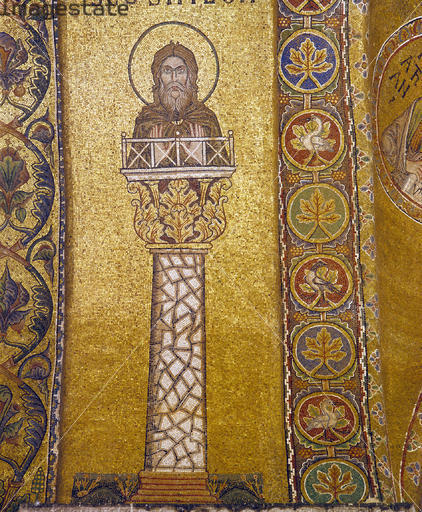
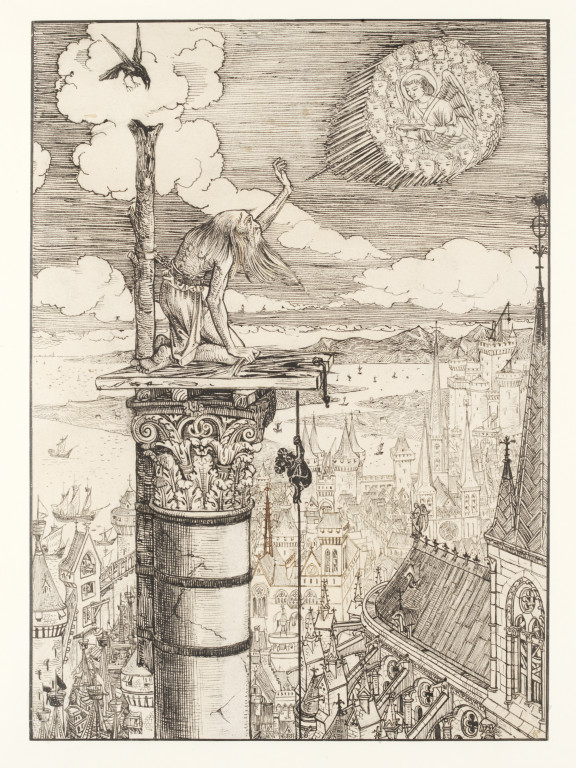
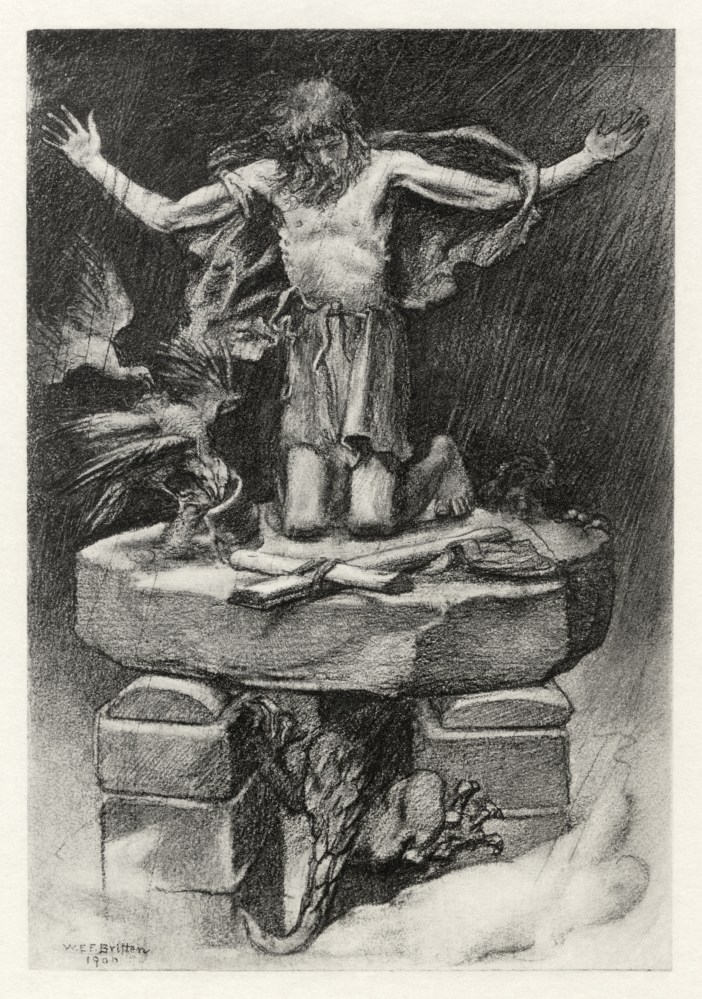
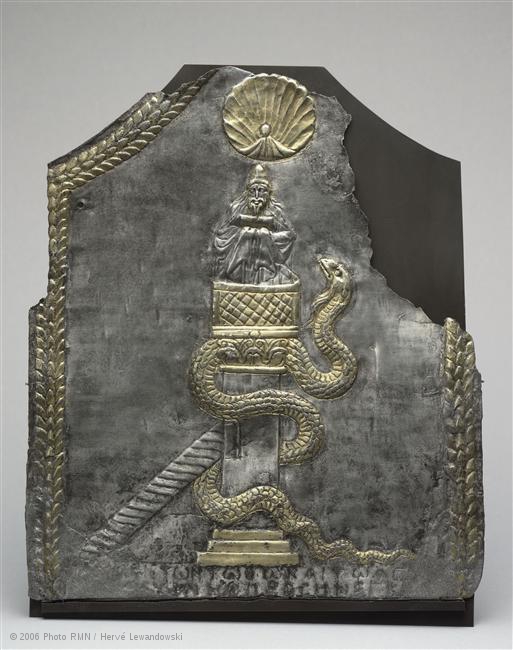
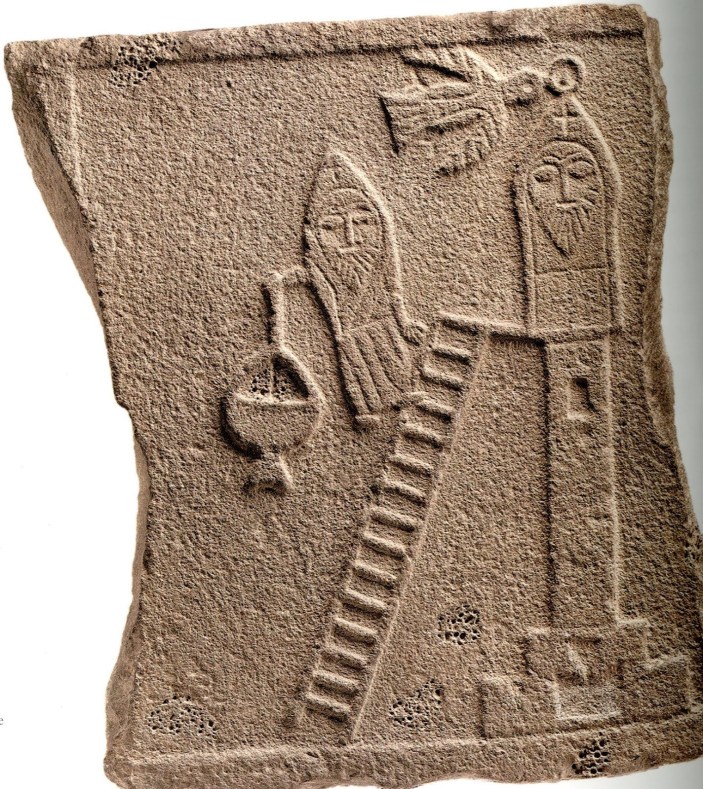
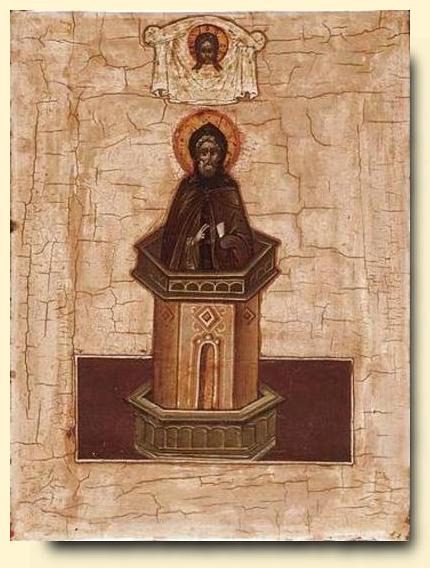
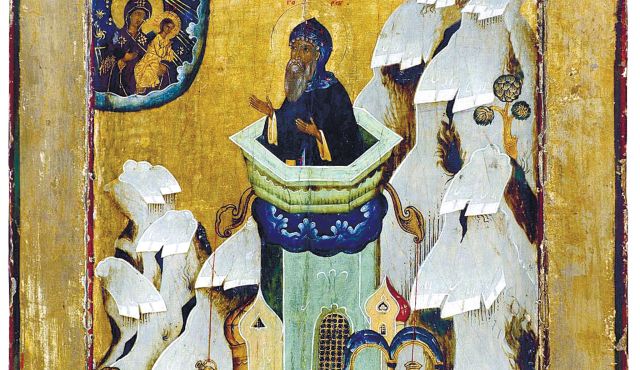
LUKAS: … My interest in monasticism in general has led me to a very particular interest in stylitism (stylos, in Greek, meaning “column”), the ascetics who stood on pillars. Although we often think of stylitism as a very unique and lonely calling, in its developed form it cannot be separated from monasticism. The stylite withdrew from the world, but in doing so in such a spectacular way, he attracted the world. And as soon as people began coming for advice or counsel, he needed dedicated friends or disciples to organize his life – to make sure he was protected, that he would be given the hours of silence he needed, and that the people coming to see him were taken care of.

stylitis4

The stylite himself is generally seen as a Syrian-Mesopotamian phenomenon, a very severe attempt to follow Christ not only through self-mortification and fasting, but through standing on a tiny platform at the top of an exposed column or pillar – never coming down, and only rarely sitting or lying down. By exposing themselves to the harshest conditions any human can, they strove to be spiritually cleansed and to elevate their souls.

stylites30

stylitis9

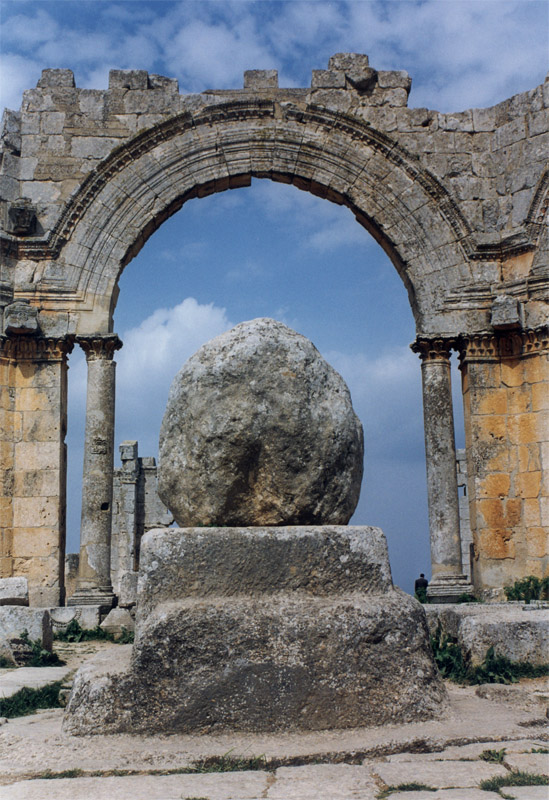
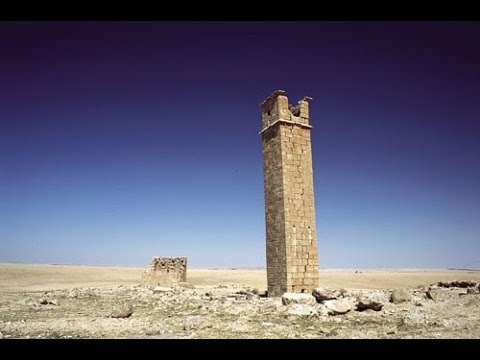
What we know about the stylites comes from Greek and Syriac texts, some written when the stylites were still alive, and many of which relate the history of the most famous pillar saint, St. Simeon the Stylite (the Elder), who died in 459. Within twenty years after his death, the famous pilgrim- age sanctuary and later medieval fortress of Qal’at Si’man was built. As Christians, we would call it “The Martyrium of St. Simeon the Stylite.”

stylites31

St. Simeon the Elder is the prototype, he was the one who was imitated. Of his life we have very specific evidence in both Greek and Syriac sources, although it is the Syriac which give the best descriptions. They tell us that he was a very ascetic man, and that at a certain point in his life he joined a monastic community. At a very early stage, however, it became clear that he was much more rigorous than the other brothers and finally had to leave to pursue his calling.

stylitis7

St. Simeon moved north of the mountain of Gebel Sheikh Barakat, to a village called Telanissos (now Deir Sim’an), at the foot of the mountain where his sanctuary was later built. (Gebel is “mountain” in Arabic, and it is now known as Gebel Sim’an.) The Syriac sources say that he lived a very basic life. We read of him taking a camel laden with goods up and down the road, and that wherever he went people were impressed by this humble, modest man. At a certain point he decided to go up the mountain to expose himself to the harshness of the wilderness.

stylitis10

Don’t forget, we are in northern Syria where winters may be very, very cold and summers extremely hot with strong winds. Simeon was very aware that this place was exposed to harsh weather conditions year round. However, it is also a very beautiful place, with a 270o view in several direc- tions, and not far from the village and the Roman road. If you take the old north-south Roman road from Cyrrhus, forty or fifty kilometers north, down towards Telanissos (now Deir Sim’an) to the junction that links you to Antioch in the west, you’ve passed between Telanissos and Gebel Sim’an.

stylitis2

So, we know that he was here not far from the main road, that he stood on the column without a break, summer and winter, for almost fifty years; that he was famous for his asceticism, for his suffering endurance, but also for the very social role he played in giving advice and counsel to the local population, to those who passed on the roads, to distant nomadic Arab tribes that came for his judgement and help, and even to the Byzantine emperor. We know he was constantly asked for personal, moral, and even legal advice (and this is important because legal matters in those days were very linked to religion, as in modern Islam.) So, St. Simeon was a man for everyone and everything.

DCF 1.0

But he soon found himself in the dilemma of having withdrawn from the world, but now being too close to the world. Pilgrims, as we know from the sources, came from far and wide. They came from all over the Mediterranean: by boat to Antioch, then crossing the rough country to Simeon’s column. They came from Seleukia, from Asia Minor, from the Arabian peninsula, from Europe. As time went on, he decided to add anoth- er ten cubits to his column, and then another, until finally according to the Syriac text, he was standing at a height of forty cubits. (40 cubits = 60 feet or 18 meters)

stylites37

RTE: I remember from his Life that he didn’t begin with a pillar – perhaps he had gone up the mountain simply because it was isolated and he knew that other people couldn’t conveniently live there. But the moment they understood that he was a holy man they came anyway, as people do, until the crowds were trying to touch him, to grab pieces of his clothing. I’ve wondered if perhaps he had even taken a vow to remain there and the pillar was simply a necessary measure to get out of their reach.

stylites36

LUKAS: Yes. I think it was the universal dilemma of an isolated holy man. Once you are holy you often become known and can’t avoid people seeking bless- ings. The holy man is like a magnet. But permanent exposure to the world puts your monastic ideals at risk because you don’t have the time of reclusion, of absolute silence, of being alone with God. So, adding to the column’s height was perhaps an attempt to maintain his original ideal of a life of prayer.

stylites38

RTE: Also, the noise of a constant crowd – in St. Simeon’s case it was not a handful, but hundreds of people a day from different countries with horses, pack animals, campfires. Some stayed for weeks. It must have been overwhelming.

stylites40

(1) For the full poem go to http://www.online-literature.com/tennyson/728/

(2) For the full two-day traveling interview through the Syrian desert, where Lukas’ command of archeological detail and his fascinating insights (both Christian and academic) into the daily lives of these great ascetics make the era come alive, its saints immediate, and their presence inescapable, go to http://www.roadtoemmaus.net/back_issue_articles/RTE_22/PILLARS_OF_HEAVEN.pdf

(3) The church of Saint Simeon Stylites dates back to the 5th century. The United Nations Educational, Scientific and Cultural Organization (UNESCO) designated it a World Heritage Site in 2011.

stylites39

* Austrian archeologist Lukas Schrachner’s extensive fieldwork centers on early Christian monasteries and stylite sites in Turkey, Syria, Lebanon, Jordan, and Egypt. The Levant in the present context is the region occupied by Palestine, Trans-Jordan, Lebanon, Syria and south-eastern Turkey.


Thin Places (IV)

celtic72

*

“The Church in The British Isles will only begin to grow 

when She begins to again venerate Her own Saints

 *

(Saint Arsenios of Paros †1877)

*

Celtic Monasticism, A Model of Sanctity By Hieromonk Ambrose (Father Alexey Young) — Part IV of IV

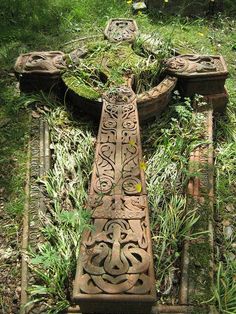
Central to Celtic Christian culture was the Cross.

For the Celts, simplicity wasn’t so much a question of externals–like furniture, architecture, and so forth. It was something internal, and it was founded upon the phrase, “Thy will be done”. This meant God’s will, not our own. It meant dying to oneself, not having opinions and not judging others.

*

Even in the 7th and 8th centuries there were so-called Christians who were uncomfortable with the Cross of Christ and chose to ignore it, just as there are today. The Celts, however, had a particularly clear-headed understanding of the Cross. To quote Sister Benedicta Ward, a renowned scholar on the subject of the Desert Fathers as well as monasticism in the British Isles in the early Christian centuries: “The Cross was not something that made them feel better, nicer, more comfortable, more victorious, more reconciled to tragedy, better able to cope with life and death; it was rather the center of the fire in which they were to be changed.” (op.cit.)

It reminded them that they must pick up and carry their own crosses in this life and follow Christ, for dying to oneself has always been the great secret of holiness.

celtic73

Thus, these monks and nuns saw themselves as warriors of the spirit, for to die to oneself was considered a greater act of heroism than dying on a battlefield in defense of one’s tribe. “The Celtic Church was a Church of heroes…of strong” and fiercely dedicated men and women. “The old Celtic warrior spirit was alive in them, [but now] put to the service of the Gospel and the following of Christ, the High King. Today [we might] find it hard to identify many [such] warrior Christians…[with] the active virtues of courage, strength, outspokenness, decisiveness, and the ability to stand up for something.” (Joyce, op.cit.)

celtic79

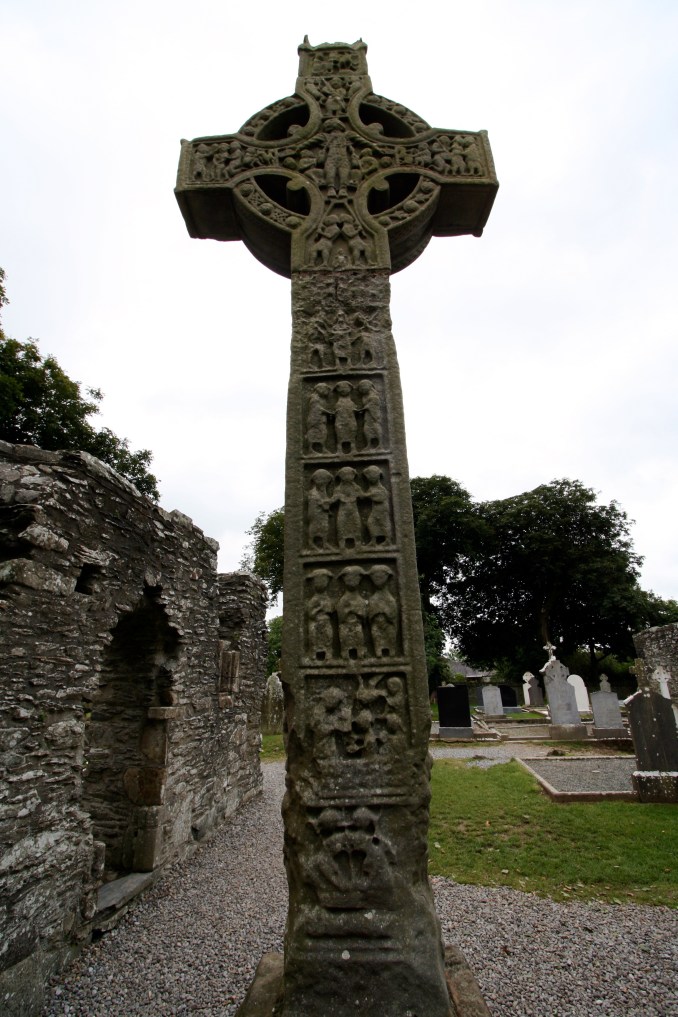
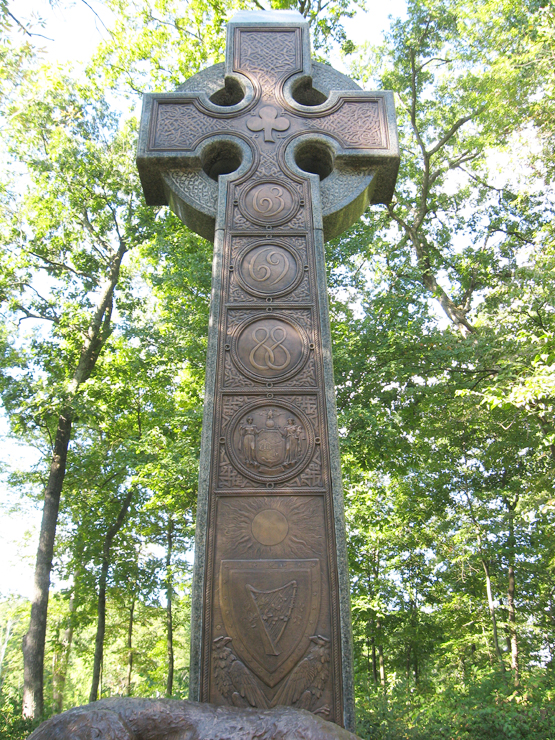
Nowhere was the Cross more loved and cherished than in the monasteries, where highly-carved and richly symbolic great “High Crosses”–some of them 15 feet and taller– were set up–many of them still standing today. These were not the suffering and bloody crucifixions found later in the West, particularly in Spain and Italy. Nor were these the serene and peaceful crosses of the Eastern Church. No, Celtic crosses were a genuine Christian expression all their own. Sometimes Christ is depicted, but often not; however, when He is shown, He is always erect, wide-eyed, and fully vested like a bishop, a great High Priest. In this form He is a symbol of victory over sin and death; He radiates invincibility.

celtic71

“The way of the cross for [Celtic Christians] was the way of heroic loyalty, obedience, and suffering. It involved study and thought, doctrine and orthodoxy, art and imagination. It was a complete, unified way of life, lived intimately with God….[Our] fragmented modern world, both secular and religious, has a lot to learn from it.” (Cavill, op.cit.)

celtic78

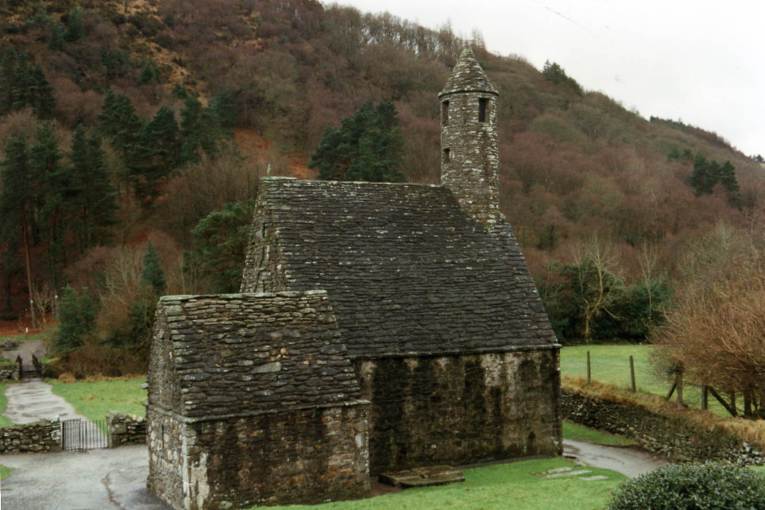
Saint Kevin, Hermitage of Glendalough

*

“Thou wast privileged to live in the age of saints, O Father Kevin,

being baptized by one saint, taught by another, and buried by a third.”

*

A common ascetic practice, even for the laity, was called crosfhigheall or “cross-vigil”, and it consisted of praying for hours with outstretched arms. St. Coemgen sometimes prayed in this position for days. Once he was so still, for so long, that birds came and began to build a nest in his outstretched hands.

celtic81

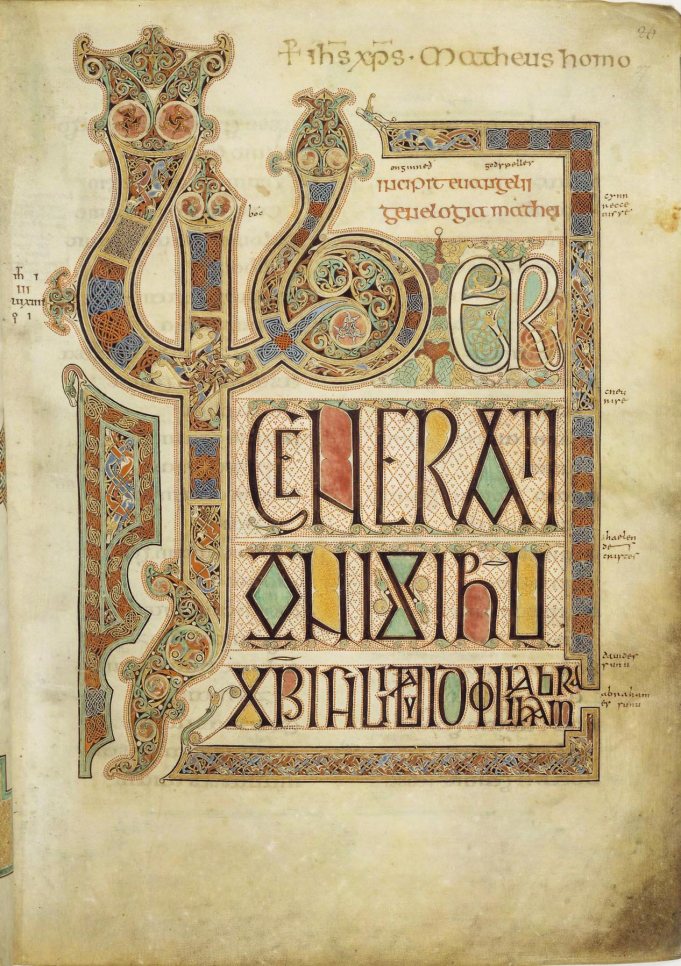
Scholars believe that the Celtic High Cross patterns probably came from Egypt. There are no loose ends in these patterns; this symbolizes the continuity of the Holy Spirit throughout existence–for God has no beginning and no end.

celtic66

Lindisfarne Priority, Rainbow Arch

celtic77

The chapel of Saint Kevin at Glendalough

An example of the love and respect they had for the Cross may be seen in an Anglo-Saxon poem, “The Dream of the Rood” (“rood” being an Old English word for “rod” or “pole”, sometimes it also meant “gallows”). In the “The Dream of the Rood,” Jesus Christ, the Second Person of the Blessed Trinity, is shone as a “serene and confident young hero…[who] prepares for battle. He strips…and climbs up on the gallows [the Tree of the Cross], intent on saving His people. He is in control, self-determining, expressing His lordship….[And] the Cross trembles at the fearful embrace of its Lord.” (Cavill, op.cit.) Listen, now, as the Cross, personified, speaks of how it raised up Christ:

“Unclothed Himself God Almighty when He would mount the Cross, courageous in the sight of all men.
I bore the powerful King, the Lord of heaven; I durst not bend.
Men mocked us both together. I was bedewed with blood. Christ was on the Cross.
Then I leaned down to the hands of men and they took God Almighty.” (Ward, Ibid.)

celtic68

St Helier’s hermitage –Hermitage rock

The interlacing, knot-work, plaiting, weaving patterns and spiral designs, with animals and plants and saints, and scenes from Scripture, which decorate almost every surface of a Celtic High Cross, are so distinctive and profound in their symbolism that they are a study all to themselves. Today I can only point out a couple of things.

celtic84

celtic86

Scholars believe that these incredibly complex patterns probably came from Egypt, but also may have some Byzantine influences. It’s important to note that there are no loose ends in these patterns; this symbolizes the continuity of the Holy Spirit throughout existence–for God has no beginning and no end; only Christ is the Alpha and the Omega. The same is true of knot-work patterns, which are endless and cannot be untied. Spiral designs symbolized the Most High God Himself, the “motionless mover,” around whom all things move. Some of these are what are called “Crosses of the Scriptures” because they are decorated with panels illustrating scenes from the Bible. High Crosses possess an almost dream-like quality in their complex geometric patterns, dignified and strong, heroic and towering over men, and yet also reminding those Christians of the Christian doctrine of kenosis, the self-emptying of Christ.

celtic80

Lindisfarne Gospels 

One of main factors contributing to the eventual decline and dissolution of a Celtic monastery was when the Cross began to no longer be a focus. “If monastic life…did not have at its center the reality of the Cross, it became a source of corruption….[for] ‘Once a religious house or order cease[d] to direct its sons to the abandonment of all that is not God and cease[d] to show them the narrow way…it [sank] to the level of a purely human institution and whatever its works may be they are the works of time and not of eternity.’” (Dom David Knowles, quoted in Ward, Ibid.)

celtic87

An essential dimension was asceticism (askesis) which, for the Celtic monk consisted of a kind of martyrdom. “A homily in archaic Irish, probably dating from the last quarter of the seventh century…speaks of [this]:

‘Now there are three kinds of martyrdom, which are accounted as a cross to a man, to wit: white martyrdom, green and red martyrdom. White martyrdom consists in a man’s abandoning everything he loves for God’s sake, though he suffer fasting or labor therat. Green martyrdom consists in this, this, that by means of fasting and labor [a Christian] frees himself from his evil desires, or suffers toil in penance and repentance. Red martyrdom consists in the endurance of a cross or death for Christ’s sake, as happened to the Apostles…’

For this reason, the Celtic tradition regarded monasticism as the Army of Christ (Militia Christi) and the monk as a soldier of Christ (miles Christi). Young men, in their effort to emulate the heroism of their ancestors, entered monasteries–the “Green Martyrdom.” Instead of fighting in the Fianna (the Celtic army), they joined the Militia Christi to wage war against the evil spirits and sin.” (Fr. Gorazd Vorpatrny, op.cit.) Not surprisingly, one writer calls these Celts “Ascetic Superstars.” (Bitel, op.cit.)

*

“I should like a great lake of ale for the King of Kings;

I should like the angels of heaven to be

drinking it through time eternal!” – St. Brigit of Kildare

*

And yet, with all of this sober asceticism, the Celts never lost their native enthusiasm, exuberance, and just plain cheer, as we see in a prayer written by the wonderful 5th century Abbess, Brigit, when she exclaims: “I should like a great lake of ale for the King of Kings; I should like the angels of heaven to be drinking it through time eternal!” How could anyone fail to be charmed by such a character–a woman who was a great leader of monastics, both men and women, who was baptized by angels, got out of an arranged marriage by plucking out one of her eyeballs, and fell asleep during a sermon given by the incomparable Equal-to-the-Apostles, St. Patrick!

celtic69

St Herbert’s Island, Derwent Water 

Finally, the Celts were Trinitarian Christians par excellence. This is partly because even before they were Christian they already thought in terms of threes. And for them–unlike most Christians today–the Trinity was very real, very alive, not something vague and theoretical. What one scholar calls a “Trinitarian consciousness” (Joyce, op.cit.) completely shaped everything about them. As another has said: “‘We are here at a central insight of Celtic theology….Christ comes not to show up or illuminate the deformity of a fallen world but rather to release a beautiful and holy world from bondage….an affirmation, difficult but possible, of [that] which is the created image of the eternal Father and the all-holy Trinity.’” (Noel Dermot O’Donoghue, quoted in Joyce, op.cit.) “To follow the spiritual world-view of the Celtic Christians is to embrace a way of life that is a real commitment to the belief that the Trinitarian God is alive in this world.” In the Celtic world, “Jesus Christ is our hero, our sweet friend….The Father is High King of heaven, a gentle and beneficent father, a wise and just ruler. The Spirit is a tangible comforter and protector ….This God is never to be reduced to the ‘man upstairs’ or anyone we can capture and box in. And yet this wonderful, mysterious God is close to us….[This] God is extremely good.” (Ibid.)

celtic85

Brothers and sisters: the sanctity of Celtic monastics is a model for us in that it combines heroism and joy in perfect and beautiful balance. For them, the heroic life was one completely dedicated to living intimately with the God-Man whom they described as “victorious,” “mighty and successful,” “the lord of victories,” a great warrior to whom they pledged undying, fearless, creative and exuberant loyalty. And yet, for all of their heroism, their monastic world-view, could be ‘summed up as the ‘Christian ideal in a sweetness which has never been surpassed.’” (Nora Chadwick, quoted by Joyce in op.cit.) To slip into their world, even for just a few moments, as we’ve done here this afternoon, is, I believe, is not just inspiring; it’s almost breathtaking.

celtic83

Just as I began my talk today with a prayer of St. Columban of Iona, I would like to conclude with another prayer from this great Celtic monastic saint:

Prayer of
St. Columban of Iona

Lord, Thou art my island; in Thy bosom I rest.
Thou art the calm of the sea;
in that peace I stay.
Thou art the deep waves
of the shining ocean.
With their eternal sound I sing.
Thou art the song of the birds; in that tune is my joy.
Thou art the smooth white strand of the shore;
in Thee is no gloom.
Thou art the breaking of the waves on the rock;
Thy praise is echoed in the swell. Thou art the Lord of my life;

*

celtic33

Source: http://www.asna.ca/angloceltic/celtic-monasticism.pdf

Also, listen to Hiermonk Ambrose (Father Alexey Young) about THE UNIQUENESS OF CELTIC MONASTICISM at http://www.asna.ca/angloceltic/

For more information on Celtic Orthodoxy, go to http://www.mullmonastery.com and follow father Seraphim’s pilgrimage and struggles to found the first Orthodox monastery in the Hebrides in over a millennium.

*

To continue our pilgrimage to the Celtic sacred sites and pilgrim routes of England, our next stop will be Scilly –pronounced “silly”–Islands! (/ˈsɪli/Cornish: Syllan or Enesek Syllan) (Introduction of the “c” may be to prevent references to “silly” men or saints!) Yet one more look at Christian faith from a Celtic perspective. The Isles of Scilly  are an archipelago off the southwestern tip of the Cornish peninsula of Great Britain, comprising  5 Major, inhabited islands,St Mary’sTrescoSt Martin’sBryherSt Agnes and 140 others. For more, go to https://orthodoxcityhermit.com/2015/11/05/scilly-pilgrimage/