Bishop Basil (Rodzyanko). Photo by Yu. Kaver
The russian bishop Basil (Rodzyanko) died on September 17, 1999, in Washington, D.C. In reality, Bishop Basil had simply been waiting for this moment to begin a journey for which he had been preparing his whole life. Indeed, Basil often spoke about it, but no one seemed to understand. His interlocutors preferred to ignore it or to express their sympathy by saying: “Why, Vladyka”—this is what Russians call their bishops, an affectionate word meaning “Sovereign,” “Master,” or “Your Grace”—“you have a life ahead of you! God is merciful!” But the bishop himself looked forward to his journey onward with impatience and with lively interest.

Bishop Basil (Rodzyanko) in Pochaev. Photo by the author
The thing is that even during his life he had always been an inveterate traveler. Moreover, I would say that traveling was his true mission and true way of life. The beginning of his journey, without a doubt, was his birth in the aristocratic estate of Otrada, which was his family patrimony. The boy who was to become the bishop Basil was called Vladimir (Volodya) by his parents. The newborn boy’s paternal grandfather was Mikhail Vladimirovich Rodzyanko, the chairman of the State Duma of the Russian Empire. And his mother came from two ancient princely lineages of the highest rank: the Golitsyn and the Sumarokov families. Indeed, many noble Russian families were in close or remote kinship with this particular servant of God.
In 1920 the bishop undertook his next real journey. At the time he was only five years old. The road was long—by land and by sea, through Turkey and Greece and on into Serbia. The family was forced to leave because the new leaders of Russia were not willing to let the former chairman of the Imperial State Duma and his family live in peace. The Rodzyankos settled in Belgrade, and this is where the future bishop was raised.
He was fortunate to have wonderful teachers. The cream of the Russian emigre community had congregated in Yugoslavia. Among them were his immediate mentors, the Holy Hierarch John (Maximovich), who thirty years later was to become the distinguished Archbishop of San Francisco, and sixty years later would be known as a saint to the Russian Orthodox Church Abroad, as well as the great Primate of the Russian Orthodox Church Abroad, Metropolitan Anthony (Khrapovitsky). These were both spiritual giants, and they had a powerful and positive influence on their young pupil.
Yet there was another teacher who was no less important in the life of the future bishop—one whom Volodya could never forget. This was his tutor, a former officer of the White Army. No one but little Volodya knew that his tutor was constantly beating him and torturing him, and torturing the poor boy very skillfully too, hitting him without leaving any traces. This miserable officer nursed intense hatred for Mikhail Vasilyevich Rodzyanko, his little student’s grandfather, believing him to be at fault for the destruction of Russia. He had no way of venting his anger at the grandfather, and so, alas, he made the poor little grandson pay for all of it.
Years later, the bishop recalled: “My mother not long before her death said: ‘Please forgive me for unwittingly letting that man torture you when you were a child.’ ‘Mother, this was God’s will,’ said I. ‘And if it had not happened to me when I was a child, I would have never become who I am today . . .’ ”

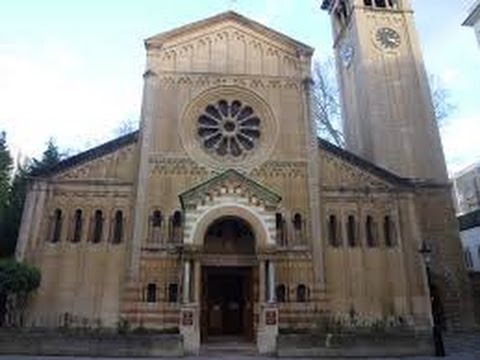
The Church of the Feodorov Icon of the Mother of God in Tsarskoye Selo. Photo: uolliss.ya.ru
When the bishop was already in his declining years, God gave him the chance to return to the Imperial village of Tsarskoye Selo. There Bishop Basil had received permission from the Church authorities to serve the Liturgy in the Church of the Feodorov Icon of the Mother of God, a church especially beloved by the Tsar’s family. When the service was over, the bishop came out to the people and confessed the guilt he had felt since his childhood solely because he had been the grandson to his beloved grandfather. The bishop said: “My grandfather only wanted the best for Russia, but as a feeble man, he often made mistakes. He was at fault when he sent his parliamentarians to his Imperial Majesty asking for his abdication. He didn’t think that the Tsar would abdicate both for himself and for his son, and so when he learned that this is what had happened, he cried bitterly and said, ‘Nothing can be done now. Russia is lost.’ And so he unwillingly became responsible for the tragedy of the massacre of the Imperial Family in Yekaterinburg. This was an involuntary sin, but a sin nonetheless. And so now, in this holy place I am asking for Russia, for her people, and for the murdered Tsar’s family to forgive my grandfather and to forgive me. And as a bishop, with the authority given to me by God, I forgive him, and release his soul from this involuntary sin.
***
The Rodzyankos settled in Yugoslavia. Vladimir grew into a kind, tall, and very handsome young man. He received a brilliant education, and fell in love with a wonderful girl who became his wife. And at the age of twenty-five he was appointed to serve as a priest in a Serbian Orthodox Church. When the Second World War began, Father Vladimir Rodzyanko fearlessly participated in the fighting against the Nazis. And when the Communists came to power, he remained unhesitatingly in Yugoslavia while most of the other White Russian emigres fled the country. Father Vladimir served as a priest in his Serbian parish and he believed it was wrong to leave his congregation, even if he were under the threat of prison or death. He was not killed, but he was sentenced to spend eight years in a camp. Tito’s camps were no less terrible than those in the USSR. Fortunately, Tito soon got into an argument with Stalin, and to irritate his former patron, he let all the White Russian emigres he had imprisoned out of the camps. As a result the bishop was let out of the labor camps after just two hard years and was allowed to leave the country. And so he immediately began his further travels.

Father Vladimir Rodzyanko in the BBC Studios
At first he came to Paris to his spiritual father, Archbishop John (Maximovich). Then he was sent off to London to serve at a Serbian Orthodox Church. While in London he began to host religious programs on the BBC Russian language radio service. And through this program many, many generations of citizens of the USSR learned something about God, about their holy Orthodox faith, and also about the history of their Church and their country.
Time passed and Father Vladimir became a widower. The Church blessed him to take his monastic vows and he received a new name, Basil, and became a bishop. Soon afterwards, Bishop Basil undertook a new journey to the United States, where he converted thousands of Protestants, Catholics, and atheists to the Russian Orthodox faith.
But as it happens, he ended up like a fish out of water, not so much for his energetic missionary activity as for his conflict with a very powerful lobby—a group who advocated certain practices that have no place in the Orthodox Church. As a result, Bishop Basil had to retire on a very modest pension. But even this uninspiring event led to the continuation of his heartfelt dreams of wandering and became a reason for renewed activities. During those years, new opportunities for travel to Russia had opened up, and the bishop rushed back to his native land, which was so scary yet so important to him. I happened to witness a part of the events that took place during his return.
***

Sculptor V. Klykov, hieromonk Tikhon (Shevkunov) and Bishop Basil (Rodzyanko)
Bishop Basil appeared in my life and in the life of my friend, the sculptor Vyacheslav Mikhailovich Klykov, because of an astonishing and unexpected encounter. It happened in 1987 just before July 17, the anniversary of the Tsar’s family’s death. Vyacheslav Mikhailovich and I had wanted to serve a requiem for the repose of His Imperial Majesty before, but during prior years it had been impossible, and the idea represented an unsolvable problem. Going to a church in Moscow and just asking a priest to serve a requiem for Tsar Nicholas II was clearly unthinkable. Everyone knew that word would get out, and the very least punishment that such a brave priest could expect for such a deed would be dismissal from the Church. Having services in a private home was impractical, as many friends would have wanted to attend.
It so happened that during those days Vyacheslav Mikhailovich Klykov had just completed the monumental gravestone for Alexander
Peresvet and Andrei Oslyabya—two famous warriors, schema-monks who had been sent to fight for the victorious army of Dmitri Donskoy at the Battle of Kulikovo Field in 1380, in which Russia freed itself from the yoke of the Tatars. After a long confrontation with the local Soviet authority, a memorial gravestone for them was finally placed on the grave of these heroic monks in the former Simonov Monastery, the site of the famous Dynamo Factory during Soviet times.
And suddenly I had a thought—since there already had been an issuance of official approval for sanctifying the gravestone for Peresvet and Oslyabya, we could insert a requiem for the Tsar’s family during the service. They would definitely send someone from the KGB to spy on us, but the spies would be unlikely to understand the subtleties of the memorial service in Church Slavonic anyway—for them it would all simply be one long church service.
Vyacheslav Mikhailovich liked this idea. Now there was only one small problem: trying to find a priest brave enough to be willing to carry out the memorial service. Because there were, after all, quite serious risks. Perhaps not the greatest of risks, but risks all the same. And if any of the snoops and stool pigeons caught on to what it was that we were planning on doing . . . we preferred to not even think about this. On the other hand, we didn’t want to get any of the priests we knew into any trouble.
And then one of my acquaintances mentioned to me that Bishop Basil Rodzyanko had recently arrived in Moscow from America. Many of us had heard about this bishop, and some of us even knew about his radio broadcasts by the “voices of the enemy.” As we thought about this, we came to the conclusion that we would never be able to find a better candidate for serving the requiem for the Imperial Family.
First of all, he was a White Russian emigre. Second of all, since he was a foreign citizen, the risk he would bear would be far less than the risk that our local priests would be facing. The KGB wouldn’t really be able to do anything particular against him—probably. At a minimum, we thought it would be easier for him to get out of any pickles he might get himself into—after all, he was an American. That’s what we told ourselves. Lastly, as it used to be said in a slightly cynical but popular line from a poem of those days: “Grandpa is old and he doesn’t care.” In fact, when push came to shove, we just didn’t have any other candidates.

Bishop Basil (Rodzyanko) in Pochaev. Photo by the author
Anyway, that evening, Vyacheslav Mikhailovich and I went to the Hotel Cosmos, where Bishop Basil was staying with a group of Orthodox American pilgrims. The bishop came out to meet us in the lobby of the hotel . . . We were amazed! Before us stood a remarkably handsome, tall, elegant old man with a surprisingly kind face. To be more exact, he was the very model of a nobleman and an elder, without any irony or sentimentality, a perfect example of the best people of the times of old. We had never seen such grand prelates. There was something noble about him that we could sense—it was the old unspoiled Russia and her culture so long lost. This was a completely different bishop from all the other bishops with whom we had ever had dealings before. It’s not that those other bishops we knew were worse. No! But this one truly was a completely different bishop, from a completely different Russia.
Vyacheslav Mikhailovich and I suddenly were ashamed of ourselves for trying to put such a grand, kind, defenseless, and trusting dear old man into danger. After we first met him and said a few general words, we excused ourselves, stepped to the side, and before having broached the main subject of our conversation, agreed between ourselves that we would insist that the bishop think very carefully before agreeing to our suggestion.
In order to have our conversation the three of us went out for a walk on the street, to be further away from the KGB microphones in the hotel.
But as soon as the bishop heard why we had come to see him, he joyously stopped right on the sidewalk, and, grasping my arm as if he were afraid that I was going to run away, he not only gave his full agreement, but passionately assured us that we had been sent to him by the Lord God Himself. While I was rubbing my elbow, trying to figure out whether or not I would have a big bruise beneath my sleeve, everything was explained. It turned out that on this date every year for the past fifty years, since the time he had first become a priest, our bishop always said a commemorative memorial service for the Imperial Family. And now here he was in Moscow, and for several days he had been trying to figure out where and how he would be able to say this memorial service for the Tsar and his family even here in the Soviet Union. And suddenly we had turned up out of the blue suggesting our pious adventure! The bishop saw us as neither more nor less than angels, sent to him by Heaven. As for all our warnings about the dangers, he merely swept his hands indignantly.
There were only a few other questions, which Bishop Basil resolved instantly. According to ancient Church canons, a bishop who arrives in another bishopric could not celebrate Divine Service without the blessing of the local presiding bishop—and in Moscow, that meant the Patriarch himself. But the bishop told us that on the evening before, His Holiness Patriarch Pimen had already allowed Bishop Basil to have private supplicatory services and requiems. This was exactly what we needed. Furthermore, we needed a choir for the service. But it turned out that almost all the pilgrims who had arrived with the bishop sang in their local church choirs.

In the early morning on the anniversary of the murder of the Imperial Family, we all met by the entrance of the Dynamo Factory. Klykov and I had brought about fifty friends, and there were also about two dozen American pilgrims. For the most part these were Orthodox Anglo-Saxons who had converted to Orthodoxy but who spoke only English and Old Church Slavonic. We had to figure out something urgently, because if our “minders” became aware that foreigners had entered the territory of the factory, this could also cause us major headaches. Therefore, in order to make sure we would be okay, we were forced to scare our American Orthodox brethren half to death by warning them that they might end up in the basements of the Lubyanka Prison if they so much as said one word other than singing during the services. By the way, once the bishop began the services, they actually were quite an excellent choir, and they sang the entire service entirely by heart, almost without any accent.
The representatives of the administration of the factory and some gloomy minders conveyed us along through very long corridors and passageways until we reached the place where the monks Peresvet and Oslyabya were buried. My heart trembled when I saw with what suspicion those plainclothes minders were staring at this elegant bishop, and at his terrified, silent, but otherwise extremely not-Soviet-looking flock. But somehow, everything went okay.
Klykov’s memorial sculpture for the warrior monks Peresvyet and Oslyabya was remarkably beautiful: acetic, restrained, and yet majestic. We began with the consecration, and then, in a way that the official minders watching us could not understand, subtly switched into the funeral service. The bishop then gave the service with such passion, and his parishioners sang with such generosity of spirit, that it seemed the whole service was over in a minute. The bishop was careful not to say the words Tsar, Tsarina, or Crown Prince, but instead said the service for the fallen Andrei Oslyabya and Alexander Peresvet, praying also for the murdered Nicholas, the murdered Alexandra, the murdered boy Alexey, and the murdered young girls Olga, Tatyana, Maria, and Anastasia, as well as those who were murdered just for being close to them.
It’s hard to say whether those folks and plainclothes understood or not. I cannot quite rule it out. But none of them gave any sign of having understood. And they even thanked us when we took our leave—sincerely, as it seemed to me and Vyacheslav Mikhailovich.
When we left the territory of the factory and once more emerged into the city, Bishop Basil suddenly came up to me and hugged me, with a great affectionate bear hug. Then he said some words that will remain in my memory forever. He said that he would be grateful for what I had done today for the rest of his life. And although I myself didn’t really understand what it was that I had done that was so extraordinary, it was extremely pleasant to hear these words from the bishop.
And it was true: the bishop for the rest of his life treated me with the most affectionate consideration and reverence, which became for me one of the most valuable and undeserved gifts ever given to me by God.
***
In those days the truth about the martyrdom of the Tsar and his family was only just coming out. Yes, there had been some books published overseas, and a few of the older generation of Russian Orthodox Christians had related what had happened—and these accounts, sparse as they were, were the source of what learning we could glean about the new martyrs of Russia. At that time, quite furious arguments were raging about the fate of Nicholas II and his family. Various people whom I very much respected were rather skeptical about the idea of elevating the Imperial Family to the status of saints. One of these skeptics was the wonderful Archpriest Metropolitan Nicholas of Nizhny Novgorod, who was as well as a professor at the Moscow Spiritual Academy, Alexey Ilyich Osipov. I had nothing to answer against the objections of these highly worthy individuals. Except for one thing: I just knew that Tsar Nicholas and his family had in the end been saints. This happened about two years after my acquaintance with the bishop, during one of the most difficult moments in my life. I was still just a novice, and I was in an unenviable state of mind when I wandered into the Donskoy Monastery to visit the grave of Patriarch Tikhon. I did this on the anniversary of the murder of the Imperial Family. In that year memorial services were said for him, but for the first time not in secret. And from the bottom of my heart I began to pray to these Imperial martyrs, asking them, if indeed they had attained holiness before God, to help me.
The memorial service ended. I left the church still in a despairing and quite heavy state of depression. By the doors of the church I met a priest whom I had not seen in several years. Without any small talk or questions from my side he immediately started talking about the subject and immediately resolved all my doubts. He calmly and clearly told me exactly what I needed to do. This without exaggeration in many ways influenced my further fate. And the question about how or whether the Imperial Family should be revered never arose further in my heart—no matter what I was told afterwards about the undeniable flaws, mistakes, foibles, and sins of the last Russian Emperor.
Of course, our own religious experience means relatively little if it has not been confirmed by the Church. But fortunately for me, the fact of the canonization by the Russian Orthodox Church of the martyred Tsar Nicholas II and his family gives me the right to recognize my own small personal experience to have been truthful.
Among my acquaintances no one has ever doubted that for Russia the monarchy is the most organic and natural form of government. This is true even though we were more than skeptical about various active and scattered monarchist movements of the time.
Once when I was working for Metropolitan Pitirim, serious people dressed up in pre-Revolutionary officers’ uniforms walked into the publishing department where I worked. On their uniforms Imperial medals and orders were gleaming, including crosses of St. George—the very highest of Tsarist honors.
I was very surprised and asked: “What made you decide to put on such medals? After all, they were only ever given out for extreme personal bravery in the battlefield.”
My guests assured me that they had indeed won these medals honestly on the battlefield. They said that they wanted to speak to the Metropolitan immediately. The Metropolitan, to my surprise, received them, and attentively heard what they had to say with great curiosity for a whole hour and a half. The theme of their visit was hardly without controversy: these guests were demanding that the Metropolitan give them all kinds of assistance in the matter of the immediate restoration of the monarchy. But when Metropolitan Pitirim had shown them out, he remarked: “Give you a new Tsar now, and you’ll shoot him again within a week . . .”
***
After this, every time Bishop Basil came to Russia, he always called me ahead of time. I was always glad to accompany him on one of his amazing new adventures and pilgrimages. Indeed, the bishop always had innumerable occasions for these. Although, strange as it may sound, the bishop never once undertook a single one of these journeys of his own free will.
He told me one particular story about this. In 1978 his wife Maria Vasilyevna died. The death of his wife was a terrible blow for Father Vladimir. He had absolutely loved and doted on her. The loss caused something that not infrequently happens to real, open-hearted Russian people: Father Vladimir began to drink. The bishop told me about this sad period of his life with a clear heart, explaining it as his most difficult ordeal, the worst he had ever been forced to undergo.

Fr. Basil with his wife
He became a real alcoholic. Fortunately, because of his incredibly strong constitution, large size, and great strength, for a while his drinking did not affect his ability to carry out his priestly duties or his radio broadcasts. Father Vladimir used to drink a powerful Balkan vodka popular in Serbia known as raki. It’s not clear how this all would have turned out, because neither his father confessor, nor his family, nor his friends could do anything about Father Vladimir’s drinking.
Things might have been absolutely terrible, had not the departed spirit of his wife Maria Vasilyevna, who in life, as they say, had been a woman of great spiritual strength and prayer, appeared from the other world in a dream to make her husband shape up. Father Vladimir was so shocked by her appearance, and particularly by the severity of what his wife had to say to him when she appeared, that he immediately pulled himself together after her supernatural scolding. His particularly Russian disease was cured instantly.
Well, he did stop drinking. But he also had to somehow live on. His children by that time had already grown up. And naturally, there could be no question of a second marriage. By the canons of the Orthodox Church, second marriages are forbidden to the clergy. In the event that a priest who is a widower remarries, he is forever stripped of any right to serve in the priesthood. But, even beside these rules, Father Vladimir had been so attached to his former wife and had loved her so deeply that the portion of his own heart that had known earthly love remained entirely devoted to Maria Vasilyevna until the end of time. Father Vladimir began to pray devotedly. And the Lord answered his prayers.
After the death of Father Vladimir’s father confessor (Archbishop John Maximovich), his new spiritual father became the Metropolitan of London, Anthony (Bloom) of Surozh, an old friend of the Rodzyanko family. It was he who informed Father Vladimir that the hierarchs of the Orthodox Church of America were delicately yet insistently petitioning him to try to talk the widowed priest Father Vladimir Rodzyanko into taking monastic vows, after which he should be sent to the United States to serve as a bishop in the capital city of Washington, D.C.
Father Vladimir knew all too well that true service as a Church hierarch has nothing to do with honors and rank, but instead with a multitude of ceaseless daily cares, and with the complete impossibility of ever having a moment to yourself, as well as with constantly bearing an enormous load of responsibility almost incomprehensible to laypeople. Furthermore, poverty is also the inescapable lot of a Russian bishop in the diaspora, even dire poverty. By this time he had nearly reached the age of sixty-six, forty years of which he had spent in the priesthood.
But Father Vladimir accepted the suggestion of becoming a monk and then a bishop as the will of God, and as the answer to his own prayers. He agreed. The hierarchs of the American and British Orthodox churches shook hands, and the fate of Father Vladimir was decided.

Metropolitan Anthony of Sourozh
However, right before taking the monastic vows, the future monk asked his spiritual father, Metropolitan Anthony of Surouzh, an unexpected yet heartfelt question. “Well, Your Grace, I will now receive the monastic vows from you. I will undertake for the Lord God and His Holy Church the great monastic vows gladly. As for the vow of chastity, I totally understand what it means. I fully accept the vow of poverty as well. All the vows related to prayer are also perfectly clear and acceptable to me. But as for the vow of obedience—here I can’t understand anything!”
“What are you talking about?” Metropolitan Anthony was very surprised.
“Well, I mean,” Father Vladimir reasoned, “instead of starting me out as a simple monk, you’re immediately making me a bishop. In other words, instead of being a novice and obeying the commands of others, my job will mean that I’m the one who will have to command and make decisions. How then do I fulfill the vow of obedience? To whom will I be a novice? Whom will I obey?”
Metropolitan Anthony grew thoughtful for a moment, and then said: “You will be in obedience to everyone and anyone whom you meet on your journey through life. As long as that person’s request will be within your power to grant it, and not in contradiction with the Scriptures.”
Father Vladimir was very pleased by this commandment. But later it turned out that people who made the acquaintance of the bishop did not have an easy time of it all in dealing with his constant willingness to carry out his decisive and unequivocal fulfillment of this monastic vow. Partly I’m referring to myself. Sometimes, the bishop’s understanding of his holy vow of obedience would prove to be quite a trial for me.

Bishop Basil blessing the fatihful in Russia. Photo: bishop-basil.org
For example, we might be walking together through the streets of Moscow—on a miserable day, through the pouring rain. And we are in a hurry to get somewhere. And suddenly an old babushka with an old string shopping bag called an avoska (“perhaps bag”) stops us.
“Father!” She quavers in the voice of an old woman, not realizing of course that she’s speaking not just to a simple priest, but to a bishop, no less—and what’s more, a bishop from America! “Father! Please can’t you help me? Please, bless my room! This is the third year that I’ve been asking our Father Ivan, and he still hasn’t come. Maybe you’ll take pity on me? Will you come?”
I hadn’t even managed to open my mouth, and the bishop was already expressing his most passionate willingness to carry out her request, as if his whole life long he had only been waiting for the chance to bless Grandmother’s little room somewhere.
“But your Grace,” I say desperately. “You don’t even have the slightest idea where this room of hers might be. Grandma, where are we going?”
“Oh, not far at all. Just the other side of town—in Orekhovo-Borisovo. It’s only forty minutes by bus from the last stop on the Metro. Really—it’s not that far,” she warbles joyfully.
And the bishop, canceling all our important plans (since it was impossible to contradict him in such situations), would first traipse headlong all the way to the other end of Moscow, the largest city in Europe, to a church where a friend of his gave him the necessary vestments and utensils needed for a house blessing. (Of course, I tagged along with him.) All the while Grandma, beside herself with joy (Lord only knows where she got her strength) and unable to contain her happiness, ceaselessly told the bishop all about her children and grandchildren who never visit her anymore . . . Then, after the expedition to the church, off we went in the other direction, jam-packed like sardines in the crowded Moscow Metro at rush hour, standing all the way and with several long walks to change train lines through the jam-packed corridors, and then standing that way as we rode all the way to the end of the line, on the very outskirts of Moscow.
From there, just as Grandma had promised, it was a forty-minute bone-rattling ride in a dusty old bus, also crammed full to overflowing. But finally the bishop blessed and consecrated Grandma’s little room, all eight meters square, on the ninth floor walk-up of some hideous Communist project housing. And he did it with sincerest prayer, majestically, and triumphantly, just the way he always performs any divine services. Then he sat down with the ecstatic Grandma (actually, both of them were ecstatic about each other) and praised to the skies her humble offerings— little Russian pretzels called sushki, and tea over-sugared with sickly-sweet cherry jam, full of pits . . .
Then, with immense gratitude, he accepted as an honor and did not refuse the crumpled one ruble note that she stealthily handed to her
“Father” as she said goodbye. “May the Lord save you!” she called out to the bishop! “Now it will be sweet for me to die in this little room!”
***

Bishop Basil (Rodzyanko). Photo: bishop-basil.org
Time after time I was able to observe how Bishop Basil gave entirely of himself in carrying out his “task of obedience as a novice” to absolutely anyone who would ask for his help. What’s more, it was plain to see that beyond his sincere desire to serve people there was an inner and still more secret desire, known but to him alone. As I meditate upon this I recall that the Russian word for a novice’s monastic obedience, poslushanie,derives from the verb slushat (to listen, to obey). Gradually I began to grasp that it was through this humble vow of service and obedience, remaining a novice even upon attaining the rank of a very senior cleric, that our sovereign Bishop Basil taught himself how to sensitively hear and to obey the will of God. Because of this his entire life was nothing more nor less than one constant search for the knowledge of the will of God, one mysterious yet absolutely real conversation with our Savior, in which He would speak to mankind not with words, but with the circumstances of this life, while granting unto His listeners the very greatest reward there is—a chance to be His instrument in this world.
***

Sometime in the summer of 1990, during one of the bishop’s visits to Moscow, a young priest who looked like an old-fashioned grenadier came to meet the bishop, and immediately asked him to come serve in his parish. As usual the bishop did not need to be asked twice; meanwhile, I realized we were in for a few problems.
“And just where is your parish?” I asked the young priest gloomily. From my tone of voice the young grenadier understood that I was hardly his ally. “Oh, not far . . .” came his unfriendly reply to me. This was the usual answer always given to us whenever we were being asked to sweep at once across the vast expanses of our endless Motherland!
“You see, Georgiy? He says it’s not far,” said the bishop, trying in vain to calm me down. “Well, not too far,” clarified the young grenadier.
“Where exactly?” I demanded to know. The young priest began to stammer a little. “It’s quite a lovely little church, built in the eighteenth century. There are hardly any in Russia like it! It’s in the village of Gorelets . . . Not far from Kostroma . . .” My forebodings, as it turned out, were entirely justified.
“I see,” said I. “And how far is it from Kostroma to your Gorelets?”
“It’s maybe about 150 kilometers. Or probably more like 200 . . .” admitted this young priest. “It’s between Chukhloma and Kologriva, to be exact . . .”
I shuddered. Then I began to think out loud. “Let’s see . . . four hundred kilometers from here to Kostroma . . . then 200 more . . . by the way, Bishop, do you have even the foggiest idea what kind of roads there are over there between this fellow’s Chukhloma and Kologriva?”
I tried to grasp the last straw of hope. “Listen, young priest! Have you received the blessing of the Bishop of Kostroma for this bishop to come visit you? Because by our Church law, without your bishop’s blessing, our bishop is forbidden to give any service in another bishop’s parish!”
“Without our bishop’s express permission I would never have come,” the young grenadier pitilessly assured me. “All the required blessings have already been received well in advance from our bishop.”

Bishop Basil (Rodzyanko) and priest Andrei Voronin
And so this is how Bishop Basil ended up on a rut-filled, bumpy, winding “road” in the middle of nowhere en route to a lost village deep in the forests of Kostroma Province. Father Andrei Voronin, as our young grenadier was called, actually turned out to be a remarkable, devoted servant of the Church, as so many of those who came calling to us in those years proved to be. He had graduated from Moscow State University, the top university in the country, but had put aside career prospects in order to restore a ruined church, and create a parish, school, and a beautiful summer camp for children. The trip to his village, however, truly was long and arduous, and we, his travel companions, were soon thoroughly worn out.
But then our car suddenly came to halt. Literally a few minutes ago there had been an accident on the road: a truck had run head-on into a motorcycle. There was a dead man lying right in the dust of the road. Standing over him, numbed with grief, stood a young man. Nearby, the truck driver listlessly stood smoking a cigarette.
The bishop and his companions hurriedly got out of the car. There was already nothing that could be done to help. This cruel senselessness of how sometimes things are in the life of this world, this awful picture of irreparable human grief depressed all of us who happened to be there at that minute on the road.
The young motorcyclist, clutching his helmet in his hands, was weeping. The dead man had been his father. The bishop embraced the young man and said: “I am a priest. If your father was a believer, I can say the necessary prayers for him.”
“Yes, yes!” The young man began to cover from shock. “Please do whatever is needed! My father was an Orthodox believer. Although . . . he never used to go to church. They got rid of all the churches around here. But he used to say that he did have a spiritual father. So please, do whatever is required!”
They were already taking the necessary ecclesiastical vestments out of the car. The bishop could not restrain himself and gently asked the young man, “How did it happen that your father never went to church, and yet had a spiritual father?”
“It just happened that way . . . For many years my father used to listen to religious broadcasts from London. They were made by some priest named Rodzyanko. And my father considered this priest his spiritual father, even though he never saw him once in his life.”
The bishop sobbed and wept and got down on his knees before his spiritual son who had just died.
***
Wanderings . . . Near and far, truly they are blessed, as are all of those who are followers of our Christ, for indeed our Lord God Himself was once a wanderer among men. His very life was but one long wandering . . . From the world above the clouds down to our sinful earth. And then amidst the fields and valleys of Galilee, and through the blazing deserts and the crowded towns, and then on to His dealing with the descendents of human souls, throughout all of the world that He has created, and with all of its people, who have forgotten that they are His children and heirs.
***

Bishop Basil (Rodzyanko) in the desert
It may be that the bishop also loved to travel because, in all his wanderings, surprises, and sometimes even dangers, he always felt a particular closeness to God. It is no accident that in every service the Russian Orthodox Church contains a prayer for “those who are voyaging and traveling” or “for those in peril on the sea.” This particular closeness to God that comes during travel may be one reason why even in this modest volume there are quite a few stories that have to do with travel. How many amazing, unexpected, and unforgettable events have taken place during all our voyages?
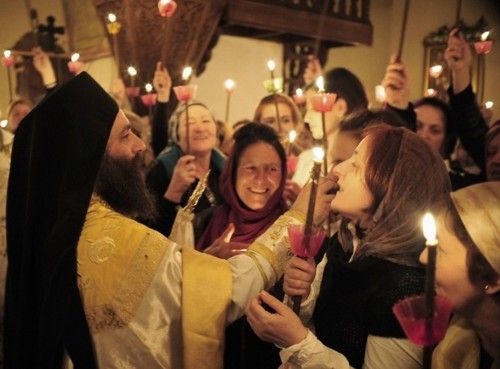
We have honestly always had the complete and utter “service and faithful obedience” in keeping with the monastic vows of this unforgettable bishop. In 1992, I was with Vyacheslav Mikhailovich Klykov and our wonderful old friend, the scholar Nikita Ilyich Tolstoy, chairman of the International Foundation for Slavic Literature, as we prepared the pilgrimage of a large Russian delegation to visit the Holy Land, in order to bring back to Russia for the first time Holy Fire from the Church of the Holy Sepulcher in Jerusalem.[1]
After the Easter service in Jerusalem our pilgrims were supposed to come back by bus to Russia bringing the Holy Fire from the Church of the Holy Sepulcher through various Orthodox countries en route: Cyprus, Greece, Yugoslavia, Rumania, Bulgaria, the Ukraine, Belarus, and finally home to Moscow.
Nowadays, the Holy Fire is specially brought for the Easter Service by airplane to many cities in our country. But back then, since it was the very first time, the trip with the Holy Fire involved all kinds of worries and complications. It was supposed to take an entire month. His Holiness Patriarch Alexiy II sent two Archimandrites—Pancratius, who is now a bishop and the Abbot of the Monastery of Valaam, and Sergius, who was later appointed Bishop of the Diocese of Novosibrsk.
One of the participants in our pilgrimage was supposed to have been Maria Georgievna Zhukova, daughter of the commander of Soviet forces in World War II, Marshal Zhukov. But suddenly on the evening before we were supposed to leave she fell ill. We had to urgently find someone who could travel in her place. Complicating matters even further was the problem that it would be impossible in such a short time to arrange for visas for such a large number of countries. And then once again we remembered Bishop Basil, who happened to have just arrived in Moscow on that very day.
To our great shame we didn’t think about the fact that the bishop had already turned seventy and it might be not so easy for him to live for a whole month on a bus—not to mention the fact that he had all kinds of things to do in Moscow. The main thing for us was that the bishop, as always, would agree. The second thing was that the question of visas would be resolved by itself: the bishop was a citizen of Great Britain, and with his passport, he did not need a visa for any of the countries we would be visiting.
Best of all, with the participation of Bishop Basil, our pilgrimage had acquired a spiritual director—the kind about whom we could only dream. We even regretted that we hadn’t thought about him earlier. In addition to all of the other good things about him, the bishop, unlike many other participants of our pilgrimage, was fluent in English, German, and French, Serbian, Greek, Bulgarian, and a fair bit of Romanian.
And so His Holiness Patriarch Alexiy II blessed him to be the leader of our pilgrimage group, which filled the heart of our bishop with joy in the feeling of extraordinary responsibility. Furthermore, thank God, the bishop’s health remained favorable throughout the trip. One of our participants, Alexander Nikolayevich Krutov, would bind up the bishop’s aching legs every day, and make sure he didn’t forget to take his medicines. In short, as Bishop Basil himself said, Alexander took care of him like a devoted mother.
I remember how then before our trip we all helped him pack and prepare, and with what relief we set out on our long journey. All our problems had been solved!

Bishop Basil (Rodzyanko) on the ship
The problems began again as soon as our pilgrims needed to cross through any country’s border control. Our delegation was supposed to cross through the border control exactly in accordance with the list that had been given to these authorities in a group visa. On that list was Maria Georgievna Zhukova. But there was now Bishop Basil (Rodzyanko) to take her place.
The first problems began when we got to Israel, a land famous for its scrupulous rigor in all issues of security, border control, and customs matters. Israeli security services in the airport immediately asked this unusual group of Russians to step aside and began to call us out each by name. There was no problem with the first names in the group visa, such as Archimandrite Pancratius and Archimandrite Sergius, Alexander Nikolayevich Krutov. But then when they called out the name Maria Georgievna Zhukova, suddenly instead of her they saw Bishop Basil, who politely smiled at the Israeli border agent and bowed to him.
“Wait a minute!” The agent was confused. “I called out Maria Georgievna Zhukova.”
“Maria Georgievna Zhukova is me,” said Bishop Basil naively.
“What do you mean that she is you?” The agent got annoyed. “Who are you?”
“I? I am the Russian Bishop Basil.”
“Maria Georgievna Zhukova is a Russian bishop? Listen, this is not a place for joking! What’s your real name?”
“You mean on my passport? Or—?”
“Of course your name on your passport!” the agent snorted.
“My name on my passport is Vladimir Rodzyanko.”
“Maria Zhukova, Bishop Basil, and now Vladimir Rodzyanko! Where are you from anyway?”
“Actually, I live in America,” the bishop began. “We can explain everything to you!”
Other members of the delegation tried to assist. But the Israeli border agent rebuffed them. “All others are requested to keep quiet!” Then he turned once more to the bishop. “Let’s see if I get this straight. You say you are a Russian bishop, but for some reason you live in America? Interesting. Let’s see your passport.”
“I have a British passport,” said the bishop cautiously, as he handed it over.
“What?” Indignantly the border guard shook the list of the group visa and waved it in the face of Bishop Basil. “Where are you listed in this group document?”

Bishop Basil (Rodzyanko)
“How should I explain?” The bishop tried his best, himself somewhat surprised and smiling. “The thing is, in this document I am listed as Maria Georgievna Zhukova.”
“Enough nonsense!” said the Israeli border guard. “Just tell me who you are! And right now!”
The bishop was genuinely upset to have been the cause of so much trouble for this young officer. Of course, notwithstanding his natural modesty, he also did not like being yelled at. “I am a Russian Orthodox cleric, Bishop Basil,” he answered with a dignified air.
“So you are Bishop Basil? Who then is Vladimir Rodzyanko?”
“That’s also me.”
“Well then, and who is Maria Georgievna Zhukova?”
“And Maria Georgievna Zhukova is also me.” The bishop waved his hands vaguely.
“Hmm! And you live—where?”
“In America.”
“And your passport is?”
“My passport is British.”
“And on this list you are . . . ?
“And on this list I am Maria Georgievna Zhukova.”
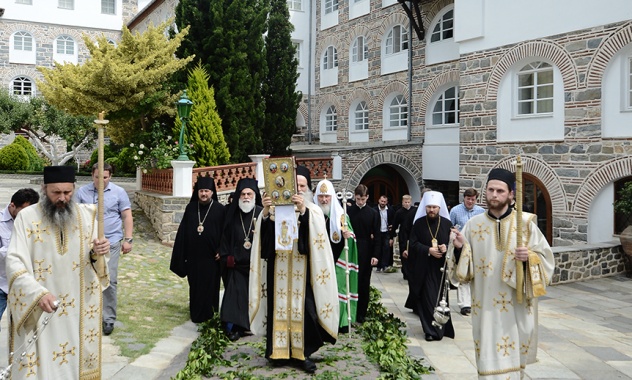
This delightful little scene was repeated every single time we crossed a national border. However, notwithstanding all these difficulties, Bishop Basil was utterly happy. It had been his dream to pray at Easter time in the Church of the Holy Sepulcher. And he was overjoyed that after so many years of separation he could be—even if only for a brief visit—back in his beloved Yugoslavia. What’s more, he faithfully executed the important task that he had been given, as head of our mission of pilgrimage to the Holy Land, and, on his return to Moscow, on the day of Saints Cyril and Methodius, was able to participate in the Procession of the Cross, right next to Patriarch Alexiy, around the Dormition Cathedral in the Kremlin on Slavyansky Square, solemnly carrying the receptacle of the Holy Fire as he did so.
***

Bishop Basil carrying the Holy Fire.
Although the bishop never said as much out loud, it had always been his fondest dream to serve Russia and the Russian Orthodox Church. He had been brought up this way. Once we were able to make arrangements with Channel 1, the Central Television Station, to record a series of broadcasts— discussions about God and the Church, about the revered saints of old, and about the new martyrs of Russia, about the Russian Diaspora, and about the fate of Russia itself.
Bishop Basil was not feeling well, but he raced to Moscow and worked day and night with all of his fading strength on these broadcasts. These turned out to be the first discussions on these themes that had ever been shown on what was then still Soviet television. These programs provoked immense interest among their viewers and were repeated many times. Wherever the bishop appeared later, people would come up to him expressing their gratitude for having acquired faith thanks to his programs. For the bishop these words were his very highest reward.
Much of the ecclesiastical history of the twentieth century was revealed to us in a completely new way by Bishop Basil. Somehow at one point an argument began about what was then a popular theme—the ecclesiastical authorities under the Soviet regime. Some of the speakers were quite bitter in their condemnation of their collaborationist mentality, expressing thereby feelings not just aggrieved, but poisonously inimical towards them. The bishop listened to the arguments silently. When these fearless judges of the Russian bishops of the past appealed to him to support their position, which they considered self-evident, the bishop merely told them one story:
In the beginning of the 1960s when he was still just a priest named Father Vladimir, he was visited in his apartment in London by Metropolitan Nicodemus, chairman of the foreign relations department of the Russian Orthodox Church. In order for them to speak, they actually needed to lie down on the floor, so that the Secret Service agents tailing Metropolitan Nicodemus, and never once leaving him alone, would not be able to record their conversation through the windows.

Bishop Basil (Rodzyanko) in Pochaev. Photo by Archimandrite Tikhon
Lying on the floor, and whispering softly as he could, Nicodemus told Father Vladimir that the Soviet authorities were planning any day now to close the ancient Pochaev Monastery (the foremost Orthodox monastery in the Western Ukraine). The Church hierarchy back in the Motherland had already exhausted all its possibilities to stop this from happening. Nicodemus therefore begged Father Vladimir to organize special broadcasts on BBC Radio and on the Voice of America to put pressure on the Soviet government not to eliminate the Pochaev Monastery. Both Metropolitan Nicodemus and Father Vladimir perfectly understood what a risk the Metropolitan was undergoing in appealing to Father Vladimir with such a request.
But by the very next day, the theme of the threat to the Pochaev Monastery was the lead topic in the religious broadcasts of the BBC and the Voice of America. Thousands of letters of protest from all over the world flew in, addressed to the Soviet government. All of this was perhaps decisive in influencing the authorities to change their minds and once again allow the Pochaev Monastery to continue with its activities.
In 1990 Bishop Basil and I had the good fortune of finally visiting Pochaev Monastery. It was his first time there. He served Divine Liturgy and was able to meet with all the people who together with him had been participants in the dramatic events that had taken place thirty years previously.
***
What else can I remember about the bishop? Somehow every one of his visits always coincided with some extraordinary event: the thousand-year anniversary of Russia’s conversion to Christianity, the bringing of the Holy Fire to Russia for the first time, the first Memorial Service for the martyred Imperial Family, the first religious programs on the Central Television Station. But as the bishop himself liked to say: “Whenever I stop praying, the amazing coincidences stop happening.”
The visit of the bishop to Moscow in the summer of 1991 was no exception. He had come as part of a large delegation from the United States attending the first global summit of Russian-speaking communities. Representatives of the Russian emigre community from many countries and of all different political persuasions were officially invited to Moscow for the first time. The government planned this meeting to mark a new stage in the development of post-Communist Russia.
A large number of people arrived. They included various emigres who had forever decided to have nothing at all to do with the Soviet Union. There were so-called “White Guards” who would never believe that anything good whatsoever could come out of the land of the Soviets, and there were even certain representatives of Vlasov’s Russian Liberation Army, famous for siding with Hitler against the Soviet Union during the Second World War, and mercilessly punished for this after the war. How anyone had convinced these people to attend remains a mystery to me! Maybe in spite of everything they truly missed their Motherland . . .
The Intourist Hotel was booked full to overflowing. Various emigres and their families wandered around Moscow, looking at the city and the faces of the people. They were all amazed to see how interested everyone was in meeting them. What amazed them even more were the high hopes, in some cases rising to the level of unbounded fantasies, with which they were received. At the time there was no shortage of well-meaning souls who truly believed in the myth that “we will be helped from overseas.” As to this, I wish to say that if anyone on behalf of the Russian emigre community truly contributed to Russia’s spiritual renaissance not just in words but in deeds, it was the ever modest retired Bishop Basil, along with several tireless laborers from the emigre community—bishops, priests, and laypeople.

Patriarch Alexiy II and Bishop Basil (Rodzyanko)
The main event of the first global summit of Russian-speaking communities was Divine Liturgy in the Dormition Cathedral in the Moscow Kremlin. After long decades in which service of Divine Liturgy in the cathedrals of the Kremlin had been forbidden, a service was held and presided over by His Holiness Patriarch Alexiy II. Bishop Basil also assisted the Patriarch at these services. Unfortunately, a week before flying to Moscow, he had broken his leg at his home in Washington. But he could not miss such an event—and so, with his leg in a cast, and hopping about oddly on crutches, he stood through the whole service, as well as all the events, barely able to catch up with the crowd of Russian emigres moving around from place to place.
Then on the early morning of August 19, 1991, on the day of the Transfiguration of Our Lord, several dozen buses crowded with Russian emigres from every continent set out from the Intourist Hotel. These buses brought the tourists to the Kutafyev Tower of the Kremlin. With tears in their eyes, hardly believing what was happening, they proceeded through the Kremlin Gates to the Dormition Cathedral, where His Holiness Patriarch Alexiy II with all his bishops (including Bishop Basil, hobbling on crutches) began the Divine Liturgy.
However, as is well known, this was precisely the day, August 19, 1991, of the attempted coup against Gorbachev and his government. Indeed, this coup was taking place exactly at the time that His Holiness the Patriarch was praying in the Dormition Cathedral. And so when these emigres, touched to the depths of their hearts and full of joy after the conclusion of the Liturgy, left the Kremlin, they were astonished to see not tour buses waiting for them, but a thick line of armored personnel carriers and tanks and soldiers with machine guns.

At first nobody knew what was going on, but then someone cried out: “I knew it! Those Bolsheviks have deceived this again! It was all a trap!”
The confused soldiers in their ranks surrounding the Kremlin looked around at this quite confusedly. Another of the emigres cried out: “I warned you! I knew we shouldn’t have come! They tricked us! It was a trap, a trap! All of this was arranged on purpose!”
Just at this moment an officer approached these panicked emigres. He had been given orders to protect these members of the foreign delegations. His orders were to accompany the delegates to Lubyanka Square, where there were buses waiting for them on the instruction of the troops who would surround the Kremlin. These buses were supposed to take these foreigners as quickly as possible to the Intourist Hotel.
“Comrades, do not panic!” The officer’s voice rang out with authority and command. “You are all instructed in an organized manner to proceed to the Lubyanka! These soldiers will accompany you now!” As he spoke, the officer pointed to a squadron of troops armed with machine guns.
“No, no, no! We don’t want to go to the Lubyanka!” The emigres’ panic was only increasing at the mention of that dreaded place.
“But they’re waiting for you there,” said the officer with good-natured surprise. This only increased the terror further.
“No! Anywhere but the Lubyanka! Absolutely not!” Everyone was yelling.
Several times the officer tried to reason with the crowd, but it was all in vain. So finally he gave the order to his troops, and they, energetically pushing these emigres, sometimes with the barrel of their machine guns, and sometimes with their burly arms, forcibly drove them on towards Lubyanka Square.
Everyone was so utterly shocked that they forgot all about Bishop Basil. He was left alone by himself on his crutches by the Kutafyev Tower, surrounded by soldiers and armored personnel carriers. Up to this point, no one had even heard about the coup. People who were accidentally in the vicinity of the Kremlin might be guessing as to what was going on, but at this point certainly no one knew for sure. But many people began to recognize Bishop Basil and asked what they should do . . . So there was an entire crowd gathered around the somewhat confused bishop, who was a head taller than everyone else.
Meanwhile the emigres who had been driven forcibly on to Lubyanka Square finally understood that they had been brought to their tour buses, which would be taking them to their hotel, and not to the prison and the dreaded basements of the KGB. Then suddenly they remembered about the bishop! The bishop’s secretary Marilyn Suizi ran out of the tour bus and courageously ran back towards the Kremlin, fearlessly approaching the tanks of the armored personnel carriers in that foreign land, trying to rescue her dear Bishop Basil.

Bishop Basil (Rodzyanko). Moscow, 1991
She recognized him immediately. He looked like a gray-haired prophet towering above the crowd in the center of the ever growing protest meeting. Marilyn stretched out her arm to him and briefly but convincingly talked him into taking the only route towards certain safety . . . to go with her towards the Lubyanka . . .
But the bishop on his crutches was physically unable to walk that far. He told Marilyn that he would go but somehow transport would need to be arranged for him. Marilyn dashed out of the crowd of protesters and looked around. There was no transport available except the armored personnel carriers of the soldiers with their engines humming. Marilyn walked up to a young officer and in her broken Russian with bits of
English mixed in explained that there was an old priest from America who was unable to walk and urgently needed to be transported to the Lubyanka Square.
But the officer shrugged his shoulders and waved his hands: “What transport can I offer you? Only a tank. Or maybe an APC . . .”
But suddenly Marilyn noticed that not far away from the tanks there appeared to be a car that might be sufficient for transporting the bishop. “How about that Jeep over there?”
“The police van, you mean?” The officer was happy to help. “All right, we can give him a lift in the police van! Let me work it out with the cops!”
For some reason this officer felt true compassion for the fate of this foreign bishop. And so the van, which had been brought up with the intention to arrest the crowd of protesters against the coup, instead drove through the crowd, in the center of which the bishop was standing towering above everyone else. Marilyn followed the officer and two policemen as they approached. Yelling above the crowd and the racing engines of the tanks, Marilyn told the bishop that they were being taken to the Lubyanka.
Everyone together—the policeman, the officer, and Marilyn—grabbed the bishop and dragged him through the crowd. When they saw this, the crowd became extremely nervous. “What’s going on? Are they arresting the priest?” The crowd grew utterly indignant.
When they saw policeman taking an old priest on crutches and with a cast on his leg and putting him in a black van, the crowd became so furious that the people immediately began to cry out in defense of the bishop. “It’s starting all over again! They’re already arresting priests! No! We won’t let them arrest that good father! We will die for him!”
“No, no!” The bishop tried to calm the crowd and get away from his own rescuers. “Let me go, let me go . . . It’s all right. I want to go to the Lubyanka!”
Those soldiers barely managed to put the bishop with his crutches and his leg in a cast into the police van and to drive off with him through the now utterly furious crowd of protesters. As the bishop looked out the window of the police van, tears of gratitude started rolling down his cheeks. “What a wonderful people! What a great country!”
Soon the bishop was met on the Lubyanka Square by his faithful parishioners.
***

Bishop Basil (Rodzyanko) in the Sretensky monastery
Even in the last years of his life, when he was ailing, he always yearned for Russia and visited as often as he could, ever hoping to serve his native land.
The bishop was already quite ill when he visited Moscow for the last time. He spent several weeks in bed. Natalya Vasilyevna Nesterova, in whose home he was staying, took tender care of him. But I understood that the bishop possibly would never come back to Russia again, and therefore asked the brothers and nurses to sit by his bed in vigil, and ordered that he be attended to around the clock by monks and novices of our Sretensky Monastery. That way the young monks could converse with the bishop, ask his advice, and pose questions to him, questions that only an extremely spiritual, wise, experienced priest could answer.
More likely than not my monks were not the best nurses. Probably they asked the poor ailing bishop too many questions and wanted too much advice and too much of his failing energies. And yet just as for these young novices it was extremely useful to spend these days and nights with this elderly bishop, so it was extremely important and pleasant for the bishop to spend time with those who one day would be taking his place in the Church. He was actually happy that even at the cost of wearing himself out he was able to answer their questions, teach them, give them the benefit of his experience and knowledge, and yet again provide service, that service for which he had always lived and without which he would not have been who he was.
***
On his final voyage, away from the country in which he was living and on to the long-awaited Kingdom of Heaven, Bishop Basil embarked all alone. He was found one morning on the floor of his room in Washington, no longer breathing. The bishop had lived in this little room for many years. It was a tiny studio, and yet in addition to housing the bishop, it had somehow also contained a house church, a radio station, a library of decades of sermons and writings and radio and television broadcasts, a hospitable refectory for parishioners who frequently came to visit, and a study. Somehow there was even space for visitors. Guests from Russia would often show up at the bishop’s home to spend a night or two—or sometimes even a week . . .
Even after his death, the bishop did not deny himself the pleasure of traveling a little bit.

Bishop Basil (Rodzyanko) after death
His family could not at first figure out where it was that he should be buried. Some said he should be buried in Russia—his Motherland, after all. Others wanted to bury him in England, next to his wife, whom he had so dearly loved. Others suggested Serbia, a land that had always been close to his heart. I can only imagine what joy filled the soul of the bishop as it was hovering above this scene in the heavens: he would truly have enjoyed any one of these journeys! But in the end his body was brought from Washington only as far as New York: one of his relatives insisted that he be buried in the Orthodox convent of New Diveyevo, which is located not far from the city. However, for some reason the burial did not take place there and the bishop was brought back again to Washington. Here his worldly wanderings finally came to an end. The bishop was laid to rest in the Orthodox Christian section of Rock Creek Cemetery.

Bishop Basil (Rodzyanko)
Sometimes during his life the bishop used to call himself “the reposed bishop.” That is because under his status he was merely a retired bishop, who had been fired (or sent “into retirement,” a phrase that in Russian sounds like being “laid to rest”) from the American Autocephalous Church. A bishop who has been “retired” in fact is no longer really a bishop, and no longer makes any official decisions about formal ecclesiastical matters. That is why the bishop from time to time used to joke about himself that he was “the reposed Bishop Basil.”
But he was indeed a real bishop! He truly governed without borders the human souls who crossed his earthly path. He did so with the indefatigable force of that remarkable power which to this day continues to bless those who had the joy of knowing Bishop Basil and experiencing his unforgettable and irreplaceable goodness, faith, and love.
[1] The miracle of the Holy Fire is an annual event in which the Patriarch of the Orthodox Church in Jerusalem enters the Holy Sepulcher with thirty-three unlit candles he has bound together and emerges with them lit. Both the Sepulcher and the Patriarch are thoroughly searched by civil authorities before the event to exclude the possibility of any technical igniting. The first written record of this event, which occurs on Saturday of Passion Week according to the Orthodox Christian calendar, dates back to 870 a.d.
“EVERYDAY SAINTS” and Other Stories