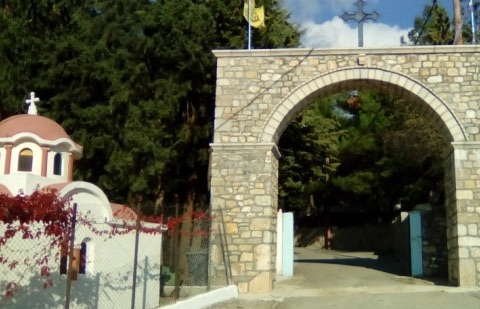
An Unexpected Return to Panagia Eleousa, Xyniada
We thought we had heard everything. We thought we had seen everything.
How mistaken we were!
On our way to Aegina for our pilgrimage to St Nektarios, we made an unexpected return to the Monastery of Panagia Eleousa in Xyniada, near Domokos.
We had visited this monastery only recently, and I had already written about our unforgettable encounter with Gerondas Athanasios and the miraculous icon of the Mother of God revealed to him as a little boy.
Surely, we thought, there could not be much more to discover.
But the Mother of God had other plans.
And this second visit was to touch us in ways we could never have anticipated.
The Grace We Had Not Fully Realised
The moment we entered the church, something extraordinary happened.
Everywhere we turned, there were icons of the Mother of God.
Not one, not two, but four great, richly adorned icons, besides numerous smaller ones! Were we that blind the previous time?!
Three of these magnificent icons occupy prominent positions around the main body of the church, surrounded by vigil lamps, flowers and votive offerings — tamata bearing silent witness to prayers, suffering, gratitude and deliverance.
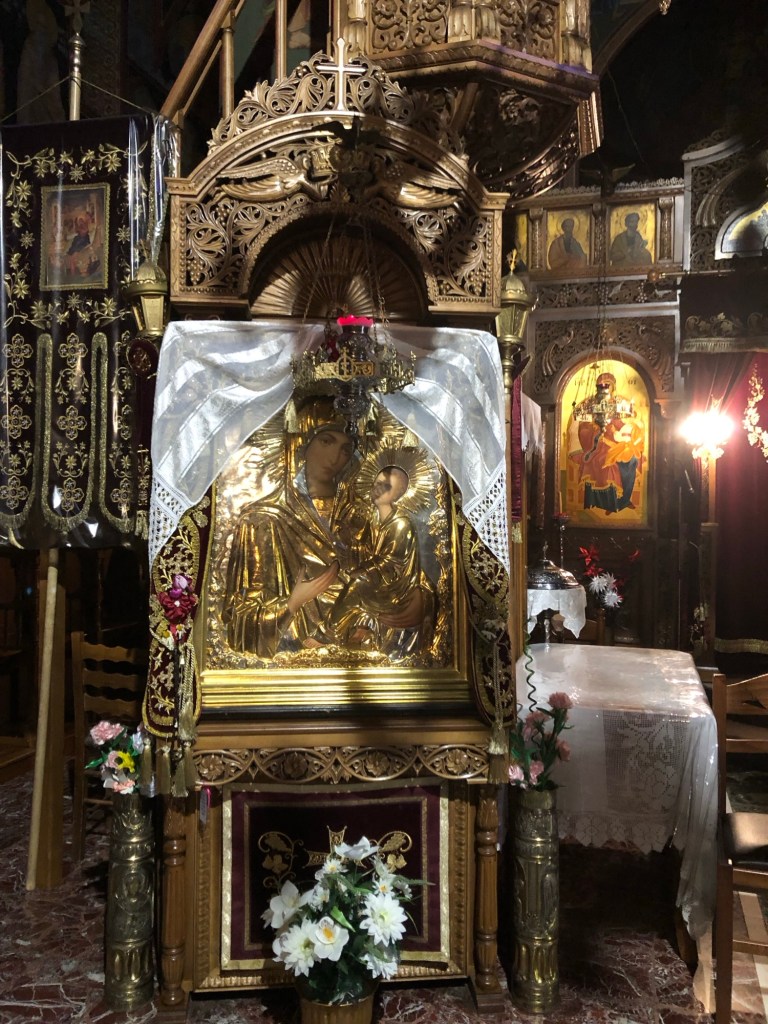
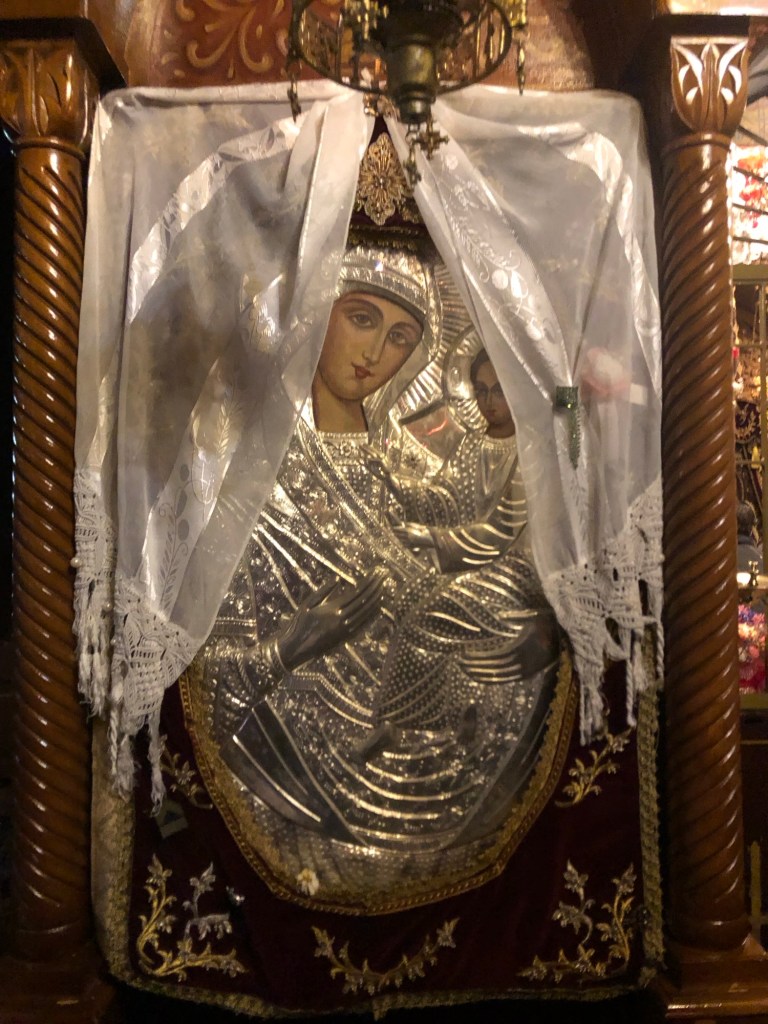
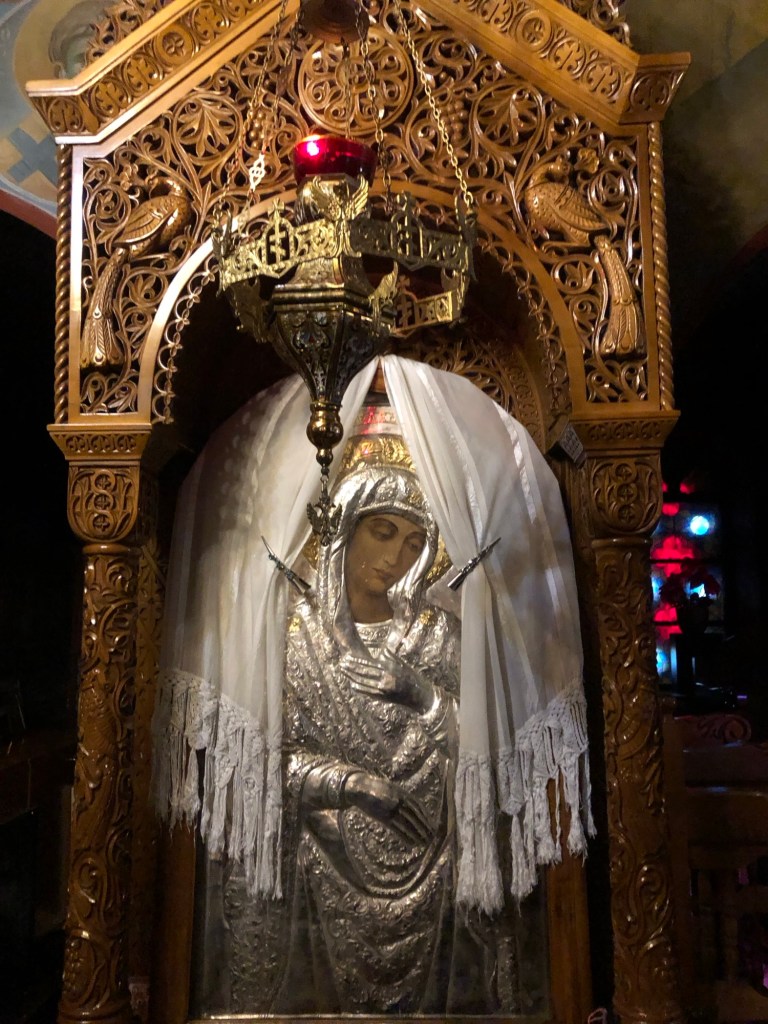
And then, of course, there was the fourth, in a separate section of the church: the miraculous icon which the Mother of God herself had revealed to little Thanassakis in 1954, and which was finally discovered on 21 June 1962, buried one and a half metres beneath the ground.
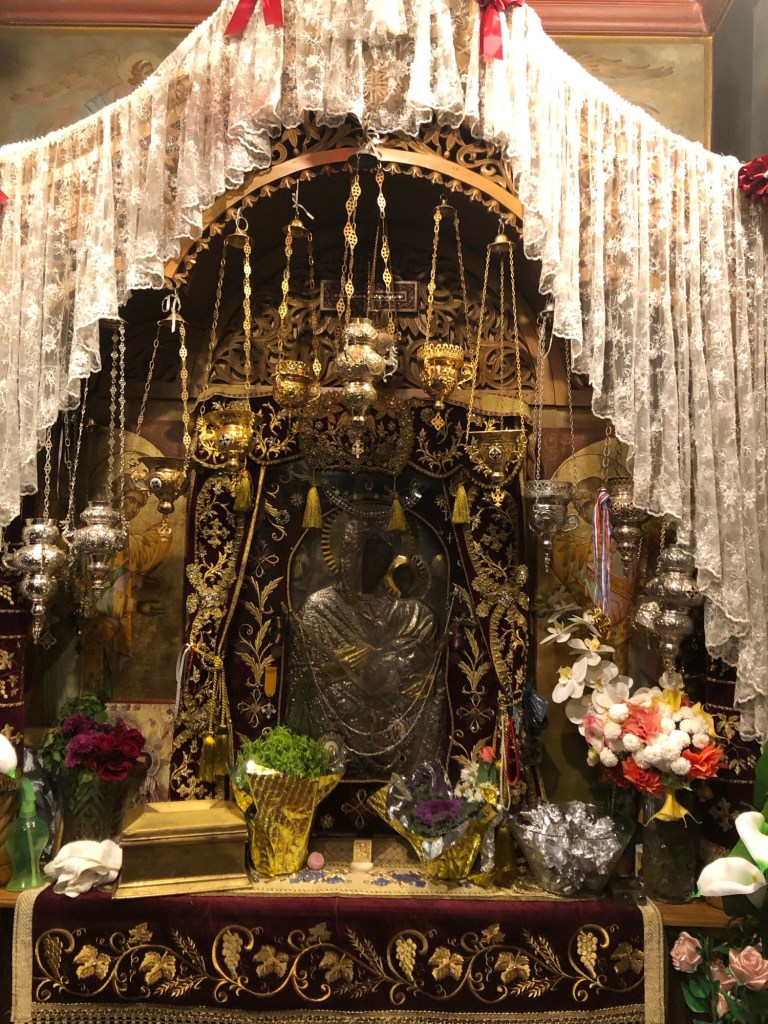
We walked through the church, looking around us, and within two or three minutes we were utterly overwhelmed.
It was almost like an electric shock.
The grace of the Mother of God seemed to strike us all at once. We were shaken to the depths of our being.
We had been here before. We had venerated the miraculous icon before. We had already been deeply moved by the extraordinary story of its discovery.
But somehow, this time, everything was different.
Had we failed to grasp, during our first visit, the extraordinary grace of this holy place? Had we been so absorbed in the miraculous story of Gerondas Athanasios that we had scarcely taken in what surrounded us?
I do not know.
I only know that within those first few minutes, we were overwhelmed.
And this was before we had even begun to listen to the Fathers.
Once again, seemingly endless queues of pilgrims waited patiently to venerate the Mother of God.
But what struck us was not simply the number of icons, nor even the extraordinary testimonies represented by their offerings.
It was the grace of the Mother of God, which seemed to surround us everywhere.
The Little Boy and the Lady in Black
And then Gerondas Athanasios began to speak.
What an extraordinary man!
A rushing torrent of words, stories, laughter and unexpected humour, almost explosive in his enthusiasm! At his advanced age, he still speaks with the irrepressible energy and childlike joy that had so astonished us during our first visit.
Gerondas Athanasios spoke to us at length and with great fervour about repentance and the need to turn to God with all our hearts. He also shared with us intimate details of his lifelong relationship with the Mother of God that we had never heard before.
He spoke not only about the miraculous discovery of the icon, buried some one and a half metres beneath the ground, but also about the many appearances of the Mother of God throughout his life.
Sometimes she appeared surrounded by light. Others who were present might see nothing at all, or perhaps only the light, without understanding what they were witnessing. But he could see her form and communicate with her.
And then he returned to that very first encounter.
It was 1954. Little Athanasios Syros was only eight years old, playing on the slope of a hill, when he saw a strange woman dressed in black, barefoot, making prostrations.
The ground was dry and hard. Yet wherever the mysterious woman bowed down, the earth softened and sank beneath her, almost like dough.
At the three places where she made her prostrations, a sweet fragrance began to rise from the ground.
The little boy was astonished.
But when he told others what he had seen, nobody believed him.
That same night, the woman appeared to him again, this time in a dream. Now a luminous halo encircled her head.
“Grandmother, who are you, and what do you want from me? I am afraid,” the little boy asked.
“Do not be afraid, my little one. I am the Mother of Christ, whom you love so much. He has sent me to reveal to you, because you have a pure heart and an innocent soul, that at the middle of the three places where you saw me praying, you must dig, and there you will find my icon. That place must become a place of worship. A church must be built there.”
And with these words, she disappeared.
The next morning, Athanasios told his parents about the second appearance and begged them to dig where the Mother of God had indicated.
They did not believe him. Neither did the villagers.
But the child could not forget.
He gathered stones with his own hands and built a little makeshift shrine on the spot. Inside, he placed a small icon of the Theotokos. There he prayed, day after day, while the disbelief of the village continued for years.
Eight long years would pass before the miraculous icon was finally discovered, on 21 June 1962.
And the little boy who had remained faithful throughout those years would one day become the Abbot of the monastery that grew around that very spot.
“I Want to See Thanassakis!”
Then Gerondas Athanasios told us another extraordinary story, this time about St Porphyrios.
When Athanasios was still a very young hieromonk, St Porphyrios came to visit the monastery.
He was brought there wrapped in a blanket, already elderly and frail, insisting that he wanted to see Thanassakis — little Thanassis!
He venerated the miraculously discovered icon of the Mother of God and then asked the young priest to read prayers over him in the sanctuary, wearing his epitrachelion, his priestly stole.
But Father Athanasios hesitated.
How could he, such a young priest, read prayers over this elderly priest? He felt terribly embarrassed and unworthy.
He did not even know that his visitor was St Porphyrios!
Eventually, he obeyed and read the prayers.
And then St Porphyrios told him something remarkable: that he would live to a very old age and would never know rest from the endless waves of pilgrims coming to the monastery.
Looking at the elderly Gerondas Athanasios today, and at the seemingly endless queues of pilgrims outside his church, we could not help remembering those words.
And Then Father Chrysanthos Spoke…
“Repentance is the renewal of baptism. Repentance is a contract with God for a second life.” St John Climacus, The Ladder of Divine Ascent, Step 5, On Repentance
We were so blessed to spend time with Hieromonk Chrysanthos, who had joined Gerondas Athanasios only recently, after the latter had spent decades as the monastery’s sole monk!
And what a different personality!
Where Gerondas Athanasios is exuberant, explosive, overflowing with stories and laughter, Father Chrysanthos is gentle, tender-hearted and unfailingly kind.
And always, that smile.
A smile that seems to radiate love.
One did not need to wait for him to speak to sense it. His eyes, his smile, his whole presence seemed to overflow with kindness.
He spoke to us about repentance, forgiveness and confession. His words were simple, vivid, and full of hope.
But what moved us most were his tears.
With tears in his eyes, he pleaded with us not to leave anything unconfessed. Not the slightest resentment, grievance, judgement, bitterness or ill feeling towards anyone. Nothing hidden, nothing held back.
He begged us to offer our whole heart to the Lord through the priest’s epitrachelion, so that we might receive complete forgiveness and cleansing.
He compared the epitrachelion to a cable connecting us to the Lord in Heaven.
But there is a switch, he told us.
And we are the ones who must press it.
We must open our hearts. We must hold nothing back.
And then he spoke about tears.
Just one tear of genuine repentance, he said, can wipe away an entire notebook of sins.
One tear!
And there he was, pleading with us through his own tears.
How much love must a spiritual father have for souls, to beg them like this to be reconciled with God?
A Little Lesson in Love
A lady at the back of the church, carried away by her enthusiasm, was trying to collect as much blessed oil as possible from one of the vigil lamps burning before the Mother of God.
She was so determined that she almost pulled the lamp off its hook!
Father Chrysanthos gently asked her to stop.
But the poor woman, suddenly finding herself caught in the act before everyone, became terribly flustered.
And then something beautiful happened.
Father Chrysanthos invited her to come forward, close to him.
And there, in front of all the pilgrims, he embraced her.
He comforted her with extraordinary tenderness, explaining that she must not disturb the vigil lamps of the Mother of God, that the oil burning before her holy icons was sacred, and that she must take care not to sin against the Lord and His Mother by interfering with holy things.
There was no harshness, no humiliation. Only a gentle correction, wrapped in such love that we were left speechless.
He did not compromise his reverence for what was holy. Nor did he allow the woman to feel rejected.
And suddenly, before our very eyes, everything he had been teaching us about repentance, forgiveness and the mercy of God came alive.
What a lesson in pastoral love!
And what an extraordinary spiritual father!
Afterwards, many pilgrims approached Father Chrysanthos privately, seeking his counsel. His ministry seemed never-ending.
And throughout it all, that smile. So gentle, so warm, so full of kindness.
We had listened to Gerondas Athanasios with astonishment, laughter and wonder. And now, listening to Father Chrysanthos, we found ourselves in tears.
Not because one encounter was greater than the other. They were simply different.
Two very different souls. Two very different ways of expressing the same love.
And through both of them, we glimpsed something of the tenderness and mercy of the Mother of God.
What We Had Not Understood the First Time
Perhaps this was the greatest surprise of our second visit.
We had come back thinking there could be little more to discover. After all, we already knew the extraordinary story of the miraculous icon. We had already met Gerondas Athanasios. We had already been deeply moved.
Or so we thought.
The grace of the Mother of God had overwhelmed us almost the moment we entered her church. It was something beyond words, almost like an electric shock, shaking us to the depths of our being.
And then there were the Fathers.
Their love, too, was immediately apparent. One had only to look at Father Chrysanthos, at his gentle eyes and that extraordinary smile radiating kindness, to feel it. And Gerondas Athanasios, with his irrepressible joy, his explosive enthusiasm and wonderful humour!
But these were experiences of a different order.
There was the overwhelming mystery of the grace we experienced in the presence of the Mother of God. And there was the deeply human, tender, joyful love of the Fathers — a love which, in its own way, reflected something of her own.
We did not need time to recognise that love. But the longer we stayed, the more deeply we were touched by it.
Perhaps the Mother of God had been offering us the same grace all along, but we had not been ready to receive it.
We had come back to hear more.
Instead, we were given more than we could ever have expected.
And this time, we began to understand what we had been given.


