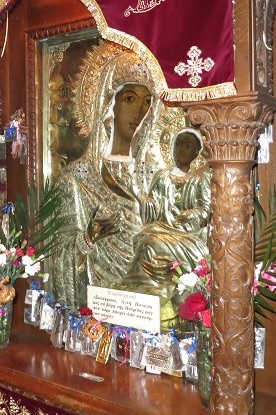
The Wonderworking Panagia of Agathonos and the Incorrupt Saint Vissarion
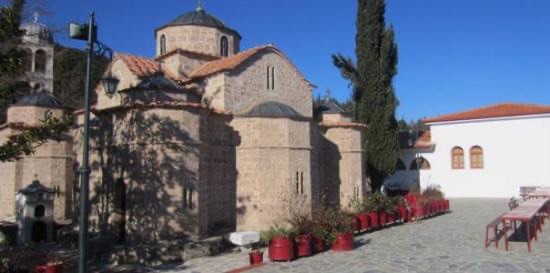
Today’s pilgrimage to the wonderworking icons of the Theotokos in Central Greece (Sterea Ellada) brought us to the Monastery of Agathonos, nestled among the wooded slopes of Mount Oiti.
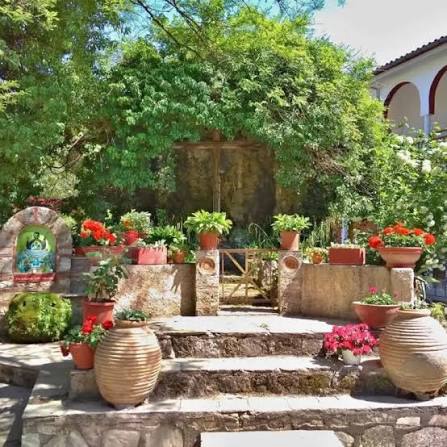
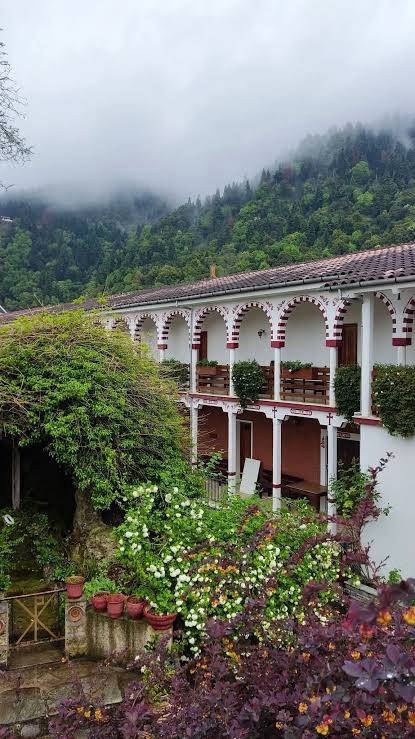
Near Ypati, the Monastery of Agathonos welcomes pilgrims into a courtyard of flowers, beneath an imposing bell tower. Beyond its walls, deer and birds inhabit the monastery grounds. Within, two beloved treasures draw the faithful: the wonderworking icon of the Mother of God and the incorrupt relics of Saint Vissarion.
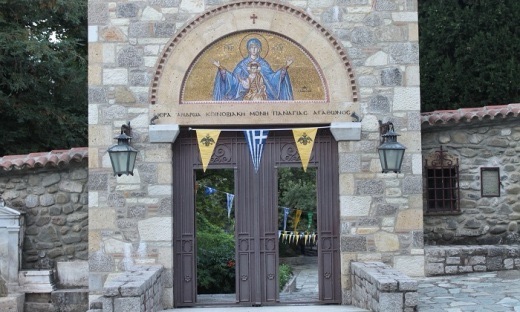
The welcome of the fathers, a small refreshment offered with love, and the quiet of the mountain allow the visitor to pause.
Beneath her gaze, the weary find shelter.
A light in the cave
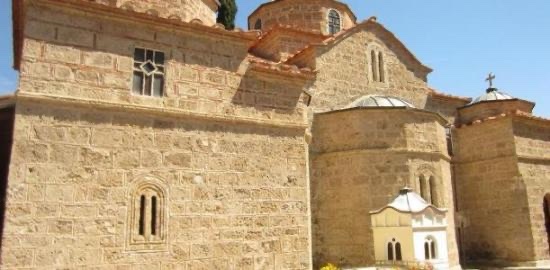
According to local tradition, Saint Agathon lived in an older monastery near the villages of Lychnos and Kastania. When the ground subsided and the buildings were damaged, its icon of the Theotokos disappeared. It was later discovered in a cave filled with light. Nearby, the saint established the present monastery, traditionally dated to the fourteenth or fifteenth century.
Another account, preserved in the monastery’s 1939 pilgrim guide, tells of two Muslim villagers who repeatedly noticed light coming from a rocky cave. Approaching it, they discovered the icon, brought it to Agathon and offered surrounding woodland to the new monastery.
The icon belongs to the Hodegetria type: the Mother of God who points towards Christ, showing us the Way. Its silver covering leaves only the faces of the Theotokos and her Child visible. Around it, votive offerings preserve the thanksgiving of generations.
In 1822, Dramali’s forces burned the monastery. Books, frescoes and treasures were lost, but the icon survived.
A boat brought safely home
One account, preserved by Theoktistos Athanasios Lainas in his book about the monastery, recalls eight sailors caught in a violent storm in November 1918.
Their boat, the Vasiliki, was struggling in the Maliakos Gulf. Its mast broke; the captain and his seven companions clung to whatever they could grasp. Then, according to their testimony, a woman appeared beside the helm, surrounded by light. The storm subsided, and the boat reached the harbour of Stylida.
When the sailors described her, people at the harbour told them of Panagia Agathonos. Still wearing their wet clothes, they set out for the monastery, walking in silence.
Inside the church, they recognised in the icon the face they had seen at sea. Monastery tradition adds that two of them stayed and became monks.
A path illuminated
Another story tells of a young woman who had lost her sight. Years later, she dreamed of a woman dressed in white, asking why she had never visited her.
“But I am blind. I cannot see.”
“Come tomorrow to the Monastery of Agathonos, and you will see me.”
Her family accompanied her along the narrow mountain path. Suddenly, she asked them to release their hold: she could make out the path shining before her feet.
Later she collapsed, and they carried her into the church, placing her beneath the icon. On regaining consciousness, she opened her eyes and cried out that she could see. Pointing to the Theotokos, she recognised the woman of her dream.
Beneath her gaze, a light upon the path.
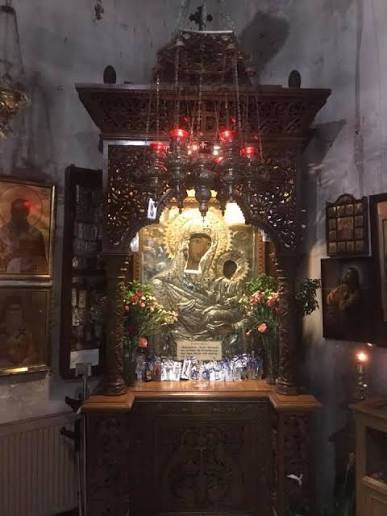
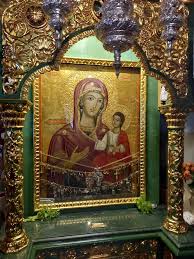
There are two icons of the Mother of God at the Monastery of Agathonos. When the ancient original was cleaned and conserved, its silver covering was removed and placed on a faithful copy. The original is now displayed without its silver covering.
Through trial, towards holiness
The monastery’s history also holds memories of resistance, education and care for the poor. During the Greek War of Independence, it sheltered fighters and offered the service of its own monks. At different periods, it supported schools and children living in poverty.
Its longtime abbot, Archimandrite Germanos Dimakos, remembered as Papa-Anypomonos, ie. Father Inpatient (!), had served as a chaplain in the resistance to the Nazi occupation. His nickname, Papa-Anypomonos—“Father Impatient”—came when, eager to receive his resistance codename, he was gently scolded: “Don’t be so impatient, Father!” And there was his name!
Alongside him, another father served through confession, almsgiving and patient attention to suffering: Father Vissarion.
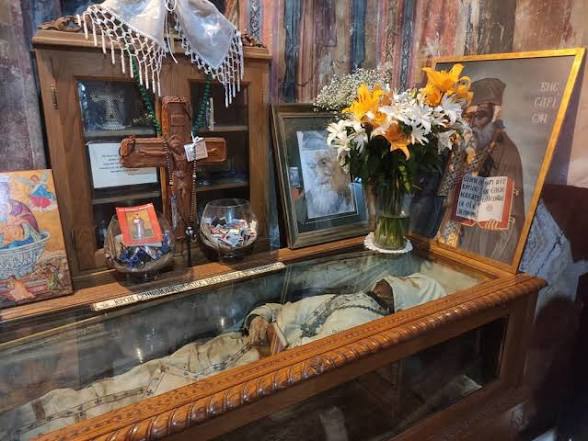
Saint Vissarion: beyond decay
Saint Vissarion the Agathonite is remembered as a compassionate spiritual father, particularly close to the poor and afflicted. People brought him their illnesses, anxieties and family troubles, finding prayer and practical kindness.
He reposed on 22 January 1991. When his tomb was opened on 3 March 2006, fifteen years later, his body was found incorrupt. The Ecumenical Patriarchate recognised his sainthood on 14 June 2022. His feast is celebrated on 22 January.
His relics rest in the monastery’s Chapel of the Holy Trinity. Some who come remember his voice and counsel; others encounter him for the first time before his reliquary.
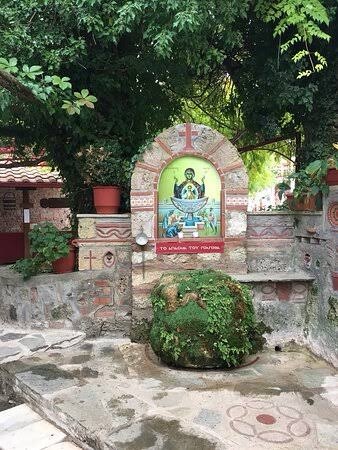
Outside, flowers grow and birds move among the trees. Within, pilgrims stand before the Mother and Child, then bow before a saint whom people of our own time knew and loved.
They bring what pilgrims have always brought: grief, gratitude, illness, hope—and prayers they can scarcely put into words.
Beneath her gaze, beyond decay.
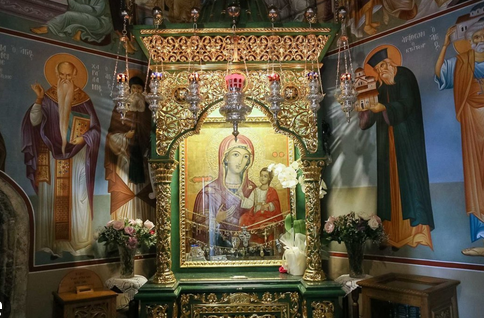
- Update · 27 November 2026
- Sadly, it was the ancient original that was damaged during the break-in in the early hours of Sunday, 22 November 2026, when the votive offerings were stolen.


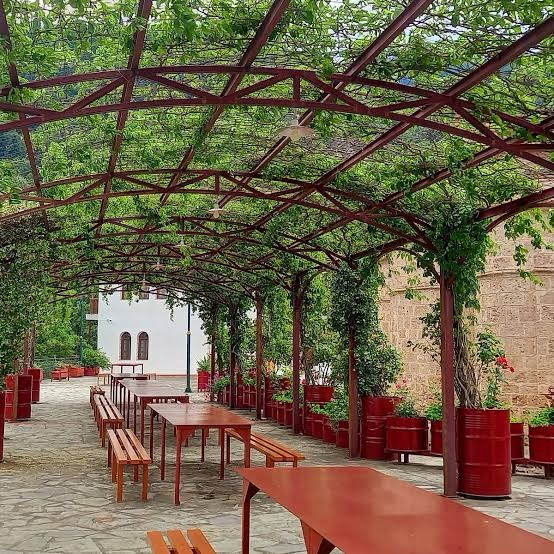
What a wonderful place. The dining area under the arbor is beautifully designed and kept, and so appealing.
Recently I read a story of an appearance of the Theotokos to some Baptists at the scene of a drowning in the High Sierras of California. It doesn’t seem that anyone recognized her, but only mentioned the strange and brief appearance of a woman in a blue dress, who gave an encouraging word to one man who had been off to the side of the people performing CPR, praying desperately for his brother in the name of Jesus.
She said that the drowned person would be okay, and then she disappeared. More than 20 minutes after the rafting accident and attempts to revive the drowned man, he woke, and was helicoptered out to receive intensive treatment for several weeks; he lives a healthy life to this day, many years later. I wonder if the family members discussed who she was, but didn’t know how to include that in the book…
Most Holy Theotokos, save us!
LikeLiked by 1 person
I have been reflecting quite a lot, dearest sister, on the story you mentioned about an appearance of the Theotokos to some Baptists at the scene of a drowning in the High Sierras of California. I keep wondering whether this was indeed a genuine visitation, particularly since those involved were not Orthodox. Of course, I do not know all the details.
Then, just the other day, I came across something rather interesting: apparently, there is documentary evidence that St Nektarios corresponded with Roman Catholics, Old Catholics and Anglicans on questions of Christian unity, always explaining Orthodox doctrine with great care and respect.
Of course, this is rather different from the incident you described. St Nektarios was clearly open to sincere and respectful theological dialogue with Western Christians, without ever minimising doctrinal differences or compromising Orthodox teaching. In the story of the Theotokos appearing to the Baptists, however, these distinctions seem a little less clear to me.
Please forgive this rather lengthy reflection! I am simply trying to understand how we should approach such accounts, and whether the Mother of God might indeed reveal herself to those outside the Orthodox Church, without this necessarily implying an endorsement of their beliefs.
I would be very interested to hear your thoughts.
LikeLiked by 1 person
Maybe I was jumping to conclusions, to think that it was she. I still would like to talk to the family, who are people I know how to contact, to ask if they discussed the event further; they don’t mention in the book if they did.
It hadn’t occurred to me that she wouldn’t show herself to him. Perhaps his heart was prepared for such an event, and he was changed by it, but was not permitted to say more about it in that account that was mainly his brother’s to tell. The drowning event took place quite a few years before the book was written, and the book is a few years old. In all that time you would think that someone before me would have wanted to follow up on this mystery.
Thank you for raising these questions; I appreciate your thoughtful response. I’m not done thinking about this story!
LikeLiked by 1 person
Your prayers, dearest sister. All the stories I know of the Theotokos saving an heterodox in danger, were always followed by conversion and baptism. And a public sharing of the miracle to their families, friends and local societies to help bring others to the Truth. Let me know if you find out anything more! Your prayers
LikeLiked by 1 person