An Encounter with Elder Ioannikios at Panagia Prousiotissa
Panagia Prousiotissa — Part III of Our Pilgrimage
Some encounters remain with us long after a pilgrimage has ended. Not because anything extraordinary happened outwardly, but because we found ourselves in the presence of someone whose faith and love seemed to overflow.
Such was our encounter with Elder Ioannikios, Abbot of the Monastery of Panagia Prousiotissa.
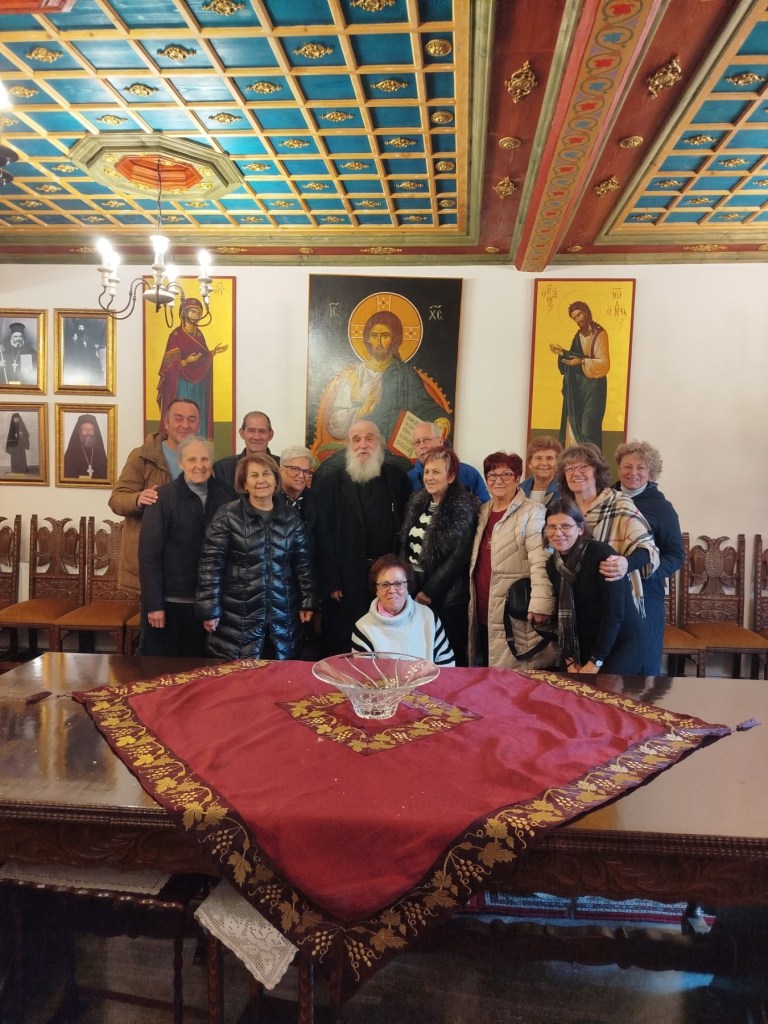
We had arrived before dawn on Sunday morning and spent the hours of Matins and the Divine Liturgy before the miraculous icon of the Mother of God. Afterwards, we gathered in the monastery’s archontariki, its traditional reception room for pilgrims, where the Abbot welcomed us and spoke to us.
We had already experienced the beauty of the monastery, its centuries of prayer, and the extraordinary story of its beloved icon. But what awaited us in that gathering was something altogether more personal.
A Return to the Beginning
Archimandrite Ioannikios Varvarelis was born in Almyros, Greece, in 1956. In 1975, at the age of nineteen, he became a monk at Panagia Prousiotissa under the guidance of Elder Gregory Zoumis, who later moved with his brotherhood to the Monastery of Docheiariou on Mount Athos.
His subsequent ministry took him to the Monastery of Panagia Xenia, where he served alongside the future Archbishop Christodoulos of Athens, and later to America, where he learned English and established connections with the Greek Orthodox community. Over the following decades, he served in various pastoral and administrative positions in Thessaly, restoring churches, developing parish life, and ministering to countless people.
On 17 October 2021, he was formally enthroned as Abbot of Panagia Prousiotissa.
He had returned to the monastery where his monastic journey had begun forty-six years earlier.
At his enthronement, he spoke movingly of this return. His past and future, he said, were bound to the same sacred place. Here he had offered the hopes of his youth to God; here he was now entrusting the years ahead to the Mother of God.
And he described what he believed his new ministry should be: to welcome pilgrims, embrace them with compassion, share their suffering, and lead them to the Lady of this holy place, who would present them as her beloved children to her Son.
Five years later, we were to witness something of what those words meant in practice.
The Tears of a Spiritual Father
What struck us most deeply was the Elder’s extraordinary zeal and love for the Mother of God.
Whenever he spoke of the Panagia, of her grace, her miracles, and her presence in the monastery, his voice trembled, and tears filled his eyes.
Again and again, he wept.
I do not remember ever hearing a spiritual talk quite like this one. His tears were not an occasional moment of emotion. They accompanied his words almost continuously whenever he spoke of the Mother of God.
He told us that this place was Paradise — not because of its breathtaking natural beauty, though that alone is remarkable, but because the grace of the Panagia had made it so.
For him, Paradise did not seem merely a distant promise. Something of its light was already present here, in these mountains, beneath the protection of the Mother of God.
I found myself remembering the words of the Apostle Paul, who spoke of caring for those entrusted to him, “night and day,” and “with tears” (Acts 20:31). There are tears born of sorrow, but also tears born of a love too deep for words. Watching Elder Ioannikios speak of the Mother of God, I wondered whether we were witnessing something of that same love.
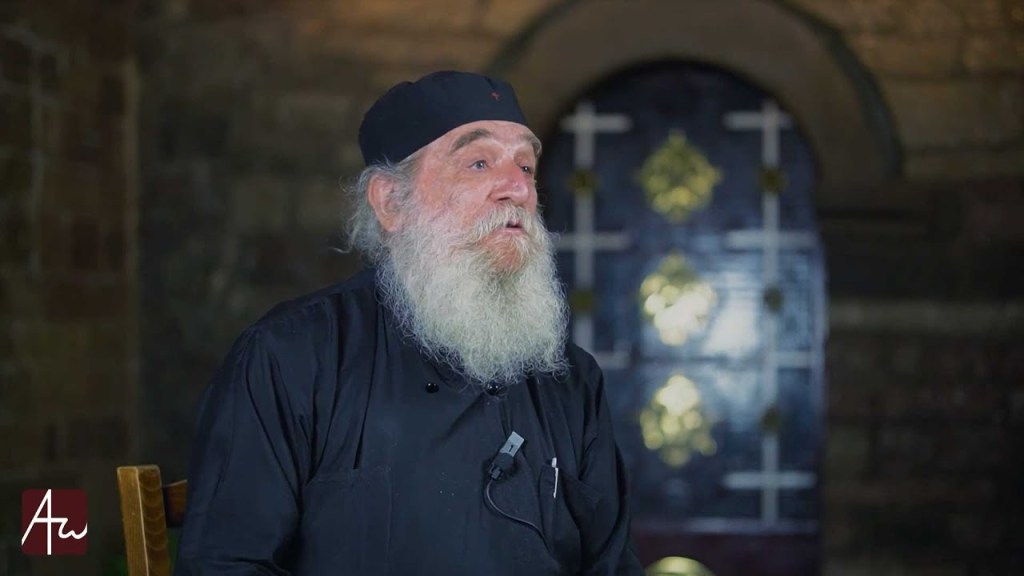
Words can hardly convey the tenderness, spiritual fervour and deep love for the Mother of God with which Elder Ioannikios speaks. The following video offers a precious glimpse of his ministry in his own voice, with English subtitles for those who do not understand Greek.
And yet, moving as this video is, it hardly does him justice. No recording can quite capture what it was like to be there: to hear his voice trembling, to see the tears continually welling up in his eyes whenever he spoke of the Mother of God, to experience the extraordinary warmth and intensity of his presence. It was far more moving than any camera could convey.
The Lamp That Has Never Gone Out
The Elder spoke of the many miracles attributed to Panagia Prousiotissa, miracles which, he told us, continue to take place in the lives of people from all over the world.
Again and again, however, he returned to one remarkable tradition.
When the shepherds first discovered the miraculous icon in its mountain cave, they found a lamp already burning beside it. According to the Elder, this was a sign that an angel had been tending the lamp.
And from that first discovery until our own day, he told us, the lamp before the Panagia has remained unextinguished for some twelve hundred years.
He compared this ancient tradition with the lamp of the Holy Sepulchre in Jerusalem, speaking of the extraordinary continuity of prayer and worship in these two sacred places.
We had spent the entire Divine Liturgy before the icon. Now, listening to him, the little flame seemed to take on another meaning: a visible sign of the prayers of generations, offered before the same beloved face.
Where the Saints Once Stood
The Elder also spoke of the saints who had prayed and worshipped within these walls, from St Kosmas of Aetolia to St Porphyrios in our own times.
And then he showed us the very stasidion — the wooden choir stall — where St Porphyrios had stood.
It was immediately beside the place where I had been standing throughout the Divine Liturgy!
It is one thing to read about the saints in books. It is quite another to discover, unexpectedly, that one has been praying only a few steps from a place associated with their own prayer.
The Elder also encouraged us to become benefactors of monasteries and churches, reminding us of the spiritual significance of supporting places of worship and of having our names remembered in their prayers through the generations.
There was a sense throughout his talk that the Church was not simply an institution stretching across centuries, but a living communion of prayer, in which the departed and the living remain bound together before God.
The Lady of the House
Among the many miracles Elder Ioannikios recounted, one story particularly stayed with us.
A woman who had visited the monastery years earlier had purchased a large copy of the miraculous icon of Panagia Prousiotissa. She placed it in the most prominent position in her living room, where everyone entering the house would see it.
And she made a rather extraordinary declaration to the Mother of God:
“From now on, You are the Lady of this house. You are in charge!”
Years passed. The woman had children, and then, quite suddenly, she was diagnosed with a particularly aggressive form of cancer.
In her anguish, she took the icon down from the wall, placed it opposite her chair, and began to scold the Panagia.
“Didn’t we agree that You would be the Lady of this house? Look what has happened! How am I supposed to raise my children now? You must do something about this!”
At that very moment, the Elder told us, a flash of light came from the icon.
The woman understood it as an answer from the Mother of God. She returned the icon to its place on the wall and continued to pray.
According to the Elder’s account, when she returned to her doctors the following morning, they found no trace of the cancer.
What moved me particularly in this story was the extraordinary intimacy of the woman’s relationship with the Panagia. She had entrusted her home to her, and when everything seemed to collapse, she turned to her with the desperate familiarity of a child appealing to its mother.
Even her protest was an expression of trust.
The Pilgrims Who Walk Through the Night(s)
The Elder also told us of the thousands of pilgrims who undertake long and arduous journeys on foot to reach the monastery.
Some walk for fourteen hours. Others for twenty, forty-eight, even fifty hours, depending on where they begin.
Through the mountains, up the steep ascents, often without stopping, they come to ask the Panagia for help or to thank her for prayers answered.
And there, in the archontariki with us, were two young women who had walked for fourteen hours.
Only fourteen!
Their presence gave the Elder’s words a wonderful immediacy. These were not merely stories from another age. The ancient tradition of pilgrimage, sacrifice, and thanksgiving was alive before our eyes.
One by One
Perhaps the most revealing part of our encounter came after the Elder had finished speaking.
Those who wished to seek his counsel approached him individually, in a quiet corner of the room. He listened to their personal concerns, offered spiritual guidance, and took their names, promising to commemorate them at forty Divine Liturgies.
Afterwards, everyone spoke of his remarkable spiritual discernment, his sound judgement, and, above all, the tenderness and love with which he had received them.
It was not merely that he had spoken so movingly to a room full of pilgrims. He had made himself available to each person, one by one.
And all this in a monastery served by a brotherhood of just four monks, including the Abbot himself. One could only wonder at the demands placed upon so few, and at the generosity with which Elder Ioannikios continued to give his time, his prayers, and his heart to each pilgrim.
The Apostle Paul once wrote of giving others not only the Gospel of God, but “our own selves” (1 Thessalonians 2:8). Perhaps this is one of the quietest and most demanding forms of spiritual fatherhood: not merely to offer words of wisdom, but to give one’s time, attention, prayer, and something of one’s very heart, without counting the cost.
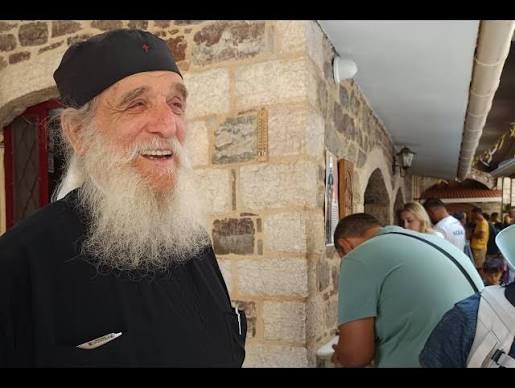
I remembered the words of his enthronement, when he had spoken of welcoming pilgrims, embracing them with compassion, and sharing their suffering.
We had seen those words become a living ministry.
A Ministry of Love
Looking back on that Sunday morning, I remember many things: the darkness before dawn, the beauty of the monastery, the miraculous icon, the ancient lamp, the stories of the saints, and the pilgrims who had walked through the night.
But above all, I remember the Elder’s tears.
Tears whenever he spoke of the Panagia. A voice trembling with love. And then, when his talk was over, the same love expressed quietly and practically, in the time he gave to those who needed him.
Perhaps this is what stayed with us most deeply.
A spiritual father who, having spoken to everyone about the Mother of God, turned to listen to each person individually.
And in that small corner of the monastery’s reception room, his ministry of love continued.