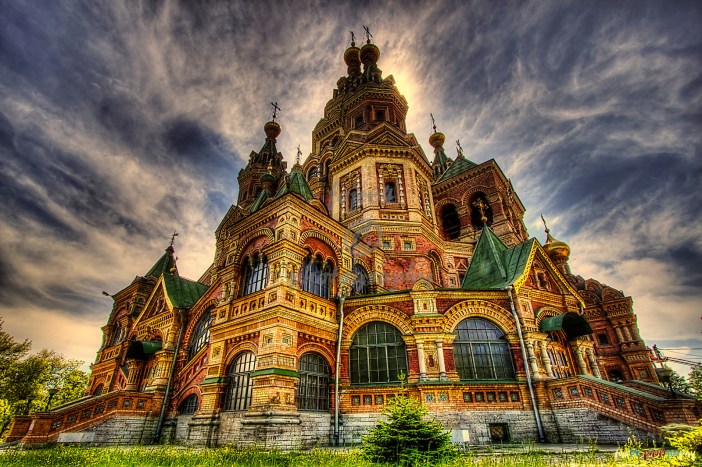
Chalice of Eternity

chalice


Time, or the Art of Deception: 1990 
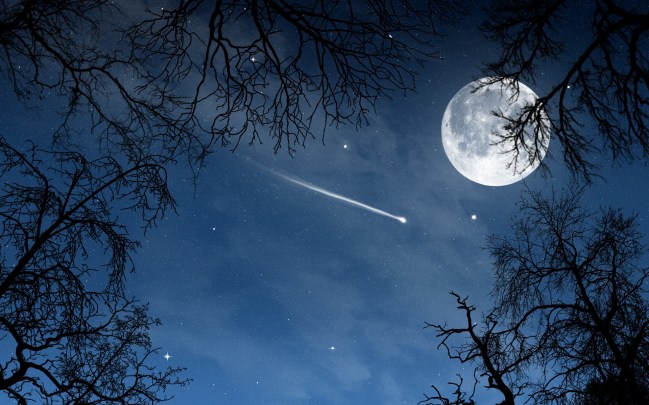
Time stands still in this surrealist composition.The water and the metronome are suspended as if Time had just stopped – yet might start again, a moment later.

An Orthodox Theology of Time -I / V

“This morning during Matins I had a ‘jolt of happiness, of fullness of life, and at the same time the thought: I will have to die! But in such a fleeting breath of happiness, time usually ‘gathers’ itself. In an instant, not only are all such breaths of happiness remembered but they are present and alive—that Holy Saturday in Paris when I was a young man—and many such ‘breaks.’ It seems to me that eternity might be not the stopping of time, but precisely its resurrection and gathering. The fragmentation of time, its division, is the fall of eternity. Maybe the words of Christ are about time when He said: ‘…not to destroy anything but will raise it all on the last day.’ The thirst for solitude, peace, freedom, is thirst for the liberation of time from cumbersome dead bodies, from hustle; thirst for the transformation of time into what it should be—the receptacle, the chalice of eternity. Liturgy is the conversion of time, its filling with eternity. There are two irreconcilable types of spirituality: one that strives to liberate man from time (Buddhism, Hinduism, Nirvana, etc.); the other that strives to liberate time. In genuine eternity, all is alive. The limit and the fullness: the whole of time, the whole of life is in each moment. But there is also the perpetual problem: What about the evil moments? Evil time? The terrible fear before dying of the drowning man, of the man falling from the tenth floor about to be crushed on the pavement? What about the tears of an abused child?

(The Journals of Father Alexander Schmemann 1973-1983, p.78)

To Be Continued

For Part II go to https://orthodoxcityhermit.com/2015/12/18/4441/ 

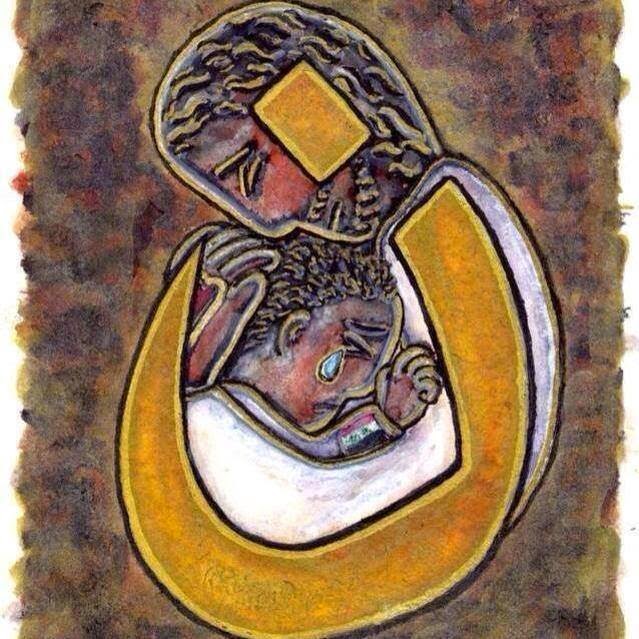
You Die For Your God But Our God Died For Us

 letter7

VIDEO: The Great Persecution of our Time is Here —

The Nine Overcoming ISIS 

Watch this powerful mini-documentary about nine confessors of Jesus Christ in Iraq

“Lord Jesus Christ, grant us all this faith and courage to bear our crosses and confess You before the world, to love and forgive our persecutors, and to follow You even to Golgotha. And to give You thanks and glory through it all!”

 letter10
“Who would dare to love ISIS?” was the question asked in the first film. Now, come and hear the testimonies of 9 refugees who fled ISIS and left everything behind. They dare to love ISIS and they dare to bring a message of hope – to counter ISIS’s message of hate. … Their testimony and faith, forged by fire, will bring healing to the nations. God has shaken the Middle East and from its ruins, deep faith is stirring in the hearts of the persecuted.

 letter3

Video by Mighty LA, the ones who brought you A Letter from the People of the Cross to ISIS 

 
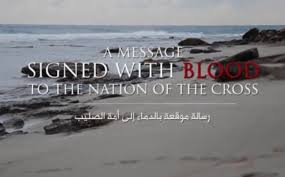
For those of you who have missed it, watch and absorb their first video, their phenomenal response to ISIS and their ‘Message Signed in Blood to the Nation of the Cross’. As the Savior might say, “Let it sink deep down into your very being.”
https://www.youtube.com/watch?v=uSv4vBcFyvo
 letter4

A Letter from the People of the Cross to ISIS 


The world is talking about you

Your apocalyptic dreams and spectacular sins

Are now awakening the Middle East

In your Holy War, come to Holy Ground

Come, children of Abraham come

The People of the Cross gathers at your gates with a message

Love is coming after you.

Like a rush of wind grazing over the Pacific

From hills of the mount of olives to the desert winds of Jordan

From the cedars of lebanon to the silk roads of the East

An army comes.

With no tanks or soldiers

But an army of martyrs faithful unto death

Carrying a message of life

The people of the cross

Comes to die at your gates.

If you won’t hear our message with words

Then we will show you with our lives laid down.

For every throat you slit and every woman you rape

For every man you burn and every child you turn to dust


There is blood on your hands brother

 But Come Brothers Come


Come with your bloodstained hands,

Come with your eyes full of murder for the people of the Cross,

Come lay your guns and your knives at the foot of the Cross

A love that is overdue and overwhelming

Breathes through your cities

Though your sins are like scarlet

They can be washed white as snow

Though you call yourselves servants

He will make you into Sons

Where can you run from His love?

Even the darkness cannot hide you


Come Brothers Come


There is the sound of a rushing rain

To remove your sins and bind your wounds

You die for your god but our God died for us

The King of Kings comes to be the sacrificial lamb

Slain on the altar where we should have been

Jesus Christ, Isa Al Masih

Walks through the Middle East


There is forgiveness tonight oh brother

There is healing for your sins oh brother

We are no different.

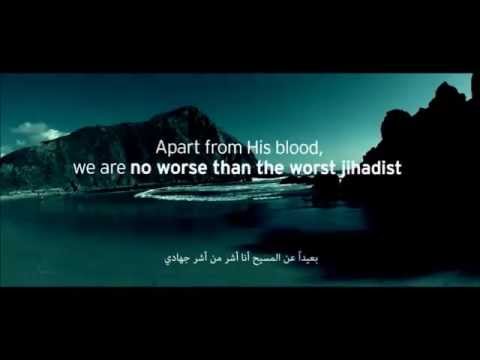
Apart from Christ, we are no better than the worst jihadist

Christ has been crucified once. and for All.

To make sinners like you and me into brothers

Even you.

Even now.


Source: http://facingislam.blogspot.gr/2015/12/video-nine-overcoming-isis-great.html?
 

See also https://orthodoxcityhermit.com/2015/11/14/paris-massacre-an-act-of-war-and-the-army-of-islams-new-martyrs/


A Kairos Life in a Chronos World

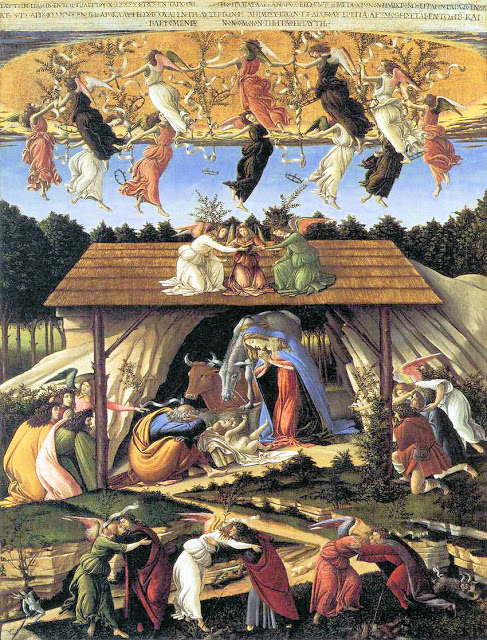
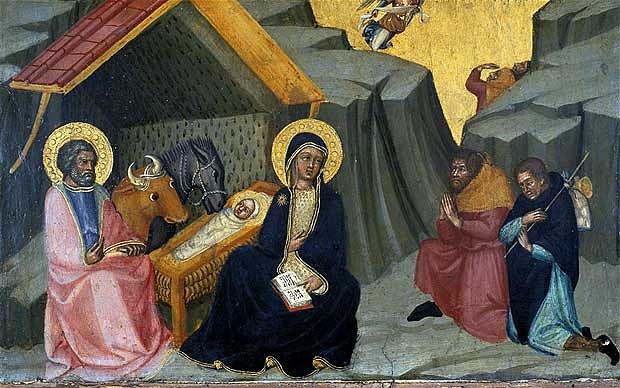
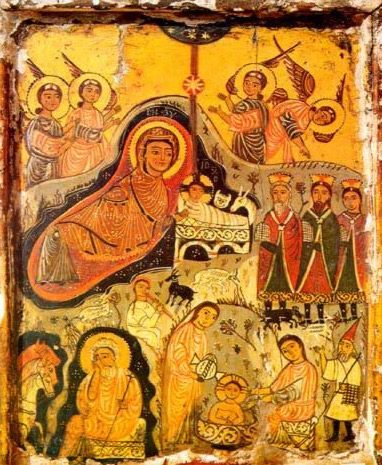
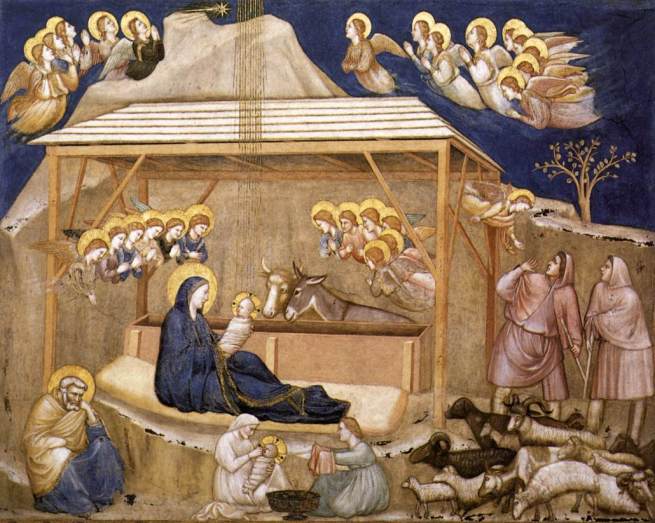
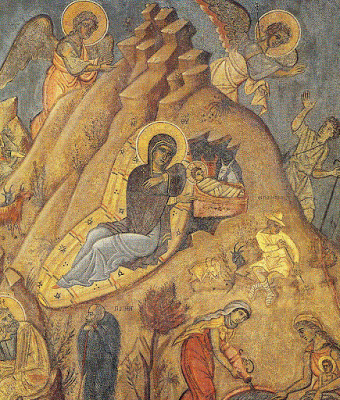
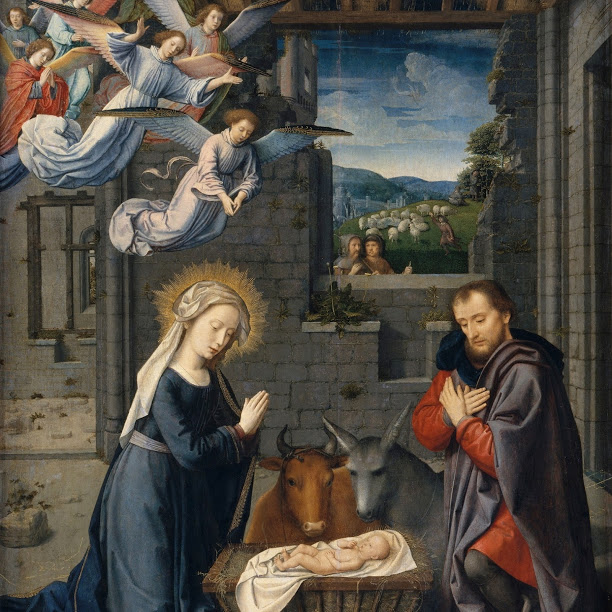
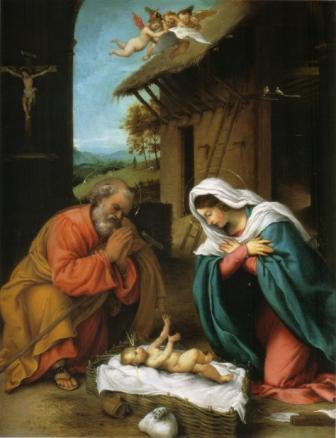
Christ’s Nativity in Eastern Byzantine Iconography and  Western Sacred Paintings

Living a Kairos Life in a Chronos World: The Three Main Differences 

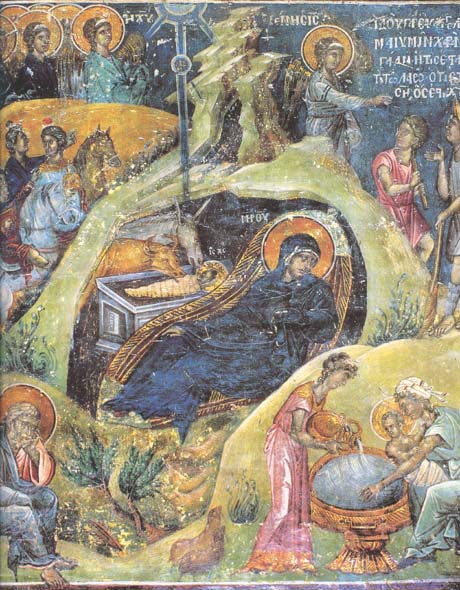
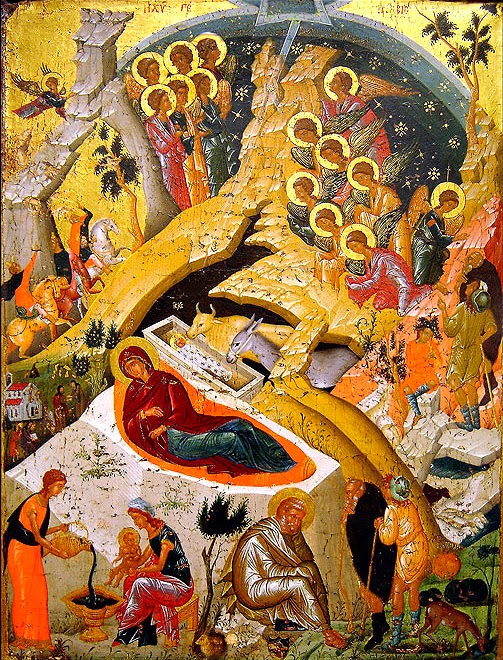
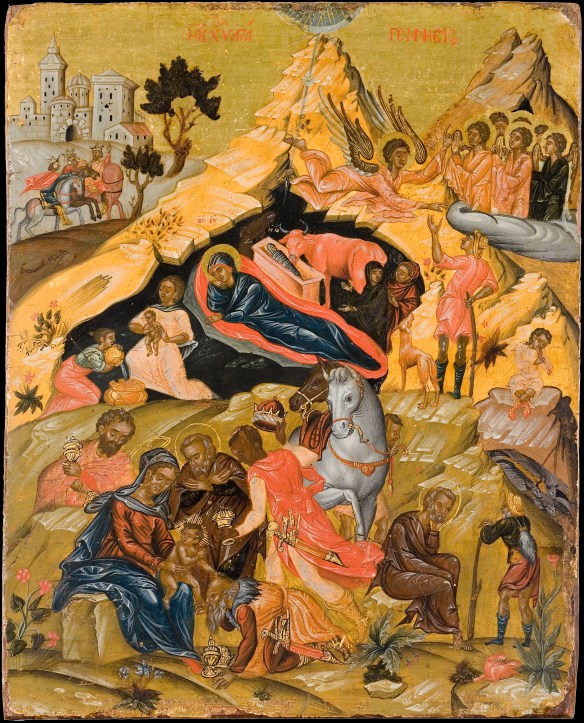
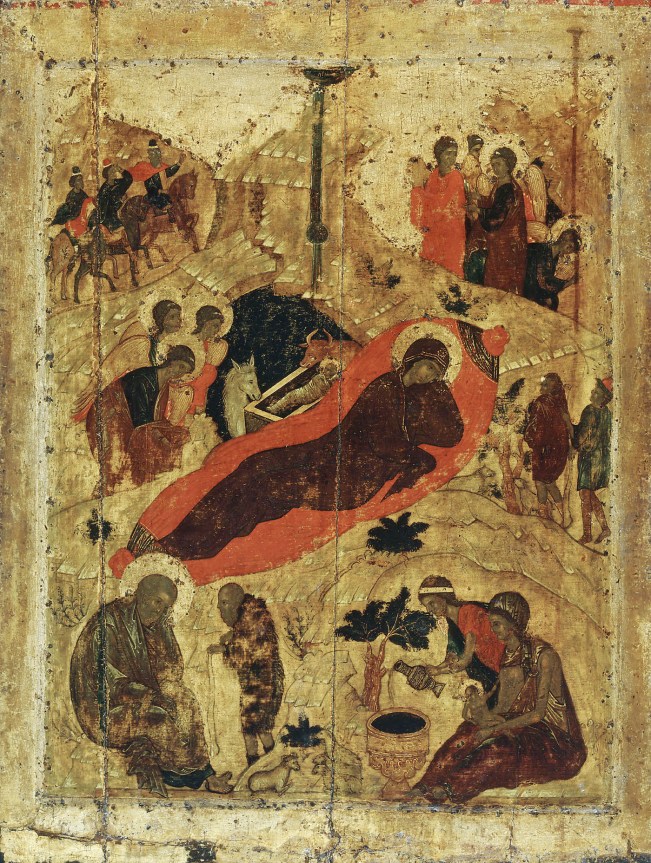
The traditional Orthodox icon of the Nativity is one that many of us have venerated since our early childhood in the Orthodox Church. Yet for many of us, born and raised in the Western world, this icon may at times seem strange and different from the depiction of the Nativity as seen in the secular press, books, television, websites and other forms of media communication. Hopefully this short article will contribute to a greater appreciation of the Orthodox teaching of the meaning and significance of the feast of the Nativity as witnessed by the icon of the holy day.

nativity2

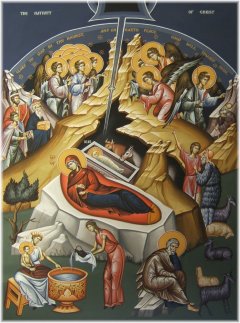
The first major difference between the Orthodox icon and the Western art depiction of the Nativity is that the main event, the birth in the flesh of Our Lord, is not depicted in the setting of a stable but in a cave immersed in a mountain. The “cave of Bethlehem”, is mentioned as early as the second century in the writings of St. Justin and by the fourth century, the site had become the place of a beautiful basilica in Bethlehem which was and is still today an important pilgrimage site for Christians. The cave itself in the icon is always depicted in dark colours or in black to indicate that the world that had plunged into the darkness of sin, through man’s fall, would soon be illuminated by the Nativity of Christ – “the light of the world” .
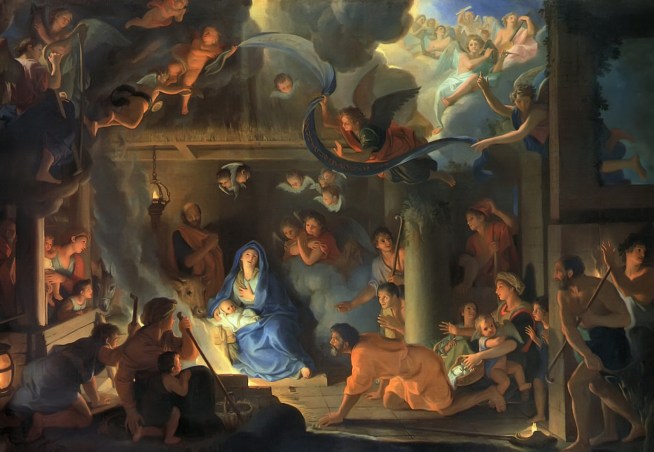
Adoration of the Shepherds by Charles Lebrun, 1689

The new-born infant Christ is found always in the centre of the icon and cave, and as such is the true enlightener of mankind, through Whom a new era begins in the history of mankind. This same cave, also foreshadows the cave of “life giving tomb” that is found in the icon of the Resurrection. Christ thus begins and ends His earthly mission in a cave.

The cave in the icon of the Nativity is situated in a mountain, symbolic of the wilderness, which gives a place of refuge to the Son of Justice and Truth in fulfilment of the Old Testament pre-figuration. The Prophet Habakkuk states in a prayer: “God comes from Teman, the Holy One from Mount Paran. Covered are the heavens with His glory, and with His praise the earth is filled” (Hab. 3:3).

Christ, the fulfilment of this and other prophesies found in the Old Testament, is represented with His Virgin Mother – the Theotokos on a mountain, which emphasises their mutual unity. True manhood and the human nature in Christ is received from His Mother, the Ever-Virgin, and thus she figures prominently in the central scene of the icon.

The Mother of God is depicted always in a reclining position on a childbed with a tranquil and peaceful expression on Her face, and showing an absence of the usual suffering of child bearing. She is usually turned away from Christ, looking at the outside world, contemplating whether mankind will accept or reject the great mystery in which she plays such an important role. She as such has completed her unique role in God’s mysterious plan as the Birth-giver of God.

The Eve of the Old Testament was the mother of all living beings; in the New Eve, the Theotokos, we now have the Mother of all those that are redeemed. Thus she is the best example of the thanksgiving offering that mankind could make to the Creator, and serves us as an example of perfect obedience to the will of the Father.
nativity3

Christ is depicted in a manger or fodder bin, wrapped up in swaddling clothes. The manger symbolizes the altar upon which the supreme gift is brought to mankind, the infant Christ who is to redeem mankind. The swaddling clothes in which He is wrapped points to the winding sheet of another cave, the sepulchre, as depicted in the icon of the Descent of Christ from the Cross and His subsequent burial in the tomb.

The Gospels do not mention any attendants at the birth of Christ; however, the icon of the Nativity shows an ox and an ass either on the right or left side of Christ. These domestic animals are symbolic of faithfulness and devotion, as well as innocence in their relation to the Master. These animals are not important for their physical bulk, but their importance lies in the acceptance of their new Master. Thus it is not only the human world that accepts Christ but also the animal world that participates in the feast of re-creation.
nativity4

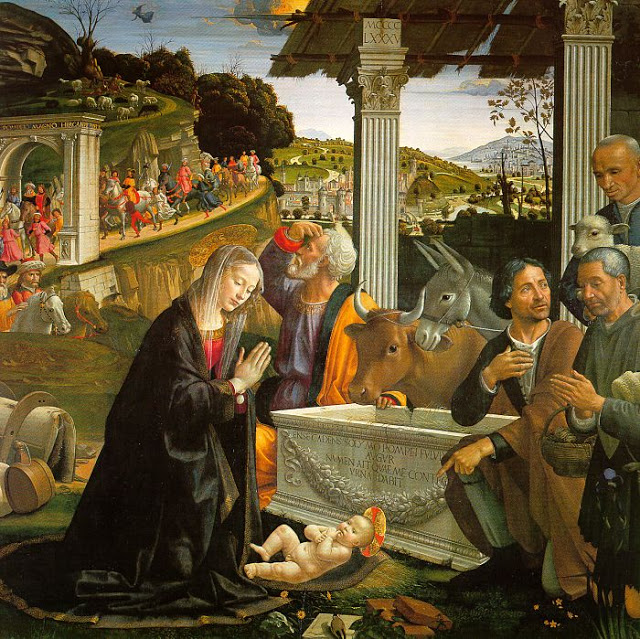
The second major difference between the Orthodox icon of the Nativity and Western art is the role and place of Joseph in the events. Western art always places Joseph in the centre of the event, close to Mary, a scene that as such depicts the “holy family”. The Orthodox icon of the Nativity does indeed include the figure of Joseph (lower right or left hand corner); however, he is far removed from the centre of the main event and finds himself in fact off the mountain or at the bottom of it. Joseph is depicted as an elderly man, sitting in a contemplative or meditating position, turned away from the main event of the icon. In our Orthodox tradition, Joseph is considered the guardian of Christ and His Mother, thus he is pictured as an aged man compared to the youthfulness of the Mother of God. In his pensive stature, Joseph seems confronted or plagued by doubts about the puzzling mystery of God’s incarnation from a Virgin. The pose of Joseph indicates that the true fatherhood of Christ is through the Virgin and the paternity of the Holy Spirit. This thus corresponds to the Nicene Creed’s verse: “Who for us men and for our salvation came down from heaven, and was incarnate of the Holy Spirit and the Virgin Mary, and was made man”.

nativity9

Often Orthodox icons show Joseph confronted by an elderly shepherd or satan like figure, always depicted in dark colours. This figure is the tempter, tempting Joseph into not accepting the miraculous birth of the Saviour from the Virgin (as recorded in the Protoevangelium). This same objection has been raised throughout the history of the Church during the last two thousand years, in different forms and ways, by those who do not accept this miracle. These arguments, which ultimately did not cause Joseph to stumble, have constantly returned to trouble the Church, and are the basis of many heresies regarding Who Christ was and is. In the person of Joseph, the icon discloses not only his personal drama, but the drama of all mankind, the difficulty of accepting that which is beyond reason, the Incarnation of God. Thus Joseph is not the “father” of Christ while his struggle with the meaning of the virgin birth is symbolic of the struggle of all of mankind in accepting the “miracle of miracles”.

Between the two bottom scenes, the icon depicts a tree that runs up and points to Jesus Christ. This is the tree of the prophecy of Jesse, who was the father of King David in the Old Testament. This clearly marks the noble ancestry of Jesus who was born of “the tree of Jesse”.

christmas3

christmas5nativity11nativity12

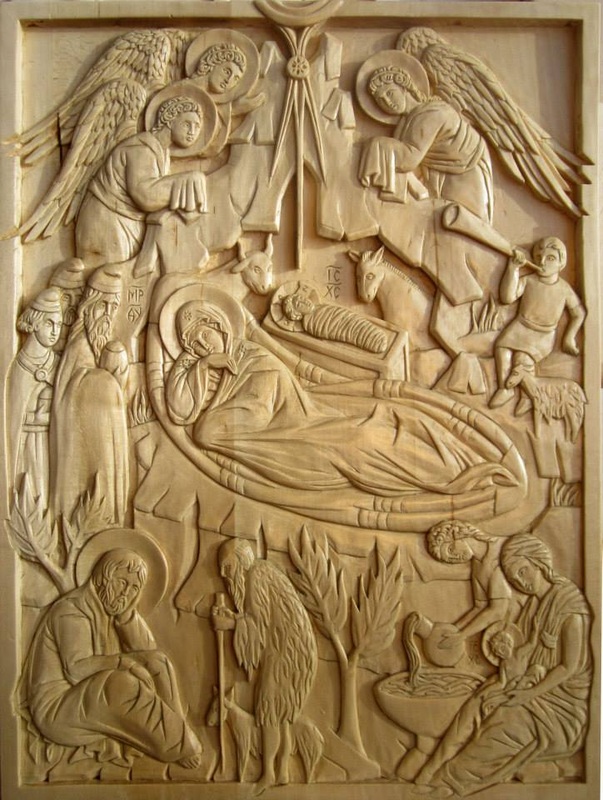
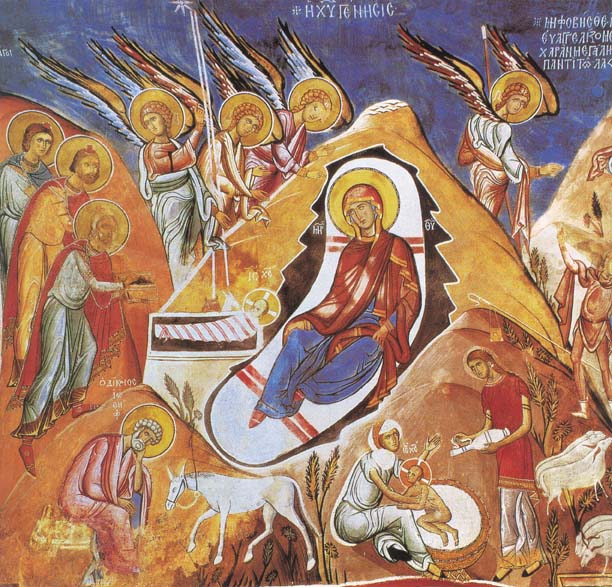
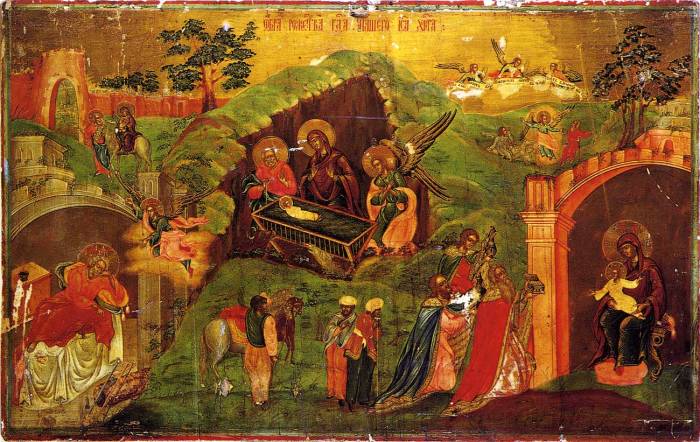
The third difference between the Orthodox icon of the Nativity and Western art is that the icon depicts as a composite image six difference scenes of the Nativity narrative surrounding the Infant Christ-child and His Mother. Western art usually depicts these scenes separately or in smaller groupings of two or three. Here are the six scenes:

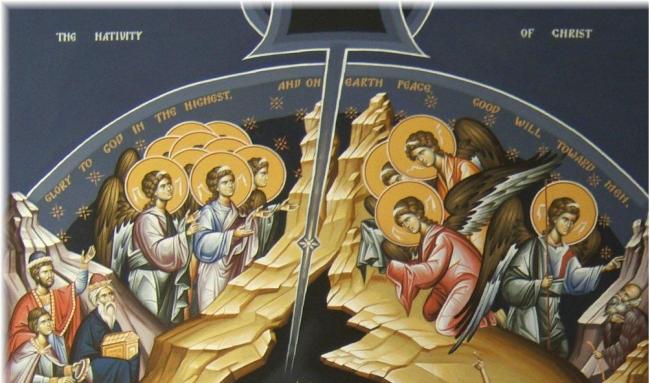
  • At the top of the icon, on both sides of the mountain, are found two groupings of angels who often are looking downwards, sometimes to the side or upwards. They serve a two-fold role. First, they are the messengers of the spiritual world bringing glad tidings to mankind and secondly, they are the true adorers of Christ’s birth, the “marvel of marvels”. The angelic hosts as such unite heaven and earth and together glorify the “new born King”. The angel of the Lord, found on the top extreme right-hand side of the icon, is depicted looking down upon an amazed shepherd, announcing to him the good news of great joy.
  • A single shepherd or sometimes several are found on the right-hand middle side of the icon. These are the first of the Israelite people – the Jewish people, to accept and worship the Lord. These shepherds are simple, unsophisticated and ordinary citizens who hear the divine message in the course of their labours and fully accept the Virgin birth. In fact the shepherds are akin to the simple fishermen that Christ will call in the Gospels “to follow Him”.
  • On the opposite side, the left-hand side of the icon are found three figures of the Magi or wise men. They are depicted following the star, shining above the cave, and bringing their royal gifts to a Babe in a poor cave. The wise men represent the humanity that has not been exposed to the Old Testament – often referred to as the Gentiles. Yet they have a mission to find the “King of Kings” and have travelled far for this event. Their search reaches an end, “following the star of Bethlehem”, and they accept of the Son of Righteousness without hesitation. The three wise men are usually depicted in three different age brackets. The one of the extreme left is very young, the middle one is middle-aged and the one on the right is an elderly person. Thus all ages of humanity are called to accept Christ. The wise men were the first fruits of the Gentile world to venerate and worship Christ. In so doing they show that the ultimate sense of human knowledge is in the contemplation and worship of a Living God, “born unto us as a young Child”.
  • Below, on the left-hand side, is the scene of Joseph and the tempter (already discussed earlier).
  • On the lower right-hand side is depicted an important bathing scene. The origin of this scene is not Scriptural or apocryphal. The first mention of the bathing of Christ was made in the travelogue of a late seventh century pilgrim to Palestine, a certain bishop Arnulf. He relates that close to the Nativity cave in Bethlehem, he was shown a stone water basin which was believed to be the one in which the Divine Child had been washed after birth. Early art depictions of the bathing scene are found from as early as the fifth century. This bathing scene illustrates that Christ was truly a human being and had the fullness of human nature while at the same time he also had a divine nature and was the second person of the Trinity. Every young child has to be bathed, washed and cleaned, upon entrance into this world and Jesus was no different. This scene also serves as an argument against those heretics that did not want to acknowledge Christ’s full humanity and placed only emphasis on his divinity (At the IV Ecumenical Council this heresy, know as Monophysitism, was defeated). Thus the two bottom scenes complement each other, showing both the theological teaching of Christ’s full divinity (the pondering of Joseph of the miracle birth-incarnation of God, the second person of the Trinity – Jesus Christ) and His full humanity (the important bathing scene). Christ as such is truly GODMAN – in Ukrainian Bohocholovik, a term coined at the IV Ecumenical Council in 451.
  • The scene at the top center of the icon depicts the three divine rays of the triune God. In so showing this, the icon depicts that the Trinity – Father, the pre-eternal Son and Holy Spirit are at the heart of the event. The Incarnation is not only about the birth of the Son, but also involves the other two members of the Trinity because all three are of one and the same essence (the Greek word for this is “Homoousios”). In another way the rays are referred to also as the divine star of Bethlehem that shone and provided the direction for all the players of the Incarnation event. The divine light thus provides a canopy for the infant birth of the Saviour and lightens the universe for the proper understanding of the truth – that God became man so that man can become potentially God-like.
nativity3

The icon of the Nativity thereby harmonizes six separate scenes of the festal narrative. Their depiction produces a balanced and well organized theology of the Nativity feast. This icon, except for the bottom part, is truly a pictorial illustration of the KONTAKION (liturgical hymn) of the feast written by St. Romanos the Melodist which proclaims:

“Today the Virgin gives birth to Him Who is above

all being and the earth offers a cave to Him whom

no man can approach. Angels with shepherds give

glory and Magi journey with a star. For unto us

is born a young Child, the pre-eternal God.”

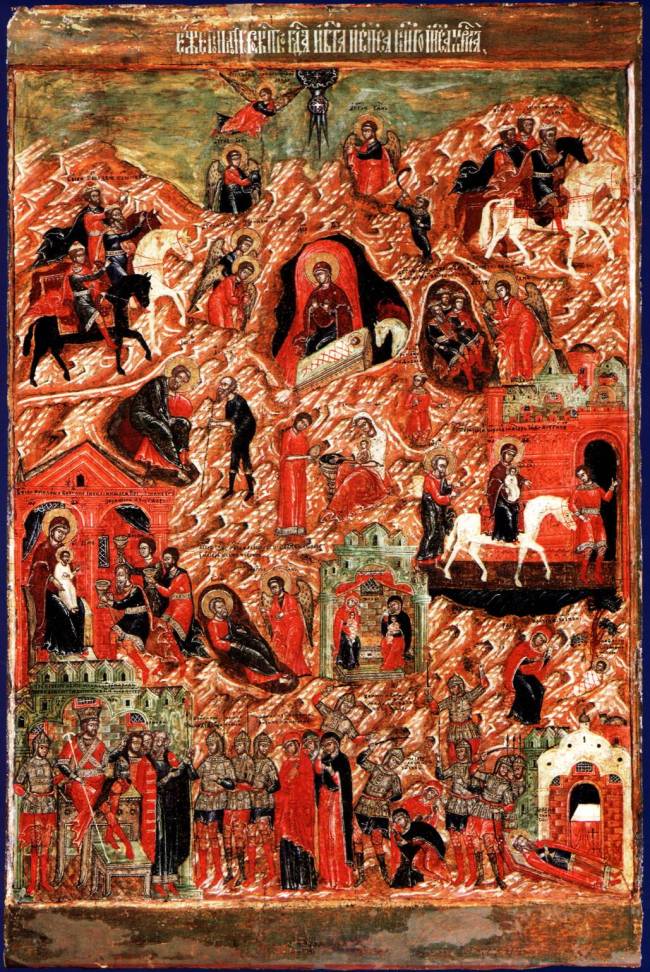
In conclusion, the icon of the Nativity, with its richness and theological content, relates the various scenes of the Incarnation narrative, overcoming both time and space limitations. Just as in the Orthodox liturgy we overcome linear time and space, so also the Nativity icon, as an integral part of the festal cycle, overcomes these limitations. In turn, the various scenes in the icon form an integrated and holistic unity to be contemplated and venerated in the ever present.

Jesus Christ as the Lord of Creation, entered the life of His creation and the life of human history as a newborn babe. He submits himself to the physical conditions and laws that govern the human race yet in his humbleness he continues to be the Saviour and the second person of the Trinity. (1)
nativity2

The very fact that in a single icon different scenes of the Nativity narrative coexist, although their historic, real time differs, such as Christ in the manger and at the same time in the stone water basin, or the Magi following the star, shining above the cave, and simultaneously offering their royal gifts to a Babe in a poor cave highlights the fact that time and space limitations are transcended when the Saviour and Lord of Creation enters the life of His creation and the life of human history, kairos in other words supplants chronos. (2)  And this is the real, mystical meaning of the kontakion “Today the Virgin gives birth to Him …” because the faithful may indeed literally participate in the Mystery of Incarnation in the liturgical “Now” and that very moment, in Church, Christ may be born in their hearts. (3)
nativity1.jpg

(*) Kairos Vs. Chronos: … When Jesus came, it was a fulfillment of promises past, a cosmic collision of the sacred and secular. It was an intersection of the holy will of God and the stubborn ways of man. It was a perfect moment.  John the Baptist said in Mark 1:15 that “time is fulfilled, and the kingdom of God is at hand.” This godly kairos pierced its way into creation at just the right time, slicing through chronos with a cry of a baby in a manger. The cross was another kairos moment. Romans 5:6 says, “For while we were still helpless, at the right time, Christ died for the ungodly.” Kairos moments then—and now—allow us to get a glimpse of the “other side.” We peek around the corner at eternity. We actually glimpse how God works. (3)

free-decorative-line-divider-clip-art-582650

(1)  http://www.uocc.ca/en-ca/about/education/nativity-icon.asp The Orthodox Icon of the Nativity of Our Lord And Saviour Jesus Christ, Dr. Roman Yereniuk, Associate Professor, St. Andrew’s College in Winnipeg.

(2) From “Living a Kairos Life in a Chronos World” http://www.thehighcalling.org/articles/essay/living-kairos-life-chronos-world

(3) Sophia Drekou’s insights and selection of icons and paintings at http://sophia-siglitiki.blogspot.gr/2013/12/blog-post_1453.html proved very stimulating.


I Shall Not Live In Vain

“Songs of Earth & Sky” Bill Douglas’ Album
Based on poems by Emily Dickinson and William Blake

“The words are a beautiful expression of compassion by Emily Dickinson (first verse) and William Blake (second verse).”

I Shall Not Live In Vain

If I can stop one heart from breaking,
I shall not live in vain.
If I can ease one life the aching,
Or cool one pain,
Or help one fainting robin
Unto his nest again –
I shall not live in vain.

Love seeketh not
Itself to please,
Nor for itself hath any care;
But for another gives its ease,
And builds a Heaven in Hell’s despair**

If I can stop one heart from breaking
I shall not live in vain
If I can ease one life the aching
Or cool one pain
Or help one fainting robin
Unto his nest again
I shall not live in vain


“Christ’s Nativity” by John Milton and Wiliam Blake

A few decades prior to writing his famous epic, Paradise LostJohn Milton composed this thirty-one-stanza ode—his first major work in English. Written in 1629 when he was just 21, the poem examines the cosmic significance of the incarnation, celebrating Christ’s triumph over the gods of paganism from the manger.

Regarding the poem’s composition, Milton wrote to his friend Charles Diodati,

I am singing the King of Heaven, bringer of peace, and the fortunate days promised by the Holy Book, the wanderings of God and the stabling under a poor roof of Him who rules with his Father the realms above; the star that led the wizards, the hymning of angels in the air and the gods flying to theirendangered fanes. This poem I made as a birthday gift for Christ; the first light of Christmas dawn brought me the theme.” (qtd. by Walter Taylor Field, 1907)

Between 1803 and 1815, visionary poet and visual artist William Blake painted on commission two sets of watercolors to illustrate the poem—one for the Rev. Joseph Thomas (the “Thomas set”), and one for Thomas Butts (the “Butts set”). Each set contains six watercolors which are very similar to one another, though not identical. The list of illustrations is as follows. (You’ll notice that not all the stanzas are illustrated.)

  1. The Descent of Peace (stanzas 1-3)
  2. The Annunciation to the Shepherds (stanzas 8-12)
  3. The Old Dragon (stanza 18)
  4. The Overthrow of Apollo and the Pagan Gods (stanzas 19-23)
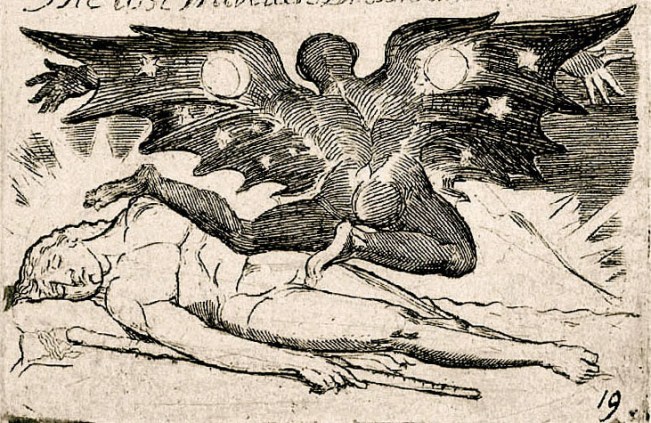
  5. The Flight of Moloch (stanza 23)
  6. The Night of Peace (stanza 27)


“On the Morning of Christ’s Nativity”

THE HYMN

I.
It was the winter wild,
While the heaven-born child
All meanly wrapt in the rude manger lies;
Nature, in awe to him,
Had doffed her gaudy trim,
With her great Master so to sympathize:
It was no season then for her
To wanton with the Sun, her lusty Paramour.

II.
Only with speeches fair
She woos the gentle air
To hide her guilty front with innocent snow,
And on her naked shame,
Pollute with sinful blame,
The saintly veil of maiden white to throw;
Confounded, that her Maker’s eyes
Should look so near upon her foul deformities.

III.
But he, her fears to cease,
Sent down the meek-eyed Peace:
She, crowned with olive green, came softly sliding
Down through the turning sphere,
His ready Harbinger,
With turtle wing the amorous clouds dividing;
And, waving wide her myrtle wand,
She strikes a universal peace through sea and land.

Blake nativity

The Descent of Peace (stanzas 1-3)

William Blake, “The Descent of Peace” (Thomas set), 1809. Watercolor on paper, 19.4 x 25.5 cm. Whitworth Art Gallery, Manchester, England. Description: Peace breaks through the heavenly spheres, dispersing the clouds and waving her myrtle wand, while Nature (below) covers her nakedness with a snowy veil as she pays reverence to her Lord.

VIII.
The Shepherds on the lawn,
Or ere the point of dawn,
Sat simply chatting in a rustic row;
Full little thought they than
That the mighty Pan1
Was kindly come to live with them below:
Perhaps their loves, or else their sheep,
Was all that did their silly thoughts so busy keep.

IX.
When such music sweet
Their hearts and ears did greet
As never was by mortal finger strook,
Divinely-warbled voice
Answering the stringèd noise,
As all their souls in blissful rapture took:
The air, such pleasure loth to lose,
With thousand echoes still prolongs each heavenly close.

X.
Nature, that heard such sound
Beneath the hollow round
Of Cynthia’s seat2 the airy Region thrilling,
Now was almost won
To think her part was done,
And that her reign had here its last fulfilling:
She knew such harmony alone
Could hold all Heaven and Earth in happier union.

XI.
At last surrounds their sight
A globe of circular light,
That with long beams the shamefaced Night arrayed;
The helmèd Cherubim
And sworded Seraphim
Are seen in glittering ranks with wings displayed,
Harping in loud and solemn quire,
With unexpressive3 notes, to Heaven’s newborn Heir.

XII.
Such music (as ’tis said)
Before was never made,
But when of old the Sons of Morning sung,
While the Creator great
His constellations set,
And the well-balanced World on hinges hung,
And cast the dark foundations deep,
And bid the weltering waves their oozy channel keep.

William Blake, "The Annunciation to the Shepherds," 1809. Watercolor on paper, 19.3 x 25.5 cm. Whitworth Art Gallery, Manchester, England. The Annunciation to the Shepherds (stanzas 8-12)

William Blake, “The Annunciation to the Shepherds” (Thomas set), 1809. Watercolor on paper, 19.3 x 25.5 cm. Whitworth Art Gallery, Manchester, England.

XVIII.
And then at last our bliss
Full and perfect is,
But now begins; for from this happy day
The Old Dragon under ground,
In straiter limits bound,
Not half so far casts his usurpèd sway,
And, wroth to see his Kingdom fail,
Swindges6 the scaly horror of his folded tail.

The Old Dragon by William Blake

William Blake, “The Old Dragon” (Thomas set), 1809. Watercolor on paper, 19.3 x 25.3 cm. Whitworth Art Gallery, Manchester, England.

blake7

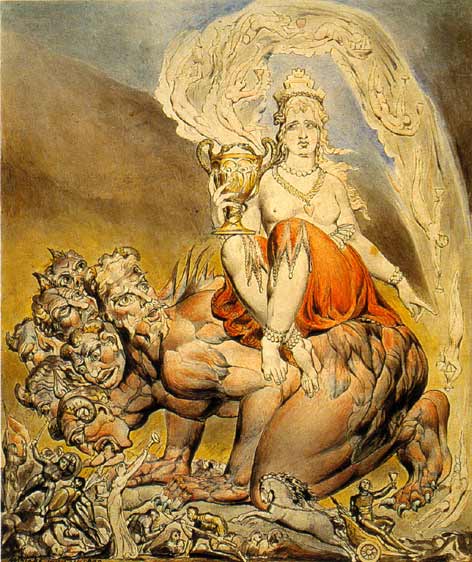
The Beast and the Whore of Babylon, elsewhere associated with institutionalized religion by Blake, are here overthrown along with Satan

The Overthrow of Apollo by William BlakeThe Overthrow of Apollo and the Pagan Gods (stanzas 19-23)
William Blake, “The Overthrow of Apollo and the Pagan Gods” (Thomas set), 1809. Watercolor on paper, 19.3 x 25 cm. Whitworth Art Gallery, Manchester, England. Description: Pagan worshipers burn an offering to Apollo as his spirit flees its statue in fear. (The statue depicts Apollo’s defeat of the giant serpent Python, who had tormented his mother during her pregnancy.) To the right, a disheveled Nymph hides in a thicket to mourn, while above her, a train of refugee gods and goddesses fills the sky.

XIX.
The Oracles are dumb;
No voice or hideous hum
Runs through the archèd roof in words deceiving.
Apollo from his shrine
Can no more divine,
Will hollow shriek the steep of Delphos1 leaving.
No nightly trance, or breathèd spell,
Inspires the pale-eyed Priest from the prophetic cell.

XX.
The lonely mountains o’er,
And the resounding shore,
A voice of weeping heard and loud lament;
Edgèd with poplar pale,
From haunted spring, and dale
The parting Genius2 is with sighing sent;
With flower-inwoven tresses torn
The Nymphs in twilight shade of tangled thickets mourn.

XXI.
In consecrated earth,
And on the holy hearth,
The Lars3 and Lemures4 moan with midnight plaint;
In urns, and altars round,
A drear and dying sound
Affrights the Flamens5 at their service quaint;
And the chill marble seems to sweat,
While each peculiar power forgoes his wonted seat.

XXII.
Peor and Baalim6
Forsake their temples dim,
With that twice-battered god of Palestine;7
And moonèd Ashtaroth,8
Heaven’s Queen and Mother both,
Now sits not girt with tapers’ holy shine:
The Libyc Hammon9 shrinks his horn;
In vain the Tyrian maids their wounded Thammuz10 mourn.

XXIII.
And sullen Moloch,11 fled,
Hath left in shadows dread
His burning idol all of blackest hue;
In vain with cymbals’ ring
They call the grisly king,
In dismal dance about the furnace blue;
The brutish gods of Nile as fast,
Isis,12 and Orus,13 and the dog Anubis,14 haste.

The Flight of Moloch by William Blake

The Flight of Moloch (stanza 23)

William Blake, “The Flight of Moloch” (Thomas set), 1809. Watercolor on paper, 19.7 x 25.7 cm. Whitworth Art Gallery, Manchester, England. Description: Worshipers of Moloch clang together cymbals and blow on trumpets as part of their infant sacrifice ritual. As they do, Moloch’s winged spirit departs from the molded image. The advent of his enemy, Jesus, has scared him away.

blake8

The winged figure of the accuser, so like the spirit of Moloch, cements that god’s identification with Blake’s Spectre

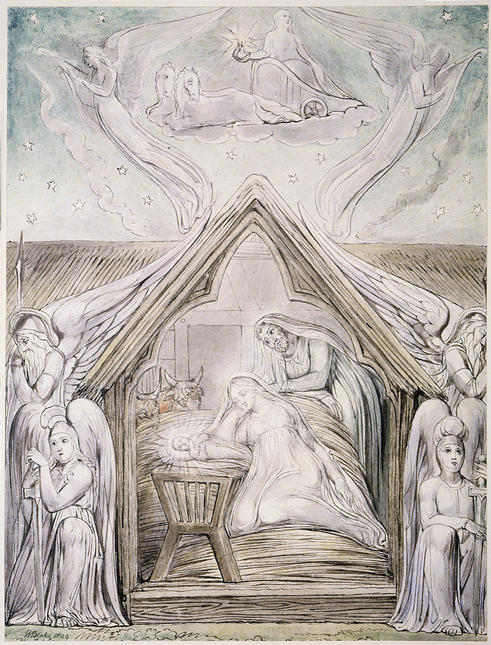
XXVII

But see the Virgin blest,
Hath laid her Babe to rest.
Time is our tedious Song should here have ending,
Heav’ns youngest-teemed Star [ 240 ]
Hath fixt her polisht Car,
Her sleeping Lord with Handmaid Lamp attending.
And all about the Courtly Stable,
Bright-harnest Angels sit in order serviceable.

blake6The Night of Peace (stanza 27)
Posted on December 14, 2012by Victoria Emily Jones

Also see “Winged Life” at https://orthodoxcityhermit.com/2015/09/12/william-blakes-mystic-visions-stunning-paintings/


The Womb and the Tomb


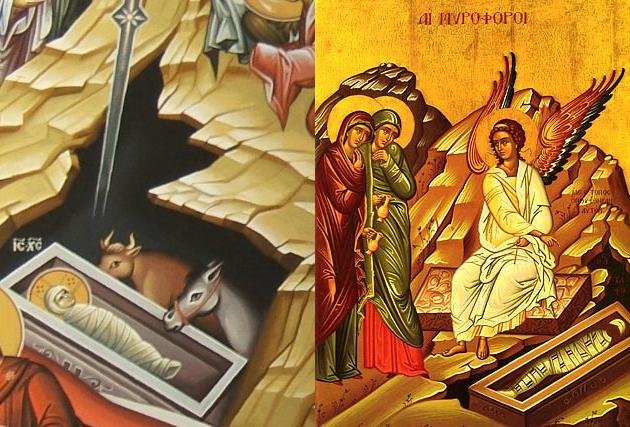
Icon of the Nativity compared with the Icon of the Resurrection

Left: Christ in the manger; Right: the Empty Tomb

No description of the Nativity Icon would be complete without mention of Jesus’ appearance in the manger.

It should be never forgotten that Jesus came to us in order to die – this was known by Him, at least, from the very beginning. Therefore, in Iconography, the manger in the Nativity Icon deliberately resembles a stone coffin, the swaddling clothes resemble a burial shroud, and the cave itself can even be said to prefigure Christ’s tomb.

With the side-by-side comparison shown above of the Icon of the Nativity with the Icon showing the Myrrh-bearing women discovering Jesus’ empty tomb, no more words are necessary. (1)

The Passion of Nativity

… Let us look more closely at the child in the relief.  “His tight swaddling clothes are evocative of burial wrappings.  In the byzantine tradition, there is an intentional connection between the swaddling clothes of the infant in a Nativity icon and the burial clothes of the Epitaphios (epi– upon; taphos- grave or tomb) icon which is venerated and anointed during Great Friday Vespers.  Also on Great Friday, the “soma” icon on the crucifix is taken down from the cross and shrouded in identical wrappings before it is processed and reposed in the sanctuary.”

nativity1

“…Note, as well, that the “manger” is a cave, a small hollow in a rock formation that mirrors Jesus’ tomb in the gospels.  In many icons, Jesus’ cradle is a stone box.  Who would lay a child in a coffin? What macabre motive would make an artist paint a baby as a mummy and give him a tomb as his nursery?  Indeed, the motive is not macabre, but joyful and eschatologically triumphant: we only understand the significance of the incarnation if we hold it in tension with Jesus’ saving death; we may not separate the two.  This also reminds us that the liturgical year commemorates events in the life of Jesus but it never parses the paschal mystery.”

nativity18

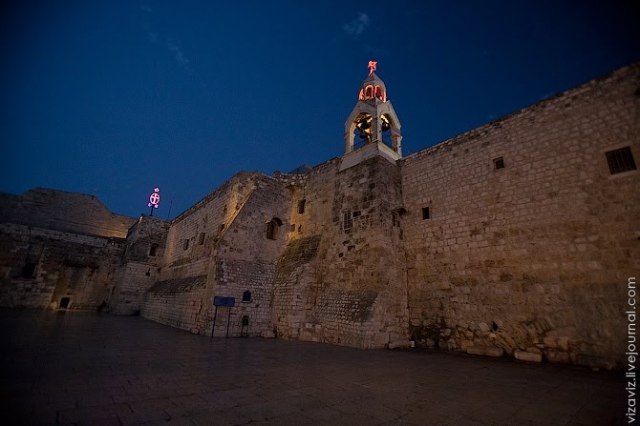
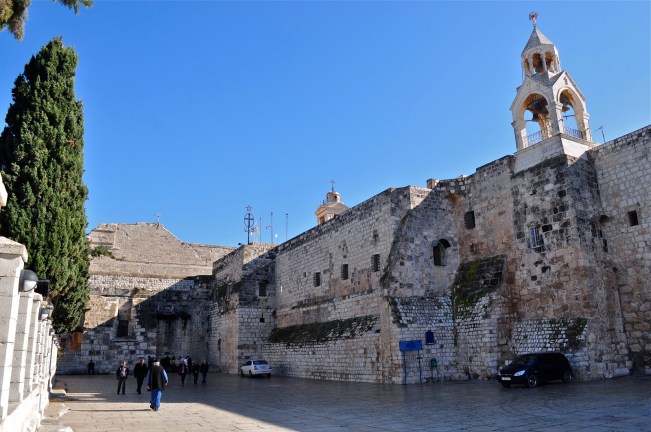
Basilica of the Nativity in Bethlehem 

The Church of the Nativity in Bethlehem is one of the oldest continuously operating churches in the world, and the oldest in the Holy Land (founded in 325)

nativity15.jpg


A virgin womb, conceiving thee, revealed thee;
a virgin tomb, receiving thee, concealed thee.

We glorify her from whom thou didst receive a beginning in time,
and we honour him that ministered to the end of thine earthly life for our sakes,
asking that through their prayers, O merciful Saviour,
we might be deemed worthy of thy Kingdom of the Heavens.

Theotokion on the Praises for the Feast of St. Joseph of Arimathea
Appendix to the July Menaion, Holy Transfiguration Monastery


nativity12

Church Of The Nativity Bethlehem Stable

All the eschatological themes of the Advent season converge in the Nativity tableau and are carried forward into Christmas.  This should not surprise us.  The birth of Christ and his salvific death form the cosmic fulcrum upon which the beam of human history rests, with creation and eschaton at each end.  In a nativity icon this is super concentrated.  Incarnation and eschaton are so ingeniously and inextricably intertwined that we might not even read “passion” in what is written in the icon unless we understand the symbolic significance of the iconographic elements.  The best known example of this is the gifts of the wise men: while gold and frankincense represent Jesus’ kingship and priesthood, respectively, myrrh, used for embalming, is a symbol of his death.

nativity10


When I look at a Nativity icon and I see a child embraced by death, and embracing death, I have at least an inkling of what Rilke was, perhaps, trying to convey in the first Duino Elegy:

“For beauty is nothing but the beginning of terror, which we are still just able to endure, and we are so awed because it serenely disdains to annihilate us.” (2)


(1) Posted on by 

(2) Posted at https://memoriadei.wordpress.com/2010/12/17/the-ox-the-ass-and-the-passion-of-the-nativity/

Arabic Christmas Carol

The Hymn of the Nativity in Arabic by St. Romanos the Melodist

The original YouTube link calls this a “Christmas Carol” and “Byzantine Hymn”. But this is not a carol, and it is not just another “Byzantine Hymn”: it is the Christmas Troparion written by the incomparable St. Romanos the Melodist, shortly after a vision of the Mother of God in which she unlocked his talent.

Church Legend

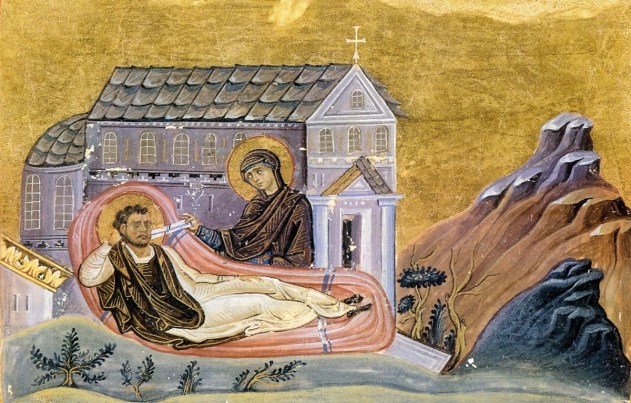
St Romanus was not a talented reader or singer. Church legend has it that during this time, Romanos’ voice was quite harsh and rasping and he was also tone deaf. It is said that the congregation cringed at hearing his voice.  Once, on the eve of the Nativity of Christ, he read the kathisma verses. He read so poorly that another reader had to take his place. The clergy ridiculed Romanus, which devastated him.

st romanos

It was in the Church of the Most Holy Theotokos in the Blachernae quarter of Constantinople, that he received the gift of sacred poetry. After a religious retreat there, in his sleep on Christmas eve, the Mother of God appeared to the grief-stricken youth in a vision while he was praying before her Kyriotissa icon. The Most Holy Theotokos told him not to despair. Blessing him with her right hand, she held forth a scroll with her left hand, saying, “Take the scroll and eat it.” The saint, in his dream, opened his mouth and swallowed the parchment. Thus was he given the gift of understanding, composition, and hymnography. It was Christmas Day, and immediately he awakened and marveled and glorified God. According to an account by Poulos, the service commenced as usual and when it came time for the voice of Romanos to be heard, the participants braced themselves for the accustomed cacophony that would ensue. Then, mounting the pulpit in the church, Romanos began the strains of his kontakion: Today the Virgin gives birth to the one who is above all living things. But when the tone rolled across the church like the sound of a heavenly angel, the stunned listeners stood transfixed. When he had finished, the confused priest signaled him to continue and once again the resonant voice reverberated in the house of God. Then it dawned on one and all that a miracle had occurred. He was now hailed as the “Melodist” (Melodos), “Sweet Singer” (Glykophonos),  and “Righteous Chanter” (Psaltis Dhikeosinis). (taken from: http://ocafs.oca.org/FeastSaintsViewer.asp?SID=4&ID=1&FSID=102826)


The Ass and the Ox

nativity1

Nativity of the Lord” Andrei Rublev 1405, Cathedral of the Annunciation, Moscow

As of today, I thought I might begin to concentrate on certain details of the Nativity iconography and explore their symbolism and theological significance in order to prepare my cave (a hermit as I am 😊) to receive the Word in the flesh.  My starting point will be a symbolic (and typological) analysis of the ox and the ass figures in the nativity iconography.

Generally speaking, the presence of any animals in the Nativity icon is in addition to any symbolic meaning a theological statement of restoration. It reminds us, I think, that all creation worships God ( the stars and the sun and even the dumb animals). That which was brought about by Adam’s transgression meant that the dominion he was given in Genesis over the birds of the air, the fish of the sea and the animals on the land was corrupted, made incomplete and he started eating that which was originally meant for companionship. When the Word who becomes flesh  is born, He who made Heaven and Earth and all that is in it,  it is only fitting that representatives of His creation are there to worship and adore the mystery of the Incarnation.

 
Revelation 5:13                
And I heard every creature in heaven and on earth and under the earth and in the sea, and all that is in them, saying, “To him who sits on the throne and to the Lamb be blessing and honor and glory and might forever and ever!” 
nativity5

Specifically now to the ox and the ass. “These two manger animals are ubiquitous in Nativity images.  They peer over the new-born Christ child in wonderment, usually with their muzzles close to the child, as if to warm him with their breath.  Their significance should be plain: The ass carries Jesus into Egypt, away from the murderous Herod who, like Pharoah, orders the slaughter of infants.  (The flight into Egypt in Matthew’s gospel is the first of many Jesus/Moses parallels.)  Later, the ass will carry him into the holy city of Jerusalem to the acclaim of the crowd: “Hossana!  Blessed is he who comes in the name of the Lord.” The ass who greets the Lord at his birth is the same ass who bears him into Egypt and carries him to his death at Jerusalem where he is hailed as “king of Israel” but crucified as a common criminal.  The red ox stands as a stark and basic  symbol of Hebrew cultic sacrifice.” (1)

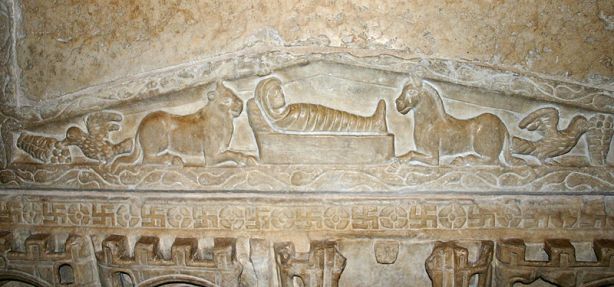
There is no ass or ox in the Biblical narratives of the birth of Christ.  Yet, besides the Christ Child himself, the ass and the ox are the most ancient and stable elements in the iconography of the nativity.  In fact the earliest example of a nativity known to us contains only the swaddled Christ in the manger flanked by the ox at his head and the ass at his feet.  David Clayton, on the New Liturgical Movement blog, has written a detailed piece on the subject, and I will go through the basics while adding a few more aspects he does not mention.

nativity6

Nativity scene on a 4th century sarcophagus from Italy

When reading comments on the nativity (for example in Ouspensky’s “The Meaning of Icons”) one finds that the inclusion of this detail is a reference to the prophecy of Isaiah:

The ox knows his owner, and the ass his master’s crib: but Israel has not known me, and my people have not understood.

nativity4

Some apocryphal texts have the ass and the ox worshiping the Christ child, such as the gospel of pseudo-Matthew:

Therefore, the animals, the ox and the ass, with him in their midst incessantly adored him. Then was fulfilled that which was said by Habakkuk the prophet, saying, “Between two animals you are made manifest.”

nativity7

The Nativity – Icon in the Monastery of St. Catherine
[Many thanks to Bill M. for the link and drawing attention to the look on the ox’s face 😊 The icons of St Catherine’s, being isolated and in dry desert conditions meant that their icons have survived remarkably well, making it is a treasure of pre-Iconoclast iconography] (2)

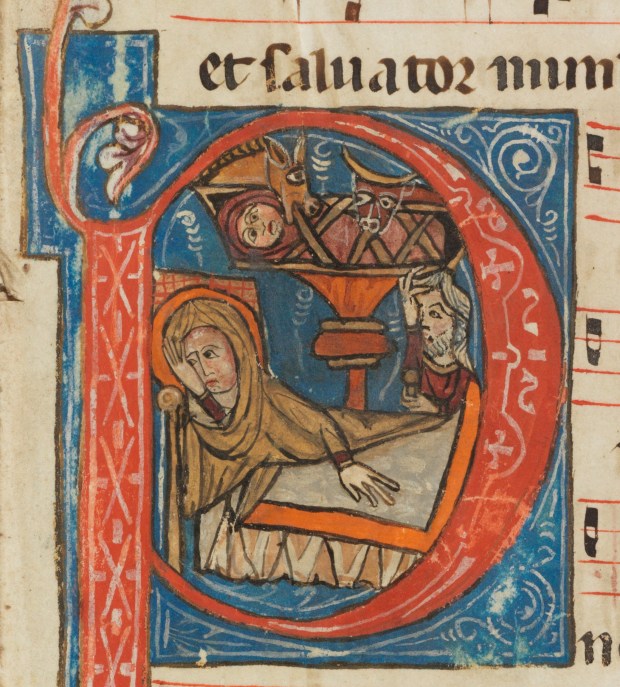
nativity9.jpgFreiburg, Couvent des Cordeliers / Franziskanerkloster, MS 9, fol. 11r. 
What though is the relationship between the ox and the ass, why are these animals paired together so?  We will often read that traditionally, the ox is seen as Israel, and the ass is seen as the Gentiles.  This comes from a very important distinction about the two animals.  The ox is a “clean” animal, and the ass is an “unclean” animal according to dietary proscription in the Old Testament.

Mixing the clean and the unclean is related very tightly to the mixing of Jews and Gentiles.  The clearest example of this is in St-Peter’s vision of the clean and unclean meats placed together, which signify the entry of Gentiles into the body of the Church.  Indeed there is a Mosaic law which I have never seen quoted in relation to the Nativity Icon, but which seems to hold one of the keys to the ass and the ox:

Thou shall not plow with an ox and an ass yoked together.

What is proscribed, the yoking of the clean and unclean, the bringing together of the “inside” and “outside” can only be accomplished without sin by the Christ, the incarnation of the Logos.  In fact, even St-Paul following this tradition, uses the same imagery to warn Christians not to be “yoked” with unbelievers.

nativity6

This brings out another meaning, which is related to the incarnation and its relation to universality of the Church.  The ass is a beast of burden, a “mindless” strength which was created to “carry” .  In this respect, the ass is a symbol of corporality itself.  One should not be surprised that the symbol of the unclean and “outer” is analogical to fallen corporal existence and sensuality. This can be seen so strongly in the hesychastic tradition in its relationship between the heart and the senses.  The “outer” part, corporality, the senses, the Gentile, are related to the garments of skin, which we have discussed before, and this periphery can be seen as protecting but also carrying what is precious, like the shell of the ark…

nativity3.jpg

Icon of the Nativity carved in linden by Jonathan Pageau

It therefore follows naturally that stories such as the talking ass of Balaam are seen as prefigurations of the incarnation in sources as early as St-Irenaeus, or that it is so important for Christ be found riding an ass (even in later Rabbinical Judaism, the ass and colt of Zecharia’s prophesy are seen as representing the Gentiles) .  These Old Testament images, like the joining of the ass and the ox in the icon of the Nativity, are symbolic of the joining of extremes, the union of the spiritual and corporal, the clean and unclean, the inside and outside and ultimately the uncreated and created in the person of our Lord Jesus Christ. (3)


Prayer By Night

night.jpg

Pray by night. Pray alone. Pray using no book, no image, no thought. Just stay awake for ten minutes after you wake up to have a glass of water, after your child or a nightmare wakes you. Stand there in the dark, and make no move or sound. Make time stand still, capture that moment and bring it before Christ as your humble offering: this is me; this is who I am; THIS is who You must save.

night2

In fact, it may be useful to even forget that you need to pray. Most of us have such terribly deformed ideas about what prayer is, that it is better to simply forget you are meant to pray. Just stand there and look into the darkness outside your window. Other times, make a prostration and even close your eyes while you are on the floor; and stay there; wait there. Keep your body in a state of tension, but your mind empty. Say nothing. Think nothing. Imagine nothing. Do not pray. Do not move. Just wait for His presence. Wait for Him to notice your silence, your stillness, your death. Wait for Christ, and He will come, because Love forces Him.

20131001-IMG_9385

This is the advantage of praying at this time; night is a shield against thoughts, against images and feelings. Try to be present in that moment, try to be aware of the silence that surrounds you, let the void of that darkness embrace you, let it enter you and fill you with peace and silence. There is something almost sacramental in this hidden silence and stillness before Christ. This darkness, this solitude, this instinctive awareness of one’s mortality, they all force one to open up in ways which would be impossible by daytime.

Be aware that you are awake before Christ while the world lies asleep, defenseless and vulnerable. You are awake before Christ, fighting for the world; you have become an intercessor for this fallen, sleeping world which is one with you, and for which Christ has died.

night3

Ten minutes alone with Christ, night after night, will change your life. When you wake up and you face the worries of the new day, there is something in you that rejoices – you and Christ share a secret, you and Christ share a fight. Your soul knows that it has been fed, and it also knows that, whatever happens during the day, the night will always return with its silence and its stillness. You will live through the day waiting for the night, because when the night falls, you will again bring yourself as an offering before your Creator, and your Creator will feed you once more.

Source: Father Seraphim http://www.mullmonastery.com/monastery-blog/prayer-by-night/

On Earth As It Is In Heaven ❧

To forget this Beauty is to lose sight of the Heavenly Kingdom. Above all we must learn to desire Beauty. It was not for theology or propriety that the Byzantines so adorned their temples. It was for Beauty. In Beauty lies Truth, and by it we show our Love for God.

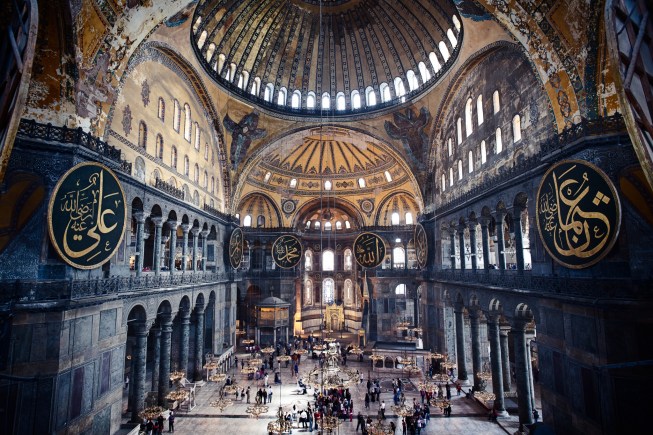
Hagia Sophia Interior (Ayasofya) - Istanbul

‘GOD DWELLS THERE AMONG MEN’

In 988, emissaries of Prince Vladimir of Kiev visited Hagia Sophia. They famously remarked, “only this we know, that god dwells there among men.” This statement highlights the attitude towards holy temples that was universal among ancient religions – that a god actually lived in the temple. Christianity has moved away from this belief, but Orthodoxy retains it as a liturgical concept. In an Orthodox church, Christ and the saints are present among the faithful. Prayers are directed towards their icons, not towards the sky. …


church1

… This is a great difference from Western architecture. A Gothic church is a monument offered up to God. It is an attempt by man to order and beautify all that exists in creation. It points upward to God the Father who is outside of it, and prayers are directed likewise. in contrast, an Orthodox church is introverted. The interior represents Heaven, and to enter it is to step into the New Jerusalem. God dwells there among men, and they have no need of the sun, neither of the moon, for the Glory of God illumines it (cf. Revelation 21 : 23).

church19


Light pours into a Gothic church through great decorated windows. Broken into dazzling colors, it overwhelms the materiality of the walls. The stonework itself magnifies the effect, as it is thin and delicate, and carven with most delicate tracery. The weight of the stone is denied. The worshipper is at once conscious of the awesome radiance and power of the light without and the tenuous structure of the material within. The light beautifies the structure by dematerializing it, even until the stone itself looks like rays of light.

church3


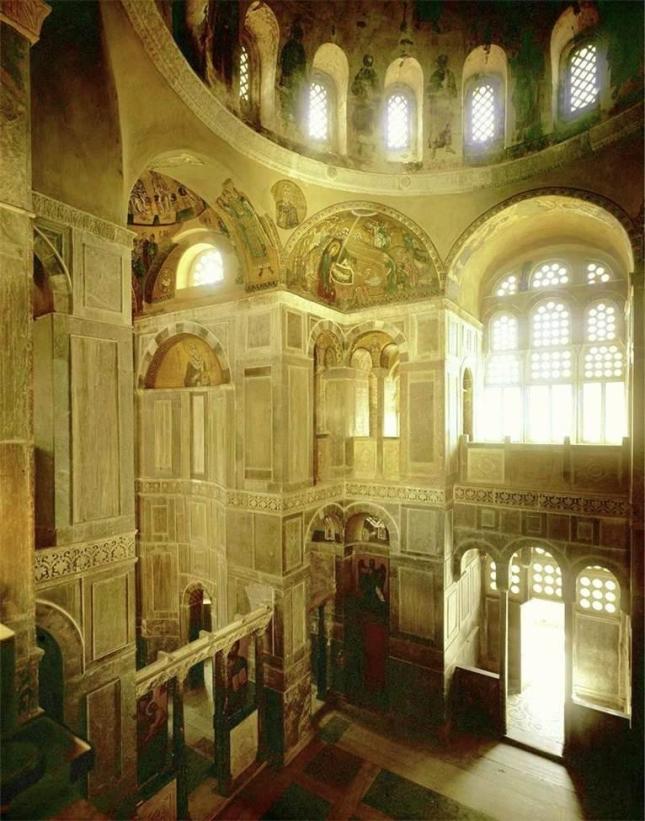
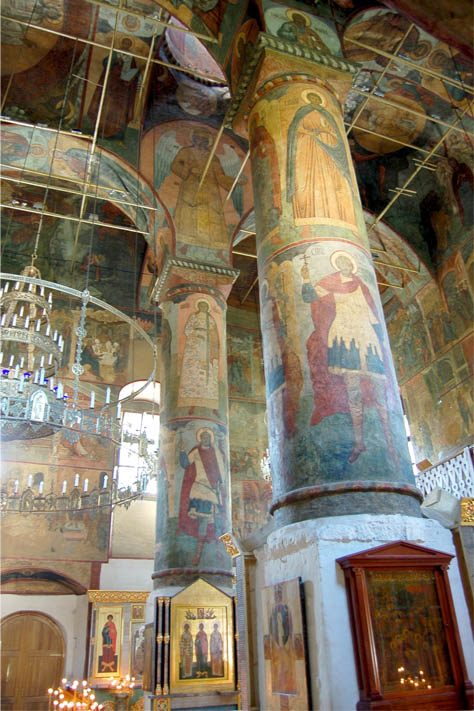
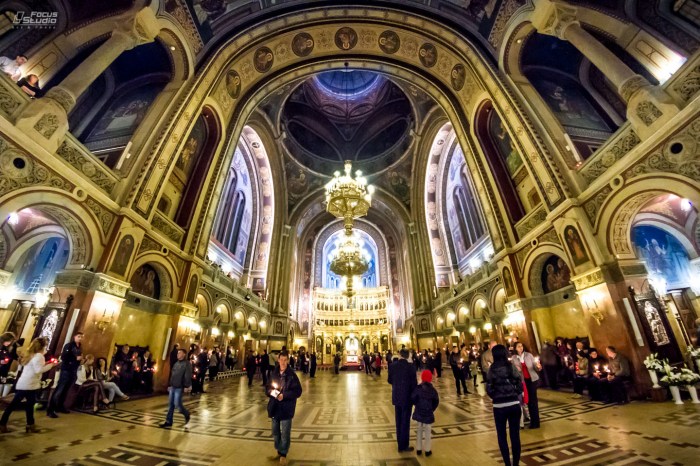
The walls of an Orthodox church are immensely thick and strong. The windows are small and up high, set deeply into the openings. The light is seen reflected off the thickness of the wall, rather than directly from the windows. In some Byzantine churches the window is translucent alabaster or marble, so that the light seems to glow from within the wall itself. Gold mosaics or bright frescoes play the light from many surfaces. Polished lamps and inlaid furniture reflect highlights from every direction. Deep aisles or side chapels behind arches appear as mysterious shadows in the distance, which make the church look brighter by the rich contrast. This is mass transfigured by light. It is the same light as in the icons, holy and all- pervading, the Uncreated Light which emanates from god to his creation. The stone and plaster glow from within. They do not seem transitory, but more real. Walls and piers seem as silent and as still as ancient mountains. They are bathed with the Light of Christ, and are sustained and strengthened by it as we are.

… A church building is the structure and organization of all the icons within it. As a unified edifice, these make up a single integrated icon which encompasses all the history and theology of the Church. The organization of the icons broadly follows three architectural axes.

The first axis is west to east. This is the liturgical axis. The narthex repre- sents the fallen world, and is used for preparation and exorcisms, for judg- ment is at the gates of heaven. The nave represents the redeemed world, or the Church, where the faithful gather among the saints for the worship of god. The sanctuary represents highest heaven; the altar is the throne of god and his tomb. (1)

church7

The second axis is vertical and can be understood as hierarchical. The Pantocrator is at the top of the dome with hands outspread, embracing the universe he created. Below are angels in their appropriate ranks, followed

 by the evangelists, representing the beginning of the church, and then the saints in their tiers below. To the medieval mind, hierarchy meant freedom; it was the mark of identity and security. This axis and hierarchy exist also in the iconostasis as a miniature version of the same concept. The vertical axis has another interpretation which is the approach of god and man. The dome, most brightly lit and filled with angels, is heaven. It touches the nave at the pendentives, where the evangelists are painted, because they record the meeting of god and man. alternately, some churches have four great feasts which are theophanies at the pendentives, for the same reason. The Theotokos of the sign in the apse represents the Church reaching back up to god. Christ appears in the sign before her, emphasizing that by the Incarnation He is already with Her.

church10

The third axis is circular and horizontal, the interplay of icons cycling around the nave and relating to one another across it. This axis often por- trays the flow of time, although it can express many other relationships as well. The great feasts may be ordered chronologically around the nave, or specific feasts may be combined or face one another to highlight theological connections. In a large church there may be hundreds of biblical and historical scenes, and their placement with respect to one another and to the principal feasts can suggest almost limitless depths of interpretation.

Historically, church builders have struggled with the interplay of these three axes. …

church12

THE TEMPLE AS COSMOLOGY

… Of all forms, the cube and the dome are the most sacred and universal in architecture. The cube or square represents the earth, while the dome symbolizes the sky. It was ever the desire of the Romans to combine these forms and represent the universe. They achieved this at Hagia Sophia. The square nave has the most water-like pavement in the world. Sheets of wavy blue-gray marble flow from the altar like the river of the water of life from the Throne of God. Rows of columns rise from the banks like trees. Amazingly, the builders abandoned the thousand-year-old tradition of the Classical orders, and crafted a new type of capital which looks like the fronds of palms blowing in the wind. The arches above the capitals are decorated similarly. The whole nave is like a walled garden of unimaginable scale, the very image of Paradise.


church15


ISLAM VS. CHRISTIANITY — MOSQUE VS. ORTHODOX TEMPLE


church21


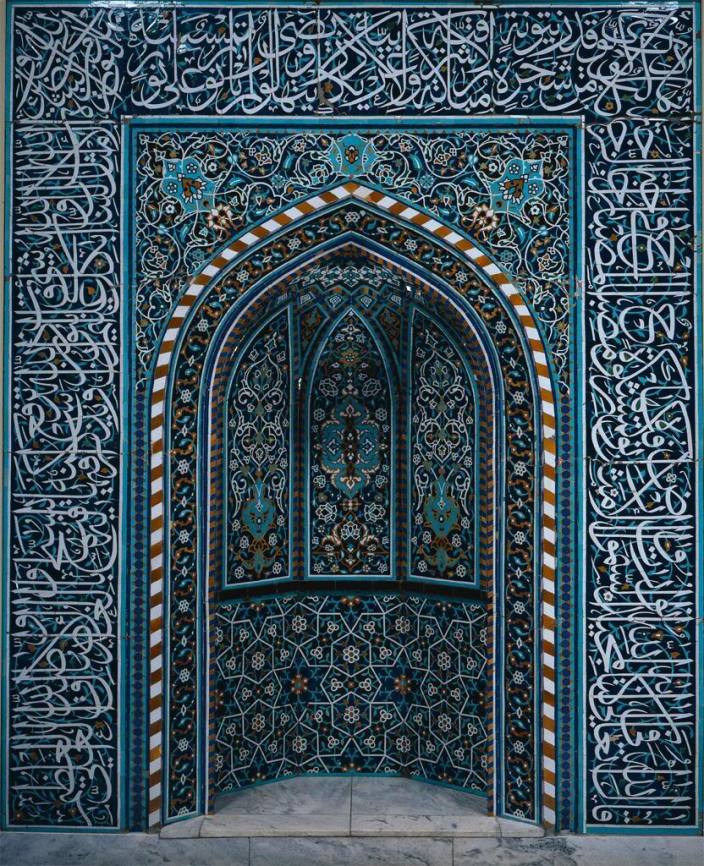
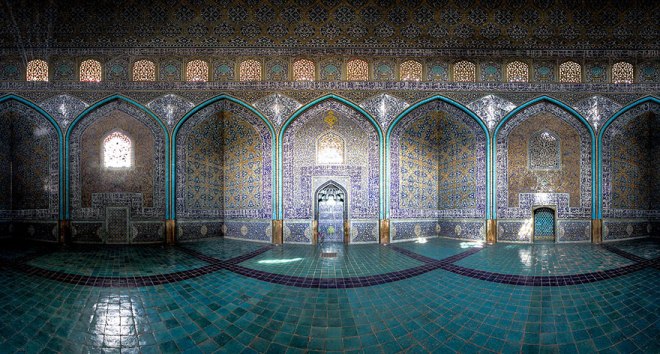
In Islam they build mosques that have the quality of jewel boxes. They are ornamented with a tremendous richness and regal splendor, but are completely devoid of anything iconographic, anything representational. They seem like abstract spaces, as does the Muslim worship within these spaces — the bowing down toward a mihrab, which is, in and of itself, nothing, but only an abstract architectural gesture that indicates the direction of Mecca. And of course, the Islamic faith emphasizes that man is very low and that God is very high, and that, really, the two do not meet; they surely do not meet in the sense that they meet in Christianity. So regardless of how beautiful a mosque may be, mosque architecture has never sought to convey an impression that God is within the mosque. It only conveys the impression that man has attempted to dignify himself by beautifying the mosque to an extent that man might be found worthy to kneel before God (because, of course, one only kneels in a mosque). So, if it is true that the emissaries of St. Vladimir attended services in an Orthodox Church, a Catholic Church, and in a mosque, I think it’s very appropriate that they would have observed that only in the Orthodox Church does it seem that God dwells with men. The very specific and deliberate attempt of Orthodox liturgical art is to convey that impression, and this is, of course, the fundamental gospel of Christianity.

church20

… A good modern building flooded with white light can be beautiful and people will often call such a building uplifting or inspiring. But we need to remember that the purpose of liturgical architecture, of an Orthodox church, is not to uplift and inspire but to make us mindful of the presence of God and the saints. Traditional architecture does this iconographically by revealing the beauty of the uncreated light shining through the saints, through the icons, and by suggesting the veil of mystery and the cloud of witnesses around the altar. For this iconographic technology to be effective requires a certain dim and mysterious light so that the reflections of light off of the gilded icons can be seen as brilliant and even supernatural in the setting of a dark church. A church that is flooded with natural light robs the icons of their ability to shine more brightly than the sun.

church11

*

(1) For the full article “ON EARTH AS IT IS IN HEAVEN ❧ Form and Meaning in Orthodox Architecture by ANDREW GOULD, go to http://nwbstudios.com/articles/On-Earth-As-Heaven.pdf

(2) For excerpts of the article “Mass Transfigured by Light”: The Iconic Vision of an Orthodox Church and ANDREW GOULD’s interview, featured in the current issue of Road to Emmaus Journal, go to http://www.orthodoxartsjournal.org/andrew-gould-featured-in-road-to-emmaus-journal/