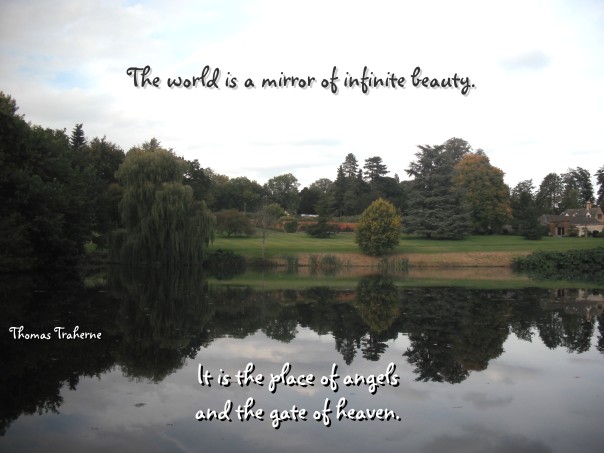
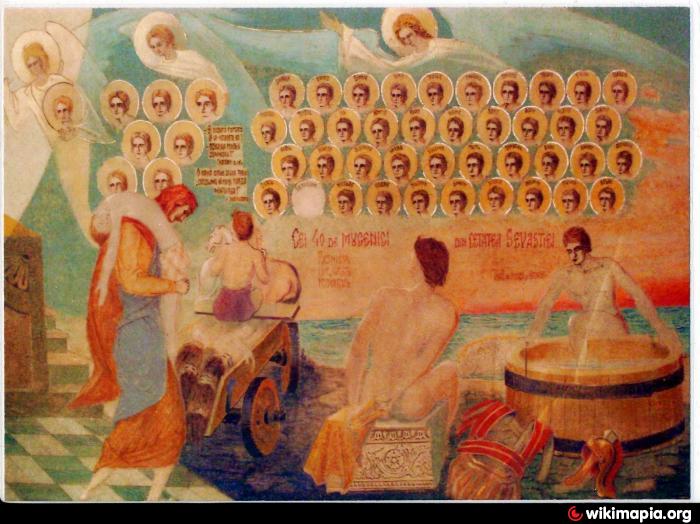
Dance The Night Of The Senses Away

 rumi1

8384433007_2862d161e5_z

Whoever wants to become a Christian must first become a poet. – St. Pophyrios of Kavsokalyvia

St. Porphyrios made this statement in the context of love and suffering:

That’s what it is! You must suffer. You must love and suffer–suffer for the one you love. Love makes effort for the loved one. She runs all through the night; she stays awake; she stains her feet with blood in order to meet her beloved. She makes sacrifices and disregards all impediments, threats, and difficulties for the sake of the loved one. Love towards Christ is something even higher, infinitely higher.

This is a rich image of the poet – or what can drive us both to poetry as well as theology. In the history of the Church, a number of the greatest theologians have also been poets. St. Gregory the Theologian, St. Gregory of Nyssa, St. John of Damascus, St. Isaac of Syria, St. Ephrem of Edessa – the list goes on and on – all joined theology to poetic endeavor. When we include the fact that the bulk of Orthodox theology is to be found in the hymns of the Church, we have to admit that the heart of the poet and the heart of the theologian are much the same thing.  (1)

*

Let us now feast on some exquisite food of the spirit, let us receive excess of saints’ poetry, let us all get drunk with the Spirit! (cf. Twelfth Night Act 1, scene 1, 1–3). St. Gregory of Nyssa, St. Gregory the Theologian, St John Damascene, and above all, St. Symeon the New Theologian will open out to us vistas of “that unseeable beauty, that unapproachable light, that unbearable glory”, such as we had never known before!

*

everything that is hurt,

everything
 that seemed to us dark,

harsh, shameful, 
maimed, ugly, irreparably
 damaged,

is in Him transformed

 and recognized as whole,

as lovely, 
and radiant in His light!

*

icon3

St Gregory of Nyssa

On Virginity

“… What, what is Virtue, but repose of mind?

A pure ethereal calm that knows no storm,

Above the reach of wild ambition’s wind,

Above the passions that this world deform,

And torture man, a proud malignant worm.”

*

icon2

St. Gregory the Theologian

Prayer

Flee swiftly from my heart, all-crafty one.

Flee from my members and from my life.

Deceiver, serpent, and fire, Belial, sin,

death, abyss, dragon, night, snare, and frenzy,

chaos, manslayer, and ferocious beast!

Thou didst entice into perdition those

first-formed folk, my foreparents, offering them

at the same time the taste of sin and death.

Christ, the Ruler of all commandeth thee to

flee into the billows, to fall upon the rocks,

or to enter the herd of swine, O baleful one,

as once He bade that presumptuous Legion.

Nay, yield forthwith, lest I smite thee with the Cross,

whereat all things tremble;

Oh, flee!

I bear the Cross upon me, in all my members.

I bear the Cross whene’er I journey, whene’er I sleep.

I hold the Cross in my heart. The Cross is my glory.

O mischievous one, wilt thou never cease from

dogging me with traps and laying snares for me?

Wilt thou not dash thyself upon the precipices?

Seest thou not Sodom? Oh, wilt thou not speedily

assail the shameless herds of ungodly heretics,

who, having so recklessly sundered the Almighty

Godhead, have witlessly destroyed and abolished It?

But comest thou against my hoariness? Comest thou

against my lowly heart? Thou ever blackenest me,

O foe, with darksome thoughts, pernicious thoughts.

Thou hast no fear of God, nor of His Priests.

This mind of mine, most evil one, was verily

a mighty and loud-voiced herald of the Trinity.

And now it beholdeth its end, whither it goeth in haste.

Confuse me not, O slimy one, that I might, as pristine,

meet the pure lights of Heaven, that they might

shine like lightning flashes upon my life.

Lo, receive me; lo, I stretch forth my hands.

Farewell, O world! Farewell, thou who bringest woes upon me!

Pity be shown to all that shall live after me.

Dirge

Woe is me! Just now that I press forward

to Heaven, to the place of God, alas!

This body of mine encompasseth me.

Neither is there an end to this much-erring life,

nor yet to loathsome evil, which bindeth me fast

here below, and woundeth me from every side,

smiting me with unexpected cares that consume

the beauty and grace of my soul.

Nonetheless, O my God, King of all,

loose me swiftly from these earthly fetters,

and enroll me henceforth in the celestial choirs. (2)

*

St John Damascene

The Funeral Hymns 

icon1

[Icon above: The Astonishment of Sisoes | Contemplating Death, staring over the dead bones of Alexander the Great]

St. Sisoi’s icon (below) is to be found in the Monastery of Varlaam, Meteora (central Greece). It depicts a unique theme, whereby St. Siois is mourning in front of Alexander the Great’s tomb, the most famous Greek king ever to have lived.

“A tomb now suffices him for whom the world was not enough.”  [Alexander’s tombstone epitaph]

*

Tone I

Where is the pleasure in life which is unmixed with sorrow? Where the glory which on earth has stood firm and unchanged? All things are weaker than shadow, all more illusive than dreams; comes one fell stroke, and Death in turn, prevails over all these vanities. Wherefore in the Light, O Christ, of Your countenance, the sweetness of Your beauty, to him (her) whom You have chosen grant repose, for You are the Friend of Mankind.

Tone 2

Like a blossom that wastes away, and like a dream that passes and is gone, so is every mortal into dust resolved; but again, when the trumpet sounds its call, as though at a quaking of the earth, all the dead shall arise and go forth to meet You, O Christ our God: on that day, O Lord, for him (her) whom You have withdrawn from among us appoint a place in the tentings of Your Saints;yea, for the spirit of Your servant, O Christ.

Another in Tone 2

Alas! What an agony the soul endures when from the body it is parting; how many are her tears for weeping, but there is none that will show compassion: unto the angels she turns with downcast eyes; useless are her supplications; and unto men she extends her imploring hands, but finds none to bring her rescue. Thus, my beloved brethren, let us all ponder well how brief is the span of our life; and peaceful rest for him (her) that now is gone, let us ask of Christ, and also His abundant mercy for our souls.

icon5

 Tone 3

Vanity are all the works and quests of man, and they have no being after death has come; our wealth is with us no longer. How can our glory go with us? For when death has come all these things are vanished clean away. Wherefore to Christ the Immortal King let us cry, “To him (her) that has departed grant repose where a home is prepared for all those whose hearts You have filled with gladness.”

 Tone 4

Terror truly past compare is by the mystery of death inspired; now the soul and the body part, disjoined by resistless might, and their concord is broken; and the bond of nature which made them live and grow as one, now by the edict of God is rest in twain. Wherefore now we implore Your aid grant that Your servant now gone to rest where the just that are Yours abide, Life-bestower and Friend of Mankind.

 Tone 4

Where is now our affection for earthly things? Where is now the alluring pomp of transient questing? Where is now our gold, and our silver? Where is now the surging crowd of domestics, and their busy cries? All is dust, all is ashes, all is shadow. Wherefore draw near that we may cry to our immortal King, “Lord, Your everlasting blessings vouchsafe unto him (her) that now has gone away. bringing him (her) to repose in that blessedness which never grows old.”

(c) Ferens Art Gallery; Supplied by The Public Catalogue Foundation

Tone 5

I Called to mind the Prophet who shouted, “I am but earth and ash.” And once again I looked with attention on the tombs, and I saw the bones therein which of flesh were naked; and I said, “Which indeed is he that is king? Or which is soldier? Which is the wealthy, which the needy? Which the righteous, or which the sinner?” But to Your servant, O Lord, grant that with the righteous he (she) may repose.

Tone 6

My beginning and foundation was the form;bestowing Word of Your commandment; for it pleased You to make me by compounding visible and invisible nature into a living thing. out of earth was my body formed and made, but a soul You gave me by the Divine and Life-creating In; breathing. Wherefore, O Christ, to Your servant in the land of the living, in the courts of the righteous, do You grant repose.

 Tone 7

Bring to his (her) rest, O our Savior, You giver of life, our brother (sister) whom You have withdrawn from this transient world, for he (she) lifts up his (her) voice to cry: “Glory to You.”

 Another in Tone 7

When in Your own image and likeness You in the beginning did create and fashion man, You gave him a home in Paradise, and made him the chief of your creation. But by the devil’s envy, alas, beguiled to eat the fruit forbidden, transgressor then of Your commandments he became; wherefore back to earth, from which he first was taken, You did sentence him to return again, O Lord, and to pray You to give him rest.

icon7

[Icon above: The Canon of Pascha, a composition by John of Damascus.]

Plagal of the Fourth Tone

Weep, and with tears lament when with understanding I think on death, and see how in the graves there sleeps the beauty which once for us was fashioned in the image of God, but now is shapeless, ignoble, and bare of all the graces. O how strange a thing; what is this mystery which concerns us humans? Why were we given up to decay? And why to death united in wedlock? Truly, as it is written, these things come to pass by ordinance of God, Who to him (her) now gone gives rest

 Glory to the Father and to the Son and to the Holy Spirit.

The death which You have endured, O Lord, is become the harbinger of deathlessness; if You had not been laid in Your tomb, then would not the gates of Paradise have been opened;wherefore to him (her) now gone from us give rest, for You are the Friend of Mankind.

 Both now and ever and to the ages of ages. Amen.

Virgin chaste and holy, Gateway of the Word, Mother of our God, make supplication that his (her) soul find mercy.

*

Listen to a selection of these Funeral Hymns chanted in a Mt Athos, Byzantine style by Apostolos Hill (Hymns of Paradise) at https://www.youtube.com/watch?v=qSBh6Iabe68 , https://www.youtube.com/watch?v=2vtNuI8Wj3g , https://www.youtube.com/watch?v=y7iXu2yO7Lc

icon9

[Icon above: Cure of Saint John Damascene]

The story behind the texts of the Funeral Service is very moving: St. John was once a powerful and wise member of the royal court. He however abandoned all this and became a monk. “Only once did John disobey the instructions that were his rule of life in the monastery. A fellow monk had lost his brother and could not be consoled. Knowing of John’s ability to compose music and poetry, he begged him to write a funeral hymn for his dead brother. Because his elder had left the monastery for a few days, John refused, for he had agreed to do nothing without the elder’s direction and consent. Finally, however, he felt so sorry for the bereaved monk that he consented, and wrote one of his most beautiful hymns–which has become part of the Orthodox funeral service. The monk was very moved by the lovely hymn and thanked John for helping him in his grief.

*

But when the elder returned and heard of John’s deed, he wanted nothing more to do with him for he had disobeyed his rule. John begged the elder to forgive him, but to no avail. The other monks also petitioned the older monk to take him back, even if it meant giving John a penance. The elder finally relented. He gave him the worst job in the monastery, cleaning the lavatories, and also forbid him to write any more hymns. John accepted gratefully and willingly carried out all his duties.

*

One night the elder had a vision. The mother of God appeared to him in a dream and said: “Why have you sealed the spring of fresh water for which the whole world is thirsty? Let it pour freely and comfort those in need. Let John praise God through his songs.” The elder then realized that he had dealt wrongly with John and hurried to him, asking forgiveness for his sternness and bluntness. He knelt and bowed low before John to beg his pardon. The talent which had been given to John could now be used to the glory of God.”

*

There is also another very moving story about St. John Damascene and the Icon of Theotokos with three Hands! St. John Damascene was the great defender of icons. Because of his defense of the holy images and because of his great ability as a writer, the order was given by the iconoclasts that his right hand be cut off at the wrist. St. John asked for the severed hand and prayed before the icon known as the Hodegetria or She Who Shows the Way. Asking fervently that his hand might be restored, he fell asleep exhausted.

*

Virgin Mary came to him in a dream; when awoke his hand was miraculously restored with only a red line showing.  In gratitude, St. John composed the hymn “In thee, O Full of Grace, all creation rejoices” The icon before which St. John prayed exists to this day on Mount Athos in the Hilander Monastery. It is called Tricherousa, or Panagia “Of  Three Hands” due to the silver hand which St. John placed on the icon as a testament to the above miracle.

icon10

*

St. Symeon the New Theologian

How are You at once the source of fire

How are You at once the source of fire,

how also the fountain of dew?

How at once burning and sweetness,

how a remedy for all disease?

How do You make gods of us men,

how do You make darkness light?

How do You make one reascend from Hell,

how do You make us mortals imperishable?

How do You draw darkness to light,

how do You triumph over night?

How do You illumine the heart?

how do You transform me entirely?

How do You become one with men,

how do You make them sons of God?

icon11

In the midst of that night, in my darkness

by Symeon the New Theologian

In the midst of that night, in my darkness,

I saw the awesome sight of Christ

opening the heavens for me.

And he bent down to me and showed himself to me

with the Father and the Holy Spirit

in the thrice holy light

–
a single light in three,

and a threefold light in one,

for they are altogether light,

and the three are but one light,.

And he illumined my soul

more radiantly than the sun,

and he lit up my mind,

which had until then been in darkness.

Never before had my mind seen such things.

I was blind, you should know it,

and I saw nothing.

That was why this strange wonder

was so astonishing to me,

when Christ, as it were,

opened the eye of my mind,

when he gave me sight, as it were,

and it was him that I saw.

He is Light within Light,

who appears
 to those

who contemplate him,

and contemplatives see him in light

–
see him, that is, in the light of the Spirit…

And now, as if from far off,

I still see that unseeable beauty,

that unapproachable light,

that unbearable glory.

My mind is completely astounded.

I tremble with fear.

Is this a small taste from the abyss,

which like a drop of water

serves to make all water

knowing all its qualities and aspects?…

I found him, the One

whom I had seen from afar,

the one whom Stephen saw

when the heavens opened,

and later whose vision blinded Paul.

Truly, he was as a fire

in the center of my heart.

I was outside myself, broken down, lost to myself,

and unable to bear

the unendurable brightness of that glory.

And so, I turned

and fled into the night of the senses.

icon12


O totally strange and inexpressible marvel!

by Symeon the New Theologian

O totally strange and inexpressible marvel!

Because of my infinite richness I am a needy person

and imagine to have nothing,

when I possess so much,

and I say: “I am thirsty,”

through superabundance of the waters

and “who will give me,”

that which I possess in abundance,

and “where will I find,”

the One whom I see each day.

“How will I lay hold of,”

the One who is within me,

and beyond the world,

since he is completely invisible? (4)

icon13

The fire rises in me

by Symeon the New Theologian

The fire rises in me,

and lights up my heart.

Like the sun!

Like the golden disk!

Opening, expanding, radiant —

Yes!
     a flame!

I say again:

I don’t know

what to say!

I’d fall silent

If only I could

but this marvel

makes my heart leap,

it leaves me open mouthed

like a fool,

urging me

to summon words

from my silence.

icon14

We awaken in Christ’s body

by Symeon the New Theologian

We awaken in Christ’s body

as Christ awakens our bodies,

and my poor hand is Christ,

He enters
 my foot,

and is infinitely me.

I move my hand,

and wonderfully

my hand becomes Christ,

becomes all of Him

(for God is indivisibly 
whole,

seamless in His Godhood).

I move my foot,

and at once
He appears

like a flash of lightning.

Do my words seem blasphemous?

Then 
open your heart to Him

and let yourself receive the one

who is opening to you so deeply.

For if we genuinely love Him,

we wake up inside Christ’s body

where all our body, all over,

every most hidden part of it,

is realized in joy as Him,

and He makes us, utterly, real,

and everything that is hurt,

everything
 that seemed to us dark,

harsh, shameful,
maimed, ugly, irreparably
 damaged,

is in Him transformed

 and recognized as whole,

as lovely, 
and radiant in His light

he awakens as the Beloved

in every last part of our body.

icon16

You, oh Christ, are the Kingdom of Heaven

by Symeon the New Theologian

You, oh Christ, are the Kingdom of Heaven;

You, the land promised to the gentle;

You the grazing lands of paradise;

You, the hall of the celestial banquet;

You, the ineffable marriage chamber;

You the table set for all,

You the bread of life;

You, the unheard of drink;

You, both the urn for the water

and the life-giving water;

You, moreover, the inextinguishable lamp

for each one of the saints;

You, the garment and the crown

and the one who distributes crowns;

You, the joy and the rest;

You, the delight and glory;

You the gaiety;

You, the mirth;

and Your grace,

grace of the Spirit of all sanctity,

will shine like the sun in all the saints;

and You, inaccessible sun,

will shine in their midst

and all will shine brightly,

to the degree of their faith,

their asceticism,

their hope

and their love,

their purification

and their illumination

by Your Spirit.


Sources:

(1) For the full article “The Poetry of God” by 

(2) Our Father among the Saints Gregory of Nazianzos, the Theologian: Selected verses from his poetry translated metrically into Modern Greek by Alexandros Moraïtides (in Greek) (Athens: Ekdosis I.N. Sideres, n.d.), Vol. II. [The original poems are found in Patrologia Græca, Vol. XXXVII, cols. 1399A-1401A (Poem LV); cols. 1384A-1385A (Poem XLIX) — trans.]

(3) The hymns by St. John of Damascus, taken from http://www.goarch.org/chapel/liturgical_texts/funeral2

(4) Original Language Greek; English version by George A. Maloney, S.J., Ivan M. Granger, Stephen Mitchell. Source: http://www.poetry-chaikhana.com/Poets/S/SymeontheNew/

Canvas Bloodily Immolated on Calvary

david jones3

*

Time is Ripe for a David Jones Revival, the long neglected figure in the history of British Modernism. Poet and visual artist, draughtsman, printmaker, illustrator, painter, engraver, calligrapher and a genuine 20th-century visionary, David Jones’ (1895-1974) creative life was largely determined by two experiences. During World War I he served on the Western Front, an event that he regarded as epic and imbued with religious, moral and mythic overtones, in which Divine Grace manifested a continual presence. The second experience was his conversion to Roman Catholicism in 1921.

*

david jones

*

David Jones served in the trenches as a Private soldier from 1915 until 1918, was wounded at The Battle of The Somme, and spent more time on active service than any of the other First World War poets. He began writing poetry more than ten years after the 1918 Armstice, publishing his first major work in 1937. He continued painting, drawing and writing poetry throughout his comparatively long life in between episodes of depression caused by what would now be called post traumatic stress. He called his illness “Rosi”, referring almost fondly to the “rosi” in “neurosis”.

*

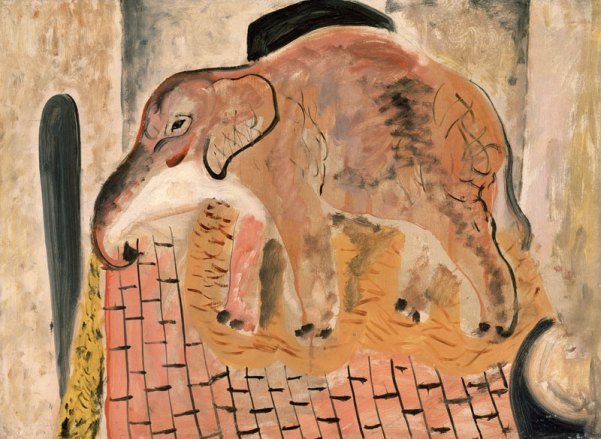
David-Jones-Elephant-1928-National-Museum-of-Wales

*

One of the most intense of his wartime recollections was of watching a Catholic mass for the first time. He was out alone in the Ypres sector scrounging for firewood in the woods when he became aware of a mass in progress in a ruined farmhouse. He watched the proceedings through a chink in the wall. He spotted the priest “in a gilt‑hued planeta, two points of flickering candlelight, white altar cloths and a few huddled figures in khaki”. The matter of factness of the scene impressed him. This almost businesslike routine had been going on for centuries. In 1921 Jones converted to Roman Catholicism. He said that “the mass makes sense of everything” and much of his poetry and paintings are religious, biblical and liturgical.

david jones 21

*

After his conversion and for the rest of his life, Jones regarded his artistic and poetic vocation as a kind of priesthood, living and working very simply and alone. Despite all this acclaim, Jones was a humble man who never sought fame, which is probably just as well. For his last 20 years, until his death in 1974, he inhabited a single room in Harrow, welcoming visitors but otherwise pursuing his work in isolation. He called that room his “dug-out”, but in truth it was a monastic cell.

*

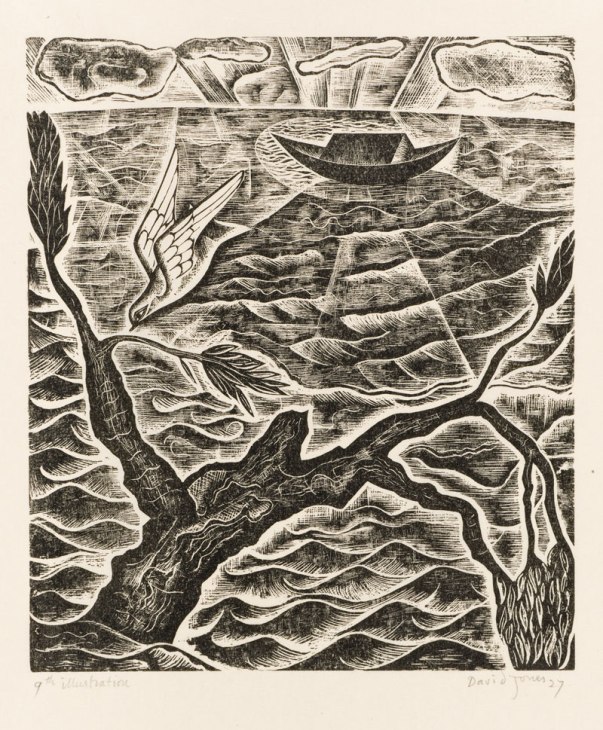
David-Jones-The-Dove

*

We need to view him as fundamentally a maker. He formed things with his hands as he shaped things in his mind, combining the visual and verbal with creative intensity not seen in Britain since the time of William Blake.

*

Jones visualized his Art as sacramental, holding affinities to the sacrament of the Eucharist: “the insistence that painting must be a thing and not the impression of something has affinity with what the Church said of the mass, that what was oblated under the species of bread and wine at the supper was the same thing as what was bloodily immolated on Calvary”.

*

trustees of the David Jones estate; (c) A. J. Hyne; Supplied by The Public Catalogue Foundation

*

When Igor Stravinsky made his last visit to England, he declared that it was largely a pilgrimage to visit David Jones. He visited him in the 1950s in the boarding house in Harrow, where he lived from 1947, after his second breakdown, until 1964. According to Stephen Spender, he remarked that it was ‘like visiting a holy man in his cell’. Recounting the same visit, Spender pictures Jones as a figure of saintly innocence, playing ‘a worn record of plain-song Gregorian chant […] with hands clasped across his knees and an expression of bliss on his face’.

*

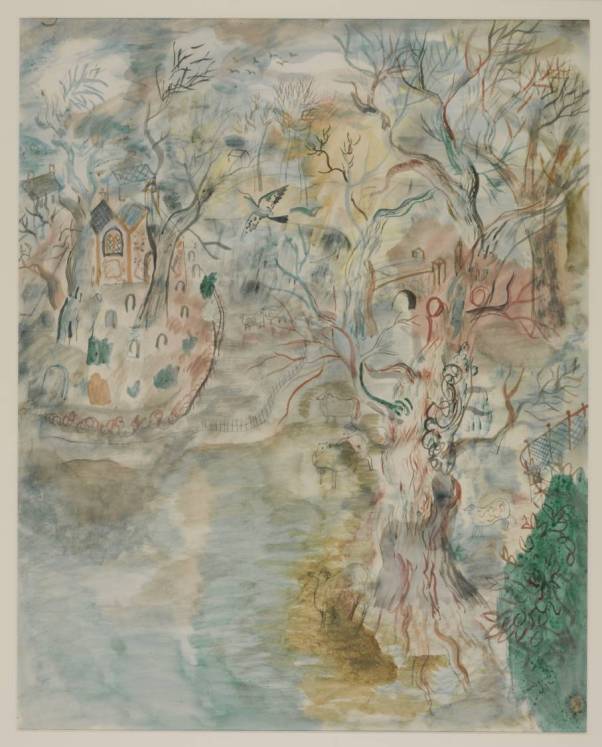
The Chapel in the Park, 1932

*

The Chapel in the Park 1932 David Jones 1895-1974 Purchased 1940 http://www.tate.org.uk/art/work/N05054

*

TS Eliot regarded In Parenthesis, Jones’s modernist poetry/prose epic, dramatising, distilling and mythologising his experiences on the Western Front during the First World War, as “a work of genius”. Auden similarly judged The Anathemata, published in 1957, as “very probably the finest long poem to be written in English this century”. Nonetheless, I personally find David Jones’ poetry highly rewarding, yet forbidding in its complexity, so, I’d rather dwell on some of this unworldly figure’s and visionary artist’s paintings which I find absolutely fascinating.

*

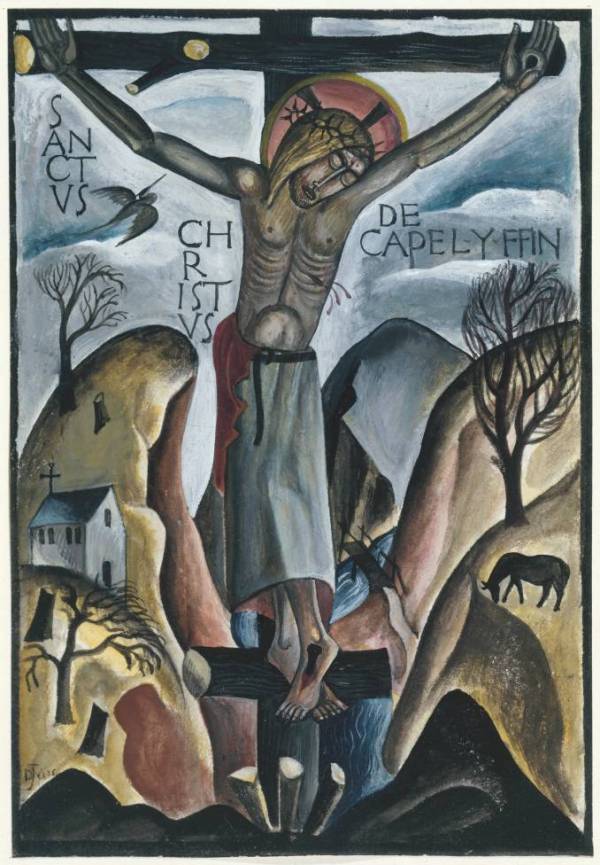
Sanctus Christus de Capel-y-ffin, 1925

*

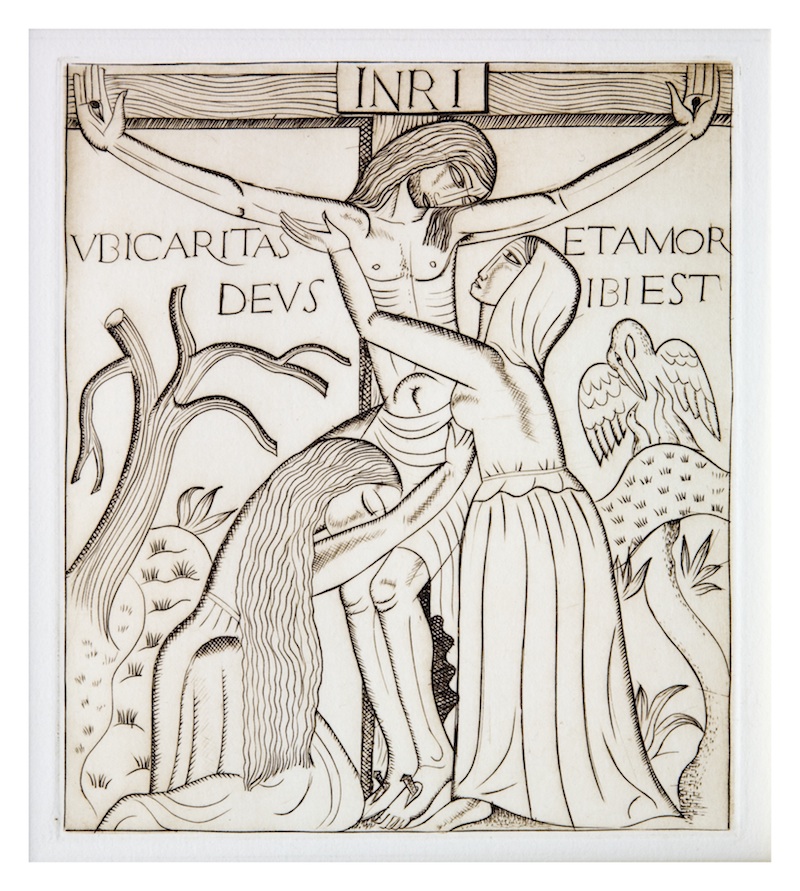
Sanctus Christus de Capel-y-ffin 1925 David Jones 1895-1974 Presented by the Friends of the Tate Gallery 1983 http://www.tate.org.uk/art/work/T03677

*

Capel-y-ffin was the former monastery in the Monmouthshire Black Mountains where Eric Gill and his family moved in August 1924. David Jones first visited them there the following December, and the building at the left of this drawing loosely resembles the monastery, in its winter landscape. Eric Rowan (loc.cit.) compares this drawing to a wall painting of the Crucifixion made by David Jones at Capel-y-ffin in the same winter.

*

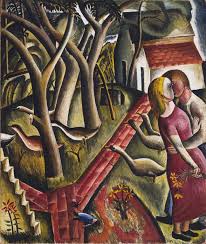
The Garden Enclosed

*

david jones 13

*

After he was received into the Roman Catholic church in 1921, Jones went to live with the artist Eric Gill and his family. The two figures in this picture represent Jones, and Gill’s daughter Petra. The picture was painted to mark their engagement in June 1924, when Petra was not quite eighteen. The title alludes to the Song of Solomon, chapter 4, v.12 ‘A garden inclosed is my sister, my spouse’. An enclosed garden is also frequently used as a symbol for the virginity of the Virgin Mary. The geese, sacred to the classical goddess Juno and associated with young girls, flee from the embracing couple, alarmed by their passion. The doll on the ground may symbolise lost childhood.

*

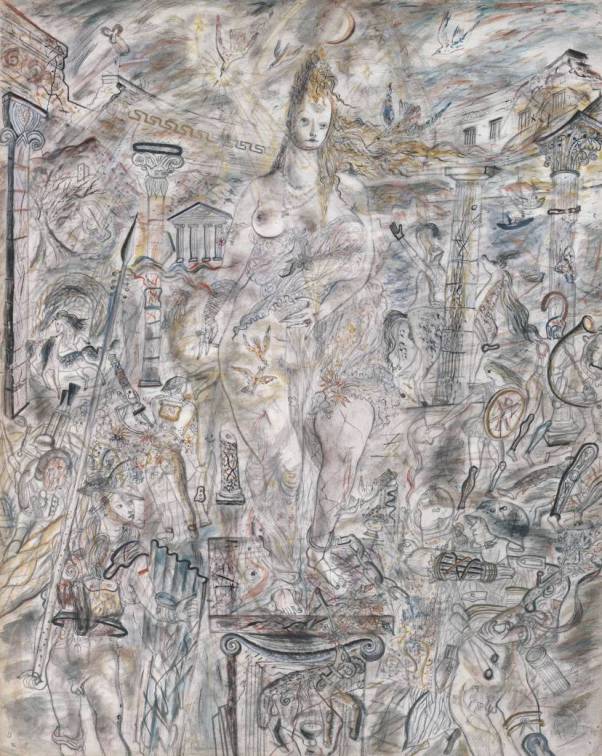
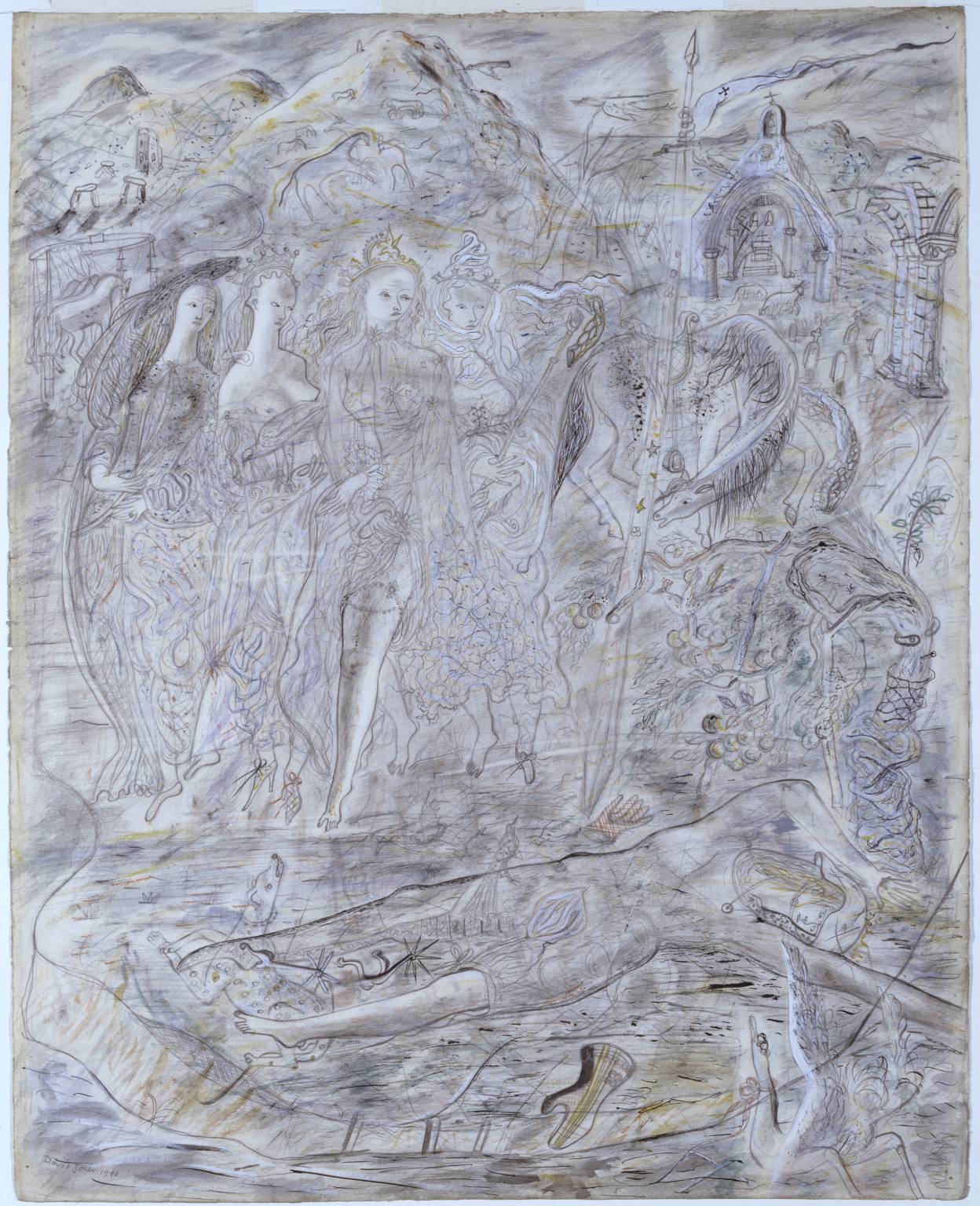
Aphrodite in Aulis 1940–1

*

Aphrodite in Aulis 1940-1 David Jones 1895-1974 Purchased 1976 http://www.tate.org.uk/art/work/T02036

*

After fighting in the First World War, Jones went to art school in 1918. Long enthusiastic about Blake, in 1943 Jones saw Blake’s Body of Abel, shown in this display, much enlarged at a lantern slide lecture. His awareness of Blake’s ‘overwhelmimg’ qualities grew. As a watercolourist, engraver and poet, Jones has obvious affinities with Blake. Aphrodite was drawn during the Second World War. Its Classical and Christian allusions are comparable with Blake’s use of art when commenting on contemporary events. Aphrodite in Aulis fuses Christian and pagan energies, combining redemptive sacrifice with sexual bounty. The Greek goddess of love and fertility, chained to an altar, is flanked by a British and German soldier.

*

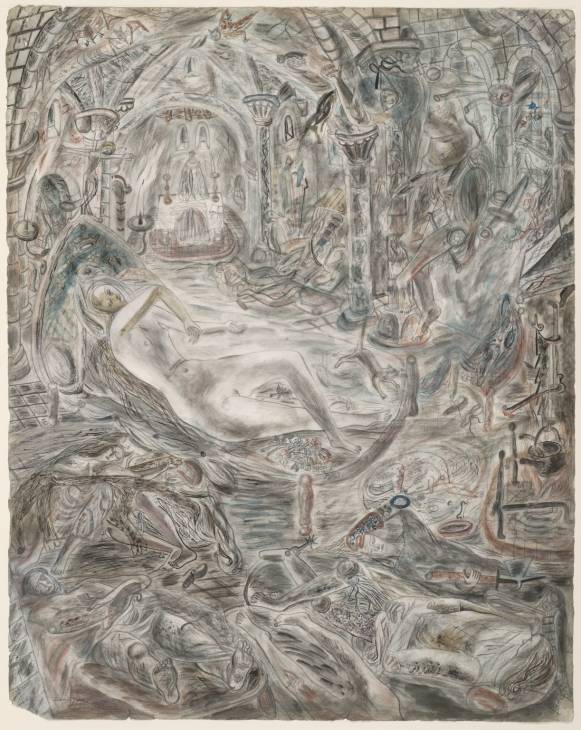
Illustration to the Arthurian Legend: Guenever, 1938–40

*

Illustration to the Arthurian Legend: Guenever 1938-40 David Jones 1895-1974 Purchased 1941 http://www.tate.org.uk/art/work/N05315

*

This drawing, which was done at Sidmouth, is an illustration to an episode in the ‘Book of Sir Launcelot and Queen Guenever’ in Malory’s Le Morte d’Arthur, Bk. XIX, Ch. 6. The artist has described the picture as follows (written statement of October 1958, in part based on a draft by Hugh Macandrew): ‘The traiterous Sir Meliagrance has captured Queen Guenever and her knights, and hearing of her abduction and the wounding and capture of her knights Sir Launcelot comes to her rescue. After being ambushed by the archers of Sir Meliagrance and enduring severe ordeal, shame and mischance Launcelot reaches the castle where the queen and her knights are captive. Meliagrance is in great fear and a kind of truce is arranged by the queen and Launcelot is admitted into the castle. When all are asleep Launcelot takes a ladder and, after breaking the window bars, climbs into the queen’s room.

*

‘The marks on Launcelot’s feet, like stigmata, show that the knight has suffered greatly both in his journey to the castle and also in breaking down the bars. Chrétien de Troyes says that Launcelot “cared not for his wounds in his hands and feet” which inevitably suggests the wounds of the Passion, hence the attitude of the crucified Christ as seen on the Crucifix above the queen’s head is echoed in the movements of Launcelot.

*

‘In this drawing and in “The Four Queens” there are fragments of a chapel and this chapel is in part associated with the ruined chapel of Capel-y-Ffin and in part with the church at Rock in Northumberland which appears in the Tate picture “The Chapel in the Park”. But in this Guenever picture it is seen as the, so to say, “garrison chapel” of the castle, the altar has been made ready for the next morning’s mass, with the mass-vestments laid out on it in the usual manner. In the Chrétien de Troyes version, when Launcelot approaches and leaves the queen’s bed he genuflects to her and the text says he does this “precisely as though he were before a shrine”. I think the association of these ideas may account, in part, for the inclusion of the altar. The St John’s Chapel in the Tower of London was also in mind.

*

‘The men of the garrison of the castle are symbolised by the gun-team asleep with their halberds against the wall on the right, in a recess to the right of the chapel. The figures in the foreground are the queen’s wounded knights and her two maids; everybody is asleep except the little cat which is jumping off the queen’s bed as the wounded feet of Sir Launcelot come forward from the broken window-bars.

*

llustration to the Arthurian Legend: The Four Queens Find Launcelot Sleeping, 1941

*

Illustration to the Arthurian Legend: The Four Queens Find Launcelot Sleeping 1941 David Jones 1895-1974 Purchased 1941 http://www.tate.org.uk/art/work/N05316

*

The stories of King Arthur and his knights had long been of interest to artists and writers as a remnant of a mysterious, lost national past. This drawing illustrates a passage in which Sir Launcelot is abducted by four queens. Launcelot, however, lies dreaming of his love, Queen Guinevere, who appears as a swan. The recumbent figure wears a German helmet and is deliberately reminiscent of the bodies of soldiers that Jones had seen on the battlefields of the 1914–18 war. Thus Medieval themes and styles are used to comment on more recent conflict.

*

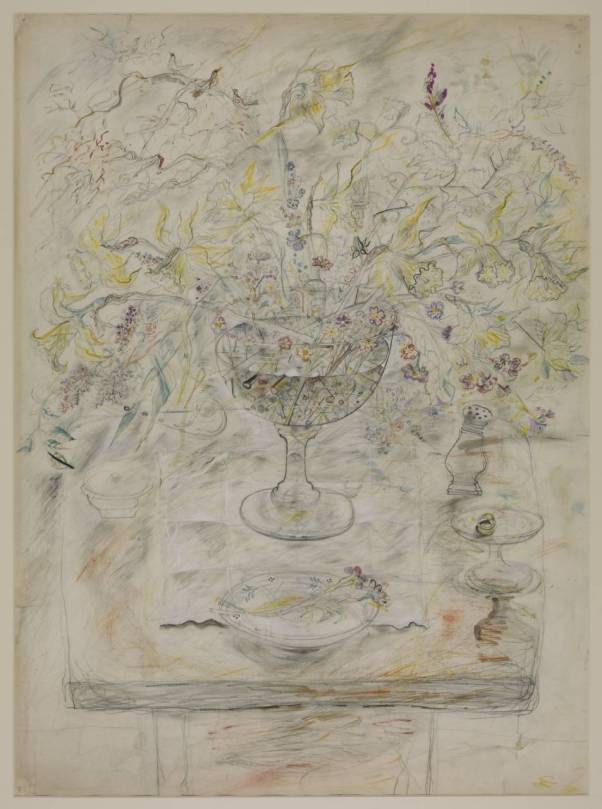
Chalice with Flowers and Pepperpot, c.1954–5

*

Chalice with Flowers and Pepperpot circa 1954-5 David Jones 1895-1974 Purchased 1976 http://www.tate.org.uk/art/work/T02038

*

‘Chalice with Flowers and Pepperpot’ is one of a group of closely related watercolour drawings dating from the latter part of David Jones’s career. All feature a glass goblet or ‘chalice’ of flowers placed centrally on a table with various domestic objects assembled around. Lord Clark (in Agenda, op cit.) has characterised these flower paintings as follows: ‘Some of the finest of David Jones’s recent paintings are not of literary subjects but represent simply a vase of flowers on a table. A pleasant subject, but we are not for long under the illusion that this is an ordinary still life. The vase, broad and capacious like a Byzantine chalice of the 8th century, stands facing us on a plain table. Although no exclusively Christian symbol is visible, we have at once the feeling that this is an altar and that the flowers in some way represent part of the Eucharist. There are wine coloured carnations and ears of corn, thorny stems of roses and blood red petals which drop onto the small white table cloth. Yet none of this is insisted on, and we are far from the closed world of symbolism. Every flower is there for a dozen reasons, visual, iconographical or even on account of its name …’

*

For more David Jones, watch a slideshow of 21 paintings of his at  http://www.bbc.co.uk/arts/yourpaintings/artists/david-jones

and also visit Tate at http://www.tate.org.uk/art/artists/david-jones-1370

Chalices Of Flesh And Bones

“God’s presence sanctifies all. Space and time – the dull and superficial space and time of our daily lives – are sanctified by Christ’s presence. Think of that this Sunday, when your priest comes out of the Altar holding the chalice with the Holy Gifts and calls you to approach Him, Who is ‘our sanctification.’

mull1

Once you have consumed Christ, you are the new chalice, a chalice made of flesh and bones carrying the same Precious, Life-Giving Mysteries. You become a mobile chalice that goes out of the church into the streets and shops and offices of this world. You become a mobile chalice, taking Christ to face His creation, giving this creation the chance to respond to His presence and find itself in Him. …”

By Father Seraphim Aldea, priest of the Monastery of All Celtic Saints on Mull

Read the full post at http://www.mullmonastery.com/monastery-blog/chalices-of-flesh-and-bones/

Listen to Father Seraphim at the Ancient Faith podcast series  “Through a Monk’s Eyes” ‘Looking at the World from the Celtic Shores of Scotland — and Elsewhere’ at http://www.ancientfaith.com/podcasts/monkseyes  Have you ever wondered what the world looks like through a monk’s eyes? Priest-monk Seraphim shares his stories of the places he visits and the people he meets as he travels the world to found the first Orthodox monastery in the Celtic Isles of Scotland in a thousand years. The Monastery is dedicated to All Celtic Saints.

Remove The Sandals From Your Feet

land1

Hurt not the earth, neither the sea, nor the trees.

— Revelation 7:3

trees50

The saints embrace the whole world with their love.

— St. Silouan the Athonite

On the Holy Mountain of Athos, the monks sometimes put up beside the forest paths special signposts, offering encouragement or warning to the pilgrim as he passes. One such notice used to give me particular pleasure. Its message was brief and clear: “Love the trees.”

tree63

Fr. Amphilochios, the geronta or “elder” on the island of Patmos when I first stayed there, would have been in full agreement. “Do you know,” he said, “that God gave us one more commandment, which is not recorded in Scripture? It is the commandment “love the trees.” Whoever does not love trees, so he believed, does not love God. “When you plant a tree,” he insisted, “you plant hope, you plant peace, you plant love, and you will receive God’s blessing.” An ecologist long before ecology had become fashionable, when hearing confessions of the local farmers he used to assign to them a penance, the task of planting a tree. During the long summer drought, he himself went round the island watering the young trees. …

tree11

Fr. Amphilochios was by no means the first spiritual teacher in the modern Greek tradition to recognize the importance of trees. Two centuries earlier, the Athonite monk St. Kosmas the Aetolian, martyred in 1779, used to plant trees as he traveled around Greece on his missionary journeys, and in one of his “prophecies” he stated, “People will remain poor, because they have no love for trees.” We can see that prophecy fulfilled today in all too many parts of the world. …

tree13

“Love the trees.” Why should we do so? Is there indeed a connection between love of trees and love of God? How far is it true that a failure to reverence and honor our natural environment — animals, trees, earth, fire, air, and water — is also, in an immediate and soul-destroying way, a failure to reverence and honor the living God?

tree12

Let us begin with two visions of a tree. Edward Carpenter, in Pagan and Christian Creeds [records] a partial vision of a tree. “It was a beech, standing somewhat isolated, and still leafless in quite early Spring. Suddenly, I was aware of its skyward-reaching arms and up-turned finger-tips, as if some vivid life (or electricity) was streaming through them far into the spaces of heaven, and of its roots plunged in the earth and drawing the same energies from below. The day was quite still and there was no movement in the branches, but in that moment the tree was no longer a separate or separable organism, but a vast being ramifying far into space, sharing and uniting the life of Earth and Sky, and full of amazement.”

tree1              tree2

… Two things above all are noteworthy in Edward Carpenter’s “partial vision.” First, the tree is alive, vibrant with what he calls “energies” or “electricity”; it is “full of most amazing activity.” Second, the tree is cosmic in its dimensions: it is not “a separate or separable organism” but is “vast” and all-embracing in its scope, “ramifying far into space … uniting the life of Earth and Sky.” Here is a vision of joyful wonder, inspired by an underlying sense of mystery. The tree has become a symbol pointing beyond itself, a sacrament that embodies some deep secret at the heart of the universe. The same sense of wonder and mystery — of the symbolic and sacramental character of the world — is strikingly manifest in Peaks and Llamas , the master-work of that spiritual mountaineer, Marco Pallis.

tree61

Yet there are at the same time certain limitations in Carpenter’s tree-vision. The mystery to which the tree points is not spelt out by him in specifically personal terms. He makes no attempt to ascend through the creation to the Creator. …

tree100

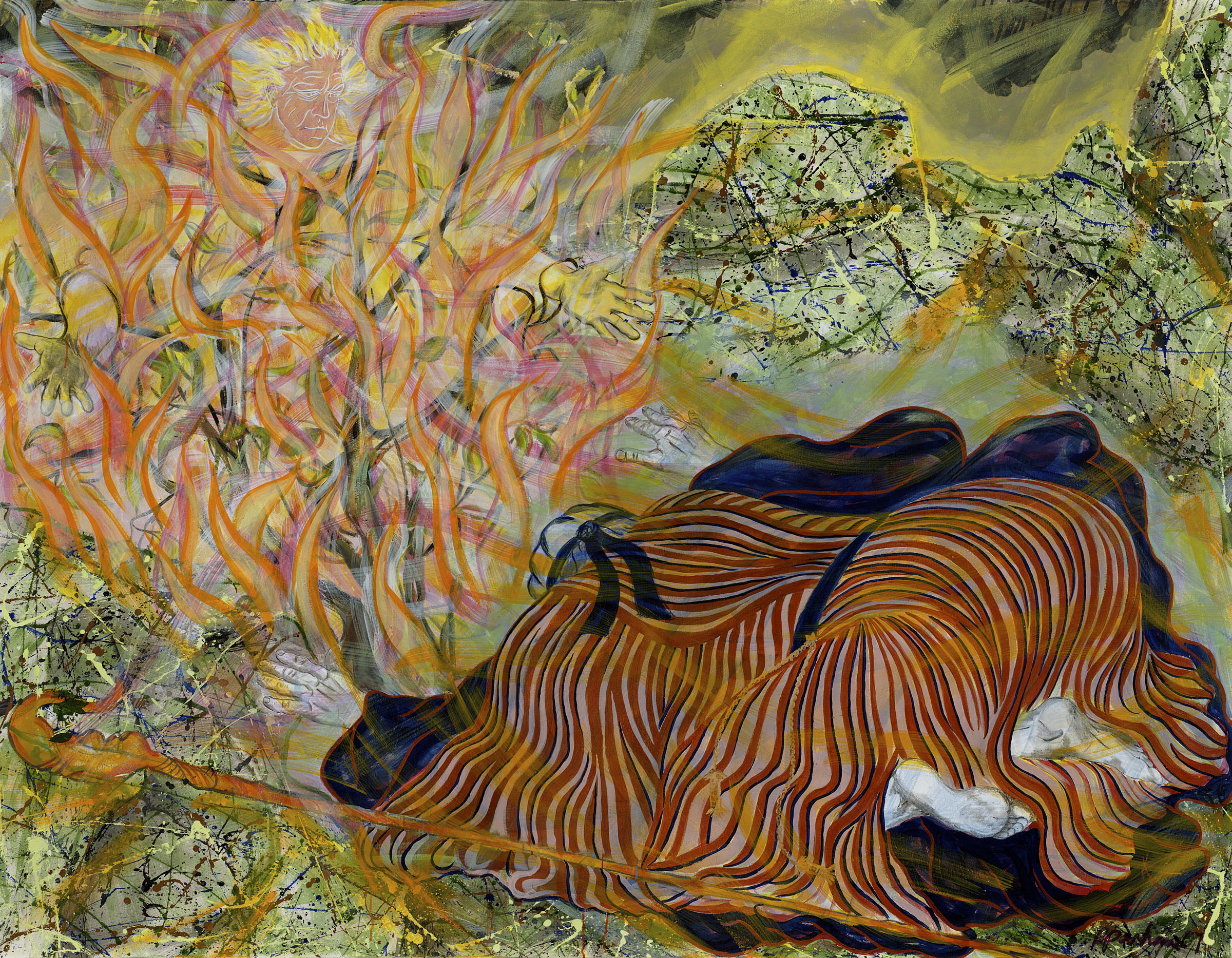
Let us turn to a second tree-vision, which is by contrast explicitly personal and theophanic: “Moses was keeping the flock of his father-in-law Jethro, the priest of Midian; he led his flock beyond the wilderness, and came to Horeb, the mountain of God. There the angel of the Lord appeared to him in a flame of fire out of a bush; he looked, and the bush was blazing, yet it was not consumed. Then Moses said, “I must turn aside and look at this great sight, and see why the bush is not burned up.” When the Lord saw that he had turned aside to see, God called to him out of the bush, “Moses, Moses!” And he said, “Here I am.” Then He said, “Come no closer! Remove the sandals from your feet, for the place on which you are standing is holy ground.” He said further, “I am the God of your Father, the God of Abraham, the God of Isaac, and the God of Jacob.” And Moses hid his face, for he was afraid to look at God.”  (Ex 3:1-6)

tree68

Comparing the experience of Moses with that of Carpenter, we observe three things: in the first place, the vision described in Exodus reaches out beyond the realm of the impersonal. The burning bush at Horeb acts as the locus of an interpersonal encounter, of a meeting face-to-face, of a dialogue between two subjects. God calls out to Moses by name, “Moses, Moses!” and Moses responds, “Here I am.” “Through the creation to the Creator”: in and through the tree he beholds, Moses enters into communion with the living God.

land2

In the second place, God does not only appear to Moses but also issues a practical command to him: “Remove the sandals from your feet.” According to Greek Fathers such as St. Gregory of Nyssa, sandals or shoes — being made from the skins of dead animals — are something lifeless, inert, dead and earthly, and so they symbolize the heaviness, weariness, and mortality that assail our human nature as a result of the Fall.

tree99

“Remove your sandals,” then, may be understood to signify: Strip off from yourself the deadness of familiarity and boredom; free yourself from the lifelessness of the trivial, the mechanical, the repetitive; wake up, open your eyes, cleanse the doors of your perception, look and see! And what, in the third place, happens to us when in this manner we strip off the dead skins of boredom and triviality? At once we realize the truth of God’s next words to Moses: “The place on which you are standing is holy ground.” Set free from spiritual deadness, awakening from sleep, opening our eyes both outwardly and inwardly, we look upon the world around us in a different way.

tree6

So we enter the dimensions of sacred space and sacred time. We discern the great within the small, the extraordinary within the ordinary, “a world in a grain of sand … and eternity in an hour,” to quote Blake once more. This place where I am, this tree, this animal, this person to whom I am speaking, this moment of time through which I am living: each is holy, each is unique and unrepeatable, and each is therefore infinite in value.

tree8

Combining Edward Carpenter’s living tree, uniting earth and heaven and the burning bush of Moses, we can see emerging a precise and distinctive conception of the universe. Nature is sacred. The world is a sacrament of the divine presence, a means of communion with God. The environment consists not in dead matter but in living relationship. The entire cosmos is one vast burning bush, permeated by the fire of divine power and glory. …

*

For more Orthodox ecology of Transfiguration, theophanic transparency, pellucid double vision and Zen ‘haeccitas’, read the full article THROUGH CREATION TO THE CREATOR by Bishop Kallistos of Diokleia

 at http://incommunion.org/2004/12/11/through-creation-to-the-creator/

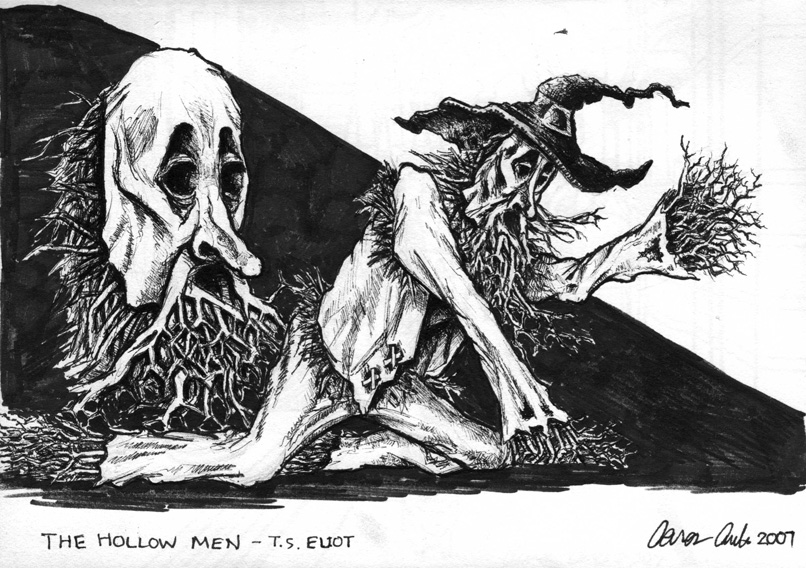
New Martyrs. New Mob. New Hollow Men.

HollowMen

“One of the women looked up and seemed to be almost smiling as she said, ‘Jesus!'” (1)

*

They are the “new martyrs” and sadly, we are the “new mob”, “we are the hollow men”.

*

“I’ve learnt something important from the horrors of the last few weeks. As I pray for the Christians in Mosul, it becomes clear to me that I need their prayers more than they need mine. … I thank God for the humbling gift of allowing me to witness these new martyrs walking on their way to salvation before my very eyes. … We are witnessing the birth of holiness; we are part of a miracle.” (2)

*

The Hollow Men by T. S. Eliot

*

We are the hollow men

… Alas!

Our dried voices, when

We whisper together

Are quiet and meaningless

As …

rats’ feet over broken glass

In our dry cellar…

*

This is the way the world ends
 (3)

Not with a bang but a whimper.

*

Watch Marlon Brando legendary reading of “The Hollow Men” in Francis Ford Coppola’s and Stanley Kubrick’s groundbreaking classic Apocalypse Now (1979) at https://www.youtube.com/watch?v=IPeHO1r8paU and also listen to T. S. Eliot himself reading it in his own unforgettable manner at https://www.youtube.com/watch?v=5fu8awT5Jzs

*

(1) http://www.christiantoday.com/article/isis.executes.12.christiansincluding.boy.and.2.women.who.were.raped.in.public.and.beheadedfor.refusing.to.renounce.jesus/66532.htm

(2) For the full article “NEW MARTYRS. NEW MOB” go to Father Seraphim’s last year blog entry at http://www.mullmonastery.com/uncategorized/new-martyrs-new-mob/, ” still timely, with the ever-rising wave of genocidal persecution of Christians by Muslims.

Church Vertigo

Church-of-St-Vincent-Ferrer

Richard Silver (previously) has a unique way of looking at architecture, building composite photographs from several images that seamlessly reveal a structure’s interior. His new series captures the insides of New York churches … These images are composed of 6-10 shots, forming a vertical panorama so cohesive that it might give you vertigo.

Although Silver has been to hundreds of churches during his career and many years of travel, it’s only recently that he figured out how to capture the expansive inner beauty of their architecture. “Finding the perfect location in the center aisle then shooting vertically from the pew to the back of the church gives the perspective that only architecture of this style can portray,” says Silver.

church-2
Church of St. Stephen / Church of St. Paul the Apostle

Silver was born and raised in New York and has visited 75 countries in his life, including 13 last year alone. His previous careers involved computer science, real estate, and a stint on Wall Street, but he embraced photography full-time in 2011. You can see more of his vertical church series on his Flickr page here.

Calvary-Episcopal-Church
Calvary Episcopal Church

church-4
Serbian Orthodox Cathedral of St. Sava / Church of the Village

Church-of-St.-Francis-Xavier
Church of St. Francis Xavier

church-6
Vincent St. de Paul / Most Holy Redeemer Church

St-Monica's-Church
St. Monica’s Church

Source: “Vertical Panoramic Photographs of New York Churches by Richard Silver” Colossal http://www.thisiscolossal.com/2015/09/vertical-panoramic-churches/

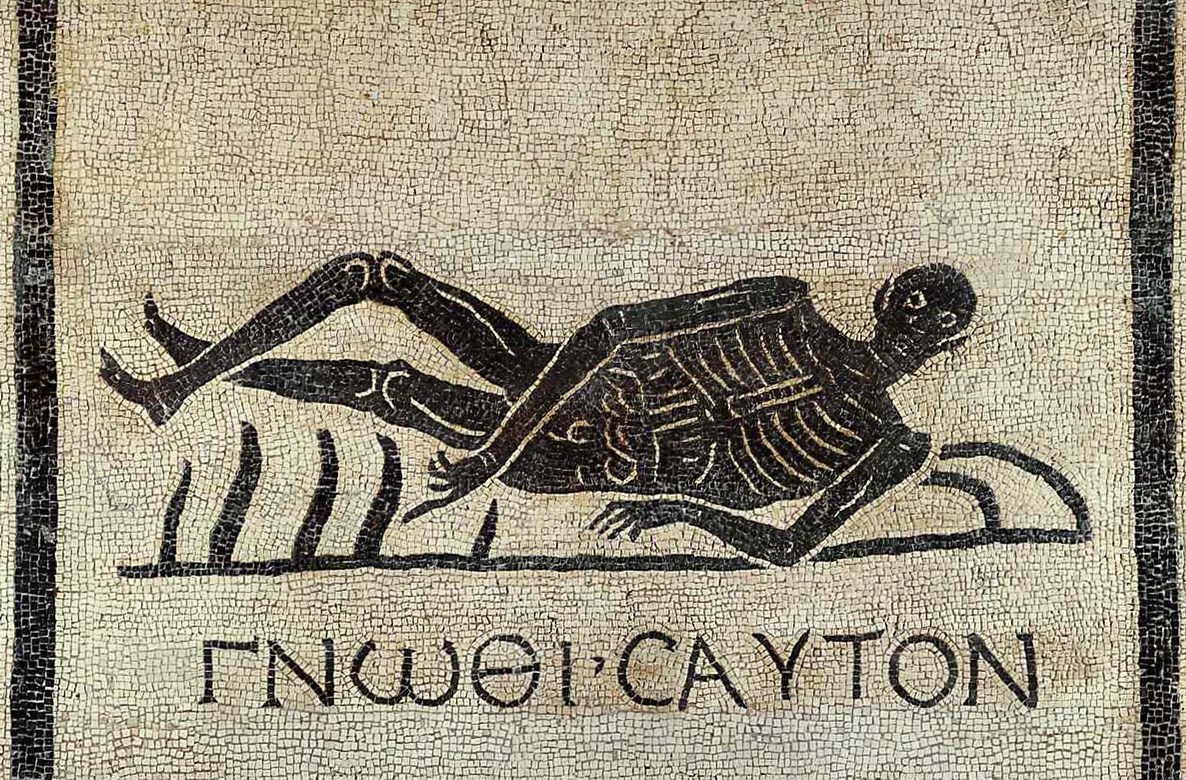
Temet Nosce

know-thyself

Legion

Lord, hear my voice, my present voice I mean,
Not that which may be speaking an hour hence
(For I am Legion) in an opposite sense,
And not by show of hands decide between
The multiple factions which my state has seen
Or will see. Condescend to the pretence
That what speaks now is I; in its defence
Dissolve my parliament and intervene.
*
Thou wilt not, though we asked it, quite recall
Free will once given. Yet to this moment’s choice
Give unfair weight. Hold me to this. Oh strain
A point – use legal fictions; for if all
My quarrelling selves must bear an equal voice,
Farewell, thou has created me in vain.

*

“And He asked him, What is thy name? And he answered, saying, My name is Legion: for we are many.” Mark 5:9 (KJB)

*

*

As the Ruin Falls

All this is flashy rhetoric about loving you.
I never had a selfless thought since I was born.
I am mercenary and self-seeking through and through:
I want God, you, all friends, merely to serve my turn.
*
Peace, re-assurance, pleasure, are the goals I seek,
I cannot crawl one inch outside my proper skin:
I talk of love –a scholar’s parrot may talk Greek–
But, self-imprisoned, always end where I begin.
*
Only that now you have taught me (but how late) my lack.
I see the chasm. And everything you are was making
My heart into a bridge by which I might get back
From exile, and grow man. And now the bridge is breaking.
*
For this I bless you as the ruin falls. The pains
You give me are more precious than all other gains.

*

“Selfishness cries to Thee: My Father! But Love cries: Our Father!” — St. Nikolai Velimirovic

Draganescu Sistine Chapel

boca12

boca9   

   boca4 

 boca16

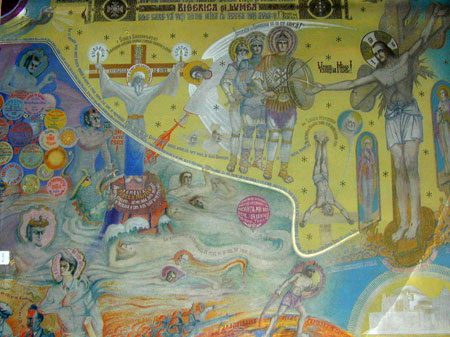
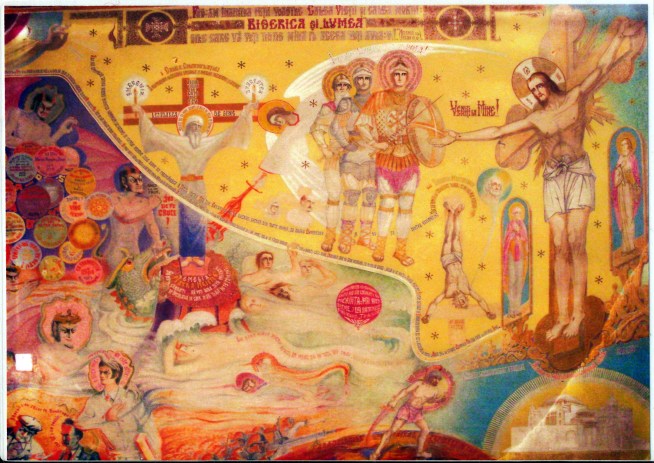
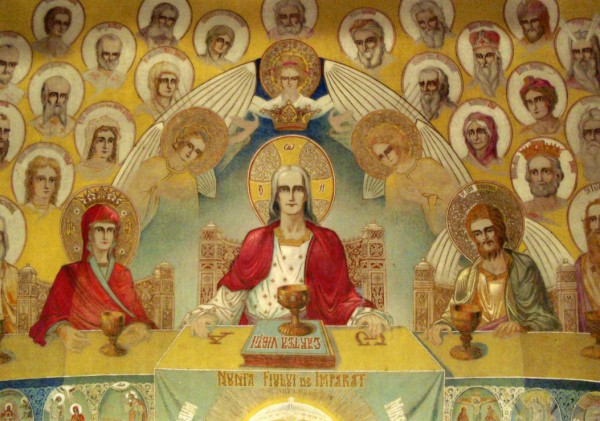
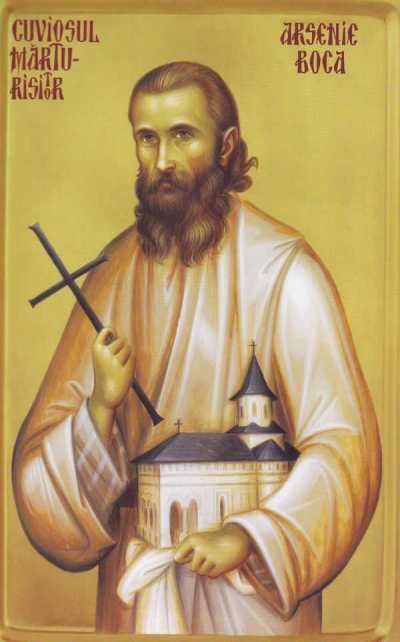
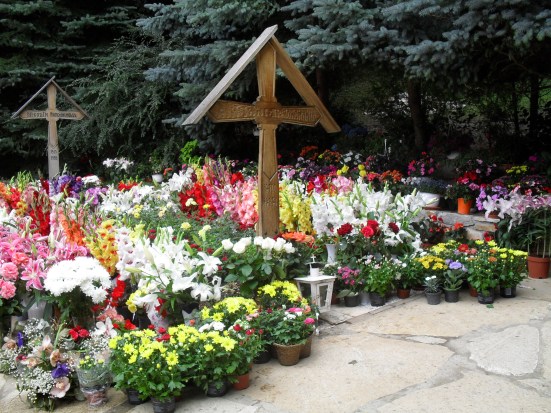
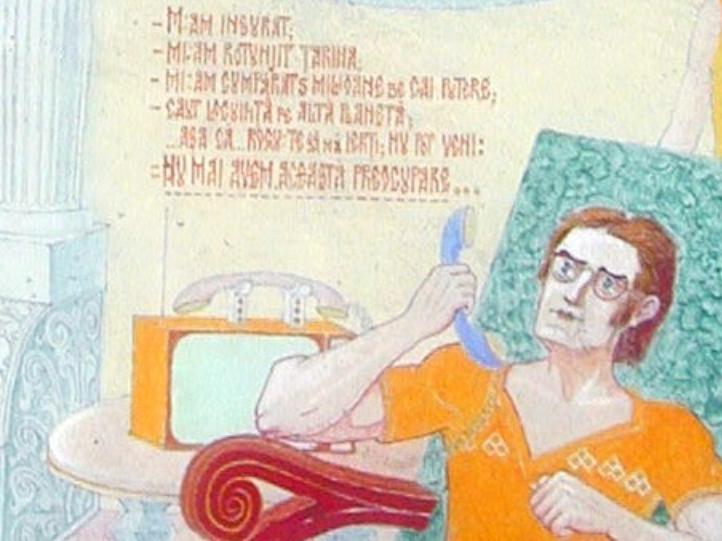
The Romanian Orthodox Church is considering a Romanian monk persecuted by the communists and known as the “saint of Transylvania” for sainthood. … Boca, who became a monk in 1940, was harassed by the Securitate secret police, detained and did forced labor on the Black Sea Canal, a notorious labor camp where tens of thousands of political prisoners worked in the 1950s. In 1959, he was banned from leading worship and the Prislop monastery, where he is now buried, was converted into a retirement home. He was forced to retire from the church in 1968 and spent 15 years painting religious images and icons in the small church of Draganescu in southern Romania. The church’s interiors are now considered among the most beautiful in the country. Elder Arsenie Boca reposed in the Lord in early 1989, a month before Romania’s anti-communist revolt, aged 79. Though he is not yet canonized, Elder Arsenie’s grave, located in Prislop Monastery, is visited by tens of thousands of pilgrims every year, where many miracles occur. One miracle which everyone can see is that the flowers over his grave never die or wither , neither in the hot summer or the frigid winter.

st arsenie boca 

 arsenie3

For his amazing life, the  documentary “Fr. Arsenie Boca – Man of God” is a MUST.  “His colleagues at the Theological Academy of Sibiu named him ‘The Saint’, he is considered a founding father of the Romanian Philokalia by father Dumitru Staniloaie, who thought of him as an unparalleled phenomenon of Romanian monasticism.

*
Sought after and followed by thousands of believers eager to quench their spiritual thirst from his inexhaustible spring of serenity; legendary for his prophesying and healing gifts, painter of souls and painter of churches, man of culture, philosopher of sciences and religion, father Arsenie Boca was, just like Saint Basil as depicted by him in his essential work The Path of the Kingdom.

*

A disciple calmly walking across the stormy seas, an unmoving pillar against the troubled waves, a man among people, providing guidance and strength with otherworldly serenity, unflinching in the belief that God alone is ruler of our world. An unequaled personality, a magnet for thousands of people in all walks of life, and also a target for suspicion for the authorities of his day, who failed to understand the source of his exceptional power to gather people around him.” 

*

As one person interviewed in this documentary says: “Fr. Arsenie made Christ transparent to us.” He still does. His presence in the midst of us after his passing is a reminder of the proximity of Heaven. This film is an opportunity to (re)discover it for ourselves. https://www.youtube.com/watch?v=ptbTap5NHqw

 boca8  

 boca27

  boca15      

*

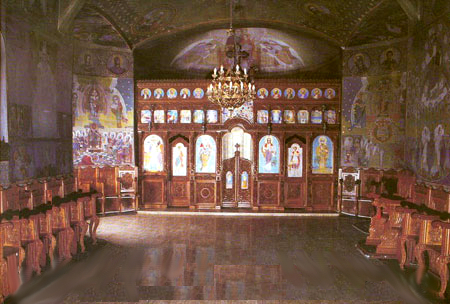
The Sistine Chapel of the Romanians: the Draganescu Church

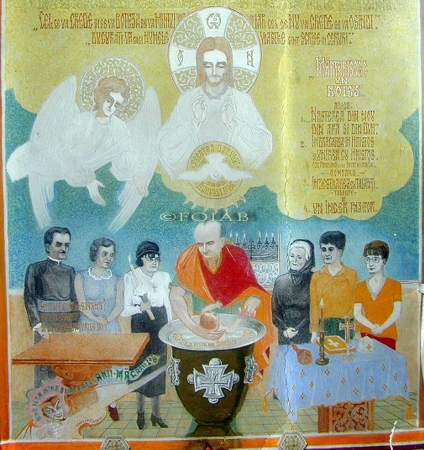
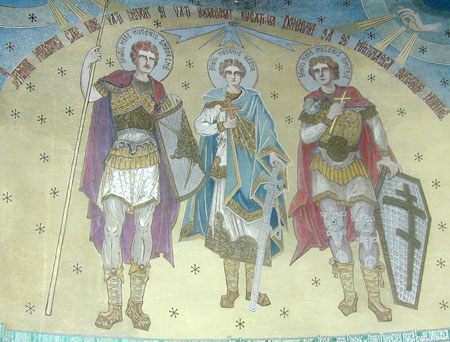
Father Arsenie Boca lived in Draganescu for 20 years and in 1968 he began painting the parish church, a work that took him more than 15 years. As he wasn’t allowed to celebrate service, some of the priests who visited the church over the years claim that Arsenie Boca has actually painted the sermons he delivered at Sambata de Sus.

*

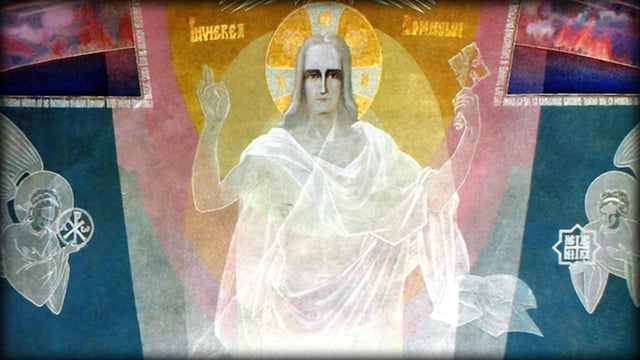
Rainbow colors reverberating in frescoes, light flowing from Christ’s Resurrection, Heaven trickling down through the painting brush, that’s the way the murals painted by Orthodoxy beacon Arsenie Boca at the “St. Nicholas” Church of the Draganescu town – Giurgiu County can be translated and rendered into metaphor. …

 boca6 

 boca7

boca22 

 boca13

Prophetic Artist in Shackles

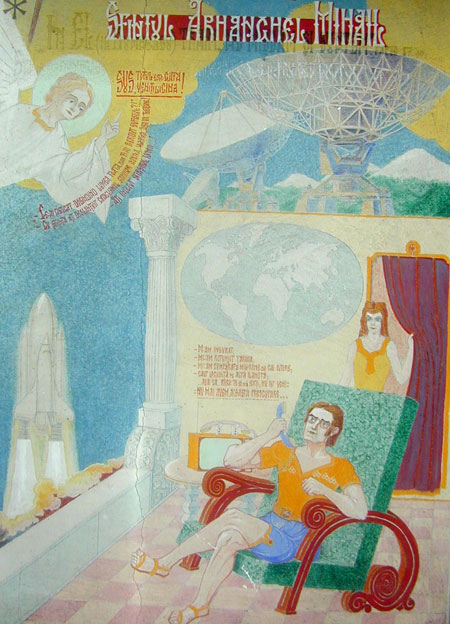
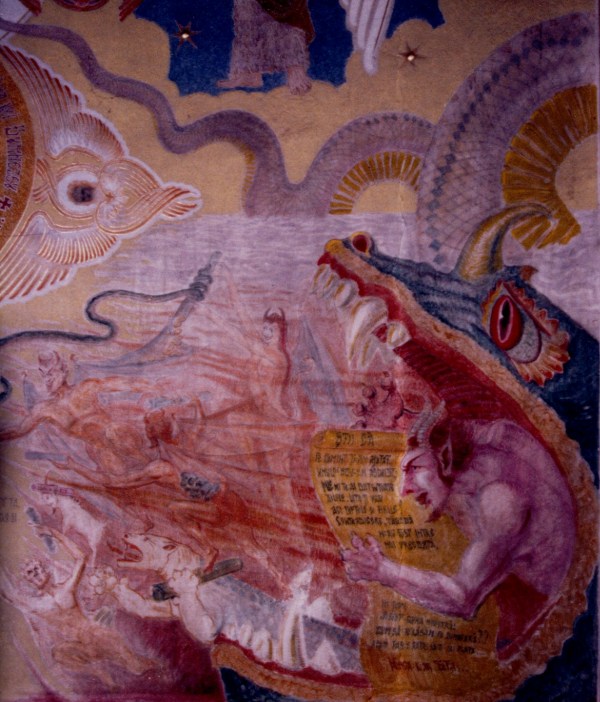
His frescoes are diaphanous, and the images are accompanied by metaphors referring to people’s weaknesses and sins, by aphorisms, quotations from the Holy Scripture, sometimes by teachings of the Father and biblical scenes: the Resurrection, a picture of hell, the Group of the Righteous. The paintings are said to have a visionary, prophetic content, as it is known that Father Arsenie Boca had the gift of spiritual far-sight: one of the scenes, two tall buildings engulfed in flames, is said to allude to the 9/11 attack on the Twin Towers, not to mention those where items like a cell phone, a space shuttle, satellite dishes, all unusual things in that period, appear.

boca14

boca2

For his paintings, the art documentary “Picturi ale pr. Arsenie Boca pe biserica din Drăgănescu” at https://vimeo.com/82791105 is a MUST. Also, go to http://www.themidlandhostel.com/the-sistine-chapel-of-the-romanians-the-draganescu-church/ and http://www.agerpres.ro/engleza-destinatie-romania/2014/11/22/destination-romania-the-draganescu-church-swathed-in-father-arsenie-boca-s-prophetic-paintings-18-04-37 and watch a short art film “Father Arsenie Boca, one of Romania greatest Saint”  at https://www.youtube.com/watch?v=5r6ZX8M8vwY

boca23

boca11   

 boca5

Morning prayer by Arsenie Boca
Lord Jesus Christ, help me let go of myself today, as I can create great problems from small and insignificant issues, and this way, caring for myself, I will lose You.

*
Lord Jesus Christ, help me so that the prayer of Your Holy name will wander (work) through my mind more than lightning on the sky, so that I stay clear of even the shadow of bad thoughts as, look, I am sinning every minute.
*
Lord, coming secretly amongst people, have mercy upon us, because we stumble as we are walking in the dark. Our temptations are closing the eyes of our mind, forgetfulness has become like a wall amongst us, turning our hearts to stone and all together have made the prison cell in which we keep You crippled, starving and naked, wasting our days.
*

Lord, coming secretly amongst people, have mercy upon us and set fire to this prison cell, light up the love in our hearts, burn the thorns of our temptations and make our souls bright.

*

Lord, coming secretly amongst people, have mercy upon us, come and live within us, together with the Father and the Holy Spirit. The Holy Spirit prays through us with unspoken sighs, when word and mind don’t have the power.

*
Lord, coming secretly amongst people, have mercy upon us, because we don’t realise how imperfect we are and how close You are to our souls; and how distant we become through our sins. Shine Your light over us, so that we see light through Your eyes and live eternally through Your life. Our light and joy, praise be to You!

Amen!

 *

Bending in the Archer’s Hand

Poetry, Theology, Videos: Orthodox Worship, Conception and the Personhood of the Unborn 

gibran-arrow

Your children are not your children.
They are the sons and daughters of Life’s longing for itself.
They come through you but not from you,
And though they are with you yet they belong not to you.

You may give them your love but not your thoughts,
For they have their own thoughts.
You may house their bodies but not their souls,
For their souls dwell in the house of tomorrow,
which you cannot visit, not even in your dreams.
You may strive to be like them,
but seek not to make them like you.
For life goes not backward nor tarries with yesterday.

You are the bows from which your children
as living arrows are sent forth.
The archer sees the mark upon the path of the infinite,
and He bends you with His might
that His arrows may go swift and far.
Let your bending in the archer’s hand be for gladness;
For even as He loves the arrow that flies,
so He loves also the bow that is stable.

Kahlil Gibran – The Prophet

*

“Before I formed you in the womb I knew you” Jeremiah 1:5

“Your eyes saw my unformed substance” Psalm 139:16

*

Orthodox Worship, Conception and the Personhood of the Unborn 

“If we turn to the Festal cycle, the consciousness of the personhood of the unborn is strikingly manifest especially in three important Feasts: The first is the Feast of the Conception of John the Baptist (September 23) in which we sing: “Rejoice, O barren one, who had not given birth; for behold you have clearly conceived the one who was about to illuminate the whole universe, blighted by blindness. Shout in joy, O Zacharias, crying in favor; truly the one to be born is a prophet of the High!” John the Baptist existed as a human being and a part of God’s plan of salvation from the moment of his conception.

The second is the Conception of the Theotokos (December 9). Here the vesperal hymn proclaims: “Behold the promises of the Prophets are realized for the  Holy Mountain is planted in the womb, the Divine Ladder is set up, the great Throne of the King is ready, the place for the passage of the Lord is prepared . . .” It is notable that both Elizabeth and Anna were advanced in years and barren. Thus they were considered “cursed” in the Jewish tradition where children were a sign of God’s blessing. (Consider that mind-set with our own of today and how God’s Plan is being affected by the hundreds of millions who will never participate in it.)

*

The quintessential Feast illustrating the Church’s belief of the importance of human beings from the moment of conception is the Annunciation (March 25) which is so important that a Divine Liturgy must be served even when it falls on Great and Holy Friday! The Annunciation Troparion makes a most profound statement:

“Today is the beginning of our salvation, the revelation of the eternal mystery! The Son of God becomes the Son of the Virgin as Gabriel announces the coming of grace…” 

*

  This is a far cry from the “pro-choice” rhetoric of “Who knows when life begins?” or the degradation of the unborn by calling him a “blob of tissue” and a “product of conception.”

*

Can any Christian seriously propose that Jesus Christ was ever a “blob” or an appendage of the Theotokos’s body?

*

At the Great Compline the hymnography makes this astonishing claim: “…O marvel! God has come among men; He who cannot be contained in a womb; the timeless One enters time…For God empties Himself, takes flesh, and is fashioned as a creature, when the angel tells the pure Virgin of her conception…” This is not sung at the feast of our Lord’s Nativity but at His conception!!! Such concepts as “viability” and “quickening” are utterly withoutmeaning and irrelevant.

 *


Scripture and the Unborn 

In the New Testament, consciousness of the personhood of the unborn is clearly manifested. The same word – brephos – is used for the child in the womb as out of the womb unlike modern medical and scientific distinctions of “zygote,” “embryo,” “fetus“ etc. used to differentiate among the stages of pre-natal life. The Latin word “fetus” simply means “little one” and was never intended as a means of denying humanity to the child dwelling in his mother’s womb. A similar pattern of language occurs in the Old Testament as in the book of Job 3:16 in which he refers to: “Infants [gohlal] which never saw the light.” 

*

In Luke 1:41 we find another astonishing image of the scriptural consciousness of the personhood of the unborn: “And when Elizabeth heard the greeting of Mary, the babe leaped in her womb” Here, the unborn John the Baptist recognizes and rejoices at the unborn Messiah – a “fetus” greeting a “fetus.” This is not just a “literary device” as some would insist. It illustrates the narrator’s consciousness of the already existing personality – and Divine calling – of an unborn human being. We do celebrate the birth of John the Baptist, the Theotokos, and the Lord Jesus Himself, but we also celebrate their conception – their entry into time and the physical world – the “fulness of time” as it is called by St. Paul.

*

A more profound point to this all is that these feasts, especially the Annunciation, point to the Incarnation. By Jesus Christ taking on our humanity from the moment of conception, existing in the pre-natal condition in the womb of the Theotokos, experiencing birth, living through infancy to adulthood, and finally physical death, God sanctified every moment of human existence – from conception to death.

*

There is more to this – God also completely identifies with us in our fallen suffering nature, and by dying for us on the cross, He expresses His solidarity with us: whether we are a zygote, embryo, fetus, infant, child, adolescent, adult, or elderly: human existence is a continuum from conception, and – yes – beyond death to life eternal in the Lord! Read the rest of the article at “Abortion: An Orthodox Christian Perspective on the Sanctity of Human Life” by Rev. Deacon John Protopapas at https://orthodoxword.wordpress.com/2011/01/29/abortion-an-orthodox-christian-perspective-on-the-sanctity-of-human-life/

*

“Science Does TOO Know When “Human Life” Begins”. Read more at http://www.nationalreview.com/human-exceptionalism

*

Watch a disturbing undercover investigative video by Live Action, “What is Human?”, which  probes America’s late-term abortion industry, and reveals chilling admissions from abortionists on the humanity of children in the womb, at https://www.lifesitenews.com/pulse/this-viral-video-is-changing-countless-minds-about-abortion

*
Watch a very disturbing undercover video which catches planned parenthood selling “uterine contents” (ie. one unborn baby plus placenta and amniotic fluid –> aborted baby body parts), while casually sipping wine and eating salad at a ‘business’ lunch: http://www.pravoslavie.ru/english/80682.htm

*

Watch a new, shocking video: Planned Parenthood abortionist–between sips- jokes about harvesting baby’s brains, getting ‘intact’ head at https://www.lifesitenews.com/news/tearing-off-a-babys-head-intact-is-something-to-strive-for-planned-parentho 

*

“Hooverized” is a California High School Expression for an abortion

As for “Reproductive Justice”,  there is absolutely nothing ‘just’ about abortion!

Check more Pro-Choice Euphemisms at http://gerardnadal.com/2010/05/31/how-many-pro-choice-euphemisms-can-you-list/

orthodoxword's avatarOrthodoxWord

Abortion: An Orthodox Christian Perspective on the Sanctity of Human Life 


Reflection:

Each human being is unique creation of God. Each one of us has never been before and will never be again – throughout all eternity each human being who is, has, and will be conceived is unique.


By Rev. Deacon John Protopapas, Executive Director,Orthodox Christians for Life 


Overview

  The Orthodox Church regards abortion as premeditated murder. As such, She strongly opposes it because God demands the protection of all innocent human life, including that of the unborn child. The humanity (personhood) of that child exists from conception, a scientific fact that has always been recognized and unquestioned in Orthodox theology from the very beginning. Indeed, conception and not birth is the moment of the union of soul and body.

  The Early Church – of which the Orthodox Church is a…

View original post 4,528 more words

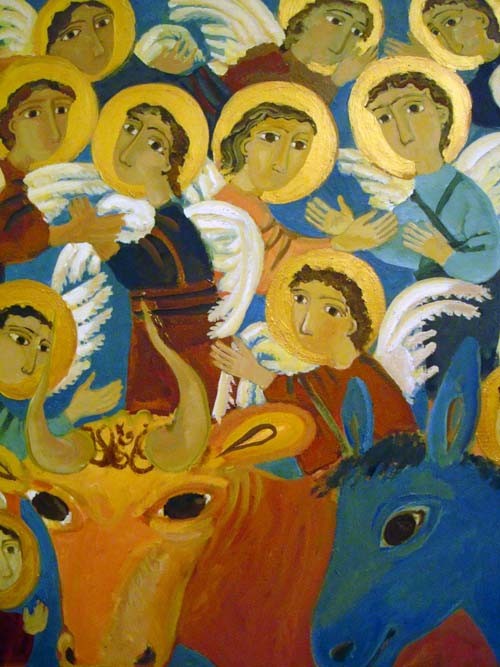
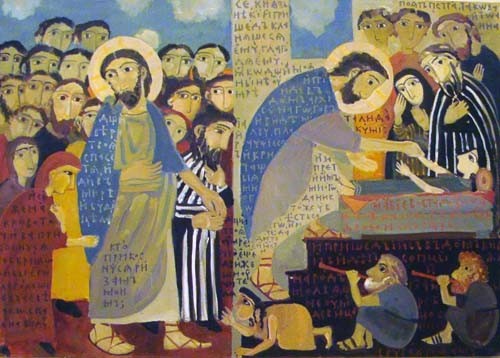
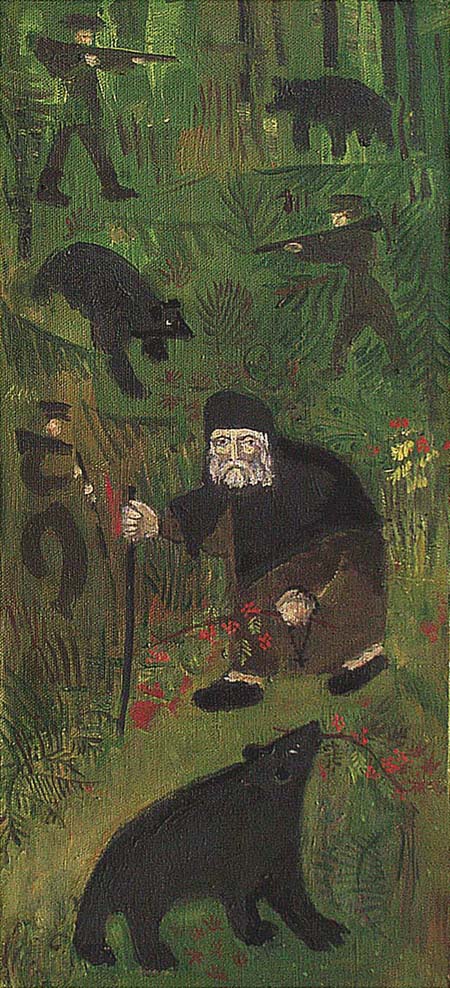
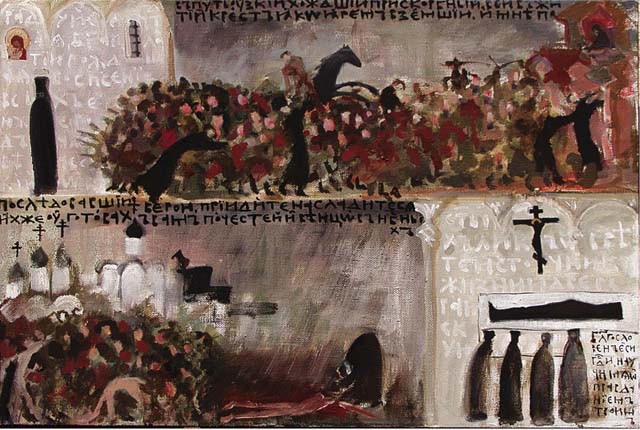
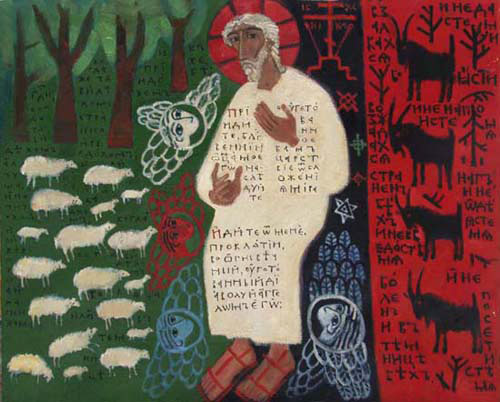
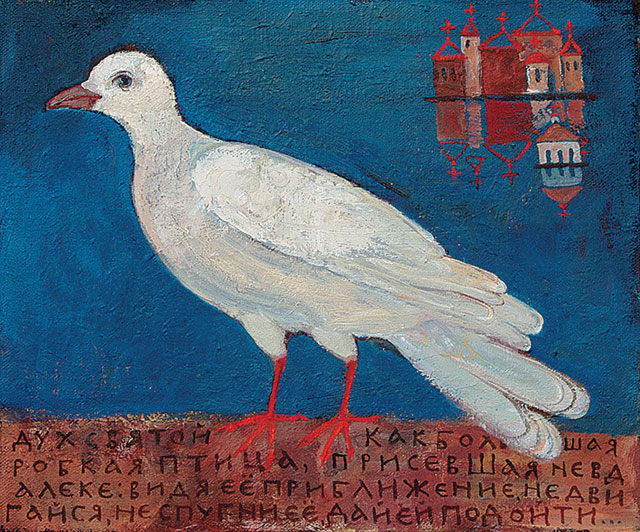
Through the Eyes of a Child

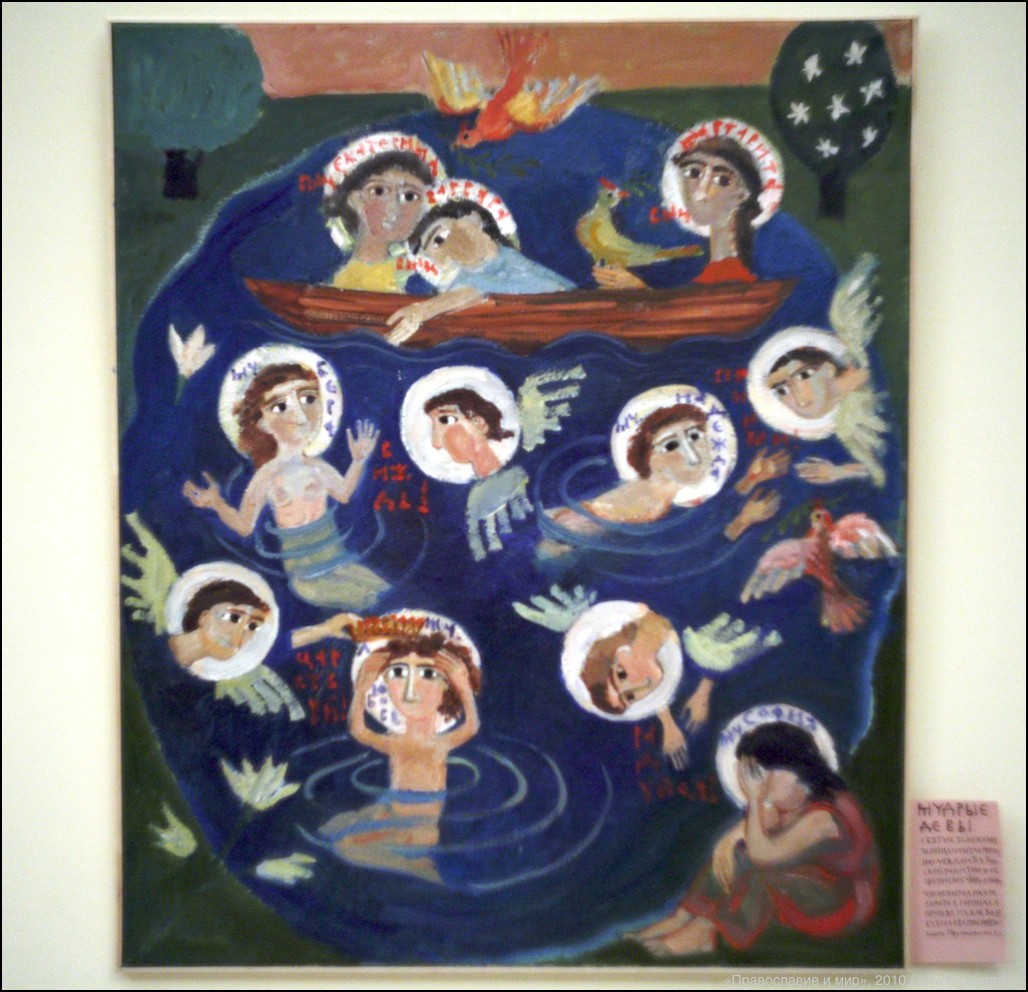
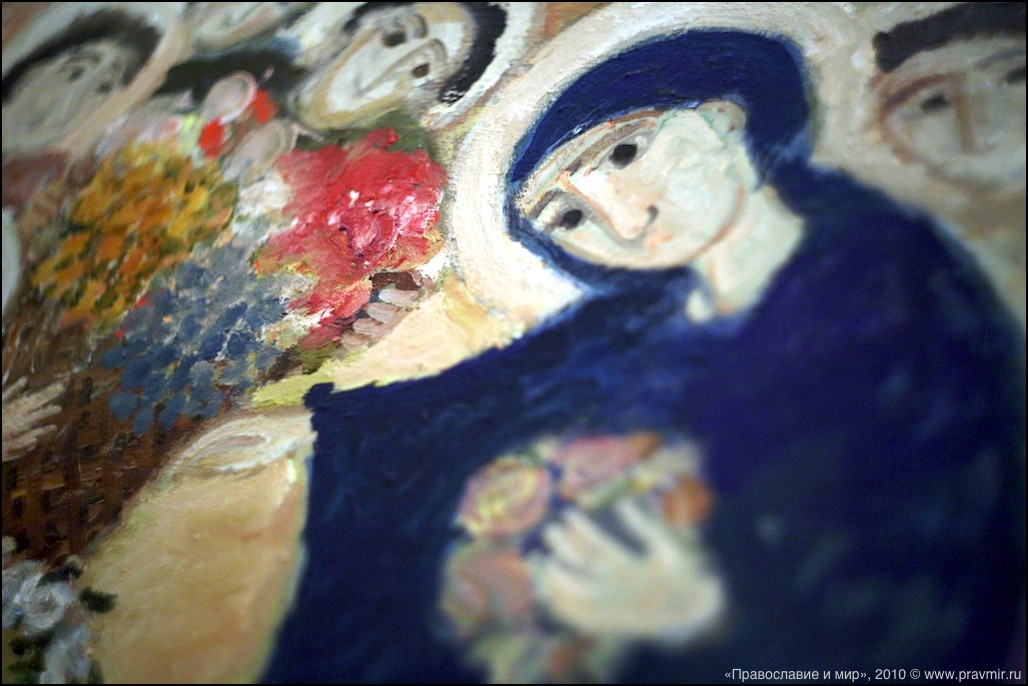
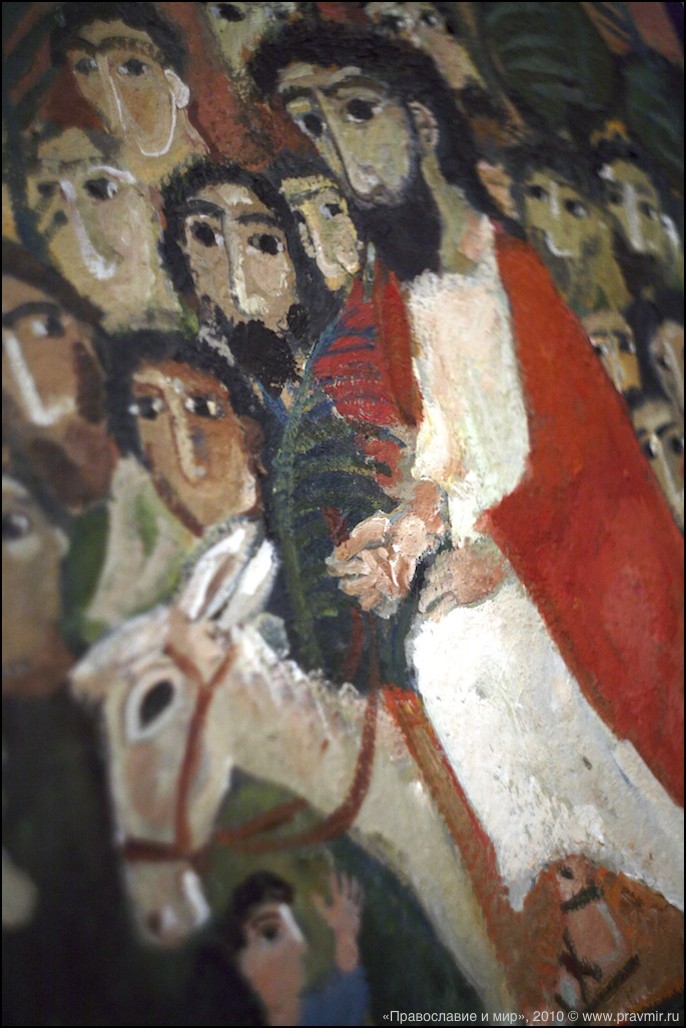
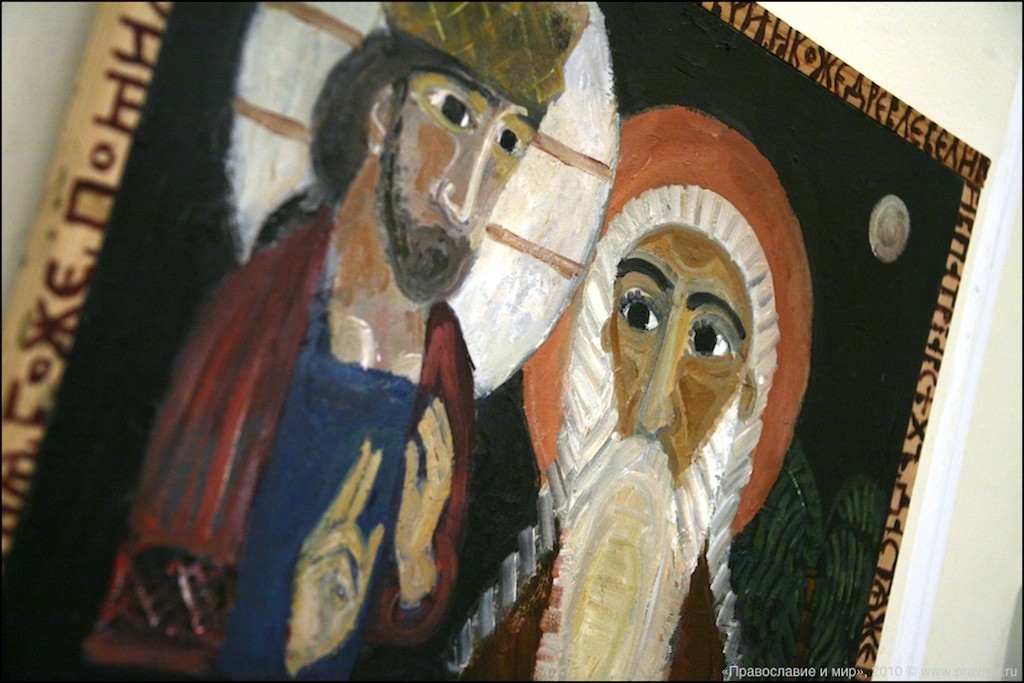
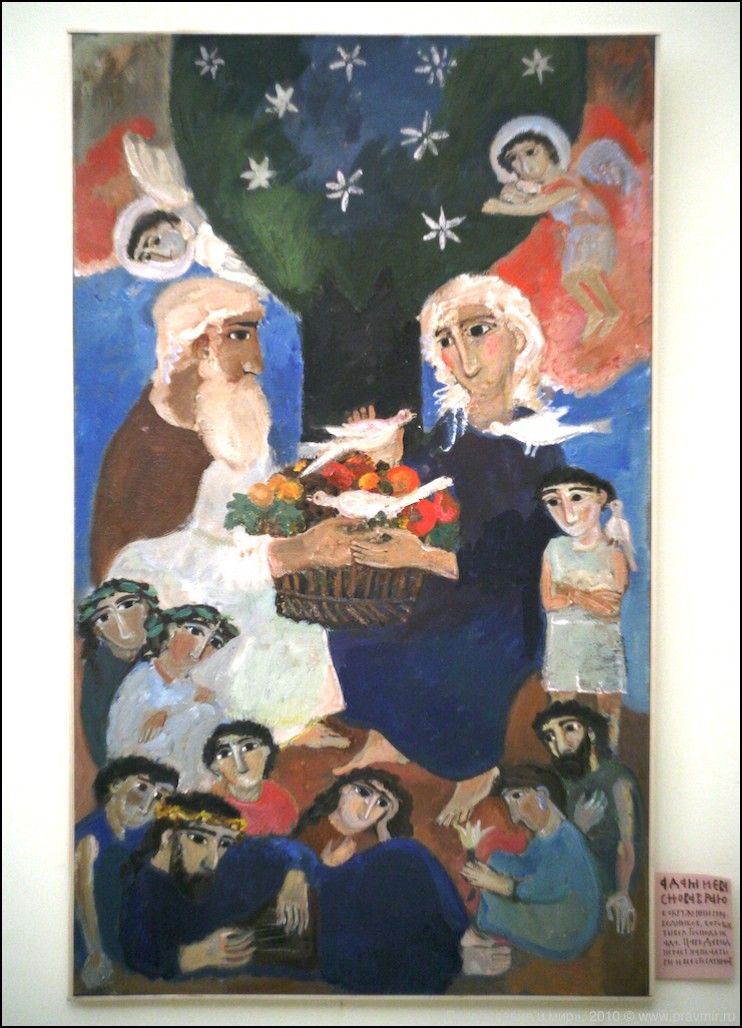
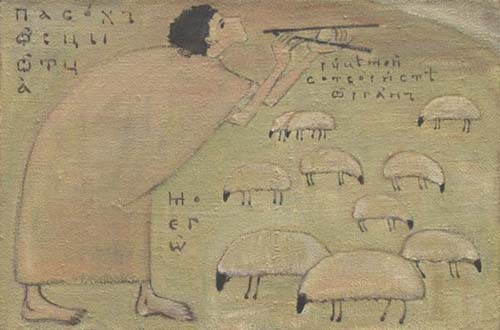
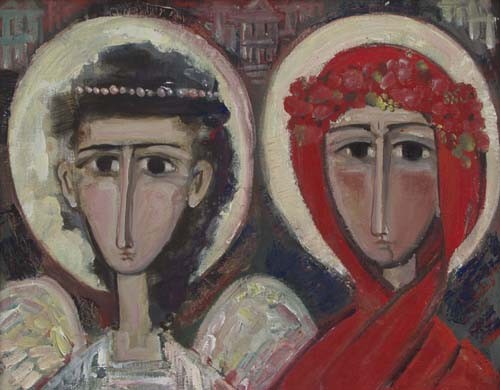
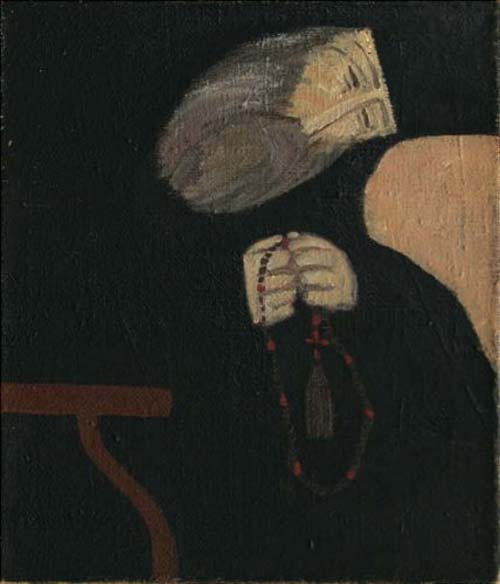
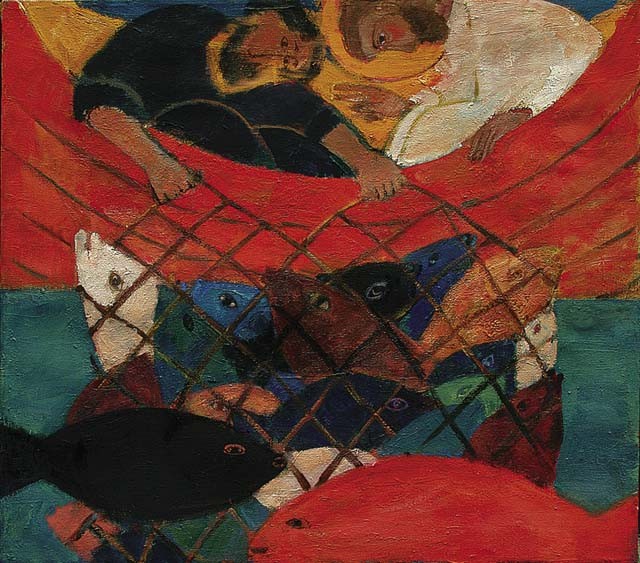
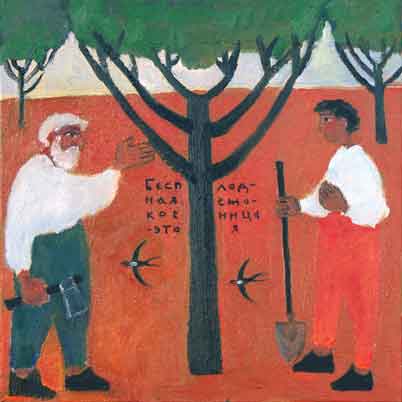
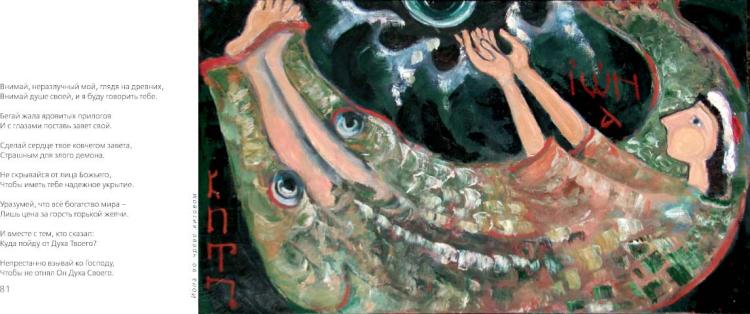
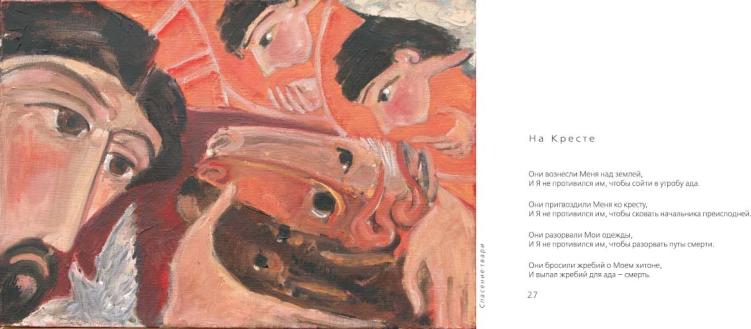
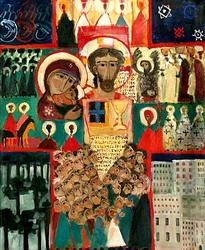
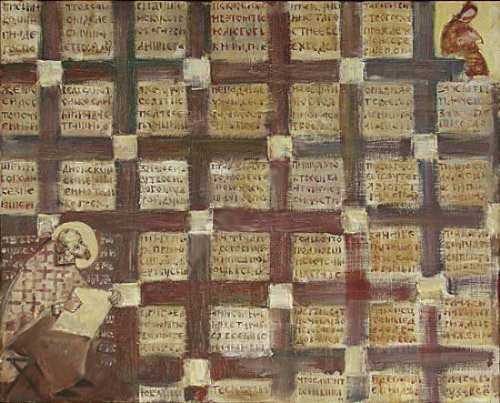
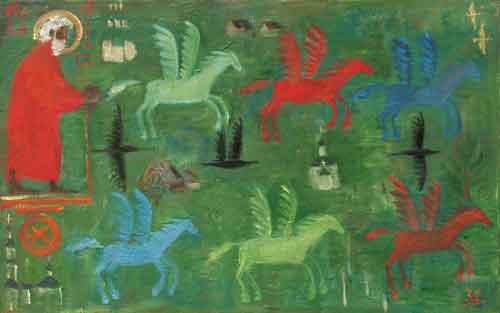
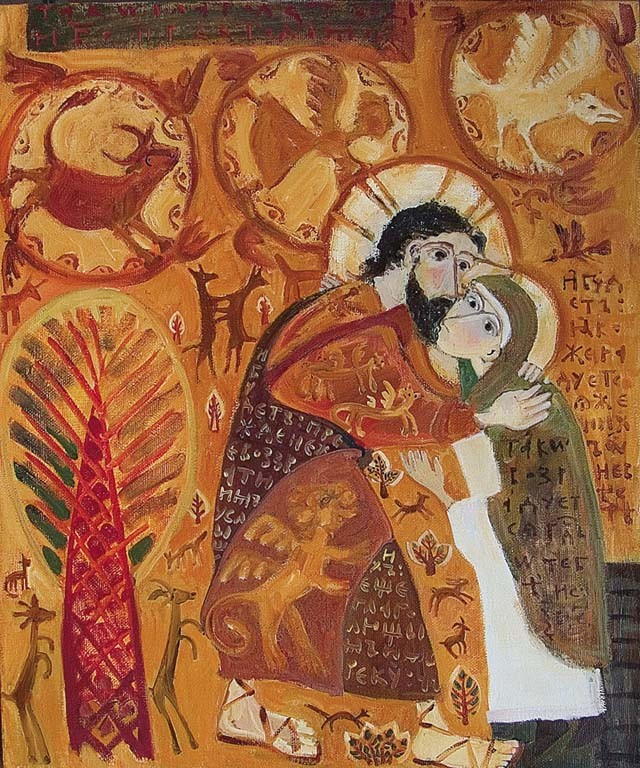
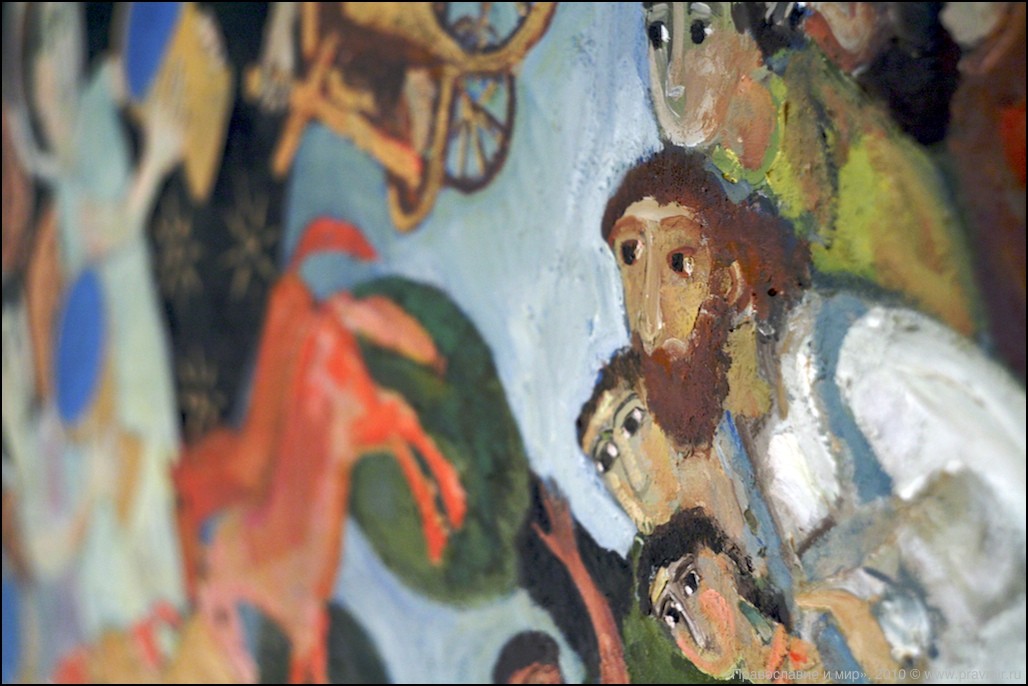
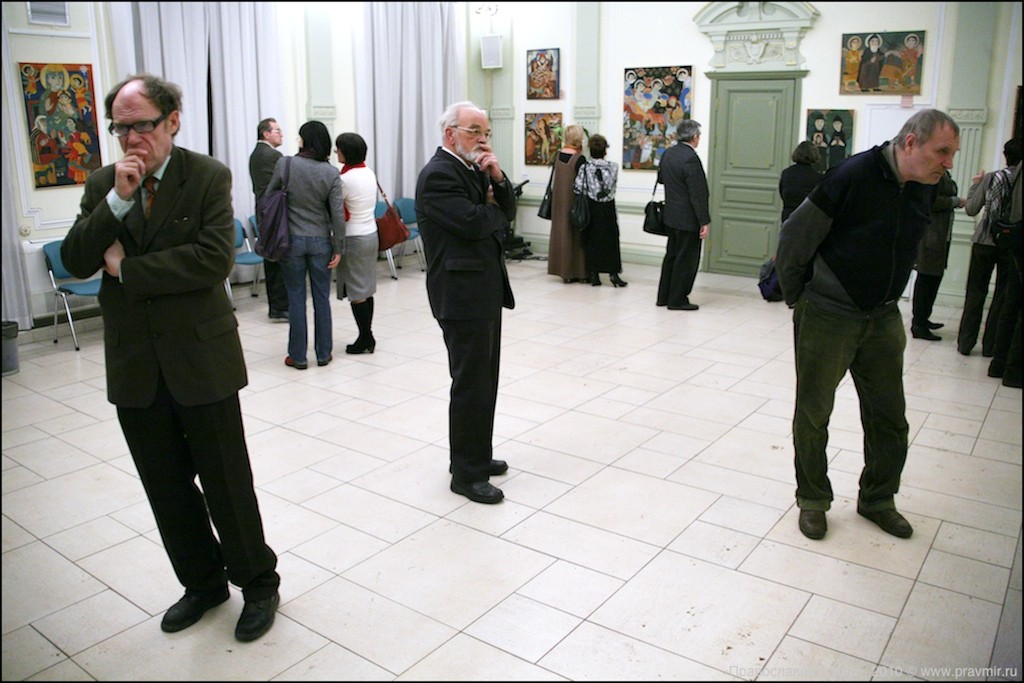
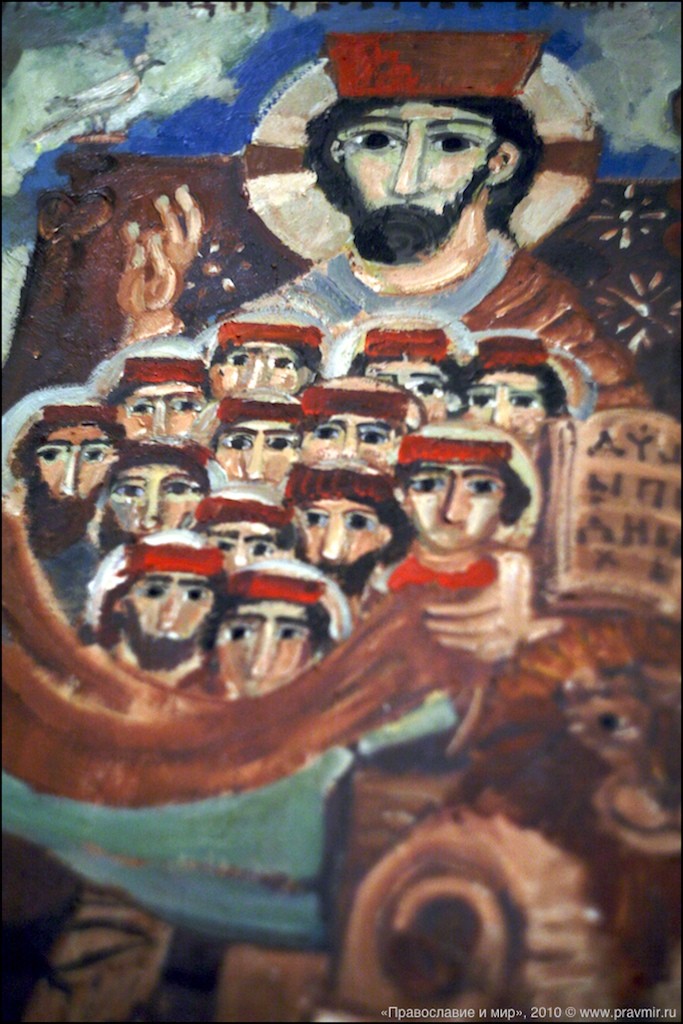
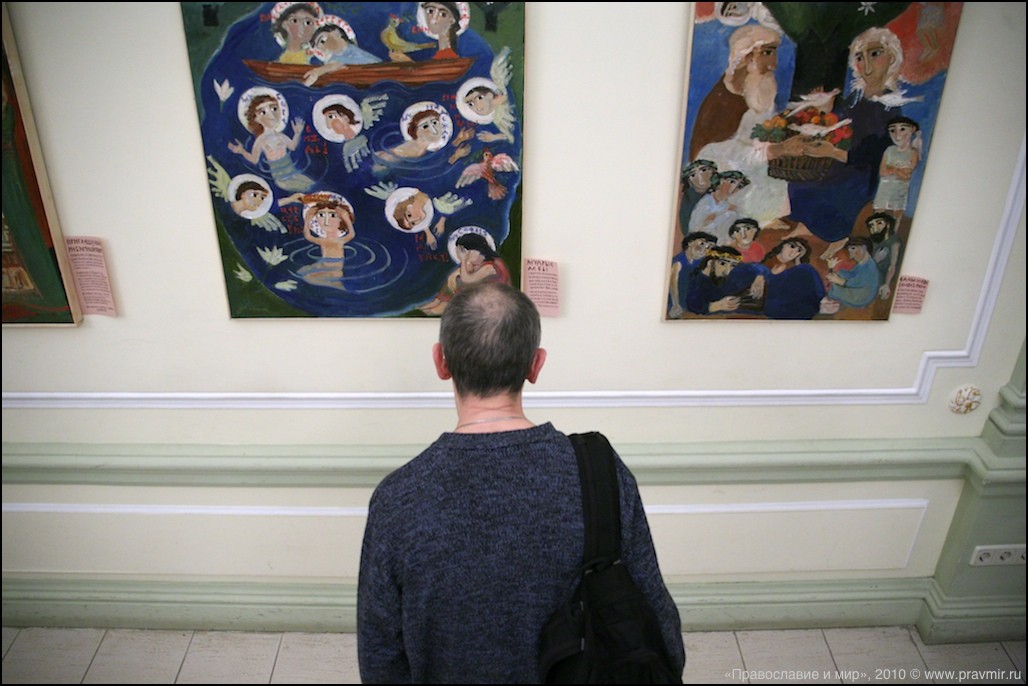
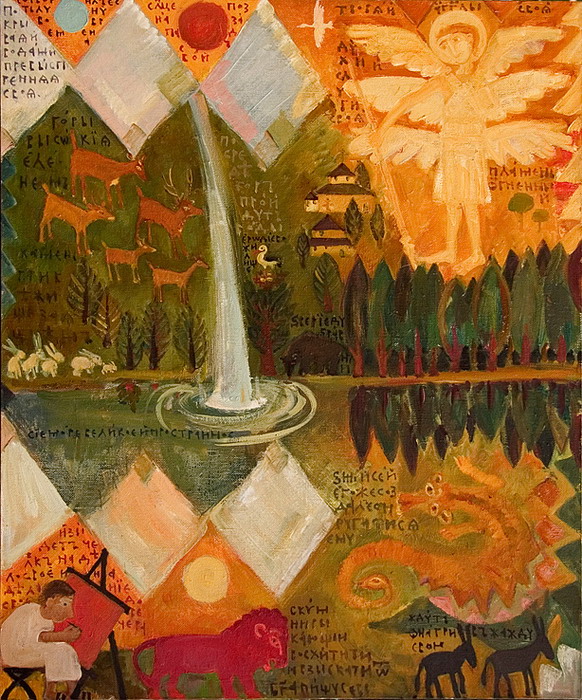
 “The quiet art of Helen Cherkasova seems simple at first sight – simple even to the naivete. And for much it is true if we imply by naivete pure natural sources and the belief in the clear divine spring of any real creative act.  As usual, dimensions of her works are not great. Nevertheless, some of them bear evident epic traits that are inherent to such monumental arts as mosaic or fresco.” (William Meiland, March, 1998)
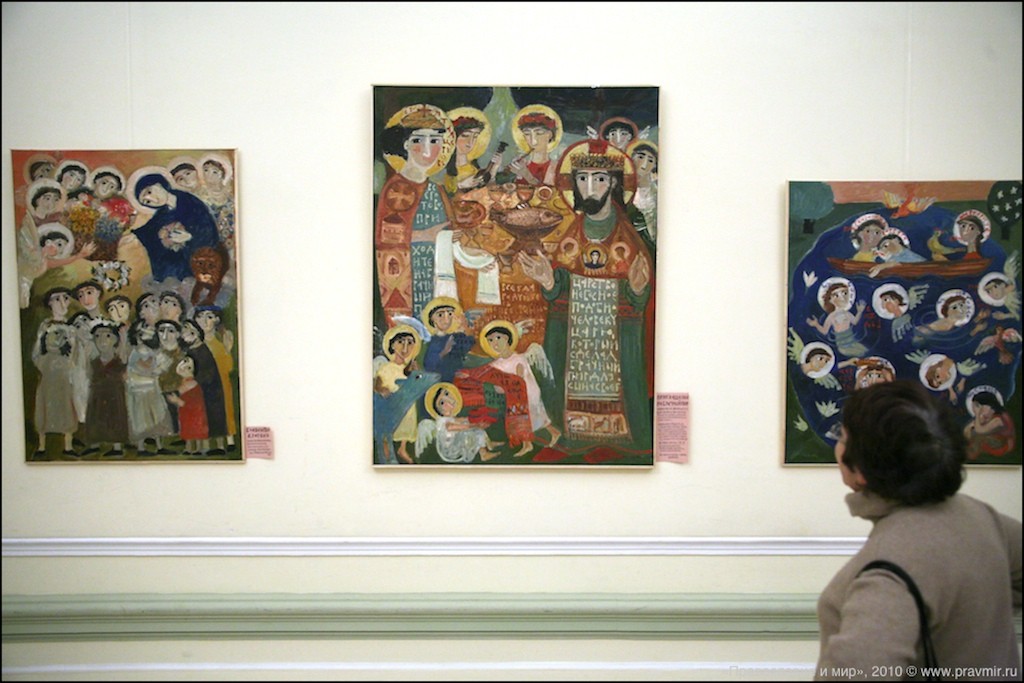
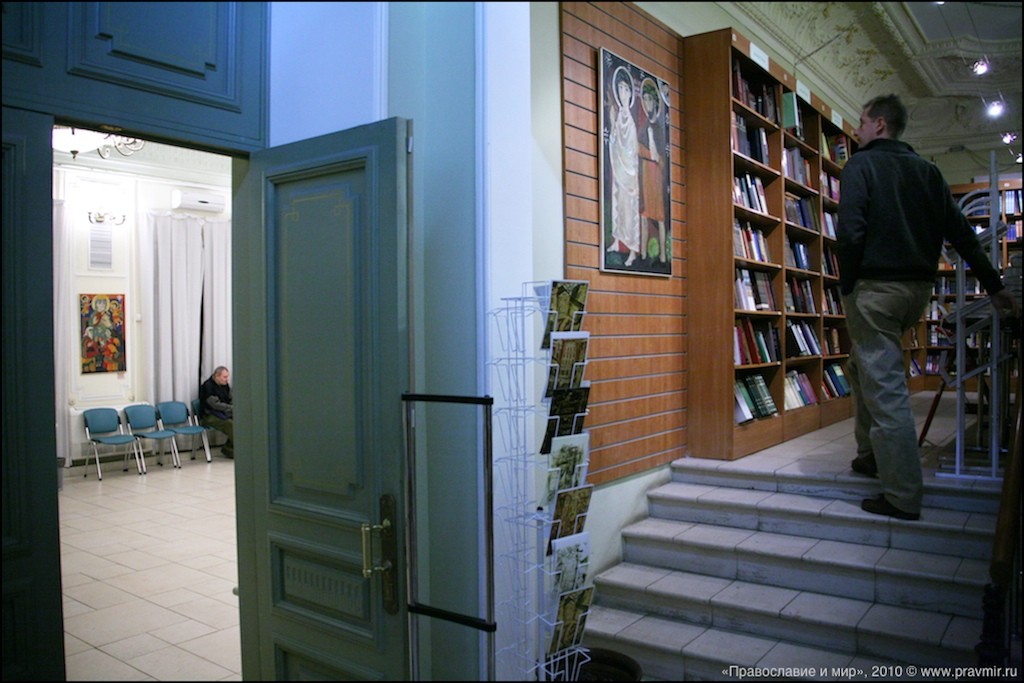
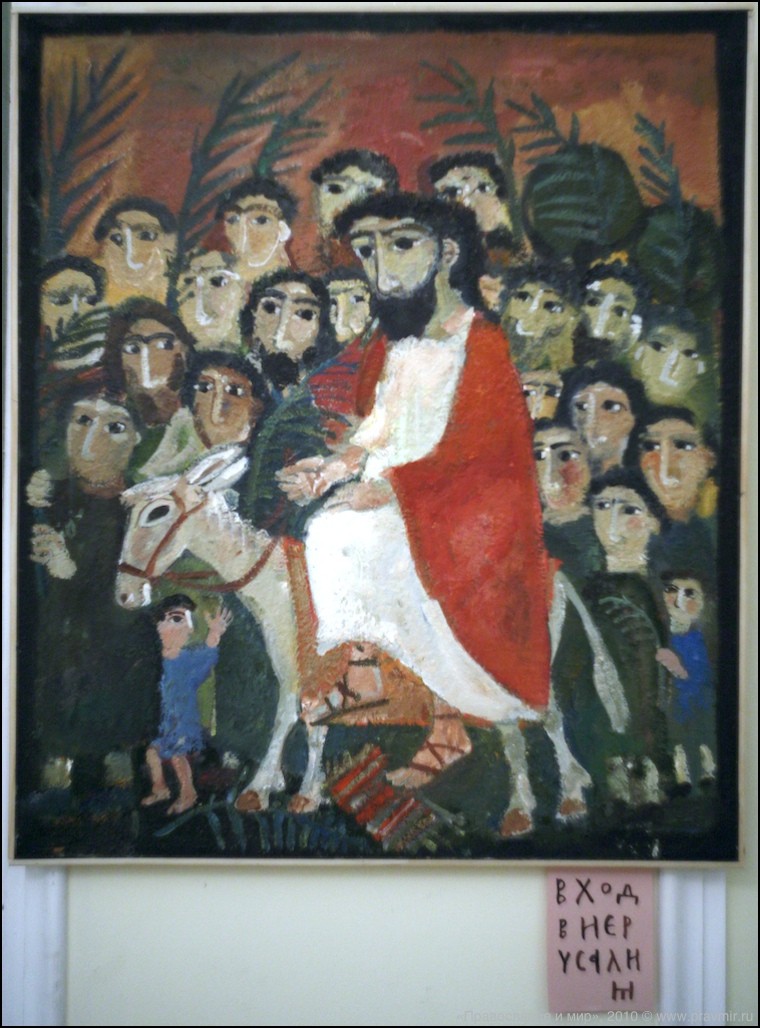
Helena Cherkasova was born in Moscow in 1962. Finished art school in Moscow. Painted icons for orthodox churches. Now she paints by oil landscapes, still lifes and compositions mainly with religious topics. Participant of exhibitions in Russia and abroad. Lives and works in Moscow.

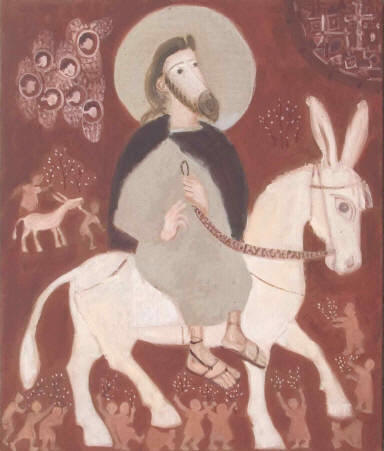
Lord’s Entrance into Jerusalem

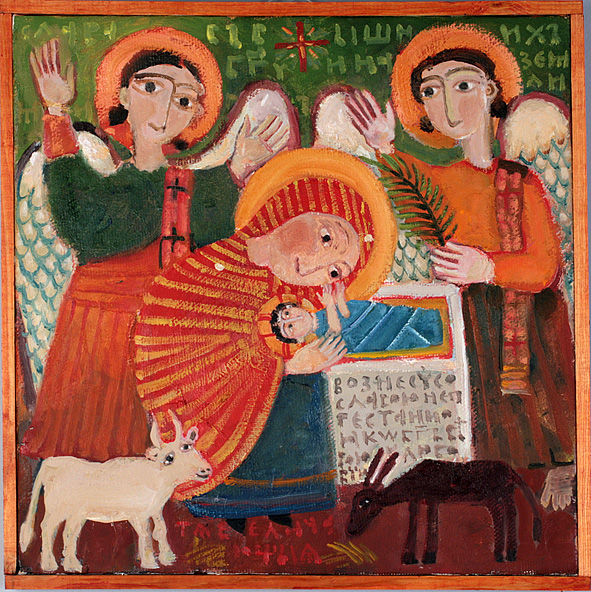
Nativity

Blessedness of the meek

Wise virgins

The kingdom of heaven is like unto leaven, which a woman took, and hid in three measures of meal, till the whole was leavened.

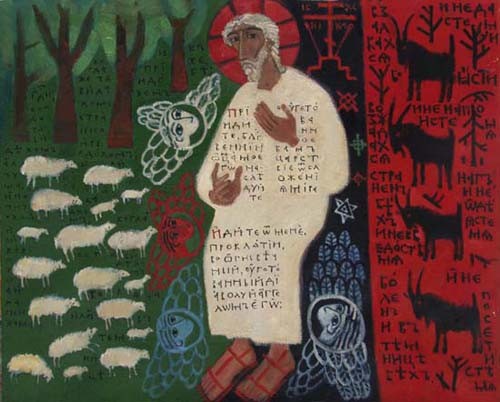
Psalm 127

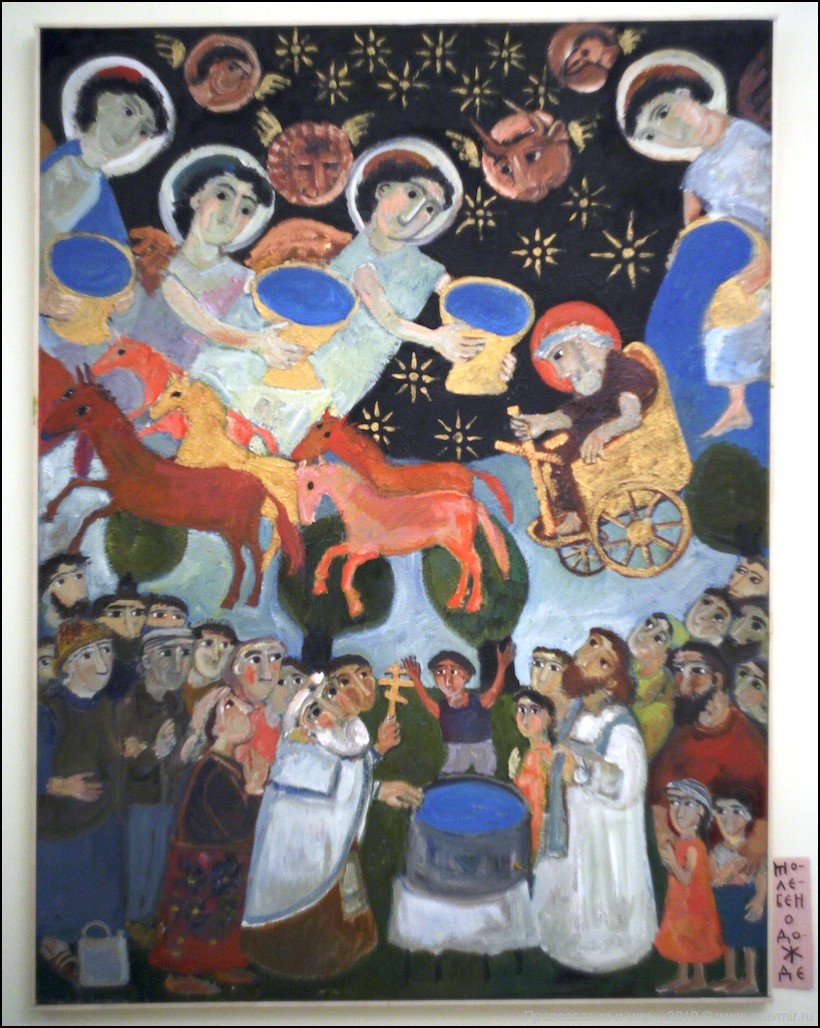
Prayer for rain

cherk_20

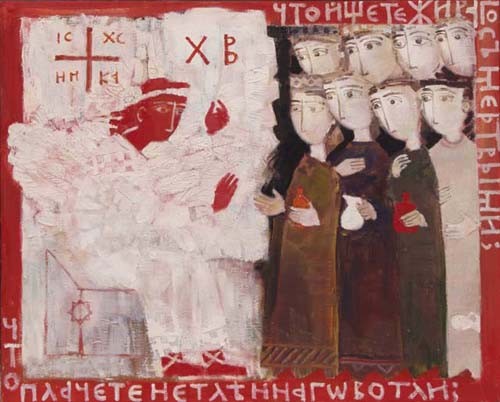
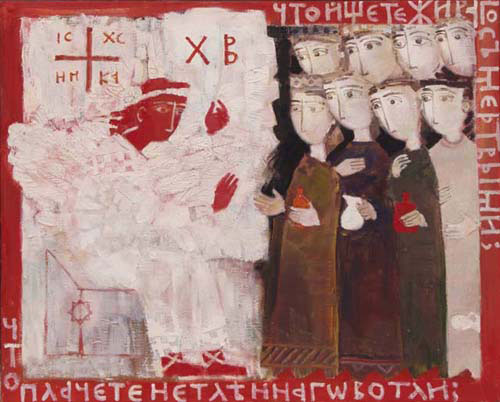
Angel speaks to the myrrh-bearin women

cherk_14

cherk_12

cherk_5

cherk_4

cherk_3

A monk

b_70

smokv

rai010

PC249278
Lord’s Entrance into Jerusalem
memra05

memra04

kraski
793614

the Tsar’s family

kolimpiade
Letters of St. John Chrysostom to Olimpiada
iliin
Prophet’s Eliah’s day

cherk_39

b_65

cherk_36

b_69

St. Seraphim of Sarov

b_68

Prince Igor’s murder

b_66

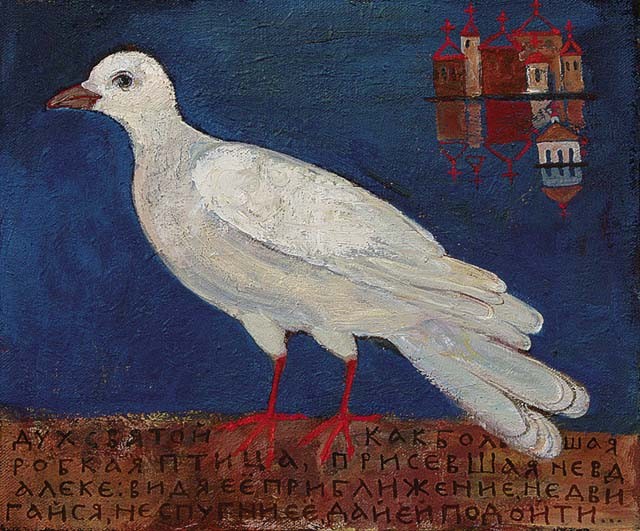
A bird from Heaven

b_64
The righteous soul enters Heaven

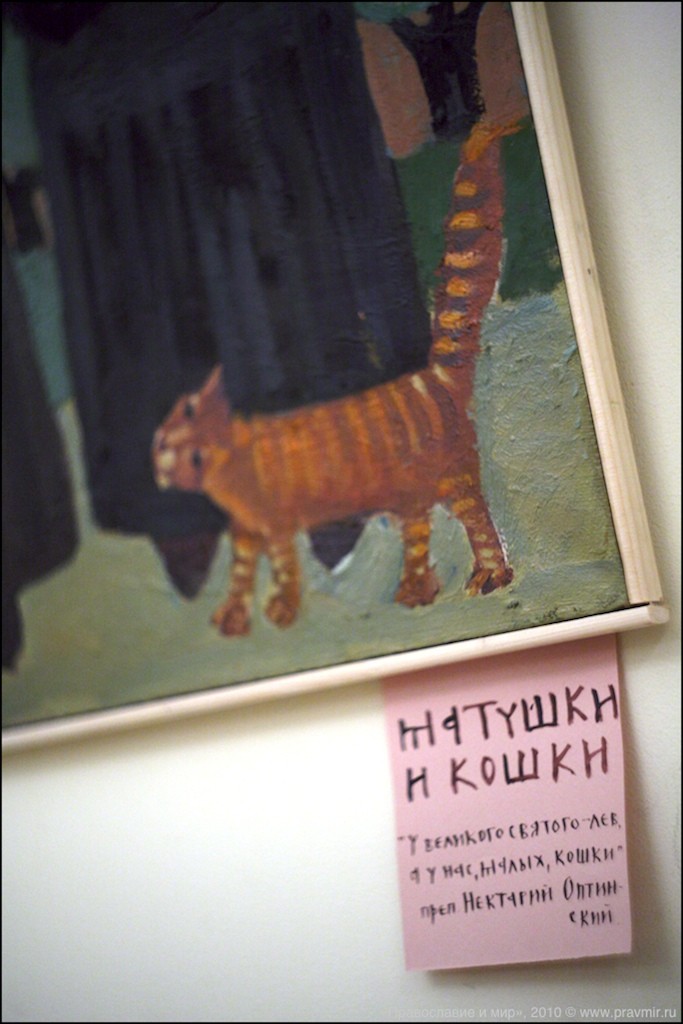
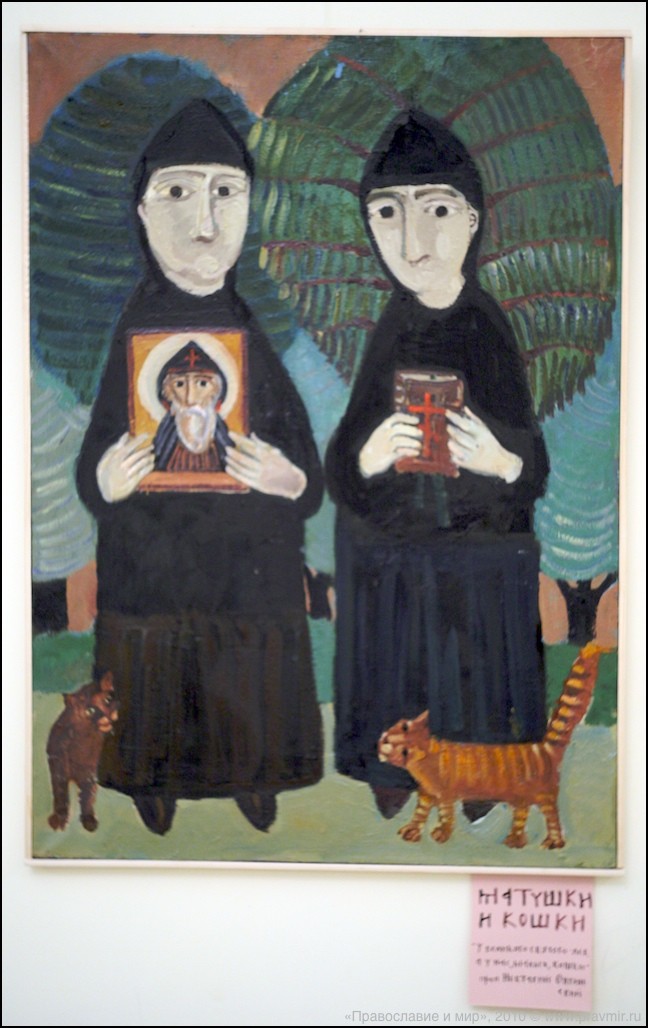
Matushki and cats

Matushki and cats

icon1

“103rd Psalm”

icon2

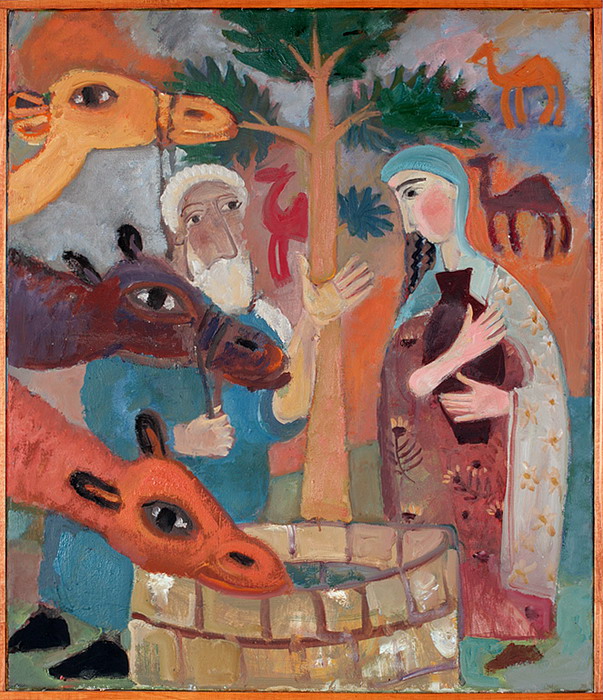
“Eleazar and Rebekah”

( the Old Testament story of the marriage of Isaac)
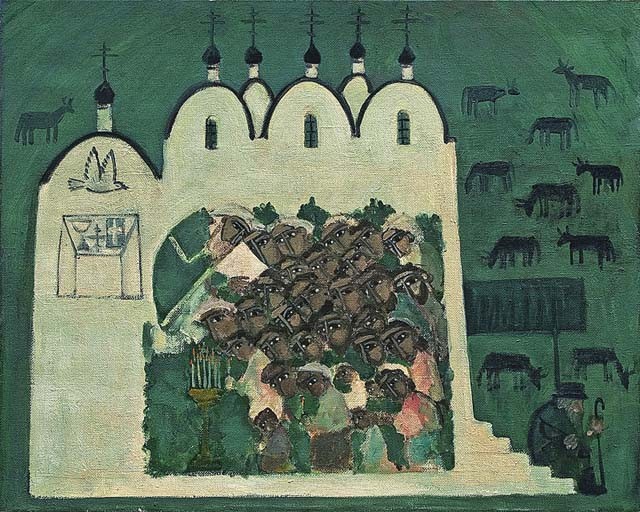
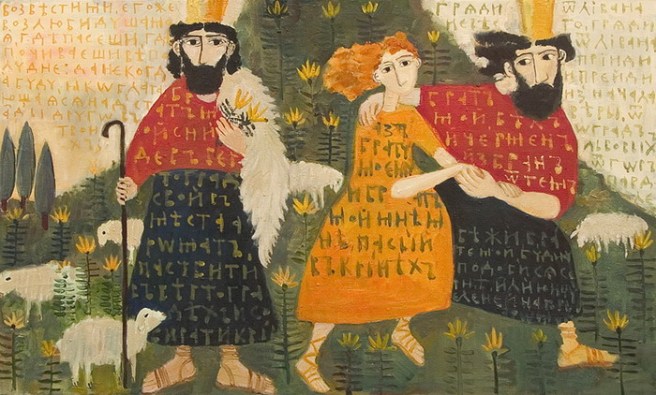
icon3

“Song of Songs”

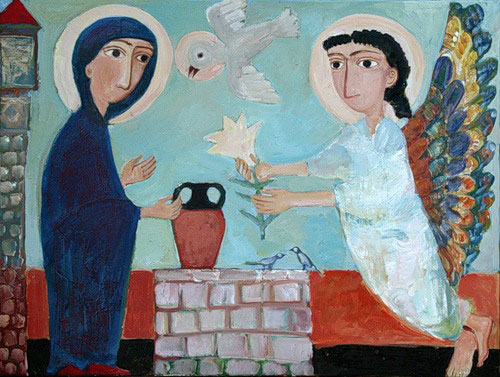
icon18

Annunciation

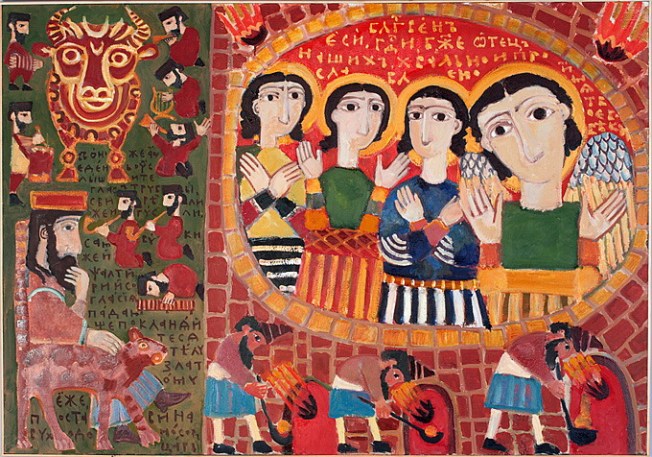
icon4

“Teens in the furnace” Daniel

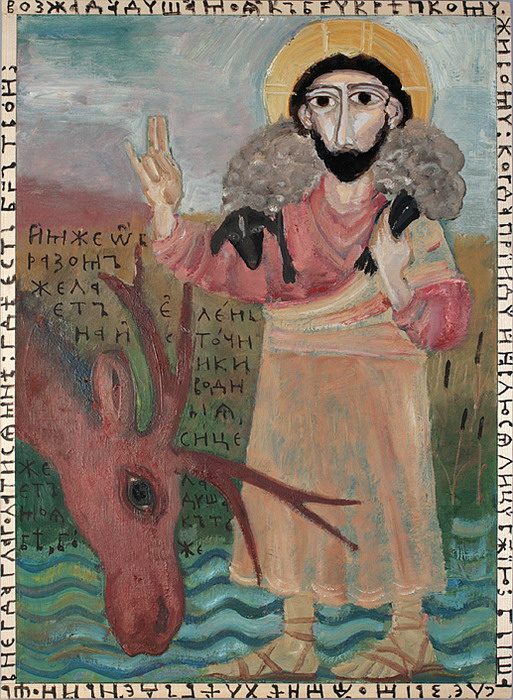
icon5

“As the deer pants for streams of water, so my soul pants for you, O God!”  “Psalm 41”

icon6

“Nativity”

icon7

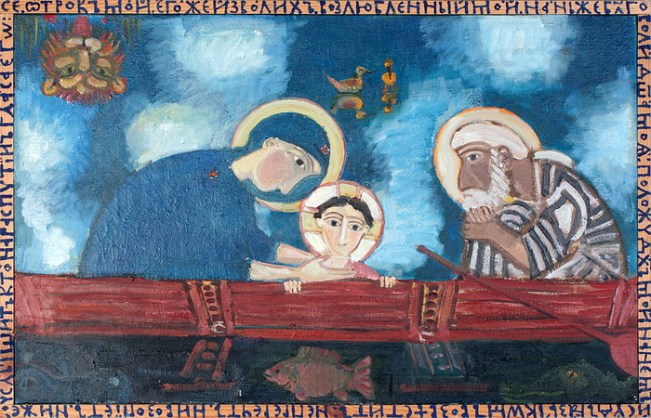
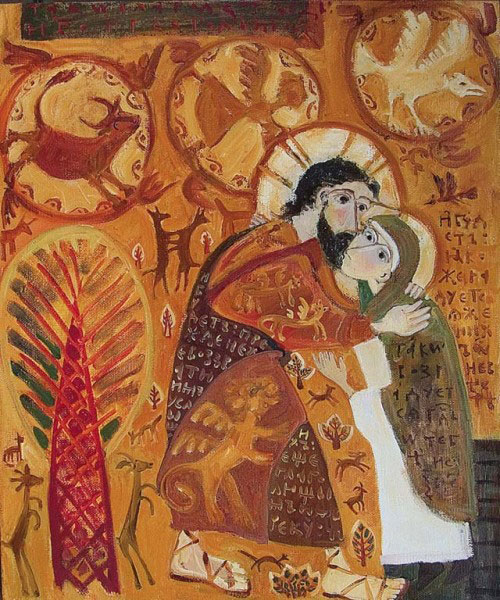
“The Holy Family”

icon9

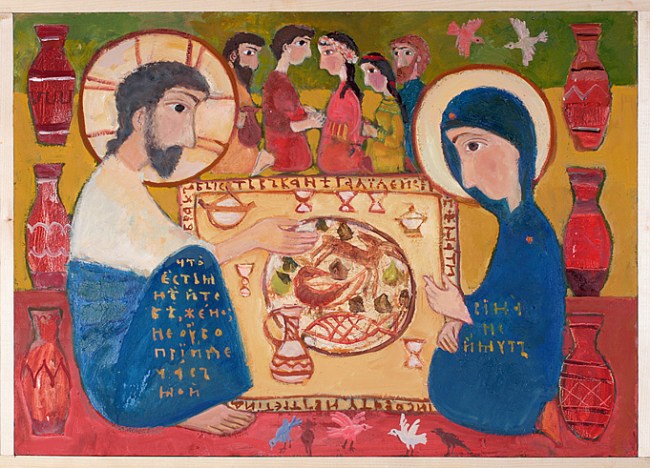
“Marriage at Cana”

converted PNM file

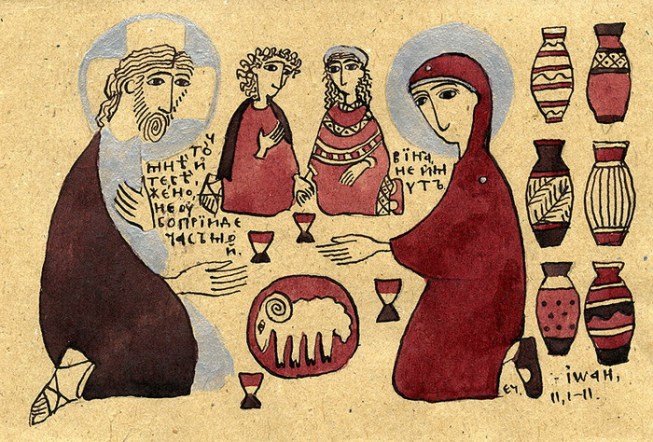
Another option of the marriage at Cana

converted PNM file

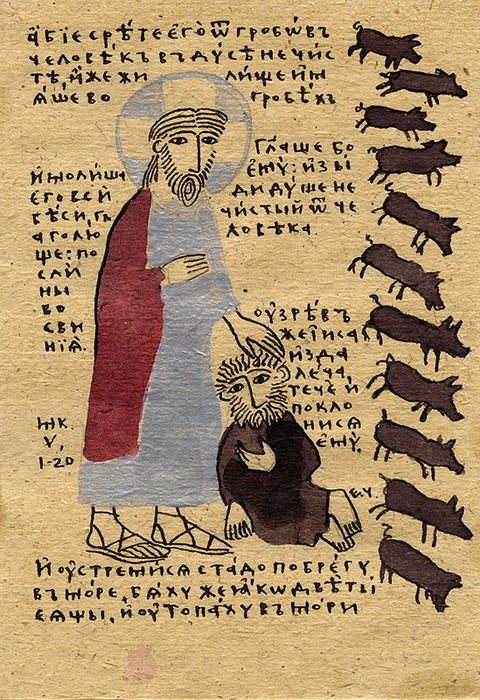
Healing the Demoniac of the Gadarene

converted PNM file

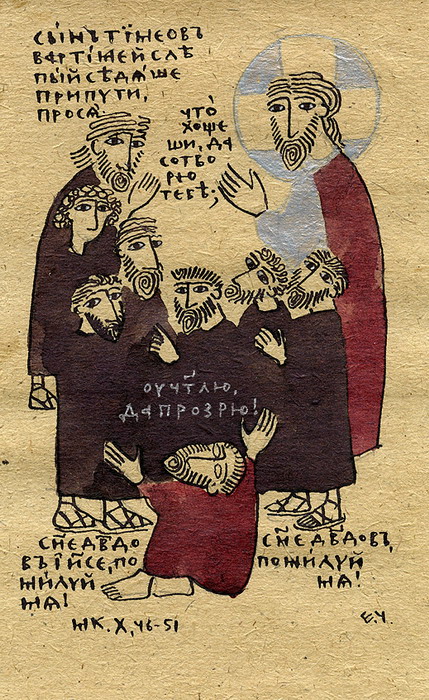
“Healing the Blind”

icon12

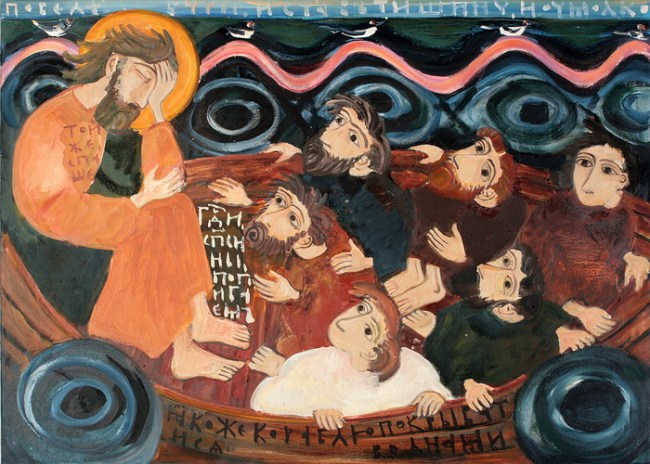
“The storm on the lake”(Mk . 4 , 35-41 )

icon13

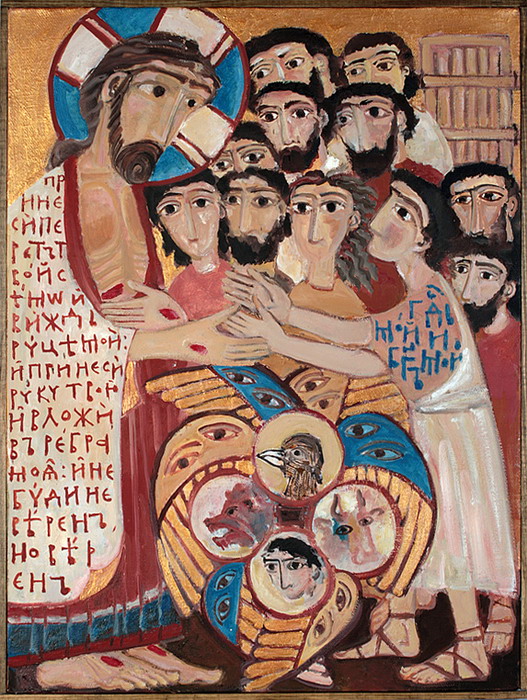
Doubting Thomas ( Jn. 20 , 24-29 )

OLYMPUS DIGITAL CAMERA

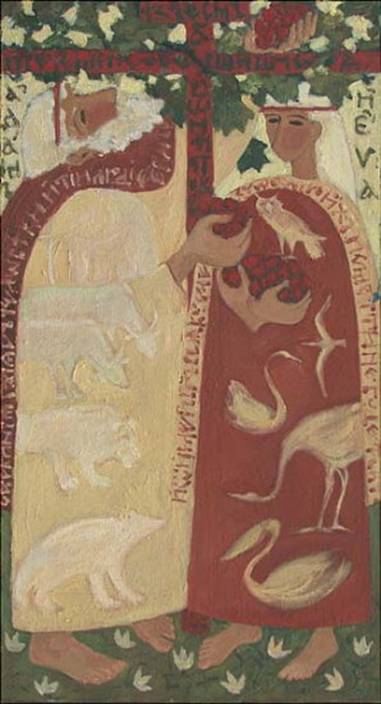
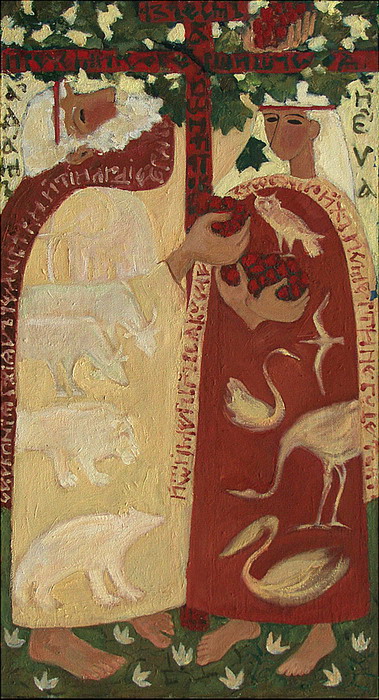
“Adam and Eve in paradise again”

icon22

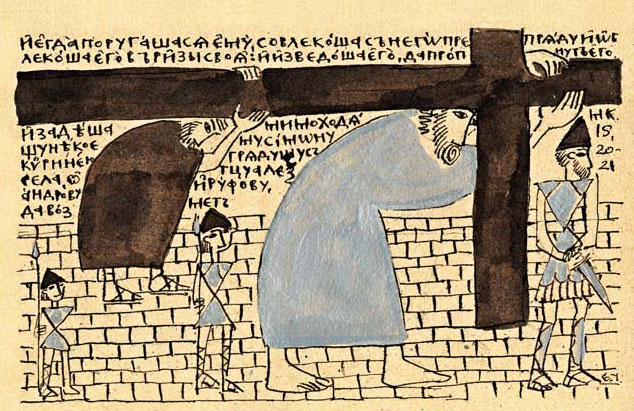
Way of the Cross

icon26

The Resurrection of Christ

icon23

Last (Final) Judgment — Day of Judgment

icon25

The entry of a righteous soul in paradise

icon28

The Holy Spirit – a timid bird

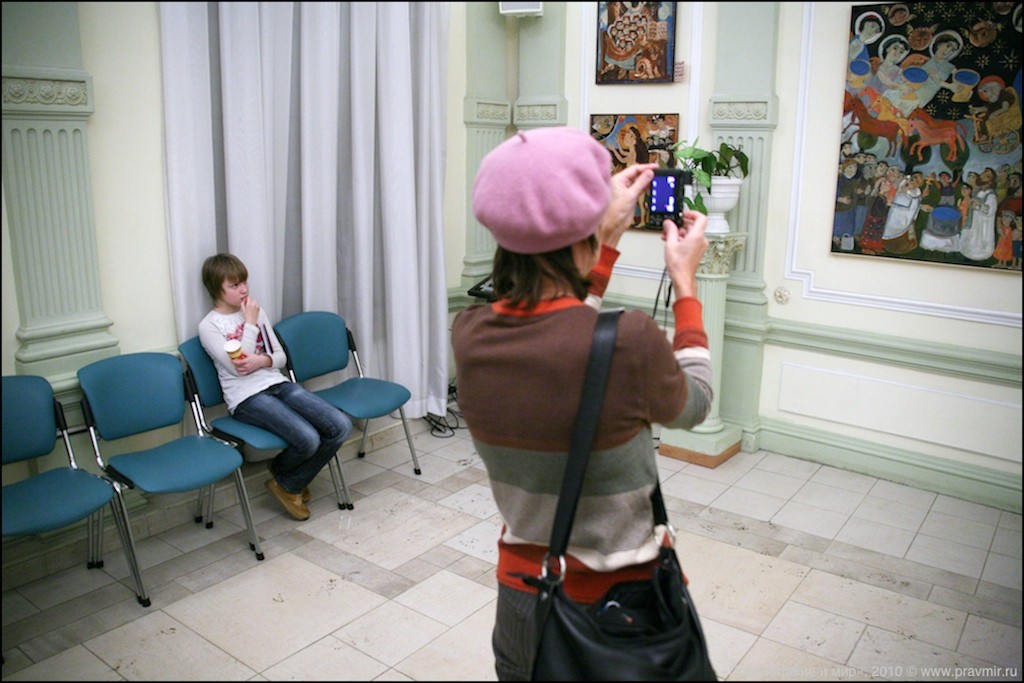
Photos by Michael Moiseev
Source: Pramvir