Awed by the Beauty of thy Virginity

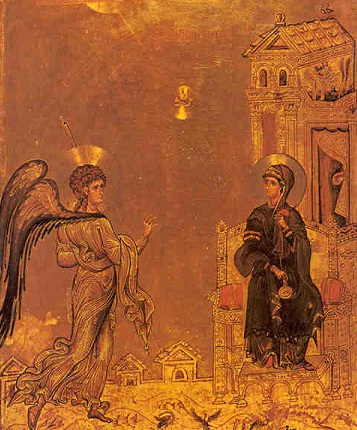
icon-sinai-annunciation

Iconography Trivia: The fact that Panagia is shown sitting in the presence of an angel illustrates that she is “higher than the Seraphim and beyond compare more glorious than the Cherubim”. I don’t think many would remain seated in the presence of an angel of God, but this icon testifies to the spiritual height of the Mother of God. (Not that she necessarily sat during this encounter – it depicts a spiritual reality more than a historical one)

The miracle depicted and described in this video is so awe-inspiring. The hymn, sung first in Greek and then in English, is so beautiful. It is the same hymn chanted at the end of the Akathist services held on Friday nights during Great Lent.

May we have her blessing!

Awed by the beauty of thy virginity, and the exceeding radiance of thy purity;

Gabriel called out unto thee, O Theotokos,

What worthy hymn of praise can I offer unto thee?

And what shall I name thee?

I am in doubt and stand in awe! Wherefore as commanded, I cry to thee:

Rejoice, O full of grace.

 Source: LESSONS FROM A MONASTERY here and here


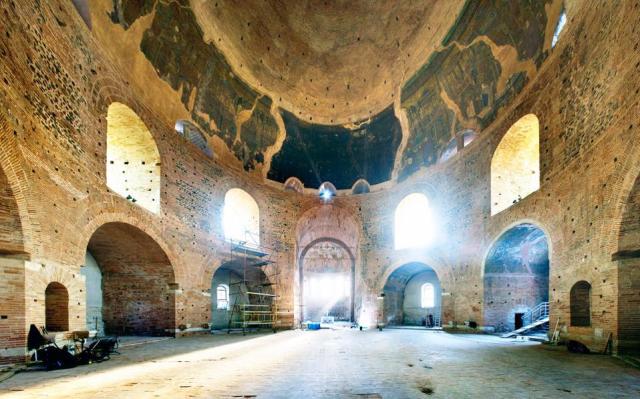
rotonda_thessaloniki_web-thumb-large

Rotunda, Thessaloniki, during restoration work

St. Nektarios, the unknown hermit and the raging demons

saint_nektarios_egina_1


A meeting of Saint Nektarios with a clairvoyant hermit on Mount Athos. Also, a recent miracle of the Saint in Romania.


St. Nektarios enjoys wide popularity amongst Orthodox throughout the world, yet his popularity in Romania has gained over the past few years. Portions of his relics can even be found in such places as Putna Monastery, Radu Voda Monastery in Bucharest, the Church of the Holy Hierarch Nektarios in Iasi, and the Hermitage of Saint John and Nektarios in Bradetu, Arges. Why do so many Romanians venerate Saint Nektarios and go to pilgrimage to his Monastery in Aegina? All this seems to be related to a recent, miraculous “visit” of the Saint to a village in Romania.

Below is the account as it was told by Romanians to Greeks:

“In a village of Romania there was no priest and the residents often went to the Patriarch with the problem in order to fill the empty spot. However the Patriarch did not have the means of satisfying the demand. The villagers often went to the Patriarch, but he would say the same thing, that he did not have a priest to send to the village.

Meanwhile people died unread (no funeral service), others had relationships and children without marriage vows, and the children and adults alike were unbaptized.

Then one day, outside of the church, a car stopped and out stepped a priest. The village was astonished and yelled out that a priest had come.

The villagers went to the church to greet him and asked him, “How did you come to the village after our Patriarch had said that he doesn’t have a priest to send us?”

The priest answered, “Isn’t this what you wanted? Did you not want a priest? Here I am.”

All the villagers were glad in the presence of the new priest.

The priest began immediately working. He went to all the graves and read the funeral service. He baptized and married everyone in the village and administered Holy Communion.

One day he invited all the villagers to church and told them, “I will leave now, my mission is done.”

The villagers were confused and asked, “Now that you came, you are leaving?”

However the priest did not listen to the villagers and proceeded with his decision.

When the villagers realized that their wasn’t anything they could do, they thanked him for his offering.

After a few days, the villagers went to the Patriarch and they thanked him for sending them a priest and to let him know that they would appreciate it if he could send them another priest soon, but the Patriarch didn’t know anything.

He said to them, “I didn’t send a priest because I don’t have one, however let me check with the chancellor to see if he had sent a priest to you to serve your needs.”

He phoned the chancellor, but he too didn’t send anyone.

The Patriarch inquired, “What did this priest do in your parish?”

The villagers answered, “He married us, baptized us, performed funerals for our parents, he did what any other priest would have performed for us.”

Then the Patriarch asked, “Well, didn’t he gave you any papers or log the Mysteries.

“Of course,” said the villagers, “he gave us papers and he wrote them in the church’s books.”

“Then did anyone see what he wrote? And with what name he signed?”

“All the documents were written in Romanian and we are not well educated and the signature he signed in a language we have not seen before.”

The Patriarch requested they go bring the books in order to see who was this clergyman.

When they returned with the book the Patriarch remained speechless. He couldn’t believe his eyes.

Indeed all the documents were written in Romanian while his name was written in Greek with the name of his signature,

Nektarios, Bishop of Pentapolis

For the original sources of the miracle and further information, all translated by John Sanidopoulos, go to Mystagogy. 


The Eight Means of Temptation

Parintele Cleopa de la Sihastria

By Elder Cleopa (Ilie) (1912-1998) of Sihastria Monastery in Romania

The Holy Fathers say (this is how Fr. Cleopa began to express concisely his spiritual experience to us, inherited from the Holy Fathers and personally experienced by him, as every one of his words clearly confirms) that on the path of salvation one is tempted by the devil from eight sides: from the front, from behind, from the left, from the right, from above, from below, from inside, and from the outside.

1. One is tempted from behind when one continuously remembers the sins and evil deeds one has committed in the past, recalling them anew in one’s mind, reshuffling them, engaging them, despairing because of them, and contemplating them sensually. Such a remembrance of how we have sinned in the past is a demonic temptation.

2. One is normally tempted from the front through fear at the thought of what the future holds: of what will happen to us or to the world; of how much longer we will live; of whether we will have anything to eat; of whether there will be a war or any other kind of serious and frightful event to come; and, in general, by making all kinds of guesses, predictions, prophecies, and everything else that induces fear of the future in us.

3. One is tempted by the devil from the left through the call to commit obvious sins and to behave and act in ways that are known to be sinful and evil, but which people do nonetheless. This temptation is a direct call to sin openly and consciously.

4. There are two ways in which the devil tempts from the right. The first is when one performs good deeds and actions, but with a bad or malicious intent and purpose. For example, if one does good or acts well out of vainglory, to receive praise, to obtain a position, to acquire fame, or in order to attain some benefit for oneself – it follows that one is doing such good out of vanity, avarice, and greed. The performance of good deeds for bad purposes is sinful and vain. The Holy Fathers liken such a performance of good deeds (such as fasting and almsgiving) to a body without a soul, inasmuch as the purpose for which a deed is accomplished is its soul, while the deed itself is its body. Therefore, the performance of good deeds with an ungodly purpose is essentially a temptation coming from the right, that is, coming under the guise of good. The second demonic temptation from the right comes through various apparitions and visions, when one receives visions of the devil in the form of God or an Angel of God. The Holy Fathers call trusting these specters from the devil, or accepting these demonic phenomena, delusion or deception [prelest].

5. Further, the devil tempts one from below when one is capable of performing good deeds or holy virtues but is too lazy to do so; or when one knows that one should make greater efforts and labors in ascetic struggles (in virtues and good deeds), and is capable of doing so, but does not do so out of laziness or because one is looking for excuses for one’s laziness. One thereby spiritually rejects these virtues by doing much less than one could in fact do.

6. Temptations from above (Elder Cleopa, in order better to explain this to us, demonstrated with his hands the direction from which one or another temptation came; he then briefly repeated what the direction of the temptation he had just described was) also come about in two ways. The first is when one takes upon oneself ascetic struggles that exceed one’s strength, thereby recklessly straining oneself. This happens, for instance, when one is sick but imposes a fast on oneself that is beyond one’s strength; or generally when one overdoes any ascetic struggle that is beyond one’s spiritual and physical capacity. Such obstinacy lacks humility and is unreasonably presumptuous.

Another temptation from above is when one strives to learn the mysteries of Holy Scripture (and of God’s mysteries in general), but does not do so according to one’s spiritual maturity. That is, when one wants to penetrate the mysteries of God in Holy Scripture (or in the saints, the world, and life in general) in order later to explain and teach these mysteries to other people when one is not spiritually mature enough to do so. The Holy Fathers say that such a person wants to chew through a bone with baby teeth. St. Gregory of Nyssa speaks about this in his work, The Life of Moses. He says that it was for this reason that God commanded the Israelites, who were imperfect, to eat only the meat (which is like milk for the teeth) from the Passover lamb – and, moreover, with bitter herbs – and not to break into pieces or to eat the bones, but rather to burn them in fire (cf. Exodus 12: 8, 10, 46). This means that we, too, should interpret only those mysteries in Holy Scripture (and in our faith in God generally) that correspond to our spiritual maturity and to eat (absorb) them with bitter herbs, that is, with everything that life brings us (suffering, grief); we should not bite into the mysteries of Holy Scripture, Divine knowledge, and God’s Providence, like so many hard bones, with our baby teeth; they are susceptible to fire only, that is, they become clear only in ripe spiritual maturity and in experienced souls that have been tested by grace-filled Divine fire.

7. One is tempted from within by that which one has in one’s heart and by that which proceeds from the heart. The Lord Jesus Christ clearly stated that it is from within, from one’s heart, that sinful and impure thoughts, desires, and lusts proceed (cf. Matthew 15:19) and tempt one. Temptations come not only from the devil, but also humanly, from the evil intentions and skills, lusts, evil desires, and inner love of sin that proceed from an unclean heart.

8. Finally, the eighth door to demonic temptation is opened from the outside, through external things and occasions, that is, through everything that enters from outside through one’s senses, which are the soul’s windows. These external things are not evil in and of themselves, but by means of them one’s feelings can be tempted and induced to evil and sin.

These, then, are the eight means by which everyone is tempted, regardless of whether one is in the world or in seclusion.

(Having completed listing all eight means by which one is tempted, Elder Cleopa briefly repeated them and then added the ways and means with which to combat each of these temptations.)

Against each of these temptations – from behind, from the front, from the left, from the right, from above, from below, from inside, and from the outside – one must fight by means of watchfulness (the Elder used precisely this Slavonic word [trezvenie]), that is, attentiveness, carefulness, and wakefulness of soul and body; wakefulness and vigilance of spirit; sobriety and discernment; attention to one’s thoughts and actions; or, in a word: judgment. On the other hand, by means of constant prayer that invokes the name of the Lord Jesus Christ, that is, through unceasing prayer. (Here Fr. Petronius added in Greek: “Prosochi kai prosefchi” – that is, as the Holy Fathers put it, “by attention and prayer.”)

In other words (the Elder added), the Holy Fathers said that the battle against all temptations and passions consists in the following: guarding all one’s mind, soul, and body from temptation – this is our ascetic struggle, from our human point of view; from the Divine side, one must continuously and prayerfully call upon the help of the All-Merciful Lord Jesus Christ – and this is that unceasing and primary prayer of the hesychasts called the Jesus Prayer: “Lord Jesus Christ, have mercy on me, a sinner!”
A Song for Martyrs – Nuns of the Diaconesti convent

manastirea diaconesti

Manastirea Diaconesti – Sfanta Liturghie la praznicul Invierii Domnului


A poem written by the nun Zorica (Teodosia) Laţcu. Chanted by the nuns of the Diaconesti convent, Romania.

A song for

“Those who have fallen in battle across the centuries

For the triumph of the most honored Cross,

Those who in the moment of their death

Had in mind the Name of the most blessed Trinity,

And those who longed for The glory and crown above the mind,

Remember them O, Lord, when you come, Into the Kingdom of Your Holy Glory.”


For more chanting by the Sisters:
Manastirea Diaconesti – Sfanta Liturghie la praznicul Invierii Domnului

Manastirea Diaconesti-Cantari Ortodoxe-Colaj

Manastirea Diaconesti – Canonul Sfintilor Marturisitori din temnitele comuniste

Grupul psaltic al Mănăstirii Diaconești

St. Gabriel’s fiery zeal

Saint Gabriel

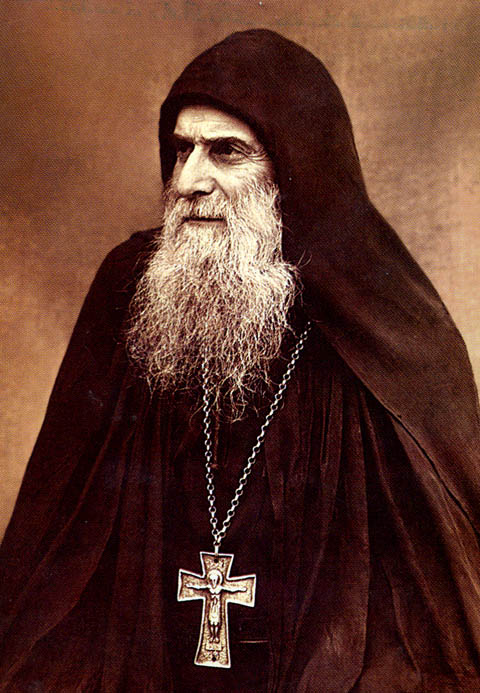
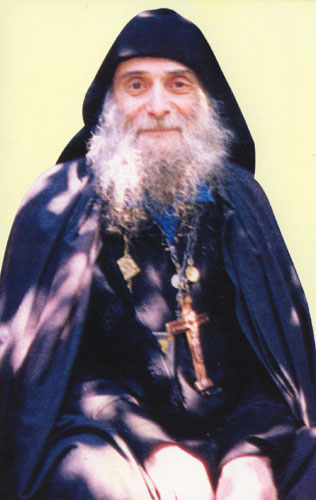
Excerpt from the life of Saint Gabriel the Confessor and Fool for Christ of Georgia,   including rare video footage of him


“It is quite difficult for the contemporary generation to imagine the unusual spiritual ability of the young monk, who adopted unprecedented and astonishing steps during the terrible communist regime. … The Soviet government planned to keep him in the psycho-neurological hospital forever. But God had preserved the life of His chosen one not for such a fate. It is interesting to read an excerpt from the medical conclusion:

Georgian SSR Tbilisi Healthcare City Psycho-Neurological Hospital 19/1 – 1966, Tbilisi, 1, Electroni Str.

#666Patient: Vasili Urgebadze, born in 1929, 6 class education. Address: 11, Tetritskaro Str.

The patient is stationed in the city psycho-neurological hospital on 18.VIII.1965, and is brought from the prison for forced treatment. Diagnosis: psychopathic person, inclined to schizophrenia-like psychosis blanks. He was discharged from the hospital on 19/11/65. According to anamnesis he had a vision of a ghostly evil spirit with horns on the head at the age of 12… The patient proves that everything bad that is taking place in the world is due to Evil. From the age of 12 he started to go to churches, prayed, bought icons, and studied church literature… He ate nothing on Wednesdays and Fridays. Grown-ups and soldiers laughed at his nonsense: “On Wednesday Judas sold Christ for thirty silver coins, and on Friday the Jewish priests crucified him”; he was totally hallucinating. It was clear from the case that at the 1 May 1965 demonstration, he burnt a big portrait of Lenin, hanging on the building of the Council of Ministers. After interrogatory he said he did this because the picture of the Crucifixion of Christ should hang there and that it was not possible to idolize an earthly man – the doubt appeared in regard to his psychic health, due to which he was sent to court-psychopathic expertise. The examination showed the patient’s orientation is disoriented in place, in time, and in environment. He talks to himself in a low voice: he believes in the existence of heavenly beings, God and angels, etc. While talking, the main axis of a psychopath is always turned to that everything depends on God’s Will, etc. He is isolated from the other mental patients in the department. When someone talks to him, he surely mentions God, angels, and icons, etc. He is unable to criticize his condition. He was treated with the aminazinophrazia and syptomicine therapy, after which he passed commission.

Act of stationary #42 1965

Chairman of the commission: candidate of medicine, chief physician T. Abramishvili,

Members: J. Shalamberidze and physician Kropov.

He was discharged from the hospital on 19 Jan. 1965 and was taken home by his mother.

Physician: Lezhava 19 Jan. 1966.


… From that time on, Father Gabriel decided to completely change his lifestyle, which was too painful for him. Now he was determined to pretend as being mentally ill and to outwardly refuse his usual way of life. Instead of being in silence, he loudly preached in the streets. If till now he completely refused to drink wine, now he drank among people and pretended to be drunk. To pretend being foolish is an unusual feat which requires a spiritual strength and divine mind. “Because the foolishness of God is wiser than men; and the weakness of God is stronger than men” (I Cor. 1:25).


Source: Mystagogy Resource Center by John Sanidopoulos

St Gregory the Theologian in Spiritual Warfare

gregory-the-theologian-1408.jpeg

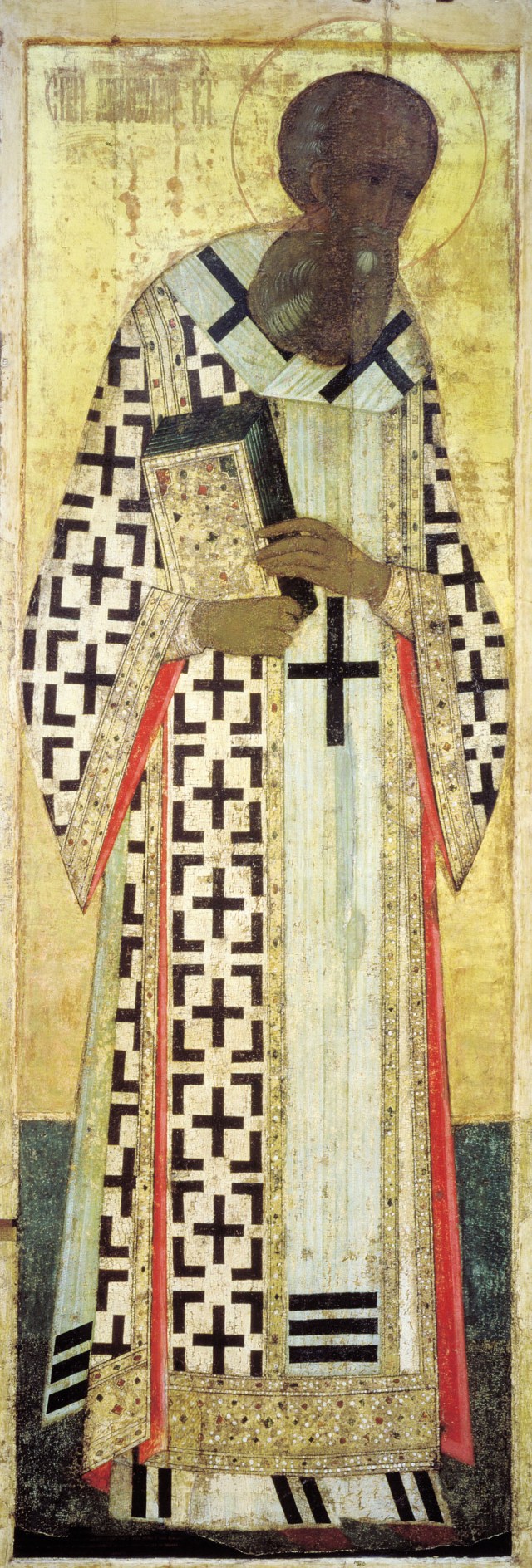
Gregory the Theologian, 1408 – Andrei Rublev

Flee swiftly from my heart, all-crafty one.
Flee from my members and from my life.
Deceiver, serpent, and fire, Belial, sin,
death, abyss, dragon, night, snare, and frenzy,
chaos, manslayer, and ferocious beast!
Thou didst entice into perdition those
first-formed folk, my foreparents, offering them
at the same time the taste of sin and death.
Christ, the Ruler of all commandeth thee to
flee into the billows, to fall upon the rocks,
or to enter the herd of swine, O baleful one,
as once He bade that presumptuous Legion.
Nay, yield forthwith, lest I smite thee with the Cross,
whereat all things tremble;
Oh, flee!
I bear the Cross upon me, in all my members.
I bear the Cross whene’er I journey, whene’er I sleep.
I hold the Cross in my heart. The Cross is my glory.
O mischievous one, wilt thou never cease from
dogging me with traps and laying snares for me?
Wilt thou not dash thyself upon the precipices?
Seest thou not Sodom? Oh, wilt thou not speedily
assail the shameless herds of ungodly heretics,
who, having so recklessly sundered the Almighty
Godhead, have witlessly destroyed and abolished It?
But comest thou against my hoariness? Comest thou
against my lowly heart? Thou ever blackenest me,
O foe, with darksome thoughts, pernicious thoughts.
Thou hast no fear of God, nor of His Priests.
This mind of mine, most evil one, was verily
a mighty and loud-voiced herald of the Trinity.
And now it beholdeth its end, whither it goeth in haste.
Confuse me not, O slimy one, that I might, as pristine,
meet the pure lights of Heaven, that they might
shine like lightning flashes upon my life.
Lo, receive me; lo, I stretch forth my hands.
Farewell, O world! Farewell, thou who bringest woes upon me!
Pity be shown to all that shall live after me.


The Cross

cross2

Fourth in her ‘series’ of Cross-related visions, Abbess Thaisia sees a Cross. This is not a dream like the others before, but a vision while awake. Always these visions take place in the midst of heavy trials and tribulations, when she begins to lose heart and starts to languish:


“Once, during the period of labours and sorrows when I was beginning to put the community in good order, I was sitting in my study, all alone. All the doors were closed. Everyone had gone to bed, and I was preparing to do the same–yet I continued to sit there–I don’t know why. I was putting off going to sleep. I was not praying, nor was I thinking of anything special. There was something heavy on my heart, something very heavy, and there was silence in my heart and soul. Suddenly, in the middle of my cell, I saw a large wooden cross standing on the floor, so large that it almost reached the ceiling. (Evidently this was not a dream, for I was awake–I was just sitting, conscious of everything around me.) At the place where the horizontal and vertical beams met, there was something like a bloody, red, oblong fastening. seeing the cross, I did not become afraid; I crossed myself, and involuntarily thought, ‘How large it is! How will I be able to carry it?’ Then I heard these words, as if coming from the cross itself: ‘You will lift it and carry it, for My strength is made perfect in weakness!’ 

I considered that this was sent either to strengthen me in my sorrowful life, or to warn me of still greater sorrows to come. Although I felt some sadness, I accepted this with equanimity. I was ready to endure any suffering for the good of the community, and, through it, for the glorifying of the Name of God.”

*

For Abbess Thaisia’ first vision, go to The Cross-Baptism

For her second vision, go to The Fool-For-Christ and the Cross

Finally, for her third vision, go to Martyrdom Before the Crucifix

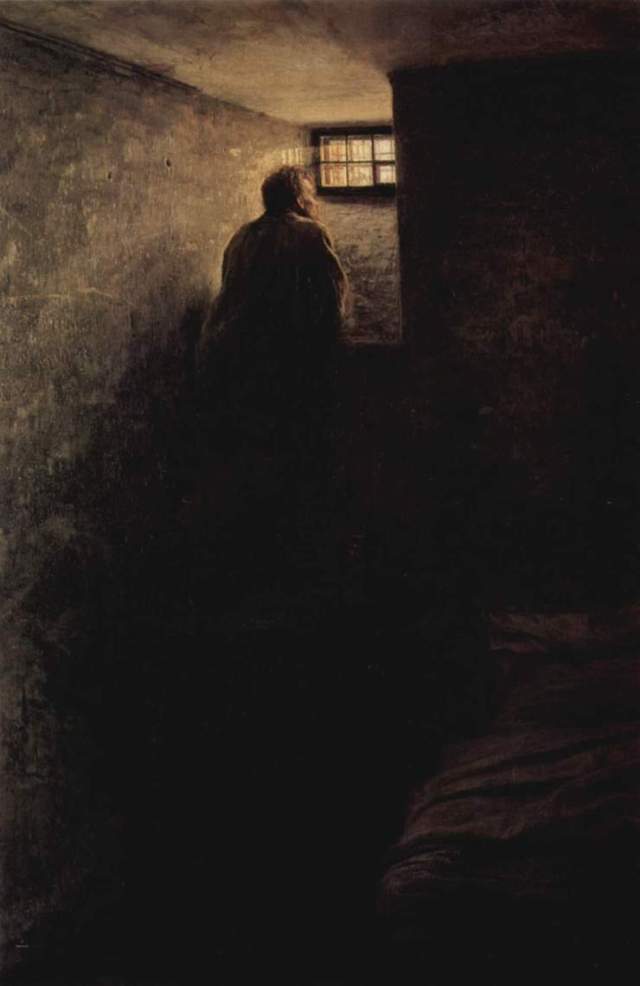
Christ’s Light in Tolstoy’s Prison


the prisoner

A Vision granted to Nun Maria concerning her brother Leo Tolstoy. Also, his apostasy, his excommunication by the Russian Orthodox Church, his tragic final days, the torturous struggle that went on in his soul at his last breath, and St. John’s of Kronstadt and St. Theophan’s the Recluse ‘examination’ of his spiritual condition


“I have renounced the Church that calls itself Orthodox… I renounce all the sacraments… I have truly renounced the Church, I have stopped fulfilling its rites, and I have written in my will to my close ones that they should not allow any clergymen from the Church near me when I will be dying…” (Lev Nicholaevich Tolstoy). Yet, in his final days, Tolstoy sought the most famous Russian monastery, Optina Hermitage, where ascetic elders were living. He wanted to meet with them, but at the last minute he lost his resolve, about which he regretfully told his sister, a nun of Shamordino Convent near Optina. When at Ostapovo station he felt his approaching death, he asked that a telegram be sent to Optina Hermitage with the request that they send him Elder Joseph. However, when two priests arrived in Astapovo, the writer’s followers would not allow them to meet…”


*

“Throughout the history of Russian literature there has never been a more tragic personality than Lev Nicholaevich Tolstoy, the “great writer of the Russian land,” in the words of Ivan Turgenev. His literary works reach the heights not only of Russian, but world literature. Therefore, the pain and perplexity of many people who respect his works are understandable; these include Orthodox Christians, for whom the reason for the decision on February 20, 1901 by the Holy Governing Synod to excommunicate him may still be unclear.

The Holy Synod simply cited by its decision a fact that had already taken place—Count Leo Tolstoy excommunicated himself from the Church and completely broke off ties with it. This is something that he not only did not deny, but even resolutely emphasized at every convenient opportunity: “It is perfectly justifiable that I have renounced the Church that calls itself Orthodox… I renounce all the sacraments… I have truly renounced the Church, I have stopped fulfilling its rites, and I have written in my will to my close ones that they should not allow any clergymen from the Church near me when I will be dying…” These are just a few of the great writer’s numerous proclamations in this regard.

Furthermore, when Leo Tolstoy was twenty-seven years old, he nurtured the idea of creating a new faith, which his diary entries of the time witness. In his old age, when he felt that his aim was nearly accomplished, the writer created a small sect of his fans and wrote “The Gospel according to Tolstoy.” The main object of Tolstoy’s attacks became the Orthodox Church. His words and actions directed against the Church were horrifying to the Orthodox consciousness. Furthermore, Leo Tolstoy’s activities during the final ten years of his life were, unfortunately, truly destructive for Russia, which he loved. They brought misfortune to the people whom he so badly wanted to serve. It is no accident that the leader of the Bolsheviks extremely valued the aim of Leo’ Tolstoy’s activity, and called the writer “the mirror of the Russian revolution.”

Great ascetics of the Russian Orthodox Church—St. John of Kronstadt, St. Theophan the Recluse, and many others, admitted with regret that Count Tolstoy purposefully used his great talent to destroy Russia’s traditional spiritual and social order.

The writer’s final days speak to us about the torturous struggle that went on in his soul. He fled his family nest, Yasnaya Polyana—not to his like-minded friends, the “Tolstoyans,” but to the most famous Russian monastery, Optina Hermitage, where ascetic elders were living. He wanted to meet with them, but at the last minute he lost his resolve, about which he regretfully told his sister, a nun of Shamordino Convent near Optina. When at Ostapovo station he felt his approaching death, he asked that a telegram be sent to Optina Hermitage with the request that they send him Elder Joseph. However, when two priests arrived in Astapovo, the writer’s followers would not allow them to meet…

Nevertheless, because the writer himself never made peace with the Church (Leo Tolstoy never publicly renounced his tragic spiritual error), the excommunication by which he separated himself from the Church cannot be removed. This means that canonically he cannot be commemorated in the Church. But the compassionate heart of any Christian who holds the literary works of this great writer in high regard cannot be closed to sincere, humble prayer for his soul. (Archimandrite Tikhon, Shevkunov) Source: OrthoChristian


Martyrdom Before the Crucifix

cross2

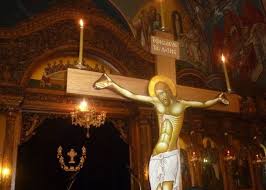
Third in her ‘series’ of Cross-related visions, Abbess Thaisia sees a Crucifix. Always these visions take place in the midst of heavy trials and tribulations, when she begins to lose heart and starts to languish… Here, the Holy Hierach St. Nicholas visits her to sternly admonish her. Below follows another except from her Autobiography:

“Then once I had a dream. I was walking along a road in an open field. I had to turn right, but there was no path in that direction; there were only beds of planting vegetables, very long ones. They looked as they do in autumn after the vegetables have been harvested, and the furrows between the beds were dirty and wet. I stopped and considered how to turn right. To go along the furrows would mean getting dirty and wet, but to walk across the beds would be a muddy, sticky business. Suddenly, I saw an old bishop coming in my direction with a staff in his hand. I thought, ‘I’ll wait and see, and whichever way he goes I will go too.’ Coming close to me, he said: ‘Come with me, I will show you the way.’ Leaning on his staff with his left hand, he took me with his right hand and led me along a bed, saying: ‘Although it’s muddy and you will often get stuck, the path is high; look how much dirt and water there is along the low path.’ We walked together for a long time. He continued preaching, and I talked to him without fear, although I recognised him as St. Nicholas. Finally we came to some church or chapel (I don’t remember which), and went in. Inside was a large Crucifix, and on the right, hanging on the wall, was an icon of St. Parasceva. I began to prostrate myself before the Crucifix. As soon as I touched the floor with my head, the holy man struck me on the neck with such force that I thought he would chop my head off. I had hardly recovered when another blow followed, and then another, and so on to five. ‘Why is he beating me?’ I asked myself. ‘Does he really want to chop my head off? But why would he want to do that?’ ‘Don’t argue, don’t act wise,’ he answered my thought. ‘If I struck you, it was because I had to. You have forgotten that one must obey without arguing. You don’t have to show off your  knowledge.’ I stood up, and the holy hierarch looked at me, smiling kindly. He pointed at the icon of martyr Parasceva, saying: ‘Here she is, the bride of Christ. She allowed her head to be cut off as an offering to her Bridegroom; whereas you are unable to suffer even a little, and you keep on philosophising while you still don’t possess spiritual wisdom. Humble yourself; endure, and you will be saved.’ “

*

For her first Vision-Encounter with our Lord’s Cross, go to The Cross-Baptism

For her second Vision-Encounter with our Lord’s Cross, go to The Fool-for-Christ and the Cross

The Miracle of the True Cross


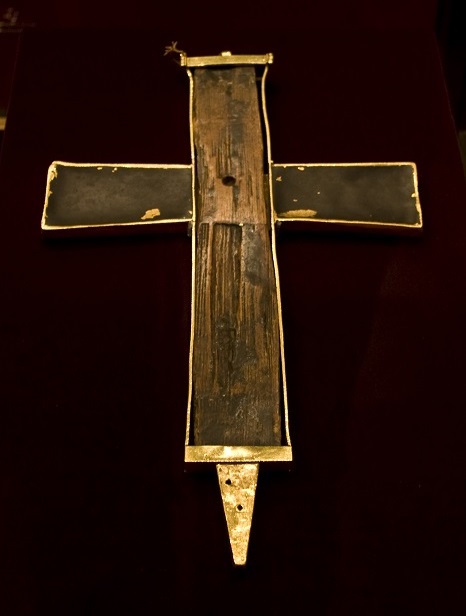
holy cross

Holy Cross, Romanos III, with the hole of a nail from the Crucifixion

The miracle displayed in the video below is the traditional mark of authenticity of any splinter of wood which people might claim to be a segment of the true Holy Wood. The video shows a monk from Mount Athos placing the splinter of the Holy Wood in a glass of water. Initially, the splinter naturally floats, but after the monk says the Trisagion prayer, Psalms 50 and 142 , and makes the sign of the Cross three times with this splinter on the water, when he places it in the water again, the splinter sinks to the bottom. 

The monk also displays a fragrant relic of St. Haralambos towards the end for veneration.