Taking things for granted is a trap most of us fall into. It is easy to get used to things and to stop noticing. We stop noticing God’s little gifts, little gestures of love of those around us, our comforts and advantages. The last four weeks, since Father J. has been taken gravely ill, have been a time of deep sadness but also of reflection and hopefully of growth.
Familiarity is a dangerous element in our spiritual life. I have spent so much time with Father J. over the last 18 years, I have relied so much on his advice, prayers, lifts to church, on his love, tolerance and good will that I think I have come to take it all for granted. In any crisis, I assume that he will be there to guide me and especially pray for me. In this crisis, for the first time, I had to pray for him and couldn’t ask for his guidance. I felt lost, but I also felt more than ever the power of prayer, the strengthening bonds of fellowship and I experienced once again the manifold grace of brothers and sisters in Christ praying together. For years now, I have felt that father joyfully carried me and every single person in his church on his back like a cross. His care and prayers make up for our negligence and lack of zeal, for all our lack of love towards God, the church and others.
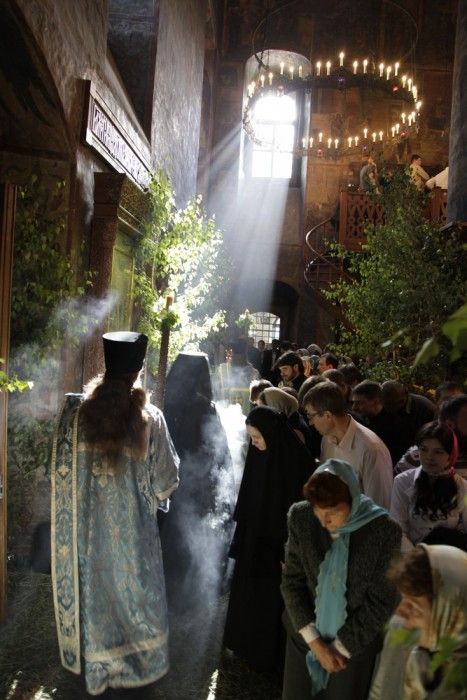
As a community, especially the cradle Orthodox, we always take for granted that we shall have a church where the Holy Liturgy will be served every Sunday (take it or leave it as it suits us), that there will be a Father to come bless our house, cars, food and visit us when we are ill, that there will be a Father to sign the papers of church attendance for our children to get a place at a desired school and give us a reference of good character, that this Father will pray for us whenever we ask him, that he will be there to hear our confession whenever
we feel burdened, that he will settle our little squabbles, that he will baptise our children and read us the prayers on our death bed and serve at our funeral. In the case of our parish, we take for granted even more than that, that our Father will make sure everyone has transport to get to church, that he will answer the phone to hear our little troubles at any hour of the day or night, that he will arrive first in church and leave last and generally make sure that everything is well with the church and in our life. The last weeks have forcefully reminded me that all these are not our due or by any means guaranteed to be there and that we are blessed to have had all these for so many years through God’s grace and Father J.’s love, faith and energy.
Umberto Eco said: “Absence is to love as wind is to fire: it extinguishes the little flame, it
fans the big.” I cannot exactly quantify my affection for Father J., but I have thought
of him more over the last month than ever before. In his absence, so many touching memories and images came flooding in bringing along both sadness and joy. One of my favourite mental snapshots is of Father looking up to see somebody come through the church door. Every time his eyes light up with joy when his gaze rests on you as you come in through the door and I noticed that Father’s joy is even greater when someone comes who has not been to the church in months or years. This joyful, loving gaze makes you feel so welcome and loved and somehow special. It makes you feel that you are coming home. And this image lead on to another memory of Father crying when he reads the Gospel of the Return of the prodigal son. I cannot remember him ever reading it without tears in his eyes. His love for all these many prodigal children that we are is so great that he stands by us in prayer before God no matter what we are or have done. I know for sure he has stood by me with gentleness and patience even when I disobeyed his spiritual guidance or I argued back or wanted to leave the church.
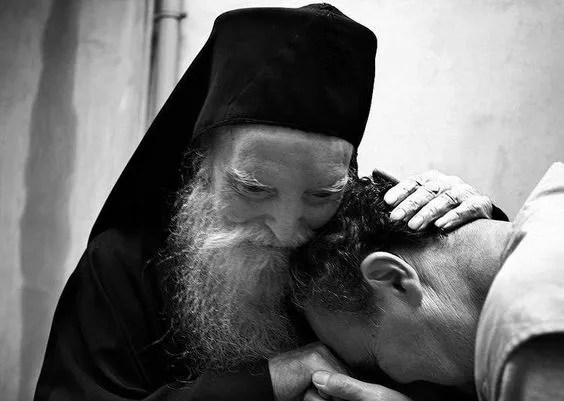
St John of the Ladder teaches that it is more fearful to anger your Spiritual Father than to
disobey and anger God himself. If we anger God, our spiritual father has the grace to pray for us, to intercede and obtain forgiveness for us, but if our spiritual father turns away from us, we have no defence or advocate before God. This is how I have felt about my Spiritual Father, about Father J. He has been my advocate before God, my safety rope for the rock climbing. This rope has kept me connected to the rock when I fell, it stopped me from walking away and giving up when the going got too hard.
Fr Seraphim of Mull Monastery tells the story of the advice he received from his spiritual
father just before he was ordained. He told him that the value of his priesthood will be measured in the madness of his love for every single human being who will stand before him irrespective of what they look like, who they are, where they come from, what they have done.
This is exactly how I see Father’s ministry. In his love of all people and in his joyful daily sacrifices for us, I see the reflection of God’s love for all his children. By knowing Father, I feel I have come a step closer to understanding God’s love for every single one of us.
The church or monastery is like a beehive. The spirit of the queen permeates the whole hive and sets the tone for all the bees. If the queen bee is aggressive the whole hive will be an aggressive one, just so when a community has a very loving father, like us, the whole community is loving and gentle. And if at times this isn’t the case, Father dissipates all tension by his prayers and mild spirit.
As Father is recovering from his illness and there is a general sigh of relief in the community and a sense of joy and expectation, I have made a vow not to take my spiritual father for granted ever again or any of God’s gifts to our community, but rejoice in each of them and see them for what they are – signs of God’s love: the beautiful church filled with the gifts from Old parishioners, the people who have prepared the prosphoro, brought the wine, oil and candles and cleaned the church, the people who have come to give and receive and most of all the presence of a father through whose hand a gentle and humble God reaches out to his people. None of my or anyone’s giving of time, money or energy can match the wonder of these gifts.
A. McC.
* Kalo Stadio! A blessed Great Lent!