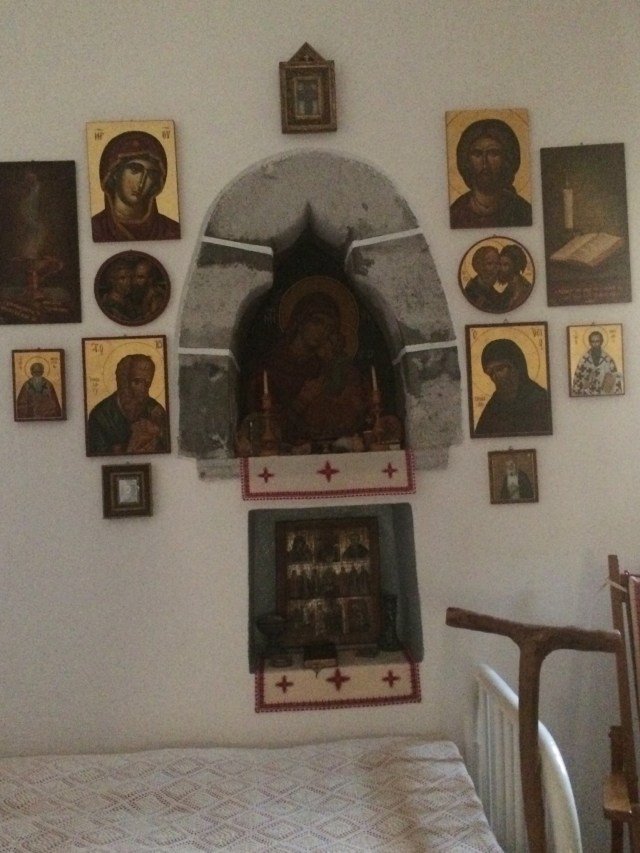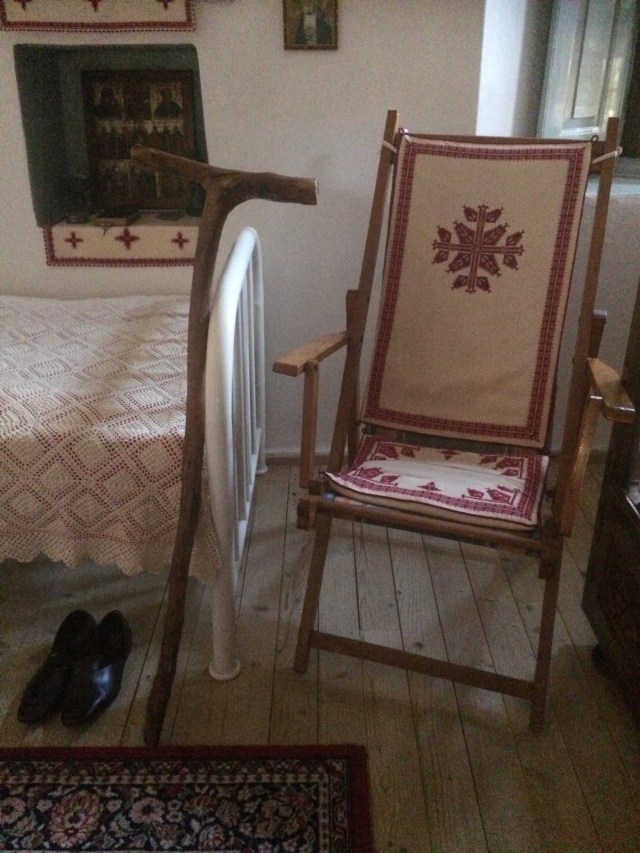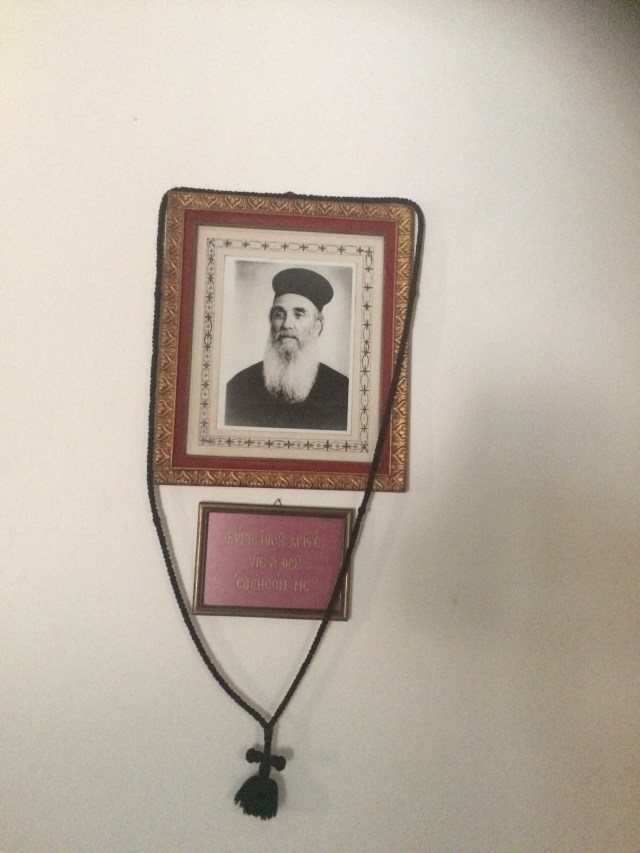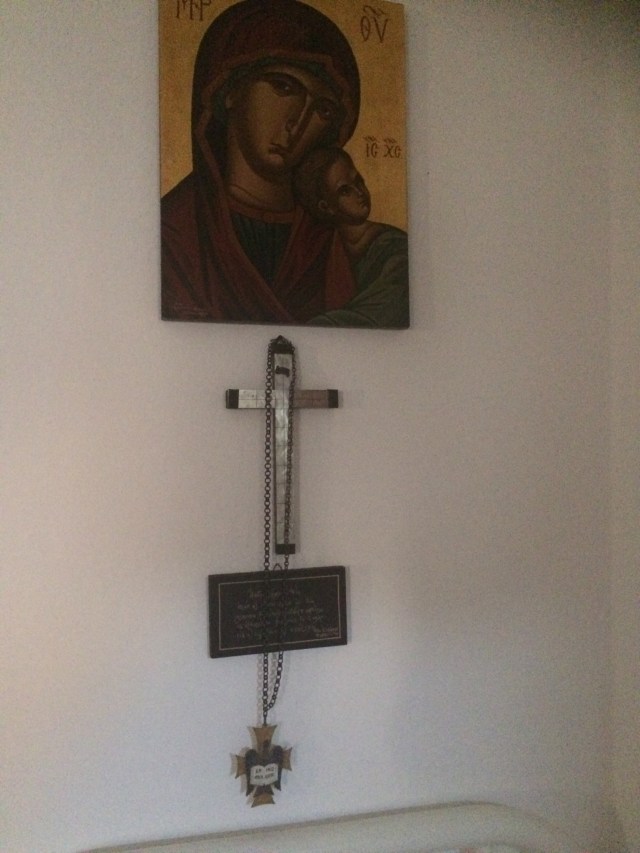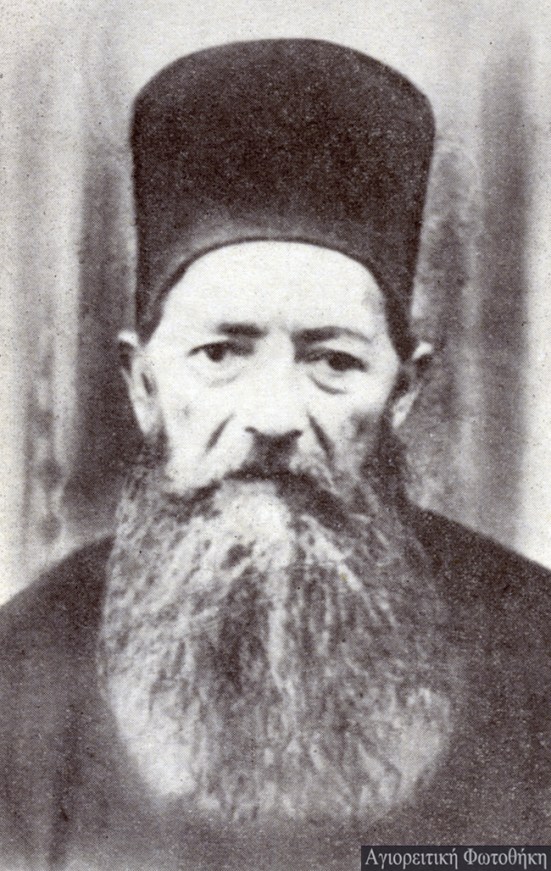
Holy Father Savvas the New of Kalymnos

agios_sabbas

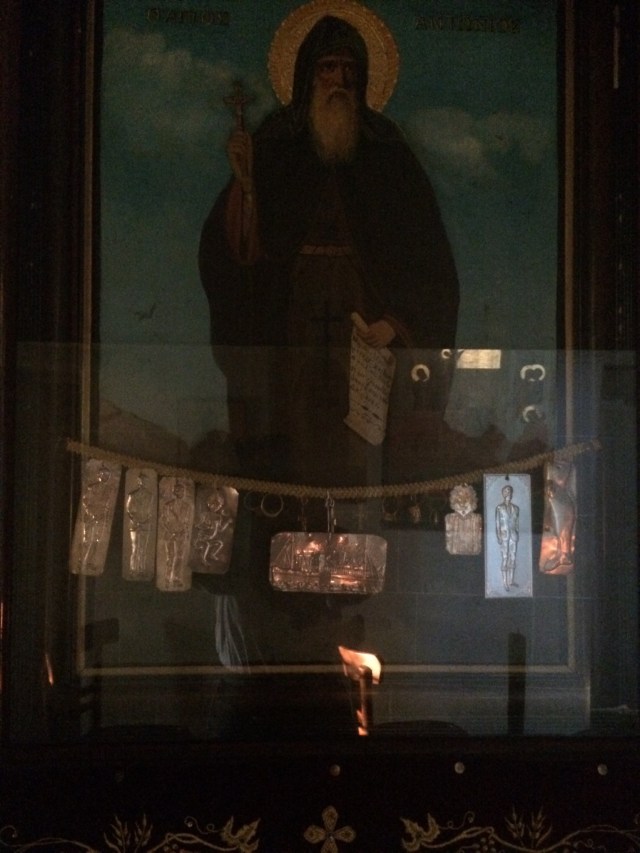
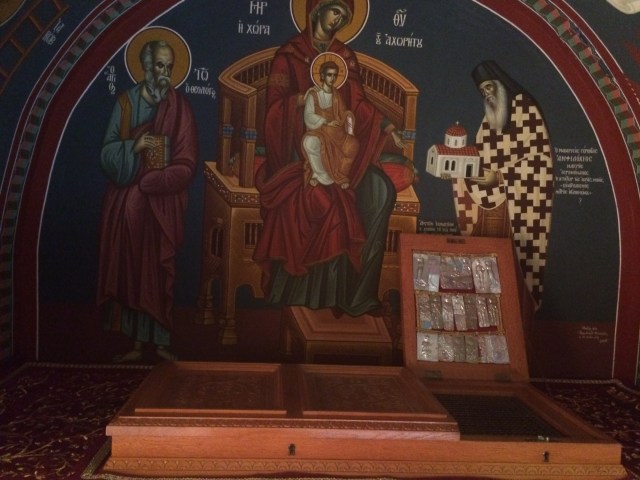
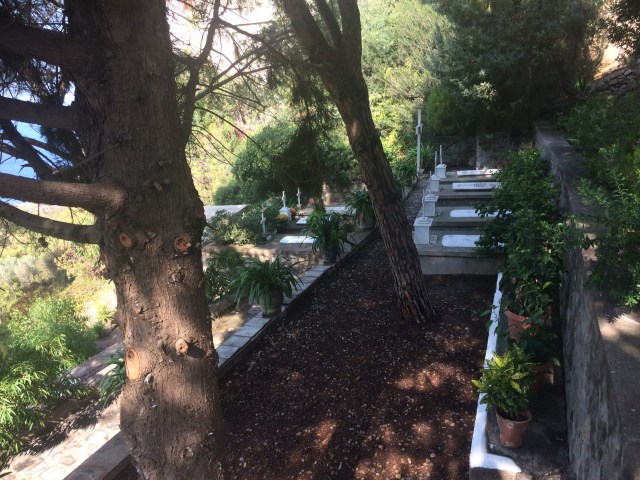
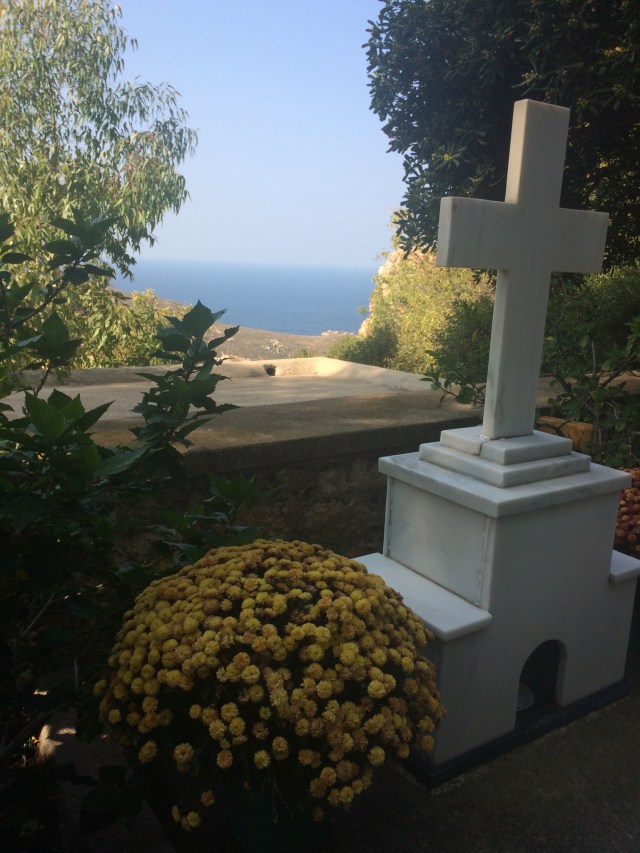
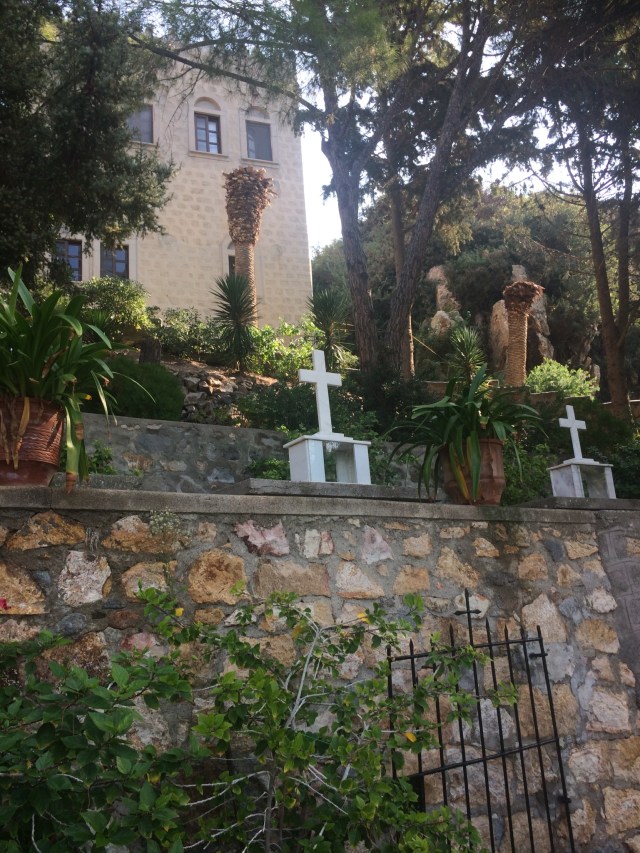
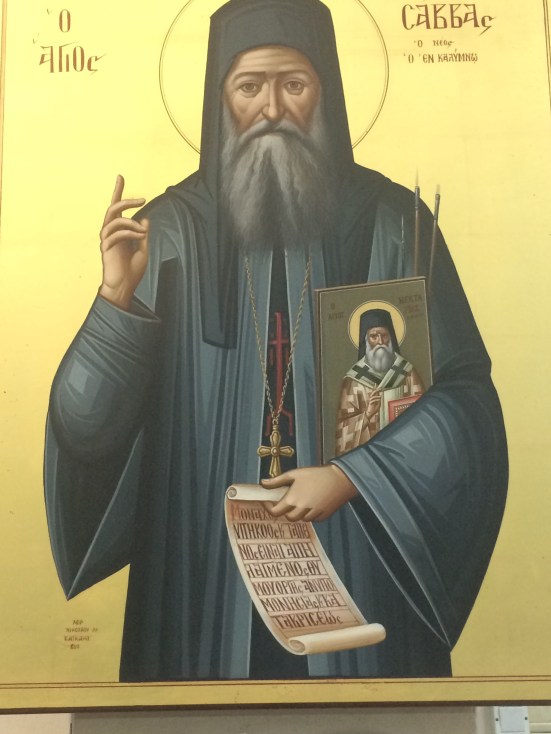
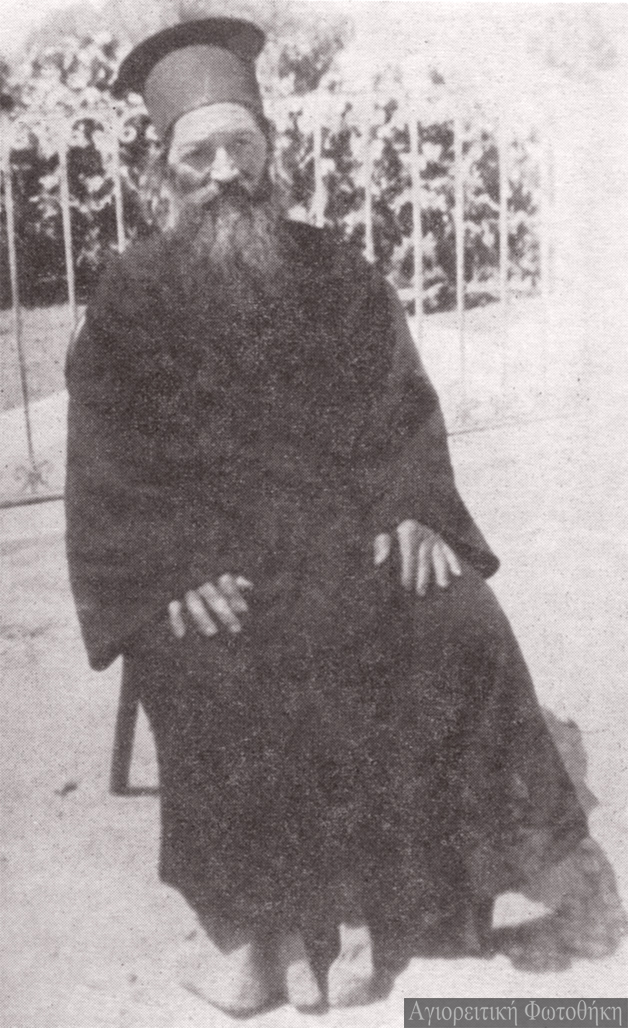
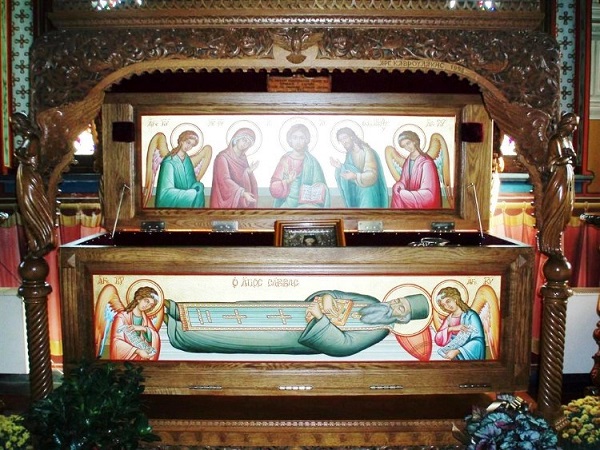
During my recent pilgrimage to Patmos, on my way back through Kalymnos, I venerated the incorrupt relics of an amazing ascetic and Saint of the “latter days”, our Holy Father Savvas the New of Kalymnos. I even spoke to people whose parents confessed to him and remember with tears his love, compassion and angelic purity. 
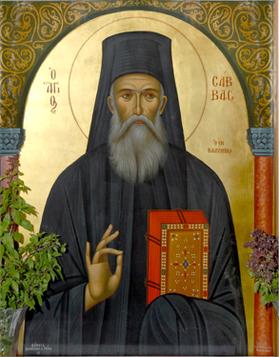
Saint_Savvas_from_Church

I would like to share here two episodes from his life which made a big impression on me (recorded in the monastery’s edition of his life):


In Athens he met the acolyte of Saint Nektarios, who informed him that Saint Nektarios was looking for him. Based on this fact, it is assumed that the two saints had met before; in fact, most biographers agree that St Savvas was St. Nektarios’ spiritual child. Therefore, he went from Athens to Aegina in 1919, where he was with Saint Nektarios until he reposed. There he served as a priest in the Convent of the Holy Trinity. He taught the nuns iconography and ecclesiastical music. Upon the repose of Saint Nektarios in 1920, Savas witnessed the first miracle of the Saint when, after his repose, St. Nektarios leaned over so that St. Savas could attire him with his epitrahelion [ie. stole], and then the Saint returned back to his previous rigour mortis (ie. postmortem rigidity). St. Savas performed the funeral and for the first three nights he continued his communication with St. Nektarios over his grave, asking him a number of questions and listening to his answers! St. Savvas’ biographers have recorded those facts from first-hand witnesses and the stunned nuns’ testimonies.
Then, St. Savas enclosed himself in a cell for forty days where he lived in strict prayer and fasting, and emerged holding an icon of Saint Nektarios he had painted, which was the first icon of the Saint to exist. He gave the icon to the abbess ordering her to offer to the faithful for veneration. The abbess told him that this was not possible, as St Nektarios had not been yet officially canonised despite his numerous miracles from the very first moment of his repose and that such an action was not prudent and might get them in trouble with the ecclesiastical authorities and even cause the shutting down of the monastery. But St. Savas insisted that “You must obey. Take this icon and offer it for veneration and do not scrutinise God’s Ways”.
IMG_3965.JPG
The second episode too happened again in Aegina. A young nun, Nektaria, wanted to see for one last time the face of St. Nektarios after his repose and started digging stealthily his tomb. The other nuns caught her in the act and reported her to the Abbess. She rebuked her and then sent her to St. Savas. He too rebuked her sternly and told her that her action was called grave-robbing and she should not receive Holy Communion until Holy Thursday. The young nun started to cry and beg for forgiveness, telling St. Savas that she did not know that what she had been doing was wrong and sinful. As soon as she left St. Savas’ cell, St. Nektarios appeared to St. Savas, smiling,  and told him: “Elder, forgive her. She is very young. She didn’t know, she didn’t know that this was a sin. Offer her Holy Communion on Holy Thursday. Actually, offer her Holy Communion before Holy Thursday. Did you hear, Elder? Have mercy on her. She did not know. Did you hear? Thank you.”


Apolytikion
Let us faithful praise Holy Savvas, the glory and protector of Kalymnos, and peer of the Holy Ascetics of old; for he has been glorified resplendently as a servant of Christ, with the gift of working miracles, and he bestows upon all God’s grace and mercy.
Kontakion
Today the island of the Kalymnians celebrates your holy memory with a rejoicing heart; for it possesses as truly God-given wealth, your sacred body that has been glorified by God, O Father Savvas, approaching which they receive health of both soul and body.
Megalynarion
Rejoice, thou new star of the Church, the offspring of Thrace and the beauty of Kalymnos, O God-inspired Savvas, fellow citizen of angels and equal of all the saints.


You contended with the saints of old Savas,
And are glorified with them by your numerous miracles.

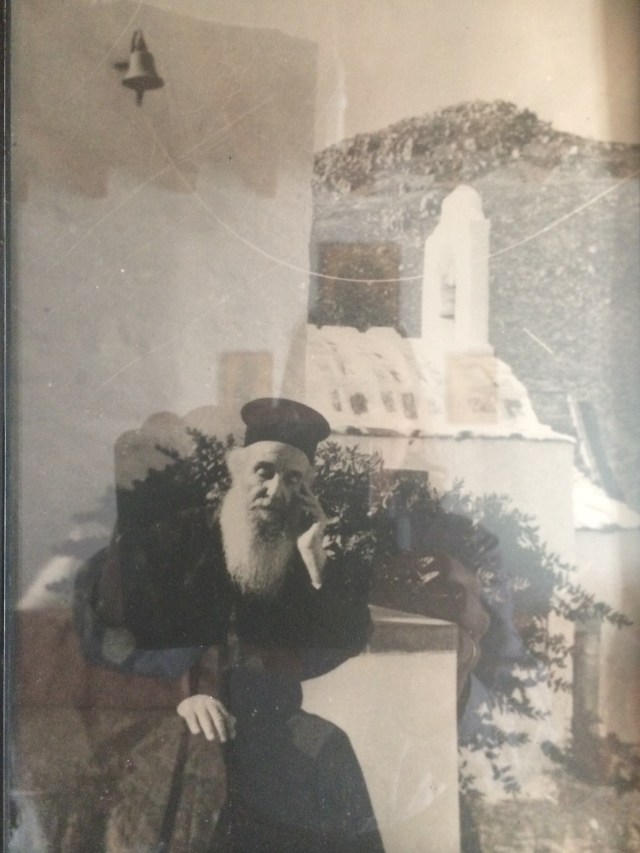
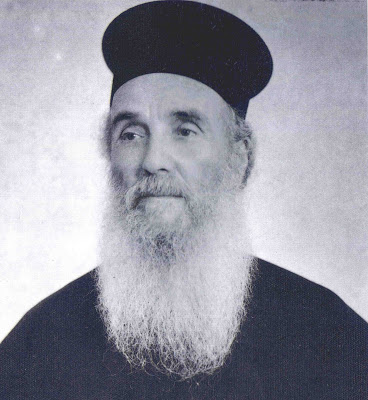
This angel on earth and a human in heaven was born in 1862 Herakleitsa, Eastern Thrace, Ottoman Empire and reposed in our Lord on 7 April 1947 (aged 85). He lived as a monastic and practiced the arts of Iconography and Ecclesiastical Music in the Saint Anna’s Skete (Mount Athos), the historic Monastery of Saint George Chozeba, the Convent of the Holy Trinity (Aegina), the monastery of St John the theologian and Evangelist (Patmos) and the Convent of All Saints (Kalymnos) and a number of caves and hermitages all over the world.  His feast day is 7 April (25 March), The Fifth Sunday in Lent and was canonised in 1992.

For those who have never heard of him, a synopsis of his life can be found at the Mystagogy Resource Page.

Twenty-four hours with St. Amphilochios (II)

1.Cultivate the Jesus Prayer and a time will come when your heart will leap with joy, just as it does when you are about to see a person who you love very much.

IMG_0026

2.Do not neglect evening prayer. Pray with eagerness like those who are going to a feast. They are awake and feel joy alone. Thus, since you are going to speak with your Bridegroom, do not listen when the Tempter tells you various things in order to hinder you, because you know there is someone who cares for you.
IMG_0027

3.-“Elder, how must we picture Christ?”

-“We must always bring to Christ to mind with love. We could be holding the photograph of someone in our hands, but since we do not know them, we do not love him, we are not moved. Whereas, when we pick up a photograph of our mother, our soul immediately leaps and cries out with love.

IMG_0028

4.A person can be raised up above the earth by two wings, one is simplicity and the other is purity of heart. You must be simple in your actions and pure in your thoughts and feelings. With a pure heart you’ll seek God and with simplicity you’ll find Him and be glad. A pure heart passes through Heavens gate with ease.

IMG_0029

5.Self-denial must be cultivated with discernment, otherwise we reach the point of suicide.

IMG_0030

6.We are on the high seas of life, sometimes there are storms and at other times calm. God’s grace does not leave us. Else, we would have sunk, if he had not held us up. 

IMG_0031

7.The saints always look to the other life. It is the grace of the remembrance of death.

IMG_0033

8.God guards us from temptation. He does not allow us to be tempted beyond our strength. He allows everything for our good.

IMG_0034

9.When spirituality increases, even sleep will have been fought off.

IMG_0035

10.Prayer is grace. God gives it when zeal and humility exist.

IMG_0036

11.Fight the Hater of Good, who envies you, bravely suffer whatever befalls you with fortitude, patience and faith.

IMG_0037

12.Do not allow your soul’s enemy to wage war against you. He appears in sheep’s clothing, supposedly wanting your soul’s benefit.

IMG_0038

13.Trust in the Lord always and he will nourish you in time of hunger. … Spiritual bonds become unbreakable when they come across a child-like spirit, innocence and sanctity.

IMG_0039

14.With a good word for your neighbour, supporting him, you buy paradise.

IMG_0040

15.Repentance must occur, not from fear of punishment but because we have sinned before God. Sweeten your thoughts with words of consolation and hope. Warm your words with the warmth of your love towards your Bridegroom and remember His Passion, which he underwent for you, so that you would remain firm, devoted and humble. Give your whole self completely over to the protecting veil of the Panagia.

IMG_0041

16.Love giving hospitality, my child, for it opens the gates of Paradise. In this you also offer hospitality to angels. “Entertain strangers so that you won’t be a stranger to God.”

IMG_0042

17.The saints submitted to whatever God sent them, with childlike simplicity, “That’s the way You want it. Let Your will be done.”

IMG_0043

18.Hospitality… the greatest of virtues. It draws the grace of the Holy Spirit towards us. In every stranger’s face, my child, I see Christ himself.

IMG_0045

Chapel of Unknown martyrs by St. Amphilochios

19.Sorrow is pleasing to God, in as much as it doesn’t take away our courage to fight.

IMG_0046

20.It is necessary and beneficial for a general self-examination to take place from time to time, remembering all former sins. … Our deeds, dear sister, will not save us; God’s infinite mercy will.

IMG_0047

21.Leave all your concerns to the hands of God. Ask for whatever you want, like a child asking from its father. … Prayer is a gift from God. Always ask with hope.


patmos5

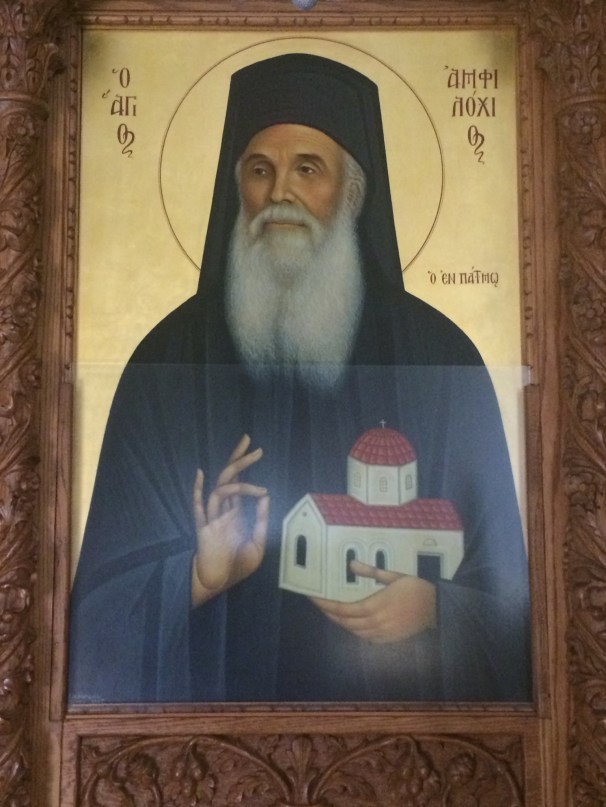
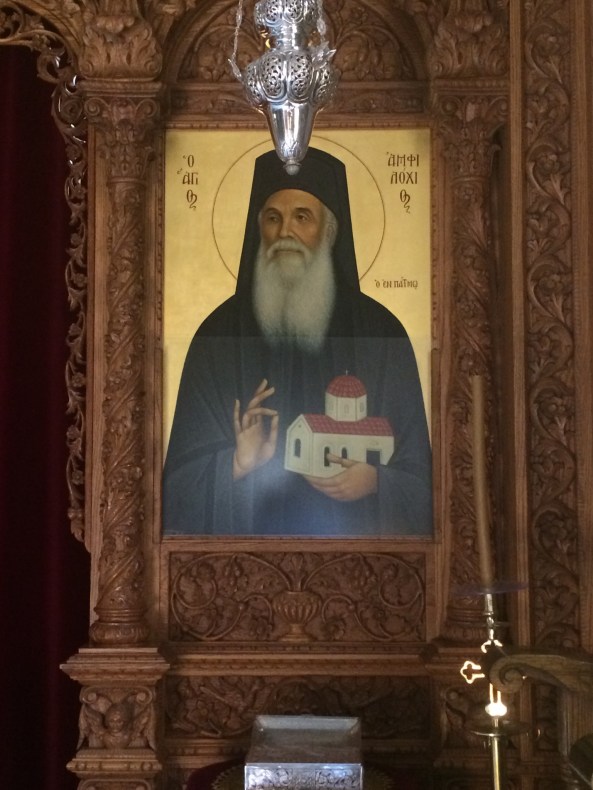
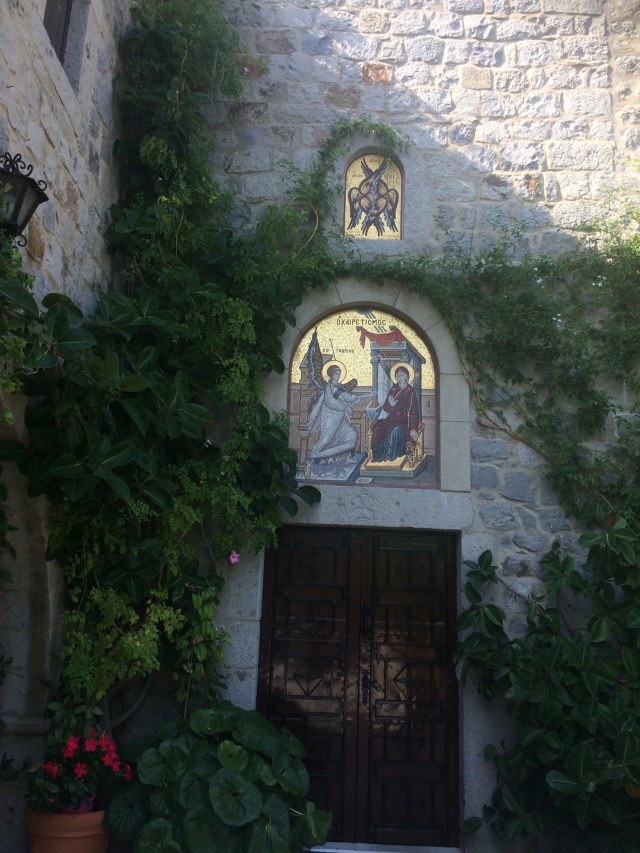
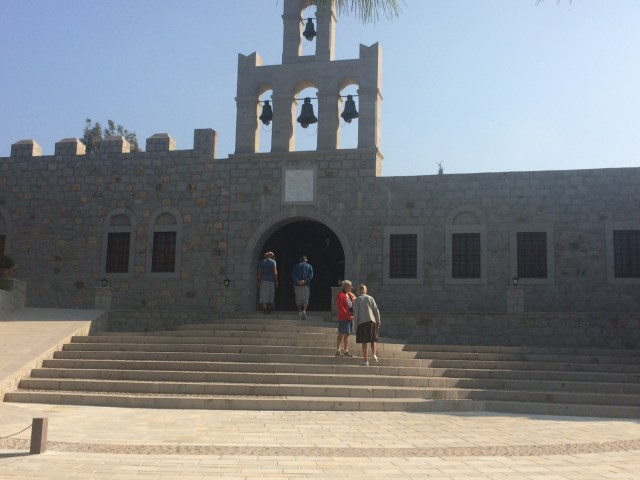
The nunnery of  Evangelismos “The Annunciation to the Mother of the Beloved One” was built in 1613 from a Cretan monk of the Monastery, named Nikiforos. It is southwest of Chora. It consists of the temple of the Evangelistria (Our Lady of the Annunciation) of the side chapel of St. Luke and from a three-floored fortified tower with the side chapel of St. Antonio. The foundation of the monastery is dated from 1936, from the monk Amphilochios Makris, a great spiritual figure. He worked hard for the foundation and the development of the nunnery. The icons in the church date back to the 15th, 16th and 17th century. The sisterhood is home to over 40 nuns who apart from praying, occupy themselves with social welfare, gardening, beekeeping and Byzantine embroidery called the”spitha” (spark). The same stitch was used to make embroidery for aristocratic Byzantine families from the time of Hosios Cristodoulos.

Spiritual Counsels and Sayings Translated by Marina Robb.

All material is copywrited to Evangelismos Monastery, Patmos.

Source: CyberDesert

Twenty-four hours with St. Amphilochios (I)

patmos9

At the nunnery of  Evangelismos “The Annunciation to the Mother of the Beloved One” in Patmos

IMG_0048


1.When you cultivate prayer the Tempter’s blusterings will not trouble you. Prayer diminishes his strength, he cannot do anything to us. (February 1965) .. The spiritual life has great pleasures. You fly, you leave the world , you don’t consider anything. You become children and God dwells in your heart. 

IMG_0002

St. Amhilochios Makris

2. The end of my life draws near I ask you to live a holy life, to walk along holy paths, so that you may help both our Church and Greece. … Your hearts are young and want to love. You must have our Christ alone in your heart. Your Bridegroom wants you to love only Him. 1/1/1968

IMG_0003

3.Remaining faithful to Monasticism is considered to be a martyrdom. … We must have our gaze fixed on heaven. Then nothing will shake us. …Take communion regularly, pray warmly, be patient and you will see a strong hand holding you.

IMG_0004

4.Christ often comes and knocks at your door and you invite him to sit in the living-room of your soul. Then, absorbed in your own business you forget the Great Visitor. He waits for you to appear and when you are too long in returning, he gets up and leaves. At other times, you are so busy that you answer him from the window. You don’t even have time to open the door.

IMG_0005

5.You are royalty, destined for the heavenly bridal chamber. …. Christ is near us even if we don’t see Him. Sometimes, from his great love, He gives us a slap too.

IMG_0006

6.We you see a person who is spiritually tired do not burden him any further, because his knees won’t be able to bear it. … A person who suffers from egotism attracts no-one. And if he does attract someone he will soon go away. When one comes across a childlike spirit, innocence and holiness the bond becomes unbreakable.

IMG_0007

7.Love the One, so that even wild beasts will love you. … Do you know there is an eleventh commandment not recorded in the Bible, and it says, ‘Love the trees.’ Those who do not love trees do not love Christ.

IMG_0008

8.True wealth, for me, is to see you in the Kingdom of Heaven. [to his spiritual children]

IMG_0009

9.When the flame of love exists, it consumes whatever evil approaches. … The person who shouts has no strength.

IMG_0010

10.The person who loves spiritually, feels prayerful, that he can be found within God and his brother. He is saddened when his brother is not advancing well and prays for his progress. Whoever has Christian love never changes.

IMG_0011

11.Hold the banner of Christ up high, so that you’ve always got your elder’s telephone number no matter where you are. … The Grace of the All-Holy Spirit makes a person send out rays. However, other people must have a good receiver in order to realise this. 1/1/1968

IMG_0012

12.Christ is the same, yesterday and today, but we have closed our eyes and look into the darkness. It is because we carry on like this that some fall in the mud and others are killed.

IMG_0013

13.I beseech the Lord to sanctify you, so that I may see you in Paradise. This is the dowry which I seek from the Lord for you.

IMG_0014

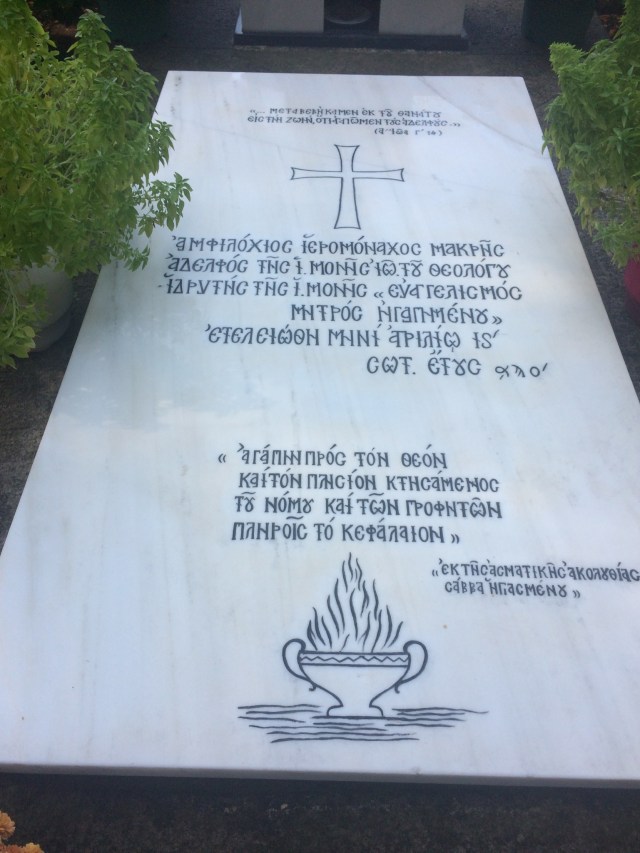
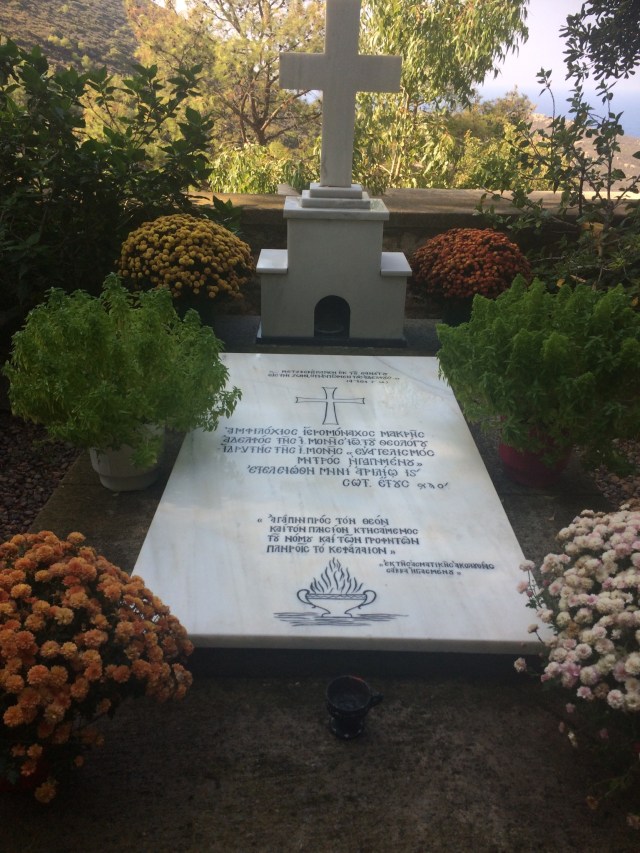
St Amphilochios’ tomb

14.For God’s grace to come during the Liturgy you must be concentrated and untroubled. 

IMG_0015

15.The more a person loves God, the more he loves other people. He loves them with holiness, respect and refinement, as images of God.

IMG_0016

16.When a person lacks inner warmth, he will be frozen and cold, even in summer.

IMG_0017

17.When your heart does not have Christ, it will contain either money, property or people instead. 

IMG_0018

18.Please put this commandment into practice. Cultivate love towards the Person of Christ to such an extent that, when you pronounce His name, tears fall from your eyes. Your heart must really burn. Then He will become your teacher. He will be your Guide, your Brother, your Father, and your Elder.

IMG_0019

19.Love your Bridegroom Christ with all your heart and then everyone will love you and take care of you.

IMG_0020

20.I desire the rebirth of Monasticism, because in my opinion, monasticism is the evzone [elite military unit] battalion of the Church.

IMG_0021

21.God’s protection diminishes temptation. … Innocence is greater than genius.

22.Because of widespread corruption, people cannot understand that spiritual love exists.

IMG_0023

St. Amphilochios cell

23.Let us look upon everyone as our superiors, however weak they may appear. Let us not be harsh, but always bear in mind that the other person also has the same destination as us. 

IMG_0024

24.We must have Love, even if they do us the greatest harm, we must love them. We will be able to enter Paradise only with love. 

IMG_0025


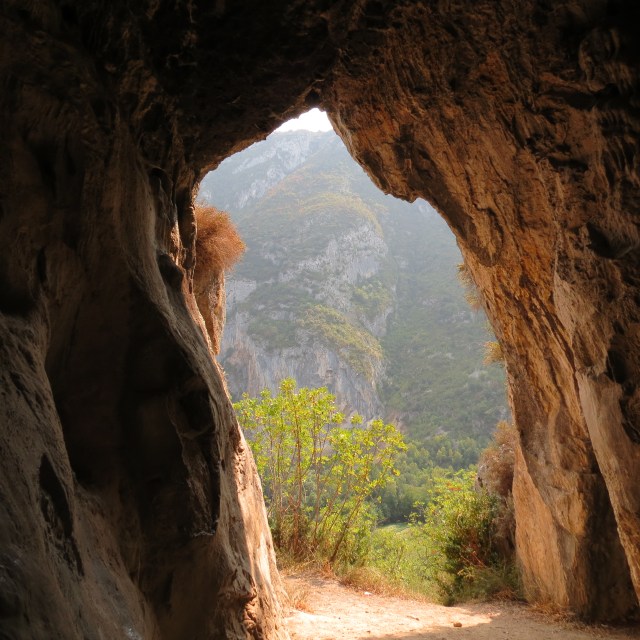
My cave

cave.jpg

— “Elder, I want to flee to the mountains, far away from the world, and find a cave to hide so that neither I tire anybody nor I get worn out”.

— “Try, my dear child, to enter Jesus’ cave, and once inside there, everything will be put right.”

St Amphilochios of Patmos (Makris)

* This recently canonised Saint awaited the little city hermit, ‘called’ him through his spiritual father and eventually ‘adopted’ him during his recent trip to Patmos. Glory to God for all things!!! “I think he would not have called you to visit him if it was not for this blessing” [Abouna].  Yet the Saint’s reassurance was sobering: “You should be glad. Jesus holds an artist’s chisel in His hands. He wants to prepare you a statue for the Heavenly Palace.” May St. Amphilochios teach the little city hermit to submit, like all the saints, to whatever God sends him, with childlike simplicity: “That’s the way You want it. Let Your will be done.”


st amphilohios.jpg

“Worldly people tire you, because whatever is stored up inside them comes at you like waves of electricity. We must be people of grace so much so that whoever comes to us may find rest.”

*

-“How do you manage to have such patience and perseverance in everything?”

– “The grace of God helps. I always believe in the power of God, my child, Who alters and adjusts everything for the benefit of our soul.”

*

“When I see a person who is irritated, I don’t listen to what he is saying, but pray for God to pacify him. That’s why I don’t get distressed. When they calm down, when the time is right, I talk to them because they are then in a position to comprehend their foolishness.”

How much do we really need?

Minimalism has always attracted me but will by necessity become central to my lifestyle from now on, if I am to survive what is to come… The word from my spiritual father was unequivocal this time. Life as I have known it will change drastically in the months to come: the little city hermit will constantly be on the move. Little did I know back to four years ago how prophetic this would be: “My Lifestyle – Suitcases, Lover of the Theotokos, Pilgrim, Traveller and a Little City Hermit. Belonging to Neither and Both.”


*


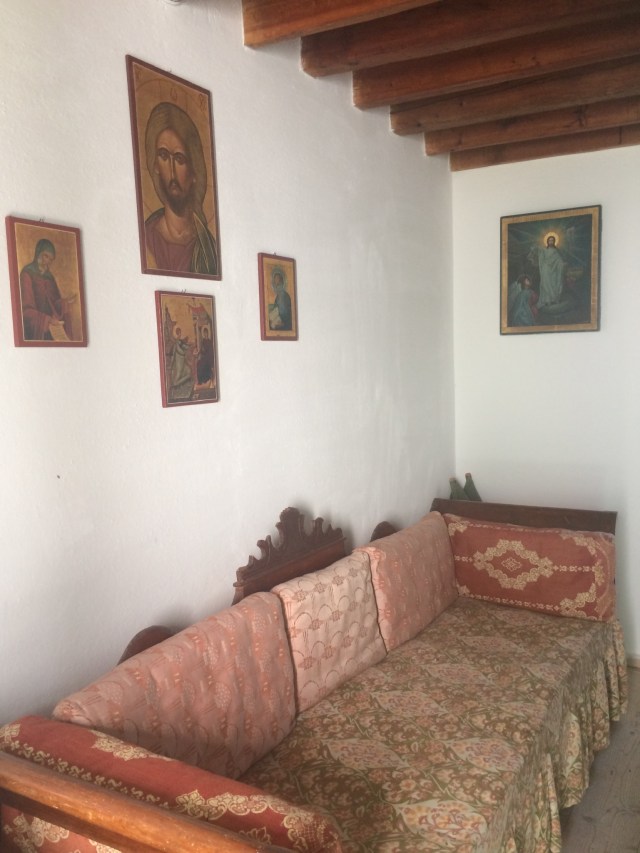
“Since I am a leader, I often visit different places, in luxurious salons and houses, and then I remember the cell of elder Paisios, in which there was nothing.

Do you know what this “nothing” means? Absolutely nothing, in the truest sense of the word. Some boxes and old blankets that he had found and attached were his “sofas.” He said about them:

– I specially ordered these sofas from France, from Louis! – so he told us laughingly.

At first, when we went to him, since I was young, he said to me:

– For you, pop, I have a special chair, you sit there because it is special, and I hold it for official guests!

And what do you think it was? The box was covered with a blanket, and another blanket was nailed to the wall so that you would not be cold when you lean against it.

He had nothing, the icons were paper, inserted in cellophane, there was a stool instead of a table; The old man put a board on his knees and wrote on it. Poverty. He didn’t have anything, not because he couldn’t, but because he didn’t want it. If he wanted, he would be rich, a millionaire – if he wanted, but he did not want it. All his goodness was placed in one chest, where there was a little bean, simple rice and what was sometimes worn from monasteries: some dried fruit or Turkish delight, which he treated visitors to. No pans, nothing, that is, those things that for us are self-evident, were a luxury for him.

Once the old man prepared tea for one person – what do you think? In a canned food can. Remember, grandmothers once did that? He put a few pieces of grass into it and brewed tea, and then, when he poured it into another can, all the tea leaves fell out. The man went and bought him a sieve, and he said to him:

– But, my child, why did you bring it? Do we wish luxury now?

– Geronda, one tea strainer – is it a luxury? So that tea leaves do not get into tea … What is this luxurious?

And he answered:

– Why did you bring it? Now I will have to wash it, I will need a nail to hang it, a hammer to nail it, I will have to take care of it … Why do I need all this stuff? You take this your strainer, I do not need it, I do not want it.

Such simple things were a luxury to him. But I confess to you that I would exchange all the salons in the world for this cell, infinitely poor, modest, which, however, was full of God, even the dust in it – everything in it was filled with God.

I was told what some people from America had done: they went and took a rag, about which the elder wiped his shoes, before entering the cell, cut it into many pieces and distributed them to people, and they faithfully and reverently kept this rag , with which he wiped his feet, and miracles were performed. So you say to yourself: this is what God’s man means! Even the dust from his feet will be honored.

So who succeeded now? Whether the one who lived in the palaces and the memory of him perished, and it is unknown whether even children remember him — or this extremely poor, uneducated ascetic in the middle of the mountains, who, however, was filled with blessing from God with happiness, optimism, the former like a source from which happiness and joy exuded? And we all walked, like all suffering people, drank and were saturated with this water, flowing from this poor man, who often had nothing to eat.

I remember once, when I went to Thessaloniki, I bought some dry milk for the old man, because he had problems with his stomach, and brought him to him.

– What is it?

– Geronda, for your stomach! A little water and a spoonful of powder – and it turns out milk!

– Well, leave it over there!

After a year or two, I had to do something there and found a bag of milk in the same corner. He did not even open it, did not touch it. The way I bought it, so it was.

“Geronda blessed, did you leave it there?”

And he answered me:

– If I wanted it, I would have bought it myself! I did not ask you to bring it to me!

“I don’t have it, not because I can’t, but because I don’t want it, I decided that my life would be like that. If I wanted to, I could live differently. ”

This, naturally, I am not saying so that we imitate him, because, probably, in the world where we live, we don’t need and we can’t even do such things because of our obligations. But let our heart be free, wise, and we need to learn what matters in our lives: for ultimately only God matters.

You say: “I did not succeed in one thing, did not succeed in the other, did not become what I wanted.” Why do you want this? All this is transient, vain. Achieve what has value. Have you attained God? Do you have God in your heart? Do you have the expectation of the kingdom of God? That is what has value. And everything else – for a short time.

Well, add everything else, and what happened? Those who have should be as not having. You will not be with this for long, you will lose it, you will not have it all your life. Even the most expensive things, even they will not be with you in the hour of your difficulty. God is here Who will be with you always, you need Him, you need Christ. We will look for Him.”

Metropolitan Athanasius of Limassol

The fire in Mati and St. Paisios

st paisios1

st paisios2

st paisios4.png

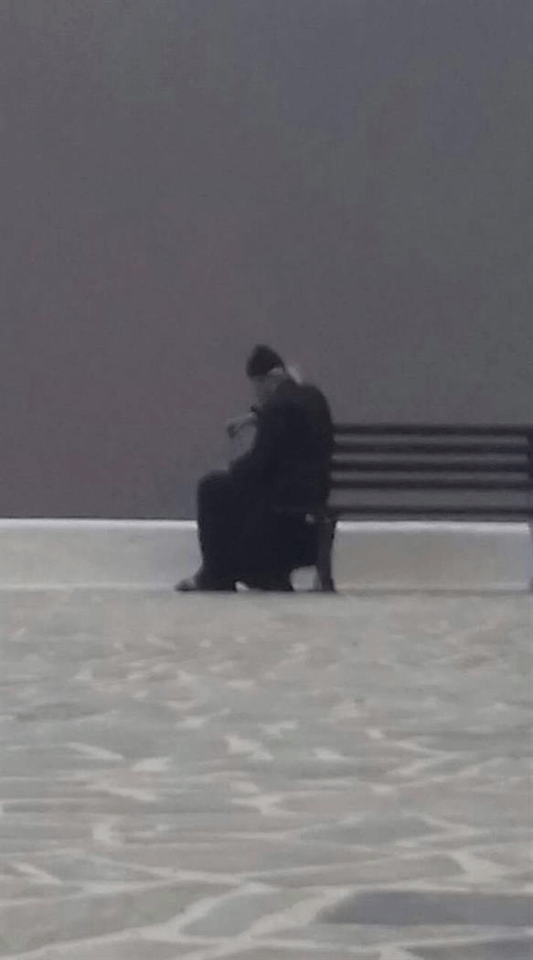
It was the moment when the fire of 23rd July had completed its life-damaging work in Neo Vujza and Mati (about 7pm in the evening), and started spreading northeast to Agios Andreas where the children’s camps of the Municipality of Athens is located and southwest to Rafina.

Those present at the port of Rafina (where they had moved to escape the flames, including my brother) heard the bell in the chapel of Agios Nikolaos, located on a hill just above the harbour. The flames were already threatening the chapel. Some went to the chapel courtyard to see if there was a need for help.

Among them was a lady, and on the bench of the courtyard, she saw what looked like the form of a rallying priest who sat on the bench in the fumes and turned his body toward the flames. Impressed, she took a picture on her cell phone from a distance. Approaching, she took another one. But once she reached the bench, the figure disappeared unexpectedly and mysteriously into the smoke.

At that moment, the wailing stormy wind suddenly stopped blowing completely, so that the flames were not extended to the settlement of Rafina. A corresponding phenomenon, a sudden interruption of the wind that pushed the northeast flames, happened at the same time on the opposite side, at the boundary between Matio and St. Andrew. The result was to save the main settlement of Rafina and most importantly, save the area of ​​Agios Andreas where the camps were located.

It should be noted that 600 young children temporarily resorted to the beach of Agios Andreas whilst waiting for the buses to take them to Athens. The area of ​​Agios Andreas is overgrown with pine trees and with lush vegetation, just like Mattia. If the flames had reached this area, an incredible tragedy would unfold, much worse than what happened in Mati.

Note that the fire was expanding at an inconvenient speed, causing people to be trapped in the pass, unable to escape, not even by car. So, the dozens of unfortunate victims of the fire found in the beach at Mati were locked.

The lady, a few days later, visited Father Dorotheos, the Parish Priest of the Temple of the Assumption, the parish Church at Mati. She told him the incident with the priest who sat on the bench next to the chapel of St. Nicholas and showed him the pictures.

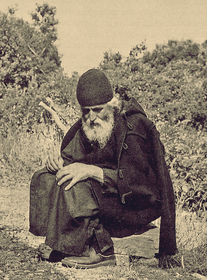
He first told her that this chapel does not have a priest and that he does not recognise any clergy in the face of the photos from those who serve in the wider region. In fact, he wondered what a priest can sit there among the wild fire and the smoke. But when he noticed the photographs better, he exclaimed with awe: “This is the face of Saint Paisios!”

The above story of this lady was narrated by Father Dorotheos to my brother, who lives next to the Church of the Assumption of the Virgin Mary.

If you carefully look at the two photographs the lady took, it will distinguish a priest-monk who only wears a robe, holds a prayer rope in his hand and has his body turned towards the flames. The resemblance to Saint Paisios is astonishing. In the closest picture, the cap of Saint Paisios is distinguished in the head of the figure, while on the feet of this figure can be seen flip-flops with socks. Another characteristic of the Saint.

Nikos Koulouris
Professor of Law
2/9/2018

Source: from Holy Apostles Greek Orthodox Parish and Community of Newcastle

A snake dying in the fire

snake

The man saw a snake dying in the fire, and decided to pull it out of the flame. When he did this, the snake bit him, causing unbearable pain. The man shook off the snake, and she fell into the fire again.

The man grabbed a metal pole, pulled the snake out of the flame and saved her life.

Some of the watchers approached the man and said: “This snake bit you, why are you still trying to save her?”

The man replied: “The nature of reptiles – to bite, but this should not change my nature – to help.”

Do not change your essence just because someone hurt you.
Do not lose your good heart, but learn to take precautions …


Source: Orthodox Parables and Stories

A few Saints Await

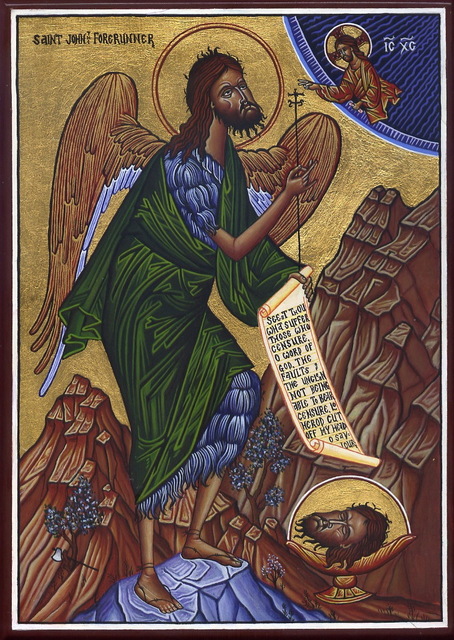
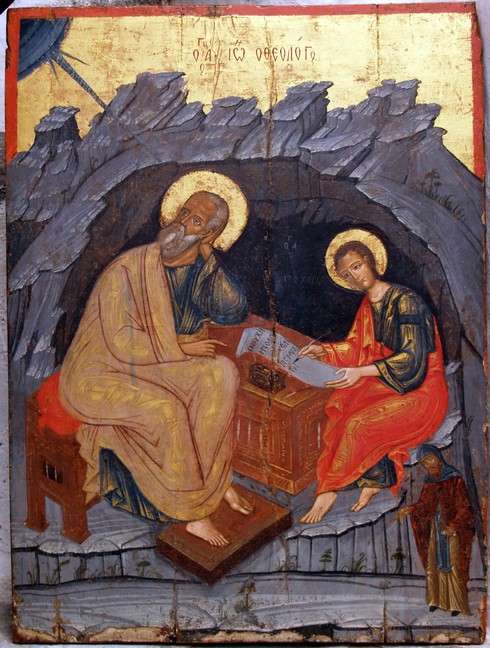
The little city hermit has started to take heart! So many prayers for him from all four corners of the world could not possibly go unheard! They have not been answered  in the way that he would have hoped — yet!– but this is a matter of least importance. Still in the dark, then, about a number of serious professional and family matters, the little city hermit is about to embark on a long pilgrimage across Greece and Romania, where a few Saints and spiritual elders await him for an “emergency treatment”:

St John the Forerunner in the Chalkidiki monastery of his spiritual father;

st john the forerunner

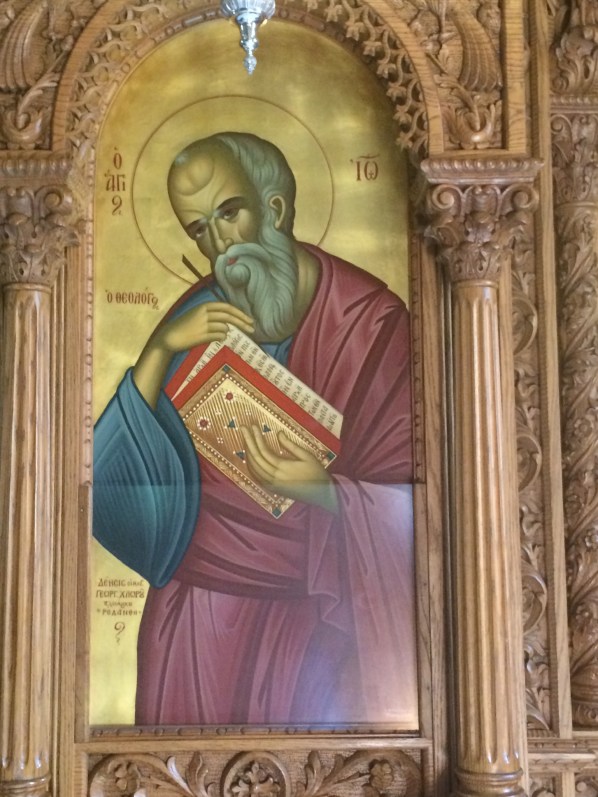
St John the Evangelist and St Amphilochios in Patmos!

st john the evangelistapokalipsi spilaio patmos ag

And an elusive Romanian father Ioann, literally hiding in a North Romania hamlet, who has been praying about him for a long time, and a spiritual sister has made all necessary arrangements for them to meet at long last!

outbuilding-at-horezu

Glory to God for all things! Even if no answers are to be disclosed in all these meetings, still so many blessings are under way!

Clay

clay.jpg

Clay robs clay.

Clay insults clay.

Clay slanders clay.

Clay gets rich at the expense of  clay.

Clay rules clay.

Clay punches clay.

Clay imprisons clay.


And in general:

Clay considers itself

wiser,

stronger,

richer,

nobler,

more valuable

to other clay.

Elder Joseph the Hesychast, Monastic Wisdom, Epistle 39


Agape and Philia Loves

christ's love
Lost in translation: Reflections on John 21:15-17 
 It is important to note that the first two times Christ inquires of Peter, “Do you love Me?” He uses a form of the word agape, which denotes the highest form of sacrificial and self-emptying love, the kind of love God has for man and that man can develop only through maturing in God’s grace. Each time, however, Peter is unable to claim such a lofty love.
When Peter answers, “You know that I love You,” he uses the term philo, which is a lesser form of love, akin to brotherly affection. When the Lord asks the third time, “Do you love Me?”He has changed to the term philo, condescending to Peter’s weakness and accepting whatever love Peter is able to offer. Nevertheless, Christ knows that Peter will develop agape love for Him, as Peter will eventually accept martyrdom for His sake (vv. 18, 19). Peter was grieved both that the Lord had to condescend to his level of love and that this was a clear, though gentle, reference to his three denials.

*

15 When they had finished eating, Jesus said to Simon Peter, “Simon son of John, do you love me more than these?”

“Yes, Lord,” he said, “you know that I love you.”

Jesus said, “Feed my lambs.”

16 Again Jesus said, “Simon son of John, do you love me?”

He answered, “Yes, Lord, you know that I love you.”

Jesus said, “Take care of my sheep.”

17 The third time he said to him, “Simon son of John, do you love me?”

Peter was hurt because Jesus asked him the third time, “Do you love me?” He said, “Lord, you know all things; you know that I love you.”

Jesus said, “Feed my sheep.

*

Ὅτε οὖν ἠρίστησαν, λέγει τῷ Σίμωνι Πέτρῳ ὁ Ἰησοῦς· Σίμων Ἰωνᾶ, ἀγαπᾷς με πλεῖον τούτων; λέγει αὐτῷ· ναί, Κύριε, σὺ οἶδας ὅτι φιλῶ σε. λέγει αὐτῷ· βόσκε τὰ ἀρνία μου. (Ιω. 21,15 )

λέγει αὐτῷ πάλιν δεύτερον· Σίμων Ἰωνᾶ, ἀγαπᾷς με; λέγει αὐτῷ· ναί, Κύριε, σὺ οἶδας ὅτι φιλῶ σε. λέγει αὐτῷ· ποίμαινε τὰ πρόβατά μου. (Ιω. 21,16 )

λέγει αὐτῷ τὸ τρίτον· Σίμων Ἰωνᾶ, φιλεῖς με; ἐλυπήθη ὁ Πέτρος ὅτι εἶπεν αὐτῷ τὸ τρίτον, φιλεῖς με, καὶ εἶπεν αὐτῷ· Κύριε, σὺ πάντα οἶδας, σὺ γινώσκεις ὅτι φιλῶ σε. λέγει αὐτῷ ὁ Ἰησοῦς· βόσκε τὰ πρόβατά μου. (Ιω. 21,17 )