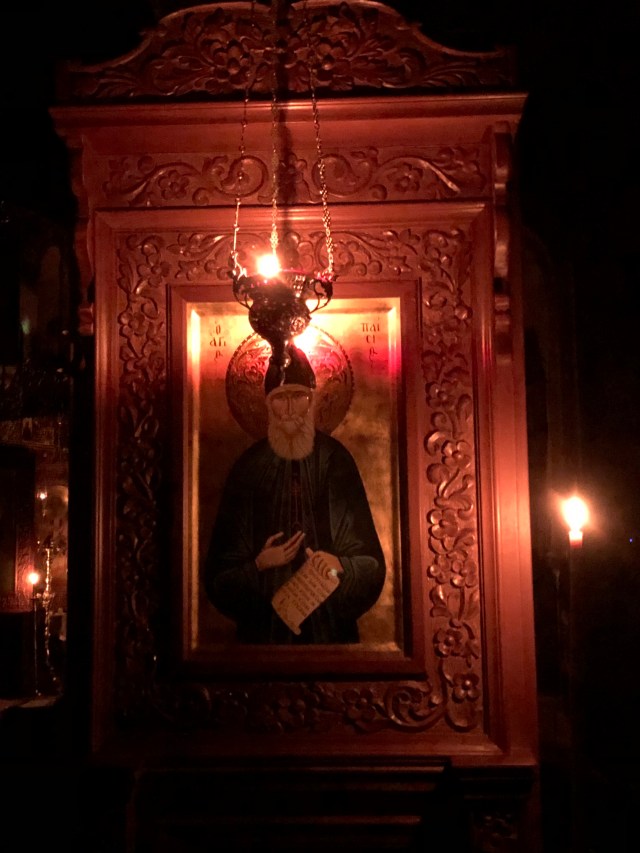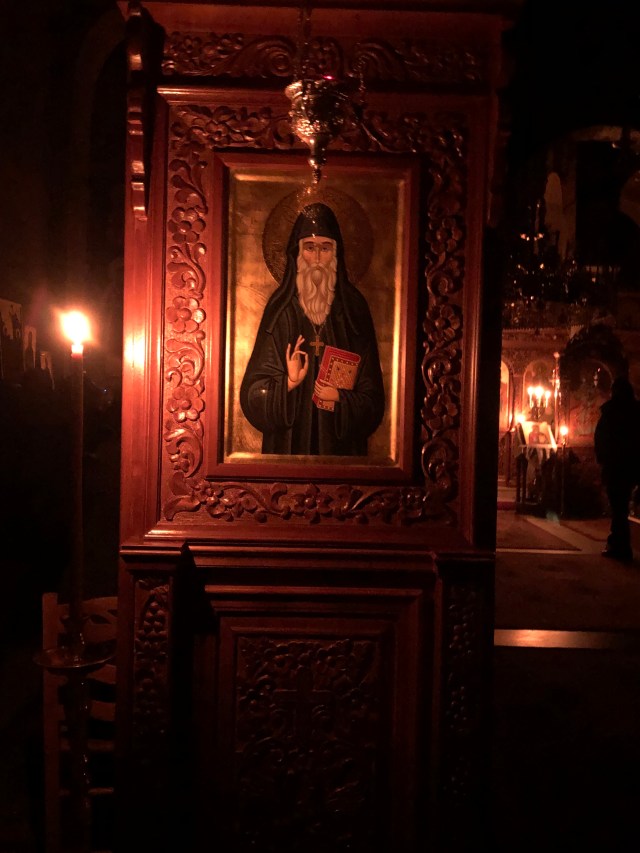
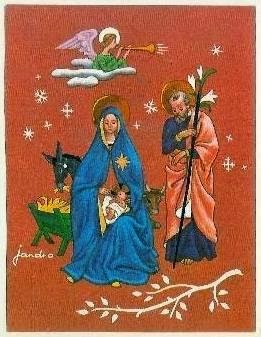
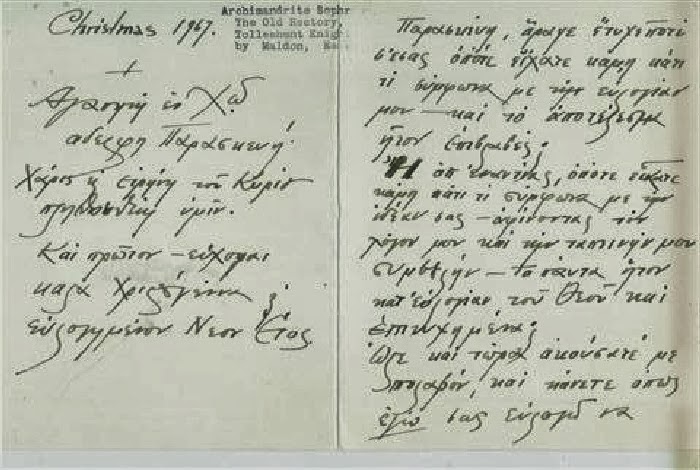
On top it says:
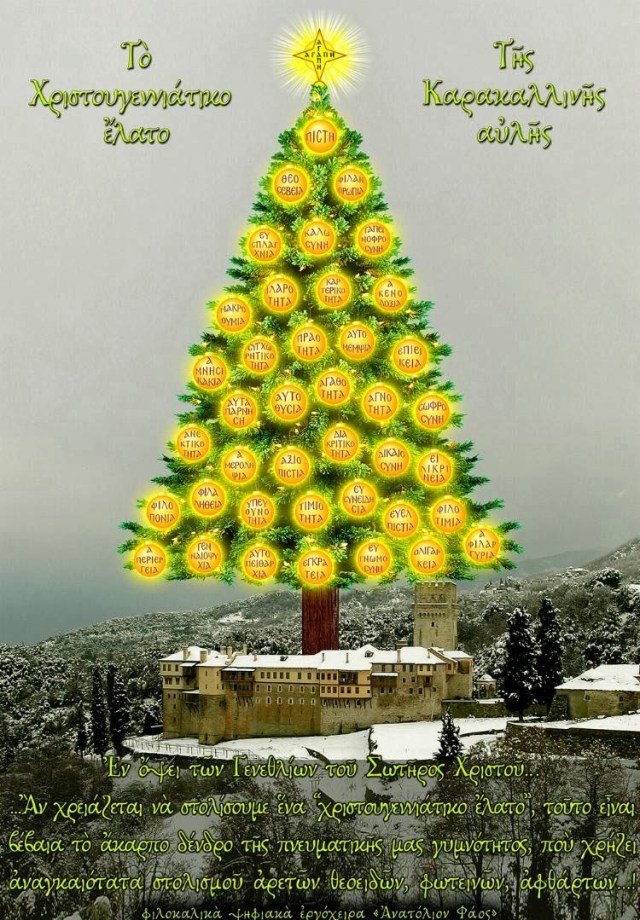
The Christmas Tree in the Courtyard of Karakalou Monastery
On the bottom it says:
In view of the Nativity of the Savior Christ … if we need to decorate a Christmas tree, this would surely be the fruitless tree of our spiritual nakedness, which requires the needed decoration of the God-seeing, illuminating and incorruptible virtues…!
*

My dear sister K.,

There was a woman in a small village in Aitoloakarnania and had three children.
Kyra Vasiliki managed to raise up her family with incredible deprivations and difficulties, but with a unique dignity! She died on Dormition eve in 1998.
The next day, on August 15, the cheap coffin with her corpse, which was on the chassis of the priest’s small van, was headed toward the cemetery.
In the course of the funeral, some of her fellow villagers followed and talked about the sufferings that she had endured when she lived, when suddenly a beautiful fragrance exuded and spread all over the place:
If thousands of flowers were there, no such aroma would be possible !!!
All of them were surprised and could not explain that mystery. Among those who accompanied her was also a spiritual child of the late Elder Ambrosius Lazaris (1912-2006), the charismatic Spiritual Father of the Holy Monastery of Dadi. After a few days of this miraculous, yet incomprehensible event, he went to Elder Ambrosius, reporting to him the whole incident. Very laconically, he told him only that: “A woman died, and the place was full of fragrance.”
Elder Ambrosius, at first, remained silent.
Then, he walked into his room, stayed for a while there, and then returned.
These were his words:
– She has been sanctified! And, do you know why? Because, never in her life, did she ever complain! Such are the people which God ‘wants’! To fill Paradise and make the Second Coming. Do you understand? …

When one sins, he is heavy because of his selfishness. He can neither read nor pray because praying and kneeling seem daunting. Since then, you cannot pray, nor keep vigil, at least force yourself to study the Psalms. The Psalms express prayer, repentance, praise, thanksgiving, and contain feelings and experiences that can raise even the weakest man. Just like, when the other loses his senses, you give him a bit of raki, and you revive him, precisely so, read the Psalms, and they will resurrect you again.(Elder Aimilianos)

A testimony offered by Hieromonk Synesios.
“A few years ago, I was the parish priest of St. Vasileios church (Piraeus) and was called to hear the confession of a young man, Xenophon, 42 years old.
When I arrived, his days were numbered. Cancer with rapid metastases had affected his brain too. He was all alone at the ward, the bed next to him was empty, so we were all alone.
This is what he told me about how he came to Faith, since he was a “hardened atheist” in his own words:
‘I arrived here about 35 days ago, in this ward of two beds. Next to me was another patient, about 80 years old. He was suffering from cancer too, in his bones, and although he was experiencing excruciating pain, he was constantly praising the Lord “Glory to God! Glory to God for all things!” He also recited more prayers which I heard for the first time in my life since I was an atheist who had never set my foot to church. Often, all those prayers comforted him and he slept for a couple of hours. Then, after 2-3 hours, he woke up again from the excruciating pain, and he would start over “My Christ, I thank you! Glory be to Thy Name! Glory to God! Glory to God for all things!” I was moaning with my pain, and this patient at the next bed to mine was glorifying God. I was blaspheming Christ and the Theotokos, and he was thanking God, thanking him for the cancer which he had given to him, and for all the excruciating pain he was suffering.
I was so rebellious and indignant at this! Not only for the excruciating pain I was suffering, but also for his never-ending Doxology. He was also partaking daily of Holy Communion, while I was throwing up in disgust.
– ‘Will you please shut up! Shut up and stop saying all the time ‘Glory to God’! Can’t you see that this God, Whom you are thanking and glorifying, this same God is torturing us with such cruelty? What kind of God this is? No, He does not exist!’
And the patient on the next bed would meekly answer me: ‘He does exist, my child, and He is also a most loving Father, because with all this illness and pain, He cleanses me from my many sins. If you had worked on some rough task, and your clothes and your body stank, would you not need a rough brush to clean all this dirt? Likewise, God is using this disease as a balm, as a beneficial cleansing for my soul, in order to prepare it for the Kingdom of Heaven’.
His replies got even more on my nerves and I was blaspheming gods and demons. All my reactions were sadly most negative, and all I did was to keep on screaming: ‘There is no God. … I do not believe in anything. … Neither in this God nor in His Kingdom …’
I remember his last words: ‘Wait and you shall see with your own eyes how the soul of a Christian who believes is separated from his body. I am a sinner, but His Mercy will save me. Wait, and you will behold and will believe!’
And that day came. The nurses wanted to place a screen, as is their duty, but I protested against and stopped them. I told them ‘No, don’t do this, because I want to watch how this old man will die!!!’
So I watched him and he was glorifying God all the time. He also said a few ‘Hail, Unwedded Bride’ for the Theotokos, which as I later found out, they are called ‘Salutations’. He would also chant “Theotokos Virgin Mary …”, “From my many sins ..” and “It is truly right to bless you, Theotokos …”, and he would also make the sign of the Cross a number of times.
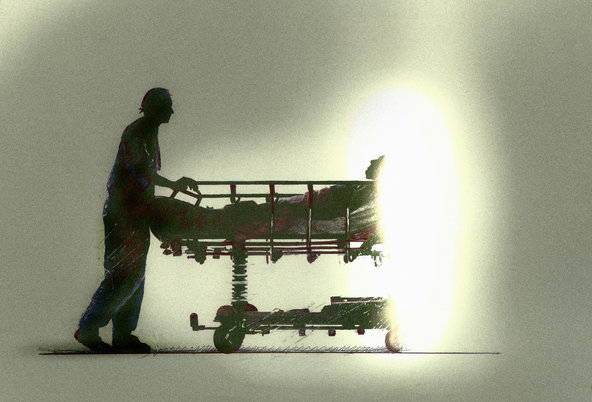
Then … he raised both of his hands and said “Welcome, my Angel! Thank you for coming with such a bright synodeia to take my soul. Thank you! Thank you!” He raised his hands a little bit more, he made the sign of the Cross, he crossed his arms on his chest and fell asleep in the Lord. Suddenly, the ward was filled with Light, like ten and more bright suns had risen all together, such was splendour of the light with which this ward was lit!” And not only was this ward lit, but a heavenly fragrance spread around, inside the ward, even outside the corridor, so powerful that those patients in the neighbouring wards who were not asleep and could get out of their beds, they came out and started walking up and down the corridor, trying to discern where this special fragrance was exuded from.
Thus, my Father, I, the hardened atheist did believe and called for you to hear my Confession.’
*
Xenophon was firm and merciless with his old self, but the Mercy of our Lord was great, really great! He offered a clear confession, received Holy Communion a couple of times, and departed in deep repentance, in peace, a holy death, himself glorifying God!”
By Protopresbyter Stephanos Anagnostopoulos
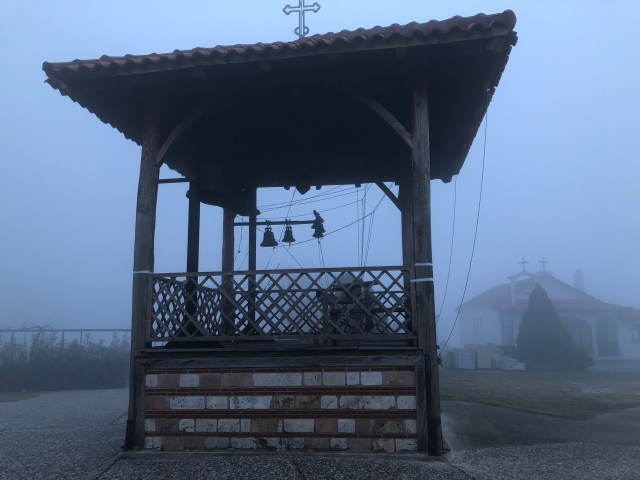
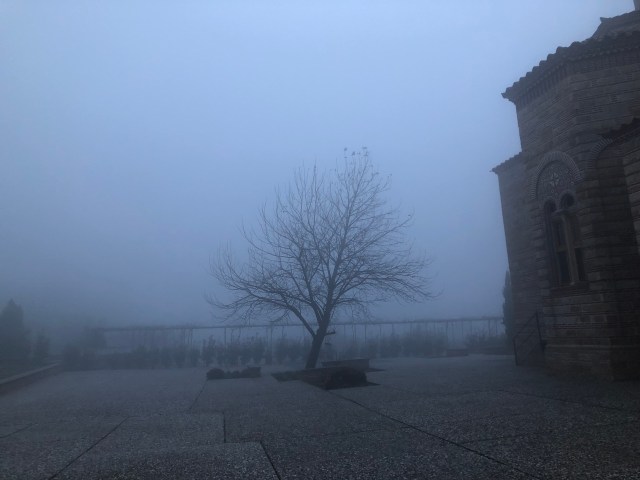
Back to Greece, for yet another long pilgrimage. And yes, Greece can be foggy like England.

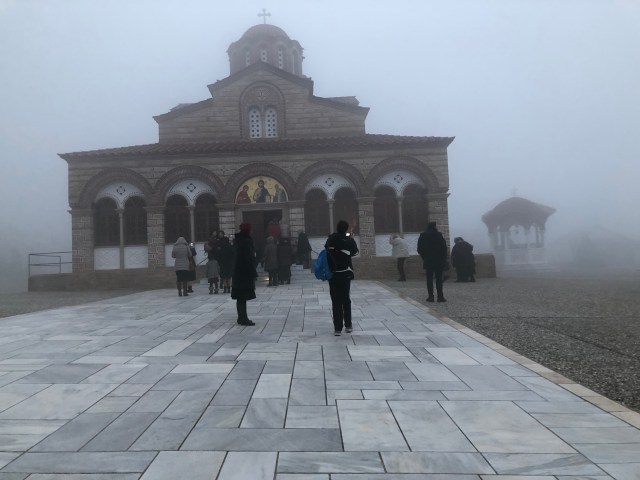
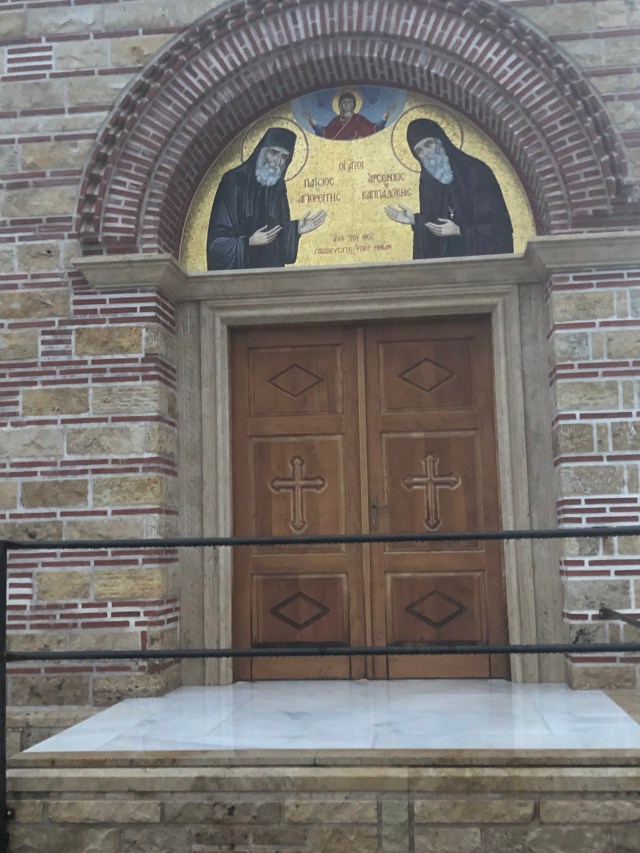
Our pilgrimage starts at a historic monastery, dating back to the 12th century, located one kilometer from Promahi village (Aridaia, Greece), founded by St. Hilarion of Meglin (Feast Day – October 21).

St. Hilarion was born of eminent and devout parents in that same village of Promahi, in the late 11th century. His childless mother had long prayed to God that He grant her a child, and in accordance with her prayer, the Most Holy Theotokos appeared to her and comforted her with the words: “Do not grieve, you will give birth to a son and he will turn many to the light of truth.” When Hilarion was three years old, the hymn, “Holy, Holy, Holy, Lord God of Sabaoth!” was constantly on his lips. He was well-educated, was tonsured a monk at age eighteen, and founded this monastery dedicated to the Holy Apostles, based on the Rule of Saint Pachomios.

These days, the monastery is an austere women’s monastery with 5 nuns under the obedience of Hieromonk Paisios, a spiritual child of St. Paisios. Vespers here is otherworldly in its beauty.


Saint Hilarion of Meglin’s lifelong struggle and contribution to the Orthodox Church was against the Bogomils. Because of Hilarion’s prayers and exhortations, many of the Bogomils abandoned their teachings and converted to Orthodox Christianity. It is noted in the thirteenth century Markianos Code, Codex 524, that during his burial service, myrrh streamed continually from his eyes and that he later appeared on many occasions in visions to the monks of the monasteries to strengthen them in their monastic duties.
O Venerable Father Hilarion, intercede with Christ God to save our souls.

Photos of the personal belongings of His Holiness Patriarch Pavle and a few stories about his proverbial poverty and non-attachment to material things
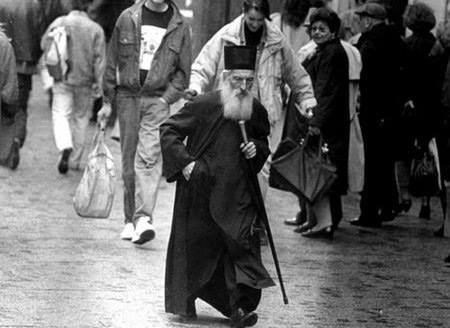
His Holiness Patriarch Pavle was born as Gojko Stojcevic in a small village in present day Croatia. He lost both of his parents at a young age and was raised by his aunt. He studied in Belgrade and was majoring in Theology and Medicine. He graduated from University of Belgrade in 1942. He worked as a construction worker after WWII and then took his monastic vows in Ovcar. That is when he received the monastic name Pavle. He later took post-graduate studies in Athens, Greece when he returned in 1957 he was elected as Bishop of Ras and Prizren. He held that position for 33 years before becoming Patriarch in 1990. He held that position until his death on November 15th, 2009.
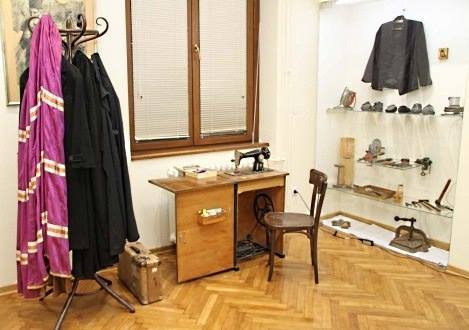
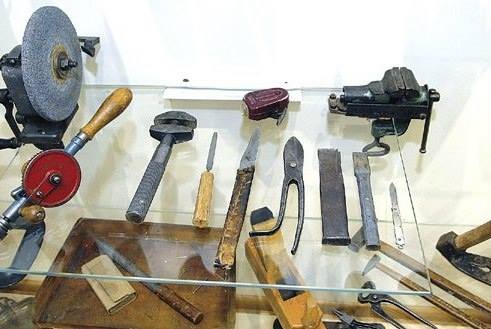
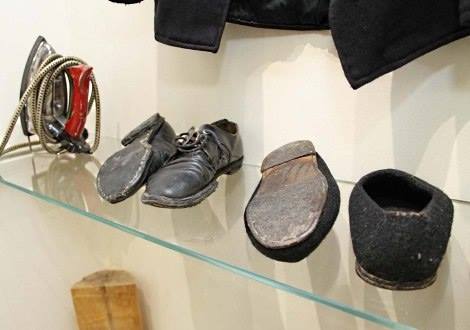
The Patriarch of Serbian Pavel had only one robe, which he himself made (he always answered with a smile: “I have more than one robe and I don’t need – I cannot wear two at once.”) He dressed himself with a vestment – he cleaned and ironed himself.
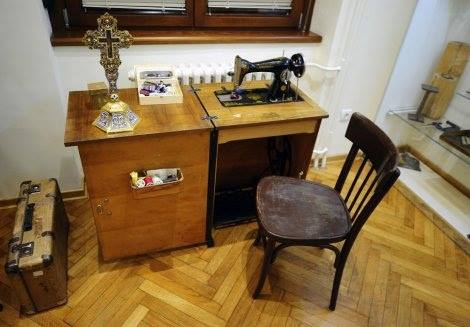
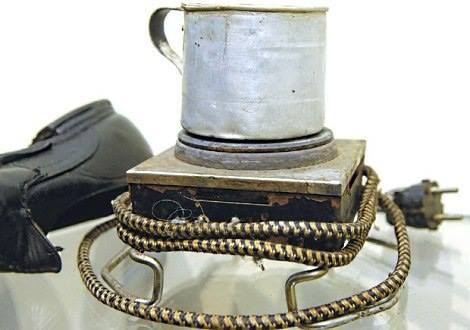
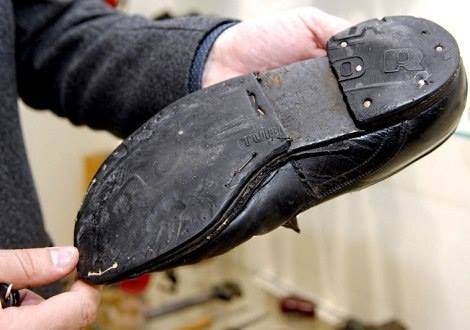
The patriarch repaired shoes and even sewed shoes for himself (moreover, if he saw that someone had torn his clothes or shoes, he offered his services in repair). The patriarch until the end used old printing and sewing machines, heated the water on a tiny old stove, wrote with a pen. He had neither personal assistants, nor a personal secretary, nor a personal car.
The photos below show some of the personal belongings of the Patriarch of Serbian Pavel


His Holiness was known for his humility. When he was asked why he always walked or took public transport, he replied “I will not purchase one until every Albanian and Serbian household in Kosovo and Metohija has an automobile.”
Here are a few great stories that show how humble of a man he was ……….
******The Mercedes Story******
Patriarch Pavle, as he was known, continued to live a simple life even after he moved to the new residence – the Patriarchal Palace – in Belgrade. People form Belgrade often encountered him on the streets, riding the train or the bus … Once, while walking alone the hilly street of King Peter the I, towards the Patriarchate,a Mercedes – last model barely passed him, the driver – a priest from one of the well-known parish in Belgrade, stopped the car and said:
– Your Holiness, permit me to invite you in! Just tell me where you heading …The Patriarch entered the car, and as soon as it started moving, asked:
– Tell me, Father, whose car is this?
– It’s mine, your Holiness!
– Stop it! – the Patriarch replied, he then got off, made the sign of the Cross and said to the priest:
-May the Lord, watch over you!
*****The Black Automobile Story*****
The great session of the Holy Synod of the Serbian Orthodox Church had just ended. As it was the customary, his Holiness was heading to the vespers service at the Cathedral. When he exited the Patriarchal Palace, he saw many black limousines parked near and asked:
– So many luxury cars, who do you think they belong to?
– To our bishops, Your Holiness! They came with them to the Synod meeting-replied the priest who accompanied him.
– Oh, God watch over them, what would they’ve traveled with, if they weren’t taken the monastic vows of poverty?!
******The Travel Story******
In the Patriarchate building, it is often heard the story of the Patriarch dialogue with the deacon accompanying him everywhere; as they were ready to go to the church in Banovo Brdo, the deacon asked:
– So, how are we traveling? By car?
– By bus! – the Patriarch replied with determination.
– It’s crowded, it’s stuffy in the bus, and the church is not close …
– We’re going (by bus)! – His Holiness replied shortly.
– But … – the Deacon, following him, advance a new argument, — Your Holiness, it is summer, many people go to Ada Ciganlija [a famous pool] and buses are full of barely naked people. It is not appropriate…
– You know, Father – the Patriarch replied back – one can see what he desires to see!
*****Raising Salaries*****
Patriarch Pavle refused, in fact, to get paid.He only received a small pension he was entitled to as a formal bishop of Raska and Prizren. All his needs were modest, given that he sewed his mantle and repaired his shoes … Yet, he still had some money left of that pension. What was left of it, he divided among poor or donated it to other purposes of civic good.
When a request from bishops was made to increase their salaries in 1962, his reaction as a bishop became proverbial :
– “But why, since we are not able to spend what we already have?”.
He did, likewise with what he received as gifts. If he received mantle material, he keep it until he met a monk or a priest not been able to afford it. Then he would calculate how much they would need to sew a cassock (mantle) and give them exactly that, so he may share the rest with others.
May our Lord grant us the same spiritual poverty and humility. Patriarch Pavle’s acts condemn me.
“Whoever is kind to the poor lends to the Lord, and he will reward them for what they have done.”— Proverbs 19:17
By Susanna Schneider

Podvig is a Russian term that is used to describe struggle, ascesis, and quite literally, hard work that become spiritual offerings by virtue of the orientation of the soul from self to God. … Elder Sophrony noted that harmful self-love can be overcome only through much struggle and effort. According to Saint Theophan the Recluse, “all the saints accept the only true path to virtue to be pain and hard work… lightness and ease are a sign of a false path. Anyone who is not struggling, not in podvig, is in prelest” [spiritual delusion] (The Path to Salvation, p. 209). One can add that anyone not struggling for virtue is under the deluding influence of egocentricity that prevents the sufferer from seeing God and neighbor and philautia that prevents the wretched soul from genuinely loving them as well.
The terrible struggles involved in physical illnesses and ailments can also be understood in terms of podvigs as long as those experiencing such illnesses and ailments perceive them as being allowed by God’s loving providence for their own purification and illumination. And this perception can only come through a conscious and heroic act of will to move beyond the orbit of self.
Fr. John Krestiankin, in his letters to laypeople, writes, “While our illnesses, yours and mine, should not upset us, for we have already gone out into the final frontier; our podvig of labors is already over; it is left for us only to bear the podvig of illness. I think that this is the most valuable and promising spiritual labor, for nothing humbles a person like sickness. Now we truly stand before the Lord like babes, with the awareness that we and all of ours are in God’s hands. We stretch out our hands to Him, our hearts cry out only to Him, and no ambition or pridefulness about this podvig can stick to us. How good and saving this is!”
When we are physically ill or incapacitated, we are forced to confront our own weakness and helplessness. In such instances, we are no longer capable of doing ordinary things for ourselves. We are dependent on others who have their own lives to lead and we feel as though we are on the periphery, not in the center. This is painfully crushing for the ego, which finds itself at a crossroads: should it rebel with even more vehement egocentric demands or humbly accept life on its own difficult terms. Often, people try both approaches. Blessed are those who willingly allow their ego to be humbled, for then the nous awakens and turns to the only One it can: it turns to God in prayer, in hope, and in love.
The notion of illness as podvig could be most beneficial for us if we look at our spiritual state in this way, for indeed, we are spiritually ill and without care from those physicians and nurses in the Hospital of the Church we would be lost, exposed, and in danger of spiritual death. If we were able to keep this notion of our illness and our dependency in the recesses of our heart, we would be more inclined to call upon the most Holy Name of Christ in humility and repentance. The recollection of our own spiritual illness would assist us in the continual remembrance of God throughout the day.
This notion is found in the teachings of Elder Sophrony and explained by Archimandrite Zacharias, “Two abysses lie before us: the depth of the mercy and love of God shown by His Cross to which we join ourselves by voluntarily mourning over our transgressions, and the depth of the fallen state in which we find ourselves. Both lead us to intensify our cry to God, in the way of all righteous souls, and grace comes to our help and strengthens us, for it bears within itself the seed of eternal life. This seed and the consolation that accompanies it inspire us to undertake an awesome struggle with the darkness that we have discovered within ourselves, until it is all ‘swallowed up by life’ (2 Cor. 5:4). We stand constrained by the abyss of the love of Christ, the Cross and the grace of His Resurrection on the one hand, and the abyss of our fall on the other hand. The abyss of our fall cries to the abyss of the mercy of the love of Christ (cf. Ps. 42:7) and if we acquire this two-fold vision in our life, we will never cease to be inspired day and night.”
Illness, physical and spiritual, can be therapeutic instruments for healing us of the ills of our egocentricity if we choose to embrace them as a podvig. But this is only be possible if we are prepared to glorify God for all things, the joys and the sorrows. When we treat illness as a podvig we are echoing the words of Saint Paul to the Romans, “And we know that all things work together for good to them that love God, to them who are the called according to his purpose.” And such podvigs give life a deep sense of purpose that frivolous egocentricity never can and never will.
Source: Ancient Christian Wisdom
The year is 1943, with communists oppressing Russia and persecuting Christians. The main character, a girl named Seraphima, dreams about a Palm Sunday celebration in a church where her father serves as a priest. The dream ends with the Soviet police taking her father away, and the church being blown up.
Seraphima lives in a Soviet orphanage and secretly keeps a single reminder of her family — a cross. She finds it difficult to form friendships with the other girls, and the main teacher at the orphanage mocks and persecutes her.

Her friend tells her the house is full of secrets, including some resident ghosts. Seraphima visits a mysterious secret chamber under the stairs, to see one of them. From this moment, Seraphima falls into a whirlpool of incredible events, allowing her to shed light on the mystery of the orphanage, and the fate of her parents.
When the teacher discovers that Seraphima is a Christian, and that she secretly wears a cross, she has Seraphima banished from the orphanage. The girl refuses to renounce her faith, and she waits in suspense to find out who will arrive to take her away . . .