So moving, isn’t it? Prayer is Light! Here is also a link to a time table to pray the Jesus Prayer in the time of the Pandemic crisis. Please consider praying the Jesus prayer for 15 minutes for the world and choose your time slot. It goes without saying that the time zone can be altered depending upon where you are in the world. Please share with your Orthodox friends, especially in the USA and Australia, as there are a few available spaces in their time zones. You can have more than one slot if you like and apparently, there is an option for people to have the same time slot if they use a comma or semicolon but it would seem best to use the available spaces first. Please consider. Our world is parched dry, so thirsty for prayer and the Holy Spirit.
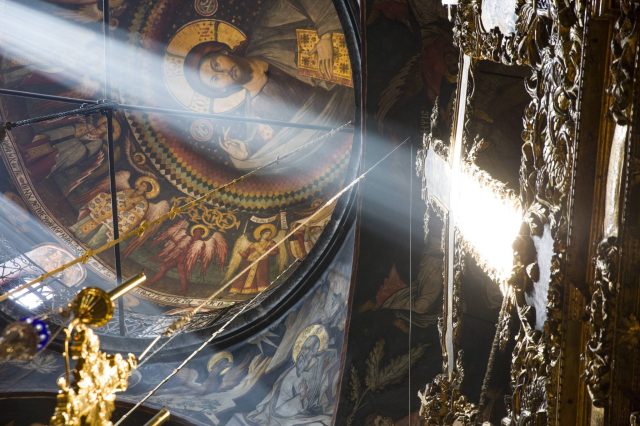
https://docs.google.com/spreadsheets/d/1QagBKLCyxZJVtG8FX106QkrGMAXhf8u_GWVPiQEJXpk/edit#gid=2002126163*Photograph from the Ascetic Experience


The Coronavirus Diary of a Joyous Pustinik — 32

Identification
Christ is Risen!
Our identity is significant, knowing who we are and to whom we belong is important. A royal visitor came to the school where I taught some years ago. One of the retinue seeing a decorative Pectoral Cross I was wearing asked:
“Are these jewels real?”
“No” I replied “I believe they are paste, but the faith is real!”
When I passed through an airport security check more recently wearing my cross I was just about to remove it when the security officer said “you can leave it on, that is your identity!”
The Cross worn around the neck is not an ornament or jewelry for Christians but is the Sign of their identity and signifies to Whom they belong.
Identification
John 17:22-24
22 And the glory which You gave Me I have given them, that they may be one just as We are one: 23 I in them, and You in Me; that they may be made perfect in one, and that the world may know that You have sent Me, and have loved them as You have loved Me.
24 “Father, I desire that they also whom You gave Me may be with Me where I am, that they may behold My glory which You have given Me; for You loved Me before the foundation of the world.
The sighs of present, future, past
On holy limbs were laid
What price redeemed the groaning earth
In flowing crimson paid?
We greet our smaller Golgothas
Christ’s scenes become our own
Sprinkled by dry orient dust
From Zion’s fortress blown.
Each insult that Our Lord received
The Suffering He endured
Transfers to us in Union;
By His pure Body cured.
We live His life, we share His death
By Perfection we’re appraised
By mercy saved, by grace forgiven
By Holy power we’re raised.
“I in them, and You in me”
From Jordan to the Tree
We travel, grow in faith and find
Our true Identity.

Suffering is an indication of another Kingdom which we look to. If being Christian meant being “happy” in this life, we wouldn’t need the Kingdom of Heaven.
—Blessed Seraphim Rose
My prayers
Eν Χριστώ
*Photographs by Pedro Quintela and Bahram Pourshahbazi
Share this:

The Coronavirus Diary of a Joyous Pustinik — 31
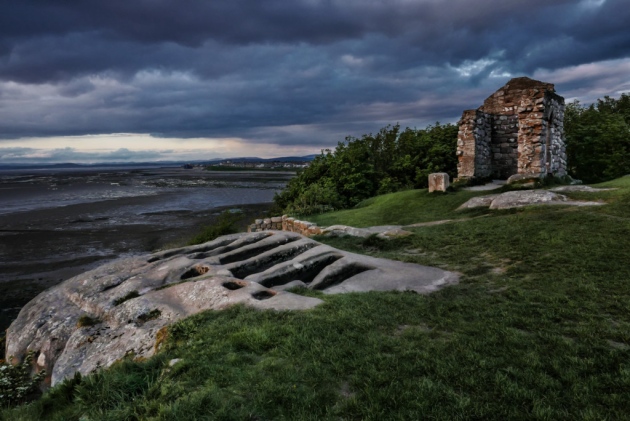
The ruins and rock-hewn graves of St. Patrick’s Chapel, Heysham
There is an ancient Chapel dedicated to St Patrick which I often visit. I like to take friends and visitors there( when possible) and each time it is a blessing for us. The place is holy, graced by God and visited by His saints. There is a tangible feeling of the eternal energies breaking through time and space. It is a place which attracts people like metal to a magnet. Some are drawn by the sheer beauty of the place, some come for daily exercise or recreation and others come to pray and experience harmony with God.
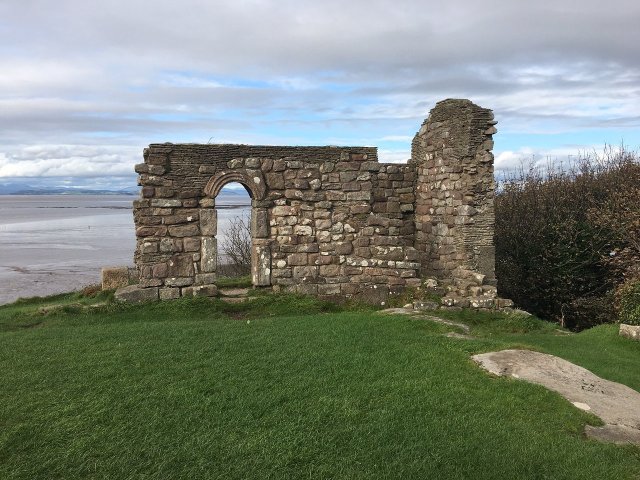
Saint Patrick’s Chapel, Heysham
At Tara today in this fateful hour
I place all Heaven with its power,
And the sun with its brightness,
And the snow with its whiteness,
And fire with all the strength it hath,
And lightning with its rapid wrath,
And the winds with their swiftness along their path,
And the sea with its deepness,
And the rocks with their steepness,
And the earth with its starkness
All these I place,
By God’s almighty help and grace,
Between myself and the powers of darkness.
The Rune of St Patrick
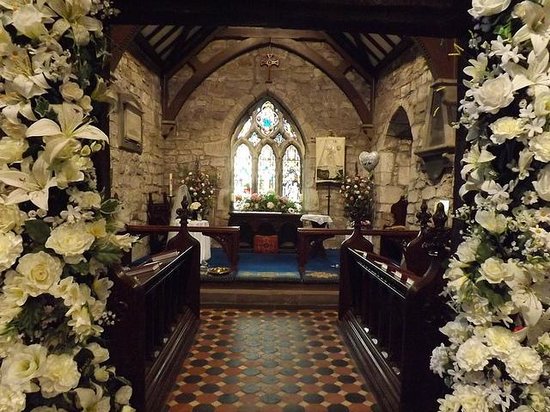
Inside st Peter’s church Heysham
Here and now.
Matthew 28:19: “Go therefore and make disciples of all the nations,
baptizing them in the name of the Father and of the Son and of the Holy Spirit.”
Here, St. Patrick’s monks made toil of prayers
And shared the task to foil the demons snares,
Here on this headland of Bannavem Taburniæ,
The work of saints confer a blessing still today.
Near is that realm on high where heavenly host
Disperse the thoughts that charm us most.
Here, upon this ancient Celtic Christian place
A light shines upon the weary pilgrim’s face;
So that we may too reflect in holiness of life
Struggling human flesh in ascetic pious strife.
Here, where holy bread was broken
Lies a shadow of that most holy token
A simple meal in fellowship
A contract signed in partnership.
Here, on Britain’s western edge of land and sea
An eastern promise is fulfilled, made once in Galilee:
“Lo, I am with you always even to the end of the age.”
He is with us now, to bestow upon the simple sage
A truth perceived, perhaps a joy or word of inspiration,
To those who gather here from every nation.
Here where sea and human efforts ebb and flow
The eternal veil is lifted high on those below.
Here, where gold-red beams of sunset sink beneath the waves
Christ, the Rising Son of times past, future and of present, saves.
“What is a merciful heart? It is a heart on fire for the whole of creation, for humanity, for the birds, for the animals, for demons, and for all that exists. By the recollection of them the eyes of a merciful person pour forth tears in abundance. By the strong and vehement mercy that grips such a person’s heart, and by such great compassion, the heart is humbled and one cannot bear to hear or to see any injury or slight sorrow in any in creation. For this reason, such a person offers up tearful prayer continually even for irrational beasts, for the enemies of the truth, and for those who harm her or him, that they be protected and receive mercy. And in like manner such a person prays for the family of reptiles because of the great compassion that burns without measure in a heart that is in the likeness of God.”
St. Isaac the Syrian
My prayers
Eν Χριστώ
Share this:

Judgment in Three Acts

I was busy, stressed and prayer-less shopping at a supermarket when one of the employees called me out persistently, at least 3-4 times, ‘insisting’ I stop right there and turn around. Why? … She wanted to greet me with “Christ is Risen!”
*
I finally met that person I had spent the whole day judging and quarrelling about with my family. How dare he try to solve that problem, my problem –my pain and my suffering– in a different way than I would? … He was right! Not only did he also help me but he did so gently, with a great sense of humour and compassion.
*
I was walking back home when a wretched, ragged beggar stopped me and asked for a little money. “Excuse me, ma’am. Please help me. I have not had anything to eat for the last two days!” He followed me pleading for quite some time. My heart was cold and I gave him nothing. I only turned back and looked at him perplexed at the softness of his voice. Then, he looked me in the eyes and gently blessed me: “May the Theotokos intercede for you and keep you under Her Protecting Veil!” Ashamed, I changed my mind and decided to give him a little money, but … too late! He vanished before my eyes!
* Text by C. Photo by Jason Tiilikainen
Share this:

Homily on the Sunday of the Paralytic
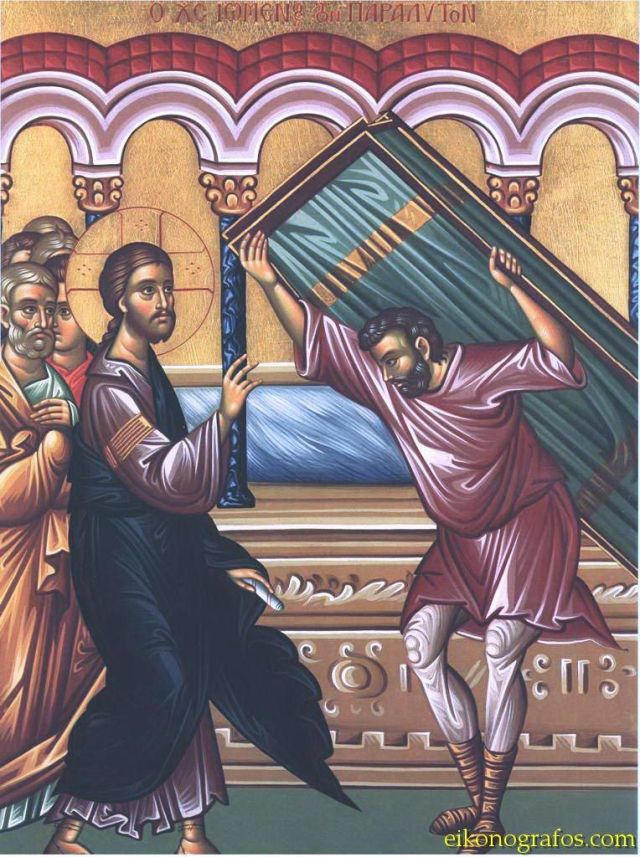
JOHN 5:1-15
… When Jesus saw him and knew that he had been lying there a long time, he said to him, “Do you want to be healed?” The sick man answered him, “Sir, I have no man to put me into the pool when the water is troubled, and while I am going another steps down before me.” … Afterward, Jesus found him in the temple, and said to him, “See, you are well! Sin no more, that nothing worse befall you.” The man went away and told the Jews that it was Jesus who had healed him.
“I have no one to put me into the Pool” Let us concentrate on the first four words of this reply the man made to Our Lord’s enquiry:” Do you want to be healed?”
“I have no one…” The Paralytic in today’s Gospel was not only paralyzed but he was lonely, isolated from society, an outcast because of his condition and unloved. No one cared enough to put him into the water but perhaps a few on the way into the temple offered a few coins. He was surrounded by people but he was alone:
” In these lay a multitude of invalids, blind, lame, paralyzed,”
For thirty-eight years he had been on his own by the pool of Bethesda waiting for someone, anyone, to put him into the healing waters when they stirred.” I have no man to put me into the pool.” Loneliness is a terrible disease every much as disabling as being paralysed.
In these days of the pandemic coronavirus, loneliness has become even more apparent. There are many who are elderly or sick who are locked down, living on their own, not being able to see their families. Others are isolated in high rise flats with small children with no garden who also feel paralysed- frightened, unable to move.
We have today the social media which provides us with pathways to build bridges of encouragement, faith and hope. We must try to avoid becoming victims of self-pity which is an inverted form of pride. Instead, we must reach out to those who need our support, to see their need and ask if they require our help. The Holy Apostle Paul expressed the nature of the Church as members of the Body of Christ- 1 Corinthians 12:27.
As the Body, we live individually but inter-dependently of one another sharing joys and hardships, pains and sorrows and in fellowship with the Holy Spirit.
St Paisios wrote in his book “Epistles”: “ The trials that God allows are in proportion to our tolerance level, but unfortunately many times the mockery and thoughtlessness of merciless people are added on and then we break down. Strong wind usually splits sensitive trees and uproots those with shallow roots, while it helps trees with deep roots to extend deeper into the ground.”
Indeed, putting down deep roots or laying firm foundations can give us a strong base to withstand the storms of life. However, we see in the giant Californian Redwoods which are 30 feet in width, often 3000 years old often soaring over 300 feet into the air another survival technique. One would think that being so tall they would have extra deep roots but instead, they have proportionately shallow roots, choosing rather lateral strength by interweaving and interlocking with their neighbouring trees. The root system is hidden from sight but effective- we may wish to compare this to networking!
Solitude, especially when it is combined with silence, can be a good teacher in order for us to learn by observing and listening more carefully. People are often lonely because they think they are self-sufficient but discover that within the defensive walls with which they surround themselves, they are empty, unfulfilled and in need of God.
As Christians we are not alone, we have spiritual resources to draw upon. One of the roles of the Holy Spirit, the Paraclete, is as the Comforter, the one who stands at our side. We have been given a guardian angel at our Baptism, we have the Most Holy Theotokos and all the saints who continually support and intercede for us- we are surrounded by a cloud of witnesses. Hebrews 12:1-3
But alienation from God brings separation and separation brings loneliness.
So Christ comes to the man who had been ill for thirty-eight years and He asks:
“What do you want me to do for you?” One may think that the question is unnecessary and the answer obvious. But perhaps the man earned his living by begging and was content with his situation. We are often set in our ways, preferring our small, dark self, safe, secure comfort zone rather than breaking out into the light. God takes the initiative. Christ asks us “What do you want Me to do for You? Do you want to be left alone, do you want to be independent, do you want your own will, do you want to go your own way? He had a choice and we have a choice.
We must remember that Christ Himself knew what it was to be alone- He went to a lonely place to pray, His disciples deserted Him, He said “My God, my God why have you forsaken me?” Christ shows understanding and compassion but He will not force Himself on others- He asks us what we want!
The Evangelist John gives particular attention to the place where this took place. For the Evangelist wants us to understand that The Good Shepherd and the One who is Grace and Truth comes to the Sheep Gate near the pool of “Beth hesda- translated from the Hebrew and Aramaic as the House of Grace (because of the healing that took place there) or Disgrace (since the unclean and outcast were gathered there).
The man is healed and Afterward, Jesus found him in the temple, and said to him, “See, you are well! Sin no more, that nothing worse befall you.”
Christ finds the man is in the Temple precincts- no longer alone, no longer paralysed, no longer an outcast but healed, restored, forgiven. But Christ tells him to sin no more because sin separates us from God and makes us once more lonely.
When Christ comes to us He asks us “What do you want me to do for you?”
We should have an answer.
By the Joyous Pustinnyk
Share this:

The Coronavirus Diary of a Joyous Pustinik — 30

#Icarus
Christ is Risen!
Being of a certain age, I often have to call upon one of my trusted “computer savvy techies” as they are known, to help me when my computer fails. I am hopeless when it comes to technology having been brought up with “chalk and talk”. So I would like to put a good word in for modern and ancient technology; for those who enable and help today and for the default reliability of books and pencils of ” yesterday”.
I see the great benefit of modern technology, particularly in these days of lockdown, but the internet is a Pandora’s Box. Information requires distillation and discernment if we are to sift the good from the bad. We have to know the boundaries and limits. The fear of big brother and artificial intelligence is far removed from the fear of God and Divine illumination. Where are we, if and when this technology crashes? Back to pencils and books!
Although today most records in space are electronic, in the original space race, faced with the fact that ballpoint pens do not operate in zero gravity, a vast amount was spent on developing an alternative that would write in conditions experienced during space flight. Russia took the simple option of using pencils for recording data.
Some years ago I was able to help a rather concerned student in revision mode whose computer had a problem- the solution, a book on the precise academic subject he was studying. Glory to God, he passed his exam!
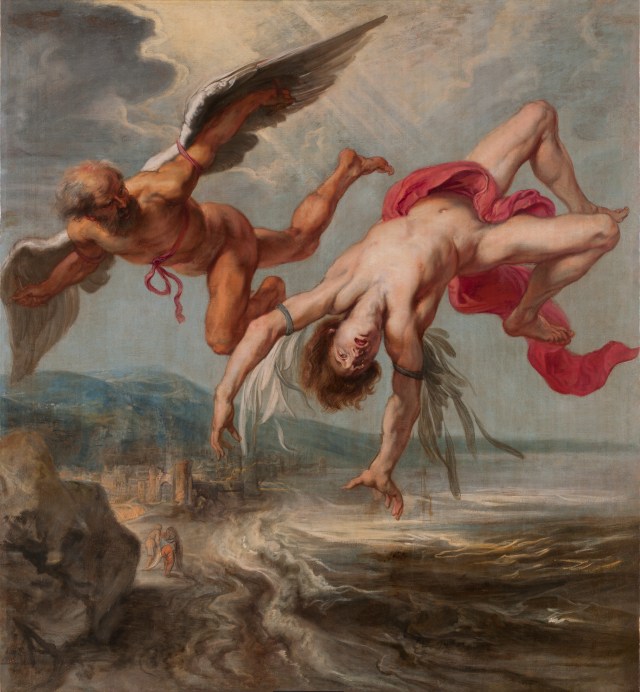
Icarus
Ecclesiastes 1
“16 I communed with my heart, saying, “Look, I have attained greatness, and have gained more wisdom than all who were before me in Jerusalem. My heart has understood great wisdom and knowledge.” 17 And I set my heart to know wisdom and to know madness and folly. I perceived that this also is grasping for the wind.
18 For in much wisdom is much grief, And he who increases knowledge increases sorrow.”
High flyers soar upwards to enthral
Little knowing the sun’s own ire
“As wax melts before the fire”
So too “Pride comes before a fall.”
In Paradise we make our wings
And think escape so great, so smart
To ply our course in scientific art,
As in the tree a mocking bird sings.
Satan still whispers “bow to me”
“Be free!” and “all these kingdoms own.”
Whilst angels standing round the throne
Weep at feathers floating on the sea.
| “Poor human reason, when it trusts in itself, substitutes the strangest absurdities for the highest divine concepts” St John Chrysostom |
Share this:

Dried Flowers and Tender Buds
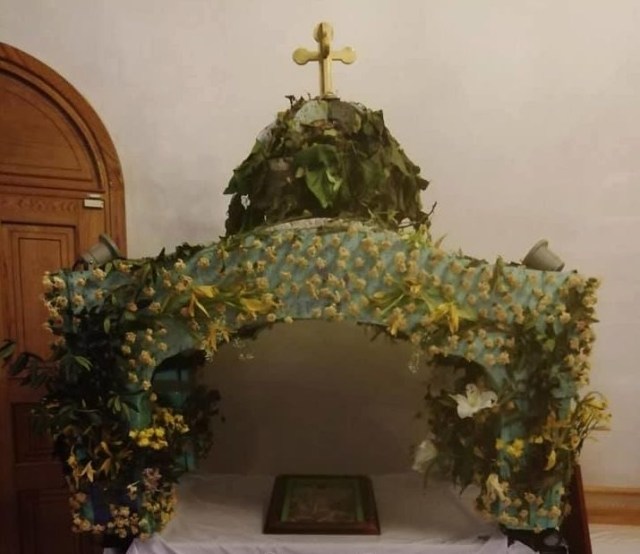
Christ is Risen! A miracle at St. George church in New Moudania, Chalkidiki. 18 days after the Epitaphios, all lillies “looking”towards Him are sprouting anew! Glory to God for all things!
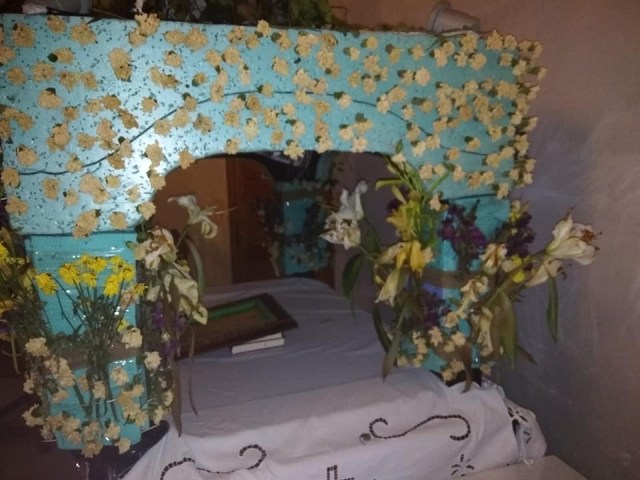
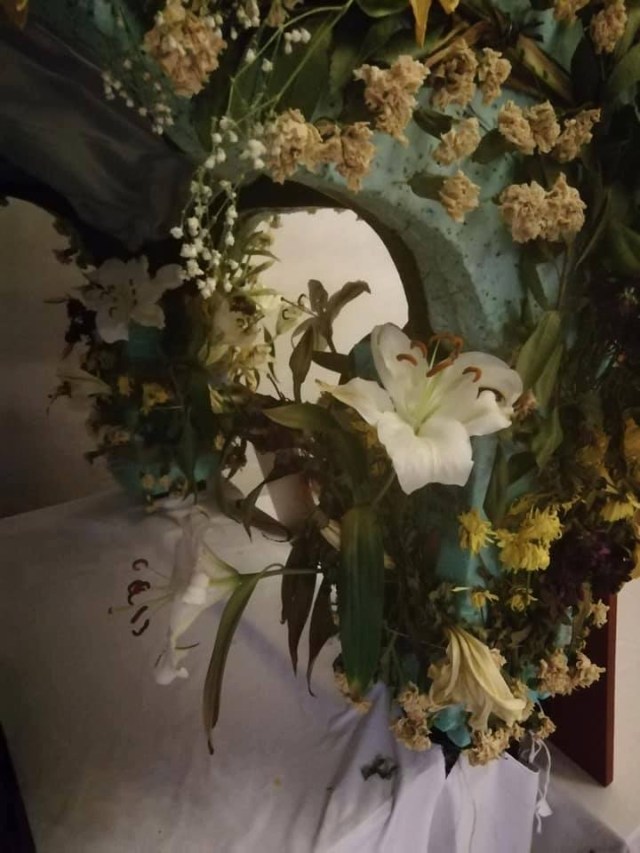
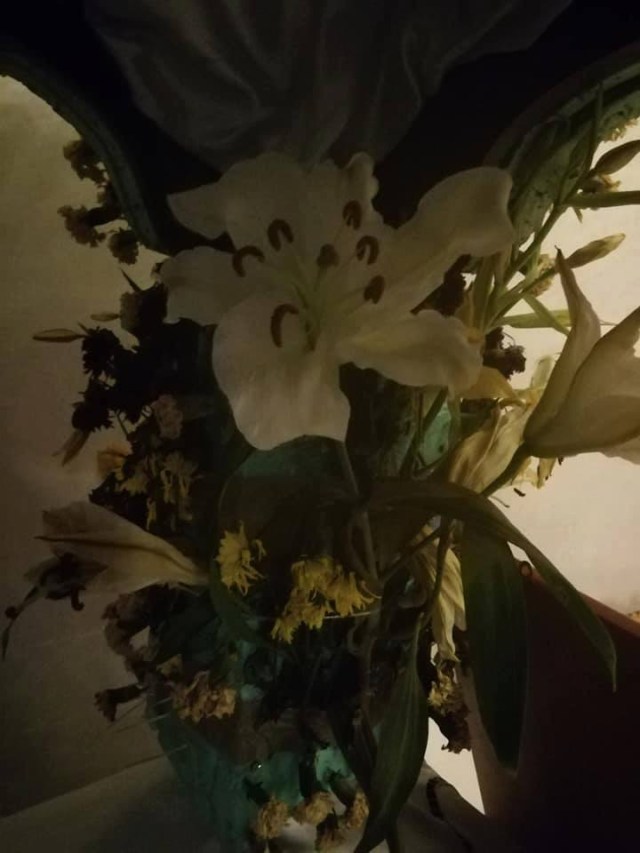
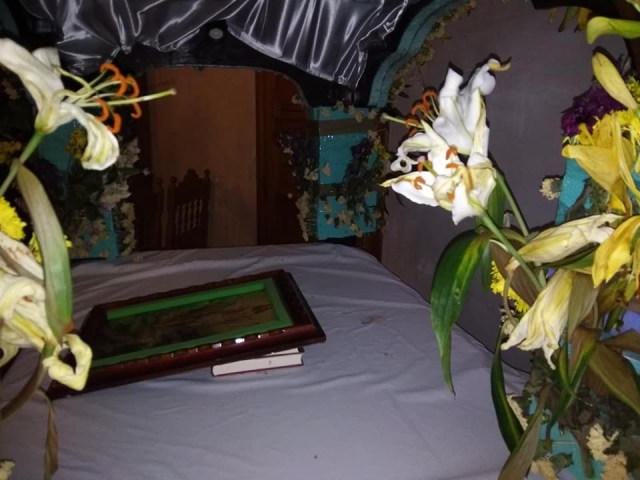
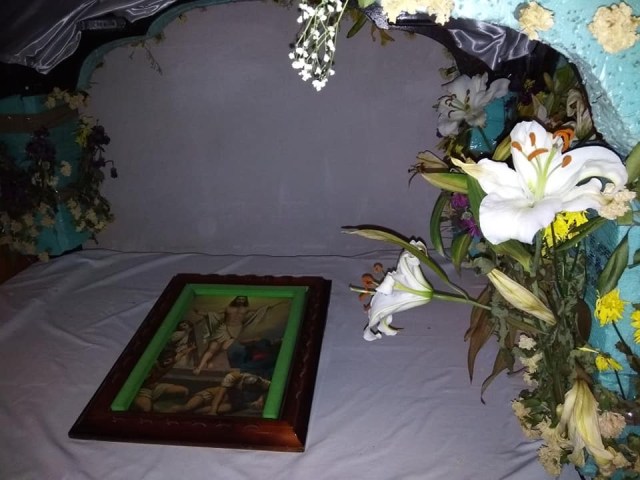
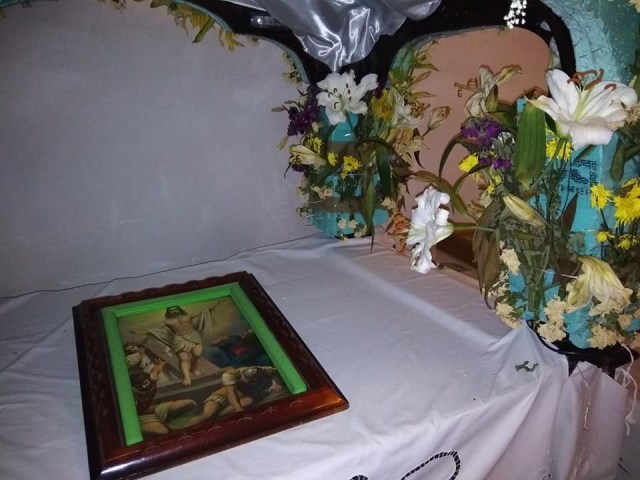
Christ is Risen! A miracle at St. George church in New Moudania, Chalkidiki. 18 days after the Epitaphios, all lillies “looking”towards Him are sprouting anew! Glory to God for all things!
Share this:

The Coronavirus Diary of a Joyous Pustinik — 29
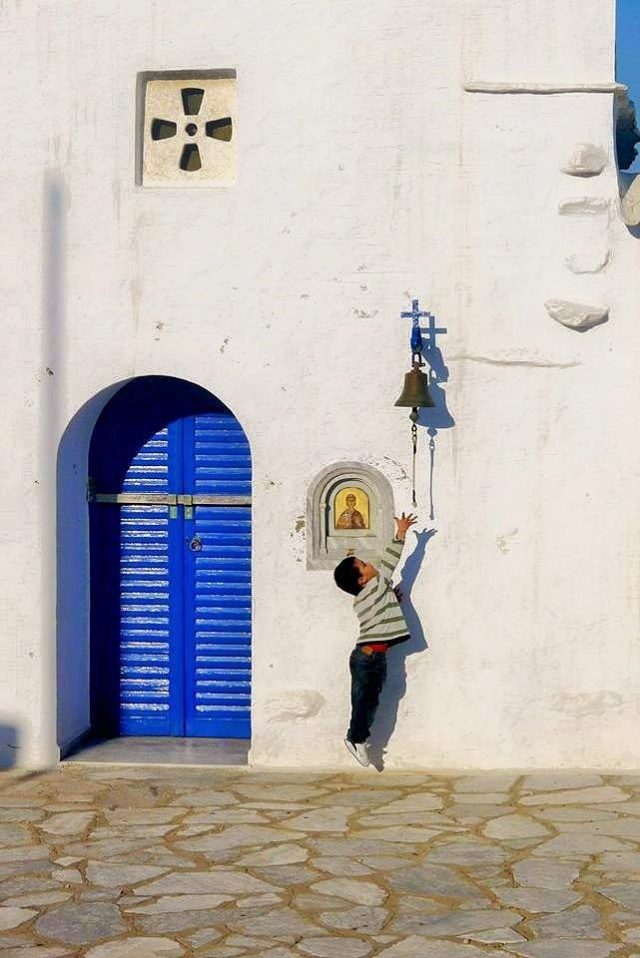
Middle English: Crist is arisen! Arisen He sothe!
As a pupil at school, I was obliged to study Shakespeare for English Literature; it was part of the curriculum and therefore I had no choice. I have to say that I found it rather dry, boring and difficult to understand. Many years later, however, a colleague asked me if I would like to go to Stratford on Avon to see the Royal Shakespeare Company in a Shakespeare play. I was rather disinclined based on my childhood antagonism but reluctantly agreed to go. What a revelation the play proved to be, causing a 180-degree reversal in my disposition! It was transformative, like for the first time seeing something in the light which had formerly only been in shadows. Within a short time of the play commencing I was wrapped, enthralled and fully engaged in the plot, transfixed by the sheer depth and cadence of language and in total empathy with the characters.
The words took form in action and came to life!
The Word became flesh and lived amongst us!
The Celtic saints were very active, they did not just preach the word of God, they acted upon it and lived the Gospel out in their lives.
Sonnet I:
Nature and Nurture
Matthew 19:14
14 But Jesus said, “Let the little children come to Me, and do not forbid them; for of such is the kingdom of heaven.”
What is this treasure which I hold so near?
Closer than my breath which her name repeats;
Reserve her character till time stands clear
To shape her mind as her own voice entreats.
I do not cradle now by spoken will,
But by parental care as love dictates;
Her fragile frame from birth is caused to fill
Gentle arms, whose enfolding indicates.
Echoes aforesaid when grown, she will be
A woman, wife and mother to her child;
Transferring grace and form for all to see
The pattern’s gift, though by encounters styled.
Sweet Nature, thy bounds are kindly, free and fair
If Nurture’s bonds from beauty seeks to share.
As a parent, every action you take is important when you raise children. It is not necessarily what you say but how you act that teaches them the Orthodox way of life.
St Paisios of the Holy Mountain
My prayers
Eν Χριστώ
Share this:

The Coronavirus Diary of a Joyous Pustinik — 28
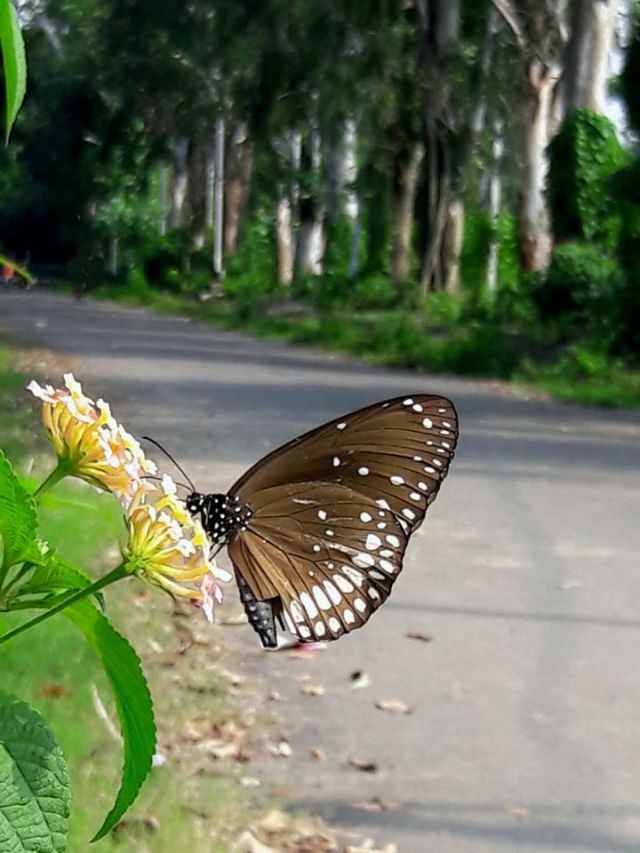
Christ is Risen!
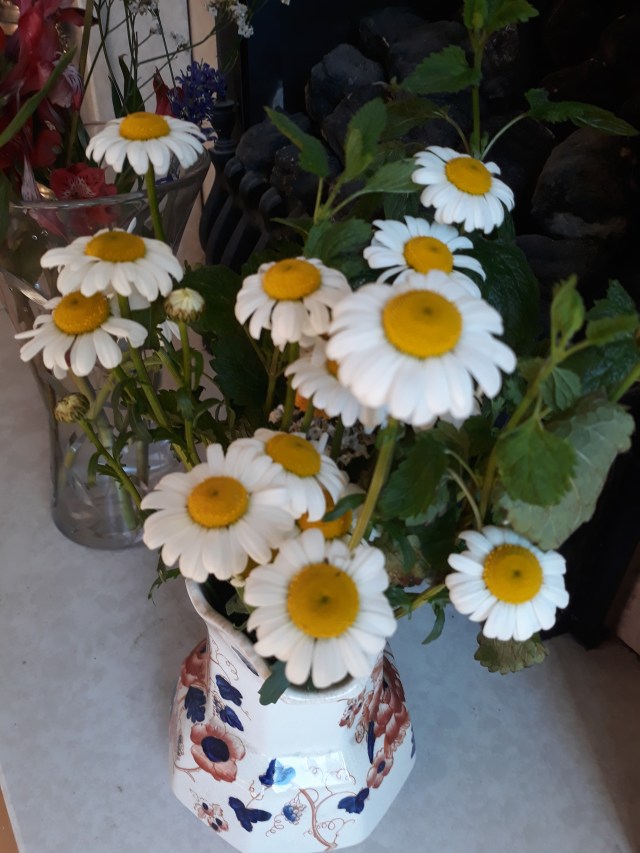
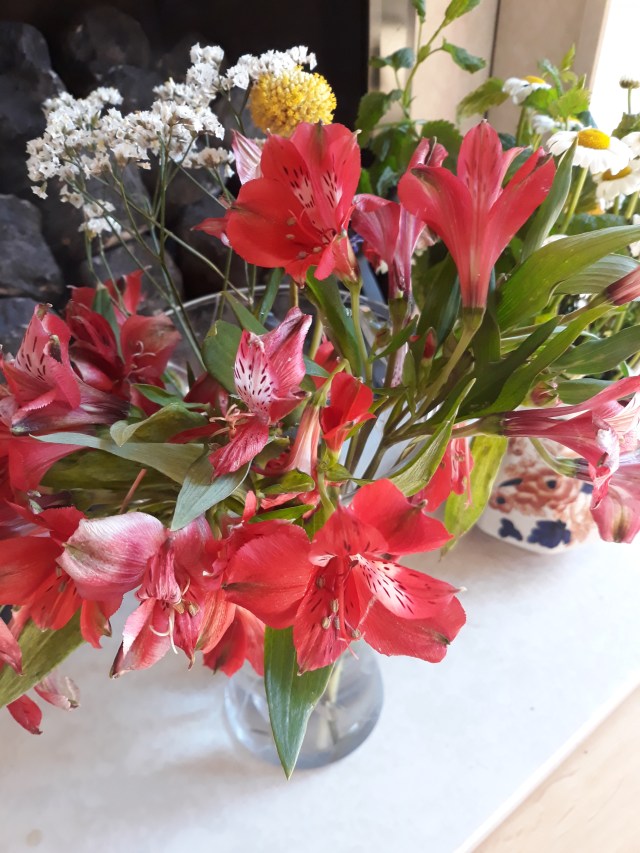
I had a lovely surprise this morning. One of my Parishioners brought me a beautiful bunch of wildflowers; amongst them lots of Ox-eye Daisies, together with a number of “Lockdown goodies” as she describes them, one of which was another kind of flower-flour! Indeed, the English word flour is originally a variant of the word flower both words deriving from the French word fleur. At last, I can bake some bread! The wildflowers now supplement the cultivated ones the sisters brought me some weeks ago.
It reminded me of when I was in a village in Romania and a kind gentleman presented me with a huge bunch of wildflowers which he had picked. The amount, the richness and variety were amazing. I remember too visiting a hermitage where the monk was turning over the soil to bring to life the seeds which had lain dormant for so many years.
My spiritual father when he lived near Cambridge had a large garden. He gave a large portion of it over to a meadow for sowing seeds of wildflowers. The result was a heartwarming profusion of colour: Meadow Buttercups, Cowslips, Dandelion Ragged Robin, Red Campion, Yarrow, Poppy, Chamomile, Corn Marigold, Cornflower, Evening Primrose, Vipers Bugloss, and of course, Forget-me-not.
As if I could?
These Island nations each have a flower which is often found as an emblem appearing on crests, coins, and flags. The national flower of Ireland is the shamrock (which is technically a plant), while Scotland’s national flower is the Thistle. Wales’ national flower is the bright yellow Daffodil. England has the Red Rose( as does Lancashire!)
A Garden in Harston*
John 12:24: Most assuredly, I say to you, unless a grain of wheat falls into the ground and dies, it remains alone; but if it dies, it produces much grain.”
Autumn’s gentle dying and sighing into aspiring worth
Witnesses the gold leaves fall to carpet, as a covering for sin, the soft green earth.
What rich abundance there is in God’s economy!
Mellow fruits and flowers are wrapped in finest robes for God’s glory.
No harsh light to pierce the eyes of the tiredness of our soul,
Only the fresh glow of holy breath to make broken bodies whole:
Until God’s flora rests in winter’s death.
Here in the seasoned wisdom of third age flowers
The seeds of resurrection are stored for many hours,
Until that explosion of the third-day tomb;
God’s radiance warms the ground of that stone-cold womb.
In dappled light, in a garden in Harston, at hand is Son blessed soil.
We share the joy of those who labour there and wait on God with love and toil:
For new growth in God’s garden.
In weeding and turning of man’s substance is revealed new seeds
Which grow into new plants of scent and colour through holy deeds.
Sweet Mill View where, often unseen by human eye, the wheel of Life is turned,
Where through careful stewardship, the labourer’s pay is earned.
A dialogue with heaven is found and a covenant made long ago
In another garden secretly comes in time to grow:
Into that spring beauty of New Life.
“The more resolutely, the more constantly, your heart is turned towards God and His saints the more it will be enlightened, purified, and vivified.” St. John of Kronstadt.
* Harston is a village near Cambridge, England.
* Photography by Amit Das
Share this:

Daisies thriving and some epitaph flowers still going!
By a Joyous Pustinnyk

 ORTHODOX CHRISTIAN FAITH AND LIFE