Five Reasons to Visit a Monastery

Striving to Live a Christ-centered Life
 

Five Reasons to Visit a Monastery

Striving to Live a Christ-centered Life: Five Reasons to Visit a Monastery By Matushka Constantina Palmer

Introduction: Journeying by boat to visit their beloved spiritual father, , Constantine Palamas – the father of St. Gregory – suddenly realized he and his family had forgotten to bring food with them for the monastery. While his wife and five children looked on, he raised his voice in prayer and put his hand into the sea; immediately he caught a massive fish. Taking it out of the water, he glorified God for the miracle. Out of his great admiration and respect for the monastic life, Constantine Palamas worked a miracle so that his family would not arrive at the monastery empty-handed. In this way, and in countless others, he instilled in the hearts of his children a firm love for and reverence of monasticism.

This practice of going out into the wilderness to seek a word from a holy monastic is a tradition well established in the Church as early as Christ’s own times. St. John the Forerunner was the first monk, and people sought him out, as St. Andrew of Crete testifies: “The Forerunner of grace dwelt in the desert and all Judea and Samaria ran to hear him.”[1] He, like many of our prophets before him, preached amendment of life. The central difference between him and the prophets, however, was that St. John would become the first and greatest “Father of Monasticism.” Generations of monastics would take his way of life, his asceticism, his bold dedication to discipleship to Christ as the epitome of the monastic life, and they would follow him. “Verily I say unto you, Among them that are born of women there hath not risen a greater than John the Baptist” (Matt 11:11).

The radical lifestyle of St. John changed the world, especially the Christian world, because many who came after him decided to imitate him and live outside the cities solely for Christ’s sake. Thus, slowly the monastic life was established, and those in the world began to look to it as a shining example of the Christian lifestyle. It is an indisputably great and ancient practice of those living in the world to make pilgrimages to monasteries. Below are five of the many reasons one should.

1. Spiritual Direction

Five Reasons to Visit a MonasteryFinding a spiritual guide who has the will and means to guide and direct a believer in his endeavour to live the Gospel precepts in his daily life is not an easy task. It requires prayer and discernment on the part of the seeker, a humble disposition, and an openness to the will of God. This is because once the believer asks a priest or monk to be his spiritual father, he enters into a relationship with that person that cannot easily be dissolved, and which will have everlasting effects on his spiritual life: “A spiritual father… becomes the means of leading the life of men out of hell (by the negative effect of their passions), and into pure Christian life and spiritual freedom.”[2]

Thus, the goal should be to find a spiritual guide who not only preaches Christ, but lives like Christ. As Monk Isaiah wrote to Nun Theodora: “The Holy Spirit is for everyone; but in those who are pure of the passions, who are chaste and live in stillness and silence, He reveals special powers.”[3] This is the primary reason why a person living in the world seeks spiritual direction from those living in monasteries. Not because the Holy Spirit only dwells in those who wear the monastic habit, but because their way of life is far more conducive to acquiring the Holy Spirit. The greatest spiritual guides are those whose manner of life teaches as much or more than their words and advice. If a spiritual guide does not live the commandments of Christ, if he has not experienced temptation, if he does not actively struggle to overcome his passions, then how will he teach others to do likewise? On this point Archmandrite Zacharias of Essex says: “if the word that the spiritual father says is not seasoned with grace, nor proceeds from a heart that is warmed by the love of Christ, it becomes like the work of psychologists or counsellors – a ‘half-blind’ worldly activity. The word of the spiritual father must bear the seal of grace, the seasoning of grace.”[4]

The life of the monk is a macrocosm of the Christian life in the world. And so, it follows that if there are good spiritual fathers in the world, there are great spiritual fathers in the monastery. The reason for this is very simple, as St. Nikodemus states: “monastics, through ascetic struggles and through the monastic way of life, first purified themselves (from the passions and from faults) and then set out to purify others: they were first enlightened and afterwards enlightened others: they were first perfected, and then perfected others, they were, to express it concisely, first made holy and afterwards made others holy…”[5]

For those who have spiritual fathers in the world, they need not forsake them for a priest-monk. They can, however, with the blessing of their spiritual father, seek the counsel of a monastic in certain circumstances that require the guidance of an experienced and specialized “doctor” since, as St. Zosimas says to St. Mary of Egypt: “Grace is recognized not by one’s orders, but by gifts of the Spirit.”

And in fulfilling the instructions of one’s spiritual guide, the layman becomes a candidate for the grace which is for the saints (2 Cor. 8:4). By this, one becomes like a certain youth who, living in the world, “began immediately, with great eagerness, to fulfill the command which the elder had given him… With this work that he did, he was made worthy to lift his mind up to Heaven, where he cried out to the Mother of Christ for compassion; and through her intercessions, he was atoned before God and there came down upon him the Grace of the Holy Spirit….”[6] Ultimately, this is the goal of seeking spiritual direction: to not only be “atoned before God” through a life of repentance, but through the counsels and prayers of one’s spiritual guide – who himself has attained grace – to have the Holy Spirit “come down upon us.”

2. Spiritual Conversation and Action

Five Reasons to Visit a MonasteryOne of the greatest benefits of visiting a monastery is the spiritual conversation and activity pilgrims are able to take part in. At a monastery, spiritual stories and uplifting anecdotes abound. Although many monastics shy away from conversation with pilgrims for a variety of reasons, given the appropriate circumstance a conversation with a monastic can rear a multitude of benefits – not to mention conversations with fellow pilgrims.

Whether they share a story they have heard, wisdom from the Mothers and Fathers of the Church, or even a tale from that monastery, their words inform and enlighten the pilgrim and help refocus his busy mind. Even time relaxing in the world does not refresh the soul the way a spiritual conversation does. This type of conversation, though found more rarely in the world, is often a common occurrence at a monastery.

Furthermore, many monastics, despite not living in the world any longer or dealing with its struggles and temptations, have great wisdom to share. Not only did they also once live in darkness (Matt. 4:16), but they have a wealth of experience from speaking with pilgrims who confide in them. Through prayer and reading, the monastic manages to help the pilgrim approach his problems with a bit more clarity and even a new perspective.

Coupled with this beneficial spiritual conversation is the spiritual activity that takes place in a monastery. Work and prayer are two primary tenets of the monastic life. Work, however, is done in a slightly different spirit than work done in the world. An Abbess at a monastery not far from Thessaloniki has often said work in a monastery is a great deed because it is done solely for the love of God, and the love of His saint, the monastery’s patron. She teaches that to even pick up a piece of garbage in a monastery yields a great heavenly reward because it is done in honour of the saint, to keep his house clean. After helping with work in the monastery, she would tell the pilgrims: “The patron saint wrote down the work you have done, and you will find it presented on the Day of Judgement.”

When a monastic bakes bread, he bakes for the glory of God. When he chants in church, he chants for the glory of God. When he sweeps, he does so for the glory of God. And when a pilgrim partakes of such God-honouring work, he begins to look at his own work in a different light, just as the monastic offers all his work for the glory of God, so too can the pilgrim – both while at the monastery, and when he returns to his work in the world. The Christian home is a microcosm of the coenobitic monastery; when the mother, father, or children clean the house, they too can do so for the glory of God.

Both the monastic and the pilgrim can approach work the way Abba Apollo did: “If someone came to find him about doing a piece of work, he would set out joyfully, saying, ‘I am going to work with Christ today, for the salvation of my soul, for that is the reward he gives.’”[7] The only difference between the monastic’s work in the monastery and the layman’s work in the world is that the monastic knows that he left behind his own success to seek the Kingdom of God; the layman merely needs a reminder now and again. He needs to ask himself which of the following he is and who he desires to glorify: “The man who loves himself seeks his own glory, whereas the man who loves God loves the glory of his Creator.”[8]

3. Humility

 Five Reasons to Visit a MonasteryThe fallen human soul is predisposed toward pride. This is something that occurs with the monastic as much as with the layman. When the Christian keeps his prayer rule faithfully, observes the fasts of the Church, or attends church services regularly, the soul is inclined to become puffed up. The antidote is finding better examples than oneself of Christian dedication to remind the proud soul that she is lacking in virtue.

The layman has the ability to make pilgrimages to monasteries and so finds a helpful means to stay grounded in his spiritual life. Encountering monastics reminds the pilgrim that there are better Christians than himself (not that he cannot also learn this in the parish, he most certainly can, but it is an indisputable fact that one is faced with at a monastery). Hence the famous statement: “Angels are a light for monastics, and monastics are a light for the world.”[9] The monastic is simultaneously humbled and enlightened by reading the lives of the saints, just as the layman is when he compares his life with that of a monastic.

Humility is a virtue that the monastic and layman ought to strive for above all else, for as St. John Cassian says, “Humility of soul helps more than everything else; without it no one can overcome lewdness or any other sin.” And so, the layman makes pilgrimages to monasteries in order to draw the soul away from the distracting world and into an environment of stillness and prayer, where the atmosphere is conducive to taking stock of one’s life alongside that of a dedicated monastic, and to allow the grace of the monastery to help him see his own sinfulness.

The following story, taken from The Wisdom of the Desert Fathers, illustrates this point: There were three friends, all of whom chose different means of work. The first decided to become a peace-maker among men. The second decided to tend to the sick. While the third decided to live in prayer and stillness in the desert. The first two friends found that they were unable to complete the work they set out to do and became disheartened. So they decided to visit their third friend who was living in the stillness of prayer. They confessed their difficulties and asked for guidance. This was the third friend’s response: “After a short silence, he poured some water into a bowl and said to them, ‘Look at the water,’ and it was disturbed. After a little while he said to them again, ‘Look how still the water is now,’ and as they looked into the water, they saw their own faces reflected in it as in a mirror. Then he said to them, ‘It is the same for those who live among men; disturbances prevent them from seeing their faults. But when a man is still, especially in the desert, then he sees his failings.’”

And so it is with the pilgrim from the world. In the stillness of the monastery, he is able to reflect on his failings. Whether it be in comparing his spiritual life with the monastic who left all things behind to live “alone with God alone,” as Elder Porphyrios was wont to say, or simply due to slowing down and reflecting on his faults, the pilgrim returns to the world with greater humility of soul. [15] St. Theodora, Matericon, 85.

4. Imitation

Five Reasons to Visit a MonasteryThe command to imitate Christ is found throughout the Gospels. He is the image of perfect obedience, extreme humility, utter chastity, and a life of poverty. To be sure, if a believer only ever read the Gospels, he would be informed on how to live a proper Christian life. However, because man is weak and in need of examples, the monastic life illustrates the Gospel commandments lived out to their perfection. Thus the layman has before him a pragmatic example of how the teachings of the Lord are upheld and practiced. In turn, he emulates those things in an appropriate and prudent way, just as St. Paul encourages: “what ye learned and received and heard and saw in me, these things be practising; and the God of peace shall be with you” (Phill. 4:9).

There is much to be learned and gained from spiritual books, practical guides, and the wisdom of the desert Fathers and Mothers. However, nothing compares to the spiritual benefit brought about by actually being around someone who shares in the grace of God in a deep and intimate way. For whether or not he has “the words of life,” his prayer, his patience, and his virtue are enough to form and inform the humble-hearted that seek his unique, if silent, wisdom. Abba Dorotheos writes: “It is said that a certain brother asked an elder, ‘What shall I do, father, in order to fear God?’ The elder answered, ‘Go and cling to a man who fears God and from the fact that he fears Him, he will teach you to do likewise.’”[10]

Laymen are called to keep the commandments of the Gospel with as much precision as monastics. The monk is not called to one type of life, and the layman to another. No, they are both called to “be perfect even as my Father in heaven who is perfect” (Matt. 5:48), just as St. John Chrysostom taught: “You greatly delude yourself and err, if you think that one thing is demanded from the layman and another from the monk; since the difference between them is in that whether one is married or not, while in everything else they have the same responsibilities… Because all must rise to the same height; and what has turned the world upside down is that we think only the monk must live rigorously, while the rest are allowed to live a life of indolence.”[11]

The only difference between a Christian living in the world and a monastic living in a monastery is that monasticism “rejects any kind of compromise and seeks the absolute”[12], whereas the layman struggles as best he can in the midst of the distracting world. Both are acceptable and blessed in the eyes of God. Both ways are only successful by the grace of God. The layman should not be disheartened by his struggles in “the darkness of the world” (Eph. 6:12). Rather, he should take courage that he is upheld by the prayers of countless monastics, as Bishop Nikolai of Lavreot has stated: “The life of the faithful is supported by the prayers of the monks. This is elucidated by the very fact that the faithful take refuge in such prayers. Just as Moses stretched out his hands and the Israelites conquered the Amalekites, so the monastics lift up their hands to God and we, the faithful who are struggling in the wilderness of this world, conquer the noetic Amalek.” And more significantly, the layman should take courage that “where sin abounded, grace did much more abound” (Rom. 5:20).
5. Encountering Sacred Place 

Five Reasons to Visit a MonasteryEven if there were no other reason for visiting a monastery, there would remain this one: it is an agios topos, a holy place. “And Moses said, I will go near and see this great sight, why the bush is not consumed. And when the Lord saw that he drew nigh to see, the Lord called him out of the bush, saying, Moses, Moses… loose thy sandals from off thy feet for the place whereon thou standest is holy ground” (Exodus 3: 3-5).

Coupled with the prayers of the monastics, the saints that dwell within the monastery, and the angels that protect it, there are also at least one or more chapels. The presence of a temple of God alone is enough to sanctify a place. And it is in this sanctified place that even without hearing God-inspired words or witnessing miraculous events, the pilgrim is refreshed. His weary and tired body and soul are nourished with more than monastic fare – they are nourished with monastic stillness.

A pilgrim once asked a priest-monk why it was that out of all the monasteries the pilgrim had visited, this one particular well-known monastery was the one in which grace and divine fragrance was the most perceivable. The priest-monk answered that although all monasteries are holy, that that monastery held the typikon to celebrate Divine Liturgy every single day, and confessed people for hours on end, and so as a result it attracted the grace of the Holy Spirit and He dwelt there. As Dr. Constantine Carvanos surmises, “[t]hrough confession at these centers of spirituality, through participation in the moving services of the monks or nuns, and speaking with them, a Christian living in the world is aided by calm refuge from his worldly cares, by being purified, by rediscovering himself, and by tasting of the gifts of the Holy Spirit.”[13]

St. Nikolai Velimirovich records: “When [St. David of Garesja] arrived at a hill from which Jerusalem was visible, [he] began to weep and said, ‘How can I be so bold to walk in the footsteps of the God-man with my sinful feet?’ David then told his disciples that they, being more worthy, should go to worship at the holy places, and he took three stones and began to return.”[14] The saint’s humility was so great that he considered the sight of the Holy Land and even its pebbles to be overflowing with grace. How much more does the grace of a sacred place exceed sight and stones? In this sense the words of St. Theodora hold an even greater significance: “Love stillness. One who is not attached to the vanities of this world is strengthened in soul by stillness, abstinence and silence.”[15] This strength, harnessed by the grace of a sacred place, can then be brought back into the world if treasured and safeguarded through prayer and watchfulness.

Conclusion:

In conclusion, “if you want to know if someone loves Christ, find out if he loves monasticism,” as the saying goes. Visit monasteries, acquire humble-mindedness, and abstain from judging others – both the believer who is too lax and he who is too strict. “Wherefore seeing we also are compassed about with so great a cloud of witnesses, let us lay aside every weight, and the sin which doth so easily beset us, and let us run with patience the race that is set before us, looking unto Jesus the author and finisher of our faith” (Heb. 12:1-2).

All photos that appear in this article belong to Nektarios and are used with permission.


[1] The Great Canon of Repentance, Song 9, [11].

[2] Archimandrite Zacharias, The Enlargement of the Heart, 174.

[3] Monk Isaiah to Honourable Nun Theodora, Matericon, 160.

[4] Archimandrite Zacharias, The Enlargement of the Heart, 174.

[5] St. Nikodemos, Handbooks of Counsel [Greek], 15-16.

[6] St. Symeon the New Theologian, from Dr. Constantine Carvanos’ article A Discourse for those living in the world, Orthodox Info:http://orthodoxinfo.com/praxis/discourselivingworld.aspx.

[7] Abba Apollo, Sayings of the Desert Fathers, 36.

[8] Philokalia, St. Diadochos of Photiki: “On Spiritual Knowledge and Discrimination: One Hundred Texts”, vol. 1, [12], 255.

[9] St. John Climacus, The Ladder of Divine Ascent, op. cit., 128.

[10] Abba Dorotheos, Practical teaching on the Christian life, “On the Fear of God,” [52], 113.

[11] St. John Chrysostom, Pros piston patera (To the faithful father) 3, 14, PG47, 372- 74.

[12] Professor Georgios Mantzarides, Images of Athos by monk Chariton,http://www.stanthonysmonastery.org/monasticism.php

[13] Constantine Carvanos, Discourse on those living in the world, Orthodox Info:http://orthodoxinfo.com/praxis/discourselivingworld.aspx.

[14] St. Nikolai Velimirovitch, Prologue, May 27.

[15] St. Theodora, Matericon, 85.

By Matushka Constantina Palmer

Source: Lessons from a Monastery (wordpress.com)


Our Lady of Kipina


kipina39kipina38kipina36kipina35kipina34kipina33

kipina23kipina32kipina31

kipina37kipina28

kipina19


kipina26


kipina11

kipina13

kipina8

kipina6

kipina4

kipina2kipina1kipina16

kipina21

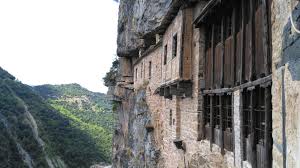
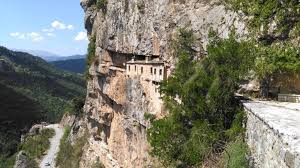
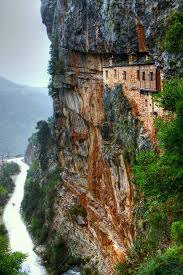
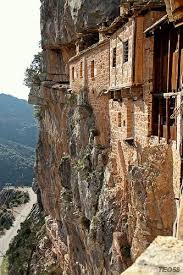
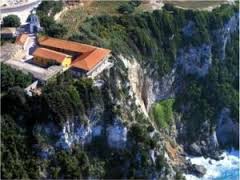
If you go towards the old-world village of Kalarrytes in the Tsoumerka Mountains in Epirus, you come across an impressive fortified monastery built into a rock face: the Holy Monastery of Our Lady of Kipina.


The Holy Monastery of Kipina is built into a large cave in a sheer rock.


According to the founder’s inscription, building began in 1349. But according to Metropolitan Serafeim (Vyzantio) of Arta, a historian, the foundation dates back further in time. Other historical sources date it to 1212.
 

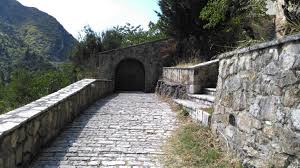
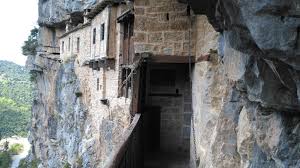
Access to the Monastery is by a stone path hewn into the rock. In former times, contact could be broken by means of a wooden drawbridge.

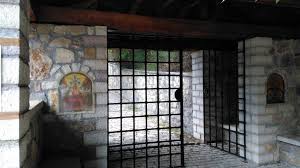
The outer gate of the monastery.


Without doubt, the time when the Monastery of Kipina was at its peak was the 18th century. Indeed, it’s recorded that, in 1760, the exceptionally active Abbot Kallinikos funded the construction of a bridge over the nearby River Kalarrytikos, a tempestuous tributary of the Arakhthos.


The Monastery also ran a school and a water-mill. All of this shows both the financial power of the foundation and also the close links with its social setting.


The imposing rock casts its shadow over the steps of visitors, next to the path to the entry.


Still surviving from the old Monastery complex are the church, four cells and a small building which used to serve as a stable.


In the olden days, the drawbridge would be raised at night or at times of danger. Access to the Monastery was thus completed severed, which is why it is one of the few that escaped pillage. The crank handle of the drawbridge has been preserved.


The Monastery is dedicated to the Dormition of the Mother of God. According to tradition, however, it celebrates on the feast of the Life-Receiving Spring (Friday in the week after Easter).


The church is a small, single space, built within the cave.


The rich iconographical decoration of the church was carried out in the 18th century.


At the northern end of the narthex is the opening to the cave, which extends to a depth of 240 metres into the rock.

Today’s Abbesses of Abbesses

Gerondissa Akylina, Porphyria, Sipsa Monastery and St. Georgios Karslidis

Gerondissa Akylina, Gerondissa Porphyria (Sipsa) and Gerondissa Makrina (Portaria)
Friday, November 4, feast day of the Blessed Elder Georgios Karslidis of Pontos, warmed my heart with fond memories of nearly 3 decades of pilgrimages to beautiful, gem monasteries in Northern Greece!

 *

“God cares for everyone. Despair is in effect a lack of faith.”


Gerondissa Akylina, Porphyria, Sipsa Monastery and St. Georgios Karslidis


Taxiarches and the Analipseos Monastery (Sipsa) in Greece is one of the Monasteries in Greece that holds a dear place in my heart. Together with that of St. Paisios in Souroti, they were the first monasteries I started visiting as a University student, before my graduate studies and work at the US. At that time Gerondissa Porphyria, a Living Signpost in my journey on The Way,  had not even become a monastic, and now she is a renowned Abbess, one of the few of her ‘calibre’ in contemporary women’s monasteries.


Gerondissa Akylina, Porphyria, Sipsa Monastery and St. Georgios Karslidis


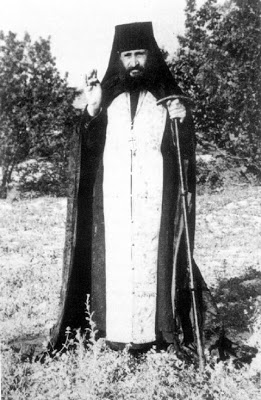
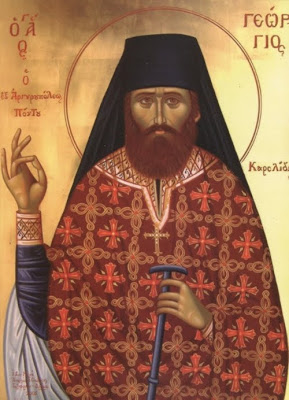
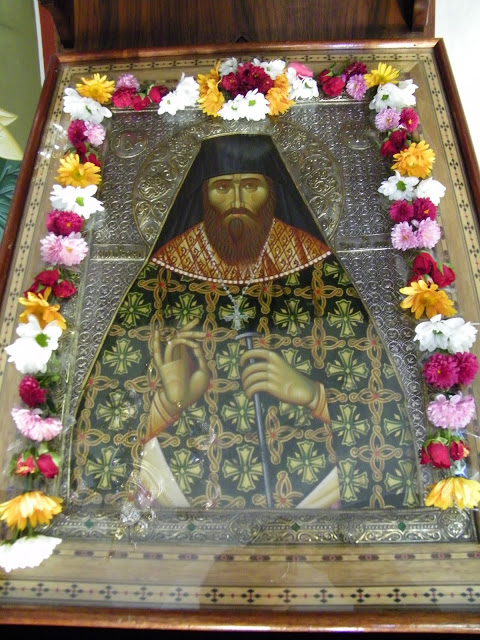
The Blessed Elder Georgios Karslidis of Pontos (1901-1959), latter day saint of the Saintly Orthodox Church in Greece,  glorified by the Patriarchate of Constantinople in 2008, was the first “resident” and founder of the monastery in the year 1930. He is one of few saints known to bear an imprint of the sign of the cross on his skull. There is a flourishing multitudinous sisterhood of nuns here today, who occupy themselves with the Iconography of handheld pictures, gold embroidery,knitting and waxwork.


Gerondissa Akylina, Porphyria, Sipsa Monastery and St. Georgios Karslidis


Gerondissa Akylina, Porphyria, Sipsa Monastery and St. Georgios Karslidis


Gerondissa Akylina, Porphyria, Sipsa Monastery and St. Georgios Karslidis


Gerondissa Akylina, Porphyria, Sipsa Monastery and St. Georgios Karslidis


Gerondissa Akylina, Porphyria, Sipsa Monastery and St. Georgios Karslidis


Gerondissa Akylina, Porphyria, Sipsa Monastery and St. Georgios Karslidis


Gerondissa Akylina, Porphyria, Sipsa Monastery and St. Georgios Karslidis


Gerondissa Akylina, Porphyria, Sipsa Monastery and St. Georgios Karslidis


Gerondissa Akylina, Porphyria, Sipsa Monastery and St. Georgios Karslidis


Gerondissa Akylina, Porphyria, Sipsa Monastery and St. Georgios Karslidis


Gerondissa Akylina, Porphyria, Sipsa Monastery and St. Georgios Karslidis


Gerondissa Akylina, Porphyria, Sipsa Monastery and St. Georgios Karslidis


Gerondissa Akylina, Porphyria, Sipsa Monastery and St. Georgios Karslidis


Gerondissa Akylina, Porphyria, Sipsa Monastery and St. Georgios Karslidis


Gerondissa Akylina, Porphyria, Sipsa Monastery and St. Georgios Karslidis


Gerondissa Akylina, Porphyria, Sipsa Monastery and St. Georgios Karslidis


Gerondissa Akylina, Porphyria, Sipsa Monastery and St. Georgios Karslidis


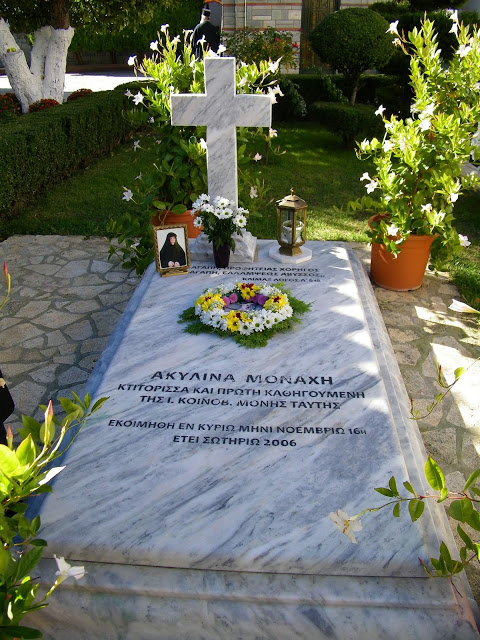
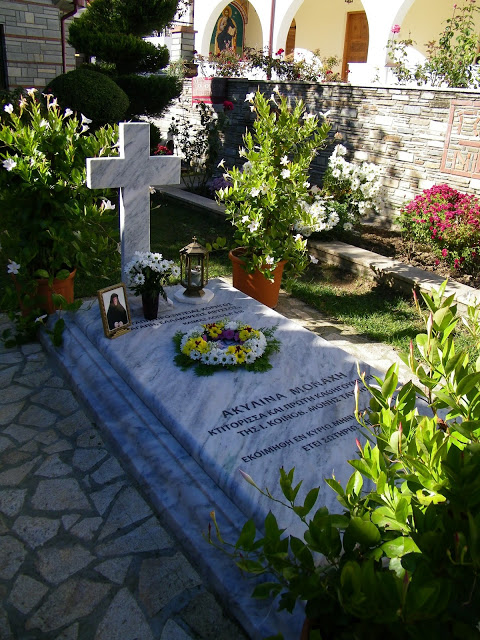
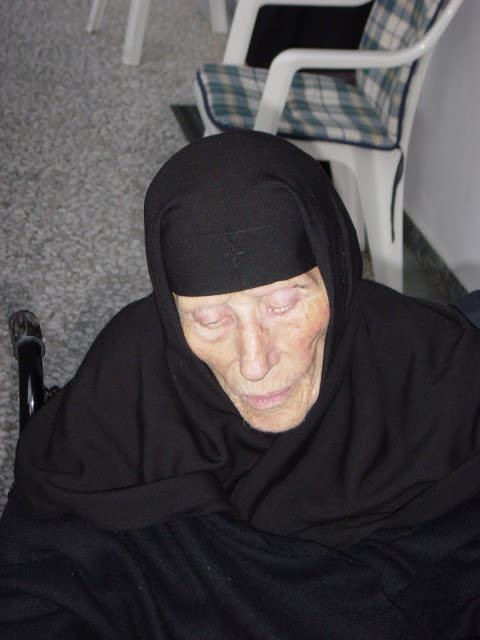
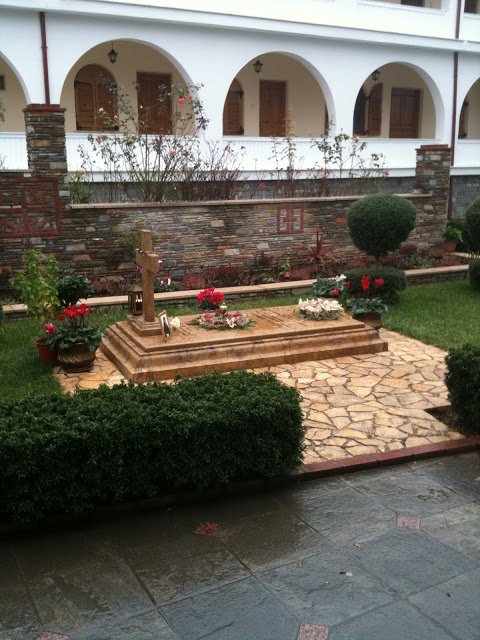
Gerondissa Akylina was the first Abbess. I had the rare blessing to meet her a number of times during the last years of her life. In the words of our late Elder Iosif Vatopaidinos, Gerondissa Akylina, together with Gerondissa Makrina in Portaria, were ‘Abbesses of Abbesses’:  examples of the monastic life and their monasteries models of coenobia, workshops of virtue and antechambers of Paradise.


Gerondissa Akylina, Porphyria, Sipsa Monastery and St. Georgios Karslidis


Gerondissa Akylina, Porphyria, Sipsa Monastery and St. Georgios Karslidis

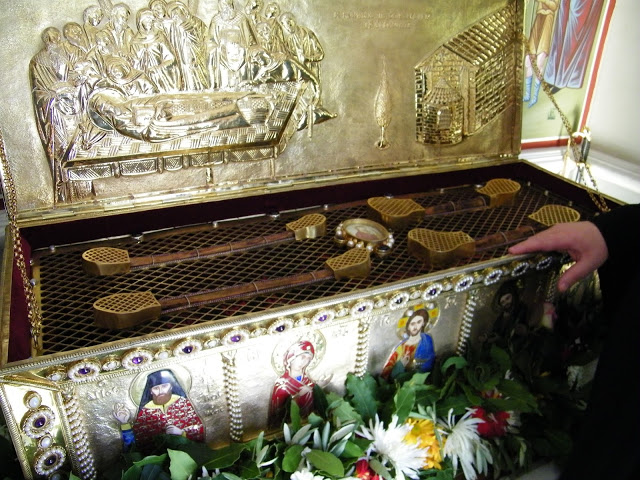
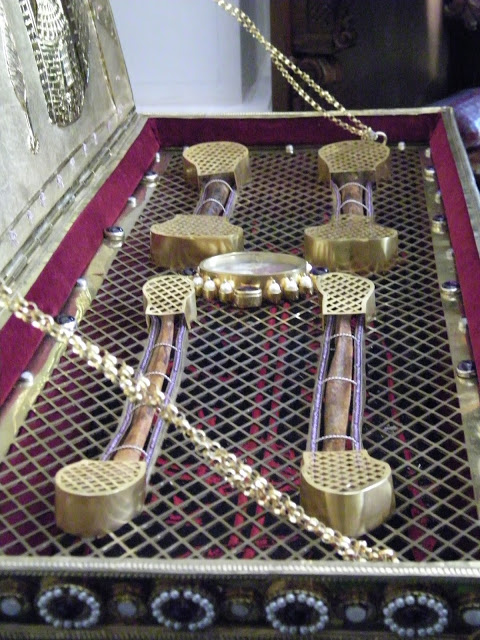
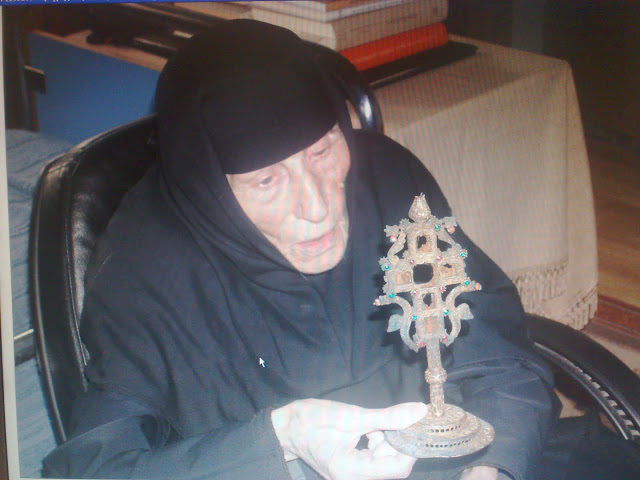
Gerondissa Akylina holding the Cross of St. Georgios Karslidis which was found intact after the translation of his relics. He is one of few saints known to bear an imprint of the sign of the cross on his skull.


Gerondissa Akylina, Porphyria, Sipsa Monastery and St. Georgios Karslidis


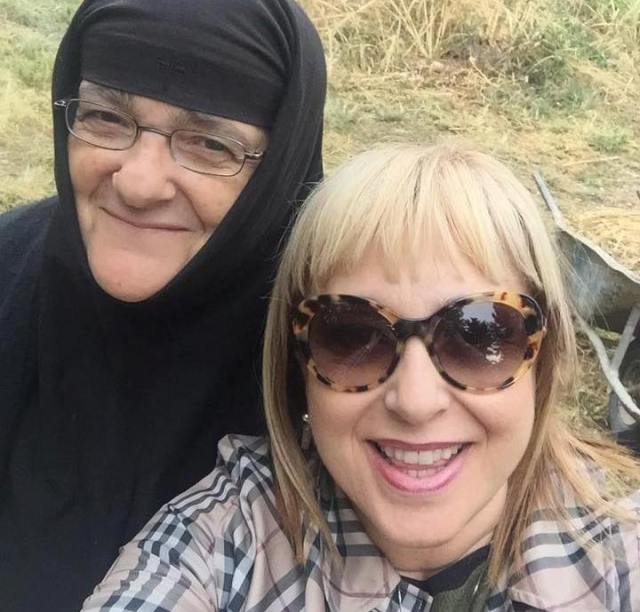
Gerondissa Porphyria has always been so full of love and humility, always ready to sacrifice her ease,  her rest and sleep, everything for her ‘neighbour! How many times has she consoled me in the trials and tribulations of my life! Always by my side, always! How many times has she offered a shoulder to cry on and precious, practical counsel! Her prayerful presence is intensely, intimately felt even thousands of miles away, here at the UK, and her smile warms my heart. Oh, just look at her smile in the photographs below with a pilgrim at the monastery and imagine the rays of the sun warming your shoulders after a rainy, cold day! How blessed am I to have such a spiritual mother by my side! Over the years I got better acquainted with the friendly and hospitable nuns there and the pilgrims and the faithful who regularly visit this monastery. St. Georgios’ holy presence is immediately felt upon entering the monastery gate, and there is always a queue at his tomb where his spiritual children kneel before their spiritual father, now in Heaven, to ask for his spiritual guidance and to seek comfort in life’s trials and tribulations.


For a closer insight at Elder Georgios Karslidis and his miracles, watch the following interview by Gerontissa Porphyria:


When Demons Speak

 At St. Gerasimos’ Feast

St. Gerasimos of Cephalonia Feast Litany Miracles 


St. Gerasimos the New Ascetic of Kefallonia (+1579) is known as a renowned healer of the mentally ill and a grace-filled exorcist of the demon possessed. They flock to his holy shrine which contains his incorrupt relics to receive healing. His nickname is “Kapsalis” (“the burning one”), after the desolate place of Kapsala on Mount Athos, where the Saint lived as an ascetic.The demons cry out: “Kapsalis, you have burned us.”


An eye-witness: “When the priest was performing the Holy Unction, a demon-possessed woman was screaming in convulsions: ‘Is it not enough that the old priest that stays here doesn’t leave me in peace day or night, and today you with the oil, the two of you will burn me?’ As soon as she was anointed, the demon was so shaken that the woman fell down unconscious but she was freed by the grace of the Saint.”


Another: I happened to be traveling in Kefallonia during the feast of St. Gerasimos. When I arrived at the monastery, loud screams were coming from the demon possessed in the church, saying: “You are burning me, Gerasimos. You are burning me Kapsali.” Everyone understood in the church that there was a spiritual battle going on around them at that moment that they could hear but not see.


The Saint ‘Gets Up’!


A most solemn moment, as the Saint is ‘allowed’ in the vertical position

only during his Feast and Litany.

And His Litany

“As the sun you emerge from Your church Gerasimos, and with heaven’s angels you ascend the heights”.


On Aug 16 the Saint’s relics are carried in an upright position in a procession for 500 metres. The procession starts at the church and proceeds down a wide road lined with poplars as far as a spreading plane tree where there is a well which is said to have been dug by the Saint himself.


Tradition has it that Omala valley exclusively receives His Blessing. Many times it was attempted to remove Him from here, without success. A little further down on the road to Troianata, the location is called “podoria” and it is the place from where He could be moved no further. He would become heavy.


Among the procession, the Saint is in the middle, raised high, untouched by time, in His clerical robes which like His body did not perish in the grave.


“A five-branch plane tree and a deep well you left for us Gerasimos as an eternal sign”


He will rest at the Well that He dug, under the shade of the plane tree – The water in the Well will overflow and the leaves of the plane tree will thrush to greet The Master.


Hours before the litany begins, people struggle to secure a position to lay down anywhere along the procession’s way so that the Saint may pass over them. The Litany  is the peak of hope for miraculous healings.


St. Gerasimos of Cephalonia Feast Litany Miracles


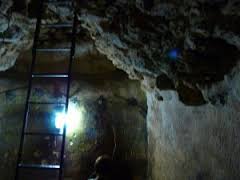
The older church containing the relics of St. Gerasimos is built directly over his cave and pilgrims are welcome to descend the ladder and squeeze through the tiny floor-level entrance that leads into the cave.

St. Gerasimos of Cephalonia Feast Litany Miracles


This August the Lord granted me the special blessing to take part in all this. An indelible pilgrimage for both the profound mourning that was searing my heart and the healing ointment of forgiveness that is still working wonders in my life.


Near-Death and Afterlife Stories in a True Crown Jewel


dryvouno29dryvouno28dryvouno27dryvouno26dryvouno25dryvouno24dryvouno23dryvouno22dryvouno21dryvouno20dryvouno19dryvouno18dryvouno17dryvouno16

Dryovouno Monastery, Near-Death and Afterlife Stories

dryvouno15dryovouno14dryovouno13dryovouno12dryovouno11dryovouno10dryovouno9dryovouno7dryovouno6dryovouno5dryovouno4dryovouno3dryovouno2dryovouno1


Father Stephanos of the Monastery of Transfiguration (Metamorfosi tou Sotiros) in Dryovouno speaks very little, mainly with his eyes.

*

Mother Theologia: “How little do we think of death, although he is so near to us!” commenting on a yet another sudden, unexpected death.

*

Laokratia told us about a dream: “My friend’s late young son, who had suffered a sudden and violent death through a road crush, appeared in his father’s dream in tears, standing before a closed gate, telling him that ‘they’ do not allow him in. His father, a very faithful man, promptly met Elder Iakovos Tsalikis and told him his dream. By the grace of God, the elder, having a pure nous, was deemed worthy to see the souls of people at the time they were leaving the earth and ascending towards heaven. Elder Iakovos asked him if his son was blaspheming God, and the father sadly admitted so. Then, Elder Iakovos promised to pray for his son, and he also advised him to do alms in his son’s name, fast and pray to the Lord so He will grant him rest”. The poor father made a prostration and obeyed the elder, and after 40 days, he saw again his son in his dream, this time radiant with joy, in front of an open gate, thanking him and telling him that ‘they’ had allowed him in!”

*

Sister Gregoria: “I just received a message from a friend who had to undergo a difficult operation and she told me that it all went well but that it was St. Luke Bishop of Simferopol and Crimea, the Blessed Surgeon who operated her! In the operating room she felt that she was dying. She started ascending and watched the surgeon and the nurses trying to revive her unconscious body. Then she met ‘somewhere in the air’ St Luke. To be sure she could not really interpret what was happening to her as it was taking place. Still she understood that he reassured her that he would take over as the surgeon was clearly in an impasse. Then she started moving in the reverse direction, got into her body again and found herself in the hospital, having had the surgery performed, with doctors standing around her, looking at her puzzled. But who was this St Luke she had met? It took her a few hours to find out that her mother, a very devout woman, had placed a little icon of his underneath her pillow, just before the operation started!”

*

Sister Ioanna:”Yesterday at midnight, while I can finishing the writing of an icon and adding the dedication, I realised that although I could write the mother’s name easily, there was no way I could add her late son’s name. I started praying and in the Spirit I ‘saw’ that the mother was in a very good spiritual state, but her son was not at all well and needed our prayers. She felt that God had granted rest to the mother’s soul, but they should do alms in the son’s name and pray to the Lord so He will grant him rest”.

We arrived at the Monastery of the Transfiguration (Metamorfosi tou Sotiros) in Dryovouno on its Feast  day. We were a group of faithful, Mother Theologia and some nuns from the nearby Monastery of the Assumption, Dormition (Koimiseos tis Theotokou) of Mikrokastro. What stunning Beauty confronted us!


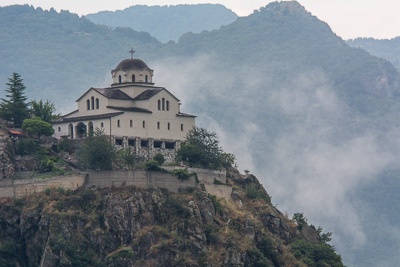
This male monastery is located a few kilometers above Dryovouno, at a secluded area. Its foundation goes back to 1592, while the murals were completed in 1652, by painter Nikolaos from Linotopi while the narthex in particular is the work of Argyris Kriminiotis.


Kosmas Aitolos arrived here and, after preaching, treated the monks who had been taken ill due to an epidemic. He fetched water from a nearby spring, blessed it, and gave it to the monks to drink, who were then cured. This water has been considered holy ever since and a chapel devoted to saint Kosmas has been constructed at the spring. St. Kosmas received from God the gift of prophecy.


At wartime, the monastery offered valuable services to the local population. It served as storage for ammunition and as base for various chieftains. This is where Dimitrios Feraios, Kapetan Vardas and Pavlos Melas resorted to.


In 1943 it was set on fire by Italians along with its historic records. Its renovation began in 1996, the prime mover being Archbishop Stefanos Rinos with the personal efforts of monks and believers. The parvis offers a sense of tranquility and a spectacular view to Voio and Kastoria.


It is Your Turn Now!

 Happy New Church Year! New Beginning Wishes from Cephallonia, a Story of Repentance, a Rumi Sufi poem, a robin singing and the little city hermit’s name day  ☺️

kef1

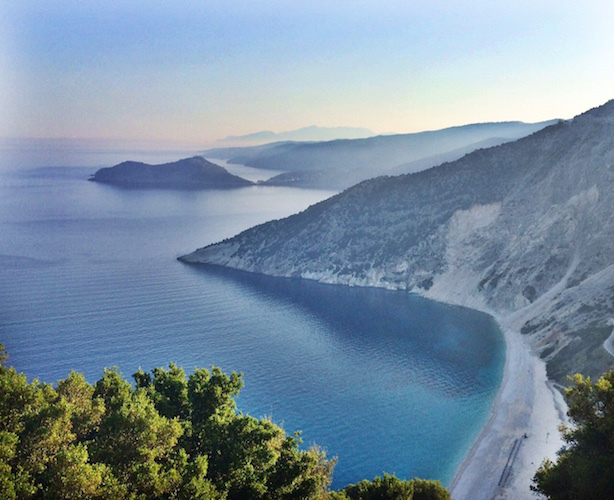
Myrtos Beach

kef5.jpg

kef6

kef7

Monastery of Agios Gerassimos

kef2.jpg

Fiskardo, Kefalonia

kef4.jpg


It Is Your Turn Now!

Transform your inner pearl.

It is your turn now,

You waited, you were patient.

The time has come,

For us to polish you.

We will transform your inner pearl

Into a house of fire.

You’re a gold mine.

Did you know that,

Hidden in the dirt of the earth?

It is your turn now,

To be placed in fire.

Let us cremate your impurities.

By Rumi

alchemist.jpg

A Story of Repentance

We knew virtually nothing…I had come to make my confession for the first time in my life. Shortly beforehand I had become a Christian by the grace of God. I had no deeper knowledge either of Christianity or of the church – who could have taught me? I and my newly-converted girl friend, both in the same position, learned what to do by imitating our old women, who zealously preserved the Orthodox faith and practices. We didn’t know anything. But we had something which in our day should perhaps be treasured more than knowledge: a boundless trust in the church, belief in all its words, in every movement and demand. Only yesterday we had rejected all authority and all norms. Today we understood the deliverance that we had experienced as a miracle. We regarded our church as the indubitable, absolute truth, in minor matters just as much as in its main concern. God has changed us and given us childhood: ‘Unless you become as children, you will not enter into the kingdom of heaven.’

I only knew that it was necessary to go to confession and to communion. I knew that both confession and communion were high sacraments which reconcile us with God and even unite us with him, really unite us with him in all fullness, both physical and spiritual. I was formally baptized by my unbelieving parents as a child. Whether they did that out of tradition or whether someone had persuaded them to do it, I never discovered from their explanations. Now at the age of twenty-six I had decided to renew the grace of baptism.

confession.jpg

Like a hardened crust

I knew that the priest himself – the well-known confessor Father Hermogen – would ask me questions and guide my confession. Then the day before I read a little booklet in order to prepare myself for confession, I discovered that I had transgressed all the commandments of the Old and New Testaments. But quite independently of that it was clear to me that the while of my life was full of sins of the most varied kind, of transgressions and unnatural forms of behavior. They now pursued me and tormented me after my conversion, and lay like a heavy burden on my soul. How could I have not seen earlier how abhorrent and stupid, how boring and sterile sin is? From my childhood my eyes had been blindfolded in some way. I longed to make my confession because I already felt with my innermost being that I would receive liberation, that the new person which I had recently discovered within myself would be completely victorious and drive out the old person. For every moment after my conversion I felt inwardly healed and renewed, but at the same time it was as though I was somehow covered with a crust of sin which had grown around me and had become hard. So I to longed for penance, as if for a wash. And I recalled the marvellous words of the Psalm which I had recently learned by heart: ‘Purge me with hyssop, and I shall be clean: wash me and I shall be whiter than snow.’


confession5

The experience of a miracle

And so my turn came. I went up, and kissed the gospel and the cross. Of course because I felt dismay and apprehension, I was afraid to say that I was confessing for the first time. Father Hermogen began by asking,

‘When did you last fail to go to church? What festivals have you deliberately neglected?’

‘All of them,’ I replied.

Then Father Hermogen knew that he was dealing with a new convert. In recent times new converts have come into the Russian church in large numbers, and they have to be treated in a different way.

He began by asking about the most terrible, the ‘greatest’ sins in my life, and I had to tell him my whole biography: a life based on pride and a quest for praise, on arrogant contempt for other people. I told him about my drunkenness and my sexual excesses, my unhappy marriages, the abortions and my inability to love anyone. I also told him about the next period of my life, my preoccupation with yoga and my desire for ‘self-fulfillment’, for becoming God, without love and without penitence. I spoke for a long time, though I also found it difficult. My shame got in the way and tears took away my breath. At the end I said almost automatically: ‘I want to suffer for all my sins, and be purged at least a little from them. Please give me absolution.’

Father Hermogen listened to me attentively, and hardly interrupted. Then he sighed deeply and said, ‘Yes, they are grave sins.’

I was given absolution by the grace of God: very easily, it seemed to me: for the space of several years I was to say five times a day the prayer ‘Virgin and Mother of God, rejoice’, each time with a deep prostration to the ground.

This absolution was a great support to me through all the following years. Our sins (the life of my newly-converted friend was hardly different from my own) somehow seemed to us to be so enormous that we found it hard to believe that they could disappear so simply, with the wave of a priest’s hand. But we had already had a miraculous experience: from the nothingness of a meaningless existence bordering on desperation we had come into the Father’s house, into the church, which for us was paradise. We knew that with God anything is possible. That helped us to believe that confession did away with sin. And the starets also said, ‘Don’t think about it again. You have confessed and that is enough. If you keep thinking about it you are only sinning all over again.’ (Tatiana Goricheva, a member of the “intelligentsia” and a Soviet-era dissident, Talking About God Is Dangerous)

Repentance and the Orthodox Sacrament of Confession

It Is Your Turn Now! 

*

“It is later than you think! Hasten, therefore, to do the work of God.”

+ Fr. Seraphim Rose, Fr. Seraphim Rose: His Life and Works

*

“When someone makes a decision, he is really diving into a strong current that will carry him to places he had never dreamed of when he first made the decision.” (The Alchemist)

confession2

Happy New Year!

* September 1st is the start of a new liturgical in the Orthodox Church

and

the little city hermit‘s name day 😊 


Cephalonia-Ithaka Pilgrimage

On my way  to this summer’s last pilgrimage: Cephalonia-Ithaca for the Dormition Feast

orthodox-city-hermit-and-cephalonia-ithaka-dormition-fast4

orthodox-city-hermit-and-cephalonia-ithaka-dormition-fast1orthodox-city-hermit-and-cephalonia-ithaka-dormition-fast2orthodox-city-hermit-and-cephalonia-ithaka-dormition-fast3


Apologies for being offline through August 31st.

May our Lady bless us and may the Lord keep us in the palm of His Hand until we meet again!

*

“Sister Begona Miguel of the Huelgas Monastery says:

“San Juan de La Cruz teaches us that silence has its own music; it is silence that enables us to see ourselves and the things around us.

‘I would like to add that there are words that can only be said in silence, odd as that may seem. To compose their symphonies, the great geniuses needed silence – and they managed to transform this silence into divine sounds. Philosophers and scientists need silence.

‘In the monastery, at night, we practice what we call The Great Silence.

‘In the absence of speech we can understand what lies beyond.” (Paulo Coehlo blog, In the Huelgas Monastery)

*

Therefore, it is time for the little city hermit to embark on yet another quest for stillness and silence. This blog takes a vacation, returning by the end of August, where I will start making preparations for my return trip to the UK.

You are always welcome to browse the ARCHIVES on the right.

Enjoy the rest of your summer.

With lots of love and poor prayers

The little city hermit

In Love, For Love, and By Love: Missionary Series IV

Families on Mission Vs. Single Missionaries


Families on Mission Vs. Single Missionaries

RTE: How has it been having your family in the mission field?

FR. LUKE: When my wife and I first went to Albania, many people thought that it was going to be very dangerous and that our children would suffer: “You are going to deprive your children of all the benefits of life in America.” Contrary to that expectation, we feel that our three children who were raised in the mission field were immensely blessed by the experience of learning another culture and language. They always appreciated what they had in America when they went back, but they also appreciated their mission home in Albania, which they thought of as their “real” home.

*

They’ve grown up with a very different world-view. They appreciate things that they would never think twice about if they had grown up in America. During our first years in Albania, we didn’t have running water every day. So, the kids learned to appreciate it. When we had water, we’d say, “Thank God for water. It’s great to have it.” During different periods, for months at a time, the electricity is off about five hours a day; in winter, maybe seven or eight hours. So they got excited when the electricity came on. Or, if we did have electricity, the tension was often so low that we couldn’t do something as simple as watch a video. I remember on one of our visits to the U.S., they wanted to watch a video, and came to my wife saying, “Mommy, if there’s enough tension can we watch television?” They still flip the switch to see if the electricity is working.

Families on Mission Vs. Single Missionaries

Next to our house in Albania we had a very tiny shop, nine by fifteen feet, with all different types of food – this was where we did most of our shopping. Once, when we were about to go back to America, my son Paul asked his mother, “In America, will they have shops as big as Uncle Soorie’s?” We laughed. It was beautiful to see how they were exposed to a different way of life. We lived in Tirana, the capital of Albania, and we were constantly exposed to beggars, poor people who came to our house every day asking for help. It was wonderful for our children to see this, day in and day out. They got used to getting things for the beggars, answering the door and coming and saying, “Oh, so-and-so is here.” We got to know these people by name, we visited their homes. When you live in suburban America you aren’t even exposed to them unless you go downtown. Many of these beggars truly became friends, and our kids loved them. They loved playing with them and saw them as human beings, not as beggars.

Families on Mission Vs. Single Missionaries

Another blessing of raising children in the mission field is community, both the indigenous Albanian community, the wonderful local people that were part of our life, and our co-missionaries who themselves had numerous children. At one time we had fifteen missionary children in the field, and they created such bonds of love and friendship. They weren’t exposed to the busyness, to the constant activities that American children are involved in. Their lives were very simple, and very fulfilled.

*

Neither my wife nor I have any sense of their being deprived, and one of our greatest regrets in leaving Albania after ten and a half years is that we have left at a time when our children are still young, and we are not sure how much they will remember. We often talk about going back into missions when they are a little older so that they not only remember, but can participate more fully. Even though they were young, we tried to get the idea across that they themselves were missionaries, that they needed to be witnesses. To whatever degree they could participate in our different activities, they did.

Families on Mission Vs. Single Missionaries

RTE: Growing up with cultural diversity must not only teach what is universal in human nature, but how to deal with differences early on.

FR. LUKE: Right. We Americans, unfortunately, are quite isolated from the rest of the world. The universal business language is English, so we think we can get anywhere speaking English. Having only Canada to the north and Mexico in the south, we aren’t exposed to many different cultures and languages and this is a great loss for us. It’s so enriching to be around the diversity found in a mission field, and to learn to see beauty in such diversity. One thing I tried to get across to the Kenyans, and later to the Albanians, was, “Sure, in America we have things that are nicer than in Kenya or Albania, but you have many aspects of your culture and life that we Americans can envy. Family connectedness, the support you have for one another, hospitality – how beautiful these things are! Don’t ever lose these aspects of your culture and think, ‘We want to become western, or American, because America is better in everything.’ There are certain things you can adopt from America that are beautiful, but don’t lose the beauty and richness that you have in your own tradition.”

*

Hospitality was something that always left the greatest imprint on me. I could travel to the poorest village in Africa and they would put on a feast. It was their responsibility to show love and hospitality to guests. It is the same in Albania. I don’t know who is more hospitable, the Albanians or the Kenyans, but they would put anyone in the West to total shame. Having almost nothing, they share whatever they have with whoever comes.

Families on Mission Vs. Single Missionaries

RTE: An American seminarian at Holy Cross Seminary told me about a depressed acquaintance who called one night, feeling suicidal. The seminarian invited him to come to the seminary for a few days for a change of scene and to be in a calm atmosphere. He agreed and the seminarian made the arrangements and cleaned an empty dorm room so that he could have his own space. The day his friend moved in, one of the Greek-born seminarians found out what was happening and insisted that the man take his own room, which contained his books and belongings, icons that were prayed in front of, and was a real home. The Greek seminarian slept in the hall on a couch outside the door so he could check on him through the night. The American seminarian said, “You know, I was so pleased that I’d found him his own space where he could have some privacy, where he could put his own things up – but actually what he needed was to be taken into someone else’s home and taken care of. I didn’t get it until I saw it.”

FR. LUKE: Yes, this virtue of hospitality is something missing in our American way of life. As missionaries, my wife and I saw hospitality as one of the greatest ways to express God’s love to the people. We wanted our home to always be open to people. We married right at the beginning of our time in Albania and it is interesting to think that my wife and I slept in our house alone perhaps three months out of the first five years of our marriage. We always had people coming, numerous people staying for months at a time. Our open home was a hallmark of our ministry. Even after the children started coming and we didn’t have as many overnight guests, we always had an open-door policy. There were people at our house every day. One of the difficult counter-cultural adjustments in coming back to America on sabbatical was that although we lived on campus at a seminary, no one came to visit. We lived there for four months and maybe a handful of people came to our house. And even when people came, they’d say, “I’m just here for a minute, I’ve got to run…” They’d stay briefly and then go on with their day.

Single Missionaries

Families on Mission Vs. Single Missionaries

RTE: We’ve been speaking here of missionary families. What opportunities are there for unmarried men and women? And in view of cultural differences, are single women limited as missionaries? What part do they play on a mission team?

FR. LUKE: The mission in Albania offers a good response to this question.

Families on Mission Vs. Single Missionaries

During the years I served there, of the 20-25 missionaries we had at any one time, we had a nice mix – usually about eight monastics, eight married missionaries, and six or seven single missionaries. Of the two dozen missionaries, about half were men and half were women. Also, about eight were clergy, and the rest laity. The unmarried missionaries played an important role in the overall outreach of the Church. In Albania, we had single missionaries who headed up our medical clinic, our elementary school, our post-secondary professional institute, as well as our development and emergency relief office. We also had single missionaries who taught at our seminary, who taught English in a variety of contexts, taught catechism, worked in administration, and who participated in our university ministry, among other things.

Families on Mission Vs. Single Missionaries

The Body of Christ has a need for everyone – men or women, married or unmarried. It is the same for the mission field. In fact, when a missionary team has a variety of members, it makes the overall witness that much more effective. Some people will relate well to a monastic. Others feel more comfortable with a married priest. Some prefer to approach a mother, or a married woman. Still others will listen to a single man or woman. All are part of one body, offering a unified witness. So there are surely opportunities for the monastics, the married, and the unmarried! In some countries, it isn’t appropriate for men to approach women and talk with them in public. Such societies need women missionaries, and this means both married and single women.

*

In the Protestant world of missions, single women really weren’t encouraged, or even allowed, in the mission field until the 1800’s. By the 1900’s, women outnumbered men as missionaries. Today, women far outnumber men, and this includes many single women. Women had to overcome many obstacles and prejudices before being allowed to serve in a variety of capacities, and this may be the same for the modern Orthodox missionary movement.

*

RTE: Do you have any specific counsel for unmarried missionaries?

FR. LUKE: My advice for single men or women is that they must be ready for some additional challenges. The loneliness of a new culture, the challenges of entering a new country, the frustrations of learning a language, and the normal difficulties and disappointments of the mission field can be overwhelming. As a married missionary, you have your spouse to support and comfort you; the monastics may be living in community and have another type of support; but the single missionary can feel the loneliness and frustration in a magnified manner. A single person has to be ready for these added challenges. He or she needs to be a strong person, and also be able to find support in time of need. Their co-missionaries need to be sensitive to this extra burden, and try to reach out to them.

Families on Mission Vs. Single Missionaries

One way to help overcome these additional struggles would be for single missionaries to live in community, either with other missionaries of the same sex, one of the missionary families, or even with an indigenous family. Living with a family of the country can be one of the fastest ways to learn the language, culture, and ways of the host country. Of course, other challenges may arise as cultures clash and one’s privacy may be lost.


In Love, For Love, By Love: Missionary Series III

How can I become a long-term missionary?

Archbishop Anastasios of Albania Orthodoxy missionary work

Long and Short-Term Missions

RTE: Can you tell us what it takes to be a long-term missionary? You’ve spoken of the beginning stages, how about later?

FR. LUKE: Archbishop Anastasios has good advice for people thinking of going into the mission field: “It’s always better to say you are going for one year and stay for ten, than to say, ‘I am going for ten years,’ and after the initial enthusiasm fades away, you realize you can’t handle it.” There is wisdom in this: go step-by-stepand God will give you grace and strength.

Archbishop Anastasios of Albania Orthodoxy missionary work

The goal of missions is to establish an authentic Eucharistic worshipping community in the people’s own language and culture

In my early 20’s, when I attended Pennsylvania State University, I contemplated entering the Peace Corps. When I learned more about it though, I was afraid, because I wasn’t sure I could handle the two-year commitment to leave my country and live in an impoverished third-world village. I turned down the opportunity, but God in His own way took me step-by step. He didn’t reveal to me, “In the future you will spend ten years in Albania.” No. First, I went on a short-term mission team for one month to Kenya. The following year I returned for a six-month commitment, and these six months turned into a year of service. After returning to Africa three times over the next four years, I began looking at Albania as a place where I could serve as a long-term missionary. I suggested to my wife, “Let’s make a three year commitment, and then see.” God took us through those three years and gave us the strength we needed. Those three years turned into five years, seven years, a decade. We might have been frightened, had we known at the beginning that we would serve in Albania for ten years, but God took us by the hand and led us.

Archbishop Anastasios of Albania Orthodoxy missionary work

Don’t frighten yourself by thinking, “How can I become a missionary and live in another culture for so many years?” Just go, make the sign of the cross, and start working. Be open and willing to stay for longer, but tell yourself, “I am going for one year or for two years, and see how it works.” But keep praying, “Lord, if You give me the grace, I will stay as long as You want me here.”

Archbishop Anastasios of Albania Orthodoxy missionary work

RTE: You mentioned the short-term mission teams of two or three weeks. I imagine that it’s helpful for people in a foreign country to feel that others appreciate them enough to come, but what are the real benefits of this short-term experience?

FR. LUKE: One has to be very clear about the purpose of missions. The goal of missions is to establish an authentic Eucharistic worshipping community in the people’s own language and culture. If one is going to serve in a place that isn’t yet Christian, this will take many years and involve great effort, sacrifice, and struggle. To achieve anything, the missionary must commit himself to living among the people long-term and learning the language and culture.

With the ease of travel and technology, a new phenomenon has arisen in the past thirty years in the mission field – “short-term mission teams” – which send people for a week or two, or a month, to a certain area. They often have a specific project: to build a church, run a catechetical program, etc.

Orhtodoxy missionary work

There is value in these short-term projects, and the first and greatest value is for those who are going. It exposes them to a different culture, a different people. For westerners it is often the first time they’ve seen a third-world country up close, with of all its poverty and hardship. It’s an eye-opening experience. For many, this initial experience is an exciting adventure, and although these short-termers go with the intention of offering something, they receive much more than they can offer, and usually return to their home country full of enthusiasm. They often become ambassadors for the missionary movement; they speak in churches and their enthusiasm is contagious. It’s great for them and for the church that sent them.

But what did they really offer for the week, or month, or two months they were in the mission field? They offered something. Perhaps they built a building – but I’m sure the indigenous people could have built the building themselves if they’d had the money. Perhaps they created some nice friendships, and that’s important to encourage people, but they have to realize that what they offered was very limited.

It is not going to transform, convert, and change people’s lives. At best it is going to complement the work that’s already being done by the long-term missionaries and the local Christians who live there. Some churches are now sending many short-term teams; you can get the people, they’re enthusiastic, it motivates people back home. But people are still afraid to go into long-term mission and this “short-term” trend can create a great danger for the future.

Short-term teams are not the goal of missions, but they can support the overall effort, and short-termers need to be challenged as to where they are going to take this experience when they return home. In any group of twenty short-term missionaries who go somewhere for a month, my goal would be that at least one or two of them seriously consider long-term mission work.

Orthodoxy missionary work

For others, hopefully, this incredible experience will help to transform them into more serious Christians. Lord willing, they will use this experience as a stepping stone in their own spiritual journey. Perhaps they won’t become long-term missionaries, but they will be more dedicated Christians in whatever they do. Hopefully, the majority of people who go will at least understand missions in a new way, and even if they never become long-term missionaries, they will become supporters and partners of those in long-term missions.

There are two results we don’t want from short-term missions. First, we don’t want these participants to think that they are missionaries who have fulfilled their responsibility in missions. They are not missionaries, but members of a missions team. They now have a responsibility to use the experience they’ve received for the glory of God and to spread the spirit of missions in the Church.

The second danger is that we don’t want short-term participants to return home and, after an initial month of excitement, put the experience away as a great adventure and go on with their life as they lived it before. We would consider both of these results as a failure in our short-term strategy.

Orthodoxy missionary work

I have participated on five short-term mission teams, four times as a leader. I have also received five short-term teams while being a long-term missionary. So I’ve been exposed to this concept of missions from a variety of angles. These short-term experiences radically changed the direction of my life, so I’m very grateful for the experience. They exposed me to the reality of missions work and led me to longer stays in Africa. Such trips filled me with enthusiasm and zeal for missions, and led me to eventually study theology at Holy Cross Greek Orthodox School of Theology, as well as to study missiology at Fuller Seminary’s School of World Missions.

orthodoxy missionary work

When I was a long-term missionary receiving missions teams, I did all the prep work for the teams, and it took a month out of my schedule each time to accommodate them. In certain cases it was worth it. Some teams did great and really complemented the ministries we were already doing. But to be honest, other teams were very demanding and in the end, the benefit that they offered was minimal. In those instances, it became a very time-consuming project that didn’t have a lot of value for our overall mission. Short-termers need to be aware of this, and when they go, to be humble about it.

RTE: I imagine they are more like pilgrims than missionaries, guests of Orthodox missions who may be able to help out in a small way.

FR. LUKE: Yes, I always tell the short-termers that they shouldn’t call themselves missionaries. They aren’t missionaries. They should think of themselves as visitors to a mission field. Some don’t like to hear this. They would like to think, “I’m following the path of the great missionaries; I’m a missionary now.” That’s quite naive.

Orthodoxy missionary work

To Be Continued …

Go here for Part I

Go here for Part II