Face to Face

Nothing about the human body is as intimate as the face. We generally think of other aspects of our bodies when we say “intimate,” but it is our face that reveals the most about us. It is the face we seek to watch in order to see what others are thinking, or even who they are. The importance of the face is emphasized repeatedly in the Scriptures. In the Old Testament, it is the common expression for how we rightly meet one another – and rarely – God Himself – “face to face.”

In the New Testament, St. Paul uses the language of the face to describe our transformation into the image of Christ.

Χώρα-των-ζώντων

The holy icons are doubtless the most abundant expression of the “theology of the face,” and perhaps among the most profound contributions of Orthodoxy to the world and the proclamation of what it truly means to be human. Every saint, from the least to the greatest, shares the same attribute as Christ in their icons. We see all of them, face to face. In the icons, no person is ever depicted in profile – with two exceptions – Judas Iscariot and the demons. For it is in the vision of the face that we encounter someone as person. It is our sin that turns us away from the face of another – our effort to make ourselves somehow other than or less than personal. It is a manifestation of our turning away from God.

In human behavior, the emotion most associated with hiding the face is shame. The feeling of shame brings an immediate and deep instinct to hide or cover the face. Even infants, confronted by embarrassment or mild shame, will cover their faces with their hands or quickly tuck their face into the chest of the one holding them. It is part of the unbearable quality of shame.

Hiding is the instinctive response of Adam and Eve. “We were naked and we hid…” is their explanation. Readers have always assumed that it is the nakedness of their intimate parts that drive the first couple to hide. I think it more likely that it was their faces they most wanted to cover.

In an extended use of the story of Moses’ encounter with God after which he veiled his face, St. Paul presents the gospel of Christ as a transforming, face-to-face relationship with Christ.

Therefore, since we have such hope, we use great boldness of speech–unlike Moses,who put a veil over his face so that the children of Israel could not look steadily at the end of what was passing away. But their minds were blinded. For until this day the same veil remains unlifted in the reading of the Old Testament, because the veil is taken away in Christ. But even to this day, when Moses is read, a veil lies on their heart. Nevertheless when one turns to the Lord, the veil is taken away. Now the Lord is the Spirit; and where the Spirit of the Lord is, there is liberty. But we all, with unveiled face, beholding as in a mirror the glory of the Lord, are being transformed into the same image from glory to glory, just as by the Spirit of the Lord. Therefore, since we have this ministry, as we have received mercy, we do not lose heart. But we have renounced the hidden things of shame, not walking in craftiness nor handling the word of God deceitfully, but by manifestation of the truth commending ourselves to every man’s conscience in the sight of God. But even if our gospel is veiled, it is veiled to those who are perishing, whose minds the god of this age has blinded, who do not believe, lest the light of the gospel of the glory of Christ, who is the image of God, should shine on them. For we do not preach ourselves, but Christ Jesus the Lord, and ourselves your bondservants for Jesus’ sake. For it is the God who commanded light to shine out of darkness, who has shone in our hearts to give the light of the knowledge of the glory of God in the face of Jesus Christ. (2Co 3:12-6 NKJ)

The veil of Moses is an image of the blindness of the heart and spiritual bondage. Turning to Christ removes this blindness and hardness of heart. With unveiled faces we behold the knowledge of the glory of God revealed in the face of Jesus Christ and are transformed into the very same image which is Christ.

In Russian, the word lik (лик) can mean face and person. Sergius Bulgakov plays with various forms of the word in his book Icons and the Name of God. It is an essential Orthodox insight. The Greek word for person (πρόσωπον) also carries this double meaning. The unveiled or unhidden face is a face without shame – or a face that no longer hides from its shame. This is perhaps the most fundamental aspect of our transformation in Christ. The self in whom shame has been healed is the self that is able to live as person.

We are restored to our essential and authentic humanity – our personhood. We behold Christ face to face, as a person would who looks into a mirror. And, as St. John says, “We shall be like Him, for we shall see Him as He is” (1Jo 3:2 NKJ).

The sacrament of penance boldly walks directly into the world of shame. Archimandrite Zacharias says:

… if we know to whom we present ourselves, we shall have the courage to take some shame upon ourselves. I remember that when I became a spiritual father at the monastery, Fr. Sophrony said to me, “Encourage the young people that come to you to confess just those things about which they are ashamed, because that shame will be converted into spiritual energy that can overcome the passions and sin.” In confession, the energy of shame becomes energy against the passions. As for a definition of shame, I would say it is the lack of courage to see ourselves as God sees us. (from The Enlargement of the Heart).

This is not an invitation to toxic shame – nor an invitation to take on yet more shame – it is a description of the healing from shame that is given in Christ. That healing is “the courage to see ourselves as God sees us.” It is the courage to answer like the prophet Samuel, “Here I am!” when God calls. God called to Adam who spoke from his shameful and faceless hiding.

Some of the mystical sermons of the fathers speak of Christ seeking Adam out a second time – but this time, in Hades, when Christ descended to the dead. There, Adam, hid no longer, turned to face the risen Lord. And so the traditional icon of the resurrection shows Christ taking Adam and Eve out of the smashed gates of Hades.

The gates of Hades are written in our faces – as are the gates of paradise. It is the mystery of our true self – the one that is being re-created in the image of Christ – precisely as we behold Him face to face and discover that no shame need remain. Where the Spirit of the Lord is, there is liberty. Sweet liberty!

Source: glory2godforallthings.com/

Orthodox Miracle The River Jordan Turning Back


Ever since the Theophany of our Lord and Saviour Jesus Christ, this miracle keeps happening in the Jordan River, on this Feast Day, only on this day, once a year: the River Jordan Reverses its Flow!  The calm river literally turns back when the Holy Cross is thrust into, parts start bubling up creating waves and the direction of flow is changed. After the crosses are removed from the water, the direction changes back to normal. I have been ‘baptised’ in the Jordan River myself, not on Theophany, so I have not personally witnessed this, but those friends of mine who have been present there on Theophany Day, all attest to it happening! May we acquire at least Nature’s ‘sensitivity’ before Our Master!

*

This miracle echoes excerpts from the Orthodox Service for the Great Sanctification of the water, conducted every liturgical year, at the Feast of the Theophany, known as Epiphany:


“Today the Jordan is cloven, and its waters shall be held from flowing, the Master being shown washed therein.

The waters saw Thee, O God, the waters saw Thee; they  were afraid. Jordan turned back when it beheld the fire of the Godhead coming down and descending upon it in the flesh.” 

jordan.jpg

River Jordan on the day of the Theophany


On Zeal

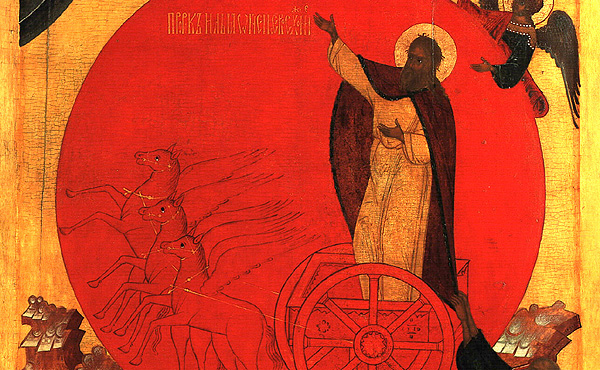
elijah1

A monk must be extremely cautious of carnal and animal zeal, which outwardly appears pious but in reality is foolish and harmful to the soul.

Worldly people and many living the monastic life, through ignorance and inexperience, often praise such zeal without understanding that it springs from conceit and pride. They extol this zeal as zeal for the faith, for piety, for the Church, for God. It consists in a more or less harsh condemnation and criticism of one’s neighbours in their moral faults, and in faults against good order in church and in the performance of the church services. Deceived by a wrong conception of zeal, these imprudent zealots think that by yielding themselves to it they are imitating the holy fathers and holy martyrs, forgetting that they – the zealots – are not saints, but sinners.

When for your labour in the garden of the commandments God grants you to feel in your soul divine zeal, then you will see clearly that this zeal will urge you to be silent and humble in the presence of your neighbours, to love them, to show them kindness and compassion, as Saint Isaac the Syrian has said. 

Divine zeal is a fire, but it does not heat the blood. It cools it and reduces it to a calm state. The zeal of the carnal mind is always accompanied by heating of the blood, and by an invasion of swarms of thoughts and fancies. The consequences of blind and ignorant zeal, if our neighbour opposes it, are usually displeasure with him, resentment, or vengeance in various forms; while if he submits, our heart is filled with vainglorious self-satisfaction, excitement and an increase of our pride and presumption.

St. Ignatius Brianchaninov

The Arena

Chapter 36

The Butterfly Lesson

Butterflies-in-cocoons-emerging.jpg

“One day a tiny tear appeared on a cocoon. One man was watching the butterfly trying to push her body through the opening. The struggle lasted for hours. Then it looked as though every activity had ceased. It looked as though the butterfly had done all it could and could not move any further. The man took a pair of scissors and opened up the cocoon. The butterfly moved out easily yet her body and her wings looked withered.

The man continued watching. He was waiting for her to flap her wings, hoping they would slowly grow, strengthen and become able to lift the butterfly to the air.

Yet, the butterfly went through her entire life moving painfully and slowly, harboring a wasted body and withered wings. She never managed to fly away.

What this kind man could not understand was that the restricted space in the cocoon and the struggle the butterfly waged served to force the liquids in her body to move towards her wings, so that she would be able to fly away as soon as she would get out.

Sometimes we too need this kind of struggle.

If we go through life without facing any troubles, we will be wasting away. We would not be as strong as we could be. We would never be able to ‘fly away’.

 pretty-butterfly

I have asked for strength…

I faced trouble so that I could become stronger

I have asked for wisdom…

I was given riddles to solve

I have asked for a good life…

I was given a brain and a healthy body so that I could work

I have asked for courage…

I was given obstacles to overcome

I have asked for love…

I met people in pain so that I could help them

I have asked for favours…

I was given opportunities

I did not receive what I have asked for…

But I did receive what I needed”.

Translated by Filothei

Source: synodoiporia.blogspot.gr/

How a Dead Mother Stopped Her Son From Suicide

Nein!

The most painful NEIN in cinema’s history…

To a person who had to choose between suicide and begging

le-suicide

St. Velimirovich letter 

29 December 2016

You write that all your worldly goods were sold off to a third party. When you found yourself out on the street with nothing and nobody, you headed to the cemetery, bent on killing yourself. You had no doubts or second thoughts about this. Exhausted by the vexations, you lay down on your parents’ grave and fell asleep. Your mother appeared to you in your sleep and berated you, saying that in the Kingdom of God there were plenty of people who had been beggars, but not a single one of those who had done away with themselves. That dream saved you from suicide. Your beloved mother really did save you, by God’s providence. You began to beg and to live off begging. And you’re asking if, by doing so, you’re transgressing God’s law.

Take courage. God gave the commandment: ‘Don’t steal’. He didn’t give any commandment ‘Don’t beg’. Begging without any real need is stealing, but in your case it isn’t. The general and emperor Justinian was left blind in his old age, with no possessions or friends. He would sit, blind, outside the courtyard of the throne and beg for a little bread. As a Christian, he didn’t permit himself to consider suicide. Because, just as life’s better than death, so it’s better to be a beggar than a suicide. 

You say that you’re overcome with shame and that your sorrow’s deep. You stand at night outside the coffee-shop that used to be yours and ask for money from those who go in and out. You remember that, until recently, you were the owner of the coffee-shop and now you don’t dare go in even as a customer. Your eyes are red from weeping and lamentation. Comfort yourself. God’s angels aren’t far from you. Why are you crying about the coffee-shop? Haven’t you heard of the coffee-shop at the other end of Belgrade where it says: ‘Someone’s it wasn’t; someone’s it won’t be’? Whoever wrote those words was a true philosopher. Because that’s true of all the coffee-shops, all houses all the castles and all the palaces in the world.

What have you lost? Something that you didn’t have when you were born and which isn’t yours now. You were the boss, now you’re poor. That’s not loss. Loss is when a person becomes a beast. But you were a person and have remained so. You signed some papers for certain of your prominent customers and now your coffee-shop’s in the hands of a stranger. Now you look through the window and see everybody laughing, just the way they used to, and you’re wandering the streets with tears in your eyes and covered in shame. Never fear, God’s just. They’ll all have to answer for their misdeeds. But when they attempt to commit suicide, who’s to say whether the merciful Lord will allow their mothers to appear to them from the other world in order to keep them from the crime? Don’t consider them successful even for a moment. Because you don’t know how they’ll end up. A wise man in ancient Greece said: ‘Never call anybody happy before the end’. It’s difficult to be a beggar? But aren’t we all? Don’t we all depend, every hour of every day, on the mercy of Him Who gives us a life to lead? Now you’ve got an important mission in the world: to engage people’s attention so that they remember God and their soul and to be charitable. Since you’re forced to live in silence, delve into your soul and talk to God through prayer. The life of a beggar’s more heroic than that of a boss. ‘For gold is tested in the fire and accepted people in the furnace of humility’ (Sir. 2, 5). But you’ve already demonstrated heroism by rejecting the black thought of suicide. This is a victory over the spirit of despondency. After this victory, all the others will be easy for you. The Lord will be at your side.

Peace and comfort from the Lord!

le-suicide2

A Holy Man’s Christmas Card

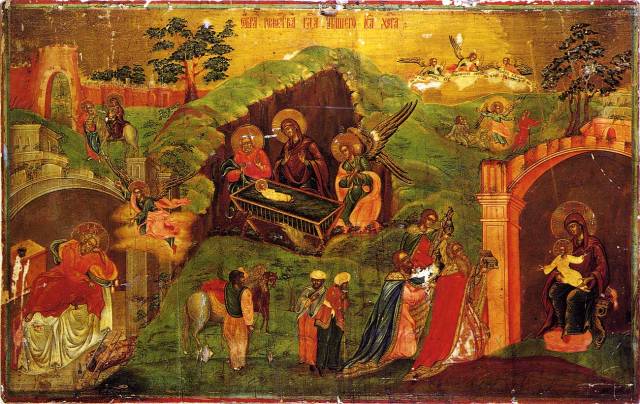
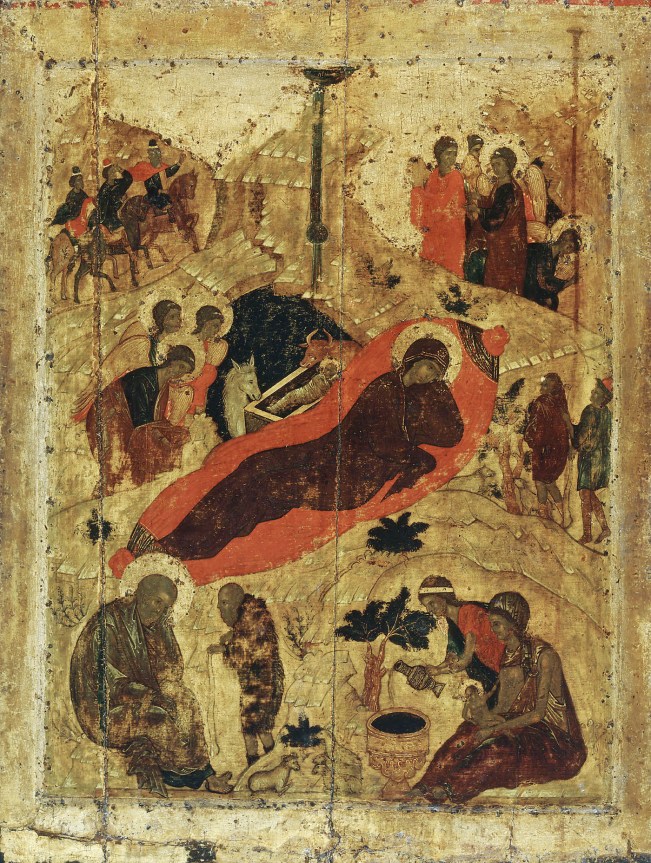
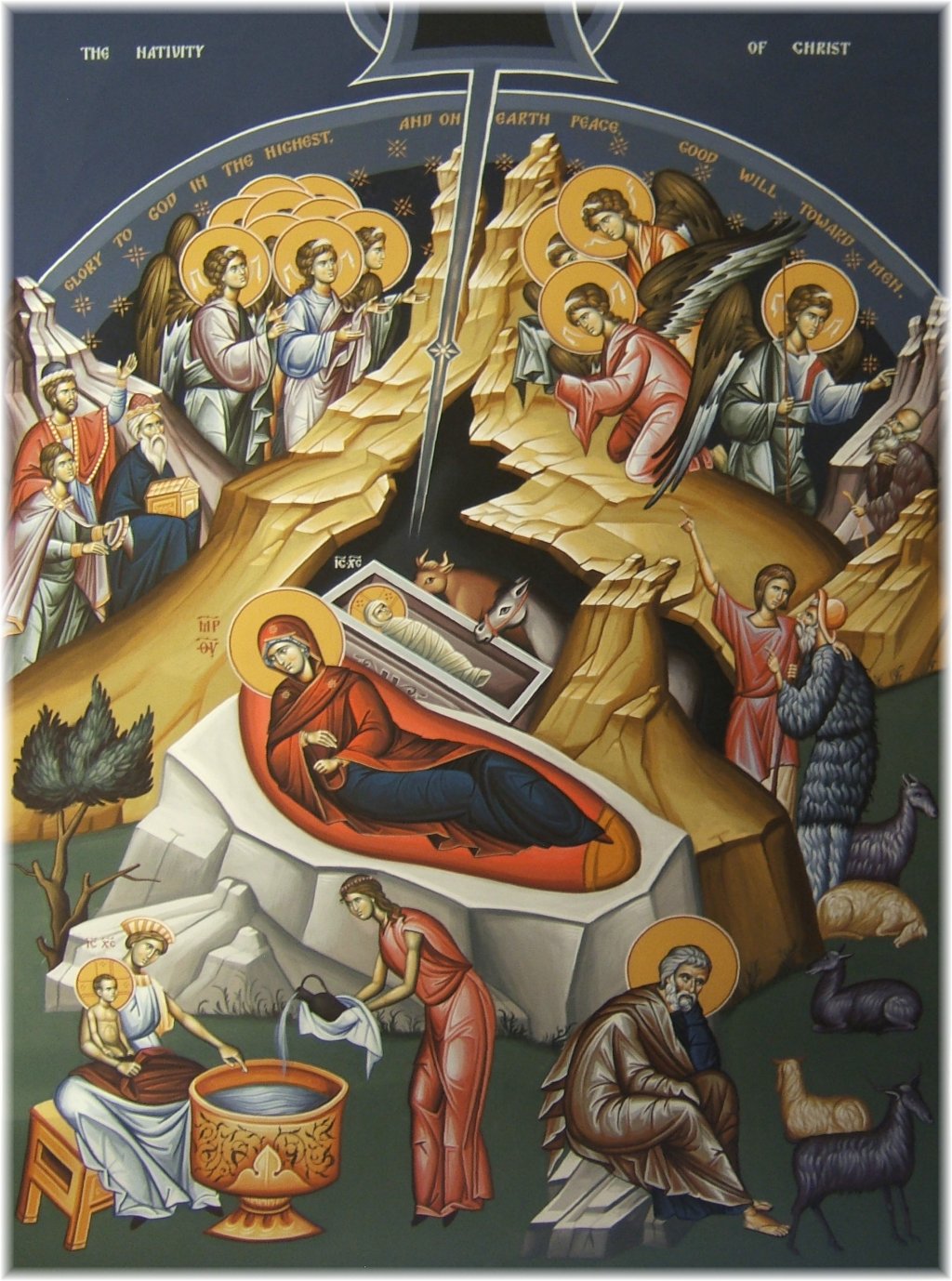
nativity-icon-5Paraskevi, who out of sheer humility does not wish to reveal her full name, was among the first spiritual children of Elder Sophrony, during the time of her studies in England. She sent us a copy of two handwritten scripts by the blessed Elder.

christmas-card

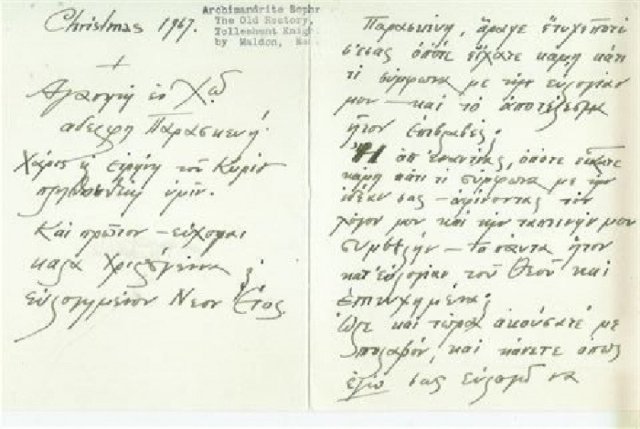
A good wish card which the blessed Elder sent during Christmas 1967, when Paraskevi was going through some difficult times because of the illness of a close relative.

christmas-card2

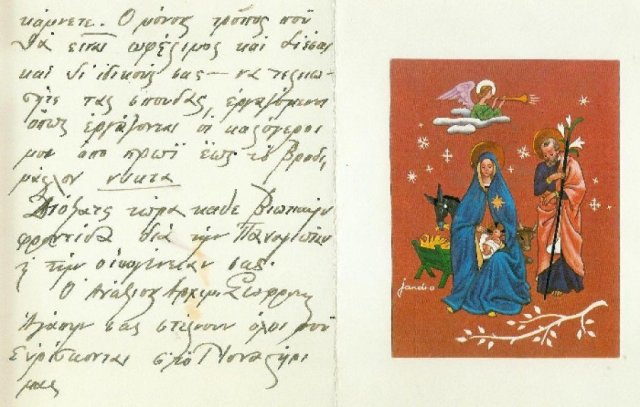
 The outside of the card

The Christmas wish card (handwritten):

Archimandrite Sophrony

The Old Rectroy,Tolleshent Knight

by Maldon, Essex

Christmass 1967,

+

Dear beloved in Christ, Sister Paraskevi.

May the Lord’s grace and peace be abundant in you. Let me first wish you Merry Christmas and a blessed New Year!

Paraskevi, has it ever happened to do something according to my blessing and it turned out harmful? Or has it happened that you did something according to your mind and not according to my humble advice that it was successful and in accordance with God’s providence? Therefore, now you must listen to me, the old fool, and do as I give you the blessing to do. The only beneficial way for you and your relatives is to finish your studies and work at the same time, as my monks do from morning till the evening. Get rid of any worry for X and your family.

The unworthy Arch. Sophrony.

You have the love of all who are at out monastery.

***

christmas-card3

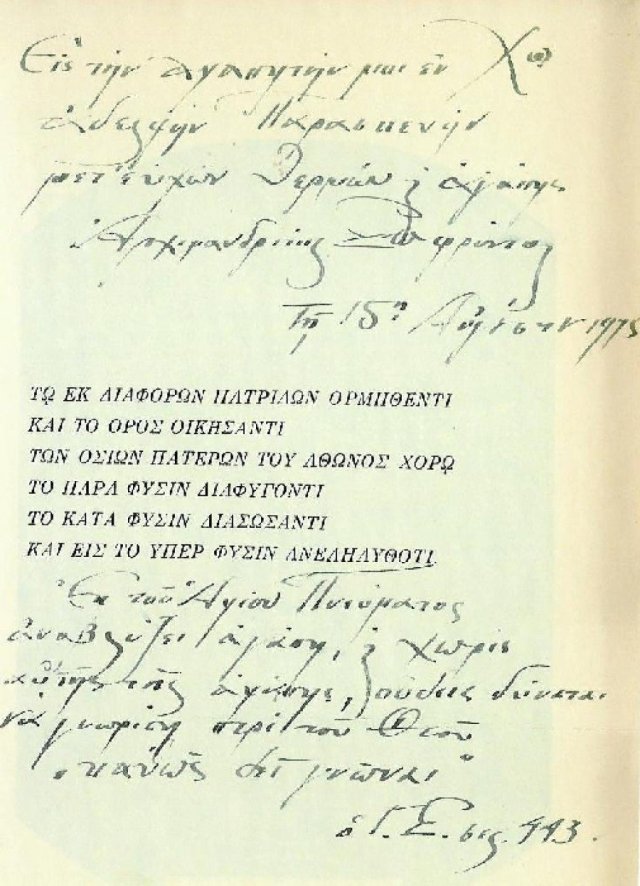
Handwritten inscription by the Elder on the 15th August 1975, when he sent her his book, St Silouan the Athonite

On the book St Silouan the Athonite (handwritten):

To my beloved in Christ sister Paraskevi with warm wishes and love

Arch. Sophrony

15th August 1975

Printed in Caps:

Hailing from various countries

And retreating to the Mountain,

Among the holy fathers of Mount Athos,

Escaping the unnatural

And safeguarding the natural

Rising to that which is beyond nature

Again, by hand of Elder Sophrony:

From the Holy Spirit gashes out love, and without it no one is able to know God ‘as He must be known’.

E.S. p. 443

(Note: E.S. refer to Elder Silouan, not yet recognized as a Saint at the time)

Nativity Paintings from Around the World

Christ is Born! Indeed He is Born!

 Χριστός Ετέχθη! Αληθώς Ετέχθη!

nativity1

Christ is Born! Glorify Him!

“Behold, I bring you good tidings of great joy, which shall be to all people. For unto you is born this day in the city of David a Saviour, which is Christ the Lord.” (Luke 2:10-11)

Jesus Christ was born for all people of all times. To illustrate this truth, Christians around the world often depict him as coming into their own culture, in the present time. The Italians, whose visual language was predominant during the Middle Ages and Renaissance, did it. In fact, when you think “Nativity,” you probably think of the church art from that age and country—not because it offers the most legitimate representations (they are no more “accurate” than the ones below), but because the Church held particular sway at that time, in that place.

Well, the center of Christianity has shifted; it is no longer in the West. And thus if we were to survey the Christian art being produced today, we would see that Jesus, Mary, and Joseph, and the settings they inhabit, have a much different look. We’d see Mary dressed in a sari or a hanbok; we’d see Jesus wrapped in buffalo skin, or silk. We’d see lizards and kangaroos instead of oxes and asses.

Historical accuracy is not the point; the point is to see Jesus as the Savior of your own people, as incarnated very close to you, and relevant to life today.

Here are 19 contextualizations of the Nativity painted within the last century. Each work brings Jesus into a different place, in order to emphasize the universality of his birth.

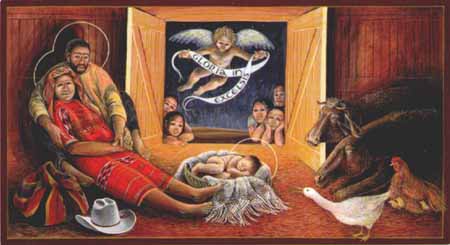
USA:

nativity1

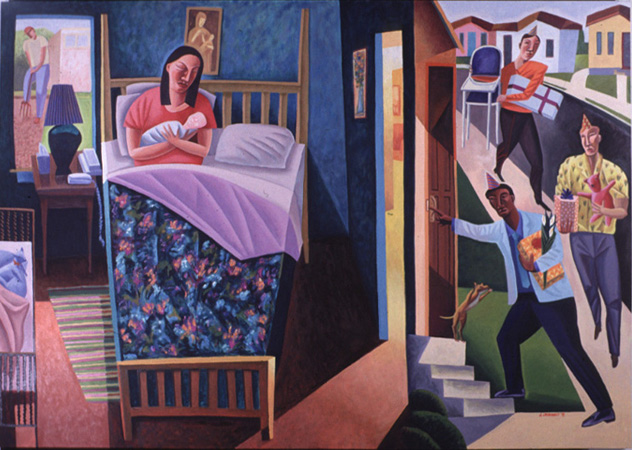
“Nativity” by James B. Janknegt
James B. Janknegt, Nativity, 1995. Oil on canvas, 57 x 82 cm.

Crow Nation (Montana-based tribe):

nativity2

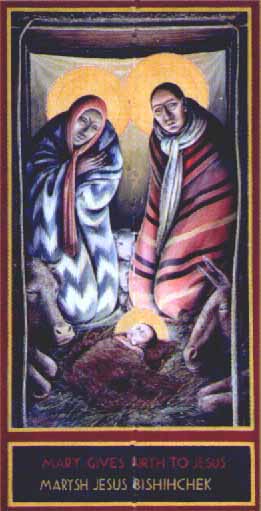
Native American Nativity
John Guiliani, Mary Gives Birth to Jesus, 1999. From The Crow Series.

Guatemala:

nativity3

Guatemalan Nativity
John Giuliani, Guatemalan Nativity, 1990s.

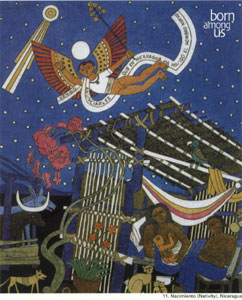
Nicaragua:

nativity4

Nicaraguan Nativity
Leoncio Saenz, Nacimiento (Nativity), 1983. The banner reads: “I come to tell them that in Nicaragua the new man has been born.”

England:

nativity5

Nativity by Dinah Roe Kendall
Dinah Roe Kendall, The Shepherds Went to See the Baby, 1998.

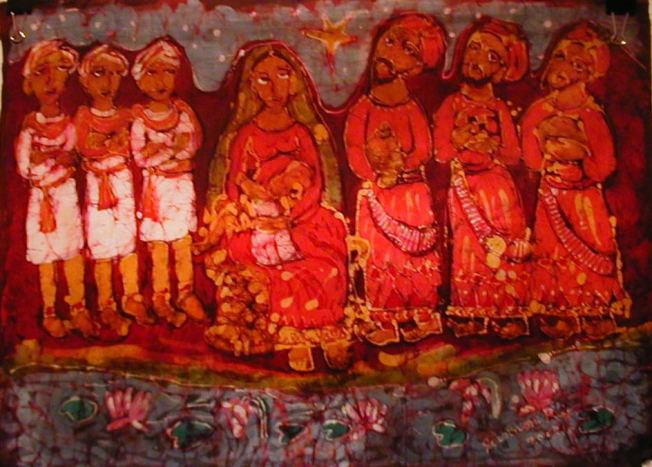
India:

OLYMPUS DIGITAL CAMERA

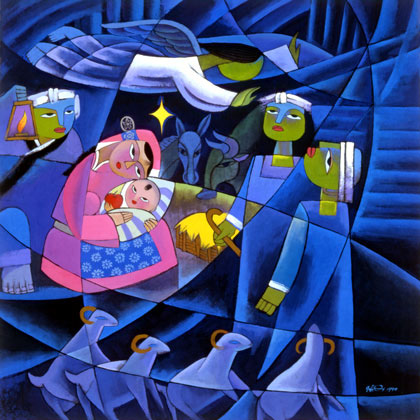
China:

nativity7

Chinese nativity
He Qi, Nativity, 1998. Ink and gouache on rice paper.

Tibet:

nativity8

Tibetan nativity
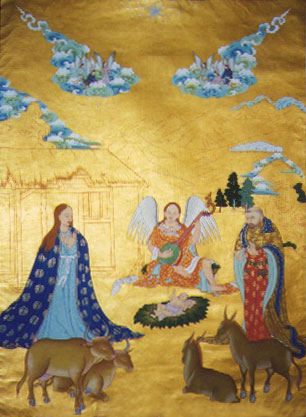
A thangka (sacred wall hanging) given by H.H. the Dalai Lama to Fr. Laurence Freeman and the World Community for Christian Meditation in 1998.

Korea:

nativity9

Korean nativity
Woonbo Kim Ki-chang, The Birth of Jesus Christ, 1952-53. Ink and color on silk, 76 x 63 cm.

Japan:

nativity10

Japanese nativity
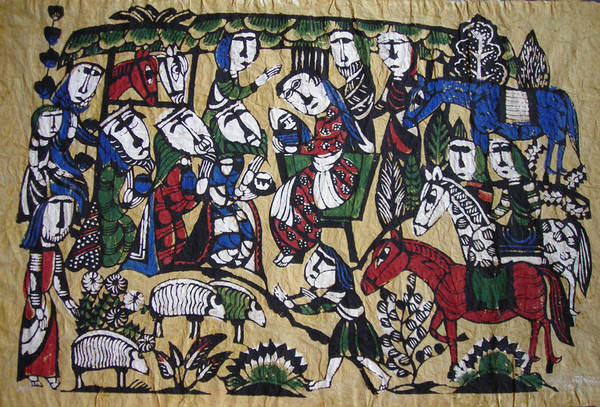
Sadao Watanabe, Nativity, 1960s? Stencil print on momigami paper, 58 x 78 cm.

Thailand:

nativity11

Thai nativity
Sawai Chinnawong, Nativity, 2004. Acrylic on canvas, 32 x 37 in.

Malaysia:

nativity12

Malaysian nativity
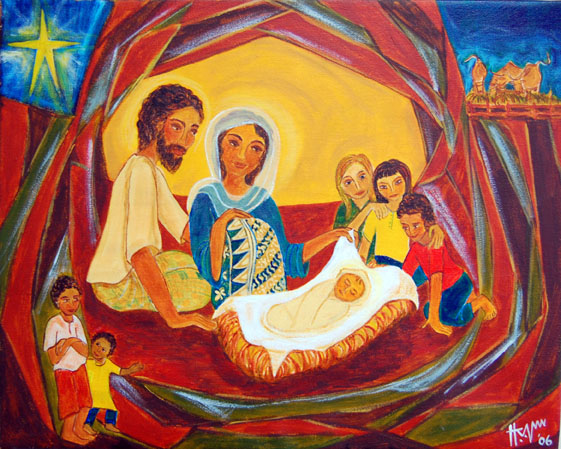
Hanna Varghese, God Is With Us, 2006. Acrylic on canvas, 16 x 20 in.

Indonesia:

nativity44

Indonesian nativity
Erland Sibuea, Nativity, 2008. Acrylic on canvas, 31 x 23.6 cm.

Philippines:

nativity33.jpg

Filippino nativity:
Kristoffer Ardena, The Meaning of Christmas, 1995. Oil on canvas, 62 x 46 cm.

Uganda:

nativity15

African nativity
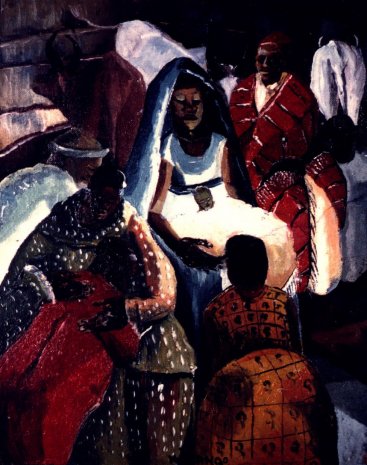
Francis Musango, Christ in the Manger, n.d. Oil painting.

Cameroon:

nativity16

African nativity
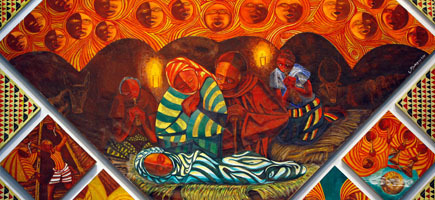
Fr. Engelbert Mveng, Nativity, early 1990s. Central scene from church mural. Holy Angels Church, Aurora, Illinois.

Democratic Republic of the Congo:

nativity17

African nativity
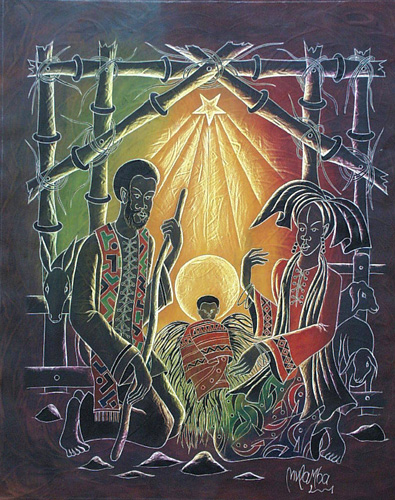
Joseph Mulamba-Mandangi, Nativity, 2001. Peinture grattée, 70 x 50 cm.

Australia (Aboriginal):

nativity18

Australian nativity
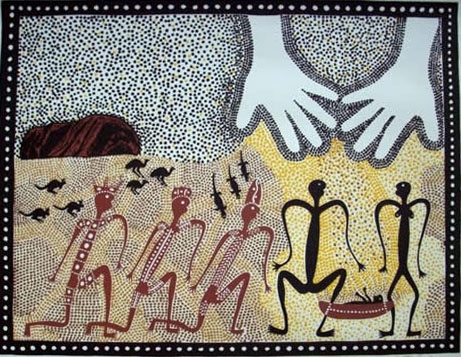
Greg Weatherby, Dreamtime Birth, 1990s? 51 x 64 cm.

Tahiti:

nativity19

Nativity by Paul Gauguin
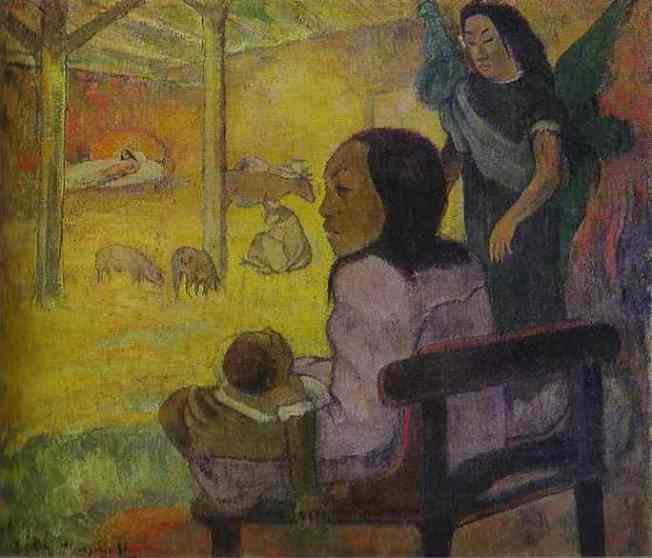
Paul Gauguin, Baby (The Nativity), 1896. Oil on canvas. The Hermitage, St. Petersburg, Russia.

Posted on December 25, 2011 by Victoria Emily Jones

Victoria Emily Jones's avatarThe Jesus Question

Four years ago on Christmas Day I posted a selection of nativity paintings originating mainly in non-Western cultures. Each year since then that post has ranked as one of the five most-read posts on this site, with over twelve thousand views to date. So I’ve decided to do a part 2.

My friend Scott Rayl shared a quote with me this week by S. D. Gordon: “Jesus was God spelling Himself out in language humanity could understand.” What a succinct summary of the Incarnation!

Today we celebrate the transcendent God made immanent, accessible. We celebrate his new name: Emmanuel, God-with-us. The artists here can aid us in that celebration.


Australia (Aboriginal):

First Nations of Canada:

Guatemala:

Nicaragua: 

India:

Thailand: 

China:

Japan:

Korea:

Vietnam: 

Philippines: 

Indonesia:

Nigeria:

Ethiopia:

Kenya:

Tanzania:

South Africa:

(Many of the Asian artworks in this post were found through the Asian Christian Art Association website. It’s a really rich resource…

View original post 3 more words

We Are All One

nativity icon.jpg

In a few hours, I’m flying to Thessaloniki, from where I’ll get the bus to Ouranopolis, the port to Mount Athos. I’ll be away until January 4th, so have a blessed Feast of the Nativity and a happy New Year.

This has been a tough year, in ways that I cannot even begin to express, and I’m only now starting to feel the effects. Tiredness, hopelessness and fear, sadness to the point of despair – all of these have haunted me relentlessly during the last twelve months. To say that 2016 has not been my favourite year would be too kind, even for my standards. To say that 2016 has been even remotely a good year would be beyond insincerity and would approach hypocrisy.

We have achieved many things for the Monastery, and for that I must thank you. I have tried to let you know, to the best of my ability, how much I appreciate your support. All my hard work, all my best intentions, all my sacrifice would amount to nothing without you and your hard work, your best intentions, your sacrifice. Together, we have done incredible things this year, and I trust that, by the grace of God, we shall do even more in 2017. For all of this, I thank you. You are in my prayer always, where ever life takes me.

That being said, the Monastery exists in this world and cannot ignore the world. Monasteries are doors between this fallen world and the Kingdom, calling our fallen nature to its true prototype, encouraging us on the way, guiding us step by step, as we fight to let go of our fallenness and we learn to see ourselves through the eyes of God. This is why monasteries exist, this is their purpose.

And this is where I’ve fallen mostly in 2016. Although I’ve kept far from the political fights that consumed the world, I have allowed their noise to disturb me, I have allowed them to distract me from the things that truly matter. I have kept silence over the outpouring of hatred that drowned the world over the Council, Brexit or the US elections, but I have not succeeded to hold on to the silence in my heart.

As a monastic, I have no responsibility to get involved in these fights. Monastics are dead to the world, and to get involved is a failure towards one’s calling. When people accused the Abbas of the Desert for refusing to get involved and judge various people or causes, they sent their accusers to the cemetery and told them to ask the dead buried there to judge them. As a monastic, my responsibility is to stand among you, silent and dressed in my black vestment, as a reminder that our true Calling, our true Identity and our true Home are somewhere else.

As the world rages consumed with passion for one cause or the other, a monk’s calling is to silently remind those who have the eyes to see that we are all mortal and that the real fight, the real cause, the real passion should be for something entirely different: the salvation of our souls. All else is dust.

It is my responsibility, therefore, to tell you all that no one won in 2016. There are no winners. We have all lost. We have all allowed hatred and doubt and fear to enter our hearts. We have all judged, we have all looked at Christ’s image, our brother, and saw in him the enemy. We have all built walls: some have built walls against those who are different from them, others have built walls against those who build walls. There is no difference between walls: regardless of what motivates them, they are all expressions of a void in our hearts. That empty void where Love should have been.

I’m going to Mount Athos for two weeks with this in mind. I’m not looking for rest, physical or emotional. I’m going to regain my perspective of the world and myself. I need to taste silence to be reminded of the things that matter. I need to touch holiness so I may redirect my steps toward it. I need to see sparkles of the Kingdom, so I may turn my back to this empty noise and start walking towards Life again.

I leave behind 2016 with a void in my heart. I pray, I pray with all my strength that Love Incarnate will return once more and fill it. I pray for me, I pray for you – the same prayer, for we are all One. We are ALL One.

Source: Mull Monastery blog

* Kindly excuse any technical issues; we are migrating the blog back to WordPress

See also The Womb and The Tomb in The Nativity Icon

Nativity Paintings from Around the World

Carpe Diem and Christmas

The Ass and the Ox in the Nativity Icon 

Christ’s Nativity: Living a Kairos Life in a Chronos World

Arabic Christmas Carol

Sing Ye Carols!


A Conversation About God

With Actor Jonathan Jackson & Dr. Norris Chumley

While Jonathan’s views about Art in his book The Mystery of Art: Becoming an Artist in the Image of God are quite controversial, as two opposing book reviews below indicate(*), the narrative of his conversion and finding the true Church in “A Conversation About God” is captivating.

Watch a fascinating conversation about God, Conversion and Art, with Actor Jonathan Jackson and Dr. Norris Chumley:

Orthodox Christian Network


(*) Moses Benjamin Cabe (Ben Cabe) is praising Jackson’s views here, while  Richard Barrett (Orthodox Arts Journal) urges caution in

The problem of art in Anglophone Orthodoxy: a review essay” .

As for me, I am undecided yet and still studying the matter. Jackson invokes Dostoyevski‘s  quotation “Beauty will save the world.” and quotes Elder Porphyrios’ words in Wounded by Love“Whoever wants to become a Christian must first become a poet.”, both  central in my life and this blog.

Indeed, you do not have to be a Christian to create true art.  In fact, it may be that you have to become an artist before you are able to truly become a Christian. Jackson adds  that, when someone is drawn to the beauty of a certain piece of music or painting, he is really being drawn to Christ.  Far removed from Christ is anyone who does not, and cannot, appreciate beauty.  “It is an incredible thing to discover that Christianity is an experience of saying yes to what is truly beautiful. …  From the beginning, the pure and ancient faith of Christ, which is still alive today, proclaims that God is beautiful!”

While Jackson is surely right in all this, there are other claims he makes in this book which may be problematic and will hopefully be addressed in future blog posts, when this whole matter is clearer in my mind…

St. Porphyrios’ Farewell

st-porphyrios

Such profound humbleness!


While at the Holy Skete of Kavsokalyvia on Mt. Athos, the Elder Porphyrios had given orders for his grave to be dug.
Through a spiritual child of his, he dictated a farewell letter of advice and forgiveness to all his spiritual children.

Here is the letter as it was sent to us from the Holy Convent of the Transfiguration of the Savior.
It is dated June 17, 1991. It was found amongst the monk’s garments that were laid out for his burial on the day of his departure.
It indicates his profound humbleness.

My dear spiritual Children,

Now that I am still in charge of my faculties, I want to give you some advice.

Ever since I was a child, I was always in sin. When my mother sent me to watch the animals on the mountain, (my father

had gone to America to work on the Panama Canal for us his children, because we were poor), there, where I shepherded

the animals, I slowly read, word by word, the life of St. John the Hut-dweller and I loved St. John very much. 

I said a lot of prayers, like the young child that I was, twelve or fifteen years old, I don’t remember too well. I wanted 

to follow his example. So, with a lot of difficulty, I secretly left my parents and came to Kavsokalyvia on the Holy Mountain. 

I became obedient to two elders, the true brothers, Panteleimon and loannikios.

They happened to be very devout and full of virtue, I loved them very much and because of that, with their blessing,

I gave them absolute obedience. That helped me a lot. I also felt great love for God and got along very well. 

However, because of my sins, God allowed me to become ill, and my elders told me to go to my parents in my village 

of St. John, Evia. Although I had sinned a lot from when I was a small child, when I returned to the world I continued

to commit sins which, today are very many. The world, however, thought highly of me, and everyone shouts that I’m a saint.

I however, feel that I am the most sinful person in the world. Of course, whatever I remembered I confessed, and I know God

has forgiven me. But now I have the feeling that my spiritual sins are very many and I ask all those who have known me 

to pray for me, because, for as long as I lived, I humbly prayed for you, too. Now that I’m leaving for heaven, I have the 

feeling that God will say to me, “What are you doing here?” I have only one thing to say to him, “I am not worthy of here, Lord, 

but whatever your love wills, it’ll do for me.” From then on, I don’t know what will happen. I however, wish for God’s love to act

I always pray that my spiritual children will love God, Who is everything, so that He will make us worthy to enter His earthly

uncreated Church. We must begin from here. I always made the effort to pray, to read the hymns of the Church, the Holy Scriptures 

and the Lives of the Saints. May you do the same. I tried, by the grace of God, to approach God and may you also do the same.

I beg all of you to forgive me for whatever I did to upset you.

Hieromonk Porphyrios
Kavsokalyvia, June 4/17 1991


And


That phone ring 🙂 At 14:35′ onwards 🙂 This Elder was sought after by the whole of Greece and all mankind. His whole life was dedicated in service to the faithful. I imagine that phone never stopped ringing, just as pilgrims never stopped coming. A saint receives everyone, that is his vocation. May we have his blessing! +2 Dec.