What is a Christian end to life?

When Breath Becomes Air


Final Hours and Death in Western Painting, Byzantine chanting and iconography, end of life care/ palliative care and … in my life.

The blog post which follows is  painfully relevant to me. I have seen some of this first-hand, and I do have very elderly and frail, ailing parents, nearing death and requiring constant one-on-one nursing care. Even for a poor ‘hermit’ as I am, their impending death is a difficult emotional time. The ‘bodies’ of both my parents, simultaneously, especially though my father’s, prepare themselves for the final days of life. Thank God they have both gone to Confession before and received Eucharist! Just in time! I believe my father is nearer to the ‘end’ than my mother and he will be the first to go. I am most impressed by his calmness and humility in accepting his “body’s process of ‘shutting down’, which will end when all the physical systems cease to function”. I am deeply moved by my father’s tender care to make sure we are all well, his attempts to resolve whatever is unfinished of a practical nature, and his silent seeking permission from us, family members to “let go.””. His eyes are so eloquent! He tries to hold on, even though this brings him a prolonged discomfort, in order to be assured that those left behind will be all right.

I have often felt these days that a family’s ability to reassure and release the dying person from this concern is the greatest gift of love they can give at this time. Saying Good-bye is also so important, so prolonged, so heart-rending, so personal! These last days are typically spent laying in bed with him and holding his hand, in tears.

“O my sweet springtime, O my sweetest Child, where has all Thy beauty gone?” (The Lamentations of the Tomb)

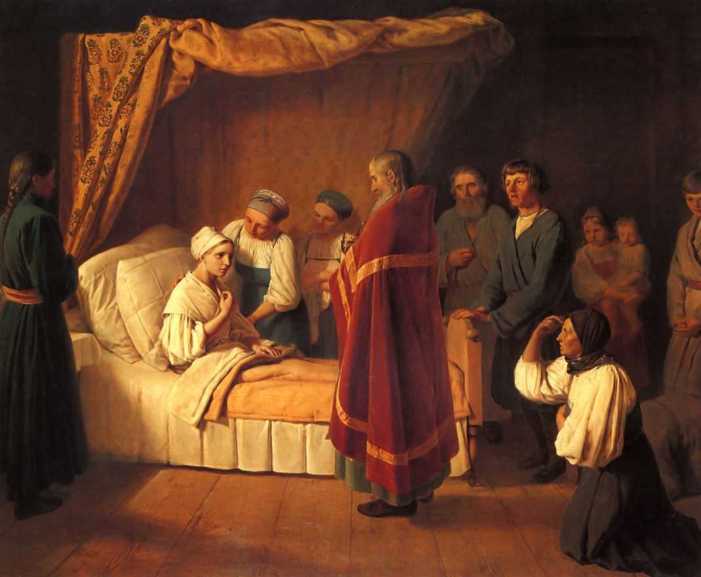
Alexey_Venetsianov_25

Administration of the Eucharist to a dying person (painting by 19th-century artist Alexey Venetsianov)

-1

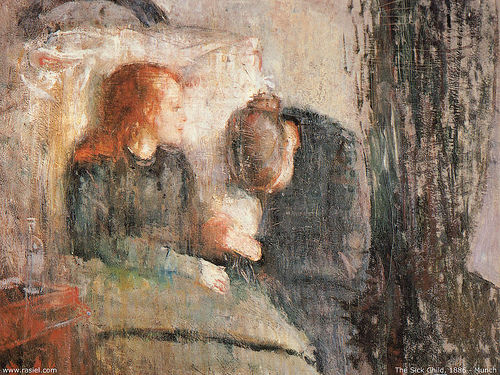
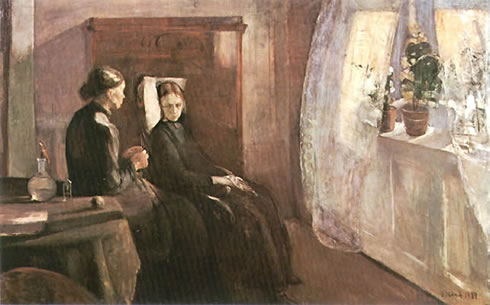
This painting didn’t have the Expressionism Style. The girl in this painting is dying and Munch used light colors instead of a dark palette.

dying_child1.jpg

“Dying Child” by Edvard Munch. Everything in this painting is saturated in suffering, except the dying girl, who is fragilely posed (in repose) in a way that is heartbreaking.

595

‘Dying Well’

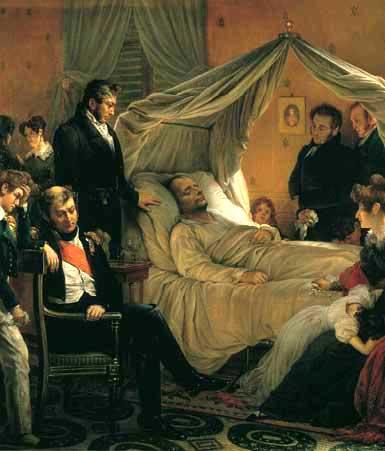
Cardinal Mazarin Dying.jpg

Paul Delaroche Cardinal Mazarin Dying

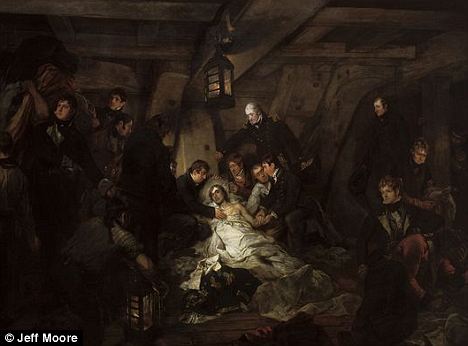
article-1285847-09FE7377000005DC-699_468x346

The famous picture by Arthur William Devis showing a dying Nelson


IngresDeathOfDaVinci

The Death of Leonardo da Vinci is an 1818 painting by the French artist Jean Auguste Dominique Ingres


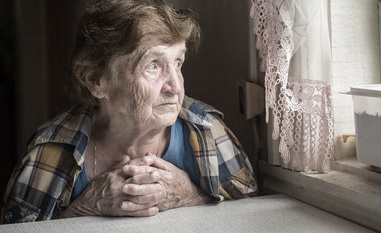
elderly woman looking outIn the old days, she would be propped up on a comfy pillow, in fresh cleaned sheets under the corner window where she would in days gone past watch her children play. Soup would boil on the stove just in case she felt like a sip or two. Perhaps the radio softly played Al Jolson or Glenn Miller, flowers sat on the nightstand, and family quietly came and went. These were her last days. … spent with familiar sounds, in a familiar room, with familiar smells that gave her a final chance to summon memories that will help carry her away. …

You see, that’s how she used to die.

The essay is entitled “I Know You Love Me; Now Let Me Die” I saw it on Facebook, handed around the way that we do everything from meatloaf recipes to the greatest speeches in history, with the result that everything has the same value.

But considering the topic, I feel like this one deserves to come with a big label that says, “Read this. It actually matters.” The physician author of this article has first-hand knowledge of just what death looks like in the modern hospital room or elderly care facility. He approaches it from the medical professional’s point of view, and considers what happens to the theoretical dying woman whose gentler, old-fashioned death he sketched above. But these days …

Empty-hospital-bed-scale-300x200She can be fed a steady diet of Ensure through a tube directly into her stomach and she can be kept alive until her limbs contract and her skin thins so much that a simple bump into that bed rail can literally open her up …. She can be kept alive until her bladder is chronically infected, until antibiotic resistant diarrhea flows and pools in her diaper so much that it erodes her buttocks. The fat padding around her tailbone and hips are consumed and ulcers open up exposing the underlying bone, which now becomes ripe for infection.

I know these aren’t pretty things to talk about. But I have seen some of this first-hand; I think quite a lot of people my age have. When my father-in-law was in decline, he received end-of-life care that went on for about three years. When I blogged about it back in March 2014, in spite of the excellent hospice care Charles received, I had to ask:

Is this really the best we can do for Greg’s dad? Charles is on “palliative care,” and so the only medical concern is limiting suffering. But is an unsuffering death really possible? And if it is, am I wrong to think that it’s just not what I would want for myself?

… if it were my time to go, and I could see that it would be this creeping, sanitized kind of yearlong journey with caretakers trying to keep every little thing operating as if I were just a collection of little things … would I be just crazy to say that I’d like to opt out? …Wouldn’t I rather have a short end punctuated by intense focus than a protracted fugue state with no intensity and no humanity?

We go through it with our elderly parents and we have no way to change the current practices. But I hope that by the time I get there, enough of us will have spoken up to say that just because we CAN keep bodily functions going at maximum cost with maximum artificiality doesn’t mean we SHOULD. Because we aren’t just pumps and springs and tubes — we’re human beings made in the image of God.

We pray for “a Christian end to our life — painless, blameless and peaceful.” But what does that really look like? Can’t we see out our days better in the quiet corner that the author places his patient in than in the sterile, hopeless hospital beds that most of us are bound for?

What is “a Christian end to our life?” I really want to know.

Source: This Side of Glory

Confessing to Grow Closer to God

confession.jpg

“Confessing to Grow Closer to God” Fr. Seraphim reflects on his experiences confessing, the role of a spiritual father, and he gives three recommendations to help get the most out of each confession. Podcast here

“Continuing in Confessional Growth”Fr. Seraphim continues his discussion from last week on how to get more out of each confession, by recommending three more exercises to help grow closer to both the spiritual father and Christ. Podcast here

“Confessing to Grow Closer to God”
In the name of the Father, the Son, and the Holy Spirit. Amen.
While I have done my best to record these podcasts in silence and moments of the day, or rather moments of the night, when there is silence, enough silence for me to focus on the things I want to talk to you about and also enough silence for you to be able to hear me, I do live in England, so it is almost always impossible to hide from rain. We’ll just have to live with that.I have mentioned in some of the previous podcasts that the monastery has started writing and publishing a series of booklets on various subjects. We have one booklet published on the topic of prayer, and it will be followed by a second one on the subject. There is one which we have published on the island of Iona, including a small guide, a sort of spiritual guide, to St. Columba’s isle. And I’m now working on a booklet on confession and the role of the father-confessor in monastery life.I have decided to write this particular booklet because the questions surrounding a monastic father-confessor and the way one relates to a spiritual father are very frequent. Everywhere I go and meet people to talk to them about the monastery, this is one of the central questions I get asked. So as I am preparing this booklet, I would like to discuss with you some of the topics and some of the ideas I am considering to include into the final form of the booklet. If you feel that there are other aspects you would like covered, if you feel I have not properly addressed or have not addressed at large some of the aspects I am discussing, please feel free to send me an email, and I shall do my best to either reply to you personally or in future podcasts.What I would like to tell you today is just a tiny bit of my own experience with confession. I remember when I started confessing that I was quite puzzled about the whole ritual. I didn’t quite understand what I was supposed to talk about. I didn’t quite understand to whom I was confessing—if it was the priest, if it was Christ, if I was actually simply there to acknowledge things in front of my own conscience. Then I went through a series of more or less difficult experiences with my father-confessor. I had to change my spiritual father when I went to the monastery, and that was a nightmare. Other times I felt that my spiritual father did not have enough time or he didn’t pay enough attention to what I was saying. There were instances when he felt rushed or even almost annoyed and upset for the things I was telling him.But through it all, I kept going. I kept confessing. And as a general attitude, I often thought that the more difficult it feels, the more distant my father-confessor seems, the more useless, pointless the whole experience may feel—the more it is worth doing it, almost like hitting a wild animal when you are attacked. You’re not supposed to simply lie down and be eaten alive because you are attacked. If you are under attack, you fight back. So the more difficult confession felt to me, the more determined, almost stubborn I was to make it work.

Once you have decided, once you have chosen your father-confessor, your spiritual father, my advice is to trust him more than you trust yourself, at least for the first years. When I say “the first years,” I do not mean one or two years; I mean the first ten years at least. Trust him more than you trust yourself. After these ten, fifteen years, there may be the case that you should start placing your trust more in Christ than in yourself. With that general rule, you should be right.

Now let us turn back to confession. Confession can simply be a listing of your sins or your weaknesses, but it can be a lot more. It is entirely up to you to make it more, to make it better. Confession can indeed simply be an encounter between you and your spiritual father during which you tell him of your weaknesses and your sins and the ways in which you have failed God and yourself and your neighbors, but it can be much more if you put a bit of work into it. I am going to list a few exercises for you to consider trying out during your confession. These are things I have discovered simply through experience, and I have learned that, as a general rule, anything can be useful, anything can be turned into a useful experience from which you can learn something. I will give you only one example of what I mean by this, and then we’ll turn to the exercises.

The best thing to do when you prepare for confession, the best practical thing you can do, is to allow your father-confessor time. Never go for confession at the end of Lent or at the end of the fasting period before Christmas or Dormition. Never go and confess at the end of a long queue of 20 or 30 people. If your father-confessor has the time to hear you, if you allow him the time to hear you, he will be paying much more attention to you than if he feels pressed to hear 20 more confessions after you or if he feels exhausted for having heard 50 confessions prior to yours.

And that does happen. I remember in the monastery in Moldavia that we would be for hours, every day, especially during long periods of fasting, hearing the confession of people coming from the villages and the towns nearby. After five or six hours of hearing confessions, all you wanted to do is hide somewhere, find some sort of hole and crawl into it and never come out again, because the confessor is also a human being, and you take all that negativity, all those negative experiences, all the pain, all the failure, all the things that weigh so heavily on the shoulders of all those people whose confessions you’re hearing—it all ends up weighing down on your own shoulder. If you plan your time, if you plan your confession properly, you will be the one who benefits from it.

Now, this is the general rule. That being said, I have once noticed that if I went to my father-confessor when he was absolutely exhausted, the experience of confession felt entirely different. Yes, he as a human being was clearly not paying as much attention as he could have. He simply wasn’t able to any more. He wasn’t there any more. His attention wasn’t there any more. He was simply exhausted. But somehow, from that hollow being, from that exhausted person, came the most extraordinary advice I could possibly hope for, and these were not things my father-confessor would have normally said. After 15 years of confessing to the same person, you end up eventually knowing more or less what to expect. But I have noticed that if I want to hear not my father-confessor’s voice but somehow the voice of his conscience or his heart—I wouldn’t say God’s voice through him, but that is what I’m thinking—if I wanted a clearer view of that, then I should approach him when he, as a human being, is exhausted, when he has reached his limits.

All I wanted to say by giving you this example is that if you want to hear God, if you want to grow, anything can be turned into a positive, useful tool. If you allow the time for your father-confessor to hear your confession properly, you will definitely benefit from it, because your father-confessor understand the context, and he has the ability to think through all possible implications, and he will give you the best possible advice. So take that and use it for your salvation and rejoice in this gift.

On the other hand, though, if you ended up confessing at the end of a long period of fasting or when your father-confessor is simply tired or just not there, for any reason, known or unknown to you, then even that can be turned into a positive experience. The golden rule is that if you tell Christ in your heart, “I want to hear you. Please speak to me,” Christ will speak to you, regardless whether your father-confessor is tired or not, whether he is paying attention or not, whether he’s wholly entirely there or not. The sacrament—you must remember this—the sacrament is between you and Christ. The confessor, the spiritual father, is merely a tool. If there are problems in confession, they are never because of the spiritual father; they are always because something is not working between you and Christ, something is not working, something is not right in the way you have approached confession.

That being said, I just want to list a few exercises for you, and feel free to pick and choose which of these you think may benefit your confession. But I do encourage you to try them at least once. The first and most useful one is to try to reduce your confession as much as possible. Try to keep it under three minutes, for example. The way to do that is to look for the source of evil. I mean, do not make philosophy. Do not be expanding your confession. Do not give any sort of context. Be as simple and plain as you possibly can. Just list the things you need to confess: “I lied.” Full stop. “I am lazy and waste time.” Full stop. “I am proud and yet envious.” Full stop. And so on.

When you cut away the context, there is no way for you to use that context to justify your sinfulness. If you keep it very simple and try to go back to the source of evilness, things become very clear to you. It is the first step you must take. You must understand that there is evilness in you, or that you are fighting evilness. This is not about you selling an image to your father-confessor. This is not about you playing a game or putting on a show: the pious Christian show or the rebel Christian show or whatever else attracts you. This is simply about you being as naked as possible before Christ. Try to limit your confession under three minutes. Try to list, for instance, all your sins on a piece of paper before you go to confession, and then group them into categories, and try to see what is the source of each category. What is that initial mistake, that initial thing that generates all the visible outcomes, so to say? You may have yelled at your brother and your sister, and that is a sin, but what lies underneath that reaction? You may have wasted time, and that is a sin, but what lies underneath that behavior? And so on and so forth.

Really, this simply helps you to understand the depths of our sinfulness and not focus merely on the surface of it. If you simply list the mistakes you’ve made, you are really just focusing on the visible side of your sinfulness, but the depth of it, the heaviness of it lies hidden.

A second thing I try to do from time to time—and again, these are things I do on purpose—is to confess one thing that is extremely disturbing to me, even if it’s not necessarily heavy or as heavy as other things, but it is the sort of thing that, in my mind, will make my father-confessor think less of me, something that I feel horribly guilty for or disgusted. To do that is an exercise of humility, of forced humility. It is a way to empty yourself as much as you can before your spiritual father. It is a way to be as naked, spiritually naked, as you can before him and Christ.

I remember that the first time I’ve done this was after reading the Life of one of those Russian fools-for-Christ. You know who they are. They purposely commit some sort of horrible, disgusting thing in front of people, just so they feel lower and more humble than everyone else. It is useful to do that in front of your father-confessor because it is fighting your pride, and this is one of the best ways of fighting your pride. When you feel pride in your heart, always commit something stupid, on purpose, and do it in front of the people whose opinion counts most for you.

I know of monks in my monastery in Moldavia who would fast according to the strictest of rules, but then when they had guests coming over, they would always behave as if they had entirely forgotten that it was a fasting day. And this is not something that was invented by the Russian fools-for-Christ. You find this type of behavior even in the lives and the stories of the Desert Fathers, the Fathers from Egypt, the first generations of monks. There are these stories of some of the Desert Fathers going and wandering through the desert to collect leftovers or empty bowls which they would then carry to their cells and spread all around, and they did that so that the people who came to visit them would think, “Oh, what a gluttonous monk! He is good for nothing! We should move forward, as nothing good… there’s no good advice we can get from him.”

You can do the same thing in confession, and the experience of grace which you shall receive will be more than you can imagine. In a way, this will help you face your own emptiness, your own nothingness. It is a way to crush these idols we all construct of ourselves. It is also a way to test the love of your father-confessor, because the one thing that you must look for in your father-confessor is his love for you. I remember once that my father-confessor told me, “You do realize that I shall have to stand before Christ on the Judgment Day and protect you against all those who accuse you of your sins?” And that was the day I understood that that man loved me more than anyone has ever loved me. Love is what makes a priest into a spiritual father, not the ability to apply rules, not the ability to build for himself the image of an elder, not his intellectual wisdom, but simply his love.

I think I shall stop now. I’ve listed really three things you could try out. Try to confess when your father-confessor has the time, and then try to confess when he is absolutely exhausted, but in both cases keep in mind that the conversation happens between you and Christ, and he is merely a tool, a channel. Secondly, try to reduce your confession to the absolute minimum, because that will help you see the source of your failures; that will help you move from focusing on the tip of the iceberg to the real depths of it. Once you understand, once you face the roots of your sinfulness, your healing can properly begin. And thirdly, try to systematically, almost like a ritual, crush this idol we all build of our own person, and the best way to do that is to confess something that feels horribly intimate, almost disgusting, to your father-confessor.

There are some other things, some other exercises we could talk about, and perhaps I shall mention them in a second podcast on this subject. Remember to pray for me. Remember to pray for the Monastery of the Celtic Saints in Scotland. And remember to support us if you can. May God bless you and this whole world, now and forever. Amen.”
A Hectic Schedule, a Big Scene and a Pilgrimage

All these three are part of my life! Let me explain …

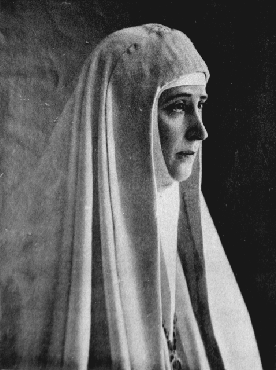
rsz_grand_duchess_elizabeth


“Innumerable business transactions, consideration of many requests and petitions from every corner of … , and other cares, filled her day, sometimes bringing her to a state of complete exhaustion.”

This excerpt is from St Elizabeth the Grand Duchess and New Martyr‘s life but it could easily have written about me in the last couple of weeks, since my days have lately been so filled  with numerous administrative, academic duties and ‘interruptions’ – constant– phone calls, texts, mail, e-mail — all at the same time! — to the point of complete exhaustion. In particular, my duties for the founding of a new monastery have proven so far a most demanding (and rewarding) experience. But my similarities to the Saint and major role model  for me of course stop short here …

nunelizabeth


I do apologise for not being able to write as much as I would like in this blog, for failing to always keep ‘on schedule’. I am sorry. It is just that I hardly have a spare moment any more. It also has to do with English not being my mother tongue. Sometimes I have to rewrite a paragraph so many times! I write something as best as I can and yet I am never sure whether what I really wanted to communicate to you, not so much semantically, as emotionally, is what is really communicated. Most likely I shall never know. I sincerely hope I have never offended anybody here or sounded — God forbid! — sarcastic, harsh, cruel, or indifferent.

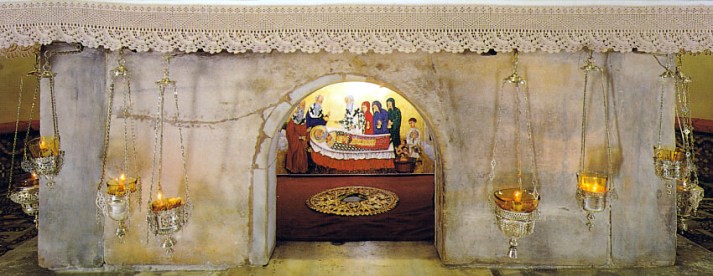
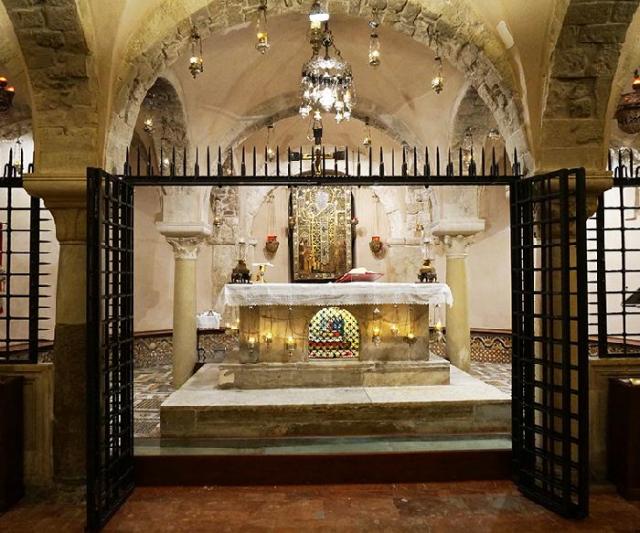
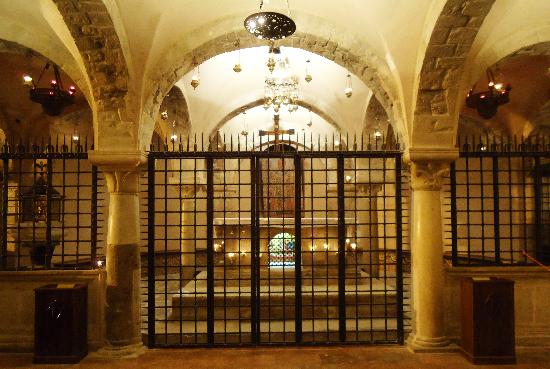
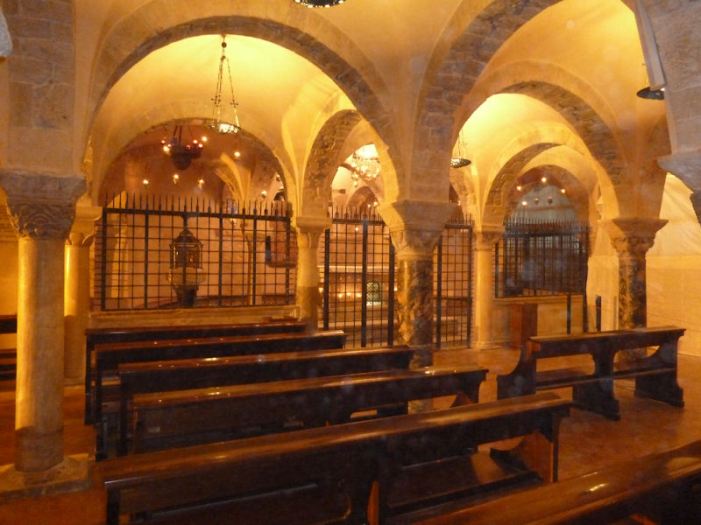
On a different note, tomorrow, God Willing, I am leaving on a Pilgrimage to Italy, Bari, for St. Nicholas!!

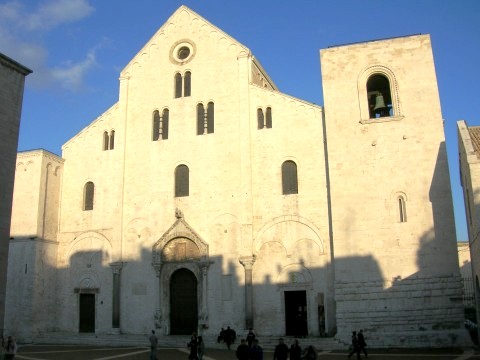
St._Nicholas_Bari1

Basilica di San Nicola in Bari, Italy where most of the relics of St. Nicholas are kept today.

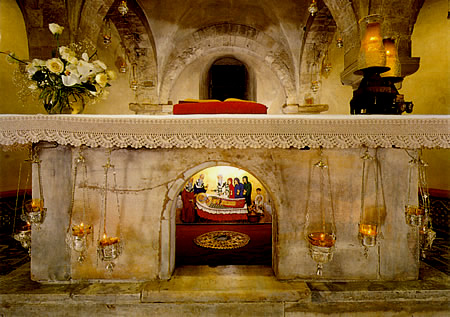
bari-4

San Nicola, Basilica di San Nicola, Bari, Italy, the crypt, the grotto

relics-baritomba 12

grotto-st-nicholas-tombitaly2011-a07


I am so excited and so much looking forward to going on this pilgrimage and ‘meeting’ St. Nikolaos! My feelings can only be expressed with the ‘dancing’ of the chandeliers (polyeleoi in Greek) which follows in Psalm 135 (Arabic)!


The Apolytikion or Troparion (Hymn) of Saint Nicholas

An example of the Faith and a life of humility, 
as a teacher of abstinence
you did inspire and lead your flock
and through your truthfulness of your deeds
were exalted by greatness through your humility
uplifting all and by poverty gaining wealth.
Father and hierarch Nicholas intercede
with Christ our God that our souls be saved.
or, in literal translation:

As a canon of faith and an icon (image) of meekness,
(and) of self-control (abstinence) a teacher,
the truth of your deeds has shown you to your flock;
wherefore you acquired through humility the high things (greatness),
through poverty riches
Father hierarch Nicholas,
intercede with Christ the God
that our souls may be saved.


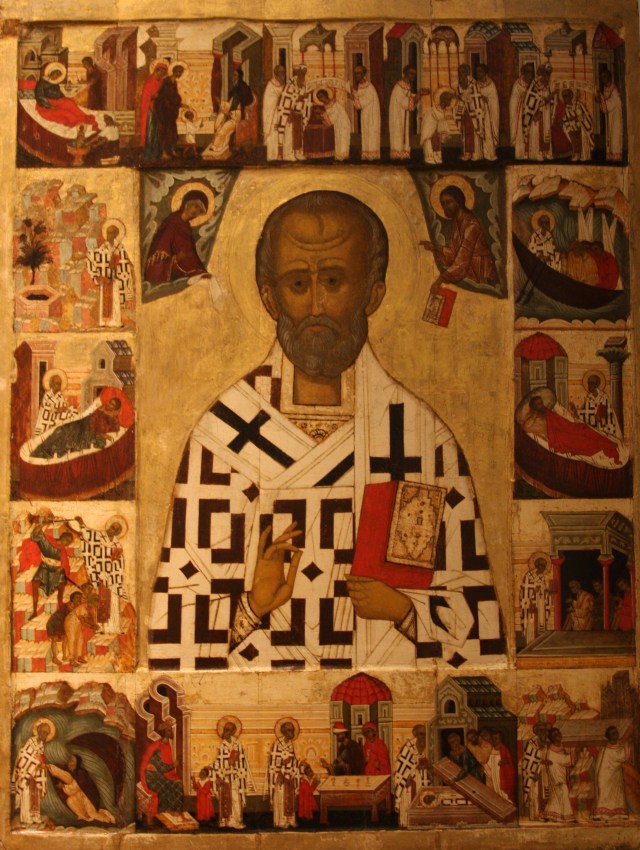
Icon_c_1500_St_Nicholas

I have always wanted to ‘meet’ this Spiritual Giant, the Defender of Orthodoxy, Wonderworker, Holy Hierarch, and Bishop of Myra, especially ever since I found out that this icon (image) of meekness and teacher of self-control, ‘abstinence’ literally got up, crossed the room, and slapped Arius across the face at the Council of Nicea!  😃

“In AD 325 Emperor Constantine convened the Council of Nicaea, the very first ecumenical council. More than 300 bishops came from all over the Christian world to debate the nature of the Holy Trinity. It was one of the early church’s most intense theological questions. Arius, from Egypt, was teaching that Jesus the Son was not equal to God the Father. Arius forcefully argued his position at length. The bishops listened respectfully.

As Arius vigorously continued, Nicholas became more and more agitated. Finally, he could no longer bear what he believed was essential being attacked. The outraged Nicholas got up, crossed the room, and slapped Arius across the face! The bishops were shocked. It was unbelievable that a bishop would lose control and be so hotheaded in such a solemn assembly. They brought Nicholas to Constantine. Constantine said even though it was illegal for anyone to strike another in his presence, in this case, the bishops themselves must determine the punishment.

The bishops stripped Nicholas of his bishop’s garments, chained him, and threw him into jail. That would keep Nicholas away from the meeting. When the Council ended a final decision would be made about his future.

Nicholas was ashamed and prayed for forgiveness, though he did not waver in his belief. During the night, Jesus and Mary his Mother, appeared,* asking, “Why are you in jail?” “Because of my love for you,” Nicholas replied. Jesus then gave the Book of the Gospels to Nicholas. Mary gave him an omophorion, so Nicholas would again be dressed as a bishop. Now at peace, Nicholas studied the Scriptures for the rest of the night.

When the jailer came in the morning, he found the chains loose on the floor and Nicholas dressed in bishop’s robes, quietly reading the Scriptures. When Constantine was told of this, the emperor asked that Nicholas be freed. Nicholas was then fully reinstated as the Bishop of Myra.

The Council of Nicaea agreed with Nicholas’ views, deciding the question against Arius. The work of the Council produced the Nicene Creed which to this day many Christians repeat weekly when they stand to say what they believe.


* Other versions of the story have Jesus and Mary with Nicholas appearing in a dream to Constantine or, even, to all the bishops. In the dream, they give the Book of the Gospels and an omophorion to Nicholas, convincing Constantine and the bishops that Nicholas should be reinstated as Bishop of Myra.” [Bishop Nicholas Loses His Cool (At The Council of Nicaea)]


‘The Rock’: Life on the Island of Newfoundland

All this is so exciting! In Greece, at every turn of the corner, you can find a church, but look at how resourceful these people have to become to be able to say Prayers and attend Church Services in their hometown! This blog post warmed my heart, as I am currently engaged in such endeavours at the UK. Bless the Lord o my soul and forget not all His benefits! Glory to God!

matushka constantina's avatarlessons from a monastery

By the grace of God, and through the prayers of many holy souls, our simple life in St. John’s, Newfoundland is progressing. Just after Fr. John and I returned from a pilgrimage to a monastery in September significant changes began to occur. First, we moved out of our one bedroom apartment and into a house (with a yard and a deck and a front porch!) and second, I got a permanent, full-time job. So, it looks as though God wills for us to continue our feeble attempts to firmly establish Orthodoxy on this island.

The best part about our new home is that the downstairs is a walk-out basement with an external exit/ entrance and so we are finally able to have a chapel in our home (I had already painted the icons for our future home-chapel while living in Greece). Thus, instead of bothering Queen’s College (where our…

View original post 632 more words

Good-bye, and thank you (see you at ArtandTheology.org)

This is a blogger I cannot recommend too strongly and I shall definitely follow on all her new projects. Καλοτάξιδο, as we say in Greek. Or, Bon Voyage (to the new website), in French 😊

Victoria Emily Jones's avatarThe Jesus Question

I’m sad to remind you that, as I announced in November, I am discontinuing The Jesus Question—but I’m happy to let you know that my new blog, Art & Theology, is now live! Please show me some love and share the URL with your friends and social media followers and “Like” the Facebook page.

Art & Theology website

Art & Theology Facebook page

The Jesus Question started out as a project for a social media class in February 2011. The assignment was to develop a blog in which we were to explore a well-defined subject of interest, the purpose being to enhance our online presence, connect with others of like interests, experiment with web building and marketing, and establish ourselves as an authority in a field.

It may not have achieved a vast reach by professional standards (it gets about 7,000 unique views per month), but I feel pleased with how it was received and what came…

View original post 677 more words

The Ill, the Weak And The Mortal

MY ‘LESSER’ VERSIONS: The Ill, the Weak And The Mortal,

Or, In Search of True Personhood

2

All my life I have been surrounded by family members, suffering with one of the forms of dementia and psychiatric disorders. Rare is the time that I meet someone who doesn’t have a loved one likewise. I hope this blogpost by Father Seraphim Aldea can be of some help, even for a brief moment. May God’s love and strength protect us all …


3


I have seen people die. I have seen people suffer. I have seen the anguish in their eyes. Most times, it comes from a combination of fear of the weak beings they have become, and regret for the strong being they once were. Fear of turning into something we no longer recognise as ourselves, and regret for losing something we perceived as our ‘correct’ selves.

We only think of ourselves as ‘whole’ when we fit into a wellness norm fed by the idolatric attitude we have for the society we are part of. This society – here and now – tells me that I am all right when I am healthy; therefore, I am my ‘proper’ version, I am my ‘correct’ self, I am who I am supposed to be only when I am healthy. This society tells me that illness and sadness and all forms of weakness are wrong; therefore, I am no longer my ‘proper’ version when I am ill – my ‘correct’ self has become corrupted, infested, compromised.

IMG_5323

But society changes its mind, because it is empty, devoid of meaning, and – like any form without substance – it takes in whatever substance fits its purpose. To be healthy once meant to be chubby and live the sort of life that gave you gout. To be your true self meant at different times to die young, to suffer from melancholia, and to kill yourself in the name of honour. Things have changed. Today (and mostly here, in the West), we worship the healthy, strong, optimist being. Anything else is not properly human.

The implications are the same, though: only when we fit these norms we think of ourselves as being ‘ourselves’. Whatever does not fit these norms is not part of us, it is us being ‘someone else’, a lesser version of myself, an amputated, decayed version of myself, which either has lost things proper to my true self (‘I cannot move anymore’) or has taken over and incorporated things that are alien to my true self, things from the outside, things that entered my true self and diseased it (illness; sadness; death).

We have this perfect version of who we are supposed to be, and we define our happiness depending on the level of conformity to that ideal. We replace the living being that we are – changing, evolving and discovering oneself from all perspectives, including the ‘negative’ ones (illness; old age) – with the immobile poster-like image of the ‘healthy young man’. There is not much difference in essence between the tyranny of this healthy young idol and other tyrannies we have seen in the recent past: the arian man of the second world war, the new man of communism, the jihad man of terrorism. They all want to eradicate what they perceive as corrupted, lesser versions of humanity.

In some way, the tyranny of our idol is even more violent, because we not only enforce it upon others, but we internalise it and we end up inflicting it upon ourselves. A Nazi criminal could never become a Jew himself; his idol never reflected its hatred against himself. We, on the other hand, we all shall as some point feel weak, we all shall get sick, we all shall become old and face the reality of our mortality. To shy away from these ‘lesser’ versions of ourselves, to reject and to fight against them is to reject and fight against ourselves. To run away from them is to run away from myself. To fear and hate them is to fear and hate myself.

Source: The Mull Monastery Blog

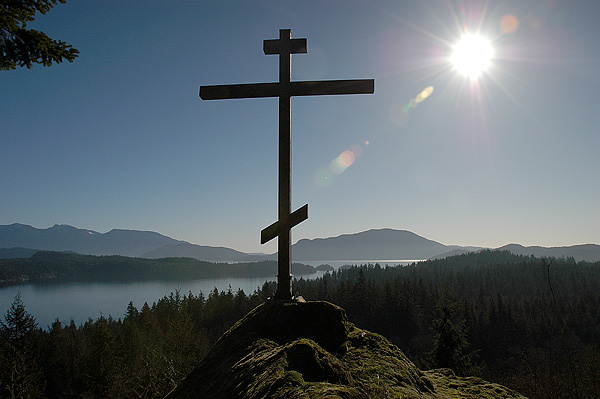
The Tree of the Cross

“The fiery sword no longer guards the gate of Eden, for in a strange and glorious way the wood of the Cross has quenched its flames.  The sting of death and the victory of hell are now destroyed, for Thou art come my Saviour, crying unto those in hell: ‘Return again to Paradise.”

DSC_5762

I have recently completed a small but highly interesting project, two years in the making, and involving several master artisans. It is a wooden cross with carved stone icons, crafted like a jewel, wholly traditional, and yet quite unlike anything seen before.

This is one of those projects that grew, perhaps providentially, from an initially simple commission. The client wished for Jonathan Pageau to carve an iconographic cross from stone to hang on the wall. But a stone cross is fragile, so we considered how to frame it. As the frame became more elaborate, I suggested the cross ought to have a more prominent liturgical function. Ultimately we decided to make two bases for it – one that allows it to stand on a table for veneration, and another, a tall shaft, that allows it to be used as a processional cross. It is intended to be a companion piece to a gospel book we made for the same client.

DSC_5734

DSC_5713

I began by designing all the parts, and sent templates to Jonathan. He carved the four icons in steatite, a fine stone from Africa that was used to carve icons in ancient Byzantine times. He also gilded certain details, which considerably increases the material beauty of the carving. I crafted the wooden frame, edging it in African rosewood and inlaying the front and sides with marquetry banding. Finally I designed the turned base, processional shaft, and matching candlesticks, and had them made by a master wood-turner. These parts are made from instrument-grade American curly maple and walnut. I ebonized the walnut with ferrous sulfate solution and finished all the woodwork with shellac and wax.

Thus this work is a collaboration among four artists: myself, the designer and woodworker; Jonathan Pageau, the carver; Lee Henson, maker of the marquetry banding; and Ashley Harwood, master turner.

DSC_5868

DSC_5475

Stylistically, this project draws from several traditional sources to synthesize what might be considered a new style. The use of inlay in Orthodox woodwork became prevalent in Greece in the 17th century. There are many fine doors and other furnishings on Mt. Athos that include inlay banding, and there is the spectacular example of the abbatial throne at the Phanar in Istanbul. This type of inlay work was, in a sense, foreign to Orthodoxy, but it arrived in Greece via simultaneous influence from both east and west. In the 15th-16thcenturies, inlaid furniture was developed to great refinement in the Islamic world, and at the same time, Italian masters began a fashion of decorating choir stalls and sacristy cupboards with a tour-de-force of marquetry. So it is no surprise that Greek monasteries imitated the beauty of foreign inlay work, and thus baptized this craft into Orthodox tradition.

Choir stalls, Church of Santa Maria in Organo, Verona, Italy, 16th century.

Inlaid door, Stavronikita, Mt. Athos

Abbatial throne, Ecumenical Patriarchate, Istanbul, 17th century

Much later, in the 19th century, inlay work became popular in American woodworking, not so much in fine furniture from urban centers, but in folk-woodwork, often made by farmers in wintertime. This American inlay-work often bears a striking resemblance to the old Athonite pieces. Whenever I observe a connection like this – an accidental resemblance of an American tradition to an Orthodox one, I know that it is a connection worth developing. After all, emphasizing these cultural sympathies is the natural way for Orthodoxy to become at home in a new land. As an artist, I also recognize that this process is periodically necessary to breathe new life into Orthodox tradition, to keep it fresh.

Inlaid picture frame, American, 19th century

Inlaid box, American, 19th century

Inlaid sideboard, American, 19th century

I hope you’ll agree that this carved and inlaid cross, made with materials and traditions from both sides of the world, constitutes a successful and inspiring marriage, and provides a glimpse of the staggering beauty that American Orthodoxy could potentially offer the world.

DSC_5822 used

DSC_5785 used

DSC_5730 used

DSC_5727 used

DSC_5586 used

DSC_5717 used

DSC_5589 used

DSC_5590 used

DSC_5366 usedDSC_5608 usedDSC_5692 used

DSC_5840 used

DSC_5665 used

DSC_5634 used

DSC_5713 used

DSC_5659 used

DSC_5755 used


Source: A Carved and Inlaid Cross, a Collaborative Work by 


cross1.jpg

Shine, Cross of the Lord, shine with the light of thy grace upon the hearts of those that honor thee.

Illustrated by David Popiashvili

Jesus1

Stories about Jesus Christ

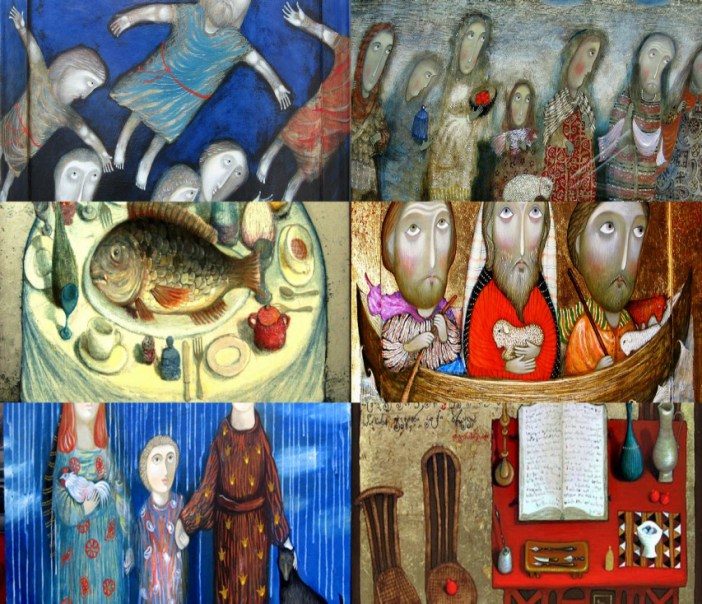
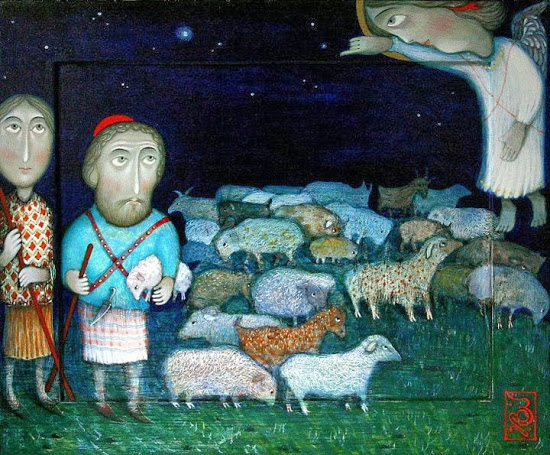
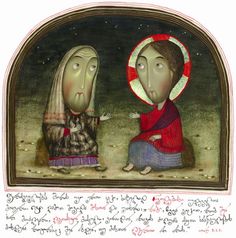
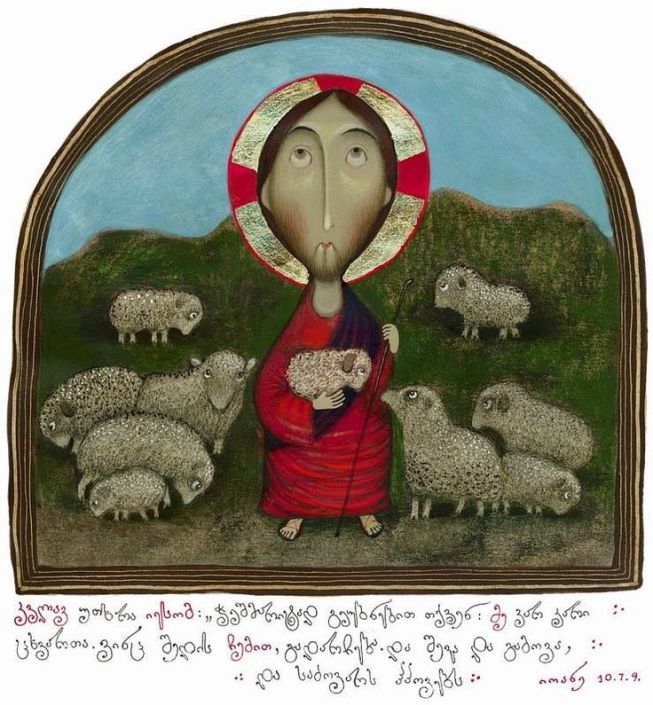
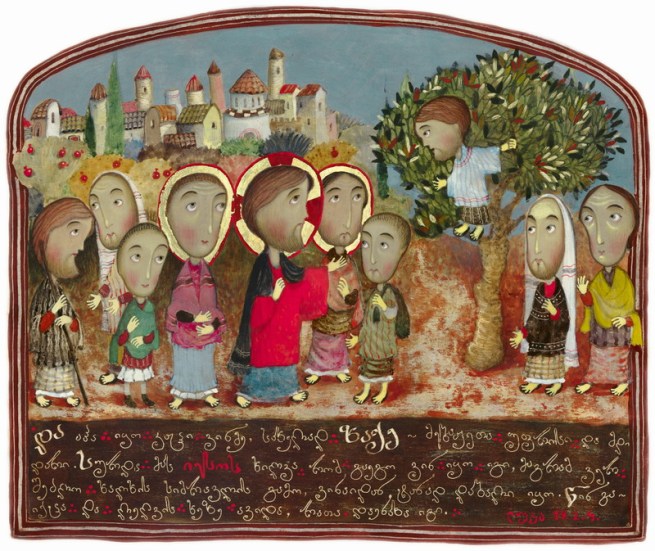
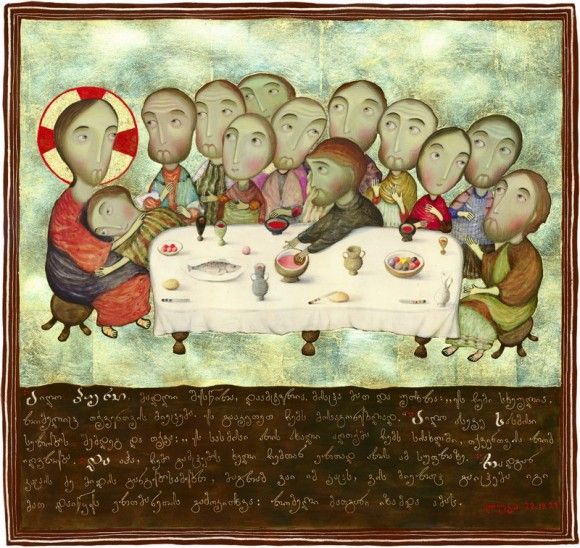
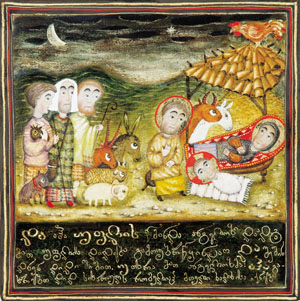
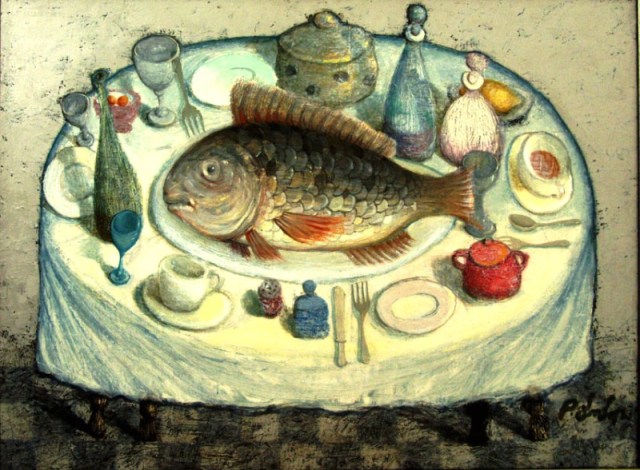
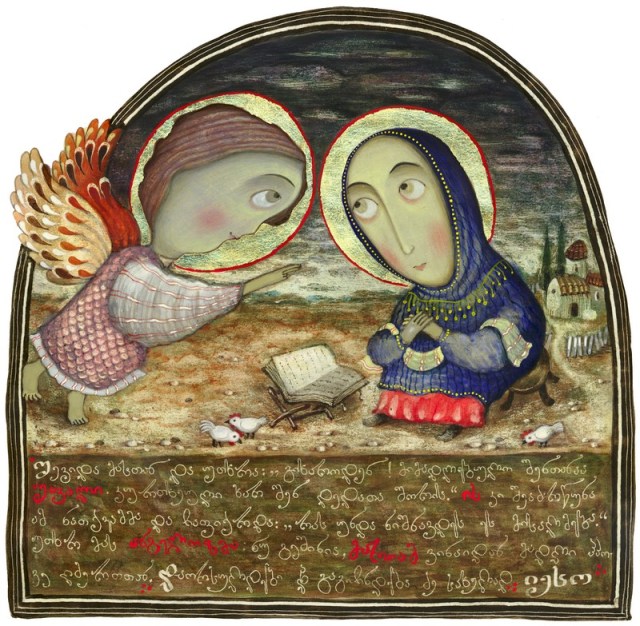
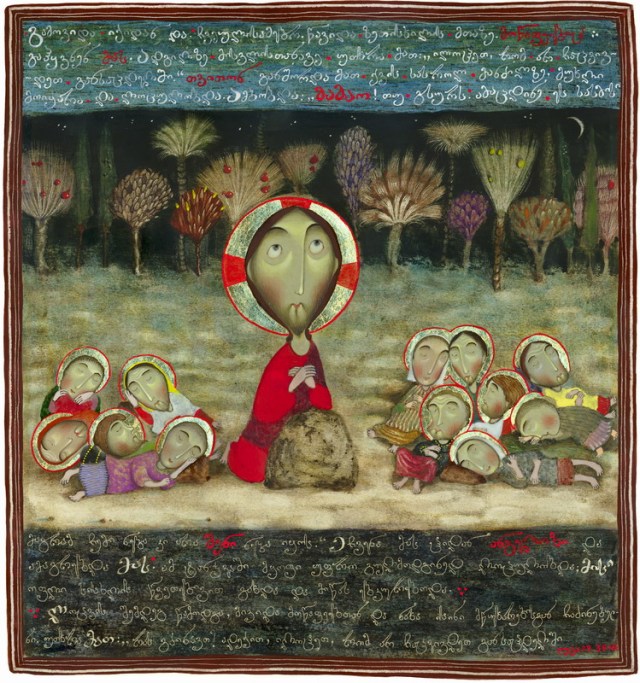
The always thought-provoking Jesus Question website, which traces the identity of Jesus through history, art, and pop culture, featured today David Popiashvili – Date of birth 1969, Tbilisi, Georgia; graduated from the State Academy of Fine Arts; Georgia Commonwealth of Artists member since 1997. Their blogpost made me smile! What an artist! Such beauty, “naive art” and childlike innocence, such freshness of vision!   … “In 2002 the IBT published a Georgian edition of Stories about Jesus Christ, a children’s book based on the four New Testament Gospels. They commissioned Georgian artist David Popiashvili, who studied at the Tbilisi State Academy of Arts, to create thirty-one illustrations for it. People responded so well to Popiashvili’s images that IBT decided to create a digital version of the book that includes Russian and English translations as well the original Georgian. You can access this edition here.


14

https://www.youtube.com/watch?v=N8HN5u903QQ


2456789121315

1

3031323334363738394041

4243464849505152

535456

3

OLYMPUS DIGITAL CAMERA

Victoria Emily Jones's avatarThe Jesus Question

The Moscow-based Institute for Bible Translation (IBT) exists to translate, publish, and distribute the Bible in the 130-plus languages of the non-Slavic peoples living in the Commonwealth of Independent States (that is, in former Soviet Union countries).

In 2002 the IBT published a Georgian edition of Stories about Jesus Christ, a children’s book based on the four New Testament Gospels. They commissioned Georgian artist David Popiashvili, who studied at the Tbilisi State Academy of Arts, to create thirty-one illustrations for it. People responded so well to Popiashvili’s images that IBT decided to create a digital version of the book that includes Russian and English translations as well the original Georgian. You can access this edition here.

Annunciation by David PopiashviliThe Good News about the Birth of Jesus

Baptism of Christ by David PopiashviliThe Baptism of Jesus

Walking on Water by David PopiashviliJesus Calms a Storm

Good Shepherd by David PopiashviliThe Good Shepherd

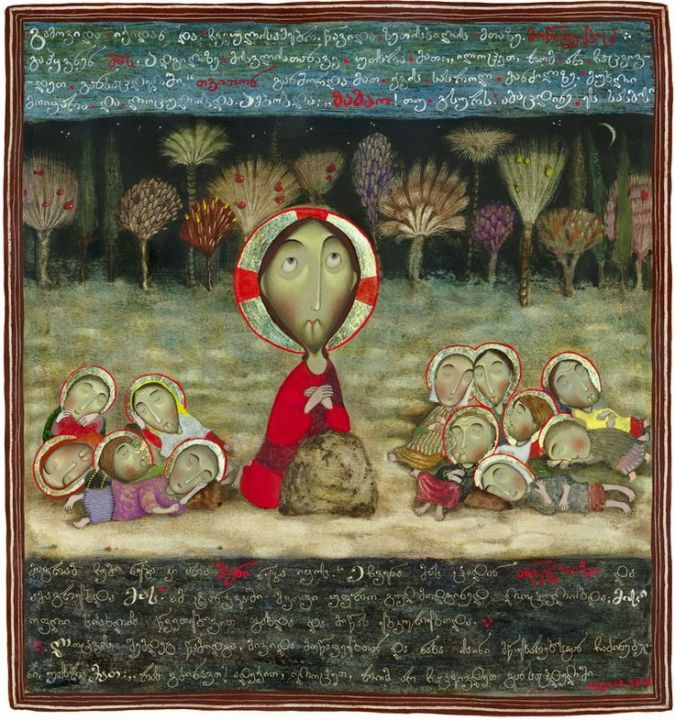
Agony in the Garden by David PopiashviliJesus Prays in Gethsemane

Christ carries his cross by David PopiashviliCarrying His Own Cross

View original post 200 more words

Rage, Rage At the Dying of the Light

Or, The Hollow Gaze Of a  Beast

holoow3

I am beginning to think that I am secretly a bear. I definitely have the social skills of one. I am as voluble as a bear during hibernation, and as attached to my room as a bear to its cave. In all honesty, I am continuously amazed anyone still wants to talk to me given how bad I am at keeping in touch. The simple reality is that I function in a state of amazement. I have rewritten this paragraph so many times; I can find no better way to describe this. I function like a stunned being. I go through the motions I see in other people; I do what it takes to be functional in this world. But deep down, I am paralysed.

I once saw a huge bull being taken to the slaughterhouse. I was in my monastery in Moldavia at the time. The animals know. The know perfectly well that behind that big door there is death. Many of them go wild, and desperation takes over. Some times, their hearts fail and they collapse, so they have to be dragged inside. I remember this bull: a huge, beautiful animal. I remember its stare. Its muscles had completely frozen; there was no movement at all – not a blink, not a sound. At the centre of that heard of bellowing animals, fighting to escape death, I remember that hollow, frozen gaze as the bull was pushed by three men towards the gate, inside the slaughterhouse.

Icon 1

I function very much like that stunned animal. When I look in the mirror (which I purposely try not to do) I recognise that gaze. There is something of that in everyone. Often times, I switch off as people talk to me about their holidays and homes and plans. I switch off and I try to recognise that frozen gaze in their eyes: beyond the noise, beyond the superficial glitter of life, that hollowness is always there. It is imprinted in us. It is part of what makes us who we are, part of what makes us human.

I suppose this is my apology for failing to always keep ‘on schedule’ with posting here, recording our podcasts and so on. I am sorry. I am aware I should be doing more, especially as many of you continue to support the monastery even through these periods of silence. Perhaps you feel something. Perhaps you yourselves recognise something in this silence.

I have prayed to make sense of this desperation. I live with a perfect hope that we shall all survive the slaughterhouse, but this hope comes with an equally perfect awareness of the hollowness of this life. I have prayed to make sense of this. I have also prayed that I loose neither the hope, nor the desperation; living with both creates an intense tension, and that tension feeds my heart. I have an intuition that this tension will lead me to Life.

If I have learned something so far, it is that I must protect and treasure this life, because the seed of Life is buried in it. The hollowness of this life, its senselessness, its pain have taught me that I myself can only get as far as the gate of the slaughterhouse. If there is any hope to make it beyond that gate, if there is any hope to survive it, it does not come from me. I cannot be my own saviour. I cannot be anyone’s saviour. This is a tough lesson to learn and impossible to fully accept without the grace of God. I am nothing without a Saviour. It is a tough lesson, but we cannot run away from it. Horrid as it feels, this is the foundation of all our hope.

Just think how different things could have been, had Adam stared into his own hollowness and accepted it, instead of collapsing at the feet of the devil. Had Adam accepted this truth, had he accepted that he cannot be his own saviour, has he reached out for a Saviour, this world would have known a different history. Perhaps this is the point of it all: to learn the lesson Adam has not; to stare into the hollowness of our being and not despair, to not collapse as he did, because we know that a Saviour has taken on the form of this hollowness and lifted it up to Life.

http://www.mullmonastery.com/monastery-blog/the-hollow-gaze-of-a-beast/

holllow6

The Hollow Men by T.S. Eliot

Mistah Kurtz – he dead.

A penny for the Old Guy

I

We are the hollow men
We are the stuffed men
Leaning together
Headpiece filled with straw. Alas!
Our dried voices, when 
We whisper together
Are quiet and meaningless
As wind in dry grass
or rats’ feet over broken glass
In our dry cellar

Shape without form, shade without colour, 
Paralysed force, gesture without motion;

Those who have crossed
With direct eyes, to death’s other kingdom 
Remember us – if at all – not as lost
Violent souls, but only
As the hollow men 
The stuffed men. 

Picture

 
IIEyes I dare not meet in dreams
In death’s dream kingdom
These do not appear: 
There, the eyes are
Sunlight on a broken column 
There, is a tree swinging
And voices are 
In the wind’s singing 
More distant and more solemn 
Than a fading star.Let me be no nearer
In death’s dream kingdom 
Let me also wear
Such deliberate disguises
Rat’s coat, crowskin, crossed staves
In a field
Behaving as the wind behaves
No nearer – 

Not that final meeting 
In the twilight kingdom

Picture


III

This is the dead land
This is cactus land
Here the stone images
Are raised, here they receive
The supplication of a dead man’s hand
Under the twinkle of a fading star.

Is it like this
In death’s other kingdom 
Waking alone
At the hour when we are
Trembling with tenderness
Lips that would kiss
Form prayers to broken stone. 

Picture


IV

The eyes are not here
There are no eyes here
In this valley of dying stars
In this hollow valley
This broken jaw of our lost kingdoms

In this last of meeting places 
We grope together
And avoid speech
Gathered on this beach of this tumid river

Sightless, unless
The eyes reappear
As the perpetual star
Multifoliate rose
Of death’s twilight kingdom
The hope only
Of empty men. 

Picture


V

Here we go round the prickly pear
Prickly pear prickly pear
Here we go round the prickly pear
At five o’clock in the morning. 

Between the idea
And the reality
Between the motion 
And the act
Falls the Shadow

For Thine is the Kingdom 

Between the conception
And the creation 
Between the emotion 
And the response
Falls the Shadow

Life is very long

Between the desire
And the spasm 
Between the potency
And the existence
Between the essence
And the descent
Falls the Shadow

For Thine is the Kingdom 

For Thine is
Life is
For Thine is the

This is the way the world ends
Not with a bang but with a whimper. 

holoow3

Because I Could Not Stop For Death


People are so beautiful it hurts. We all have this beauty in us, this otherworldly potential to be so much more than what we settle for. At times, this awareness is the only thing that makes sense of this senseless existence, its very foundation, the star calling us forward, the purpose of this flesh. Most of the times, though, it makes life ever more painful, because it throws light upon the dark truths we have spent a lifetime learning to ignore.

Someone’s asked in an email from where I get the strength to keep going. The raw answer is: fear. Fear and desperation and the knife-like breath of death I see slowly and implacably eating me from the inside, consuming the beauty within myself, the beauty within you. I look in the mirror and I see a caged animal, waiting in line to be sacrificed. I live with the awareness that none of the breaths I’ve taken, none of the things I’ve felt and done have life within themselves.

The most painful thing I live with, the heaviest weight I carry is the total, perfect knowledge that there is no memory here to preserve even the slightest trace of our sparks of life.

I look in the mirror and I see nothing that will survive death. I stare at this nothingness and life becomes a desperate attempt to outrun death. At times, this turns into pure isolation, and no island can be far enough; no darkness thick enough to cover me. Other times, for very few and rare moments, this turns into white silence. A bright blanket of silence that covers my mind like rarefied air. Up there, in those rarefied clouds, floating high above death, there is Rest, there is Peacefulness.


Source: Father Seraphim –The Mull Monastery at http://www.mullmonastery.com/uncategorized/someones-asked-in-an-email-from-where-i-get-the-strength-to-keep-going/