Memory Made Clear and Serene

time13

An Orthodox Theology of Time – V / V -Conclusion

Time as Renewal: Growth unto Goodness in Christ. The concept of the liturgical Eighth Day. If time is the change inherent in being created then can we experience our life as other than a growth unto death? Can we experience life as perhaps, a growth unto goodness in Christ in His Church?


Therefore, let not a person be grieved by the fact that his nature is mutable; rather, by always being changed to what is better and by being transformed from glory to glory (2 Cor 3.18), let him so be changed: by daily growth he always becomes better and is always being perfected yet never attains perfection’s goal. For perfection truly consists in never stopping our increase towards the better nor to limit perfection with any boundary (Gregory of Nyssa, On Perfection, p.379)

Decay unto death can be renewed as a growth unto life in Jesus Christ. … Our everlasting God has come down into the broken temporality of time and renewed our memory in the saving event of Jesus Christ, God as Man and Man for God.

Memory needs to be healed not destroyed. Often the greatest difficulties in our lives are the result of being plagued by evil memories, which wound and lacerate us as persons. Indeed, we pray at Great Vespers that God will protect us “from vain thoughts and from evil memories.”An image exists for this ‘weight of memory’ at the end of the Purgatorio when Dante, after confessing to Beatrice, first drinks of the river of Lethe forgetting all the evil and sin of his past life then drinking of the river of Eunöe (‘good remembrance’ or ‘good mind’) and remembering everything but from the perspective of the grace and love of God.

Forgiveness, then, is a process of progressive confession and absolution where we gradually let go of the past (are freed from its chains) by confronting the past and then giving it up in forgiveness (forgetting it without repression) so that we can regain it back from Jesus Christ through His remembrance in love. This healed or forgiven memory is paradise regained, that is, “radical innocence” as Yeats termed the state of learned childlikeness after our dreaming innocence has gone through the fire of experience.

We are given this renewal of our memory, this reality of memory shining forth with the light of the new age of the coming Kingdom of God fulfilled once for all time on the cross (‘It is finished!’/’Behold I make all things new’), in the perpetual rebirth—perpetual Pentecost—of the Church in its praise of God. In praising God, the Church is given the gift of the eternal Memory of the Spirit whereby we remember the life of Christ as our very own thus redeeming all memory under the sign of His cross. Such ‘eternal remembrance’ renews the face of the earth and makes of it, as Schmemann put it, a “liturgical paradise.”


“Today, a sacred Pascha is revealed to us” or “This is the day of resurrection”or yet again “On Mount Tabor, O Lord, Thou hast shown today the glory of Thy divine form unto Thy chosen disciples”.
SONY DSC

In Christ, as the Lord of Time, is realized the ingathering of all moments in One Moment of what we might call an ‘eternal temporality’ and which Schmemann calls temps immobile, that is, the co-inherence or co-presence of each part of time to each other in the present, in Jesus Christ.

Christ is Himself the Lord of Chronos or time proper because He is the Kyrios Kairou, Lord of the appointed time of our salvation. In Him, our broken mode of temporality, chronos, is renewed and sanctified, ascending with Him to the Father and becoming a spiritual mode of time through its marriage with creaturely eternity (aeon).

But when He returns to us in His Body and Blood in the liturgy, which is both our ascent to God and His descent to us, we see that our new mode of time, eternal temporality, is something radically new to creation, sensible and spiritual at once, as it has partaken of the very mode of God Himself as everlasting Trinity (aidiotes), God before the ages.

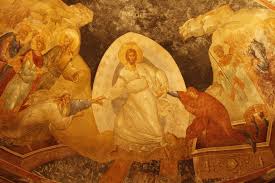
Therefore, the central locus of this ingathering of time is our Lord’s anamnesis or His recollection of His own saving actions in the liturgy in which His living memory becomes life everlasting by renewing all time in the new age of His Kingdom. This Kingdom of Jesus Christ is the very same life we will receive at the resurrection on the last day. It has been variously described as the ‘eighth day’ or ‘liturgy without end’ and it is granted as a gracious foretaste to us. It is a sort of liturgical in-breaking of the life to come in our crooked and wounded time.
time19

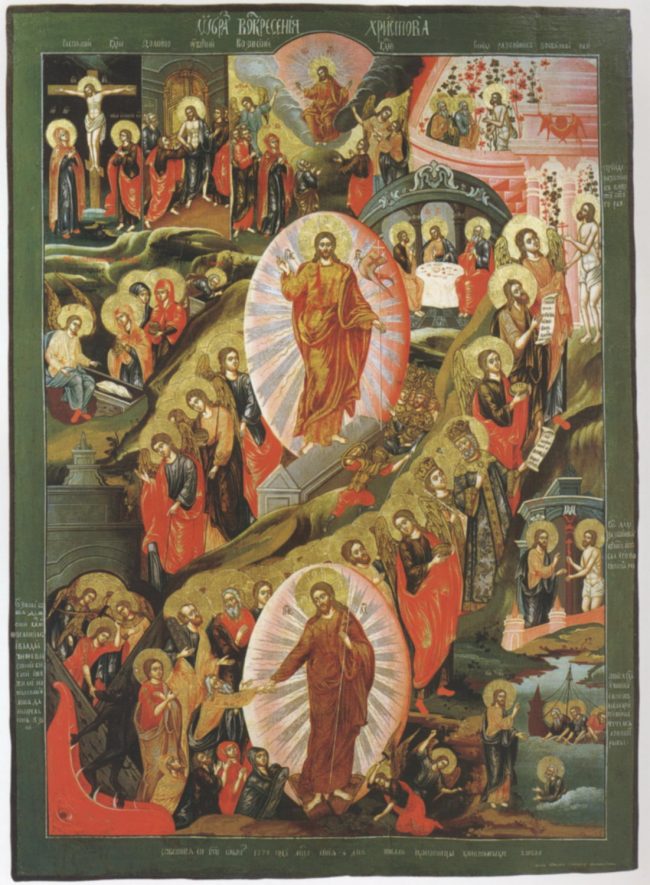
Harrowing of Hades, fresco in the parecclesion of the Chora Church, Istanbul, c. 1315, raising Adam and Eve is depicted as part of the Resurrection icon

It should be noted that when, in Scripture, Christ remembers His own Body and Blood broken and shed for the life of the world, it is prior to the actual sacrifice. In other words, in Christ’s remembrance, memory is not merely retrospective, in that it looks back at a life of sacrifice, but it is also simultaneously prospective in actuating prophetically the sacrifice of the cross before it happens. 

Likewise, our Lord as our Great High Priest remembers us and all time before the Father in heaven when at the Anaphora on the Lord’s Day the priest says both retrospectively and prospectively at once: “Remembering this saving commandment and all those things which have come to pass for us: the Cross, the Tomb, the Resurrection on the third day, the Ascension into heaven, the Sitting down at the right hand, and the second and glorious Coming.”

Christ’s memory is eschatological, a remembering of the future life to come. Thus the Christian life is one of memory eternal where we live in the liturgical ingathering of all moments by remembering, with Christ, the saving acts that have accomplished our salvation now and to come. In the Christian life lived as anamnesis, past and future converge in one another in the present moment of our loving memory where we taste of the new age given in our midst.

Eternal memory is not the destruction of the past as past and the future as future but their clarification and illumination in encountering each other in our present consciousness of Jesus Christ who gives us eternal life. To borrow a phrase from Berdyaev, “Immortality is memory made clear and serene.”

Christ, then, as our renewed memory effecting salvation has, as Schmemann put it, “power over time” because He makes time His own as its Lord and does not destroy it but burns away, with healing fire, its wounds, making it itself through contact with Himself insofar as “Eternity is not the negation of time, but time’s absolute wholeness, gathering and restoration.”

Source: Excerpts from http://www.bogoslov.ru/en/text/2668945.html

The Sisyphus Myth


time5

An Orthodox Theology of Time – IV / V

Time as Woundedness and Time as Decay, Growth unto Death.  How do we primarily experience time as fallen beings? Do we experience it as change or, more precisely, mutability, that is, a growth unto death? 


“To-morrow, and to-morrow, and to-morrow,/ Creeps in this petty pace from day to day/ To the last syllable of recorded time,/ And all our yesterdays have lighted fools/ The way to dusty death. […] it is a tale/ Told by an idiot, full of sound and fury,/ Signifying nothing.” (Shakespeare, Macbeth, V.v. ll.)


First we experience fallen time as constant change or ceaseless movement in a cycle of death that can be seen cyclically in the seasons, which move in a circle like a snake swallowing its tail. Winter follows Autumn and Spring follows Winter just as death follows old age and old age is not the end, for out of our death comes the birth of our descendants. Thus all of time is a perpetual repetition of death since the moment that things come into existence, changing from non-existence into being, they straightway move back again from existence into non-being.

This experience of fallen time is what Pozzo, in Waiting For Godot, expresses when he cries furiously at Vladimir:

Have you not done tormenting me with your accursed time! It’s abominable! When! When! One day, is that not enough for you, one day he went dumb, one day I went blind, one day we’ll go deaf, one day we were born, one day we shall die, the same day, the same second, is that enough for you? [Calmer] They give birth astride of a grave, the light gleams an instant, then it’s night once more.


Second, we experience fallen time as unending desire. Once we desire something it lacerates our whole being until we possess it and our desire for that thing is then satiated until the thing possessed tempts us into some new perversion and the vicious circle begins all over again. Man’s life, then, is like this vicious circle insofar as he is continually turning around while facing his own self like it was a household idol, as The Great Canon of St. Andrew of Crete puts it: “I am become my own idol, and have injured my soul with passions.” Luther expressed this fallen circularity of time well when he says that homo in se incurvatus or man is turned in on himself.


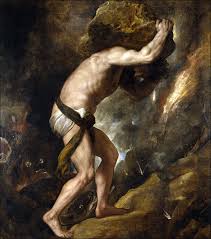
… St. Gregory of Nyssa  has a nice image to convey this hopeless cyclical perpetuum mobile. It is of a man fruitlessly attempting to climb uphill in sand and never making any progress. It is the spiritual life where one’s house is built not on the rock of Christ but on the sand of spiritual illusions:

“He [the passionate man] is like those who toil endlessly as they climb uphill in sand: Even though they take long steps, their footing in the sand always slips downhill, so that, although there is much motion, no progress results from it.” 

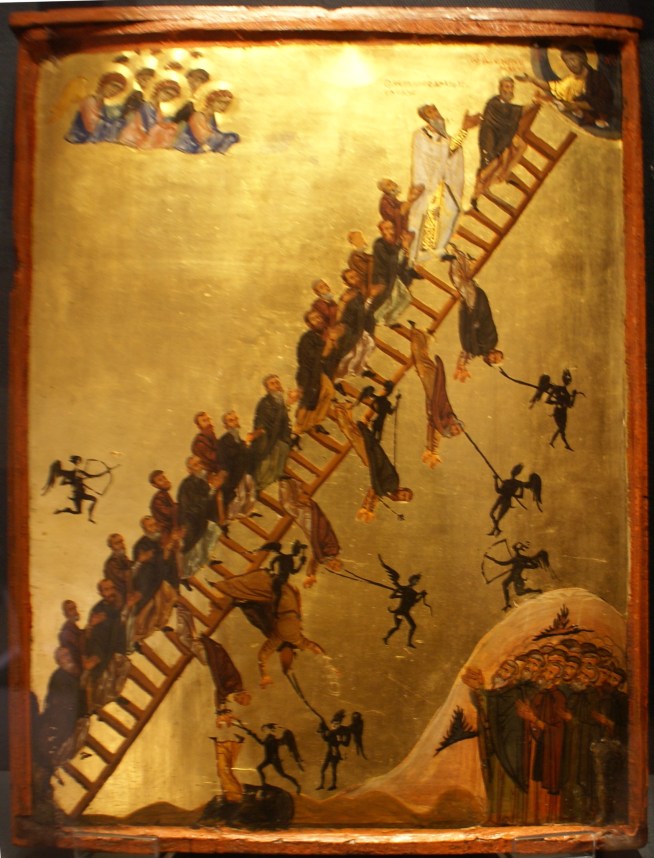
[Also, remember here The Myth of Sisyphus: The gods had condemned Sisyphus to ceaselessly rolling a rock to the top of a mountain, whence the stone would fall back of its own weight. They had thought with some reason that there is no more dreadful punishment than futile and hopeless labor.]

Third, we see time as decay in memory—Schmemann’s “evil time.” In evil time, we remember the past as perpetually lost like a ghost that must relive its own murder.  Thus we remember continually and cannot change the death of our spouse, our mother, our child, or worse, a moment of humiliation by our spouse, our mother, by us of our own child. We cannot choose our past, for deliberation is a mark of future action in the present, the choice between what we would like to have happened and what actually happened remains only an undying craving for another world, as T. S. Eliot acknowledged: “What might have been is an abstraction/ Remaining a perpetual possibility/ Only in a world of speculation.”(T. S. Eliot, “Burnt Norton”, I, ll.6-8 in Four Quartets).

Each of these faces of fallen time points to our fundamental need, in time, for time’s renewal in Jesus Christ.

Source: http://www.bogoslov.ru/en/text/2668945.html
To Be Continued

For Part V go to https://orthodoxcityhermit.com/2015/12/18/memory-made-clear-and-serene/

Carpe Diem and Christmas


time4.jpg

Carpe Diem:  Kairos Moments In Our Chronos

An Orthodox Theology of Time – III / V

Everything we do is marked by the steady march of time. Seconds lead to minutes to hours to days to weeks to years to decades to centuries.

The problem for all of us is that the clock is always running the wrong way, and we simply cannot stop its precipitous crawl toward the next tick. We lose moments to the past, out of our reach, never to be regained.

Where did all the years go?

The kids have grown and gone. We’re muddling along in a career, making a living, just existing out of habit more than anything.

Did I miss out on my chance to make a difference?

The Greek language has a couple of words that mean “time.” The first is most familiarchronos . It means the chronology of days, governed by the carefully calculated earths’ sweep around the sun. God himself ordained this measurement of days on the fourth day of Creation, spinning the heavenly lights “for seasons, and for days and years.”

Boy, do I know about time. The wrinkles etched on my face; the wrinkles etched on my heart are the visual reminders of chronos.

But another word for time is also used in the New Testament—kairos . This speaks more to specific, God-ordained times throughout history, sometimes called the “right time” or “appointed season” (Titus 1:3).  Kairos is God’s dimension—one not marked by the past, the present, or the future.

When Jesus came, it was a fulfillment of promises past, a cosmic collision of the sacred and secular. It was an intersection of the holy will of God and the stubborn ways of man.It was a perfect moment.  John the Baptist said in Mark 1:15 that “time is fulfilled, and the kingdom of God is at hand.” 

This godly kairos pierced its way into creation at just the right time, slicing through chronos with a cry of a baby in a manger.

The cross was another kairos moment. Romans 5:6 says, “For while we were still helpless, at the right time, Christ died for the ungodly.”

Kairos moments then—and now—allow us to get a glimpse of the “other side.” We peek around the corner at eternity. We actually glimpse how God works.

As the omniscient, omnipresent Deity, God is not bound by the confines of space or time. That’s why He flows into our existence when we least expect Him. When we ask for something right away, it might not always come. Or when we don’t ask at all. But he shows up. It can be frustrating, “with the Lord one day is as a thousand years.”  It can also be surprising “a thousand years as one day.” (2 Pet 3:8).

We should always live our days looking for those moments, those inexplicable times when His will and his way intersect with our daily walks.

And they can happen anytime! A friend calls you out of the blue to give a good word. A child’s innocent joy pierces a long, hard day of struggle. A coworker takes a moment to lend a hand.

God is always surprising us with his perfect, kairos timing.
Am I ready, waiting, and watching for him to move in my life?

Source: Living a Kairos Life in a Chronos World, By DAVID RUPERT MAY 22, 2009 at http://www.thehighcalling.org/articles/essay/living-kairos-life-chronos-world

 free-decorative-line-divider-clip-art-582650

Hebrews 3

Wherefore (as the Holy Ghost saith, To day if ye will hear his voice,

Harden not your hearts, as in the provocation, in the day of temptation in the wilderness

13 But exhort one another daily, while it is called To day

15 While it is said, To day if ye will hear his voice, harden not your hearts, as in the provocation.

 free-decorative-line-divider-clip-art-582650

To Be Continued

For Part II go to https://orthodoxcityhermit.com/2015/12/18/4441/

For Part IV go to https://orthodoxcityhermit.com/2015/12/18/woundedness-the-sisyphus-myth/

Christ(mas) Healing of Chronos, Kairos, and Aeon

An Orthodox Theology of Time – II / V


time2.jpeg

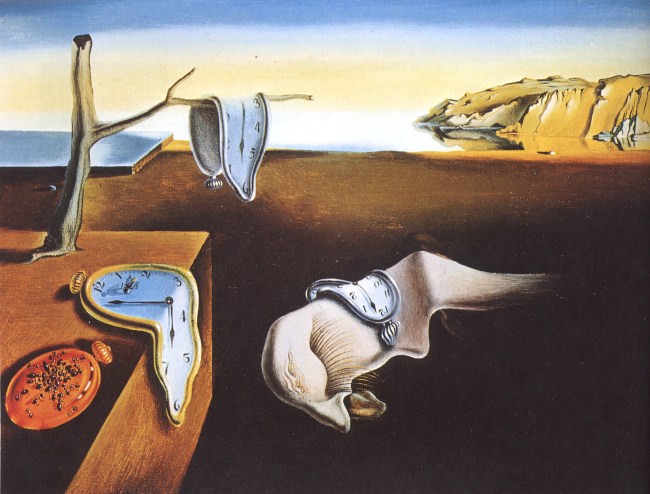
The Persistence of Memory – Salvador Dali

Nature of Time: What is time? What is its relation to God’s mode of being? Time as understood in its relation to the Church as a receptacle of the eternal Kingdom of God.


“What is time? Who can explain this easily and briefly? Who can comprehend this even in thought so as to articulate the answer in words?

Yet what do we speak of, in our familiar everyday conversation, more than of time?

We surely know what we mean when we speak of it.

We also know what is meant when we hear someone else taking about it.

What then is time? Provided that no one asks me, I know.

If I want to explain it to an inquirer, I do not know”


(Augustine’s Confessions,11.14.17, p. 230)

Some Fathers, including Sts. Basil the Great and Maximus the Confessor, spoke of three modes of being (i.e. time (chronos), age or creaturely eternity (aeon) and the everlasting or uncreated eternity (aidios, aidiotes) and sometimes … proaionios or the pre-eternal which is ateleutetos or without an end)), not just the two of time and eternity.


…First, everlastingness or everexistingness (aidiotes)  is the mode of being only of God, who is utterly beyond the distinction between time and creaturely eternity, being and non-being, since He is the pre-eternal (proaionios) God who is “endless” in the sense of being beyond duration. Everlastingness is essentially a negative or apophatic category emphasizing God’s unknowableness.


God is indefinable as the ho pro aionon Theos (Slavonic: prevechnyi Bog) which can be translated as ‘the pre-eternal God’ or ‘God before the ages.’ As the Kontakion of Christmas puts it:


Today the Virgin gives birth to him who is above all being [ton huperousion], and the earth offers the cave to him whom no one can approach; Angels with Shepherds give glory, while Magi journey with a star, for to us there has been born a little child, God before the ages [ho pro aionon Theos].


Second, we have creaturely eternity/age (aion–aionios), which is the creaturely mode of being of the supra-cosmic or spiritual creation of God—angels. [Human beings too. Both Angels and humans are eternal, because although they were created in Time, they do not have an end]. This mode of being is not one that excludes change but it is not bound by the distinctions of our present time’s version of change. The past is not utterly past but it is contained in the present as is the future and the future in the past and the past in the future so that eternity is a sort of perichoretic version of time. This, I would argue, is what Schmemann was getting at when he wrote that points in time can be gathered together and encountered simultaneously:

“In an instant, not only are all such breaths of happiness remembered but they are present and alive—that Holy Saturday in Paris when I was a young man—and many such ‘breaks.’ It seems to me that eternity might be not the stopping of time, but precisely its resurrection and gathering.”


Moreover, there is in the Kingdom of God, which is an eternal Kingdom not of this world, an enduring quality of being where one forever praises God from one moment to the next—a sort of sempiternal or eternal duration—without in any way being trapped in growing old or being trapped in the inexperience of youth. In such eternal duration, the goodness of God is always desired and always held in its fullness at the same time as that goodness continually increases our capacity and desire for it although we never possess this goodness in its fullness.


Time in physical creation, as we now experience it under the weight of sin, is understood as a reality with a strict division between past, present and future where the person in time, who has turned his back on God’s grace in Jesus Christ, is prevented from being present to more than one division at once. Thus when I err under the weight of sin I cannot be present to here and there at once since I am bound to here.


… Christ heals our time (chronos), and indeed the time of the invisible creation (aeon), by making it His time of opportunity for our salvation in Him (kairos).


Time, as Christ’s time, becomes a means to our perfection in Him rather than the ultimate expression of our rejection of God’s grace. Through Him in His Body the Church we come to partake in the mode of being of the invisible creation, creaturely eternity, but this eternity or time of the invisible creation becomes wedded with our sensible time, remade for an embodied being like man, through participating in the everlasting life of God. Time is, therefore, remade and renewed in the Church as the Kingdom of God and we have a foretaste of this renewal in the liturgy.

[Chronos, Kairos and Eternity, or, Agape. Because Eternity is Hypostatical Agape in God]


Source: Excerpts from Gallaher, Brandon ‘s Orthodox Theology of Time at https://www.academia.edu/3561108/Chalice_of_Eternity_An_Orthodox_Theology_of_Time_St_Vladimirs_Theological_Quarterly_57.1_2013_pp.5-35

To Be Continued …

For Part I go to https://orthodoxcityhermit.com/2015/12/18/chalice-of-eternity/

For Part III go to https://orthodoxcityhermit.com/2015/12/18/4497/

Chalice of Eternity

chalice


Time, or the Art of Deception: 1990 
Time stands still in this surrealist composition.The water and the metronome are suspended as if Time had just stopped – yet might start again, a moment later.

An Orthodox Theology of Time -I / V

“This morning during Matins I had a ‘jolt of happiness, of fullness of life, and at the same time the thought: I will have to die! But in such a fleeting breath of happiness, time usually ‘gathers’ itself. In an instant, not only are all such breaths of happiness remembered but they are present and alive—that Holy Saturday in Paris when I was a young man—and many such ‘breaks.’ It seems to me that eternity might be not the stopping of time, but precisely its resurrection and gathering. The fragmentation of time, its division, is the fall of eternity. Maybe the words of Christ are about time when He said: ‘…not to destroy anything but will raise it all on the last day.’ The thirst for solitude, peace, freedom, is thirst for the liberation of time from cumbersome dead bodies, from hustle; thirst for the transformation of time into what it should be—the receptacle, the chalice of eternity. Liturgy is the conversion of time, its filling with eternity. There are two irreconcilable types of spirituality: one that strives to liberate man from time (Buddhism, Hinduism, Nirvana, etc.); the other that strives to liberate time. In genuine eternity, all is alive. The limit and the fullness: the whole of time, the whole of life is in each moment. But there is also the perpetual problem: What about the evil moments? Evil time? The terrible fear before dying of the drowning man, of the man falling from the tenth floor about to be crushed on the pavement? What about the tears of an abused child?

(The Journals of Father Alexander Schmemann 1973-1983, p.78)

To Be Continued

For Part II go to https://orthodoxcityhermit.com/2015/12/18/4441/ 

You Die For Your God But Our God Died For Us

 letter7

VIDEO: The Great Persecution of our Time is Here —

The Nine Overcoming ISIS 

Watch this powerful mini-documentary about nine confessors of Jesus Christ in Iraq

“Lord Jesus Christ, grant us all this faith and courage to bear our crosses and confess You before the world, to love and forgive our persecutors, and to follow You even to Golgotha. And to give You thanks and glory through it all!”

 letter10
“Who would dare to love ISIS?” was the question asked in the first film. Now, come and hear the testimonies of 9 refugees who fled ISIS and left everything behind. They dare to love ISIS and they dare to bring a message of hope – to counter ISIS’s message of hate. … Their testimony and faith, forged by fire, will bring healing to the nations. God has shaken the Middle East and from its ruins, deep faith is stirring in the hearts of the persecuted.

 letter3

Video by Mighty LA, the ones who brought you A Letter from the People of the Cross to ISIS 

 
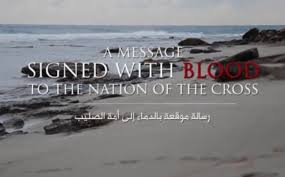
For those of you who have missed it, watch and absorb their first video, their phenomenal response to ISIS and their ‘Message Signed in Blood to the Nation of the Cross’. As the Savior might say, “Let it sink deep down into your very being.”
https://www.youtube.com/watch?v=uSv4vBcFyvo
 letter4

A Letter from the People of the Cross to ISIS 


The world is talking about you

Your apocalyptic dreams and spectacular sins

Are now awakening the Middle East

In your Holy War, come to Holy Ground

Come, children of Abraham come

The People of the Cross gathers at your gates with a message

Love is coming after you.

Like a rush of wind grazing over the Pacific

From hills of the mount of olives to the desert winds of Jordan

From the cedars of lebanon to the silk roads of the East

An army comes.

With no tanks or soldiers

But an army of martyrs faithful unto death

Carrying a message of life

The people of the cross

Comes to die at your gates.

If you won’t hear our message with words

Then we will show you with our lives laid down.

For every throat you slit and every woman you rape

For every man you burn and every child you turn to dust


There is blood on your hands brother

 But Come Brothers Come


Come with your bloodstained hands,

Come with your eyes full of murder for the people of the Cross,

Come lay your guns and your knives at the foot of the Cross

A love that is overdue and overwhelming

Breathes through your cities

Though your sins are like scarlet

They can be washed white as snow

Though you call yourselves servants

He will make you into Sons

Where can you run from His love?

Even the darkness cannot hide you


Come Brothers Come


There is the sound of a rushing rain

To remove your sins and bind your wounds

You die for your god but our God died for us

The King of Kings comes to be the sacrificial lamb

Slain on the altar where we should have been

Jesus Christ, Isa Al Masih

Walks through the Middle East


There is forgiveness tonight oh brother

There is healing for your sins oh brother

We are no different.

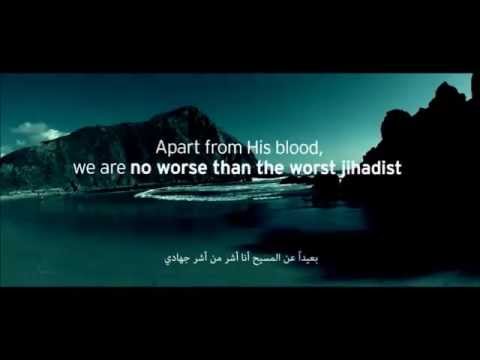
Apart from Christ, we are no better than the worst jihadist

Christ has been crucified once. and for All.

To make sinners like you and me into brothers

Even you.

Even now.


Source: http://facingislam.blogspot.gr/2015/12/video-nine-overcoming-isis-great.html?
 

See also https://orthodoxcityhermit.com/2015/11/14/paris-massacre-an-act-of-war-and-the-army-of-islams-new-martyrs/


A Kairos Life in a Chronos World

Christ’s Nativity in Eastern Byzantine Iconography and  Western Sacred Paintings

Living a Kairos Life in a Chronos World: The Three Main Differences 

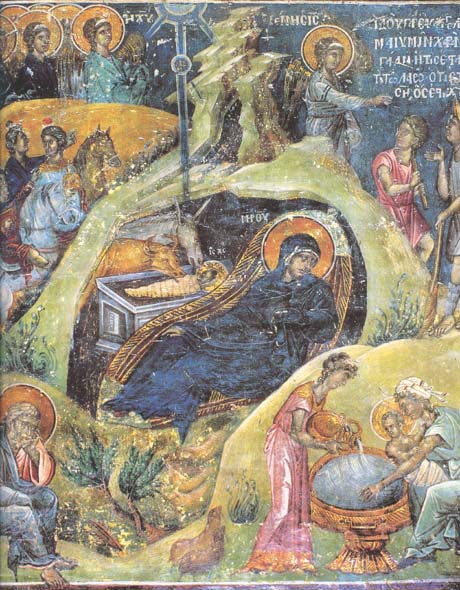
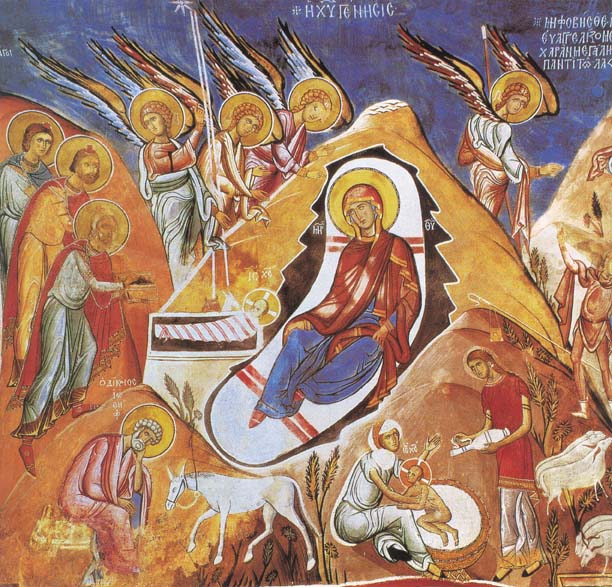
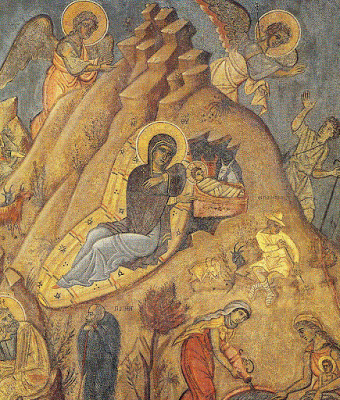
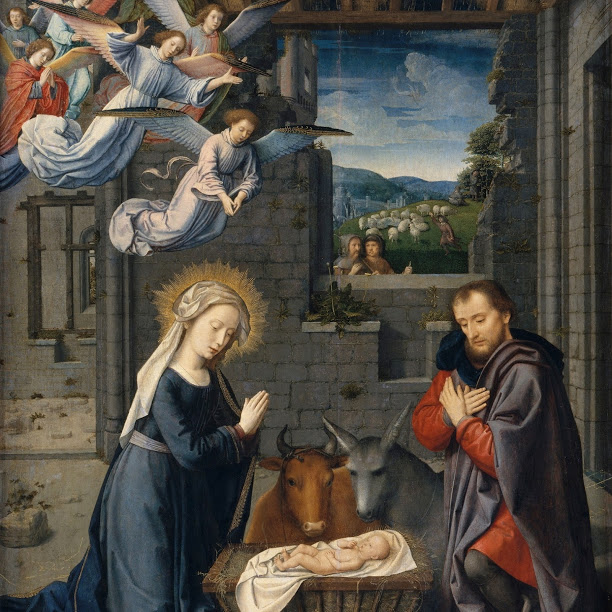
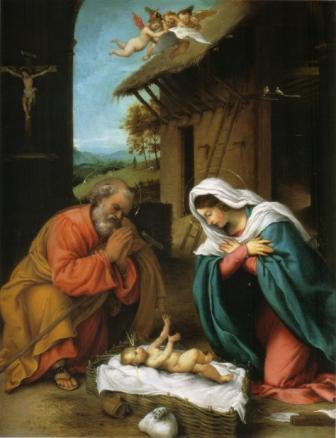
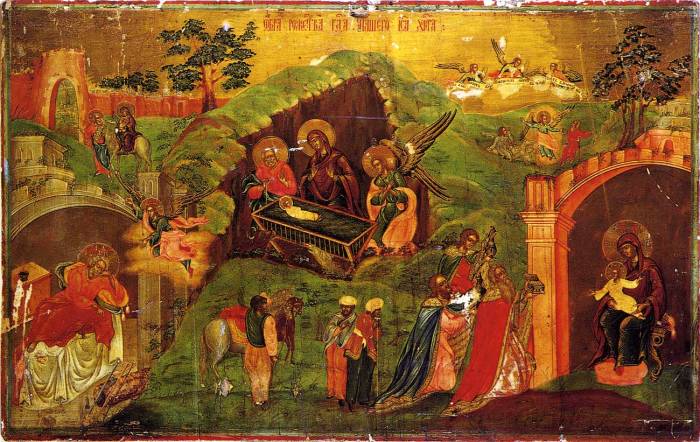
The traditional Orthodox icon of the Nativity is one that many of us have venerated since our early childhood in the Orthodox Church. Yet for many of us, born and raised in the Western world, this icon may at times seem strange and different from the depiction of the Nativity as seen in the secular press, books, television, websites and other forms of media communication. Hopefully this short article will contribute to a greater appreciation of the Orthodox teaching of the meaning and significance of the feast of the Nativity as witnessed by the icon of the holy day.

nativity2

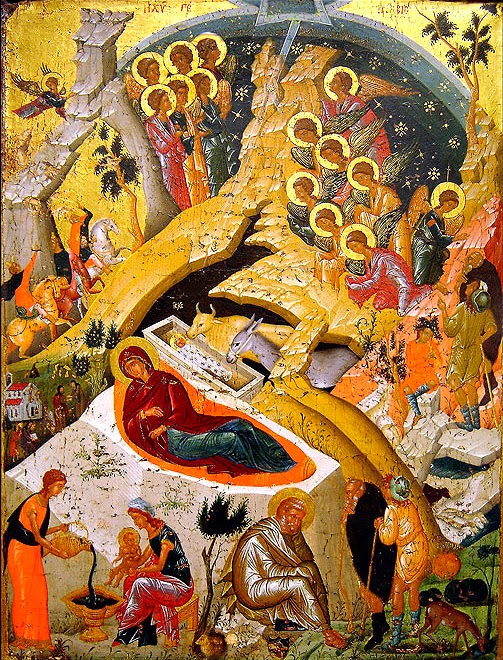
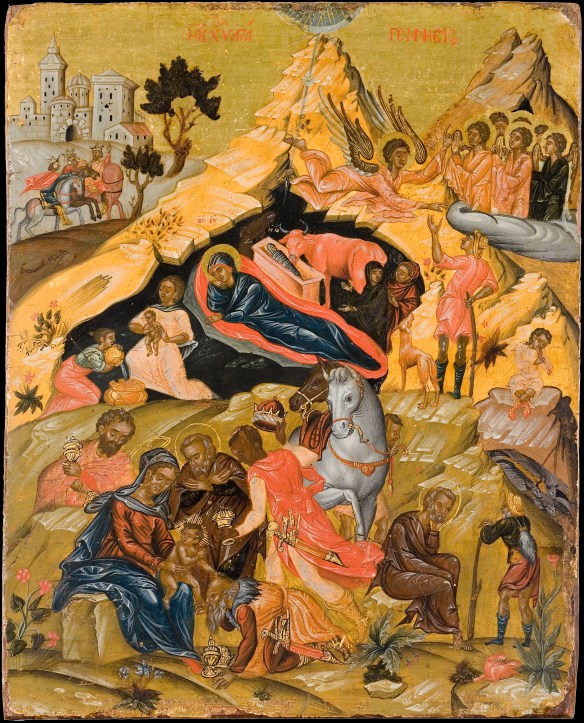
The first major difference between the Orthodox icon and the Western art depiction of the Nativity is that the main event, the birth in the flesh of Our Lord, is not depicted in the setting of a stable but in a cave immersed in a mountain. The “cave of Bethlehem”, is mentioned as early as the second century in the writings of St. Justin and by the fourth century, the site had become the place of a beautiful basilica in Bethlehem which was and is still today an important pilgrimage site for Christians. The cave itself in the icon is always depicted in dark colours or in black to indicate that the world that had plunged into the darkness of sin, through man’s fall, would soon be illuminated by the Nativity of Christ – “the light of the world” .

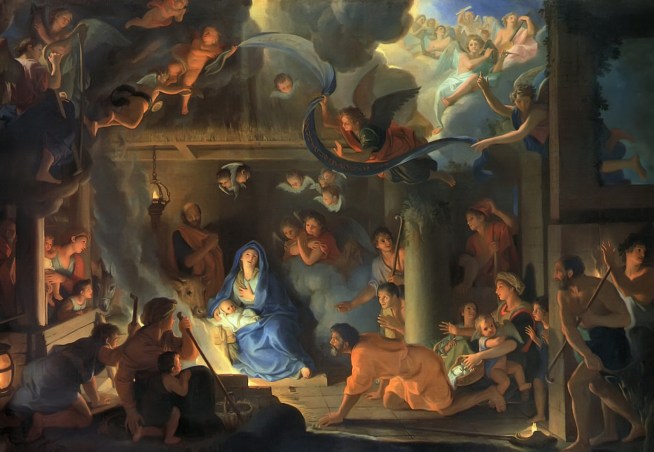
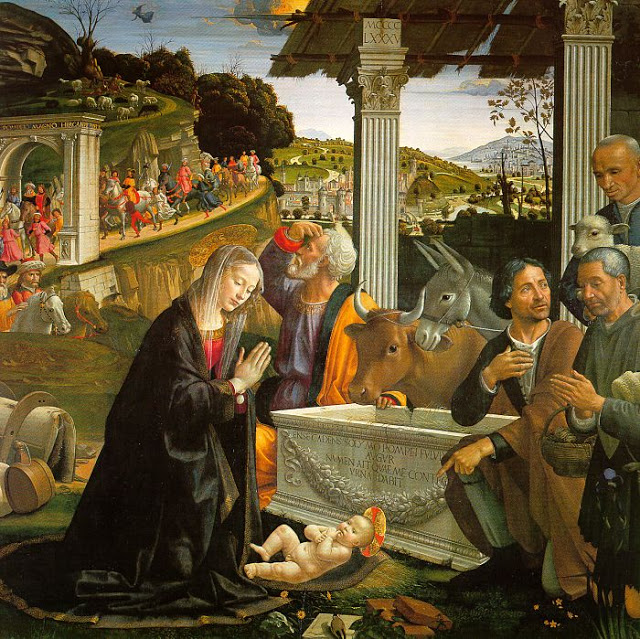
Adoration of the Shepherds by Charles Lebrun, 1689

The new-born infant Christ is found always in the centre of the icon and cave, and as such is the true enlightener of mankind, through Whom a new era begins in the history of mankind. This same cave, also foreshadows the cave of “life giving tomb” that is found in the icon of the Resurrection. Christ thus begins and ends His earthly mission in a cave.

The cave in the icon of the Nativity is situated in a mountain, symbolic of the wilderness, which gives a place of refuge to the Son of Justice and Truth in fulfilment of the Old Testament pre-figuration. The Prophet Habakkuk states in a prayer: “God comes from Teman, the Holy One from Mount Paran. Covered are the heavens with His glory, and with His praise the earth is filled” (Hab. 3:3).

Christ, the fulfilment of this and other prophesies found in the Old Testament, is represented with His Virgin Mother – the Theotokos on a mountain, which emphasises their mutual unity. True manhood and the human nature in Christ is received from His Mother, the Ever-Virgin, and thus she figures prominently in the central scene of the icon.

The Mother of God is depicted always in a reclining position on a childbed with a tranquil and peaceful expression on Her face, and showing an absence of the usual suffering of child bearing. She is usually turned away from Christ, looking at the outside world, contemplating whether mankind will accept or reject the great mystery in which she plays such an important role. She as such has completed her unique role in God’s mysterious plan as the Birth-giver of God.

The Eve of the Old Testament was the mother of all living beings; in the New Eve, the Theotokos, we now have the Mother of all those that are redeemed. Thus she is the best example of the thanksgiving offering that mankind could make to the Creator, and serves us as an example of perfect obedience to the will of the Father.

nativity3

Christ is depicted in a manger or fodder bin, wrapped up in swaddling clothes. The manger symbolizes the altar upon which the supreme gift is brought to mankind, the infant Christ who is to redeem mankind. The swaddling clothes in which He is wrapped points to the winding sheet of another cave, the sepulchre, as depicted in the icon of the Descent of Christ from the Cross and His subsequent burial in the tomb.

The Gospels do not mention any attendants at the birth of Christ; however, the icon of the Nativity shows an ox and an ass either on the right or left side of Christ. These domestic animals are symbolic of faithfulness and devotion, as well as innocence in their relation to the Master. These animals are not important for their physical bulk, but their importance lies in the acceptance of their new Master. Thus it is not only the human world that accepts Christ but also the animal world that participates in the feast of re-creation.

nativity4

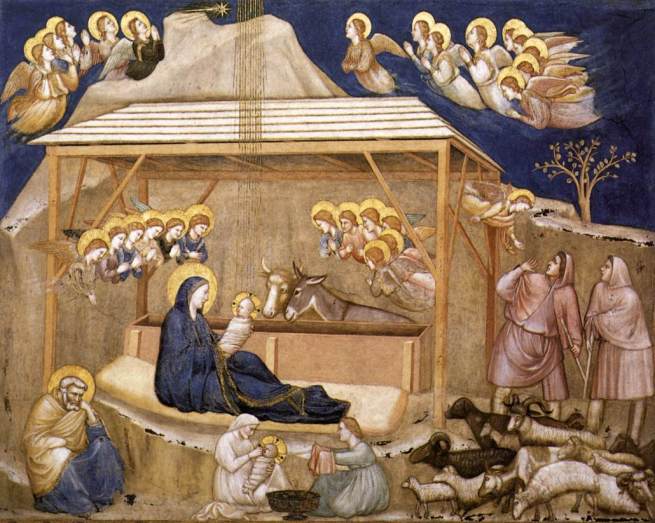
The second major difference between the Orthodox icon of the Nativity and Western art is the role and place of Joseph in the events. Western art always places Joseph in the centre of the event, close to Mary, a scene that as such depicts the “holy family”. The Orthodox icon of the Nativity does indeed include the figure of Joseph (lower right or left hand corner); however, he is far removed from the centre of the main event and finds himself in fact off the mountain or at the bottom of it. Joseph is depicted as an elderly man, sitting in a contemplative or meditating position, turned away from the main event of the icon. In our Orthodox tradition, Joseph is considered the guardian of Christ and His Mother, thus he is pictured as an aged man compared to the youthfulness of the Mother of God. In his pensive stature, Joseph seems confronted or plagued by doubts about the puzzling mystery of God’s incarnation from a Virgin. The pose of Joseph indicates that the true fatherhood of Christ is through the Virgin and the paternity of the Holy Spirit. This thus corresponds to the Nicene Creed’s verse: “Who for us men and for our salvation came down from heaven, and was incarnate of the Holy Spirit and the Virgin Mary, and was made man”.

nativity9

Often Orthodox icons show Joseph confronted by an elderly shepherd or satan like figure, always depicted in dark colours. This figure is the tempter, tempting Joseph into not accepting the miraculous birth of the Saviour from the Virgin (as recorded in the Protoevangelium). This same objection has been raised throughout the history of the Church during the last two thousand years, in different forms and ways, by those who do not accept this miracle. These arguments, which ultimately did not cause Joseph to stumble, have constantly returned to trouble the Church, and are the basis of many heresies regarding Who Christ was and is. In the person of Joseph, the icon discloses not only his personal drama, but the drama of all mankind, the difficulty of accepting that which is beyond reason, the Incarnation of God. Thus Joseph is not the “father” of Christ while his struggle with the meaning of the virgin birth is symbolic of the struggle of all of mankind in accepting the “miracle of miracles”.

Between the two bottom scenes, the icon depicts a tree that runs up and points to Jesus Christ. This is the tree of the prophecy of Jesse, who was the father of King David in the Old Testament. This clearly marks the noble ancestry of Jesus who was born of “the tree of Jesse”.

christmas3

christmas5nativity11nativity12

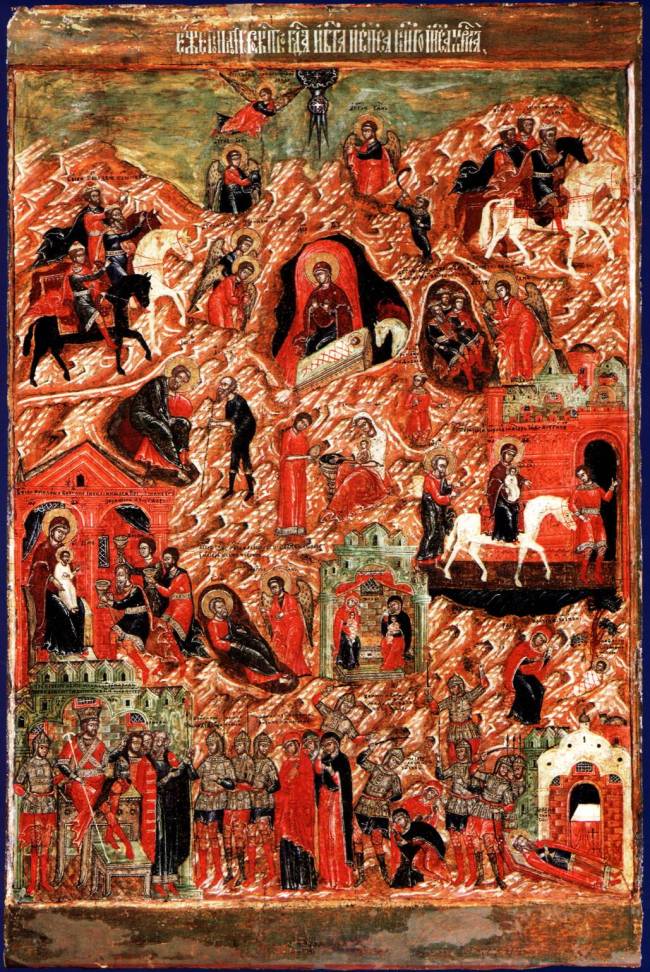
The third difference between the Orthodox icon of the Nativity and Western art is that the icon depicts as a composite image six difference scenes of the Nativity narrative surrounding the Infant Christ-child and His Mother. Western art usually depicts these scenes separately or in smaller groupings of two or three. Here are the six scenes:

  • At the top of the icon, on both sides of the mountain, are found two groupings of angels who often are looking downwards, sometimes to the side or upwards. They serve a two-fold role. First, they are the messengers of the spiritual world bringing glad tidings to mankind and secondly, they are the true adorers of Christ’s birth, the “marvel of marvels”. The angelic hosts as such unite heaven and earth and together glorify the “new born King”. The angel of the Lord, found on the top extreme right-hand side of the icon, is depicted looking down upon an amazed shepherd, announcing to him the good news of great joy.
  • A single shepherd or sometimes several are found on the right-hand middle side of the icon. These are the first of the Israelite people – the Jewish people, to accept and worship the Lord. These shepherds are simple, unsophisticated and ordinary citizens who hear the divine message in the course of their labours and fully accept the Virgin birth. In fact the shepherds are akin to the simple fishermen that Christ will call in the Gospels “to follow Him”.
  • On the opposite side, the left-hand side of the icon are found three figures of the Magi or wise men. They are depicted following the star, shining above the cave, and bringing their royal gifts to a Babe in a poor cave. The wise men represent the humanity that has not been exposed to the Old Testament – often referred to as the Gentiles. Yet they have a mission to find the “King of Kings” and have travelled far for this event. Their search reaches an end, “following the star of Bethlehem”, and they accept of the Son of Righteousness without hesitation. The three wise men are usually depicted in three different age brackets. The one of the extreme left is very young, the middle one is middle-aged and the one on the right is an elderly person. Thus all ages of humanity are called to accept Christ. The wise men were the first fruits of the Gentile world to venerate and worship Christ. In so doing they show that the ultimate sense of human knowledge is in the contemplation and worship of a Living God, “born unto us as a young Child”.
  • Below, on the left-hand side, is the scene of Joseph and the tempter (already discussed earlier).
  • On the lower right-hand side is depicted an important bathing scene. The origin of this scene is not Scriptural or apocryphal. The first mention of the bathing of Christ was made in the travelogue of a late seventh century pilgrim to Palestine, a certain bishop Arnulf. He relates that close to the Nativity cave in Bethlehem, he was shown a stone water basin which was believed to be the one in which the Divine Child had been washed after birth. Early art depictions of the bathing scene are found from as early as the fifth century. This bathing scene illustrates that Christ was truly a human being and had the fullness of human nature while at the same time he also had a divine nature and was the second person of the Trinity. Every young child has to be bathed, washed and cleaned, upon entrance into this world and Jesus was no different. This scene also serves as an argument against those heretics that did not want to acknowledge Christ’s full humanity and placed only emphasis on his divinity (At the IV Ecumenical Council this heresy, know as Monophysitism, was defeated). Thus the two bottom scenes complement each other, showing both the theological teaching of Christ’s full divinity (the pondering of Joseph of the miracle birth-incarnation of God, the second person of the Trinity – Jesus Christ) and His full humanity (the important bathing scene). Christ as such is truly GODMAN – in Ukrainian Bohocholovik, a term coined at the IV Ecumenical Council in 451.
  • The scene at the top center of the icon depicts the three divine rays of the triune God. In so showing this, the icon depicts that the Trinity – Father, the pre-eternal Son and Holy Spirit are at the heart of the event. The Incarnation is not only about the birth of the Son, but also involves the other two members of the Trinity because all three are of one and the same essence (the Greek word for this is “Homoousios”). In another way the rays are referred to also as the divine star of Bethlehem that shone and provided the direction for all the players of the Incarnation event. The divine light thus provides a canopy for the infant birth of the Saviour and lightens the universe for the proper understanding of the truth – that God became man so that man can become potentially God-like.

nativity3

The icon of the Nativity thereby harmonizes six separate scenes of the festal narrative. Their depiction produces a balanced and well organized theology of the Nativity feast. This icon, except for the bottom part, is truly a pictorial illustration of the KONTAKION (liturgical hymn) of the feast written by St. Romanos the Melodist which proclaims:

“Today the Virgin gives birth to Him Who is above

all being and the earth offers a cave to Him whom

no man can approach. Angels with shepherds give

glory and Magi journey with a star. For unto us

is born a young Child, the pre-eternal God.”

In conclusion, the icon of the Nativity, with its richness and theological content, relates the various scenes of the Incarnation narrative, overcoming both time and space limitations. Just as in the Orthodox liturgy we overcome linear time and space, so also the Nativity icon, as an integral part of the festal cycle, overcomes these limitations. In turn, the various scenes in the icon form an integrated and holistic unity to be contemplated and venerated in the ever present.

Jesus Christ as the Lord of Creation, entered the life of His creation and the life of human history as a newborn babe. He submits himself to the physical conditions and laws that govern the human race yet in his humbleness he continues to be the Saviour and the second person of the Trinity. (1)

nativity2

The very fact that in a single icon different scenes of the Nativity narrative coexist, although their historic, real time differs, such as Christ in the manger and at the same time in the stone water basin, or the Magi following the star, shining above the cave, and simultaneously offering their royal gifts to a Babe in a poor cave highlights the fact that time and space limitations are transcended when the Saviour and Lord of Creation enters the life of His creation and the life of human history, kairos in other words supplants chronos. (2)  And this is the real, mystical meaning of the kontakion “Today the Virgin gives birth to Him …” because the faithful may indeed literally participate in the Mystery of Incarnation in the liturgical “Now” and that very moment, in Church, Christ may be born in their hearts. (3)

nativity1.jpg

(*) Kairos Vs. Chronos: … When Jesus came, it was a fulfillment of promises past, a cosmic collision of the sacred and secular. It was an intersection of the holy will of God and the stubborn ways of man. It was a perfect moment.  John the Baptist said in Mark 1:15 that “time is fulfilled, and the kingdom of God is at hand.” This godly kairos pierced its way into creation at just the right time, slicing through chronos with a cry of a baby in a manger. The cross was another kairos moment. Romans 5:6 says, “For while we were still helpless, at the right time, Christ died for the ungodly.” Kairos moments then—and now—allow us to get a glimpse of the “other side.” We peek around the corner at eternity. We actually glimpse how God works. (3)

free-decorative-line-divider-clip-art-582650

(1)  http://www.uocc.ca/en-ca/about/education/nativity-icon.asp The Orthodox Icon of the Nativity of Our Lord And Saviour Jesus Christ, Dr. Roman Yereniuk, Associate Professor, St. Andrew’s College in Winnipeg.

(2) From “Living a Kairos Life in a Chronos World” http://www.thehighcalling.org/articles/essay/living-kairos-life-chronos-world

(3) Sophia Drekou’s insights and selection of icons and paintings at http://sophia-siglitiki.blogspot.gr/2013/12/blog-post_1453.html proved very stimulating.


I Shall Not Live In Vain
“Songs of Earth & Sky” Bill Douglas’ Album
Based on poems by Emily Dickinson and William Blake

“The words are a beautiful expression of compassion by Emily Dickinson (first verse) and William Blake (second verse).”

I Shall Not Live In Vain

If I can stop one heart from breaking,
I shall not live in vain.
If I can ease one life the aching,
Or cool one pain,
Or help one fainting robin
Unto his nest again –
I shall not live in vain.

Love seeketh not
Itself to please,
Nor for itself hath any care;
But for another gives its ease,
And builds a Heaven in Hell’s despair**

If I can stop one heart from breaking
I shall not live in vain
If I can ease one life the aching
Or cool one pain
Or help one fainting robin
Unto his nest again
I shall not live in vain


“Christ’s Nativity” by John Milton and Wiliam Blake

A few decades prior to writing his famous epic, Paradise LostJohn Milton composed this thirty-one-stanza ode—his first major work in English. Written in 1629 when he was just 21, the poem examines the cosmic significance of the incarnation, celebrating Christ’s triumph over the gods of paganism from the manger.

Regarding the poem’s composition, Milton wrote to his friend Charles Diodati,

I am singing the King of Heaven, bringer of peace, and the fortunate days promised by the Holy Book, the wanderings of God and the stabling under a poor roof of Him who rules with his Father the realms above; the star that led the wizards, the hymning of angels in the air and the gods flying to theirendangered fanes. This poem I made as a birthday gift for Christ; the first light of Christmas dawn brought me the theme.” (qtd. by Walter Taylor Field, 1907)

Between 1803 and 1815, visionary poet and visual artist William Blake painted on commission two sets of watercolors to illustrate the poem—one for the Rev. Joseph Thomas (the “Thomas set”), and one for Thomas Butts (the “Butts set”). Each set contains six watercolors which are very similar to one another, though not identical. The list of illustrations is as follows. (You’ll notice that not all the stanzas are illustrated.)

  1. The Descent of Peace (stanzas 1-3)
  2. The Annunciation to the Shepherds (stanzas 8-12)
  3. The Old Dragon (stanza 18)
  4. The Overthrow of Apollo and the Pagan Gods (stanzas 19-23)
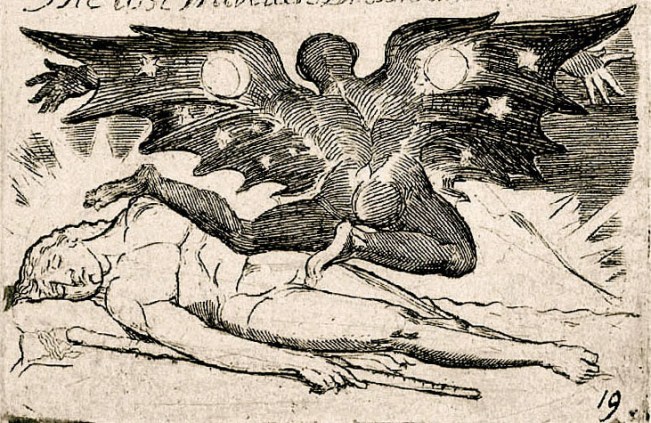
  5. The Flight of Moloch (stanza 23)
  6. The Night of Peace (stanza 27)


“On the Morning of Christ’s Nativity”

THE HYMN

I.
It was the winter wild,
While the heaven-born child
All meanly wrapt in the rude manger lies;
Nature, in awe to him,
Had doffed her gaudy trim,
With her great Master so to sympathize:
It was no season then for her
To wanton with the Sun, her lusty Paramour.

II.
Only with speeches fair
She woos the gentle air
To hide her guilty front with innocent snow,
And on her naked shame,
Pollute with sinful blame,
The saintly veil of maiden white to throw;
Confounded, that her Maker’s eyes
Should look so near upon her foul deformities.

III.
But he, her fears to cease,
Sent down the meek-eyed Peace:
She, crowned with olive green, came softly sliding
Down through the turning sphere,
His ready Harbinger,
With turtle wing the amorous clouds dividing;
And, waving wide her myrtle wand,
She strikes a universal peace through sea and land.

Blake nativity

The Descent of Peace (stanzas 1-3)

William Blake, “The Descent of Peace” (Thomas set), 1809. Watercolor on paper, 19.4 x 25.5 cm. Whitworth Art Gallery, Manchester, England. Description: Peace breaks through the heavenly spheres, dispersing the clouds and waving her myrtle wand, while Nature (below) covers her nakedness with a snowy veil as she pays reverence to her Lord.

VIII.
The Shepherds on the lawn,
Or ere the point of dawn,
Sat simply chatting in a rustic row;
Full little thought they than
That the mighty Pan1
Was kindly come to live with them below:
Perhaps their loves, or else their sheep,
Was all that did their silly thoughts so busy keep.

IX.
When such music sweet
Their hearts and ears did greet
As never was by mortal finger strook,
Divinely-warbled voice
Answering the stringèd noise,
As all their souls in blissful rapture took:
The air, such pleasure loth to lose,
With thousand echoes still prolongs each heavenly close.

X.
Nature, that heard such sound
Beneath the hollow round
Of Cynthia’s seat2 the airy Region thrilling,
Now was almost won
To think her part was done,
And that her reign had here its last fulfilling:
She knew such harmony alone
Could hold all Heaven and Earth in happier union.

XI.
At last surrounds their sight
A globe of circular light,
That with long beams the shamefaced Night arrayed;
The helmèd Cherubim
And sworded Seraphim
Are seen in glittering ranks with wings displayed,
Harping in loud and solemn quire,
With unexpressive3 notes, to Heaven’s newborn Heir.

XII.
Such music (as ’tis said)
Before was never made,
But when of old the Sons of Morning sung,
While the Creator great
His constellations set,
And the well-balanced World on hinges hung,
And cast the dark foundations deep,
And bid the weltering waves their oozy channel keep.

William Blake, "The Annunciation to the Shepherds," 1809. Watercolor on paper, 19.3 x 25.5 cm. Whitworth Art Gallery, Manchester, England. The Annunciation to the Shepherds (stanzas 8-12)

William Blake, “The Annunciation to the Shepherds” (Thomas set), 1809. Watercolor on paper, 19.3 x 25.5 cm. Whitworth Art Gallery, Manchester, England.

XVIII.
And then at last our bliss
Full and perfect is,
But now begins; for from this happy day
The Old Dragon under ground,
In straiter limits bound,
Not half so far casts his usurpèd sway,
And, wroth to see his Kingdom fail,
Swindges6 the scaly horror of his folded tail.

The Old Dragon by William Blake

William Blake, “The Old Dragon” (Thomas set), 1809. Watercolor on paper, 19.3 x 25.3 cm. Whitworth Art Gallery, Manchester, England.

blake7

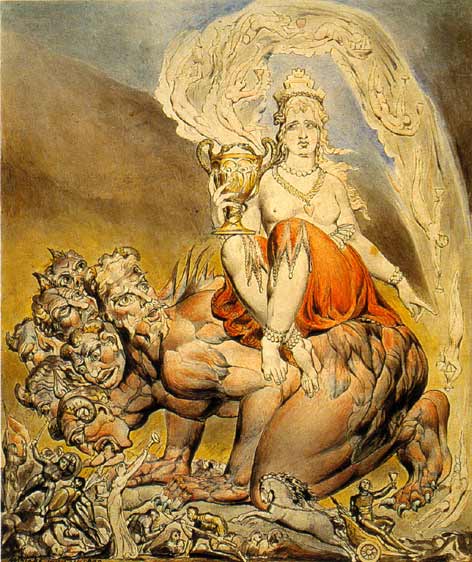
The Beast and the Whore of Babylon, elsewhere associated with institutionalized religion by Blake, are here overthrown along with Satan

The Overthrow of Apollo by William BlakeThe Overthrow of Apollo and the Pagan Gods (stanzas 19-23)
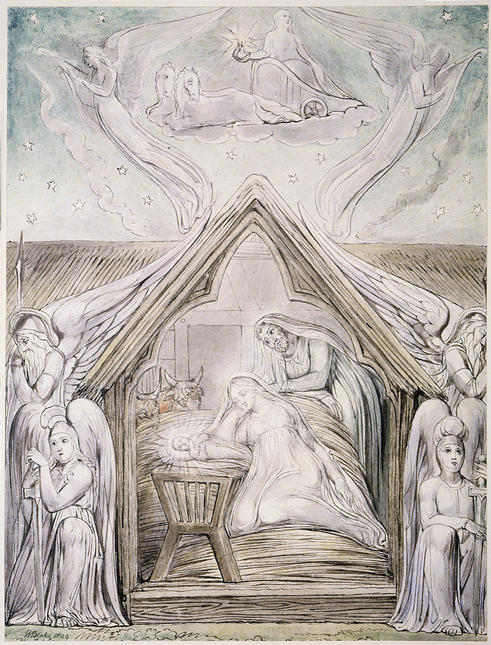
William Blake, “The Overthrow of Apollo and the Pagan Gods” (Thomas set), 1809. Watercolor on paper, 19.3 x 25 cm. Whitworth Art Gallery, Manchester, England. Description: Pagan worshipers burn an offering to Apollo as his spirit flees its statue in fear. (The statue depicts Apollo’s defeat of the giant serpent Python, who had tormented his mother during her pregnancy.) To the right, a disheveled Nymph hides in a thicket to mourn, while above her, a train of refugee gods and goddesses fills the sky.

XIX.
The Oracles are dumb;
No voice or hideous hum
Runs through the archèd roof in words deceiving.
Apollo from his shrine
Can no more divine,
Will hollow shriek the steep of Delphos1 leaving.
No nightly trance, or breathèd spell,
Inspires the pale-eyed Priest from the prophetic cell.

XX.
The lonely mountains o’er,
And the resounding shore,
A voice of weeping heard and loud lament;
Edgèd with poplar pale,
From haunted spring, and dale
The parting Genius2 is with sighing sent;
With flower-inwoven tresses torn
The Nymphs in twilight shade of tangled thickets mourn.

XXI.
In consecrated earth,
And on the holy hearth,
The Lars3 and Lemures4 moan with midnight plaint;
In urns, and altars round,
A drear and dying sound
Affrights the Flamens5 at their service quaint;
And the chill marble seems to sweat,
While each peculiar power forgoes his wonted seat.

XXII.
Peor and Baalim6
Forsake their temples dim,
With that twice-battered god of Palestine;7
And moonèd Ashtaroth,8
Heaven’s Queen and Mother both,
Now sits not girt with tapers’ holy shine:
The Libyc Hammon9 shrinks his horn;
In vain the Tyrian maids their wounded Thammuz10 mourn.

XXIII.
And sullen Moloch,11 fled,
Hath left in shadows dread
His burning idol all of blackest hue;
In vain with cymbals’ ring
They call the grisly king,
In dismal dance about the furnace blue;
The brutish gods of Nile as fast,
Isis,12 and Orus,13 and the dog Anubis,14 haste.

The Flight of Moloch by William Blake

The Flight of Moloch (stanza 23)

William Blake, “The Flight of Moloch” (Thomas set), 1809. Watercolor on paper, 19.7 x 25.7 cm. Whitworth Art Gallery, Manchester, England. Description: Worshipers of Moloch clang together cymbals and blow on trumpets as part of their infant sacrifice ritual. As they do, Moloch’s winged spirit departs from the molded image. The advent of his enemy, Jesus, has scared him away.

blake8

The winged figure of the accuser, so like the spirit of Moloch, cements that god’s identification with Blake’s Spectre

XXVII

But see the Virgin blest,
Hath laid her Babe to rest.
Time is our tedious Song should here have ending,
Heav’ns youngest-teemed Star [ 240 ]
Hath fixt her polisht Car,
Her sleeping Lord with Handmaid Lamp attending.
And all about the Courtly Stable,
Bright-harnest Angels sit in order serviceable.

blake6The Night of Peace (stanza 27)

Posted on December 14, 2012by Victoria Emily Jones

Also see “Winged Life” at https://orthodoxcityhermit.com/2015/09/12/william-blakes-mystic-visions-stunning-paintings/


The Womb and the Tomb


Icon of the Nativity compared with the Icon of the Resurrection

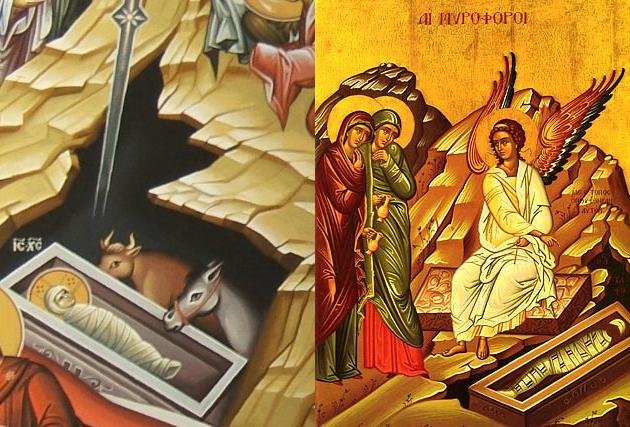
Left: Christ in the manger; Right: the Empty Tomb

No description of the Nativity Icon would be complete without mention of Jesus’ appearance in the manger.

It should be never forgotten that Jesus came to us in order to die – this was known by Him, at least, from the very beginning. Therefore, in Iconography, the manger in the Nativity Icon deliberately resembles a stone coffin, the swaddling clothes resemble a burial shroud, and the cave itself can even be said to prefigure Christ’s tomb.

With the side-by-side comparison shown above of the Icon of the Nativity with the Icon showing the Myrrh-bearing women discovering Jesus’ empty tomb, no more words are necessary. (1)

The Passion of Nativity

… Let us look more closely at the child in the relief.  “His tight swaddling clothes are evocative of burial wrappings.  In the byzantine tradition, there is an intentional connection between the swaddling clothes of the infant in a Nativity icon and the burial clothes of the Epitaphios (epi– upon; taphos- grave or tomb) icon which is venerated and anointed during Great Friday Vespers.  Also on Great Friday, the “soma” icon on the crucifix is taken down from the cross and shrouded in identical wrappings before it is processed and reposed in the sanctuary.”

nativity1

“…Note, as well, that the “manger” is a cave, a small hollow in a rock formation that mirrors Jesus’ tomb in the gospels.  In many icons, Jesus’ cradle is a stone box.  Who would lay a child in a coffin? What macabre motive would make an artist paint a baby as a mummy and give him a tomb as his nursery?  Indeed, the motive is not macabre, but joyful and eschatologically triumphant: we only understand the significance of the incarnation if we hold it in tension with Jesus’ saving death; we may not separate the two.  This also reminds us that the liturgical year commemorates events in the life of Jesus but it never parses the paschal mystery.”

nativity18

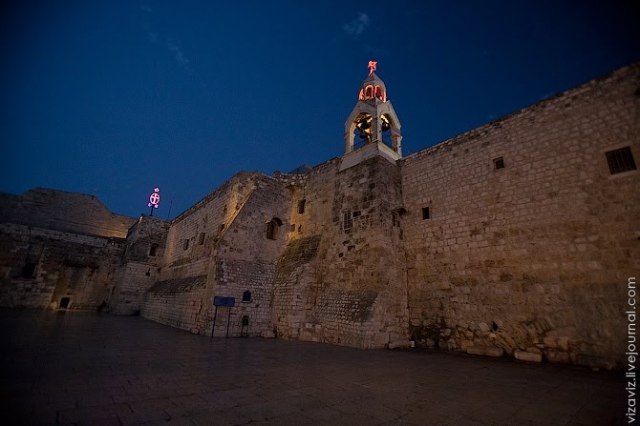
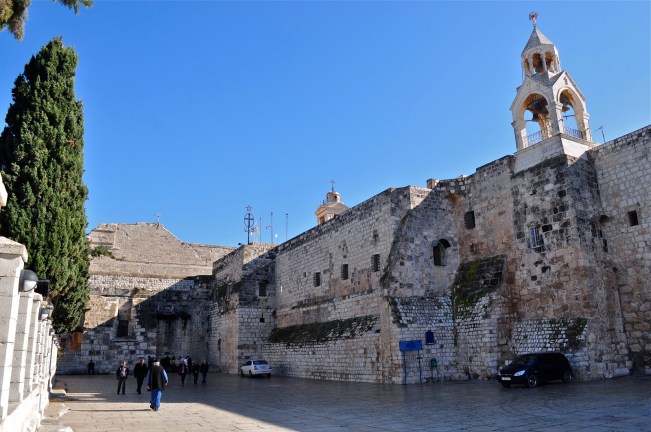
Basilica of the Nativity in Bethlehem 

The Church of the Nativity in Bethlehem is one of the oldest continuously operating churches in the world, and the oldest in the Holy Land (founded in 325)

nativity15.jpg


A virgin womb, conceiving thee, revealed thee;
a virgin tomb, receiving thee, concealed thee.

We glorify her from whom thou didst receive a beginning in time,
and we honour him that ministered to the end of thine earthly life for our sakes,
asking that through their prayers, O merciful Saviour,
we might be deemed worthy of thy Kingdom of the Heavens.

Theotokion on the Praises for the Feast of St. Joseph of Arimathea
Appendix to the July Menaion, Holy Transfiguration Monastery


nativity12

Church Of The Nativity Bethlehem Stable

All the eschatological themes of the Advent season converge in the Nativity tableau and are carried forward into Christmas.  This should not surprise us.  The birth of Christ and his salvific death form the cosmic fulcrum upon which the beam of human history rests, with creation and eschaton at each end.  In a nativity icon this is super concentrated.  Incarnation and eschaton are so ingeniously and inextricably intertwined that we might not even read “passion” in what is written in the icon unless we understand the symbolic significance of the iconographic elements.  The best known example of this is the gifts of the wise men: while gold and frankincense represent Jesus’ kingship and priesthood, respectively, myrrh, used for embalming, is a symbol of his death.

nativity10


When I look at a Nativity icon and I see a child embraced by death, and embracing death, I have at least an inkling of what Rilke was, perhaps, trying to convey in the first Duino Elegy:

“For beauty is nothing but the beginning of terror, which we are still just able to endure, and we are so awed because it serenely disdains to annihilate us.” (2)


(1) Posted on by 

(2) Posted at https://memoriadei.wordpress.com/2010/12/17/the-ox-the-ass-and-the-passion-of-the-nativity/