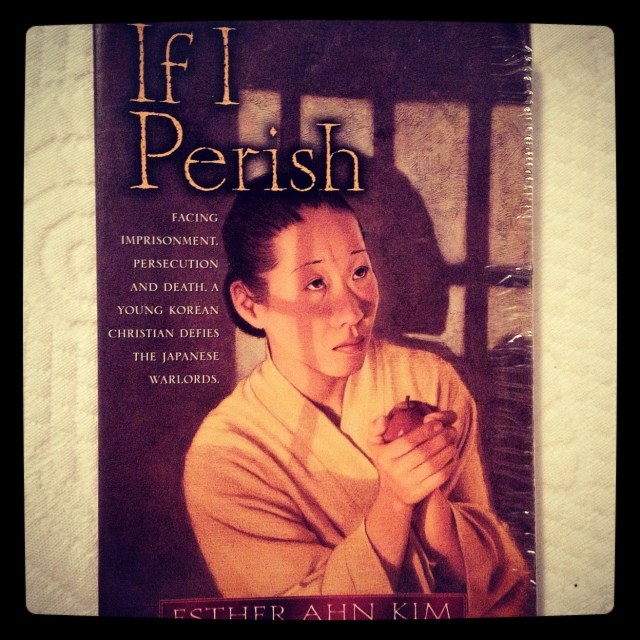
If I Perish

if I perish.jpg

Esther Ahn Kim

If I Perish

Korea 1929

Esther Ahn Kim walked slowly up the hill to the shrine, with her students following silently behind her. The young teacher knew that when she arrived at the place of worship she would be forced to make a life-altering choice. The Japanese, who had taken control of Korea, were forcing everyone to bow at the shrine of their “sun god.” The punishment for refusing was imprisonment, torture and possibly even death. Fearing for their lives, many Christians had already given in to the Japanese soldier’s demands. And now it was Esther’s turn to make her decision. She fixed her eyes on the vast sky beyond the hills and thought of Shadrach, Meshach, and Abed-nego, when they were commanded to bow to the statue of the Babylonian king, Nebuchadnezzar. The three young men had decided that even if God did not choose to save them from the burning fire, they would die honoring Him.

At that moment, Esther knew what she would do. Even though so many other Christians had decided that outwardly bowing to the idol was acceptable as long as they continued to worship Christ in their hearts, Esther could make no such compromise. She would not bow to any other but the one true God. Defying the Japanese warlords would most likely mean torture and imprisonment, but Esther decided that she would not live her youthful life for herself. She would offer it fully to her Prince, Jesus Christ. She said a silent prayer to Him. Today on the mountain, before the large crowd, I will proclaim that there is no other god but You, she declared.

christian persecution orthodox city hermit

Esther’s group was the last to arrive at the shrine. A huge crowd had gathered, standing in straight, respectful lines, afraid to move because of the cruel gazes of the Japanese policemen. A few of the authorities eyed Esther and her students with disapproval as they joined the rest of the worshipers. Esther’s heart began to pound with dread for what she was about to do. A sense of uneasiness swept over her, and she silently repeated the Lord’s Prayer over and over. Lord, she prayed, I am so weak! Please help me do this— watch over me as I stand for You.

“Attention!” came the commanding voice of one of the officials. The crowd stood in silence and submission. “Our profoundest bow to Amaterasu Omikami!” As he shouted the words, the entire group bent the upper half of their bodies, bowing solemnly before the shrine. Esther was the only one who remained standing, looking up at the sky. The fear and uncertainty that had gripped her just moments before had vanished. Calmness and peace flooded her. She had done what she knew God wanted her to do. On the long walk back to the school, Esther continued her dialogue with God. I have done what I should have done, she told Him. Now, I commit the rest to You. I died today on that mountain—now it is only You who lives through me. I leave everything in Your hands.

For several months, Esther lived in hiding. She knew it was only a matter of time before she was found and imprisoned for the stand that she had taken against the Japanese. But instead of cowering in fear and worry about what her future held, she decided to prepare her heart and her body to suffer for Christ. Just as Paul said, “I buffet my body and make it my servant,” (1 Cor 9:27) Esther decided to train for prison life, just as an athlete might train for competitive sports. She counted it a great honor to suffer for Christ, but she also knew she was weak and unready for all that lay ahead.

If I Perish

“I knew it would be impossible for me to keep my faith in my own power,” Esther wrote later. “God would have to work through me if I was to stand firm. I decided to fast.” Many times before, Esther had fasted for three days without difficulty. Now, she was determined to go without food or drink while she prayed for an entire week. The fast was extremely difficult. By the sixth and seventh day Esther’s lips were dry and her chest was in an iron vise, causing her to fight to breathe. But when the fast was finally over and water was poured into her mouth, she raised her hands in victory, thanking God for being with her.

“Although I had not expected it, after the fast I was able to understand the Scriptures better and I felt a new power in my prayer. Now I felt I could leave the fear of torture in the Lord’s hands.”

More time went by and more fearful news of prison life reached Esther’s ears. As anxiety crept back in, she fasted once more – this time for ten days.

“Again I found a peace I had never known before,” she wrote. “I read the Bible earnestly and had a new concern to memorize important chapters against the day when I would be in prison without my Bible.”

Esther also began sleeping on the floor, learning to live in a state of poverty, and going without all the comforts she had grown up with, so that she would be prepared for the harsh conditions of prison. When she went to the market to buy produce, she bought ripe fruit for her family members but rotten fruit for herself. When her mother and sister saw the decaying food she selected for herself, they cried, but soon they understood. This was the kind of food Esther would be forced to eat in prison.

Months of faithful, diligent preparation—fasting, memorizing Scripture, tirelessly praying, and training to endure harsh conditions – transformed Esther from a weak, frail, faltering young woman to a bold and confident ambassador for Christ. Instead of fearing torture, she now faced it boldly in the power and grace of God.

Esther felt God calling her to come out of hiding and boldly proclaim the truth of the Gospel among the Japanese. She knew that this would likely lead to her death, but she was determined to follow the Lamb wherever He led her.

Her courageous stand for Christ led to six harrowing years in Japanese prisons. During that time, though her body grew week with suffering, she shone with supernatural love toward her persecutors and fellow prisoners. Even through torture, she refused to deny the name of Christ. Her astounding example of “suffering hardship as a good solider for Christ” brought many into the Kingdom who would never have heard the Gospel otherwise. After she was released, the story of her imprisonment and unwavering faith became the all-time religious bestseller in Korea, inspiring countless thousands to stand strong in their faith.

If I perish Taking up our Cross orthodox city hermit

Gleaning From Esther’s Example

Modern Christianity often encourages us to chase after achievements and accolades; to develop skills and pursue accomplishments that will be applauded and esteemed by this world. Some even go so far as to say that the more impressive we are to pop-culture, the greater our witness for Christ will be. The hip, trendy, pop-culture style of many modern worship services illustrate how far we have come from the days of the apostles, when Paul proclaimed, “If I must boast, I will boast in the things which concern my infirmity.” (2 Cor. 11:20)

Though Paul had plenty of human skills and achievements he could have emphasized or built upon, he chose to treat those things as “rubbish.” (Phil 3:8) His greatest accomplishments; his most powerful witness, came from the incredible suffering he endured for Christ’s sake: “Three times I was beaten with rods; once I was stoned; three times I was shipwrecked; a night and a day I have been in the deep; in journeys often, in perils of waters, in perils of robbers, in perils of my own countrymen, in perils of the Gentiles, in perils in the city, in perils in the wilderness, in perils in the sea, in perils among false brethren; in weariness and toil, in sleeplessness often, in hunger and thirst, in fastings often, in cold and nakedness…” (2 Cor. 11:27-29).

And so it was in the life of Esther Ahn Kim. It wasn’t her accomplishments, personality, money, or skills that caused the nation of Korea to be forever changed. It was her shining example of suffering for Christ’s sake.

One time in prison, her arms were handcuffed behind her back for days until she passed out from the relentless pain. The intent was to torture her until she finally denied Christ. But even though her mind and body were broken, her spirit remained strong, rooted and grounded in Truth. She would not relent, no matter how horrible the pain became. She emerged from the torture victorious in her faith.

Another time, she gave up her meager prison food for several days to a woman who was filthy, insane, and sentenced to death for murdering her husband. Instead of being repulsed by the woman as all the other prisoners were, Esther prayed relentlessly for her, sacrificing her own comforts to reach the woman’s heart. The woman died in her right mind, knowing Jesus Christ, with a hope and a future.

Such sacrifice and personal suffering for Christ’s sake is only possible through the supernatural grace of God. Only one who has truly given up everything to follow Jesus can exude such grace in the face of such hardship.

Esther’s story challenges me to ask the question – am I prepared to suffer for Jesus Christ? In the midst of our comfortable … lifestyles, it’s easy to think, “Of course, if persecution came, I would never deny the name of Christ. Of course if I were thrown into prison, I’d remain strong in my faith.”

But we must ask ourselves – are we truly “dying to self” daily, as Esther did, or are we more concerned with protecting our own comforts and interests than in consecrating our lives fully to Jesus Christ? The only way to be a true follower of Christ is to willingly give up everything; to take up our cross and follow Him (Matt. 10:38, Lk. 9:23).

… We will never gain Esther Ahn Kim’s version of supernatural boldness and sacrificial love by coddling our own self interests and protecting our own comforts. … We are not walking the narrow way of the cross anymore. We are merely living selfish lives with a “Christian label” over them.

Esther Ahn Kim counted the cost of following Jesus – not only on the day when she refused to bow at the shrine, but every day thereafter. She counted the cost when she willingly and gladly gave up comforts and trained her body to endure hardship for the sake of Christ. She counted the cost when she came out of hiding and boldly proclaimed the Gospel among the Japanese who had the power to torture and kill her. She counted the cost when, in prison, she endured horrible misery rather than deny her faith in Christ. She counted the cost when she sacficially loved a filthy, repulsive woman and gave of what little she had in order to win her to Christ. Esther’s life was no longer her own—and every outward decision she made reflected that inner reality. If you desire to do “big things” for God—ask yourself today whether you have truly counted the cost of following Christ.

Many of us think that in order to prepare for an effective ministry, we must gain a large following, write a book, gain worldly accolades, or make a lot of money. But the best way to prepare for a world-changing ministry is to ‘die’ – so that Christ may live through us. Remember that Paul had every reason to boast in his earthly accomplishments, and yet he threw them aside as worthless and counted his suffering for Christ’s sake as his greatest, most important acheivments. (See 2 Cor. 11:30 and Phil. 3:8.)

When self is at the center of our lives, the only impact we will have on this world will be shallow and human-scripted rather than eternal and God-scripted. We may make a temporary splash, but if we do not take up our cross and truly follow Him, we will never reflect the supernatural radiance and grace of Heaven.

If I perish Taking up our Cross orthodox city hermit

Taking up our Cross

… It may take a few days, weeks, or months for those old habits to fully die. But if you allow Him to re-train your daily decisions and enable you to “deny yourself, pick up your Cross, and follow Him” you will soon understand from firsthand experience what Paul meant when he said, “it is no longer I who live, but Christ who lives in me.” (Gal 2:20)

This world needs more young women like Esther Ahn Kim—young women who unreservedly take up their cross and follow Him, no matter what the cost. May it be our greatest desire to follow such a path, and joyfully suffer any hardship for the One who gave everything to us. The world will never be the same when they encounter such a life.

*Story of Esther Ahn Kim taken from If I Perish by Esther Ahn Kim

Suzana Monastery Retreat I


SONY DSC


Part A: How the little city hermit became a bird, a fountain, a tree and a pearl!


Deep peace of Christ, silence, hesychia, these are the words that come to my mind when I remember Suzana monastery and my three-day retreat there this summer. Also, self-emptying, kenosis. But above all, silence!


Only through poetry can such silence be conveyed, so I will paraphrase a favourite poet of mine, Rumi, to convey to you what I experienced here.


I had begged the Wise One to tell me
 the secret of my existence, my calling in this world.
 Gently, gently, He whispered at Suzana monastery “Be quiet,
the secret cannot be spoken,
 It is wrapped in silence.”


I ground myself, strip myself down, to this overpowering Silence. I feel spiraling into a void of silence where a hundred voices thundered messages I longed to hear.


At its unfathomable bottom I encounter a vast fullness, the Spark of LIFE and LOVE, a secret passage to the WAY which wandering talk blocks, a dimension where HE was waiting for me, for my soul to shake.


I was carrying so much baggage while seeking the signs of the Way.


But at Suzana* monastery, I am ‘forced’ to stop, open up, surrender to this thundering silence, be invaded by ‘It’, and 
stay there until I Saw, until I looked at this blinding Light 
with infinite eyes.


This overpowering Silence kidnaps me to the core of Life. There is a sacredness in it. Silence is indeed the language of God, and all else is poor translation.


This is exactly what I experience when I am trying to write a poem, how I feel especially when I finish a poem. A great silence overcomes me and I wonder why I ever thought to use language.

suzana6

Silence is indeed the sea, and speech is like the river. The sea is seeking you: don’t seek or walk into the river. Don’t turn your head away from the signs offered by the sea. Listen to the ocean.


The sound of Waters and the sound of Silence is a motif in Suzana monastery. At least for me. Everywhere the sound of waters reaches you, so overwhelmingly that I often feel the need to stay in my ‘cell’ and not even venture out.


Just listening to that sound was so overwhelming! The very moment I set my foot on this monastery, the sound of Living waters immobilized me, an ocean wave, a mighty river in flood, a cascading waterfall, a fountain of benediction, a Life- Giving spring, welling up to Eternity.


Isaiah 43:19

19 Behold, I will do a new thing,
Now it shall spring forth;
Shall you not know it?
I will even make a road in the wilderness
And rivers in the desert.


John 7:38

38 He who believes in Me, as the Scripture has said, out of his heart will flow rivers of living water.”


Kenosis is also another state I suffered there:

“And they shall build the old wastes,

they shall raise up the former desolations,

and they shall repair the waste cities,

the desolations of many generations.” (Isaiah 61:4)


I needed so desperately such ‘Decluttering’ in my life, a Relentless Focus, a Subtraction, Becoming ‘poor’, an Unburdening, a Curtail, a Reduction and Emptying, Until my rebellious bones sore.


suzana1

This silence, this moment, every moment, this silence brought all what I needed. I sat quietly, and listened for a voice which told me ‘Be more silent.’ ‘Die’ and be quiet. Maybe quietness is the surest sign that you’ve ‘died’. My old life was such a frantic running from silence. Suzana monastery moved me, even for a little, outside the tangle of fear-thinking.


In the end, I became a pearl!


“And since I have wandered in thee, pearl,

I will gather up my mind

And by having contemplated thee,

Would become like thee,

In that thou art all gathered up into thyself;

And as thou in all times art one,

One let me become by thee!” (St Ephraim, The Pearl)


This very old, poor, secluded, fairy-tale monastery, surrounded by forests, mountains and springs, and steeped in holiness, is most certainly God’s special Providence for my tired, exhausted self.


I feels like coiling in a virginal womb, unwinding time, beholding


“The memory of the glory that I had when I was entirely with You and entirely in You, before time and temporal illusions.


When I, too, was a harmonious trinity in holy unity, just as You are from eternity to eternity.


When the soul within me was also in friendship with consciousness and life.


When my soul also was a virginal womb, and my consciousness was wisdom in virginity, and my life was spiritual power and holiness.


When I, too, was all light, and when there was no darkness within me.


When I, too, was bliss and peace, and when there were no torments of imbalance within me.


When I also knew You, even as You know me, and when I was not mingled with darkness.


When I, too, had no boundaries, no neighbors, no partitions between “me” and “you.” (St. Nikolai Velimirovich, Memories – Prayers By the Lake XXX)


Even the very fact that I cannot not speak Romanian, just barely understand it, is an added blessing, an extra ‘precaution’, a ‘just in case’ … Speaking all too often impoverishes, drenches us. As St. Seraphim of Sarov wisely urges us, “Keep away from the spilling of speech”.


Hesychia, Deep peace of Christ wrapped me in green leaves like a tree;

I breathed like a tree in the quiet light!


* Suzana Monastery is a Romanian monastery about 5.5 to 6 hours away from Rasca monastery in Bucovine, North Moldavia, where Fr. Seraphim Aldea was tonsured as a monk in 2005. After my retreat here I have a slightly better, more ‘intimate’ understanding of ‘Romanian’ Orthodoxy and Fr. Seraphim’s calling to found the first Orthodox monastery, Mull monastery, in the Hebrides in over a millennium. In a sense only a Romanian hieromonk would be really equipped, spiritually, emotionally, as well as intellectually, to undertake such a huge task! Glory to God for everything!


Continue to Part II

St. Paisios the Athonite

Icons, Photographs and Video on his feast day

a1a2

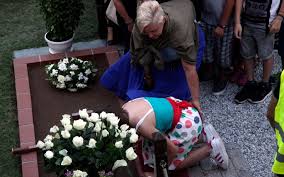
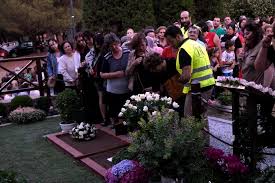
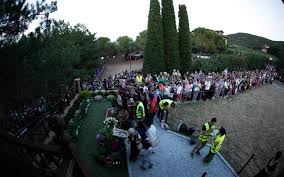
I may be on a pilgrimage in Romanian monasteries, but St Paisios’ the Athonite, my patron Saint‘s, presence is strongly felt all over Romania. Plenty of icons of his and books with his services and spiritual counsels in all monasteries and churches I have been so far! I truly regret having to leave this week of all weeks Greece, but thanks be to God, while this was going on inside Souroti monastery church on July 12, and this outside the church, near his tomb

a3

Much longer queues than in 2013 … every year longer! The Lord is glorified in His saints!


the faithful all over in Romania were holding Vigils and praying Akathists and Supplication canons, asking for his prayers.

Wherever I go, the moment Romanians realise that I am Greek and my home town is near Souroti, they start asking for my telephone number and email, so that I can make arrangements and help them go and venerate his tomb.


Just in case you missed it, this is a beautiful documentary (in Russian with English subtitles) about the life of St. Paisios the Athonite and his years spent on Mount Sinai in Egypt.

And another one:

And yet another one by the Patriarchate of Moscow (a film documentary of six episodes with total duration of 5 hours on the holy life and work of Saint Paisius of Mount Athos):

Romanian Monasteries Pilgrimage —Suzana Monastery

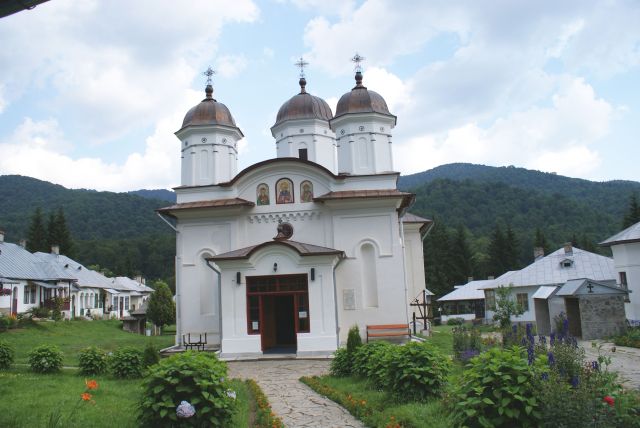
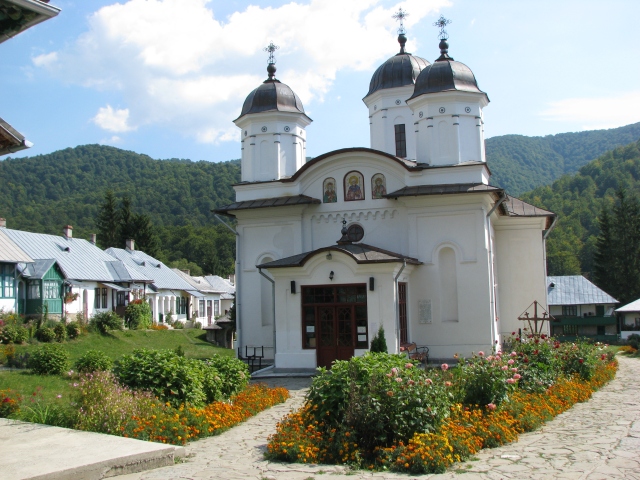
My next stop:  Suzana Monastery. The Suzana Orthodoxe Convent, hidden in a forest of beeches on the road of Valeni-Cheia gladdens the hearts of those who visit by the tranquillity that reigns here. This monastery now has 62 nuns who share in community prayer and work. I am invited to stay 3 days here. Lets see now how I can survive in a place where no one speaks English and I understand (little) their native language but cannot speak it!

IMG_0759IMG_0670IMG_0642IMG_0551IMG_0529IMG_0472

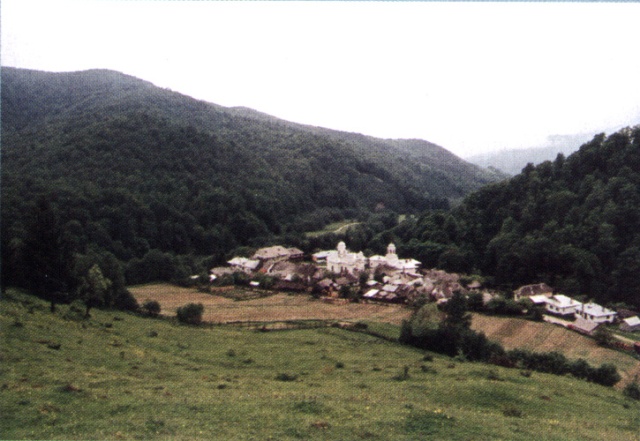
The Suzana Monastery of nuns took refuge along the Teleajenului stream, some 40 km from Valenii de Munte, at the highest point of the foot of Bobul Mare. The waters of the Teleajenul, Stanca and Iepurasul come together at this monastery in the form of a cross and run off together as a single stream. From above, the settlement looks like a tiny village, a cluster of houses stuck together, as if they were afraid of flying away in a storm. The houses are attractive and well kept.


A few stories with some elderly nuns

AT THE MONASTERY, EVERYTHING HAS A PURPOSE…”Leave us be, says an elderly nun, as we have no time for posing in magazines. We have a lot of work.” She then disappears into the abbey to announce the arrival of some…guests. Out comes the Mother Superior …”Please, do come into the living room and have a syrup drink.” A homemade syrup made of caramelized sugar is brought in with glasses of water.

“Our monastery is not very well-off,” says the Mother Superior. “We work hard, there are few young nuns and quite a number of very old nuns who need our constant care like young children …”

Someone knocks on the door. A nun curtseys and kisses Mother Superior’s hand. Snatches of words, choked by timidity: “Mother Superior…the bell…blessed.”


The girls come to the monastery from places you cannot even imagine, from all over the country. They come from Sighetul Marmatiei, from Moldova. But they do not all stay here, some cannot get used to life in a monastery. First they must learn about order. The monastery has its own rules, its own system, and none can do as she pleases. And then these girls have to be taught some skill, to be useful, and they learn to weave carpets”.

HOW LADY ARSICU SURVIVED THE STORM. Suzana Arsicu, the monastery’s founder, raised a church of beams. The wealthy woman was from Sacele, in Ardeal, and this was her way of thanking God for having saved her from a storm. She was the monastery’s first Mother Superior.


The church, whose Patron Saint was St. Nicholas (Dec 6), lasted one century and was replaced by another. At that point the church council decided to change its patron to the Mother of God whose anniversary is celebrated in summer, on the 15th of August, and the monastery can be more easily reached during that season than during the winter religious festival with the snows. On the eve of the dedication, however, the sky got covered with clouds, the streams overflowed from their beds and flooded the valleys. The torrent took everyone who came for the feast by surprise, washing away all their bags, their habits, their books and their holy paraphernalia. They all escaped unharmed, and instead of holding a dedication they held a mass, to thank God for having averted the danger. They then decided that they would not change the patron Saint for the church, and celebrate on December 6, the anniversary of St. Nicholas.


Today’s church was raised between 1880-1882, during the time of a Mother Superior named Natalia Perlea. She kept the same patron, and no one has ever thought again of changing him. The monastery has another tiny church, Paraclisul, built during the time of Mother Superior Tomaida Perlea.

THIS IS MY HOME. The story of a nun: “This cannot really be called a community life, as we have little work in the field where we might meet. It is more of a solitary life. Each nun receives a house for which she is responsible. Some have novices, and when these become nuns in their own right, they take over the house. There are two or three nuns to every house. There is enough space.


The monastery courtyard is wide open, but the buildings are stuck together in such ways that the space is compact, built to last. This house and that one over there are the settlement’s oldest, dating back to around 1860. That over there is a guesthouse. It does not have a lot of rooms. From time to time officials come here and then can be befittingly received. The nuns put people up in their homes. All of them rent out rooms. But if there were some sort of organized tourism it would be difficult to keep the visitors and the monastery’s daily routine apart. There would be people coming and going in the courtyard, in the church. If we had a guesthouse separate from the monastery, things would be different.

The green house is mine. This house in which I have received you is the abbey, as the inscription shows above the door, but the green one is mine.”


NOTHING IS POSSIBLE WITHOUT HARD WORK. “I came to the monastery in 1940. Now I am 79 years old. In 1990, I offered to step down. I told them: “Perhaps you want a younger nun.” But what would a younger nun do with such a burden on her shoulders? It is a great responsibility.

The nuns earn a little money from their icons and candles…The money does not go far, as everything is expensive these days. The church walls were painted, and look how they are peeling . A company from Bucharest did the job, but they did not scrape off the old paint.

Other than that, there are some hayfields that are in the care of the people. Half belongs to them and half to the monastery. We grow potatoes as nothing else grows around here because of the weather. It rains, it is chilly…And the fruit does not last long here because of the rain.” Two nuns put aside the forks with which they were gathering grass and begin talking. The man with the scythe watches them silently.

“We used to have seven cows, but now we have five. There is a lot of work, but everything requires toil. Now we bring everything we need to the monastery by car, but for a long time we even carted things on our backs.

The work would be impossible without the help of people of means, who make contributions.” These people of means paid some workers whom the Mother Superior met at a dinner at the Archbishop’s. “Now we have some craftsmen building paths, and only when this work is finished can we send for someone to cut the grass, which has grown very long.

PEOPLE WANT TO COME STAY WITH US. The oil painting in the church is the work of Master Petre Nicolau, an apprentice of Gheorghe Tattarescu. The monastery also owns a collection of icons painted on wood and glass, numerous old books and other religious objects. The icons are finished with gilded silver.
An 18-year-old nun leads a group of children around the man-made miracles. There is not enough light, and the nun who serves as guide and is wellgrounded in modern civilization explains that the neon bulb is 60 watt while tha starter is only 20. “They need to be the the same to light properly.”
The children have written their comments in the 48-page guest book at the entrance: “This monastery is truly special,” “I visited this beautiful monastery,” “I enjoyed this visit so much as I saw very old and special things”. Mother Superior Singlitichia Marin mentions, “We must get another guest book, a real one.
For the time being the monastery has no priest. There is a priest who comes to hold services, but he is not employed permanently. He is a young priest, too young. A priest who serves at a monastery of nuns should be older. One will eventually be hired, as the need becomes evident. This is another problem that requires resourcefulness.”
On major holidays we hold services from 7:30 p.m. to around midnight. People come from town, from Valeni, even from Ploiesti, to get married or to baptize their children. At first we were criticized, and were asked why we allow people from outside the parish to come here. I replied: “What should I do? Turn them away at the gates of the monastery? The church cannot do this. You do something to encourage them to come to you, so that they no longer want to come here.” After that no one said anything anymore.”
INSIGHT, Summer 2001

Part A

For more photographs, go here

Romanian Monasteries Pilgrimage — Mânăstirea Pissiota

Most hospitable next stop: Mânăstirea Pissiota!

Romanian Monasteries Pilgrimage Mânăstirea Pissiota Orthodox city hermit pilgrimage

Romanian Monasteries Pilgrimage Mânăstirea Pissiota Orthodox city hermit pilgrimage

Romanian Monasteries Pilgrimage Mânăstirea Pissiota Orthodox city hermit pilgrimage

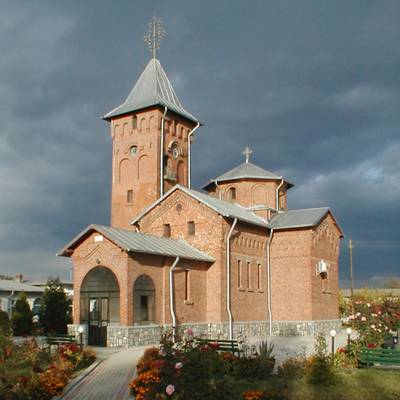
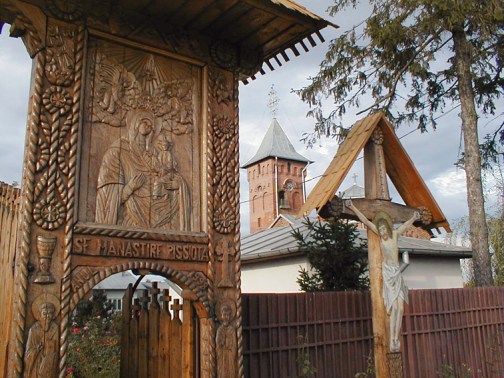
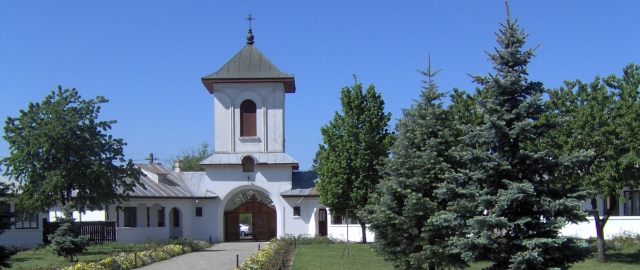
The monastery of Pissiota, located in Poienarii Burchi, was built between 1928 and 1929 by Nicolae Pissiota (1860-1940), a great man of culture, and his wife, Zoe Pissiota (1868-1940), on the estate bought from the family of General Gheorghe Angelescu (1850-1923), an important name in the 1877 war.

Romanian Monasteries Pilgrimage Mânăstirea Pissiota Orthodox city hermit pilgrimage

The first record of the village of Poienarii Burchi dates back to 21st September 1594, on the former „Poeana” estate of Lady Stanca, the wife of Michael the Brave. The village was dedicated by Lady Stanca to the Simonopetra monastery of Mount Athos, in 1594. The original document is kept at the Archives of the State in Bucharest.

Romanian Monasteries Pilgrimage Mânăstirea Pissiota Orthodox city hermit pilgrimage

The engineer Nicolae Pissiota, of Macedonian origin, born in Greece and settled in Walachia, had a huge fortune that allowed him to build this place of worship. The church was designed by the architect Ioan Giurgea – a harmonious combination between Italian Renaissance style and the Byzantine elements that are specific to Romanian churches.

Romanian Monasteries Pilgrimage Mânăstirea Pissiota Orthodox city hermit pilgrimage

Romanian Monasteries Pilgrimage Mânăstirea Pissiota Orthodox city hermit pilgrimage

Romanian Monasteries Pilgrimage Mânăstirea Pissiota Orthodox city hermit pilgrimage

Famous names were called to decorate the church: Costin Petrescu (1877-1954), the one that painted the interior frescoes of the Romanian Athenaeum, or the Cathedral of Alba Iulia, and his apprentice, Gheorghe Eftimiu.

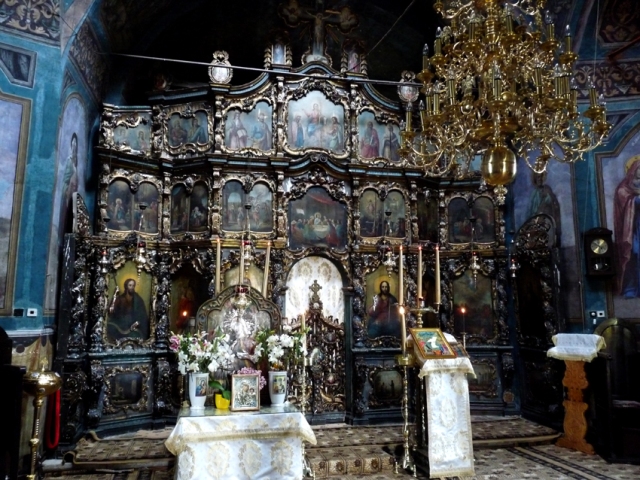
The portraits of the patrons and of the Patriarchs Miron Cristea and Justinian Marina were done by the painter Vasile Rudeanu (in 1956). The iconostasis is carved in rosewood and cherry wood, brought from Greece, creating a balance between sensitivity and detail, influenced by Italian art.

The furniture was carved of oak wood, with ethnic motifs, by the sculptor Anghel Dima, in 1928, the author of Mihai Eminescu’s sculpture in front of the Romanian Athenaeum. The floor is made of red Carrara marble; underneath the church lie the marble crypts where the patrons and their families are buried. Inside the church there are icons and silver icon lights, in Brancoveanu style, as well as triodyons, Pentecostarians and hymn books.

Romanian Monasteries Pilgrimage Mânăstirea Pissiota Orthodox city hermit pilgrimage miraculous icon

Romanian Monasteries Pilgrimage Mânăstirea Pissiota Orthodox city hermit pilgrimage

Romanian Monasteries Pilgrimage Mânăstirea Pissiota Orthodox city hermit pilgrimage

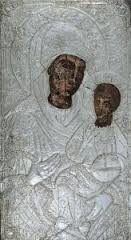
The defining religious element in the Holy Monastery of Pissiota is the Icon of the Holy Virgin with the Child – miracle-working icon. The icon is painted on oak wood, against a background of Byzantine brocade, signed by the famous painter Gheorghe Eftimiu, the apprentice of the great Costin Petrescu.

For two decades after the opening, between 1928 and 1948, the monastery was a monk monastery. In 1948, the Patriarch Justinian Marina transformed it into a monastery of nuns, and this is how it remained until 1962, when it was discontinued. In 1993, after 31 years in ruin, the monastery resumed its community life.

Currently, the monastery is inhabited by 23 nuns and a priest; prayer is in harmony with work, as there are tailoring workshops where priestly vestments and clothes are made, allowing people to add the little money they have for the restoration of the monastery.

Abbess Monahia Ioana Irina Calin


Romanian Monasteries Pilgrimage — Zamfira Monastery

A most spiritually intense summer so far! Full of such dramatic ups and downs! Personal tribulations and divine interventions, violent, ‘rough seas’ in the ‘world’ and hesychastic pilgrimages and retreats in monasteries!

This week I am entering the atmosphere of Romanian Orthodox Christianity and undertaking together with very special Romanian spiritual brothers and sisters a pilgrimage to various, notable monasteries to the south of Romania.

My first stop was the Monastery of Zamfira, famous for its ties with Greek Revolutionary history, and specifically Nicolae Mavrocordat, and for its amazing paintings by the skilful young Romanian painter Nicu Grigoresku.

zamfira1.jpg

This monastic complex is located in the Teleajen Valley, halfway between Ploiesti and Valenii de Munte. It has two churches (monuments of art), a collection of religious art and the cells of the nuns.


The first church (named The Big Church) is located the large yard of the convent. It was founded by Metropolite Nifon and was built between 1855 and 1857 with the aim of transferring the monks from the “Rosioara” hermitage of Filipestii de Padure. The artistic significance of this church is based on its painting, because it is the first church entirely painted by the great Romanian painter, Nicolae Grigorescu, at the age of 18.

zamfira2.jpg


This painting is considered to be unique since it the only one created in “fresco” by Grigorescu. The mural painting and the icons of the iconostasis were completed in an extremely short time, i. e., in less than 14 months.

This painting has undergone several restorations, the last and best one being done between 1986 and 1989 by the painter and restorer, Chiriac Ion. He carefully removed all the repainted portions, hence making the original painting visible once again. It is a remarkable restoration.


The collection of religious art containing objects dating from the 18th, 19th and 20th centuries belonged to the two churches or to the various donors: icons on wood or glass, books of worship, invaluable objects of worship, carved pieces embroideries, etc.


Frescos of the great Romanian painter, Nicolae Grigorescu.

zamfira3.jpgzamfira4.jpg


The chanting of the nuns was breathtaking, the kneeling during its long services surprisingly soothing, a balm to the wounded heart, and the Vespers and Matins services dedicated to the veneration of St. Paisios the Athonite, my patron Saint and spiritual grandfather, incredibly moving! What a surprise to find his Icon and seek his intercessions at the very heart of Romania! Even the strangeness of praying in a language you can barely follow was a special blessing, a long-sought-for emptying, a kenosis, allowing all this silence and deep peace of Christ ‘invade’ you!

Pilgrimage to Mikrokastro Mother of God Monastery

This post has been long due, since Mikrokastro Mother of God Monastery has been my refuge and retreat since 2014, ever since I discovered it, or better ever since our Holy Lady revealed herself to me there.  A most  holy place, a ‘thin’ place I keep returning, especially when badly in need of spiritual nourishment, in times of trials, adversity, tribulations and temptations. This is a place where the Mother of God comforts all her children, a place where its peace invades you and the fellowship of the nuns warms you.


a1a2a4a5a8

a11a15a16a17

Part A: A brief history of the Monastery of the Mikrokastro Mother Of God


The Holy Monastery is dedicated to the Assumption of the Mother of God. According to historians, the main church of the monastery is estimated to have been founded 200-250 years ago. The iconography in the church was completed in 1797 (about 200 years ago), as is shown by the inscription that still exists on the west wall of the church.

a7


The history of this place started with a small chapel in the nearby village of Mikrokastro, but its propitious geographical position as a passing place on the journey from Kozani to Kastoria helped the site become a place of worship. This was mainly due to the presence of the Holy Icon of the Eleoussa Mother of God on the icon screen; it is not known when or under what historical and religious circumstances this Icons was found here.


The miracle-working power of the Icon contributed to the place quickly becoming the most important place of worship in Western Macedonia. According to the inscription mentioned above, the church’s frescoes were painted by iconographers from Kopessovo in Epirus, who, despite Western influence, tried to remain loyal to the Byzantine tradition following the standards of the Konstantinos Palaiologos era. The more popular manner of the depictions does not diminish the sweetness of the facial expression or the comforting feeling instilled in the souls of the faithful.

a9a10a12a13a14

a19


The icon screen of the convent is one of the most beautiful in the region and was made by skilled craftsmen either from the local area or Epirus. The miracle-working Icon of the Mother of God found in and belonging to the monastery dates back to either the 12th or the 13th century according to modern methods of dating holy icons.


The plenty votive offerings to the Mother of God helped the property of the Monastery to increase, and this property was taken care of by workmen inhabiting the area. In 1820 this place of worship was characterized as a Holy Monastery for reasons of prestige because of the presence of the Holy Icon, since it never had a monastic brotherhood. It only had an Abbot appointed by the Bishop of Siatista and an administration Committee.


This Holy place played an important religious and national role supporting the nation’s struggle for independence in 1821, offering hospitality and a hiding place to revolutionaries of the independence struggle, maintaining an ammunition store, paying the salary of the village teacher, and strengthening the inhabitants’ faith so that they could resist the pressure of Islamic proselytism.


The monastery participated in the historic events of 1878, offering moral and material support, in the Macedonian struggle during the years 1904-1908, in the war of liberation in 1912, in the relief of the victims of the Asia Minor disaster, in the epic struggle of 1940-1941 and its climax, i.e. the historic Fardikampos battle in March 1943. The monastery “offered soul, blood and money” offering the sacrifice even of its priest.


After the war, the bishop of Sisani and Siatista, Iakovos Kleomvrotos, (later to become Bishop of Mytilini), a powerful personality of the clergy, realised that the Holy Monastery was a more suitable place for spiritual and social activity than mountainous Siatista.


In 1952 he founded a School of Agriculture here for the farmers’ sons of the area, which, after functioning for two years, closed and was given to the Swiss Red Cross with a view to founding a hospital for local children suffering from glandular problems. In this building a primary school was also set up. In this way, hundreds of local children were helped.


Other buildings at the same location include the boarding school of the School of Housekeeping, which was used as a guest house and later as a home for the elderly. In addition, another building was erected in which his successor – Bishop Polykarpos – founded an orphanage.


Bishop Antonios was elected in 1974, and he showed great interest in the restoration and peopling of the monasteries in the region. In 1981 the position of the Abbot fell vacant and Father Stephanos Renos took over. With the moral, spiritual and material support of the Bishop as well as the contribution of the faithful and well-known donors, Father Stephanos Renos did great renovation work and added new buildings, a guest house and chapels.


In 1993, by a presidential decree, the Holy Monastery was turned into a monastery for women, and some time later the first monastics entered the monastery.


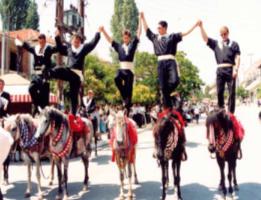
Two noticeable customs have been preserved since the years of Turkish domination. The first is the custom of Horseriding. On the 15th August, a religious festival day, the young men from Siatista armed and riding ornate horses came to the festival to venerate the Mother of God and under the unsuspicious eyes of the Turks the leaders of the struggle talked about the issues concerning the revolution, and the hope of freedom for the enslaved Greeks was strengthened. This custom has been preserved until today and has been incorporated in the whole festive religious atmosphere.

a18


eleousa Mother of god orthodox city hermit pilgrimage retreat mikrokastro horse ridingeleousa Mother of god orthodox city hermit pilgrimage retreat mikrokastro horse riding

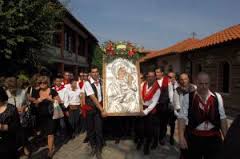
The second custom is the carrying in procession of the icon of the Mother of God That is, apart from extraordinary events such as insect epidemics, droughts and illnesses, during which the inhabitants of the area carried the icon in procession around the area to ward off evil, the inhabitants of Siatista have been taking the same icon in procession regularly for centuries now. In all weathers and accompanied by many people of all ages, they cover a three-hour distance on foot holding the icon in their hands until they arrive in their town, where the icon is solemnly received and taken to the cathedral and a prayer is chanted. After this, the Icon is taken to every house and flat. This event witnesses the fact that neither the Mother of God’s grace nor the people’s faith have diminished.

a3

icon procession mikrokastro eleousa Mmother of god orthodox city hermit pilgrimage retreat mikrokastro


The grace of the Mother of God has gathered peace-loving and pious women who have offered themselves to life-long service in the monastery, vowing to find salvation through the basic virtues of monastic life: obedience, chastity, lack of property, prayer, charity, and at the same time trying to achieve the moral elevation of local inhabitants.

The small sisterhood has devoted itself to a struggle for inner order, the restoration of buildings, the organization of worship, tree-planting on the land belonging to the convent, hospitality and spiritual outreach to visitors. The sisterhood sows with patience, cultivates the seeds of the virtues referred to in the Gospel with assiduity, re-baptizes the faithful in the genuine spiritual concepts of the Orthodox Church and the Holy Fathers, interprets the Gospel, comforts the sad and turns the beautiful stone-built monastery into a safe harbour, where people struggling in life can find shelter and relief.


Contact Information:

Mikrokastro, Siatista, Greece

Tel no: +30 24650 71307

To be continued …

Part B: Lessons from the Monastery and Miracles at Mikrokastro Mother Of God to follow soon


Three Old Age Vignettes

Written at my refuge, the Mikrokastro monastery, under Our Lady’s Protective Veil . Watching my father die the last two weeks has been very painful and filled my mind with images of old age and decay.


Three Old Age Vignettes


 Terminal, Temporary, Transcending 


1 Corinthians 2

14 But the natural man does not receive the things of the Spirit of God, for they are foolishness to him; nor can he know them, because they are spiritually discerned. 15 But he who is spiritual judges all things, yet he himself is rightly judged by no one.


1 Corinthians 3

  1. And I, brethren, could not speak unto you as unto spiritual, but as unto carnal, …

3. For ye are yet carnal: for whereas there is among you envying, and strife, and divisions, are ye not carnal, and walk as men?


I. Terminal

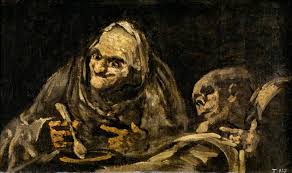
Three Old Age Death Vignettes orthodox city hermit


An Old Man by

C. P. Cavafys (1863-1933)


At the noisy end of the café, head bent

over the table, an old man sits alone,

a newspaper in front of him.


And in the miserable banality of old age

he thinks how little he enjoyed the years

when he had strength, eloquence, and looks.


He knows he’s aged a lot: he sees it, feels it.

Yet it seems he was young just yesterday.

So brief an interval, so very brief.


And he thinks of Prudence, how it fooled him,

how he always believed—what madness—

that cheat who said: “Tomorrow. You have plenty of time.”


He remembers impulses bridled, the joy

he sacrificed. Every chance he lost

now mocks his senseless caution.


But so much thinking, so much remembering

makes the old man dizzy. He falls asleep,

his head resting on the café table.


II. Temporary


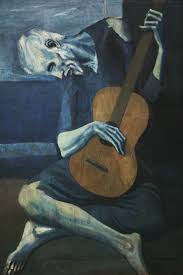
Three Old Age Death Vignettes picasso old guitarist orthodox city hermit


Do not go gentle into that good night

Dylan Thomas, 1914 – 1953


Do not go gentle into that good night,

Old age should burn and rave at close of day;

Rage, rage against the dying of the light.


Though wise men at their end know dark is right,

Because their words had forked no lightning they

Do not go gentle into that good night.


Good men, the last wave by, crying how bright

Their frail deeds might have danced in a green bay,

Rage, rage against the dying of the light.


Wild men who caught and sang the sun in flight,

And learn, too late, they grieved it on its way,

Do not go gentle into that good night.


Grave men, near death, who see with blinding sight

Blind eyes could blaze like meteors and be gay,

Rage, rage against the dying of the light.


And you, my father, there on the sad height,

Curse, bless, me now with your fierce tears, I pray.

Do not go gentle into that good night.

Rage, rage against the dying of the light.


III. Transcending

An Old Man in Christ


The royal doors are open, the great Liturgy is about to begin!


In the pouring rain, our fate

In Your hands, Lord brighten,

We make our way to meet you,

Beloved, across massive puddles

Rising with the tide of excitement.


“Ah, the blameless in the way. Alleluia”


Heart, body, mind and soul

Thoroughly cleansed and washed,

We are determined

To sprinkle Joy on your grey day,

Be your Guardian angels For a while

And hold off dark clouds

Of abandonment.


“My soul is worn with endless longing. Alleluia”


At the door, your quiet Strength surprises us!

An enchanting infant’s smile, behold!

You Beam our welcome,

Appropriately Toothless!

Are you, old friend, but a year old?


“Lord, I am become as a bottle in the frost. Alleluia.”


Head bent, hands crossed

The epitrachelion wraps gently

Emasciated shoulders, frail, stooped.

Humbly you whisper to Father

Your Confession, Taste Loyal Servant

The Fountain of Immortality

Invisible choirs accompany our poor hymn!


“Call me up to You, O Savior, and save me. Alleluia.”


You live alone, at your 93,

Even climb, dear, bedroom’s stairs steep!

Yet Angels and Saints keep you company

In the lonely path to Christ.
 
Christ before wife, mother and child, you put
 
Grace is free but discipleship is not cheap.


“The sheep that was lost am I. Alleluia.”


World wars have feared

Your Faith’s strong fortress,

Violently, you took the kingdom, by force.

Ravenous wolves failed

To lead you astray, the one pearl of great price

You unearthed, All that you had

You sold and bought.


“The Choir of the Saints has found the Fountain of Life.  Alleluia.”


What a living icon you are!

Like your faded with candles kissed

In your icon corner, full of Grace and Light

Painstakingly you commemorate,

Day-to-day, a long, tattered names’ list.


“Image am I of Your unutterable glory. Alleluia.”


You may be old, feeble and frail,

Yet your zeal and bright courage

Shames us all,

Amidst peppermint and cakes

His wonderful acts prophetically you proclaim,

The Spirit lifts you up,

To generations to come.


“Though I bear the scars of my stumblings. Alleluia”


Old Brother, toothless, we implore you in Christ,

Begging on your knees we sinful, beseech,

Under your roof, unworthy we pray

Just a little more while, abide with us,

Please stay, bless, to Heavens reach!


“Lead me back to be refashioned. Alleluia.”


Meek Humility, shine upon us,

Grace abundant your poor children enthuse!

What matters is the soul not the sole,

Bless us, Bless us, Guide us in judgment

You have inherited the Earth indeed.

Even if you’re wearing odd shoes!


“Into that ancient beauty of Your Likeness. Alleluia.”


The Pentecost icon


Every year I discover new ‘details’ in the Feasts’ icons. This Pentecost what caught my attention was the old king at the bottom of the Pentecost icon, mysteriously in a small semi-circle.  The more I studied the icon though, the more questions came to my mind. What is St. Paul doing here, since we know he became an Apostle after the feast?! …

pentecost icon.jpg


The Icon for the feast of Pentecost is also called the Descent of the Holy Spirit, as it is a depiction of the event described in the Book of Acts (Acts 2:1-4) when the Holy Spirit descended as tongues of fire upon the Apostles gathered together and enabled them to preach in different languages. However, the Feast of Pentecost is not only the commemoration of an historical event, but a celebration of a present reality: the presence of the Holy Spirit in the Church. Likewise, the Icon for Pentecost is much more than the depiction of a past event.

pentecost St Peter and St Paul Uncreated Church

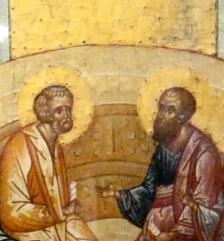
The presence of the Apostle Paul in the icon, even though at that time he had not yet converted on the road to Damascus, hints that this icon is more than a purely historical picture. Sometimes, the evangelists Luke and Mark are also shown, despite also not having been present in the upper chamber at Pentecost. The gathering, then, is a representation of the Church. The Apostles are seated in a semi-circle, representing a unity and harmony similar to that found in Icons of the Holy Trinity. As in icons of the Holy Trinity, a semi-circle, rather than a full circle, is used so that we as observers are drawn into the unity.

pentecost Descent of the holy spirit orthodox pilgrim uncreated Church

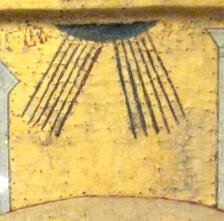
The source of their unity is in another semi-circle at the top of the icon, showing the descent of the Holy Spirit. From the blue semi-circle (c.a. mandorlas) a single ray of light for each of those gathered shines down to illumine them. Sometimes the “tongues of fire” described in Acts are shown at the tips of the rays, ready to descend upon the Apostles. Other times, the tongues of fire are shown already within the halos of each of the seated Saints. Some icons of Pentecost show a dove, either within the mandorla at the top of the icon, or even descending upon those gathered in the upper chamber. Given the appearance of the Holy Spirit as a dove during Christ’s Baptism, it is understandable that this physical image of the Spirit is also used in Pentecost icons. However, the Holy Spirit appeared as tongues of flame at Pentecost, and a dove at Christ’s Baptism, being – in reality – neither of these things. Therefore it is inappropriate to depict the Holy Spirit as a dove at Pentecost, or indeed in any icon except those for the Theophany feast.


pentecost orthodox pilgrim the world and the Uncreated Church


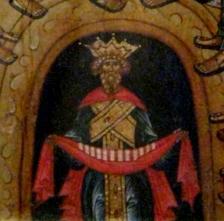
At the bottom of the Icon is another semi-circle, showing an old king against a dark background. He is often named as Kosmos and represents the world. He is crowned as a symbol of earthly authority – i.e. he represents all the peoples of the world, rather than the whole of creation. He is sat “in darkness and the shadow of death” (Luke 1:79), and is aged to show the corruptibility of the world. Yet he also holds a blanket containing scrolls representing Apostolic teaching (compare with the scrolls held by the Apostles in the Icon itself and “the meaning of objects held by saints in icons“). Though in darkness, the descent of the Holy Spirit has not only reached the Apostles, but also all corners of the world into which the Apostles will preach the Gospel. The Empty Seat A striking aspect of the Pentecost Icon is the empty space at the centre, between the Apostles Peter and Paul. This central seat is a place of honour, the “Teacher’s Seat” around which the Apostles are gathered. Why is it empty? Because it is the seat Christ should be sitting in, Who has ascended physically into Heaven. Yet Jesus promised many times that though He would leave them physically, He would instead give to them the Holy Spirit as a comforter, advocate, and guide. This promise was first realized at Pentecost, and is still true today. Therefore, the Icon, which is also an Icon of the Church, shows the Apostles gathered in unity, sustained by the power of the Holy Spirit, surrounding Christ Who is invisibly present. The world, Cosmos, is at their feet, ready and waiting to be harvested through the passing on of Christ’s teaching.


Some icons of Pentecost show Mary the Mother of God in the centre, occupying the “Teacher’s Seat”. Surviving icons of this sort are usually western (the above comes from the border between Finland and Russia). Mary was present at Pentecost, though as already mentioned, the icon is not primarily a historical snapshot of the event. The Theotokos’ presence in the centre is not problematic though, as she is the ultimate exemplar of a Christian. With Jesus Christ ascended into Heaven, the Holy Spirit acts within people, and through the Saints Christ is manifested in the world. Mary is therefore shown in the “teacher’s seat” as the best example we have, and the person on earth who most resembled Jesus Christ (both physically, as His mother, and spiritually as His disciple). Nevertheless, the “empty” seat is a more widespread and, I believe, more impressive image of both Pentecost and the Church. The Apostles are seated as equals, with no individual among them taking the central seat of authority. They don’t need to. Their unity as the Body of Christ is sustained through the real “Vicar of Christ”: the Holy Spirit.


Blessed are You, O Christ our God, who made fisherman all-wise, by sending down upon them the Holy Spirit, and through them, drawing all the world into Your net. O Loving One, glory be to You. (Apolytikion for Pentecost) More About the Feast of Pentecost>>


Source: Pentecost Icon as an Icon of the Church

The Comforter

Fascinating homily in its breadth and depth! Like all by Metropolitan Anthony of Sourozh. In it you may meditate on Nature, God’s Creation, God’s Energia in His CreationThe Little Prince by Saint-Exupery, three-fold etymology of ‘Paraklitos’, Conversion, Betrayal and Apostasy narratives, Faith and Loss of Faith, C. S. Lewis, the difference between Art and Mankind, a beautiful statues and human ‘wreckage’, Father Sergei Bulgakov’s theology, a bold, ‘heretical’, ‘syncretistic’ worship during a World Council of Churches meeting, and so much more. Enjoy!

‘The Comforter’: Our Support and Strength for Mission

I feel more than slightly apprehensive, giving this talk in the background of a very theological theme. And so, you will forgive me, if my theological statements are untheological and if the rest is very different from what you may expect.

First of all, may I make a totally non-theological statement about the Holy Spirit? When we speak of the Trinity, for people as primitive as I am, we can imagine that the old image, given centuries ago, still holds, and we can develop it on one point. Speaking of the Trinity, trying to understand the relation there is between the Father, the Son and the Holy Spirit, some writers have said that we can compare God to the sun in the sky. In its mystery, the sun is unknowable as such. No one of us will ever be able to participate in the nature of the sun, but it becomes accessible to us in its light and warmth. The light is something which we perceive with our senses, by sight, and which reveals to us everything that surrounds us. We do not see the light as such, but it is in the light that things are revealed to us. The warmth of the sun is the way in which He pervades us, and in which we can become participants — to whatever degree is accessible to us — in the life of God.

Christ the Word is an objective revelation of God. The Spirit reaches us only within our experience, in the way in which the warmth of the sun pervades us and we become aware of it, and through it of something which is of God. This is a non-theological introduction to the subject.

As an illustration of this, I would like to give you an example of a contemporary of mine, who had discovered his faith in God through an encounter with Christ. But he puzzled and puzzled about the Holy Spirit. He did not understand. One day, he found himself on a bus. It was in Paris, around the theatre of the Odeon, and he was saying to himself or to God: ‘But what does the Holy Spirit do to us? How can I know that I have had some sort of contact with the Spirit of God?’ And of a sudden he felt he was, unexpectedly to himself, filled with a love of the creation and of the human beings that were surrounding him, in a way in which he had never known he could. And he realised that, at that moment, the Holy Spirit had come to him and made him partake, to the extent to which he could, in his immaturity perhaps, in Love Divine. At that moment, he knew something about the Holy Spirit: that the Holy Spirit was communicating Himself to him by communicating to him something which could not be invented or forced, even out of his human experience.

The Holy Spirit comes to us quietly; at times unexpectedly, at times as the result of a long longing. Some of you may have read a book called The Little Prince by Saint-Exupery. There is a passage in which the Little Prince meets a little fox. Both the Little Prince and the little fox are attracted to one another, but both are desperately shy. The little fox comes and sits down at a certain distance, but whenever the boy makes a movement towards it, it runs away. Then one day the little fox says to him something like: You know, we both long to come to one another, but we are shy and afraid. So when I come, don’t make the slightest move. Look askance, so that I may imagine that you have not noticed my presence. And, not being afraid of being watched, I will come a little nearer than the day before, but don’t turn to me, because I will be afraid and run away. And then, another thing,’ he said, ‘I long to come close to you. And so, let us fix a time when you will come, because then — oh, a good hour before the time — I will know that you will be coming. I’ll come myself and wait. And I shall be filled with this expectation of the moment when you will appear. And then you will sit down and, as I said, pay no attention to me, and allow me to come nearer, and nearer, and nearer.’ This image of the little fox is something that, to me, resembles very much the way in which we relate to the Holy Spirit. Christ comes to us, proclaiming the truth. He is the Truth; He is the One who Is. He is a revelation, an unveiling. The Holy Spirit, in this sense, is not a revelation. He is the one who makes the revelation possible, by making us commune with what is the essence of this revelation: the closeness and the knowledge of God.

If we turn to what we hear in the Gospel about the Holy Spirit, I would like to attract your attention to one passage — to a word rather than a passage — that we repeat time and time again in our prayer: the Comforter. ‘Comforter” is the English translation of the word. When we look at the various languages into which it has been translated from the original, I think we can see a variety of facets in the event. First of all, the Holy Spirit, whom the Lord Jesus Christ sends us, is the one who consoles us for our loss of Christ. I am speaking of the loss of Christ, because each of us believes in Christ, each of us has had an experience of His closeness, His presence. Each of us has had, through His teaching, an experience which He conveys to us in word and in person. But, with the Crucifixion, the death of Christ and the Resurrection and Ascension, He is not present as He was present to His disciples, and He is not present in the way in which He will be present to us when all things will be fulfilled. You remember, probably, the words of Saint Paul, when he says: As long as I am in the flesh, I am separated from Christ. And yet — Christ is my life. And we are all, to a lesser degree than Paul was, of course, in the same kind of situation. On the one hand, Christ is our life; on the other hand, we are still separated from Him. We all long to be with Him, but we cannot go beyond a certain point of closeness. And Saint Paul points it out, when he says that, as long as he lives in the flesh, he is separated from Christ, and he longs for death to come. Not as an end of his earthly life, but as the moment when a veil will be torn apart and, as he puts it, he will know as he is known. He will see face to face what he can see yet only as shadows and images mirrored.

823-600x459

The Holy Spirit reveals Himself to us as our Consoler. In the sense that Christ has promised to send Him to us, He comes to us. He gives us an incipient participation in a closeness of communion with Christ, and through Christ, in Christ, with the Father. So that this is our first experience. His closeness to us consoles us for the fact that we long to meet Christ face to face, to commune with the Father in a way unutterable to us.

But the word goes beyond this. He is not only the one who comforts us; He is the one who gives us strength; strength to live in this orphaned situation in which, on the one hand, we belong to God wholeheartedly, sincerely, heroically at times, and on the other hand live in a world that has fallen away from God and in which we have a function to fulfil. He is the one who gives us strength to live in the world which at times denies everything we long for, which stands between us and our fulfilment by temptation, by beguilement.

At the same time, there is a third meaning in the word. He is not only the Consoler. He is not only the one who gives us strength to face life, in the faith and yet in the partial absence of Christ. He gives us the exulting joy of being with Christ already in this world, because, although our communion with Christ is imperfect, although it is not all-embracing, although we do not know Him as He knows us, we do know Him. And this is a miracle that we could not appreciate if we were born, as it were, in a believing family and if we had been given our faith together with our birth. But those of us who were unbelievers, the millions who believed not and have discovered, know the exulting joy of this discovery of God in Christ and through Him, of the fatherhood of God’s own Father. So that, in the Holy Spirit, we have consolation because we are orphans. We are sent into the world to conquer it for God. And in the process, at moments, we are given a sense of incredible closeness, and we can be astounded and rejoice in the way in which the young man whom I mentioned in the beginning rejoiced, having been filled, in an unutterable manner, with a love he did not know could exist; not only for humanity, not only for every concrete human person, but for the whole of creation.

We are told by Christ that He will send the Spirit to us, who will lead us into all truth. ‘All truth’ is not an intellectual situation. It is not the knowledge of the mind; it is an experiential knowledge. The truth (in Russian istina) is what is: I am He who is. And the knowledge of the truth can only be possessed in communion with Him who is. In a strange way, we have lost through the centuries this certainty that this is what the truth is. It is God Himself; it is the absolute Reality. Pavel Florensky, speaking of the truth, says: ‘Istina — eto Estina’ — the Truth is what is!’ ‘I AM’. And strangely enough, because we have moved knowledge of the truth from this existential experience onto an intellectual level, we feel that we must fight for the truth and defend it, forgetting that the Truth cannot be destroyed by any created power. The Greek word aletheia means ‘what cannot be washed away’, annihilated, even by the waters of the River of Oblivion. Nothing can do it!

If we continue to dwell on words, we could remember that the words verity, veritas, Wahrheit, derive from a Latin word meaning ‘to defend’, not ‘to be defended’. The Truth can defend us against everything, and it does not need us to defend it. This is a very important point with regard to our mission in the world, because it means that we are sent to proclaim it and reveal it, but not to defend it in argument. We cannot defend the Truth by argument. We can present another facet of things, which people can accept or not, but we cannot always defend it in the way it should be defended. I remember when I was young and began to do youth work, my father saying to me: ‘Proclaim the truth and be to people a vision of it, however dim, but do not try to convert anyone by argument, because, if you prove to be more intelligent, more well-read than another person, you will be able to defeat the other person, but you will not have changed his life. And I remember an occasion, a case in the comparatively recent history of the Russian Church in Stalin’s time. A young man called Evgraff Doulouman, who was a student at university, was looking for digs. He found a room in the house of the local parish priest. The priest was mature, ageing, with a deep and tragic experience of life: of the beginning of the Revolution and of the persecution that followed. The young man was full of his atheistic convictions, and he decided to convert the priest to what he believed to be the truth, and they engaged in conversation and discussion. The priest was an old and wise man. He did not argue point by point, but unfolded before the young man the truth as he knew it. The young man was not mature enough to go through the experience that was offered him, and he made it into an intellectual world-outlook that defeated, completely annihilated, his atheistic vision. Having been dialectically defeated, he embraced the Christian faith, asked for baptism, went to study theology in Zagorsk, was brilliant as a student, was ordained deacon and priest and was sent to Samara, I think, to a parish. It was expected that he would be a brilliant missionary, taking into account the way he had moved from refined, deep atheism into a powerful sense of Christianity. When he was in the parish, this young man discovered — in the celebration of the Liturgy, in the sacraments, in his pastoral work — that he could present the Christian truth in words, but he did not believe it all in his inner self. After a while, he renounced the Church and became an active agent of atheist propaganda. I give you this example to underline the fact that it is not in the refinement of argument in debate that one conveys one’s faith.

In the course of the whole history of Christianity, you meet people who are filled with the Holy Spirit, and whose life, whose person, whose words, in their simplicity reached others, hit them at the very core of their being and brought to life a knowledge of the divine that had been dormant. It has been for many as though the knowledge of God was like Lazarus: dead, lying in his grave, who suddenly heard a voice saying: ‘Lazarus, come out!’ And the knowledge of God, an experience that was conveyed by having heard God speak to him, made all the difference. And so, when we speak of the Holy Spirit as being the Spirit of truth, it is not the spirit of formal theological discourse or of any formal thing divorced from the inner experience. Unless it is sustained by this inner experience, it may be a convincing argument but it will not be a power that can transfigure the life of another person.

We are sent into the world to proclaim Christ, but we are not sent into the world to argue about Him. In 1943, C. S. Lewis gave a series of addresses on the English wireless, and in one of them he asks: “What is the difference between the believer that has become alive in God and any other human?’ And he says: The difference can be compared to that which there is between a statue and a living person. A statue may be of supreme beauty, but it is nothing but stone or wood. It can be looked at and admired. It can send us a message of beauty, but not of communion. This beauty will be communion with something earthly, created, but not beyond. Something must happen that will make it of the ‘beyond’. A human being may be infinitely less beautiful than a statue, but it is alive.’ And C. S. Lewis says: “When someone meets one of those statues that have become a living person, he should stop and say: “Look, this statue has come to life!” ‘ This is a challenge to each of us, because we may be satisfactory statues, but are we the kind of people whom others meet, look at and discover that there is life there and not only a shape?

It is very important for us to realise that our message to the world is not a world-outlook. It is a revelation of the presence of the Holy Spirit and of Christ. The Church is a mysterious Body, because the Church is the presence, in the midst of the fallen world, of the fullness of the divine Presence. The first member of the Church is He whom Saint Paul calls the Man Jesus Christ. He is one of us, as well as being, if I may put it that way, one of Them. He is not only One of the Trinity; He is one of humanity. Looking at Him, we can see what it means to be both totally man, human, and totally and perfectly divine. Since the Ascension and the Feast of Pentecost, the Holy Spirit has indwelt the Church totally, filled it with His presence. In the Spirit and in Christ, the whole Trinity is present in the Church. Are we Christians, Orthodox Christians, aware of this? Or is the Church a human body that looks Godward, that believes in God, that has evolved a very elaborate theology, but whose members are not limbs of Christ — as Father Sergei Bulgakov puts it: ‘an extension of the Incarnation’? Are we ‘an extension of the Incarnation’? Does anyone, meeting us, stop a minute and say: ‘In this person, there is something I have never met before. Here is a human shape, but there is something beyond it.’

I think I have mentioned a personal example which I will dare mention again. I came once to the church that became my parish for years in Paris. I aimed at being present at the Vigil, but for one reason or another I was late. The service was over. It had taken place in an underground garage, that led to ground level up a wooden staircase. I entered, and saw that everything was over. Only, there was a man coming up the stairs. It was a monk, in monastic garb, and when I looked at him I felt that I had never in my life met such total inwardness, such serenity, such peace and depth. I did not know who he was. I came up to him and said: ‘I do not know who you are, but would you become my spiritual father?’ This is a sort of central experience I had of a person in whom I saw something I had never seen to that extent: this total inwardness in the abiding presence of God, the Spirit at work, and the Incarnation in him. Years later, I received a little note from him, saying: ‘I have experienced the mystery of contemplative silence. I can now die.’ And three days later, he died. This, to me, was an example of what a Christian can be. He was not ‘impressive’ in any respect. He was not a man of superior education or of an outward holiness, but in him I could see the Incarnation and the presence of the Spirit.

When we look around, do you realise the kind of world in which we live? Bishop Basil must have talked to you about the presence of the Holy Spirit in the created world. At the moment of creation, the Holy Spirit was hovering over the newly-created world. This newly-created world, in translation, is called ‘chaos’. When we think of chaos nowadays, we think of destruction, the chaos that followed the bombing of Dresden. But chaos is something much more essential and deeper. Chaos is the sum-total of all the existing possibilities that have not yet found a shape and blossomed out. The Holy Spirit was breathing over the chaos, over all the possibilities of a world that had been called into being and had no shape yet. By breathing over this chaos, the Holy Spirit was bringing to life all its possibilities, and everything that was hidden as the possible began to emerge as reality, as you can see in the beginning of Genesis. But God did not force the shapes. He initiated the possibility for the creation to become itself more and more; to expand in depth, and in width, and in every respect

Things changed with the Fall. But what had been given first was never taken away; the created world is still that world which God created. If it is distorted, it is not because it has turned away from God, but because its guide, man, has turned away from God, has lost his way and has proved incapable of helping this chaos to become the perfect cosmos: beauty in form, in line and life, so that the world in which we live is the world which, in itself, is pure of stain except for the distortion that we have created in it. When we look at the surrounding world, we must be aware that everything that is monstrous, frightening, ugly and distorted in it is our doing. To apply to the generality a phrase that was spoken in a particular situation, one of the Fathers says: “We must remember that what we call the sins of the flesh are the sins that the spirit inflicts on the flesh. The flesh is pure.’ We make it a victim of sin. Our body says: ‘I am hungry.’ Our imagination says: ‘I want to delight in such-and-such foods.’ The natural situation of the created world is that of a victim of the human fall, of our being separated from God, of our being unable to restore, even in a small patch of land, the purity, the wholeness and the harmony that belong to it by right. This we must remember. With what veneration must we look at the cosmos and everything that is the material world around us, and what broken-heartedness we must feel when we see it distorted, broken, ugly and monstrous at times.

Again, when we turn to God, to God’s revelation and the creation of man — the Lord God breathed His own breath into man: that is the original human, the anthropos, the chelovek, and man, the total man, has remained filled with the Spirit of God. We must remember this: it is not our Christian, our Orthodox, privilege to be such. All human beings are such. Sinful, yes, but basically such. And so, when we look round at all human beings, we have no right to see good in some and evil in others. We must see victims of the human fall in one and the victory of Christ in the Spirit in the other. The saints are examples of this victory. To them, to the extent to which it is possible in a world which has not yet come to the parousia, to its end in Christ’s victory, we find, incipiently or still-surviving, true humanity. And this we must remember when we deal with whomever we deal with. Some people are ‘evil’, yes. But why are they? Have we given them newness of life by being a revelation of Christ and a gift of the Holy Spirit? It is easy, perhaps, at times to be compassionate to a person in error, but how easily do we condemn the error from the height of what we imagine to be the truth as we know it!

I have paid some attention, in the course of the last seventy years or so, to the beliefs of men, to the religions of the world. What strikes me more and more is that, however different they are from the faith of Christianity, they are all a distortion of the truth; not a straight lie against it, except for some who have chosen to be servants of Satan and not servants of Christ.

I would like to keep you a little longer than I intended: my forty-five minutes are just over. If you will allow me ten more minutes, I will let you free.

437

Many years ago, I had a conversation with Vladimir Lossky about oriental religions. He was absolutely in denial of any knowledge, any true knowledge of God, in them. I did not dare argue with a theologian of such magnitude, but what courage could not achieve, I thought cunning might. As we lived across the street from one another, I went home and copied eight passages from the Upanishads, the most ancient Indian writings, went back to Lossky and said: “Vladimir Nikolayevich, I have been reading the Fathers, and I always take down the passages that strike me particularly. I always put down the name of the author, but alas, with these eight quotations I cannot find the author’s name. Could you identify them for me?’ He looked and said: ‘Oh, yes!’, and within a minute and a half he had put eight names of the greatest Fathers of the Church under the quotations from the Upanishads. And then cunning revealed itself in false humility, and I said to him: ‘I’m afraid I have deceived you. These are from the Upanishads.’ He looked at me and said: ‘Really? Then I must read them.’ And that was the beginning of a change of mind in him with regard to the statements of other religions.

Many years ago, in 1961, I was part of the first Russian delegation to the World Council of Churches in Delhi. Among a number of us, there was a man called Father Ioann Wendland, who later became a bishop in America and in Germany. He had been a secret priest in Siberia while doing geological research during the Stalin period. We decided to go to a pagan place of worship, to see and to try to understand. We arrived there. At the door, we had to take our shoes off, which we obligingly did, and we were about to leave them there when the warden came up to us and said: ‘Oh no, sir, you do not leave your shoes here. They are new and good, and would be stolen. I’ll put them in my office.’ So our shoes went into the office and we went into the place of worship. It was a round place of worship, divided into ten or twelve sections, and in each of them there was what we would call a pagan denomination, worshipping in its own way. We sat one after the other in the ten or twelve compartments, at the back, using our rosaries and praying the Jesus Prayer, trying to commune with God and seeing if we could commune with the people there. We both came out of it with the certainty that, whatever they called their god — whether it was the god-elephant or the god-monkey or another — they were praying to the only one God there is. And we had communed in prayer with them all, in spite of the fact that, on the surface, they had been praying pagan prayers to idols. That also made me think.

I will end your torment with one more thing. What I have said should make us much more understanding and attentive in our attitude to unbelievers. Not those who are empty of belief but those who are actively godless. I will give you one example, which some of you must have heard from me, because I always repeat myself. The example is this: I was coming down the steps of the Hotel Ukrainia a number of years ago. I was wearing my cassock, as I always do. A young man came up to me and said: ‘I am an officer in the Soviet Army. You are, I presume, a believer, dressed as you are.’ I said: Yes.’ Well, I am an unbeliever. Bezbozhnik (I am godless).’ I said: That’s your loss.’ He said: ‘And why should I turn to God? What have I got in common with Him?’ I said: ‘Do you believe in anything at all?’ Yes,’ he said, ‘I believe in man and in humanity.’ I said: ‘In that, you and God share the same faith. Start at that point.’ And, I think, more often than we do, we should be aware that there is no-one who lives without a faith, without believing in something. And more often than not, we may discover that God believes in the same. Only better, deeper, more perfectly, but that this person who fears that there is nothing between God and him has something in common with Him. At this point, we may remember the passage of the Gospel in which Christ says to Nicodemus: The Spirit blows where It chooses, and no-one knows where It comes from and where It goes.

We must be infinitely reverent when we look at the world that surrounds us, which we have distorted and which suffers like a martyr under the result of human sin, and remains pure, so pure that God could become man and put on flesh; a flesh He inherited not only from the personal saintliness of the Mother of God but from the fact that she was the heir of all the saintliness of thousands of years of human life in history. We must remember that all humans are possessed of this breath of life which is God’s breath and God’s life, however distorted it may be. We must remember, as I have said, that the Spirit blows where It chooses. Without this precondition of the way in which the world, mankind, relates to God, no-one — no one of us and no-one in the world — could discover God. It is the Spirit that reaches us and that kindles in us life eternal. So, when we speak of being sent into the world, we must remember that we are unworthy messengers of a message that may be received by the created world around us, and by the humankind around us, better than we are capable of proclaiming it.

How often it happens that words of truth are said that do not reach the congregation that is there, but reach someone who by accident, or by an act of divine Providence, has entered the church. We must remember this. And go into the world, not to proclaim a theoretical theology of the mind but to grow into the life of Christ, to open ourselves to the action of the Holy Spirit, to believe that the Holy Spirit is active in the created world which is dear to God. Dear to God, because the Body of Christ belongs to this created world through the Incarnation, and to mankind — to everyone.