How Modern Psychology Gives Tools to the Demons

Spiritual Fatherhood and Modern Psychology 

Spiritual Fatherhood and Modern Psychology

How a priest left the priesthood and his wife, and remarried, and other stories

In writing about this subject I have both fear and compassion: fear because of my lack of qualification to make a sophisticated analysis. Yet being aware of growing trust in the field within the Church, I am stirred with compassion in concern for the Orthodox faithful. So this is not a sophisticated analysis, but I will share some thoughts for consideration on this subject, most of which are quotations from others. It must be noted, however, that the final conclusion is meant to be a general statement and is not meant to be an absolute for each person.

Archimandrite Sophrony teaches that just as in the Liturgy during the Cherubic Hymn the priest prays, “No one is worthy” [that is, to perform the Divine Liturgy], so also no one is capable of being a spiritual father. He further explains that this is so because a spiritual father is a co-worker with God in the creation of immortal gods. Here, of course, his is implying our call to deification. He, and others that I have conversed with on this subject, have stressed the fact that a spiritual father must be a man of prayer. Although it is necessary to be familiar with the ascetic tradition of the Church, and things that one has read may come to mind, above all a spiritual father must be seeking God’s help through prayer. So now, let me go on to share a few thoughts for consideration:

I posed the following question to a Father from Athos who wished to remain unidentified (He was a doctor before becoming a monastic): “I have run across priests in the Church who rely much on modern psychology in their counseling. Is it possible for us to turn to psychology?” He answered:

“We trace the teachings of our holy fathers back to the fourth century but psychology has its roots only back to the 16th or 17th century in the non-Orthodox West. In psychology they do discover some things that are useful but our fathers already knew these things for over a millennium. In the West there is a problem: it is believed that the thoughts and mind are one. However, according to the teaching of the Orthodox Church the mind and thoughts are not one, but two; and the mind must be cleansed of wrong thoughts that pass through it.”

The development of psychology can be traced to problems in Western Christianity in reference to salvation. In Catholicism salvation is a black and white systematic observance of rules and the performance of good works. This is said to give each person their own merit towards the salvation of one’s soul. In Protestantism salvation is thought to be only a matter of a confession of faith. And it is believed therefore that your name is written in the Book of Life. But in Orthodoxy salvation is a process of working to cleanse the inner man. In this process there are three stages of grace, the first is that of cleansing, the second enlightenment, and the third perfection which is rare. We must repent and become cleansed of our wrong thoughts and sins, and then the mind can become enlightened by receiving thoughts of God.

Psychology evolved in the West because Christians in the West do not understand the need of cleansing the thoughts. The thoughts that go through one’s mind can drive one to a state of mental illness, and so psychology tries to keep the mind occupied with other things in order to avoid this. Psychologists can therefore sometimes be helpful in keeping someone from going further into mental illness, but psychology cannot actually heal the soul.

In reference to this something was said by a novice at my former monastery. He quoted a relative of his who works as a psychologist and has written books in this field. His relative commented: “We psychologists are like a sponge. We soak up people’s problems but we cannot heal them.”

When I was a deacon, a young man who visited our monastery had just received a bachelor’s degree in psychology. I asked him: “Is it a good idea for me as a spiritual father to study some psychology for this ministry?” He answered: “No, you will learn nothing new for your spiritual ministry, and it will not help you to correct their errors.”

One priest told me of a friend of his who suggested he read a book on psychology. This man told him that although everything in the book was not proper teaching, there were some good points. This priest said this man was indeed very perceptive in what he saw. However he noticed a change in this man’s way of thinking from having read the book. He became very skeptical, and through deductive reasoning, sought proofs and systematic explanations for matters of faith. He sought to analyze and give rational explanations for mysteries of faith which cannot be subject to this. As a result of this, his simple faith was harmed.

I know a former priest who at one time was very enthusiastic about a parishioner who was a psychologist and whose forte was group therapy. He introduced this practice at his parish and began reading books on psychology. He had personal struggles in his marriage and as a result of his reading in psychology, he concluded that what he needed was a real relationship with a “good” woman. He wound up leaving the priesthood and his wife, and remarried.

In a conversation with Bishop Basil Rodzianko (a large section in the popular book Everyday Saints is dedicated to him) he commented: “Both the Church and psychology agree that guilt will drive a man crazy. In the Church we deal with this through repentance but in psychology they try to use other methods”

Someone I am acquainted with and who spent some time at Holy Transfiguration Monastery at Elwood City, Pennsylvania, told me the following: “I was having some difficulty with anger, and our chaplain, Fr. Roman, was away. I told a visiting priest of my struggle. He said I needed to go through the past and heal the inner child. This priest thought therapy would be helpful. When Fr. Roman returned I asked him if I should do this and he replied, “No, you will only give tools to the demons.”

I believe Fr. Roman was concerned about reintroducing old temptations and breaking open old wounds. I learned from a psychologist that their aim in this is to remove stumbling blocks from the past which can cause abnormal behavior. This brings up a question: Which approach is the best? I will offer some reflections and let the readers decide for themselves.

Speaking of recalling the past brings to mind a letter of the 20th century elder, Fr. John of Valaamo. Concerning memory he writes:

“Imagination and memory are one inner sense. Sometimes the memory of former events hits us on the head like a hammer. At such time concentrated prayer is needed, and patience too. Our memory must be filled by reading the Holy Gospel and the writings of the Holy Fathers; in other words, the mind should not be idle. Former events must be replaced by other thoughts, and gradually the former recollections will be crowded out and the melancholy will pass. In one heart two masters cannot live together. (Christ is in our Midst, Letters from a Russian Monk, p. 30)”

Something else says with some relation to this:

“When I visited St. John the Baptist Monastery in England I had the blessing of speaking with Fr. Sophrony. I had questions written down which the Abbot, Fr. Kyril, read to him ahead of time. When we sat down to talk Fr. Sophrony first asked me: “Where did you study psychology?” I was amazed to hear him say that, and it is true that I did have one semester of psychology in college, for which I had an avid interest. He felt I was over-examining and over-analyzing myself. He stated: There are some who have done this and have become saints (I think he had St. John Climacus in mind who in his Ladder of Divine Ascent examined the passions and spoke of the action of virtue in detail) and Father continued: “This was not the way for St. Silouan and this is not the way for us. The way for me is straight ahead.”

Let me comment on the words: “The way for me is straight ahead.” St. Seraphim has said that the aim of Christian life is to acquire the grace of the Holy Spirit. We do need to be aware of our faults and confess them. But rather than trying to examine and fix everything that appears to be wrong with us, we should go straight ahead and seek to acquire the grace of the Holy Spirit. As we grow in the grace of God the hold that the passions have on us will lessen. All our weaknesses and sicknesses of soul will also become easier to bear. The above mentioned words of the Elder John of Valaamo are quite applicable if we replace the word “memory” with “soul” and “melancholy” with “passions, etc.”:

“Our memory [or soul] must be filled by reading the Holy Gospel and the writings of the Holy Fathers; in other words, the mind should not be idle. Former events must be replaced by other thoughts, and gradually the former recollections will be crowded out and the melancholy [or passions etc.] will pass. In one heart two masters cannot live together.”

Psychology has a different approach. One hieromonk who studied at St. Tikhon’s commented: “Psychology is a secular form of Eastern religion. Psychologists try to put all the parts in the right place.” They can even appear to perfect that which according to the image of God is in one’s self. But, Fr. Sophrony comments, concerning those who experience some state of perfection in Eastern religion: “The God of all is not in this.”

In conclusion I leave you with a comment by Archimandrite Sophrony: “Psychology is not profitable for those in the Church. A spiritual father helps those who come to him because he has gone through similar struggles and has learned from what he has suffered.”

My Conversion To Orthodoxy

fr-jonathan

Fr. Jonathan Hemmings (Orthodox Christian Parish of the Holy and Life-Giving Cross at Lancaster) talks about his conversion to Orthodoxy, his meeting Metropolitan Anthony of Sourouzh, the Most Reverend Metropolitan Kallistos Ware, and other Living Signposts God of the Faith, and his last book, Fountains in the Desert.


For a more detailed testimony of Fr. Jonathan’s Conversion go to Finding the Faith of Joseph of Arimathea

Source

A Novice of her own Son

On Gerontissa Theophano, the mother of Archimandrite Ephraim of Philotheou

A Novice of her own Son


“The climate on the island of Thassos suited her better than in Portaria, so I moved her there. She gradually drew near to the end of her life. Two years before her death, at the age of 92, she was paralyzed. From that time she didn’t completely raise herself from her bed. But, glory to God, as the Gospel says: And every one that hath forsaken houses, or brethren, or sisters, or father, or mother, or wife, or children, or lands, for my name’s sake, shall receive an hundredfold, and shall inherit everlasting life (Mt. 19:29).

This is what happened with my mother: during her illness she was surrounded by caring daughters—the sisters of the monastery who took care of her with great zeal. And where in the world will you find such love now?! Her nurse, one of the sisters of the monastery, so loved my mother that there are no words! She was so nice, so kind, and even slept together with her, head to head…

When a crisis came during my mama’ illness, something happened which happens very rarely, but when it happens it’s only with spiritual people for the sake of testing them and for gaining experience. It happened one night. Mama was as if dead already several days—she didn’t eat, didn’t drink, and didn’t open her eyes. She didn’t drink a single drop of water. She was dehydrated, with closed eyes—how dying people usually look…

When she was in such a state I was there with her, together with the nun-nurses and Gerontissa. It was dark, lampadas were burning. The night before, at about the same time, her eyes opened at some point. She opened her eyes and looked around, as if she was expecting something to happen or that already happened, with some kind of uneasiness, as if listening to something, or seeing something or someone. This was the first time after being unconscious for so many days that she showed some attention to the world around her. Lying, because she was unable to move, with open eyes, she looked all around, to the right, left, up, and down. And as the moments flowed by, her face more strongly revealed a state of terrible agony and terrible fear—a whole river of fear. I saw such fear reflected on her face as when some killer is drawing near with a knife, ready to cut you.

I began to cover her with the sign of the Cross, repeating aloud the Jesus Prayer to calm her. I understood that what was happening was a demonic temptation. After a while the danger passed, and the invisible powers departed. Mama calmed down, and she was still conscious. Then I asked her: ‘Mama, what happened? What’s with you’—‘Oh… so many, they are so many!’ And from that moment mama began to pray: ‘O Mother of God, save me! O Mother of God, save me!’ Day and night! From that point her mouth never stopped. Day and night she besought salvation from the Mother of God.

It is striking that she had no thoughts, only prayer—sick people usually easily succumb to thoughts. By her way of life—constant podvigs and labors—mama acquired exceptional patience, and this patience helped her maintain prayer this whole time. I asked her: ‘What happened?’—‘The Mother of God helps me!’ And again the prayer continued: ‘O Mother of God, save me! O Mother of God, save me!’

After some time, when the torment was over, she completely calmed down and shut her eyes. The next day at the exact same time her eyes again opened. The same fear and agony was again displayed on her face. The exact same scenario happened again. It was all quite excruciating.

Then I wondered: why does the devil have authority over this holy soul? I, of course, understood that this temptation was allowed so she could obtain a crown, that through this ordeal she could acquire boldness before God. And at some point, when she was in such a state, I said to myself: ‘It’s not fitting that this should continue. It’s time to end this.’ I went to my cell, got on my knees and began to pray: ‘O Lord, I beg Thee, do one of two things. Either take her right now, that she could have peace already, because she is worthy of peace, or banish the devil away from this holy soul. She has already labored for Thee so much, and now her time for rest has arrived.’ This is how I prayed.

When her eyes opened again the next day at the same time, she was calm. ‘Mama, how are you?’—‘They left…’ The trial was over. From that very moment began the blessed final period of her blessed life. Days passed in this blessed state. Her appearance gradually changed, she became more and more beautiful. Of course, this beauty was not physical, but spiritual. I wanted to photograph her. The grace in her was clearly apparent. Thus she gradually drew nearer to death.”

“I saw how her soul ascended unhindered to Heaven”

“The following year, after Nativity, in Christmastide, I went to the monastery to see her again,” continues Elder Ephraim’s narration. “She spoke and understood what was happening, and unceasingly repeated the prayer. In the final moments of her life her face was transfigured, blessedness shining upon it. She turned to the right, revealing her widely shining eyes and glanced off to the side as if she saw something there. In that moment I felt such Paschal joy in my soul, such resurrection, as if I had suddenly gathered the grace of ten Paschal nights.

It was the first time I felt this in my life. Of course, when my elder Joseph departed to the Lord there was something special then too, but here it happened with my own relative. I felt such happiness at that moment, and also felt and saw … I don’t know, in what manner it happened, but I saw how her soul ascended unhindered to Heaven.

When the doctor arrived he couldn’t believe that she had already died—she looked so alive. Her body was warm and soft, like the body of someone living. ‘Lord, have mercy! I can’t believe it!’ the doctor exclaimed. It was incorruption. I told the doctor that Christ said: death is but a dream, and every person will awaken on the day of the Second Coming at the sound of the archangel’s trump.

When the doctor left, we sewed her up in a monastic habit, with three crosses sewed on top. Meanwhile I continued to feel such strong Paschal joy, that I wanted to go out on the street and sing ‘Christ is Risen!’ She was so beautiful after death. She was 95, but she looked like she was 15. It was the result of her whole life, all her labors; it was a reward for all her labors.”

Her relics were found to be “very beautiful”

The sisters of the monastery told me that when Gerontissa Theophano’s coffin was carried to the monastery cemetery, sheep came and doves flew over. The sheep managed to get themselves out of their pen, ran to the grave, all bleating at the same time, and turned around and ran back to their pen. Then from somewhere above their appeared a flock of doves which flew over the grave and disappeared into the heights.

Her relics were found to be “very beautiful.” In Greece the tradition still exists of taking bones around the third year after death and placing them in an ossuary—not only on Athos but in other monasteries and even among the laity in regular cemeteries. By the color and smell of the relics you can hypothesize about the postmortem state of the soul of the departed. For example, there are cases when the body does not dissolve, or the relics emit a foul odor—then it is considered that things are bad for the soul of the departed and it stands in need of prayerful help. Family members begin to order forty-day prayers for the dead and distribute alms for the repose of the soul. There are particular signs by which you can know that the soul of the departed found grace from the Lord: an amber color to the relics and a sweet fragrance emanating from them. It even happens that the relics of some Orthodox acquire incorruptibility.

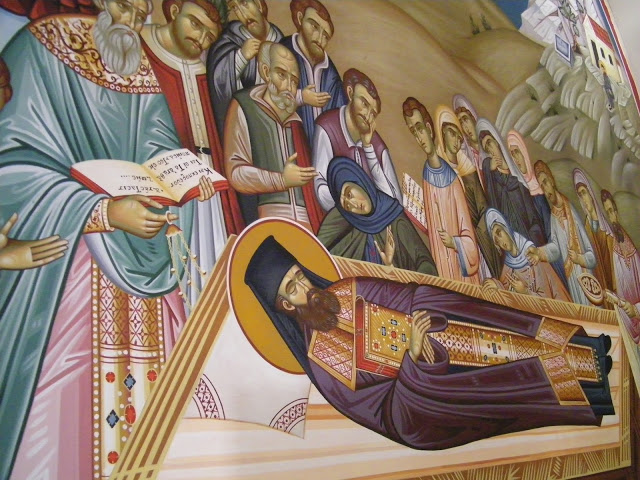
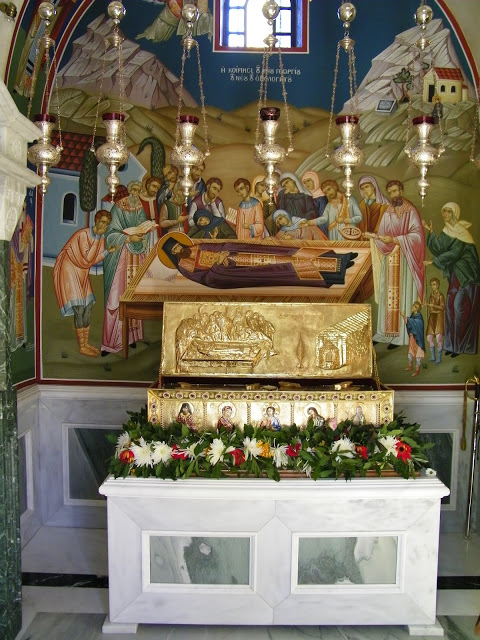
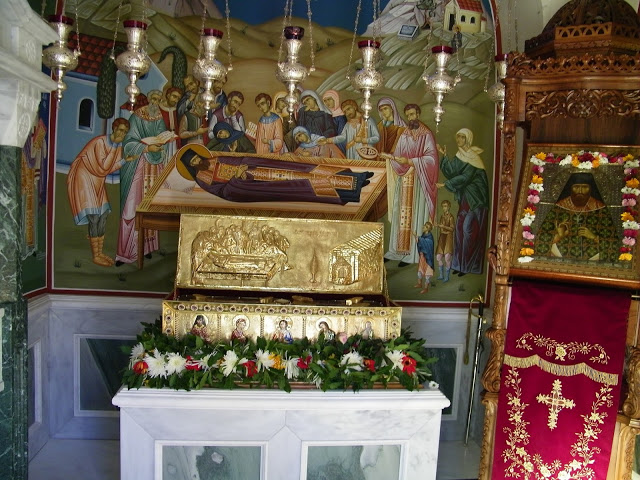
So, when they opened Gerontissa Theophano’s grave, her relics were fragrant and had the most amber color, by which it could be determined that her soul found salvation. A reliquary was made for her head which is now kept in the Monastery of the Archangel Michael on the island of Thassos.

Through the prayer of holy fathers, O Lord Jesus Christ, our God, have mercy on us!

[1] Gerondissa, the feminine form of geronda, is the Greek word used to denote respect for an abbess or female spiritual instructor.

[2] A piece of wood which monastics rhythmically beat to call the others to the services.

Source: Pravoslavie.ru

Noli Me Tangere

Magdalene and the Resurrected Lord, Byzantine icons and Western Art


Touch Me Not


Magdalene and the Resurrected Lord, Byzantine icons and Western Art

‘Touch Me Not’ theme in Byzantine Iconography and Western Art


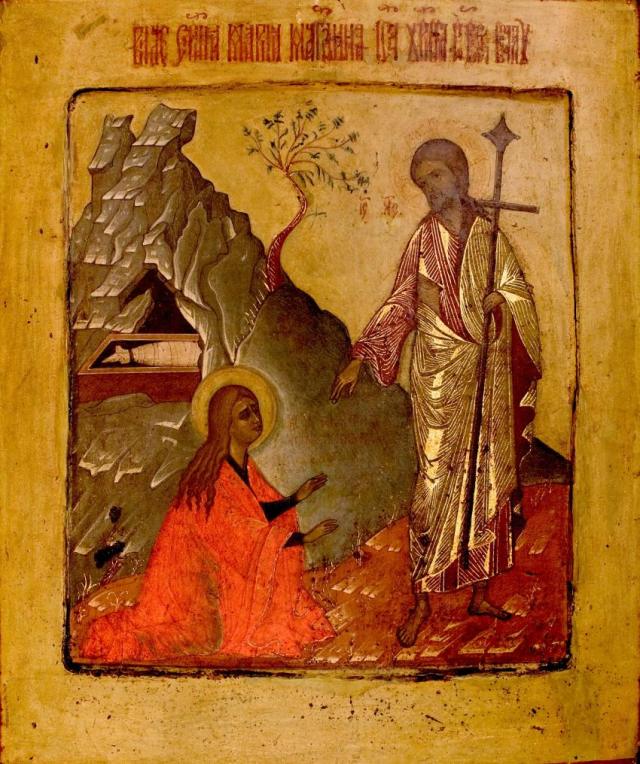
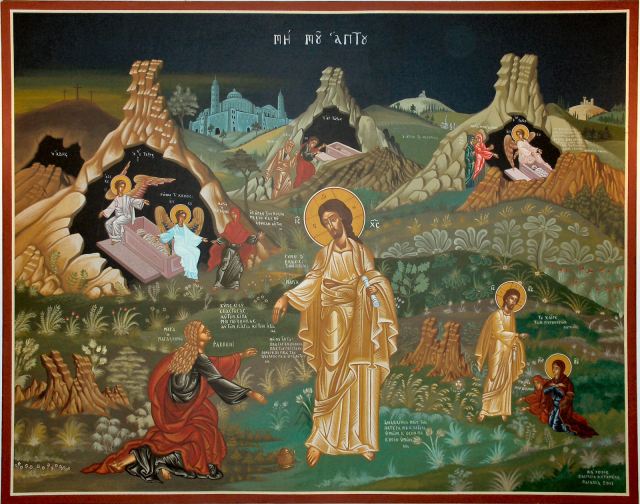
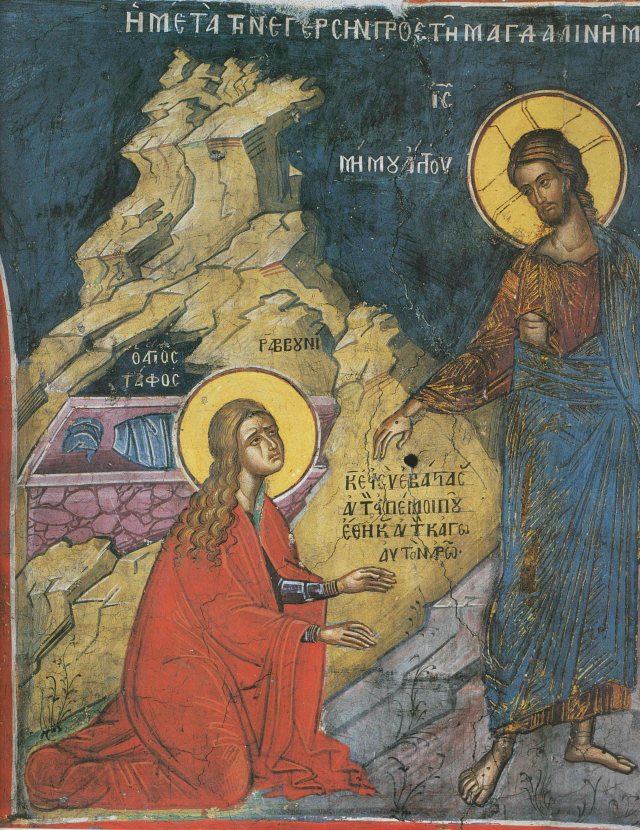
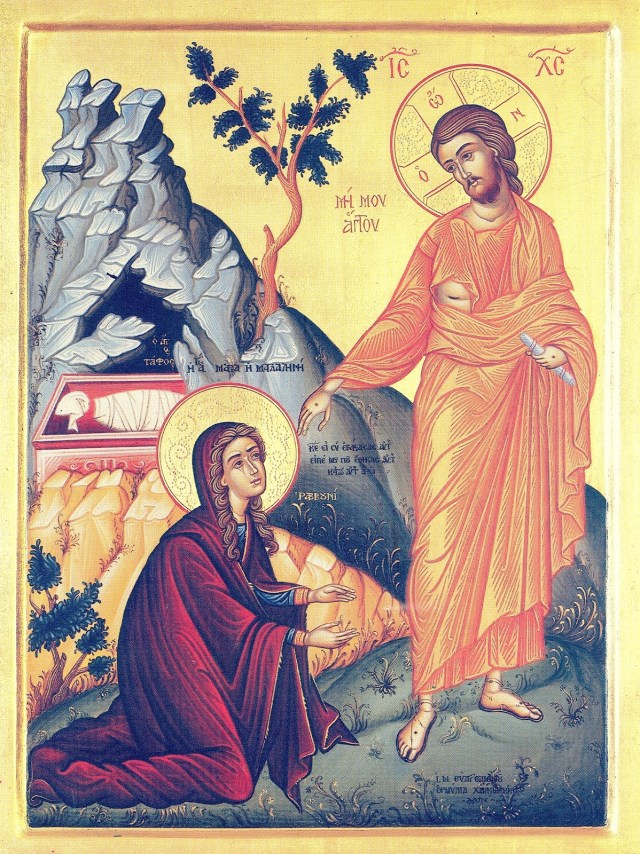
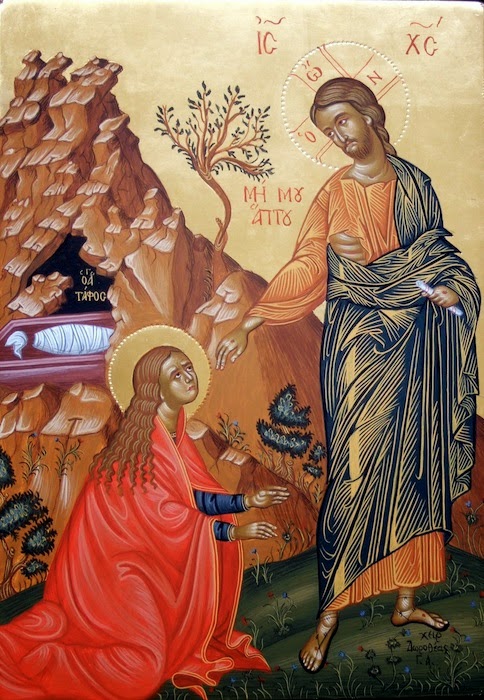
I must say right away that although I am an Art lover, I do not consider any of the paintings presented in the analysis below as either ‘beautiful’ or ‘Art’, let alone spiritual, in any sense. (Ok. probably the first three, the early Middle Ages, pass the mark) Their ‘fleshliness’ and ‘wordliness’ deeply offend and appall me. Just look at the corresponding Byzantine icons “Touch Me Not” (in Greek: Μη μου άπτου, Mi mou áptou), which show the appearance of the Resurrected Christ to Mary Magdalene as described in the Gospel of John :

Magdalene and the Resurrected Lord, Byzantine icons and Western Art

Magdalene and the Resurrected Lord, Byzantine icons and Western Art

Magdalene and the Resurrected Lord, Byzantine icons and Western ArtMagdalene and the Resurrected Lord, Byzantine icons and Western Art

Magdalene and the Resurrected Lord, Byzantine icons and Western Art

If the long flowing hair of a female Saint is considered (and rightly so) not common in Orthodox iconography, inappropriate for a number of reasons, and a borrowing from Western art of the time, how are we to feel with the Resurrected Jesus wearing a floppy sun hat ?!

*

Oh, the spirituality and ineffable, ethereal Beauty of Byzantine Art, especially its iconography! How movingly does Andrei Tarkovsky capture it in the concluding scene of Andrei Rublev!

*

*

Let us now turn to the original article and more about ‘my’ views on the matter in the coming week’s blog posts. Hopefully I should be able to explain better my mind as to why i do not consider such paintings ‘Art’, let alone ‘Sacred’.

*

“In his Gospel John records that on the Sunday morning following Jesus’s crucifixion, Mary Magdalene went to the tomb and, finding it empty, started to weep, for she thought someone had taken the body. In her worry and frustration, she “turned around and saw Jesus standing, but she did not know that it was Jesus . . . supposing him to be the gardener” (John 20:14–15). It isn’t until he says her name that she recognizes him.

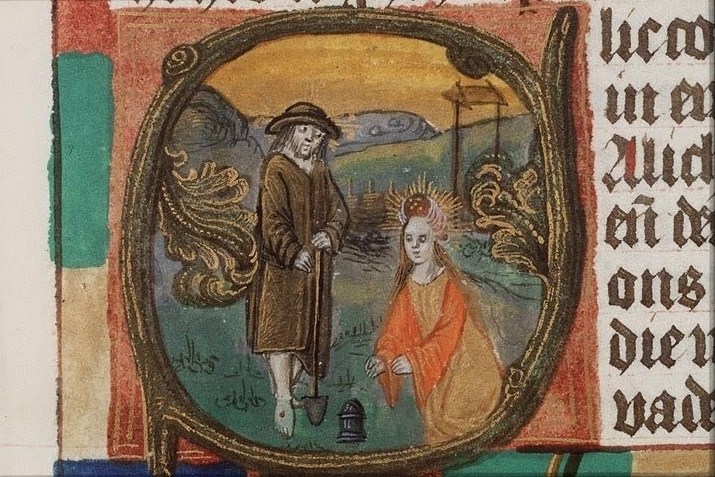
Artists—mainly from the fifteenth and sixteenth centuries—have latched onto this detail of mistaken identity, representing Jesus carrying gardening tools, like a shovel or a hoe, and sometimes sporting a floppy gardener’s hat. A few artists, such as Lavinia Fontana, Rembrandt, and the illuminators of the book of hours and passional shown below, have even shown Jesus in full-out gardener’s getup. (In her commentary on John, Dr. Jo-Ann A. Brant mentions that the fact that Jesus left his burial clothes in the tomb, coupled with Mary’s confusion, might provoke the “fanciful speculation” that Jesus actually borrowed the gardener’s clothes. Nevertheless, a different understanding is more likely behind the artistic representations; read on.)


Magdalene and the Resurrected Lord, Byzantine icons and Western Art
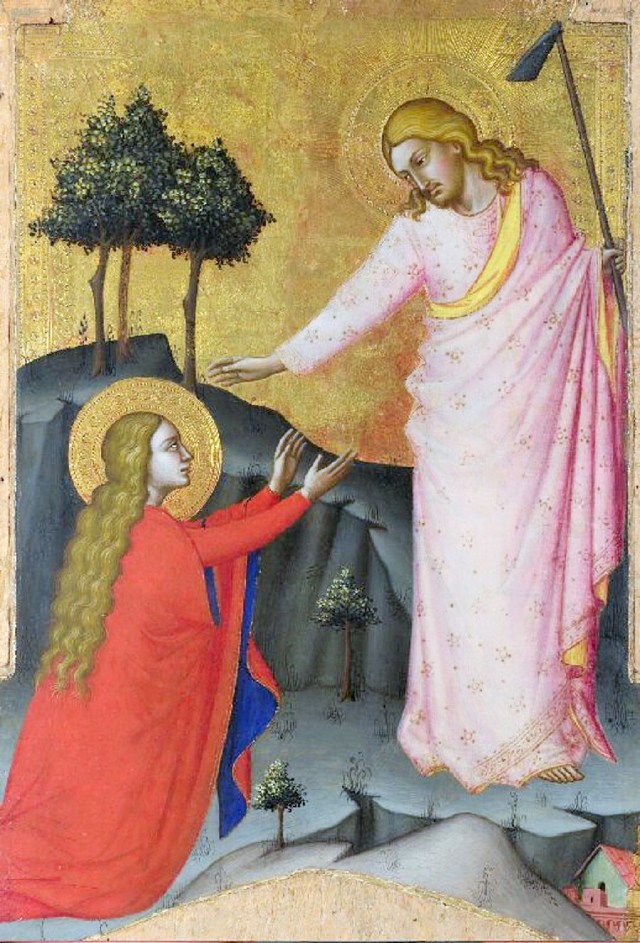
Attributed to Jacopo di Cione (Italian, 1365–1398/1400), Noli me tangere, ca. 1368–70. Pinnacle panel from a Florentine altarpiece, now in the collection of the National Gallery, London.
Magdalene and the Resurrected Lord, Byzantine icons and Western Art
Jesus Appears to Mary Magdalene, from a Biblia Pauperum (typological picture book), ca. 1405, Netherlands. British Library, London.
Magdalene and the Resurrected Lord, Byzantine icons and Western Art
Fra Angelico (Italian, ca. 1395–1455), Noli me tangere, 1440–42. Fresco from the convent of San Marco, Florence, Italy.
Magdalene and the Resurrected Lord, Byzantine icons and Western Art
Israhel van Meckenem (German, ca. 1445–1503), Noli me tangere, 1460–1500. Engraving. British Museum, London.
Magdalene and the Resurrected Lord, Byzantine icons and Western Art
Sandro Botticelli (Italian, 1445–1510), Noli me tangere, ca. 1484–91. Predella panel from an altarpiece from the convent of Sant’Elisabetta delle Convertite, Florence, Italy, in the collection of the Philadelphia Museum of Art.
Magdalene and the Resurrected Lord, Byzantine icons and Western Art
Master of the Dark Eyes, “Christ Appears to St. Mary Magdalene as a Gardener,” from The Hours of the Eternal Wisdom: Lauds (KB, 76 G 9), fol. 88r, ca. 1490. Koninklijke Bibliotheek (National Library of the Netherlands), The Hague.
Magdalene and the Resurrected Lord, Byzantine icons and Western Art
“Christ Appears to Mary Magdalene as a Gardener” (detail), ca. 1503–1504, England. Fol. 134v, Vaux Passional(Peniarth 482D), National Library of Wales.
Magdalene and the Resurrected Lord, Byzantine icons and Western Art
Noli me tangere, 16th century, Limoges, France. Enamel plaque, 27 × 19 cm.
Magdalene and the Resurrected Lord, Byzantine icons and Western Art
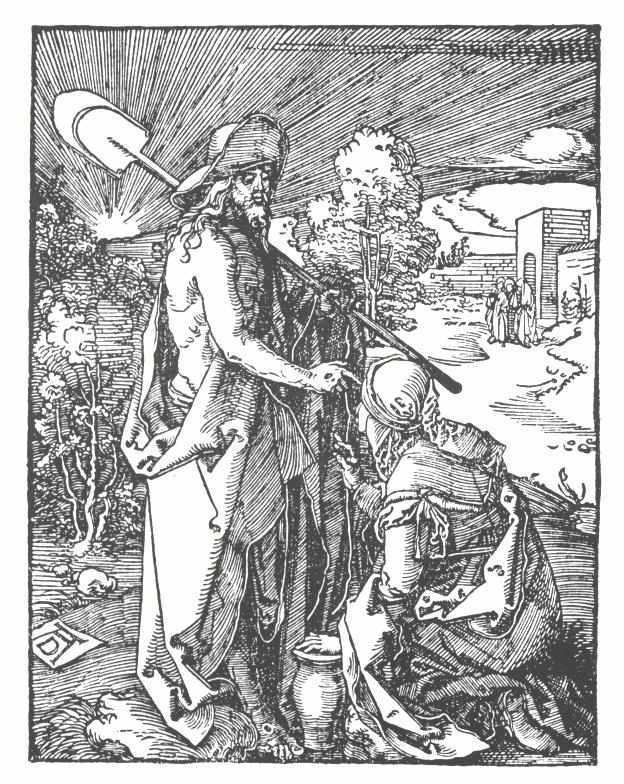
Albrecht Dürer (German, 1471–1528), Noli me tangere, 1511. Woodcut. British Museum, London.
Titian (Italian, ca. 1488–1576), Noli me tangere, ca. 1514. Oil on canvas, 110.5 × 91.9 cm. X-ray photographs show that Christ was originally painted wearing a gardener’s hat.
Magdalene and the Resurrected Lord, Byzantine icons and Western Art
Hans Baldung (German, ca. 1484–1545), Christ as a Gardener, 1539. Oil on canvas, 110.1 × 84.1 cm. Hessen State Museum, Darmstadt, Germany.
Magdalene and the Resurrected Lord, Byzantine icons and Western Art
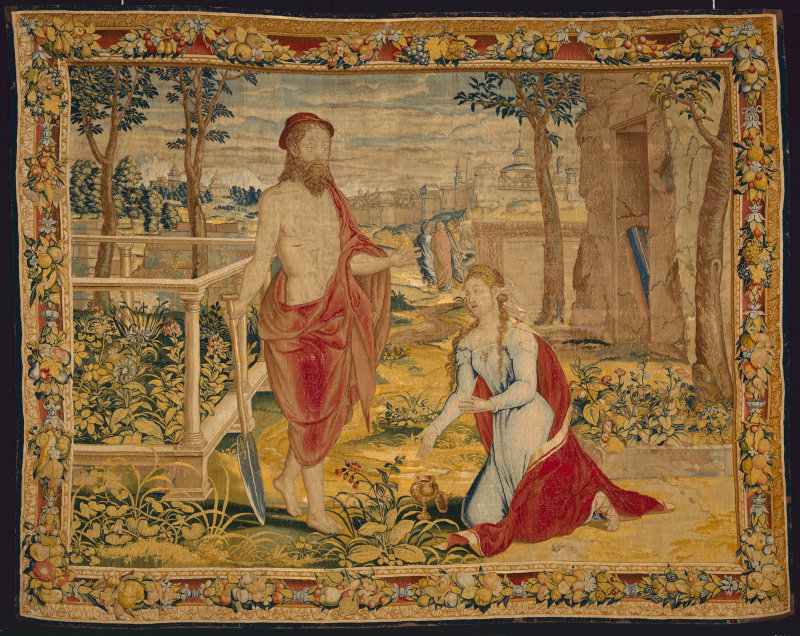
Christ Appearing to Mary Magdalene, 1540/45. Tapestry, 210.3 × 268 cm. Design attributed to Michiel Coxcie (Flemish, 1499–1592) or Giovanni Battista Lodi da Cremona (Italian, active 1540–1552). Woven in the workshop of Willem de Pannemaker (active 1515–ca. 1581). Collection of the Art Institute of Chicago.
Magdalene and the Resurrected Lord, Byzantine icons and Western Art
Noli me tangere, ca. 1560–70, Germany. Ink and wash on paper.
Magdalene and the Resurrected Lord, Byzantine icons and Western Art
Agnolo Bronzino (Italian, 1503–1572), Noli me tangere, 1561. Oil on canvas, 291 × 195 cm. Musée du Louvre, Paris.
Magdalene and the Resurrected Lord, Byzantine icons and Western Art
Lavinia Fontana (Italian, 1552–1614), Noli me tangere, 1581. Oil on canvas, 80 × 65.6 cm. Uffizi Gallery, Florence, Italy.
Magdalene and the Resurrected Lord, Byzantine icons and Western Art
Rembrandt van Rijn (Dutch, 1606–1669), Noli me tangere, 1638. Oil on panel, 61 × 49 cm. Royal Collection Trust, London.
Magdalene and the Resurrected Lord, Byzantine icons and Western Art
Noli me tangere by Edward Burne-Jones (design) and William Morris (execution), 1874. Bottom right stained-glass panel of the Vanderpoel Window, Trinity Church, Saugerties, New York.

The portrayal of Jesus as a gardener isn’t meant to suggest that Jesus was literally gardening that day—though he might have been, and that’s amusing to think of. Rather, it alludes to his role as one who “plants” us and grows us. He gets his hands dirty in the soil of our hearts, bringing us to life and cultivating us with care so that we flourish.

According to Franco Mormando, whose research involves the religious sources of Renaissance and Baroque Catholic art, Jesus the gardener was a traditional theme of orthodox scriptural exegesis and popular preaching that traces its origins to patristic times. In a 2009 article for America magazine, he writes,

Mary’s misidentification was meant to remind us, so the pre-modern exegetes taught, of a spiritual reality: Jesus is the gardener of the human soul, eradicating evil, noxious vegetation and planting, as St. Gregory the Great says, “the flourishing seeds of virtue.” Although today out of circulation, this teaching was disseminated in [the fourteenth through eighteenth centuries] in such popular, authoritative texts as Ludolph of Saxony’s Life of Christ (a book that played a crucial role in St. Ignatius Loyola’s conversion) and [starting in the seventeenth century] Jesuit Cornelius a Lapide’s Great Commentary on Scripture.

The Bible makes explicit the connection between God the Father and gardening. Genesis 2:8 tells us he was the world’s first gardener: “And the Lord God planted a garden in Eden, in the east, and there he put the man whom he had formed.” The prophets sometimes wrote of God’s gardening in a metaphoric sense—for example, in Isaiah 61:11: “For as the earth brings forth its sprouts, / and as a garden causes what is sown in it to sprout up, / so the Lord God will cause righteousness and praise / to sprout up before all the nations.” Or Jeremiah 24:6, in which God says of the exiles from Judah, “I will build them up, and not tear them down; I will plant them, and not pluck them up.” Furthermore, Jesus’s parable from John 15 casts God as a vinedresser.

John’s Gospel, though, goes even further to ascribe this role to Jesus, and to present his resurrection as the genesis of something new. For example, the prologue to his Gospel starts, “In the beginning . . . ,” an obvious echo of the prologue to Genesis. In 19:41 he mentions that Jesus was buried in a garden, and in chapter 20, that he was found walking around in it. He mentions twice that Jesus rose on “the first day” of the week, as if this were the first day of a new creation (cf. Genesis 1:35). And then he has Mary mistake Jesus for the gardener. When taken in concert with Paul’s conception of Jesus as the Second Adam (Romans 5:12–211 Corinthians 15:21–22, 45), these allusions suggest that Jesus is the gardener of the new Eden, doing what Adam could not do. His resurrection broke ground in this garden, marking the beginning of a massive restoration project.

That’s why Jesus is so often found toting a shovel in the resurrection art of Renaissance and Baroque Europe. He is the caretaker of humanity, bending down to bring us up, to make us full and healthy and beautiful. Charles Spurgeon preached a sermon on the topic back in 1882, in which he declares,

Behold, the church is Christ’s Eden, watered by the river of life, and so fertilized that all manner of fruits are brought forth unto God; and he, our second Adam, walks in this spiritual Eden to dress it and to keep it; and so by a type we see that we are right in “supposing him to be the gardener.”

More recently, Andrew Hudgins—inspired by the imagination of visual artists—wrote a poem called “Christ as a Gardener.” You can read it in full here.

I’m curious to know whether any modern artists have exegeted John’s text in the same way—that is, portraying Jesus as a gardener in his appearance to Mary Magdalene. Besides a pen, brush, and chalk work by Anton Kern, done in a Baroque style, I am aware of only a few, the first of which is Graham Sutherland’s 1961 altarpiece in the St. Mary Magdalene Chapel of Chichester Cathedral. Commissioned by Walter Hussey, one of the twentieth century’s most important patrons of sacred art, Graham Sutherland painted two versions of Noli me tangere. Hussey chose the one that shows a door opening out into a garden and Christ wearing a sun hat made of straw, pictured below. (Click here to see a longer shot of the painting in its chapel context.) The alternate version is in the Pallant House Gallery, also in Chichester.

Magdalene and the Resurrected Lord, Byzantine icons and Western Art
Graham Sutherland (British, 1903–1980), Noli me tangere, 1961. Oil on canvas. St. Mary Magdalene Chapel, Chichester Cathedral, England.

Back in 2010 Jyoti Sahi posted an oil painting on his blog along with three others under the heading “The Resurrection.” I think the signature says 1987, but it’s hard to tell, as it’s cut off in the photo. In it Jesus carries an oversize scythe while Mary anoints his feet, just as she had done a week earlier, when she had shed tears in anticipation of his death (John 12:1–8). The outline around her is reminiscent of a kernel of wheat.

Magdalene and the Resurrected Lord, Byzantine icons and Western Art
Jyoti Sahi (Indian, 1944–), The Resurrection. Oil on canvas.

Most people associate scythe-wielding figures in art with the Grim Reaper—that is, Death—due to an iconography that stretches all the way back to the fourteenth century. But the Bible associates scythes with Jesus, the lord of the harvest (Matthew 3:12Matthew 13:2430Revelation 14:14–20), the harvest being the end of the world. Only those who have rejected Jesus need fear his Second Coming, for those who have grown in his word will be gathered up into heaven. This painting in particular reminds me of Psalm 126:5: “They that sow in tears shall reap in joy”—a beautiful song of ascents that has been set to music by, among others, Bifrost Arts. Mary had wept penitently over her sin, and then later over the impending execution of her Lord, and still again at his grave, but now, because of his Resurrection, she enters into his presence with shouts of joy, and even more cause for worship.

Lastly, He Qi’s Do Not Hold On to Me from 2013 also references the Jesus as gardener metaphor, but because the head of the shovel isn’t visible, it’s not as obvious.

Magdalene and the Resurrected Lord, Byzantine icons and Western Art
He Qi (Chinese, 1950–), Do Not Hold On to Me, 2013. Oil on canvas.

Do you know of any artworks from recent times that take on this theme?

*

Our Lady of Kipina


kipina39kipina38kipina36kipina35kipina34kipina33

kipina23kipina32kipina31

kipina37kipina28

kipina19


kipina26


kipina11

kipina13

kipina8

kipina6

kipina4

kipina2kipina1kipina16

kipina21

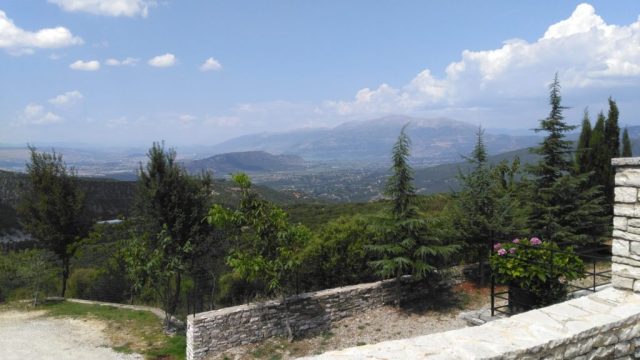
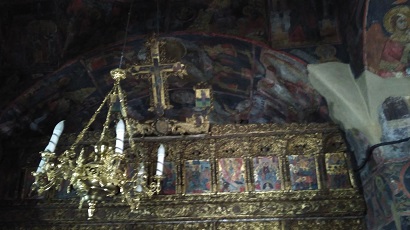
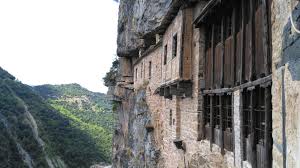
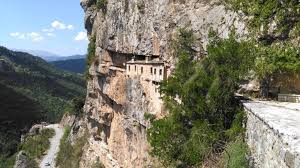
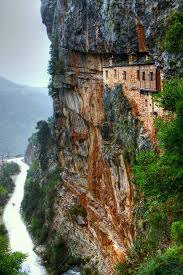
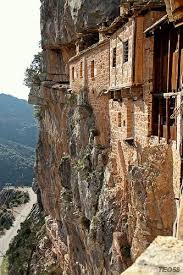
If you go towards the old-world village of Kalarrytes in the Tsoumerka Mountains in Epirus, you come across an impressive fortified monastery built into a rock face: the Holy Monastery of Our Lady of Kipina.


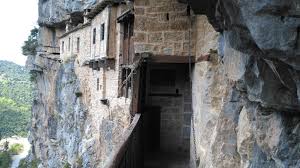
The Holy Monastery of Kipina is built into a large cave in a sheer rock.


According to the founder’s inscription, building began in 1349. But according to Metropolitan Serafeim (Vyzantio) of Arta, a historian, the foundation dates back further in time. Other historical sources date it to 1212.


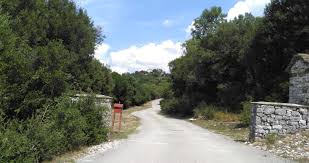
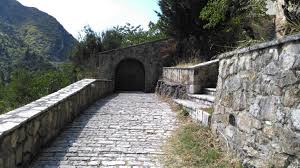
Access to the Monastery is by a stone path hewn into the rock. In former times, contact could be broken by means of a wooden drawbridge.

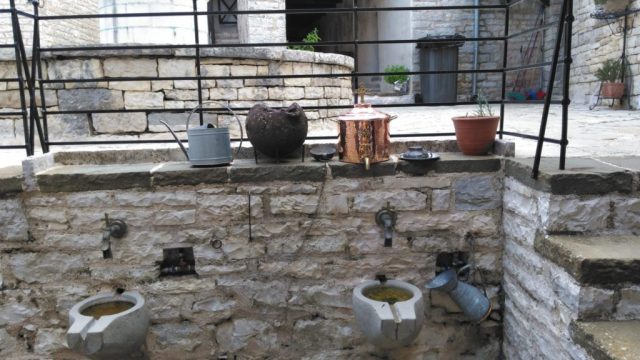
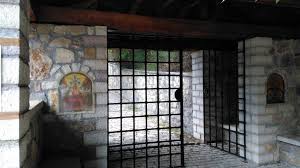
The outer gate of the monastery.


Without doubt, the time when the Monastery of Kipina was at its peak was the 18th century. Indeed, it’s recorded that, in 1760, the exceptionally active Abbot Kallinikos funded the construction of a bridge over the nearby River Kalarrytikos, a tempestuous tributary of the Arakhthos.


The Monastery also ran a school and a water-mill. All of this shows both the financial power of the foundation and also the close links with its social setting.


The imposing rock casts its shadow over the steps of visitors, next to the path to the entry.


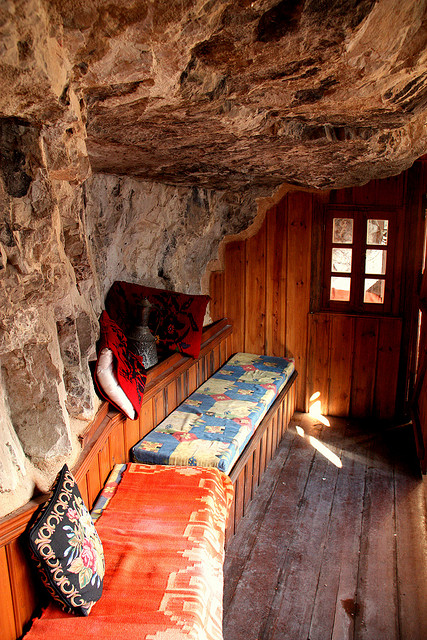
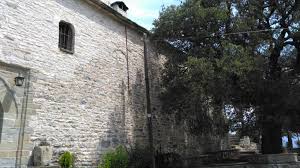
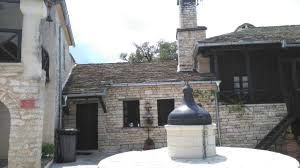
Still surviving from the old Monastery complex are the church, four cells and a small building which used to serve as a stable.


In the olden days, the drawbridge would be raised at night or at times of danger. Access to the Monastery was thus completed severed, which is why it is one of the few that escaped pillage. The crank handle of the drawbridge has been preserved.


The Monastery is dedicated to the Dormition of the Mother of God. According to tradition, however, it celebrates on the feast of the Life-Receiving Spring (Friday in the week after Easter).


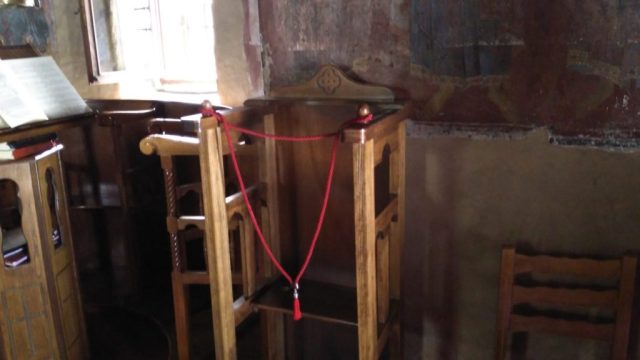
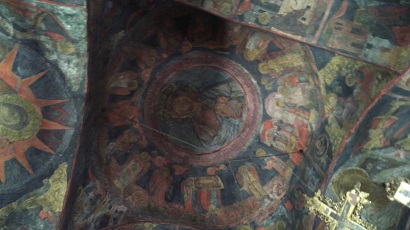
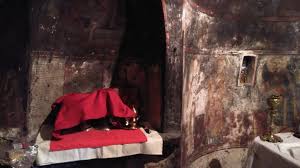
The church is a small, single space, built within the cave.


The rich iconographical decoration of the church was carried out in the 18th century.


At the northern end of the narthex is the opening to the cave, which extends to a depth of 240 metres into the rock.

Today’s Abbesses of Abbesses

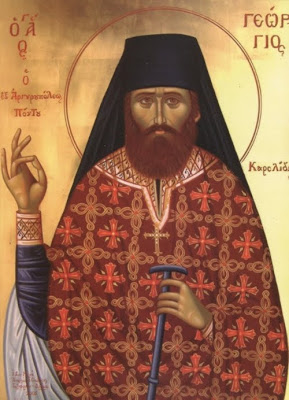
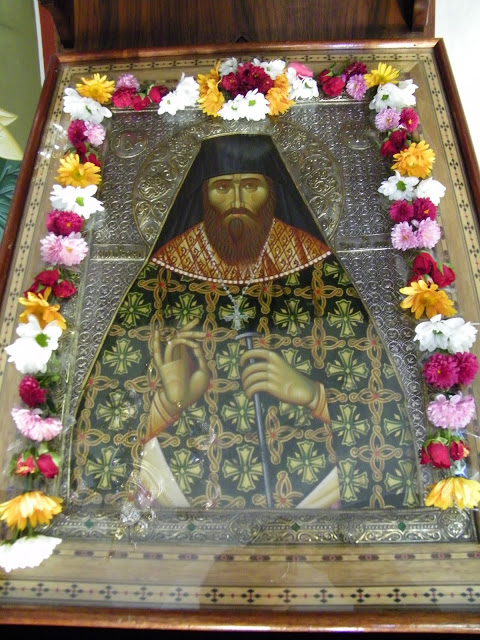
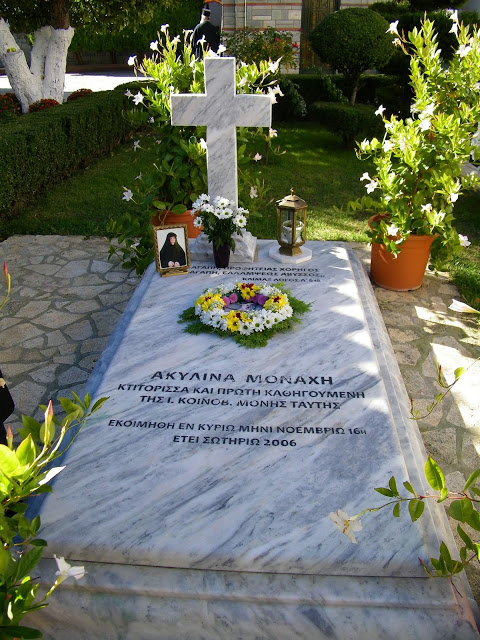
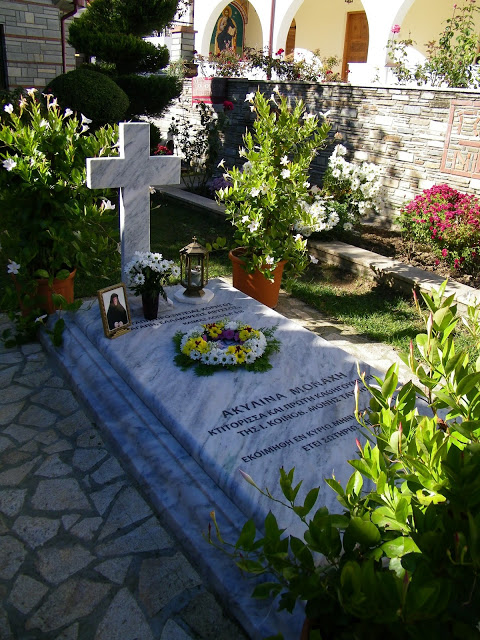
Gerondissa Akylina, Porphyria, Sipsa Monastery and St. Georgios Karslidis

Gerondissa Akylina, Gerondissa Porphyria (Sipsa) and Gerondissa Makrina (Portaria)

Friday, November 4, feast day of the Blessed Elder Georgios Karslidis of Pontos, warmed my heart with fond memories of nearly 3 decades of pilgrimages to beautiful, gem monasteries in Northern Greece!

 *

“God cares for everyone. Despair is in effect a lack of faith.”


Gerondissa Akylina, Porphyria, Sipsa Monastery and St. Georgios Karslidis


Taxiarches and the Analipseos Monastery (Sipsa) in Greece is one of the Monasteries in Greece that holds a dear place in my heart. Together with that of St. Paisios in Souroti, they were the first monasteries I started visiting as a University student, before my graduate studies and work at the US. At that time Gerondissa Porphyria, a Living Signpost in my journey on The Way,  had not even become a monastic, and now she is a renowned Abbess, one of the few of her ‘calibre’ in contemporary women’s monasteries.


Gerondissa Akylina, Porphyria, Sipsa Monastery and St. Georgios Karslidis


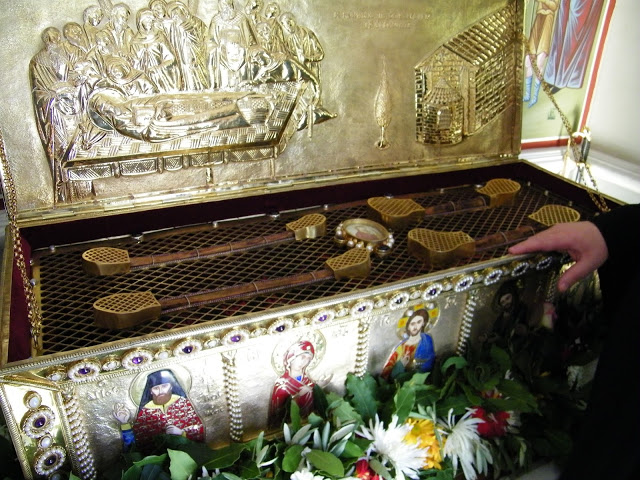
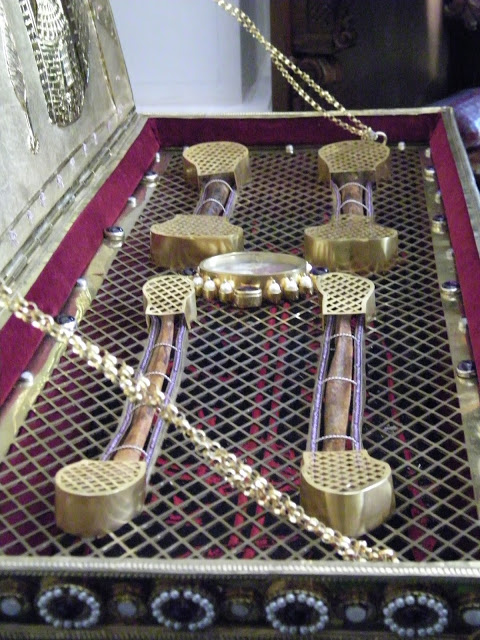
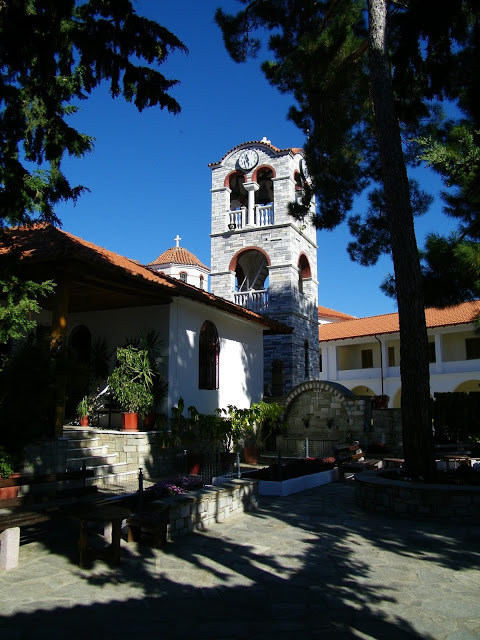
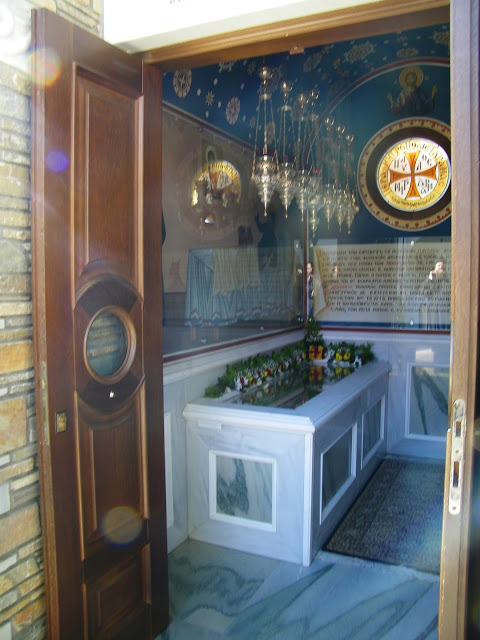
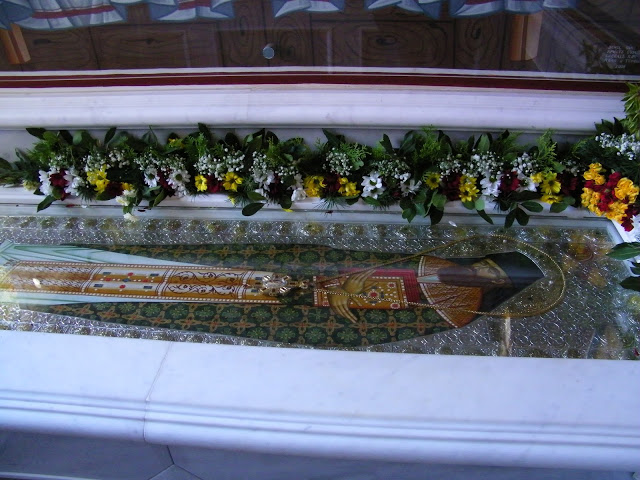
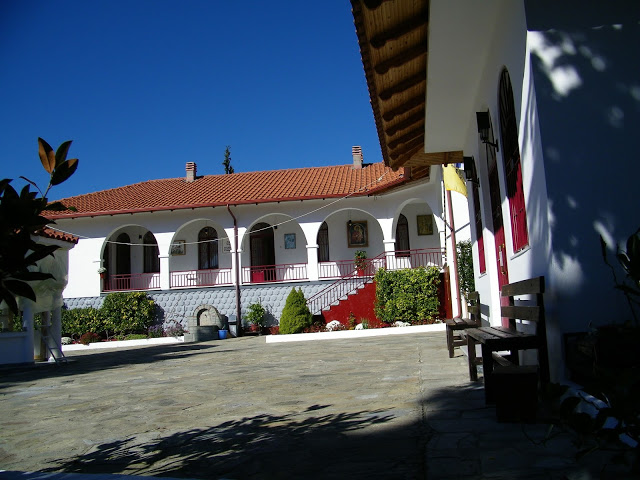
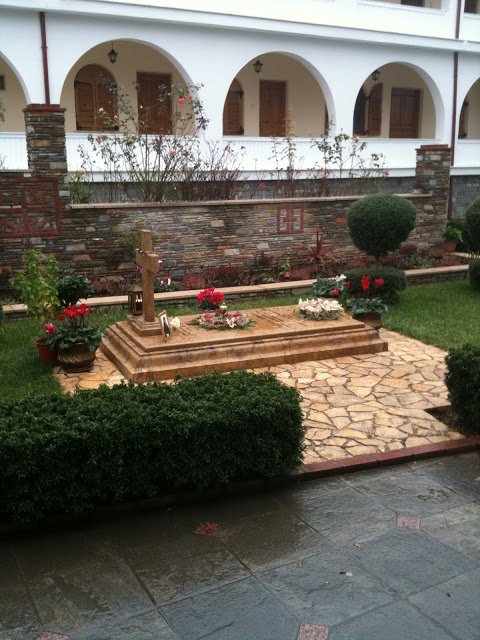
The Blessed Elder Georgios Karslidis of Pontos (1901-1959), latter day saint of the Saintly Orthodox Church in Greece,  glorified by the Patriarchate of Constantinople in 2008, was the first “resident” and founder of the monastery in the year 1930. He is one of few saints known to bear an imprint of the sign of the cross on his skull. There is a flourishing multitudinous sisterhood of nuns here today, who occupy themselves with the Iconography of handheld pictures, gold embroidery,knitting and waxwork.


Gerondissa Akylina, Porphyria, Sipsa Monastery and St. Georgios Karslidis


Gerondissa Akylina, Porphyria, Sipsa Monastery and St. Georgios Karslidis


Gerondissa Akylina, Porphyria, Sipsa Monastery and St. Georgios Karslidis


Gerondissa Akylina, Porphyria, Sipsa Monastery and St. Georgios Karslidis


Gerondissa Akylina, Porphyria, Sipsa Monastery and St. Georgios Karslidis


Gerondissa Akylina, Porphyria, Sipsa Monastery and St. Georgios Karslidis


Gerondissa Akylina, Porphyria, Sipsa Monastery and St. Georgios Karslidis


Gerondissa Akylina, Porphyria, Sipsa Monastery and St. Georgios Karslidis


Gerondissa Akylina, Porphyria, Sipsa Monastery and St. Georgios Karslidis


Gerondissa Akylina, Porphyria, Sipsa Monastery and St. Georgios Karslidis


Gerondissa Akylina, Porphyria, Sipsa Monastery and St. Georgios Karslidis


Gerondissa Akylina, Porphyria, Sipsa Monastery and St. Georgios Karslidis


Gerondissa Akylina, Porphyria, Sipsa Monastery and St. Georgios Karslidis


Gerondissa Akylina, Porphyria, Sipsa Monastery and St. Georgios Karslidis


Gerondissa Akylina, Porphyria, Sipsa Monastery and St. Georgios Karslidis


Gerondissa Akylina, Porphyria, Sipsa Monastery and St. Georgios Karslidis


Gerondissa Akylina, Porphyria, Sipsa Monastery and St. Georgios Karslidis


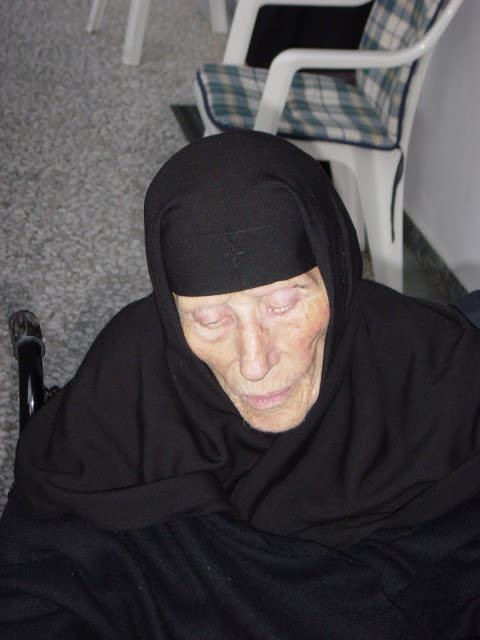
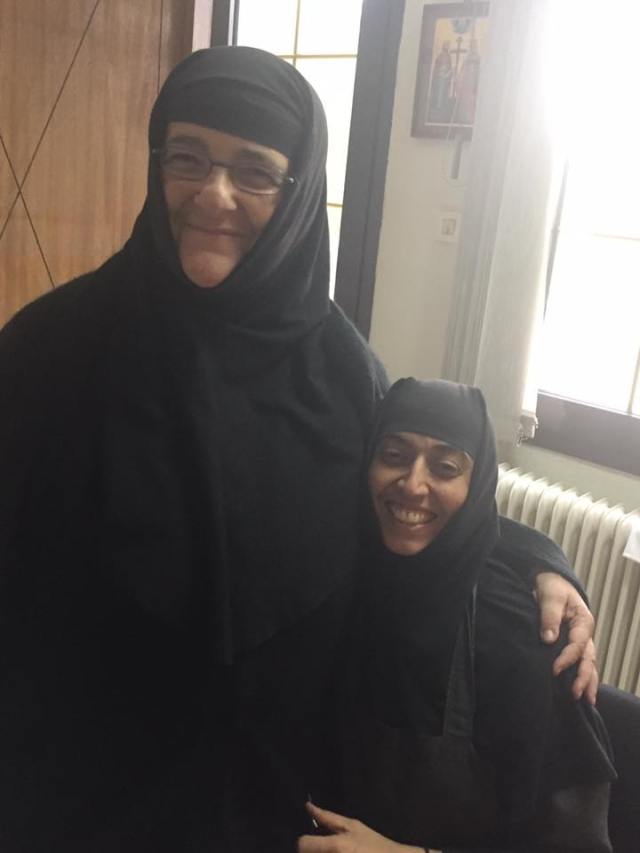
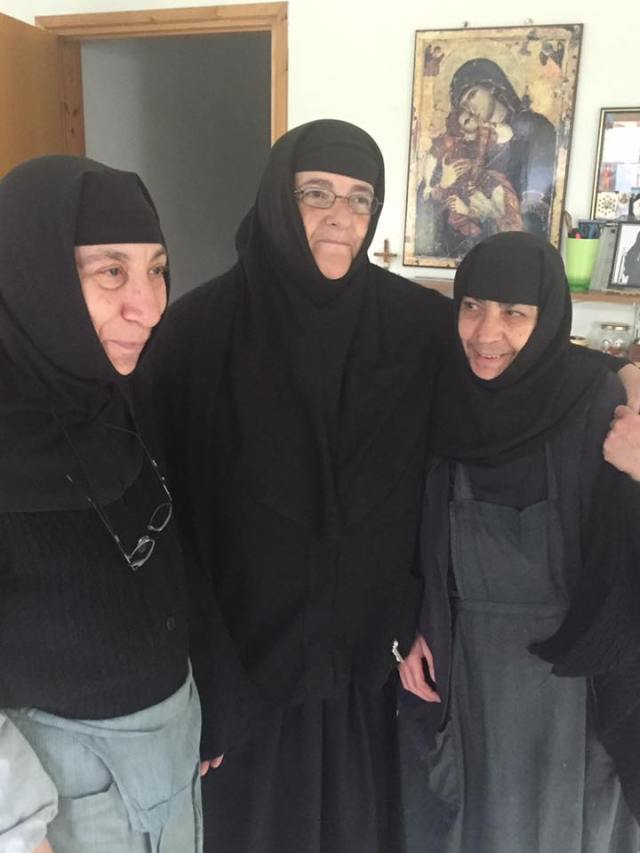
Gerondissa Akylina was the first Abbess. I had the rare blessing to meet her a number of times during the last years of her life. In the words of our late Elder Iosif Vatopaidinos, Gerondissa Akylina, together with Gerondissa Makrina in Portaria, were ‘Abbesses of Abbesses’:  examples of the monastic life and their monasteries models of coenobia, workshops of virtue and antechambers of Paradise.


Gerondissa Akylina, Porphyria, Sipsa Monastery and St. Georgios Karslidis


Gerondissa Akylina, Porphyria, Sipsa Monastery and St. Georgios Karslidis

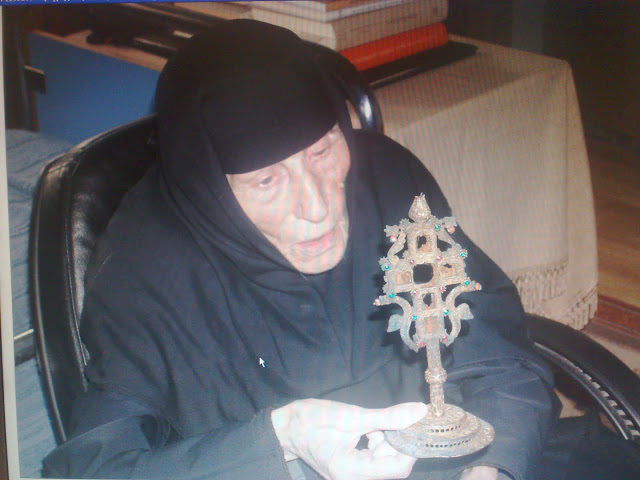
Gerondissa Akylina holding the Cross of St. Georgios Karslidis which was found intact after the translation of his relics. He is one of few saints known to bear an imprint of the sign of the cross on his skull.


Gerondissa Akylina, Porphyria, Sipsa Monastery and St. Georgios Karslidis


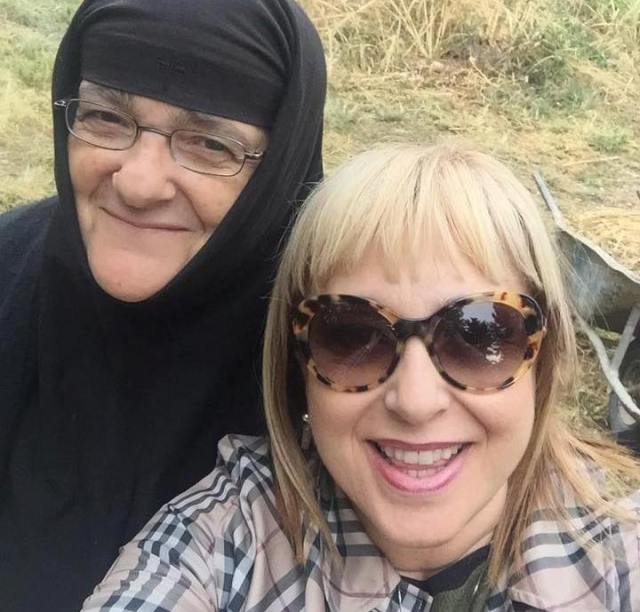
Gerondissa Porphyria has always been so full of love and humility, always ready to sacrifice her ease,  her rest and sleep, everything for her ‘neighbour! How many times has she consoled me in the trials and tribulations of my life! Always by my side, always! How many times has she offered a shoulder to cry on and precious, practical counsel! Her prayerful presence is intensely, intimately felt even thousands of miles away, here at the UK, and her smile warms my heart. Oh, just look at her smile in the photographs below with a pilgrim at the monastery and imagine the rays of the sun warming your shoulders after a rainy, cold day! How blessed am I to have such a spiritual mother by my side! Over the years I got better acquainted with the friendly and hospitable nuns there and the pilgrims and the faithful who regularly visit this monastery. St. Georgios’ holy presence is immediately felt upon entering the monastery gate, and there is always a queue at his tomb where his spiritual children kneel before their spiritual father, now in Heaven, to ask for his spiritual guidance and to seek comfort in life’s trials and tribulations.
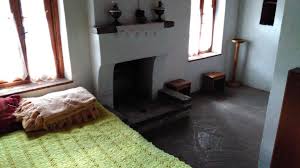
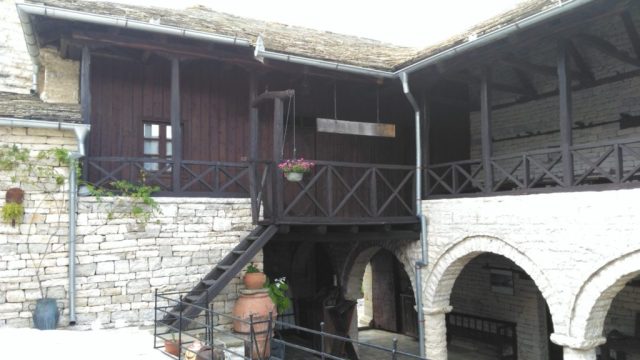


For a closer insight at Elder Georgios Karslidis and his miracles, watch the following interview by Gerontissa Porphyria:


Finding the Faith of Joseph of Arimathea

icon7

An Interview with Fr. Jonathan Hemmings

The tradition of faith in Great Britain goes back to the Apostolic era!

by Tudor Petcu

A Romanian writer, Tudor is a graduate of the Faculty of Philosophy, University of Bucharest, Romania. He has published a number of articles related to philosophy and theology in different cultural and academic journals. His work focuses on the evolution of Orthodox spirituality in Western societies as well and he is going to publish a book of interviews with Westerners converted to Orthodoxy. In this article, he interviews Fr. Jonathan Hemmings, Orthodox theologian, who is the priest of the Holy Life-Giving Cross Orthodox Church in Lancaster, UK, talks about faith and love in Christ.

1.) Before discussing your conversion to Orthodoxy, I would appreciate it a lot if you could talk about your main spiritual experiences and journies untill you have discovered the Orthodox Church.

First of all, we need to be sure of what we mean when we use the term convert or “conversion.” We all need to be converted – both those who come from different traditions and confessions and those from traditionally Orthodox countries who are referred to as “cradle Orthodox”. Christianity is not a Philosophy, it is a relationship with the All Holy Trinity. We are converted to Christ and we are received into the (Orthodox) Church through Baptism and/or Chrismation. Sometimes this happens in the other order of events. Those who are Baptised Orthodox as babies need to employ the gift of the Holy Spirit given to them; those who are called to the Orthodox Christian faith are prompted by the same All Holy Spirit. As Metropolitan Kallistos said

“We Orthodox know where the Holy Spirit is but we cannot say where He is not.”

As scripture says

“the Holy Spirit moves where He wills.”

One has to experience the Orthodox Church either through her Liturgy or through the “living signposts of the faith” whom God sets before us if we are open to the Truth. By “ living signposts” I mean men and women who possess grace and in whom we see the light of Christ. Christianity in the west tends to be analytical and logical, Eastern Christianity is synthetic and mystical and engages the whole of our being.

You shall love the Lord your God with all your mind with all your strength, with all your heart and with all your soul.

The fact that we do metanoias (reverences or bows) shows that even prayer is a physical as well as a mental process. I have always believed in God, from a little child. I cannot remember a time when I did not believe in God. I had the right Christ, I just needed the right Church. Of course all this was a preparation for me to discover or rather recover the Orthodox faith.

2.) How would you characterise your own spiritual road to Orthodoxy? According to this question, would it be correct to say that Orthodoxy is able to heal the wounded souls?

I am like the Prodigal son in the parable who returns to his father. The Orthodox faith according to tradition was brought to Britain by St Joseph of Arimathea. An early Archbishop of Canterbury was Greek- St Theodore of Tarsus.  St Constantine the Great was made Augustus Emperor here in York when he was in charge of the sixth Legion. So I did not choose to find something “foreign”; I returned to the Church which was established here in Britain.

The Orthodox Church is Universal as we proclaim on the Sunday of Orthodoxy. The Church is the hospital for souls. As Blessed Augustine said

“Our hearts are restless until they find their rest in God”

Restlessness of the spirit is a characteristic of this age. So I have not discovered something new, I have recovered something authentic and original.

3.) Considering all what you have experienced over the years from the spiritual point of view, why is Orthodoxy so precious and meaningful to you?

Well, I believe Orthodoxy is not only original, unchanged and authentic but it is the teaching and preaching of Christ’s Apostles (Kerygma and Paradosi). Tradition is not simply historical, it is vital and dynamic. The Orthodox way fulfils the needs of the whole person and makes the broken person whole. It is precious because it is the

“pearl of great price.”

Once you find it, then you must share this treasure with others and not keep it to yourself.

4.) Do you think that Orthodoxy could be considered a burning bush?

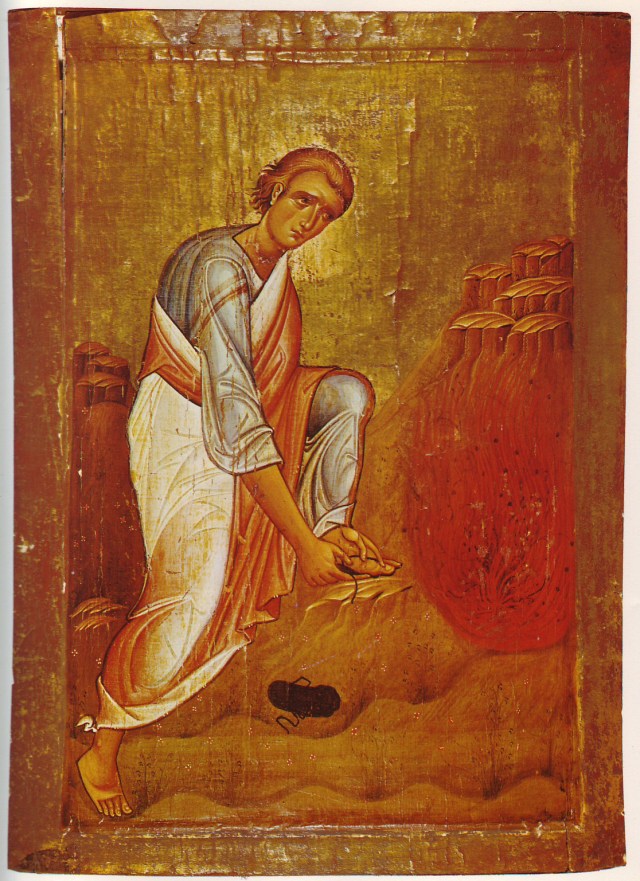
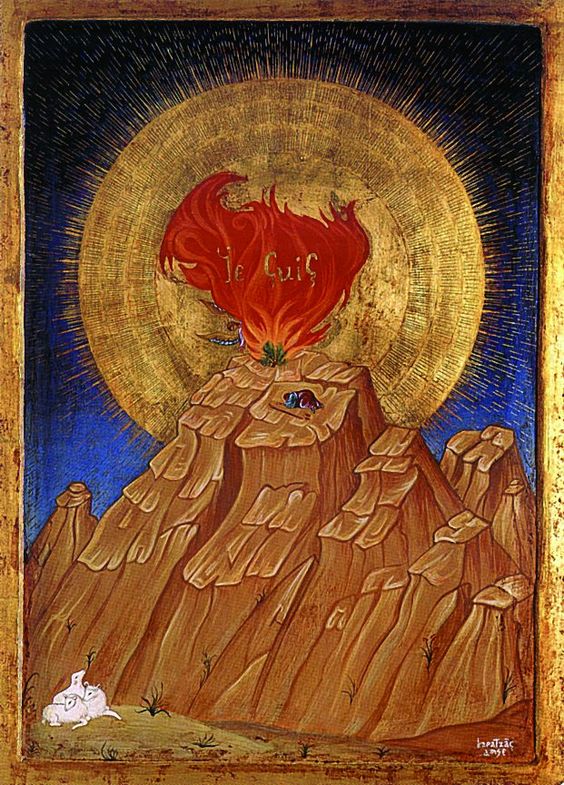
4. I have a stone from Mount Sinai which contains the image of the bush which Moses saw burning and yet which was not consumed. If you want to forge metal, you must first heat it and out it into the fire and then you can shape it to the tool you require. When we are put into the fire of God, the same happens. It is so God can shape us into the person that He has called us to be. When we are alive in God then we become all flame. We are standing on holy ground, so when we approach God we must do so with awe before the majestic power of God.

5.) Now, I would like you to tell me what does the Orthodox monasticism mean for you and what impressed you most in your monastic pilgrimage, if I can call it like that?

5. Orthodox Monasteries are “LightHouses” for souls. They are often remote and inaccessible because the quietness for the soul requires asceticism . They are full of angels because the angelic life is lived there. When we say in the Lord’s Prayer

“Thy kingdom come on earth as it is in heaven”

then this is what monks are doing. The very walls of the Churches are filled with prayer and so one can feel tangibly the peace of God. It is this peace which passes all understanding that one experiences. Again I say that Orthodoxy is Life in the sense that we experience it, we live it. I have been to many Orthodox Monasteries in Romania. The most memorable moments are when I met Pr Ioanichie Balan in Sihastria Monastery and when I served the Holy Liturgy with Pr. Teofil Paraian( the blind Staretz) at Sambata de Sus. These were moments when the veil between heaven and earth was very thin.

6.) What would be the difference between you as a heterodox and you as an Orthodox?

I am complete. When Our Lord died on the Cross he said in St John’s Gospel

“It is finished”

but this also means

“It is completed”

that is, the work of salvation. In this sense “conversion” is an extension of what I once was. As C. S. Lewis (much respected by Orthodox) once put it

“Imagine yourself as a living house. God comes in to rebuild that house. At first, perhaps, you can understand what He is doing. He is getting the drains right and stopping the leaks in the roof and so on; you knew that those jobs needed doing and so you are not surprised. But presently He starts knocking the house about in a way that hurts abominably and does not seem to make any sense. What on earth is He up to? The explanation is that He is building quite a different house from the one you thought of – throwing out a new wing here, putting on an extra floor there, running up towers, making courtyards. You thought you were being made into a decent little cottage: but He is building a palace. He intends to come and live in it Himself.”

C.S. Lewis, Mere Christianity

As I have said before, I have always loved God but the depths of Orthodoxy provide me with the resources that nourish my soul.

7.) I remember some words which impressed me much while I was discussing with a Swiss writer converted to Orthodoxy. He was saying that he was born to hate but through Orthodoxy reborn to love. How would you characterise these words as a convert to Orthodoxy?

We were all born to love. Christ summarised the Commandments as Loving God and Loving your neighbour. Orthodox Christianity can be summarised in these words. But love is a verb… we must put into action those things which we believe. I am sure the prisons in Romania are full of criminals who would call themselves Orthodox and who have been baptised as such, but sin found a place in their hearts. Glory to God he is merciful and loves mankind! And so we must live out our life in peace and repentance. Being Romanian does not make you Orthodox anymore than being Greek, Russian, Serb or British. There was no ethnic identity in the Garden of Eden before Adam and Eve’s transgressions. May the love of God embrace us all.

This interview is one of many that will be published in the book “The rediscovery of Orthodox heritage of the West” by Tudor Petcu, containing interviews with different Westerners converted to Orthodoxy. It will be published in two volumes and the first one will appear by the end of this year.

Journey to Orthodoxy

Ravages of Time

Destruction Of Monuments Of Eastern Christianity: A Photo Contest

The Interparliamentary Assembly on Orthodoxy announced the results of their second annual photo contest dedicated to the “Destruction of Monuments of Eastern Christianity.”

The contest, dedicated to the enduring spiritual and cultural monuments of the Eastern Christian Tradition, was organized at the proposal of the IAO’s Committee of Culture and in collaboration with the website OrthoPhoto.net, sharing beautiful photos from around the Orthodox world for twelve years.

Ravages of Time, Nature and Man

The international jury voted on photos divided into three categories:

  1. Abandoned monuments left to the ravages of time due to compulsive or voluntary discontinued usage
  2. Monuments that are accessible and in use, although damaged by weather or other sorts of pollutants and other natural elements
  3. Monuments that have suffered man-made damage and destruction.

Photos were judged on artistic value, as well as information about the monument, including its importance, location, and accessibility. Three prizes were awarded in each of the three categories. The winning photographs are:

Abandoned monuments left to the ravages of time due to compulsive or voluntary discontinued usage

First prize: The Church of the Nativity of the Theotokos in the village of Stepantsikovo in the Yaroslavl region of Russia, by Nikolay Spiridonov

Winning photograph:

Supplementary photographs:

The church made of bricks, with two altars, with a St. Nicholas’ chapel. The cost for its erection was covered by the parishioners on the spot of the old wooden church (seventeenth century). It is square-shaped, with five cupolas, two series of windows, an altar and a multi-level bell-tower. During the Soviet era, it was closed down and used as a storehouse. Currently, it is abandoned and destroyed. Up until 1764, the village was an estate owned by the monastery of Saints Boris and Gleb of Rostov.

Second prize: The Churches of St. Demetrios and St. George of the Castle on Aegina, Greece, by Nikolaos Mourtzis

Winning photograph:

Supplementary photographs:

At the top of Paleochora hill on Aegina, the so-called ‘small Mystras’, is a castle built by the Venetians in 1654 and two large interconnected churches, the Twin Basilicas with two altars-entrances, of Saint Demetrios and Saint Georgios of the Castle, one for the Latin Catholics and one for the Greek Catholics. For pedestrians visiting the place, the view is fantastic; the area of Souvala and Aegina (the town) can be seen from there. The signs of abandonment are visible, although occasional efforts have been made to save them.

Third prize: The Church of St. Mary of Sinti in Paphos, Cyprus, by Tomasz Mościcki

Winning photography:

The Panayia tou Sindi Monastery was built in the sixteenth century. Only the main church has remained. The rest of the monastery is almost completely dilapidated.

* * *

Monuments that are accessible and in use, although damaged by weather or other sorts of pollutants and other natural elements

First prize: The Ampouchala cloister in the Karelia region, on the northern slope of the Trialeti Range in Georgia, by Vakhtang Beridze

Winning photograph:

Supplementary photographs:

Abukhalo Skete is mentioned in the “History of the Kingdom of Georgia” by Vakhushti Bagration. The monastic compound is located in the Kareli district, on the northern side of Trialeti Mountain, and dates back to the seventeenth-eighteenth centuries.

The skete consists of several caves of different sizes carved into the rock and is inhabited by monks, as it used to be in the past.

Second prize: The Church of St. John the Baptist in Goles, Bulgaria, by Vyacheslav Popov

Winning photograph:

Goles is a village in western Bulgaria, in the Godech municipality of Sofia. Goles village is located in a mountainous area to the south of Vidlic Mountain. The church of St. John the Baptist that is currently operational was built in 1896-1900 and needs repair. There are a few votive offering-crosses in the village, dedicated to Saint Nicholas, Saint Elias, Saints Peter and Paul, and Saint George. Above the village of Goles, the monastery of Saint Nicholas is being renovated. We do not know the exact date of its erection.

Third prize: The Armenian Monastery of Agios Stefanos, 15 km northwest of the city of Tzolga, Iran, by Mohammad Nourmohammadian

Winning photograph:

Supplementary photographs:

The St. Stefanos Monastery is an Armenian monastery about 15 km northwest of Tzolga city in the East Azarbaijan Province of northwest Iran. The first monastery was built in the seventh century and completed in the tenth century. However, St. Bartholomew first founded a church on the site around 62 AD. It was partly destroyed during the wars between the Seljuks and the Byzantine Empire in the eleventh and twelfth centuries.

* * *

Monuments that have suffered man-made damage and destruction.

First prize: The Church of the Holy Protection in Bouzi village in Chelyabinsk, Russia, by Anzhela Usmanova

Winning photograph:

Supplementary photograph:

The church of the Holy Protection of the Mother of God in Bouzi village, to the north of the Chelyabinsk region, was built in the eighteenth-nineteenth centuries. It has three altars. Close to the church lies the abandoned building of the former school, a ground-floor building made of red bricks. It now houses the monks’ cells and a church. Currently, the population of the village is not more than one thousand. The church is on a hill and is visible from far away. The Sinara River flows under the mountain. The Resurrection was celebrated there in April 2014, after a break of 80 years.

Second prize: Church of the Archangel Michael in Ammochostos, Cyprus, by Constantinos Charalambous

Winning photograph:

Supplementary photographs:

The church of the upper parish of Lefkoniko was dedicated to the Archangel Michael. It was built in the early nineteenth century and had an imposing appearance, with an excellent wood-carved iconostasis and numerous Byzantine icons. The grandiose wall painting of the Archangel Michael was dominant in the interior of the church. All the official ceremonies and rituals of the community would take place here.

After the Turkish invasion in Cyprus, the church of the Archangel Michael in Lefkoniko village of the Famagusta province had the same fortune as several hundreds of other sacred monuments and sites of Christian pilgrimage in the occupied part of Cyprus: desecration and abandonment for forty-two years.

Third prize (tie): The Church of St. Petka in Kik, in Gospić Croatia, by Mirko Celic

Winning photograph:

Supplementary photographs:

Kik village is located halfway between Gospić and Gračac, Lika, Croatia. It is a part of the village Ploče. There is very little information about Saint Petka church in Kik, but it is known that it was moved in 1809 from the neighbouring village of Raduč since the latter got a bigger church dedicated to Saint Elijah the Prophet. The Kik church used to be the filial church of the cathedral church, dedicated to the Descent of the Holy Spirit, in the village of Ploče. During WW II Croat Nazis destroyed the church documents about the parish so the most important information about its history is lost. After the end of the war, the communists – the former parishioners, blew up the Ploča church, and used its stones to build community stables. They also burned down the Kik church, which remains devastated until today. In 1995, during the war operation “Storm”, the Croats banished all the remaining Orthodox Serbs from the area, and there is nobody to reconstruct these two monuments. Time and the weather continue to damage the remains of the Kik church.

Third prize (tie): Vrontama Monastery in Laconia Peloponnese, Greece, by Ioannis Gekas

Winning photograph:

Supplementary photographs:

At Vrontamas in the Evrotas Municipality of Laconia, around seven kilometers from the “Kleisoura” settlement, at an inaccessible site of the gorge in the middle of which Evrotas flows, there is a cave that some monks had chosen in the Byzantine years to dedicate themselves to God. They established a monastery with a narthex, a main church, a small chapel, cells, rainwater tanks, ovens, and the essentials for an austere life. The church is dedicated to the Virgin Mary and the great martyr Nikita, while the interior is dedicated to St. Nicholas. The wall paintings date back to the twelfth or fourteenth century (the bust-length Christ extending His hands in blessing), and those in the chapel are from the post-Byzantine era. Due to the unreachable location of the monastery, the sacredness of the place and the need for protection from the Supreme Power, the inhabitants of Vrontamas, in September 1825, sought refuge there to escape the fury of the enemy and defend themselves with safety. Ibrahim’s troops were tightly besieging the Christians, but the narrow space and the fortification of the castle brought only casualties to the besiegers. The furious raiders opened up holes at a weak point of the rock, placed explosives and blew up the monastery. The death was torturous, as the infidels brought in huge quantities of dry grasses and branches from the valley and placed them in the opening of the roof. Using torches, they started a fire at the top of the mountain, causing a strong explosion that was lethal for those entrapped.

The Burning Bush

bush2

The Role of a Spiritual Father

Excerpts from a transcript of a talk by Metropolitan Anthony (Bloom) of Sourozh about the role of a spiritual father; an unforgettable talk, for both its essence and the power of its pastoral word.

The Burning Bush

“It is easy and expected for a spiritual child to have humility. But what humility a priest or spiritual father must have in order not to intrude upon that sacred realm, to treat a person’s soul in the way that God commanded Moses to treat the ground surrounding the Burning Bush! Every human being—potentially or actually—is that very Bush. Everything surrounding him is sacred ground upon which the spiritual father may step only after removing his shoes, never stepping in any other way than that of the publican who stood in the back of the temple, looking in and knowing that this is the realm of the Living God, that this is a holy place, and he has no right to enter unless God Himself commands him, or as God Himself suggests he proceed or what words to say.”
*

Fatherhood consists in a person—and he or she may not even be a priest—giving another person birth to spiritual life. Looking at his spiritual father, that person saw, as the old saying goes, the radiance of eternal life in his eyes, and therefore was able to approach him and ask him to be his instructor and guide.

The second thing that distinguishes a father is that a father is as if of the same blood and spirit as his disciple; and he can guide his disciple because there is not only a spiritual but also a psychological resonance between them. Probably you remember how the Egyptian desert was once filled with ascetics and instructors, but people did not choose their instructors according to signs of his glory. They did not go to the one about whom they had heard the best reports, but rather sought out instructors who they understood, and who understood them.

This is very important, because obedience does not mean blindly doing what someone who has either material-physical or emotional-spiritual authority over us says. Obedience is when a novice has chosen an instructor whom he trusts unconditionally, in whom he finds what he has sought for. He hearkens not only to his every word, but even his to tone of voice, and tries through all of what manifests the elder’s personality and his spiritual experience to re-cultivate himself, to partake of that experience and become a human being who has grown beyond the limits of what he could have done by himself.

bush3

Obedience is first and foremost a gift of hearing—not only with the mind, or with the ear, but with one’s whole being, with an open heart; a reverent contemplation of the spiritual mystery of another human being.

On the part of the spiritual father, who has perhaps given you birth or received you already born but became a father to you, there should be a deep reverence for what the Holy Spirit is working within you.

A spiritual father, just as the simple and ordinary, commonplace priest, should be in a condition to see the beauty of God’s image in a person that cannot be taken away. (This condition often takes effort, thoughtfulness, and reverence for the person who comes to him.) Even if a person is marred by sin, the priest should see an icon in him that has been harmed either by conditions in life, from human neglect, or blasphemy. He should see an icon in him and have reverence for what has remained of this icon; and only for the sake of this, for the sake of the divine beauty within that person, he should labor to remove everything that deforms that image of God.

When Fr. Evgraf Kovalevsky was still a layman, he once said to me that when God looks at a human being, He does not see the virtues that he may lack, or the successes he has not attained—He sees the unshakeable, radiant beauty of His own Image.

Thus, if a spiritual father is incapable of seeing this eternal beauty in a person, to see the beginning of the process of fulfilling his call to become a God-man in the image of Christ, then he is not capable of leading him, for people are not built or made. They are only aided in their growth according to the measure of their own calling.

At this juncture, the word “obedience” calls for a bit of an explanation. Usually we talk about obedience as submission, being under authority, and often as a kind of enslavement to a spiritual father or a priest whom we call our spiritual father or elder—not to own our detriment only, but also to his.

Obedience consists in, as I have said, hearing with all the powers of our soul. However, this obligates both the spiritual father and the “listener” equally, because a spiritual father should also be listening with all his experience, all his existence, and all his prayer. I will even go further to say that that he should listen with all the power of the Holy Spirit working in him to what the Holy Spirit is bringing to pass in the person entrusted to his care. He should know how to search out the paths of the Holy Spirit in him, to be in awe before what God is doing, and not bring him up according to his own image or how he thinks he should develop, making him a victim of his spiritual guidance.

… One of the tasks of a spiritual father consists in educating a person in spiritual freedom, in the royal freedom of God’s children. He must not keep him in an infantile state all his life, running to his spiritual father over every trifle, but growing into maturity and learning how to hear what the Holy Spirit is wordlessly speaking to him in his heart.

Humility in Russian means a state of being at peace, when a person has made peace with God’s will; that is, he has given himself over to it boundlessly, fully, and joyfully, and says, “Lord, do with me as Thou wilt!” As a result he has also made peace with all the circumstances of his own life—everything for him is a gift of God, be it good or terrible. God has called us to be His emissaries on earth, and He sends us into places of darkness in order to be a light; into places of hopelessness in order to bring hope; into places where joy has died in order to be a joy; and so on. Our place is not necessarily where it is peaceful—in church, at the Liturgy, where we are shielded by the mutual presence of the faithful—but in those places where we stand alone, as the presence of Christ in the darkness of a disfigured world.

bush1

On the other hand, if we think about the Latin roots of the word humility, we see that it comes from the word humus, which indicates fruitful earth. St. Theophan writes about this. Just think about what earth is. It lies there in silence, open, defenseless, vulnerable before the face of the sky. From the sky it receives scorching heat, the sun’s rays, rain, and dew. It also receives what we call fertilizer, that is, manure—everything that we throw into it. And what happens? It brings forth fruit. And the more it bears what we emotionally call humiliation and insult, the more fruit it yields.

Thus, humility means opening up to God perfectly, without any defenses against Him, the action of the Holy Spirit, or the positive image of Christ and His teachings. It means being vulnerable to grace, just as in our sinfulness we are sometimes vulnerable to harm from human hands, from a sharp word, a cruel deed, or mockery. It means giving ourselves over, that it be our own desire that God do with us as He wills. It means accepting everything, opening up; and then giving the Holy Spirit room to win us over.

It seems to me that if a spiritual father would learn humility in this sense—seeing the eternal beauty in a person; if he would know his place, which is nothing other (and this is a place that is so holy, so wondrous) than the place of a friend of the bridegroom, who is appointed to safeguard the meeting of the bride—not his own bride—with the Bridegroom. Then the spiritual father can truly be a travelling companion to his spiritual child, walk with him step by step, protect him, support him, and never intrude upon the realm of the Holy Spirit.

Then the role of the spiritual father becomes a part of that spirituality and that maturing into the sanctity to which each of us is called, and which each spiritual father should help his spiritual children attain.

*

For more food for thought on this matter, go to:

WHAT IS SPIRITUAL DIRECTION? WHAT IS SPIRITUAL DECEPTION? by Fr Alexey Young (now Hieroschemamonk Ambrose), a spiritual child of Fr. Seraphim Rose, who offers some insightful words on the role of a spiritual father in our lives and how to relate to him, seeking to avoid deception and leading us to a true knowledge of God. Fr. Alexey also offers some recollections of his own spiritual father, Fr. Seraphim Rose.


And to:

St. John of Kronstadt: The Circle of Grace (2)

St. John of Kronstadt: The Circle of Grace

How fascinating to see a Saint through the eyes of another!

Who would have thought that St. John of Krostandt had helped finance, all the way from Russia and in very difficult times, the construction of St. Nicholas Cathedral in New York! A Saint worthy to meet St. Seraphim Sarov in a vision in January of 1901, in order to warn him of the impending Russian ‘Golgotha’. A spiritual father to Abbess Thaisia and founder of numerous women monasteries under her godly administration. St. Theophan the Recluse, himself a remarkable ascetic of the faith, spoke of him with wonder: “Father John of Kronstadt is a man of God. His prayer has reached God by virtue of his great faith. May the Lord keep him in humility and devotion to His holy will, and in self-sacrifice.”

The Athonite starets St. Silouan asked for St. John‘s  prayers to become a monk. Having finished his military service, before departing for home, Symeon (his name before tonsure) and the company clerk went to visit Father Ioann of Kronstadt to ask for his prayers and blessing. However, Father Ioann was absent from Kronstadt, so they decided to leave him letters instead. The clerk began to write a long letter in his best handwriting, but Semyon wrote only a few words: “Father, I wish to become a monk. Pray that the world does not detain me.” They returned to their barracks in St. Petersburg and, in the words of the Elder, the very next day he felt that all round him “the flames of hell were burning.” St Silouan recalled later in his life: “I still marvel at the power of his prayer. Almost 40 years have passed, yet I have not seen anyone serve the way he did.”

New martyr Alexander Hotovitzky, a Russian Saint living and serving in the United States from 1895 to 1914, also had the blessing to meet St. John of Krostandt and work together! Specifically, St. Alexander traveled to Russia in 1903, and while there, he paid a visit to Fr. John Sergiev — known even then as the wonderworker John of Kronstadt. After his return to America, St. Alexander spoke with a reporter from the Wilkes-Barre Times.  did the research and reprinted the resulting, fascinating article, one of the best things I have ever read in a newspaper, at Orthodox History. (The original date, incidentally, is April 7, 1904.)


*The Circle of Grace