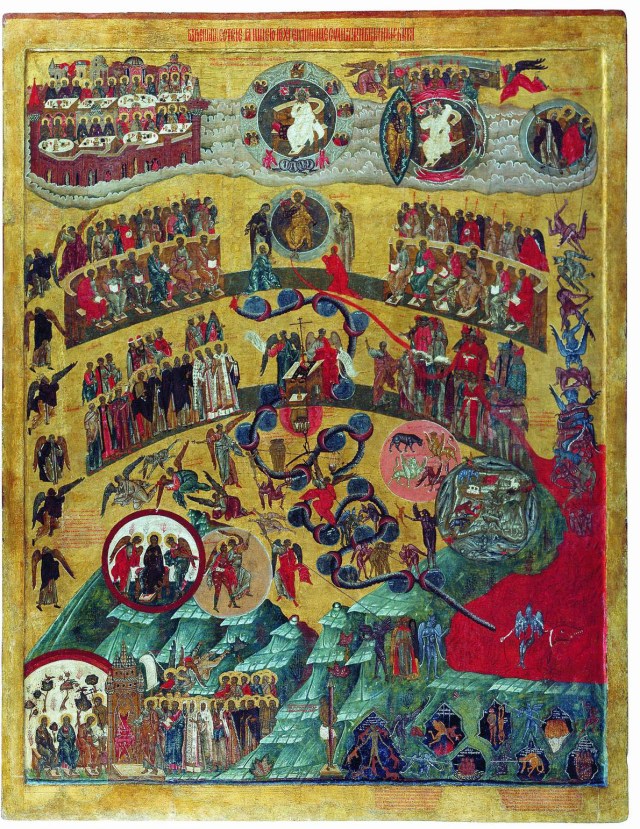
Letter Addressed to Publius
By St. Ephraim the Syrian
You would do well not to let fall from your hands the polished mirror of the holy Gospel of your Lord, which reproduces the image of everyone who gazes at it and the likeness of everyone who peers into it. While it keeps its own natural quality, undergoes no change, is devoid of any spots, and is free of any soiling, it changes its appearance before colors although it itself is not changed .
Before white things it becomes [white] like them.
Before black things, it becomes dark like them.
Before red things [it becomes] red like them.
Before beautiful things, it becomes beautiful like them and before ugly things, it becomes hideous like them.
It paints every detail on itself. It rebukes the ugly ones for their defects so that they might heal themselves and remove the foulness from their faces. It exhorts the beautiful to be watchful over their beauty and even to increase their natural beauty with whatever ornaments they wish, lest they become sullied with dirt.
Although it is silent, it speaks.
Although it is mute, it cries out.
Although it is reckoned as dead, it makes proclamation.
Although it is still, it dances.
Although it has no belly, its womb is of great expanse.
And there in those hidden inner chambers every limb is painted and every body is framed in a bare fraction of a second. Within it they are created with undetectable quickness.
2. For this mirror is a foreshadowing of the holy tidings of the outer Gospel, within which is depicted the beauty of the beautiful ones who gaze at it. Also within it the blemishes of the ugly ones who are despised are put to shame. And just as this natural mirror is a foreshadowing of the Gospel, so also is the Gospel a foreshadowing of that heavenly unfading beauty by which all the sins of Creation are reproved and by which reward is given to all those who have preserved their beauty from being defiled with filth. To everyone who peers into this mirror, his sins are visible in it. And everyone who takes careful notice will see in it that portion which is reserved for him, whether good or evil.
There the kingdom of heaven is depicted and can be seen by those who have a pure eye.
There the exalted ranks of the good ones can be seen.
There the high ranks of the middle ones can be discerned.
There the lowly ranks of the evil ones are delineated.
There the beautiful places, which have been prepared for those worthy of them, are evident.
There Paradise can be seen rejoicing in its flowers.
3. In this mirror, Gehenna in flames can be seen by those who deserve to dwell there.
In Paradise there are joyous promises for the good as they wait for [the day] when they will receive their masters with uncovered faces. But in Gehenna, the promises for the wicked will be grievous at the time when they see their masters abased in stature.
There the outer darkness can be seen clearly and from within it can be heard the sound of wailing and weeping, of groans, and of gnashing of teeth.
There in their bonds people wail as they are tortured, and it becomes more intense according to their wickedness so that they are punished with all justice.
4. There that rich man, who used to wear different clothes every day and used to take delight in his luxuries, wails from anguish inside Sheol.
There the groaning cry of the rich man can be heard crying out to Abraham, the father of the just, “Send Lazarus, your son, to moisten my tongue for I am afflicted, for my sins are burning me up and my evil deeds like coals of a broom tree are roasting me.”
And there was sent from the mouth of the just One to that evildoer a direct reply, like a swift messenger with swift wings flying over that dreadful chasm’s that has been set as a boundary between the good and the evil. And that letter of justice, which was written by the mouth of the just One, was carried forthwith and sent to the deaf ear of that one who had never opened the gate of his ear for any holy voice to enter. And in that letter, which it carried like a speedy messenger, were drawn those gentle sounds of just judgment: “My son, remember that you received your precious and luxurious things while you were alive whereas at that time Lazarus received his evils and his afflictions. And now he is unable to come to help you in your torments because you did not help him when he was in anguish from his diseases. For this reason you are seeking his aid just as he once sought your aid. But you refused. Now he is unable to come because that great chasm, which cannot be crossed, is between us. No one from you can come to us, nor can any from us come to you. ”
5. Fix the eye of your mind and gaze on this mirror of which I spoke to you above.
Notice the twelve thrones that are fashioned on it for judgment.
Notice how the tribes stand there trembling and how the many nations stand there quaking.
Notice how their bodies shake and their knees knock. Notice how their hearts palpitate and how their minds pine.
Notice how their faces are downcast and how their shame is thick upon them like darkness.
Notice how their souls languish and how their spirits flicker.
Notice how their tears overflow and soak the dust beneath them.
Notice how their complexions are changing to green. One takes on that color and hands it on to his companion.
Notice their faces, which used to be joyful, have been transformed to look like soot from a cauldron.
Hear their many groans and their wailing moans.
Hear their sighs of grief and their churning innards.
Notice their deeds:
those that were in secret have now become manifest;
those that were done in darkness now shine forth like the sun;
those that they had committed in secret now make their complaint with loud voice.
Notice how everyone stands, his deeds before him justly accusing him in the presence of his judge.
Notice how their evil thoughts have now taken on shape and stand before their masters to accuse them .
Notice their slanderous whisperings crying out in a loud voice, and how the snares once hidden are now revealed before them.
A little further …
6. Notice that Judge of righteousness as He sits, the Word of His Father,
the Wisdom of His nature, the Arm of His glory,
the Right Hand of His mercy, the Ray of His Light,
the Manifestation of His rest,
that One Who is equal in essence with the One Who begot Him, that One Whose nature is commensurate with the nature from Which He sprang forth,
that One Who is at once near and far from Him,
that One Who is at once joined with Him and separated from Him,
in His presence and not at a distance, at His right hand and not far away, Who shares the same dwelling but not as a foreigner, the Gate of life,
the Way of truth,
the propitiatory Lamb, the pure Sacrifice,
the Priest Who remits debts, the Sprinkling that purifies, the One who created [all] that was made,
the One Who formed and the One Who established, the One Who fashioned creatures,
the One Who gives senses to the dust, Who clothes the earth with perception, Who gives movement to all flesh,
Who separates the places of every species, Who differentiates faces without number, Who renews the minds of all races, Who sows all wisdom everywhere,
Who stretches out the heavens, Who adorned them with lights,
Who gave names to them all,
Who spread out the earth on a foundation that cannot be touched,
Who is the architect of the mountains, Who built the high places,
Who commands the grasses, Who causes trees to spring forth, Who causes woodplants to give seed, who causes fruit to grow,
Who distinguishes tastes,
Who gives color to blossoms and shape to all flowers,
Who measures heaven with His span, with that power that can not be measured,
Who meted out in the palm of His hand the dust of the earth in that right hand which cannot be meted out,
Who weighed the mountains on scales with a knowledge that cannot be comprehended,
and the hills on a balance with an unerring understanding
by which the gathering places of the seas that envelop all Creation and the depths of the sea that cannot be grasped by us are considered to be even less than a drop there before Him.
7. God from God,
the second Light of Being,
the Treasure House of all riches that have been or will be made,
the Judge of the tribes, the Measure of justice, the Scale without deceit, the even Measuring Rod, the Measuring Bowl that is not false, Wisdom that does not err,
Intelligence that cannot pass away, the Renewer of creatures,
the Restorer of natures,
the Resuscitator of mortality,
Who rolls away the cloud of darkness, Who brings to an end the reign of iniquity, Who destroys the power of Sheol,
Who shatters the sting of evil, Who brings captives to the light, Who raises up from Abaddon those who were cast down, Who removes the darkness,
Who makes worthy of rest,
Who opens mouths that had been shut and Who breathes in life just as of old.
8. Look then upon that Divine Child Whose names surpass the reckoning of mortals and Whose titles are more numerous than the computations of the earth:
King of kings,
the Messiah affirmed by the prophets,
Who spoke through the Prophets,
Who sends the Spirit,
Who sanctifies every soul in the Spirit, for His aid is manifest.
Consider this Only-Begotten, the multitude of His names, this One Who does the will of Him Who sent Him, this One Whose will fulfills the will of Him Who begot Him. Look at Him, on that day, sitting at the right hand of Him Who begot Him, in that hour, placing the sheep at His right hand and the goats at His left hand, at that moment, calling out to His blessed ones, while giving them thanks, “Come, inherit that kingdom,” which from of old had been made ready for them in His knowledge and which from the beginning had been prepared for them.
When He was hungry they fed Him in the poor.
He was thirsty and they gave Him to drink in the disabled.
He was naked and they clothed Him in the naked.
He was imprisoned and they visited Him in the imprisoned.
He was a stranger and they took Him in with the aliens.
He was sick and they visited Him in the infirm.
And when they did not make their good works known before Him, those same beautiful works, which were depicted on their limbs, sounded the trumpet and gave witness on their behalf. Like luscious fruits on beautiful trees they hung on them and stood like bunches in order to be witnesses to the truth that these persons had truly wrought them.
9. For just as the deeds of the wicked are their accusers before the righteous judge, making them bend and bow down their heads silently in shame, so also their beautiful deeds plead cause for the good before the Good One. For the deeds of all mankind are both silent and speak – silent by their nature, yet they speak when one sees them.
(2) In that place, there is no interrogation, for He is the judge of knowledge; nor is there any response, for when He sees it, He hears. He hears with sight and He sees with hearing. Because in that one thing, which is not a composite, is hearing and sight, swiftness, touch, sensation, smell, taste, discernment, knowledge, and judgment. Also by that which is not a composite, there is given out the reward of good things and the punishment of evil things to the two sides: those on the right hand and those on the left.
(3) It is not that there really are a right and a left in that place, but rather these are names for those who are honored among us and for those in our midst who are unworthy. Rather we reckon that there is a throne for the judge in that place -and we call the place of the good “the right,” while we label the place of the wicked “the left.” We call the good “sheep” because of their docility, and we call the wicked “goats” because of their impudence. We call His justice “a balance” and His retribution to us “the measure of truth.”
10. Take firm hold, then, of this clear mirror of the divine Gospel in your two hands and look at it with a pure eye that is able to look at that divine mirror. For not everyone is able to see himself in it, but only the one whose heart is discerning, whose mind is sympathetic, and whose eye desires to see its helper. Look at it, then, and see all the images of Creation, the depiction of the children of Adam, both the good and the wicked. Within it can be observed the beautiful images of the works of the good and the unsightly images of the deeds of the wicked. They are conceived within it so that at their time they might be given birth either to praise those who did [the good works] or to rebukes those who performed [the evil deeds]. See that just as here [the mirror] rebukes the ugly, so also there will it manifest within itself their ugly deeds. Just as here it sets out the good for praise, so there will it also mark out in itself their beautiful deeds.
11. At times even we when we were in error, mired in the pride of our mind as if with our feet in the mud, did not perceive our error because our soul was unable to see itself. Although we would look [into the mirror] each day, we would grope around in the dark like blind men because our inner mind did not possess that which is necessary for discernment. Then, as if from a deep sleep, the mercy of the Most High, poured out like pure rain, was sprinkled on our drowsiness and from our sleep we were roused and boldly took up this mirror to see our self in it. At that very moment we were convicted by our faults and we discovered that we were barren of any good virtue and that we had become a dwelling place for every corrupting thought and a lodge and an abode for every lust.
12. I saw there virtuous people and I longed for their beauties, [I saw] the places whereon the good were standing and I earnestly desired their dwellings.
I saw their bridal chambers on the opposite side into which no one who did not have a lamp was allowed to enter.
I saw their joy and I sat mourning the fact that I possessed none of the deeds that were worthy of that bridal chamber.
I saw that they were arrayed in a garment of light, and I was distressed that no noble garments had been prepared for me.
I saw their crowns, which were adorned with victory, and I was grieved that I had no victorious deeds with which I might be crowned.
I saw there virgins knocking [at the gate], and there was no one who would open it for them, and I wailed because I lacked the deeds of that blessed ointment.
13. I saw there many crowds shouting at the gate and no one would respond to them, and I was alarmed that I had none of those virtues that had the power to open the gate of the kingdom.
I heard the clamor of many voices saying, “Lord, Lord, open [the gate] for us.” And a voice from there fell upon myears, swearing to itself, “I do not know you” to be worthy of salvation.
I saw there those who were pleading, “We ate and drank in your presence,” but [the voice] answered and said to them, “It is not I Whom you sought but only that you ate bread and were satisfied.”
14. I also, like them, had always taken refuge in His name and had been honored in His honors and had always wrapped His name like a cloak over my hidden faults, but fear then seized me, terror shook me, and a great alarm counseled me to turn back so that perhaps those provisions required for that narrow way that leads to the land of the living might come to me. For I saw no one there who was able to give any relief to his companion or to moisten his tongue in that burning fire. For that deep chasm, which keeps the good separate from the wicked, did not allow them to give any relief to those others.
15. I saw there pure virgins whose virginity, because it was not adorned with the precious ointment of desirable deeds, was rejected. They implored their fellow virgins to give them some assistance, but they received no mercy and [they asked] that they might be given the opportunity to go and purchase for themselves some deeds, but this was not permitted them because the end, their departure from this life, was coming quickly. I drew near to the gate of the kingdom of heaven and I saw there those who did not bear the title “virgin” who were crowned with victorious deeds, for their virtues filled the place of virginity. For just as those who had been espoused to Him only in their bodies had been rejected because they were naked of any garment of good deeds, so too those who had espoused their bodies in a chaste marriage while their spirit was bound to the love of their Lord were chosen, and they wore their love for Him like a robe with [their] desire for Him stretched over all their limbs.
16. And when I saw those there, I said to myself, “No one from henceforth should rely solely on the chaste name of virginity when it is lacking those deeds that are the oil for the lamps.” And while I was being reproved by this dreadful vision of others being tortured, I heard another voice from the mouth of the mirror crying out, “Keep watch, O feeble one, over your wretched soul. ‘It is a fearful thing to fall into the hands of the living God.’” Have you not heard children shouting to you, “If a man gain the whole world yet lose his soul what will he gain?” or, “What shall he give in return for his soul?” Do you not see what happened to that man whose land yielded abundant crops because he said to his soul, “My soul, eat and drink, be at ease, and enjoy yourself for abundant crops have been gathered in for you for many years?” Have you not heard that while this word was yet sweet in his mouth a bitter word was poured into the womb of his ear.” Although it had no understanding, it cried out saying, “On this very night your beloved soul is required of you. This thing which you have prepared, whose will it be?”
17. Be alarmed by this your seal, and consider where all the children of Adam are, who like locust have swarmed over the earth since the first day. Rouse yourself from this deep sleep that is enfeebling you and that is spreading over all your limbs like a shadow of death. Rise, then, and bring yourself back to those former generations about which you have heard. Where is Adam? Where are your fathers who like fatted sheep lived luxuriously in the midst of the Paradise of Eden, who like friends spoke fearlessly with God, whose arms made all creatures obedient to their authority, whose power held the authority over sea and dry land, whose feet tread upon the dreadful serpents and before whom those beasts, which are rebellious nowadays, bent their necks, whose minds used to reach up to heaven and to seek out the deepest part of the deep as if it were dry land?
18. Where are those ten generations from Adam to Noah? Were they not washed away in that flood of waters?
Where are those generations of the Sodomites? Were they not also swept away in a flood of fire?
Where are those generations from then until today?
Where are those who in that time used to live for almost a thousand years?
Have they not diminished and passed away? If the ink written on goatskins had not preserved for us the memory of their names, we would not even have known that they had ever existed.
19. Come, I will lead you out to the gloomy sepulchres.
Come down, in your mind, with me even to lowest Sheol and I will show you there kings cast down upon their faces, their crowns buried in the dust with them.
Come, see the princes, those who once luxuriated in silks, how the worm has now become their bed and the grub their covering.
Come, look at those military chiefs who used to command thousands of armies, how they have become useless vessels of dust and things of no understanding.
Look carefully at the dust of the earth and consider that it is your kin. How long will you delude yourself and think that you are any better than the grass on the housetops? For the heat of one day dries out the grass. The burning fever of a single day also causes a desirable body to become parched.
(2) Where are the kings, their raiment, their crowns, or their purple ? Where are their dominions, their battles, their armies, their companies, their treasuries, or their wealth? See how their spears are shattered, their bows destroyed, their swords rusted, their arms eaten by worms. Their generations have departed and passed on, the threads of their lives are severed like a tent full of worms at their death, and like a web about to be cut; their military expeditions are cut down and they are brought to ruin.
20. Notice how their songs have turned to mourning, their harps to the sound of weeping, how their laughter is overcome by mourning, their sweet melodies by songs of lamentation. The garment of a spider has been woven for them there and a bed of worms lies beneath them and a covering of moths is spread over them like a tunic. Tables lie upended before them. Their splendid state of luxury is completely reversed. Their administration is destroyed and is rendered useless. Their glory is laid out in the dust and all their luxury is also buried there in ashes. Bridegrooms are plundered and brides are forsaken who have been thrown out of their bridal chambers, and the crowns have withered on their heads and together with them they are sprinkled with the dust from the earth. Over them is spread a garment of darkness which Sheol has woven for them on a dingy loom. From every mouth there you hear the sound of wailing because there is no one there who can console his companion.
21. Everything that their eyes see causes them suffering, for when they reach out to the boundary of the chasm, they quickly pass over it and fly to the garden of Eden and hover over the Paradise of God and see the blessed place of rest and are filled with desire for the banquet tables of the kingdom. And they hear the sound of pure melodies combined with holy songs and intermingled with the praises of God. And as they stretch out they soar to heaven and the gates of the kingdom are opened. Before their Lord they hover with joy, sending only the sound of their mouths back and forth to each other. There the vision of their eyes is allowed to come and go, and on the two sides it either grieves or gives joy so that when the good look out upon the wicked their lot increases and they rejoice therein. But, as for the wicked, their souls are condemned and their distress is multiplied.
22. Perhaps, for the wicked, that which they see is Gehenna, and their separation is what burns them with their mind as the flame. That hidden judge who dwells in the discerning mind has spoken and there has become for them the judge of righteousness and he scourges them without mercy with torments for the compunction of their soul. Perhaps, it is this that separates them and sends each of them to the place suitable for him. Perhaps, it is this that lays hold of the good with its extended right hand and sends them to the Exalted Right Hand. It also takes hold of the wicked in its left hand, equal in power, and casts them into the place which is called “the left.””’ And perhaps, it is this that silently accuses them and quietly pronounces judgment upon them.
23. In this matter, I believe the inner mind has been made judge and law, for it is the embodiment of the figure of the law and itself is the figure of the Lord of the law. And for this reason there is given to it complete authority to be portioned out in every generation although it is one, to be imprinted on every body although it is indivisible,
to be painted on every heart although it is inseparable,
to fly over all without tiring,
to rebuke all without shame,
to teach and guide all without compulsion,
to counsel them with no constraint on them,
to remind them of the judgment to come while cautioning them,
to recall to them the kingdom of heaven so that they might yearn for it,
to point out to them the beneficent rewards so that they might desire them,
to show them the severity of the judgment so they might restrain themselves,
to make known to them the sweetness of the Only-Begotten so that they might be comforted.
With them [the mind] runs after all good things, strengthening them. Over them it flies when they incline to hated things and reproves them. For its mercy is similar to that of its Lord in that it does not turn away from them when they are defiled with impurities and is not ashamed of them when they are wallowing in the mud. As for those who obey it, it will remember them and as for those who do not heed it, it will recall to them. Here it is mingled with them in every form whereas there it stands before them on this day [of judgment].
24. And when I saw these things in that bright mirror of the holy Gospel of my Lord, my soul became weak and my spirit was at an end and my body was bent down to the dust; my heart was filled with bitter groans that perhaps my stains might be made white by the washing of my tears. And I remembered that good Lord and kindly God who cancels through tears the bond of those in debt and accepts lamentation in the place of burnt sacrifices. When I came to this point, I took refuge in repentance and I hid myself beneath the wings of compunction. I sought refuge in the shade of humility and I said, “What more than these am I required to offer to Him who has no need of sacrifices and burnt offerings?” Rather, a humble spirit, which is the perfect sacrifice that is able to make propitiation for defects, a broken heart in the place of burnt offerings, and tears of propitiation in the place of a libation of wine are things which God will not reject.”
25. That, then, which I saw in that living mirror that speaks, on which the images of all the deeds of men move from Adam until the end of the world and from the resurrection until the day of the judgment of righteousness – and that which I heard from that blessed voice that could be heard from inside it, I have written for you in this letter, my beloved brother.
Translated by E. G. Mathews and J. P. Amar in Selected Prose Works of St. Ephrem of Syria, Fathers of the Church 91, (Washington: Catholic University, 1994).










 ORTHODOX CHRISTIAN FAITH AND LIFE