In Egypt, in whose ancient Christian past there had once been many grand monasteries, there once lived a monk who befriended an uneducated and simple peasant farmer. One day this peasant said to the monk, “I too respect God who created this world! Every evening I pour out a bowl of goat’s milk and leave it out under a palm tree. In the evening God comes and drinks up my milk! He is very fond of it! There’s never once been a time when even a drop of milk is left in the bowl.”
Hearing these words, the monk could not help smiling. He kindly and logically explained to his friend that God doesn’t need a bowl of goat’s milk. But the peasant so stubbornly insisted that he was right that the monk then suggested that the next night they secretly watch to see what happened after the bowl of milk was left under the palm tree.
No sooner said than done. When night fell, the monk and the peasant hid themselves some distance from the tree, and soon in the moonlight they saw how a little fox crept up to the bowl and lapped up all the milk till the bowl was empty.
“Indeed!” the peasant sighed disappointedly. “Now I can see that it wasn’t God!”
The monk tried to comfort the peasant and explained that God is a spirit, that God is something completely beyond our poor ability to comprehend in our world, and that people comprehend His presence each in their own unique way. But the peasant merely stood hanging his head sadly. Then he wept and went back home to his hovel.
The monk also went back to his cell, but when he got there he was amazed to see an angel blocking his path. Utterly terrified, the monk fell to his knees, but the angel said to him:
“That simple fellow had neither education nor wisdom nor book-learning enough to be able to comprehend God otherwise. Then you with your wisdom and book learning took away what little he had! You will say that doubtless you reasoned correctly. But there’s one thing that you don’t know, oh learned man: God, seeing the sincerity and true heart of this good peasant, every night sent the little fox to that palm tree to comfort him and accept his sacrifice.”
Lev Gillet’s Reflections on the Presentation of Our Lord in the Temple, the famous Byzantine ‘waltz’, Ormylia Women’s Monastery choir, Byzantine icons and hymns with lyrics
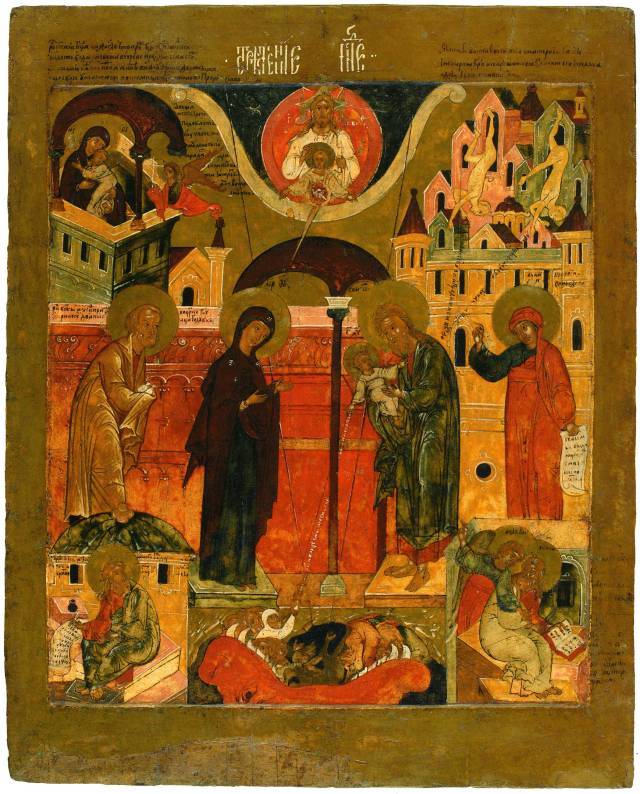
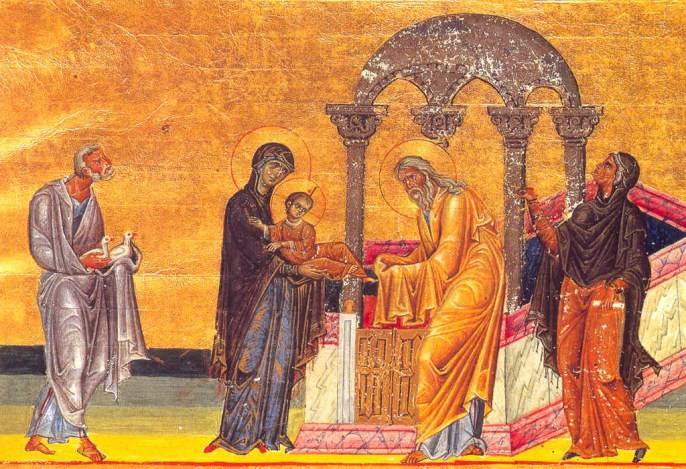
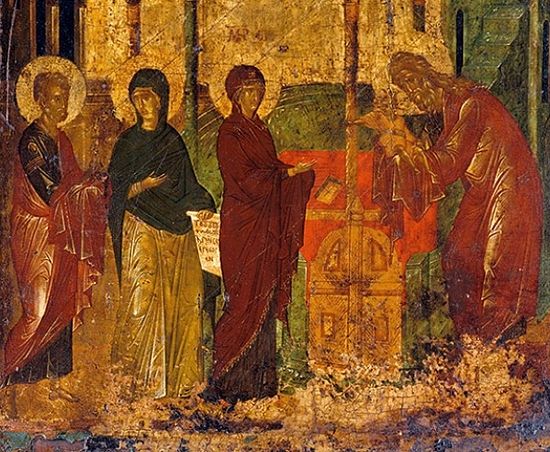
Symeon receiving Our Lord is of course an Icon in the true sense of the word of how we too receive Christ
* The Russian icon above emphasizes the meeting aspect. Pay attention to the way Jesus and Simeon are so face to face.
Lyrics for the famous Orthodox ‘waltz’, the Megalynarion, the “Magnification”; also called Velichaniye in Church Slavonic), the special Byzantine hymn for Panagia and the Presentation of the Lord in the Temple by Ormylia convent.
What glorious Hope, what tenderness amidst weariness, old age, frailty and shadows, what consolation especially when ‘dealing’ with end of life care, as I currently am, what a wonderful ending to our life, should we accept Lord’s offered Love! Rejoicing with Symeon, let us sing a hymn of thanksgiving to God and say: “Let me depart in peace, for my eyes have seen Your compassion and Your holy Salvation.”
-That which is fulfilled in you is beyond the understanding both of Angels and of mortals, O pure Virgin Mother.
-Symeon the Elder embraces in his arms the Maker of the Law and Master of all.
-The Creator, wishing to save Adam, took up his dwelling in your virgin womb.
-The whole race of mortals calls you blessed, pure Virgin, and glorifies you with faith as Mother of God.
[Come and see Christ, the Master of all, whom Symeon carries today in the temple.]
-You look upon the earth and make it tremble how then can I, aged and weary, hold you in my arms?
-Mary, you are the mystic tongs who conceived in your womb Christ, the burning coal.
[Symeon had lived for many years when he saw Christ, and cried aloud to him, ‘Now I seek my release.’]
[O God, who are before all things, of your own will you became man, and are carried in the temple as a child of forty days.]
-Symeon the priest received the Master of all, come down from heaven.
– Make bright my soul and the Light of my senses, that I may see you in purity, and I will proclaim that you are God.
– Pure Virgin Mother, why do you bring into the temple a new-born babe and commit him to Symeon’s hands?
From you, the Creator, I now seek release, for I have seen you, O Christ, my salvation and my light.
‘In the shadow and letter of the Law, Let us the faithful discern a figure. ‘Every male child that opens the womb shall be holy to God.’ Therefore the firstborn Word, Son of a Father who has no beginning, the firstborn child of a Mother who had not known man, we magnify.’ [Irmos]
Him whom the Ministers at the Liturgy on High entreat with trembling, here below Symeon now takes in his arms.
For those of old there was a pair of doves and two young pigeons In their place the godly Elder and Anna the sober prophetess, ministering to the One born from a Virgin and only offspring of the Father as he enters the temple, magnify him. [Irmos]
Glory to the Father, to the Son, and to the Holy Spirit.
In nature Unity, but in Persons Trinity, watch over your servants who put their faith in you.
‘You have granted me, O Christ, the joy of your salvation’, cried Symeon, ‘Take your servant, wearied by the shadow, as a new initiate and preacher of grace, as with praise he magnifies you.’ [Irmos]
Both now and ever and unto ages of ages, Amin.
Mother of God, hope of all Christians, protect, watch over, guard all those who put their hope in you.
Reverently holy Anna, sober and aged, openly confessed the Master, announcing him clearly in the temple. While as she proclaimed the Mother of God to all those present, she magnified her. [Irmos]
In accordance with the law of Moses, forty days after the birth of a male child, its mother had to present it in the tabernacle and to offer as a sacrifice either a lamb or a pair of doves or pigeons for purification ‘from the issue of her blood’. The presentation of a first-born creatures, whether animal or human, were considered to belong to God. Mary and Joseph obeyed this precept of the law. They brought Jesus to the Temple where he was blessed by the aged Simeon, and recognized as Saviour by the prophetess Anna, It is this event which we celebrate at the feast of February 2nd.
“Let us also go to meet Christ and let us receive him … Adorn thy bridal chamber … and welcome Christ the King; salute Mary, the heavenly gate.” These texts from the feast of the Presentation can also be applied to our souls. Each soul ought to be a Temple of God, to which Mary brings Jesus. And each one of us should, like Symeon, take the child in his arms and say to the Father: “My eyes have seen thy salvation.” The prayer of Symeon, “now lettest thou thy servant depart in peace” does not simply mean that someone who has seen Jesus and has held in his arms can now leave this life and die in peace: it also means for us, having seen and touched the Saviour, we are released from the hold that sin has on us, and, in peace, can leave the realm of evil. (The Year of Grace of the Lord by A Monk of the Eastern Church)
Metropolitan of Nafpaktos and Agios Vlasios, Hierotheos, speaks on Mount Athos’ secret cry: the Prayer of the Heart
As biological life is transmitted, so spiritual tradition is a whole life.
*
A guide speaks theoretically, but the Fathers beget spiritually.
*
The Holy Mountain is a living organism.
*
May the Lord find us worthy to hear its secret cry!
*
Already in his youth, Metropolitan Hierotheos was particularly interested in the Fathers of the Church, working for a time in the monastery libraries of Mount Athos, on the recording of the codices. He was especially interested in the teaching of St. Gregory Palamas.
The influence of Fr. John Romanidis, the study of the patristic texts and particularly those of the hesychast Fathers of the Philokalia, many years of studying St. Gregory Palamas, association with the monks of the Holy Mountain (Mount Athos), and many years of pastoral experience, all brought him to the realisation that Orthodox theology is a science of the healing of man and that the neptic fathers can help the modern restless man who is disturbed by many internal and existential problems.
Within this framework he has written a multitude of books, the fruit of his pastoral work, among which is Orthodox Psychotherapy. Some of these books have been translated into various languages, such as English, French, Spanish, Russian, and Arabic. With these books he conveys the Orthodox spirit of the Philokalia to the restless and disturbed man of our time.
Empirical Dogmatics of The Orthodox Catholic Church. According to the Spoken Teaching of Father John Romanides. Volume 1. (2012). ISBN 9789607070753. Volume 2. (2013). ISBN 9789607070814
Hesychia and Theology: The Context for Man’s Healing in the Orthodox Church (2007). ISBN 9789607070609
The Illness and Cure of the Soul in the Orthodox Tradition (1993). ISBN 9607070186
“Rejoice always,pray without ceasing,give thanks in all circumstances; for this is the will of God in Christ Jesus for you”(1 Thessalonians 5:16-18)
“Many times the sisters at some of the monasteries I visit will try to commit one or more akathists or supplicatory canons to memory. Here is how they do this:
Some print off the prayers they want to learn and cut them into small sections to keep in their pocket. When they are doing some of the more simpler jobs or tasks around the monastery they take out one piece of paper at a time and lay it in front of them. Then they say that section over and over again until they have it committed to memory. Afterward they take out the next piece of paper, adding another stanza or ode and so on until they have memorized the whole thing.
Others will use small prayer books to do they same thing – taking them out to read when they get stumped.
In the monastery there is always work to be done, rarely will a nun find herself idle. But in the world we are constantly waiting in lines at the grocery store, at the mechanic’s shop etc. And so, even if we don’t particularly care to commit a large prayer to memory, we can keep our mind occupied with prayer.
I wanted to memorize some prayers, so I took a tip from the sisters and made my own miniature prayer book. I thought writing out the prayers would help. So I that’s what I did. I keep it in my bag so that I have it wherever I go.
When I’m on the bus or waiting for something I pull it out and read an akathist. It only fits two akasthists and a few other favourite prayers but it is very helpful – mostly because it’s size makes reading the prayers in public somewhat discreet.
You don’t have to hand-write a prayer book, you could simply glue photocopies of prayers in a small book, or keep a larger prayer book with you. The point is to offer our attention – our nous – to God, to make an effort to “pray without ceasing”. I haven’t memorized any akathists yet, but I try to tell myself the point is to pray them, not accomplish something arbitrarily so I can feel self-righteous.
And besides, I love an excuse to try and make something look pretty. Having a notebook filled with prayers and icons and a little calligraphy makes the work worthwhile.”
“Be thankful to God that this desire for the Prayer and this facility in it have been manifested in you. It is a natural consequence which follows constant effort and spiritual achievement…. Now you see with what admirable gifts God in His love for mankind has endowed even the bodily nature of man. You see what feelings can be produced even outside a state of grace in a soul which is sinful and with passions unsubdued, as you yourself have experienced. But how wonderful, how delightful and how consoling a thing it is when God is pleased to grant the gift of self-acting spiritual prayer, and to cleanse the soul from all sensuality! It is a condition which is impossible to describe, and the discovery of this mystery of prayer is a foretaste on earth of the bliss of Heaven. Such happiness is reserved for those who seek after God in the simplicity of a loving heart.” (The Way of the Pilgrim – a word from the pilgrim’s spiritual father)
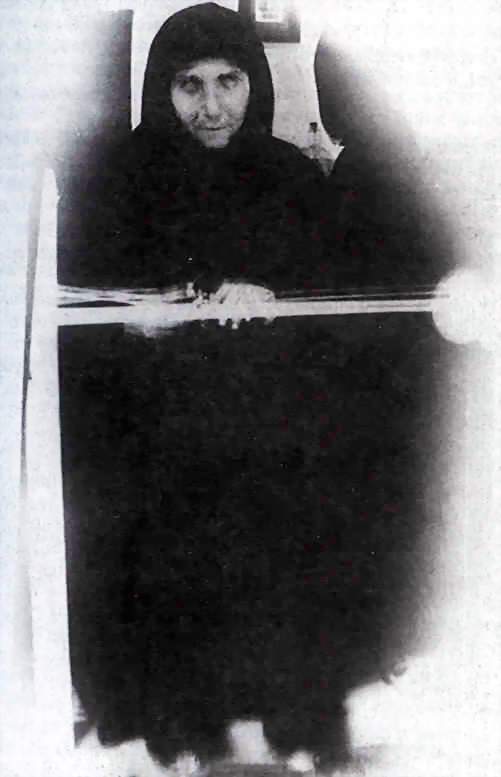
Today I discovereda new member of my spiritual family, a blind, prescient Amma and a gifted poetess, who happens to be my own spiritual great-grandmother!Mother Xeni served as the Abbess of St. Nectarios’ (spelled also: St.Nektarios) newly-founded Monastery in Aegina (Greece) for nuns, and was the spiritual grandmother of my own spiritual mother, Sister Angeliki, who was tonsured a novice there and was ringing the bells upon St. Nektarios’ glorification!
Glory to God! The circle of Grace expands like ripples in the pool!
To God
A soul, of lamentations worthy, and sorrows, is sighing,
and with a loud and fervent voice, the name of God crying,
and saying, my God save me now, my God, have mercy on me,
O God, You’ve seen my darkness now, so shed Your light upon me,
my God, don’t turn away from me, but quickly hear my pleading,
enlighten my soul’s eyes, O God, spiritually leading;
because they have been blinded from the sins within my depths.
O wretched self, I cannot see; my God, I lose my steps.
Miserable me, I cannot see, my God, where I am going,
or where I stand, or that I am a stranger, past my knowing.
Many clouds and mists my soul in darkness shroud and cover,
and without measure I embitter You, my sweetest Savior. O wretch, within I feel upheaval, mourning pierced my side,
for Your All-Holy Spirit, Lord, to me must be denied;
my soul must weep eternally her poverty of grace,
and without ceasing to lament in tears that woeful place.
I must avenge myself for all the pain sin makes me suffer,
and with the rivers of my tears, my deep repentance offer;
the tender earth to which I will return, with weeping drench,
to cleanse and flood away the traces of my sins’ foul stench.
I am no longer worthy, Lord, to hope in Your compassion,
I’m worthy only of hell-fire, and suffering, damnation.
But you, my refuge is in You, my God and my Salvation…
(transl. from Greek Fr Demetrios Serfes)
Confession of the Blind Woman
People, hear and pity me, for this, my situation,
and pray to God to spare me, my wretched soul to give salvation.
Believe me, all of you, my brethren, truly I’ll explain,
in me is found abundantly the name of works I now will make plain.
If you would like to know which virtues I have called my own,
I’ll tell you: naked is my soul of good in every form.
Utterly devoid of virtue, sentenced to be damned,
and by every purity most utterly abandoned.
Poverty past bounds is mine, and wounds and ill diseases,
and being lost forever in the folds of death’s deep creases.
Severe insentitivity and stupor overcome me,
anger, pride, hard-heartedness and evil have undone me.
To virtue I am cold as ice, but warm to wickedness,
always ready for laughter’s lure and for talkativeness.
Instead of being compassionate, I’m totally unfeeling,
instead of weeping constantly, I laugh, the wretched worldling!
But there is something yet, that hides so perfectly these evils.
How long will I so fool the world, though I am like the devils,
with my false piety, fake virtue and hypocrisy?
When the world regards me highly, I rejoice and boast,
but when they criticise me, even kindly, I am sad, and mope.
Whomever of you knows me, I exhort you to feel piety,
and when reminded of me, weep for my iniguity.
Beg our God that someday He enlightenment will send me;
and by your prayers, my brethren, I hope that He will save me,
and from my somber wickedness and evil, He will free me.
(transl. from Greek Fr Demetrios Serfes)
Go here for an interview with a nun who knew Saint Nektarios and who lived with Mother Xeni
“Gerondissa (Greek for Abbess) Xeni, was born in 1867, and reposed in the Lord 1923. Mother Xeni, was chosen to become an Abbess of St. Nectarios (spelled also: St.Nektarios) newly-founded Monastery in Aegina for nuns. This beloved handmaiden of our Lord was blind from the age of 9 months, and although physically blind, she was not spiritually blind. She lived under the spiritual guidance of St. Nectarios, and sincerely developed great Christian virtue, discernment and love. Even before the holy Saint Nectarios officially named her to preside over the Community of nuns in Aegina all the girls and women considered her to be their leader due to her piety, compassion and the great grace which dwelt in her sweet soul. This holy, pure, and chosen woman, though she fully realized the scope of her blessedness, did not “consider salvation a thing to be grasped” (Phil.3:13).
During the life of Gerondissa Xeni, she wrote her poetry, which is now becomming more and more well known. We truly discover the secret of her blessed familiarity and closeness both to the Saint, and to our God in Trinity: humility. Gerondissa Xeni poetry is spiritually remarkable, and full of love for God! Her poetry serves to help us, her readers, to be able to reflect on our own path to salvation.”
By Father Demetrios Serfes
Source: Orthodox Poetry Of Gerondissa (Abbess) Xeni Of Aegina, Greece (1867-1923), Compiled by Father Demetrios Serfes, Boise, Idaho, USA, Introduction by Father Demetrios Serfes
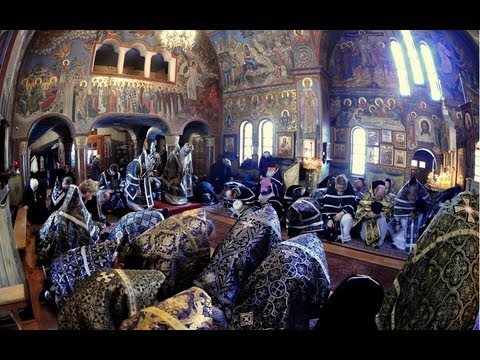
Holy Trinity Seminary Choir sings “Now the Powers of heaven minister unseen with us. Lo, the King of glory enters in. Lo, the mystical Sacrifice, fully accomplished, is borne on high” during Pre-sanctified Liturgy .
PRIEST: (Standing before the icon of Christ) Almighty Lord, You have created all things in wisdom. In Your inexpressible providence and great goodness You have brought us to these saving days, for the cleansing of our souls and bodies, for control of our passions, in the hope of the Resurrection. After the forty days You delivered into the hands of Your servant Moses the tablets of the law in characters divinely traced. Enable us also, O benevolent One, to fight the good fight, to complete the course of the fast, to keep the faith inviolate, to crush underfoot the heads of unseen tempters, to emerge victors over sin and to come, without reproach, to the worship of Your Holy Resurrection. For blessed and glorified is Your most honorable and majestic name, of the Father, the Son and the Holy Spirit, now and forevermore. –
The Liturgy of the Presanctified Gifts, informally the Presanctified Liturgy, is a liturgical service for the distribution of the Holy Gifts on the weekdays of Great Lent. Because Great Lent is a season of repentance, fasting, and intensified prayer, the Orthodox Church regards more frequent reception of communion as especially desirable at that time. However, the Divine Liturgy has a festal character not in keeping with the season. Thus, the Presanctified Liturgy is celebrated instead; the Divine Liturgy is only performed on Saturdays and Sundays. Although it is possible to celebrate this service on any weekday of Great Lent, the service is prescribed to be celebrated only on Wednesdays and Fridays of Lent, Thursday of the fifth week of Lent (when the Great Canon of St. Andrew is read), and Monday to Wednesday of Holy Week.
“Toward the last years of his life, I had the blessing to speak with him in private and pray together. Elder Eusebios, the mystic, the poet, the Seer of God, as they called him! This Meeting burns still in my heart! May we have his blessing!” (Little city hermit)
*
“Prior to his [ie. Elder Eusevios] death he was sought after by many souls seeking comfort and consolation. I, though unworthy, was granted the blessing of not only meeting him but hearing a homily he gave and of speaking with him very briefly in private. The memory of his soft hands and piercing eyes have remained forever in my heart.
Since my feeble words cannot properly convey his holiness, nor his pure and all-consuming love for Christ our God, I have taken the liberty of copying a translation of one of his poems for our spiritual benefit. It was translated by a fellow-student of mine, Michael Tishel. May God grant him many blessings for his effort in bringing the inspiring writing of a contemporary saint to the English-speaking world!
O soul, you who are weary and saddened by many things that, out of politeness, you would rather not mention. Instead, you hold them within you, not wanting to offend, hurt or scandalize any other soul around you–from near or far. You, o restless soul, who search for peace, run to the Crucified One, the Sweet Jesus; kneel before Him with contrition. Tell Him the following words with courage, slowly, purely, and honestly, and with steadfast faith that you will be heard:
O Lord my Jesus, meek and humble in heart, I wholeheartedly beg and beseech You:
Release me from the desire to be admired by others. Release me from the desire to be loved by others. Release me from the desire to be sought out by others. Release me from the desire to be honored by others. Release me from the desire to be praised by others. Release me from the desire to be preferred by others. Release me from the desire to give advise to others. Release me from the desire to be commended by others. Release me from the desire to be cared for by others.
Release me from the fear that they will humiliate me. Release me from the fear that they will scorn me. Release me from the fear that they will reject me. Release me from the fear that they will slander me. Release me from the fear that they will forget me. Release me from the fear that they will offend me. Release me from the fear that they will suspect me.
***
Lord, grant me to desire that others be loved more than me. Lord, grant me to desire that others be esteemed more than me. Lord, grant me to desire that the good view of others increase, and that my own decrease. Lord, grant me to desire that others be put to use more than me. Lord, grant me to desire that others be praised more than me. Lord, grant me to desire that others be remembered, and not me. Lord, grant me to desire that others be preferred and chosen over me. Lord, grant me to desire that others make progress in virtue more than me, if of course I could achieve something like that on my own.
O soul, you who art hurt and wounded by that which you have inflicted on yourself, if the Lord hears you–and He will hear you if your prayer is genuine, honest, fervent and comes from the depths of who you are–
–how much peace will reign in your heart! –how much serenity will take root inside of you! –how much tranquility will be painted on your face! –and amongst all of the events of your life, how many blissful moments will you experience, both large and small!
Don’t forget, beloved soul, that most of the offenses that we experience stem from the exaggerated concept that we have of ourselves. They have their beginning when we overestimate what we do and offer, with the hidden intention of increasing our status in the world, however possible.
The greatest thing in the world is to be forgotten by everyone, except by those who we love and who love us (even if we find that those who we love very much do not respond in like manner). Maybe you think, blessed soul, that your love for others is greater than theirs is for you. How can you truthfully measure this? The Holy Spirit through the Apostle says: ”owe no man anything, except to love one another“ (Romans 13:8). In other words, your debt is always unpaid! So how are you so bold as to make demands as if you’d paid it? Love, therefore, without waiting for some sort of response. Love the following truth, and carry it in your heart: that anything, except for our ”debt“, creates within us
restlessness, instead of joy, agitation, instead of peace, anxiety, instead of certainty,
Don’t ever forget this!
Let’s allow this attitude, therefore to be implanted within us. Let’s not stop walking this road. Let’s not allow prideful thoughts to trick us, such as the following:
I could be doing something else, much more important than what I am doing,
It is a thought, seduced by deceptive aspirations, desires and unfounded zeal to leave our everyday work, as we quite ridiculously want our virtuousness to blossom more than that of our neighbor’s.
Rather, let us keep busy with what we are doing, because that is what God has given us to do.
Let us occupy ourselves by doing it as best as we can.
This means, in short, to do it with clarity. with energy. with joy. completely.
This is how the Elder looked the two times I met him, like a little angel.
Prayers, Confessio and Traditional Customs follow.
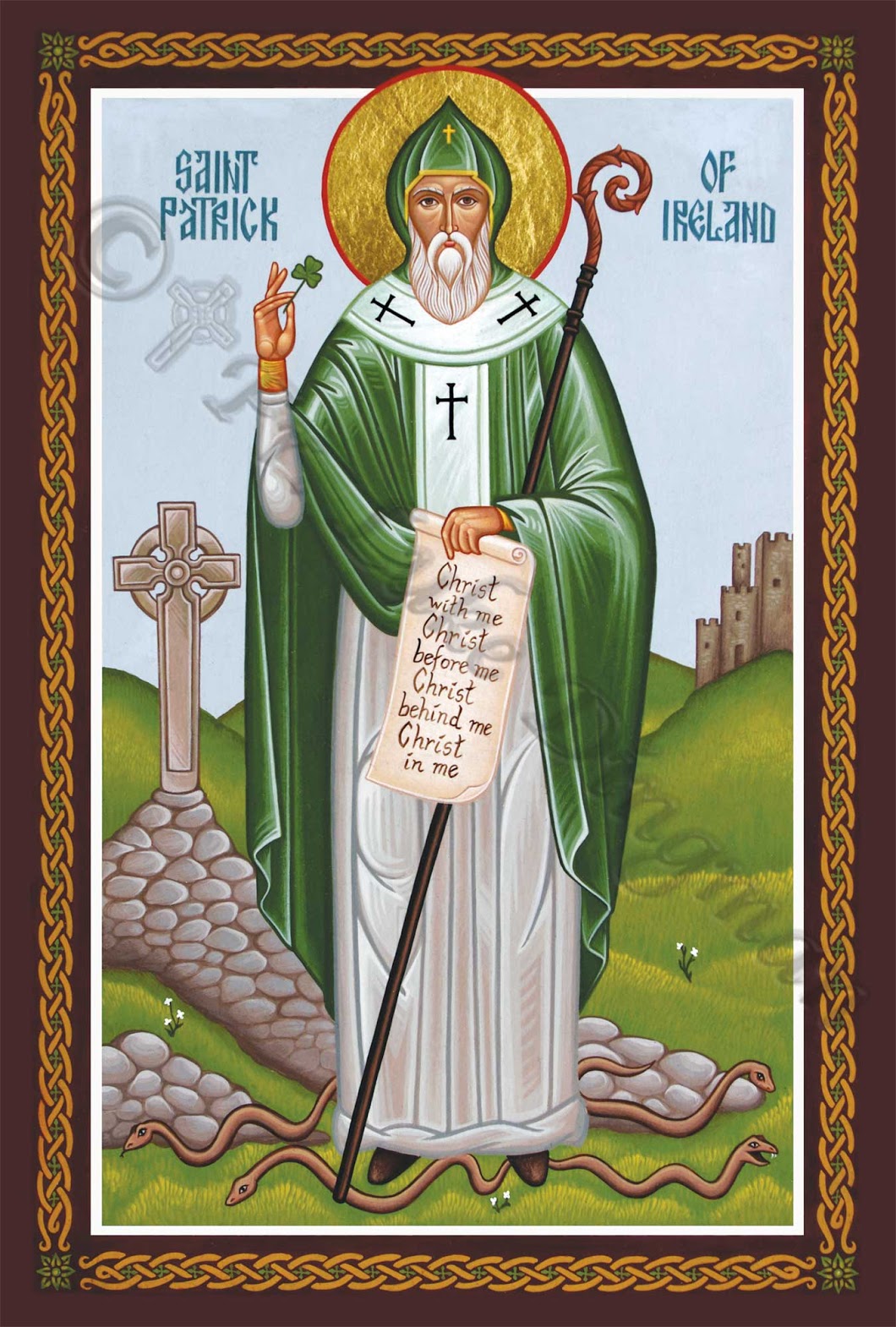
Let us pray, especially today, with St. Patrick’s powerful prayer, St. Patrick’s Breastplate, also known as The Lorica of Saint Patrick. I have always experienced awe and gratitude at its incantation, especially after knowing its tradition: St. Patrick wrote it in 433 A.D. for divine protection before successfully converting the Irish King Leoghaire and his subjects from paganism to Christianity. The term breastplate refers to a piece of armor worn in battle. Lorica means breastplate in Latin. The story of this prayer is that Patrick and his followers used this most beautiful prayer to protect themselves from the people who wanted to kill them as they travelled across Ireland. It is also called the Deer’s Cry (Fáed Fíada) because their enemies saw, not men, but deer!
Lorica of Saint Patrick
I arise today Through a mighty strength, the invocation of the Trinity, Through a belief in the Threeness, Through confession of the Oneness Of the Creator of creation.
I arise today Through the strength of Christ’s birth and His baptism, Through the strength of His crucifixion and His burial, Through the strength of His resurrection and His ascension, Through the strength of His descent for the judgment of doom.
I arise today Through the strength of the love of cherubim, In obedience of angels, In service of archangels, In the hope of resurrection to meet with reward, In the prayers of patriarchs, In preachings of the apostles, In faiths of confessors, In innocence of virgins, In deeds of righteous men.
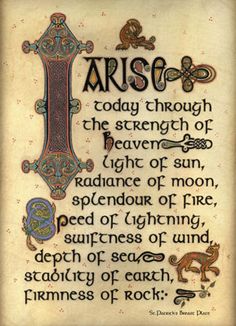
I arise today Through the strength of heaven; Light of the sun, Splendor of fire, Speed of lightning, Swiftness of the wind, Depth of the sea, Stability of the earth, Firmness of the rock.
I arise today Through God’s strength to pilot me; God’s might to uphold me, God’s wisdom to guide me, God’s eye to look before me, God’s ear to hear me, God’s word to speak for me, God’s hand to guard me, God’s way to lie before me, God’s shield to protect me, God’s hosts to save me From snares of the devil, From temptations of vices, From every one who desires me ill, Afar and anear, Alone or in a mulitude.
I summon today all these powers between me and evil, Against every cruel merciless power that opposes my body and soul, Against incantations of false prophets, Against black laws of pagandom, Against false laws of heretics, Against craft of idolatry, Against spells of women and smiths and wizards, Against every knowledge that corrupts man’s body and soul. Christ shield me today Against poison, against burning, Against drowning, against wounding, So that reward may come to me in abundance.
Christ with me, Christ before me, Christ behind me, Christ in me, Christ beneath me, Christ above me, Christ on my right, Christ on my left, Christ when I lie down, Christ when I sit down, Christ in the heart of every man who thinks of me, Christ in the mouth of every man who speaks of me, Christ in the eye that sees me, Christ in the ear that hears me.
I arise today Through a mighty strength, the invocation of the Trinity, Through a belief in the Threeness, Through a confession of the Oneness Of the Creator of creation
Salvation is of the Lord.
Salvation is of the Lord.
Salvation is of Christ.
May Thy Salvation, O Lord, be ever with us.
St. Patrick (ca. 377)
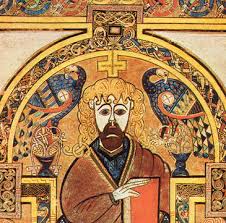
The Book of Kells, detail The Lorica of St. Patrick
* For the whole Book of Kells, Ireland’s greatest cultural treasure and the world’s most famous and beautiful medieval manuscript, an illuminated manuscript Gospel book in Latin, containing the four Gospels of the New Testament together with various prefatory texts and tables, free to view online, go here http://www.tcd.ie/Library/news/2013/03/book-of-kells-now-free-to-view-online/
Let us also prayerfully study today St. Patrick’s most inspiring Confessio, a semi-autobiography, written as a labor for God, explaining the story of his life to inspire others to believe and turn their lives to God.
‘My name is Patrick…
I am a sinner, a simple country person, and the least of all believers. I am looked down upon by many.
My father was Calpornius. He was a deacon; his father was Potitus, a priest, who lived at Bannavem Taburniae.
His home was near there, and that is where I was taken prisoner.
“Kalo Stadio!” is a traditional monastic greeting in Greek as we begin Great Lent. Literally it means “Good stadium!” The hymns of the season tell us that now we are entering “the arena of the virtues” where we will do battle. By their prayers, may we contend well.
Do not turn away thy face from your child, because I am distressed. Please answer my prayer quickly, take care of my soul, and redeem her.
This was my great grandfather’s, Seraphim’s Rose of Blessed Memory favourite Lenten hymn, and they would always see him secretly wipe tears while chanting it.
*
Saint Luke, Bishop of Simferopol and Crimea, the Blessed Surgeon once literally experienced our Saviour’s turning away of His face from him, when he prayed with tears in front of His icon, doubting and complaining in his heart against the Lord. He had been ‘informed’ in prayer before that his (first) exile would soon been brought to an end, yet the days would pass without any news or change. Why was God’s promise delayed to him? “Suddenly, I saw Christ in the icon, turning away His face from me. Scared, despaired, I dared not look at the icon anymore. ‘With my tail between my legs’ I left the altar and entered the … chapel. …I started reading the Epistles, the first excerpt that came to my eyes. Unfortunately I cannot remember the excerpt, but it wrought an amazing result. I found in it … my impertinence to grumble against God, and my lack of understanding. I was also reassured that I will indeed be freed, impatient that I was. I returned to the altar and saw with joy that Christ was looking again at me with his kind eyes full of Joy and Light. Wasn’t this a miracle?” (Saint Luke, Autobiography, Voyages a Travers la Suffrance).
Likewise, St. Luke’s wife, experienced something similar on the eve of her wedding! “In Chita, I married a nurse who had previously worked in Kiev’s military hospital, and her nick name was ‘Saint’. Two doctors before me had asked her to het married to them, but she had refused, because she had taken an oath of chastity. In accepting to marry me, she broke her vow. The night before the Sacrament of our marriage, in the church that Decembrists [ie. Russian rebels led by Russian army officers in a protest against Nicholas I‘s assumption of the throne] had built, while she was praying in front of Christ’s icon, she suddenly had the impression that the Lord was indeed turning His face away from her, and that His Face kept disappearing from the icon! This was obviously a reminder of her vow. Since she did not keep it, the Lord intended to punish her unsparingly, harshly, by upsetting her with an unbearable, pathological jealousy. (Saint Luke, Ibid)
*
Arise, O my soul, O my soul, why sleepest thou? The end draweth near, and thou shall be confounded. Arise, therefore, from thy sleep, and Christ our God, who is in all places and filleth all things, shall spare thee.
*
Saint Romanos the Melodist or the Hymnographer (Greek: Ῥωμανὸς ὁ Μελωδός, often Latinized as Romanus or Anglicized as Roman), was one of the greatest of Greek hymnographers, called “the Pindar of rhythmic poetry”. He flourished during the sixth century, which is considered to be the “Golden Age” of Byzantine hymnography. Of his other Kontakia, one of the most well-known is the hymn, “My soul, my soul, why sleepest thou…” which is chanted as part of the service of the “Great Canon” of St. Andrew of Crete on the first and fifth Thursday of Great Lent.
*
Lenten Prayer Of St. Ephrem The Syrian
O Lord and Master of my life! Take from me the spirit of sloth, faint-heartedness, lust of power, and idle talk.
But give rather the spirit of chastity, humility, patience, and love to Thy servant.
Yea, Lord and King! Grant me to see my own errors and not to judge my brother, for Thou art blessed unto ages of ages. Amen.
*
Have a Blessed Great Lent everyone! Kalo Stadio!! Good fight in the spiritual arena!!May the Lord bless our struggle in the ‘arena’! May our Lord never turn His face away from us!



![Jesus Prayer].jpg](https://orthodoxcityhermit.com/wp-content/uploads/2016/11/jesus-prayer.jpg?w=648&h=391)








 ORTHODOX CHRISTIAN FAITH AND LIFE