I am Back


IMG-2256

Pantokratoros Monastery in Ntaou Penteli

Virginia: “When will you start writing in Greek? English comes difficult to me. I struggle with your posts. Please consider …”

And Gianna. And Kalliopi. And …

Christ is Risen! 

It seems this blog may soon become bilingual… Maybe I should alternate one blogpost in Greek, one in English? … Once, twice a week? Do you think this is a good idea? On the bus, on our way to Attica, my Greek friends asked me to share on the microphone a few of my experiences here. They gasped at the stories I told them. They did not know. How could they even begin to imagine? 

IMG-2262

St. Nektarios’ the Wonderworker monastery, Agia Triada (The Holy Trinity) in Aegina

I feel I owe this to my Greek and Cypriot brethren who should not be left behind. They need to recover Orthodoxy, expand their horizons and learn about Orthodoxy’s struggles in foreign lands. In so many ways, I have discovered more about Orthodoxy during my brief ‘exile’ in an un-Orthodox country than in a lifetime in an Orthodox one.

Besides, any missionary endeavour and blog require by their very nature more than one tongue. At Pentecost “every man heard them speak in his own language”(Acts 2:6). I still find writing in English a lot harder than in Greek my mother tongue, and there are a lot of texts yet untranslated in English. 

What is your opinion? Do you have any suggestions? I would be so grateful for any help.


IMG-2250

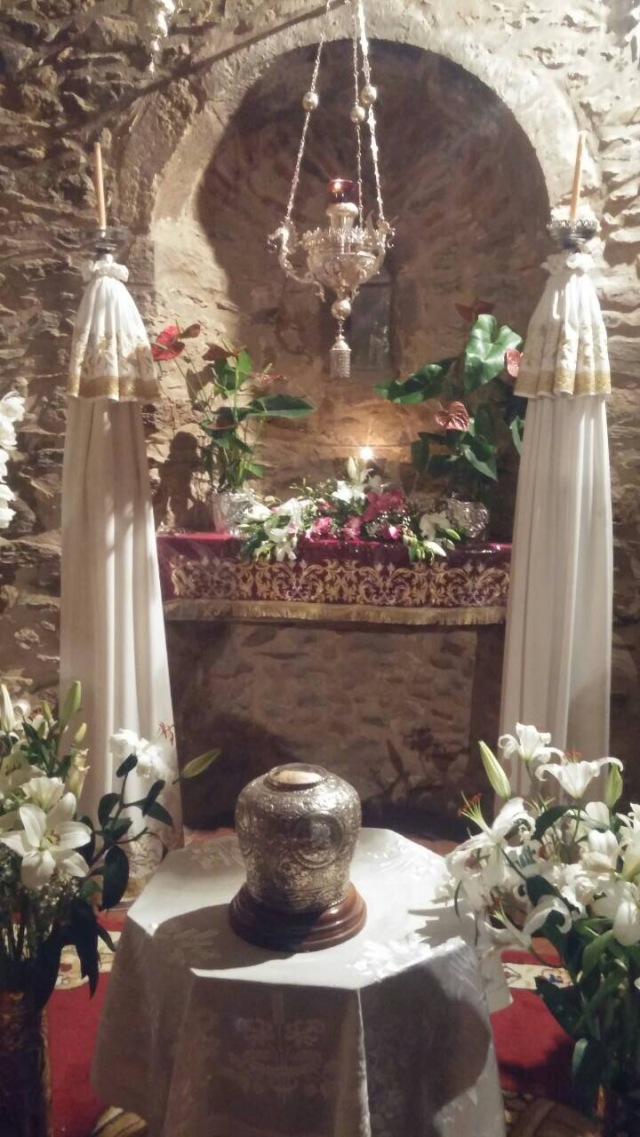
Pantokratoros Monastery in Ntaou Penteli, 179 Martyrs Reliquary

Christ is Risen! 

I am back. I can’t believe a whole month flew by so fast! Thank you for staying in touch through my inbox. So many emails to reply, questions to answer, stories to be told … Please be patient with me, as I am still unpacking. My pilgrimage to Attica, Aegina and Euboia lasted only a few precious days, yet had quite an effect on me. It felt like a landmark and a watershed. More in the posts to follow…


IMG-2292

The Kato Xenia Monastery at Almyros, near Volos – The Wonder Working Belt of Virgin Mary

IMG-2289

Monastery of Transfiguration near Rovies, island of Evia, constructed by Saint David, and served by the recently canonised St. Iakovos Tsalikis. + His grave

Contrition and Repentance

peter-denies-christ-bloch-carl_.jpg

Peter denies Christ, Bloch Carl (1834-1890)

“Thinking of my own sinfulness brings the need for contrition (μεταμέλεια). We are not speaking yet about repentance (μετάνοια), but about contrition. Repentance is a gift of the Holy Spirit. God will give it to me. For example, you did something and then say “Oh no! What have I done? Why did I not listen to the Gerondas? Now I will have to hear the Gerondas’ admonition!” This is being contrite. But when I call you and tell you, “My child, what have you done?” If you confess your error and say “Punish me, Geronta!”, and I don’t punish you, but rather grant you to take Communion, you will say, “How good is Geronta! How I am and how he is! Look at the Grace of God! Oh my soul does not suffer to sadden God!” Now repentance begins. Contrition is one thing, repentance is another.’

Elder Aimilianos of Simonopetra

… ” “

A Great Lent Story

geron-paisios5

A real story where the disciple thought he knew better than his spiritual father …


‘It was a day in Great Lent that the Elder saw from afar a burglar breaking into his cell.

This burglar was the same one like last year …

The Elder hid in the barn until the burglar completed his task.

When the Elder’s disciple later found out, he was furious and scolded his Elder:

– “Why did you not call me to catch him? This is the same burglar who broke into us last year and remains unrepentant!”

– “Who knows, my child”, answered the Elder. “Maybe he will repent this year …”

-“And if he repeats this again?”, the disciple burst out.

-“Then, my child, I must run, open the door and give him everything, so that he will not fall into temptation for a third time …”

The disciple knelt, kissed his spiritual father’s hand, and left in tears…’


St. Nektarios, the unknown hermit and the raging demons

saint_nektarios_egina_1


A meeting of Saint Nektarios with a clairvoyant hermit on Mount Athos. Also, a recent miracle of the Saint in Romania.


St. Nektarios enjoys wide popularity amongst Orthodox throughout the world, yet his popularity in Romania has gained over the past few years. Portions of his relics can even be found in such places as Putna Monastery, Radu Voda Monastery in Bucharest, the Church of the Holy Hierarch Nektarios in Iasi, and the Hermitage of Saint John and Nektarios in Bradetu, Arges. Why do so many Romanians venerate Saint Nektarios and go to pilgrimage to his Monastery in Aegina? All this seems to be related to a recent, miraculous “visit” of the Saint to a village in Romania.

Below is the account as it was told by Romanians to Greeks:

“In a village of Romania there was no priest and the residents often went to the Patriarch with the problem in order to fill the empty spot. However the Patriarch did not have the means of satisfying the demand. The villagers often went to the Patriarch, but he would say the same thing, that he did not have a priest to send to the village.

Meanwhile people died unread (no funeral service), others had relationships and children without marriage vows, and the children and adults alike were unbaptized.

Then one day, outside of the church, a car stopped and out stepped a priest. The village was astonished and yelled out that a priest had come.

The villagers went to the church to greet him and asked him, “How did you come to the village after our Patriarch had said that he doesn’t have a priest to send us?”

The priest answered, “Isn’t this what you wanted? Did you not want a priest? Here I am.”

All the villagers were glad in the presence of the new priest.

The priest began immediately working. He went to all the graves and read the funeral service. He baptized and married everyone in the village and administered Holy Communion.

One day he invited all the villagers to church and told them, “I will leave now, my mission is done.”

The villagers were confused and asked, “Now that you came, you are leaving?”

However the priest did not listen to the villagers and proceeded with his decision.

When the villagers realized that their wasn’t anything they could do, they thanked him for his offering.

After a few days, the villagers went to the Patriarch and they thanked him for sending them a priest and to let him know that they would appreciate it if he could send them another priest soon, but the Patriarch didn’t know anything.

He said to them, “I didn’t send a priest because I don’t have one, however let me check with the chancellor to see if he had sent a priest to you to serve your needs.”

He phoned the chancellor, but he too didn’t send anyone.

The Patriarch inquired, “What did this priest do in your parish?”

The villagers answered, “He married us, baptized us, performed funerals for our parents, he did what any other priest would have performed for us.”

Then the Patriarch asked, “Well, didn’t he gave you any papers or log the Mysteries.

“Of course,” said the villagers, “he gave us papers and he wrote them in the church’s books.”

“Then did anyone see what he wrote? And with what name he signed?”

“All the documents were written in Romanian and we are not well educated and the signature he signed in a language we have not seen before.”

The Patriarch requested they go bring the books in order to see who was this clergyman.

When they returned with the book the Patriarch remained speechless. He couldn’t believe his eyes.

Indeed all the documents were written in Romanian while his name was written in Greek with the name of his signature,

Nektarios, Bishop of Pentapolis

For the original sources of the miracle and further information, all translated by John Sanidopoulos, go to Mystagogy. 


The Eight Means of Temptation

Parintele Cleopa de la Sihastria

By Elder Cleopa (Ilie) (1912-1998) of Sihastria Monastery in Romania

The Holy Fathers say (this is how Fr. Cleopa began to express concisely his spiritual experience to us, inherited from the Holy Fathers and personally experienced by him, as every one of his words clearly confirms) that on the path of salvation one is tempted by the devil from eight sides: from the front, from behind, from the left, from the right, from above, from below, from inside, and from the outside.

1. One is tempted from behind when one continuously remembers the sins and evil deeds one has committed in the past, recalling them anew in one’s mind, reshuffling them, engaging them, despairing because of them, and contemplating them sensually. Such a remembrance of how we have sinned in the past is a demonic temptation.

2. One is normally tempted from the front through fear at the thought of what the future holds: of what will happen to us or to the world; of how much longer we will live; of whether we will have anything to eat; of whether there will be a war or any other kind of serious and frightful event to come; and, in general, by making all kinds of guesses, predictions, prophecies, and everything else that induces fear of the future in us.

3. One is tempted by the devil from the left through the call to commit obvious sins and to behave and act in ways that are known to be sinful and evil, but which people do nonetheless. This temptation is a direct call to sin openly and consciously.

4. There are two ways in which the devil tempts from the right. The first is when one performs good deeds and actions, but with a bad or malicious intent and purpose. For example, if one does good or acts well out of vainglory, to receive praise, to obtain a position, to acquire fame, or in order to attain some benefit for oneself – it follows that one is doing such good out of vanity, avarice, and greed. The performance of good deeds for bad purposes is sinful and vain. The Holy Fathers liken such a performance of good deeds (such as fasting and almsgiving) to a body without a soul, inasmuch as the purpose for which a deed is accomplished is its soul, while the deed itself is its body. Therefore, the performance of good deeds with an ungodly purpose is essentially a temptation coming from the right, that is, coming under the guise of good. The second demonic temptation from the right comes through various apparitions and visions, when one receives visions of the devil in the form of God or an Angel of God. The Holy Fathers call trusting these specters from the devil, or accepting these demonic phenomena, delusion or deception [prelest].

5. Further, the devil tempts one from below when one is capable of performing good deeds or holy virtues but is too lazy to do so; or when one knows that one should make greater efforts and labors in ascetic struggles (in virtues and good deeds), and is capable of doing so, but does not do so out of laziness or because one is looking for excuses for one’s laziness. One thereby spiritually rejects these virtues by doing much less than one could in fact do.

6. Temptations from above (Elder Cleopa, in order better to explain this to us, demonstrated with his hands the direction from which one or another temptation came; he then briefly repeated what the direction of the temptation he had just described was) also come about in two ways. The first is when one takes upon oneself ascetic struggles that exceed one’s strength, thereby recklessly straining oneself. This happens, for instance, when one is sick but imposes a fast on oneself that is beyond one’s strength; or generally when one overdoes any ascetic struggle that is beyond one’s spiritual and physical capacity. Such obstinacy lacks humility and is unreasonably presumptuous.

Another temptation from above is when one strives to learn the mysteries of Holy Scripture (and of God’s mysteries in general), but does not do so according to one’s spiritual maturity. That is, when one wants to penetrate the mysteries of God in Holy Scripture (or in the saints, the world, and life in general) in order later to explain and teach these mysteries to other people when one is not spiritually mature enough to do so. The Holy Fathers say that such a person wants to chew through a bone with baby teeth. St. Gregory of Nyssa speaks about this in his work, The Life of Moses. He says that it was for this reason that God commanded the Israelites, who were imperfect, to eat only the meat (which is like milk for the teeth) from the Passover lamb – and, moreover, with bitter herbs – and not to break into pieces or to eat the bones, but rather to burn them in fire (cf. Exodus 12: 8, 10, 46). This means that we, too, should interpret only those mysteries in Holy Scripture (and in our faith in God generally) that correspond to our spiritual maturity and to eat (absorb) them with bitter herbs, that is, with everything that life brings us (suffering, grief); we should not bite into the mysteries of Holy Scripture, Divine knowledge, and God’s Providence, like so many hard bones, with our baby teeth; they are susceptible to fire only, that is, they become clear only in ripe spiritual maturity and in experienced souls that have been tested by grace-filled Divine fire.

7. One is tempted from within by that which one has in one’s heart and by that which proceeds from the heart. The Lord Jesus Christ clearly stated that it is from within, from one’s heart, that sinful and impure thoughts, desires, and lusts proceed (cf. Matthew 15:19) and tempt one. Temptations come not only from the devil, but also humanly, from the evil intentions and skills, lusts, evil desires, and inner love of sin that proceed from an unclean heart.

8. Finally, the eighth door to demonic temptation is opened from the outside, through external things and occasions, that is, through everything that enters from outside through one’s senses, which are the soul’s windows. These external things are not evil in and of themselves, but by means of them one’s feelings can be tempted and induced to evil and sin.

These, then, are the eight means by which everyone is tempted, regardless of whether one is in the world or in seclusion.

(Having completed listing all eight means by which one is tempted, Elder Cleopa briefly repeated them and then added the ways and means with which to combat each of these temptations.)

Against each of these temptations – from behind, from the front, from the left, from the right, from above, from below, from inside, and from the outside – one must fight by means of watchfulness (the Elder used precisely this Slavonic word [trezvenie]), that is, attentiveness, carefulness, and wakefulness of soul and body; wakefulness and vigilance of spirit; sobriety and discernment; attention to one’s thoughts and actions; or, in a word: judgment. On the other hand, by means of constant prayer that invokes the name of the Lord Jesus Christ, that is, through unceasing prayer. (Here Fr. Petronius added in Greek: “Prosochi kai prosefchi” – that is, as the Holy Fathers put it, “by attention and prayer.”)

In other words (the Elder added), the Holy Fathers said that the battle against all temptations and passions consists in the following: guarding all one’s mind, soul, and body from temptation – this is our ascetic struggle, from our human point of view; from the Divine side, one must continuously and prayerfully call upon the help of the All-Merciful Lord Jesus Christ – and this is that unceasing and primary prayer of the hesychasts called the Jesus Prayer: “Lord Jesus Christ, have mercy on me, a sinner!”
The Cross

cross2

Fourth in her ‘series’ of Cross-related visions, Abbess Thaisia sees a Cross. This is not a dream like the others before, but a vision while awake. Always these visions take place in the midst of heavy trials and tribulations, when she begins to lose heart and starts to languish:


“Once, during the period of labours and sorrows when I was beginning to put the community in good order, I was sitting in my study, all alone. All the doors were closed. Everyone had gone to bed, and I was preparing to do the same–yet I continued to sit there–I don’t know why. I was putting off going to sleep. I was not praying, nor was I thinking of anything special. There was something heavy on my heart, something very heavy, and there was silence in my heart and soul. Suddenly, in the middle of my cell, I saw a large wooden cross standing on the floor, so large that it almost reached the ceiling. (Evidently this was not a dream, for I was awake–I was just sitting, conscious of everything around me.) At the place where the horizontal and vertical beams met, there was something like a bloody, red, oblong fastening. seeing the cross, I did not become afraid; I crossed myself, and involuntarily thought, ‘How large it is! How will I be able to carry it?’ Then I heard these words, as if coming from the cross itself: ‘You will lift it and carry it, for My strength is made perfect in weakness!’ 

I considered that this was sent either to strengthen me in my sorrowful life, or to warn me of still greater sorrows to come. Although I felt some sadness, I accepted this with equanimity. I was ready to endure any suffering for the good of the community, and, through it, for the glorifying of the Name of God.”

*

For Abbess Thaisia’ first vision, go to The Cross-Baptism

For her second vision, go to The Fool-For-Christ and the Cross

Finally, for her third vision, go to Martyrdom Before the Crucifix

Martyrdom Before the Crucifix

cross2

Third in her ‘series’ of Cross-related visions, Abbess Thaisia sees a Crucifix. Always these visions take place in the midst of heavy trials and tribulations, when she begins to lose heart and starts to languish… Here, the Holy Hierach St. Nicholas visits her to sternly admonish her. Below follows another except from her Autobiography:

“Then once I had a dream. I was walking along a road in an open field. I had to turn right, but there was no path in that direction; there were only beds of planting vegetables, very long ones. They looked as they do in autumn after the vegetables have been harvested, and the furrows between the beds were dirty and wet. I stopped and considered how to turn right. To go along the furrows would mean getting dirty and wet, but to walk across the beds would be a muddy, sticky business. Suddenly, I saw an old bishop coming in my direction with a staff in his hand. I thought, ‘I’ll wait and see, and whichever way he goes I will go too.’ Coming close to me, he said: ‘Come with me, I will show you the way.’ Leaning on his staff with his left hand, he took me with his right hand and led me along a bed, saying: ‘Although it’s muddy and you will often get stuck, the path is high; look how much dirt and water there is along the low path.’ We walked together for a long time. He continued preaching, and I talked to him without fear, although I recognised him as St. Nicholas. Finally we came to some church or chapel (I don’t remember which), and went in. Inside was a large Crucifix, and on the right, hanging on the wall, was an icon of St. Parasceva. I began to prostrate myself before the Crucifix. As soon as I touched the floor with my head, the holy man struck me on the neck with such force that I thought he would chop my head off. I had hardly recovered when another blow followed, and then another, and so on to five. ‘Why is he beating me?’ I asked myself. ‘Does he really want to chop my head off? But why would he want to do that?’ ‘Don’t argue, don’t act wise,’ he answered my thought. ‘If I struck you, it was because I had to. You have forgotten that one must obey without arguing. You don’t have to show off your  knowledge.’ I stood up, and the holy hierarch looked at me, smiling kindly. He pointed at the icon of martyr Parasceva, saying: ‘Here she is, the bride of Christ. She allowed her head to be cut off as an offering to her Bridegroom; whereas you are unable to suffer even a little, and you keep on philosophising while you still don’t possess spiritual wisdom. Humble yourself; endure, and you will be saved.’ “

*

For her first Vision-Encounter with our Lord’s Cross, go to The Cross-Baptism

For her second Vision-Encounter with our Lord’s Cross, go to The Fool-for-Christ and the Cross

The Fool-for-Christ and the Cross

St symeon full for Christ

This is the second of many such visions Abbess Thaisia had. Predominantly with the Cross. Another excerpt from her Autobiography:

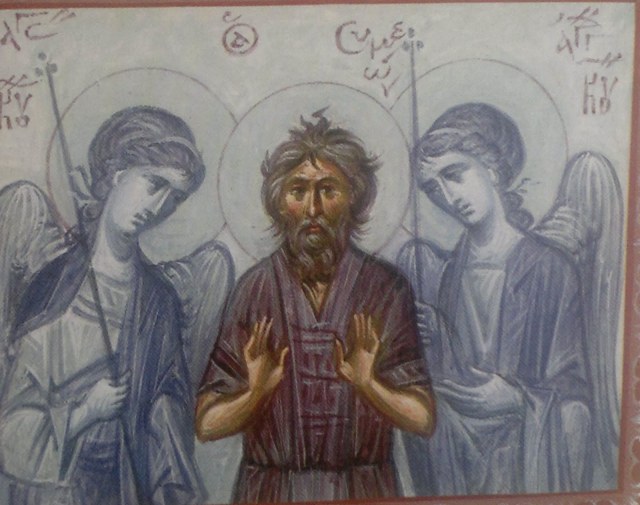
“I dreamt that I was walking along a road together with some other sisters. We were in an open place, passing by many fields, and we were walking two by two, in full monastic dress. All of a sudden, I saw two men crossing the field and coming towards us from the side. One of them looked like a monk; he was clad in a mantia and had a kamilavka on his head, the veil of which covered his face. He was holding a cross in his hands, like one who has just made his vows. The other one who was walking alongside the monk looked like a beggar. He wore a ripped shirt, and his hair was all disheveled. He was like a Fool-for-Christ; he kept leaping and jumping, and at the same time he was eating a piece of white bread that he was holding. Coming near to us, he seemed to tease us with his piece of bread, and he kept on leaping, looking at us with a smile. The monk was walking with his eyes lowered, and seemed to be completely immersed in his inner thoughts. I fixed my attention on them. When I looked around, my companions had all disappeared somewhere. I was standing alone in the middle of the road. Meanwhile, the two men came near and began walking by my side. The Fool-for-Christ looked at me intently, at first in silence, and then he said: “‘What are you thinking about? Crry your cross, like brother John is doing. Look at me, how I am leaping, carefree and gay, while I eat my piece of bread. You leap, too! Keep leaping along your way! Do people laugh at you? So what? Keep leaping, like Symeon the Fool-for-Christ! Keep leaping! Here is the church now, quite near!’ With these words, he indeed went leaping through the doors of a church we had inadvertently drawn near to. John followed him silently. I woke up. This is how I came to explain this dream: there is no need to seek salvation through complicated and tortuous ways. Instead, with a simple heart, one must walk along the path shown by Divine providence, not paying any attention to other people’s jeers and gossip, just carrying one’s monastic cross.”

For her first vision of our Saviour’s Cross, go to The Cross-Baptism. In my opinion, both of her visions are quite relevant for non-monastics too. Don’t you think so?


The Cross-Baptism

abbess thaisia

Excerpt from the Autobiography by Abbess Thaisia:

“… I fell asleep.

I saw myself entering a church or chapel (I do not know which) of modest size, from the south side. In the middle, as if facing the altar, there were standing three figures, all of the same size, clothed the sake, and alike in everything. I was at a loss to name them. They looked like human beings, but their heads were surrounded by something like a mist. I could not see them clearly. Besides me and them, nobody else was there. The church was empty. I became curious about these beings. Rather boldly, I began to approach them, first from one side, then from the other, trying to find out who they were. When I drew near to their right, the one standing there asked me, “What convent is this?” I replied, “The Convent of the Entrance into the Temple”. He asked me again, “How long have you lived here?” I answered, “Three years.” Then he said, “You have lived three years in this convent already, and still you do not know its name.” I began to argue, saying that I well knew the name of my convent. “It is the Convent of the Entrance into the Temple.” Then he beckoned me to come nearer, and went on, “If you do not know the name of your convent, I will tell you. It is the Convent of the Cross-Baptism.” At this moment I saw his head. It was like the head of our Saviour, as it is seen in the icons. With His left hand He was holding an enormous wooden Cross, as if He was leaning against it, and with His right Hand He lightly touched my shoulder. Tapping it gently, He said, “I tell you, it is the Convent of the Cross-Baptism. Do you not understand? Then I will explain it to you. Just as a Christian child is baptised through the water and the Spirit, and is not able to become a Christian otherwise, so a child-monk must be baptised through the Cross. Otherwise he cannot become a monk. Do you understand me now?” While He was speaking, I recognised Him as Christ, and full of joy and tender feeling, I exclaimed, “Truly, O my Lord, I do understand that I have to endure everything for the sake of Thy Cross.” I awoke with the same feeling of joy and tender feeling. My shoulder seemed to still feel the gentle tapping of His Hand. I was quite renewed  spiritually, and all my dark mood vanished as though it had never been there at all”