I saw myself entering a church or chapel (I do not know which) of modest size, from the south side. In the middle, as if facing the altar, there were standing three figures, all of the same size, clothed the sake, and alike in everything. I was at a loss to name them. They looked like human beings, but their heads were surrounded by something like a mist. I could not see them clearly. Besides me and them, nobody else was there. The church was empty. I became curious about these beings. Rather boldly, I began to approach them, first from one side, then from the other, trying to find out who they were. When I drew near to their right, the one standing there asked me, “What convent is this?” I replied, “The Convent of the Entrance into the Temple”. He asked me again, “How long have you lived here?” I answered, “Three years.” Then he said, “You have lived three years in this convent already, and still you do not know its name.” I began to argue, saying that I well knew the name of my convent. “It is the Convent of the Entrance into the Temple.” Then he beckoned me to come nearer, and went on, “If you do not know the name of your convent, I will tell you. It is the Convent of the Cross-Baptism.” At this moment I saw his head. It was like the head of our Saviour, as it is seen in the icons. With His left hand He was holding an enormous wooden Cross, as if He was leaning against it, and with His right Hand He lightly touched my shoulder. Tapping it gently, He said, “I tell you, it is the Convent of the Cross-Baptism. Do you not understand? Then I will explain it to you. Just as a Christian child is baptised through the water and the Spirit, and is not able to become a Christian otherwise, so a child-monk must be baptised through the Cross. Otherwise he cannot become a monk. Do you understand me now?” While He was speaking, I recognised Him as Christ, and full of joy and tender feeling, I exclaimed, “Truly, O my Lord, I do understand that I have to endure everything for the sake of Thy Cross.” I awoke with the same feeling of joy and tender feeling. My shoulder seemed to still feel the gentle tapping of His Hand. I was quite renewed spiritually, and all my dark mood vanished as though it had never been there at all”
In a termination hearing, one of the last big trials, the Prosecutor Liberis Papandreou told me the following, when he noticed a cross around my neck. He also showed me a cross that he wore around his neck and told me the following:
“This cross saved my life. Without this I would have been dead in the Winter of 1943. It was the period when anyone who fell into the hands of the Germans and brought to the torturers, on the road Merlin, did not leave except to go to the cemetery.
During this time I also was arrested. I was accused by a senior official of the Municipality of Piraeus – a German organization – and a Mayor of a Settlement of Piraeus as a General Prosecutor of the Communists, because these two men I had arrested for the abuse of food, which was intended for the hungry. My refusal, in which I denied any “blame”, infuriated my investigators.
For this reason I was brought to be tortured. On the third day of my martyrdom I was lead into a spacious room. This was hell on earth. Inside paraded five giant torturers, each of which exhausted all his powers upon me. Slowly I started to feel that soon I would be dead there.
After the huge torturers, I was taken by the investigator himself. In a furious moment he took me with both hands by the throat and began to squeeze. I felt that I would die of asphyxiation. He used all his power and I was freed from his hands. Immediately I tore my shirt for my chest to breathe. I had not even thought about what I did. At the same time I noticed my torturer become pale. He turned white, more white than the wall of the room. He tried to lift his hands but could not succeed.
He then began to cry… Yes, crying like a frightened baby! He then came near me, leaned on my chest and kissed this here cross! I confess that I could not believe what I saw with my eyes.
After a little while he called out to be brought a glass of water. With this he washed, with his own hands, which now could move, my wounds, and after he sat me on a chair to recover. He then left to return to several colleagues, to whom he recounted the following:
‘Once this man opened his chest, lightning flashed before my eyes from this tiny cross. This flash formed a fiery “nein” [German for “no”]. Now that I’ve recovered, gentlemen, I can say that God is close to the faithful.’
Then he returned to me and said:
‘I would ask you to offer this cross to me to protect me from this unjust crisis. Not from death, because I do not fear it. But I’m not worthy, I do not believe in God like you. Because if I believed…’ and he stopped short the sentence.
So, my beloved one, it saved me from certain death thanks to my faith,” said the Prosecutor Liberis Papandreou.
From Ν. Καπιτσόγλου, “Θαύματα που γίνονται σήμερα”, περιοδ. Κιβωτός, αριθ. 21/ Σεπτέμβριος 1953, σελ. 347.
2. The Cross of Preveli Monastery
This miraculous relic constitutes the “Palladium” of the Monastery and is associated with many miracles especially related with eye diseases. It’s a big silver cross (Dim. 0.56 x 0.25) with wider points at the ends and protruded decorative buttons and tokens in a wire working process. The Baptism of Jesus Christ is shown from one side. The Father on the upper part and the Angels beside the points of the cross. On the other side the crucifixion are the symbols of four Evangelists. A big crystal is attached to the handle of the cross and in the perimeter of the cyclical base the donation inscription appears: “The Fatigue And Hard Work Of Abbot Ephraim, Whom The Lord Saved From Hell Fire”. The cross demonstrates the level of folklore silversmiths in Crete had during the second half of 18th century, when the active and energetic Abbot Ephraim Prevelis lived. The cross is kept in a shrine in the main church of the Monastery.
The Cross was carried in the front line of every battle thus greatly encouraging the fighters. In 1823, in the unequal battle against the Turks at Amourgeles, in Monofatsiou province, the Holy Symbol was lost. The Cross was found at the end of 1823 in the hands of Genoese sailors, who had purchased it in Heraklion. According to the legend, they returned the Cross to the Monastery when their ship simply stopped in the water, in a a quite mysterious way, while sailing in the Libyan Sea near the Monastery of Preveli, and was able to proceed only after the precious relic was given back. In 1941, German officers removed the Cross from the Monastery and attempted to send it to Germany. The airplane though which would transfer the Holy Symbol away could not take off. They put the Cross in another airplane without result, the second airplane could not start. They attributed this event to the Holy Symbol, so a few days after the looting, the Cross was back in its position. It was also September 13th, the eve of the feast of the Exaltation of the Holy Cross, the feast day of the Monastery.
According to reliable sources, a well-known Hodja of Egypt with his family abandoned Islam and were baptized Christians. As he says, it was because of a miracle.
The former Hodja, now a Christian convert, said that his daughter was suffering from an incurable disease. They went to every hospital and saw many doctors where they lived in Egypt, and even travelled abroad. They would recommend treatment, but did not have much hope. Indeed they would inform the desperate father to take his daughter home since there really was no treatment. The Hodja prayed daily to Allah for help.
A close friend saw the father’s grief, and offered to put a cross on the pillow of his daughter. On hearing this proposal, the father responded: “It is not possible for me to do something like that…, I will not sell my faith.” The idea however began to occupy his thoughts. Without telling anyone, he bought a cross and placed it on the pillow of his daughter. The days passed and his daughter entered a comatose state, losing all consciousness. The whole family and the people of the area served by the former Hodja waited for her death. The desperate father day and night sat next to her, crying. Inside, as he confesses now, there was a hope that something would happen.
One evening as the depressed father held the hand of his daughter, he saw the cross that was on the pillow to emit a bright light which spread all over the bed. Initially he thought that it was a dream or something wrong with his mind because of his sadness. However, the light he saw was obvious. Suddenly he saw his daughter getting up from bed and saying: ‘Dad, I am hungry, bring me something to eat.” The Hodja could not understand what had happened. He went to the kitchen overjoyed. The voices roused his wife and the neighborhood. Soon the house was crowded. He told and re-told what happened. He spoke about the miracle of the cross. He even phoned his friend who had proposed to put the cross on the pillow of the daughter and thanked him.
Neighbors and friends tried to ascribe the miracle to Saint George, who is accepted by Muslims. But he knew the power of the cross. He experienced the miracle. The daughter no longer had anything and physicians aware of the situation did not believe their eyes when they saw that the new tests did not show anything. A few days after the miracle the former Hodja had made a decision. He told his wife he would become a Christian. She initially was against this and thought of the persecution that will follow the entire family by Muslims. “They will kill us” she said. But he was already on his way. He notified her that they leave permanently from Egypt. “We will be baptized and live in another country.” So it happened.
However, the news of his entering the Church of Christ, was widely circulated in the city he served, and to Muslim clergy. Today, the former Hodja and now Christian convert studies theology. For Muslims today, he and his family are outlaws. This is why we cannot publish more data.
Source: mystagogy Translations by John Sanidopoulos
I feel sinful and dirty. The true awareness of my nothingness greatly helps me to see God.
“Thou shalt gladden him in joy with Thy face” (Ps. 20:6). Oh, that divine face! It has Eros and Beauty from the Glory, from the supremely radiant Light of the Trinity’s effulgence. This is what the transcendent Beauty of God is: a divine electrification and contact with God the Father, His humility and condescension. Oh, how unlimited the humility and simplicity of God is! The humility and condescension of the awesome God astounds and overwhelms me! How filthy and dirty man is! Even though he has so many sins and is so guilty, he feels haughty and behaves egotistically. There is nothing stupider than this.
The angels are celebrating in heaven, dressed in white with inconceivable beauty within the supremely bright light of God. They are chanting — and what are they chanting! Their hymns are pure bliss. But that which makes them stay in this blessed state is the grace of humility and true self-knowledge.
Unfortunately, I am proud, which is why I lack this joy and grace. Like a helpless creature, like a thirsty deer, I seek, cry out, and long to be watered by the true Fountain — my God — with a divine drink, with the water springing up into eternal life (cf. Jn. 4:14). “When shall I come and appear before the face of my God?” (cf. Ps. 41:2) I weep, seeking my God. When I touch Him, I feel him and weep. But how this is happening, I do not know; one thing I do know, and that is that I feel Him as much as He wants and corresponding to the humility I feel for my dirty self. My God and Father, open the eyes of my blind soul to see my nature, the nothingness of my nothingness, and through it to see You, the most lovely Light, Who gives eternal life to mortal man. Enlighten my darkness, O divine, lovely Light.
In the video which follows a Georgian Elder appears bathed in the Uncreated Light. Please pay particular attention to how the priest appears quite ordinary in the beginning, and approximately after 3:17, a transfiguration begins to take place. The event is captured by the videocamera but is not witnessed by his congregation. I would be really interested if anybody could offer us a translation in English of what the Elder is saying. Interestingly enough, I have come across two quite different translations so far.
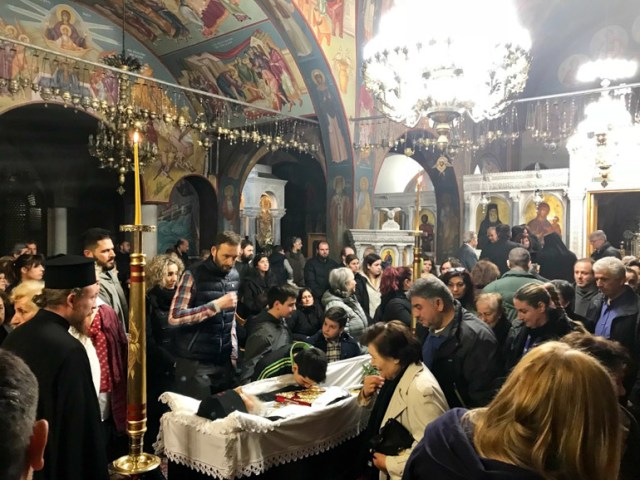
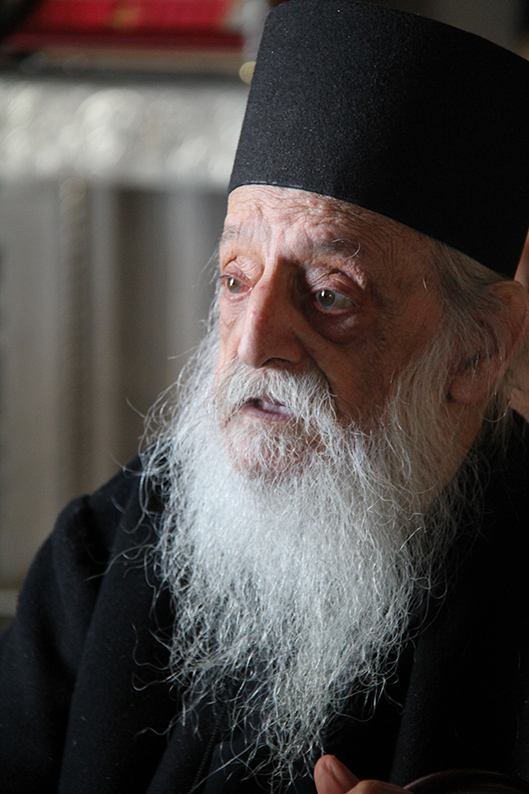
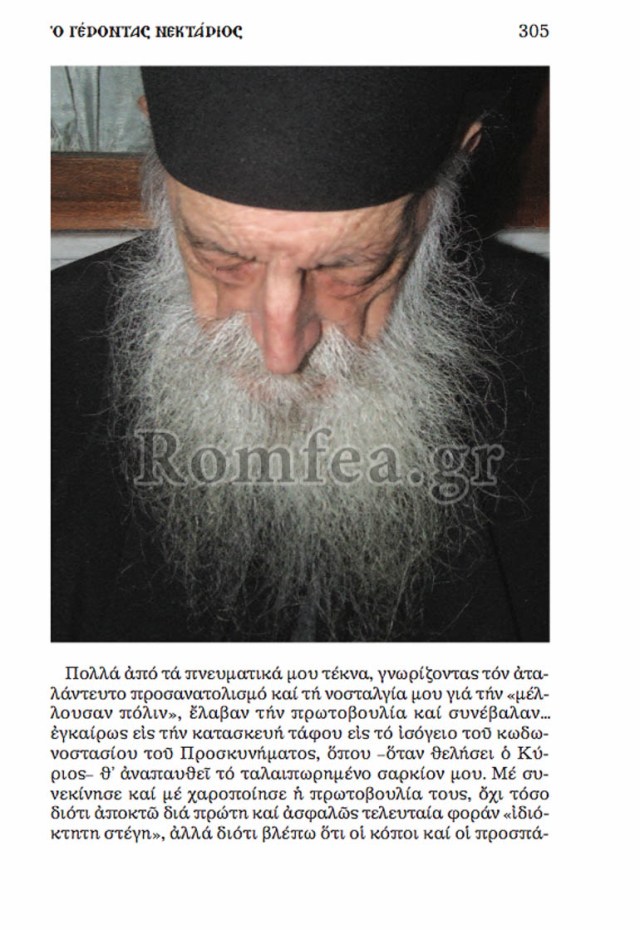
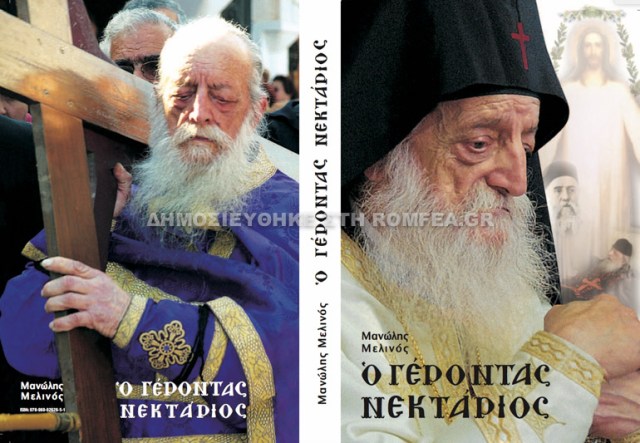
On Thursday, February 8, 2018, at 5:30 AM, the renowned elder and spiritual father Nektarios Vitalis, the elder of Saint Athanasius Monastery in Kouvaras, reposed in the Lord. I wrote about his holy life in a previous post. Today I would like to share with you a miracle which took place on the day of his funeral, February 9 at the Monastery of Saint Athanasius, sealing a life full of heavenly visitations. The Youtube video which follows, shows, from 1:38onwards, how his corpse is not stiff (ie. rigor mortis) but shows signs of flexibility, as if he were only sleeping. Pay attention to how a spiritual child of his fondly kisses and gently caresses his Gerondas’ hand, seeking his final blessing. God is glorified in His Saints!
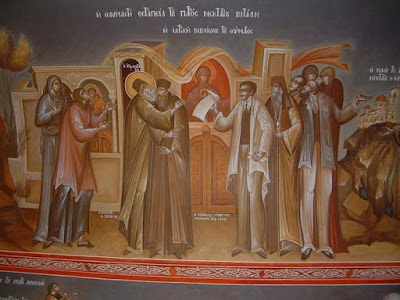
Icon of St. Nektarios embracing and healing Fr. Nektarios Vitalis, along with the two women bearing witness to this to the left, and the doctors confirming the miracle to the right. The icon is from the Chapel of Saint Nektarios in Aretaieion Hospital.
Before this, in 1965, he suffered a stroke, and his situation was dire, but Saint Nektarios the Wonderworker granted him healing. As soon as he became well, he moved to Lavro. A short time later, he again saw Saint Nektarios in his sleep, who asked him to build his “house” in Kamariza, Lavro [a famous pilgrimage of the saint, where many miracles have occurred], and who informed him that he would help him.
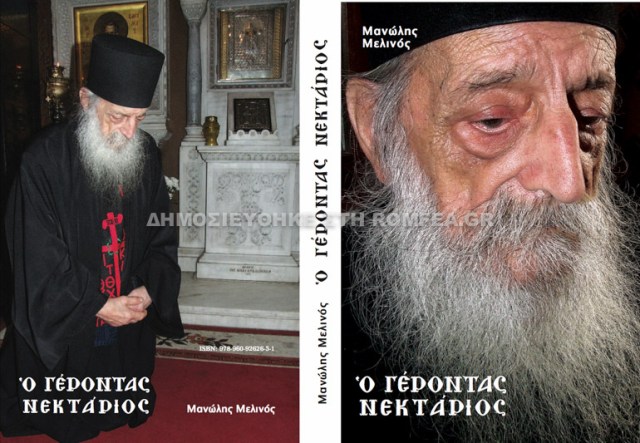
Excerpt from a short encomium written by Mr. Manolis Melinos, who wrote several books on St. Nektarios, his life and miracles, and spent 30 years together with him: ELDER NEKTARIOS The sweet, the simple, the father, The brother, the fellow man, The consoler, the humble one, The child among children, the great one among the great, the elder among the elders, in other words, the child-elder, reposed today, February 8th, 2018 at the age of 88. Now he is an intercessor for us at the heavenly Altar, together with St. Nektarios, near the Great High Priest Christ, to Whom he gave everything!
Fr. Nektarios Vitalis is at long last with our Saviour Christ and his beloved patron Saint, St. Nektarios. May he pray for us! His was a life full of visions, visitations and miracles with his patron saint, even near-death, after-life experiences! Miracles and signs of Holiness even during his Memorial Service and Funeral!
Καλό Παράδεισο, Γέροντα! Καλή αντάμωση στην Αιωνιότητα!
Greek traditional wish for the departed: “A Blessed Paradise, Gerondas! Until we meet again in Eternity!
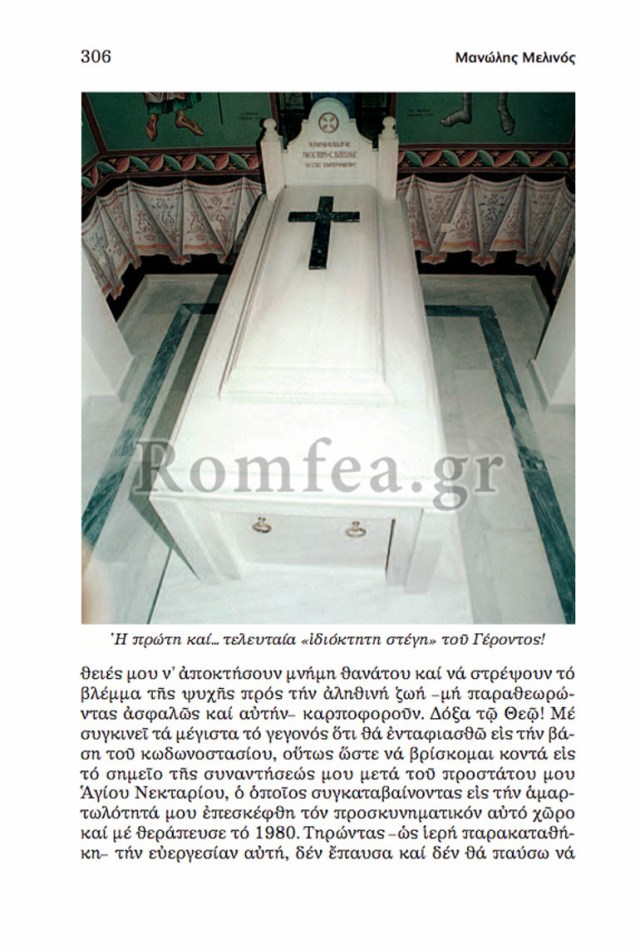
Below follow Fr. Nektarios’ recalling of his miraculous healing of cancer by St. Nektarios, a few youtube videos where he tells of St. Nektarios’ visitations to him and his near-death, ‘after-life’ experience, and his final will, testament and tomb.
Miracle of Saint Nektarios: The Healing of Fr. Nektarios Vitalis of Cancer
Fr. Nektarios Vitalis, well-known in Lavrio [a city in Attika, Greece] for his deeds and his sympathy to the poor and those written-off by the world in these difficult times, retells the following incident from when he was dying from cancer. What is said below has been told elsewhere, repeatedly, including in the book I talked to Saint Nektarios (Athens 1997, by the renowned writer Mr. Manolis Melinos).
Fr. Nektarios Vitalis recalls:
“I was suffering from a serious form of cancer. My chest was an open wound that was continuously running blood and pus. I would tear my undershirts from the pain. It was a tragic situation, and I was headed directly to death. So you understand, I had even prepared my grave clothes….
“On the 26th of March 1980, in the morning, I was talking in my office in the basement of the Church with Sofia Bourdoy (the church care-taker [a woman who cleans the church]) and the icon painter Helen Kitraki, when the door suddenly opened and an old, unknown man entered. He had a snow-white beard, was short and was slighty bald. He looked exactly the same as St. Nektarios appears in photographs. He took three candles without paying and lit only two. He venerated all the icons of the church, but passed over the icon of St. Nektarios without venerating it. He did not see me where I was. I had terrible pains when they pulled aside the curtain of the office and went to see the old man. He faced the Beautiful Gate [the Royal Doors in the Holy Iconostasion], crossed his palms and without looking around he asked: ‘Is the Geronta [Elder] here?’
“The church care-taker knowing my disease wanted to protect me…: ‘No, no…he is at home with the flu….’
“He replied: ‘Never mind. Pray, and have a Good Resurrection,’ [the traditional Orthodox greeting during Great Lent in anticipation of Pascha ‘Kali Anastasi’] he said as he left.
“The church care-taker came running to me and said ‘Father Nektarios, the old man who just left resembled St. Nektarios himself! His eyes flew flames. It seems to me that was St. Nektarios and he came to help you….’
“I thanked her thinking that she said this to console me. But deep down something was wrong. I sent her along with the icon painter to find the unknown man and quickly bring him back. I walked into the sanctuary and venerated the Crucified One [the icon of Christ on the Cross in every Holy Altar] crying, and once again asking Christ to heal me. Their footsteps stopped: ‘Father, the Elder has come!’
“I tried to kiss his hand, but out of humilty he did not let me. He bent and kissed my own! I asked him: ‘What is your name?’
“‘Anastasios, my son,’ he said, relating his baptismal name that he had before he become a monk….
“I led him to venerate the holy relics. He took out a pair of glasses with only one arm, and as soon as we saw them we were amazed! They were the same glasses of St. Nektarios that we had in the case with the holy relics. They were given to me by the old Gerontissa [Eldress] Nektaria of the monastery in Aegina.
“‘Belief is everything!’ said the stranger, as he put on his glasses.
“He began with reverence to embrace all the holy relics as the church care-taker showed, except for the relics of St. Nektarios, which he passed over….
“‘Geronta, forgive me,’ I said, ‘but why don’t you venerate the miraculous Saint Nektarios?’
“He turned and looked at me smiling. I asked him: ‘Where are you staying Geronta?’
“He showed me the ceiling, where we were building the new church [dedicated to St. Nektarios], saying: ‘My house is still not ready and I’m worried. My position does not allow me to live here and there….’
“‘Geronta, I must confess, you were told a lie earlier. I have cancer! But I want to get well, to make the Holy Altar, to finish the Church first, and then I can die….’
“‘Do not worry,’ he told me. ‘I’m leaving now. I’m going to Paros [an island in Greece] to venerate St. Arsenios and to visit Fr. Philotheos [Zervakos],’ he added, starting to leave and passing by the big icon without giving it a second thought….
“I stopped him and put my hands to his face.
“‘My Geronta, my Geronta, your face looks exactly like St. Nektarios who is honored here in our church….’
“Then, tears rolled from his eyes. He crossed me and embraced me with his hands. Taking courage I opened my hands to hug him. But when I spread out my hands, and while I was watching I could see him before my face, my arms closed back to my chest! The hairs then stood up on my arms and I crossed myself!
“I said again: ‘O my Geronta, I beg you, I want to live to do my first Liturgy. Help me to live….’
“He left from being close to me and stopped in front of his icon and said: ‘Oh, my child Nektarios, don’t worry. It is a passing trial, and you will be well! The miracle which you are asking for will happen, and it will be told to the whole world. Don’t be afraid….’
“Immediately he left us by walking through a closed door….
“The women ran to catch up to him. They reached him at the bus stop. He went inside and disappeared before the bus left!”
This story is always told by Fr. Nektarios Vitalis, a respected and reliable person, in the presence of witnesses. Fr. Nektarios eventually became well – to the amazement of doctors, radiologists, and forecasters of death. Because above all is Christ, our living God, and our intercessors before God, the Saints, plus our Mother the Panagia!
For “where God wills, the laws of nature are overcome….”
Kalo Paradeiso! Kali Synandisi! [Greek wishes on a funeral] May you enter Paradise! May we meet again there!
October 10, 2017 Acts 11:22-24 22 Then news of these things came to the ears of the church in Jerusalem, and they sent out Barnabas to go as far as Antioch. 23 When he came and had seen the grace of God, he was glad, and encouraged them all that with purpose of heart they should continue with the Lord. 24 For he was a good man, full of the Holy Spirit and of faith. And a great many people were added to the Lord.
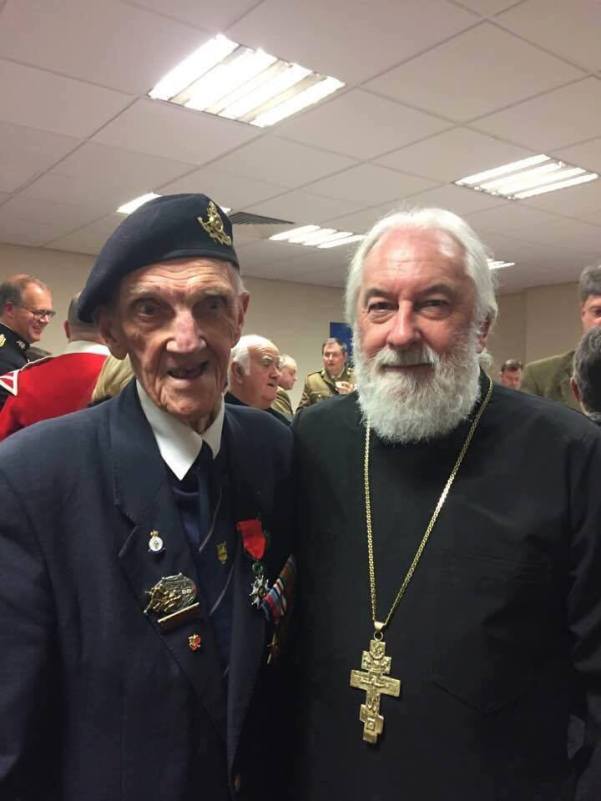
“It is with gladdening sorrow that we have composed and dedicated this issue of the Stavronian to our beloved elder Barnabas, founder of the Parish of Holy and Life-Giving Cross and Normandy veteran. Our brother Barnabas peacefully fell asleep in the Lord at 21:40, October 10, three days before his 94th birthday. He was not alone when he passed into God’s keeping. Apart from the angels that attended his repose, members of the Parish, his spiritual family, were there as well as his own family were at his bedside. He was holding my hand when he breathed his last breath. He received Holy Unction the same morning. He even drew energy to make the sign of the cross. We asked him for a word from the Lord and he said “Love”! It was a holy repose with the faithful holding lighted candles. I thank God that he entrusted to me the unworthy priest this holy soul and brave soldier of Christ as an example of the Christian life. As a founder of the Orthodox Community of the Holy Cross he will remain forever inour prayers. May angels take him to his just reward in the Heavenly Kingdom of Our Lord Jesus Christ. May his memory be eternal. Christ is Risen!”
Fr. Jonathan
*
HEAVEN: FROM PROTESTANTISM TO ORTHODOXY
A Westerner Looks East for the Truth
ByBarnabas Dickinson
“When God the Holy Spirit says ‘Do something, you jolly well do it, or else…’,but what? Our loving Saviour had some stern words about lukewarmness, about turning back, having put one’s hand to the plough. … During the years of strife in the Church of England over this matter, pressure groups formed on both sides of the divide, and I attended rallies of the opposition in the Blackburn diocese. …What happens next? What do we do? Where do we go? What is our place in the Church? Speeches and discussion led nowhere… People were bewildered, defeated, hurt. Then, for me, God the Holy Spirit took a hand. Right at the end, in the question and answer session, a priest I did not know [ie. Father Jonathan Hem-mings] said very simply, ‘If anyone is wondering where to go’, they should be aware that Orthodox Church services in English are becoming available’, or words to that effect. Option (7) had come out of the blue, completely unexpected, and when the rally broke up for a cup of tea, I approached him. …
… One Saturday in the Spring of 1995, Fr Jonathan took me to the railway station for my train back to Chorley. He said to me, ‘It’s decision time’. The Patriarch of Antioch, who had taken personal oversight of this English group in May 1995, and the Holy Synod, had decided to accept us into membership of the Orthodox Church. ‘Are you coming, or are you not?’ Father Jonathan said. I said that I would …Grass did not grow under our feet, and quite soon, on Wednesday of Bright Week I was received into the Church, along with half a dozen others, including Fr Jonathan, now a lay member of the Church, having resigned his Anglican priesthood after Easter Day; eastern and western coincided that year. Our baptism in the Church of England was accepted as valid, having been in the threefold Name, and we were chrismated at the hands of Father Alexey, with Holy Oil consecrated by the Patriarch. For the first time I received the true Body and Blood of our Saviour. Now, twenty six years later I would not be anywhere else.
Thanks be to God for bringing Fr Jonathan into my life, and for all things. Lord Jesus Christ, Son of God, have mercy on me a sinner.”
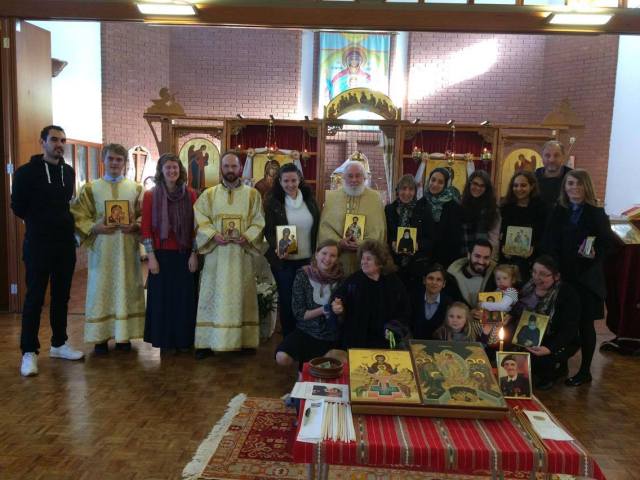
Barnabas’ icons have been bequeathed to our parish. Barnabas’ legacy of icons by the hand of Dimitrios Hakim perfectly compliment the parish icons by the same artist.
To find out more about Barnabas, a most dear father to this poor little city hermit, please have a look at the November Stavronian which this month is dedicated to our beloved elder and co founder of the Church of the Holy Cross, Stanley ( Barnabas) Dickinson at http://www.orthodox-lancaster.org.uk/newsletter
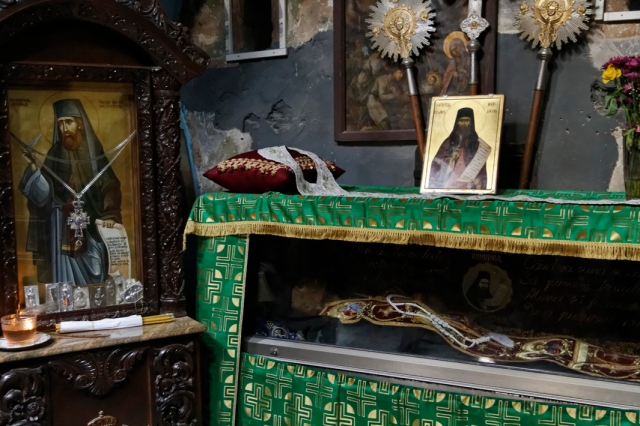
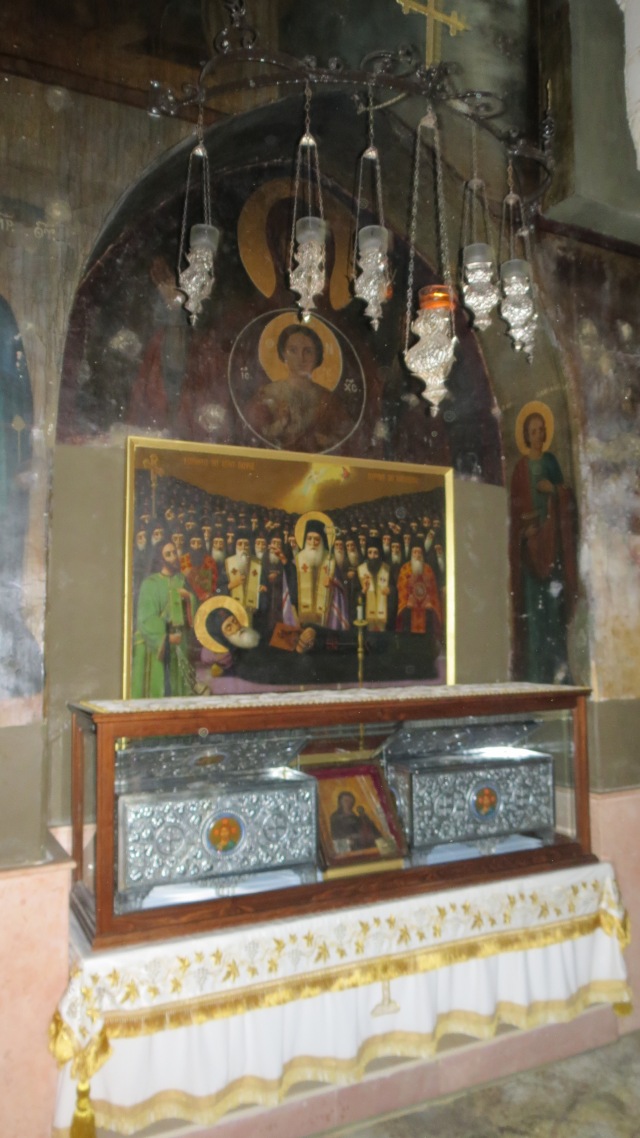
* A Hermit from the Holy Land with complete Incorruptible Relics at the monastery of St. George Choziba! He was a great ascetic and a poet. He called himself “the child of zero” who “followed the One”. After his all night- vigils, he would briefly rest in the verandah of the monastery and write his so moving poetry, sadly not translated yet in English.
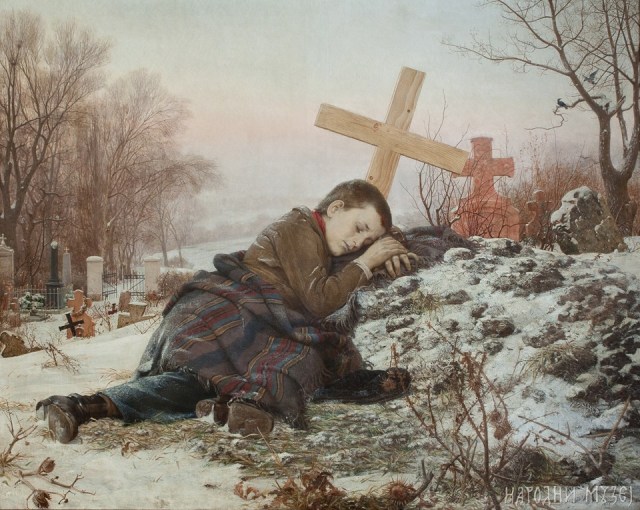
* The painting is by the Serbian artist Uroš Predić, Siroče (Orphan), oil on canvas, 1888. National Museum
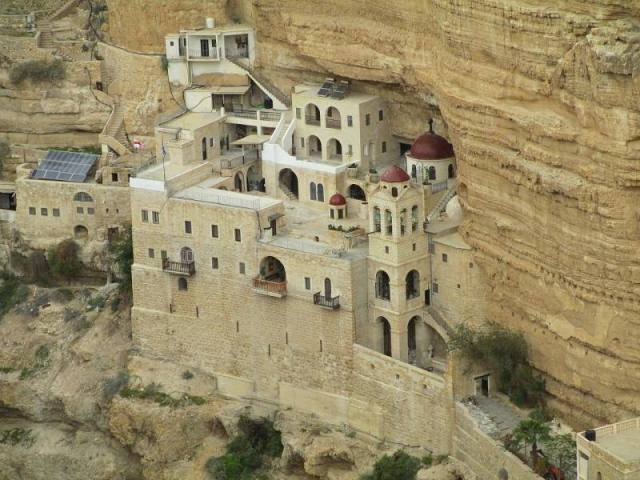
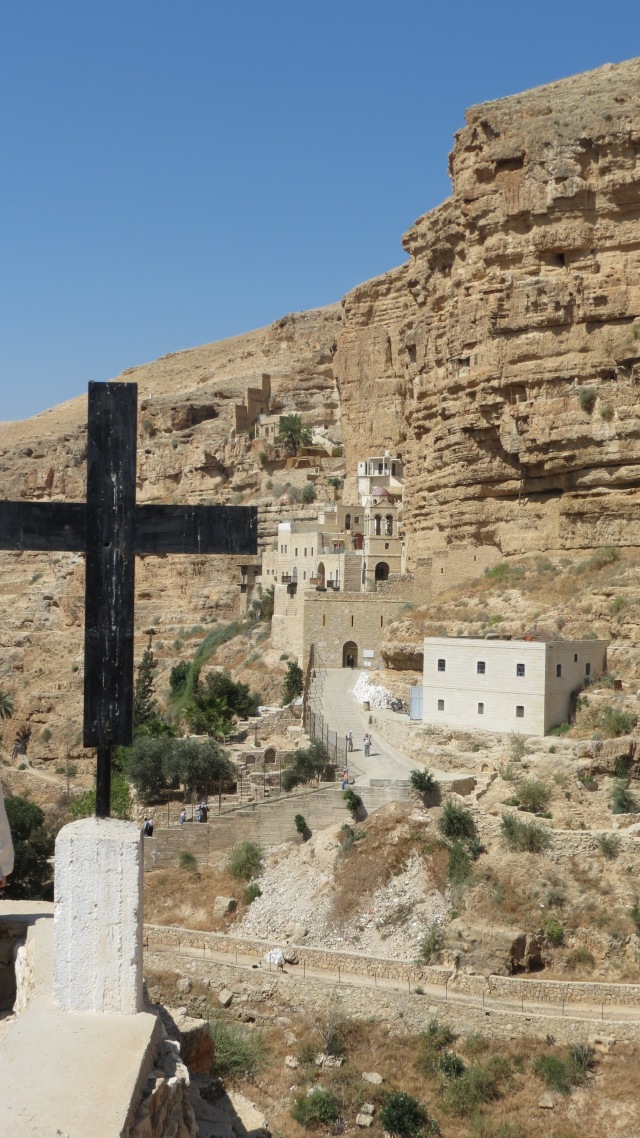
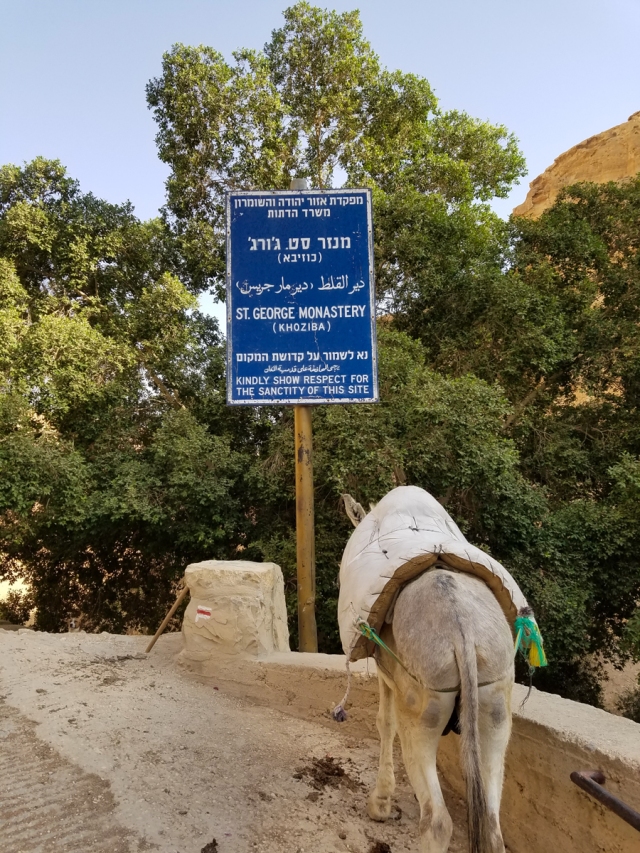
When you first catch a glimpse of the magical St. George’s Monastery (Choziba) in the Judean desert, the Desert Fathers’ Wisdom is brought to life in its uncompromising, breathtaking asceticism. This amazing cliff-hanging monastery, one of the world’s oldest and definitely one of the most inspiring churches in the Holy Land, is a must-see for the desert / archeological fans / devout Pilgrims.
St. George Orthodox Monastery, or Monastery of St. George of Choziba is a monastery located in Wadi Qelt, in the eastern West Bank, in the occupied territories. The sixth-century cliff-hanging complex, with its ancient chapel and gardens, is active and inhabited by Eastern Orthodox monks. It is reached by a pedestrian bridge across Wadi Qelt, which many believe to be Psalm 23’s Valley of the Shadow. The valley parallels the old Roman road to Jericho, the backdrop for the parable of the Good Samaritan (Luke 10:29-37).
Here’s some beautiful aerial video footage to give you a taste of the area around St. George’s Monastery…
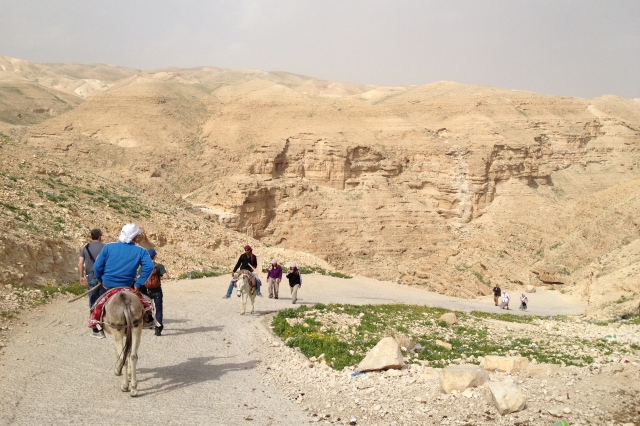
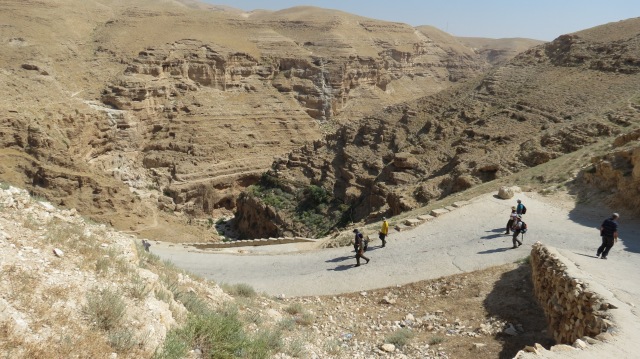
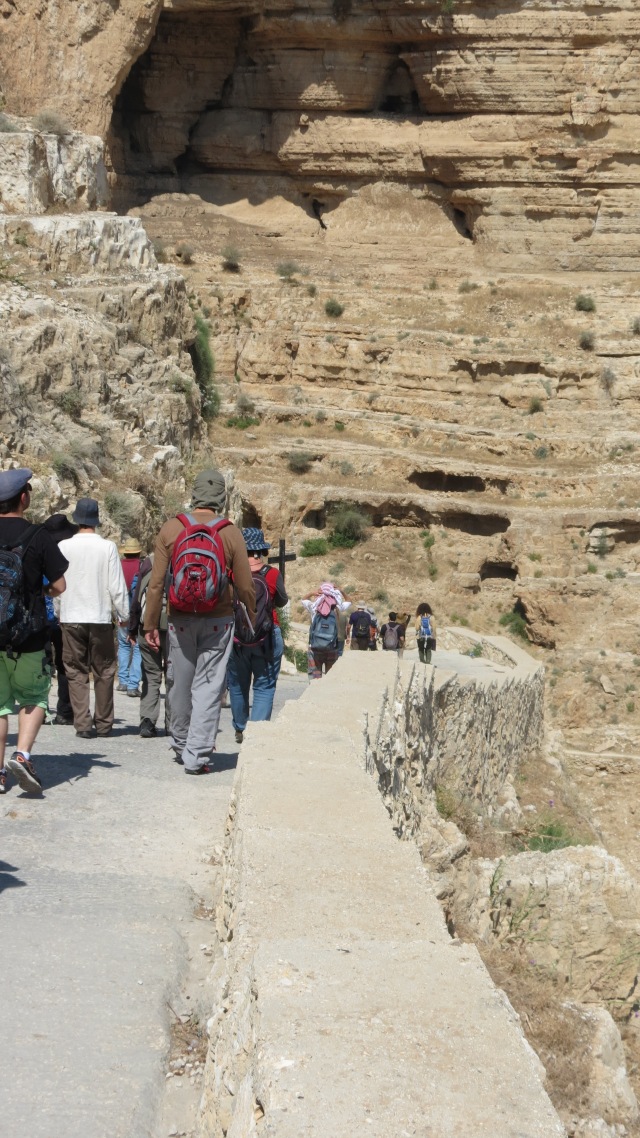
St George’s Monastery can be reached via the main Jerusalem – Dead Sea highway (Road 1). Take a left at Mitzpeh Jericho (or a right if you’re coming from Jericho) and follow the brown signs for Wadi Kelt. You can hike the Wadi all the way to the monastery but it will take lots of hours of arduous trekking in the desert under the blazing sun! Up and down, for hours, a windy path! Not so easy for seniors or people with disabilities, but there are usually plenty of locals offering their donkeys for the ride (at a cost of course).
Check out the clip below for a real taste of the walk to St George’s Monastery … When I look at these photographs or watch the videos, I cannot believe I did all this walking!
St. George’s Monastery was originally started in the fourth century by a few monks who were looking to immerse themselves in the lifestyles and desert stories of John the Baptist and Jesus. The monks, and perhaps most notably the hermit John of Thebes, eventually settled on the spot around a cave where it is believed the prophet Elijah was fed by ravens (1 Kings 17:5-6). The traditions attached to the monastery include a visit by Elijah en route to the Sinai Peninsula, and St. Joachim, whose wife Anne was infertile, weeping here when an angel announced to him the news of Mary’s conception.
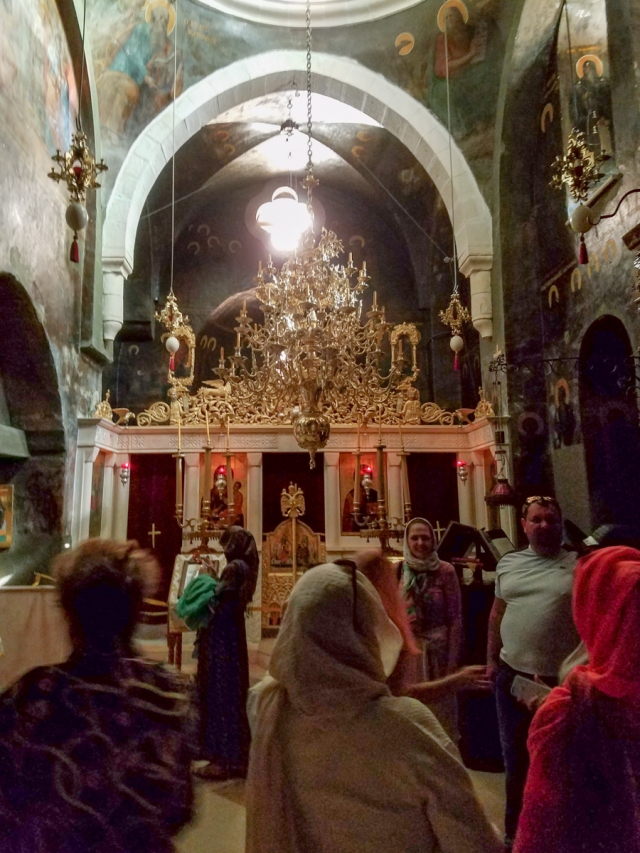
The monastery became an important spiritual centre in the sixth century under Saint George of Choziba. Hermits living in caves in nearby cliffs would meet in the monastery for a weekly mass and communal meal.John of Thebes became a hermit and moved from Egypt to Syria Palaestina. The monastery was named St. George after the most famous monk who lived at the site. Destroyed in 614 A.D. by the Persians, the monastery was more or less abandoned after the Persians swept through the valley and massacred the fourteen monks who dwelt there. The bones and skulls of the martyred monks killed by the Persians in 614 A.D. can still be seen today in the monastery chapel. These 3000 and more martyrs’ relics are so alive that during their Supplication canon every week an exquisite fragrance and raw smell of fresh slaughtered blood are alternately exuded from them!
The Crusaders made some attempts at restoration in 1179. However, it fell into disuse after their expulsion. In 1878, a Greek monk, Kallinikos, settled here and restored the monastery, finishing it in 1901. Father Germanos, born Georgios Tsibouktzakis, who came from Thessaloniki, Greece, to St George’s in 1993 and lived there until he was murdered by Palestinian terrorists in 2001, was for many years the sole occupant of the monastery, he was named Abbot in 2000. Emulating the Wadi Qelt monks of late antiquity, Father Germanos offered hospitality to visitors, improved the stone path used by pilgrims to climb up to the monastery, repaired the aqueducts, and improved the gardens of shade and olive trees.
This is probably the most stunning discovery in the monastery: St. John Jacob (the Romanian) – a Hermit from the Holy Land with complete Incorruptible Relics! He was a great ascetic and a poet. He called himself “the child of zero” who “followed the One”. After his all night- vigils, he would briefly rest in the verandah of the monastery and write his so moving poetry, sadly not translated yet in English. In the next days I plan to translate and post here some of his most moving autobiographical poems. This Saint is famous for his miracles, from the discovery of his relics to nowadays.
This discovery was even more stunning for me personally because my spiritual father had introduced him to me the last day before flying from Lancaster to Greece and then to Tel Aviv. He also gave me a tiny piece of a secondary relic of him. What a ‘coincidence’! I knew nothing about him, other than his name, and then a brief google search, and here I found him most alive and incorruptible!
Let me close with Archimandrite Konstandinos, a holy Elder, very special in his hospitality and famous for his clairvoyance gifts.
*A personal witness by Maran Ata, a person who had the joy to meet this
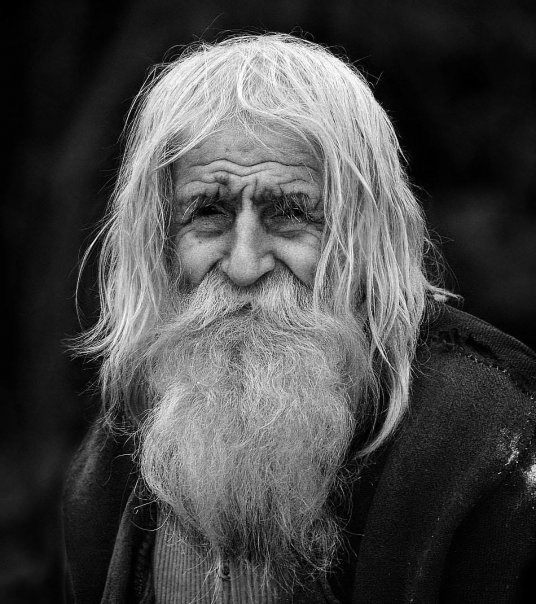
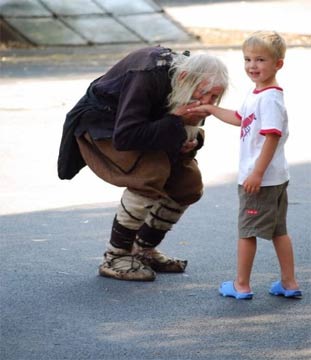
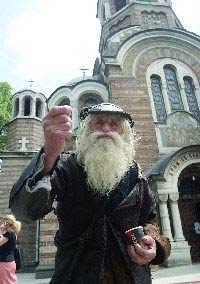
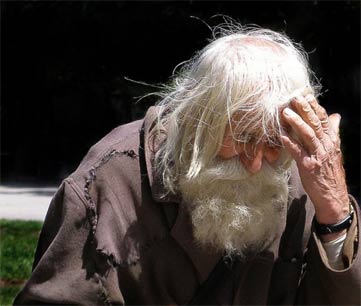
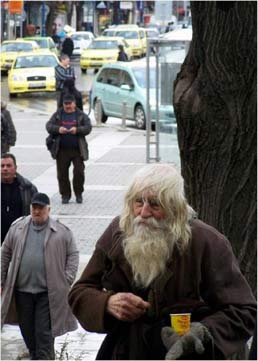
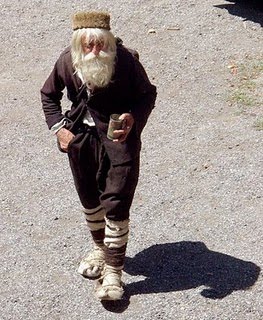
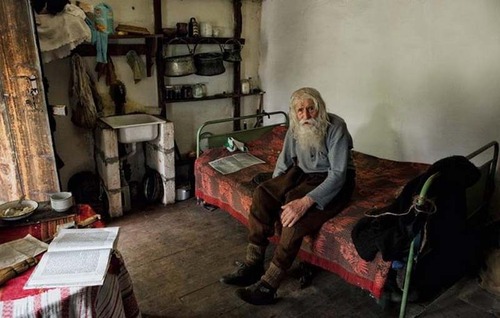
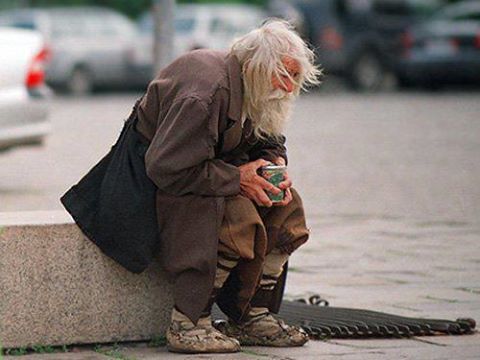
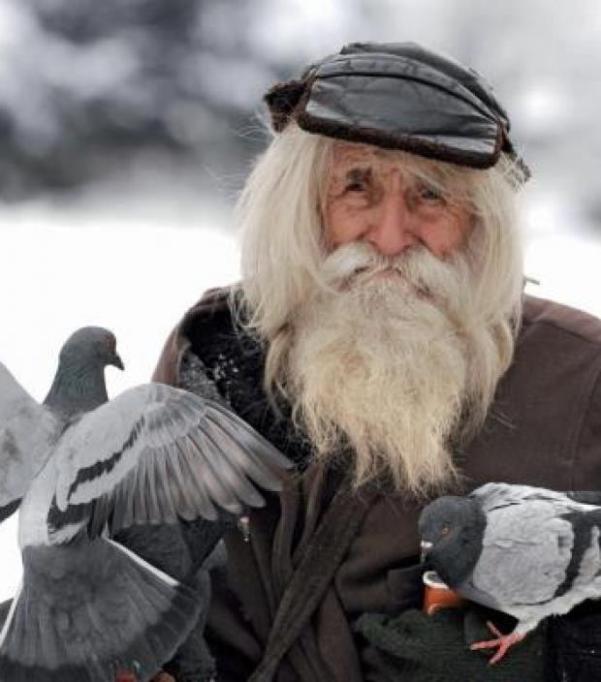
This is one part of the film “Mite” produced by the Pokrov Foundation in the year 2000, showing the Bulgarian Elder Dobri, who is considered a holy man of God.
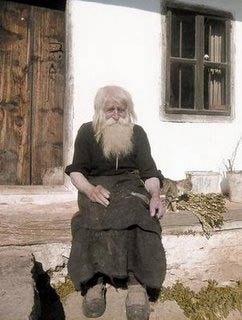
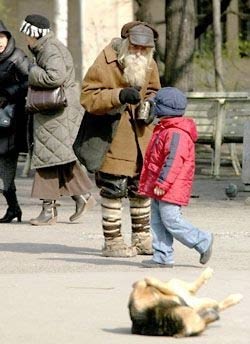
“Four years ago, I had the pleasure to meet him and directly delight in his innocent kindness and simplicity. People from Sofia know him as Elder Dobri Dobrev from the village Baylovo. He is a 96 year old elder who could often be seen standing in front of the church St. Alexander Nevsky or St. Methodius and Cyril and their five disciples with his metal cashbox and begging for money. He gives the collected money for renewing of the monasteries and churches or to poor people.
I met him at the Church of St. Kyriaki, when I was attending the Holy Liturgy which was led by several bishops, in the presence of the graceful relics of St. Stephen Milutin the King. Simply, he entered through the church gate, stood in front of the relics and, as a young boy, made a few deep bows [prostrations]. That was an amazing scene, especially because of the feeling of unworthiness when God crosses our life-path with one of His righteous men.
Kind eyes, pleasant smile, humble look… all that makes him bright in the eyes of those who have met him and without hesitation hurry to get a blessing from this sagacious elder. He wears traditional shoes from raw skin and he all the time rushes somewhere, but he never uses modern transport vehicles. Simply, he loves the ascetic walk. He eats whatever the good people give him and he never repines for his condition. His face shines with heavenly light which at one point of the moment makes people unconsciously to understand that he really is like someone out of the Bible.
I hope that I’ll be vouchsafed by God to kiss the elders merciful right hand for third time in my life.” (Maran Ata)
“Man should keep righteousness and the truth. That’s God’s path!”
















 ORTHODOX CHRISTIAN FAITH AND LIFE