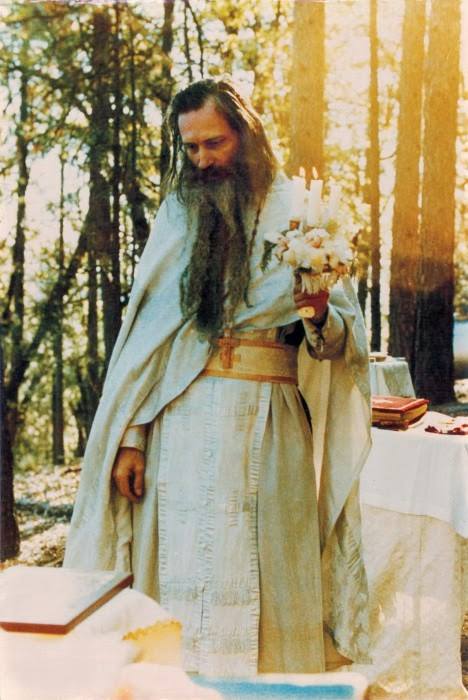
One young convert, radiant after experiencing his first Pascha in the wilderness, was asked by Fr. Seraphim: “Well, how did you like the Feast?”
“It was wonderful!” replied the elated pilgrim.
“Don’t waste what you’ve been given,” Fr. Seraphim said, echoing the words of Bishop Nektary. “Don’t spill the grace. Keep it there!” As he said this, Fr. Seraphim tapped the young man’s chest, right on his heart.
The sequel to Father Arseny 1893-1973: Priest, Prisoner, Spiritual Father
“There are many times when we read the words “the best book I have ever read”….well, this book is certainly the benchmark by which you can measure all the others you will read. If you are spiritually hungry and thirsting for that one drop of spiritual water….then read this. It will open your heart. The words in this book will feed your soul. If you are reading this because you are undecided…..then why don’t you ask your heart to make the decision for you? I did…..!”
St. Silouan’s the Athonite poetry-prayer, Byzantine iconography, and Arvo Pärt’s lyrical musical/ choral setting of the text faithful to its every nuance.(*)
Lenten Reflections (III)
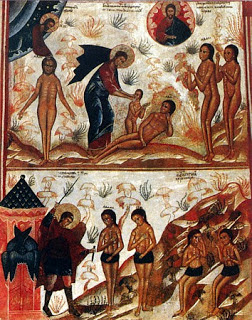
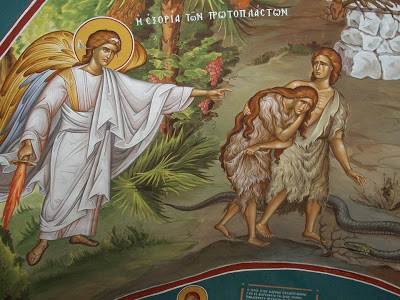
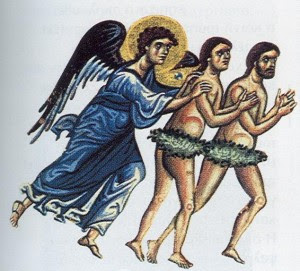
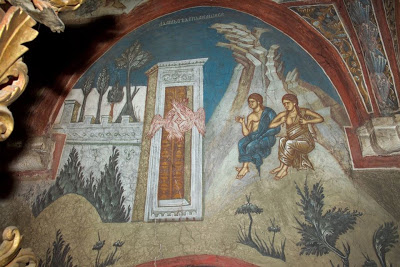
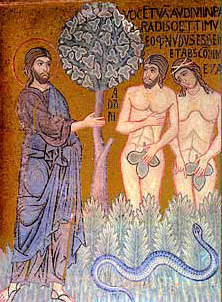
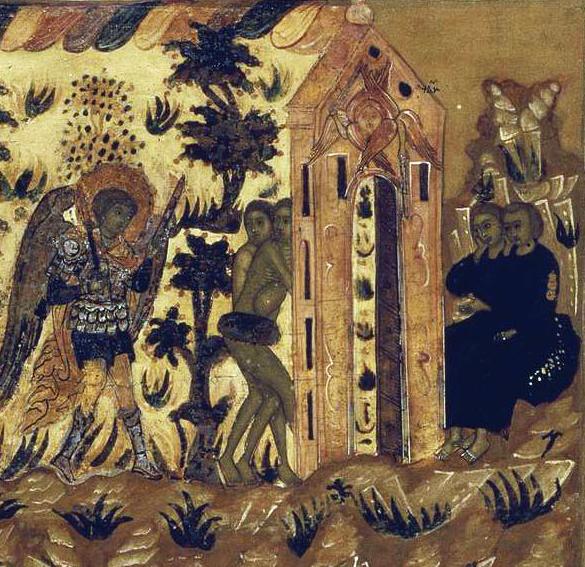
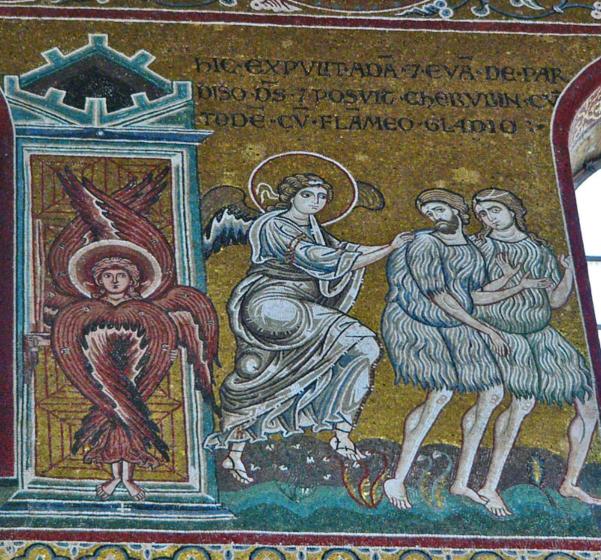
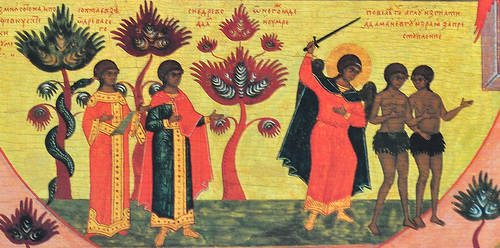
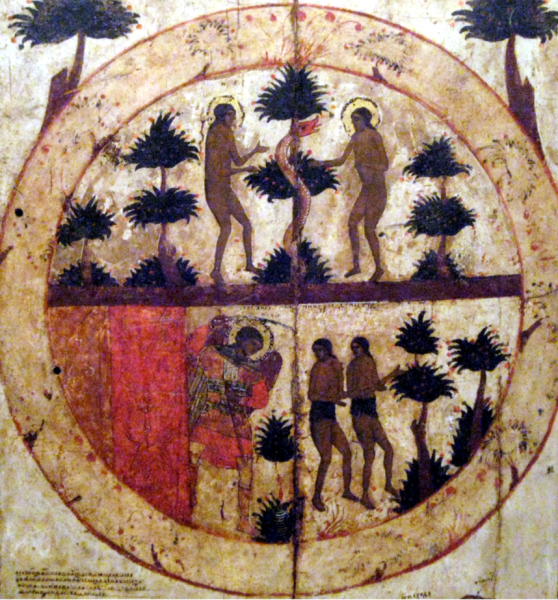
Adam, father of all mankind, in paradise knew the sweetness of the love of God; and so when for his sin he was driven forth from the garden of Eden, and was widowed of the love of God, he suffered grievously and lamented with a great moan. And the whole desert rang with his lamentations, for his soul was racked as he thought, ‘I have distressed my beloved God’. He sorrowed less after paradise and the beauty thereof; for he sorrowed that he was bereft of the love of God, which insatiably, at every instant, draws the soul to Him.
In the same way the soul which has known God through the Holy Spirit, but has afterwards lost grace experiences the torment that Adam suffered. There is an aching and a deep regret in the soul that has grieved the beloved Lord.
Adam pined on earth, and wept bitterly, and the earth was not pleasing to him. He was heartsick for God, and this was his cry:
My soul wearies for the Lord, and I seek Him in tears.
How should I not seek Him?
When I was with Him my soul was glad and at rest, and the enemy could not come nigh me;
But now the spirit of evil has gained power over me, harassing and oppressing my soul,
So that I weary for the Lord even unto death, And my spirit strains to God,
and there is naught on earth can make me glad, Nor can my soul take comfort in any thing,
but longs once more to see the Lord, that her hunger may be appeased.
I cannot forget Him for a single moment, and my soul languishes after Him,
and from the multitude of my afflictions I lift up my voice and cry: ‘Have mercy upon me, O God. Have mercy on Thy fallen creature.’
Thus did Adam lament, and the tears steamed down his face on to his beard, on to the ground beneath his feet, and the whole desert heard the sound of his moaning. The beasts and the birds were hushed in grief; while Adam wept because peace and love were lost to all men on account of his sin.
Adam knew great grief when he was banished from paradise, but when he saw his son Abel slain by Cain his brother, Adam’s grief was even heavier. His soul was heavy, and he lamented and thought:
Peoples and nations will descend from me, and multiply, and suffering will be their lot, and they will live in enmity and seek to slay one another.
And his sorrow stretched wide as the sea, and only the soul that has come to know the Lord and the magnitude of His love for us can understand.
I, too, have lost grace and call with Adam:
Be merciful unto me, O Lord! Bestow on me the spirit of humility and love.
O love of the Lord! He who has known Thee seeks Thee, tireless, day and night, crying with a loud voice: “I pine for Thee, O Lord, and seek Thee in tears.
How should I not seek Thee?
Thou didst give me to know Thee by the Holy Spirit,
And in her knowing of God my soul is drawn to seek Thee in tears.” Adam wept:
The desert cannot pleasure me; nor the high mountains, nor meadow nor forest, nor the singing of birds. I have no pleasure in any thing.
My soul sorrows with a great sorrow: I have grieved God.
And were the Lord to set me down in paradise again,
There, too, would I sorrow and weep – ‘O why did I grieve my beloved God?’
The soul of Adam fell sick when he was exiled from paradise, and many were the tears he shed in his distress. Likewise every soul that has known the Lord yearns for Him, and cries:
Where art Thou, O Lord? Where art Thou, my Light? Why hast Thou hidden Thy face from me?
Long is it since my soul beheld Thee,
And she wearies after Thee and seeks Thee in tears. Where is my Lord?
Why is it that my soul sees Him not? What hinders Him from dwelling in me?
This hinders Him: Christ-like humility and love for my enemies art not in me. God is love insaturable, love impossible to describe.
Adam walked the earth, weeping from his heart’s manifold ills, while the thoughts of his mind were on God; and when his body grew faint, and he could no longer shed tears, still his spirit burned with longing for God, for he could not forget paradise and the beauty thereof; but even more was it the power of His love which caused the soul of Adam to reach out towards God.
I write of thee, O Adam: But thou art witness,
my feeble understanding cannot fathom thy longing after God,
Nor how thou didst carry the burden of repentance.
O Adam, thou dost see how I, thy child, suffer here on earth. Small is the fire within me, and the flame of my love flickers low. O Adam, sing unto us the song of the Lord,
That my soul may rejoice in the Lord And be moved to praise and glorify Him
as the Cherubim and Seraphim praise Him in the heavens And all the hosts of heavenly angels
sing to Him the thrice-holy hymn.
O Adam, our father, sing unto us the Lord’s song, That the whole earth may hear
And all thy sons may lift their minds to God
and delight in the strains of the heavenly anthem, And forget their sorrows on earth.
The Holy Spirit is love and sweetness for the soul, mind and body. And those who have come to know God by the Holy Spirit stretch upward day and night, insatiable, to the living God, for the love of God is very sweet. But when the soul loses grace her tears flow as she seeks the Holy Spirit anew.
But the man who has not known God through the Holy Spirit cannot seek Him with tears, and his soul is ever harrowed by the passions; his mind is on earthly things. Contemplation is not for him, and he cannot come to know Jesus Christ. Jesus Christ is made known through the Holy Spirit.
Adam knew God in paradise, and after his fall sought Him in tears.
O Adam, our father, tell us, thy sons, of the Lord. Thy soul didst know God on earth,
Knew paradise too, and the sweetness and gladness thereof,
And now thou livest in heaven and dost behold the glory of the Lord. Tell of how our Lord is glorified for His sufferings.
Speak to us of the songs that are sung in heaven, how sweet they are, For they are sung in the Holy Spirit.
Tell us of the glory of the Lord,
of His great mercy and how He loveth His creature. Tell us of the Most Holy Mother of God,
how she is magnified in the heavens, And the hymns that call her blessed.
Tell us how the Saints rejoice there, radiant with grace. Tell us how they love the Lord,
and in what humility they stand before God.
O Adam, comfort and cheer our troubled souls. Speak to us of the things thou dost behold in heaven. Why art thou silent?
Lo, the whole earth is in travail.
Art thou so filled with the love of God that thou canst not think of us? Or thou beholdest the Mother of God in glory,
and canst not tear thyself from the sight,
And wouldst not bestow a word of tenderness on us who sorrow, That we might forget the affliction there on earth?
O Adam, our father,
thou dost see the wretchedness of thy sons on earth.
Why then art thou silent?
And Adam speaks:
My children, leave me in peace.
I cannot wrench myself from the love of God to speak with you.
My soul is wounded with love of the Lord and rejoices in His beauty. How should I remember the earth?
Those who live before the Face of the Most High cannot think on earthly things.
O Adam, our father, thou hast forsaken us, thine orphans, though misery is our portion here on earth.
Tell us what we may do to be pleasing to God?
Look upon thy children scattered over the face of the earth, our minds scattered too.
Many have forgotten God.
They live in darkness and journey to the abysses of hell.
Trouble me not. I see the Mother of God in glory – How can I tear myself away to speak with you?
I see the holy Prophets and Apostles,
and all they are in the likeness of our Lord Jesus Christ, Son of God. I walk in the gardens of paradise,
and everywhere behold the glory of the Lord.
For the Lord is in me and hath made me like unto Himself.
O Adam, yet we are they children!
Tell us in our tribulation how we may inherit paradise, That we too, like thee, may behold the glory of the Lord. Our souls long for the Lord,
while thou dost live in heaven and rejoice in the glory of the Lord. We beseech thee – comfort us.
‘Adam’s Lament’ (2009) by Arvo Pärt
Why cry ye out to me, my children?
The Lord loveth you and hath given you commandments.
Be faithful to them, love one another, and ye shall find rest in God. Let not an hour pass without ye repent of your transgressions, That ye may be ready to meet the Lord.
The Lord said: ‘I love them that love me, and glorify them that glorify me.’
O Adam, pray for us, thy children.
Our souls are sad from many sorrows.
O Adam, our father, thou dwellest in heaven and dost behold the Lord seated in glory On the right hand of God the Father.
Thou dost see the Cherubim and Seraphim and all the Saints And thou dost hear celestial songs
whose sweetness maketh thy soul forgetful of the earth.
But we here on earth are sad, and e weary greatly after God. There is little fire within us with which to love the Lord ardently. Inspire us, what must we do to gain paradise?
Adam makes answer:
Leave me in peace, my children, for from sweetness of the love of God I cannot think about the earth.
O Adam, our souls are weary, and we are heavy-laden with sorrow. Speak a word of comfort to us.
Sing to us from the songs thou hearest in heaven,
That the whole earth may hear and men forget their afflictions. O Adam, we are very sad.
Leave me in peace.
The time of my tribulation is past.
From the beauty of paradise and the sweetness of the Holy Spirit I can no longer be mindful of the earth.
But this I tell you:
The Lord loveth you, and do you live in love and be obedient to those in authority over you.
Humble your hearts, and the Spirit of God will live in you. He cometh softly into the soul and giveth her peace,
And bearth wordless witness to salvation. Sing to God in love and lowliness of Spirit, for the Lord rejoiceth therein.
O Adam, our father, what are we to do? We sing but love and humility are not in us.
Repent before the Lord, and entreat of Him. He loveth man and will give all things.
I too repented deeply and sorrowed much that I had grieved God,
And that peace and love were lost on earth because of my sin. My tears ran down my face.
My breast was wet with my tears, and the earth under my feet; And the desert heard the sound of my moaning.
You cannot apprehend my sorrow,
nor how I lamented for God and for paradise. In paradise was I joyful and glad:
the Spirit of God rejoiced me, and suffering was a strange to me.
But when I was driven forth from paradise cold and hunger began to torment me;
The beasts and the birds that were gentle and had loved me turned into wild things
And were afraid and ran from me. Evil thoughts goaded me.
The sun and the wind scorched me. The rain fell on me.
I was plagued by sickness and all the afflictions of the earth. But I endured all things, trusting steadfastly in God.
Do ye, then, bear the travail of repentance.
Greet tribulation. Wear down your bodies. Humble yourselves And love your enemies,
That the Holy Spirit may take up His abode in you,
And then shall ye know and attain the kingdom of heaven. But come not night me:
Now from love of God
have I forgotten the earth and all that therein is. Forgotten even is the paradise I lost,
for I behold the glory of the Lord And the glory of the Saints
whom the light of God’s countenance maketh radiant as the Lord Himself.
O Adam, sing unto us a heavenly song,
That the whole earth may hearken
and delight in the peace of love towards God. We would hear those songs:
Sweet are they for they are sung in the Holy Spirit.
Adam lost the earthly paradise and sought it weeping. But the Lord through His love on the Cross gave Adam another paradise, fairer than the old – a paradise in heave where shines the Light of the Holy Trinity.
What shall we render unto the Lord for His love to us?
Source: St. Silouan the Athonite, by Archimandrite Sophrony.
(*) In an interview in Toronto in the 1980’s, Pärt shared his personal definition of minimalism as the process by which his music is reduced to the number One. In his view, that One is the Divine Creator. In Adam’s Lament (2009) he sees the Biblical Adam as a unifying symbol. Pärt said, “Our ancestor Adam foresaw the human tragedy that was to come and experienced it as his own guilty responsibility, the result of his sinful act. He suffered all the cataclysms of humanity into the depths of depression, inconsolable in his agony.” Adam’s Lament is based on a Russian text by the ascetic monk and poet, St. Silouan of Athos (1866–1938). Pärt’s fascination with Silouan is such that his setting of this text is faithful to its every nuance. The music reflects a range of devotional writing that’s by turns dramatic, passionate, humble and submissive.
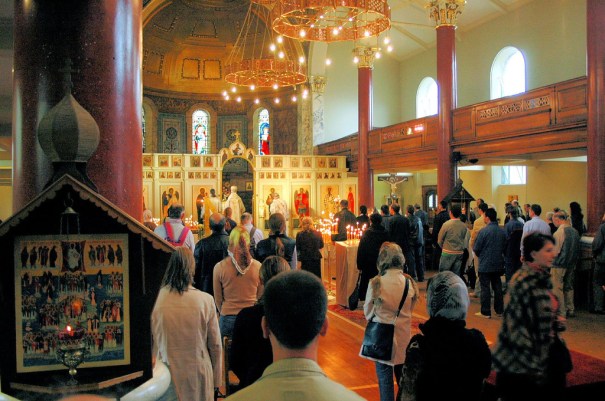
Being immersed in the Beauty of Slavonic Church services, especially the awesome beauty of the Eucharist- the Divine Liturgy has everything we need. Overpoweringly beautiful and haunting. Such Beauty seems to sum up Christianity. We Christians should be first and foremost Eucharistic creatures.
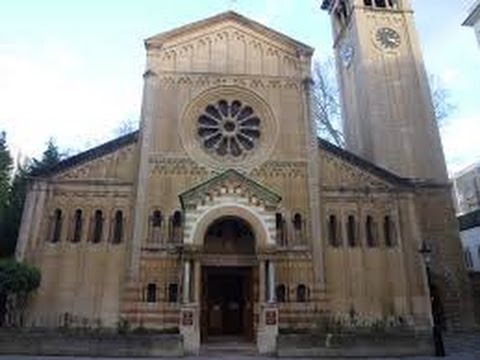
The Russian Orthodox Cathedral of the Dormition of the Mother of God and All Saints (Ennismore Gardens, London)
Coming here has been a dream from my youth. Metropolitan Anthony’s of Sourozh books, especially Living Prayer, School for Prayer, God and man, and Courage to Pray, have sealed my conversion to Christ:
“I met Christ as a Person at a moment when I needed him in order to live, and at a moment when I was not in search of him. I was found; I did not find him.
I was a teenager then. Life had been difficult in the early years and now it had of a sudden become easier. All the years when life had been hard I had found it natural, if not easy, to fight; but when life became easy and happy I was faced quite unexpectedly with a problem: I could not accept aimless happiness. Hardships and suffering had to be overcome, there was something beyond them. Happiness seemed to be stale if it had no further meaning.
As it often happens when you are young and when you act with passion, bent to possess either everything or nothing, I decided that I would give myself a year to see whether life had a meaning, and if I discovered it had none I would not live beyond the year…”(continue)
Metropolitan Anthony’s presence is so alive here! You can feel him still serving, from Heaven, at the Altar, especially during the Divine Liturgy.
So many Russian Saints relics here! St Seraphim Sarov, St Silouan the Athonite, Grand Duchess Elizabeth Feodorovna, Ignatius Bryanchaninov, John of Shanghai and San Francisco, Xenia of Saint Petersburg, just to name a few ...
Praise the name of the Lord Byzantine Chant
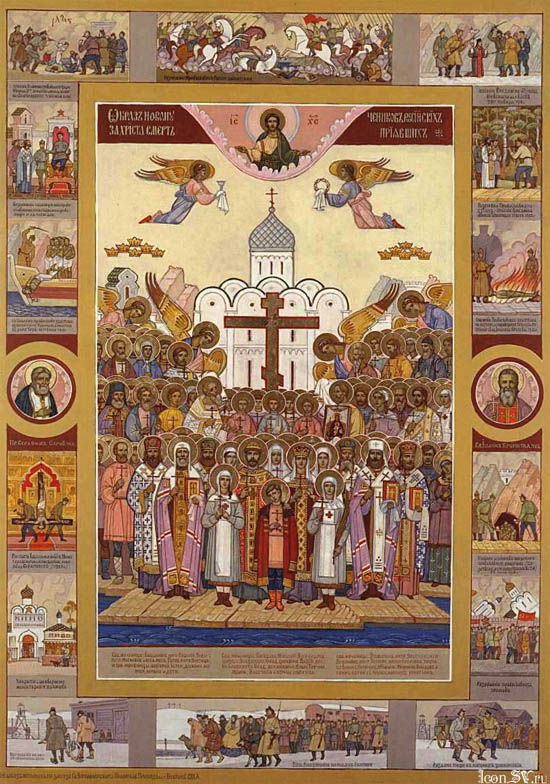
At the homily, the priest spoke about the Feast of the day: the Synaxis of the Holy New Martyrs and Confessors of the Russian Church
More than 1700 names are commemorated in the Synaxis. Here is just one of them:
Martyr Catherine Arsky, laywoman
Commemoration date December, 17 (December, 4 old calendar)
Born into a merchant family in St. Petersburg. In 1920, she survived a tragedy. First, her husband, an officer of the Tsar’s Army and warden of the Smolny cathedral, died of cholera, then all five of their children. Seeking the Lord’s succour, Catherine joined the brotherhood of St. Alexander Nevsky, founded at the cathedral of the Fedorovskaya Icon in Petrograd, and became the spiritual child of Hieromartyr Leo (Egorov).
Catherine was arrested in 1932 with the other members of the brotherhood (ninety in total). She was sentenced to three years of labour camp “as a member of a counter-revolutionary organisation.” Upon release, she settled in Borovichi, like Martyr Keira Obolensky. In 1937, she was arrested and charged with the clergy of Borovichi. She refused to plead guilty of “counter-revolutionary activity” even under torture. Was executed by firing squad on the same day as Keira Obolensky.
At the time of execution, she was sixty-two.
For other martyrs and confessors commemorated today, go to Pravmir
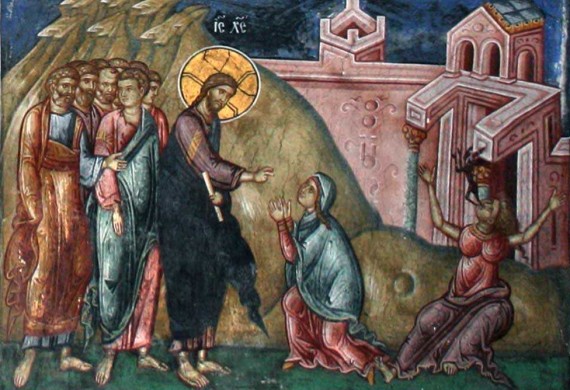
In today’s gospel reading, we find a woman in great need: her daughter is horribly demon-possessed. In such situations, when you experience pain, you do things that you wouldn’t do under other circumstances. Just so, this Canaanite woman runs with determination to receive that which she seeks. First, her great faith and second, the depth of her humility, give her complete conviction that she will receive that which she desires. And her entire conversation with Christ develops gradually, in a remarkable way.
She seeks, although it looks as though God does not hear. In reality, all holy souls come across this very difficulty ( reached the point of saying: “Lord, you are implacable.”)
Christ says something, but in a way that prohibits any such help: “I was not sent except to the lost sheep of the house of Israel.” (Everyone who wants to find God will feel that he is rejected by Him.) Humility makes the woman insist: “Lord, help me”. The Canaanite woman is not affected; she does not take offence. In this way, humility holds the door of God’s mercy open.
With Christ’s final response: “It is not good to take the children’s bread and throw it to the little dogs”, one would expect the woman to get up and leave. Her faith, however, informs her and she humbly responds: “Yes, Lord, yet even the little dogs eat the crumbs which fall from their masters’ table.” (When you are humble, you know what to say to the Lord.) Following the whole of this trial the Canaanite woman is made worthy to hear from the Lord: “O woman, great is your faith! Let it be to you as you desire.” He does not simply say: “Your faith has saved you …”
And what about us? I wonder, will we go down, one step at a time, just as the Canaanite woman did? Will we accept whatever the Lord permits so that we stay faithful until we receive our desired end, our salvation?
Holy Hesychasterion “The Nativity of Theotokos” Publications.
Jonathan Jackson and The Seeds of “The Mystery of Art”
Whoever wants to become a Christian, must first become a poet. — Saint Porphyrios When I was young, they brought me to Babylon And the night hung over my head The smoke came into my dreams In the valley of dry bones
It was under the skies of Babylon Where my soul fell in love with God My eyes were seared and my blood was bruised But I was hidden within a song
All around were the sounds of Babylon But all I heard, were the hymns of heaven
It was under the skies of Babylon Where my soul fell in love with her I was barely coming clean and she had already seen A war on her innocence
I spoke of the Christ underneath the clouds And woke her from the sleep of death
She took my hand and walked me through the crowd Why, is anybody’s guess?
All around, was the gold of Babylon But all I saw, was an angel of heaven
You can shut me up but you cannot quiet The silence of the Mystic Church You can shut me up but you cannot quiet The silence of the Mystic Church
I would like to start with the journey of how this book, “The Mystery of Art” began. It was not an intellectual or abstract search. The questions and explorations on this subject were immediate and crucial for me growing up. I began working as a professional actor at the age of 11 on General Hospital. At The age of 12, by God’s grace I had a profound encounter with Christ. My father would give us cassette tapes of sermons to listen to and one night, I heard a sermon on “The holiness of God and the pride of the human heart.” I don’t know why and I don’t know how these things occur, but I was cut to the heart. I suddenly realized how far away from God I truly was. How prideful and full of selfishness and egoism I was. It scared me to be honest. And yet, paradoxically, in that very moment of feeling the weight of my sinfulness—how my supposed righteousness is like “filthy rags” before the holiness of God, as Isaiah says—a Divine Presence also overwhelmed me. I felt like a great sinner who was also mysteriously loved beyond comprehension.
Around the same time, I read C.S. Lewis’ chapter called “The Great Sin”, which is all about Pride. I read Matthew 25, the Last Judgment and Matthew 5 when Christ says, “You have heard that it was said, ‘You shall not commit adultery.’ But I tell you that anyone who looks at a woman lustfully has already committed adultery with her in his heart.” I knew I could never impress God with my self-righteousness, so I cried out for mercy, I cried out for grace. And the compassions of God washed over me.
This was a turning point in my life. Nothing was the same after this encounter. I began to hear and perceive my own thoughts with great clarity. This was frightening too because I was suddenly aware of all the judgments and horrible thoughts I had about people. But the Holy Spirit was so merciful in this process. He never made me feel condemned. Convicted, yes. But never condemned. He would always whisper, “I’m not showing you this to condemn you, I’m showing you this darkness, so you can be healed.”
I began to think about God all the time. Throughout the following years there were many struggles and trials but the mystery of God became the most beautiful, the most attractive, the most intriguing and important pursuit in my life.
Naturally and organically, I had a desire to incorporate the Holy Spirit into the work I was doing. I had studied a few different acting methods but for the most part, my own personal method was being birthed through experience. Working with Anthony Geary and Genie Francis and other incredible performers like Michelle Pfeiffer and Sir Ben Kingsley. It was very much like Orthodoxy in the sense that I was a sponge, soaking everything in through experience and not through theory.
Within a short period of time after this initial encounter of grace, I was given some very heavy storylines to portray. I was about 15 years old and my character Lucky Spencer finds a young girl in the woods, who has just been raped. It is winter and the poor girl is freezing out in the cold, left for dead. He rescues her and they develop a friendship. He spends months taking care of her and being by her side as she tries to heal from this horrific event.
On a Soap Opera, you are on TV almost every day; especially when your storyline in prominent. In a more direct way than most artistic mediums, you are living the day-to-day story of your character. I was portraying this storyline for months. It was during this time that I first remember bringing God into my preparation as an actor. I began to ask Him, “How could you allow this innocent creature to suffer in this way?” “How can anyone be healed from such a wound?”
They were questions my character could have been asking God and questions most of us have asked before. What it began to do for me, was nudge my work towards something inherently spiritual and although I would not have known it at the time, something sacramental.
Over the following years I portrayed a lot of dark and tragic roles: someone struggling with suicide, a heroine addict, a murderer among others. It was around this time when I began to ask God, “How can I portray these dark and troubled characters dynamically and truthfully, without being consumed by the darkness myself?” There are many tragic stories of young actors who become drug addicts after playing one in a film. The stories of drug overdoses and suicides among young actors and actresses are too many. I instinctively steered away from “Method Acting” and sought a different path, even though I didn’t know exactly what that would be.
It was around this time when I discovered Dostoevsky. It’s amazing to me now, being Orthodox that I wasn’t able to comprehend anything about the Orthodox Church as I read his books. It was like a veil, I suppose. But what I did discover was a kindred soul. Here was someone who was writing about very dark and tragic characters and themes but from a place of beauty—from a place of the Light of Christ. Prince Myshkin, from the “The Idiot”, changed my life. I clung to Dostoevsky in my heart as I approached portraying these dark characters and prayed, “Lord, please help me to portray the darkness of this world from a place of purity and light. Please, help me not to be overcome by the darkness, but to infiltrate the darkness with Your Light. Without you I can do nothing. I am nothing, I have nothing and I can do nothing without You, Lord. Amen.”
This is a snap shot so to speak, of the journey towards writing, “The Mystery Of Art”. These were the seeds, which by God’s grace, grew over time. There were so many important and profound spiritual realities that I wasn’t exposed to at the time, because I had not encountered the Holy Orthodox Church. I was grasping in the dark, looking for answers, feeling my way towards Christ, as best I could, but I always knew that something was missing; something significant and crucial to my relationship with God. There is a beautiful Scripture in the Gospel of John where Christ says,
“And I have other sheep that are not of this fold. I must bring them also, and they will listen to my voice. So there will be one flock, one shepherd.” (John 10:16)
I was one those lambs who was not of this fold. But through the grace of Jesus Christ, the Good Shepherd and your prayers, He found me and brought me home. My journey to the Orthodox Faith took many years and was paved with blood and heartache. I carried all of these artistic questions and experiences with me as my family and I came into the Church for salvation, deliverance and healing.
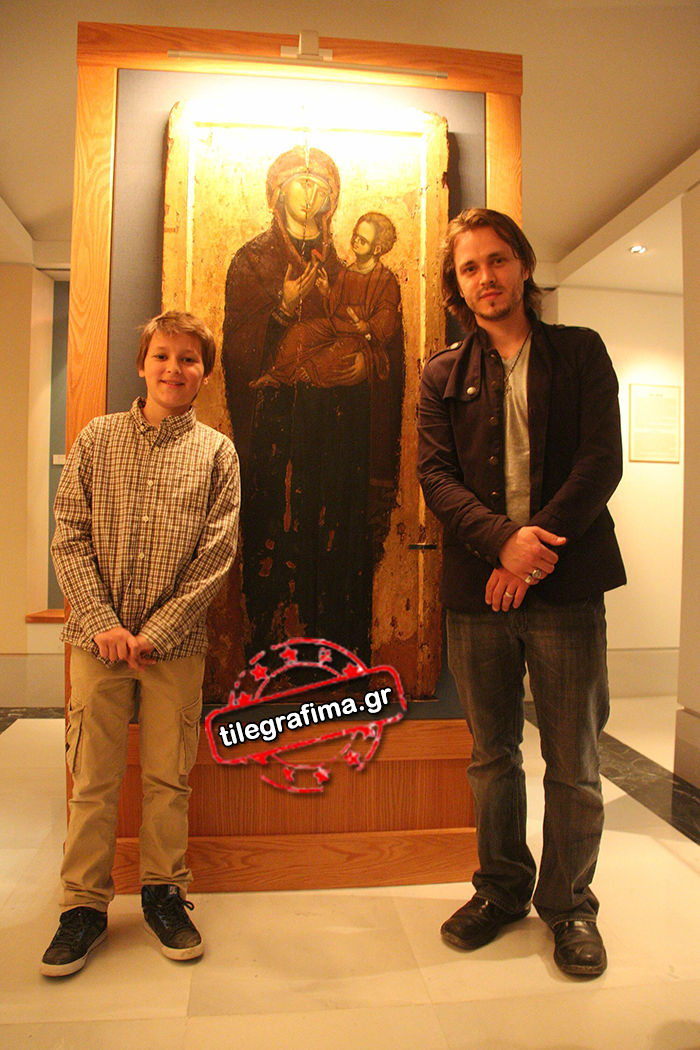
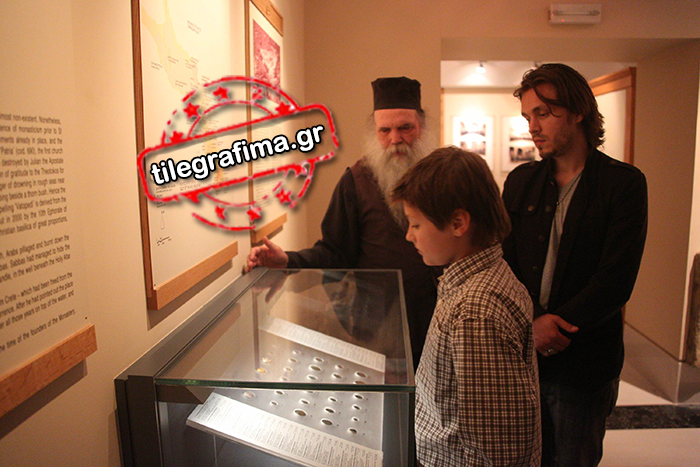
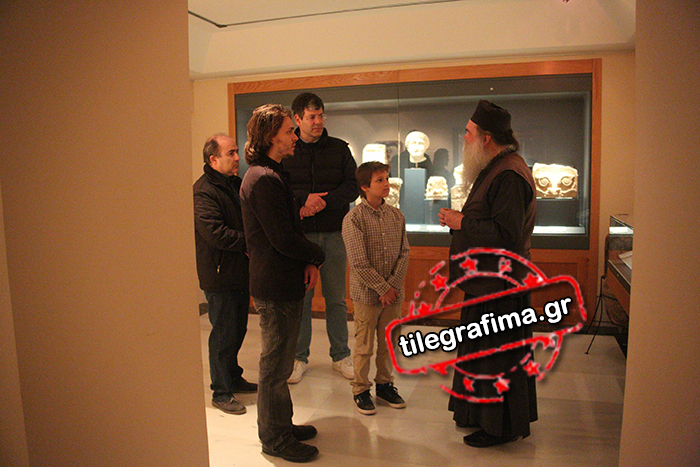
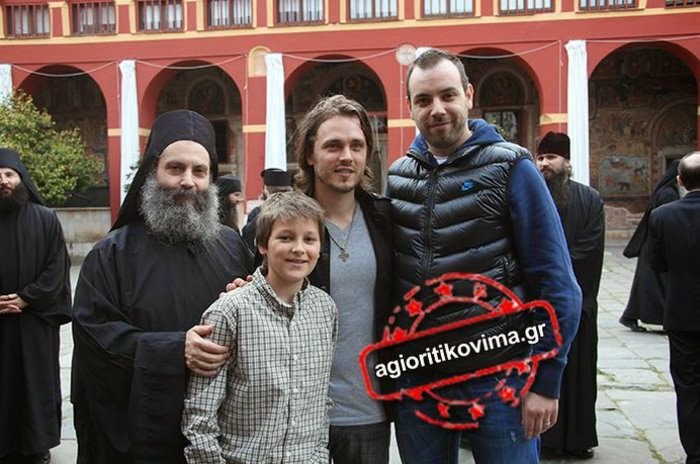
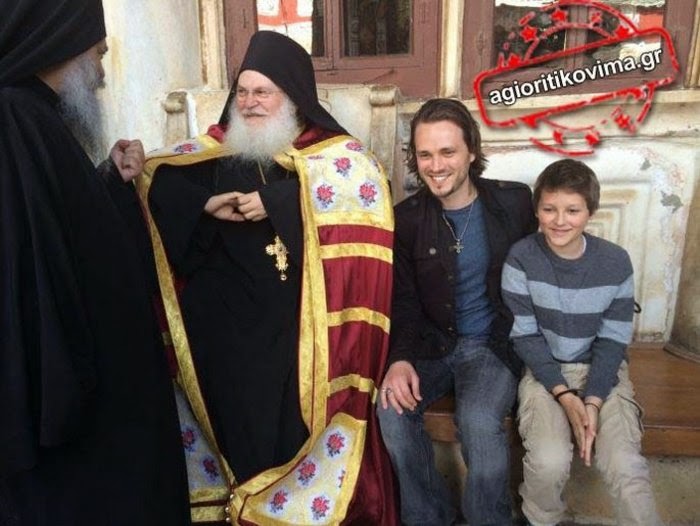
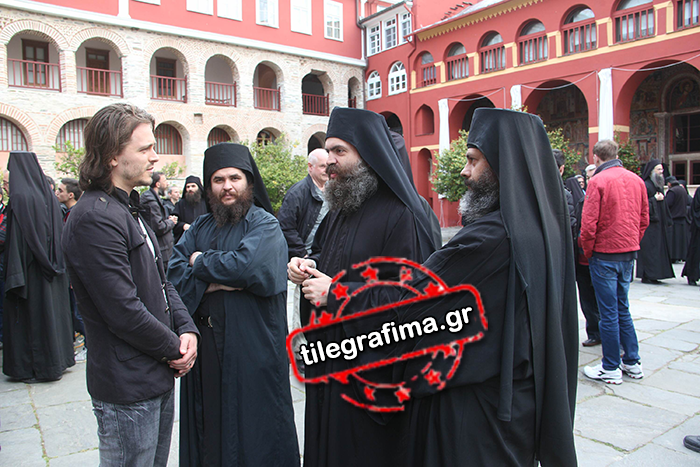
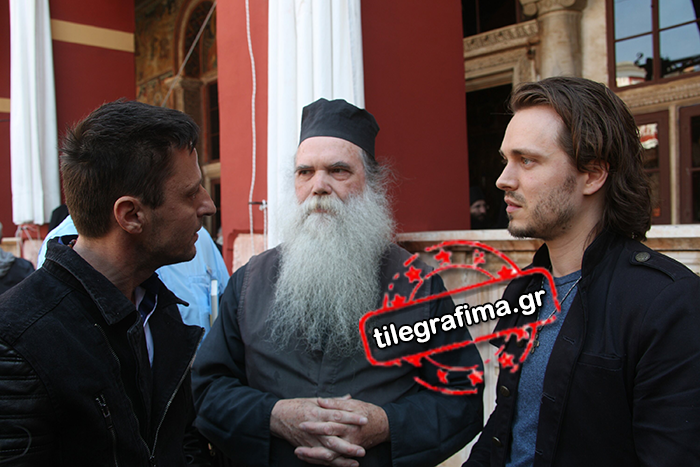
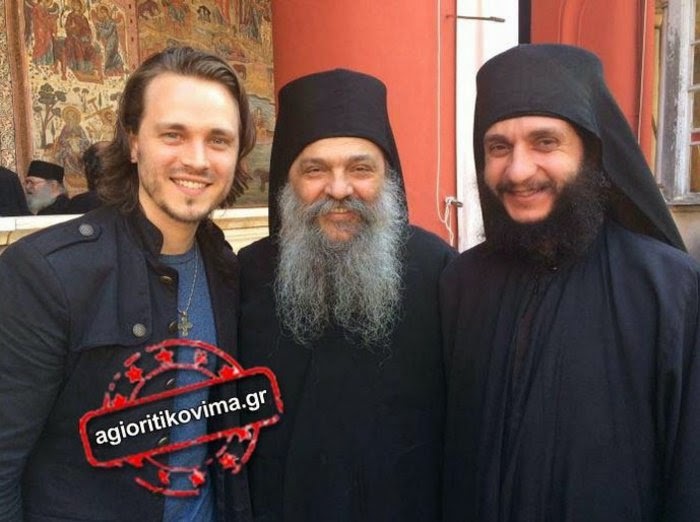
See photos from his visit to Mount Athos for the first time with his 11 year-old son Caleb (2015), where they stayed for five days visiting Simonopetra and Xenophontos monasteries, and spent most of his time at Vatopaidi Monastery (Friday till Tuesday) where he met the Abbot, Elder Ephraim, and attended an all-night vigil on Saturday night.
While at Vatopaidi Monastery, Jonathan also gave a testimony of how he converted to Orthodoxy for Pemptousia, which can be seen here.
To a person who had to choose between suicide and begging
St. Velimirovich letter
29 December 2016
You write that all your worldly goods were sold off to a third party. When you found yourself out on the street with nothing and nobody, you headed to the cemetery, bent on killing yourself. You had no doubts or second thoughts about this. Exhausted by the vexations, you lay down on your parents’ grave and fell asleep. Your mother appeared to you in your sleep and berated you, saying that in the Kingdom of God there were plenty of people who had been beggars, but not a single one of those who had done away with themselves. That dream saved you from suicide. Your beloved mother really did save you, by God’s providence. You began to beg and to live off begging. And you’re asking if, by doing so, you’re transgressing God’s law.
Take courage. God gave the commandment: ‘Don’t steal’. He didn’t give any commandment ‘Don’t beg’. Begging without any real need is stealing, but in your case it isn’t. The general and emperor Justinian was left blind in his old age, with no possessions or friends. He would sit, blind, outside the courtyard of the throne and beg for a little bread. As a Christian, he didn’t permit himself to consider suicide. Because, just as life’s better than death, so it’s better to be a beggar than a suicide.
You say that you’re overcome with shame and that your sorrow’s deep. You stand at night outside the coffee-shop that used to be yours and ask for money from those who go in and out. You remember that, until recently, you were the owner of the coffee-shop and now you don’t dare go in even as a customer. Your eyes are red from weeping and lamentation. Comfort yourself. God’s angels aren’t far from you. Why are you crying about the coffee-shop? Haven’t you heard of the coffee-shop at the other end of Belgrade where it says: ‘Someone’s it wasn’t; someone’s it won’t be’? Whoever wrote those words was a true philosopher. Because that’s true of all the coffee-shops, all houses all the castles and all the palaces in the world.
What have you lost? Something that you didn’t have when you were born and which isn’t yours now. You were the boss, now you’re poor. That’s not loss. Loss is when a person becomes a beast. But you were a person and have remained so. You signed some papers for certain of your prominent customers and now your coffee-shop’s in the hands of a stranger. Now you look through the window and see everybody laughing, just the way they used to, and you’re wandering the streets with tears in your eyes and covered in shame. Never fear, God’s just. They’ll all have to answer for their misdeeds. But when they attempt to commit suicide, who’s to say whether the merciful Lord will allow their mothers to appear to them from the other world in order to keep them from the crime? Don’t consider them successful even for a moment. Because you don’t know how they’ll end up. A wise man in ancient Greece said: ‘Never call anybody happy before the end’. It’s difficult to be a beggar? But aren’t we all? Don’t we all depend, every hour of every day, on the mercy of Him Who gives us a life to lead? Now you’ve got an important mission in the world: to engage people’s attention so that they remember God and their soul and to be charitable. Since you’re forced to live in silence, delve into your soul and talk to God through prayer. The life of a beggar’s more heroic than that of a boss. ‘For gold is tested in the fire and accepted people in the furnace of humility’ (Sir. 2, 5). But you’ve already demonstrated heroism by rejecting the black thought of suicide. This is a victory over the spirit of despondency. After this victory, all the others will be easy for you. The Lord will be at your side.
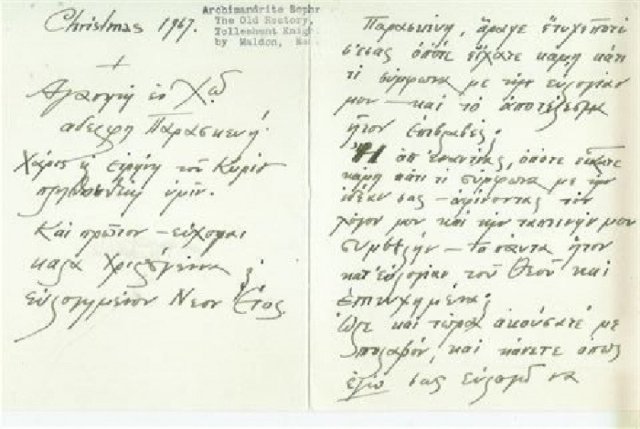
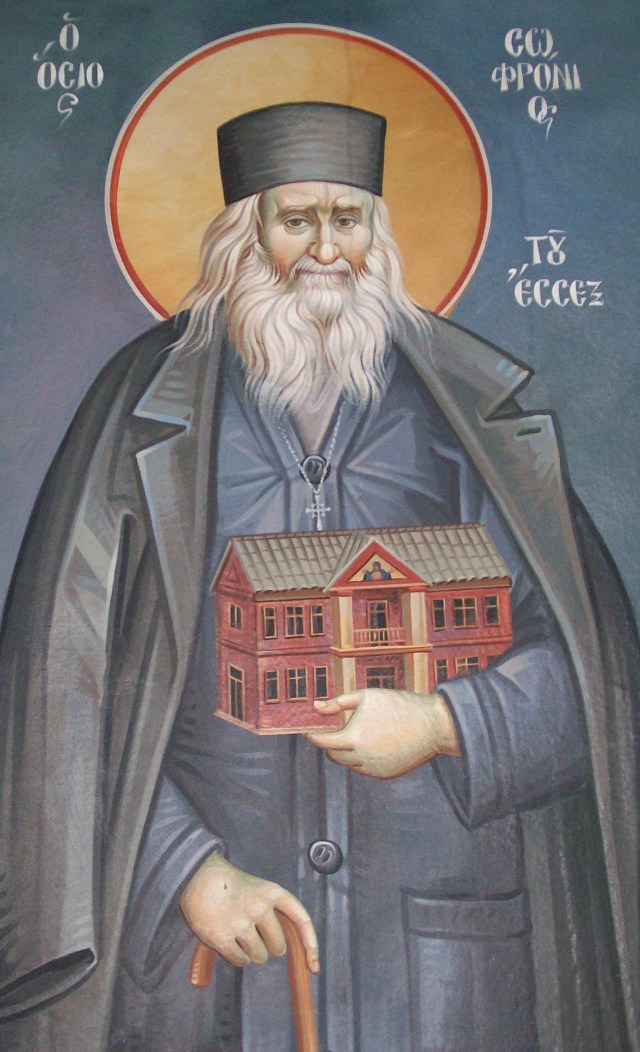
Paraskevi, who out of sheer humility does not wish to reveal her full name, was among the first spiritual children of Elder Sophrony, during the time of her studies in England. She sent us a copy of two handwritten scripts by the blessed Elder.
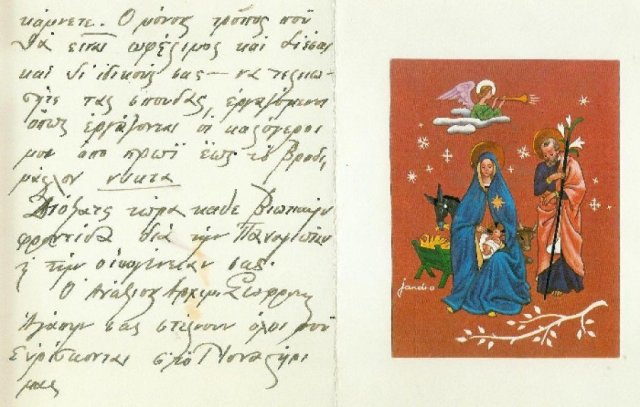
A good wish card which the blessed Elder sent during Christmas 1967, when Paraskevi was going through some difficult times because of the illness of a close relative.
The outside of the card
The Christmas wish card (handwritten):
Archimandrite Sophrony
The Old Rectroy,Tolleshent Knight
by Maldon, Essex
Christmass 1967,
+
Dear beloved in Christ, Sister Paraskevi.
May the Lord’s grace and peace be abundant in you. Let me first wish you Merry Christmas and a blessed New Year!
Paraskevi, has it ever happened to do something according to my blessing and it turned out harmful? Or has it happened that you did something according to your mind and not according to my humble advice that it was successful and in accordance with God’s providence? Therefore, now you must listen to me, the old fool, and do as I give you the blessing to do. The only beneficial way for you and your relatives is to finish your studies and work at the same time, as my monks do from morning till the evening. Get rid of any worry for X and your family.
The unworthy Arch. Sophrony.
You have the love of all who are at out monastery.
***
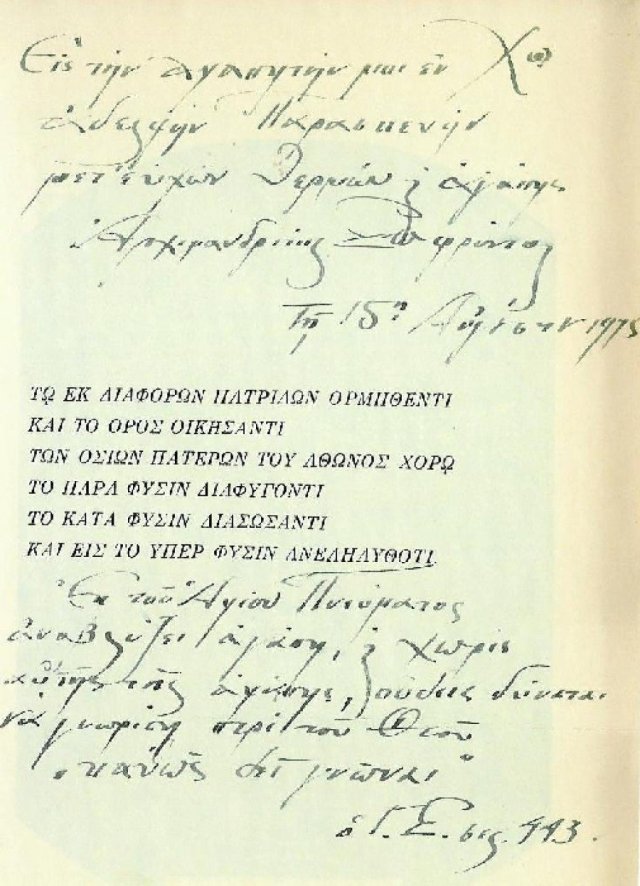
Handwritten inscription by the Elder on the 15th August 1975, when he sent her his book, St Silouan the Athonite
On the bookSt Silouan the Athonite(handwritten):
To my beloved in Christ sister Paraskevi with warm wishes and love
Arch. Sophrony
15th August 1975
Printed in Caps:
Hailing from various countries
And retreating to the Mountain,
Among the holy fathers of Mount Athos,
Escaping the unnatural
And safeguarding the natural
Rising to that which is beyond nature
Again, by hand of Elder Sophrony:
From the Holy Spirit gashes out love, and without it no one is able to know God ‘as He must be known’.
E.S. p. 443
(Note: E.S. refer to Elder Silouan, not yet recognized as a Saint at the time)
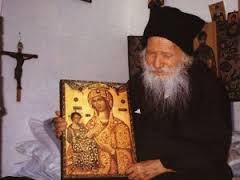
While at the Holy Skete of Kavsokalyvia on Mt. Athos, the Elder Porphyrios had given orders for his grave to be dug.
Through a spiritual child of his, he dictated a farewell letter of advice and forgiveness to all his spiritual children.
Here is the letter as it was sent to us from the Holy Convent of the Transfiguration of the Savior. It is dated June 17, 1991. It was found amongst the monk’s garments that were laid out for his burial on the day of his departure. It indicates his profound humbleness.
My dear spiritual Children,
Now that I am still in charge of my faculties, I want to give you some advice.
Ever since I was a child, I was always in sin. When my mother sent me to watch the animals on the mountain, (my father
had gone to America to work on the Panama Canal for us his children, because we were poor), there, where I shepherded
the animals, I slowly read, word by word, the life of St. John the Hut-dweller and I loved St. John very much.
I said a lot of prayers, like the young child that I was, twelve or fifteen years old, I don’t remember too well. I wanted
to follow his example. So, with a lot of difficulty, I secretly left my parents and came to Kavsokalyvia on the Holy Mountain.
I became obedient to two elders, the true brothers, Panteleimon and loannikios.
They happened to be very devout and full of virtue, I loved them very much and because of that, with their blessing,
I gave them absolute obedience. That helped me a lot. I also felt great love for God and got along very well.
However, because of my sins, God allowed me to become ill, and my elders told me to go to my parents in my village
of St. John, Evia. Although I had sinned a lot from when I was a small child, when I returned to the world I continued
to commit sins which, today are very many. The world, however, thought highly of me, and everyone shouts that I’m a saint.
I however, feel that I am the most sinful person in the world. Of course, whatever I remembered I confessed, and I know God
has forgiven me. But now I have the feeling that my spiritual sins are very many and I ask all those who have known me
to pray for me, because, for as long as I lived, I humbly prayed for you, too. Now that I’m leaving for heaven, I have the
feeling that God will say to me, “What are you doing here?” I have only one thing to say to him, “I am not worthy of here, Lord,
but whatever your love wills, it’ll do for me.” From then on, I don’t know what will happen. I however, wish for God’s love to act
I always pray that my spiritual children will love God, Who is everything, so that He will make us worthy to enter His earthly
uncreated Church. We must begin from here. I always made the effort to pray, to read the hymns of the Church, the Holy Scriptures
and the Lives of the Saints. May you do the same. I tried, by the grace of God, to approach God and may you also do the same.
I beg all of you to forgive me for whatever I did to upset you.
Hieromonk Porphyrios Kavsokalyvia, June 4/17 1991
And
That phone ring 🙂 At 14:35′ onwards 🙂 This Elder was sought after by the whole of Greece and all mankind. His whole life was dedicated in service to the faithful. I imagine that phone never stopped ringing, just as pilgrims never stopped coming. A saint receives everyone, that is his vocation. May we have his blessing! +2 Dec.
This is something of a follow up on a recent post. Here I will be simply listing quotes of Archimandrite Sophrony taken from the book, “I Know a Man in Christ”, by Metrtopolitan of Nafpaktos, Hierotheos, published by, Birth of the Theotokos Monastery, 2015. Therefore at the end of each quote only a page number will be designated. In addition I will tack on an ending which I choose to refer to as “epilogue”:
People’s growing love of psychology is a terrible thing. Psychology helps those in the West, but it is dreadful when the Orthodox learn psychology and substitute it for the neptic tradition of the Church. We must undermine Orthodox Christians’ love of psychology, because psychological methodology is outside the Orthodox tradition and, at the same time, it is characterized by the Western mentality. (p.269)
The whole of the West was influenced by St. Augustine. Augustinian theory is rather psychological; it deals with God psychologically. In Greece today there is a noticeable trend towards psychology, which is why St. Augustine is studied so much. St. Augustine may be a saint, but his work is subject to much exploitation.(p.345)
There is a great difference between the Orthodox and Western traditions. Psychology is adjusted to the Western tradition, so it differs enormously from the Orthodox tradition. (p. 358)
I am sorry about those spiritual fathers who assert that the spiritual life is not enough and psychology is also necessary. (p.368)
Human psychology uses different anthropology. It is more or less heretical. It is dangerous. It is bad that it is used by spiritual fathers. To a certain extent it helps those who have no experience to understand other people, but it does harm. Spiritual things also have psychological repercussions, as can be seen when one looks at the Orthodox and the Latins. But psychological things are not spiritual as well. (p.364)
Psychology and the spiritual life have different starting points; their anthropology is different. However, we cannot overlook psychology, which mainly helps people who are atheists and do not want to use the hesychastic tradition of the Church. It is a remedy for people who are far from the living God and are in terrible torment. It should be used discreetly and wisely. Medication may help the body that has suffered serious harm from various problems, but the cure will come through man’s regeneration by the grace of God. The soul’s wounds are cured by means of prayer.(p. 227)
The view that everything psychological is also spiritual, and everything spiritual is also psychological is a deadly danger. It is very dangerous for us to regard people’s psychological problems as spiritual states. Such a view is a blasphemy against God. The exact opposite ought to happen, that is to say, we ought to make a distinction between spiritual life and psychological life. (p. 358)
In all our years in the Monastery here is England, I have never met anyone who was cured through psychoanalysis, although it is highly developed in Western societies, However, to be fair, neurologist and doctors who give drugs to patients are more humble than psychoanalysts, and they help people to become socially balanced. They also help those within the Church, when they have problems of a neurological nature for various reasons. (p. 358)
The observations of psychology with regard to human beings are significant, because they explain that beyond the rational faculty there is something more profound. Psychological analysis, however, is infantile compared with the teaching of the Fathers of the Church. Although the observations of psychology are significant, the therapeutic method that it offers is awful. Psychoanalysis does not cure man; rather it confuses him even more. (p. 358)
One ought not to ‘spy’ on oneself, but to have profound repentance. (p. 286)
There is a difference between psychology and life in Christ. Psychology attempts to deliver man from guilt complexes, whereas in life in Christ we experience grief, pain, on account of being far from God, and we do not stop repenting until this grief is transformed. (pp. 343-4)
Epilogue: A priest who studied psychology in the 1980’s both read the former post and worked together with me on this in that he found the quotes listed above. As we discussed the subject at hand he made some interesting observations: “Psychology today, no longer has a guiding star; it has nothing outside itself to look to as a model. It is self-absorbed. Whatever pleases a person, he can do. It has acquired the ethic of the culture it exists in.”
By Father Gregory The Greek Archdiocese Metropolis of Denver, St. Arsenius Hermitage, “Archimandrite Sophrony on Psychology” Panagia Quick to Hear






















 ORTHODOX CHRISTIAN FAITH AND LIFE