A Holy Man’s Christmas Card

nativity-icon-5Paraskevi, who out of sheer humility does not wish to reveal her full name, was among the first spiritual children of Elder Sophrony, during the time of her studies in England. She sent us a copy of two handwritten scripts by the blessed Elder.

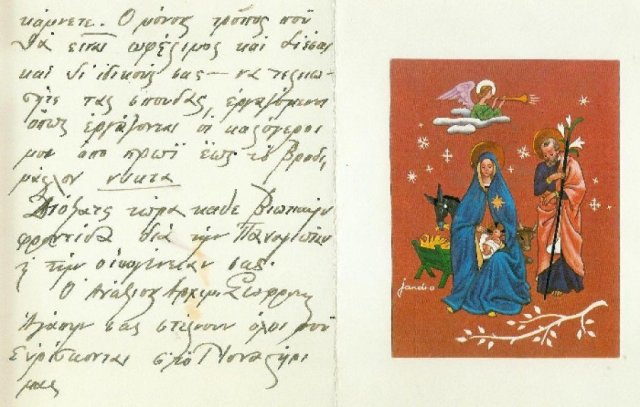
christmas-card

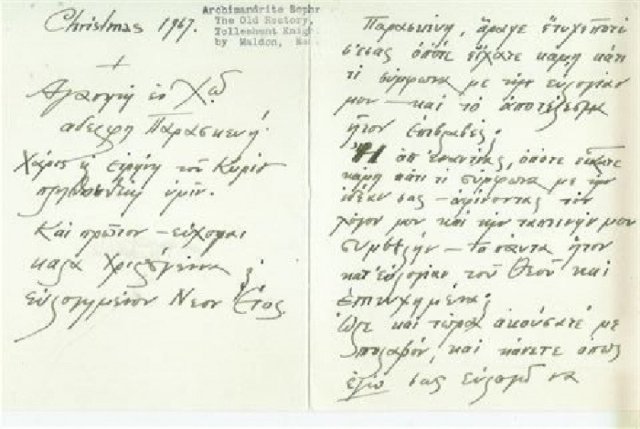
A good wish card which the blessed Elder sent during Christmas 1967, when Paraskevi was going through some difficult times because of the illness of a close relative.

christmas-card2

 The outside of the card

The Christmas wish card (handwritten):

Archimandrite Sophrony

The Old Rectroy,Tolleshent Knight

by Maldon, Essex

Christmass 1967,

+

Dear beloved in Christ, Sister Paraskevi.

May the Lord’s grace and peace be abundant in you. Let me first wish you Merry Christmas and a blessed New Year!

Paraskevi, has it ever happened to do something according to my blessing and it turned out harmful? Or has it happened that you did something according to your mind and not according to my humble advice that it was successful and in accordance with God’s providence? Therefore, now you must listen to me, the old fool, and do as I give you the blessing to do. The only beneficial way for you and your relatives is to finish your studies and work at the same time, as my monks do from morning till the evening. Get rid of any worry for X and your family.

The unworthy Arch. Sophrony.

You have the love of all who are at out monastery.

***

christmas-card3

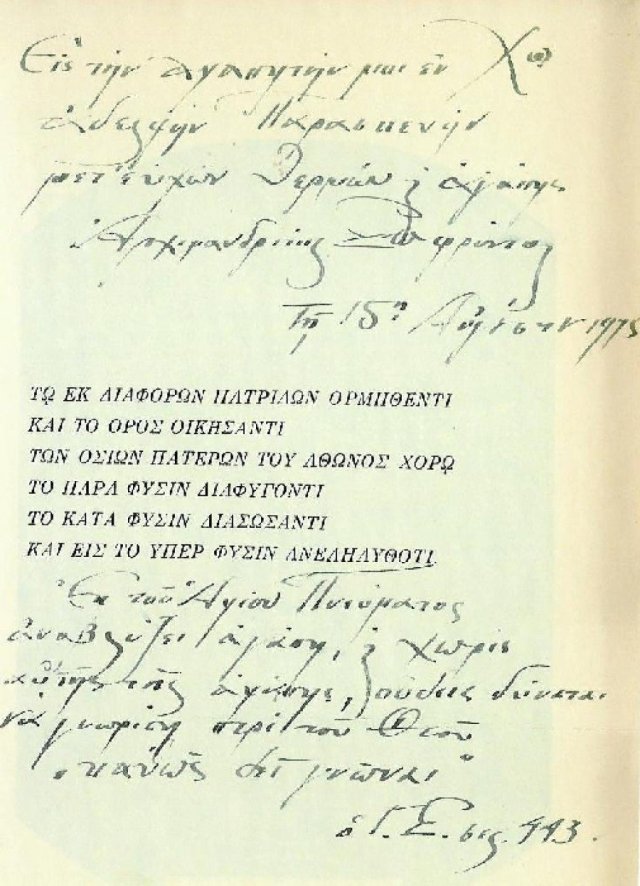
Handwritten inscription by the Elder on the 15th August 1975, when he sent her his book, St Silouan the Athonite

On the book St Silouan the Athonite (handwritten):

To my beloved in Christ sister Paraskevi with warm wishes and love

Arch. Sophrony

15th August 1975

Printed in Caps:

Hailing from various countries

And retreating to the Mountain,

Among the holy fathers of Mount Athos,

Escaping the unnatural

And safeguarding the natural

Rising to that which is beyond nature

Again, by hand of Elder Sophrony:

From the Holy Spirit gashes out love, and without it no one is able to know God ‘as He must be known’.

E.S. p. 443

(Note: E.S. refer to Elder Silouan, not yet recognized as a Saint at the time)

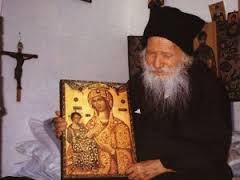
St. Porphyrios’ Farewell

st-porphyrios

Such profound humbleness!


While at the Holy Skete of Kavsokalyvia on Mt. Athos, the Elder Porphyrios had given orders for his grave to be dug.
Through a spiritual child of his, he dictated a farewell letter of advice and forgiveness to all his spiritual children.

Here is the letter as it was sent to us from the Holy Convent of the Transfiguration of the Savior.
It is dated June 17, 1991. It was found amongst the monk’s garments that were laid out for his burial on the day of his departure.
It indicates his profound humbleness.

My dear spiritual Children,

Now that I am still in charge of my faculties, I want to give you some advice.

Ever since I was a child, I was always in sin. When my mother sent me to watch the animals on the mountain, (my father

had gone to America to work on the Panama Canal for us his children, because we were poor), there, where I shepherded

the animals, I slowly read, word by word, the life of St. John the Hut-dweller and I loved St. John very much. 

I said a lot of prayers, like the young child that I was, twelve or fifteen years old, I don’t remember too well. I wanted 

to follow his example. So, with a lot of difficulty, I secretly left my parents and came to Kavsokalyvia on the Holy Mountain. 

I became obedient to two elders, the true brothers, Panteleimon and loannikios.

They happened to be very devout and full of virtue, I loved them very much and because of that, with their blessing,

I gave them absolute obedience. That helped me a lot. I also felt great love for God and got along very well. 

However, because of my sins, God allowed me to become ill, and my elders told me to go to my parents in my village 

of St. John, Evia. Although I had sinned a lot from when I was a small child, when I returned to the world I continued

to commit sins which, today are very many. The world, however, thought highly of me, and everyone shouts that I’m a saint.

I however, feel that I am the most sinful person in the world. Of course, whatever I remembered I confessed, and I know God

has forgiven me. But now I have the feeling that my spiritual sins are very many and I ask all those who have known me 

to pray for me, because, for as long as I lived, I humbly prayed for you, too. Now that I’m leaving for heaven, I have the 

feeling that God will say to me, “What are you doing here?” I have only one thing to say to him, “I am not worthy of here, Lord, 

but whatever your love wills, it’ll do for me.” From then on, I don’t know what will happen. I however, wish for God’s love to act

I always pray that my spiritual children will love God, Who is everything, so that He will make us worthy to enter His earthly

uncreated Church. We must begin from here. I always made the effort to pray, to read the hymns of the Church, the Holy Scriptures 

and the Lives of the Saints. May you do the same. I tried, by the grace of God, to approach God and may you also do the same.

I beg all of you to forgive me for whatever I did to upset you.

Hieromonk Porphyrios
Kavsokalyvia, June 4/17 1991


And


That phone ring 🙂 At 14:35′ onwards 🙂 This Elder was sought after by the whole of Greece and all mankind. His whole life was dedicated in service to the faithful. I imagine that phone never stopped ringing, just as pilgrims never stopped coming. A saint receives everyone, that is his vocation. May we have his blessing! +2 Dec.


Do Not try. Give up. Be wrong.

elder sophrony.jpg

This is something of a follow up on a recent post. Here I will be simply listing quotes of Archimandrite Sophrony taken from the book, “I Know a Man in Christ”, by Metrtopolitan of Nafpaktos, Hierotheos, published by, Birth of the Theotokos Monastery, 2015. Therefore at the end of each quote only a page number will be designated. In addition I will tack on an ending which I choose to refer to as “epilogue”:

People’s growing love of psychology is a terrible thing. Psychology helps those in the West, but it is dreadful when the Orthodox learn psychology and substitute it for the neptic tradition of the Church. We must undermine Orthodox Christians’ love of psychology, because psychological methodology is outside the Orthodox tradition and, at the same time, it is characterized by the Western mentality. (p.269)

The whole of the West was influenced by St. Augustine. Augustinian theory is rather psychological; it deals with God psychologically. In Greece today there is a noticeable trend towards psychology, which is why St. Augustine is studied so much. St. Augustine may be a saint, but his work is subject to much exploitation.(p.345)

There is a great difference between the Orthodox and Western traditions. Psychology is adjusted to the Western tradition, so it differs enormously from the Orthodox tradition. (p. 358)

I am sorry about those spiritual fathers who assert that the spiritual life is not enough and psychology is also necessary. (p.368)

Human psychology uses different anthropology. It is more or less heretical. It is dangerous. It is bad that it is used by spiritual fathers. To a certain extent it helps those who have no experience to understand other people, but it does harm. Spiritual things also have psychological repercussions, as can be seen when one looks at the Orthodox and the Latins. But psychological things are not spiritual as well. (p.364)

Psychology and the spiritual life have different starting points; their anthropology is different. However, we cannot overlook psychology, which mainly helps people who are atheists and do not want to use the hesychastic tradition of the Church. It is a remedy for people who are far from the living God and are in terrible torment. It should be used discreetly and wisely. Medication may help the body that has suffered serious harm from various problems, but the cure will come through man’s regeneration by the grace of God. The soul’s wounds are cured by means of prayer.(p. 227)

The view that everything psychological is also spiritual, and everything spiritual is also psychological is a deadly danger. It is very dangerous for us to regard people’s psychological problems as spiritual states. Such a view is a blasphemy against God. The exact opposite ought to happen, that is to say, we ought to make a distinction between spiritual life and psychological life. (p. 358)

In all our years in the Monastery here is England, I have never met anyone who was cured through psychoanalysis, although it is highly developed in Western societies, However, to be fair, neurologist and doctors who give drugs to patients are more humble than psychoanalysts, and they help people to become socially balanced. They also help those within the Church, when they have problems of a neurological nature for various reasons. (p. 358)

The observations of psychology with regard to human beings are significant, because they explain that beyond the rational faculty there is something more profound. Psychological analysis, however, is infantile compared with the teaching of the Fathers of the Church. Although the observations of psychology are significant, the therapeutic method that it offers is awful. Psychoanalysis does not cure man; rather it confuses him even more. (p. 358)

One ought not to ‘spy’ on oneself, but to have profound repentance. (p. 286)

There is a difference between psychology and life in Christ. Psychology attempts to deliver man from guilt complexes, whereas in life in Christ we experience grief, pain, on account of being far from God, and we do not stop repenting until this grief is transformed. (pp. 343-4)

Epilogue:
A priest who studied psychology in the 1980’s both read the former post and worked together with me on this in that he found the quotes listed above. As we discussed the subject at hand he made some interesting observations: “Psychology today, no longer has a guiding star; it has nothing outside itself to look to as a model. It is self-absorbed. Whatever pleases a person, he can do. It has acquired the ethic of the culture it exists in.”

Holy Mountain’s Secret Cry


Jesus Prayer].jpg

Metropolitan of Nafpaktos and Agios Vlasios, Hierotheos, speaks on Mount Athos’ secret cry:  the Prayer of the Heart


As biological life is transmitted, so spiritual tradition is a whole life.

*

A guide speaks theoretically, but the Fathers beget spiritually.

*

The Holy Mountain is a living organism.

*

May the Lord find us worthy to hear its secret cry!

*

Already in his youth, Metropolitan Hierotheos was particularly interested in the Fathers of the Church, working for a time in the monastery libraries of Mount Athos, on the recording of the codices. He was especially interested in the teaching of St. Gregory Palamas.

The influence of Fr. John Romanidis, the study of the patristic texts and particularly those of the hesychast Fathers of the Philokalia, many years of studying St. Gregory Palamas, association with the monks of the Holy Mountain (Mount Athos), and many years of pastoral experience, all brought him to the realisation that Orthodox theology is a science of the healing of man and that the neptic fathers can help the modern restless man who is disturbed by many internal and existential problems.

Within this framework he has written a multitude of books, the fruit of his pastoral work, among which is Orthodox Psychotherapy. Some of these books have been translated into various languages, such as English, French, Spanish, Russian, and Arabic. With these books he conveys the Orthodox spirit of the Philokalia to the restless and disturbed man of our time.

Books


Today’s Abbesses of Abbesses

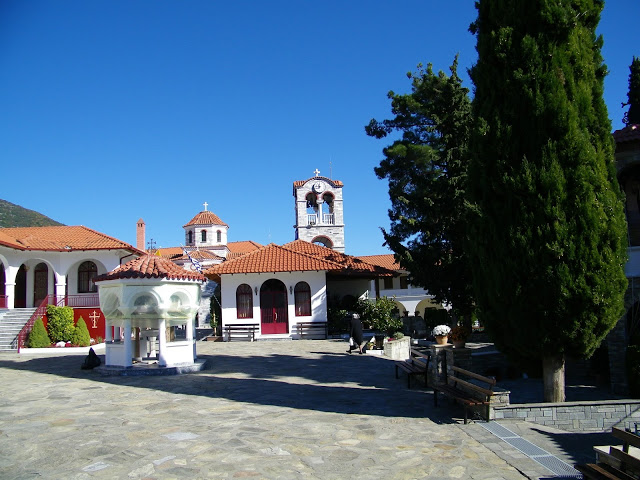
Gerondissa Akylina, Porphyria, Sipsa Monastery and St. Georgios Karslidis

Gerondissa Akylina, Gerondissa Porphyria (Sipsa) and Gerondissa Makrina (Portaria)

Friday, November 4, feast day of the Blessed Elder Georgios Karslidis of Pontos, warmed my heart with fond memories of nearly 3 decades of pilgrimages to beautiful, gem monasteries in Northern Greece!

 *

“God cares for everyone. Despair is in effect a lack of faith.”


Gerondissa Akylina, Porphyria, Sipsa Monastery and St. Georgios Karslidis


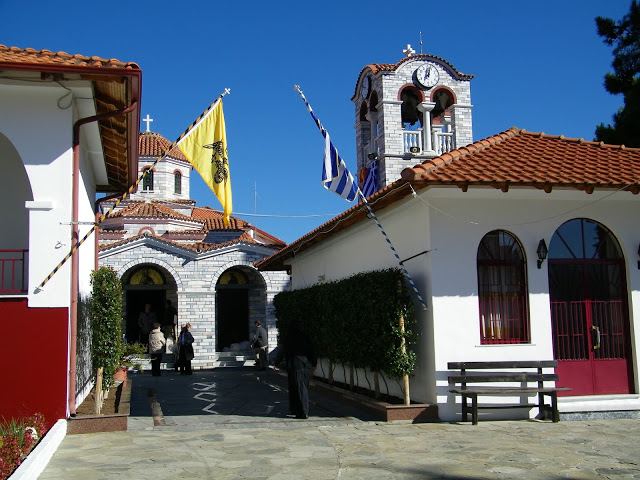
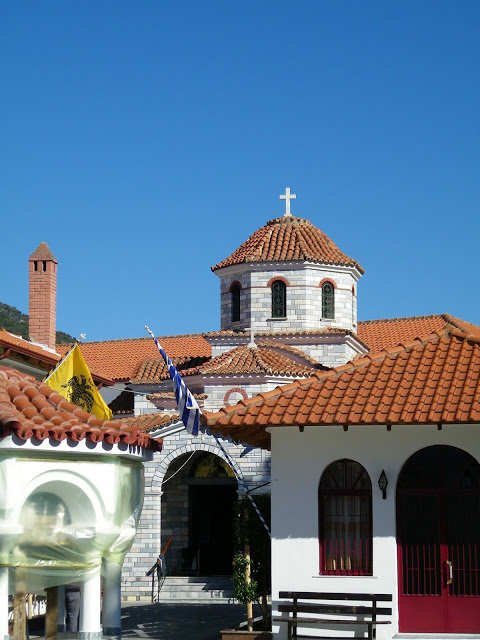
Taxiarches and the Analipseos Monastery (Sipsa) in Greece is one of the Monasteries in Greece that holds a dear place in my heart. Together with that of St. Paisios in Souroti, they were the first monasteries I started visiting as a University student, before my graduate studies and work at the US. At that time Gerondissa Porphyria, a Living Signpost in my journey on The Way,  had not even become a monastic, and now she is a renowned Abbess, one of the few of her ‘calibre’ in contemporary women’s monasteries.


Gerondissa Akylina, Porphyria, Sipsa Monastery and St. Georgios Karslidis


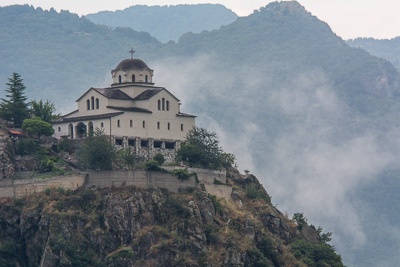
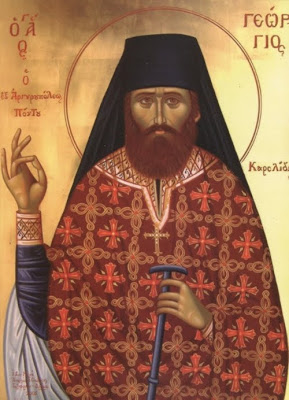
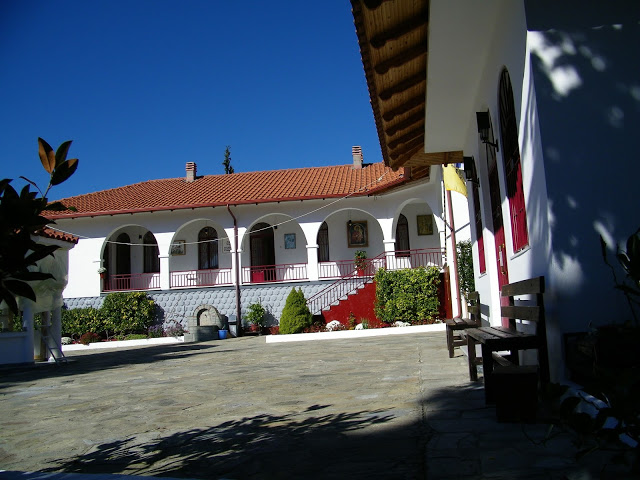
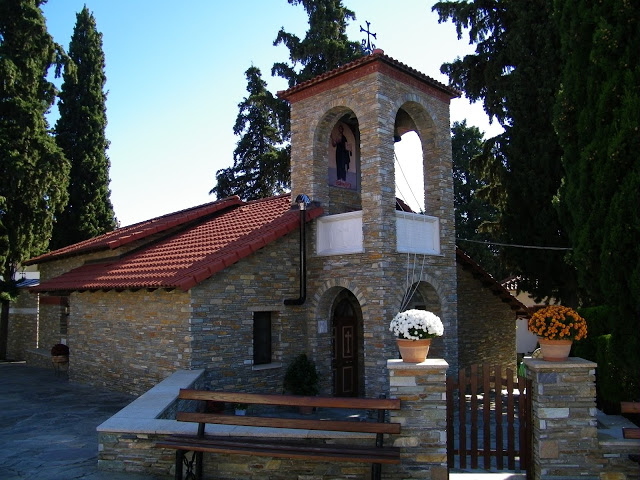
The Blessed Elder Georgios Karslidis of Pontos (1901-1959), latter day saint of the Saintly Orthodox Church in Greece,  glorified by the Patriarchate of Constantinople in 2008, was the first “resident” and founder of the monastery in the year 1930. He is one of few saints known to bear an imprint of the sign of the cross on his skull. There is a flourishing multitudinous sisterhood of nuns here today, who occupy themselves with the Iconography of handheld pictures, gold embroidery,knitting and waxwork.


Gerondissa Akylina, Porphyria, Sipsa Monastery and St. Georgios Karslidis


Gerondissa Akylina, Porphyria, Sipsa Monastery and St. Georgios Karslidis


Gerondissa Akylina, Porphyria, Sipsa Monastery and St. Georgios Karslidis


Gerondissa Akylina, Porphyria, Sipsa Monastery and St. Georgios Karslidis


Gerondissa Akylina, Porphyria, Sipsa Monastery and St. Georgios Karslidis


Gerondissa Akylina, Porphyria, Sipsa Monastery and St. Georgios Karslidis


Gerondissa Akylina, Porphyria, Sipsa Monastery and St. Georgios Karslidis


Gerondissa Akylina, Porphyria, Sipsa Monastery and St. Georgios Karslidis


Gerondissa Akylina, Porphyria, Sipsa Monastery and St. Georgios Karslidis


Gerondissa Akylina, Porphyria, Sipsa Monastery and St. Georgios Karslidis


Gerondissa Akylina, Porphyria, Sipsa Monastery and St. Georgios Karslidis


Gerondissa Akylina, Porphyria, Sipsa Monastery and St. Georgios Karslidis


Gerondissa Akylina, Porphyria, Sipsa Monastery and St. Georgios Karslidis


Gerondissa Akylina, Porphyria, Sipsa Monastery and St. Georgios Karslidis


Gerondissa Akylina, Porphyria, Sipsa Monastery and St. Georgios Karslidis


Gerondissa Akylina, Porphyria, Sipsa Monastery and St. Georgios Karslidis


Gerondissa Akylina, Porphyria, Sipsa Monastery and St. Georgios Karslidis


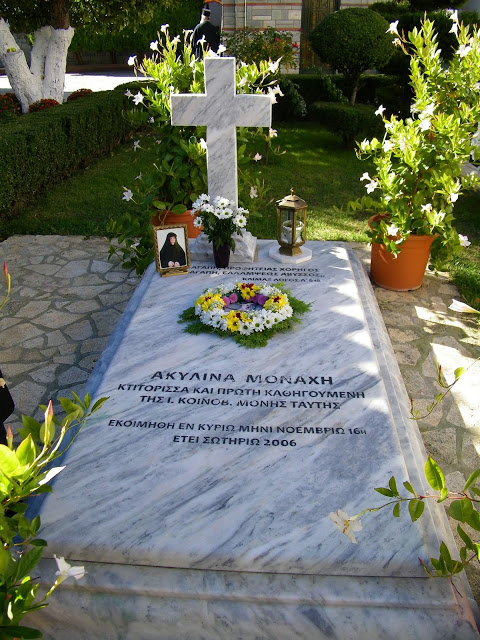
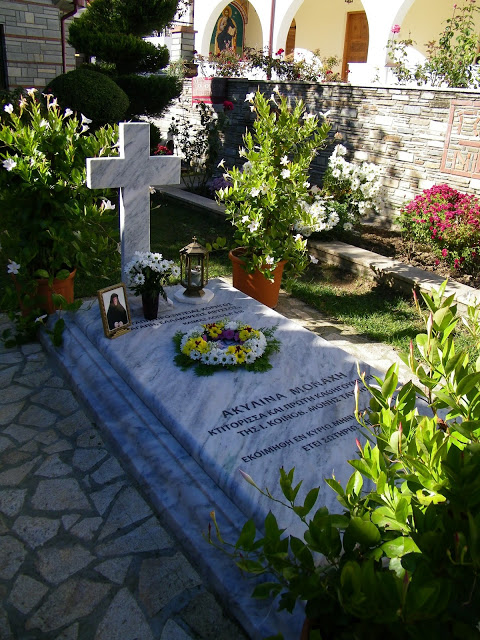
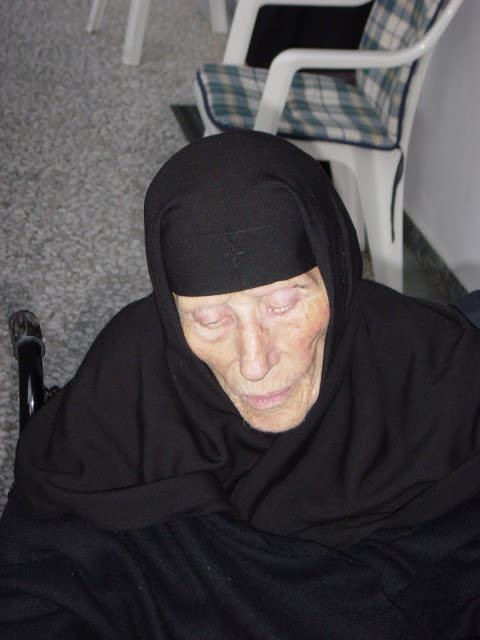
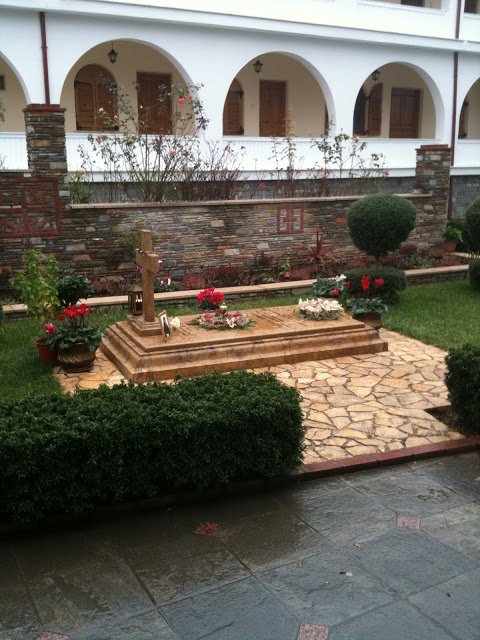
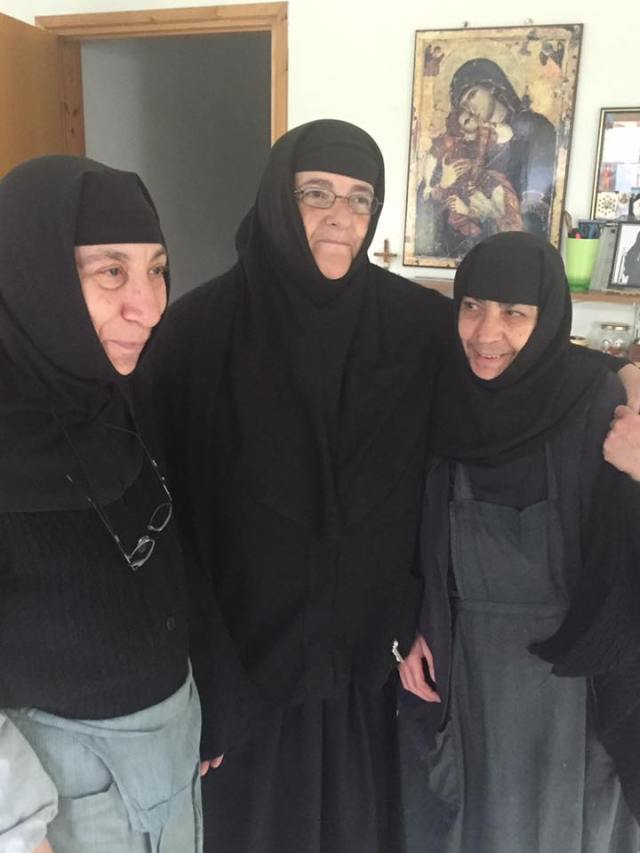
Gerondissa Akylina was the first Abbess. I had the rare blessing to meet her a number of times during the last years of her life. In the words of our late Elder Iosif Vatopaidinos, Gerondissa Akylina, together with Gerondissa Makrina in Portaria, were ‘Abbesses of Abbesses’:  examples of the monastic life and their monasteries models of coenobia, workshops of virtue and antechambers of Paradise.


Gerondissa Akylina, Porphyria, Sipsa Monastery and St. Georgios Karslidis


Gerondissa Akylina, Porphyria, Sipsa Monastery and St. Georgios Karslidis

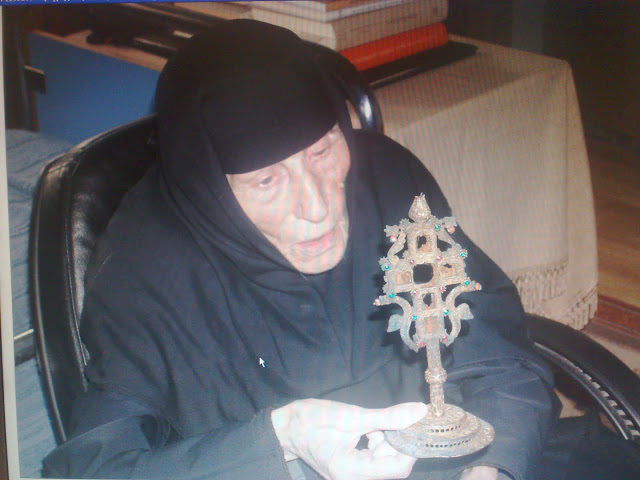
Gerondissa Akylina holding the Cross of St. Georgios Karslidis which was found intact after the translation of his relics. He is one of few saints known to bear an imprint of the sign of the cross on his skull.


Gerondissa Akylina, Porphyria, Sipsa Monastery and St. Georgios Karslidis


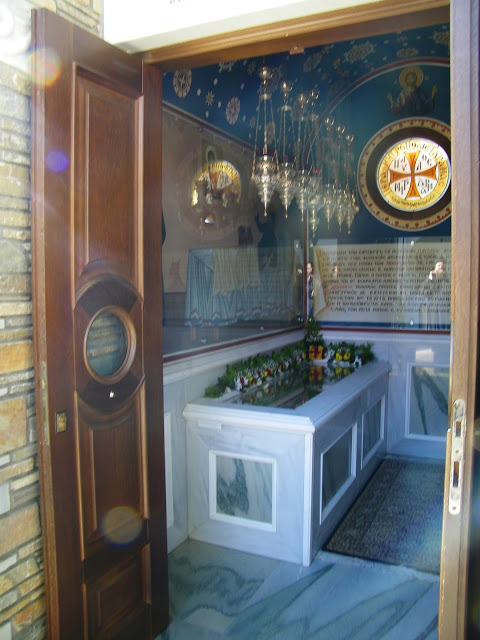
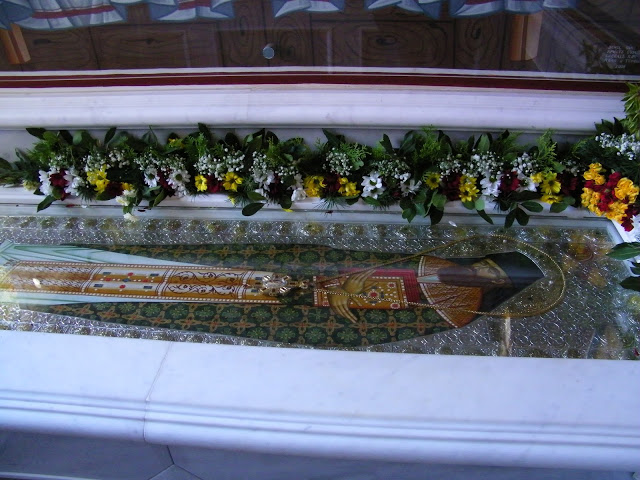
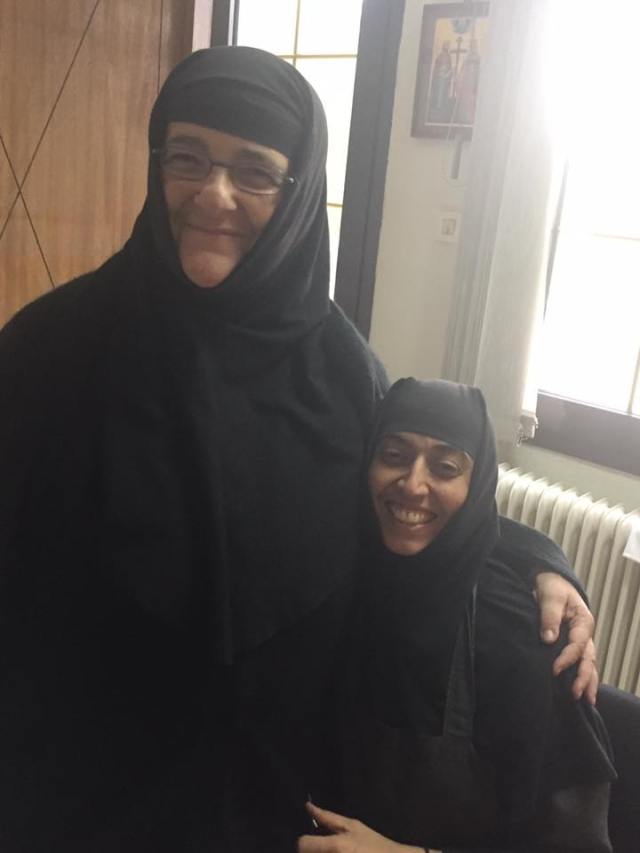
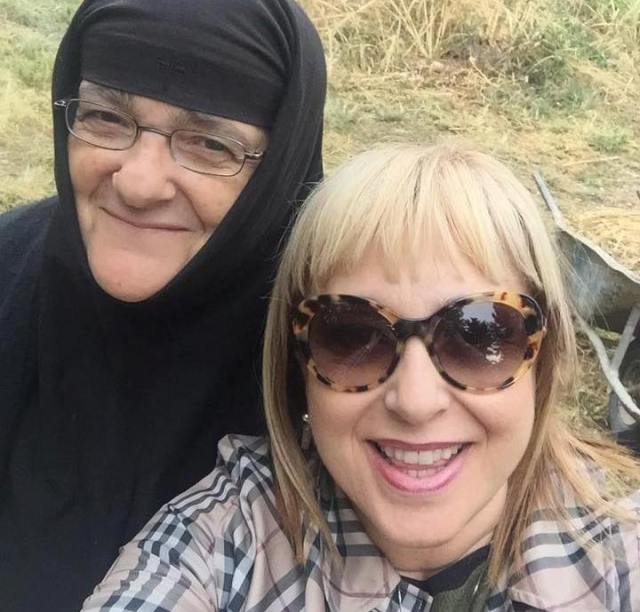
Gerondissa Porphyria has always been so full of love and humility, always ready to sacrifice her ease,  her rest and sleep, everything for her ‘neighbour! How many times has she consoled me in the trials and tribulations of my life! Always by my side, always! How many times has she offered a shoulder to cry on and precious, practical counsel! Her prayerful presence is intensely, intimately felt even thousands of miles away, here at the UK, and her smile warms my heart. Oh, just look at her smile in the photographs below with a pilgrim at the monastery and imagine the rays of the sun warming your shoulders after a rainy, cold day! How blessed am I to have such a spiritual mother by my side! Over the years I got better acquainted with the friendly and hospitable nuns there and the pilgrims and the faithful who regularly visit this monastery. St. Georgios’ holy presence is immediately felt upon entering the monastery gate, and there is always a queue at his tomb where his spiritual children kneel before their spiritual father, now in Heaven, to ask for his spiritual guidance and to seek comfort in life’s trials and tribulations.


For a closer insight at Elder Georgios Karslidis and his miracles, watch the following interview by Gerontissa Porphyria:


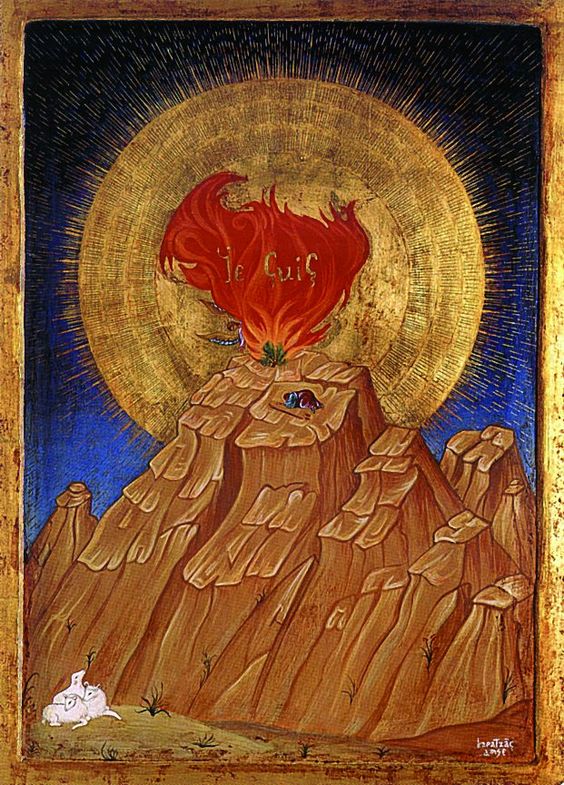
The Burning Bush

bush2

The Role of a Spiritual Father

Excerpts from a transcript of a talk by Metropolitan Anthony (Bloom) of Sourozh about the role of a spiritual father; an unforgettable talk, for both its essence and the power of its pastoral word.

The Burning Bush

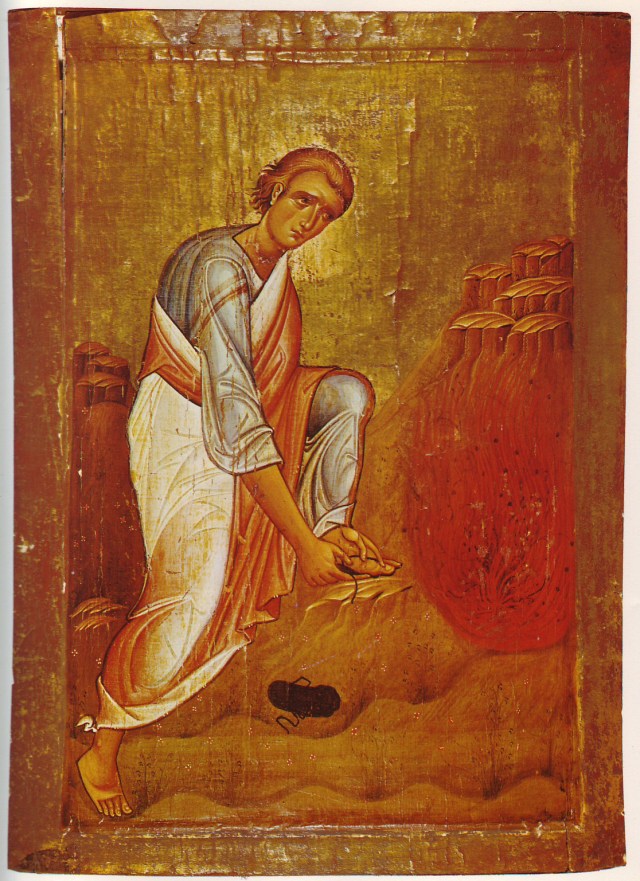
“It is easy and expected for a spiritual child to have humility. But what humility a priest or spiritual father must have in order not to intrude upon that sacred realm, to treat a person’s soul in the way that God commanded Moses to treat the ground surrounding the Burning Bush! Every human being—potentially or actually—is that very Bush. Everything surrounding him is sacred ground upon which the spiritual father may step only after removing his shoes, never stepping in any other way than that of the publican who stood in the back of the temple, looking in and knowing that this is the realm of the Living God, that this is a holy place, and he has no right to enter unless God Himself commands him, or as God Himself suggests he proceed or what words to say.”
*

Fatherhood consists in a person—and he or she may not even be a priest—giving another person birth to spiritual life. Looking at his spiritual father, that person saw, as the old saying goes, the radiance of eternal life in his eyes, and therefore was able to approach him and ask him to be his instructor and guide.

The second thing that distinguishes a father is that a father is as if of the same blood and spirit as his disciple; and he can guide his disciple because there is not only a spiritual but also a psychological resonance between them. Probably you remember how the Egyptian desert was once filled with ascetics and instructors, but people did not choose their instructors according to signs of his glory. They did not go to the one about whom they had heard the best reports, but rather sought out instructors who they understood, and who understood them.

This is very important, because obedience does not mean blindly doing what someone who has either material-physical or emotional-spiritual authority over us says. Obedience is when a novice has chosen an instructor whom he trusts unconditionally, in whom he finds what he has sought for. He hearkens not only to his every word, but even his to tone of voice, and tries through all of what manifests the elder’s personality and his spiritual experience to re-cultivate himself, to partake of that experience and become a human being who has grown beyond the limits of what he could have done by himself.

bush3

Obedience is first and foremost a gift of hearing—not only with the mind, or with the ear, but with one’s whole being, with an open heart; a reverent contemplation of the spiritual mystery of another human being.

On the part of the spiritual father, who has perhaps given you birth or received you already born but became a father to you, there should be a deep reverence for what the Holy Spirit is working within you.

A spiritual father, just as the simple and ordinary, commonplace priest, should be in a condition to see the beauty of God’s image in a person that cannot be taken away. (This condition often takes effort, thoughtfulness, and reverence for the person who comes to him.) Even if a person is marred by sin, the priest should see an icon in him that has been harmed either by conditions in life, from human neglect, or blasphemy. He should see an icon in him and have reverence for what has remained of this icon; and only for the sake of this, for the sake of the divine beauty within that person, he should labor to remove everything that deforms that image of God.

When Fr. Evgraf Kovalevsky was still a layman, he once said to me that when God looks at a human being, He does not see the virtues that he may lack, or the successes he has not attained—He sees the unshakeable, radiant beauty of His own Image.

Thus, if a spiritual father is incapable of seeing this eternal beauty in a person, to see the beginning of the process of fulfilling his call to become a God-man in the image of Christ, then he is not capable of leading him, for people are not built or made. They are only aided in their growth according to the measure of their own calling.

At this juncture, the word “obedience” calls for a bit of an explanation. Usually we talk about obedience as submission, being under authority, and often as a kind of enslavement to a spiritual father or a priest whom we call our spiritual father or elder—not to own our detriment only, but also to his.

Obedience consists in, as I have said, hearing with all the powers of our soul. However, this obligates both the spiritual father and the “listener” equally, because a spiritual father should also be listening with all his experience, all his existence, and all his prayer. I will even go further to say that that he should listen with all the power of the Holy Spirit working in him to what the Holy Spirit is bringing to pass in the person entrusted to his care. He should know how to search out the paths of the Holy Spirit in him, to be in awe before what God is doing, and not bring him up according to his own image or how he thinks he should develop, making him a victim of his spiritual guidance.

… One of the tasks of a spiritual father consists in educating a person in spiritual freedom, in the royal freedom of God’s children. He must not keep him in an infantile state all his life, running to his spiritual father over every trifle, but growing into maturity and learning how to hear what the Holy Spirit is wordlessly speaking to him in his heart.

Humility in Russian means a state of being at peace, when a person has made peace with God’s will; that is, he has given himself over to it boundlessly, fully, and joyfully, and says, “Lord, do with me as Thou wilt!” As a result he has also made peace with all the circumstances of his own life—everything for him is a gift of God, be it good or terrible. God has called us to be His emissaries on earth, and He sends us into places of darkness in order to be a light; into places of hopelessness in order to bring hope; into places where joy has died in order to be a joy; and so on. Our place is not necessarily where it is peaceful—in church, at the Liturgy, where we are shielded by the mutual presence of the faithful—but in those places where we stand alone, as the presence of Christ in the darkness of a disfigured world.

bush1

On the other hand, if we think about the Latin roots of the word humility, we see that it comes from the word humus, which indicates fruitful earth. St. Theophan writes about this. Just think about what earth is. It lies there in silence, open, defenseless, vulnerable before the face of the sky. From the sky it receives scorching heat, the sun’s rays, rain, and dew. It also receives what we call fertilizer, that is, manure—everything that we throw into it. And what happens? It brings forth fruit. And the more it bears what we emotionally call humiliation and insult, the more fruit it yields.

Thus, humility means opening up to God perfectly, without any defenses against Him, the action of the Holy Spirit, or the positive image of Christ and His teachings. It means being vulnerable to grace, just as in our sinfulness we are sometimes vulnerable to harm from human hands, from a sharp word, a cruel deed, or mockery. It means giving ourselves over, that it be our own desire that God do with us as He wills. It means accepting everything, opening up; and then giving the Holy Spirit room to win us over.

It seems to me that if a spiritual father would learn humility in this sense—seeing the eternal beauty in a person; if he would know his place, which is nothing other (and this is a place that is so holy, so wondrous) than the place of a friend of the bridegroom, who is appointed to safeguard the meeting of the bride—not his own bride—with the Bridegroom. Then the spiritual father can truly be a travelling companion to his spiritual child, walk with him step by step, protect him, support him, and never intrude upon the realm of the Holy Spirit.

Then the role of the spiritual father becomes a part of that spirituality and that maturing into the sanctity to which each of us is called, and which each spiritual father should help his spiritual children attain.

*

For more food for thought on this matter, go to:

WHAT IS SPIRITUAL DIRECTION? WHAT IS SPIRITUAL DECEPTION? by Fr Alexey Young (now Hieroschemamonk Ambrose), a spiritual child of Fr. Seraphim Rose, who offers some insightful words on the role of a spiritual father in our lives and how to relate to him, seeking to avoid deception and leading us to a true knowledge of God. Fr. Alexey also offers some recollections of his own spiritual father, Fr. Seraphim Rose.


And to:

St. John of Kronstadt: The Circle of Grace (2)

St. John of Kronstadt: The Circle of Grace

How fascinating to see a Saint through the eyes of another!

Who would have thought that St. John of Krostandt had helped finance, all the way from Russia and in very difficult times, the construction of St. Nicholas Cathedral in New York! A Saint worthy to meet St. Seraphim Sarov in a vision in January of 1901, in order to warn him of the impending Russian ‘Golgotha’. A spiritual father to Abbess Thaisia and founder of numerous women monasteries under her godly administration. St. Theophan the Recluse, himself a remarkable ascetic of the faith, spoke of him with wonder: “Father John of Kronstadt is a man of God. His prayer has reached God by virtue of his great faith. May the Lord keep him in humility and devotion to His holy will, and in self-sacrifice.”

The Athonite starets St. Silouan asked for St. John‘s  prayers to become a monk. Having finished his military service, before departing for home, Symeon (his name before tonsure) and the company clerk went to visit Father Ioann of Kronstadt to ask for his prayers and blessing. However, Father Ioann was absent from Kronstadt, so they decided to leave him letters instead. The clerk began to write a long letter in his best handwriting, but Semyon wrote only a few words: “Father, I wish to become a monk. Pray that the world does not detain me.” They returned to their barracks in St. Petersburg and, in the words of the Elder, the very next day he felt that all round him “the flames of hell were burning.” St Silouan recalled later in his life: “I still marvel at the power of his prayer. Almost 40 years have passed, yet I have not seen anyone serve the way he did.”

New martyr Alexander Hotovitzky, a Russian Saint living and serving in the United States from 1895 to 1914, also had the blessing to meet St. John of Krostandt and work together! Specifically, St. Alexander traveled to Russia in 1903, and while there, he paid a visit to Fr. John Sergiev — known even then as the wonderworker John of Kronstadt. After his return to America, St. Alexander spoke with a reporter from the Wilkes-Barre Times.  did the research and reprinted the resulting, fascinating article, one of the best things I have ever read in a newspaper, at Orthodox History. (The original date, incidentally, is April 7, 1904.)


*The Circle of Grace

Allowed to See

The Bible: the center of Theology of Father Symeon Krayiopoulos

The Bible: Father Symeon’s Kragiopoulos Centre of Theology

His discourse was also theological. He never ignored dogma, never indulged in moralizing, empty verbiage or flights of fancy. He spoke well, was comprehensible, and used theology, not as a system of knowledge, but as the essence of life, which imbues the whole of human existence. The centre of his theology was the Bible, which he knew in depth. His sermons were, at bottom, Biblical and he recommended that his ‘children’ read the Scriptures, and, indeed, he set a chapter of the New Testament to be read every day, by all of them. He immersed himself in the Scriptures, engaging with the text and enjoying the interpretational footnotes, both Patristic and modern.

We would often speak at length on the telephone about one passage or a single word.

His theological discourse wasn’t superficial. He knew theology in depth, he was up-to-date with theological bibliography and followed developments in academic theology. He was usually present at conferences of the Greek Society for Biblical Studies and took part in the discussions, reminding people, through what he said, that theology isn’t merely knowledge, but also an experience, without which knowledge ‘is puffed up’. And all the days of the conferences, when Fr. Symeon circulated as an ordinary member, he emanated the fragrance of Christ with his words, his smile and his presence. At one such conference in Cyprus, during a break, a professor from Thessaloniki approached a group of a few young people who were talking to Fr. Symeon and said: ‘Do you know what a blessing this moment is for you. In Thessaloniki we get to enjoy Fr. Symeon’s presence in drips and drabs. You’ve got him here when and for as long as you want’.


‘If you’re a theologian, you’ll pray properly; and,

if you pray properly, you’re a theologian’ (On Prayer 61)


His theological discourse was also niptic. He enjoyed the niptic fathers and imitated them in word and deed. The saying attributed to Saint Neilos: ‘If you’re a theologian, you’ll pray properly; and if you pray properly, you’re a theologian’ (On Prayer 61) was a rule of life. The silent assemblies, of which we spoke above, are a small example of his desire to teach the method of the prayer of the heart. And even if these silent assemblies have not been generally adopted as his vigils have, they were of great benefit, because the idea spread of using a prayer-rope and saying the Jesus prayer. Until then, it had been unknown to the wider public, neglected or held to be something that was appropriate only for monastics.

I realized just how much Fr. Symeon was imbued with the spirit of the prayer of the heart, how much he was himself niptic, from a long discussion we had as we were returning from a conference of the Greek Society for Biblical Studies on Patmos, the first of a series, at the end of September, 1975.

As we were sitting in the stern of the ship, in the moonlight, returning from the island of the Revelation, he showed himself to be a great niptic father, a holy teacher of the prayer of the heart. He was taken up, speaking from another world, and I tried to follow him, drinking in his words. We parted past midnight, with the feeling that we weren’t done with the subject. How could we be when ‘perfection is never-ending’?

Fr. Symeon never advertised his work. He never challenged anyone in his homilies. You learned about him from other people. I recommended his talks to someone and he said to me afterwards: ‘You mean there’s somebody like him in Thessaloniki and you didn’t tell me earlier?’

*

“I thank you, my Lord, that you allowed me to see what I am”


The Bible: the center of Theology of Father Symeon Krayiopoulos


I thank you, my LordThe event of salvation is conscious. We should know this and not fear it at all. Further, we should beg God to reveal our true selves to us. Then God will see that we accept this not with words, but in practice. Therefore, when at some point, either we make a mistake or something else happens, and God allows all of our wickedness, and our whole diseased and bleak inner state to be revealed, we need to accept it. We need even to be thankful, saying: “My God, such a thing I had awithin me and I didn’t recognize it! I thank you, my Lord, that you allowed me to see what I am”. 

You must see this and embrace it. Not in the sense that you will hang onto it, but in the sense that you will acknowledge that you are the one that has this within you. You ought to acknowledge it without wanting to blame and pass the responsibility to someone else and without averting your eyes as though not wanting to see it. Some men and women who work at lowly jobs, whatever happens, they stoop and patiently do the work completely. On the contrary, a person may be fragile or delicate, and supposedly ashamed, supposedly disgusted and supposedly isn’t able to do such work. If he does this work though, it will be incomplete. Here, though, in our own case, it’s necessary that we see our sin. We must see this thing that we hold onto as if we want it, and within which our soul has been sunk for an entire life. We must see it, must feel it. We must see how difficult it is, nearly impossible, to escape from this state.  Therefore, someone is completely convinced, and thinks: “It’s over. I’m going to perish”. This is Hades. Namely, someone sees that he is in Hades.

However, we know that we have a Saviour, we know that Christ came to earth. Then we start to understand what it means that he came to save us, and we run to the Saviour. We run to the Lord with pain, with prayer, with a cry, with faith, with hope and a firm conviction that the Lord will accept us and will save us. The Lord wants us to approach things exactly like this. This is not our own daring or our own boldness.  He wants us act just like that, to entrust ourselves in this way, and for this reason he gave us promises. So someone does this work, and little by little the decay of his soul, that lies in the subconscious and the unconscious, emerges.

How long will this last for? A lifetime. Until the end of our life, this is the work we have to do. But grace is involved. It also happens every so often that when you enter within yourself or when you give yourself to God, the decay you have within emerges on its own, and you see it whether you want to or not.

It is a bleak state, a filthy state, but grace is involved since in exactly this way you are redeemed, once and for all, and are saved. And it is through this that you are delivered from this state.

 *

Is our disposition such that the Lord is able  to be moved to compassion for us?

 The Bible: the center of Theology of Father Symeon Krayiopoulos

“And when Jesus went out He saw a great multitude; and He was moved with compassion for them, and healed their sick.”

Then – as the Gospel passage tells us – since the multitude had followed him into the desert for many hours and were hungry, the Lord with five loaves and two fish, having blessed and multiplied them, fed five thousand men with twelve additional baskets taken up.

The compassion of Christ is not simply some sentimentality, but is a manifestation of His love toward His creation. God always loves the world, He loves every individual person, but for Him to be moved to compassion and to show it, it is also necessary for a person to be appropriately receptive to it.

It’s not enough to simply do some good works (to pray, to go to church, to study). Whatever we do we are sinners and unworthy of God. Consequently, we are unacceptable. All the same, we need to do these things precisely to show our good disposition, to show that we want to be saved, that we choose God, we seek Him, we love Him. But is not enough for these things to be done only because of habit.

That’s why it is good, wherever we find ourselves, to ask ourselves night and day whether our disposition is such that the Lord is able to be moved to compassion for us. It is not necessary for you to journey along many and distant roads, climbing and descending, in order to achieve this. God is the one who covers the distance that exists between us and Him.

All a person needs to do is one little thing, but a little thing which is great and which is everything: to humble himself, to repent, to have the fear of God within him, to not be puffed up, self-inflated, and conceited.

And then – O, the wonder! – God will be found wherever we are. Then irrespectively of how things arise in our lives, we will feel the compassion of God and see how God will provide all that our souls and bodies need. It is not difficult for God – not difficult even for God to heal you from sickness or to put in order other problems and situations in your life. He can take care of everything. But we need to adopt that disposition that will elicit His compassion toward us. (August 3rd, 2014)


Transcribed talks by Archimandrite Symeon Kragiopoulos

 From: Holy Hesychasterion “The Nativity of Theotokos” Publications.

Translated by fr. Matthew Penney


(To be continued …)


For Fr. Symeon Kragiopoulos: The Portrait of a Spiritual Father – I, The Theologian and the ‘Liturgical’ Being (his famous church services and vigils), go here

For Fr. Symeon Kragiopoulos: The Portrait of a Spiritual Father – IIThe ‘Silent’ Assemblies of Father Symeon Kragiopoulos, (his famous silent sessions of the Jesus prayer), go here

For Fr Symeon Krayiopoulos: The Portrait of a Spiritual Father – III, A Servant of the Holy Mystery of Confession, go here …
Blessed Elder Philotheos Zervakos: The Circle of Grace (1)
elder-philotheos


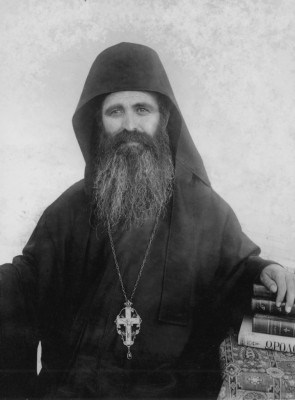
Blessed Elder Philotheos Zervakos was spiritual father to Photios Kontoglou, Sister Angeliki the Unmercenary (my spiritual mother),  and a spiritual child of St. Nectarios of Aegina. During his youth he chanted several times  at vigils served by the saintly Fr. Nicholas Planas. Elder Philotheos experienced two life-saving miracles in his life with St. Demetrios and visibly encountered the Saint.


  • This post marks the beginning of a series which has always fascinated me: The ‘inter-connection’ of the Saints, the faithful and members from my spiritual family in the Holy Spirit.  Glory to God! The circle of Grace expands like ripples in the pool!  “That they all may be one; as thou, Father, art in me, and I  in thee, that they also may be one in us ” (John 17:21, KJV) There will be no commentary or analysis on my part in this series; just a plain presentation of facts and accompanying hyperlinks. I would be greatly indebted to any of you who might point out to me further  ‘inter-connections’.

A Servant of the Holy Mystery of Confession

 Father Symeon : A Servant of the Holy Mystery of Confession

Father Symeon : A Servant of the Holy Mystery of Confession

In confession, as in the whole of his everyday behaviour, Fr. Symeon was all love. Love overflowed from within him. He radiated love, not with words, nor with actions, but with his mere gaze, his smile, with a single word. He was formal, but not a slave to formalities. I remember one incident in particular. He’d given me the number of his personal telephone, the one in his room. I would usually phone him between 11-12 in the evening, which was the best time for him because, as he explained: ‘Now it’s the afternoon for me’.

We’d speak without restraints of time, but he would still be up in the morning for his rule. One evening, around midnight, the son of a friend of mine, a spiritual son of Fr. Symeon’s, who was studying abroad, telephoned me. He was very upset and asked for help with a really important problem which needed to be resolved immediately. I was in no position to advise him. Only the Elder could do so, but how? At that time of night nobody would have answered a telephone call to the monastery. I hesitated to give his confidential telephone number, because he’d told me not to give it to anyone at all. The case was such, however, that I decided that I’d just have to go against his instructions. So I gave it. And the boy was saved. The father saved his son.  The next day I asked forgiveness for the infraction, but he told me not to worry and that I’d done the right thing.

That was Father Symeon. A discerning, consoling and enlightened advisor to whom we had recourse and to whom we referred people with difficulties, so they could find refuge.

*

In his sermons, in his discussions, in confession, Fr. Symeon didn’t avoid taking a position on burning questions which others didn’t dare to touch on so as not to come into conflict with the prevailing, unhealthy atmosphere. Let me explain. There was at one time much ado generated over 666 and this was an issue that threw people into turmoil. Father Symeon did not leave his spiritual children in the dark over this. He clarified the issue in a series of talks, reassuring those who were worried. He did the same for bar codes and other similar issue which aggravated ill-informed believers. In general, he dealt with important ecclesiastical and theological issues with clear thinking, theological depth and knowledge of the Patristic tradition. And all of this with sobriety, without any spirit of contention.  If ever I wanted a second opinion on my own articles on Church matters, I would submit them to him and he would always make useful observations. For example, if I used acerbic language, he would suggest I tone it down.

In general, his discourse was prophetic. He did not ignore dogma, he was never restricted to dry moralizing, he used neither clichés nor soaring rhetoric. Well-grounded, comprehensible, he spoke in the name of God, telling the truth, castigating lies and thus bringing the faithful to his way of thinking. Listening to him, you felt that you were listening to the word of God, that his discourse was official, authentic and valid. He didn’t impose himself through human coercion, but spoke rather ‘in the Holy Spirit’. Without prevarication, he went straight to the heart of the matter and didn’t mince his words in order to please people. He told the truth of the Church, without pulling any punches, however hard this seemed to many people. He was a prophet in the Biblical sense, shaking people up to get them to cast off the fripperies with which their egotism had burdened them, so that they could see naked reality clearly.

*

Pain is a shortcut to salvation

Father Symeon : A Servant of the Holy Mystery of Confession

It says in the Gerondikon: “In the morning you may be in hell and in the evening you can be in paradise”. What is meant is that in the morning man may have committed sins, but, as in the course of the day he came to his senses, showed reverence, repented and wept for his sins. As the sun sets, it is no big deal for God to place him in paradise. Things are easy and the road to salvation is short. We, by having the wrong attitude, make things hard and the road to salvation “un-short”.

Whatever your condition is, if you repent, God welcomes you and you are saved. All you need is to repent truly.

You may repent for something you have done, but you repent because your egoism has been hurt. You go to confession, for the one and only reason that your egoism has been wounded. Not because you have sinned in the eyes of God. You had a good impression of yourself. As you have sinned though, you can no longer have it. And that makes you suffer. This is not repentance, though.

*

(To be continued)

For Fr. Symeon Kragiopoulos: The Portrait of a Spiritual Father – IIThe ‘Silent’ Assemblies of Father Symeon Kragiopoulos, (his famous silent sessions of the Jesus prayer), go here

For Fr. Symeon Kragiopoulos: The Portrait of a Spiritual Father – I, The Theologian and the ‘Liturgical’ Being (his famous church services and vigils), go here