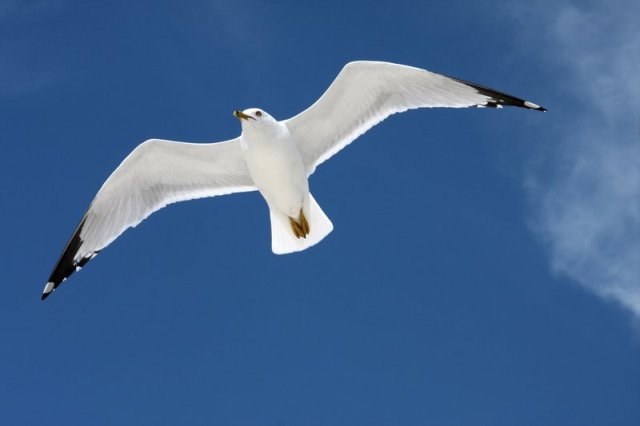
Are you Afraid? Yesterday I took a long walk by the promenade. It was dusk, and the tired sun sparkled gold across the ripples of a gentle sea. The sea was basking in an orange sunset. Watching the seagulls’ gliding and soaring was mesmerising. I just stopped and let it sink deep into my heart . It brought such peace, freedom and joy to me!No video can do justice to the Beauty of their flight!
I was reminded of Jonathan Livingston Seagull‘s daring before challenges. His Yes to Life:
“You have the freedom to be yourself, your true self, here and now, and nothing can stand in your way”.”
Are You Afraid?
How diametrically different to J. Alfred Prufrock‘s neurotic cowardice, futile death-in-life and paralysing procrastination:
“…To lead you to an overwhelming question …
Oh, do not ask, “What is it?”
…
And indeed …
There will be time … for a hundred indecisions,
And for a hundred visions and revisions … which a minute will reverse.
…
Do I dare
Disturb the universe?
… Have the strength to force the moment to its crisis?
… And in short, I was afraid.
Surely “the mermaids” will not sing to him. “… Till human voices wake us, and we drown.” “Let the dead bury their dead” (Luke 9:60)
Are You Afraid?
“But the cowardly … –they will be consigned to the fiery lake of burning sulfur. This is the second death.” (1. Revelation 21:8)
“And there we saw the giants, the sons of Anak, which come of the giants: and we were in our own sight as grasshoppers, and so we were in their sight. (Numbers 13:13)
“How do you say Yes to everything?”
[Interview with Mother Gabrielia (1897-1992), a 20th century saintly Greek Orthodox]
Three things we need in life: first, Faith; second, Faith; third, Faith.
“I say yes because I believe that if it is not for my good God will make it so that the No will come from the very one who invited me. …
Today I am ninety years old–may you live so long! I read again and again and again in the Gospels, and I see something strange. Jesus Christ comes and says to the Apostles, “Leave now what you have and follow Me.”
Now, if they said, “And who are you? Why should we lose what we have? Why should we lose our profit? Where will you take us? What will you do with us?”—if they had said that, what would have happened? They would have remained in darkness.
They said Yes to the Unknown who came and said, “Throw all that away!” Why? Because they believed in God, and they waited for the One who would say to them, “Come!” And that was the beginning.
Because if we say No, what will happen? . . . One or the other: If you believe, you will walk on the water like St. Peter. If you are scared–Bloop! Nothing else.
… He said to us, “Why do you worry? … Even the hairs of your head are numbered!” Why worry? Faith is lacking. May we have faith.
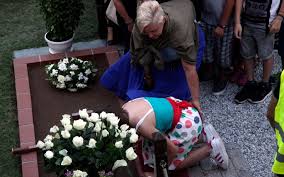
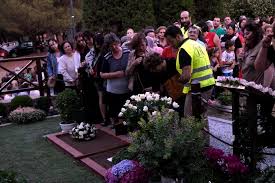
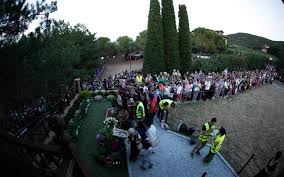
I may be on a pilgrimage in Romanian monasteries, but St Paisios’ the Athonite, my patron Saint‘s, presence is strongly felt all over Romania. Plenty of icons of his and books with his services and spiritual counsels in all monasteries and churches I have been so far! I truly regret having to leave this week of all weeks Greece, but thanks be to God, while this was going on inside Souroti monastery church on July 12, and this outside the church, near his tomb
Much longer queues than in 2013 … every year longer! The Lord is glorified in His saints!
the faithful all over in Romania were holding Vigils and praying Akathists and Supplication canons, asking for his prayers.
Wherever I go, the moment Romanians realise that I am Greek and my home town is near Souroti, they start asking for my telephone number and email, so that I can make arrangements and help them go and venerate his tomb.
Just in case you missed it, this is a beautiful documentary (in Russian with English subtitles) about the life of St. Paisios the Athonite and his years spent on Mount Sinai in Egypt.
And another one:
And yet another one by the Patriarchate of Moscow (a film documentary of six episodes with total duration of 5 hours on the holy life and work of Saint Paisius of Mount Athos):
A dear sister in Christ, a nun in a Greek monastery, recommended Mother Gavrilia’s book to me a month ago, to study again, and draw inspiration and courage and faith in my poor, little missionary endeavours, by that Missionary and Unmercenary Giant. I am so grateful for this Holy Mother and her book. I have had it for many years and read it many times. Each time it goes deeper, deeper. I am reading this again after many years of traveling and the book was packed away. She always, through the message of the Holy Spirit-alive in her, has a word or two about my/your struggles. Especially now. I feel her so close to my side. Mother Gavrilia is such a role model in her fearlessness, her humility and obedience to God’s Will, her dedication to the service of all mankind, her Faith! May we have her blessing!
A poem in the book touched my heart so deeply:
THOU HAST made me known to friends
whom I knew not.
Thou hast given me seats in homes not my own.
Thou hast brought the distant near
and made a brother of the stranger.
I am uneasy at heart
when I have to leave my accustomed shelter;
I forget that there abides the old in the new,
and that there also thou abidest.
Through birth and death,
in this world or in others,
wherever thou leadest me, it is thou the same,
the one companion of my endless life,
who ever linkest my heart
with bonds of joy to the unfamiliar.
When one knows thee,
then alien there is none,
then no door is shut.
Oh, grant me my prayer
that I may never lose the bliss
of the touch of the one
in the play of the many.
[R. Tagore, Gitanjali, LXIII]
This poem, dated March 24, 1964, exactly ten years after she was “reborn”, was found among her papers. On the top of that page, she made the sign of the Cross
Arvo Pärt – And then came the evening and the morning (1990)
“God is Love” … and Mother Gavrilia‘s entire life, which was a hymn to the Lord, became thanks to Him, a burnt offering, a holocaust to His Love.
“Only one thing do I know that I have always, and it is not pride, nor fantasy, but that which I have day and night, wherever I find myself–three things: first, Faith; second, Faith; third, Faith. That’s all! Nothing else can I say to you. It has directed all my life.”
May the Saint bless us and may we have a fraction of his courage and his endurance!
2 Corinthians 4:8-12
We are hard pressed on every side, but not crushed; perplexed, but not in despair;9 persecuted, but not abandoned; struck down, but not destroyed.10 We always carry around in our body the death of Jesus, so that the life of Jesus may also be revealed in our body.11 For we who are alive are always being given over to death for Jesus’ sake, so that his life may also be revealed in our mortal body.
TO MY THREE SONS, MY DAUGHTER, MY GRANDCHILDDREN AND MY GREAT GRANDCHILDREN MY SPIRITUAL WILL
I am now 79 years old. My heart is weak and my strength is failing me and it is evident that my time of departure from this world is near. St. Paul left a will to all the Christians. “Become followers of me, as I am of Christ.” I certainly do not dare to say this to all the Christians but to you, my children; I can say follow my example just as I have followed the example of the Apostle Paul. My life has been tough and difficult but never did I pray to God to make it easy. Because “narrow is the gate and difficult is the way which leads to life, and there are few who find it.” MT.7:14.
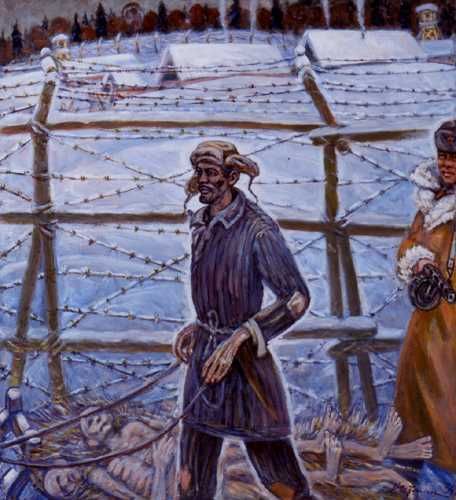
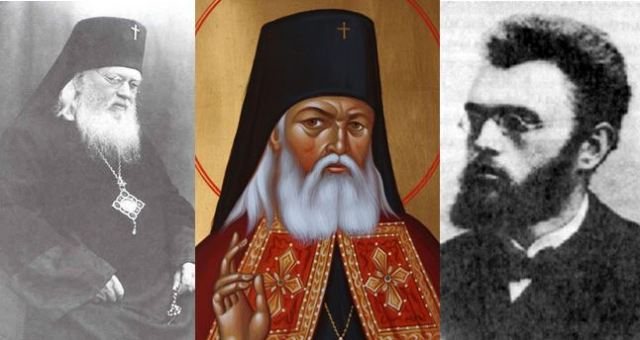
For more than twenty five years my life was identified with the work of a rural surgeon and professor of surgery. And for eleven years I suffered persecution for the name of Christ by being jailed and exiled. From 1944 I combined the toilsome ministry of being a Bishop along with the healing the wounded at Tambor and only in 1946 did I stop being a surgeon and I continued as a Bishop.
Amongst most of the people it was inconceivable to understand how a great surgeon, who was honored with the First Prize of Stalin, could abandon a profession in surgery and become a Bishop. Yet there was nothing unusual about that because from my youthful years, the Lord destined me to the high position of service to Him and to the people.
When I finished high school I received from the dean of the school my high school diploma. I placed this in the Book of the New Testament. I had read the New Testament before but now, when I read it again, I heard the words of Christ that were directed to the Apostles say: “The harvest is truly plentiful, but the laborers are few, therefore pray the Lord of the harvest to send out laborers into His harvest.” (MT 9:37-38) My heart responded and I cried out in silence: “Oh Lord! Are you lacking workers?”
Many years went by. I became a doctor of medicine and I thought that I would write the book “A Treatise on surgery in treating festering wounds.” When I made that decision, the following strange thought came to mind: “When that book is finished, it will be signed by a Bishop.” I could not understand from where that thought came. But a few years later, I understood that it was a thought that was sent to me by God because after my first arrest, in the office of the head jailer, the first edition of my book was published and on the facing page I wrote: “Bishop Luke, “A Treatise on surgically treating festering wounds.”
Two more years went by. I was in my first exile to Siberia, in the city of Geniseisk. A monk suddenly came to meet me from Krasnogiarsk. In this city, all the priests had compromised the faith and the faithful of the canonical Church had sent the monk to be ordained a priest but not to me at Geniseik but to Minousinsk, to a non-canonical orthodox bishop. But there was an unexplainable force which directed him to me at Geniseisk. When this monk saw me, he was startled and froze. He could not speak. He revealed to me, that when he saw me, he knew clearly that I was the same hierarch that he saw in an unforgettable dream ten years ago. That Bishop ordained him to the priesthood. At that time I was just a country doctor in the city of Perezlavl, Zaleski.
The Lord God has blessed me with different talents. In high school, I finished my studies in the School of Fine Arts in Kiev. I was very talented in artist and I decided to enter the Academy of Fine Arts in Leningrad. But in the middle of exams I abandoned this effort because I thought that I should serve God and His people, in work that is more beneficial than art. Even though at that time it was clear to me the direction my art would take if I didn’t abandon it; it would purely be a religious direction or I would follow in the footsteps of V. Vasnetsof and Nesterof.
From that time theological issues concerned me very much. The driving force in my character was a strong desire to serve God and His people, only because of that. But in spite of my opposition toward the physical sciences, I took exams for medical school at the University of Kiev and I graduated with honors.
My talent was revealed at the university in anatomy and surgery and my fellow students didn’t want to hear that I desired to become a rural doctor. They had decided unanimously that I would become a professor of anatomy or a surgeon. From what you now know, they had prophesied my future correctly.
As a rural doctor, I worked for thirteen years twelve to fourteen hours a day. I was thinking seriously of abandoning the rural hospital in order travel to distant villages where the people were poor and dying because of the lack of medical help. But the Lord had decided differently for me. He sent me to Tashkent where I was one of the organizers of the University of Middle Asia and became a professor of topographical anatomy and the chief surgeon. This was at the beginning of the decade of the 1920s.
During the years of the antireligious demonstrations during which they derided the Lord Jesus Christ, my heart was saying: “I cannot keep silent.”At that time there was a clergy-laity congress taking place in Tashkent. I was present and during the discussions on some important issues I made an impassioned speech. That speech made a great impression on Bishop Innocent of Tashkent and at the end of the congress he said to me; “Doctor, you must become a priest.” That was something that was completely unexpected by me but the words of the Hierarch brought forth a calling through his lips and I did not hesitate one second in answering him: “Of course, Your Eminence, if that is the will of God, I will become a priest.” And the following Sunday, I, the professor of medicine, with a borrowed robe, appeared before the Bishop who was standing on his throne and I was ordained a sub-deacon and then during the course of the Divine Liturgy I was then ordained a deacon. Within two weeks I became a priest and the pastor of the Cathedral Church.
One and a half years before that great event in my life, my wife and your mother died. The smallest of you, Valentine, was then six years old and the oldest was fourteen.
Two years and four months later, the Lord made me worthy of being elevated to the rank of Bishop. It was divine providence for me and for you, my children that was revealed to us at that time when the Lord called your mother to eternal life by allowing her to get sick with tuberculosis. By this happening to her the road was opened for me to enter monastic life and the hierarchical ministry. All the responsibility for you, my children, I gave over to the care of the Lord and truly, I was not made a liar by believing in Him. Your care and upbringing was provided for by sending me an unknown woman, Sofia Sergakevna Veletskagia, who during the times I was jailed and the three times I was sent into exile she provided for your care. With a great deal of self-sacrifice and love she lifted the heavy cross for your care during those years of the plague. She raised you successfully and gave you a good education.
Later on all three of you and my daughter, with the protection and the help of your guardian angels, completed your advanced studies. Michael for some time now has become a professor, while Aliosa and Valia are teachers in the medical and biological sciences and in a little while they will become professors.
The Lord accepted all the sacrifices which I have offered Him and not only did He accept them but He changed and corrected many of them. I abandoned doing any more surgeries so that I could spend more time preaching about Jesus Christ. I was not concerned with the fame of a surgeon which certainly I deserve. While this glory is important and belongs to God, the new freedom I had increased the power and content of my sermons. My well-known and famous book “The Treatise on surgery for festering wounds” was completed while I was in exile and when I was Archbishop. My determination to sacrifice everything for the glory of Him, the Lord gave me another talent, that of preaching. The nine volumes of my sermons have been recognized by the Spiritual Academy of Moscow as unique in contemporary ecclesiastical theology and a treasure of commentary on the Holy Bible. And I, a self-taught theologian was chosen to be a member of the Spiritual Academy of Moscow. For the Church, my sermons will have greater meaning than my “Treatise on the surgery for festering wounds.”
In addition to this, the miraculous events which I spoke about earlier which were directed by the Lord without my realizing it led me mystically to the Hierarchical ministry. I often physically felt the presence of God in my communion with Him, in my spiritual life and in my prayers.
But if I have not said enough for any of you to convince you of these things then I think his (Michael’s) involvement with the physical sciences have bewitched him so much that he does not want to hear those things that I have lived; the things I have undeniably felt many times.
In other words, I will tell you just the way it is, how astonishing and clearly the Lord God reveals His desire for those who fear Him and love Him. When I was in Leningrad for an operation, during the time of a memorial service, the Lord in a miraculous and shocking way caused me to tremble with fright when He gave me this command: “Shepherd my sheep, feed my lambs.” The years have since gone by and I, under the spell of a cunning diabolical spell, forgot that command of God and Satan again placed in my soul that great urge to return to surgery. And this is why the Lord punished me by allowing the retina in my eye to tear. My eye was operated on twice unsuccessfully by professor Ontintsof because God’s punishment had to remain with me.
The day after the second operation, when I was laying flat with my eyes bandaged, the strong urge to do surgery again overwhelmed me when the Lord sent me a shocking dream: I was in a Church without lights. The only lit up place was the altar. A little beyond the altar was a casket of a saint. They had placed on the altar a wooden board and on this was a naked human body. In the back and next to the altar I saw students and doctors smoking cigarettes and I was teaching them anatomy of the human body.
I was then startled by a noise and when I turned my head, I saw that the covering of the saint’s casket fell off. The saint sat up in the casket, he turned and looked at me with a look of pain and shock. I finally realized the great burden of my sin, of my disobedience to the command of the Lord Jesus Christ to “shepherd my sheep and feed my lambs.” For the last fourteen years I begged the Lord Jesus Christ to forgive me remembering clearly my dramatic dream with the body and the dead person lying on the Holy Altar. Lately I have been informed by God that my sin has been forgiven. Day after day, I see the body less and less on the Holy Altar where it finally disappeared completely.
And now, my children let me offer to you my last will and testament. I believe deeply in God and I have built my whole life upon His commandments. And I bequeath to you that you offer your lives to God and build all things upon the commandments of Christ.
For a long time and with great determination I sailed through life against the current of the world and to you my children I bequeath that you sail against the current, as difficult at that may be. Turn your attention and your heart away from the great majority of human beings who pursue not the higher goals but those which are easy to acquire. Do not accede to the great majority of people who live according to their own thinking and with the mind of their leaders. They anchor their lives not with the commandments of Christ but on the directives of people who have the power to lead them not to the Kingdom of Heaven but to the riches of the earthly kingdom.
The purpose of life is to seek after the highest truth and to never divert from that road even when they force you to serve the purposes of the lowest form of truth by trampling upon the truth of Christ.
You should be ready even to be martyred since you are sailing against the current. Keep your faith firmly in your thoughts, in your husbands and in your wives just the way I kept it.
In your scientific endeavors and in your efforts to study the mysteries of nature, you should not look for your own glory but only to lessen the pain of your sick and helpless fellow human beings.
Remember that I, your father, sacrificed all my life in doing these things. Imitate me just the way I imitated the Apostle Paul and do not work for your stomach but to help those who without your help cannot free themselves from the tortures of poverty and lies.
If you fulfill all these things that I bequeath to you, the blessing of God will come upon you in harmony with the words of David the prophet. “But the mercy of the Lord is from everlasting to everlasting on those who fear Him, and His righteousness to children’s children, to such as keep His covenant, And to those who remember his commandments to do them.” (Psalm 103: 17-18.)
I have always prayed for that blessing and grace of God in my life for you my children, my grandchildren and my great grandchildren and surely I will always pray for your eternal life when I will stand before the throne of my God and your God, my Creator and your Creator. That time is most likely near because my heart and my strength have been weakened.
Your father Alousta, July 22, 1956
“I loved martyrdom, which so strangely cleanses the soul.”
The Saint’s last words
“My children, very much do I entreat you,
Arm yourselves with the armor that God gives, That you may withstand the devil’s tricks.
You can’t imagine how evil he is.
We don’t have to fight with people but with rulers and powers, in effect the evil spirits.
Take care!
It’s no use to the devil for anyone to think and feel
that he is close to him.
A hidden and unknown enemy is more dangerous than a visible enemy.
O how large and terrible is the army of the demons.
How numberless is their black horde!
Unchanged, untiring, day and night, seeking to push all of us who believe
in the name of Christ, to lure us on the road of unbelief, of evil and of impiety.
These unseen enemies of God have made their sole purpose, day and night to seek our destruction.
But do not be afraid, take power from the name of Jesus.”
Reflections on Pilgrimages by three fellow ‘Pilgrims‘
“No one descends from the Cross, but they take him down” Christ to Elder Sophrony (Sakharov)
[My interposed or ‘highlighted’ comments are in brackets and in blue]
“I had made grand plans [Oh yes! Sooo me!! Throw caution to the wind!] this past summer. My goal was to retrace Paul’s first missionary journey. I would start in Antalya, shoot past Perge up north through the Taurus Mountains until I was just north of Yalvac (Antioch of Pisidia). From there I would swing west to Konya (Iconium) and do a quick circle hitting the ruins that were Lystra and Derbe before finishing back up at Konya. Unfortunately, just three days into this journey I ended up spraining my ankle. Even though that random injury shortened my planned 500+ mile journey down to seventy, it was still the longest I had ever walked in one setting and it was a great experience.
From start to finish I did that walk with this big black bag. In this bag I carried a tent and small blanket, some clothes, a Bible and a notebook, some food, and water. I carried lots of water. I would much rather not have the need, but I was going through some uninhabited mountains and near desert in weather that was in the nineties and sunny every single day. You might not think of it but water is heavy. Very heavy. As I was walking this bag gave me bruises on my shoulders. When I tried to loosen the straps to relieve them, it would end up chafing my lower ribs and back. [And blisters, corns and callouses on my feet]
[I have moved to the UK since May 20, ‘moved’ by a ‘similar’ missionary impulse. Little did I know that I would spend so much of my day walking from place to place, since I am not in possession of a car (yet?) and my lodgings appropriately ‘primitive’ and remote, often getting lost in unfamiliar surroundings, carrying, more often than I would have liked, heavy objects in my backpack and bags. Never would I have grasped how spoilt and what a creature of comfort I am if I had not been restricted to such old, poorly maintained, cramped, uncomfortable, poor lodgings!]
There was no escaping the pain.This thing hurt and it was preventing me from being able to walk the walk I wanted to. It was a beautiful moment when I was able to hobble into my hotel in Isparta, drop my bag, and say, “I am done with you.” Like me dropping that bag, there are some things we will need to let go of if we are to chose to walk the life Jesus has called us to.
Mark 10:46 – Then they reached Jericho, and as Jesus and his disciples left town, a large crowd followed them. A blind beggar named Bartimaeus (son of Timaeus) was sitting beside the road.
The first set of baggage Bartimaeus need to drop is the Baggage of his background.What is your background? What is your cultural heritage? One of the popular memes floating around on the internet are those “Keep calm and _______” Keep calm and pray. Keep calm and drink starbucks. Keep calm and eat a cookie. Keep calm and kill zombies. Keep calm and watch gossip girl. You name it, they’ve “keep calmed” it. One of my favorite “Keep calm’s” is a T-shirt I have seen a few times: “I can’t keep calm. I’m Turkish.” Every culture has it’s own distinctions, some would say stereotypes, and there will always be some who will use one of those cultural distinctions, or their family upbringing, as an excuse for their behavior. “I cant help being an alcoholic, I’m…” Or, “I can’t control my temper. It is the ______ in me coming out.” Or “You think I’m rude? I’m _____. We’re all rude. Deal with it.”
Although our cultural background and family background might make us more likely to act in certain ways, ultimately we are all responsible for our own behavior. [I would have never been made so intensely aware of my own cultural/ family background, had I not moved to a ‘foreign’ country and being ‘forced’ to communicate all the time, in writing and in speaking, in a language which is not my mother tongue. Can you imagine? Two conferencesin just two weeks! Most fascinating but forcing me to struggle as they were not in my mother tongue. We never realise how deeply rooted we are in an ‘environment’ until we are completely removed from it] Bartimaeus could have said his background was a blessing or a curse. On the one hand since Timaeus means “highly favored”, Bartimaeus would mean “highly favored son”. He was not born blind and so the name “favorite son” was probably not an ironic misnomer. On the other hand, Timaeus is a Greek name. Those who like philosophy might recognize that it was Timaeus who debated Socrates in Plato’s dialogues. Bartimaeus was a mixed blood in a very racist society. Whether you come from a home of abuse, shame, and poverty or whether you had an incredibly blessed and very loving background, there comes a point when you just need to let go. Leave it behind you. Walk your own walk.
Mark 10:46 – Then they reached Jericho, and as Jesus and his disciples left town, a large crowd followed them. A blind beggar named Bartimaeus (son of Timaeus) was sitting beside the road.
In addition to the baggage of his background, Bartimaeus needed to drop the baggage of his disability. Bartimaeus was a blind beggar. In modern society being blind is not as crippling as it was in his day. We have books in braille. I have even been through a drive through for McDonalds where a sign says that they have braille menus available. I really hope no blind driver is ever pulling up to ask for one while I am anywhere near. We also have audio books and a program that will read any PDF file in a reasonably normal voice. We also have medical advances where many who would once have gone blind can now get surgery and see perfectly fine. Bartimaeus had none of that. He had no hope.
What is your disability? Most people would say I am average height, but in my family my shortness is a disability. All of my cousins and siblings, even most of the girls, are taller than me. Our family loves basketball. I love basketball, but I have a permanent unfixable disability against others in my family. No matter how hard I try, I will never grow taller. It just won’t happen. But then I think of pros like Spud Webb and Mugsy Bogues. These guys were much shorter than I was and yet they played well against others who were far taller and better than anyone in my family. Just like our background, we need to drop the baggage of our supposed disabilities if we are to experience our miracle. If God calls us, He will enable us. [I have repeatedly felt so incompetent, weak, discouraged, vulnerable, frustrated, inadequate, struggling, the last three weeks, even while trying to accomplish such basic tasks, as moving, unpacking, struggling to have a reliable Wi-Fi connection–still a struggle!–registering at NHS, opening bank accounts, securing a variety of official documents …]
Mark 10:47 – When Bartimaeus heard that Jesus of Nazareth was nearby, he began to shout, “Jesus, Son of David, have mercy on me!”
In addition to his background and disability, Bartimaeus needed to drop the baggage of his respectability. [Oh yes! Can you imagine what friends, relatives back in Greece think of me when they ask about what on earth I am doing here at the UK? Re-discovering Orthodoxy in a ‘secular’, ‘pagan’, ‘depraved’ country?! Certainly a country that is not God’s ‘chosen nation’ such as Greece!!??] In Mark 10:47 it says that Bartimaeus began to shout. There are two different Greek words that are both translated “shout” in the New Testament. One of those shouts is the cry of joy or greeting. When I am watching Real Madrid in football and Cristiano Ronaldo scores again, I am shouting right along with that announcer, “GOOOOOOOOOOAAAAAAAAAAAALLLLLLLLL!!!!!!!” When I spot an unexpected friend walking along at the far end of Sultanahmet Square, I will be shouting out their name. This type of shout is very different from the type of shout I would be proclaiming if I was in a car that just crashed off the side of a bridge. As that sinking car started to fill up with water and I was still trapped inside, my shout would become louder and louder as I grew more and more desperate.
The truth is, the more joyful or desperate we become, the less concerned we are with those around us. Joy and desperation both expose the fear of respectability as the shadow it really is. The rest of the time, most of us are far too concerned with our respectability. “What would they think if…” is a thought we all think much too often. Think about it. Ninety percent of the time we think about someone else, we are really only wondering what they are thinking about us. On the flip side, those same people, if they think of us at all, are spending ninety percent of those thoughts wondering what we think of them. We are all trapped in a web of false respectability and we need to drop that baggage off and come to Jesus.
Mark 10:48 – “Be quiet!” Many of the people yelled at him. But he only shouted louder, “Son of David, have mercy on me!”
Very similar to that baggage of respectability that Bartimaeus had to drop was the baggage of others expectations of him. As much as I just said people don’t often think about you, on those rare moments when they do, they are sure to let you know just exactly what they think. When I first told a certain friends that I was moving to Turkey, they told me I was being stupid. [Likewise] They said I was doing a lot of good work right where I was and that I had no business giving all that up, and leaving my family and friends to go to the other side of the world. It hurt. I knew that I was doing the right thing, and others who I trust their voice in my life agreed, but to hear this person say those things even though I knew they were wrong really hurt.
Everybody around Bartimaeus told him to shut up. They wanted to silence him, but he wasn’t screaming for the crowd. His voice was aimed only at Jesus and he would not be quiet until he received his answer. Sometimes, pursuing our miracle means those around us might end up getting angry or confused. They might not understand what God has called us to or they might become disappointed because we are not following their dreams for our life. Oh well. We need to drop the baggage of other’s expectations if we are going to walk the life Jesus has called us to.[Precisely, ‘crazy’ though that ‘calling’ may appear]
Mark 10:49-50 – When Jesus heard him, he stopped and said, “Tell him to come here.” So they called the blind man. “Cheer up,” they said. “Come on. He’s calling you!” Bartimaeus threw aside his coat, jumped up, and came to Jesus.
The next thing Bartimaeus had to throw off was the baggage of his security.[Oh yes! To be sure, Jesus has blessed my every single day here with new friends, new ‘signposts’, caring, clairvoyant elders, miracles, Sants’ relics, you name it, but every single day I had also to learn the hard lesson to rely only on Him] Bartimaeus threw aside his coat. We hear that and think, “so what?” What we do not realize is how much of a big deal this would be for a poor person at that time. Bartimaeus was most likely homeless and, if so, that coat was his most prized possession. The poor man’s coat was also his blanket. In the hot summer days, it was his only protection from the sun. During the cloudless chilly nights, it was his shelter from the cold.
Following Jesus is not safe.[No ‘plans’ or comfortable old habits will do here]I am currently reading a book that is a collection of stories about people who have left their former religion to become followers of Christ. Every single one of them is using a fake name for the book. Most of them had to leave their homes and even their countries to become God followers. I have a friend who is in Bible college now who still has not told his family that he has become a follower of Jesus. He fears that when his father finds out, he will hire someone to forcefully bring him back to his home country or, failing that, just kill him.
I cannot imagine that but I can imagine giving away a thousand book library. For me those books were my security. They were my prized possession. But when Jesus said, “come here” they did not matter.Those things we hold dear, those things that make us feel safe, can be very good or decent things. There was nothing evil about Bartimaeus’s coat but when it weighed him down from coming to Jesus, it had to go. If there is anything in my life that I trust or value more than following Christ, it is baggage that needs to be dropped.
Mark 10:51-52 – “What do you want me to do for you?” Jesus asked him. The blind man said, “Rabbi, I want to see.” “Go,” said Jesus, “your faith has healed you.” Immediately he received his sight and followed Jesus along the road.
He received his sight and followed Jesus. His eyes were opened and his path was set.
So what is our baggage? Jesus is calling us today. He is asking us to come, follow him. What baggage do we need to leave by the roadside in order to obey? For some reading this, it might be the first time you have ever seriously considered following Him. What is holding you back? Is it a fear of losing your respectability? Do the expectations of your family and friends hold you back? Maybe there is something you have done in your past, or something that was done to you, which makes you believe you are not worthy. Drop the baggage.
Others reading this have been following after Jesus for a while now. He is asking you to come a little higher. What would that take? Do you fear you are unfit because of some disability or struggle? Are you unwilling to just let loose and scream? Does the next step that you already know he is calling you to take seem just a little too unsafe?
When Bartimaeus met Jesus, the Messiah was on His way to the cross. This was the last time he would ever pass through Jericho. He did not know it at the time but if Bartimaeus passed up this opportunity, he would never have another. We might think there is all the time in the world to let go of that painful baggage which we consider so dear. We think that, but we certainly do not know it. This might be the last such opportunity you will ever have to grab hold of your miracle. This could be your final opportunity. Will you drop the baggage and step out?Will you be willing to lay everything down at the roadside and begin walking in the footsteps of Jesus?”
“It is later than you think. Hasten, therefore, to do the work of God”.” as my spiritual great-grandfather Blessed Seraphim Rose would say.
[My fellow pilgrim seems to be far more courageous and determined than I am. I must confess, although it may be embarrassing–let us bear the little shame of who we truly are serenely–that I have experienced fear, weak faith and stress the past three weeks far more often than I would have in my native country, and my knees have often started to shake, my heart started beating faster, my palms become sweaty and my mind was flooded by ‘thoughts’, but the Lord has always reassured me in the end.]
“When thoughts come, call to our Lord Jesus, often and patiently, and they will retreat; for they cannot bear the warmth of heart produced by prayer, and they flee as if scorched by fire.” ~ St. Gregory of Sinai
“No one descends from the Cross, but they take him down” Christ to Elder Sophrony (Sakharov)
“I am tired. I feel tired and afraid,with no control over anything. At my best moments, I realise that this is a gift – the gift of awareness, of truth. Because the truth is we are never in control over anything. We invent little worlds (our group of friends; our family; our parish; our monastery) over which we may claim some sort of dominion. We invent silly games (our careers, the rules of our society) which we can win. We upgrade or downgrade these games carefully, so that we are never pushed beyond what we feel we can control.
[John 14:1: The Lord said to his disciples, “Let not your hearts be troubled; believe in God, believe also in me. — Oh, how difficult such faith and trust truly is!]
But look up, look beyond the borders of these silly little kingdoms where we rule. Lent [‘Exile’, in my case case, Adoption of a ‘foreign’ country, Ξενιτεία] is a horrid period. Year by year, Lent is when some force within me pushes me out of my comfort zones, and I find myself in a lions’ den, face to face with the beasts, utterly unprepared to fight, totally helpless, fully aware that the only possible outcome is to be slaughtered. [Indeed, I feel that my decision to move to the UK feels like a never-ending, a continuous, arduous Lent]
This is nothing new. This happens every year. Yet, I somehow survive, because the same Force that pushes me out of my self-created kingdoms, out of my self-created games – that same Force saves me from those wild beasts at the last moment.
And this changes everything.
Perhaps I should not share this with you. Perhaps it would help the monastery more if I kept my weakness to myselfand pretended to be someone I am not.This would be the proper thing to do – but I have never tried to be proper; I have never cared to replace my honest, weak self with the false image of a man who is in control. Those who play this game are one step away from a type of suicide – not to allow yourself to be seen, to cover yourself under the expectations of others, to betray the feeble, yet precious being that you are out of fear that you will not stand up to the standards of others… This is the definition of hell, the betrayal of one’s deepest, most intimate self. I don’t want to leave this world having played a respectable part, yet knowing that who-I-am was never visible. What can be worse than to go though life as someone else? What bigger failure than to sell out your own self?
If you don’t live as yourself – weak and fallen, as you are – how can you love? Whose love is it that you feel? With whose love do you embrace the world around you? Whose good deeds and whose sins are your good deeds and your sins? When you hide yourself under an image, you basically step aside and die – all that is left is the image you created. It is this image – not yourself – who loves and hates, who lives and dies. You will never experience love – your love – until you own up to your true self. You will never experience life – not even death, ultimately – until you settle down in your own life and accept yourself as you are. I don’t mean this in the sense of ‘this is who I am and there is no reason to change’, but in the sense of ‘this is who I am, this is the real starting point of any change’.
No healing is possible. No repentance is possible. No prayer is possible, until the heart that heals, repents and prays is your sinful, fallen, yet beating heart. False images do not have hearts. False images do not love. Most painful than all, false images will never reflect Christ, because there is nothing false in Christ, nothing common between Life and void. Prayer begins with pain at one’s fallen nature; it grows out of this pain, and its flowers bloom out of it.”
PS. A third (!) fellow pilgrim, upon reading this blog post, confided to me: “Always a comfort to share the journey and the pain with others! It seems that I have been carrying such bags for all these years, because I too am a foreigner in my own country. [He is an English-Anglican priest ‘convert’] ( Nothing new under the sun as the writer of Ecclesiastes says) Frustrating yes, exhausting yes- sacrificial most certainly but could I do anything else in order to follow Jesus. No!The image of an Orthodox Pilgrim dive bombing into the pool of Saint Winefride in Holywell shouting ” All for Jesus!!” is an Icon which sums up the leap of faith!” https://wellhopper.wordpress.com/2012/06/22/st-winefrides-well-holywell/
“No one on this earth can avoid affliction; and although the afflictions which the Lord sends are not great, men imagine them beyond their strength and are crushed by them. This is because they will not humble their souls and commit themselves to the will of God.”
These words seem to sum up soberingly D. Balfour’s tumultuous life, and indeed in so many respects ours…
SPEECHLESS! “It seems ludicrous to rate a book like this according to a certain amount of stars…I searched for it after reading the book I Know a Man in Christ — a great book about our holy and blessed Elder Sophrony, which mentions this correspondence with the amazing Englishman David Balfour. I imagine that the only reason why anyone would be interested in this book would be to learn about this incredible spiritual friendship. (No! There are so many more reasons to want to study this book) And this book does allow for that — and much more besides. I’ve read letters of spiritual direction before. These letters go way beyond that. They give insights to the Elder and to St. Silouan which are simply impossible to convey otherwise. And this David Balfour — he went from Catholic hieromonk to Orthodox hieromonk to British Army major and intelligence officer to diplomatic interpreter to midlife husband and father to Oxford Byzantine scholar in old age. A biography of him wouldn’t go amiss, although I don’t think we’ll see one. And underlying his whole life is the gaining and the losing and the eventual regaining of that inestimable treasure, the Holy Orthodox Christian faith and Holy Grace. Not for the faint of heart.” (D. Kovacs )
Not for the faint of heart.” Most certainly!
What an intense book which can be read on so many levels! A heart-rending spiritual biography of a brother in Christ struggling for his faith and the salvation of his soul amidst staggering trials, temptations and tribulations! A sobering warning too to all of us to be deadly serious with our faith and never forsake our obedience to our spiritual father at any cost! Hell indeed broke loose when Balfour decided to disobey St. Silouan and use his own mind instead for his life-decisions! To give you just one example: After converting to Orthodoxy and becoming an Orthodox hieromonk, Balfour disobeyed St Silouan’s ‘suggestion’ to move to France, and then to England, and went to Greece instead. Things went well at first, but with the outbreak of the Second World War, Balfour was forced to flee Greece and started wandering all over Europe, while undergoing a very dark period of disobedience, disillusionment, doubt and eventual loss of his faith, to the extent that he decided to shave his beard and defrock himself in Cairo, Egypt! I cannot even begin to imagine how traumatic all this experiences must have been for him!
What a most sobering book! “For Whom the Bells Toll” indeed. How often have I betrayed the Lord and disobeyed my spiritual father in the past! How dire the consequences of my disobedience have always been! Indeed, how fragile our faith is, how precarious our decision to follow the Lord at any cost like a true disciple, how unpredictable our falls and how uncertain our salvation until the very last moment of our life!
Striving for Knowledge of God: Correspondence with David Balfour is a treasury of wisdom distilled from Fr. Sophrony’s reading of the Fathers of the Church, from his conversations with St. Silouan, and from his own experience. Since most of these letters were written to someone new to the Orthodox Church and to Orthodox monasticism, they are of greatest interest to anyone contemplating converting to Orthodoxy.
In particular, the correspondence touches and elaborates on the difference between Eastern Orthodox and Western thought, in both Christian and philosophical writings. Thus Fr.Sophrony mentions Schleiermacher, Spinoza and Kant, and St John of the Cross (The Dark Night of the Soul). He dedicates a few pages to the concepts of the heart and prayer. In Eastern Christianity, he argues, the spiritual heart is not an abstract notion but is linked with our material heart and has its physical location. In opposition to the Western search for some visionary mystical experience, Fr.Sophrony advocates the prayer of repentance, which is the basis of all spiritual life.
As a reply to Balfour’s doubt over the importance of specifically Eastern ascetic and dogmatic traditions, Fr.Sophrony asserts the organic integrity and integrality of ascetic life, dogma and the Church. Criticising Schleiermacher in connexion with this issue, he writes:
“There are three things I cannot take in: nondogmatic faith, nonecclesiological Christianity and nonascetic Christianity. These three – the church, dogma, and asceticism – constitute one single life for me.” – Letter to D. Balfour, August 21, 1945.
“If one rejects the Orthodox creed and the eastern ascetic experience of life in Christ, which has been acquired throughout the centuries, then Orthodox culture would be left with nothing but the Greek minor [key] and Russian tetraphony.” – Letter to D. Balfour.
Fr.Sophrony also warns against attributing to intellectual reasoning the status of being the sole basis for religious search:
Historical experience has demonstrated that natural intellectual reasoning, left to its own devices, fatally arrives at pantheistic mysticism with its particular perception of reality. If this takes place in the soul of the Christian who does not want to reject Christ (as in the case of Leo Tolstoy), he arrives at Protestant rationalism or at spiritualism, which stands mystically close to pantheism… I am convinced that the rejection of the Church will lead to the rejection of the Apostolic message about Сthat which was from the beginning, which we have heard, which we have seen with our eyes… and our hands have handled (1Jn.1:1) [148].
On a more general level, these letters are full with profound theological and spiritual insights. What a most blessed golden ‘chain’ of Grace and Sainthood! Elder Sophrony, already under consideration for glorification, was ordained to the diaconate by St Nicolai (Velimirovic) of Zicha and became a disciple of St Silouan the Athonite. Can you imagine? All these Saints were also ‘connected’ with the greatest probably Saint of our century, St. John Maximovitch! St. Nikolai Velimirovich is often referred to as Serbia’s New Chrysostom. St. John Maximovitch, who had been a young instructor at a seminary in Bishop Nikolai’s diocese of Ohrid, called him “a great saint and Chrysostom of our day [whose] significance for Orthodoxy in our time can be compared only with that of Metropolitan Anthony (Khrapovitsky). … They were both universal teachers of the Orthodox Church.”
Coming back to the book, of all theological concepts touched upon in this book, the one which most interests me is the concept of Godforsakenness, as outlined by Fr.Sophrony, who worked out a distinction between two types:The first one is when man deserts God: To the extent that we live in this world, to that same extent we are dead in God. The second one is when God hides from man: a horrific state of Godforsakenness. When man has no more life in this world, i.e. cannot live by this world, the memory of the divine world draws him there, yet despite all this darkness encompasses his soul. He explains: these fluctuations of the presence and absence of grace are our destiny until the end of our earthly life. Fr.Sophrony saw suffering as a necessary stage in ascetic development: Divine grace comes only in the soul which has undergone suffering.
“We must have the determination to overcome temptations comparable to the sorrows of the first Christians. All the witnesses of Christ’s Resurrection were martyred. We should be ready to endure any hardship.”
“The most important thing in the spiritual life is to strive to receive the grace of the Holy Spirit. It changes our lives (above all inwardly, not outwardly). We will live in the same house, in the same circumstances, and with the same people, but our life will already be different. But this is possible only under certain conditions: if we find the time to pray fervently, with tears in our eyes. From the morning to ask for God’s blessing, that a prayerful attitude may define our entire day.”
“Whoever gives up his cross cannot be worthy of the Lord and become His disciple. The depths of the Divine Being are revealed to the Christian when he is crucified for our Savior. The Cross is the foundation of authentic theology.”
I’ve been travelling for the last two weeks. It was simply wonderful, but I’m waiting for a few free hours to put together a post about all this, my moving to the UK, the Archdiocesan Conference with our Father and Metropolitan His Eminence Silouan which I attended, and all the new friends I made and the living signposts (newly baptised ‘converts’ with amazing stories to share, clairvoyant priests who would read your thoughts across the room! …) I met in just two weeks!
Meanwhile …
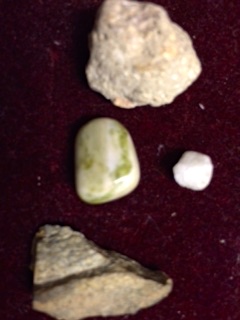
While unpacking here, I discovered a small box with 4 pebbles and put it in my icon corner (under construction …)
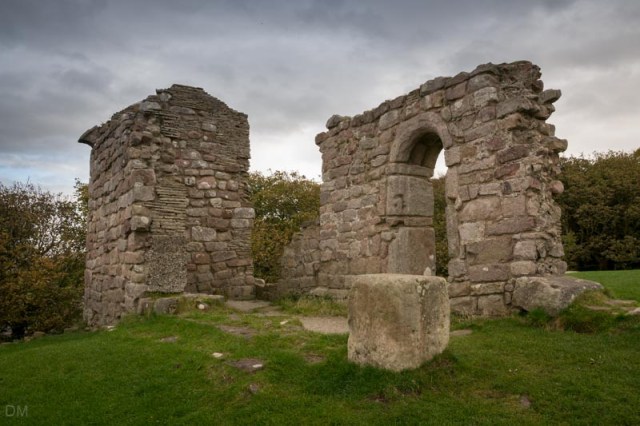
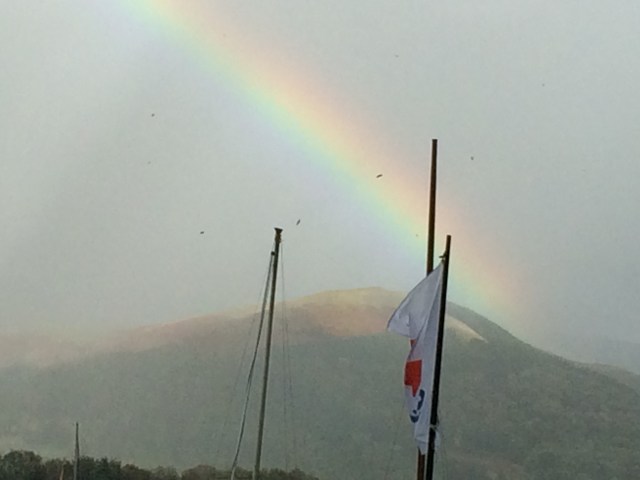
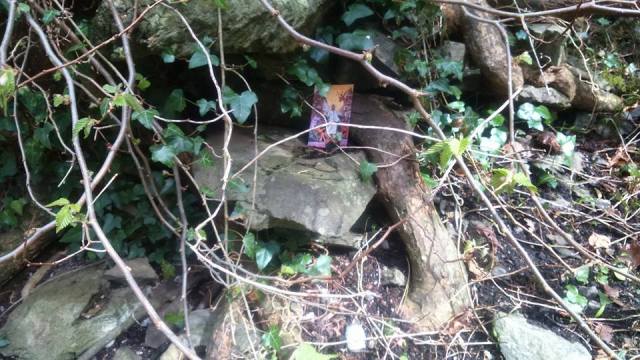
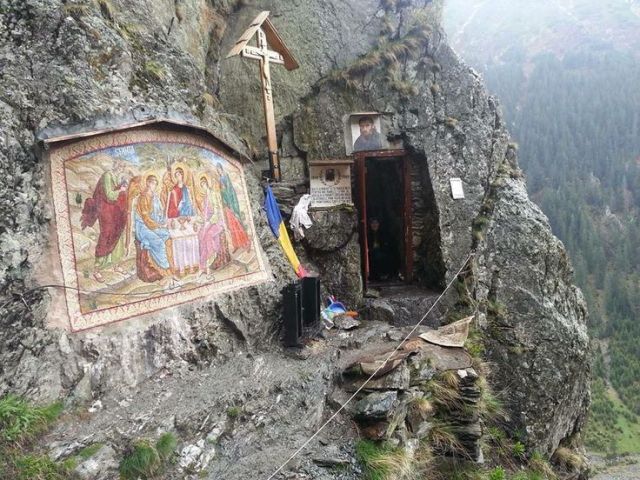
It all started with 3 pebbles I was given by my spiritual father back in 2015. (All but the pebble in the middle above) They were from St Patrick’s Chapel, St Herbert’s Island (Celtic Pilgrimages) and Sambata de Sus (Romania).
Heysham — St Patrick’s Chapel, Heysham, Lancashire, UK
St Herbert’s Island
Sambata de Sus
For Fr. Arsenie Boca – the blessed Romanian elder and prophet, who “made Christ transparent to us”, watch the documentary The Man of God.
Little did I know then how those tiny pebbles would affect my life! They were not just a memento of my visit to the UK, but “relics” blessed with extraordinary Grace of most mighty Saints who were to turn my life upside down.
Back in Greece, these 3 pebbles started to exert a magnetic “attraction” in my icon corner and soon “assembled” there dozens of Saints’ relics from all over the world!
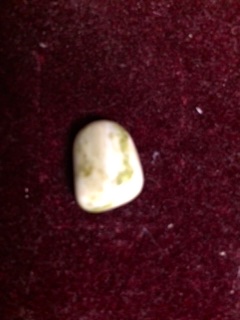
This Easter I was offered by my spiritual father yet one more …
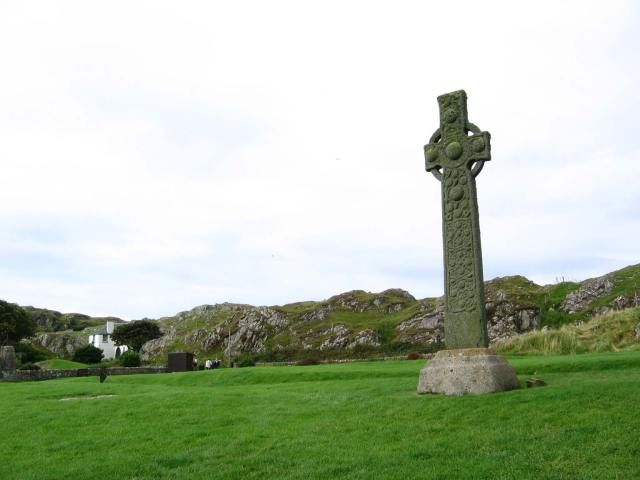
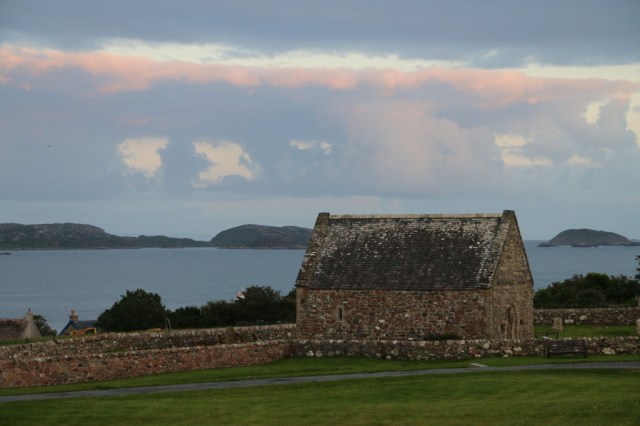
This pebble was picked by him when he was 10 (!) from Iona Island, another major Celtic pilgrimage.
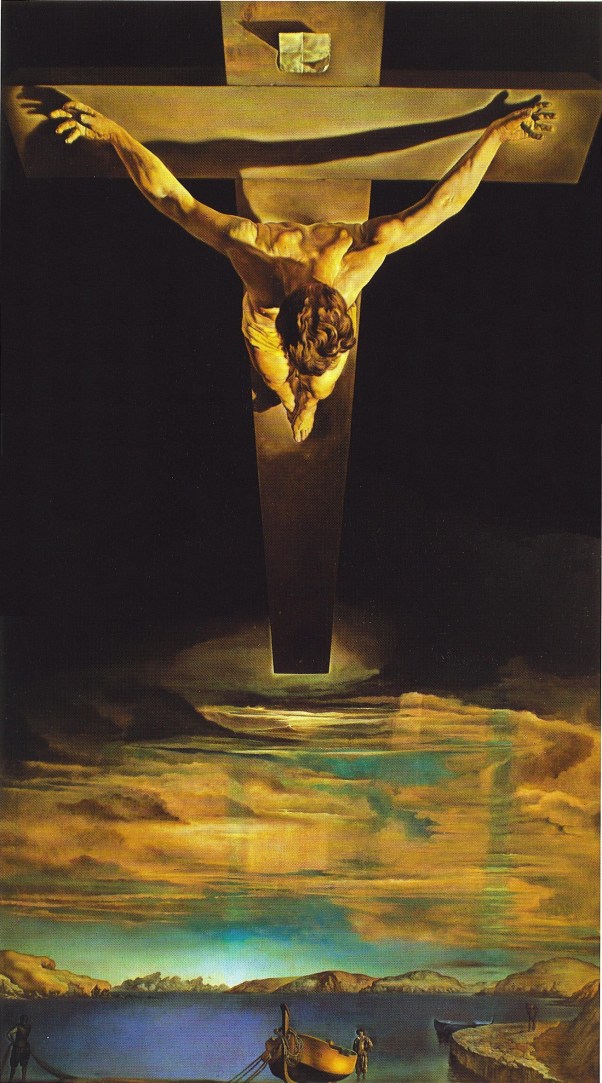
We need to recognise that as Christians, if we are truly following Christ, not just abandoning him at the Cross, denying him or God forbid betraying Him, we will receive the same insults. Even Pilate would not remove that charge which he pinned to the Cross, Jesus of Nazareth King of the Jews, though the crowd protested.
May we all be blessed!
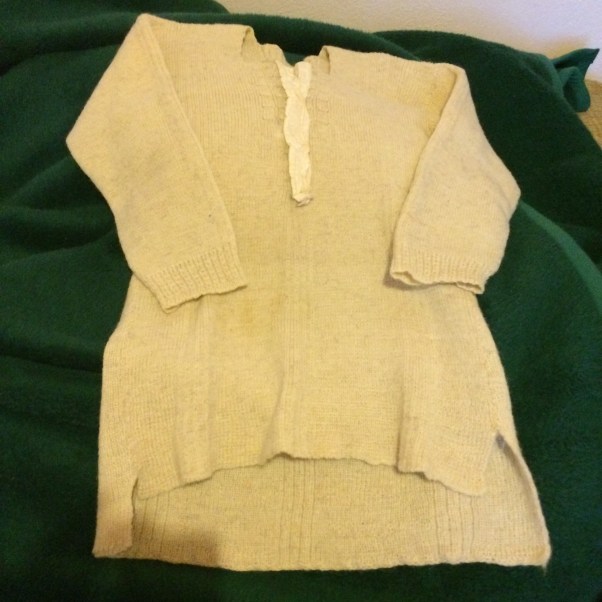
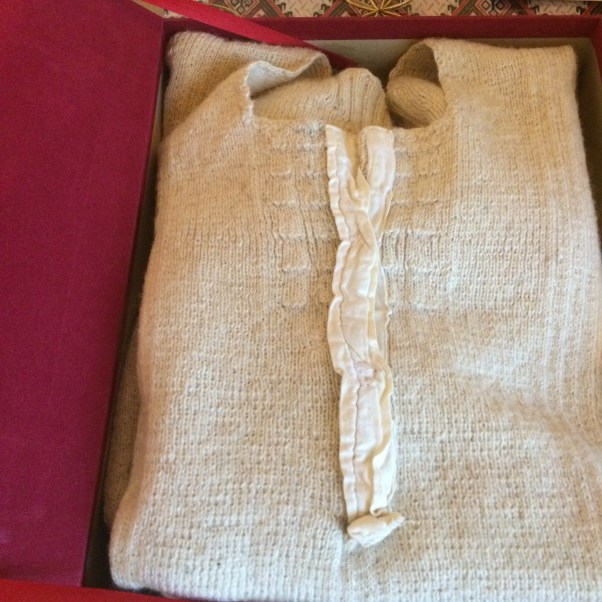
In a few hours, I’ll arrive at The Orthodox Christian Parish of the Holy and Life Giving Cross at Lancaster (United Kingdom), accompanying the Byzantine St Anysia Choir from Thessaloniki for Pascha; this choir also visited last year to help with the worship, particularly the long, demanding Holy Week services. We will also bring with us a hand crafted Icon, a comb and a prayer rope, all by St Paisios of Mount Athos, a Reliquary for containing these holy relics, and a handwritten Icon of his. We will also bring on loan for Holy Week a piece of St. Paisios’ clothing, his undershirt, from another Monastery in Greece.
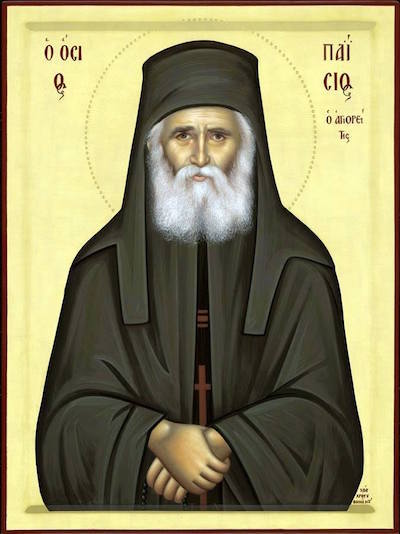
I am deeply moved by the fact that I am ‘carrying’ my patron Saint, Saint Paisios, though the truth is that the Saints carry us! This is the nearest that people will get to venerating Saint Paisios since his body is not to be disturbed in Souroti.
I am still packing, since so many monasteries in Greece have overwhelmed us with their generosity, and there are so many blessings, candles, incense, icons, secondary relics etc. to bring to the UK!
The hectic days to follow at the Holy Cross parish will take away from me all phone connections and internet, but they will give me in return a precious chance to shut the world away and lock myself in the heavy, crushing silence of the Holy Week.
Before I do that, I want to wish you with all my heart to enjoy a Blessed, Life-Changing Holy Week and Easter!
I must admit that I am very tired. I feel tired, vulnerable and afraid, with no control over anything. I am so exhausted! Indeed, “Lent is a horrid period. Year by year, Lent is when some force within me pushes me out of my comfort zones, and I find myself in a lions’ den, face to face with the beasts, utterly unprepared to fight, totally helpless, fully aware that the only possible outcome is to be slaughtered.”
Slaughtered indeed! This is exactly what I feel! A corpse!
“This is nothing new. This happens every year. Yet, I somehow survive, because the same Force that pushes me out of my self-created kingdoms, out of my self-created games – that same Force saves me from those wild beasts at the last moment.”
And this changes everything.
And yet, every time, I forget all about this, and I experience such despair and death, just before God intervenes! As if He has utterly forsaken me!
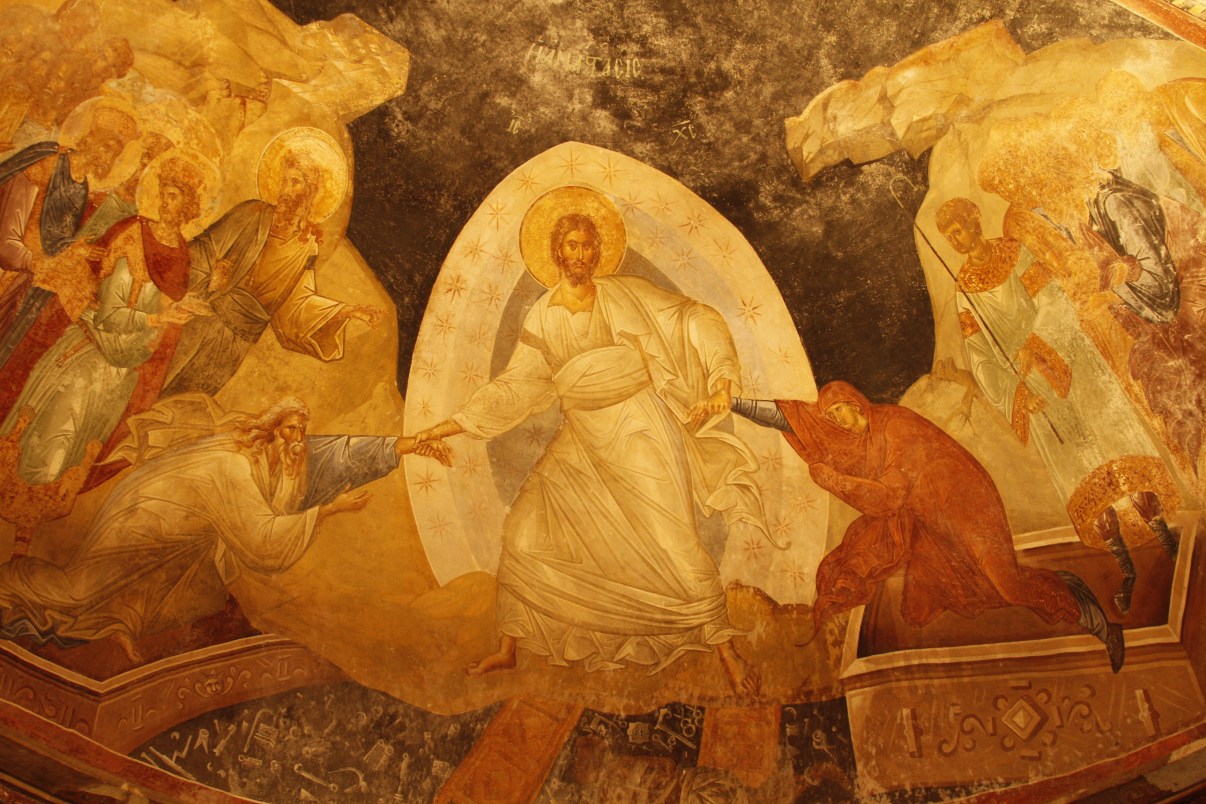
Now I understand why one focus of the Resurrection icon is Christ’s hands, pulling Adam and Eve! I desperately need this Hand to pull me out of this Hell!Weak and Fallen!In such a desperate need of healing, repentance, an intervention, a meeting with my spiritual father, a literal falling into his arms, the Sacrament of Confession! Is this who I really am? How can just 40 days reduce me to this? Is this the real starting point of my change, repentance and redemption?
Deep in my heart, I bitterly realise that no healing is possible. No repentance is possible. No prayer is possible, until the heart that heals, repents and prays is my sinful, fallen, yet beating heart. False images do not have hearts. False images do not love. Most painful than all, false images will never reflect Christ, because there is nothing false in Christ, nothing common between Life and void. Prayer begins with pain at one’s fallen nature; it grows out of this pain, and its flowers bloom out of it.The taste of ashes in my mouth. Am I, fallen and depraved and sinful that I am, still the image of the Immortal God?
I need to hold on, just a little bit more, to the Living God, and may His immortal image remain within me. It may then reflect on me, bless me and I may grow into it. Day by day, year by year, I may grow into this image, and be more Christ-like. Then His Life will be mine, His Resurrection will be mine.
So many miles to go before I sleep!
If you have ever experienced such confusion and fallenness, have courage and pray for me. Let us all fight in our body and spirit. His Resurrection is real, and it is coming. In His Resurrection we shall all be one!
My heart has been very moved by a passage from Wounded by Love, the Life and Wisdom of Saint Porphyrios. It speaks to so much of my own life and the world around me that for this post I would like to invite you in to hear his wonderful story of one lone nightingale. May the Celtic Orthodox spirit of seeing God’s energia in His creation bring peace to you. Please let it sink deep into your heart, I know that I am trying to do the same. Holy Father Porphyrios, pray to God for us!
One morning I was walking alone in the virgin forest. Everything, freshened by the morning dew, was shining in the sunlight. I found myself in a gorge. I walked through it and sat on a rock. Cold water was running peacefully beside me and I was saying the prayer. Complete peace. Nothing could be heard. After a while the silence was broken by a sweet, intoxicating voice singing and praising the Creator. I looked. I couldn’t discern anything. Eventually, on a branch opposite me I saw a tiny bird. It was a nightingale. I listened as the nightingale trilled unstintingly, its throat puffed out to bursting in sustained song. The microscopic little bird was stretching back its wings in order to find power to emit those sweetest of tones, and puffing out its throat to produce that exquisite voice. If only I had a cup of water to give it to drink and quench its thirst!
Tears came to my eyes – the same tears of grace that flowed so effortlessly and that I had acquired from Old Dimas. It was the second time I had experienced them.
I cannot convey to you the things I felt, the things I experienced. I have, however, revealed to you the mystery. And I thought, ‘Why does this tiny nightingale produce these songs? Why does it trill like that? Why is it singing that exquisite thought? Why, why, why…why is it bursting its throat? Why, why, for what reason? Is it waiting for someone to praise it? Certainly not. No one there will do that.’ So I philosophized to myself. This sensitivity I acquired after the experience with Old Dimas. Previously I didn’t have it. What did that nightingale not tell me! And how much did I say to it in silence: ‘Little nightingale, who told you that I would pass by here? No one comes here. It’s such an out-of-the-way place. How marvelously you unceasingly carry on your duty, your prayer to God! How much you tell me, and how much you teach me, little nightingale! My God, how I am moved. With your warbling, dear nightingale, you show me how to hymn God, you teach me a thousand things beyond number…’
My poor health does not allow me to narrate all this to you as I feel it. A whole book could be written about it. I loved that nightingale very much. I loved it and it inspired me. I thought, ‘Why it and not me? Why does it hide from the world and not me?’ And the thought entered into my mind that I must leave, I must lose myself, I must cease to exist. I said to myself, ‘Why? Did it have an audience? Did it know I was there and could hear it? Who heard it as it was bursting its throat in song? Why did it go to such a hidden location? But what about of all these little nightingales in the middle of the thick forest, in the ravines, night and day, at sunset and sunrise? Who heard their throat-bursting song? Why did they go to such secret places? Why did they puff out their throats to bursting?’ The purpose was worship, to sing to their Creator, to worship God. That’s how I explained it.
I regarded all of them as angels of God, little birds that glorified God the Creator of all and no one heard them. Yes, believe me, they hid themselves so that no one would hear them. They weren’t interested in being heard; but there in solitude, in peace, in the wilderness, in silence, they longed to be heard, but by whom? None other than by the Maker of everything, the Creator of all, by Him who gave them life and breath and voice. You will ask, ‘Did they have consciousness? What am I to say?’ I don’t know if they did it consciously or not. I don’t know. These, after all, are birds. It may be, as Holy Scripture says, that today they live and tomorrow exist no more. We mustn’t think differently from what Holy Scripture says. God may present to us that all these were angels of God. We don’t know about these things. At all events they hid themselves that no one would hear their doxology.
So it is also for the monks there on the Holy Mountain; their life is unknown. You live with your elder and you love him. Prostrations and ascetic struggles are all part of daily life, but you don’t remember them, nor does anyone ask about you, ‘Who is he?’ You live in Christ; you belong to Christ. You live with everything and you live God, in whom all things live and move – in whom and through whom…you enter into the uncreated Church and live there unknown. And although you devote yourself in prayer to your fellow men, you remain unknown to all men, and perhaps they will never know you.
A Gaelic Blessing
Deep peace of the running wave to you. Deep peace of the flowing air to you. Deep peace of the quiet earth to you. Deep peace of the shining stars to you. Deep peace of the gentle night to you. Moon and stars pour their healing light on you. Deep peace of Christ, of Christ the light of the world to you. Deep peace of Christ to you
Visited by God is the extraordinary spiritual journey of an extraordinary Spiritual man – Michael Harper. I think that I would not be missing the mark to say that Michael Harper was the leader of the Charismatic renewal in England and many other parts of the Globe. Beginning as an Anglican chaplain under John Stott at All Souls Church, Langham Place, London, his journey finally culminated in his introducing an authentically British Orthodoxy as Dean of a new Antiochian Orthodox Deanery with English-speaking parishes all over the country.
His journey was a long and often ‘very difficult’ and testing one. In some ways I can liken it to the journey of St. Paul in that he depended solely on the Holy Spirit to lead him and lead him the Holy Spirit did! It all began in 1962 when Michael was visited by God while studying St Paul’s two prayers in his Epistle to the Ephesians. He ‘saw’ the Church as God saw her – broken by divisions and untended wounds.
It was almost from that very moment that Michael’s God-given mission for unity in the Church began. But there were many in the Anglican Church who opposed this renewal and together with Pentecostalism the movement was dismissed as over-emotionalism and therefore unacceptable. Inevitable disputes and arguments occurred but this did not deter Michael. On the contrary his detractors spurred him on! He continued to go wherever in the world there were people hungry for the power to live what they believed.
One might come to the conclusion that Michael’s journey as leader of the Charismatic renewal movement would result in a very broad liberality but when the Church of England’s General Synod of 1975 passed the motion allowing women into the priesthood, Michael felt more than just stirrings of discontent. Jeanne Harper describes Michael’s anguish which led to a most difficult and painful decision – to leave the Church of England – whom he called his foster mother, so faithfully had she cared for him and led him to his real mother, Orthodoxy.
Jeanne describes how he was led by the Holy Spirit to the Orthodox Church and in 2000 Michael founded the English-speaking Antiochan Orthodox Parish of St. Botolph’s near Liverpool Street, London. At the same time Michael was appointed as a director of the Institute for Orthodox Christian Studies Cambridge. And in 2005 he was elevated to Archpriest.
The silken thread of a spider is spun from behind him as he moves forward to spin his web. The spider cannot see his work until he looks back and then the pattern of his web with all its links is revealed. Looking back over the web of Michael Harper’s life one thing is clear – from the very beginning Michael’s journey had a pattern and this pattern was a pure reflection of God’s will in his life. Once this was achieved Michael was taken in 2010 and lives in constant joy and prayer along with the saints in glory.
Jeanne Harper shares this God given Spirit filled journey of her husband with the reader and in so doing cannot fail to make us all yearn for the presence of the Holy Spirit to touch and lead all our lives.
* Last but not least, the concluding chapter “The British Antiochian Orthodox Deanery Mission” is written by Fr. Jonathan Hemmings, one of the priests of the Deanery, whose parishes are strategically spread over England and are to be found in Ireland, north and south. The Dean who succeeded Father Michael, is Father Gregory Hallam, whose vibrant parish is in Manchester. Fr. Jonathan Hemmings ministers in Lancaster at the Orthodox Church of the Holy and Life Giving Cross, worshipping at St Martin of Tours, Westgate. He writes the following chapter on the story of the Deanery and its missionary vision.










 For Fr. Arsenie Boca – the blessed Romanian elder and prophet, who “made Christ transparent to us”, watch the documentary







 ORTHODOX CHRISTIAN FAITH AND LIFE