All these three are part of my life! Let me explain …
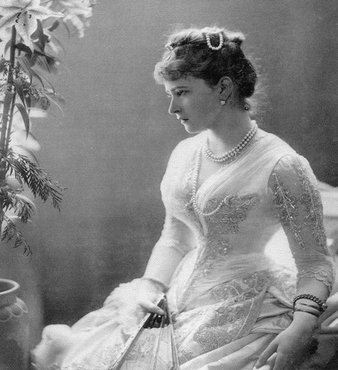
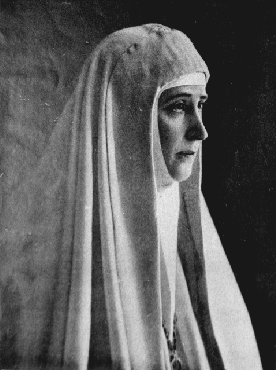
“Innumerable business transactions, consideration of many requests and petitions from every corner of … , and other cares, filled her day, sometimes bringing her to a state of complete exhaustion.”
This excerpt is from St Elizabeth the Grand Duchess and New Martyr‘s life but it could easily have written about me in the last couple of weeks, since my days have lately been so filled with numerous administrative, academic duties and ‘interruptions’ – constant– phone calls, texts, mail, e-mail — all at the same time! — to the point of complete exhaustion. In particular, my duties for the founding of a new monastery have proven so far a most demanding (and rewarding) experience. But my similarities to the Saint and major role model for me of course stop short here …
I do apologise for not being able to write as much as I would like in this blog, for failing to always keep ‘on schedule’. I am sorry. It is just that I hardly have a spare moment any more. It also has to do with English not being my mother tongue. Sometimes I have to rewrite a paragraph so many times! I write something as best as I can and yet I am never sure whether what I really wanted to communicate to you, not so much semantically, as emotionally, is what is really communicated. Most likely I shall never know. I sincerely hope I have never offended anybody here or sounded — God forbid! — sarcastic, harsh, cruel, or indifferent.
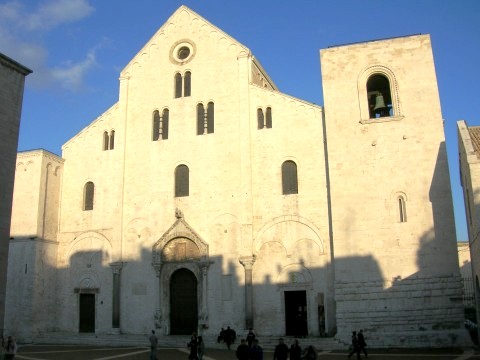
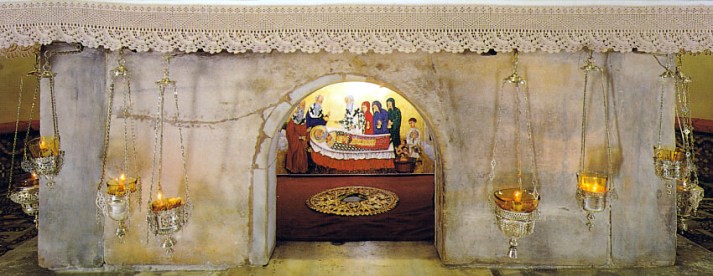
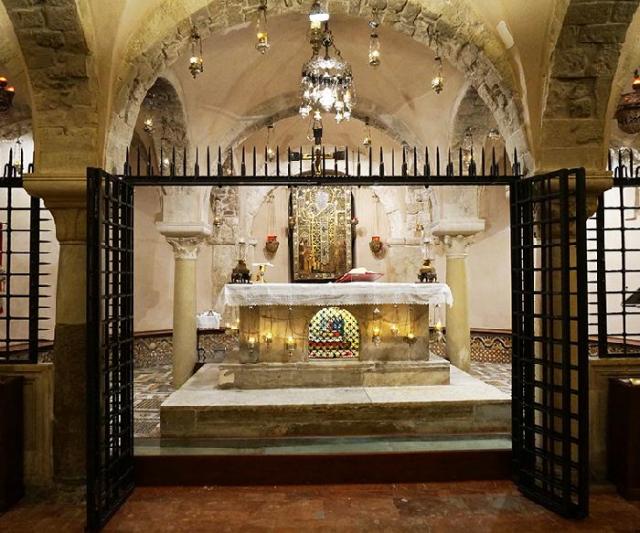
On a different note, tomorrow, God Willing, I am leaving on a Pilgrimage to Italy, Bari, for St. Nicholas!!
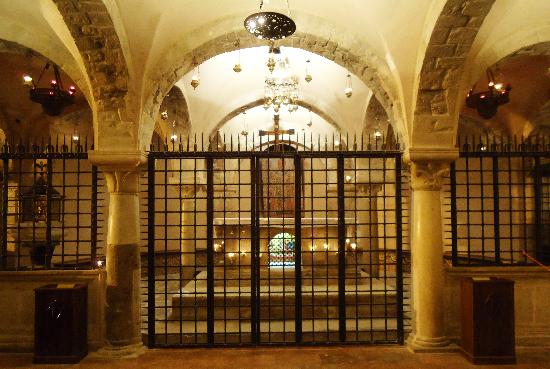
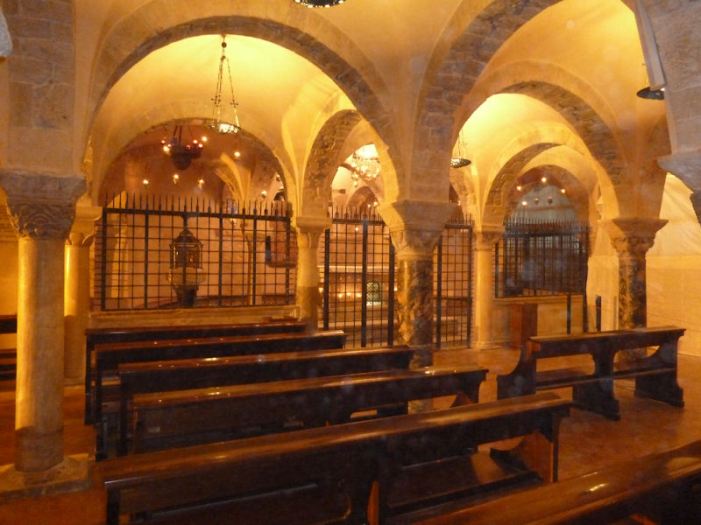
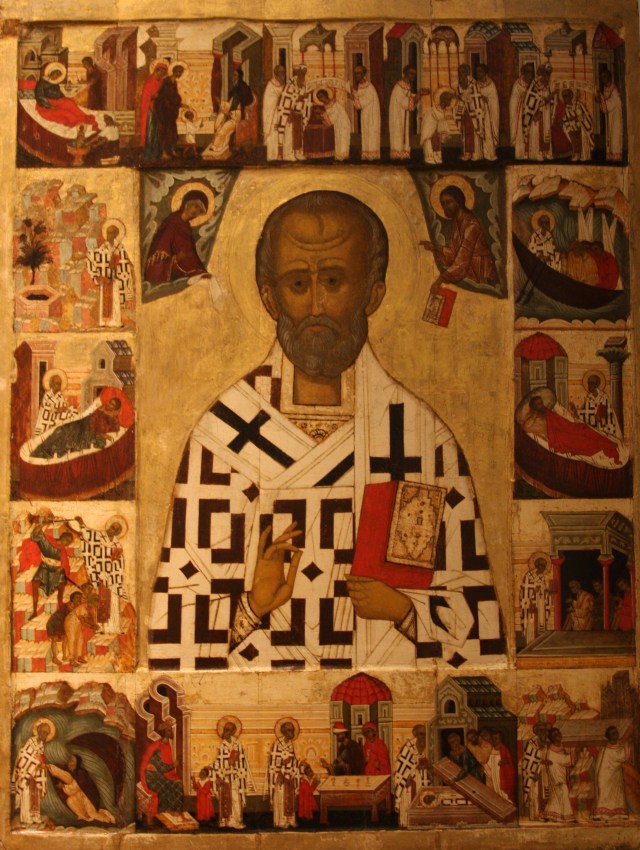
Basilica di San Nicola in Bari, Italy where most of the relics of St. Nicholas are kept today.
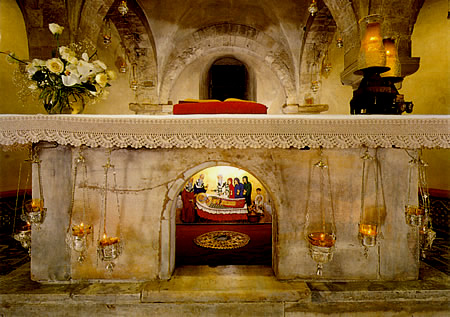
San Nicola, Basilica di San Nicola, Bari, Italy, the crypt, the grotto
I am so excited and so much looking forward to going on this pilgrimage and ‘meeting’ St. Nikolaos! My feelings can only be expressed with the ‘dancing’ of the chandeliers (polyeleoi in Greek) which follows in Psalm 135 (Arabic)!
An example of the Faith and a life of humility, as a teacher of abstinence you did inspire and lead your flock and through your truthfulness of your deeds were exalted by greatness through your humility uplifting all and by poverty gaining wealth. Father and hierarch Nicholas intercede with Christ our God that our souls be saved. or, in literal translation:
As a canon of faith and an icon (image) of meekness, (and) of self-control (abstinence) a teacher, the truth of your deeds has shown you to your flock; wherefore you acquired through humility the high things (greatness), through poverty riches Father hierarch Nicholas, intercede with Christ the God that our souls may be saved.
I have always wanted to ‘meet’ this Spiritual Giant, the Defender of Orthodoxy, Wonderworker, Holy Hierarch, and Bishop of Myra, especially ever since I found out that this icon (image) of meekness and teacher of self-control, ‘abstinence’ literally got up, crossed the room, and slapped Arius across the face at the Council of Nicea! 😃
“In AD 325 Emperor Constantine convened the Council of Nicaea, the very first ecumenical council. More than 300 bishops came from all over the Christian world to debate the nature of the Holy Trinity. It was one of the early church’s most intense theological questions. Arius, from Egypt, was teaching that Jesus the Son was not equal to God the Father. Arius forcefully argued his position at length. The bishops listened respectfully.
As Arius vigorously continued, Nicholas became more and more agitated. Finally, he could no longer bear what he believed was essential being attacked. The outraged Nicholas got up, crossed the room, and slapped Arius across the face! The bishops were shocked. It was unbelievable that a bishop would lose control and be so hotheaded in such a solemn assembly. They brought Nicholas to Constantine. Constantine said even though it was illegal for anyone to strike another in his presence, in this case, the bishops themselves must determine the punishment.
The bishops stripped Nicholas of his bishop’s garments, chained him, and threw him into jail. That would keep Nicholas away from the meeting. When the Council ended a final decision would be made about his future.
Nicholas was ashamed and prayed for forgiveness, though he did not waver in his belief. During the night, Jesus and Mary his Mother, appeared,* asking, “Why are you in jail?” “Because of my love for you,” Nicholas replied. Jesus then gave the Book of the Gospels to Nicholas. Mary gave him an omophorion, so Nicholas would again be dressed as a bishop. Now at peace, Nicholas studied the Scriptures for the rest of the night.
When the jailer came in the morning, he found the chains loose on the floor and Nicholas dressed in bishop’s robes, quietly reading the Scriptures. When Constantine was told of this, the emperor asked that Nicholas be freed. Nicholas was then fully reinstated as the Bishop of Myra.
The Council of Nicaea agreed with Nicholas’ views, deciding the question against Arius. The work of the Council produced the Nicene Creed which to this day many Christians repeat weekly when they stand to say what they believe.
* Other versions of the story have Jesus and Mary with Nicholas appearing in a dream to Constantine or, even, to all the bishops. In the dream, they give the Book of the Gospels and an omophorion to Nicholas, convincing Constantine and the bishops that Nicholas should be reinstated as Bishop of Myra.” [Bishop Nicholas Loses His Cool (At The Council of Nicaea)]
All this is so exciting! In Greece, at every turn of the corner, you can find a church, but look at how resourceful these people have to become to be able to say Prayers and attend Church Services in their hometown! This blog post warmed my heart, as I am currently engaged in such endeavours at the UK. Bless the Lord o my soul and forget not all His benefits! Glory to God!
By the grace of God, and through the prayers of many holy souls, our simple life in St. John’s, Newfoundland is progressing. Just after Fr. John and I returned from a pilgrimage to a monastery in September significant changes began to occur. First, we moved out of our one bedroom apartment and into a house (with a yard and a deck and a front porch!) and second, I got a permanent, full-time job. So, it looks as though God wills for us to continue our feeble attempts to firmly establish Orthodoxy on this island.
The best part about our new home is that the downstairs is a walk-out basement with an external exit/ entrance and so we are finally able to have a chapel in our home (I had already painted the icons for our future home-chapel while living in Greece). Thus, instead of bothering Queen’s College (where our…
This is a blogger I cannot recommend too strongly and I shall definitely follow on all her new projects. Καλοτάξιδο, as we say in Greek. Or, Bon Voyage (to the new website), in French 😊
I’m sad to remind you that, as I announced in November, I am discontinuing The Jesus Question—but I’m happy to let you know that my new blog, Art & Theology, is now live! Please show me some love and share the URL with your friends and social media followers and “Like” the Facebook page.
The Jesus Question started out as a project for a social media class in February 2011. The assignment was to develop a blog in which we were to explore a well-defined subject of interest, the purpose being to enhance our online presence, connect with others of like interests, experiment with web building and marketing, and establish ourselves as an authority in a field.
It may not have achieved a vast reach by professional standards (it gets about 7,000 unique views per month), but I feel pleased with how it was received and what came…
MY ‘LESSER’ VERSIONS: The Ill, the Weak And The Mortal,
Or, In Search of True Personhood
All my life I have been surrounded by family members, suffering with one of the forms of dementia and psychiatric disorders. Rare is the time that I meet someone who doesn’t have a loved one likewise. I hope this blogpost by Father Seraphim Aldea can be of some help, even for a brief moment. May God’s love and strength protect us all …
I have seen people die. I have seen people suffer. I have seen the anguish in their eyes. Most times, it comes from a combination of fear of the weak beings they have become, and regret for the strong being they once were. Fear of turning into something we no longer recognise as ourselves, and regret for losing something we perceived as our ‘correct’ selves.
We only think of ourselves as ‘whole’ when we fit into a wellness norm fed by the idolatric attitude we have for the society we are part of. This society – here and now – tells me that I am all right when I am healthy; therefore, I am my ‘proper’ version, I am my ‘correct’ self, I am who I am supposed to be only when I am healthy. This society tells me that illness and sadness and all forms of weakness are wrong; therefore, I am no longer my ‘proper’ version when I am ill – my ‘correct’ self has become corrupted, infested, compromised.
But society changes its mind, because it is empty, devoid of meaning, and – like any form without substance – it takes in whatever substance fits its purpose. To be healthy once meant to be chubby and live the sort of life that gave you gout. To be your true self meant at different times to die young, to suffer from melancholia, and to kill yourself in the name of honour. Things have changed. Today (and mostly here, in the West), we worship the healthy, strong, optimist being. Anything else is not properly human.
The implications are the same, though: only when we fit these norms we think of ourselves as being ‘ourselves’. Whatever does not fit these norms is not part of us, it is us being ‘someone else’, a lesser version of myself, an amputated, decayed version of myself, which either has lost things proper to my true self (‘I cannot move anymore’) or has taken over and incorporated things that are alien to my true self, things from the outside, things that entered my true self and diseased it (illness; sadness; death).
We have this perfect version of who we are supposed to be, and we define our happiness depending on the level of conformity to that ideal. We replace the living being that we are – changing, evolving and discovering oneself from all perspectives, including the ‘negative’ ones (illness; old age) – with the immobile poster-like image of the ‘healthy young man’. There is not much difference in essence between the tyranny of this healthy young idol and other tyrannies we have seen in the recent past: the arian man of the second world war, the new man of communism, the jihad man of terrorism. They all want to eradicate what they perceive as corrupted, lesser versions of humanity.
In some way, the tyranny of our idol is even more violent, because we not only enforce it upon others, but we internalise it and we end up inflicting it upon ourselves. A Nazi criminal could never become a Jew himself; his idol never reflected its hatred against himself. We, on the other hand, we all shall as some point feel weak, we all shall get sick, we all shall become old and face the reality of our mortality. To shy away from these ‘lesser’ versions of ourselves, to reject and to fight against them is to reject and fight against ourselves. To run away from them is to run away from myself. To fear and hate them is to fear and hate myself.
“The fiery sword no longer guards the gate of Eden, for in a strange and glorious way the wood of the Cross has quenched its flames. The sting of death and the victory of hell are now destroyed, for Thou art come my Saviour, crying unto those in hell: ‘Return again to Paradise.”
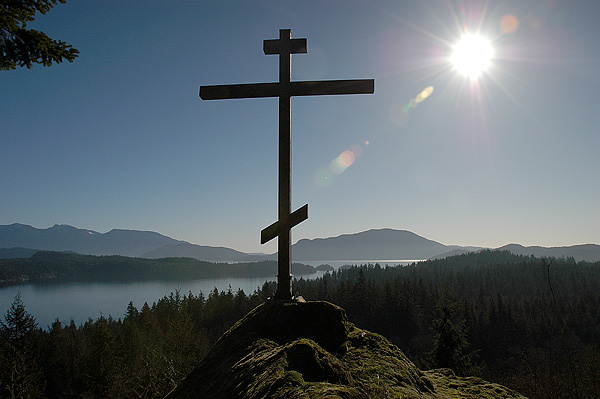
I have recently completed a small but highly interesting project, two years in the making, and involving several master artisans. It is a wooden cross with carved stone icons, crafted like a jewel, wholly traditional, and yet quite unlike anything seen before.
This is one of those projects that grew, perhaps providentially, from an initially simple commission. The client wished for Jonathan Pageau to carve an iconographic cross from stone to hang on the wall. But a stone cross is fragile, so we considered how to frame it. As the frame became more elaborate, I suggested the cross ought to have a more prominent liturgical function. Ultimately we decided to make two bases for it – one that allows it to stand on a table for veneration, and another, a tall shaft, that allows it to be used as a processional cross. It is intended to be a companion piece to a gospel book we made for the same client.
I began by designing all the parts, and sent templates to Jonathan. He carved the four icons in steatite, a fine stone from Africa that was used to carve icons in ancient Byzantine times. He also gilded certain details, which considerably increases the material beauty of the carving. I crafted the wooden frame, edging it in African rosewood and inlaying the front and sides with marquetry banding. Finally I designed the turned base, processional shaft, and matching candlesticks, and had them made by a master wood-turner. These parts are made from instrument-grade American curly maple and walnut. I ebonized the walnut with ferrous sulfate solution and finished all the woodwork with shellac and wax.
Thus this work is a collaboration among four artists: myself, the designer and woodworker; Jonathan Pageau, the carver; Lee Henson, maker of the marquetry banding; and Ashley Harwood, master turner.
Stylistically, this project draws from several traditional sources to synthesize what might be considered a new style. The use of inlay in Orthodox woodwork became prevalent in Greece in the 17th century. There are many fine doors and other furnishings on Mt. Athos that include inlay banding, and there is the spectacular example of the abbatial throne at the Phanar in Istanbul. This type of inlay work was, in a sense, foreign to Orthodoxy, but it arrived in Greece via simultaneous influence from both east and west. In the 15th-16thcenturies, inlaid furniture was developed to great refinement in the Islamic world, and at the same time, Italian masters began a fashion of decorating choir stalls and sacristy cupboards with a tour-de-force of marquetry. So it is no surprise that Greek monasteries imitated the beauty of foreign inlay work, and thus baptized this craft into Orthodox tradition.
Much later, in the 19th century, inlay work became popular in American woodworking, not so much in fine furniture from urban centers, but in folk-woodwork, often made by farmers in wintertime. This American inlay-work often bears a striking resemblance to the old Athonite pieces. Whenever I observe a connection like this – an accidental resemblance of an American tradition to an Orthodox one, I know that it is a connection worth developing. After all, emphasizing these cultural sympathies is the natural way for Orthodoxy to become at home in a new land. As an artist, I also recognize that this process is periodically necessary to breathe new life into Orthodox tradition, to keep it fresh.
I hope you’ll agree that this carved and inlaid cross, made with materials and traditions from both sides of the world, constitutes a successful and inspiring marriage, and provides a glimpse of the staggering beauty that American Orthodoxy could potentially offer the world.
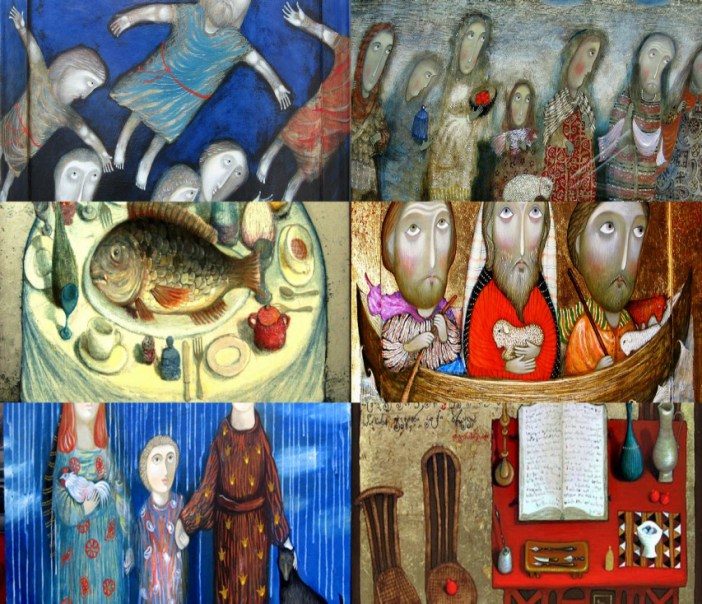
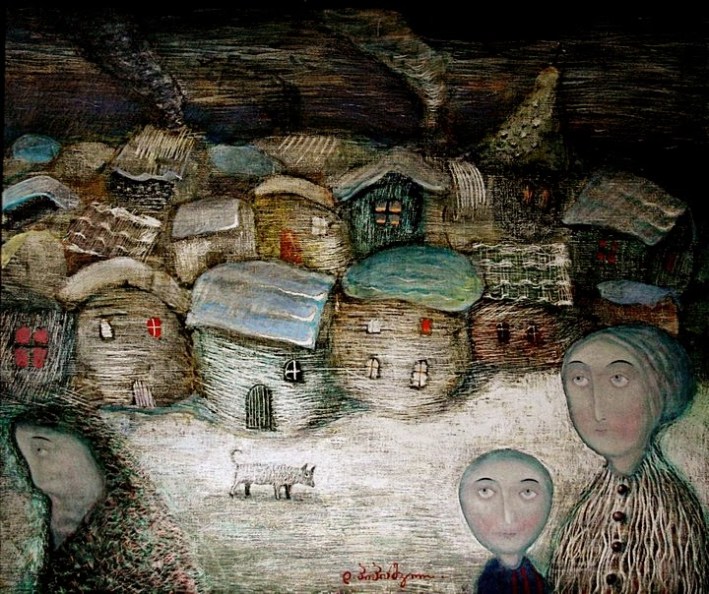
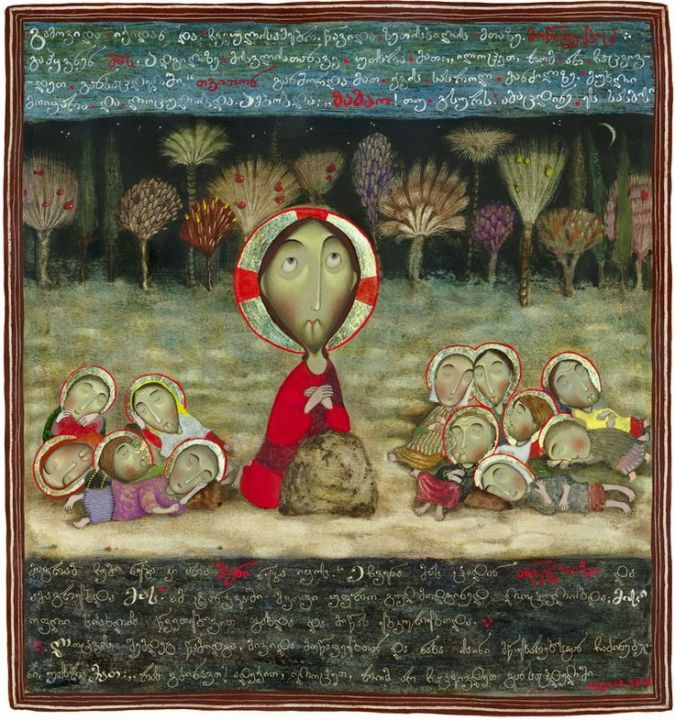
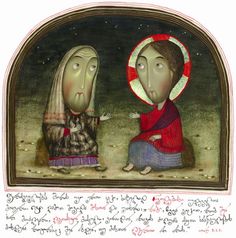
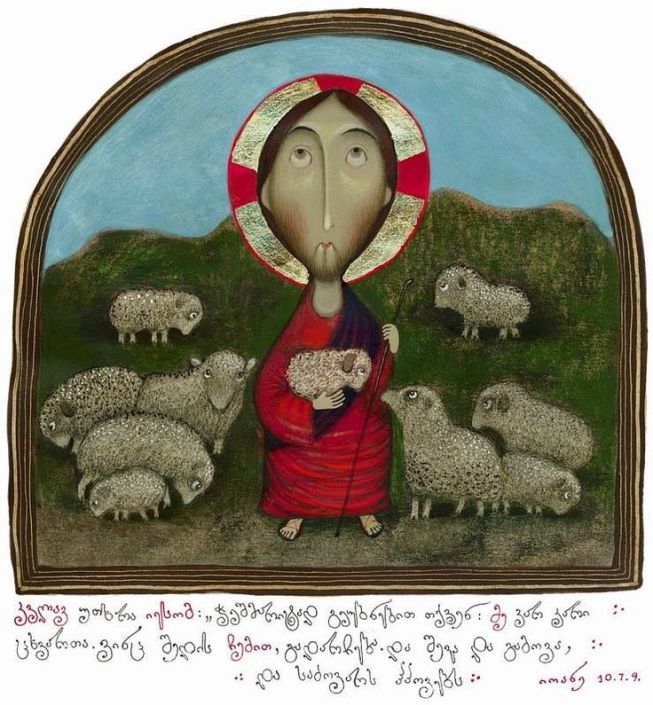
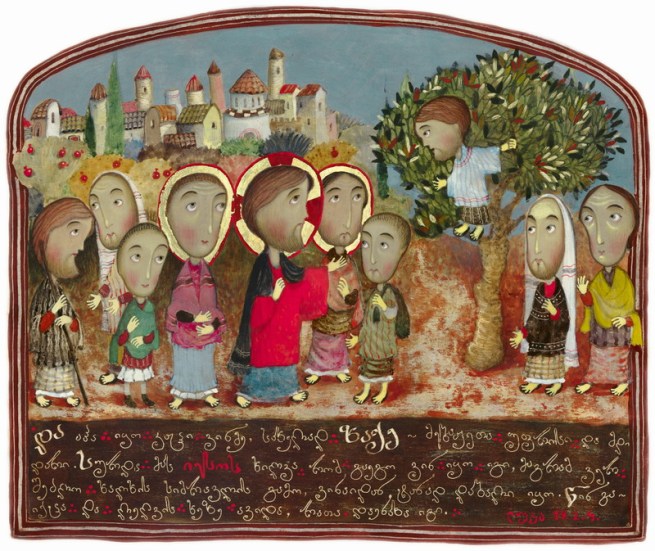
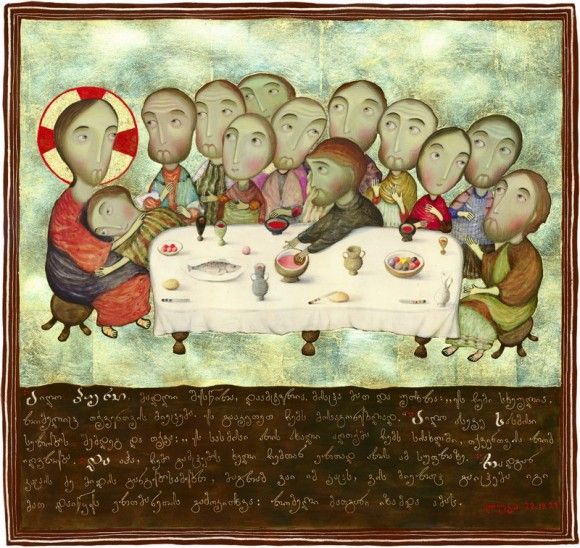
The always thought-provoking Jesus Question website, which traces the identity of Jesus through history, art, and pop culture, featured today David Popiashvili – Date of birth 1969, Tbilisi, Georgia; graduated from the State Academy of Fine Arts; Georgia Commonwealth of Artists member since 1997. Their blogpost made me smile! What an artist! Such beauty, “naive art” and childlike innocence, such freshness of vision! … “In 2002 the IBT published a Georgian edition of Stories about Jesus Christ, a children’s book based on the four New Testament Gospels. They commissionedGeorgian artist David Popiashvili, who studied at theTbilisi State Academy of Arts, to create thirty-one illustrations for it. People responded so well to Popiashvili’s images that IBT decided to createa digital version of the book that includes Russian and English translations as well the original Georgian. You can access this edition here.“
The Moscow-based Institute for Bible Translation (IBT) exists to translate, publish, and distribute the Bible in the 130-plus languages of the non-Slavic peoples living in the Commonwealth of Independent States (that is, in former Soviet Union countries).
In 2002 the IBT published a Georgian edition of Stories about Jesus Christ, a children’s book based on the four New Testament Gospels. They commissioned Georgian artist David Popiashvili, who studied at the Tbilisi State Academy of Arts, to create thirty-one illustrations for it. People responded so well to Popiashvili’s images that IBT decided to create a digital version of the book that includes Russian and English translations as well the original Georgian. You can access this edition here.
I am beginning to think that I am secretly a bear. I definitely have the social skills of one. I am as voluble as a bear during hibernation, and as attached to my room as a bear to its cave. In all honesty, I am continuously amazed anyone still wants to talk to me given how bad I am at keeping in touch. The simple reality is that I function in a state of amazement. I have rewritten this paragraph so many times; I can find no better way to describe this. I function like a stunned being. I go through the motions I see in other people; I do what it takes to be functional in this world. But deep down, I am paralysed.
I once saw a huge bull being taken to the slaughterhouse. I was in my monastery in Moldavia at the time. The animals know. The know perfectly well that behind that big door there is death. Many of them go wild, and desperation takes over. Some times, their hearts fail and they collapse, so they have to be dragged inside. I remember this bull: a huge, beautiful animal. I remember its stare. Its muscles had completely frozen; there was no movement at all – not a blink, not a sound. At the centre of that heard of bellowing animals, fighting to escape death, I remember that hollow, frozen gaze as the bull was pushed by three men towards the gate, inside the slaughterhouse.
I function very much like that stunned animal. When I look in the mirror (which I purposely try not to do) I recognise that gaze. There is something of that in everyone. Often times, I switch off as people talk to me about their holidays and homes and plans. I switch off and I try to recognise that frozen gaze in their eyes: beyond the noise, beyond the superficial glitter of life, that hollowness is always there. It is imprinted in us. It is part of what makes us who we are, part of what makes us human.
I suppose this is my apology for failing to always keep ‘on schedule’ with posting here, recording our podcasts and so on. I am sorry. I am aware I should be doing more, especially as many of you continue to support the monastery even through these periods of silence. Perhaps you feel something. Perhaps you yourselves recognise something in this silence.
I have prayed to make sense of this desperation. I live with a perfect hope that we shall all survive the slaughterhouse, but this hope comes with an equally perfect awareness of the hollowness of this life. I have prayed to make sense of this. I have also prayed that I loose neither the hope, nor the desperation; living with both creates an intense tension, and that tension feeds my heart. I have an intuition that this tension will lead me to Life.
If I have learned something so far, it is that I must protect and treasure this life, because the seed of Life is buried in it. The hollowness of this life, its senselessness, its pain have taught me that I myself can only get as far as the gate of the slaughterhouse. If there is any hope to make it beyond that gate, if there is any hope to survive it, it does not come from me. I cannot be my own saviour. I cannot be anyone’s saviour. This is a tough lesson to learn and impossible to fully accept without the grace of God. I am nothing without a Saviour. It is a tough lesson, but we cannot run away from it. Horrid as it feels, this is the foundation of all our hope.
Just think how different things could have been, had Adam stared into his own hollowness and accepted it, instead of collapsing at the feet of the devil. Had Adam accepted this truth, had he accepted that he cannot be his own saviour, has he reached out for a Saviour, this world would have known a different history. Perhaps this is the point of it all: to learn the lesson Adam has not; to stare into the hollowness of our being and not despair, to not collapse as he did, because we know that a Saviour has taken on the form of this hollowness and lifted it up to Life.
We are the hollow men We are the stuffed men Leaning together Headpiece filled with straw. Alas! Our dried voices, when We whisper together Are quiet and meaningless As wind in dry grass or rats’ feet over broken glass In our dry cellar
Shape without form, shade without colour, Paralysed force, gesture without motion;
Those who have crossed With direct eyes, to death’s other kingdom Remember us – if at all – not as lost Violent souls, but only As the hollow men The stuffed men.
IIEyes I dare not meet in dreams In death’s dream kingdom These do not appear: There, the eyes are Sunlight on a broken column There, is a tree swinging And voices are In the wind’s singing More distant and more solemn Than a fading star.Let me be no nearer In death’s dream kingdom Let me also wear Such deliberate disguises Rat’s coat, crowskin, crossed staves In a field Behaving as the wind behaves No nearer –
Not that final meeting In the twilight kingdom
III
This is the dead land This is cactus land Here the stone images Are raised, here they receive The supplication of a dead man’s hand Under the twinkle of a fading star.
Is it like this In death’s other kingdom Waking alone At the hour when we are Trembling with tenderness Lips that would kiss Form prayers to broken stone.
IV
The eyes are not here There are no eyes here In this valley of dying stars In this hollow valley This broken jaw of our lost kingdoms
In this last of meeting places We grope together And avoid speech Gathered on this beach of this tumid river
Sightless, unless The eyes reappear As the perpetual star Multifoliate rose Of death’s twilight kingdom The hope only Of empty men.
V
Here we go round the prickly pear Prickly pear prickly pear Here we go round the prickly pear At five o’clock in the morning.
Between the idea And the reality Between the motion And the act Falls the Shadow
For Thine is the Kingdom
Between the conception And the creation Between the emotion And the response Falls the Shadow
Life is very long
Between the desire And the spasm Between the potency And the existence Between the essence And the descent Falls the Shadow
For Thine is the Kingdom
For Thine is Life is For Thine is the
This is the way the world ends This is the way the world ends This is the way the world ends Not with a bang but with a whimper.
People are so beautiful it hurts. We all have this beauty in us, this otherworldly potential to be so much more than what we settle for. At times, this awareness is the only thing that makes sense of this senseless existence, its very foundation, the star calling us forward, the purpose of this flesh. Most of the times, though, it makes life ever more painful, because it throws light upon the dark truths we have spent a lifetime learning to ignore.
Someone’s asked in an email from where I get the strength to keep going. The raw answer is: fear. Fear and desperation and the knife-like breath of death I see slowly and implacably eating me from the inside, consuming the beauty within myself, the beauty within you. I look in the mirror and I see a caged animal, waiting in line to be sacrificed. I live with the awareness that none of the breaths I’ve taken, none of the things I’ve felt and done have life within themselves.
The most painful thing I live with, the heaviest weight I carry is the total, perfect knowledge that there is no memory here to preserve even the slightest trace of our sparks of life.
I look in the mirror and I see nothing that will survive death. I stare at this nothingness and life becomes a desperate attempt to outrun death. At times, this turns into pure isolation, and no island can be far enough; no darkness thick enough to cover me. Other times, for very few and rare moments, this turns into white silence. A bright blanket of silence that covers my mind like rarefied air. Up there, in those rarefied clouds, floating high above death, there is Rest, there is Peacefulness.
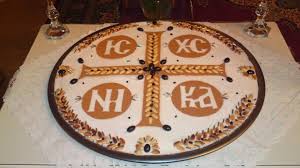
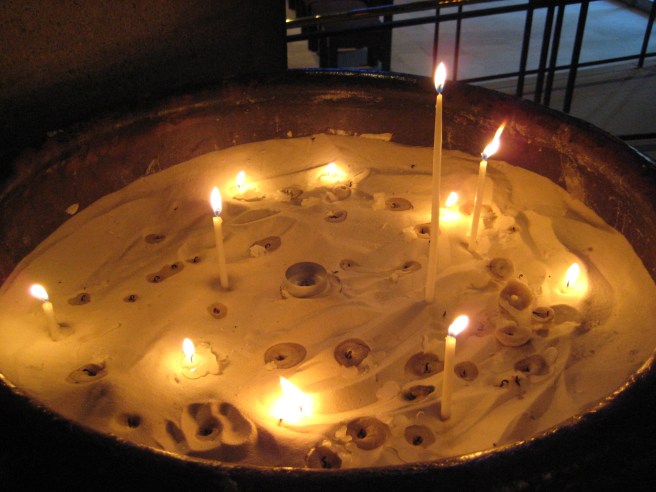
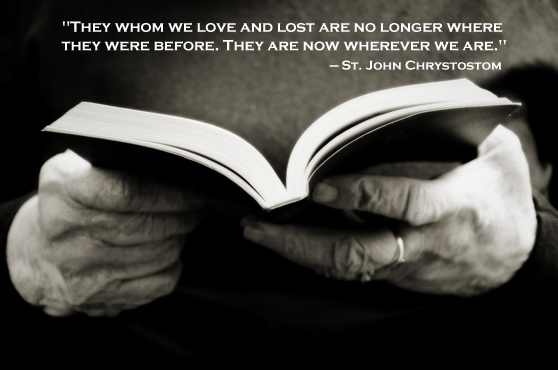
Today I have been to the Annual Greek Memorial Service for a very special person, one I consider my spiritual mother. On the anniversary of the repose the tradition is for members of the church to pray for the reposed during Holy Liturgy, at the very centre of the temple, with Koliva, accompany the relatives to the graveside with flowers, candles, incense, prayers and singing … and follow these prayers by a special meal with the family and friends.
After Meeting such a Person, how can you not change?
St. Porphyrios once told a Pediatrician: “Listen to what I have to say to you. Every time you examine a child*** you should offer a fervent prayer with love: Lord Jesus Christ have mercy on your servant.”
As he said this he took a deep breath while he opened his hands. “It is in this way that you should pray for every child. God has sent a precious soul into your hands. As you place your hands on them pray fervently within yourself that the grace of God will be transfused into the soul of the child.
“Do all this things spiritually and in secret. The others who are present won’t understand anything. You will prescribe to them medicines which science dictates but in the final analysis Christ will heal the child.”(source)
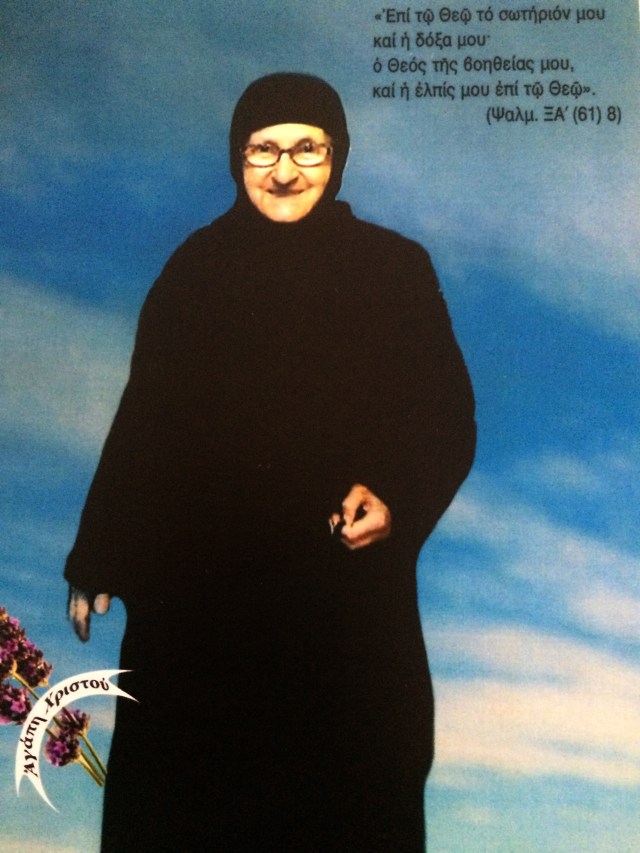
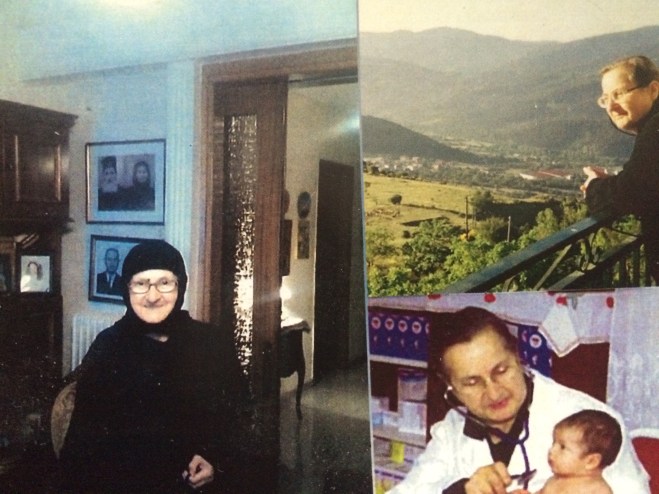
* This is exactly how Sister Aggeliki lived and ministered the needs of her younger (and older) patients. She was a true Child of God, taking care of all of us, children of God. She was a paediatrician for “paedia” (children) from newborn to 99+ years old 😊
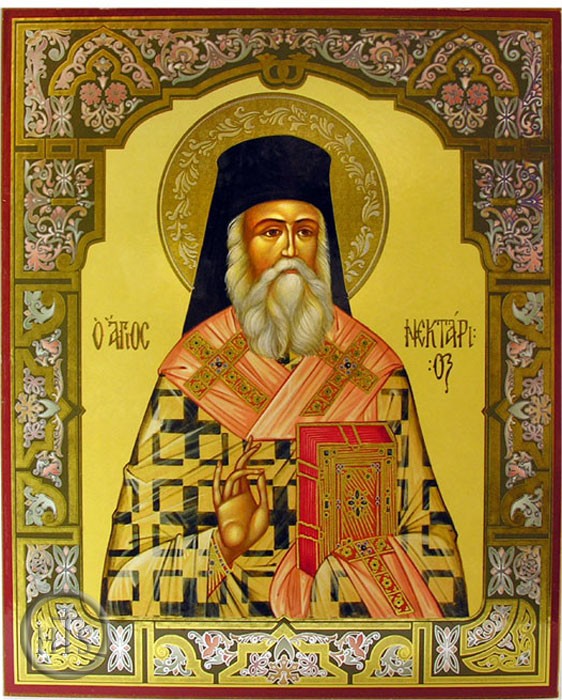
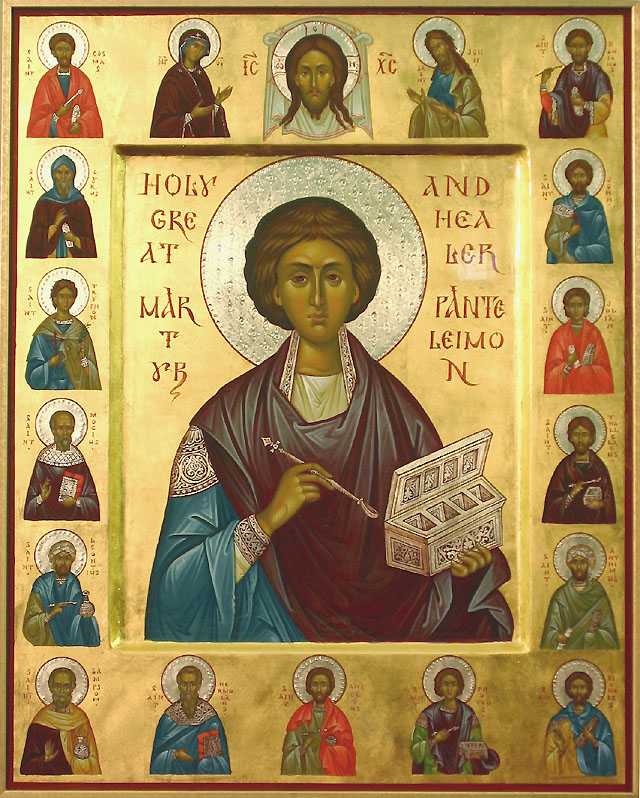
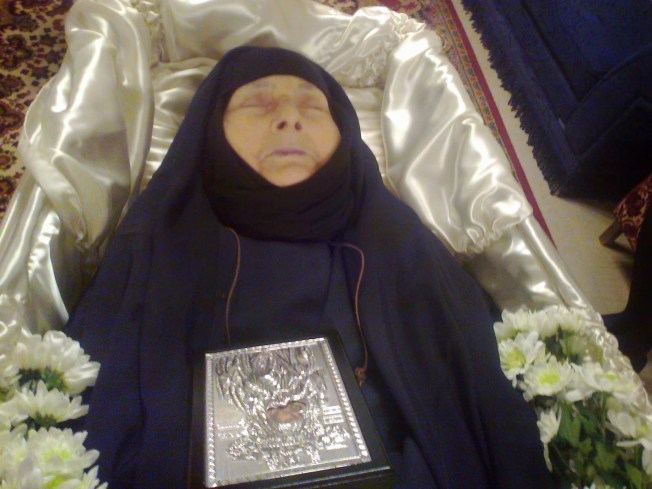
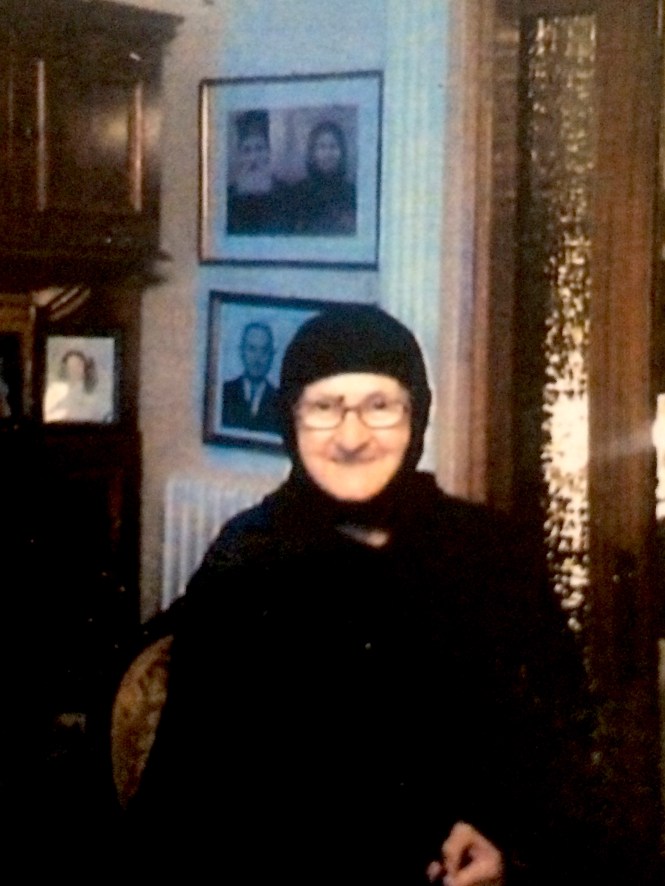
Sister Aggeliki Tsaousi slept in Christ last year amidst the Lights of Theophany, having lived a long life of poverty for Christ, of sacrifice and prayer, dedicated to the ministering of the poor, the sick, the needy, the addicted, the refugees, families in crises, all her brethren in Christ, no matter what their country of origin was and what their religion. She established a charitable organization “Love of Christ”, recruited other like-minded volunteer doctors and founded an ‘international’ humanitarian-aid non-governmental organization (NGO), a model Doctors Without Borders, before that term was even invented. The fact that the doors of her clinic remained open 24/7 and welcomed everybody drew upon her the criticism, even wrath of some of Thessaloniki’s local society, who could not understand why she bothered with gypsies, Muslims, drug addicts, Albanians or atheists. She often got into trouble for being no respecter of persons, but the Lord did not abandon this handmaiden who trusted in Him and lived a life of holiness and humility. She was a woman of integrity, great strength and faith, and pursued the path of the Cross, of sacrifice, with the Holy Unmercenary St. Panteleimon and St. Nektarios of Pentapolis by her side, making their presence most powerfully felt in her daily ministry with great miracles of healing.
After Meeting such a Person, how can you not change?
I have never written before in my life an obituary, especially in a language which is not my mother tongue! but I feel deeply moved to make a humble attempt for Sister Aggeliki, since I have been blessed to be on her side for more than 2 decades.
Sister Aggeliki was truly, genuinely ecumenical. She “incarnated” John Donne’s Meditation:
No man is an island, Entire of itself, Every man is a piece of the continent, A part of the main. If a clod be washed away by the sea, Europe is the less. As well as if a promontory were. As well as if a manor of thy friend’s Or of thine own were: Any man’s death diminishes me, Because I am involved in mankind, And therefore never send to know for whom the bell tolls; It tolls for thee.
Sister Aggeliki’s love for God and her ‘neighbour’ was proverbial, unwavering, selfless, unconditional and boundless. She was special and she made everybody feel special and loved! She became a legend all over Greece! A doctor who was never granted her degree, because as a University student she refused to take the oath, which was the custom of Greek universities back in those days, since she felt it contradicted God’s law: “But I say unto you, Swear not at all …” (Matthew 5:34).
A doctor whose career collapsed before its beginning, but not her calling! A doctor who never “earned” any salary for her services, who worked as a volunteer in all major hospitals, clinics, charitable and missionary organisations, in Greece and abroad, a doctor who was eventually hired as a cleaning lady (!) but was never paid, again (!), and even her “pension” as a cleaning lady went straight to the poor, the church and various charitable organisations, as we all found out after her repose. So, how on earth did she make it? This remains still a mystery to everyone but God!
Dear Sister Aggeliki, such zeal, such a pure spirit and love for Christ! She strove so hard to remain invisible, hidden, but God’s Grace “betrayed” her … She would make it a point to frequent ‘anonymous’ chapels to hide herself from people and their praise — indeed I remember her ‘confessing’ this ‘secret’ to me — yet, everybody recognised her everywhere and sought her blessing and her prayers! She was the families’ refuge and strength, a proverbial Rock in times of distress, always present in times of need, always preferring fasts to feasts, when faced with conflicting demands in her hectic schedule.
Serving as the doctor of ‘Love for Christ’, assisting administratively nearby and far monasteries , supporting charitable/missionary organisations, ministering the needs of the poor who flocked around her, had Sister Aggeliki working from dawn to midnight each day. In the midst of her exhausting ministry she devoted careful time to her inner life of prayer, composed Christian poetry and wrote Christian plays, kept a diary in which she set down her thoughts, feelings, and prayers, and systematically recorded Patristic teachings on monasticism together with her broad experience in contemporary monasticism, encoding them in her voluminous work, her magnum opus (in the editing process; under publication) Rule of Love for Christ: A Set of (Spiritual) Articles of ‘Incorporation’ For a Woman’s Monastery.
So, let me eventually dare upon a few vignettes …
Vignette1: It all started very unexpectedly, back to the days when my son was a toddler, and undergoing from one medical complication to another, being sent from one hospital to another, with doctors at their wits’ ends, experimenting on all sorts of medication on him, without being able to diagnose, let alone treat, his health problem, whatever that was. In despair, always in search for a paediatrician who could assist us in our impasse and bring our woes to an end, God took care of us and I was given her telephone number, I cannot recall by whom …
I remember our first telephone call in full detail. I was very upset and frustrated and all she did was calmly ask a couple of questions to understand what the problem was and then she paused! I thought the line was broken, but she was still there on the other side; she told me she had to pray so that she would not pile error upon error on this chain of medical misjudgments to avoid further jeopardising my son’s health. So, I waited and … waited in silence … Finally, she told me in full detail what we had to do, until she would examine our son, which she promptly did, once she was available, and then treated him for just one week, and do I need to add that she was correct 100% in her “diagnosis” and that this was the end to my son’s health problems?
You would not want to let such a paediatrician disappear from your life, would you? The fact that you would not have to pay anything for such treatment, or travel all the way to hospitals or wait long hours in queues outside surgeries, was the least for such a Godsend present. Even the fact that she never erred, even in the most difficult cases, never! , was a “minor” detail to what just a single visit to this amazing woman offered you. Really, could it be that people like her truly existed? Indeed, she was in “possession” of something which none or very few other paediatricians or doctors, or indeed anybody, could offer, and that was nothing less than a glimpse to another world, a beautiful world full of Serenity, Love, Compassion, Light, Peace, Hope and true Healing.
She was such a magnet and we soon got stuck to her, like practically anybody else who got to know her better. One could not help but be drawn into her strong, warm, calm, prayerful, charismatic circle of grace- and be changed! Gradually we even began to fathom the depths of her life and ministry if that could ever be possible ! Because you have to somehow be spiritually similar to such a person to be able to understand or describe her by any means. And we most surely were not. But we were blessed to be next door neighbours (😊), so we would regularly visit her at her home-clinic, and spend hours and days talking, praying, helping, planning … Yes, planning! Because during these intimate visits, we eventually became attracted to her vision and started ourselves volunteering to help other people.
All these long days of ministry, of driving her to homes in need, of visiting terminal patients, orphans, of children summer camps and soup kitchens, of concerts and plays, of sharing the holiness of fellowship in Christ and bringing the Church to the Laity of God, to give you just a few examples, would not only not tire us, but on the contrary would help us forget or deal better with “our” problems, would most deeply refresh us. She had such a fine sense of humour and was always so cheerful! So many memories, dear Sister Aggeliki, a true Angel, Messenger of God, so many words of yours still echoing in my ears, so many pieces of invaluable spiritual advice. May you remember us in your prayers now that you are face to face to God and behold His Glory in the company of His Saints.
After Meeting such a Person [Προς-Ωπο, Prosopon (/ˈprɒsɵpɒn/[1] or /prɵˈsoʊpən/;[2] from Ancient Greek: πρόσωπον, πρός (prós, “towards”) + ὤψ (ṓps, “eye”), most often translated as “person”, and as such is sometimes confused in translation with hypostasis, which is also translated as “person.”, but pros-opon originally meant a Person whose eyes are directed Up-wards, to Heaven — Sister Aggeliki’s eyes were most certainly directed Up-wards!
Vignette2: Preparations for a feast for the children’s summer camp were under way and a volunteer got very tired, lost its temper, started shouting at Sister Aggeliki and insulting her, and eventually slammed the door in her face! As if all this exhaustion had triggered an explosion of deep-rooted rivalry, jealousy, pride and resentment! She wanted so desperately to be in charge and lead! And what did most patient Sister Aggeliki do? Did she lose her temper? She was older, exhausted after all and suffering from cancer too. No, she just took a deep breath and started praying spiritually and in secret. I was stupefied !! What was that woman thinking?! Just the age, frailty and the habit that Sister Aggeliki was wearing should be more than enough to teach her to behave herself and show more respect! I rushed downstairs to try to appease her (to no avail), as she was still shouting at the top of her voice that she was right and that Sister Aggeliki was to blame for all this! So what did Sister Aggeliki decide to do? Magnanimous Sister Aggeliki, generous in forgiving an insult or injury, free from petty resentfulness or vindictiveness. She “punished” herself just like St. Nektarios, who rather than punish two students of his, when they misbehaved, when he served as the headmaster of the Rizarion Ecclesiastical School, he ‘punished’ himself and started fasting (ie. eating nothing!) and praying for their sake. Likewise, Sister Aggeliki repented, fasted, prayed and refrained from Holy Communion that Sunday until she confessed to her spiritual father and asked for forgiveness for a wrong she had not committed! Needless to add, she forgave that woman wholly and unconditionally that very moment and never entertaining any bad thought (logismos). Sister Aggeliki would always, very humbly, like her patron Saint, Saint Nektarios, endure injustice slanders and meekly face temptations.
Vignette 3: She was on her deathbed, facing terminal cancer, and stifling her moans with Hymns and Martyrs’ Apolytikia. To her very last day, she examined sick children and ministered people’s needs. Just to remember her hoarse from pain voice singing a hymn a day before her end reduces me to tears.
Vignette 4: The minute her pure soul flew to her Maker, Sister Aggeliki’s face glowed; she raised her hand with her prayer rope, and blessed everybody at her side, leaving this world with ineffable Joy!
After Meeting such a Person, how can you not change?
–– Geronda [ie. Saint Paisios], the final diagnosis has been made. Your tumor is cancerous and it’s aggressive.
And so, she danced her way to Heaven! Sister Aggeliki had always wanted to become a nun; she fasted and prayed like a nun; she owned nothing, gave away everything, and wore a habit all her life, but she stayed in the desert of the cities instead, because she sacrificed her “calling” in order to take care of her blind sister, who was suffering from a very serious mental disorder and was dangerous to herself, her environment and Sister Aggeliki of course. Humbly she would confess that this cross was for the expiation of her sins! She did not want to commit het to a mental institution, because this sister was simultaneously a fool for Christ, and wanted to spend endless hours in Church and in prayer. Sister Aggeliki knew that she could not lead such a church life in a mental hospital, where they would ‘sedate’ her with heavy medication, so she ‘waited’ by her side for 50+ years and would walk her to church whenever there was a service. Sister Aggeliki received tonsure only a few months before her death, when her sister had died. And yet, how moving it was today to hear her commemorated in Church as a “Sister”, because if there was any woman who deserved to be thus commemorated as a nun, if not on Earth, then surely in Heaven, this was most certainly her!
Today, during the Memorial Service, it suddenly occurred to me that rather than praying for her, we ought to pray to her, and ask her blessing from “above”!
Why these bitter words of the dying, o brethren, which they utter as they go hence? I am parted from my brethren. All my friends do I abandon and go hence. But whither I go, that understand I not, neither what shall become of me yonder; only God who hath summoned me knoweth. But make commemoration of me with the song: Alleluia! Alleluia! Alleluia!
But whither now go the souls? How dwell they now together there? This mystery have i desired to learn; but none can impart aright. Do they call to mind their own people, as we do them? Or have they forgotten all those who mourn them and make the song: Alleluia! Alleluia! Alleluia!
We go forth on the path eternal, and as condemned, with downcast faces, present ourselves before the only God eternal. Where then is comeliness? Where then is wealth? Where then is the glory of this world? There shall none of these things aid us, but only to say oft the psalm: Alleluia! Alleluia! Alleluia!
If thou hast shown mercy unto man, o man, that same mercy shall be shown thee there; and if on an orphan thou hast shown compassion, the same shall there deliver thee from want. If in this life the naked thou hast clothed, the same shall give thee shelter there, and sing the psalm: Alleluia! Alleluia! Alleluia!
Youth and the beauty of the body fade at the hour of death, and the tongue then burneth fiercely, and the parched throat is inflamed. The beauty of the eyes is quenched then, the comeliness of the face all altered, the shapeliness of the neck destroyed; and the other parts have become numb, nor often say: Alleluia! Alleluia! Alleluia!
With ecstasy are we inflamed if we but hear that there is light eternal yonder; that there is Paradise, wherein every soul of Righteous Ones rejoiceth. Let us all, also, enter into Christ, that we may cry aloud thus unto God: Alleluia! Alleluia! Alleluia!









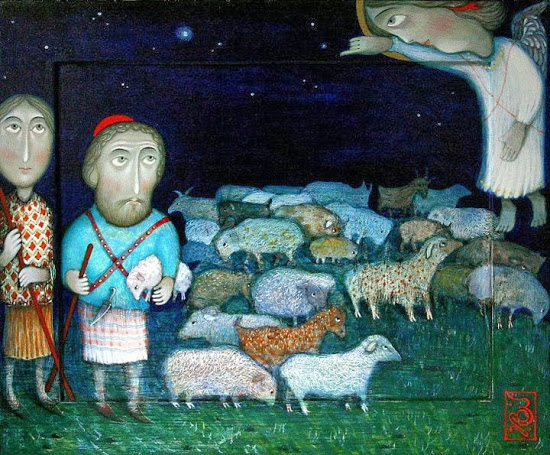

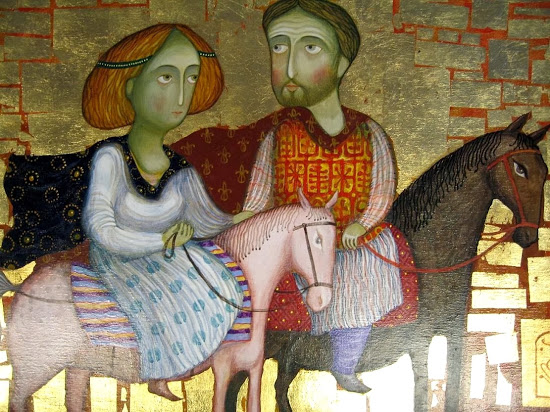










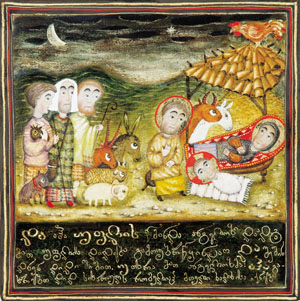


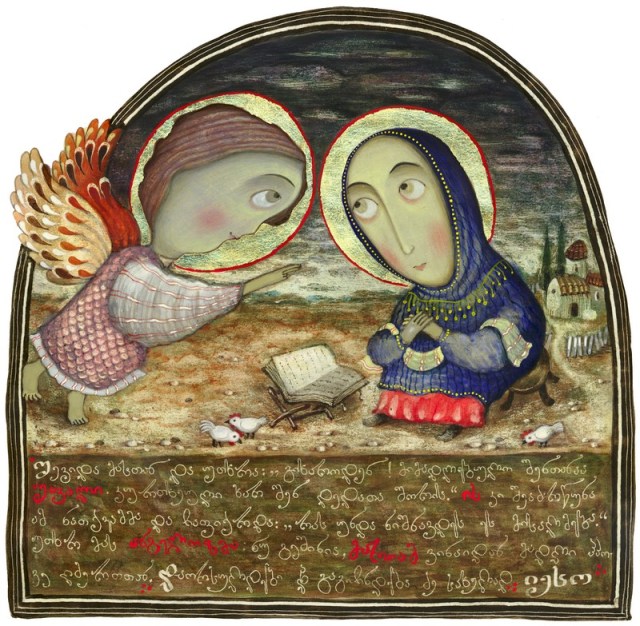 The Good News about the Birth of Jesus
 The Baptism of Jesus
 Jesus Calms a Storm
 The Good Shepherd
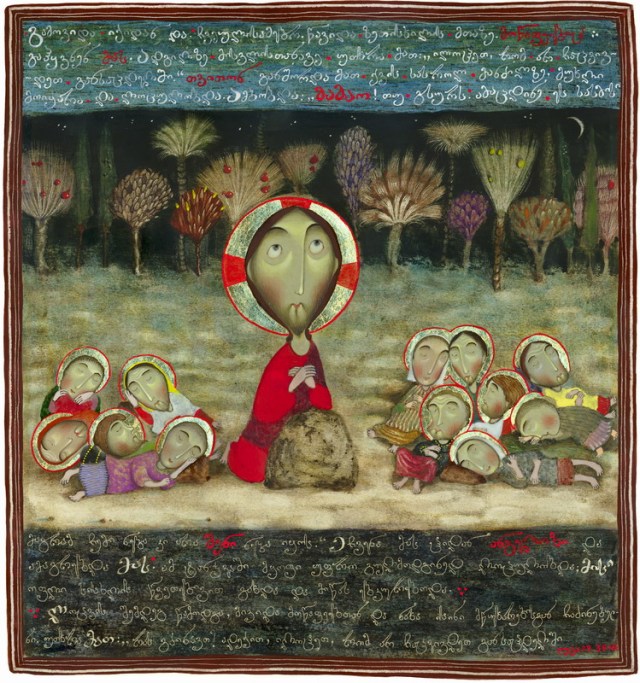 Jesus Prays in Gethsemane
 Carrying His Own Cross







 ORTHODOX CHRISTIAN FAITH AND LIFE