‘No one is saved alone.’

Love all; Pray for all; Weep for all; Repent for all

Starets Zosima, St Silouan the Athonite and St Isaac the Syrian on Salvation of all the World
aaa

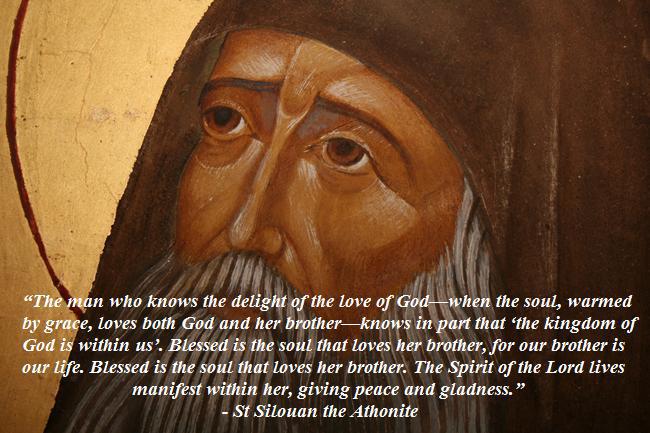
For St Silouan there is a single and undivided mystery of salvation, at once personal, pan-human and cosmic: everything, like the ocean, flows and enters into contact with everything else. There can be no disagreement between our personal salvation and the salvation of the world. The two form a unity. Our own salvation is necessarily linked to the salvation of every other human being, for ‘our brother is our life’. At the same time, the transfiguration of us humans inaugurates the transfiguration of the cosmos. Not without reason, on the last page of Fr Sophrony’s book on the Starets, do we find a prayer that is all-embracing in its scope: 

O Lord, give unto us this love throughout Thine whole universe (504)
bbb

We Must Pray for All: The Salvation of the World According to St Silouan

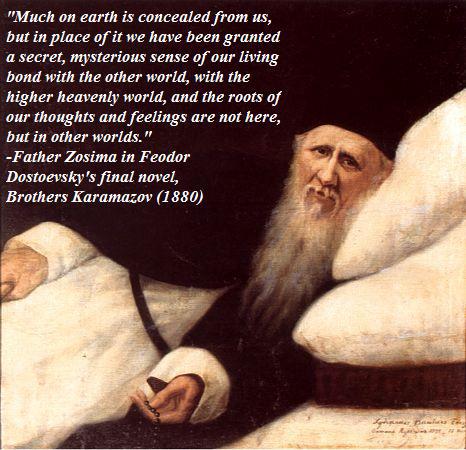
‘Love all creation’, says Starets Zosima in Fyodor Dostoevsky’s novel The Brothers Karamazov:

Love all creation, the whole of it and every grain of sand within it. Love every leaf, every ray of God’s light. Love the animals, love the plants, love everything. If you love everything, you will perceive the divine mystery in things.

This ‘divine mystery’ of which Starets Zosima speaks is precisely the interdependence, the reciprocal coinherence, of all created things in God.

Everything, like the ocean, flows and enters into contact with everything else: touch one place, and you set up a movement at the other end of the world.

Such is Dostoevsky’s vision of cosmic unity. The created world constitutes an individual whole, and so the salvation of each individual person is inextricably bound up with the salvation of all humankind and, yet more widely, with the salvation of the entire universe. ‘We are members of one another’ (Ephesians 4:25) needs to be given the broadest possible application. It is not only we humans who depend on each other as the limbs of a single body; but we have bonds of kinship with the animals as well, and also with trees and plants, rocks and earth, air and water. We live in them, and they in us.

Precisely the same sense of cosmic unity is expressed by St Silouan the Athonite:

He who has the Holy Spirit in him, to however slight a degree, sorrows day and night for all mankind. His heart is filled with pity for all God’s creatures, more especially for those who do not know God, or who resist Him and therefore are bound for torment. For them, more than for himself, he prays day and night, that all may repent and know the Lord (352).

The Lord bestows such rich grace on His chosen that they embrace the whole earth, the whole world, with that love (367).

Archimandrite Sophrony, in his book on Starets Silouan, sums up the teaching of the Starets on cosmic coinherence in these words:

The life of the spiritual world, the Staretz recognized as one life and because of this unity every spiritual phenomenon inevitably reacts on the state of the whole spiritual world (101).

We shall not be distorting the meaning of the Starets – or that of Fr Sophrony – if we give to these words an all-inclusive scope: instead of saying ‘the spiritual world’ and ‘every spiritual phenomenon’, we can correctly say ‘the createdworld’ and ‘every phenomenon’. As Fr Sophrony states elsewhere, St Silouan believed that each person who truly prays to God ‘integrates everyone into his own eternal life whatever the geographical distance or the historical time between them’ (233). Indeed, he integrates not only every person but every thing. Nothing is alien to him. In Dostoevsky’s words, ‘Everything, like the ocean, flows and enters into contact with everything else.’

Despite the striking parallels between the Russian novelist and the Athonite monk, it is highly unlikely that St Silouan had ever read Dostoevsky. More probably, the similarities arise because both are shaped by the same living tradition, and both are drawing on the same sources. St Silouan (almost certainly) and Dostoevsky (possibly) have been influenced by a Mesopotamian hermit of the seventh century, St Isaac the Syrian, who writes in a famous passage of his Ascetical Homilies:

What is a merciful heart? It is a heart on fire for the whole of creation, for humanity, for the birds, for the animals, for demons, and for every created thing. At the recollection and at the sight of them such a person’s eyes overflow with tears owing to the vehemence of the compassion which grips his heart; as a result of his deep mercy his heart shrinks and cannot bear to hear or look on any injury or the slightest suffering of anything in creation. This is why he constantly offers up prayer full of tears, even for the irrational animals and for enemies of truth, even for those who harm him, so that they may be protected and find mercy.

What exactly does Starets Silouan mean when, faithful to the teaching of St Isaac, he affirms that the saints ‘embrace the whole earth, the whole world, with their love’? Let us note the all-embracing love and prayer that constitute our true vocation as human persons. There is first his firm conviction that God calls every human being to salvation. Secondly, there is his conception of the ‘total Adam’ and, linked with this, his insistence that my neighbour is myself. Thirdly, there is his firm assurance that in God’s total plan it is not only human beings but the entire cosmos that is to be redeemed and transfigured.

‘Divine love desires salvation for all’

‘It was particularly characteristic of Staretz Silouan to pray for the dead suffering in the hell of separation from God’, writes Fr Sophrony, and he goes on to recall an exchange that he overheard between the Starets and a somewhat dour hermit:

I remember a conversation between him and a certain hermit, who declared with evident satisfaction, ‘God will punish all atheists. They will burn in everlasting fire.’

Obviously upset, The Staretz said:

‘Tell me, supposing you went to paradise and there looked down and saw somebody burning in hell-fire – would you feel happy?’

‘It can’t be helped. It would be their own fault,’ said the hermit.

The Staretz answered him with a sorrowful countenance:

‘Love could not bear that,’ he said. ‘We must pray for all’ (48).

This universal intercession commended by St Silouan, so far from being sentimental or Utopian, has on the contrary a clear Scriptural foundation: ‘God desires everyone to be saved and to come to the knowledge of the truth’ (1 Timothy 2:4). This is the key text that the seventeenth-century Arminians invoked when opposing the strict Calvinist doctrine of double predestination; this is the text that inspired the dynamic missionary preaching of John Wesley in the eighteenth century; and this is equally a saying that the twentieth-century Athonite keeps steadfastly in view:

My soul longs for the whole world to be saved (291)…. Divine love desires the salvation of all (328)…. The Lord’s is such that He would have all men to be saved (368)…. Our one thought must be that all should be saved (379)…. The merciful Lord sometimes gives the soul peace in God but sometimes makes the heart ache for the whole universe, that all men might repent and enter paradise (426).

According to St Silouan, this burning desire for the salvation of all humankind is to be found to a supreme degree in the Mother of God, the Blessed Virgin Mary:

She, like her beloved Son, desired with her whole heart the salvation of all (406)…. She loved mankind and prayed ardently… for the whole world that all might be saved (365).

The fact that God desires the salvation of all does not of course mean that our salvation is automatic and inevitable. As the Letter to Diognetus states, ‘God persuades, He does not compel, for violence is foreign to Him.’God’s call to salvation comes in the form of an invitation, which we on the human side are free to accept or to reject. But, although the response varies, the call is universal.

St Silouan’s belief that God does indeed desire the universal salvation of the human race can be summed up in four short injunctions: love all; pray for all; weep for all; repent for all.

(1) Love all. When as a young monk, attending a service in the Church of the Holy Prophet Elijah, St Silouan received a vision of Christ (26), the effect of this vision was to flood his soul with ‘a rare feeling of love for God and for man, for every man’ (34). This all-embracing love remained with him throughout his life: ‘Love cannot suffer a single soul to perish’, he wrote many years later (272). Comprehensive love of this kind he saw as par excellence the characteristic of the saints (not that he would have made any claim to be himself numbered among them):

The holy saints have attained the Kingdom of Heaven, and there they look upon the glory of our Lord Jesus Christ; but by the Holy Spirit they see, too, the sufferings of men on earth. The Lord gave them such great grace that they embrace the whole world with their love (396).

This ardent love, as the Starets envisages it, extends beyond the living to the dead and to those not yet born. In Fr Sophrony’s words:

In seeking salvation for all men love feels impelled to embrace not only the world of the living but also the world of the dead, the underworld and the world of the as yet unborn – that is, the whole race of Adam (108).

For St Silouan, as we have seen from his conversation with the dour hermit, this love for our fellow-humans includes even hell within its scope. Expounding the teaching of the Starets, Fr Sophrony writes:

Dwelling in heaven, the Saints behold hell and embrace it too in their love (116).

This is possible for them, because the love that is at work in their hearts is nothing else than the love of God Himself; and God’s love is present everywhere – even in hell:

God is present in hell, too, as love (115)…. Even in hell Divine love will embrace all men, but, while this love is joy and life for them that love God, it is torment for those who hate Him (148).

In the words of Vladimir Lossky, ‘The love of God will be an intolerable torment for those who have not acquired it within themselves’

In thus teaching that the power of love extends even to hell, the Starets is once more following St Isaac the Syrian:

Even those who are punished in Gehenna are tormented with the scourging of love. The scourges that result from love – that is, the scourges of those who realize that they have sinned against love – are harder and more bitter than the torments which result from fear…. The power of love works in two ways: it torments those who have sinned, just as happens here on earth; but those who have observed its duties, love gives delight. So it is in Gehenna: the contrition that comes from love is the harsh torment; but in the case of the sons of heaven, delight in this love inebriates their souls.

‘The power of love works in two ways’: what the saints in heaven feel as joy, those under condemnation in hell experience as intense pain. But it is the same divine love that is present in them both.

If those in hell are not deprived of God’s love, if they are embraced also by the love of the saints, may it not still be possible for them to respond to this love that surrounds them on every side? Is there not still a hope that they may ultimately be saved? St Isaac certainly seems to have believed in universal salvation:as a member of the Church of the East, dwelling safely beyond the confines of the Byzantine Empire, he had no reason to fear the anti-Origenist anathemas of the Fifth Ecumenical Council (553).

What of St Silouan? Fr Sophrony maintains that the Starets was no Origenist (109), and I agree with him. St Silouan insists that our loving intercession should extend even to those in hell, we are to sorrow ‘over those who are not saved’ (377) and to weep for those ‘who do not know God’ (386). Further than this, however, he does not go. With characteristic reticence, he avoids all speculation about a final apocatastasis. He does not attempt to specify who can be saved and who cannot; that is a mystery known at present only to God. For his part he answers only with the words, ‘ I do not know’:

Father Cassian used to say that all heretics would perish. I do not know about this – my trust is only in the Orthodox Church (483).

When reflecting on the possibility that in the Age to Come there may be some who remain for ever unreconciled, burning in hell-fire, the Starets says simply, ‘Love could not bear that.’ Further than this he does not go.

What of the demons? Might they also be saved, and in that case should we not pray also for them? St Isaac the Syrian, as already noted, affirms that the merciful heart is ‘on fire’ with compassion for the demons, but he does not actually say that we should pray for them. St Silouan speaks in similar terms. We are to ‘pity’ the demons, but nothing is stated about intercession on their behalf:

The Spirit of God teaches love towards all, and the soul feels compassion for every being, loves her enemies and pities even devils because they have fallen away from God (469).

The Starets was emphatically a man of the Church; and so, if asked whether we may legitimately pray for the demons – Fr Sophrony does not in fact record any occasion when he was so asked – surely his answer would have been that the Church has no such practice; and in all such matters we must follow the Church’s rule of prayer. But at the same time it is not for us to set limits to the divine mercy.

(2) Pray for all. Love and prayer go together; if, then, we are to love all human persons, this signifies that we are also to pray for them. So the Starets writes:

I pray Thee, O Merciful Lord, let all mankind, from Adam to the end of time, come to know Thee (319)…. I will pray for the whole human race, that all people may turn to the Lord and find rest in Him (328)…. I beseech Thee, O Lord, let all peoples come to know Thee (332).

The Starets quotes with approval the words of an ascetic monk with whom he once talked:

Were it possible I would pray everyone out of hell, and only then would my soul be easy and rejoice (468).

‘Were it possible’: the Starets does not say that it actually is possible. The Starets sees this all-inclusive intercession as the proper and characteristic vocation of the monk.

The constant prayer for others constitutes the monk’s way of serving society as a whole:

Thanks to monks, prayer continues unceasing on earth, for through prayer the world continues to exist…. When there are no men of prayer on the earth, the world will come to an end…. The world is supported by the prayers of the saints (407-8).

In this connection Fr Sophrony refers appropriately to the sixth-century elder St Barsanuphius of Gaza, who asserts that in his day there were three men who through their prayers were preserving the whole human race from catastrophe (223). Barsanuphius mentions the names of the first two, who significantly are otherwise unknown to the annals of history. He does not say who the third was, presumably because God had revealed to him that it was Barsanuphius himself.

By thus praying for the world, the monk not only helps the Church and human society at large, but he also helps himself. Here the Starets describes his own experience as a monastery steward. Most monks consider that this particular ‘obedience’ renders it impossible to preserve continual prayer and inner peace, for it involves contact with large numbers of people throughout the day. Starets Silouan disagrees. If the steward will only intercede constantly for those under his charge, saying ‘The Lord loves His creation’, all will be well: he will find that he is freed from distractions and can maintain an uninterrupted remembrance of God (418).

In the monk’s relationship with the world, St Silouan distinguishes a double movement. First, through prayer the monk withdraws into himself, shutting out the world, gradually liberating himself from visual imagery and discursive thinking, and so entering into the image-free stillness of the heart. But then, within the depths of his own heart, he rediscovers his solidarity with all humankind and with the whole creation. So the monk’s flight from the world turns out to be not world-denying but world-affirming. In the words of Fr Sophrony:

In his longing for God he ‘hates’ the world and retires totally into the depths of his own heart. And when he does so totally, in order there to do battle against Satan, in order to cleanse his heart from every single passion, in the depths of this heart of his he meets with God, and in God begins to see himself indissolubly linked with the whole of cosmic existence; and then there is nothing alien, nothing that is extraneous to them.

As St Silouan observes, ‘True, Arsenius the Great was bidden to “shun” people but in the desert, too, the Spirit of God teaches us to pray for people and for all the world (296).

(3) Weep for all. True prayer cannot but be costly; loving intercession involves an inner martyrdom, a willingness on our part to accept suffering. As St Silouan says, ‘Praying for people means shedding blood (236); ‘The greater the love, the greater the suffering’ (338). It is not enough simply to read lists of names; we are required to intercede with tears of sorrow. ‘Pray for all’ means ‘Weep for all’:

My heart aches for the whole world, and I pray and shed tears fro the whole world, that all may repent (341)…. My soul weeps for the whole world (371)…. O Lord, grant me tears to shed for myself, and for the whole universe’ (385).

(4) Repent for all. St Silouan would have us go yet further on the path of mutual coinherence. Not only are we required to weep for all, but we should also repent for all. In his view this is part of what St Paul meant when he said, ‘Bear one another’s burdens, and in this way fulfil the law of Christ’ (Galatians 6:2). As Fr Sophrony points out, if viewed in purely juridical terms the notion of vicarious repentance – of laying one person’s guilt upon another – makes no sense; it is simply ‘not fair’. But the love of Christ is not limited to juridical norms:

The spirit of Christian love speaks otherwise, seeing nothing strange but something rather natural in sharing the guilt of those we love – even in assuming full responsibility for their wrong-doing. Indeed, it is only in this bearing of another’s guilt that the authenticity of love is made manifest and develops into full awareness of self (120).

Adam’s fall consisted precisely in his refusal to accept that he too was involved in the guilt of Eve’s sin. ‘Adam denied responsibility, laying all the blame on Eve and on God who had given him this wife’, and so he shattered the unity of the human race. If only, instead of justifying himself, he ‘had taken upon his shoulders the responsibility for their joint sin, the destinies of the world might have been different’ (121). We in our turn, when we refuse to repent for others, are repeating Adam’s sin, thus making his fall our own.

Strange though this concept of vicarious repentance may seem to most modern readers, it has in fact an excellent Patristic pedigree. One author who expresses this idea in strong terms is St Mark the Monk (?early fifth century):

The saints are required to offer repentance not only on their own behalf but also on behalf of their neighbour, for without active love they cannot be made perfect…. In this way the whole universe is held together in unity, and through God’s providence we are each of us assisted by one another.

‘Adam, our father’

St Silouan’s consuming desire for the salvation of all stands out in yet sharper relief when we take into account his teaching about what may be termed the ‘total Adam’. This is not, I think, a phrase that he himself employs, but it accurately sums up his point of view.

For St Silouan, Adam is ‘our father’ (451), the ‘father of all mankind’ (448). Following St Paul (1 Corinthians 15:22, 45), the Starets sees Adam the first-formed man as the collective head of the human race, containing and recapitulating within himself the whole of humankind. There are obvious parallels here between St Silouan and St Irenaeus of Lyon, even though the Starets was probably unfamiliar with the Irenaean writings. This solidarity and recapitulation in Adam renders all human persons ‘consubstantial’ and ‘ontologically one’, as Fr Sophrony puts it (123, 51, 217). This ontological unity is not merely abstract and theoretical but specific and actual, ‘for the whole Adam is not an abstraction but the most concrete fullness of the human being’, to quote Fr Sophrony once more (222). It was the denial of this ‘consubstantiality’ that constituted, as we saw earlier, the essence of Adam’s fall.

This unity in the ‘total Adam’ is movingly expressed in the best-known of all St Silouan’s writings, ‘Adam’s Lament’ (448-56). Here the Starets takes up and develops in his own way the liturgical texts for the Sunday before Lent, the ‘Sunday of Forgiveness’, on which the Orthodox Church commemorates the expulsion of Adam from paradise. In particular he has used the ikos appointed for that day:

Banished from the joys of paradise, Adam sat outside and wept, and beating his hands upon his face, he said: ‘I am fallen, in Thy compassion have mercy on me.’…

O paradise, share in the sorrow of thy master who is brought to poverty, and with the sound of thy leaves pray to the Creator that he may not keep thy gate closed for ever. I am fallen, in Thy compassion have mercy on me.

As we read St Silouan’s prose-poem ‘Adam’s Lament’, it becomes clear that this is the lament not just of Adam but of Silouan himself, and not of him alone but of the whole human race. Adam’s sorrowful repentance is our repentance also:

The soul that has lost grace yearns after the Lord, and weeps as Adam wept when he was driven from paradise (326)…. O Lord, grant unto us the repentance of Adam (271).

Nor is this all. It is the lament not of humankind alone but of the entire creation, for all created things are involved in Adam’s fall:

Thus did Adam lament,

And the tears streamed down his face onto his beard,

onto the ground beneath his feet,

And the whole desert heard the sound of his mourning.

The beasts and the birds were hushed in grief (449).

Lo, the whole earth is in travail (452).

The sin of Adam is cosmic in its effects, destroying as it does the primal harmony that prevailed between humans and the rest of creation. So Adam exclaims in his ‘Lament’:

In paradise was I joyful and glad:

the Spirit of God rejoiced me,

and suffering was a stranger to me.

But when I was driven forth from paradise

cold and hunger began to torment me.

The beasts and the birds that were gentle

  and had loved me turned into wild things,

and were afraid and ran from me (455).

Because of our solidarity in the ‘total Adam’, writes Fr Sophrony, all of us share in Adam’s guilt (120). This does not mean that either he or St Silouan would endorse an Augustinian doctrine of original sin, in a fully developed form. But it does mean that, united as we are as members of a single human family, we are each of us ‘responsible for everyone and everything’, to use the phrase of Starets Zosima in The Brothers Karamazov. Yet, if we are subject to a solidarity in guilt, we enjoy egually a solidarity in salvation: in the words of Khomiakov, ‘No one is saved alone.’My personal salvation is bound up with the salvation of the entire human race, and indeed of the whole creation. Fr Sophrony neatly illustrates this interdependence in both sinfulness and salvation by recounting a conversation that he once heard between two Athonite monks:

The first said,

   ‘I cannot understand why the Lord does not grant peace to the world even if only a single person implored him to do so.’

   To which the other replied,

   ‘And how could there be complete peace in the world if but a single malicious man remained?’ (200)

This understanding of the ‘total Adam’ means that, on each occasion when we say the Lord’s Prayer, we offer it not only on our own behalf but on behalf of everyone. As Fr Sophrony says, ‘When we pray “Our Father” we think of all mankind, and solicit the fullness of grace for all as for ourselves’. St Gregory of Nyssa emphasizes this same point when he states that, since we ‘share in Adam’s nature and therefore share also in his fall’, in consequence the petition in the Lord’s Prayer, ‘Forgive us our trespasses’, is something that we offer for Adam’s sake as well as for our own.This fits exactly with St Silouan’s line of thought.

On the basis of this theology of the ‘total Adam’, the Starets is able to give a particularly powerful interpretation to Christ’s command, ‘You shall love your neighbour as yourself’ (Matthew 19:19). I am able to love my neighbour as myself, because by virtue of the unity of all humankind in ‘Adam our father’, my neighbour is myself. I am likewise to pray for others as I pray for myself: ‘All my desire’, says St Silouan, ‘is to learn humility and the love of Christ, that I may offend no man but pray for all as I pray for myself (350: italics in the original). In the same way the suffering of the other is my suffering, and my neighbour’s healing is healing for me as well; ‘my brother’s glory will be my glory also.’ ‘If one member suffers, all suffer together with it; if one member is honoured, all rejoice together with it’ (l Corinthians 12:26).

This leads St Silouan to affirm in a strong and literal sense that my neighbour’s life is my own: ‘Blessed is the souls that loves her brother, for our brother is our life’ (371: italics in the original). For the one who prays, says Fr Sophrony,

The existence of mankind is not alien and extraneous to him but is inextricably bound up with his own being…. Through Christ’s love all men become an inseparable part of our own individual, eternal existence (47).

Christ has taken up the ‘total Adam’ into Himself and has suffered for him; we therefore should take up into ourselves ‘the life of all mankind’, looking upon every other person as our ‘eternal brother’:

Each of us must, therefore, take heed not only for himself but for this single whole (47-48).

So it is that, according to the Starets, ‘in his deep heart the Christian after a certain fashion lives the whole history of the world as his own history’; for ‘no man is alien to him’ (234).

Exactly because my neighbour is myself, because my brother’s life is my own, I am required to love my enemies.

Only in the light of St Silouan’s teaching on the ‘total Adam’ can we truly appreciate the crucial importance that he attached to love for enemies. I am to love my enemy, because my enemy is myself; I am the other whom I regard as my enemy. His life is mine, and mine is his. Love for enemies is a direct corollary of our mutual coinherence in ‘Adam, our father’.

‘Weep with me, forest and desert’

Sin and salvation, however, are not merely human in scope, but they also involve the entire created order. When Adam fell, the whole creation fell with him; and by the same token our human salvation will inaugurate the salvation of the total cosmos. As Fr Sophrony puts it, ‘Every saint is a phenomenon of cosmic character’ (223). We are not saved from but with the world.

This cosmic understanding of sin and salvation has a firm basis in Scripture. St John the Baptist, for example, greets Jesus with the words, ‘Behold the Lamb of God, who takes away the sin of the world’ (John 1:29). The Forerunner does not say ‘the sins’, but he says ‘the sin’ (in the singular) ‘of the world’. Beyond the personal sins of individual humans, there is a deeper sinfulness that involves the world as a whole. St Paul in his turn states that the entire created universe is at present ‘in bondage to decay’ and ‘groans as if in pangs of childbirth’, waiting ‘with eager expectation for the revealing of the children of God’. When we humans enter into our ‘glorious liberty’ in Christ, then the whole creation will also be set free (Romans 8:19-22). Our fall, that is to say, entails the fall of all creation, and our redemption will likewise bring liberation to creation as a whole. The New Testament concludes with a comprehensive vision not only of a ‘new heaven’ but of a ‘new earth’ as well (Revelation 23:1).

The same understanding of the cosmic dimensions of Christ’s saving work finds expression in the service books of the Church. Let us take as an example a text with which St Silouan was certainly familiar: the ‘Praises’ or ‘Encomia’ recited at Matins on Great Saturday in front of the Epitaphion depicting the dead Christ laid out for burial.[17] In the first place the ‘Praises’ emphasize that Christ’s death and resurrection bring forgiveness and new life to all the human race:

Uplifted on the Cross, Thou hast uplifted with Thyself all living people; and then, descending beneath the earth, Thou raisest all that lie buried there.

Stretched out upon the Wood, Thou hast drawn us mortals to unity; pierced in Thy life-giving side, O Jesus, Thou art become a fountain of forgiveness unto all.

We notice how the atonement is not selective but universal in its scope. But the ‘Praises’ go further than this, proclaiming that Christ’s death upon the Cross has transformed the entire created order:

The whole creation was altered by thy Passion: for all things suffered with Thee, knowing, O Word, that Thou holdest all in unity.

This is a remarkable statement, but it does not stand alone. The ‘Praises’ return frequently to the theme of this all-inclusive co-suffering:

Though Thou wast shut within the narrowest of sepulchres, O Jesus, all creation knew Thee as true King of heaven and earth.

The whole earth quaked with fear, O Word, and the daystar hid its rays, when thy great Light was hidden in the earth.

Of old the lamb was sacrificed in secret; but Thou, longsuffering Saviour, wast sacrificed beneath the open sky and hast cleansed the whole creation.

O hills and valleys, the multitude of humankind, and all creation, weep and lament with me.

The sun and moon grew dark together, O Saviour, like faithful servants, clothed in black robes of mourning.

Come, and with the whole creation let us offer a funeral hymn to the Creator.

The whole earth mourns with us humans for the dead Christ laid in the tomb; and to an equal degree the whole earth is raised to new life, along with us humans, through the Saviour’s resurrection from the dead. Paschal salvation extends beyond the human realm to the world of nature, involving animals, trees, hills and valleys, sun and moon, and the totality of the material creation.

Faithful to this all-inclusive understanding of Christ’s redemptive work, the Starets believes that our personal salvation is integrally connected with the salvation of the whole world. The precept ‘Love all’ means that we are to love the entire creation: humans first, but also animals, plants, and each and every part of nature. Ours is to be a ‘love without limits’, to borrow the title of one of Fr Lev Gillet’s books. We are to feel ‘compassion for the whole universe and every living creature… a love for every one of God’s creatures’, says St Silouan. ‘Weep for all’ means that ‘you will shed abundant tears for your fellow-man and for every thing that hath breath, and all creation’ (427). ‘When the soul learns love of the Lord, she is filled with compassion for the whole universe (443); and when she mourns for the withdrawal of God’s grace she calls on all creation to lament with her:

Weep with me, forest and desert. Weep with me, every creature created by God, and comfort me in my grief and sorrow (365).

In St Silouan’s teaching concerning the bonds that unite us humans to the rest of creation, there are three points that I find particularly interesting:

(1) The Starets underlines the spiritual value of the human body. While he adopts a negative attitude towards the passions, he is fundamentally positive in his estimate of our human physicality. We are to hate, not our bodies as such, but the sinfulness that corrupts them. In its present fallen state the body may appear to us as our adversary, but in its true and natural condition, as originally created by God, it is our helper and our friend. God calls us to a total sanctification:

The Light of the Lord will be in the souls and minds and bodies of the Saints (290)…. The Holy Spirit pervades the entire man – soul, mind and body (353) (italics in the original).

Advancing on the spiritual way, a person becomes ‘sensible’, consciously aware, of the grace of the Holy Spirit in body as well as soul (283); the ninth of the ten ‘rewards’ that the monk receives from God ‘even here on earth’ is that ‘he feels the grace of God in his body, too’ (501)/ ‘The man with grace in soul and body knows perfect love’ (368).

‘Perfect love’, then, leads to the transfiguration of the body:

The fourth and perfect kind of love for God exists when a man possesses the grace of the Holy Spirit in both soul and body. His body is then hallowed, and after death his earthly remains become relics (343).

The Starets mentions from his own experience an instance of bodily glorification:

At Vespers during one Lent at the Monastery of Old Russikon-on-the-Hill the Lord allowed a certain monk to see Father Abraham, a priest-monk of the strict rule, in the image of Christ. The old confessor, wearing his priestly stole, was standing hearing confessions. When the monk entered the confessional he saw that the grey­haired confessor’s face looked young like the face of a boy, and his entire being shone radiant and was in the likeness of Christ (403-4).

In this way St Silouan’s theology of the human person is firmly holistic. Divine grace embraces the total person, soul and body together; the body is deified along with the soul. This has an immediate relevance for his attitude to the material creation. It is through our bodies that we relate to our physical environment, which passes within us and becomes part of us through the exercise of the five senses. If, then, sanctification involves not only our soul but our physical nature, it follows that through our body we can experience the material world as holy, and through our body we can in turn transmit holiness to the material world around us. Our body is the essential intermediary between our inward being and the world of nature; and, because our body can be filled with grace, it is clear that our own sanctification forms a single mystery with the redemption of the material creation.

As a monk of the strict Athonite tradition, St Silouan had been formed by an austere physical discipline. But never did he interpret this ascetic self-denial in a dualistic sense. The monk’s aim, in the words of St John Climacus, is precisely ‘a body made holy’. He seeks the sanctification of the body, not its destruction.

(2) St Silouan gave careful thought to our relationship as humans with the animals. This is only to be expected. He had grown up in an agricultural community. The Holy Mountain which then became his monastic home abounds in living creatures, in birds, butterflies, snakes and jackals, and also (at any rate in the days of the Starets) in wolves and wild boar, not to mention the domestic animals, the horses and mules, that the monasteries used to keep in great numbers before the advent of the tractor and the jeep. Animals were his constant companions.

His attitude towards them is marked by two characteristics: by loving compassion and by realism. He displays both gentleness and detachment. Loving compassion inspires him to write:

Once I needlessly killed a fly. the poor thing crawled on the ground, hurt and mangled, and for three whole days I wept over my cruelty to a living creature, and to this day the incident remains in my memory….

One day, going from the Monastery to Old Russikon-on-the- Hill, I saw a dead snake on my path which had been chopped in pieces, and each piece writhed convulsively, and I was filled with pity for every living creature, every suffering thing in creation, and I wept bitterly before God (469).

At the same time the Starets urges us not to grow unduly attached to animals, and not to bestow on them the love that we ought rather to give to God and to our fellow-humans:

Feed animals and cattle, and do not beat them – in this consists man’s duty of kindness towards them; but to become attached, to love, caress and talk to them – that is folly for the soul (470).

‘I left that passage out from the first English edition,’ Fr Sophrony once said to me. ‘I knew the English would never be able to understand that.’

Incidentally, St Silouan nowhere suggests that there is anything intrinsically sinful in eating animal flesh. As an Athonite monk he would not have eaten meat, but there are many days in the year when the monastic rule permits fish. There was even a time, so he tells us, when he had to struggle against an almost obsessive desire to consume fish (470-1). If the monk abstains from meat, this is for ascetic and disciplinary reasons, not because meat-eating is in itself wrong. Indeed, the Orthodox Church had never advocated vegetarianism as a general principle.

St Silouan’s compassion for the suffering of animals did not make him lose sight of the truth that God has given this world to us humans for our use. Man, as he puts it, is the ‘supreme creation’ (376). In Fr Sophrony’s words, ‘The world itself was created for man.’ Of course this does not in any way justify a cruel and selfish exploitation of our natural environment. On the contrary, in our enjoyment of the world, we are to show the utmost humbleness and sensitivity. God has indeed given us ‘dominion’ over the animals (Genesis 1:28), but dominion does not signify tyranny.

(3) The compassionate love of St Silouan extends beyond animals to plants: ‘Hurt not the earth, neither the sea, nor the trees’ (Revelation 7:3). On one occasion when the two of them were walking together, Fr Sophrony struck out with his stick at a clump of tall wild grass. The Starets said nothing, but he shook his head doubtfully; and at once Fr Sophrony was ashamed (94). In his own writings St Silouan says:

That green leaf on the tree which you needlessly plucked – it was not wrong, only rather a pity for the little leaf. The heart that has learned to love feels sorry for every created thing (376).

The Spirit of God teaches the soul to love every living thing so that she would have no harm come to even a green leaf on a tree, or trample underfoot a flower of the field. Thus the Spirit of God teaches love towards all, and the soul feels compassion for every being (469).

Thus cosmic compassion, this sense of our human responsibility towards the whole of creation, makes the Starets very much a saint of our own time, living as we do in an era of global pollution. His words, written over half a century ago, are marked by prophetic insight. With good reason the Ecumenical Patriarchate of Constantinople, in the timely statement on Orthodoxy and the Ecological Crisis published in 1990, includes St Silouan the Athonite among the witnesses that it cites, along with the Prophet Isaiah, St Isaac the Syrian and Dostoevsky.

Yet there is a tension, even a paradox, in St Silouan’s attitude towards the created order. He urges us to ‘love every created thing; and emphasizes the beauty of nature:

From my childhood days I loved the world and its beauty. I loved the woods and green gardens, I loved the fields and all the beauty of God’s creation. I liked to watch the shining clouds scurrying across the blue sky (286).

If we lose our sense of wonder before the beauty of nature, so he believed, this suggests that we have at the same time lost our sense of God’s grace (96).

On the other hand, the Starets maintains that the true monk ‘forgets the world’ (501). So he writes:

After I came to know my Lord, and He made my soul His prisoner, everything changed, and now I no longer want to contemplate the world (286)…. My soul… has no wish to look upon this world, though I do love it (381)…. My soul is filled with love of Thee and knows no desire to look upon this world, beautiful though it be (284).

Such is St Silouan’s order of priorities. However much we value the beauty of the creation, we should feel an incomparably greater love for God the Creator.

*  *  *  *

For St Silouan, then, there is a single and undivided mystery of salvation, at once personal, pan-human and cosmic: everything, like the ocean, flows and enters into contact with everything else. There can be no disagreement between our personal salvation and the salvation of the world. The two form a unity. Our own salvation is necessarily linked to the salvation of every other human being, for ‘our brother is our life’. At the same time, the transfiguration of us humans inaugurates the transfiguration of the cosmos. Not without reason, on the last page of Fr Sophrony’s book on the Starets, do we find a prayer that is all-embracing in its scope:

O Lord, give unto us this love throughout Thine whole universe (504)

Ultimatum

death-painting.jpg

No, my father will not be ‘spared’ in the end. Like all of us. The final diagnosis is terminal cancer. The prognosis chillingly blunt. It is just that God said Not yet! Biopsy confirmed adenocarcinoma. The liver findings are metastases. The location of the primary carcinoma will be found from results which we will have on Monday. Possible locations: colon, pancreas, … No point to operate, we already have metastases.Life expectancy: very uncertain since we still do not know location of primary cancer but MAYBE 6 – 12 months …

Glory to God for all things! Surely God is not our Servant. We are His. Likewise, our will is not to be done. But His. His Love and Providence has shone and is still shining, again, so brilliantly, through this life’s trial that my heart is moved to Doxology, leaping with Joy and joining  St. Paisios of Mount Athos at  his ‘Crazy’ Beatitudes. Not the least of such blessings was my father’s conscious decision, before this crisis escalated, to approach the sacrament of Holy Confession for the first time in his life at the age of 86 (!) This was a decision which caught all of us by surprise! All but the spiritual fathers who have been praying all their lives for this.  My father accordingly prepared, confessed and partook of the Holy Communion. Glory to God for all things! 

3.jpgDetail from Descent into Hades

*Pay attention to the heart-rending detail of Christ’s crucifixion wound on the hand. Metropolitan Anthony of Sourozh, or what it Lev Gillet, once commented that these crucifixion wounds are to remain in Jesus Resurrected Body to Eternity as a token of His Love and Sacrifice.

 2.jpg

Ossuary in Dionysiou Monastery – Mount Athos

Written c. 750 .A.D.
“Media vita in morte sumus ; quem quaerimus adjutorem, nisi te Domine, qui pro peccatis nostris juste irasceris? Sancte Deus, sancte fortis, sancte et misericors Salvator, amarae morti ne tradas nos.”
“In the midst of life we are in death: of whom may we seek for succour, but of thee, O Lord, who for our sins art justly displeased? Yet, O Lord God most holy, O Lord most mighty, O holy and most merciful Saviour, deliver us not into the bitter pains of eternal death.”

Photis Kontoglou: The Last Anti-Classicist

            Photios Kontoglou, the greatest icon painter of modern Greece and one of her most important theologians and literary writers, died in Athens on July 13, 1965. His death, during surgery, passed almost entirely unnoticed in America, even among Greek-Americans, but he was deeply mourned throughout Greece.

            I was in Greece when he died and had the good fortune of seeing and talking with this great and holy man just five days before his “falling asleep.” The editor of an Athenian religious monthly asked me to write an obituary . . .  I have undertaken to write this brief biography.

Photios Kontoglou was born on November 8, 1895, at Kydoniai (Aivali), on the west coast of Asia Minor, across from Mytilene. Kydoniai was a city consisting of about 30,000 Greeks and three persons—the district governor, the judge, and the tax collector—who were Turks.

Kontoglou came from a devout family, which had its own chapel containing precious articles including a carved ancient crucifix and a large panel icon depicting Saint Paraskevi. Many of his ancestors were monks, and an uncle, Stephanos Kontoglou, was abbot of the Monastery of Saint Paraskevi near Kydoniai. Stephanos was an important influence in Photios’s life. In his book Vasanta (1923), Kontoglou dedicates the chapter of translations from the Psalms of David “to the austere soul of the Hieromonk Stephanos Kontoglou, my uncle, whose virtue I perpetually have before me as a model and rule.”

The young Kontoglou was extremely fond of the sea, sailing, and the solitude of the deserted neighboring islets. He liked to live alone, like Robinson Crusoe. Daniel Defoe’s hero fascinated Kontoglou; he mentions him in many of his writings.

After graduating from the famous Academy of Gymnasium of Kydoniai, Kontoglou spent several years in Europe, especially in France, studying art and acquiring painting techniques. He lived in Paris during the First World War, where he first gained attention, winning prizes for his paintings and his writings. His first book, a novel entitled Pedro Cazas, was written and published there in 1919.

After the armistice, Kontoglou returned to Kydoniai. In 1920 he wrote a remarkable prologue for the second edition of Pedro Cazas which was published in Athens in 1922. In this prologue he set forth some of the basic ideas by which he abided ever after.

Persecuted by the Turks, he and his family went to Thermi, Mytilene, in 1922. Later he resided in Athens, but always lived on the outskirts, as he disliked the distractions of cities. When the Kontoglou family left Kydoniai, they took only the sacred articles mentioned above and a few Church books. These were his most cherished possessions. After his death his wife, Maria, fulfilling his wish, gave them to the Monastery of Saint Paraskevi at Nea Makri in Attica.

In Athens Kontoglou soon became well-known in literary circles as a result of his highly-praised book, Pedro Cazas. His reputation as a writer grew with the appearance of two additional books: Vasanta (a Sanskrit word meaning “springtime”) in 1923, and Taxidia (“Travels”) in 1928, and the literary and art periodical Filikh Etairia (“Friendly Society”) which he founded in 1925. Within a few years, Kontoglou had won an enviable place in the Greek world of letters, admired for his style—which is characterized by clarity, simplicity, vigor and warmth—as well as his remarkable observations and profound thoughts.

As a painter, Kontoglou was slow in winning recognition. He had to overcome difficult obstacles. After leaving Europe, he became increasingly impressed by the Byzantine traditions of painting and decided to master this style of painting. But he had to become his own teacher and learn the secrets of Byzantine art. He did this by reading old manuscripts and visiting Byzantine monuments, patiently studying the works of the old masters.

Further, Kontoglou had to overcome strong prejudice on the part of the public against Byzantine art. Having won their liberation from the Turks, the Greeks began to turn the West for prototypes in art, especially the adoption of European (particularly Italian Renaissance) models and techniques. According to the European view at that time, Byzantine civilization was a lower civilization, not worthy of serious study, and Byzantine art especially was lower, almost barbaric art. Kontoglou succeeded magnificently in overcoming both obstacles, but it took time.

The first obstacle was by far easier to overcome. He learned his most important lessons about Byzantine art at the Holy Mountain of Athos and at Mystra. It is significant that while at Athos, he wrote several chapters, the preface and profound concluding chapter on the fine arts of his second book, Vasanta. It was also at Athos that one of his three poems in this book was inspired by a Byzantine painting in a very old chapel there. His debt to Athos in his development as an iconographer is evinced by a volume published in 1925 containing photographs of copies, executed by him, of Byzantine frescoes at Athos; and also by the illustrations in two issues of Filikh Etairia that year showing panel icons of the Monastery of Iviron rendered by him.

Kontoglou visited Mystra not long after. He made copies of some of the wall paintings in the Byzantine churches at Mystra. He later worked there for a long time cleaning wall paintings in the Church of Peribleptos.

Comparing Byzantine and European religious art, Kontoglou says in his book Taxidia, “In the countries of Europe there are churches with paintings that are famous for their artistic merit; yet they do not have the mystery and the power of evoking contrition (katanyxis) possessed by the icons that were done by some unlettered and simple Byzantine painters.”

Around 1930, Kontoglou was appointed technical supervisor at the Byzantine Museum in Athens. He possessed both great love for the works in the museum, and technical knowledge for cleaning and preserving them.

In 1932, Kontoglou published a slender volume entitled Icones et Fresques d’Art Byzantine, with twenty plates of Byzantine panel icons and frescoes he copied. He continued to paint panel icons during this period.

During the later thirties, Kontoglou decorated three large rooms of the City Hall of Athens with historical frescoes. This was his first large scale work as a fresco painter, and his only extensive secular one. His next major achievement as a fresco painter was the iconographic decoration of the large Church Zoodochos Peghi at Liopesi (Paiania), a town near Athens. He began the work in 1939, but could not resume it until after the Second World War. When I met Kontoglou in 1952, he showed me the beautiful Byzantine murals he had painted at Liopesi.

Kontoglou wrote at least eight books between 1942 and 1945, during the war. Most are rather short. The longest and important is Mystikos Kepos (“Mystical Garden”) in 1944. His chapters on Piety (Theosveia) and Saint Isaac the Syrian are masterpieces, full of deep religious feeling. He speaks of other remarkable ascetics of Syria and Mesopotamia, and stresses the virtues of faith, humility and purity.

The most fruitful period for Kontoglou, as both painter and writer, was the last twenty years of his life. Assisted by several of his talented pupils, he painted numerous panel icons in churches in many parts of Greece, as well as in the United States and other countries, and many thousands of square yards of wall paintings. After the church at Liopesi, mentioned above, Kontoglou frescoed the entire interior of the Church of Saint Andrew off Patission Street at Athens. He did wall paintings for the new Metropolitan Church of Evangelismos in Rhodes and the Church of Saint George at Stemnitsa, Arcadia. Finally, he decorated with fresco icons the eastern apse, central dome, pendentives and barrel vaults below the dome, and other surfaces of the following Athenian churches: Kapnikarea, Saint George at Kypseli, Saint Haralambos in the park Pedion tou Areos, Saint Nicholas at Kato Patissia, and others.
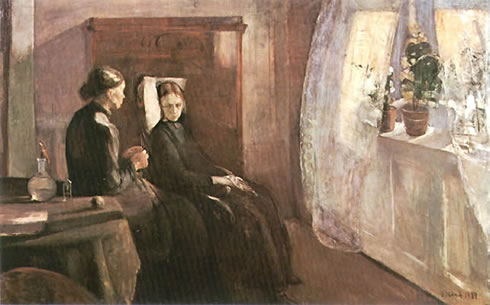
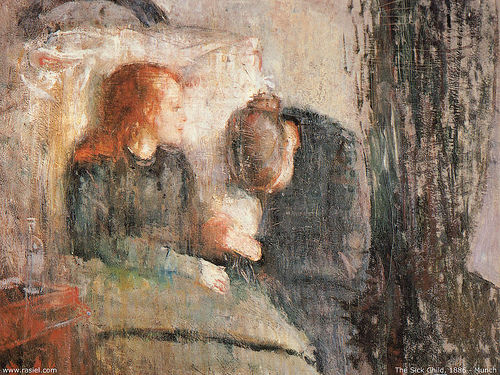
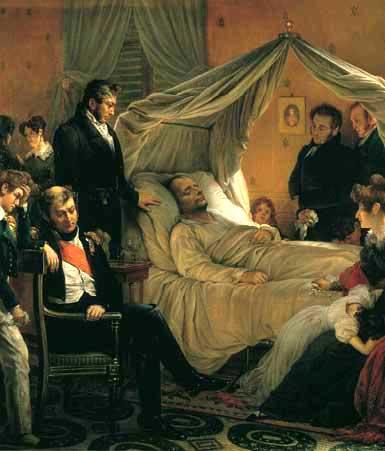
Through these works, through the training of many gifted young artists in the techniques of Byzantine iconography, and through his long, luminous and spirited defense of Byzantine art which culminated in 1961 in the monumental two-volume work entitled Ekphrasis (“Expression”) in which he teaches the theory and practice of Byzantine iconography, Kontoglou succeeded in making this art prevail in Greece. His influence spread to America, where many churches have been decorated with panel icons, frescoes and mosaics by his pupils.

During the same period, he wrote such edifying books as  A Great Sign (1945), with accounts of many extraordinary recent miracles at Thermi, Mytilene; The Life and Conduct of Blaise Pascal(1947); The Life and Ascesis of Our Holy Father Saint Mark the Anchorite  (1947, translated in The Orthodox Word, no. 1, Sept.-Oct., 1966, with illustrations by Kontoglou); Fount of Life (1951), presenting brief descriptions of the lives and selections from the teachings of some of the great Saints of the Orthodox Church; The Holy Gospel According to Matthew, Interpreted (1952); Expression (1961); and What Orthodoxy Is and What Papism Is (1964). Kontoglou also translated into Greek Leonid Ouspensky’s L’Icone: Quelques Mots sur son Sens Dogmatique, and published it with a preface and notes of his own. Together with the young theologian Basil Moustakis, Kontoglou founded and edited Kivotos (1952–1955), a religious periodical concerned especially with Orthodox spirituality.

Kontoglou contributed many articles to various other periodicals and encyclopedias. His articles in the Athenian daily Elephtheria are so numerous that they would fill several volumes. Many of them are among the most profound written by a Greek. Most are concerned with religious themes, such as faith and reason, religion and philosophy, religious versus secular art, Byzantine iconography and music, the lives of Martyrs and other Saints, and so on.

Kontoglou won the Academy of Athens Prize for his book Ekphrasis, in 1961, and the Purfina Prize for his book Aivali; My Native Place, in 1963. The latter is the first volume of his Erga (“Works”) which began to be published by Astir Publishing Company at Athens in 1962.

In recognition of his great achievements as an author, the Academy of Athens, the highest cultural institution in Greece, awarded him on March 24, 1965, its Aristeion Grammaton, its highest prize in letters.

Kontoglou also carried on an enormous correspondence. He once told me that he wrote about fifty letters a month, corresponding not only with Greeks, but also Americans, Finns, Frenchmen, Germans, Russians, Ugandans and others. He had countless friends and admirers throughout the world who sought his guidance on iconography, and on Orthodox doctrine and living.

In Kontoglou’s writings, we encounter a man who has unshakable religious faith, free from all skepticism and metaphysical anguish. We encounter a man who is steeped in the Holy Scriptures and writings of the Eastern Church Fathers, particularly the great mystics such as Saint Macarios the Egyptian, Saint John Climacos, Saint Isaac the Syrian, Saint Symeon the New Theologian, and Saint Gregory the Sinaite. We find a man who has the profoundest respect for the Sacred Tradition of Eastern Orthodoxy, including all its dogmas, canons and sacred arts (architecture, iconography, music), tolerating no deviations. Orthodoxy was for him the sacred Kivotos, the sacred Ark, and these its precious contents, which must be carefully guarded and not cast away, or exchanged for counterfeits.

Kontoglou was strongly opposed to the participation of Orthodoxy in “ecumenism,” seeing in such participation the dangers of compromise on matters which admit of no compromise. He was especially critical of the maneuvers of Patriarch Athenagoras, in whom he saw an apostate . . . a betrayer of Greece and Orthodoxy. In his last book, entitled Ti Einai he Orthodoxia kai ti Einai ho Papismos (“What Orthodoxy Is and What Papsim Is”) Kontoglou stressed the abyss that separates Orthodoxy from Roman Catholicism, which renders utterly absurd Athenagoras’s assertions that there are no real differences between the two.

Kontoglou was a man of adamantine Orthodox faith and impeccable character, adorned with the virtues of great humility, long-suffering, courage, wisdom, purity, hope and love. He was a devout man, a holy man, a man of God. All that he did bears the impress of these qualities.

As during his life, so at his death, it was evident that Kontoglou was free from worldly attachments, a citizen of the City of God, not of the earthly city, whose glory is temporary and whose power is doomed to pass away. He died poor, ignored by the State. His body was not accompanied to the grave by any State dignitaries, but only by friends and admirers, who loved him deeply.


By Dr. Constantine Cavarnos at Pemptousia

photios9

photios11

photios8

photios3

photios12

The Gratitude Of The Publican


publicanandpharisee

In the Name of the Father, the Son, and the Holy Spirit.

How short, and how well known today’s parable, and yet, how intense its message, how challenging…

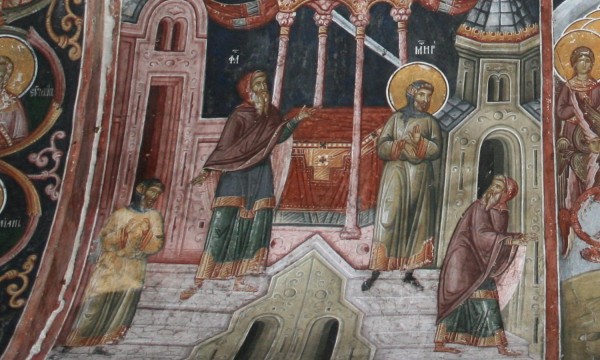
It is intense in its very words: two men come into the church of God, into a sacred realm—which belongs to Him unreservedly in a world that is otherwise lost to Him. They enter His Divine Realm. And one of the men walks boldly into it and takes a stand before God. The other one comes, and doesn’t even dare cross the threshold—he is a sinner, and the Realm is holy, like the space around the Burning Bush in the desert that Moses could not enter without unshod feet, in adoration and the fear of God.

And how different are the words they speak! Apparently the Pharisee praises God, he gives Him glory—but for what? Because He has made a man like him, a man so holy, so worthy of Him, of God; a man who not only keeps all the commandments of the Law, but goes beyond what God Himself has commanded, and can expect of man. Indeed, he stands before God praising Him that he, the Pharisee, is so wonderful that he is God’s own glory, the shining, the revelation of God’s holiness…

The Publican does not dare enter into the holy Realm of God.

publican

And the parable is clear: the man who came and stood brokenhearted, ashamed of himself, knowing that he is unworthy of entering this sacred space goes back home forgiven, loved, indeed: accompanied by God Himself Who came into the world to save sinners and Who stands by everyone who needs Him, who recognizes his need—or not—for salvation.

The Pharisee goes home, but he goes home less forgiven; his relationship with God is not the same—he is at the center, God is peripheral to him, He is at the heart of things, and God is subservient to him. It does not mean that what he did was worthless; it simply means that as far as he is concerned, it has born no fruit of holiness in him. The deeds were good, but they were spoiled, poisoned by pride, by self-assertion. The beauty of what he did was totally marred because it was addressed neither to God nor to his neighbor—it was turned in on his own self. And we are told that this pride has despoiled this man, has taken away from him the fruits of his good works, the fruit of his outward faithfulness to the law of God; that only humility could have given him and his action full meaning; that only humility could have made his actions into life, into the waters of life gushing into eternity.

But then, the question is before us: how can we learn anything about humility if that is theabsolute condition to be not like the barren fig tree, but fruitful, to be a rich harvest which people may be fed.


publican5.jpg

I do not know that we can move from pride and vanity into humility in a moment unless something so tragic happens to us that we see ourselves and discover that we are completely bereft of everything that supported our sinful, destructive, barren condition. But there is one thing we can do: however much we think that we are possessed of all sorts of gifts of heart, mind, body, and soul, however fruitful our action may be, we can remember the words of Saint Paul: O, man! What have you got which was notgivenyou?! And indeed, he echoes at this point what Christ said in the first Beatitude, the Beatitude that opens the door to all other Beatitudes; the Beatitude that is the beginning of understanding: Blessed are the poor in spirit… Blessed are those who know, not only with their intellect—but at least with their intellect!—that they are nothing, and they possess nothing which is not a gift of God.

We were called into being out of naught, without our participation; our very existence is a gift! We were given life, which we could not create or call out of ourselves. We have been given the knowledge of the existence of God, and indeed, a deeper, more intimate knowledge of God. All this is gift! And then, all that we are is a gift of God: our body, our heart, our mind, our soul. What power do we have over them when God no should longer sustain them? The greatest intelligence can suddenly be swallowed into darkness by a stroke; there are moments when we are confronted with a need that requires all our sympathy, all our love—and we discover that our hearts are made of stone and of ice… We want to do good, and we cannot; Saint Paul knew this already when he said: The good which I love, I don’t do, and the wrong which I hate I do continuously… And our body depends on so many things!

pharisee-publican


And what of our relationships, of the friendships that are given us, the love that sustains us, the comradeship—everything that we are and possess is a gift. What is the next move: isn’t it gratitude? Can’t we turn to God not as a pharisee, priding ourselves in what we are and forgetting that all of it is his, but turning to God and saying, “O, God! All this is a gift from You! All that beauty, intelligence, sensitive heart, all the circumstances of life are a gift! Indeed, all those circumstances, even those that frighten us, are a gift because God says to us: I trust you enough to send you into the darkness to bring light! I send you into corruption to be the salt that stops corruption! I send you where there is no hope to bring hope, where there is no joy to bring joy, no love to bring love… and one could go on, on, on, seeing that when we are sent into the darkness it is to be God’s presence and God’s life. And that means that He trusts us—He trusts us, He believes in us, He hopes everything for us: isn’t that enough to be grateful for?

But gratitude is not just a cold word of thanks. Gratitude means that we wish to make Him see that it was not all given in vain, that He did not become man, live, and die in vain. Gratitude means a life that could give joy to God. This is the challenge of this particular parable…

Yes, the ideal would be for us to be humble. But what is humility? Who of us knows the answer, and if someone does know it, who can communicate it to everyone who doesn’t know? But we all know gratitude; we know the small ways and aspects of it! Let us reflect on it, and let us in an act of gratitude recognize that we have no right to be in God’s own realm, and yet He lets us in! We have no right to commune with Him either in prayer, or in the sacrament and yet He calls us to commune with Him! We have no right to be His children, to be brothers and sisters of Christ, to be the dwelling place of the Spirit, and yet He grants it all in an act of love!

Let each of us reflect and ask himself: in what way can we be so grateful that God might rejoice that He has not given these gifts in vain, that He has not lived and died in vain, that we have received the message. And if we grow in a true depth of gratitude, at the depth of gratitude we will fall down, adore the Lord, and learn what humility is—not in abasement but adoration, in the awareness that He is all we possess, all that we are, and that we are open to Him as the rich earth is open to the plough, to the sowing, to the seed, to the sunshine, to the rain—to everything in order to bring forth fruit. Amen!


Mitras.ru

Edited by OrthoChristian.com

Metropolitan Anthony of Sourozh

The Publican and the Pharisee

publican

Imagine now that we are patients in this hospital of the world. The sickness that every one of us is suffering from has the same name – unrighteousness. The word includes all the passions, all lust, all sins – all the weakness and enervation of our souls, our hearts and our minds.

publican3

The sick are one thing at the beginning of their illness, another at its peak and yet another in its healing. But such are the characteristics of these illnesses of the inner man that only those who are healed are aware of the terrible sickness from which they had been suffering.


The sickest are the least aware of their illness. In physical illness, a man with a high fever is unaware of himself or his illness. Neither does a madman say of himself that he is mad. Beginners in unrighteousness feel ashamed of their sickness for a while, but repeated sinning swiftly leads to the habit of sin, and this to the inebriation and delirium of unrighteousness in a state in which the soul has no longer any sense of itself or its sickness.

publican2


And just imagine a doctor going into a hospital and asking: “What is wrong with you?” Those whose illness is in the early stages are ashamed to admit they are sick, but will say: “Nothing!” Those whose illness has reached its peak will be angered by such a question, and will not only say: “Nothing’s the matter with us!” but will begin to boast of their health.


Only those who are on the way to healing will sigh, and reply to the doctor: “Everything is wrong with us! Have mercy on us and help us!” Tertullian says, in a homily on repentance: “If you are afraid to confess your sins, look at the flames of hell that confession alone can extinguish.”


Ponder, then, on all this; listen to Christ’s parable and decide for yourself how apt it is. If you say in amazement: “This parable does not apply to me”, then this means that you are sickened in the illness known as unrighteousness. If you protest: “I am righteous; this applies to the sinners around me”, then this means your sickness has reached its peak. If, though, you beat your breast in repentance and reply: “It’s true; I’m sick and need a doctor”, then this means you are on the way to healing. Don’t be afraid then; You’ll get well.

publicanandpharisee.jpg

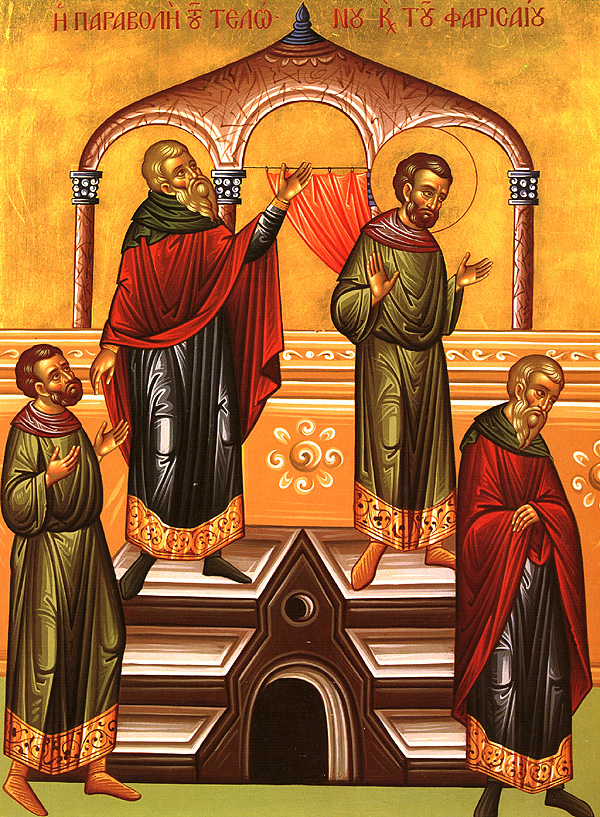
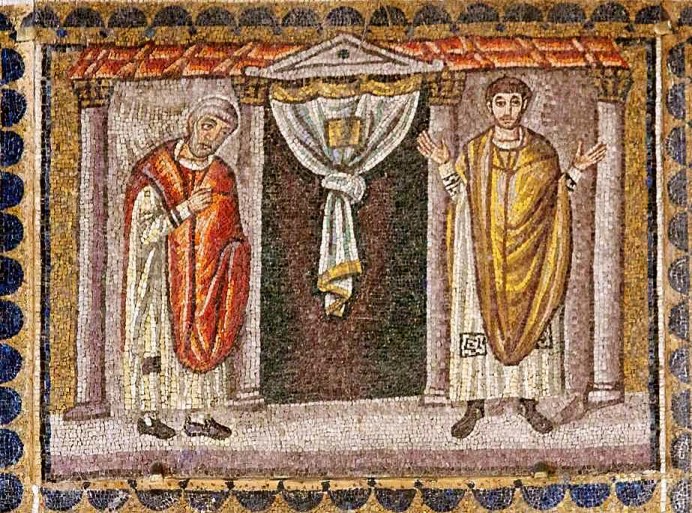
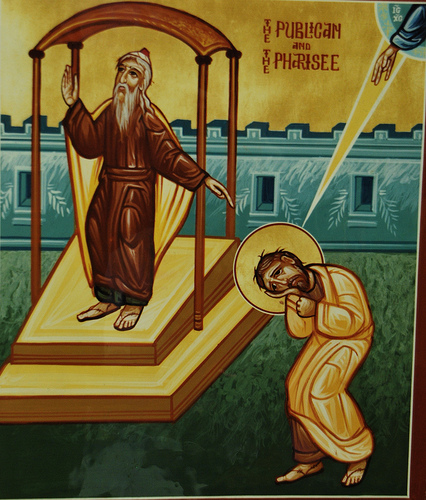
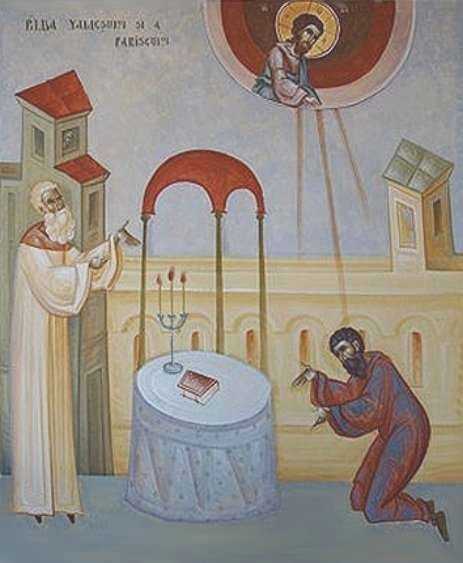
This icon is a pictorial version of the parable, which is presented below:

[Jesus] spoke this parable to some who trusted in themselves that they were righteous, and despised others:

Two men went up to the temple to pray, one a Pharisee and the other a tax collector.

God, I thank Thee that I am not as other men are...God, be merciful to me a sinner!The Pharisee stood and prayed thus with himself:
‘God, I thank You that I am not like other men—extortioners, unjust, adulterers, or even as this tax collector [or Publican]. I fast twice a week; I give tithes of all that I possess.’

And the tax collector, standing afar off, would not so much as raise his eyes to heaven, but beat his breast, saying: ‘God, be merciful to me a sinner!’ 

I tell you, this man went down to his house justified rather than the other; for everyone who exalts himself will be humbled, and he who humbles himself will be exalted.

(From: Luke 18:9-14)


The Justified Publican and Unforgiven PhariseeO Lord, You condemned the Pharisee who justified himself by boasting of his works, and You justified the Publican who humbled himself and with cries of sorrow begged for mercy. For You reject proud-minded thoughts, O Lord, but do not despise a contrite heart. Therefore in abasement we fall down before You Who have suffered for our sake: Grant us forgiveness and great mercy.

*

 Let us flee the proud speaking of the Pharisee and learn the humility of the Publican, and with groaning let us cry to the Saviour: Be merciful to us, for You alone are ready to forgive.


* By St. Nikolai Velimirovic on Luke 18:10 – 14


Prayer and the Absence of God


There is a situation in which we have no right to complain of the absence of God, because we are a great deal more absent than He ever is. 

At the outset of learning to pray there is one very important problem: God seems to be absent. Obviously I am not speaking of a real absence—God is never really absent—but of the sense of absence which we have. We stand before God and we shout into an empty sky, out of which there is no reply. We turn in all directions and He is not to be found. What ought we to think of this situation?
schema

First of all, it is very important to remember that prayer is an encounter and a relationship, a relationship which is deep, and this relationship cannot be forced either on us or on God. The fact that God can make Himself present or can leave us with the sense of His absence is part of this live and real relationship. If we could mechanically draw Him into an encounter, force Him to meet us, simply because we have chosen this moment to meet Him, there would be no relationship and no encounter. We can do that with an image, with the imagination, or with the various idols we can put in front of us instead of God; we can do nothing of the sort with the living God, any more than we can do it with a living person.

A relationship must begin and develop in mutual freedom. If you look at the relationship in terms of mutual relationship, you will see that God could complain about us a great deal more than we about Him. We complain that He does not make Himself present to us for the few minutes we reserve for Him, but what about the twenty-three and a half hours during which God may be knocking at our door and we answer, ‘I am busy, I am sorry,’ or when we do not answer at all because we do not even hear the knock at the door of our heart, of our minds, of our conscience, of our life. So there is a situation in which we have no right to complain of the absence of God, because we are a great deal more absent than He ever is.


The second very important thing is that a meeting face to face with God is always a moment of judgment for us. We cannot meet God in prayer or in meditation or in contemplation and not be either saved or condemned. I do not mean this in major terms of eternal damnation or eternal salvation already given and received, but it is always a critical moment, a crisis. ‘Crisis’ comes from the Greek and means ‘judgment.’ To meet God face to face in prayer is a critical moment in our lives, and thanks be to Him that He does not always present Himself to us when we wish to meet Him, because we might not be able to endure such a meeting. Remember the many passages in Scripture in which we are told how bad it is to find oneself face to face with God, because God is power, God is truth, God is purity. Therefore, the first thought we ought to have when we do not tangibly perceive the divine presence, is a thought of gratitude. God is merciful; He does not come in an untimely way. He gives us a chance to judge ourselves, to understand, and not to come into His presence at a moment when it would mean condemnation.

Look at the various passages in the Gospel. People much greater than ourselves hesitated to receive Christ. Remember the centurion who asked Christ to heal his servant. Christ said, ‘I will come,’ but the centurion said, ‘No, don’t. Say a word and he will be healed.’ Do we do that? Do we turn to God and say, ‘Don’t make yourself tangibly, perceptively present before me. It is enough for You to say a word and I will be healed. It is enough for You to say a word and things will happen. I do not need more for the moment.’ Or take Peter in his boat after the great catch of fish, when he fell on his knees and said, ‘Leave me, O Lord, I am a sinner.’ He asked the Lord to leave his boat because he felt humble—and he felt humble because he had suddenly perceived the greatness of Jesus. Do we ever do that? When we read the Gospel and the image of Christ becomes compelling, glorious, when we pray and we become aware of the greatness, the holiness of God, do we ever say, ‘I am unworthy that He should come near me?’ Not to speak of all the occasions when we should be aware that He cannot come to us because we are not there to receive Him. We want something from Him, not Him at all. Is that a relationship? Do we behave in that way with our friends? Do we aim at what friendship can give us or is it the friend whom we love? Is this true with regard to the Lord?

Let us think of our prayers, yours and mine; think of the warmth, the depth and intensity of your prayer when it concerns someone you love or something which matters to your life. Then your heart is open, all your inner self is recollected in the prayer. Does it mean that God matters to you? No, it does not. It simply means that the subject matter of your prayer matters to you. For when you have made your passionate, deep, intense prayer concerning the person you love or the situation that worries you, and you turn to the next item, which does not matter so much—if you suddenly grow cold, what has changed? Has God grown cold? Has He gone? No, it means that all the elation, all the intensity in your prayer was not born of God’s presence, of your faith in Him, of your longing for Him, of your awareness of Him; it was born of nothing but your concern for him or her or it, not for God. It is we who make ourselves absent, it is we who grow cold the moment we are no longer concerned with God.

From Beginning to Pray by Met. Anthony of Sourozh (Bloom)

Preparing for Lent


orthodox-prostration

Contrary to what many think or feel, Lent is a time of joy. It is a time when we come back to life. It is a time when we shake off what is bad and dead in us in order to become able to live, to live with all the vastness, all the depth, and all the intensity to which we are called. Unless we understand this quality of joy in Lent, we will make of it a monstrous caricature, a time when in God’s own name we make our life a misery. This notion of joy connected with effort, with ascetical endeavour, with strenuous effort may indeed seem strange, and yet it runs through the whole of our spiritual life, through the life of the Church and the life of the Gospel.

The Kingdom of God is something to be conquered. It is not simply given to those who leisurely, lazily wait for it to come. To those who wait for it in that spirit, it will come indeed: it will come at midnight; it will come like the Judgement of God, like the thief who enters when he is not expected, like the bridegroom, who arrives while the foolish virgins are asleep. This is not the way in which we should await Judgement and the Kingdom. Here again we need to recapture an attitude of mind which usually we can’t manage to conjure up out of our depth, something which had become strangely alien to us: the joyful expectation of the Day of the Lord – in spite of the fact that we know this Day will be a Day of judgement. It may strike us as strange to hear that in Church we proclaim the Gospel – the ‘good news’ – of judgement, and yet we do. We proclaim that the Day of the Lord is not fear, but hope, and declare together with the spirit of the Church: ‘Come, Lord Jesus, and come soon’ (cf. Rev. 22.20).

So long as we are incapable of speaking in these terms, we lack something important in our Christian consciousness. We are still, whatever we may say, pagans dressed up in evangelical garments. We are still people for whom God is a God outside of us, for whom his coming is darkness and fear, and whose judgement is not our redemption but our condemnation, for whom to meet the Lord is a dread event and not the event we long and live for.

Unless we realise this, then Lent cannot be a joy, since Lent brings with it both judgement and responsibility: we must judge ourselves in order to change, in order to become able to meet the Day of the Lord, the Resurrection, with an open heart, with faith, ready to rejoice in the fact that he has come.

Every coming of the Lord is judgement. The Fathers draw a parallel between Christ and Noah. They say that the presence of Noah in his generation was at the same time condemnation and salvation. It was condemnation because the presence of one man who remained faithful, of just one man who was a saint of God, was evidence that holiness was possible and that those who were sinners, those who had rejected God and turned away from him, could have done otherwise. So the presence of a righteous man was judgement and condemnation upon his time. Yet it was also the salvation of his time, because it was only thanks to him that God looked with mercy on mankind. And the same is true of the coming of the Lord.

There is also another joy in judgement. Judgement is not something that falls upon us from outside. Yes, the day will come when we will stand before God and be judged; but while our pilgrimage still continues, while we still live in the process of becoming, while there still lies ahead of us the road that leads us towards the fullness of the stature of Christ, towards our vocation, then judgement must be pronounced by ourselves. There is a constant dialogue within us throughout our lives. You remember the parable in which Christ says: ‘Make your peace with your adversary while you are on the way’ (Mt. 5.25). Some of the spiritual writers have seen in the adversary not the devil (with whom we cannot make our peace, with whom we are not to come to terms), but our conscience, which throughout life walks apace with us and never leaves us in peace.

Our conscience is in continuous dialogue with us, gainsaying us at every moment, and we must come to terms with it because otherwise the moment will come when we finally reach the Judge, and then our adversary will become our accuser, and we will stand condemned. So while we are on the road, judgement is something which goes on constantly within ourselves, a dialogue, a dialectical tension between our thoughts and our emotions and our feelings and our actions which stand in judgement before us and before whom we stand in judgement.

But in this respect we very often walk in darkness, and this darkness is the result of our darkened mind, of our darkened heart, of the darkening of our eye, which should be clear. It is only if the Lord himself sheds his light into our soul and upon our life, that we can begin to see what is wrong and what is right in us. There is a remarkable passage in the writings of John of Kronstadt, a Russian priest of the 19th and the beginning of the 20th century, in which he says that God does not reveal to us the ugliness of our souls unless he can see in us sufficient faith and sufficient hope for us not to be broken by the vision of our own sins.

In other words, whenever we see ourselves with our dark side, whenever this knowledge of ourselves increases, we can then understand ourselves more clearly in the light of God, that is, in the light of the divine judgement. This means two things: it means that we are saddened to discover our own ugliness, indeed, but also that we can rejoice at the same time, since God has granted us his trust. He has entrusted to us a new knowledge of ourselves as we are, as he himself always saw us and as, at times, he did not allow us to see ourselves, because we could not bear the sight of truth.

Here again, judgement becomes joy, because although we discover what is wrong, yet the discovery is conditioned by the knowledge that God has seen enough faith, enough hope and enough fortitude in us to allow us to see these things, because he knows that now we are able to act. All this is important if we want to understand that joy and Lent can go together. Otherwise the constant, insistent effort of the Church – and of the word of God – to make us aware of what is wrong in us can lead us to despair and to darkness, until finally we have been brought so low that we are no longer capable of meeting the Resurrection of Christ with joy, because we realise – or imagine that we realise – that the Resurrection has nothing to do with us. We are in darkness, God is in light. We see nothing but our judgement and condemnation at the very moment when we should be emerging out of darkness into the saving act of God, which is both our judgement and our salvation.

* This talk was given by Metropolitan Anthony to the London Group of the Fellowship of Saint Alban and Saint Sergius and their friends on Saturday, 17 February 1968. It was taken down in shorthand, transcribed, corrected by Metropolitan Anthony and published at the time in booklet form by the Fellowship, but has long been out of print. The editor of the original booklet mentioned in his introduction that ‘because of the large crowds the meeting at Saint Basil’s House (the London centre of the Fellowship) had to be transferred to the Church of Saint John the Baptist, Notting Hill.’

Thin Places, Where Heaven Reveals Its Violence

Christ_Pantocrator_Sinai

Christ Pantocrator 6th St. Catherine’s Monastery Mount Sinai Egypt 

Two weeks of no posting … Please forgive me for this ‘break’ but things have been so hectic here, with my father seriously ill, in hospital. Taking the wrong medication can cause serious side effects and even result in death, especially if the patient is 86 years old! Thanks be to God, the doctors saved my father’s life the very last minute! It was such a heart-rending experience watching him collapse …

This whole experience, as was to be expected, shook us deeply and intensified our prayer life. We were literally (and figuratively) all the time on our knees before Him.This is why I have decided to resume my posts with Father Seraphim Aldea‘s,  Metropolitan Anthony of Sourozh, and Lev Gillet‘s reflections on Meeting the Living God, Entering Into a  Relationship With Him in Prayer.

These meditations strangely match a recent experience of mine with an Icon of the Saviour I was offered as a blessing. What an icon! I cannot even begin to stare at His Eyes! As if the icon ‘itself’ ought to be “tamed” … Just staring at this ‘Icon’ feels like a Meeting face to face with Him, a moment of Judgment for me … to be either saved or condemned …

praying

“People are right, Iona truly is ‘a thin place’, a great Celtic expression, describing special places where Heaven and earth are drawn together. What I didn’t know before I came for this week (and perhaps, what many of us do not feel) is how dreadfully frightening Heaven is. Perhaps frightening is not the right word: awe-some, full of awe, entirely alien to us and frightening because of its alien nature – these are all weak descriptions, but they are as good as I’m able to make.

Iona is a thin place, but through the thin veil one can see a frightening revelation. It is precisely because these are thin places that they are frightening, too. What we see through them, what we see through their transparence is the real Face of God: not a tame God, a domesticated God; not a God taken to pieces and rebuilt to fit our sinfulness and weakness; not a God shaped against our emotions and cheap piety; not a God of human traditions and cult; not a God of political correctness or incorrectness – but the LIVING God. The Being beyond being, the Uncreated Creator of everything that is, the untouchable One, indescribable by any of our created words, philosophies and concepts. The frightening God, the crushing God, the God Who utters His voice and the earth melts; the God Who commands: Be still, and know that I am God.

To be in a thin place like Iona is frightening because of the Frightening Being Who suddenly becomes visible and Whom you must now face. I’ve learnt that to face God is frightening, because every meeting with God is a moment of total exposure and Judgement: exposure and judgement of ourselves, of our carefully assembled idols and our horrid manipulations of the Divine realities. God is an alien Being to us, because we have turned ourselves in alien beings to Him. Thin places are dangerous places; approach them with fear, as you approach the Face of God. You are in a moment of Judgement.”

Monk-at-Lake.jpg


Metropolitan Anthony of Sourozh adds to a similar vein: “a Meeting face to face with God is always a moment of Judgment for us. We cannot meet God in prayer or in meditation or in contemplation and not be either saved or condemned. I do not mean this in major terms of eternal damnation or eternal salvation already given and received, but it is always a critical moment, a crisis. ‘Crisis’ comes from the Greek and means ‘judgment.’ To meet God face to face in prayer is a critical moment in our lives, and thanks be to Him that He does not always present Himself to us when we wish to meet Him, because we might not be able to endure such a meeting. Remember the many passages in Scripture in which we are told how bad it is to find oneself face to face with God, because God is power, God is truth, God is purity.”

vladimir

Turn to me,
In your good favor, all praise-worthy Theotokos;

Yet, Lev Gillet adds a different dimension, encouraging if I may add, to this discussion: “What does this manifestation [the solemn manifestation of Christ in His baptism in the Jordan] consist of? It is made up of two aspects. On the one hand, there is the aspect of humility represented by the baptism to which our Lord submits: on the other hand, there is the aspect of glory represented by the human witness that the Precursor bears to Jesus, and, on an infinitely higher plane, the divine witness which the Father and the Spirit bear to the Son. We shall look at these aspects more closely. But first of all, let us bear this in mind: every manifestation of Jesus Christ, both in history and in the inner life of each man, is simultaneously a manifestation of humility and of glory.Whoever tries to separate these two aspects of Christ commits an error which falsifies the whole of spiritual life. I cannot approach the glorified Christ without, at the same time, approaching the humiliated Christ, nor the humiliated Christ without approaching the glorified Christ. If I desire Christ to be manifested in me, in my life, this cannot come about except through embracing Him whom Augustine delighted to call Christus humilis, and, in the same upsurge, worshipping Him who is also God, King, and Conqueror.

*

13 And ye shall seek me, and find me, when ye shall search for me with all your heart.

Jeremiah 29:13 (KJV)


  • Thin Places: “Thin Places,” comes from a Celtic Christian concept. The Celts believed that physical locations existed in which God’s presence was more accessible than elsewhere, places where heaven and earth seemed to touch, where the line between holy and human met for a moment, “the places in the world where the walls are weak”, “those rare locales where the distance between heaven and Earth collapses”, as Eric Weiner puts it in his spirituality travelogue, Man Seeks God. For such a ‘thin place’ for me visit my blog post on the Holy and Life-Giving Cross Orthodox parish at Lancaster.


What is a Christian end to life?

When Breath Becomes Air


Final Hours and Death in Western Painting, Byzantine chanting and iconography, end of life care/ palliative care and … in my life.

The blog post which follows is  painfully relevant to me. I have seen some of this first-hand, and I do have very elderly and frail, ailing parents, nearing death and requiring constant one-on-one nursing care. Even for a poor ‘hermit’ as I am, their impending death is a difficult emotional time. The ‘bodies’ of both my parents, simultaneously, especially though my father’s, prepare themselves for the final days of life. Thank God they have both gone to Confession before and received Eucharist! Just in time! I believe my father is nearer to the ‘end’ than my mother and he will be the first to go. I am most impressed by his calmness and humility in accepting his “body’s process of ‘shutting down’, which will end when all the physical systems cease to function”. I am deeply moved by my father’s tender care to make sure we are all well, his attempts to resolve whatever is unfinished of a practical nature, and his silent seeking permission from us, family members to “let go.””. His eyes are so eloquent! He tries to hold on, even though this brings him a prolonged discomfort, in order to be assured that those left behind will be all right.

I have often felt these days that a family’s ability to reassure and release the dying person from this concern is the greatest gift of love they can give at this time. Saying Good-bye is also so important, so prolonged, so heart-rending, so personal! These last days are typically spent laying in bed with him and holding his hand, in tears.

“O my sweet springtime, O my sweetest Child, where has all Thy beauty gone?” (The Lamentations of the Tomb)

Alexey_Venetsianov_25

Administration of the Eucharist to a dying person (painting by 19th-century artist Alexey Venetsianov)

-1

This painting didn’t have the Expressionism Style. The girl in this painting is dying and Munch used light colors instead of a dark palette.

dying_child1.jpg

“Dying Child” by Edvard Munch. Everything in this painting is saturated in suffering, except the dying girl, who is fragilely posed (in repose) in a way that is heartbreaking.

595

‘Dying Well’

Cardinal Mazarin Dying.jpg

Paul Delaroche Cardinal Mazarin Dying

article-1285847-09FE7377000005DC-699_468x346

The famous picture by Arthur William Devis showing a dying Nelson


IngresDeathOfDaVinci

The Death of Leonardo da Vinci is an 1818 painting by the French artist Jean Auguste Dominique Ingres


elderly woman looking outIn the old days, she would be propped up on a comfy pillow, in fresh cleaned sheets under the corner window where she would in days gone past watch her children play. Soup would boil on the stove just in case she felt like a sip or two. Perhaps the radio softly played Al Jolson or Glenn Miller, flowers sat on the nightstand, and family quietly came and went. These were her last days. … spent with familiar sounds, in a familiar room, with familiar smells that gave her a final chance to summon memories that will help carry her away. …

You see, that’s how she used to die.

The essay is entitled “I Know You Love Me; Now Let Me Die” I saw it on Facebook, handed around the way that we do everything from meatloaf recipes to the greatest speeches in history, with the result that everything has the same value.

But considering the topic, I feel like this one deserves to come with a big label that says, “Read this. It actually matters.” The physician author of this article has first-hand knowledge of just what death looks like in the modern hospital room or elderly care facility. He approaches it from the medical professional’s point of view, and considers what happens to the theoretical dying woman whose gentler, old-fashioned death he sketched above. But these days …

Empty-hospital-bed-scale-300x200She can be fed a steady diet of Ensure through a tube directly into her stomach and she can be kept alive until her limbs contract and her skin thins so much that a simple bump into that bed rail can literally open her up …. She can be kept alive until her bladder is chronically infected, until antibiotic resistant diarrhea flows and pools in her diaper so much that it erodes her buttocks. The fat padding around her tailbone and hips are consumed and ulcers open up exposing the underlying bone, which now becomes ripe for infection.

I know these aren’t pretty things to talk about. But I have seen some of this first-hand; I think quite a lot of people my age have. When my father-in-law was in decline, he received end-of-life care that went on for about three years. When I blogged about it back in March 2014, in spite of the excellent hospice care Charles received, I had to ask:

Is this really the best we can do for Greg’s dad? Charles is on “palliative care,” and so the only medical concern is limiting suffering. But is an unsuffering death really possible? And if it is, am I wrong to think that it’s just not what I would want for myself?

… if it were my time to go, and I could see that it would be this creeping, sanitized kind of yearlong journey with caretakers trying to keep every little thing operating as if I were just a collection of little things … would I be just crazy to say that I’d like to opt out? …Wouldn’t I rather have a short end punctuated by intense focus than a protracted fugue state with no intensity and no humanity?

We go through it with our elderly parents and we have no way to change the current practices. But I hope that by the time I get there, enough of us will have spoken up to say that just because we CAN keep bodily functions going at maximum cost with maximum artificiality doesn’t mean we SHOULD. Because we aren’t just pumps and springs and tubes — we’re human beings made in the image of God.

We pray for “a Christian end to our life — painless, blameless and peaceful.” But what does that really look like? Can’t we see out our days better in the quiet corner that the author places his patient in than in the sterile, hopeless hospital beds that most of us are bound for?

What is “a Christian end to our life?” I really want to know.

Source: This Side of Glory

Confessing to Grow Closer to God

confession.jpg

“Confessing to Grow Closer to God” Fr. Seraphim reflects on his experiences confessing, the role of a spiritual father, and he gives three recommendations to help get the most out of each confession. Podcast here

“Continuing in Confessional Growth”Fr. Seraphim continues his discussion from last week on how to get more out of each confession, by recommending three more exercises to help grow closer to both the spiritual father and Christ. Podcast here

“Confessing to Grow Closer to God”
In the name of the Father, the Son, and the Holy Spirit. Amen.
While I have done my best to record these podcasts in silence and moments of the day, or rather moments of the night, when there is silence, enough silence for me to focus on the things I want to talk to you about and also enough silence for you to be able to hear me, I do live in England, so it is almost always impossible to hide from rain. We’ll just have to live with that.I have mentioned in some of the previous podcasts that the monastery has started writing and publishing a series of booklets on various subjects. We have one booklet published on the topic of prayer, and it will be followed by a second one on the subject. There is one which we have published on the island of Iona, including a small guide, a sort of spiritual guide, to St. Columba’s isle. And I’m now working on a booklet on confession and the role of the father-confessor in monastery life.I have decided to write this particular booklet because the questions surrounding a monastic father-confessor and the way one relates to a spiritual father are very frequent. Everywhere I go and meet people to talk to them about the monastery, this is one of the central questions I get asked. So as I am preparing this booklet, I would like to discuss with you some of the topics and some of the ideas I am considering to include into the final form of the booklet. If you feel that there are other aspects you would like covered, if you feel I have not properly addressed or have not addressed at large some of the aspects I am discussing, please feel free to send me an email, and I shall do my best to either reply to you personally or in future podcasts.What I would like to tell you today is just a tiny bit of my own experience with confession. I remember when I started confessing that I was quite puzzled about the whole ritual. I didn’t quite understand what I was supposed to talk about. I didn’t quite understand to whom I was confessing—if it was the priest, if it was Christ, if I was actually simply there to acknowledge things in front of my own conscience. Then I went through a series of more or less difficult experiences with my father-confessor. I had to change my spiritual father when I went to the monastery, and that was a nightmare. Other times I felt that my spiritual father did not have enough time or he didn’t pay enough attention to what I was saying. There were instances when he felt rushed or even almost annoyed and upset for the things I was telling him.But through it all, I kept going. I kept confessing. And as a general attitude, I often thought that the more difficult it feels, the more distant my father-confessor seems, the more useless, pointless the whole experience may feel—the more it is worth doing it, almost like hitting a wild animal when you are attacked. You’re not supposed to simply lie down and be eaten alive because you are attacked. If you are under attack, you fight back. So the more difficult confession felt to me, the more determined, almost stubborn I was to make it work.

Once you have decided, once you have chosen your father-confessor, your spiritual father, my advice is to trust him more than you trust yourself, at least for the first years. When I say “the first years,” I do not mean one or two years; I mean the first ten years at least. Trust him more than you trust yourself. After these ten, fifteen years, there may be the case that you should start placing your trust more in Christ than in yourself. With that general rule, you should be right.

Now let us turn back to confession. Confession can simply be a listing of your sins or your weaknesses, but it can be a lot more. It is entirely up to you to make it more, to make it better. Confession can indeed simply be an encounter between you and your spiritual father during which you tell him of your weaknesses and your sins and the ways in which you have failed God and yourself and your neighbors, but it can be much more if you put a bit of work into it. I am going to list a few exercises for you to consider trying out during your confession. These are things I have discovered simply through experience, and I have learned that, as a general rule, anything can be useful, anything can be turned into a useful experience from which you can learn something. I will give you only one example of what I mean by this, and then we’ll turn to the exercises.

The best thing to do when you prepare for confession, the best practical thing you can do, is to allow your father-confessor time. Never go for confession at the end of Lent or at the end of the fasting period before Christmas or Dormition. Never go and confess at the end of a long queue of 20 or 30 people. If your father-confessor has the time to hear you, if you allow him the time to hear you, he will be paying much more attention to you than if he feels pressed to hear 20 more confessions after you or if he feels exhausted for having heard 50 confessions prior to yours.

And that does happen. I remember in the monastery in Moldavia that we would be for hours, every day, especially during long periods of fasting, hearing the confession of people coming from the villages and the towns nearby. After five or six hours of hearing confessions, all you wanted to do is hide somewhere, find some sort of hole and crawl into it and never come out again, because the confessor is also a human being, and you take all that negativity, all those negative experiences, all the pain, all the failure, all the things that weigh so heavily on the shoulders of all those people whose confessions you’re hearing—it all ends up weighing down on your own shoulder. If you plan your time, if you plan your confession properly, you will be the one who benefits from it.

Now, this is the general rule. That being said, I have once noticed that if I went to my father-confessor when he was absolutely exhausted, the experience of confession felt entirely different. Yes, he as a human being was clearly not paying as much attention as he could have. He simply wasn’t able to any more. He wasn’t there any more. His attention wasn’t there any more. He was simply exhausted. But somehow, from that hollow being, from that exhausted person, came the most extraordinary advice I could possibly hope for, and these were not things my father-confessor would have normally said. After 15 years of confessing to the same person, you end up eventually knowing more or less what to expect. But I have noticed that if I want to hear not my father-confessor’s voice but somehow the voice of his conscience or his heart—I wouldn’t say God’s voice through him, but that is what I’m thinking—if I wanted a clearer view of that, then I should approach him when he, as a human being, is exhausted, when he has reached his limits.

All I wanted to say by giving you this example is that if you want to hear God, if you want to grow, anything can be turned into a positive, useful tool. If you allow the time for your father-confessor to hear your confession properly, you will definitely benefit from it, because your father-confessor understand the context, and he has the ability to think through all possible implications, and he will give you the best possible advice. So take that and use it for your salvation and rejoice in this gift.

On the other hand, though, if you ended up confessing at the end of a long period of fasting or when your father-confessor is simply tired or just not there, for any reason, known or unknown to you, then even that can be turned into a positive experience. The golden rule is that if you tell Christ in your heart, “I want to hear you. Please speak to me,” Christ will speak to you, regardless whether your father-confessor is tired or not, whether he is paying attention or not, whether he’s wholly entirely there or not. The sacrament—you must remember this—the sacrament is between you and Christ. The confessor, the spiritual father, is merely a tool. If there are problems in confession, they are never because of the spiritual father; they are always because something is not working between you and Christ, something is not working, something is not right in the way you have approached confession.

That being said, I just want to list a few exercises for you, and feel free to pick and choose which of these you think may benefit your confession. But I do encourage you to try them at least once. The first and most useful one is to try to reduce your confession as much as possible. Try to keep it under three minutes, for example. The way to do that is to look for the source of evil. I mean, do not make philosophy. Do not be expanding your confession. Do not give any sort of context. Be as simple and plain as you possibly can. Just list the things you need to confess: “I lied.” Full stop. “I am lazy and waste time.” Full stop. “I am proud and yet envious.” Full stop. And so on.

When you cut away the context, there is no way for you to use that context to justify your sinfulness. If you keep it very simple and try to go back to the source of evilness, things become very clear to you. It is the first step you must take. You must understand that there is evilness in you, or that you are fighting evilness. This is not about you selling an image to your father-confessor. This is not about you playing a game or putting on a show: the pious Christian show or the rebel Christian show or whatever else attracts you. This is simply about you being as naked as possible before Christ. Try to limit your confession under three minutes. Try to list, for instance, all your sins on a piece of paper before you go to confession, and then group them into categories, and try to see what is the source of each category. What is that initial mistake, that initial thing that generates all the visible outcomes, so to say? You may have yelled at your brother and your sister, and that is a sin, but what lies underneath that reaction? You may have wasted time, and that is a sin, but what lies underneath that behavior? And so on and so forth.

Really, this simply helps you to understand the depths of our sinfulness and not focus merely on the surface of it. If you simply list the mistakes you’ve made, you are really just focusing on the visible side of your sinfulness, but the depth of it, the heaviness of it lies hidden.

A second thing I try to do from time to time—and again, these are things I do on purpose—is to confess one thing that is extremely disturbing to me, even if it’s not necessarily heavy or as heavy as other things, but it is the sort of thing that, in my mind, will make my father-confessor think less of me, something that I feel horribly guilty for or disgusted. To do that is an exercise of humility, of forced humility. It is a way to empty yourself as much as you can before your spiritual father. It is a way to be as naked, spiritually naked, as you can before him and Christ.

I remember that the first time I’ve done this was after reading the Life of one of those Russian fools-for-Christ. You know who they are. They purposely commit some sort of horrible, disgusting thing in front of people, just so they feel lower and more humble than everyone else. It is useful to do that in front of your father-confessor because it is fighting your pride, and this is one of the best ways of fighting your pride. When you feel pride in your heart, always commit something stupid, on purpose, and do it in front of the people whose opinion counts most for you.

I know of monks in my monastery in Moldavia who would fast according to the strictest of rules, but then when they had guests coming over, they would always behave as if they had entirely forgotten that it was a fasting day. And this is not something that was invented by the Russian fools-for-Christ. You find this type of behavior even in the lives and the stories of the Desert Fathers, the Fathers from Egypt, the first generations of monks. There are these stories of some of the Desert Fathers going and wandering through the desert to collect leftovers or empty bowls which they would then carry to their cells and spread all around, and they did that so that the people who came to visit them would think, “Oh, what a gluttonous monk! He is good for nothing! We should move forward, as nothing good… there’s no good advice we can get from him.”

You can do the same thing in confession, and the experience of grace which you shall receive will be more than you can imagine. In a way, this will help you face your own emptiness, your own nothingness. It is a way to crush these idols we all construct of ourselves. It is also a way to test the love of your father-confessor, because the one thing that you must look for in your father-confessor is his love for you. I remember once that my father-confessor told me, “You do realize that I shall have to stand before Christ on the Judgment Day and protect you against all those who accuse you of your sins?” And that was the day I understood that that man loved me more than anyone has ever loved me. Love is what makes a priest into a spiritual father, not the ability to apply rules, not the ability to build for himself the image of an elder, not his intellectual wisdom, but simply his love.

I think I shall stop now. I’ve listed really three things you could try out. Try to confess when your father-confessor has the time, and then try to confess when he is absolutely exhausted, but in both cases keep in mind that the conversation happens between you and Christ, and he is merely a tool, a channel. Secondly, try to reduce your confession to the absolute minimum, because that will help you see the source of your failures; that will help you move from focusing on the tip of the iceberg to the real depths of it. Once you understand, once you face the roots of your sinfulness, your healing can properly begin. And thirdly, try to systematically, almost like a ritual, crush this idol we all build of our own person, and the best way to do that is to confess something that feels horribly intimate, almost disgusting, to your father-confessor.

There are some other things, some other exercises we could talk about, and perhaps I shall mention them in a second podcast on this subject. Remember to pray for me. Remember to pray for the Monastery of the Celtic Saints in Scotland. And remember to support us if you can. May God bless you and this whole world, now and forever. Amen.”