Romanian Monasteries Pilgrimage — Mânăstirea Pissiota

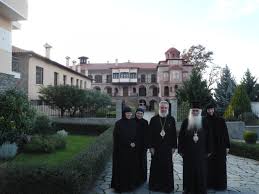
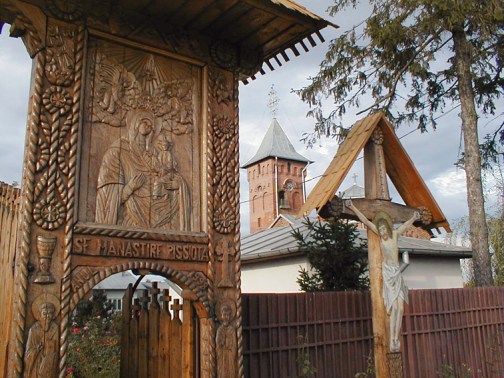
Most hospitable next stop: Mânăstirea Pissiota!

Romanian Monasteries Pilgrimage Mânăstirea Pissiota Orthodox city hermit pilgrimage

Romanian Monasteries Pilgrimage Mânăstirea Pissiota Orthodox city hermit pilgrimage

Romanian Monasteries Pilgrimage Mânăstirea Pissiota Orthodox city hermit pilgrimage

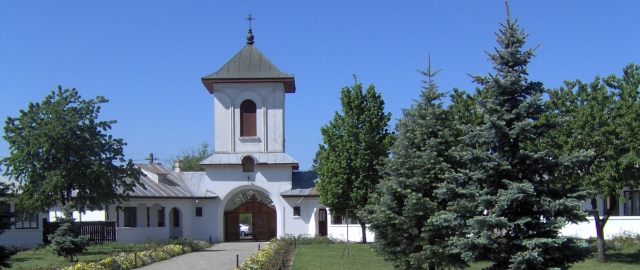
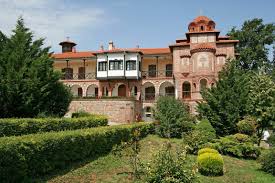
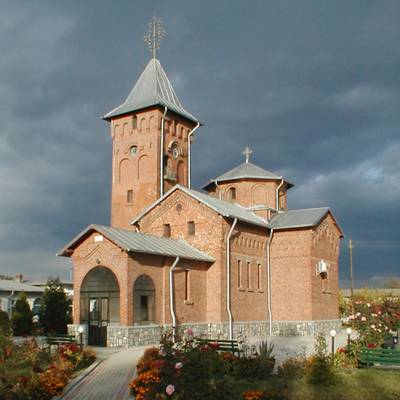
The monastery of Pissiota, located in Poienarii Burchi, was built between 1928 and 1929 by Nicolae Pissiota (1860-1940), a great man of culture, and his wife, Zoe Pissiota (1868-1940), on the estate bought from the family of General Gheorghe Angelescu (1850-1923), an important name in the 1877 war.

Romanian Monasteries Pilgrimage Mânăstirea Pissiota Orthodox city hermit pilgrimage

The first record of the village of Poienarii Burchi dates back to 21st September 1594, on the former „Poeana” estate of Lady Stanca, the wife of Michael the Brave. The village was dedicated by Lady Stanca to the Simonopetra monastery of Mount Athos, in 1594. The original document is kept at the Archives of the State in Bucharest.

Romanian Monasteries Pilgrimage Mânăstirea Pissiota Orthodox city hermit pilgrimage

The engineer Nicolae Pissiota, of Macedonian origin, born in Greece and settled in Walachia, had a huge fortune that allowed him to build this place of worship. The church was designed by the architect Ioan Giurgea – a harmonious combination between Italian Renaissance style and the Byzantine elements that are specific to Romanian churches.

Romanian Monasteries Pilgrimage Mânăstirea Pissiota Orthodox city hermit pilgrimage

Romanian Monasteries Pilgrimage Mânăstirea Pissiota Orthodox city hermit pilgrimage

Romanian Monasteries Pilgrimage Mânăstirea Pissiota Orthodox city hermit pilgrimage

Famous names were called to decorate the church: Costin Petrescu (1877-1954), the one that painted the interior frescoes of the Romanian Athenaeum, or the Cathedral of Alba Iulia, and his apprentice, Gheorghe Eftimiu.

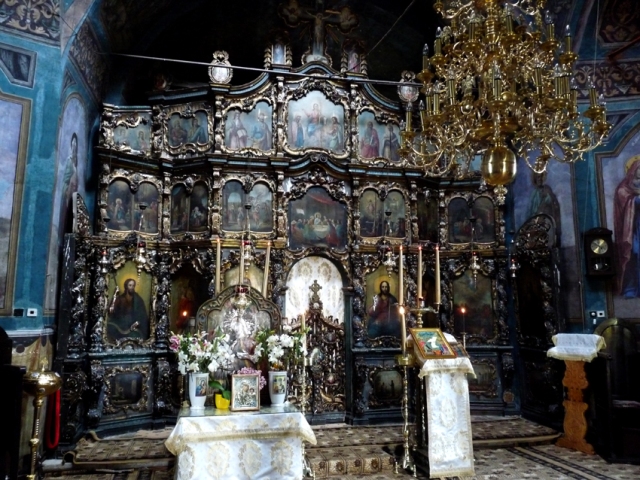
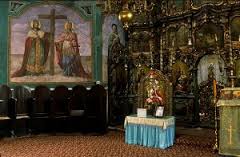
The portraits of the patrons and of the Patriarchs Miron Cristea and Justinian Marina were done by the painter Vasile Rudeanu (in 1956). The iconostasis is carved in rosewood and cherry wood, brought from Greece, creating a balance between sensitivity and detail, influenced by Italian art.

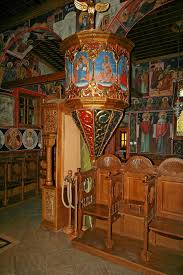
The furniture was carved of oak wood, with ethnic motifs, by the sculptor Anghel Dima, in 1928, the author of Mihai Eminescu’s sculpture in front of the Romanian Athenaeum. The floor is made of red Carrara marble; underneath the church lie the marble crypts where the patrons and their families are buried. Inside the church there are icons and silver icon lights, in Brancoveanu style, as well as triodyons, Pentecostarians and hymn books.

Romanian Monasteries Pilgrimage Mânăstirea Pissiota Orthodox city hermit pilgrimage miraculous icon

Romanian Monasteries Pilgrimage Mânăstirea Pissiota Orthodox city hermit pilgrimage

Romanian Monasteries Pilgrimage Mânăstirea Pissiota Orthodox city hermit pilgrimage

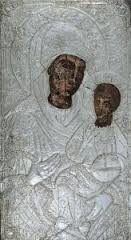
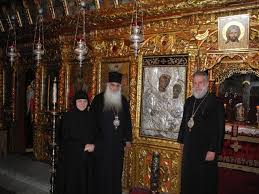
The defining religious element in the Holy Monastery of Pissiota is the Icon of the Holy Virgin with the Child – miracle-working icon. The icon is painted on oak wood, against a background of Byzantine brocade, signed by the famous painter Gheorghe Eftimiu, the apprentice of the great Costin Petrescu.

For two decades after the opening, between 1928 and 1948, the monastery was a monk monastery. In 1948, the Patriarch Justinian Marina transformed it into a monastery of nuns, and this is how it remained until 1962, when it was discontinued. In 1993, after 31 years in ruin, the monastery resumed its community life.

Currently, the monastery is inhabited by 23 nuns and a priest; prayer is in harmony with work, as there are tailoring workshops where priestly vestments and clothes are made, allowing people to add the little money they have for the restoration of the monastery.

Abbess Monahia Ioana Irina Calin


Romanian Monasteries Pilgrimage — Zamfira Monastery

A most spiritually intense summer so far! Full of such dramatic ups and downs! Personal tribulations and divine interventions, violent, ‘rough seas’ in the ‘world’ and hesychastic pilgrimages and retreats in monasteries!

This week I am entering the atmosphere of Romanian Orthodox Christianity and undertaking together with very special Romanian spiritual brothers and sisters a pilgrimage to various, notable monasteries to the south of Romania.

My first stop was the Monastery of Zamfira, famous for its ties with Greek Revolutionary history, and specifically Nicolae Mavrocordat, and for its amazing paintings by the skilful young Romanian painter Nicu Grigoresku.

zamfira1.jpg

This monastic complex is located in the Teleajen Valley, halfway between Ploiesti and Valenii de Munte. It has two churches (monuments of art), a collection of religious art and the cells of the nuns.


The first church (named The Big Church) is located the large yard of the convent. It was founded by Metropolite Nifon and was built between 1855 and 1857 with the aim of transferring the monks from the “Rosioara” hermitage of Filipestii de Padure. The artistic significance of this church is based on its painting, because it is the first church entirely painted by the great Romanian painter, Nicolae Grigorescu, at the age of 18.

zamfira2.jpg


This painting is considered to be unique since it the only one created in “fresco” by Grigorescu. The mural painting and the icons of the iconostasis were completed in an extremely short time, i. e., in less than 14 months.

This painting has undergone several restorations, the last and best one being done between 1986 and 1989 by the painter and restorer, Chiriac Ion. He carefully removed all the repainted portions, hence making the original painting visible once again. It is a remarkable restoration.


The collection of religious art containing objects dating from the 18th, 19th and 20th centuries belonged to the two churches or to the various donors: icons on wood or glass, books of worship, invaluable objects of worship, carved pieces embroideries, etc.


Frescos of the great Romanian painter, Nicolae Grigorescu.

zamfira3.jpgzamfira4.jpg


The chanting of the nuns was breathtaking, the kneeling during its long services surprisingly soothing, a balm to the wounded heart, and the Vespers and Matins services dedicated to the veneration of St. Paisios the Athonite, my patron Saint and spiritual grandfather, incredibly moving! What a surprise to find his Icon and seek his intercessions at the very heart of Romania! Even the strangeness of praying in a language you can barely follow was a special blessing, a long-sought-for emptying, a kenosis, allowing all this silence and deep peace of Christ ‘invade’ you!

Pilgrimage to Mikrokastro Mother of God Monastery

This post has been long due, since Mikrokastro Mother of God Monastery has been my refuge and retreat since 2014, ever since I discovered it, or better ever since our Holy Lady revealed herself to me there.  A most  holy place, a ‘thin’ place I keep returning, especially when badly in need of spiritual nourishment, in times of trials, adversity, tribulations and temptations. This is a place where the Mother of God comforts all her children, a place where its peace invades you and the fellowship of the nuns warms you.


a1a2a4a5a8

a11a15a16a17

Part A: A brief history of the Monastery of the Mikrokastro Mother Of God


The Holy Monastery is dedicated to the Assumption of the Mother of God. According to historians, the main church of the monastery is estimated to have been founded 200-250 years ago. The iconography in the church was completed in 1797 (about 200 years ago), as is shown by the inscription that still exists on the west wall of the church.

a7


The history of this place started with a small chapel in the nearby village of Mikrokastro, but its propitious geographical position as a passing place on the journey from Kozani to Kastoria helped the site become a place of worship. This was mainly due to the presence of the Holy Icon of the Eleoussa Mother of God on the icon screen; it is not known when or under what historical and religious circumstances this Icons was found here.


The miracle-working power of the Icon contributed to the place quickly becoming the most important place of worship in Western Macedonia. According to the inscription mentioned above, the church’s frescoes were painted by iconographers from Kopessovo in Epirus, who, despite Western influence, tried to remain loyal to the Byzantine tradition following the standards of the Konstantinos Palaiologos era. The more popular manner of the depictions does not diminish the sweetness of the facial expression or the comforting feeling instilled in the souls of the faithful.

a9a10a12a13a14

a19


The icon screen of the convent is one of the most beautiful in the region and was made by skilled craftsmen either from the local area or Epirus. The miracle-working Icon of the Mother of God found in and belonging to the monastery dates back to either the 12th or the 13th century according to modern methods of dating holy icons.


The plenty votive offerings to the Mother of God helped the property of the Monastery to increase, and this property was taken care of by workmen inhabiting the area. In 1820 this place of worship was characterized as a Holy Monastery for reasons of prestige because of the presence of the Holy Icon, since it never had a monastic brotherhood. It only had an Abbot appointed by the Bishop of Siatista and an administration Committee.


This Holy place played an important religious and national role supporting the nation’s struggle for independence in 1821, offering hospitality and a hiding place to revolutionaries of the independence struggle, maintaining an ammunition store, paying the salary of the village teacher, and strengthening the inhabitants’ faith so that they could resist the pressure of Islamic proselytism.


The monastery participated in the historic events of 1878, offering moral and material support, in the Macedonian struggle during the years 1904-1908, in the war of liberation in 1912, in the relief of the victims of the Asia Minor disaster, in the epic struggle of 1940-1941 and its climax, i.e. the historic Fardikampos battle in March 1943. The monastery “offered soul, blood and money” offering the sacrifice even of its priest.


After the war, the bishop of Sisani and Siatista, Iakovos Kleomvrotos, (later to become Bishop of Mytilini), a powerful personality of the clergy, realised that the Holy Monastery was a more suitable place for spiritual and social activity than mountainous Siatista.


In 1952 he founded a School of Agriculture here for the farmers’ sons of the area, which, after functioning for two years, closed and was given to the Swiss Red Cross with a view to founding a hospital for local children suffering from glandular problems. In this building a primary school was also set up. In this way, hundreds of local children were helped.


Other buildings at the same location include the boarding school of the School of Housekeeping, which was used as a guest house and later as a home for the elderly. In addition, another building was erected in which his successor – Bishop Polykarpos – founded an orphanage.


Bishop Antonios was elected in 1974, and he showed great interest in the restoration and peopling of the monasteries in the region. In 1981 the position of the Abbot fell vacant and Father Stephanos Renos took over. With the moral, spiritual and material support of the Bishop as well as the contribution of the faithful and well-known donors, Father Stephanos Renos did great renovation work and added new buildings, a guest house and chapels.


In 1993, by a presidential decree, the Holy Monastery was turned into a monastery for women, and some time later the first monastics entered the monastery.


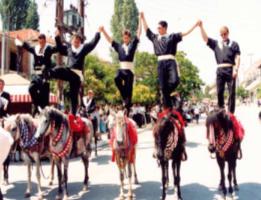
Two noticeable customs have been preserved since the years of Turkish domination. The first is the custom of Horseriding. On the 15th August, a religious festival day, the young men from Siatista armed and riding ornate horses came to the festival to venerate the Mother of God and under the unsuspicious eyes of the Turks the leaders of the struggle talked about the issues concerning the revolution, and the hope of freedom for the enslaved Greeks was strengthened. This custom has been preserved until today and has been incorporated in the whole festive religious atmosphere.

a18


eleousa Mother of god orthodox city hermit pilgrimage retreat mikrokastro horse ridingeleousa Mother of god orthodox city hermit pilgrimage retreat mikrokastro horse riding

The second custom is the carrying in procession of the icon of the Mother of God That is, apart from extraordinary events such as insect epidemics, droughts and illnesses, during which the inhabitants of the area carried the icon in procession around the area to ward off evil, the inhabitants of Siatista have been taking the same icon in procession regularly for centuries now. In all weathers and accompanied by many people of all ages, they cover a three-hour distance on foot holding the icon in their hands until they arrive in their town, where the icon is solemnly received and taken to the cathedral and a prayer is chanted. After this, the Icon is taken to every house and flat. This event witnesses the fact that neither the Mother of God’s grace nor the people’s faith have diminished.

a3

icon procession mikrokastro eleousa Mmother of god orthodox city hermit pilgrimage retreat mikrokastro


The grace of the Mother of God has gathered peace-loving and pious women who have offered themselves to life-long service in the monastery, vowing to find salvation through the basic virtues of monastic life: obedience, chastity, lack of property, prayer, charity, and at the same time trying to achieve the moral elevation of local inhabitants.

The small sisterhood has devoted itself to a struggle for inner order, the restoration of buildings, the organization of worship, tree-planting on the land belonging to the convent, hospitality and spiritual outreach to visitors. The sisterhood sows with patience, cultivates the seeds of the virtues referred to in the Gospel with assiduity, re-baptizes the faithful in the genuine spiritual concepts of the Orthodox Church and the Holy Fathers, interprets the Gospel, comforts the sad and turns the beautiful stone-built monastery into a safe harbour, where people struggling in life can find shelter and relief.


Contact Information:

Mikrokastro, Siatista, Greece

Tel no: +30 24650 71307

To be continued …

Part B: Lessons from the Monastery and Miracles at Mikrokastro Mother Of God to follow soon


Three Old Age Vignettes

Written at my refuge, the Mikrokastro monastery, under Our Lady’s Protective Veil . Watching my father die the last two weeks has been very painful and filled my mind with images of old age and decay.


Three Old Age Vignettes


 Terminal, Temporary, Transcending 


1 Corinthians 2

14 But the natural man does not receive the things of the Spirit of God, for they are foolishness to him; nor can he know them, because they are spiritually discerned. 15 But he who is spiritual judges all things, yet he himself is rightly judged by no one.


1 Corinthians 3

  1. And I, brethren, could not speak unto you as unto spiritual, but as unto carnal, …

3. For ye are yet carnal: for whereas there is among you envying, and strife, and divisions, are ye not carnal, and walk as men?


I. Terminal

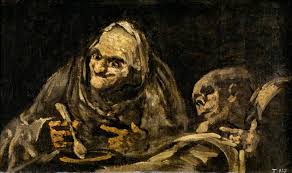
Three Old Age Death Vignettes orthodox city hermit


An Old Man by

C. P. Cavafys (1863-1933)


At the noisy end of the café, head bent

over the table, an old man sits alone,

a newspaper in front of him.


And in the miserable banality of old age

he thinks how little he enjoyed the years

when he had strength, eloquence, and looks.


He knows he’s aged a lot: he sees it, feels it.

Yet it seems he was young just yesterday.

So brief an interval, so very brief.


And he thinks of Prudence, how it fooled him,

how he always believed—what madness—

that cheat who said: “Tomorrow. You have plenty of time.”


He remembers impulses bridled, the joy

he sacrificed. Every chance he lost

now mocks his senseless caution.


But so much thinking, so much remembering

makes the old man dizzy. He falls asleep,

his head resting on the café table.


II. Temporary


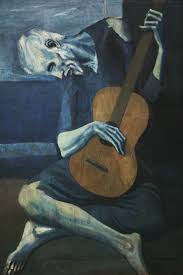
Three Old Age Death Vignettes picasso old guitarist orthodox city hermit


Do not go gentle into that good night

Dylan Thomas, 1914 – 1953


Do not go gentle into that good night,

Old age should burn and rave at close of day;

Rage, rage against the dying of the light.


Though wise men at their end know dark is right,

Because their words had forked no lightning they

Do not go gentle into that good night.


Good men, the last wave by, crying how bright

Their frail deeds might have danced in a green bay,

Rage, rage against the dying of the light.


Wild men who caught and sang the sun in flight,

And learn, too late, they grieved it on its way,

Do not go gentle into that good night.


Grave men, near death, who see with blinding sight

Blind eyes could blaze like meteors and be gay,

Rage, rage against the dying of the light.


And you, my father, there on the sad height,

Curse, bless, me now with your fierce tears, I pray.

Do not go gentle into that good night.

Rage, rage against the dying of the light.


III. Transcending

An Old Man in Christ


The royal doors are open, the great Liturgy is about to begin!


In the pouring rain, our fate

In Your hands, Lord brighten,

We make our way to meet you,

Beloved, across massive puddles

Rising with the tide of excitement.


“Ah, the blameless in the way. Alleluia”


Heart, body, mind and soul

Thoroughly cleansed and washed,

We are determined

To sprinkle Joy on your grey day,

Be your Guardian angels For a while

And hold off dark clouds

Of abandonment.


“My soul is worn with endless longing. Alleluia”


At the door, your quiet Strength surprises us!

An enchanting infant’s smile, behold!

You Beam our welcome,

Appropriately Toothless!

Are you, old friend, but a year old?


“Lord, I am become as a bottle in the frost. Alleluia.”


Head bent, hands crossed

The epitrachelion wraps gently

Emasciated shoulders, frail, stooped.

Humbly you whisper to Father

Your Confession, Taste Loyal Servant

The Fountain of Immortality

Invisible choirs accompany our poor hymn!


“Call me up to You, O Savior, and save me. Alleluia.”


You live alone, at your 93,

Even climb, dear, bedroom’s stairs steep!

Yet Angels and Saints keep you company

In the lonely path to Christ.
 
Christ before wife, mother and child, you put
 
Grace is free but discipleship is not cheap.


“The sheep that was lost am I. Alleluia.”


World wars have feared

Your Faith’s strong fortress,

Violently, you took the kingdom, by force.

Ravenous wolves failed

To lead you astray, the one pearl of great price

You unearthed, All that you had

You sold and bought.


“The Choir of the Saints has found the Fountain of Life.  Alleluia.”


What a living icon you are!

Like your faded with candles kissed

In your icon corner, full of Grace and Light

Painstakingly you commemorate,

Day-to-day, a long, tattered names’ list.


“Image am I of Your unutterable glory. Alleluia.”


You may be old, feeble and frail,

Yet your zeal and bright courage

Shames us all,

Amidst peppermint and cakes

His wonderful acts prophetically you proclaim,

The Spirit lifts you up,

To generations to come.


“Though I bear the scars of my stumblings. Alleluia”


Old Brother, toothless, we implore you in Christ,

Begging on your knees we sinful, beseech,

Under your roof, unworthy we pray

Just a little more while, abide with us,

Please stay, bless, to Heavens reach!


“Lead me back to be refashioned. Alleluia.”


Meek Humility, shine upon us,

Grace abundant your poor children enthuse!

What matters is the soul not the sole,

Bless us, Bless us, Guide us in judgment

You have inherited the Earth indeed.

Even if you’re wearing odd shoes!


“Into that ancient beauty of Your Likeness. Alleluia.”


The Pentecost icon


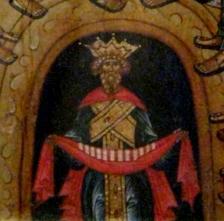
Every year I discover new ‘details’ in the Feasts’ icons. This Pentecost what caught my attention was the old king at the bottom of the Pentecost icon, mysteriously in a small semi-circle.  The more I studied the icon though, the more questions came to my mind. What is St. Paul doing here, since we know he became an Apostle after the feast?! …

pentecost icon.jpg


The Icon for the feast of Pentecost is also called the Descent of the Holy Spirit, as it is a depiction of the event described in the Book of Acts (Acts 2:1-4) when the Holy Spirit descended as tongues of fire upon the Apostles gathered together and enabled them to preach in different languages. However, the Feast of Pentecost is not only the commemoration of an historical event, but a celebration of a present reality: the presence of the Holy Spirit in the Church. Likewise, the Icon for Pentecost is much more than the depiction of a past event.

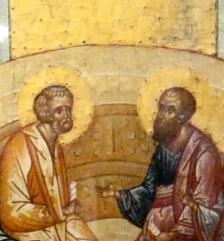
pentecost St Peter and St Paul Uncreated Church

The presence of the Apostle Paul in the icon, even though at that time he had not yet converted on the road to Damascus, hints that this icon is more than a purely historical picture. Sometimes, the evangelists Luke and Mark are also shown, despite also not having been present in the upper chamber at Pentecost. The gathering, then, is a representation of the Church. The Apostles are seated in a semi-circle, representing a unity and harmony similar to that found in Icons of the Holy Trinity. As in icons of the Holy Trinity, a semi-circle, rather than a full circle, is used so that we as observers are drawn into the unity.

pentecost Descent of the holy spirit orthodox pilgrim uncreated Church

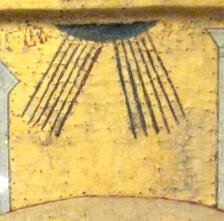
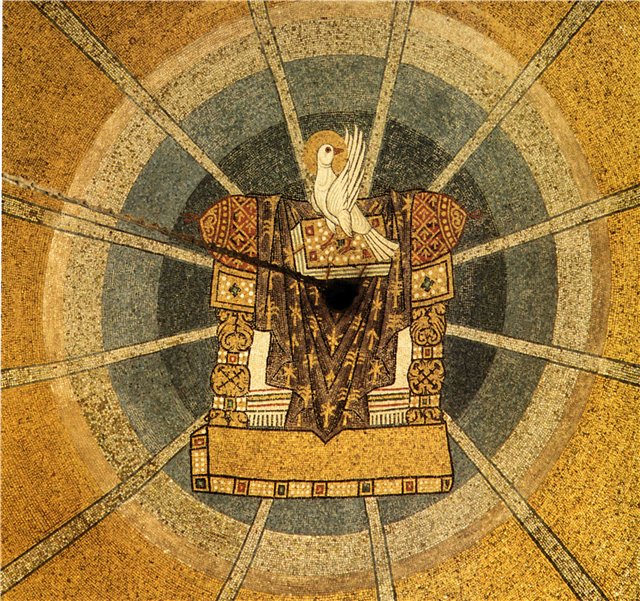
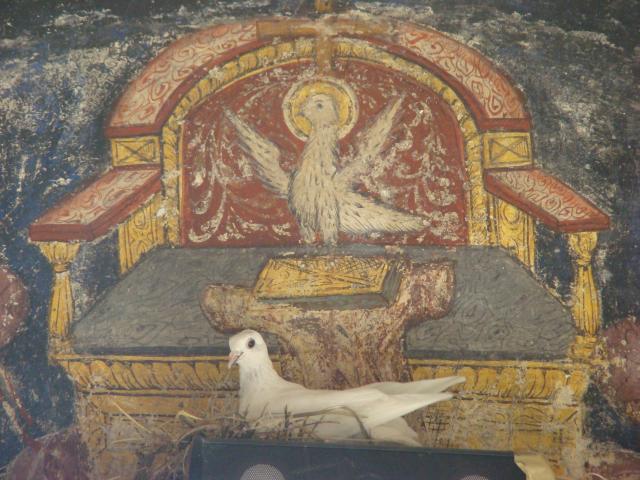
The source of their unity is in another semi-circle at the top of the icon, showing the descent of the Holy Spirit. From the blue semi-circle (c.a. mandorlas) a single ray of light for each of those gathered shines down to illumine them. Sometimes the “tongues of fire” described in Acts are shown at the tips of the rays, ready to descend upon the Apostles. Other times, the tongues of fire are shown already within the halos of each of the seated Saints. Some icons of Pentecost show a dove, either within the mandorla at the top of the icon, or even descending upon those gathered in the upper chamber. Given the appearance of the Holy Spirit as a dove during Christ’s Baptism, it is understandable that this physical image of the Spirit is also used in Pentecost icons. However, the Holy Spirit appeared as tongues of flame at Pentecost, and a dove at Christ’s Baptism, being – in reality – neither of these things. Therefore it is inappropriate to depict the Holy Spirit as a dove at Pentecost, or indeed in any icon except those for the Theophany feast.


pentecost orthodox pilgrim the world and the Uncreated Church


At the bottom of the Icon is another semi-circle, showing an old king against a dark background. He is often named as Kosmos and represents the world. He is crowned as a symbol of earthly authority – i.e. he represents all the peoples of the world, rather than the whole of creation. He is sat “in darkness and the shadow of death” (Luke 1:79), and is aged to show the corruptibility of the world. Yet he also holds a blanket containing scrolls representing Apostolic teaching (compare with the scrolls held by the Apostles in the Icon itself and “the meaning of objects held by saints in icons“). Though in darkness, the descent of the Holy Spirit has not only reached the Apostles, but also all corners of the world into which the Apostles will preach the Gospel. The Empty Seat A striking aspect of the Pentecost Icon is the empty space at the centre, between the Apostles Peter and Paul. This central seat is a place of honour, the “Teacher’s Seat” around which the Apostles are gathered. Why is it empty? Because it is the seat Christ should be sitting in, Who has ascended physically into Heaven. Yet Jesus promised many times that though He would leave them physically, He would instead give to them the Holy Spirit as a comforter, advocate, and guide. This promise was first realized at Pentecost, and is still true today. Therefore, the Icon, which is also an Icon of the Church, shows the Apostles gathered in unity, sustained by the power of the Holy Spirit, surrounding Christ Who is invisibly present. The world, Cosmos, is at their feet, ready and waiting to be harvested through the passing on of Christ’s teaching.


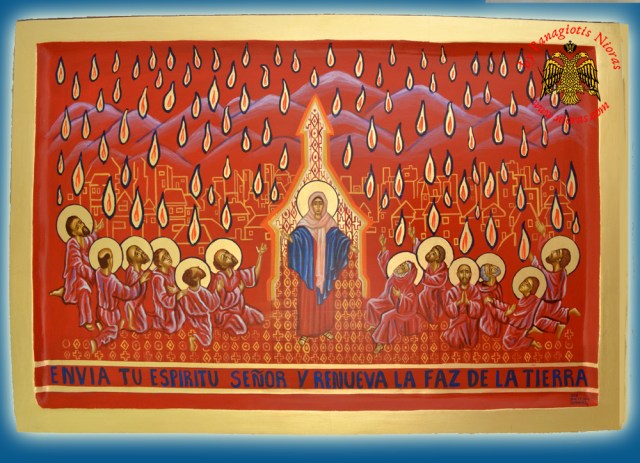
Some icons of Pentecost show Mary the Mother of God in the centre, occupying the “Teacher’s Seat”. Surviving icons of this sort are usually western (the above comes from the border between Finland and Russia). Mary was present at Pentecost, though as already mentioned, the icon is not primarily a historical snapshot of the event. The Theotokos’ presence in the centre is not problematic though, as she is the ultimate exemplar of a Christian. With Jesus Christ ascended into Heaven, the Holy Spirit acts within people, and through the Saints Christ is manifested in the world. Mary is therefore shown in the “teacher’s seat” as the best example we have, and the person on earth who most resembled Jesus Christ (both physically, as His mother, and spiritually as His disciple). Nevertheless, the “empty” seat is a more widespread and, I believe, more impressive image of both Pentecost and the Church. The Apostles are seated as equals, with no individual among them taking the central seat of authority. They don’t need to. Their unity as the Body of Christ is sustained through the real “Vicar of Christ”: the Holy Spirit.


Blessed are You, O Christ our God, who made fisherman all-wise, by sending down upon them the Holy Spirit, and through them, drawing all the world into Your net. O Loving One, glory be to You. (Apolytikion for Pentecost) More About the Feast of Pentecost>>


Source: Pentecost Icon as an Icon of the Church

The Comforter

Fascinating homily in its breadth and depth! Like all by Metropolitan Anthony of Sourozh. In it you may meditate on Nature, God’s Creation, God’s Energia in His CreationThe Little Prince by Saint-Exupery, three-fold etymology of ‘Paraklitos’, Conversion, Betrayal and Apostasy narratives, Faith and Loss of Faith, C. S. Lewis, the difference between Art and Mankind, a beautiful statues and human ‘wreckage’, Father Sergei Bulgakov’s theology, a bold, ‘heretical’, ‘syncretistic’ worship during a World Council of Churches meeting, and so much more. Enjoy!

‘The Comforter’: Our Support and Strength for Mission

I feel more than slightly apprehensive, giving this talk in the background of a very theological theme. And so, you will forgive me, if my theological statements are untheological and if the rest is very different from what you may expect.

First of all, may I make a totally non-theological statement about the Holy Spirit? When we speak of the Trinity, for people as primitive as I am, we can imagine that the old image, given centuries ago, still holds, and we can develop it on one point. Speaking of the Trinity, trying to understand the relation there is between the Father, the Son and the Holy Spirit, some writers have said that we can compare God to the sun in the sky. In its mystery, the sun is unknowable as such. No one of us will ever be able to participate in the nature of the sun, but it becomes accessible to us in its light and warmth. The light is something which we perceive with our senses, by sight, and which reveals to us everything that surrounds us. We do not see the light as such, but it is in the light that things are revealed to us. The warmth of the sun is the way in which He pervades us, and in which we can become participants — to whatever degree is accessible to us — in the life of God.

Christ the Word is an objective revelation of God. The Spirit reaches us only within our experience, in the way in which the warmth of the sun pervades us and we become aware of it, and through it of something which is of God. This is a non-theological introduction to the subject.

As an illustration of this, I would like to give you an example of a contemporary of mine, who had discovered his faith in God through an encounter with Christ. But he puzzled and puzzled about the Holy Spirit. He did not understand. One day, he found himself on a bus. It was in Paris, around the theatre of the Odeon, and he was saying to himself or to God: ‘But what does the Holy Spirit do to us? How can I know that I have had some sort of contact with the Spirit of God?’ And of a sudden he felt he was, unexpectedly to himself, filled with a love of the creation and of the human beings that were surrounding him, in a way in which he had never known he could. And he realised that, at that moment, the Holy Spirit had come to him and made him partake, to the extent to which he could, in his immaturity perhaps, in Love Divine. At that moment, he knew something about the Holy Spirit: that the Holy Spirit was communicating Himself to him by communicating to him something which could not be invented or forced, even out of his human experience.

The Holy Spirit comes to us quietly; at times unexpectedly, at times as the result of a long longing. Some of you may have read a book called The Little Prince by Saint-Exupery. There is a passage in which the Little Prince meets a little fox. Both the Little Prince and the little fox are attracted to one another, but both are desperately shy. The little fox comes and sits down at a certain distance, but whenever the boy makes a movement towards it, it runs away. Then one day the little fox says to him something like: You know, we both long to come to one another, but we are shy and afraid. So when I come, don’t make the slightest move. Look askance, so that I may imagine that you have not noticed my presence. And, not being afraid of being watched, I will come a little nearer than the day before, but don’t turn to me, because I will be afraid and run away. And then, another thing,’ he said, ‘I long to come close to you. And so, let us fix a time when you will come, because then — oh, a good hour before the time — I will know that you will be coming. I’ll come myself and wait. And I shall be filled with this expectation of the moment when you will appear. And then you will sit down and, as I said, pay no attention to me, and allow me to come nearer, and nearer, and nearer.’ This image of the little fox is something that, to me, resembles very much the way in which we relate to the Holy Spirit. Christ comes to us, proclaiming the truth. He is the Truth; He is the One who Is. He is a revelation, an unveiling. The Holy Spirit, in this sense, is not a revelation. He is the one who makes the revelation possible, by making us commune with what is the essence of this revelation: the closeness and the knowledge of God.

If we turn to what we hear in the Gospel about the Holy Spirit, I would like to attract your attention to one passage — to a word rather than a passage — that we repeat time and time again in our prayer: the Comforter. ‘Comforter” is the English translation of the word. When we look at the various languages into which it has been translated from the original, I think we can see a variety of facets in the event. First of all, the Holy Spirit, whom the Lord Jesus Christ sends us, is the one who consoles us for our loss of Christ. I am speaking of the loss of Christ, because each of us believes in Christ, each of us has had an experience of His closeness, His presence. Each of us has had, through His teaching, an experience which He conveys to us in word and in person. But, with the Crucifixion, the death of Christ and the Resurrection and Ascension, He is not present as He was present to His disciples, and He is not present in the way in which He will be present to us when all things will be fulfilled. You remember, probably, the words of Saint Paul, when he says: As long as I am in the flesh, I am separated from Christ. And yet — Christ is my life. And we are all, to a lesser degree than Paul was, of course, in the same kind of situation. On the one hand, Christ is our life; on the other hand, we are still separated from Him. We all long to be with Him, but we cannot go beyond a certain point of closeness. And Saint Paul points it out, when he says that, as long as he lives in the flesh, he is separated from Christ, and he longs for death to come. Not as an end of his earthly life, but as the moment when a veil will be torn apart and, as he puts it, he will know as he is known. He will see face to face what he can see yet only as shadows and images mirrored.

823-600x459

The Holy Spirit reveals Himself to us as our Consoler. In the sense that Christ has promised to send Him to us, He comes to us. He gives us an incipient participation in a closeness of communion with Christ, and through Christ, in Christ, with the Father. So that this is our first experience. His closeness to us consoles us for the fact that we long to meet Christ face to face, to commune with the Father in a way unutterable to us.

But the word goes beyond this. He is not only the one who comforts us; He is the one who gives us strength; strength to live in this orphaned situation in which, on the one hand, we belong to God wholeheartedly, sincerely, heroically at times, and on the other hand live in a world that has fallen away from God and in which we have a function to fulfil. He is the one who gives us strength to live in the world which at times denies everything we long for, which stands between us and our fulfilment by temptation, by beguilement.

At the same time, there is a third meaning in the word. He is not only the Consoler. He is not only the one who gives us strength to face life, in the faith and yet in the partial absence of Christ. He gives us the exulting joy of being with Christ already in this world, because, although our communion with Christ is imperfect, although it is not all-embracing, although we do not know Him as He knows us, we do know Him. And this is a miracle that we could not appreciate if we were born, as it were, in a believing family and if we had been given our faith together with our birth. But those of us who were unbelievers, the millions who believed not and have discovered, know the exulting joy of this discovery of God in Christ and through Him, of the fatherhood of God’s own Father. So that, in the Holy Spirit, we have consolation because we are orphans. We are sent into the world to conquer it for God. And in the process, at moments, we are given a sense of incredible closeness, and we can be astounded and rejoice in the way in which the young man whom I mentioned in the beginning rejoiced, having been filled, in an unutterable manner, with a love he did not know could exist; not only for humanity, not only for every concrete human person, but for the whole of creation.

We are told by Christ that He will send the Spirit to us, who will lead us into all truth. ‘All truth’ is not an intellectual situation. It is not the knowledge of the mind; it is an experiential knowledge. The truth (in Russian istina) is what is: I am He who is. And the knowledge of the truth can only be possessed in communion with Him who is. In a strange way, we have lost through the centuries this certainty that this is what the truth is. It is God Himself; it is the absolute Reality. Pavel Florensky, speaking of the truth, says: ‘Istina — eto Estina’ — the Truth is what is!’ ‘I AM’. And strangely enough, because we have moved knowledge of the truth from this existential experience onto an intellectual level, we feel that we must fight for the truth and defend it, forgetting that the Truth cannot be destroyed by any created power. The Greek word aletheia means ‘what cannot be washed away’, annihilated, even by the waters of the River of Oblivion. Nothing can do it!

If we continue to dwell on words, we could remember that the words verity, veritas, Wahrheit, derive from a Latin word meaning ‘to defend’, not ‘to be defended’. The Truth can defend us against everything, and it does not need us to defend it. This is a very important point with regard to our mission in the world, because it means that we are sent to proclaim it and reveal it, but not to defend it in argument. We cannot defend the Truth by argument. We can present another facet of things, which people can accept or not, but we cannot always defend it in the way it should be defended. I remember when I was young and began to do youth work, my father saying to me: ‘Proclaim the truth and be to people a vision of it, however dim, but do not try to convert anyone by argument, because, if you prove to be more intelligent, more well-read than another person, you will be able to defeat the other person, but you will not have changed his life. And I remember an occasion, a case in the comparatively recent history of the Russian Church in Stalin’s time. A young man called Evgraff Doulouman, who was a student at university, was looking for digs. He found a room in the house of the local parish priest. The priest was mature, ageing, with a deep and tragic experience of life: of the beginning of the Revolution and of the persecution that followed. The young man was full of his atheistic convictions, and he decided to convert the priest to what he believed to be the truth, and they engaged in conversation and discussion. The priest was an old and wise man. He did not argue point by point, but unfolded before the young man the truth as he knew it. The young man was not mature enough to go through the experience that was offered him, and he made it into an intellectual world-outlook that defeated, completely annihilated, his atheistic vision. Having been dialectically defeated, he embraced the Christian faith, asked for baptism, went to study theology in Zagorsk, was brilliant as a student, was ordained deacon and priest and was sent to Samara, I think, to a parish. It was expected that he would be a brilliant missionary, taking into account the way he had moved from refined, deep atheism into a powerful sense of Christianity. When he was in the parish, this young man discovered — in the celebration of the Liturgy, in the sacraments, in his pastoral work — that he could present the Christian truth in words, but he did not believe it all in his inner self. After a while, he renounced the Church and became an active agent of atheist propaganda. I give you this example to underline the fact that it is not in the refinement of argument in debate that one conveys one’s faith.

In the course of the whole history of Christianity, you meet people who are filled with the Holy Spirit, and whose life, whose person, whose words, in their simplicity reached others, hit them at the very core of their being and brought to life a knowledge of the divine that had been dormant. It has been for many as though the knowledge of God was like Lazarus: dead, lying in his grave, who suddenly heard a voice saying: ‘Lazarus, come out!’ And the knowledge of God, an experience that was conveyed by having heard God speak to him, made all the difference. And so, when we speak of the Holy Spirit as being the Spirit of truth, it is not the spirit of formal theological discourse or of any formal thing divorced from the inner experience. Unless it is sustained by this inner experience, it may be a convincing argument but it will not be a power that can transfigure the life of another person.

We are sent into the world to proclaim Christ, but we are not sent into the world to argue about Him. In 1943, C. S. Lewis gave a series of addresses on the English wireless, and in one of them he asks: “What is the difference between the believer that has become alive in God and any other human?’ And he says: The difference can be compared to that which there is between a statue and a living person. A statue may be of supreme beauty, but it is nothing but stone or wood. It can be looked at and admired. It can send us a message of beauty, but not of communion. This beauty will be communion with something earthly, created, but not beyond. Something must happen that will make it of the ‘beyond’. A human being may be infinitely less beautiful than a statue, but it is alive.’ And C. S. Lewis says: “When someone meets one of those statues that have become a living person, he should stop and say: “Look, this statue has come to life!” ‘ This is a challenge to each of us, because we may be satisfactory statues, but are we the kind of people whom others meet, look at and discover that there is life there and not only a shape?

It is very important for us to realise that our message to the world is not a world-outlook. It is a revelation of the presence of the Holy Spirit and of Christ. The Church is a mysterious Body, because the Church is the presence, in the midst of the fallen world, of the fullness of the divine Presence. The first member of the Church is He whom Saint Paul calls the Man Jesus Christ. He is one of us, as well as being, if I may put it that way, one of Them. He is not only One of the Trinity; He is one of humanity. Looking at Him, we can see what it means to be both totally man, human, and totally and perfectly divine. Since the Ascension and the Feast of Pentecost, the Holy Spirit has indwelt the Church totally, filled it with His presence. In the Spirit and in Christ, the whole Trinity is present in the Church. Are we Christians, Orthodox Christians, aware of this? Or is the Church a human body that looks Godward, that believes in God, that has evolved a very elaborate theology, but whose members are not limbs of Christ — as Father Sergei Bulgakov puts it: ‘an extension of the Incarnation’? Are we ‘an extension of the Incarnation’? Does anyone, meeting us, stop a minute and say: ‘In this person, there is something I have never met before. Here is a human shape, but there is something beyond it.’

I think I have mentioned a personal example which I will dare mention again. I came once to the church that became my parish for years in Paris. I aimed at being present at the Vigil, but for one reason or another I was late. The service was over. It had taken place in an underground garage, that led to ground level up a wooden staircase. I entered, and saw that everything was over. Only, there was a man coming up the stairs. It was a monk, in monastic garb, and when I looked at him I felt that I had never in my life met such total inwardness, such serenity, such peace and depth. I did not know who he was. I came up to him and said: ‘I do not know who you are, but would you become my spiritual father?’ This is a sort of central experience I had of a person in whom I saw something I had never seen to that extent: this total inwardness in the abiding presence of God, the Spirit at work, and the Incarnation in him. Years later, I received a little note from him, saying: ‘I have experienced the mystery of contemplative silence. I can now die.’ And three days later, he died. This, to me, was an example of what a Christian can be. He was not ‘impressive’ in any respect. He was not a man of superior education or of an outward holiness, but in him I could see the Incarnation and the presence of the Spirit.

When we look around, do you realise the kind of world in which we live? Bishop Basil must have talked to you about the presence of the Holy Spirit in the created world. At the moment of creation, the Holy Spirit was hovering over the newly-created world. This newly-created world, in translation, is called ‘chaos’. When we think of chaos nowadays, we think of destruction, the chaos that followed the bombing of Dresden. But chaos is something much more essential and deeper. Chaos is the sum-total of all the existing possibilities that have not yet found a shape and blossomed out. The Holy Spirit was breathing over the chaos, over all the possibilities of a world that had been called into being and had no shape yet. By breathing over this chaos, the Holy Spirit was bringing to life all its possibilities, and everything that was hidden as the possible began to emerge as reality, as you can see in the beginning of Genesis. But God did not force the shapes. He initiated the possibility for the creation to become itself more and more; to expand in depth, and in width, and in every respect

Things changed with the Fall. But what had been given first was never taken away; the created world is still that world which God created. If it is distorted, it is not because it has turned away from God, but because its guide, man, has turned away from God, has lost his way and has proved incapable of helping this chaos to become the perfect cosmos: beauty in form, in line and life, so that the world in which we live is the world which, in itself, is pure of stain except for the distortion that we have created in it. When we look at the surrounding world, we must be aware that everything that is monstrous, frightening, ugly and distorted in it is our doing. To apply to the generality a phrase that was spoken in a particular situation, one of the Fathers says: “We must remember that what we call the sins of the flesh are the sins that the spirit inflicts on the flesh. The flesh is pure.’ We make it a victim of sin. Our body says: ‘I am hungry.’ Our imagination says: ‘I want to delight in such-and-such foods.’ The natural situation of the created world is that of a victim of the human fall, of our being separated from God, of our being unable to restore, even in a small patch of land, the purity, the wholeness and the harmony that belong to it by right. This we must remember. With what veneration must we look at the cosmos and everything that is the material world around us, and what broken-heartedness we must feel when we see it distorted, broken, ugly and monstrous at times.

Again, when we turn to God, to God’s revelation and the creation of man — the Lord God breathed His own breath into man: that is the original human, the anthropos, the chelovek, and man, the total man, has remained filled with the Spirit of God. We must remember this: it is not our Christian, our Orthodox, privilege to be such. All human beings are such. Sinful, yes, but basically such. And so, when we look round at all human beings, we have no right to see good in some and evil in others. We must see victims of the human fall in one and the victory of Christ in the Spirit in the other. The saints are examples of this victory. To them, to the extent to which it is possible in a world which has not yet come to the parousia, to its end in Christ’s victory, we find, incipiently or still-surviving, true humanity. And this we must remember when we deal with whomever we deal with. Some people are ‘evil’, yes. But why are they? Have we given them newness of life by being a revelation of Christ and a gift of the Holy Spirit? It is easy, perhaps, at times to be compassionate to a person in error, but how easily do we condemn the error from the height of what we imagine to be the truth as we know it!

I have paid some attention, in the course of the last seventy years or so, to the beliefs of men, to the religions of the world. What strikes me more and more is that, however different they are from the faith of Christianity, they are all a distortion of the truth; not a straight lie against it, except for some who have chosen to be servants of Satan and not servants of Christ.

I would like to keep you a little longer than I intended: my forty-five minutes are just over. If you will allow me ten more minutes, I will let you free.

437

Many years ago, I had a conversation with Vladimir Lossky about oriental religions. He was absolutely in denial of any knowledge, any true knowledge of God, in them. I did not dare argue with a theologian of such magnitude, but what courage could not achieve, I thought cunning might. As we lived across the street from one another, I went home and copied eight passages from the Upanishads, the most ancient Indian writings, went back to Lossky and said: “Vladimir Nikolayevich, I have been reading the Fathers, and I always take down the passages that strike me particularly. I always put down the name of the author, but alas, with these eight quotations I cannot find the author’s name. Could you identify them for me?’ He looked and said: ‘Oh, yes!’, and within a minute and a half he had put eight names of the greatest Fathers of the Church under the quotations from the Upanishads. And then cunning revealed itself in false humility, and I said to him: ‘I’m afraid I have deceived you. These are from the Upanishads.’ He looked at me and said: ‘Really? Then I must read them.’ And that was the beginning of a change of mind in him with regard to the statements of other religions.

Many years ago, in 1961, I was part of the first Russian delegation to the World Council of Churches in Delhi. Among a number of us, there was a man called Father Ioann Wendland, who later became a bishop in America and in Germany. He had been a secret priest in Siberia while doing geological research during the Stalin period. We decided to go to a pagan place of worship, to see and to try to understand. We arrived there. At the door, we had to take our shoes off, which we obligingly did, and we were about to leave them there when the warden came up to us and said: ‘Oh no, sir, you do not leave your shoes here. They are new and good, and would be stolen. I’ll put them in my office.’ So our shoes went into the office and we went into the place of worship. It was a round place of worship, divided into ten or twelve sections, and in each of them there was what we would call a pagan denomination, worshipping in its own way. We sat one after the other in the ten or twelve compartments, at the back, using our rosaries and praying the Jesus Prayer, trying to commune with God and seeing if we could commune with the people there. We both came out of it with the certainty that, whatever they called their god — whether it was the god-elephant or the god-monkey or another — they were praying to the only one God there is. And we had communed in prayer with them all, in spite of the fact that, on the surface, they had been praying pagan prayers to idols. That also made me think.

I will end your torment with one more thing. What I have said should make us much more understanding and attentive in our attitude to unbelievers. Not those who are empty of belief but those who are actively godless. I will give you one example, which some of you must have heard from me, because I always repeat myself. The example is this: I was coming down the steps of the Hotel Ukrainia a number of years ago. I was wearing my cassock, as I always do. A young man came up to me and said: ‘I am an officer in the Soviet Army. You are, I presume, a believer, dressed as you are.’ I said: Yes.’ Well, I am an unbeliever. Bezbozhnik (I am godless).’ I said: That’s your loss.’ He said: ‘And why should I turn to God? What have I got in common with Him?’ I said: ‘Do you believe in anything at all?’ Yes,’ he said, ‘I believe in man and in humanity.’ I said: ‘In that, you and God share the same faith. Start at that point.’ And, I think, more often than we do, we should be aware that there is no-one who lives without a faith, without believing in something. And more often than not, we may discover that God believes in the same. Only better, deeper, more perfectly, but that this person who fears that there is nothing between God and him has something in common with Him. At this point, we may remember the passage of the Gospel in which Christ says to Nicodemus: The Spirit blows where It chooses, and no-one knows where It comes from and where It goes.

We must be infinitely reverent when we look at the world that surrounds us, which we have distorted and which suffers like a martyr under the result of human sin, and remains pure, so pure that God could become man and put on flesh; a flesh He inherited not only from the personal saintliness of the Mother of God but from the fact that she was the heir of all the saintliness of thousands of years of human life in history. We must remember that all humans are possessed of this breath of life which is God’s breath and God’s life, however distorted it may be. We must remember, as I have said, that the Spirit blows where It chooses. Without this precondition of the way in which the world, mankind, relates to God, no-one — no one of us and no-one in the world — could discover God. It is the Spirit that reaches us and that kindles in us life eternal. So, when we speak of being sent into the world, we must remember that we are unworthy messengers of a message that may be received by the created world around us, and by the humankind around us, better than we are capable of proclaiming it.

How often it happens that words of truth are said that do not reach the congregation that is there, but reach someone who by accident, or by an act of divine Providence, has entered the church. We must remember this. And go into the world, not to proclaim a theoretical theology of the mind but to grow into the life of Christ, to open ourselves to the action of the Holy Spirit, to believe that the Holy Spirit is active in the created world which is dear to God. Dear to God, because the Body of Christ belongs to this created world through the Incarnation, and to mankind — to everyone.
‘Violent’ Spirit — Viaia Pnoi

It has been such a  hectic week with me returning hastily back ‘home’ due to the sudden deterioration of my Father’s condition! A glorious week too, full of the honouring of the Holy Spirit in so many church services, the climax of the Orthodox liturgical cycle: Pentecost and the Descent of the Holy Spirit!


Giver of life: come, and abide in us


holy-spirit3


Then Father Seraphim took me very firmly by the shoulders and said “my son, we are both at this moment in the Spirit of God. Why don’t you look at me?”
“I cannot look, Father” I replied – “because your eyes are flashing like lightning – your face has become brighter than the sun, and it hurts my eyes to look at you.”

“Don’t be afraid” he said, “at this very moment you yourself have become as bright as I am. You yourself are now in the fullness of the Spirit of God; otherwise you would not be able to see me as you do.”

Then – bending his head toward me, he whispered softly in my ear: “thank the Lord God for his infinite goodness toward us… But why, my son, do you not look me in the eyes? Just look and do not be afraid; the Lord is with us.” (St Seraphim of Sarov and his encounter with Nicholas Motovilov)

holy-spirit2

Let us bow mystically to the Comforter and listen attentively to a fascinating testimony by a fascinating ‘convert’: Father Michael Harper. Crystalline Orthodox insights, such as probably only ‘converts’, or at least, they more often than ‘cradle’ Orthodox, may provide. 


And from the days of John the Baptist until now the kingdom of heaven suffereth violence, and the violent take it by force. (Matthew 11:12)

And suddenly there came a sound from heaven as of a rushing mighty wind (ie. “Kathaper feromenis Viaias [Violent] Pnois”), and it filled all the house where they were sitting. (Acts 2:2)

“Kathaper feromenis Viaias Pnois” — Violent is truly the proper translation of the original Greek word, not just ‘mighty’!


“Most will agree that the Church which through the centuries has most fully honoured the Holy Spirit, and brought Him most fully into its worship, life and ministry has been the Orthodox. Let us look briefly at five areas where this is clear:

First, there has been the strong emphasis in the whole life of the Church on the Trinity, which sees the Father, the Son and the Holy Spirit as co- equal. The Church has also condemned the insertion by the Western Church of the filioque clause into the Nicene-Constantinople Creed, which weakens the co-equalness of the Persons of the Trinity.

Secondly, the Orthodox Church has always emphasised the Incarnation and thus the work of the Holy Spirit in the conception of Christ in the womb of the Theotokos, the God-bearer.

Thirdly, the Orthodox Church has been the only Church to continue the practice of Christian baptism as the three-fold immersion of the candidate in water, followed immediately by chrismation symbolising the reception of the Holy Spirit and followed then by the candidate receiving their first communion. Again the Holy Spirit is active in the whole Baptism process.

Fourthly, in the Orthodox Eucharist (of St John Chrysostom), which is seen by the Orthodox as the heart of the Church, the service is interspersed with many references to the Holy Spirit. It begins, for example, with a prayer to the Holy Spirit which is unique in liturgical practices:

O heavenly King, Comforter, the Spirit of Truth, who art everywhere present and fillest all things, Treasury of good things and Giver of life: come, and abide in us, and cleanse us from every stain, and save our souls, O good One.
 

http://pemptousia.com/video/fr-michael-harper-the-holy-spirit


In the Russian tradition the following words are spoken by the Priest just before the Epiclesis: “O Lord, who at the third hour didst send down upon thine apostles thy Holy Spirit: take not the same from us, O good One, but renew him in us who pray unto Thee.”

Then follows the important epiclesis prayer which the Priest says, “send down thy Holy Spirit upon us and upon these gifts spread forth.” Notice it is a prayer for the Holy Spirit to come upon the people as well as the bread and the wine. Earlier in the service, if there is more than one Priest at the service, a dialogue takes place:
Pray for me, brother(s) and concelebrant(s)
May the Holy Spirit descend upon thee and the power of the Most High overshadow thee
May the same Spirit serve with us all the days of our life.

In another place the Priest prays that “the power of the Holy Spirit” will enable him.

holy spirit1.jpg

Fifthly,… For the rest of the article, go here

For an interview with Father Michael Harper, go here

The Mystery of Tomorrow

A dear sister in Christ, a nun in a Greek monastery, recommended Mother Gavrilia’s book to me a month ago, to study again, and draw inspiration and courage and faith in my poor, little missionary endeavours, by that Missionary and Unmercenary Giant. I am so grateful for this Holy Mother and her book. I have had it for many years and read it many times. Each time it goes deeper, deeper. I am reading this again after many years of traveling and the book was packed away. She always, through the message of the Holy Spirit-alive in her, has a word or two about my/your struggles. Especially now. I feel her so close to my side. Mother Gavrilia is such a role model in her fearlessness, her humility and obedience to God’s Will, her dedication to the service of all mankind, her Faith! May we have her blessing!


A poem in the book touched my heart so deeply: 


THOU HAST made me known to friends

whom I knew not.

Thou hast given me seats in homes not my own.


Thou hast brought the distant near

and made a brother of the stranger.

I am uneasy at heart

when I have to leave my accustomed shelter;

I forget that there abides the old in the new,

and that there also thou abidest.


Through birth and death,

in this world or in others,

wherever thou leadest me, it is thou the same,

the one companion of my endless life,

who ever linkest my heart

with bonds of joy to the unfamiliar.


When one knows thee,

then alien there is none,

then no door is shut.


Oh, grant me my prayer

that I may never lose the bliss

of the touch of the one

in the play of the many.


 [R. Tagore, Gitanjali, LXIII]

This poem, dated March 24, 1964, exactly ten years after she was “reborn”, was found among her papers. On the top of that page, she made the sign of the Cross

ic xc ni ka

and added:

24-3-1954

Athens-Israel-Cyprus-Lebanon-Jordan-Syria-Iraq-Iran-Pakistan-INDIA

24-3-1964

Jordan-Greece-Turkey-France-Switzerland-USA-France-Belgium-Danemark-Sweden-Germany-Greece-Lebanon-INDIA


Arvo Pärt – And then came the evening and the morning (1990)


 Mother gavrilia orthodox pilgrim missionary

“God is Love” … and Mother Gavrilia‘s entire life, which was a hymn to the Lord, became thanks to Him, a burnt offering, a holocaust to His Love.


mother-gavrilia orthodox pilgrim missionary


“Only one thing do I know that I have always, and it is not pride, nor fantasy, but that which I have day and night, wherever I find myself–three things: first, Faith; second, Faith; third, Faith. That’s all! Nothing else can I say to you. It has directed all my life.”


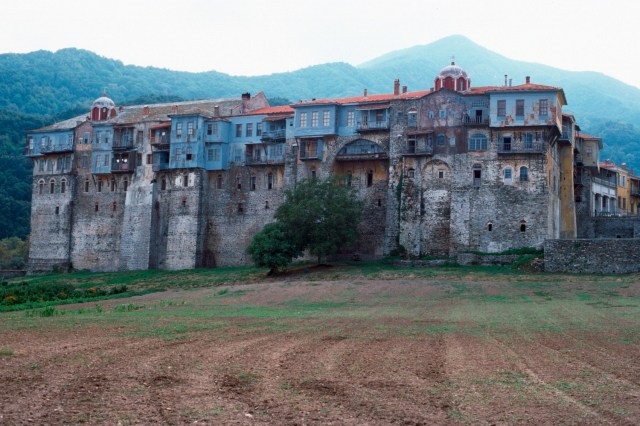
On the Holy and Great Synod of the Orthodox Church — Archmandrite Vasileios, Hegumen of the Iviron Monastery, Mount Athos

A WORD OF CAUTION 

iviron

No matter if it seems (at first sight) that irresponsible ecumenists and fanatical zealots hold opposite views, in reality they share the same poverty; they are imprisoned in the same cell. They begin and end with their own opinion. They lack the courage of faith and the truth of love which liberate man.


They torment and are tormented, they hurl threats without meaning or courtesies without essence. The presence of the first breeds the existence of the other. The rumpus of the conflict of both ‘authorities’ (by imagination) never ceases!


To both sides the Word of God proclaims: “The prophets are prophesying lies in my name. I have not sent them or appointed them or spoken to them. They are prophesying to you false visions, divinations, idolatries[a] and the delusions of their own minds. (Jeremiah 14:14)

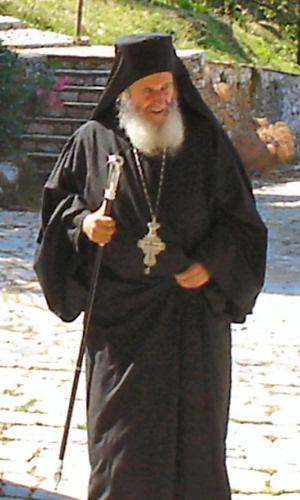
basileios_gontikakis_iveron2

By Archmandrite Vasileios, Hegumen of Iviron Monastery

βιβλιο

Confession of the Blind Woman

Mother Xeni’s poetry

Today I discovered a new member of my spiritual family, a blind, prescient Amma and a gifted poetess, who happens to be my own spiritual great-grandmother!  Mother Xeni served as  the Abbess of St. Nectarios’ (spelled also: St.Nektarios) newly-founded Monastery in Aegina (Greece) for nuns, and was the spiritual grandmother of my own spiritual mother, Sister Angeliki, who was tonsured a novice there and was ringing the bells upon St. Nektarios’ glorification! 


Glory to God! The circle of Grace expands like ripples in the pool!

To God


A soul, of lamentations worthy, and sorrows, is sighing,

and with a loud and fervent voice, the name of God crying,

and saying, my God save me now, my God, have mercy on me,

O God, You’ve seen my darkness now, so shed Your light upon me,

my God, don’t turn away from me, but quickly hear my pleading,

enlighten my soul’s eyes, O God, spiritually leading;

because they have been blinded from the sins within my depths.

O wretched self, I cannot see; my God, I lose my steps.

Miserable me, I cannot see, my God, where I am going,

or where I stand, or that I am a stranger, past my knowing.

Many clouds and mists my soul in darkness shroud and cover,

and without measure I embitter You, my sweetest Savior.
O wretch, within I feel upheaval, mourning pierced my side,

for Your All-Holy Spirit, Lord, to me must be denied;

my soul must weep eternally her poverty of grace,

and without ceasing to lament in tears that woeful place.

I must avenge myself for all the pain sin makes me suffer,

and with the rivers of my tears, my deep repentance offer;

the tender earth to which I will return, with weeping drench,

to cleanse and flood away the traces of my sins’ foul stench.

I am no longer worthy, Lord, to hope in Your compassion,

I’m worthy only of hell-fire, and suffering, damnation.

But you, my refuge is in You, my God and my Salvation…

(transl. from Greek Fr Demetrios Serfes)


Confession of the Blind Woman

People, hear and pity me, for this, my situation,

and pray to God to spare me, my wretched soul to give salvation.

Believe me, all of you, my brethren, truly I’ll explain,

in me is found abundantly the name of works I now will make plain.

If you would like to know which virtues I have called my own,

I’ll tell you: naked is my soul of good in every form.

Utterly devoid of virtue, sentenced to be damned,

and by every purity most utterly abandoned.

Poverty past bounds is mine, and wounds and ill diseases,

and being lost forever in the folds of death’s deep creases.

Severe insentitivity and stupor overcome me,

anger, pride, hard-heartedness and evil have undone me.

To virtue I am cold as ice, but warm to wickedness,

always ready for laughter’s lure and for talkativeness.

Instead of being compassionate, I’m totally unfeeling,

instead of weeping constantly, I laugh, the wretched worldling!

But there is something yet, that hides so perfectly these evils.

How long will I so fool the world, though I am like the devils,

with my false piety, fake virtue and hypocrisy?

When the world regards me highly, I rejoice and boast,

but when they criticise me, even kindly, I am sad, and mope.

Whomever of you knows me, I exhort you to feel piety,

and when reminded of me, weep for my iniguity.

Beg our God that someday He enlightenment will send me;

and by your prayers, my brethren, I hope that He will save me,

and from my somber wickedness and evil, He will free me.

(transl. from Greek Fr Demetrios Serfes)

Go here for an interview with a nun who knew Saint Nektarios and who lived with Mother Xeni


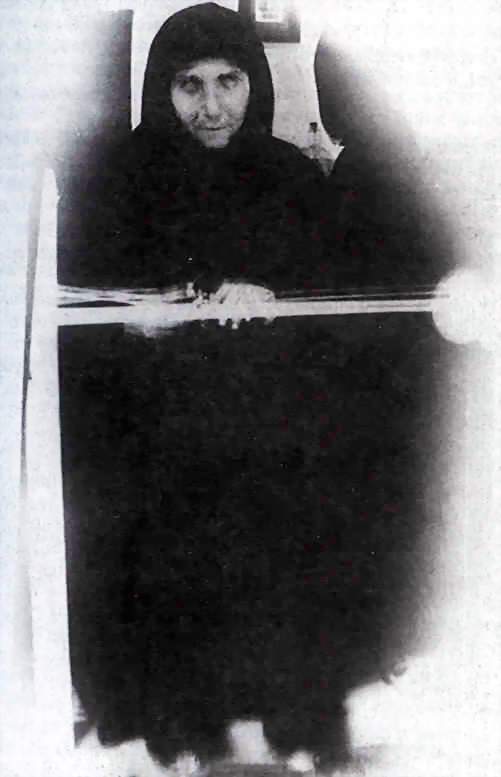
“Gerondissa (Greek for Abbess) Xeni, was born in 1867, and reposed in the Lord 1923. Mother Xeni, was chosen to become an Abbess of St. Nectarios (spelled also: St.Nektarios) newly-founded Monastery in Aegina for nuns. This beloved handmaiden of our Lord was blind from the age of 9 months, and although physically blind, she was not spiritually blind. She lived under the spiritual guidance of St. Nectarios, and sincerely developed great Christian virtue, discernment and love. Even before the holy Saint Nectarios officially named her to preside over the Community of nuns in Aegina all the girls and women considered her to be their leader due to her piety, compassion and the great grace which dwelt in her sweet soul. This holy, pure, and chosen woman, though she fully realized the scope of her blessedness, did not “consider salvation a thing to be grasped” (Phil.3:13).

Gerondissa Xeni is mentioned in the “Life of St. Nectarios of Aegina“.

During the life of Gerondissa Xeni, she wrote her poetry, which is now becomming more and more well known. We truly discover the secret of her blessed familiarity and closeness both to the Saint, and to our God in Trinity: humility. Gerondissa Xeni poetry is spiritually remarkable, and full of love for God! Her poetry serves to help us, her readers, to be able to reflect on our own path to salvation.”

By Father Demetrios Serfes

Source: Orthodox Poetry Of Gerondissa (Abbess) Xeni Of Aegina, Greece (1867-1923), Compiled by Father Demetrios Serfes, Boise, Idaho, USA, Introduction by Father Demetrios Serfes

GerontissaXeni