The Importance of Being in a Place

split23


In an early comedy sketch show on the radio, much loved by Metropolitan Kallistos, one of the characters Seagoon finding another character Eccles in a coal cellar asks: “What are you doing here?” Eccles replies “Everybody’s gotta be somewhere!” Eccles portrayed as a rather silly youth, has a special talent for taking things he hears literally, but in so doing often shows a profound insight.

*

From a slightly later vintage, some may remember Robin’s song from the T.V. Muppet Show. In innocent reflection he sings:”
Halfway down the stairs is a stair where I sit.
There isn’t any other stair quite like it.
I’m not at the bottom, I’m not at the top.
So this is the stair where I always stop.

*

The original version of “King Lear” (1605), William Shakespeare contains the line: “Jesters do oft prove prophets”; from where we gain the expression ”many a true word is spoken in jest.” The fool, whilst seen to be a jester, has his place in the plot, pointing to a truth which the “wise in their own eyes” fail to see. (Isaiah 5:21)

*

A hermit was once asked by a visitor “What do you do?” The hermit answered ”I live here!” The old English words “dwell” and “abide” for “live “conveys the sense of remaining fully in a state of stability. An embryo dwells in the mother’s womb, growing and being nourished in the darkness until the time of birth.
On meeting someone for the first time we often ask” What do you do?” as if someone is defined by their job or status! Our Lord did not judge people by what they did but he had empathy with who they were and had insight into the potential of what they could become. We are not “Human doings “we are “Human Beings.”

*


In order to “be,” to be fully in the present moment, to be fully alive, fully aware, we need to have stability of place. Constant movement is not good for the spirit. With too much movement we become like children who spin round and round and when they stop they are dizzy and fall over. Much could be said about the work/ life balance in today’s society but sufficient to say that we need to be aware of the limits and integrity of our mind, body, spirit and the heart.


*

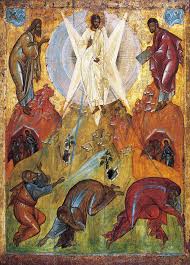
Place is the dimension of revelation. God appeared to Moses on Mount Sinai, Christ revealed His Divinity on Mount Tabor, St John received the Revelation of the Apocalypsis in the Cave on Patmos. From the beginning God has given us a place to be: Genesis 2:15 ” Then the Lord God took the man and put him in the garden of Eden to tend and keep it. “The place where we live is both the place of our daily routine and our spiritual life. Our daily duties are not separate from our spiritual life. Prayer is not separate from work. Our Icon Corner is the Church in the home and becomes the centre of our being in that place.


*


The saints were made holy in their cells, in caves, on islands, in trees, on platforms in the sky, in their places where God broke into their lives. One senses the holiness of places that are infused with prayer and built by ascesis. Go to the cave of St John in Prislop Monastery in Romania, visit the underground cell of St Gerasimos on Kefalonia, row across Derwentwater to St Herbert’s Island- you will find the grace of God.


*


Even when their bodies are separated from the souls, the grace remains in both. Their soul is apprehended invisibly. St John of Damascus says that “the holy relics of the saints, their icons, their graves, are full of grace which their souls and bodies had whilst on earth.” Since men and women are composed of soul and body, both need theosis, both need a place to be. Even when their bones have disappeared the place where they lived has become holy-sanctified- a place of refreshment for our spirit.


*

Like Eccles we have to be somewhere- but not anywhere! If we are in the wrong place then we will have no peace until we find the right place. God has given each of us a place to be.
Fr. Jonathan

How Often Should We Receive Holy Communion?

holy-communion-1


How Often Should We Receive Holy Communion? A Story

Probably the one thing that I found most puzzling during my Romanian monasteries pilgrimage is their attitude towards Holy Communion. All the days of the Suzana monastery retreat, during the Holy Liturgy nobody in the church received Holy Communion, other than the priest, not even any of the nuns, nobody! This is probably the only thing I did not like about ‘Romanian’ Orthodoxy , and I am not really sure if this attitude of theirs is an appropriate interpretation of the Fathers’ teachings.


In Greece, at the US, at the UK, everywhere I have been and I can remember having participated in Holy Liturgy, when the priest takes up the holy Cup, he proceeds to the Royal Doors, raises the holy Cup, and ‘issues an ‘order’: “Approach with the fear of God, faith, and love.” It feels so strange to listen to this in a Romanian church and immediately proceed to “Save, O God, Your people and bless Your inheritance”, with the priest lifting the holy Cup and saying: (Blessed is our God.) “Always, now and forever and to the ages of ages. Alleluia”, while NOBODY in church has received Holy Communion! I repeat NOBODY! Who is the priest blessing then?


What is the point of all Pre-Communion and communion hymns, recited and chanted, nonetheless? So, during an ordinary day, this part of the Holy Liturgy, “The servant of God (Name) receives the Body and Blood of Christ for forgiveness of sins and eternal life” is blatantly omitted! Are they then re-writing the text of St Chrysostom’s Holy Liturgy? And what about: “We have seen the true light; we have received the heavenly Spirit; we have found the true faith, worshiping the undivided Trinity, for the Trinity has saved us.” Why bother chant this, when NO ONE, I repeat NO ONE receives Holy Communion!


What is then the point of chanting “Let our mouths be filled with Your praise, Lord, that we may sing of Your glory. You have made us worthy to partake of Your holy mysteries. Keep us in Your holiness, that all the day long we may meditate upon Your righteousness. Alleluia. Alleluia. “, if NO ONE partakes of the Sacrament? And is this canonical for the meaning and existence of the Church as Christ’s mystical Body that only the priest partakes of the Sacraments? I am certainly open to suggestions and other pinions, but isn’t this ‘exclusive’ treatment of the priest distinctively non-Orthodox, possibly reminiscent of a Roman Catholic influence?


I found even more puzzling the fact that instead of the Body and Blood of Christ, the faithful are ceremoniously offered at the end of the Eucharist Holy Water and Antidoron instead ! [ie. antidoron (Greek: Ἀντίδωρον, Antídōron) is ordinary leavened bread which is blessed but not consecrated and distributed in Eastern Orthodox Churches]. In all Greek monasteries I have been, Holy Water and Antidoron are offered daily at the end of Matins [ie. Morning Prayers Service] to everybody, certainly not at the end of Holy Liturgy. Lest I be misunderstood let me add here that this custom is strictly observed on days when no Eucharist follows. For surely why on earth would there be Antidoron and Holy Water at the end of Orthros if one is going to partake of the Holy Communion, or even if they wouldn’t? Antidoron (instead of the gifts) is given out after communion, and after the liturgy is completed as a blessing from the celebrant priest. To offer it after Matins would break the fast for the Liturgy. But when no Holy Liturgy follows, then they offer it as a gift and a blessing for the day. But what a confusion with what is going on in a Romanian Holy Liturgy! It really feels as if the Romanians have kept the text of the Holy Liturgy, but re-invented some of its ‘events’, the ‘happenings’, its ‘conclusion’ indeed!


Sadly (as far as I am concerned) such an attitude is observed everywhere, not just in a ‘strict’ monastery environment, but in all Romanian parishes. This would never happen in Greece, indeed COULD NOT, and maybe in all other orthodox countries I have visited. I am told by the abbess that even nuns, whose lives are dedicated to prayer, normally receive Holy Communion only once a month (!) and only during major feasts (!), unless they ask for a ‘special’ blessing to receive Holy Communion as an exception (!), because they feel a very deep urge and need. Lay people need to make their confession immediately preceding each Holy Communion, 1 or 2 days before at the latest, to the extent that a priest will not offer Holy Communion  to them at all, even if they want to; he may even refuse them Holy Communion, because he suspects the faithful has not offered properly his Confession before. Interestingly enough, no priests were available, even though we were in the church, to listen to anybody’s confession, should someone decided to ‘go by the rules’, and confess in order to receive Holy Communion.


I remember having a particular conversation with a Romanian priest, very close to me, like a spiritual father or godfather, asking him if I am allowed to receive Holy Communion here at the monastery, reassuring him that I had confessed to my spiritual father 9-10 days before the trip. I received the following very sobering answer: “Mmm, I am not sure. So many days have lapsed. I will have to ask him to see what he thinks right.” (Sigh) Oh dear, but surely we are NEVER worthy of Holy Communion, even if just an hour has lapsed from our last Confession!


In the end, I did receive Holy Communion, right before I left Romania, holding a lit candle, following the Romanian style. Again I was the only one to receive Holy Communion in a packed church, full of faithful reverently praying, bowing, making prostrations, kneeling. The ‘exception’ was made for me because the priest who knew me explained my ‘situation’ to the Romanian priest and allowed me to receive Holy Communion because I was traveling that day, as a special blessing and protection.


In Love, For Love, By Love: Missionary Series III

How can I become a long-term missionary?

Archbishop Anastasios of Albania Orthodoxy missionary work

Long and Short-Term Missions

RTE: Can you tell us what it takes to be a long-term missionary? You’ve spoken of the beginning stages, how about later?

FR. LUKE: Archbishop Anastasios has good advice for people thinking of going into the mission field: “It’s always better to say you are going for one year and stay for ten, than to say, ‘I am going for ten years,’ and after the initial enthusiasm fades away, you realize you can’t handle it.” There is wisdom in this: go step-by-stepand God will give you grace and strength.

Archbishop Anastasios of Albania Orthodoxy missionary work

The goal of missions is to establish an authentic Eucharistic worshipping community in the people’s own language and culture

In my early 20’s, when I attended Pennsylvania State University, I contemplated entering the Peace Corps. When I learned more about it though, I was afraid, because I wasn’t sure I could handle the two-year commitment to leave my country and live in an impoverished third-world village. I turned down the opportunity, but God in His own way took me step-by step. He didn’t reveal to me, “In the future you will spend ten years in Albania.” No. First, I went on a short-term mission team for one month to Kenya. The following year I returned for a six-month commitment, and these six months turned into a year of service. After returning to Africa three times over the next four years, I began looking at Albania as a place where I could serve as a long-term missionary. I suggested to my wife, “Let’s make a three year commitment, and then see.” God took us through those three years and gave us the strength we needed. Those three years turned into five years, seven years, a decade. We might have been frightened, had we known at the beginning that we would serve in Albania for ten years, but God took us by the hand and led us.

Archbishop Anastasios of Albania Orthodoxy missionary work

Don’t frighten yourself by thinking, “How can I become a missionary and live in another culture for so many years?” Just go, make the sign of the cross, and start working. Be open and willing to stay for longer, but tell yourself, “I am going for one year or for two years, and see how it works.” But keep praying, “Lord, if You give me the grace, I will stay as long as You want me here.”

Archbishop Anastasios of Albania Orthodoxy missionary work

RTE: You mentioned the short-term mission teams of two or three weeks. I imagine that it’s helpful for people in a foreign country to feel that others appreciate them enough to come, but what are the real benefits of this short-term experience?

FR. LUKE: One has to be very clear about the purpose of missions. The goal of missions is to establish an authentic Eucharistic worshipping community in the people’s own language and culture. If one is going to serve in a place that isn’t yet Christian, this will take many years and involve great effort, sacrifice, and struggle. To achieve anything, the missionary must commit himself to living among the people long-term and learning the language and culture.

With the ease of travel and technology, a new phenomenon has arisen in the past thirty years in the mission field – “short-term mission teams” – which send people for a week or two, or a month, to a certain area. They often have a specific project: to build a church, run a catechetical program, etc.

Orhtodoxy missionary work

There is value in these short-term projects, and the first and greatest value is for those who are going. It exposes them to a different culture, a different people. For westerners it is often the first time they’ve seen a third-world country up close, with of all its poverty and hardship. It’s an eye-opening experience. For many, this initial experience is an exciting adventure, and although these short-termers go with the intention of offering something, they receive much more than they can offer, and usually return to their home country full of enthusiasm. They often become ambassadors for the missionary movement; they speak in churches and their enthusiasm is contagious. It’s great for them and for the church that sent them.

But what did they really offer for the week, or month, or two months they were in the mission field? They offered something. Perhaps they built a building – but I’m sure the indigenous people could have built the building themselves if they’d had the money. Perhaps they created some nice friendships, and that’s important to encourage people, but they have to realize that what they offered was very limited.

It is not going to transform, convert, and change people’s lives. At best it is going to complement the work that’s already being done by the long-term missionaries and the local Christians who live there. Some churches are now sending many short-term teams; you can get the people, they’re enthusiastic, it motivates people back home. But people are still afraid to go into long-term mission and this “short-term” trend can create a great danger for the future.

Short-term teams are not the goal of missions, but they can support the overall effort, and short-termers need to be challenged as to where they are going to take this experience when they return home. In any group of twenty short-term missionaries who go somewhere for a month, my goal would be that at least one or two of them seriously consider long-term mission work.

Orthodoxy missionary work

For others, hopefully, this incredible experience will help to transform them into more serious Christians. Lord willing, they will use this experience as a stepping stone in their own spiritual journey. Perhaps they won’t become long-term missionaries, but they will be more dedicated Christians in whatever they do. Hopefully, the majority of people who go will at least understand missions in a new way, and even if they never become long-term missionaries, they will become supporters and partners of those in long-term missions.

There are two results we don’t want from short-term missions. First, we don’t want these participants to think that they are missionaries who have fulfilled their responsibility in missions. They are not missionaries, but members of a missions team. They now have a responsibility to use the experience they’ve received for the glory of God and to spread the spirit of missions in the Church.

The second danger is that we don’t want short-term participants to return home and, after an initial month of excitement, put the experience away as a great adventure and go on with their life as they lived it before. We would consider both of these results as a failure in our short-term strategy.

Orthodoxy missionary work

I have participated on five short-term mission teams, four times as a leader. I have also received five short-term teams while being a long-term missionary. So I’ve been exposed to this concept of missions from a variety of angles. These short-term experiences radically changed the direction of my life, so I’m very grateful for the experience. They exposed me to the reality of missions work and led me to longer stays in Africa. Such trips filled me with enthusiasm and zeal for missions, and led me to eventually study theology at Holy Cross Greek Orthodox School of Theology, as well as to study missiology at Fuller Seminary’s School of World Missions.

orthodoxy missionary work

When I was a long-term missionary receiving missions teams, I did all the prep work for the teams, and it took a month out of my schedule each time to accommodate them. In certain cases it was worth it. Some teams did great and really complemented the ministries we were already doing. But to be honest, other teams were very demanding and in the end, the benefit that they offered was minimal. In those instances, it became a very time-consuming project that didn’t have a lot of value for our overall mission. Short-termers need to be aware of this, and when they go, to be humble about it.

RTE: I imagine they are more like pilgrims than missionaries, guests of Orthodox missions who may be able to help out in a small way.

FR. LUKE: Yes, I always tell the short-termers that they shouldn’t call themselves missionaries. They aren’t missionaries. They should think of themselves as visitors to a mission field. Some don’t like to hear this. They would like to think, “I’m following the path of the great missionaries; I’m a missionary now.” That’s quite naive.

Orthodoxy missionary work

To Be Continued …

Go here for Part I

Go here for Part II

Work Pray Be Saved

transfiguration orthodox church Work Prayer Salvation


Work Pray Be Saved! Back to Mikrokastro monastery, my spiritual basis in Greece! For the Transfiguration Feast. “Lord, it is good for us to be here. If you wish, I will put up three shelters—one for you, one for Moses and one for Elijah!” I feel so safe, protected and loved here! It is always like this: the Mother of God always comforts me; the peace, stillness and hesychia of the monastery invades me; the fellowship of the nuns warms me; the motherly affection of its Abbess, Mother Theologia’s love nurtures me; the nuns’ combination of discipline, structure, work and prayer ‘stabilises’ me; their wise ‘equation’: Work and Prayer= Salvation!‘ centers’ me, ‘grounds’ me on peace and the Holy Spirit.

orthodox monastic Work Prayer Salvation


Just today, I felt so happy harvesting, curing and storing potatoes after the Matins service and Holy Liturgy in the monastery chapel! It felt so exhilaratingly Van Goghean!

Work Pray Be Saved

van gogh Work Pray Be Saved


Certainly one eats his meal afterwards, roast potatoes😃, with gratitude and thanksgiving.

orthodox monks Work Pray Be Saved

van gogh Work Pray Be Saved

*

Fr Jonathan Hemmings has written a whole chapter on this ‘equation’: Work and Prayer= Salvation! in his book, Fountains in the Desert, which I have found most useful and often turn to for life balance ‘tips’.


When the holy Abba Antony lived in the desert he was beset by accidie (ἀκηδία) and attacked by many sinful thoughts. He said to God, “Lord, I want to be saved but these thoughts do not leave me alone; what shall I do in my affliction? How can I be saved?” A short while afterwards, when he got up to go out, Anthony saw a man like himself sitting at his work, getting up from his work to pray, then sitting down again and plaiting a rope, then getting up again to pray. It was an angel of the Lord sent to correct and reassure him. He heard the angel saying to him, “Do this and you will be saved.” At these words, Antony was filled with joy and courage. He did this, and he was saved.


Our human condition requires dependency upon God and interdependency on others. Correct spiritual examination requires the help and direction of a spiritual father who helps us grow into the image of Christ. Self examination alone without such an external reference point can put us in jeopardy such that we choose the wrong direction, make false judgements, become disappointed, lack faith, and fall into the trap of hopelessness and despair. Here we find ourselves in that spiritual malaise of accidie whereby because of our sense of sinfulness before a Holy God, we become inactive, paralysed and reach a state of torpor.

We ponder on the contradiction “How can we be Christians and have such sinful thoughts?” St Antony addresses this dilemma in the desert where he meets the devil, himself and God

“Lord, I want to be saved but these thoughts do not leave me alone;”

We notice that St Antony wants to be saved, he is aware of his own condition. Like the Prodigal son and Zacchaeus we must first come to our right mind and possess a desire (a zeal) for change. St Antony’s request is simple and succinct:

“What shall I do in my affliction. How can I be saved?”

orthodox monastic Work Prayer Salvation

We must be direct in our prayer to God; vagueness in repentance or in our requests is a form of obfuscation.

These two questions of St Antony remind us of that question the Lawyer posed to Christ before the Parable of the Good Samaritan. Luke 10:25 “What must I do to inherit eternal life?”

Inactivity is not an option for Christians; Christians are verbs not nouns!

Antony sees a man sitting at his work then getting up to pray, returning to his work and again rising to pray. The angel was sent by God to correct and reassure St Antony. Consumed by ourselves we lose focus and the source of our strength-we lose the will to work or pray! Work and Prayer= Salvation! This is an equation for all and not just for monks. Full of self loathing we need not only correction but reassurance. When called upon, the compassion and conviction of the All Holy Spirit assists us by His comfort and strength.

orthodox monastic Work Prayer Salvation

Just as our Lord was ministered to by angels in the wilderness after the Temptations Matthew 4:11

“Then the devil left Him, and behold, angels came and ministered to Him.”

So with St Antony an angel ministers to him instructing him and restoring courage and joy. “ Do this and you will be saved.”

The Fathers teach us that we should not trust too readily in our own thoughts and opinions but take heed to God’s Word Who provides us with the pattern of salvation.

orthodox monastic Work Prayer Salvation

In our modern western culture, Life balance is a much discussed topic today. When mums have to juggle careers with caring and the ever increasing demand for dads to prioritize we need to drink from the fountains of the desert. Without work we become indolent and listless; too much work makes us tired and stressed. Without prayer we become detached from our source of strength and the deeper reality Who created us. Likewise prayer without action is fruitless, as St James says in his epistle:

James 2:17

“Thus also faith by itself, if it does not have works, is dead.”

Prayer will warm and revive us in the love of God; work will warm and energise us in the love for others thus fulfilling the Divine equation for salvation:

Luke 10:

27 So he answered and said, “ ‘You shall love the LORD your God with all your heart, with all your soul, with all your strength, and with all your mind,’ and ‘your neighbour as yourself.’”

 28 And He said to him, “You have answered rightly; do this and you will live.”

orthodox monastic Work Prayer Salvation

Fountains in the Desert

Missionary Musings

missionstatement-gifts

All my previous days have been spent in quietness, stillness and intense studying. I have been reflecting on my Romanian monasteries’ pilgrimage and preparing for the next one to Cephalonia and Ithaca for the Dormition Feast. I have also been corresponding with my English brothers and sisters in Christ, preparing for my return to the UK by the end of the summer.

Central in all my thoughts, studies, activities and endeavours was the Holy SpiritOrthodoxy and Missionary work.

I started studying Archbishop Anastasios’ of Tirana, Durrës and All Albania life and works, and was inspired by his questioning of the establishment’s accepted apathy toward missions. Then, I turned to the Acts of the Apostles and marvelled at the workings of the Holy Spirit and the Apostles’ zeal and love for God and His Church! Next, I  examined various missionaries’ blogs and websites, and I also watched a number of very inspiring videos: Michael Harper‘s talk on the Holy Spirit, part of THE WAY, the outreach programme of the Institute for Orthodox Christian Studies.

Then

and

and

a two-part documentary, where renowned British actor David Suchet undertakes an epic journey spanning the Mediterranean. His inspiration is a charismatic individual whose own travels through this region, two thousand years ago, changed the world forever – Paul the Apostle:

Do you remember how all this got started? By a disturbing comment by a ‘cradle’ Orthodox that all ‘others’ are ‘foreigners’ and ‘strangers’. Now after a week I know that such an attitude cannot be farthest from the Truth. I understand I have so much more to learn yet but I am already convinced that

The love of God is manifested in mission“,

Indifference to mission is a denial of Orthodoxy“; 

“Inertia in the field of mission means, in the last analysis, a negation of Orthodoxy, a backslide into the practical heresy of localism”;

“Mission was not the duty of only the first generation of Christians. It is the duty of Christians of all ages … It is an essential expression of the Orthodox ethos.”;

“Church without mission is a contradiction in terms…. If the Church is indifferent to the apostolic work with which she has been entrusted, she denies herself, contradicts herself and her essence, and is a traitor in the warfare in which she is engaged.”

May the Holy Spirit empower us to be faithful in fulfilling the commandment of Christ to “Go into all the world and make disciples of all Nations, baptizing them in the name of the Father, and of the Son and of the Holy Spirit, teaching them to observe all [things that He has] commanded”,  so that all people may be saved and come to the knowledge of the truth.   “Thy Kingdom come on earth as it is in Heaven”!

*

May we witness to the truth, and by God’s grace and in the power of the Holy Spirit, to reveal Christ’s way of sanctification and eternal salvation to all.

Why Fast For Dormition?

Dormition Feast Fast orthodox city hermit

May the Dormition fasting prepare us to receive what God wants to give us. 


It would be a gross understatement to say that much has been written about the Feast of the Dormition of the Theotokos. Yet very little has been written about the fast that precedes it.

We fast, not to get what we want, but to prepare ourselves to receive what God wants to give us.

Every Orthodox Christian is aware and generally knows the reason behind the fasts for Pascha and Christmas. But while they may know of the Dormition Fast, few follow it, and more than a few question why it is there, neither knowing its purpose. First, given the pervasive misunderstanding of the purpose of fasting itself, a refresher on its purpose is always a good idea. There is a perception that we should fast when we want something, as though the act of fasting somehow appeases God, and seeing us “suffer” gets Him to grant our request. Nothing can be further from the truth. It is not our fasting that pleases God, it is the fruits of our fast (provided we fast in the proper mind set, and do not merely diet) that please Him. We fast, not to get what we want, but to prepare ourselves to receive what God wants to give us.


The purpose of fasting is to bring us more in line with another Mary, the sister of Lazarus, and away from their sister Martha, who in the famous passage was “anxious and troubled about many things.” Fasting is intended to bring us to the realization of “the one thing needful.” It is to help us put God first and our own desires second, if not last. As such it serves to prepare us to be instruments of God’s will, as with Moses in his flight from Egypt and on Mt. Sinai, as well as our Lord’s fast in the wilderness. Fasting turns us away from ourselves and toward God. In essence it helps us become like the Theotokos, an obedient servant of God, who heard His word and kept it better than anyone else has or could.


So why do we fast before Dormition? In a close-knit family, word that its matriarch is on her deathbed brings normal life to a halt. Otherwise important things (parties, TV, luxuries, personal desires) become unimportant; life comes to revolve around the dying matriarch. It is the same with the Orthodox family; word that our matriarch is on her deathbed, could not (or at least should not) have any different effect than the one just mentioned. The Church, through the Paraklesis Service, gives us the opportunity to come to that deathbed and eulogize and entreat the woman who bore God, the vessel of our salvation and our chief advocate at His divine throne. And as, in the earthly family, daily routines and the indulgence in personal wants should come to a halt. Fasting, in its full sense (abstaining from food and desires) accomplishes this.


Less time in leisure or other pursuits leaves more time for prayer and reflection on she who gave us Christ, and became the first and greatest Christian. In reflecting on her and her incomparable life, we see a model Christian life, embodying Christ’s retort to the woman who stated that Mary was blessed because she bore Him: blessed rather are those who hear His word and keep it. Mary did this better than anyone. As Fr. Thomas Hopko has stated, she heard the word of God and kept it so well, that she of all women in history was chosen not only to hear His Word but give birth to it (Him).


So while we fast in contemplation of her life, we are simultaneously preparing ourselves to live a life in imitation of her. That is the purpose of the Dormition Fast.

When the assumption of thine undefiled body was being prepared, the Apostles gazed on thy bed, viewing thee with trembling. Some contemplated thy body and were dazzled, but Peter cried out to thee in tears, saying, I see thee clearly, O Virgin, stretched out, O life of all, and I am astonished. O thou undefiled one, in whom the bliss of future life dwelt, beseech thy Son and God to preserve thy people unimpaired.

(Sticheron after the Gospel, Orthros)

Daniel Manzuk is a reader at the Church of the Virgin Mary in Alsip, IL.

Source: Why a Fast for Dormition?  The Word, June 2008


Praying Without Ceasing

“Rejoice always, pray without ceasing, give thanks in all circumstances; for this is the will of God in Christ Jesus for you”(1 Thessalonians 5:16-18)

prayer without ceasing monastery pilgrimage retreat

“Many times the sisters at some of the monasteries I visit will try to commit one or more akathists or supplicatory canons to memory. Here is how they do this:

Some print off the prayers they want to learn and cut them into small sections to keep in their pocket. When they are doing some of the more simpler jobs or tasks around the monastery they take out one piece of paper at a time and lay it in front of them. prayer without ceasing monastery pilgrimage retreatThen they say that section over and over again until they have it committed to memory. Afterward they take out the next piece of paper, adding another stanza or ode and so on until they have memorized the whole thing.

prayer without ceasing monastery pilgrimage retreatOthers will use small prayer books to do they same thing – taking them out to read when they get stumped.

In the monastery there is always work to be done, rarely will a nun find herself idle. But in the world we are constantly waiting in lines at the grocery store, at the mechanic’s shop etc. And so, even if we don’t particularly care to commit a large prayer to memory, we can keep our mind occupied with prayer.

prayer without ceasing monastery pilgrimage retreatI wanted to memorize some prayers, so I took a tip from the sisters and made my own miniature prayer book. I thought writing out the prayers would help. So I that’s what I did. I keep it in my bag so that I have it wherever I go.

When I’m on the bus or waiting for something I pull it out and read an akathist. It only fits two akasthists and a few other favourite prayers but it is very helpful – mostly because it’s size makes reading the prayers in public somewhat discreet.

prayer without ceasing monastery pilgrimage retreatYou don’t have to hand-write a prayer book, you could simply glue photocopies of prayers in a small book, or keep a larger prayer book with you. The point is to offer our attention – our nous – to God, to make an effort to “pray without ceasing”. I haven’t memorized any akathists yet, but I try to tell myself the point is to pray them, not accomplish something arbitrarily so I can feel self-righteous.

prayer without ceasing monastery pilgrimage retreatAnd besides, I love an excuse to try and make something look pretty. Having a notebook filled with prayers and icons and a little calligraphy makes the work worthwhile.”

“Be thankful to God that this desire for the Prayer and this facility in it have been manifested in you. It is a natural consequence which follows constant effort and spiritual achievement…. Now you see with what admirable gifts God in His love for mankind has endowed even the bodily nature of man. You see what feelings can be produced even outside a state of grace in a soul which is sinful and with passions unsubdued, as you yourself have experienced. But how wonderful, how delightful and how consoling a thing it is when God is pleased to grant the gift of self-acting spiritual prayer, and to cleanse the soul from all sensuality! It is a condition which is impossible to describe, and the discovery of this mystery of prayer is a foretaste on earth of the bliss of Heaven. Such happiness is reserved for those who seek after God in the simplicity of a loving heart.” (The Way of the Pilgrim – a word from the pilgrim’s spiritual father)

prayer without ceasing monastery pilgrimage retreat

Tips from the Monastery: Practical Advice for ‘Praying Without Ceasing’

Wonderful tips! I have been asking myself nuns and pilgrims at various pilgrimages in monasteries in Greece and abroad how they memorise prayers, because the practice seemed quite widespread. Not being very good at memorisation, nonetheless such practises attracted my attention, especially after reading in Saint Porphyrios’ life how diligently he engaged in this task from his childhood, how greatly he felt his nous profited from it and how strongly he encouraged his spiritual children on it. I have found out that probably the most important “tip” is to commit yourself to this task daily, with or without notes, and soon the Holy Spirit comes to your aid and you feel the rewards.

matushka constantina's avatarlessons from a monastery

OLYMPUS DIGITAL CAMERA(Originally posted in 2013)

Many times the sisters at some of the monasteries I visit will try to commit one or more akathists or supplicatory canons to memory. Here is how they do this:

Some print off the prayers they want to learn and cut them into small sections to keep in their pocket. When they are doing some of the more simpler jobs or tasks around the monastery they take out one piece of paper at a time and lay it in front of them. OLYMPUS DIGITAL CAMERAThen they say that section over and over again until they have it committed to memory. Afterward they take out the next piece of paper, adding another stanza or ode and so on until they have memorized the whole thing.

OLYMPUS DIGITAL CAMERAOthers will use small prayer books to do they same thing – taking them out to read when they get stumped.

In the monastery there…

View original post 426 more words

How Romanians React to Foreigners

from-romania-with-love-1-728

Suzana Monastery Retreat  II, or An Anthropological ‘Field Trip’ Insights,  and Communism Jokes 😃

Doamne Ajuta! I am obviously not the only pilgrim at Suzana Monastery, but I am the only pilgrim who is NOT Romanian. I am immediately spotted and ‘targeted’ , especially by a group of Romanian students who belong to an Orthodox youth organization and do volunteer work at the monastery in the summer. They are here to help with the housekeeping, farming and agriculture. And with chanting.

How to ‘annoy’ a Romanian (1)

Mistake Bucharest for Budapest.

Never ask a Romanian if he lives in Budapest. That’s the capital sin, the perfect way to end a potentially interesting conversation. Yes, Budapest is a capital city, and there’s a big chance you’ll nail it with this guess — but only if you’re speaking to a Hungarian! We’re so tired of hearing, “Good evening, Budapest!” every time an international act has a concert in Bucharest. Metallica did it, Lenny Kravitz did it. And many others. But they had bodyguards. You, on the other hand, will be alone in front of an outburst of anger.

*

The Romanian hospitality, warmth, enthusiasm and curiosity about anything Greek, or foreign for that matter, AND Orthodox CANNOT be exaggerated! This group of students at Suzana Monastery instantly become my ready interpreters and eager translators, my willing tutors for Romanian chanting and they are so full of questions about my job, my studies, my travels, my pilgrimages, my adopted country UK, my home country Greece and its Saints, especially St. Paisios, about everything, to the point of collapse!

*

I may be on a pilgrimage in Romanian monasteries, but St Paisios’ the Athonite, my patron Saint‘s, presence is strongly felt all over Romania. Plenty of icons of his and books with his services and spiritual counsels in all monasteries and churches I have been so far! Esp. on the 12th of July the faithful all over in Romania were holding Vigils and praying Akathists and Supplication canons, asking for his prayers. Wherever I go, the moment Romanians realise that I am Greek and my home town is near Souroti, they start asking for my telephone number and email, so that I can make arrangements and help them go and venerate his tomb. 

How to ‘annoy’ a Romanian (2)

Ask us about vampires.

In 1897, the Irish writer Bram Stoker published a Gothic novel entitled Dracula. His story made Transylvania more famous than any tourism promotion campaign ever could. By using some historical facts, he linked Vlad Tepes, the Voivode of Wallachia, to his main character, Count Dracula, the vampire. Unfortunately, that means foolish tourists now come to Transylvania expecting to see garlic hanging by doors or people walking around with wooden stakes in their pockets. Transylvania is a peaceful, hilly area with many traditional houses and fortified churches. The real threat back then wasn’t exsanguination, but impalement — the Voivode Vlad’s favorite method of execution. And that isn’t fiction.

Their energy is indomitable, even when our conversation lasts for hours while standing after very long services outside the church at dusk until midnight and …! Their effusion is so contagious and there is no end to the exchange of telephone numbers, emails and addresses for the planning of future pilgrimages in Romania and Greece and exchange of Saints! These ‘buzzing bees’ with bright eyes and brighter smiles are to follow me everywhere from now on (when they are not busy with their obediences) yet their ‘buzzying’ mysteriously does not interfere with the silence that invades me. It surely has to do with their kindness, love and purity in Christ.


If you have never experienced the intensity of Romanians’ love and hospitality, you may think I exaggerate. To give you just another example, while waiting for the bus to Bucharest from Thessaloniki, I sat at a nearby café and took out my Byzantine chanting textbook to practice! Yes, one has to be very careful with these diatonic genus and Greek:  A    Β     Γ   Δ     Ε Ζ     Η, Greek:       Πα Βου Γα Δι Κε Ζω Νη, English:     Pa Vou Ga Di Ke Zo Ni, [Re Mi   Fa Sol La Si   Do], [D   E     F   G   A   B   C ]

Can you imagine a Romanian in love with you, if that is their normal ??!!

Suddenly a Romanian interrupts me and ‘blurts’ out how excited she is for meeting me, and that she is returning back to Bucharest together with 4 Romanian musicologists, who were on a Byzantine chanting conference in Thasos, and pretty soon I am surrounded by 4 (even) more effusive, enthusiastic Romanians, reciting to me Homer in ancient Greek, hugging me and chanting Ti Ipermaho / Τῆ Ὺπερμάχῳ/ To Thee the Champion Leader, in Greek again with stunning voices right in the middle of the street (!) with tears in their eyes. What a people! Can you imagine a Romanian in love with you, if that is their normal ??!!

How to ‘annoy’ a Romanian (3)

Leave food on your plate.

Mark my words: If invited to a Romanian’s home for lunch or dinner, fast for a day or two before the visit. We are known for being a welcoming nation, and one of our favorite ways of showing it is through food. Here are a few appetizers so you don’t starve before the first course is ready. Some eggplant salad, salted roe, homemade smoked bacon with onions, and stuffed boiled eggs with mayo. Come on, try them all! Do you like the smell of our meatball soup? Here comes the clay pot full of sarmale, next to a steaming polenta and a jar of cream. You have to taste this! It’s our traditional course. You’ve finished everything? Don’t worry, there’s plenty more! The pork roast seasoned with garlic is almost ready.

*

Doamne Ajuta! Nothing best encapsulates the warmth of the Romanian heart, the warmth of their love, politeness, gentleness and hospitality, other than this greeting of theirs, ready to be offered at any time of the day, and on any occasion. So, rather than wishing someone ‘Good Morning’, or a ‘Safe Journey’, lay people and priests bless each other continuously, “Doamne Ajuta”, for surely where He is present, the journey or the job is bound to be blessed too. Such fresh and pure, innocent, child-like faith, feels refreshingly ‘simple’ compared to the Russian anguish, sinfulness and repentance.

*

Such warmth and hospitality, even when very poor, even when they want to share with you, their ‘raw’ cottage cheese, natural sour cream and bizarre non-homogenized boiled water-milk concoction straight from the monastery’s cows (!), their mamaliga, their beans puree and their boiled cabbage. (Can you imagine, again the Romanians’ soaring child-like enthusiasm when steaks or ice-cream show up in a surprise at our monastic (!) dinner?) Here, at a monastery, we have to boil water at the wood stove so that we can have hot water to wash the dishes. No hot bath to be sure. We have to sleep under kilimia, rough peasants’ rugs, becoming prey to very hungry fleas. And still, the poorer you are, the eager to share, and especially the more hospitable especially when it comes to basic human needs, such as sleep, company, food.

How to ‘annoy’ a Romanian (4)

Confuse Romanians with Gypsies.

The official name of the Gypsy ethnic group is Romani, and even though Wikipedia states they are “not to be confused with Romanians, an unrelated ethnic group and nation,” misplaced associations are still often made. There are Gypsies all over the world — one million in the United States, 800,000 in Brazil, and many others in Europe, including Romania. They originated in India and left sometime between the sixth and eleventh centuries. Confusing Romanians with Romanis only makes you sound ignorant.


All Romanians I have encountered so far, be it at the UK, be it in Romania or in Greece, anywhere, are true cosmopolitans, intelligentsia and artists, men and women of culture and refinement, often very poor but with a wealth of education, so eager to contribute to the whole world community of Arts and Sciences, so enthusiastic to learn and to connect, curious yet so courteous, well-mannered and pious (in the good sense of the world).

*

Sometimes this poverty of theirs may surface in a certain ‘ugliness’, dirtiness, slovenliness, chaos, and carelessness in their kitchens, bedrooms, living rooms and common areas. We have to surround ourselves with beauty—that is a Christian virtue., but not one that I have encountered in Romania, with the exception of their churches and monasteries. Yet one feels so privileged, honoured and blessed to just be with them! Romanian homes are often less than orderly and clean according to a western European standard, their appearance follows a pretty weird and slovenly fashion (if one may call such an ‘invention’ fashion), completely lacking any finesse and style, but just a look at their bright smiles and sparkling eyes and a companionship with their fascinating personalities ‘compensates’ immensely. Who cares about clothes and looks, when in company of such kind and refined people, refined in all tastes that truly matter, refined in spirit and soul and heart, in the company ultimately of true aristocrats? Besides, none of us would have been any the better, after such an aggressive Communist regime and persecution, followed by a ruthless dictatorship, just in recent times.

How to ‘annoy’ a Romanian (5)

Tell us a breeze can’t make you sick.

We Romanians are so convinced that a cool breeze or draft of air can make you sick that we even have an expression for it: Te trage curentul. (“You’ll be pulled by the draft.”) Take the bus on a hot summer day, and you’ll probably see the windows open on only one side of the vehicle, or not at all. Craving a breath of fresh air, you move your hand in the direction of the window. But even before you touch the handle, you’ll hear a panicked voice say, “Are you trying to get us all sick?” To anyone else, this doesn’t make sense, but the logic behind this Romanian belief goes like this: The current of cool air will make your ears hurt and your nose run. Don’t even try to argue about this. You’ll only make yourself hotter.

*

Romanians laugh a lot , especially at the face of danger, and can always appreciate a good joke. Like when I peppered sugar on my steak! Yet, I am not the only one in trouble with a foreign language. The residing priest told us that while at the States, he was invited at Arizona monasteries, and he made a homily there how Jesus was carried by a monkey (!), not donkey 😃

“Humor was a way of rebellion and survival at the same time; an escape of the mind and soul, a way of coping with all those absurd and restrictions imposed by a communist regime who did not care about its own people. Humor was a way of standing up or fighting back, a form of active resistance against a criminal regime; at that time the political jokes served as a catalyst of the constant state of discontent Romanians felt towards the things they did not agree or even hated… towards what was happening with our country. ”

Like:

Have you noticed that at every petrol station there is now a doctor and a policeman on duty? The doctor gives the first aid to those who faint when they see the price, and the policeman interrogates the ones who fill up about where they got the money from. 

A patient is hospitalized at the Insane Asylum. ‘Why are you here?’, another patient asks. ‘I wanted to cross the Romanian boarder’, says the first. ‘But for something like this they do not send you to an asylum!’, replies the other. ‘Yes, but I wanted to escape to Soviet Union!’

A citizen said the chief of the Communist Party is an idiot. For saying this, the citizen was sentenced to spend 25 years and 3 months in prison. Everybody was wondering why 25 years and 3 months. In the end, they old find out the answer: 3 months for insulting a citizen of the Socialist Republic of Romania; 25 years for revealing a state secret.  


For those who lived in Romanian during communism time, this system is very different from anything you could read in the some idealistic books. Some of the quotes show extremely well how people really felt about such an oppressing system:

Is communism a science? No, if it were a science, they would have   tested it on animals first.

An old gypsy man on his dying bad. Instead of sending after the priest, he asks for the local chief of communist party. ‘I would like to join the Party’, says the dying man. ‘Why would you do this?’, asks the communist. ‘You lived your whole life free as the wind and now you want to join the Party?’. ‘Well, you see, if somebody has to die, I would be much happier if that guy were a communist’, answers back the dying man. 

*

Last but not least, Romanians are not just ‘special’, but unique! (in their own opinion of course) Stereotypes, ethnophyleticism, ethnic superiority/ inferiority complexes and xenophobia deeply vex my spirit.Sadly, even here, in a monastery, I have to ‘defend’ English people and ‘their’ Orthodoxy from some Romanians. I do not know how good an ‘ambassador’ I am, but I am trying my best. And all of Romanians I have encountered think that St Philothei, the Righteous Martyr of Athens (sic!) is Romanian! Not that Greeks are any better. We consider St Efraim the Syrian (sic!) to be Greek! Of course!

How to ‘annoy’ a Romanian (6)

Refuse homemade beverages.

Romania has one of the oldest winemaking traditions in the world. The country once had so many vineyards it’s believed Dionysus, the god of wine, was born in southeast Romania in a region then called Thracia. As proud successors of the Thracians, Romanians practice winemaking as a popular hobby, so you’ll probably be offered some garage-made wine. Or tuica, a strong fruity beverage. Even if you have reason for concern, do not ask about hygienic conditions or quality control. We take great pride in everything made with our own hands, so turning it down would be a serious insult. Take a sip, two, three, and worry not. We all drink homemade alcohol, and no one has died of it. So far.

Go here for Part I

Go here for Part III

To Be Continued …

Sources for the jokes: How to piss off a Romanian   and Romanian Communist jokes