Gie her a Haggis


edin10.jpg


“Holiness in the Bible” Study Weekend: Highlights (I)

Orthodox Fellowship of St John the Baptist

Orthodox Community of St Andrew the Apostle in Edinburgh


edin11

Sunday 22/1/2017

*A thought-provoking talk by Dr. Fotini Hamplova on how women can be saved through child-bearing and especially child-rearing, including us all here, spiritual mothers, spiritual fathers and indeed all Orthodox Christians in this call to Holiness through asceticism, the cutting of our will, silence, podvig etc.

img_0634

Fotini: “The Church is our Arc. This is where we are safe.”

img_0633

Fr. Mark (Glasgow) on holiness in the 21st century

Fr. Mark: On Bearing Our Cross to become Holy

How can you bear it?

We cannot. But where else can we go?

The feeling of being nailed on a Cross. 

See this to the end. 

Proceed to a territory beyond our endurance–to Death. 

God will never force us, push us beyond we want to go. 

Danger: illusion of Peace. 

Terrorism of the demons: assailed largely through thoughts, discouraging: very convincing.

The Evil One becomes powerful in our lives to the extent to which we will listen to him.

It takes great humility, courage and faith in order to allow God to smash us to pieces. Because He will in order to save us. If we allow Him, if we surrender to His Will.

img_0632

How lovely to see Fr Michael Harry with his Khouriya,  who are to ‘retire’ after Easter to the Hebrides!

img_0652

And a few more friends

img_0657

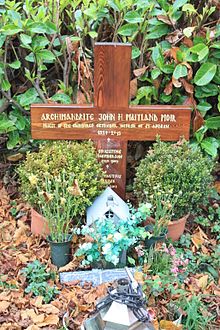
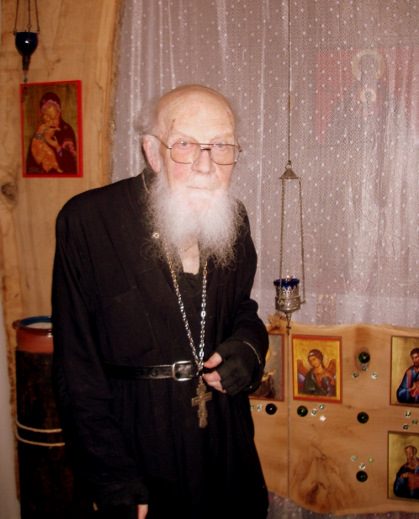
 Archimandrite John Maitland Moir (b. 18 June 1924-d. 17 April 2013), the Founding Father of the parish, was also present in our hearts.

edin51

Nice group photo of the Haggises  🙂

img_0650

A haggis lunch accompanied with with excellent Scottish folk music and Robert Burns poetry recitation while ceremoniously cutting the haggis.

The folk music was mesmerising and sounded something like that. Apologies for running out of battery…


And the Haggis ritual looked like that. Again apologies for my battery …


This poem was written by Burns to celebrate his appreciation of the Haggis. As a result Burns and Haggis have been forever linked. As I found out, this particular poem is always the first item on the programme of Burns’ suppers. The haggis is generally carried in on a silver salver at the start of the proceedings. As it is brought to the table a piper plays a suitable, rousing accompaniment. One of the invited artistes then recites the poem before the theatrical cutting of the haggis with the ceremonial knife: “But, if ye wish her gratefu prayer/ Gie her [Scotland] a Haggis”

*

Then, a scenic tour of Edinburgh

img_0654img_0653img_0655

edin30

Arthur’s Seat is one of the Best Places with Scenic Views in Edinburgh.

edin31.jpg

View of Edinburgh from the Rest and Be Thankful, Corstorphine Hill.

edin40.jpg

View from Calton Hill Edinburgh

edin7.jpg

Craiglockhart Hill

IMG_1521

Braid Hill

IMG_1541

Blackford Hill

IMG_1397

Arthur’s Seat

IMG_0987


Yes, I know. A haggis lunch…..then a walk…..Orthodox have stamina 🙂


edin41.jpg

Edinburgh is traditionally said to have been built on seven hills. Walk round the town for an hour or so and you might wonder if they didn’t mean seven …

edin44.jpg

Edinburgh Castle Edinburgh Castle as seen from Princes Street …

edin42.jpg

While spending this long weekend in Edinburgh, I’ve caught a glimpse of the castle almost every day, whether I’m walking to or from the church, shopping, or wandering about town..

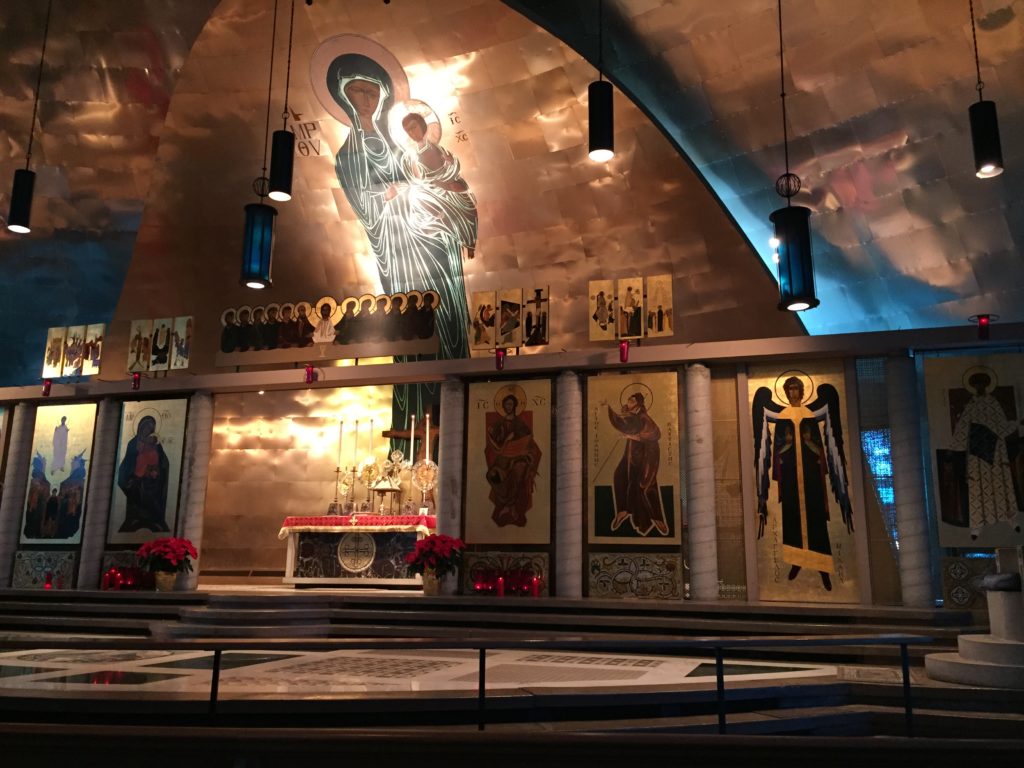
Our Sunday scenic tour culminated to St Mary’s Cathedral, Edinburgh (Roman Catholic), where we venerated the relics of St Andrew the First-called. Here parishioners and visitors for the study weekend joined together as pilgrims.

edin20.jpg

img_0656


It was such a lovely weekend; thank you to all who worked so hard and for all the kindness and fellowship!

St. Cuthbert’s Eccentic Heir

grave1

The simple grave of Maitland Moir, Dean Cemetery

Last weekend (Friday 20th – Sunday 22nd January 2017) I was invited to a Study Weekend: Holiness in the Bible, at the  Orthodox Community of St Andrew the Apostle, Edinburgh, by the Orthodox Fellowship of St John the Baptist.

Highlights from this event will follow in the coming blog entries, however, the starting point has to be the late Renown Scottish Orthodox Priest, Fr. John Maitland Moir, whose legacy and spirit is so alive in this Orthodox Community. In the words of parishioners I met there, he now continues to live in their hearts. In his words:”I love you but God loves you more.”I had the rare blessing to meet this priest a number of times back in Greece, in my hometown Thessaloniki, on his way to Mount Athos. The last time we met, shortly before he reposed, his face was so radiant, transparent and otherwordly, words cannot describe.

The Life of Fr. John Maitland Moir

Below is his official obituary. Our prayers go to all who knew and loved him, and for the repose of his holy soul.

Fr John Maitland Moir 4Archimandrite John Maitland Moir (1924 – 2013)

Father John Maitland Moir, Priest of the Orthodox Church of St Andrew in Edinburgh, founder of many smaller Orthodox communities throughout Scotland and Orthodox Chaplain to the University of Edinburgh, died peacefully in Edinburgh Royal Infirmary on the 17th April 2013.

Fr John Maitland Moir 1A man of profound holiness and bedazzling eccentricity, of boundless compassion and canny wisdom, utterly selfless and stubbornly self-willed, serenely prayerful and fiercely self-disciplined, Father John will surely earn a place as a unique and outstanding figure in the ecclesiastical annals of Scotland. He was born in 1924 in the village of Currie where his father was the local doctor; his fondness for his mother was always mingled with quiet pride in the fact that she was a member of the lesser aristocracy. The privileged but somewhat severe upbringing of an only child in this household together with a chronic weakness in his knees kept him apart from the hurly-burly of boyhood and directed him from an early age to more spiritual and intellectual pursuits. After his schooling at Edinburgh Academy, he went on to study Classics at Edinburgh University during the war years, his never robust health precluding any active military service. After the war, and a short spell as Classics Master at Cargilfield School in Perthshire, he moved to Oxford to continue classical studies at Christ Church and theological studies at Cuddesdon Theological College.

His interest in Eastern Christendom was awakened in Oxford and he eagerly seized the opportunity to study at the famous Halki Theological Academy in Istanbul in 1950-51. During this year he also travelled in the Holy Land and Middle East and forged friendships in the Eastern Churches which he maintained throughout his life. On his return to Scotland he was ordained in the Scottish Episcopalian Church, which he was to serve faithfully for the next thirty years. His first charge was as Curate at St Mary’s in Broughty Ferry, then for a period of six years he taught at St Chad’s College, Durham. He returned to Scotland in 1962 as Curate in Charge of the Edinburgh Parish of St Barnabas and as Honorary Chaplain at St Mary’s Cathedral, then in 1967 he moved north to the Diocese of Moray where he served as Chaplain to the Bishop of Moray and latterly as Canon of St Andrew’s Cathedral in Inverness. His devotion to his pastoral and liturgical duties as well as his personal holiness and prayerfulness inspired a sense of awe in his loyal parishoners. Only his habit of wearing the kilt beneath his cassock provoked a reprimand from his Bishop, who was more than somewhat bewildered by Father John’s fervent and unbending Scottish patriotism. The Scottish Episcopalian Church which Father John loved and served was, he believed, a Church with special affinities with the Eastern Churches: his eyes would light up when explaining how the Liturgy of Scottish Episcopalian Church, like those of the East, contained an epiclesis. With the passing of the years, however, he became convinced that the Scottish Episcopalian Church was moving ever further away in faith and in practice from that common ground with the Orthodox Church which he had also come to know and love and whose prayer he had made his own.

Fr John Maitland Moir 3In 1981, he resigned from his position in the Diocese of Moray and travelled to Mount Athos where he was received into the Orthodox Church at the Monastery of Simonopetra. He returned to Britain to serve now as an Orthodox Priest in the Greek Orthodox Archdiocese of Thyateira and Great Britain with utter devotion for a further full thirty years.

After three years in Coventry, Father John returned to Scotland where he united the two small Orthodox communities in Edinburgh, one Slavonic and one Greek, into the single Orthodox Community of St Andrew. At the same time, he travelled tirelessly around the country by bus serving often tiny groups of Orthodox Christians in Aberdeen, Inverness, Perth, Dundee, St Andrews, Stirling and elsewhere. For Father John, the Orthodox Church was what his beloved C.S. Lewis would call ‘Mere Christianity’, transcending the bounds of nationality and language and embracing all who seek to live a Christian life – the scandal of the cross and the glory of the resurrection. It also embraced for him the most precious elements in the Christian history of Scotland, especially that vision of Christianity expressed in figures such as St Columba and St Cuthbert. An ascetic by nature, his interest was in a practical Christianity nourished by prayer and tradition, rather than in the aesthetic refinements and intellectual gymnastics that attract many Westerners to the Orthodox Church. Not without opposition from members of his flock, Father John introduced English as the common language of worship and succeeded in creating a truly international community reflecting the many nationalities of the Orthodox students studying at the Scottish Universities and of the Orthodox families living and working in Scotland. As the Orthodox Church in Scotland grew in numbers through migration from traditionally Orthodox countries, so did the proportion of Scottish members who found themselves at home in the Community.

His role as Chaplain to the University of Edinburgh was one he took very seriously. The Chapel of St Andrew, set up at first in his house in George Square and then transferred to the former Buccleuch Parish School by the Meadows, lay at the heart of the University complex; the daily services held there with unfailing regularity and its ever open door provided and continues to provide a firm point of reference for countless students. The Chapel of St Andrew, however, was also the base for his work at the other Edinburgh Universities and throughout Scotland – work now being continued with equal zeal and selflessness by two gifted Priests, Fr Avraamy and Fr Raphael.

Fr John Maitland MoreFather John subjected himself to an almost unbelievably austere ascetic regime of fasting and prayer, while at the same making himself available to everyone who sought his assistance, spiritual or material, at all times of day and night. His care for the down-and-out in Edinburgh provoked admiration and no little concern in many parishioners who would come to the Church, which was also his home, only to find him calmly serving coffee with aristocratic gentility to a bevy of homeless alcoholics or to find a tramp asleep on his sofa. He was tireless in his efforts to help the victims of torture and persecuted Christians throughout the world. Few days would pass without him writing a letter of support for someone in prison or in mortal danger. He had inherited a comfortable fortune, he died penniless, having dispersed all his worldly assets to the deserving and undeserving in equal measure.

His habits of life would have marked him as a caricature of Scottish parsimony had they not been joined to an extraordinary generosity of spirit. All his voluminous correspondence was meticulously hand-written on scraps of recycled paper and dispatched by second-class mail in reused envelopes, whether he was writing to Dukes and Prelates or to the indigent and distressed. For many years, he was a familiar sight on the streets of Edinburgh as he passed by on his vintage electric bicycle, his black cassock and long white beard furling in the wind.

As his physical strength ebbed away, he was comforted by the love and care of those who looked to him as their spiritual father and by the ministrations and devotion of his fellow clergy. He was also tended by the medical expertise of the Greek doctors of the Community towards whom he never ceased to express his gratitude.

frjohnmm

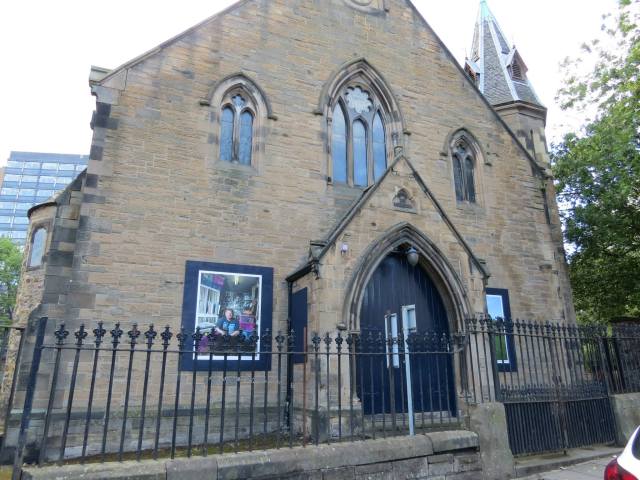
The last year of his remarkable life was perhaps the most remarkable of all. Completely bed-ridden, nearly blind and almost totally deaf, he devoted himself even more fully to prayer, especially to prayer for the continued unity, harmony, well-being and advancement of the Orthodox Communities in Scotland. On the day he died, an anonymous benefactor finally sealed the purchase of the former Buccleuch Parish Church for the Orthodox Community of St Andrew in Edinburgh thus securing a material basis for the realization of the spiritual vision that had inspired Fr John throughout his life.

church4

St. Andrew’s Church has acquired this property and is planning to move here in the future.

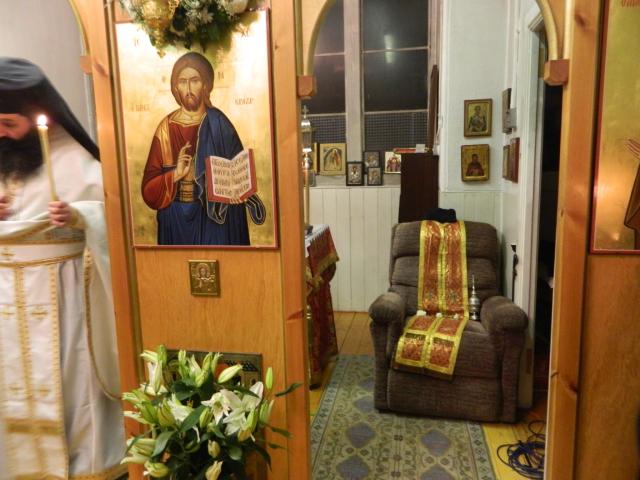
his seat.jpg


Orthodox Easter St Andrews Church Edinburgh 2013; Father John’s seat.

Read also this ex-Scottish Episcopal priest,  who even then, in the 1960s,  looked like an Orthodox priest, with a wispy beard and a Sarum cassock, and always the  fervent patriot, he once earned an episcopal reprimand for wearing a kilt  beneath his cassock, and and who “became a “weel-kent” figure riding a heavy iron bicycle around Tollcross and the Meadows. …  Although he lived a quiet life, Father John hit the national headlines in 2001 when he helped shelter an eight-year-old girl from her father.

Defying a court order that the girl should not leave the country without her father’s consent, he helped Ashley-Maria Black and her mother Valerie set up a new life in Greece.

Despite angry visits from the girl’s father Keith Black to his offices he refused to reveal the girl’s whereabouts, despite a court order, claiming Mr Black was using the girl to “harass” her mother… in “Renown Scottish Orthodox Priest Dies Just Weeks After Completing His Life’s Work” here and here

Fr John Maitland Moir 2

May his Memory be Eternal! 


The Altar and The Portico (II)

Head 6. By Aidan Hart, 1979. Ceramic.

THE SACRED AND THE SECULAR

The Relationship of Orthodox Iconography and Gallery Art

Part II: Gallery Art (here for Part I)

The journey of an artist  

At this stage in our story, by way of illustration I would like to be a little biographical. I will speak a bit about my own journey first as an artist in the world and then as an iconographer.

Though born in England, I was raised in New Zealand. Although as a child I had a modicum of education in Christianity, I ultimately came to believe in God’s existence through trees. In my childhood home there were splendid samples of trees and bushes in which my friends and I used to play hide-and-go seek and build huts. The many hours spent in their branches nurtured a deep respect and love for trees. Quietly I came to believe that a higher Wisdom must have made such splendid things. In them, function and beauty married. Trees were my proto-evangelists, leading me to belief on God.

It is pertinent that the Psalm verse set for feast days of Evangelists  -“Yet their voice goes out into all the earth, their words to the ends of the world” (Psalm 19:4a) – is actually referring to the skies, to creation. The previous verses read:

The heavens are telling of the glory of God;

And their expanse is declaring the work of His hands.

Day to day pours forth speech,

And night to night reveals knowledge.

There is no speech, nor are there words;

Their voice is not heard. (Psalm 19:1-3)

In other words, the beauty of creation is a form of proto-evangelism.

This early experience of being led a step closer to God through creation is the seed of my belief in the importance of threshold beauty. In fact, in gratitude to trees for being my proto-evangelist, thirty years later I planted 5,000 native trees in the hermitage where I then lived.

After graduating in literature and biology I began work as a sculptor, eventually going full-time. By then Christian within the Anglican/Episcopalian church, I was seeking ways to indicate in my sculptures the spiritual nature of the human person. Most of these works were not for church commissions but for gallery exhibitions.

29-thinker-copy

This period reinforced for me the role of threshold art, art that was not overtly religious or liturgical but which might draw some people a little closer to at least a primitive belief in the spiritual.

As a Christian I wanted this spirituality to embrace the material world, not to be a flight from it. I felt that this incarnational approach was all the more important in a secular age which worshipped matter and where one could not assume any prior knowledge of Christianity.

There was a parallel in the then communist and atheistic Russia. I had heard that many people there began their journey to Christian faith with Buddhism. They could not take the step straight from atheism into fully-fledged faith, but  they could took their first steps by following what is essentially an agnostic philosophical system, and one that did not require a communal and liturgical commitment as did Christianity. Having discovering some truth within Buddhism, but eventually finding it incomplete, many of these seekers then progressed onwards to Christ. I came to believe that the right sort of art, portico art, could do a similar thing, and so I wanted to make art that would affirm the numinous quality of life.

But before attempting this numinous quality I was convinced that as a sculptor one had to begin with technique and gain proficiency in depicting the material world, particularly the human body. Only then could one progress to suggest invisible realities. St Paul’s advice seemed pertinent: But it is not the spiritual which is first but the physical, and then the spiritual (I Cor. 15:46).

Since God had created both the material and the spiritual realms I believed that one would echo the other.

After mastering the essentials of modelling the human body, including making anatomical studies.

30-flayed-figure-copy

I then concentrated on how to indicate the spiritual nature of the human person. I tried varying degrees of abstraction.

Head 6. By Aidan Hart, 1979. Ceramic.

Man with a White Turban. By Aidan Hart, 1981. Ceramic, plaster and fabric.

Man in Green Shirt. By Aidan Hart, 1982. Ceramic, pigmented plaster, fabric.

To abstract means literally to “draw out”, and in its original meaning it denotes the discovery and manifestation of the essence of the subject, and not departure from reality as it tends to be understood today.

The art most influential for me at this stage was Egyptian and African work. Although perhaps too disembodied, too extreme in their abstraction, these sculptures helped me to reach some conclusions about how to indicate the spiritual. Most notably I learned the importance of a strong vertical axis or elongation; stillness rather than agitated movement; and emphasis on the eyes. Constantine Brancusi and Modigliani were also influences.

Portrait of Jeanne Hebuterne. By Modigliani, 1919.

Bird in Space. Constantin Brancusi, 1930.

Having thus studied the two poles of figurative naturalism and abstraction I then sought ways of uniting them, of incarnating the spiritual in flesh. In retrospect I see now that I was trying to hint at holiness – essentially, to sculpt icons.

Gradually I came to some conclusions how to do this stylistically,  but knew I still needed help in such a task. In due course a friend suggested that I should visit two Orthodox monks in New Zealand, one of whom was an icon painter. My friend said that icons did what I had been trying to do for some years. So I visited the monks, and found at their little monastery all that I had been seeking, both artistically, spiritually and historically.

Man in a White Turban, 2. By Aidan Hart, 1982. Ceramic, plaster, fabric.

In 1983 I was received into the Orthodox Church and soon afterwards returned to my birth place of England, where I began work as a full-time iconographer.

The last thirty-three years I have spent more or less full time as a liturgical artist, working first in relief wood carving, and then panel painting, fresco, stone carving, silverwork, and more recently, mosaic. But my earlier labours in pre-iconographic work as an exhibiting sculptor taught me the potential of gallery art to draw people a little closer to faith, to a sense of the numinous.

Crucifix,  at St John of Kronstadt Convent, Bath, UK. By Aidan Hart, 1985. Limewood/linden.

The Annunciation. By Aidan Hart, 2012

The Transfiguration. Our Lady of Lourdes Roman Catholic Church, Leeds, UK. By Aidan Hart, 2012. 20 feet high, fresco.

Our Lady of Lincoln. Lincoln Cathedral, UK. By Aidan Hart, 2014. Polychromed limestone carving

Episcopal staff, for the Patriarch of Russia. By Aidan Hart. Solid silver, 2016.

St Mary Magdalene and The Mother of God (unfinished). Detail from crucifixion for St George’s Orthodox Christian Church, Houston, Texas. By Aidan Hart, 2016. Mosaic.

How can gallery art operate as a portico to belief?

For me personally there are two types of artwork that do this: that which depicts suffering but with compassion, and that which suggests the world transfigured by light. The creators of such artworks are not necessarily people of faith, but they have grasped some truth in their search, and because this truth is an image of spiritual reality it elevates us.

Art of compassion

So first, compassionate art. Such works can help us see the divine image beneath suffering, and even behind ignorant acts. They show us that what makes us capable of suffering is also what makes us human. The Church Fathers tell us that although only holy people are in the likeness of God, all people are made in the image of God. It is precisely our God-given freedom that allows us to choose the wrong as well as the right. Compassionate artists do not idealise, but nor do they judge the wrong doer or feed on their suffering.

Dostoyevsky was the literary genius of such compassionate work, as was also the Greek writer of short stories, Alexandros Papadiamantis (1851-1911). In his short novel “The Murderess”, which is about a lady who kills the daughters of poor islanders so the parents don’t have to pay their dowries, without in any way condoning the murderous acts Papadiamantis somehow manages not to condemn or hate the woman herself.

In the artistic realm, compare a Rembrandt painting, a Van Gogh, or an Alberto Giacometti sculpture with the works of Francis Bacon.

Self Portrait. Rembrandt van Rijn,1659.

Rest from Work (after Millet). By Vincent Van Gogh,1890.

The Walking Man I. By  Alberto Giacometti, 1960.

Self Portrait. Francis Bacon, 1969.

The first two indicate the suffering of humankind with pathos and compassion. Bacon on the other hand – despite his undoubted brilliance as a colourist and the visceral power of his work – seems to feed on the suffering and torment of his subjects. One feels that he needs suffering to feed his inspiration. Indeed he said:

The feeling of desperation and unhappiness are more useful to an artist than the feeling of contentment, because desperation and unhappiness stretch your whole sensibility.[5](Francis Bacon)

It is true that great art needs a certain tension. Sentimentality and its consequent flaccidity is the bane of those trying to be positive in their art.  But even iconographers, who are trying to suggest an harmonious world, feel the tension between aspiration and reality, the struggle to express both brightness and sadness, joy and sorrow, strength and gentleness.  But to feed on negativity is different from depicting it with empathy  and identity.

Art of illumination

Another form of threshold art is the art of illumination. Ascetic writers both East and West describe three stages in the spiritual life: purification, illumination and union. In the degree to which the soul is purified it experiences the created world illuminated by God’s grace, animated by the divine logoi or words that direct and sustain each thing. We see not just the bush, but the bush burning. In due course this leads the person towards union with God Himself, with the Logos who spoke the logoi.

Icons indicate this luminous grace symbolically by such things as gold lines on trees, furniture and garments, and of course also haloes and golden backgrounds.

Threshold artists will indicate luminosity in less symbolic ways. And most critically, they personally will not necessarily relate this light to God. But through their fascination with the way light interacts and animates matter they, perhaps inadvertently, hint at a world aflame with grace.  The Impressionists are the obvious school that come to mind.

The Japanese Bridge at Giverny. Claude Monet, 1896.

The Impressionists have been criticized for being somewhat too sensual in their depiction of nature, even sentimental. Most Impressionists were not particularly religious people, but I suggest that their preoccupation with the interaction of light with matter meant that they inadvertently hinted at a transfigured world, a world not just reflecting light but radiating light. One feels just this when standing before a Monet haystack, as also a Van Gogh sunflower, landscape or farmers.

First Steps, after Millet. Vincent van Gogh, 1890. “I want to paint men and women with a touch of the eternal”.

The light seems to emanate from within these objects and not merely reflect off their surface.

Unlike the Impressionists, Van Gogh was quite deliberate about the spiritual aim of his painting. He wrote:

And in a painting I’d like to say something consoling, like a piece of music. I’d like to paint men or women with that je ne sais quoi of the eternal, of which the halo used to be the symbol, and which we try to achieve through the radiance itself, through the vibrancy of our colorations…[6]

And in the sculptural realm Constantin Brancusi too was conscious of his purpose. He wrote:

The artist should know how to dig out the being that is within matter and be the tool that brings out its cosmic essence into an actual visible essence. [7]

Brancusi’s Paris studio.

Might not such an art of illumination help keep alive in us nostalgia for the paradise that is our true home? What is the fall if we do not know the heights from which we have fallen? What is paradise lost if we have forgotten paradise? What is salvation if we do not know into what we are being saved? If hell is darkness, then it is a place where luminosity is absent, where all appears without light, where we experience the flame of the bush without its light.

From prophecy to evangelism

In conclusion, we ought to have no time for a religiosity that wants to keep us enclosed within church walls, makes us fearful of the outside. True faith finds and rejoices in the good wherever it is found. As Saint Paisius of the Holy Mountain taught me, a healthy soul is like a bee that seeks flowers and ignores rotting flesh. An unhealthy soul by contrast is like a fly that ignores vast fields of flowers and is attracted to a little rotting flesh.

One task of the Church is therefore to find the partial good in its surrounding culture and bring it to fruition. In this respect, living as we are in an increasingly non-Christian but educated epoch, our task is akin to that of the Apologists of the first centuries after Christ. They sought for truths in the Greek philosophy of the time, putting aside what was wrong, adopting what accorded with truth, and adapting what was partial. We need to embrace this creative and theological activity in our own times.

Some contemporary icon painters have done the same with modern art, most notably Gregory Krug.

Christ the Saviour, Fr Gregory Kroug.

Whether or not he consciously adopted aspects of modern art, the fact remains that his unique icons could only have been made in the 20th century. Dr. Isaac Fanous certainly adopted aspects of Cubism into his Neo-Coptic iconography in a deliberate synthesis of old and new.

The Transfiguration.  By Dr Stéphane Réne, of the Neo Coptic school founded by Dr. Isaac Fanous.

A prophetic assessment of a culture will not always of course be affirmative; it will also be critical. I suggest, for example, that an Orthodox Christian’s reading of art history will differ from the dominant narrative of secular scholarship. Scholarship reveals facts, but these facts need to be interpreted. Too often, for example, the history of art has been measured against the assumption that naturalism equals realism. So Byzantine art is considered without perspective, while Renaissance to be the champion of proper perspective.

In reality, Byzantine art uses five or six systems of perspective. These offer a far richer palette with which to express spiritual reality than the mathematical one-eyed system propagated by the Renaissance.

The Annunciation, showing different perspective systems.

They also accord more closely with our subjective experience of reality. For example, even though I do not see both sides of a building I know that they are there, and therefore the icon will often depict these sidewalls simultaneously through its multi-view perspective.  Unlike single view perspective, icons depict what we know and not just what we see. This is in fact the metaphysics behind much of early modernism, which reacted against the neo-Classicism then dominant in Europe.

The secular art historical narrative has also been too silent about the spiritual impetus behind much of the early modernist movement. Kandinsky for example was quite articulate about the spiritual aims of his art, most notably in his work “On The Spiritual in Art”, which was particularly influential in its English translation. Although perhaps more a Theosophist than an Orthodox, his Orthodoxy nevertheless informed a lot of his thinking, and sometimes, as in his “Sketch with Horseman”, icons provided inspiration for his compositions.

Sketch with Horseman. Vasily Kandinsky, 1911, showing the influence of icons, in this case, Elijah in the fiery chariot and St George slaying the dragon.

For Kandinsky painting was a spiritual exercise with spiritual aims. He wrote:

The artist must train not only his eye, but his soul.[8]

The world sounds. It is a cosmos of spiritually affective beings. Thus, dead matter is living spirit.[9]

We have already discussed the consciously religious basis of Brancusi’s work. (for more discussion see my article  “Constantin Brancusi” in http://aidanharticons.com/category/articles/).

The Scriptures and the history of the Church teach us that the best missionaries first discover what God has already revealed to the culture they are addressing, and only then begin to proclaim the Gospel. These evangelists are first listening prophets and seeing seers, and only then preaching missionaries. They perceive the words of God already accepted by the people and then try to take their listeners to the next stage.

The Apostle Paul. By Archimandrite Zenon, crypt church of Feodorovsky Cathedral, Petersburg.

Although St Paul was indignant about all the idols that he saw at the Areopagus, he began his address not by condemning his listeners for idolatry but by praising them for being so religious. He went on to base his message on their inscription to “An Unknown God”. He built his Gospel narrative on this germ of truth, even quoting their own philosophers and poets.

———————————————-

[5] Quoted in Art, Robert Cumming (DK, London, 2005), page 433.

[6] Vincent van Gogh, Letter to Theo van Gogh, 3 September 1888, (Letter 673), in Vincent Van Gogh: The Letters.  http://vangoghletters.org/vg/letters/let673/letter.html.

[7] Brancusi, in F. Bach, M. Rowell and A. Temkin, Constantin Brancusi. MIT Press, 1995. Page 23.

[8] Quoted in  Kandinsky: Complete Writings on Art (New York, 1994), eds. Kenneth C. Lindsey and Peter Vergo, page 197.

[9]  Kandinsky, in “The Blaue Reiter Almanac”, quoted in  Kandinsky: Complete Writings on Art, page 250.

Source: Orthodox Arts Journal


Leap of Faith (II)

My Journey to Eastern Orthodoxy: Part Two

Looking East

Was there a pillar and ground of truth beyond man-made organizations and belief systems? Searching online for mystical Christianity, I stumbled across a series of videos by Ted Nottingham, a former pastor of the First Christian Church (Disciples of Christ) who had converted to the Orthodox Church. His videos on Original Christianity pointed toward the ancient traditions of the Christian faith, the mystic monks of Mount Athos, and the Jesus Prayer. He talked about Eastern Orthodox spirituality as the unbroken link with Christ and the Apostles. Could this really be the original Christianity I was seeking? In all of my spiritual searching, why hadn’t I heard about Eastern Orthodoxy before? Maybe I had already walked right past it without looking, blind yet thinking I could see. Thus began my turning east toward the Orthodox Church.

I read Nottingham’s book “Written in our Heart: The Practice of Spiritual Transformation” and his translation of “The Prayer of the Heart: The Foundational Spiritual Mystery at the Core of Christ” by Father Alphonse and Rachel Goettmann. I began praying the Jesus Prayer,

“Lord Jesus Christ, Son of God, have mercy on me,”

invoking the divine presence. I watched the documentary “The Ancient Church” narrated by Stephen Baldwin as well as talks from Metropolitan Kallistos Ware and the Greek Orthodox Archdiocese. Other videos that I found helpful included talks by Father Barnabas Powell, Father John Behr, and Sister Vassa. But I realized that I needed more than just books and videos to truly connect with the ancient faith. I needed to find a living community.

Living in the San Francisco Bay Area, I discovered several Orthodox Churches in the area, including one here in my town of Walnut Creek, as well as in nearby Orinda, Berkeley, Concord, and Oakland. Where to begin? I had no idea which church might be the best one to check out just to see how the services were conducted. I was concerned that some Orthodox churches might be more ethnically based or conducted in foreign languages. As an African American who only speaks English, I wanted to find a place where I would feel welcome. What I didn’t realize at the time was that I had already visited an Orthodox Church when my wife and I attended a Greek Festival at Ascension Greek Orthodox Cathedral in Oakland several years prior. At that time, I thought I already had all the answers to my spiritual life and was not interested in learning anything about the Orthodox way of worship. But I enjoyed the delightful Greek food. Little did I know that I would be back again for something much greater than spanakopita and baklava.

I reached out to Father John Peck at JourneytoOrthodoxy.com for guidance. I also connected with Presbytera Judith Irene Matta at Descent of the Holy Spirit Orthodox Christian Mission in Santa Maria, CA as well as to Ted Nottingham with Inner Work for Spiritual Awakening. All were helpful in recommendations. Fr. John Peck connected me with Father Michael Anderson at Saint Christina of Tyre Orthodox Church in Fremont, CA. He also recommended the books “Light From the Christian East” by James Peyton and “Orthodox Spirituality” by Metropolitan of Nafpaktos Hierotheos.

Although Fremont was a bit of a distance (about 40 miles) from my home, I appreciated the meetings with Fr. Michael who showed me the inside of church and gave me some additional insights and referrals to other Orthodox churches in the area. He encouraged me to read “The Didache” which provided a short overview of early Christian tradition as taught around the first century. Fr. Michael recommended listening to Ancient Faith Radio podcasts, especially those from the late Father Thomas Hopko, of Saint Vladimir Seminary. He also suggested the Russian film “Ostrov,” a moving story (with subtitles) about a fool for Christ.

As I left my meeting with Father Michael in Fremont, I got a call from Father Marin State of the Saint Demetrios Greek Orthodox Church in Concord, CA. We scheduled a meeting for the following week. As I entered the nave of the St. Demetrios, I looked up at the Christ Pantocrator icon on the domed ceiling and wept in awe and repentance. After a long silence, Father Marin led me through the Lord’s Prayer. He welcomed me to return anytime and encouraged me to continue the journey with faith and humility. He recommended the documentary, “Mysteries of the Jesus Prayer” as well as videos from Frederica Mathewes-Green on her website Frederica.com. Meanwhile, I visited the beautiful Holy Virgin Cathedral in San Francisco where I prayed for God’s guidance and venerated the relics of Saint John Maximovich. I also purchased my first icons and prayer rope at the Holy Virgin Cathedral bookstore.
Presbytera Irene Matta from Descent of the Holy Spirit Orthodox Christian Mission sent me several books, including writings by Father John Rominides, Archbishop Lazar Puhalo, and Fr. George Metallinos along with many words of insight and encouragement.

Through Ted Nottingham I was referred via Fr. Philip Tolbert of Santa Rosa to Fr. Tom Zaferes at Ascension Cathedral in Oakland, CA. Father Tom invited me to attend Divine Liturgy the following Sunday. He also suggested the book, “Wounded by Love” by Elder Porphyrios. Ascension Cathedral is high up in Oakland Hills overlooking the San Francisco Bay. The service was moving, stunning to my senses as scents and sights of the heavenly realms surrounded me. Although the majority of the members were of Greek descent, the congregation was large and diverse enough for me to feel comfortable. Several people greeted me after the service and introduced me to other members.
I continued to attend Divine Liturgy services and met with Fathers Tom Zaferes and Ninos Oshana for biweekly Orthodox Faith Classes and Bible studies. Even though I had read the Bible from cover to cover several times in the past and had attended many studies during my years as a Protestant, I realized that Orthodox Christianity was something very different. Instead of seeing the church as a legal system with a get out of jail free card to stay the wrath of an angry judge, I began to see the church as a more like a hospital to heal the sick and brokenhearted, always welcoming us back to the open arms of a loving Father. I began to prepare for baptism into the church with prayer and fasting. I read “The Way of a Pilgrim,” “Desert Fathers,” and “The Philokalia.” I continued to say the Jesus Prayer throughout the day,

“Lord Jesus Christ, Son of God, have mercy on me.”

I was heading home.

The week leading up to my Baptism was spent with much prayer and fasting (right after Thanksgiving weekend). I was experiencing self-reflection, repentance, and unworthiness. Friday (the night before) my wife and I attended the Ascension Cathedral Christmas concert, lifting my spirits. My feelings beforehand including anticipation and humility. I made a Life Confession with Father Tom just before the baptism, which was a relief of unburdening. The “exorcism” stage in the narthex of the church was the most emotional as I experienced waves of repentance and remorse washing away and renewed commitment to Christ as I affirmed the Creed, The Symbol of Faith.

The following morning was my first communion where I went up with lighted candles with my Godfather, Athanasius. The overall experience left me with a deep sense of peace and homecoming, resting in God’s grace.  I am grateful for having found the ancient faith of the Eastern Orthodox Church and look forward to diving deep within its depths. I know that I have a long way to go. I trust that He who began a good work in me will be faithful to complete it.

My Big Greek Orthodox Baptism: 
I was received into the Orthodox Church by Holy Baptism on December 3, 2016. Here is the video:

Part 1 (The Exorcism) https://www.youtube.com/watch?v=7Wyqux0wO-0

Part 2 (Preparation) https://www.youtube.com/watch?v=BlysMNnGp1o

Part 3 (Baptism) https://www.youtube.com/watch?v=63YqzDmf7GY

Part 4 (Chrismation) https://www.youtube.com/watch?v=t9_P69gR6P8

Part 5 (Prayers) https://www.youtube.com/watch?v=DLQYsq5utpw

Part 6 (Change) https://www.youtube.com/watch?v=lB6zhl4PhQo

Part 7 (Completion) https://www.youtube.com/watch?v=iIWkBQe2rqU


By Robert Hammond

Posted by Fr. John in Journey to Orthodoxy

Read Robert’s Journey from the Beginning by clicking HERE

The Gaze of a Surgeon


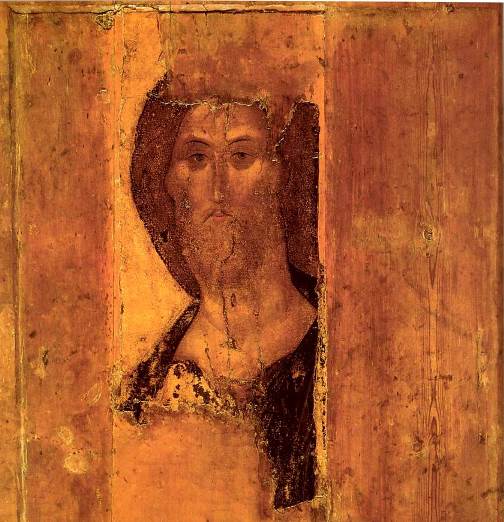
christ-pantocrator-andrei-rublev-1410-1420s-the-central-part-of-the-iconographic-deesis-of-zvenigorod-moscow-the-state-tretyakov-gallery

Understanding Icons

The first thing we sense about an icon is its great seriousness. Compare an icon in your mind, a great Western religious painting, one that moves you to deeper faith or even to tears. You’ll notice that there is a difference in the *way* it moves you, however. A Western painting—which is undeniably going to be more accomplished in terms of realism, perspective, lighting, anatomy, and so forth—moves us in our imaginations and our emotions. We engage with it like we do a movie or a story.

An icon hits us in a different way, though. In comparison, it is very still. It is silent. We find ourselves coming to silence as we stand before it. An icon somehow takes command of the space around it. It re-sets where the baseline of our awareness is.

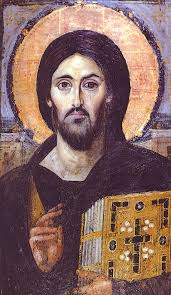
christ-sinai

Many years ago my husband bought our first icon, a copy of the famous 12th century Russian icon known as the Virgin of Vladimir. We hung it on a wall in the den and grouped other, smaller pictures and paintings around it. But it never looked quite right. We kept rearranging the pictures, and then started taking some of them down. It still didn’t work somehow. In the end, we wound up taking down every other painting, so that the Virgin reigned alone in that length of space. She blew all the other pictures off the wall. Such is the quality of her presence in this image, a quality we can’t describe apart from words like “majesty,” “mystery,” and “gravity.”


It is the gravity of an icon that is the other thing I want you to notice. The people in these images are very sober. Their silence is unsettling. We don’t know how to respond and feel awkward. I think this is something like what St. Peter felt when the Lord told him to let down his nets for a catch. When he hauled up teeming nets, St. Peter said, “Depart from me, for I am a sinful man, O Lord.”

The sober presence of the Lord in an icon makes us uncomfortable because it makes us realize how far short we fall from the ineffable beauty and power of God. Sometimes people accuse Christians of trying to make people feel bad or guilty, of being judgmental in their words. When that is the case it is unfortunate. But in this case, we feel the effect of judgment from the only true judge, the only possible judge, and he does it without a word. Yet it is a judgment wrapped in a promise of healing. It is not a rejection, but an invitation. It is an opportunity to receive the healing that only God can give, because he knows us better than we know ourselves.

The steady, unsettling gaze of the Lord in an icon is like the gaze of a surgeon as he looks at a patient’s wounded, broken body. The surgeon understands our woundedness better than we do ourselves, and he knows exactly what it will take to heal it. Our Lord sees brokenness and failures in us that we can’t, that we simply won’t, that we could not bear to see. And he invites us to open ourselves to his healing, a healing that will progress very gently, very gradually, as we are able to bear it.

This isn’t to say that the healing will always be comfortable. He may ask us to give things up that we think we can’t bear to live without. He may ask us to take things on that we think we can’t begin to carry. Only he knows what it will take to heal us. No wonder an icon looks so serious. Our condition is serious. Through the merciful condescension of our Lord, we don’t have to enter into healing with a surgeon we have never seen. He has revealed his face to us, and as we gradually learn to trust him, we can reveal our own broken selves in return.

 
By Frederica Mathewes-Green
This article was published as an inclusion in The Sacred Way by Tony Jones, Zondervan, 2004, and at  http://www.frederica.com


For the making of an icon, watch https://www.youtube.com/watch?v=HTb7l3VF1HY


Leap of Faith (I)

leap-of-faith

My Journey to Eastern Orthodoxy: Part One

Protesting Protestantism

“Do you believe that Jesus Christ was the only begotten Son of God, who died for your sins, was buried and rose again on the third day?” The Reverend’s voice echoed against the tile baptistery. The water was cold.

“Yes,” my meek reply.

“I baptize you in the name of the Father, the son, and the Holy Spirit.”

The Reverend’s voice disappeared as I sank beneath a sea of pain. The water entered my nostrils and I gagged. I choked. Coughed. Gasped for air.

Washed in the water of life. Surrendered to the eternal. Dead and buried with Christ. Yes, I did believe, but…

So many questions yet unanswered. So many deeds undone. At eight my heart had only just begun to lust for the Tree of Knowledge. Duality. Good and evil. An unfulfilled yearning pounded deep within me. My sins had been forgiven and I had only just begun to sin.

I emerged from the water of life, coughing and spitting. The water hid the tears of one who sought surcease of sorrow. Raging hatred. Rebellious angels tormented me as they revealed the evil that yet remained within my soul – that part of me which would remain apart and alone.

Thus I was baptized into the First Christian Church (Disciples of Christ), a mainline Protestant denomination. Although the Disciples of Christ movement was started by a couple of dissenting Presbyterian ministers in the early 1800s, the church claimed to be based on first century New Testament faith and practice. I attended Sunday school, memorized Bible stories, and sang in the choir, but as I grew into my teen years, I began to feel like something was missing.

Although I appreciated the basic message of believing in God and being good, I felt like I was just skimming the surface of Christianity. Where was the power and mystical experience described in the New Testament? Protesting against my Protestant upbringing, I experimented with all kinds of self-help programs, occult practices, and other religions including Buddhism, Hinduism and New Age spirituality. I meditated, chanted, practiced self-hypnosis, yoga, and Tai Chi. I read the Bhagavad Gita, the Tao Te Ching, The Lotus Sutra, Autobiography of a Yogi, and countless other spiritual texts.

Like the Prodigal Son, I eventually found myself lost in a moral and spiritual wasteland, desperately alone in the darkness. I was like a dead dog lying on the road of life when the light of grace shined down upon me and turned my heart toward Christ. I picked up the Bible and read it from cover to cover several times, recognizing that the resurrected Lord Jesus Christ was real and ever present. Glimpsing the light of grace, I experienced a deep healing and recovery, which led to turning my life around. But without clear guidance, my spiritual life meandered through various denominations and ways of worship, including Assembly of God, Calvary Chapel, Reformed, and “nondenominational” evangelical mega churches.

As a Protestant I had been taught that original Christianity had disappeared or been corrupted soon after the time of the Apostles. The “true church” did not reappear until the time of the Reformation in the 1500’s. Subsequent movements claimed to have the most correct interpretation of the scriptures as they argued over pre-tribulation raptures, pre-millennialism, predestination, and other controversies.

As I bounced between various denominations, I judged the sexual and financial scandals that plagued the televangelists and mega-church leaders, while justifying my own moral failings. Doomsday prophets cashed in on end-times hysteria with ever-changing dates for Christ’s return. As preachers fell and prophecies failed, my faith wavered. What happened to the church?

Although my confidence in organized religion was diminished, I still believed in God and Christ. But how could I connect to the one supreme God with so many contradictory paths leading in opposite directions? Enough was enough.
I was done with all these churches and their false teachers. I began to refer to denominations as “demons-in-nations” and I finally gave up man-made religious organizations altogether.

I became “spiritual but not religious,” which meant that I would just pick and choose whatever beliefs “resonated” with me at the time. Free from any sectarian dogmas, I began practicing silent prayer and meditation, reading the Bible on my own and studying 17th century Christian mystics, especially George Fox and the early Quaker writings. Perhaps I had finally found the true path, I thought, as I sat alone in silent stillness, waiting on the Lord. But how would I know that the inner guidance and insights I received were any more than delusions or vain imaginations? After five years of silent waiting, praying, and seeking the inward light, I realized I was still wandering in the wilderness alone.

I continued reading the work of more spiritual teachers like Eckhart Tolle, Krishnamurti, Vernon Howard, and George Gurdjieff. Much of what they said sounded true, but who could I really trust? My skepticism skirted toward the brink of atheism as my desperation sank into despair. What if the whole universe was just a random chaos of matter in motion? How could I restore my waning faith? I prayed for a sign from on high.

Celebrating our seventh wedding anniversary on Memorial Day in 2016, my wife and I leaped out of an airplane at 18,000 feet over Monterey Bay, California. Tumbling head over heels toward the earth, falling, floating, fearless motion blended into stillness as I let go of every thought and feeling, melting into the ever-present moment. Trusting in a safe landing on solid ground took a great leap of faith.

I didn’t know that I was about to take another leap, a leap of faith, that would make skydiving look easy.

By Robert Hammond


Journey of a Young Artist

JonathanPresentation_08

Jonathan Jackson and The Seeds of “The Mystery of Art”


Whoever wants to become a Christian, must first become a poet— Saint Porphyrios
When I was young, they brought me to Babylon
And the night hung over my head
The smoke came into my dreams 
In the valley of dry bones

It was under the skies of Babylon 
Where my soul fell in love with God
My eyes were seared and my blood was bruised
But I was hidden within a song

All around were the sounds of Babylon
But all I heard, were the hymns of heaven

It was under the skies of Babylon 
Where my soul fell in love with her 
I was barely coming clean and she had already seen
A war on her innocence

I spoke of the Christ underneath the clouds 
And woke her from the sleep of death

She took my hand and walked me through the crowd
Why, is anybody’s guess?

All around, was the gold of Babylon
But all I saw, was an angel of heaven

You can shut me up but you cannot quiet
The silence of the Mystic Church
You can shut me up but you cannot quiet
The silence of the Mystic Church


I would like to start with the journey of how this book, “The Mystery of Art” began. It was not an intellectual or abstract search. The questions and explorations on this subject were immediate and crucial for me growing up. I began working as a professional actor at the age of 11 on General Hospital. At The age of 12, by God’s grace I had a profound encounter with Christ. My father would give us cassette tapes of sermons to listen to and one night, I heard a sermon on “The holiness of God and the pride of the human heart.” I don’t know why and I don’t know how these things occur, but I was cut to the heart. I suddenly realized how far away from God I truly was. How prideful and full of selfishness and egoism I was. It scared me to be honest. And yet, paradoxically, in that very moment of feeling the weight of my sinfulness—how my supposed righteousness is like “filthy rags” before the holiness of God, as Isaiah says—a Divine Presence also overwhelmed me. I felt like a great sinner who was also mysteriously loved beyond comprehension.

Around the same time, I read C.S. Lewis’ chapter called “The Great Sin”, which is all about Pride. I read Matthew 25, the Last Judgment and Matthew 5 when Christ says, “You have heard that it was said, ‘You shall not commit adultery.’ But I tell you that anyone who looks at a woman lustfully has already committed adultery with her in his heart.” I knew I could never impress God with my self-righteousness, so I cried out for mercy, I cried out for grace. And the compassions of God washed over me.

This was a turning point in my life. Nothing was the same after this encounter. I began to hear and perceive my own thoughts with great clarity. This was frightening too because I was suddenly aware of all the judgments and horrible thoughts I had about people. But the Holy Spirit was so merciful in this process. He never made me feel condemned. Convicted, yes. But never condemned. He would always whisper, “I’m not showing you this to condemn you, I’m showing you this darkness, so you can be healed.”

I began to think about God all the time. Throughout the following years there were many struggles and trials but the mystery of God became the most beautiful, the most attractive, the most intriguing and important pursuit in my life.

Naturally and organically, I had a desire to incorporate the Holy Spirit into the work I was doing. I had studied a few different acting methods but for the most part, my own personal method was being birthed through experience. Working with Anthony Geary and Genie Francis and other incredible performers like Michelle Pfeiffer and Sir Ben Kingsley. It was very much like Orthodoxy in the sense that I was a sponge, soaking everything in through experience and not through theory.

Within a short period of time after this initial encounter of grace, I was given some very heavy storylines to portray. I was about 15 years old and my character Lucky Spencer finds a young girl in the woods, who has just been raped. It is winter and the poor girl is freezing out in the cold, left for dead. He rescues her and they develop a friendship. He spends months taking care of her and being by her side as she tries to heal from this horrific event.

On a Soap Opera, you are on TV almost every day; especially when your storyline in prominent. In a more direct way than most artistic mediums, you are living the day-to-day story of your character. I was portraying this storyline for months. It was during this time that I first remember bringing God into my preparation as an actor. I began to ask Him, “How could you allow this innocent creature to suffer in this way?” “How can anyone be healed from such a wound?”

JonathanPresentation

They were questions my character could have been asking God and questions most of us have asked before. What it began to do for me, was nudge my work towards something inherently spiritual and although I would not have known it at the time, something sacramental.

Over the following years I portrayed a lot of dark and tragic roles: someone struggling with suicide, a heroine addict, a murderer among others. It was around this time when I began to ask God, “How can I portray these dark and troubled characters dynamically and truthfully, without being consumed by the darkness myself?” There are many tragic stories of young actors who become drug addicts after playing one in a film. The stories of drug overdoses and suicides among young actors and actresses are too many. I instinctively steered away from “Method Acting” and sought a different path, even though I didn’t know exactly what that would be.

It was around this time when I discovered Dostoevsky. It’s amazing to me now, being Orthodox that I wasn’t able to comprehend anything about the Orthodox Church as I read his books. It was like a veil, I suppose. But what I did discover was a kindred soul. Here was someone who was writing about very dark and tragic characters and themes but from a place of beauty—from a place of the Light of Christ. Prince Myshkin, from the “The Idiot”, changed my life. I clung to Dostoevsky in my heart as I approached portraying these dark characters and prayed, “Lord, please help me to portray the darkness of this world from a place of purity and light. Please, help me not to be overcome by the darkness, but to infiltrate the darkness with Your Light. Without you I can do nothing. I am nothing, I have nothing and I can do nothing without You, Lord. Amen.”

This is a snap shot so to speak, of the journey towards writing, “The Mystery Of Art”. These were the seeds, which by God’s grace, grew over time. There were so many important and profound spiritual realities that I wasn’t exposed to at the time, because I had not encountered the Holy Orthodox Church. I was grasping in the dark, looking for answers, feeling my way towards Christ, as best I could, but I always knew that something was missing; something significant and crucial to my relationship with God. There is a beautiful Scripture in the Gospel of John where Christ says,

“And I have other sheep that are not of this fold. I must bring them also, and they will listen to my voice. So there will be one flock, one shepherd.” (John 10:16)

I was one those lambs who was not of this fold. But through the grace of Jesus Christ, the Good Shepherd and your prayers, He found me and brought me home. My journey to the Orthodox Faith took many years and was paved with blood and heartache. I carried all of these artistic questions and experiences with me as my family and I came into the Church for salvation, deliverance and healing.

See also: Jonathan Jackson’s Orthodox Acceptance Speech at the Emmy’s

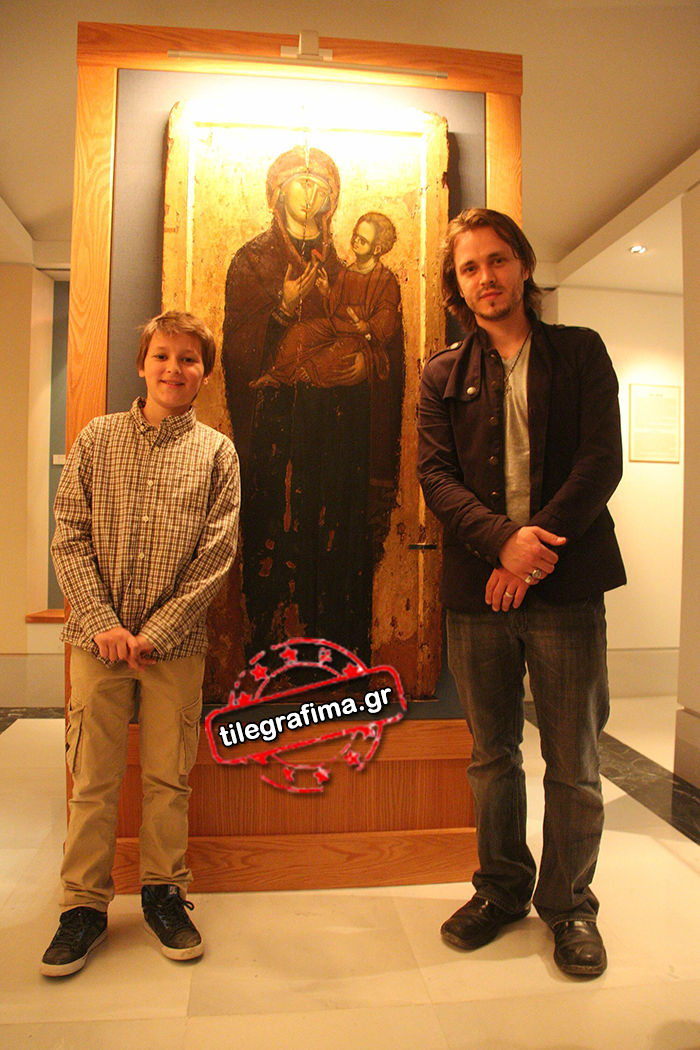
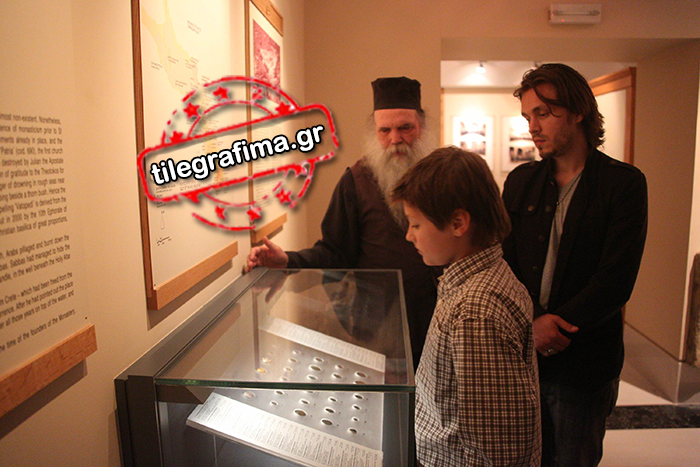
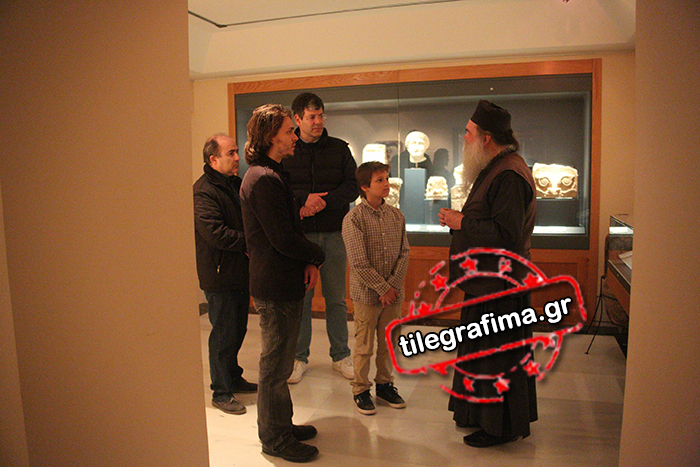
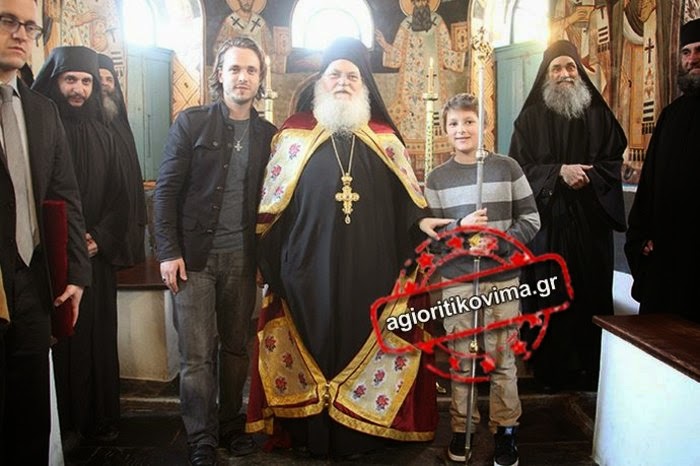
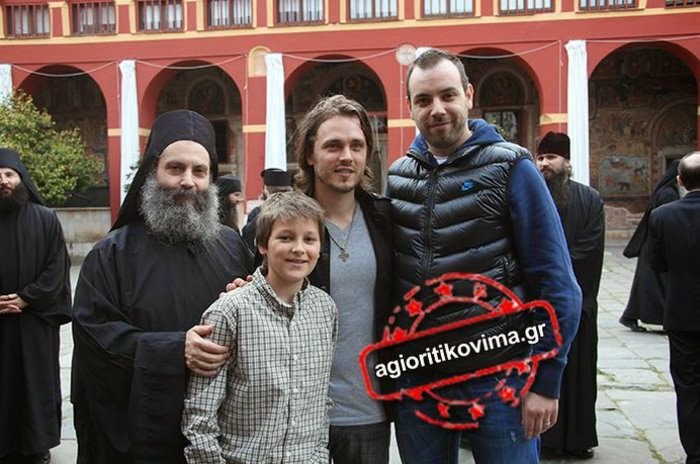
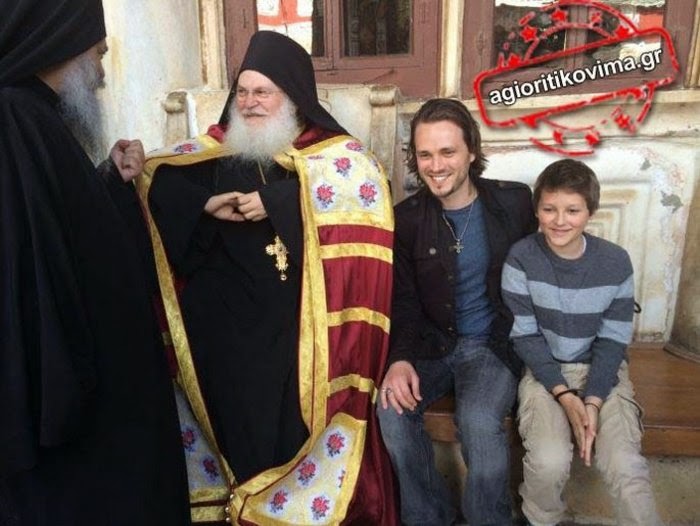
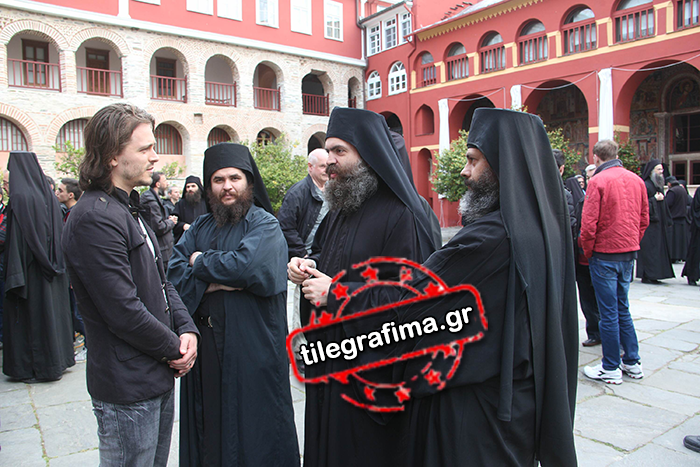
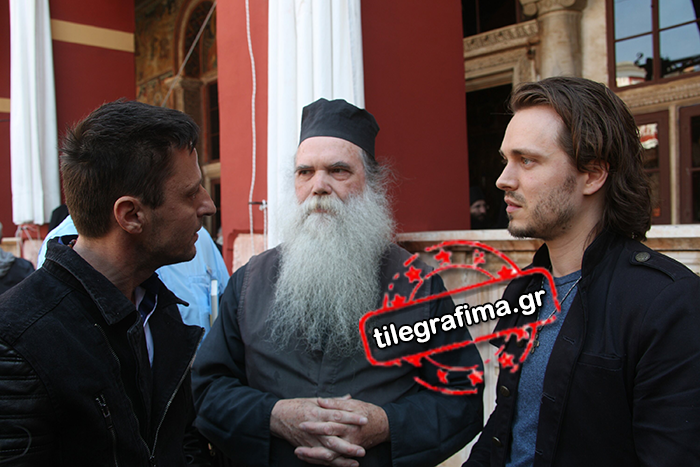
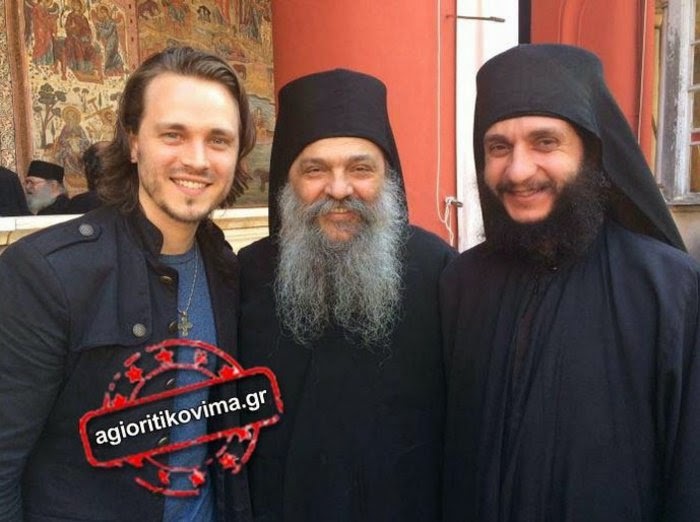
See photos from his visit to Mount Athos for the first time with his 11 year-old son Caleb (2015), where they stayed  for five days visiting Simonopetra and Xenophontos monasteries, and spent most of his time at Vatopaidi Monastery (Friday till Tuesday) where he met the Abbot, Elder Ephraim, and attended an all-night vigil on Saturday night.

While at Vatopaidi Monastery, Jonathan also gave a testimony of how he converted to Orthodoxy for Pemptousia, which can be seen here.

Abba Dorotheos, An Instruction

avvasdorotheos

Life and Sayings of Abba Dorotheos (*) — Instruction XI

115. It happened that a great Elder was with his disciples in a place where there were all kinds of cypresses, large and small. He said to one of his disciples: ‘Pull up that little cypress plant’. It was very small and the monk had no difficulty in pulling it up with one hand. Then the Elder indicated another, bigger than the first, and said ‘Pull that one up as well’. After giving it a shake, the monk used both hands to uproot it. He then pointed to another, even bigger, and the monk uprooted that, too, though with more effort. The Elder then pointed to another one, even bigger. The monk shook it hard and expended much effort and sweat before finally uprooting it. The next one was even bigger and despite his sweat and efforts, the monk wasn’t able to pull it up. When the Elder saw that he couldn’t, he told another brother to go and help him, and together they uprooted it. Then the Elder said to the monks: ‘That’s how it is with the passions, my brethren. While they’re little, if we want, we can cut them off easily. But if we ignore them, as being unimportant, they become hardier and then more effort is required. And if they strike deep roots within us, then, no matter how hard we try, we can’t cut them off on our own, unless we have the help of some saints, who, after God, will defend us’.


Do you see the power that the words of the holy Elders have? The Prophet teaches us about this when he writes in the Psalm: ‘Wretched daughter of Babylon! Blessed is he who will deal with you as you have dealt with us. Blessed is he who will seize your infants and dash them against the rock (Ps. 136, 8-9. Septuagint).

abba-john

116. But let’s investigate his words in turn. Babylon is called confusion, since this is Babel, which is the same as Sychem [Shechem][1]. The daughter of Babylon is the name for enmity. Because first the soul becomes confused and loses its discernment[2] and then it commits sin. He calls her ‘wretched’, because, as I’ve told you before, evil is without substance and without form. It’s born from non-existence, because of our heedlessness and disappears again when we fight it, returning to nonentity. On this, the saint says: ‘Blessed is he who will repay you for the evil you’ve done to us’. So, on the one hand, we have to recognize what we’ve given, and, on the other, what we’ve received in exchange and what we should pay back. We gave our will, and, in exchange, received sin. He extols the promise given as repayment: that we will not do the same thing again. And he adds: ‘Blessed is he who will seize your infants and dash them against the rock’. By this he means: ‘Blessed is he who doesn’t allow your offspring, that is wicked thoughts, to grow, even in the beginning and thus work their evil in him. On the contrary, while they’re still weak, before they’re nourished and increase against him, he grabs hold of them and dashes them against the rock, which is Christ. In this way he exterminates them by having recourse to Christ’.

117. This is how the Elders and Holy Scripture all agree and extol those who strive to cut off their passions while they’re still weak, before their pain and bitterness are felt. So, let’s work with a will, my brethren, and we’ll find mercy. Just a little effort and we’ll find abundant rest.

The Fathers said that we should carefully cleanse every facet of our soul. In other words, that we should examine, every evening, how we’ve spent the day and then, in the morning, how we’ve spent the night. And we repent to God for any sins we’ve committed. Truth to tell, since we’re so sinful we should really examine ourselves every six hours to see how we’ve spent them and how we’ve sinned. Each of us should say: ‘Have I perhaps hurt someone with what I’ve said? Perhaps I saw them doing something and judged them or derided them or gossiped about them. Did I perhaps ask the cellarer for something, and complained when he wouldn’t give it to me? Was the food not so good and I said something derogatory about the cook and hurt his feelings? Did I perhaps complain to myself because I felt disgusted about something?’ Because if you go on complaining to yourself, that’s a sin. And again he says: ‘Did the canonarch or one of the other brothers say something to me and I couldn’t take it and spoke back to him?’ So, every day we have to ask ourselves how we’ve done. And the same goes for the nights. Did we get up willingly for the vigil? Did we not pay attention to the monk who woke us, or did we complain about him? We have to understand that the monk who wakes us for the vigil is doing us a great favour and is the harbinger of great, good things, since he’s waking us up to speak to God, to seek forgiveness for our sins and enlightenment. So aren’t we under an obligation to thank him? Really, we should be aware that through the assistance of our brother, we’ve gained our salvation. 

[1] Babel does, indeed, mean ‘confusion’, but it’s not immediately apparent why Abba Dorotheos mentions Shechem. The tower of Babel was in the land of Shinar, roughly ‘Mesopotamia’.
[2] Discernment/discretion/discrimination. Described by Cassian the Roman as the ‘pinnacle and queen of the virtues’ (Philokalia, vol. 1) and by John of the Ladder as ‘the eye and lamp of the soul, ‘the sure understanding of the will of God in every place, time and thing’ (Discourse 26).

* Life and Sayings of Abba Dorotheos was the first book my (now hermit) Gerondas recommended to me, upon ‘discovering’ the Church at my 20s. What a treasure! This book has travelled with me all over the world ever since, a constant point of reference!

Uncreated Light

Baptism and Uncreated Light

At the Orthodox parish of Holy Cross preparations are under way for the making of a Catechumen. I am deeply moved, at awe before God’s Providence. I am going to become his godparent.

On Sorrows