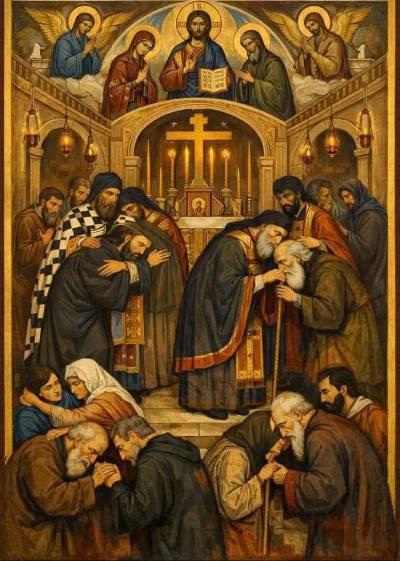
Embrace Great Lent: 55 Maxims for Spiritual Renewal

Dear brothers and sisters, I wish you all a blessed Great Lent! This 40-Day Fast is considered in Orthodox tradition, “the tithe of the year”, a spiritual offering of roughly 10% of our time (40 days plus Holy Week) to God, intended for intense spiritual renewal, prayer and fasting. It acts as a reminder that all time, all possessions and all gifts belong to God, encouraging us to reorient our lives away from passions and toward Him.

Especially for this time, I find +Rev. Thomas Hopko’s 55 Maxims are most relevant, those “55 things that a believer, very simply, would do if they were really a believer and were really obedient to God and wanted to live the way God would have us live”. These 55 Maxims may appear too practical and down-to-earth, but are in truth profound and deep. May we put these 55 Maxims into practice for the following 40 Days and ever, Amen!

1 Be always with Christ and trust God in everything. Never forget God.

2 Pray as you can, not as you think you must. Pray as God inspires you to pray, not as you want to, but as God gives. And for a Christian, that would mean in one’s heart, in one’s room, and in one’s Church.

3  Have a keepable rule of prayer done by discipline. You can’t just pray when you feel like it. You have to pray by discipline, the times of day where you would remember God and say your prayers.

4 Say the Lord’s Prayer several times each day. Just as one is getting into one’s car or walking into one’s office or into one’s classroom or before eating a meal, when waking in the morning, when going to sleep at night. Just say the Lord’s Prayer. It’s the prayer that the Lord gave, a short prayer, but it contains everything that a human being needs to pray if Christ is crucified, raised, and glorified.

5 Repeat a short prayer when your mind is not occupied. This short prayer could simply be “Lord have mercy” or “Lord Jesus Christ have mercy.” The person just might say “Jesus.” A person might say “God,” but just some short prayer that fills the mind when the mind is not working in order to have the remembrance of God in one’s life, in one’s heart.

6 Make some prostrations when you pray. Kneel down. Bend over. Bow down. Use your body. As St. Ephraim said, “If your body is not praying when you’re praying, you’re not really praying.” Prayer is not just an activity of the mind and heart. It’s an activity of the whole person.

7 Eat good foods in moderation and fast on fasting days.

8 Practice silence, inner and outer. Just sit for a few minutes every day in total silence. Turn off all the appliances. Open oneself to God. Don’t think about anything. Watch the thoughts that come, and turn them over to God.

9 Sit in silence 20 to 30 minutes each day.

10 Do acts of mercy in secret.

11 Go to liturgical services regularly.

12 Go to Confession and Holy Communion regularly.

13 Do not engage intrusive thoughts and feelings.

14 Reveal all your thoughts and feelings to a trusted person regularly.

15 Read the scriptures regularly.

16 Read good books, a little at a time.

17 Cultivate communion with the saints.

18 Be an ordinary person, one of the human race. 

19 Be polite with everyone, first of all family members.

20 Maintain cleanliness and order in your home.

21 Have a healthy, wholesome hobby.

22 Exercise regularly.

23 Live a day, even a part of a day, at a time.

24 Be totally honest, first of all with yourself.

25 Be faithful in little things.

26 Do your work, then forget it.

27 Do the most difficult and painful things first.

28 Face reality.

29 Be grateful.

30 Be cheerful.

31 Be simple, hidden, quiet and small.

32 Never bring attention to yourself.

33 Listen when people talk to you.

34 Be awake and attentive, fully present where you are.

35 Think and talk about things no more than necessary.

36 Speak simply, clearly, firmly, directly.

37 Flee imagination, fantasy, analysis, figuring things out.

38 Flee carnal, sexual things at their first appearance.

39 Don’t complain, grumble, murmur or whine.

40 Don’t seek or expect pity or praise.

41 Don’t compare yourself with anyone.

42 Don’t judge anyone for anything.

43 Don’t try to convince anyone of anything.

44 Don’t defend or justify yourself.

45 Be defined and bound by God, not people.

46 Accept criticism gracefully and test it carefully.

47 Give advice only when asked or when it is your duty.

48 Do nothing for people that they can and should do for themselves.

49 Have a daily schedule of activities, avoiding whim and caprice.

50 Be merciful with yourself and others.

51 Have no expectations except to be fiercely tempted to your last breath.

52 Focus exclusively on God and light, and never on darkness, temptation and sin.

53 Endure the trial of yourself and your faults serenely, under God’s mercy.

54 When you fall, get up immediately and start over.

55. Get help when you need it, without fear or shame.

Pramvir and St Tikhon Orthodox Church

Confronting Demons: An Encounter with Elder Gregory

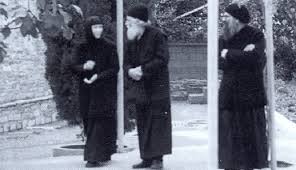
From a speech by the blessed Elder Gregory, my first spiritual father, from the Holy Hermitage of the Holy Forerunner. In the photograph above, he is on the right, at the monastery of the Holy Forerunner, together with St. Paisios in the middle and Mother Euphemia on the left.

“I will mention an incident that made an impression on me. Here, when I was hearing confessions, a Mother came with her little child, a teenager, just fifteen years old. The child was thoughtful, and his Mother told me that he was sick and that they had read exorcisms on him, that he had been put under a magic spell. The child came in, and when he came, he sat next to me and told me that his whole body was in great pain and that he was suffering greatly.

Of course, I did not say anything because he was experiencing internal turmoil. I told him to go out for a walk, to go outside for a little while, with the thought of going inside the Temple, inside the Church. He accepted, agreed, and we entered the outer Narthex.

He was quite comfortable there; a pilgrim stood before him, but he did not approach the icons. He looked at the icons, somewhat scared. I told him to make a bow to them, but he did not accept. The devil does not bow, of course; the one who was inside him began to react. I told him, “Make your cross,” and he did not do it correctly; he made some hasty movements, as if he were playing the guitar; this was not a cross he made! “Make your cross correctly, my child”, I told him, but he did not make a cross on himself at all, and I thought of a multitude of Christians who go to church regularly and do not make their cross correctly. The cross has great power; we will talk about the Cross another time. The devil trembles a lot at the Cross.

I took the child, and we walked inside the Church (internal narthex, pronaos). When we reached the main Church, the middle part, he was so scared, so agitated that he wanted to leave. “Why did you bring me here for a walk? Didn’t you tell me we were going for a walk? What did you bring me here for?” “Was this the walk?” 

Of course, it was not the child that was talking; it was the demon that was talking. He was very agitated when I put him inside the main church. I don’t know what he would do if I put him inside the sanctuary, the altar area. The devil wasn’t worried outside; he was worried inside the church. The demon is very afraid of the holy relics.

I had an icon of the Virgin Mary with me, and I sneaked it in unnoticed. As soon as I put it on, he started to get agitated, to burn, to sweat. How agitated the demon gets with just an icon of the Virgin Mary! And how bad you do to yourselves, those of you who don’t wear the Holy Cross on you. All Christians must have the Holy Cross with them.

The poor little child then asked me for water. I went into the sanctuary and, along with the water, I added a little holy water. He wouldn’t drink it at all! “No”, he said to me, “give me some water from the tap to drink”. The demon understood that I had put holy water together with plain water in the glass.  That is why it is a very good habit for those of you who, after their morning prayer, drink a little holy water and then go to work.

From this torment of the sick child, we sometimes wonder, my brothers, if these poor children who have demons inside them suffer so much here, in this life, what will happen when they go up there….”

You do understand, don’t you? 

These are a few thoughts I wanted to tell you, my brothers, and sometimes we wonder”.

A Sack of Potatoes

One Saturday morning, a very young woman dressed in black came to the church of Saint Constantine in Glyfada, where we were at the time, holding her two young children in her arms. A 5-year-old girl and a 7-year-old boy. She had lost her husband, who was also very young, and with him she lost the land beneath her feet. She had come to confess to Fr. Constantine, and she had brought her children for Catechism.

Naturally, during her confession, she wondered and asked Fr. Constantine, as she later confided in me, what would happen to her children if she died too! The Father had reassured her that if she died, he would take care of her children, which would be very good for them!

But when she wondered why such great evil had befallen her, and why God did not take pity on her and gave her something she could not bear, then Father asked her:

May I ask you for a moment for a favour?

Of course, Father, whatever you want.

Here outside the sanctuary, they have left a sack of potatoes for me. Should we call your son to bring it here, so I can give it to you?

Thank you, Father, but my son is only 7 years old. How many kilograms does the sack weigh?

It is 20 kilograms.

Well, a 7-year-old child cannot lift a 20-kilogram sack of potatoes!

Yes, but I want to give it to you. How can he bring it to us?

How? Should we give him a little bag to put a few potatoes in, as many as he can lift, and bring them to us here, little by little? Or bring them to us little by little with his little hands if you don’t have a bag? What do you say?

Is this what you are suggesting? Little by little?

How else? He can’t carry them all at once, since he is a little child.

Ah! So you are thinking of your child who can’t lift 20 kilos of potatoes, and God doesn’t think of you, who are His child, and gives you more than you can lift?

Oh Father, what are you saying to me now?

I’m telling you the truth. God doesn’t think of you, who are His child, while you think of your son?

The sequel is amazing since this advice took root in the family.

Recently, I saw the widow in question by chance on the street and now a grandmother! After we hugged and kissed, she told me that her children got married and had children too, and the family grew, but her daughter’s husband got cancer with all that that entails…

“But”, she tells me, “whenever I say to my daughter, ‘Ah, my child, what you are going through!’, she answers me 40 years after that confession of mine, ‘Mom! Remember the potatoes! I can handle what I’m lifting’ “.

Her son’s wife abandoned them, and the widowed mother says to her son, “Ah, my child, why did that girl leave and leave you? What harm she has done to us!” And my son replies, “Mom! The potatoes! That’s all I can handle!”

“So”, she tells me, “as you can see, potatoes have been on the agenda in our house for 40 years now, and so we can’t complain about anything!”

This was Father Konstantinos. Inventive about everything!

He changed our minds! He gave breath and impetus to our lives! He healed our pains and our souls!

He often said about whining in his speeches, what a soul-destroying disease it is.

(As Much as a Book can Hold, Memories by Fr. Konstantinos Stratigopoulos)

*

That is a powerful sentiment to start the year! Whether those “potatoes” are unexpected challenges or the daily grind, whatever heavy stuff life throws our way, having the resilience to carry them, the perspective to see the harvest ahead, and most importantly, faith and trust in His Providence, makes all the difference. May we all carry our ‘bags of potatoes’, without whining, this year and all our lives! May our “sack” be light, our grip be strong, and our harvest be plentiful. Amen! 

*

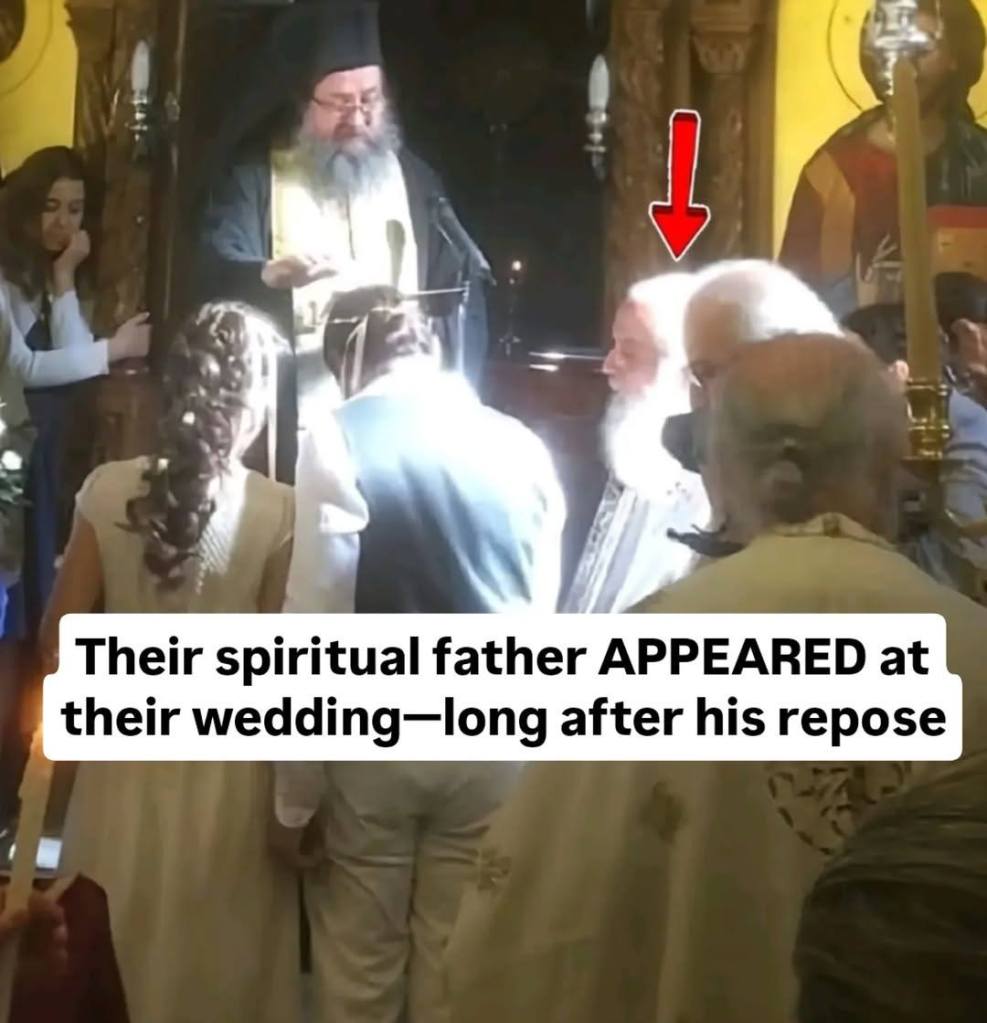
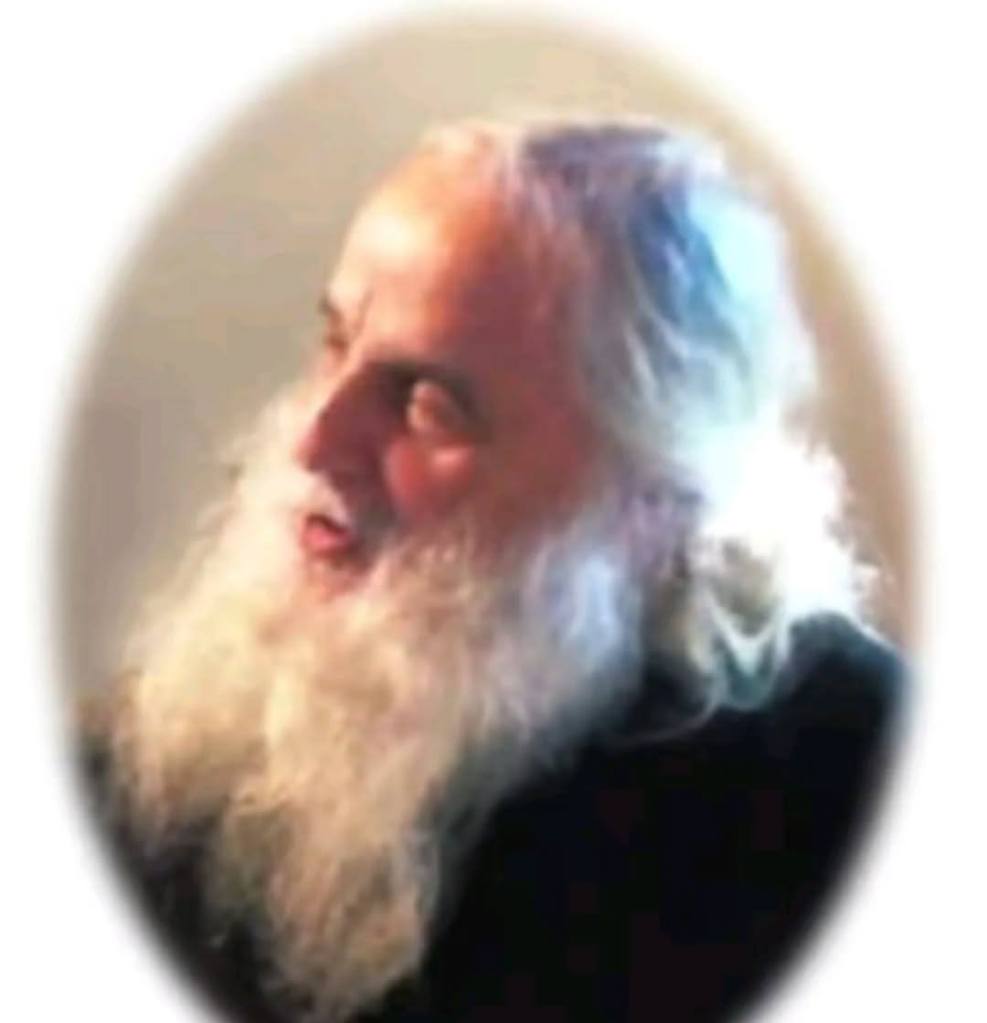
The photograph was taken last year at a wedding in Glyfada by a child. The priest dressed in white, holding the Gospel, is the spiritual father of the newlyweds, who had already reposed long before. He was not visible at the time the photo was taken, yet he appeared in the image. One can see the glorious light surrounding him…Saintly Father, please pray for us!!

He is identified as Father Konstantinos Stratigopoulos. More about this saintly Father at a future blog. Your prayers