Sir Stanley Spencer’s Burning Bushes

spencer17

Sir Stanley Spencer (1891-1959)

He was a visionary, a genius. Some said, a lunatic.

spencer12

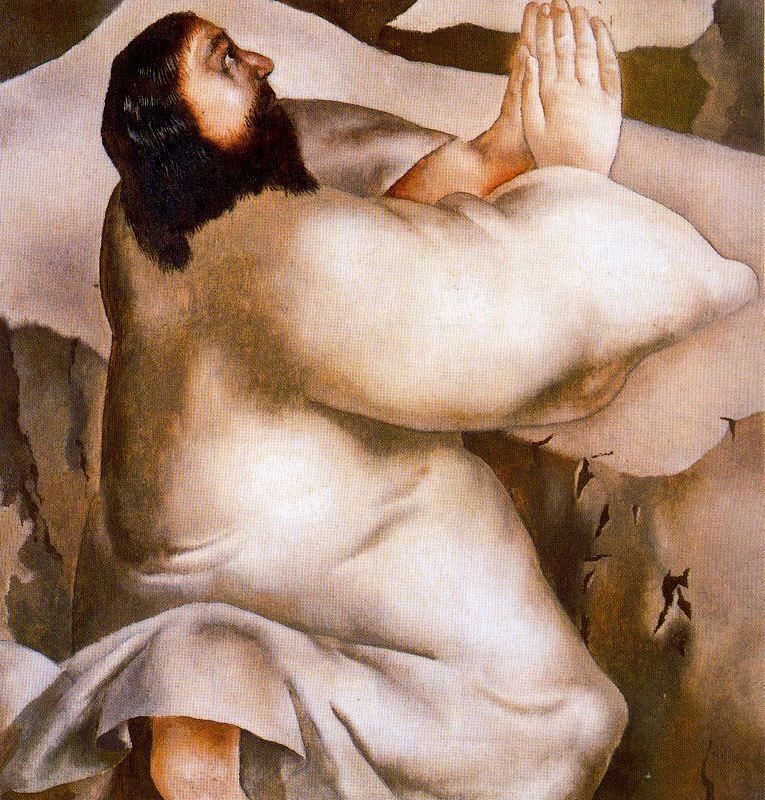
Have a look at his ‘Biblical’ contemporary Zacharias and Elizabeth praying to conceive St. John the Forerunner:

spencer40

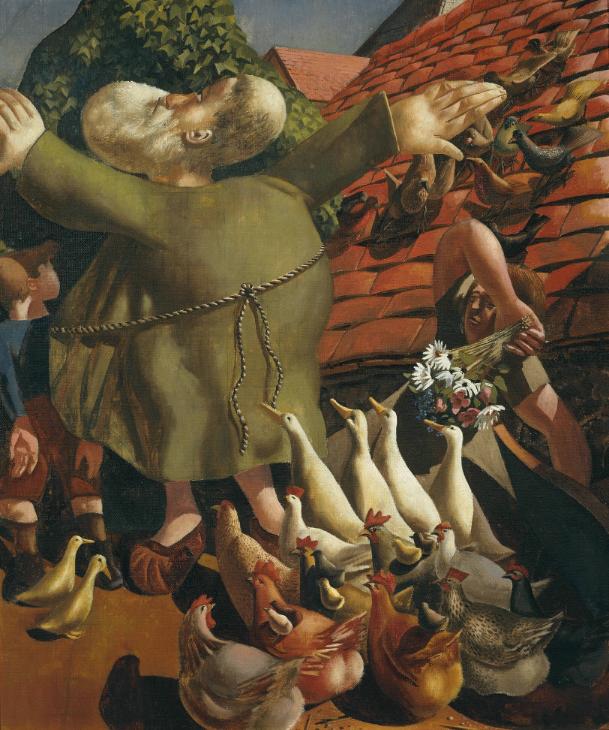
Or at his St Francis and the Birds:

St Francis and the Birds 1935 Sir Stanley Spencer 1891-1959 Presented by the Trustees of the Chantrey Bequest 1967 http://www.tate.org.uk/art/work/T00961

“St Francis of Assisi, the founder of the Franciscans, is popularly remembered for being able to talk to birds, and pray with them. Here he is shown as an old man, dressed in a Franciscan robe, talking to birds on a farm.” [Tate] Stanley Spencer intended to display this painting in his ideal gallery, which he called ‘Church House’, though it was never built. Admittedly, there is a certain “strangeness” in the painting, particularly in the way the saint separates the boy and girl. This painting was in fact rejected by the Royal Academy in 1935, interpreted as an offensive caricature. Spencer was eventually reconciled with the Royal Academy and was elected a full member in 1950; he was knighted in 1959.

spencer37

‘Understand. Spencer is not a fool. He is a damned good man’ one of his officers said. Spencer had just bandaged him and called for stretcher bearers because the officer was grievously wounded. Stanley Spencer had no idea that many people thought of him as an idiot.

spencer36

Spencer was other worldly. He was not run-of –the –mill. His genius as a painter imbued him with love for all of creation. He saw the redemptive force of love in everything, in everyday life, in hospitals ,on the battlefield, in the human body. His innocence and love of beauty could sometimes make him a victim. He thought he loved Patricia Preece, an artist of voluptuous proportions, whom he painted and who tricked him with many wiles into divorcing his wife and marrying her. Yet his childlike soul made him beloved of many. His daughters loved him and remembered his beautiful character and his redeeming love for all of nature.

spencer10

“Everything I do for anyone is as ointment poured forth and it is an exercise creating joy, which is eternal; and it is the army has caused me to learn that by being happy in the present state I am satisfied. But what is wonderful is that by praying for the power to love purely or absolutely you get that power. I feel ashamed of what I would do when I first came out here, compared with what I would do now. The army ought to make any man an artist, because it ought to give any man these feelings.”

Stanley Spencer wrote these words in a letter to friends when he was a soldier on the Salonika front during the First World War. He had been a hospital orderly but was then in active service fighting against the Bulgarians and the Germans. He was finally sent home in 1918 as a result of his frequent and debilitating bouts of malaria.

spencer101

Resurrection

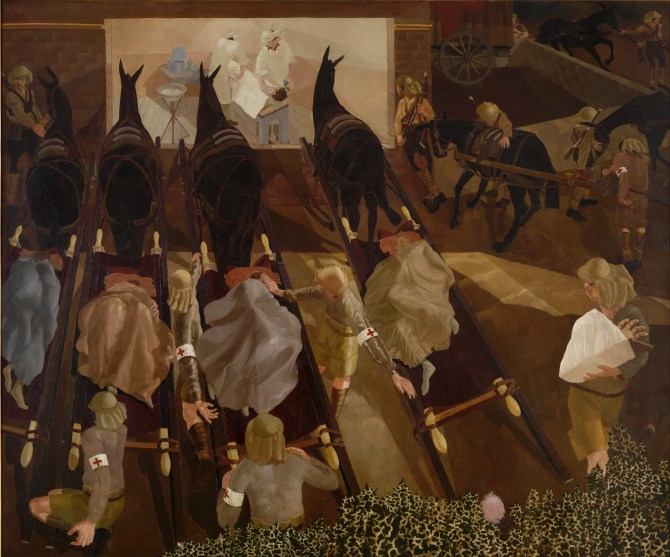
His extraordinarily moving painting of Smol in Macedonia, Travoys Arriving with Wounded at a Dressing Station at Smol, Macedonia, showing an illuminated operating theatre with the wounded on stretchers outside drawn by mules, resonates with biblical undertones: the dressing station was an old Greek church which Spencer drew such that, with the animal and human onlookers surrounding it, it would recall depictions of the birth of Christ. Rather than showing the horror of war, the painting gives hope of continuing life.

spencer19

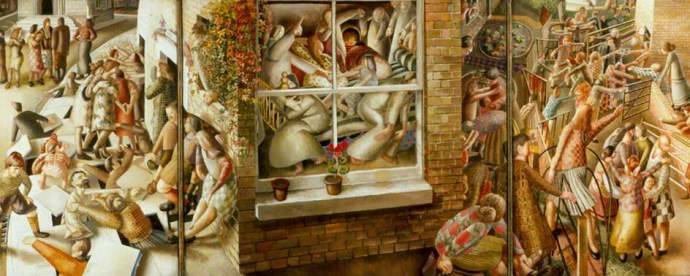
In the 1920s Spencer was asked by the Behrends family to do the murals for a memorial chapel for their brother Harry, who had died of malaria on the Salonika front. Spencer had always wanted to express his memories of the war and he spent six years on what are regarded by many to be his finest paintings, at the Sandham Memorial Chapel at Burghclere in England. Paul Mitchell says: “Perhaps one would expect scenes of death and destruction. But there is not a gun… and only one officer in sight. Entering the chapel you see ahead vivid white crosses tumbling from the sky and piling up around the altar. Soldiers are emerging from their graves in a Resurrection scene.

spencer9

spencer20

spencer21

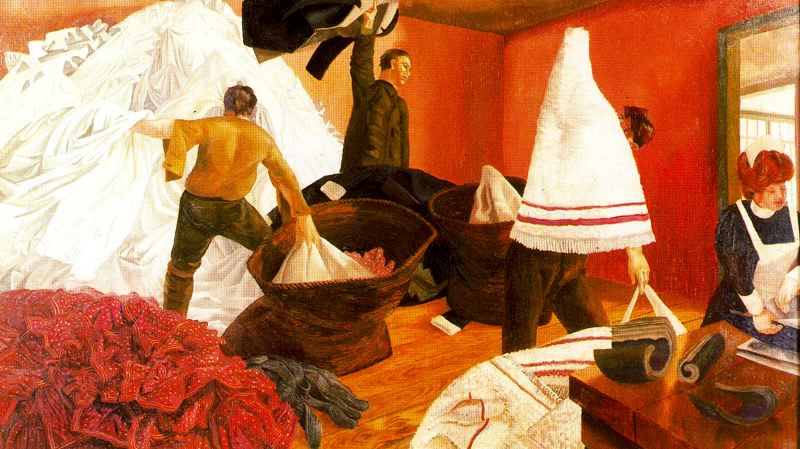
The other walls depict the everyday life that Spencer himself experienced. Even with titles such as Sorting and Moving the Kit-Bags Spencer imbues the paintings with such beauty and meaning that as he himself says, “they don’t look like war pictures, they rather look like heaven”.The everyday activities of the soldiers are transformed from banality. Saint Augustine, whom the artist had read, believed that even menial work could be a way of glorifying God. He continues, “the picture is supposed to be a reflection of the general attitude and behaviour of men during the war”, when a soldier would fondly remember the “caress of a sweetheart” or “sitting in his doorway chatting to his neighbours”. For Spencer himself the five years it took to complete the works was a means to “recover my lost self”.

spencer102

Resurrection–Reunion

spencer103

Resurrection–Waking Up

They are highly personal paintings that go beyond the mundane, treating the great themes of death and redemption in an extraordinary vision of grandeur. Spencer went on to paint an amazing Resurrection painting with his home village of Cookham, and the local churchyard as its background.

spencer100

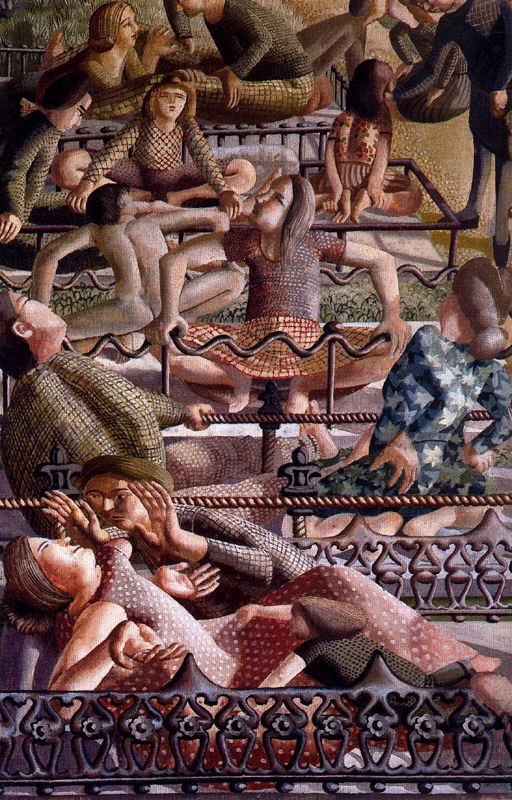
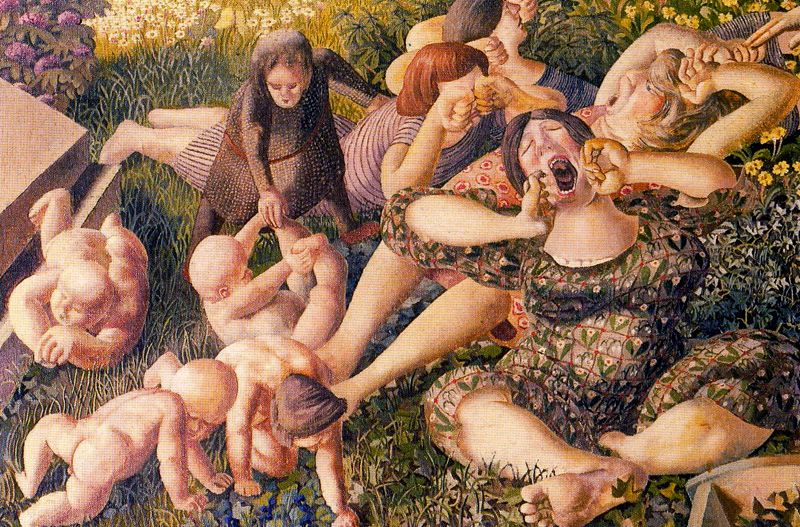
The Resurrection, Cookham 1924–7

“Spencer believed that the divine rested in all creation. He saw his home town of Cookham as a paradise in which everything is invested with mystical significance. The local churchyard here becomes the setting for the resurrection of the dead. Christ is enthroned in the church porch, cradling three babies, with God the Father standing behind. Spencer himself appears near the centre, naked, leaning against a grave stone; his fiancée Hilda lies sleeping in a bed of ivy. At the top left, risen souls are transported to Heaven in the pleasure steamers that then ploughed the Thames.” [Tate]

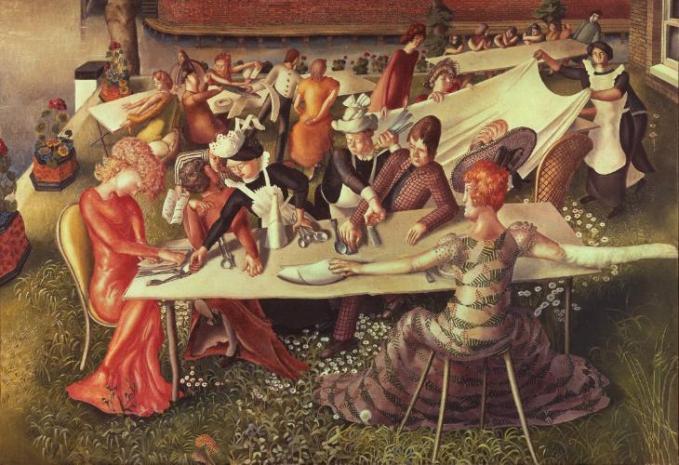
Dinner on the Hotel Lawn 1956-7 Sir Stanley Spencer 1891-1959 Presented by the Trustees of the Chantrey Bequest 1957 http://www.tate.org.uk/art/work/T00141

Not that Stanley Spencer saw himself as a prophet. On the contrary, he believed that the divine was present everywhere, in everything in the world, that the transforming power of love could express the suffering of people and their desire for a better world. Tiny details of life and the human condition were the driving force behind his work. … Spencer’s works often express his fervent if unconventional Christian faith. This is especially evident in the scenes that he based in Cookham which show the compassion that he felt for his fellow residents.

spencer27

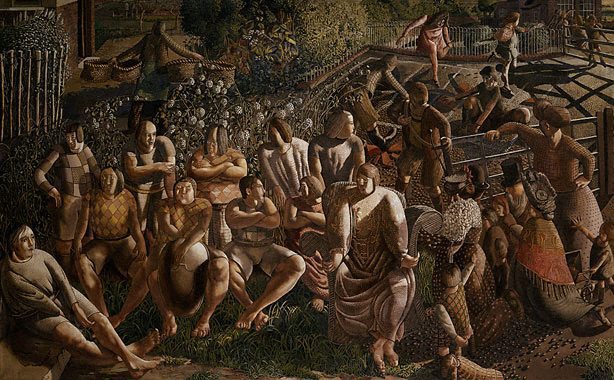
Christ Preaching at the Cookham Regatta

*

«When I lived in Cookham I was disturbed by a feeling of everything being meaningless. Quite suddenly I became aware that everything was full of special meaning, and this made everything holy. The instinct of Moses to take his shoes off when he saw the burning bush was very similar to my feelings. I saw many burning bushes in Cookham. I observed the sacred quality in the most unexpected quarters.»

Artist : Sir Stanley Spencer (England, b.1891, d.1959) Title : Date : 1951-1952 Medium Description: oil on canvas Dimensions : Credit Line : Watson Bequest Fund 1952 Image Credit Line : Accession Number : 8702

Christ in Cookham (1951-1952)

spencer105

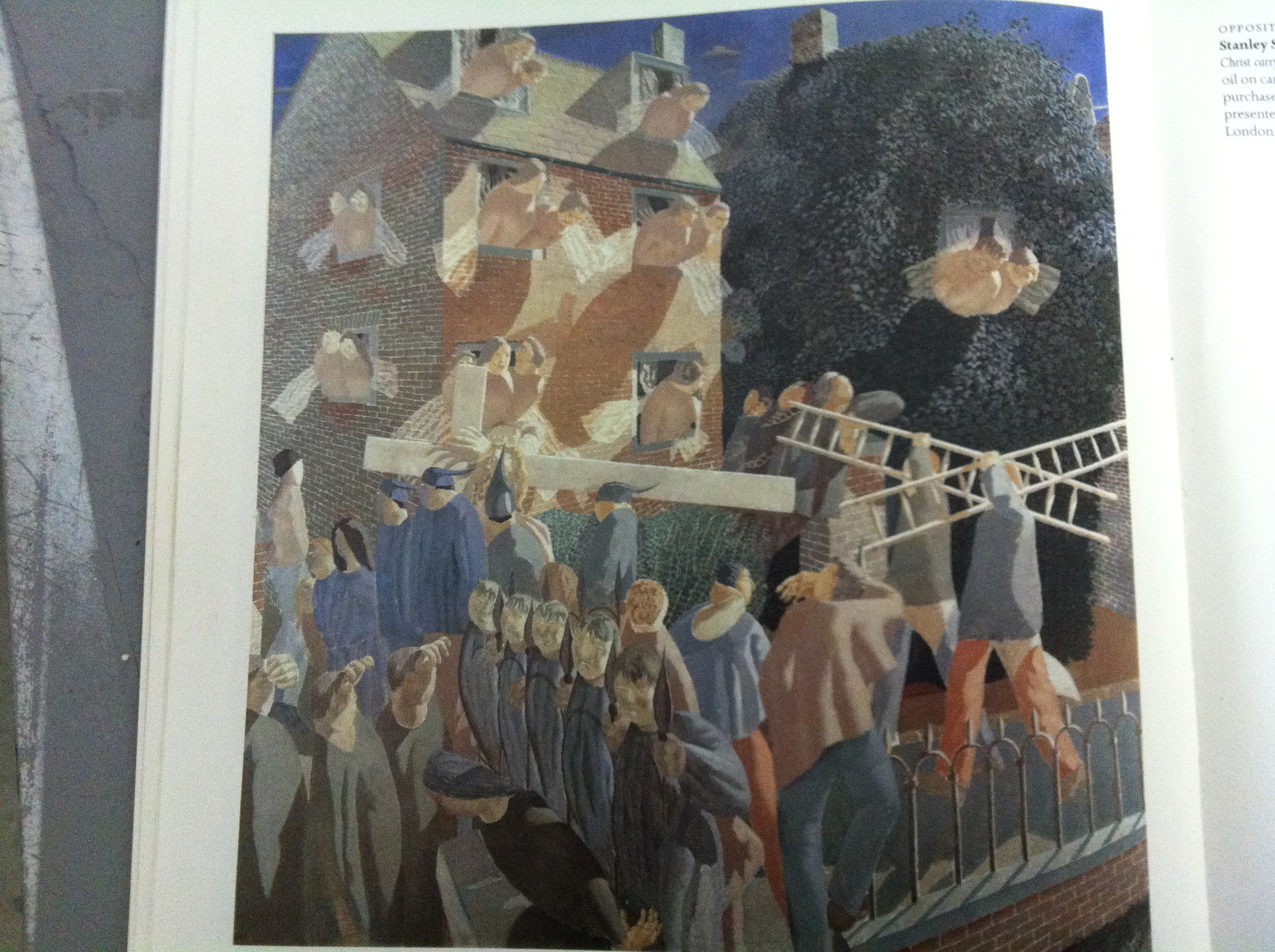
Christ Carrying the Cross 1920

Carpenters walking down Cookham High Street form a link with Christ’s carrying the cross through Jerusalem. The Tate Gallery originally mistitled this picture “Christ Bearing his Cross” which intensely irritated Stanley Spencer.  As he said, the false title implied:

A sense of suffering which was not my intention.  I particularly wished to convey the relationship between the carpenters behind him carrying the ladders and Christ in front carrying the cross.  Each doing their job of work and doing it just like workmen  . . . Christ was not doing a job or his job, but the job.

DACS; (c) DACS; Supplied by The Public Catalogue Foundation

The Resurrection with the Raising of Jarius’s Daughter

*

Again, when Stanley Spencer’s dealer thought of cataloguing the painting as “Christ Carrying His Cross” Stanley was furious. The cross was for him universal. We all have to carry the cross.

spencer35

spencer16

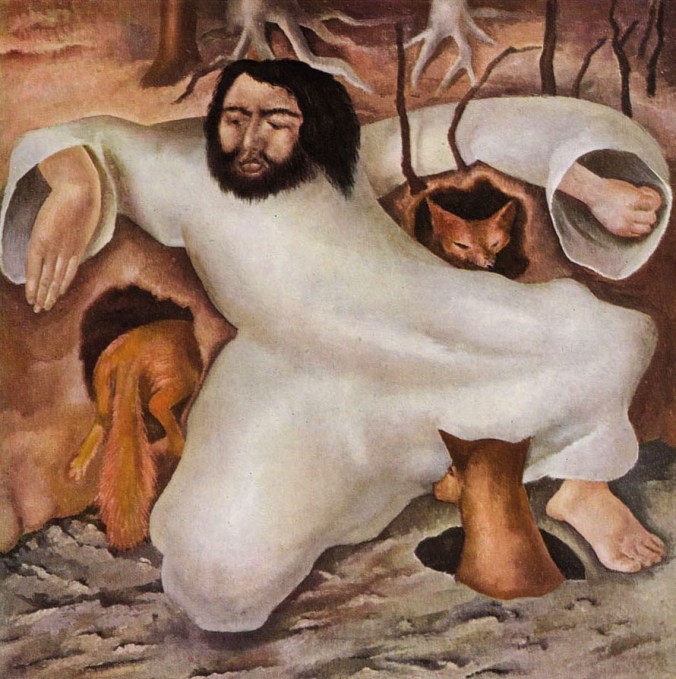
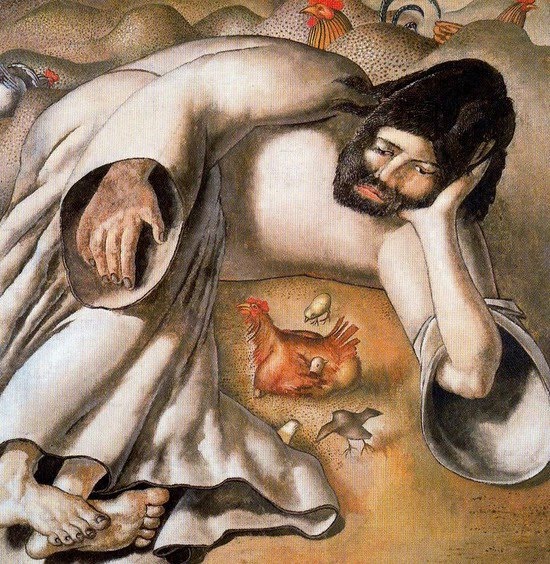
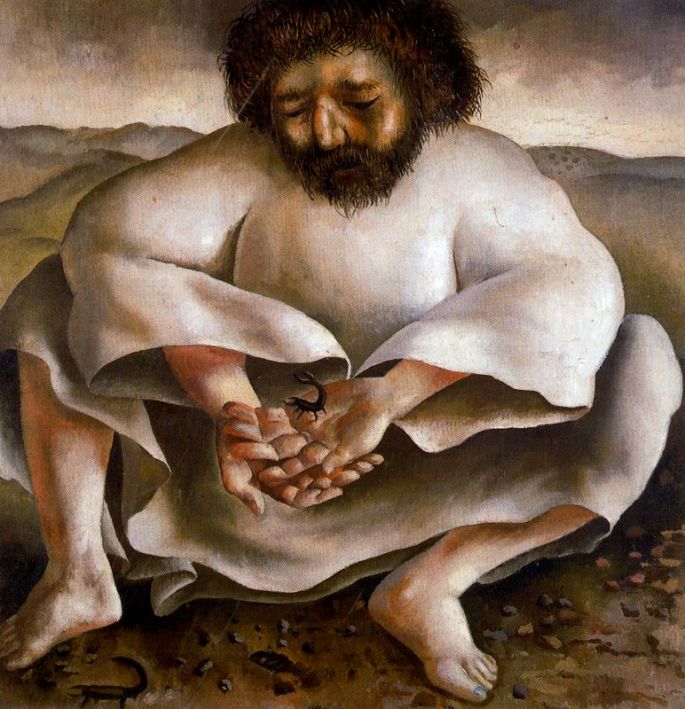
The moving series of paintings Christ in the Wilderness, were a product of a very difficult time for Spencer. He had been betrayed by Patricia Preece and left pretty much destitute. His wife Hilda and children were not with him. He worked in a bare studio in London. The depiction of Christ protecting the hen is incredibly moving.

spencer31

spencer32

Spencer’s genius was his vision. For him all that was material was divine, imbued with “the grandeur of God.” Like Saint Paisios he could love the whole world. Saint Nectarios of Aegina said: “Our heart should be so filled with love that it should overflow to our neighbor.” “The impulse for his creativity came out of his own idealistic efforts to articulate suffering humanity’s craving for a better world.” Paul Mitchell said.

spencer30

spencer34

Spencer said: “Love is the essential power in the creation of art and love is not a talent.  Love reveals and more accurately describes the nature and meaning of things than any mere lecture on technique can do. And it establishes once and for all time the final and perfect identity of every created thing.”

*

“I love to dwell on the thought that the artist is next in divinity to the saint. He, like the saint, performs miracles.”

*

Spencer’s art is fascinating, bizarre, unworldly and yet too wordly. His life was more eccentric and not always so praiseworthy. In fact, he lived a pretty messy and imperfect life, and did not always live out his convictions very well. But this does not necessarily mean that he is to be judged and condemned together with his ‘art’. Isn’t he in a sense a fellow struggler rather than a role model, and doesn’t his honesty about his own personal battles make him that much more accessible to us today? Spencer felt compelled to record the truth of Christianity as he saw and felt it, and such art as his can reach places in the human heart that reasoned argument can never penetrate. “Where William Blake was aware of heavenly voices in the next room, Stanley Spencer was susceptible to visions of holiness along the Cookham lanes, … turning its streets into visions of holiness.” May he teach us to discover burning bushes all over the world.

*

For more, please watch a brilliant lecture by Richard Harries, The Rt Revd Lord Harries of Pentregarth, Gresham Professor of Divinity, “Distinctive Individual Visions”, part of  Christian Faith and Modern Art Series http://www.gresham.ac.uk/lectures-and-events/distinctive-individual-visions  “As at the end of the 18th century William Blake developed a highly individual style that did not fit easily into the categories of the age, so in our time artists like Marc Chagall, Stanley Spencer and Cecil Collins, in their very different ways, have sought to express an intense, highly personal religious vision of the world. …”

16nov11richardharries_distinctiveindividualvisions

16nov11richardharries_distinctiveindividualvisions

The ‘Trash Can’ Rescue

trash can

The Trash Can Rescue was the code name for an undercover operation aimed at smuggling out Jewish children headed for the death camps in Paris. “The story occurs after Mother Maria had established the house with the blessing and help of her bishop, Metropolitan Evlogy Georgievsky, on rue de Lourmel.  Word got out that something was happening at the stadium, not far from the house. “. . .There was a mass arrest of Jews — 12,884, of whom 6,900 (two-thirds of them children) were brought to the Velodrome d’Hiver  . . . Held there for five days, the captives in the stadium received water only from a single hydrant, while ten latrines were supposed to serve them all. From there the captives were to be sent via Drancy to Auschwitz.”

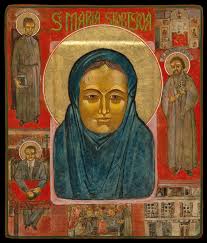
Mother Maria of Paris wrote both poetry and religious essays in addition to running a soup kitchen and community center in a ghetto of Paris

Mother Maria of Paris wrote both poetry and religious essays in addition to running a soup kitchen and community center in a ghetto of Paris.

Because Mother Maria was well-known to the police and sanitation crews as she would scour the back alleys of Paris and the central market gathering day old food and recyclables for the poor of her community, she was granted access into the stadium.  She quickly sized up the situation.  The stadium had become a central transfer and processing hub for the thousands of Jews of Paris.

She prayed for assistance.  The idea came to her.  By employing the confidence of the local sanitation workers in charge of hauling the garbage from the stadium, Mother Maria perpetrated a plot that would at least save the children from the gas chambers: stuff them into the garbage bins, haul them out on the trucks from the stadium, and then under the cover of night, sneak the children to the house on rue de Lourmel where she then could orchestrate their continued passage to the south of France, an area outside of Nazi control, and to safety. The chronicle of the Trash Can Rescue has been memorialised in the children’s book Silent as Stone written by Jim Forest and beautifully illustrated by Dasha Pancheshnaya (St Vladimir’s Press: http://www.svspress.com/silent-as-a-stone/ )“It would have been possible for her to leave Paris when the Germans were advancing toward the city, or even to leave the country to go to America. Her decision was not to budge. “If the Germans take Paris, I shall stay here with my old women. Where else could I send them?” http://incommunion.org/2004/10/18/saint-of-the-open-door

mother maria

No one is sure how many children Mother Maria and her garbage crew saved.  But what is certain is that she eventually was found out by the Nazis. (When Nazis interrogated her about whether she had seen any Jews, she would point to an icon of the Mother of God or else point to the body of Christ on her crucifix.)  The priest, Father Dimitri Klepinin who had served alongside her in the “monasticism in the world” and her son Yuri were arrested.  They had been guilty of forging fake baptismal certificates for Jews who came begging for help.  Yuri and Father Dimitri eventually died in Buchenwald camp while Mother Maria was sent to Ravensbruck. … It was Good Friday, March 30th, on the eve of the liberation of Paris, 1945, that Mother Maria was one of those chosen for death. According to other accounts, she took the place of another prisoner who was marked for the gas chamber that day. …

mother maria2

For the rest of the article go to http://greekamericangirl.com/mother-maria-of-paris-says-oxi-to-the-nazi-mass-murder-machine/

For more information about Maria’s activism, inspiration, grace, heroism, and hope-filled commitment, so needed in our world today, go to my earlier posts “Like a Russian Novel” at https://orthodoxcityhermit.com/2015/09/23/mother-maria-of-paris-saint-of-the-open-door/ and “Solitary and Naked Before God” at https://orthodoxcityhermit.com/2015/09/23/taking-up-the-cross/

Scilly Celtic Saints

scilly1

scilly4

Isles_of_Scilly_NASA

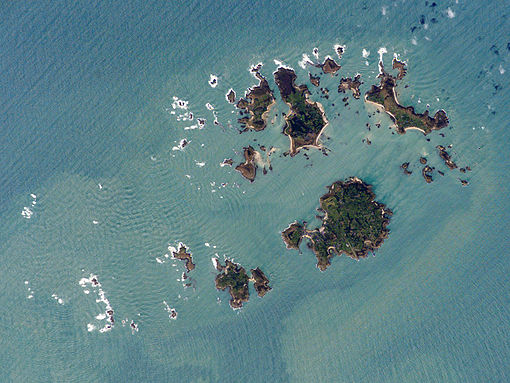
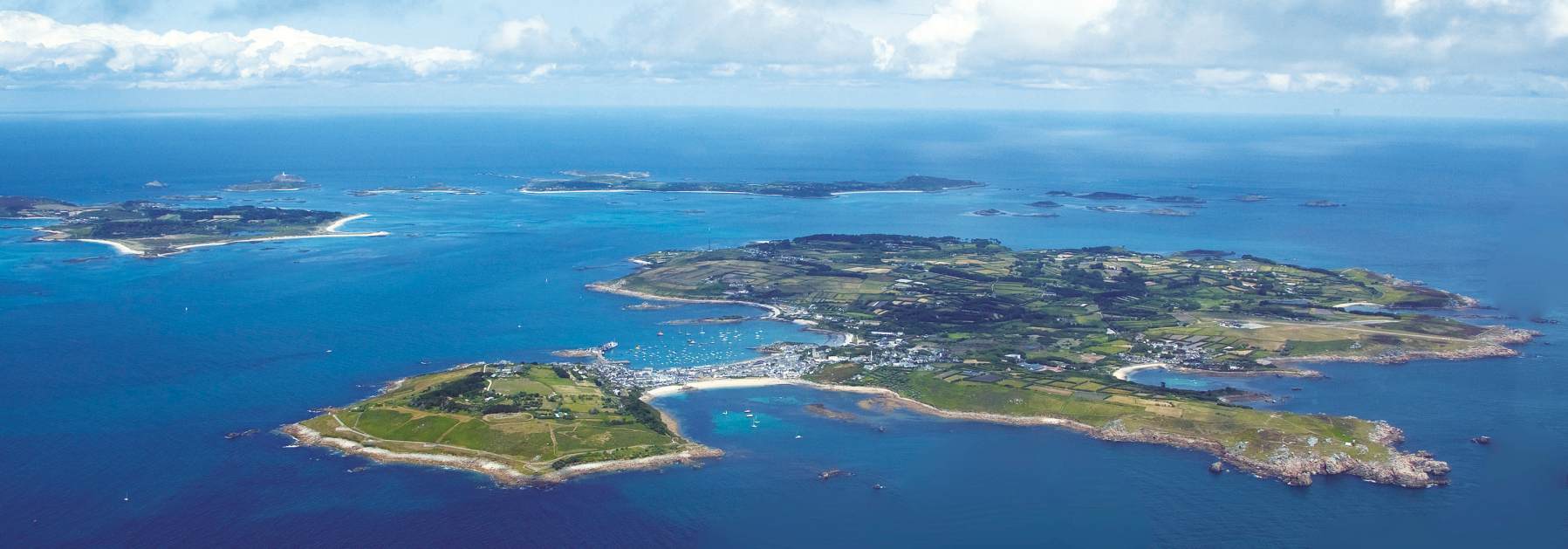
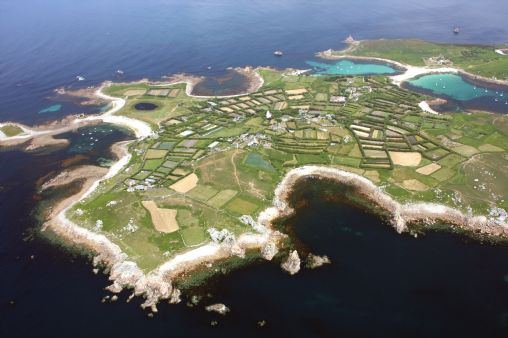
Aerial photo of the Isles of Scilly

*

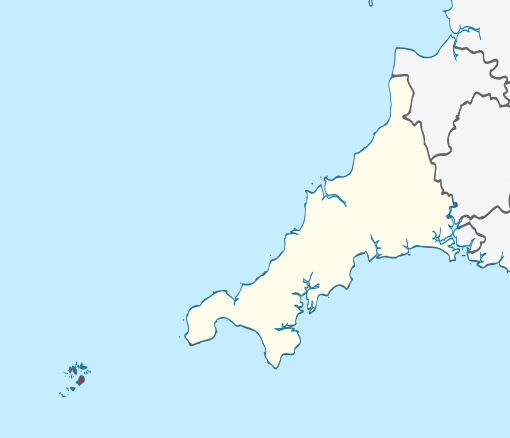
To continue our pilgrimage to the Celtic sacred sites and pilgrim routes of England, our next stop is Scilly –pronounced “silly”–Islands! Yet another look at Christian faith from a Celtic perspective. Have you been there? The Isles of Scilly (/ˈsɪli/CornishSyllan or Enesek Syllan) (Introduction of the “c” may be to prevent references to “silly” men or saints!) are an archipelago off the southwestern tip of the Cornish peninsula of Great Britain, comprising  5 Major, inhabited islands,St Mary’sTrescoSt Martin’sBryherSt Agnes and 140 others. 

Isles_of_Scilly_in_Cornwall

The Isles of Scilly (bottom left corner) are a part of the ceremonial county of Cornwall (white)

scilly3

Scilly Saints

Holiday Reflections on these Holy Isles

By Father Jonathan Hemmings

scilly2

“For since in the wisdom of God the world through its wisdom did not know him, God was pleased through the foolishness of what was preached to save those who believe.” (1 Corinthians 1:21)

*

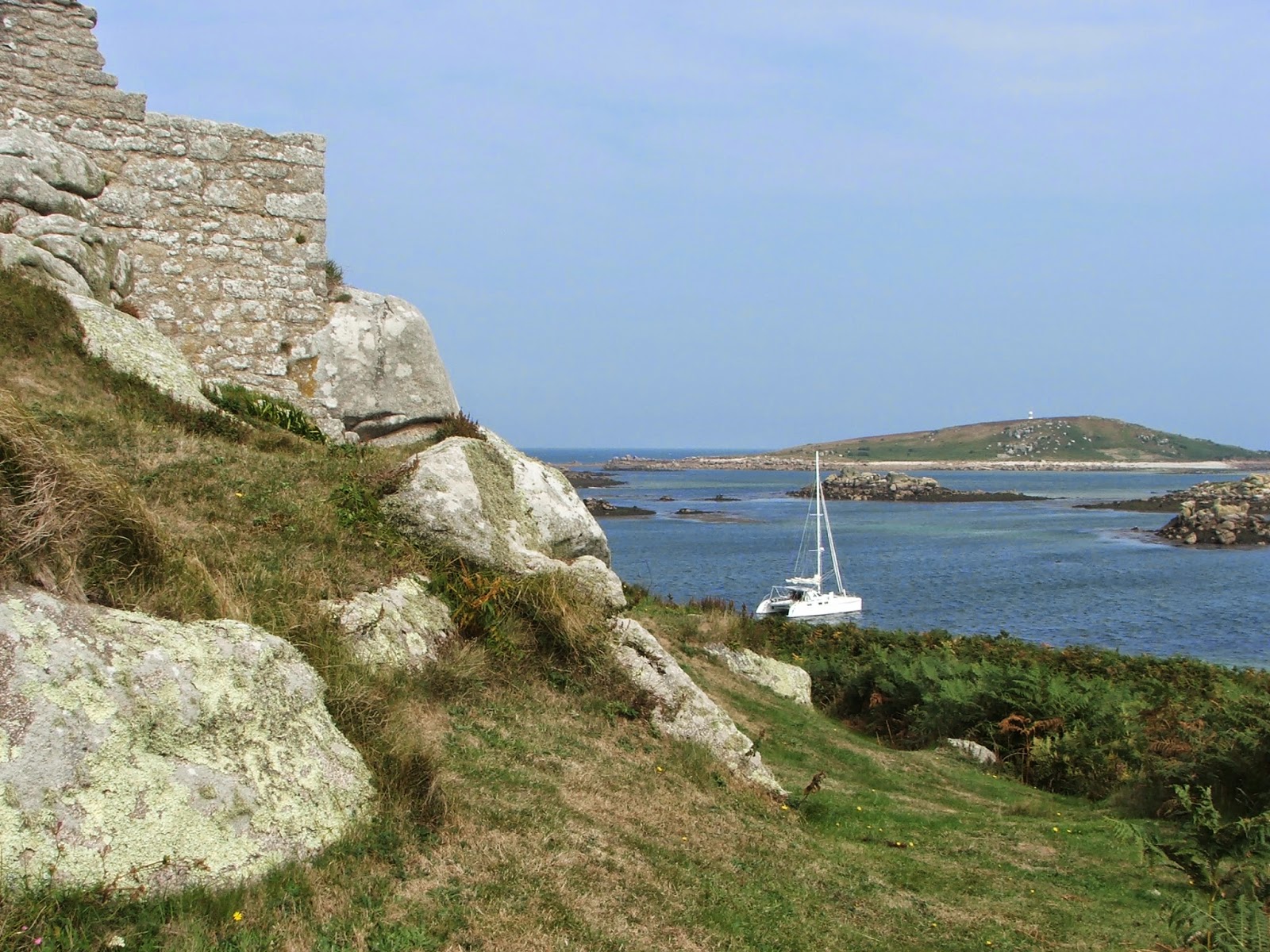
Forty miles south west off the Cornish coast are the beautiful Scilly Islands. Bathed by clear water, graced by an equitable and temperate climate, surrounded by wildlife in sea and air, seals, puffins and dolphins, they have a flora unique to the British Isles. The very names of some of these Islands, St.Mary, St.Agnes, St.Martin, St.Helen, suggest a link between faith and culture. Look a little deeper and one finds an important vein of Celtic Orthodox spirituality etched, sometimes quite literally into the very granite of the rocks that form the base of life in these offshore outposts of faith and spiritual powerhouses of prayer.

 *

St. Mary’s

The largest of the Islands, it was known at first as Ennor, the origin of which is obscure, it seems that the name of the island was taken from the dedication of the Church in the Old Town to Our Lady in mediaeval times. As “Star of the Sea” (Steren an Mor) the intercessions of the Mother of God are still sought for those who sail in these shipwreck strewn islands where the hazards of shallow tides and hazardous rocks still persist and catch the unwary voyager. [ For a list of shipwrecks of the Isles of Scilly go to http://list of shipwrecks of the Isles of ScillyThere is a little valley in the middle of the island known as Holy Vale.

scilly-st mary

scilly-st mary and tesco

scilly-st mary1

scilly-st mary3

scilly-st mary5

scilly-st mary6

scilli-st mary's9

Bants Carn, St Mary’s

 scilly-st mary8

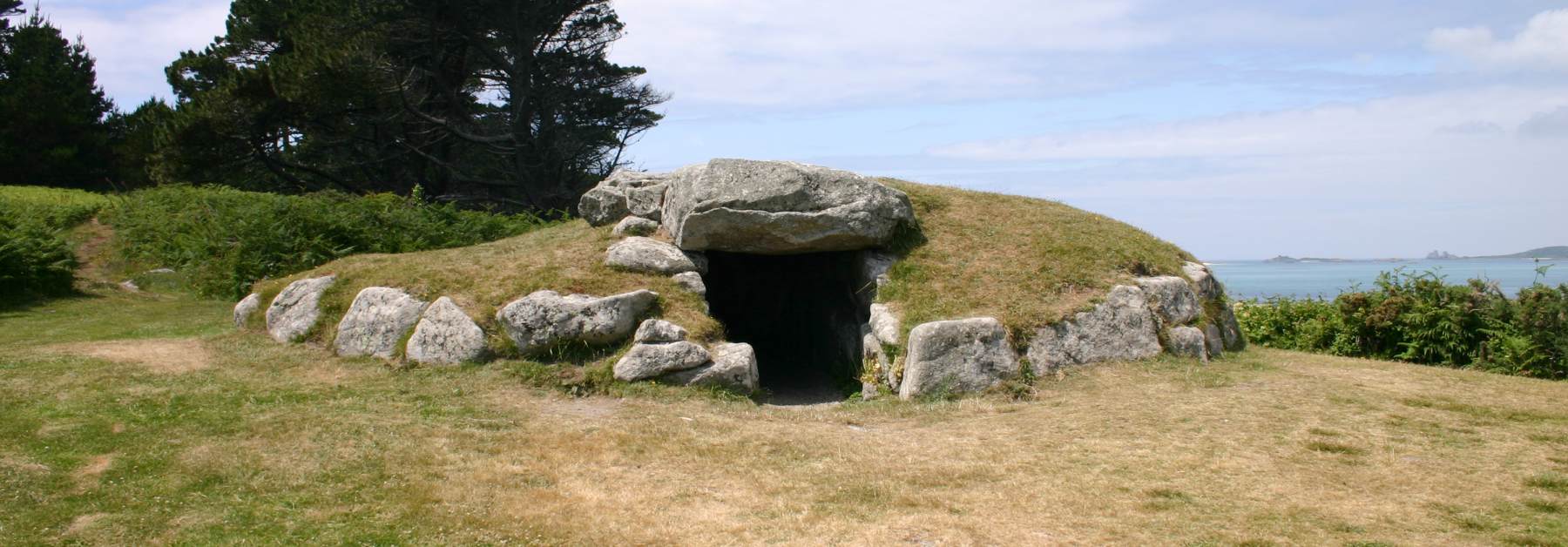
Scilly St Mary’s Bant burial chamber entrance

*

St. Agnes

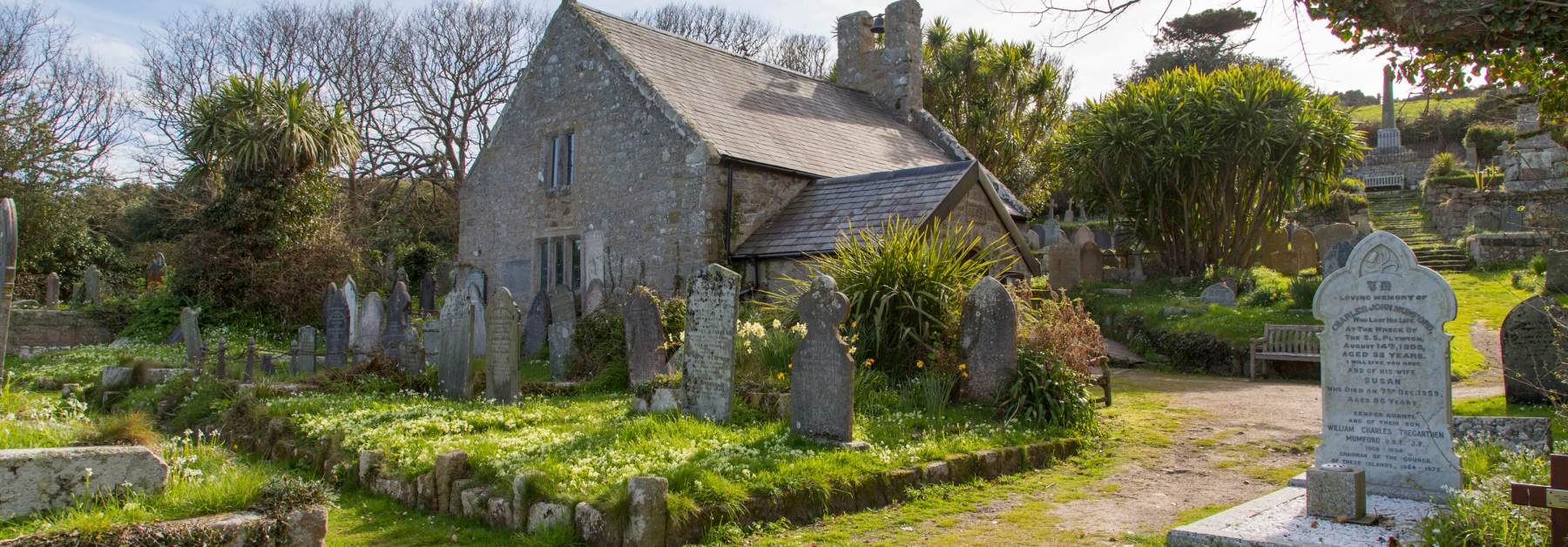
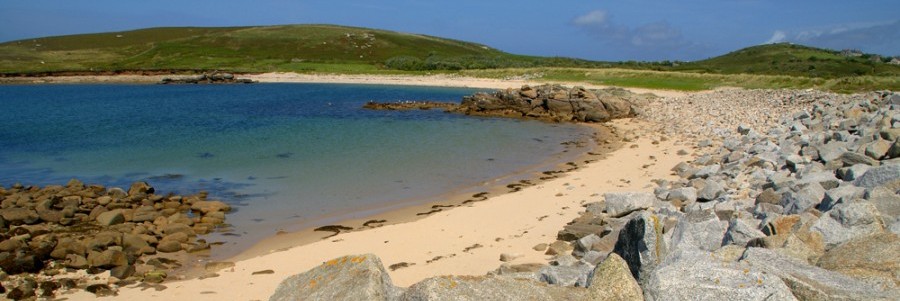
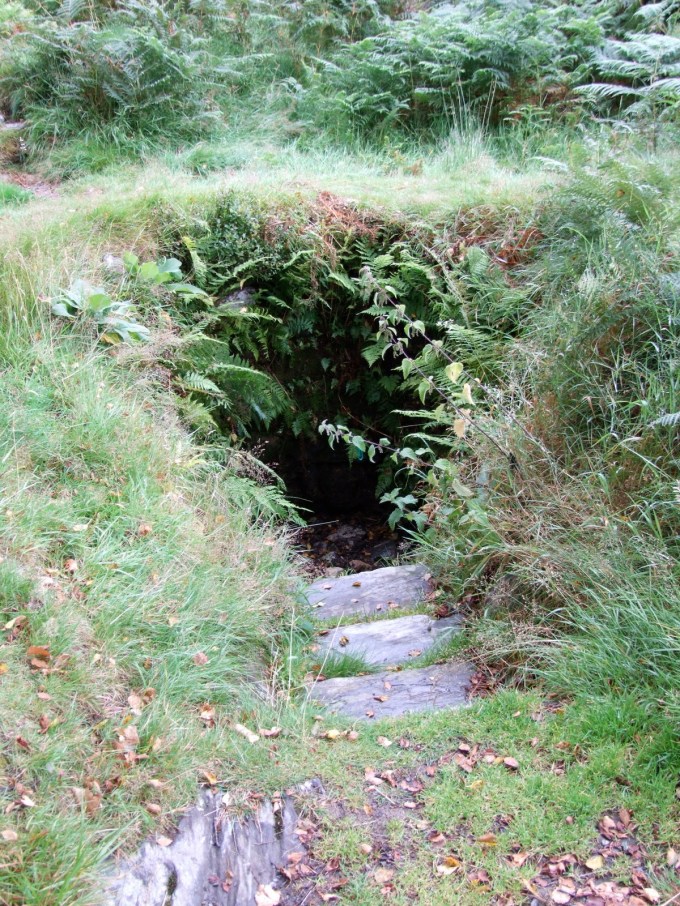
The southernmost Island is that of St. Agnes. Named after the Roman Saint we find during Norman times the replacing of celtic saints with popular western saints. However, to the south east of the Island is the crescent- shaped St. Warna’s Cove which marks the spot where this Irish celtic nun landed and made her dwelling-place after sailing single handed from Ireland. It is remarkable to ponder on the courage and fearless spiritual enterprise of the Celtic Christians who used the Irish Sea much as we today would use the M6 motorway. St. Warna is the patron saint of the Scilly Island of St Agnes and prays for the salvation of those subject to wrecks. It may be noted that it is said that some of the more pagan element wanted shipwrecks in order to plunder the cargo in past times. At St. Warna’s Cove there is a holy well near to the shore where the saint lived in her hermitage and prayed. Nearby there is a large standing granite stone with an impressive and distinctive Cross emblazoned on its face made by the weathering of the wind!

scilly-st agnes2

scilly-st agnes3

scilly-st agnes4

Porth Conger, St Agnes

scilly-st agnes

St Agnes, isles of Scilly and The Bar of sand which connects it to Gugh

scilly-st agnes7

Views taken on or on the way to St Agnes

scilly-st agnes9

Summer Sky – St Agnes, Scilly Isles

scilly-st agnes5

Troy Town Maze, St. Agnes, Isles of Scilly

scilly-st agnes6

Gugh. Gugh, St. Agnes, Isles of Scilly

scilly-st warna5

On the island of St Agnes, St Warna is the patron saint of shipwrecks

 *

St. Martin’s

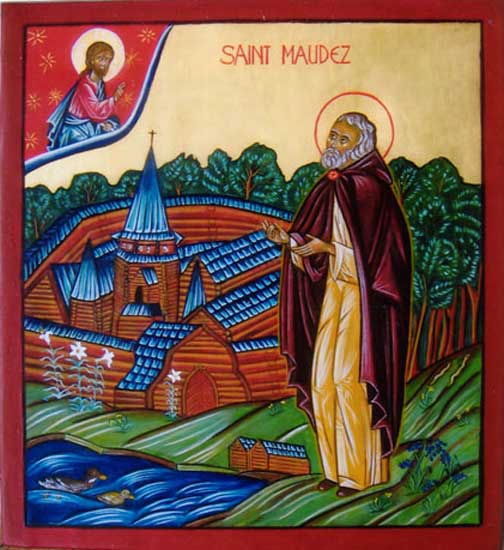
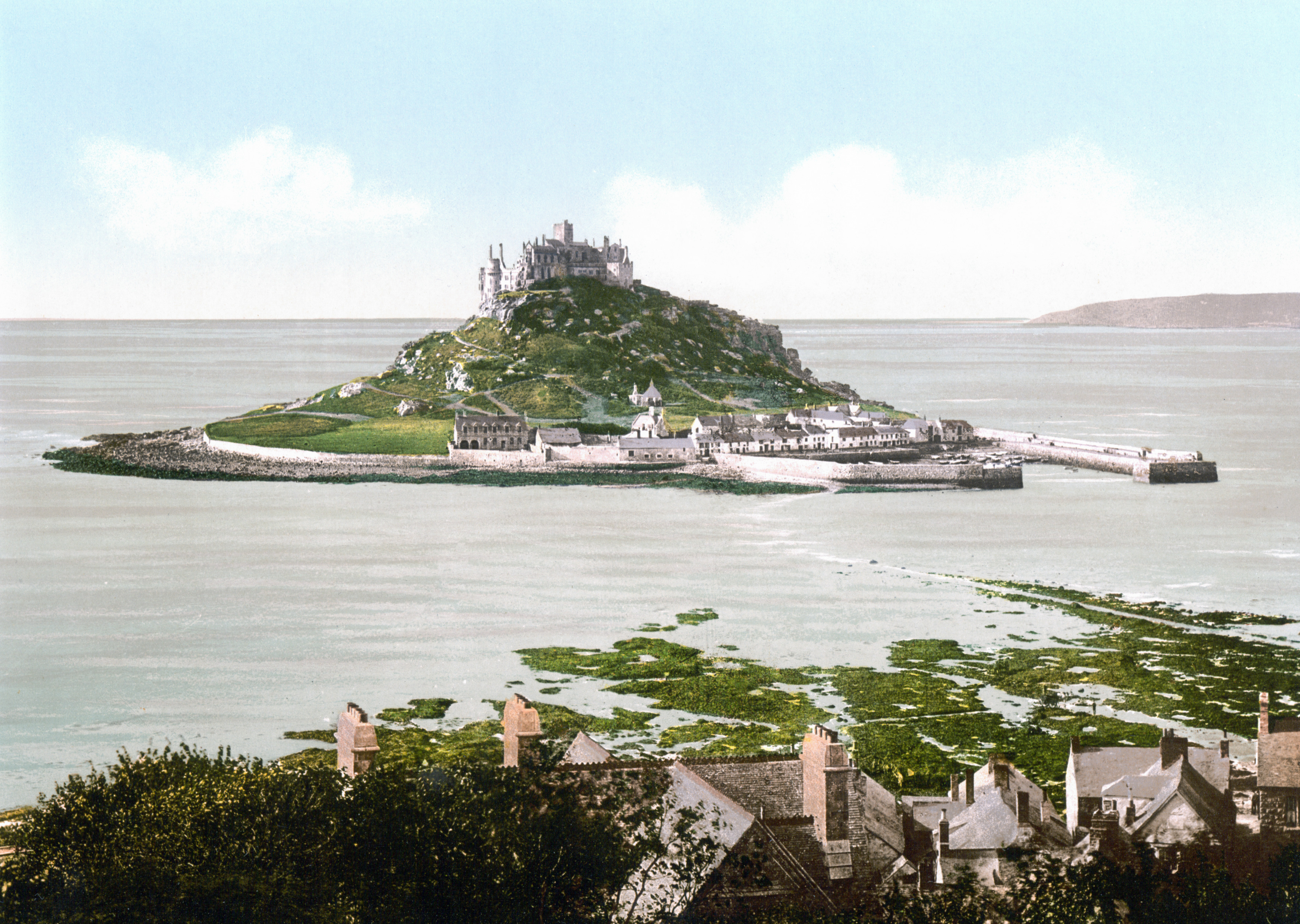
The Island was originally called Mauded which is similar to the Breton name for the Cornish St. Mawes who has a small town named after him near Falmouth where he lived for a time after sailing from south Wales. In the Roman Calendar his feast day is November 18th. According to tradition he was a 6th Century Welsh hermit and Abbot, also called Maudetus or Maudez. He lived as a solitary and then went to an island off the coast of Brittany, France, where he is revered as St.Maudez. He is believed to have founded other monasteries and churches in Cornwall and Brittany. There is a tradition that Saint Mawgan ( a place near Newquay, Cornwall which has a holy well), if he is to be identified as the same, was at one time Bishop of the Scilly Islands. The transition to a completely different saint, St. Martin seems to be a “latinization” of the name, again from the time of Norman occupation.

 scilly-st maws

scilly-st martin's1

scilly-st martins

Offshore and inshore islands, St Martin’s, The Isles of Scilly

*

Bryher Isles

scylli-bryher2

SCILLY-bryher1

scylli-bryher3

Bryher is the smallest inhabited island in the Isles of Scilly. It’s famous for the spectacular Hell Bay with it’s pounding waves crashing over the rocks on.

Tresco

The name of the Island was at one time St. Nicholas the patron saint of sea farers which seems most appropriate. This beautiful island boasts a Benedictine Priory established in 1114, the remains of which can still be seen today within the gardens of Tresco. It was probably established from the Abbey at Tavistock in Devon which was also dedicated to St. Nicholas.

scilly-tresco

scilly-tresco1

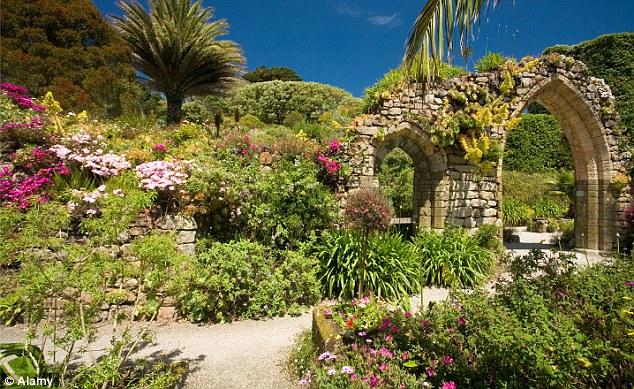
The arch from the wall of the mediaeval monastery in Tresco Abbey Gardens

scilly-tresco5

Abbey Gardens Tresco

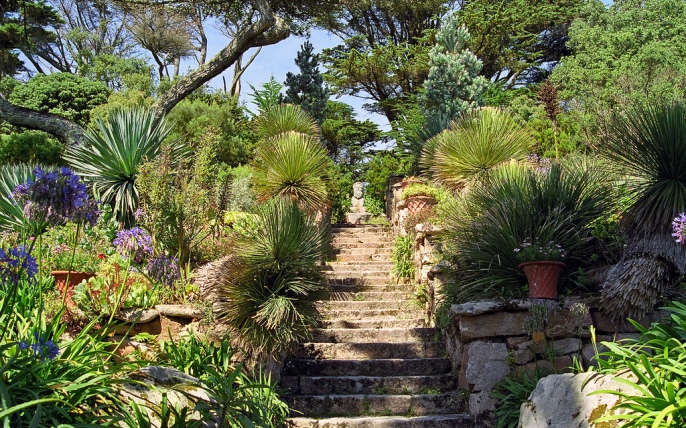
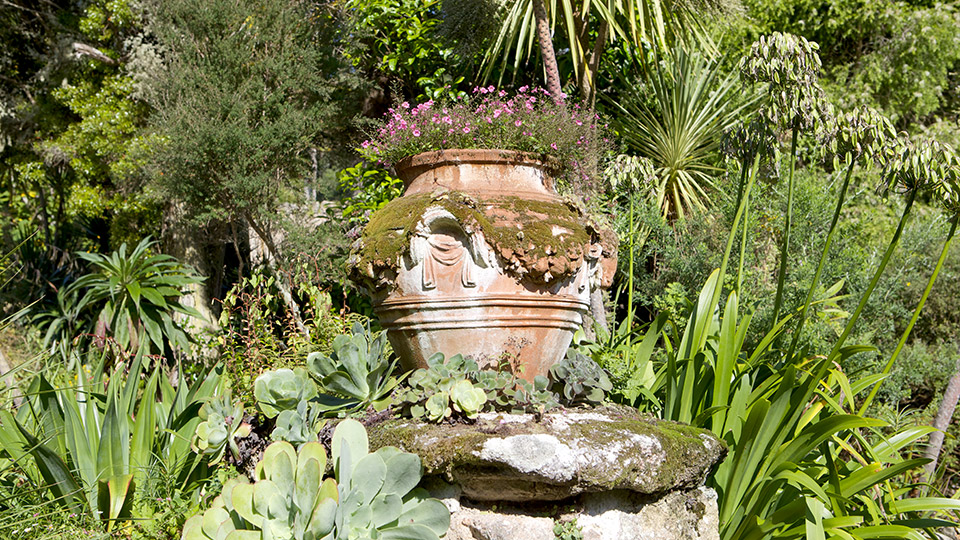
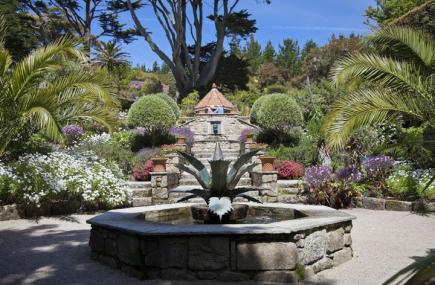
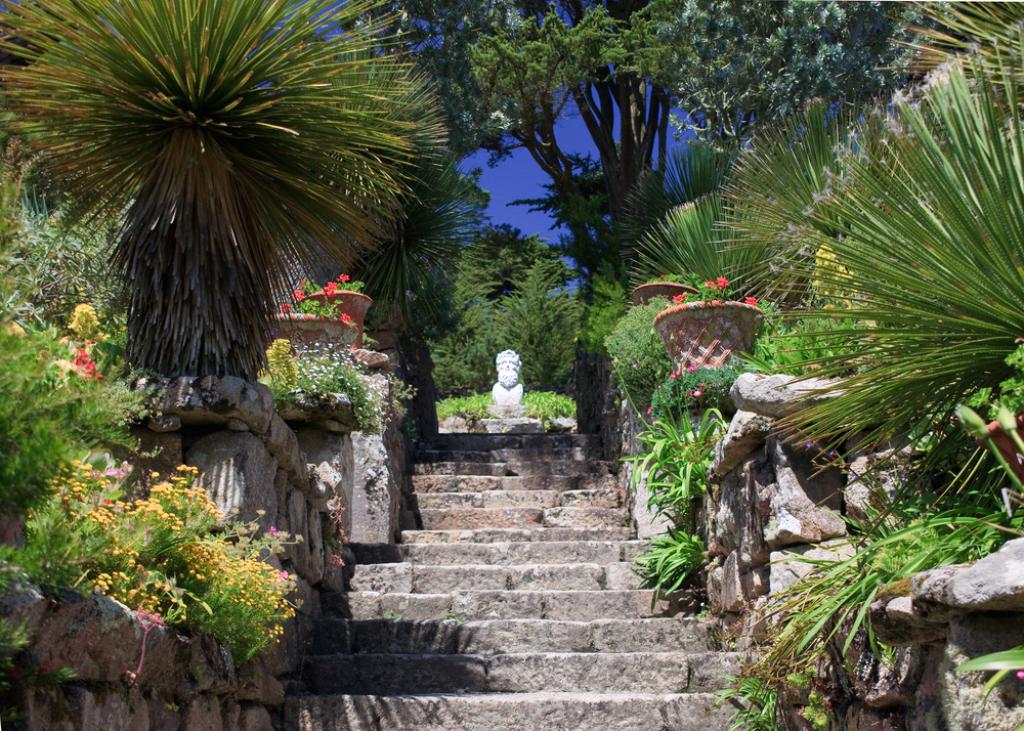
Tresco Abbey Gardens, Scilly Isles, UK Looking at the plants in this garden it is difficult to believe that Tresco Abbey Gardens is situated in the British Isles. Containing sub-tropical plants from Australia, South Africa and South America – including Echiums, Agaves, Aloes, Proteas, Aeoniums, Strelitzias and palm trees, this garden looks as though it should be situated in the Mediterranean! However, it is located in England, on the small island of Tresco in the Scilly Isles (approximately 28 miles from the south west tip of Cornwall in the United Kingdom). The photographs in this set where taken in late August when a lot of the color had already left the gardens. However, the varied planting provides a superb example of the value of a clear garden structure filled with diverse and contrasting foliage – creating a wonderful green tapestry of architectural plants throughout the year. Details: With a stunning background of white sandy beaches and vivid turquoise sea, Tresco Abbey Gardens is an outstanding historic garden set amid the romantic ruins of a 16th century priory. The gardens were started by Augustus Smith, who moved to the island in 1834. The garden has subsequently been developed by four succeeding generations of the family from Augustus Smith. The gardens have many delightful features, often seen at their best in the warmth of the afternoon sun, ranging from the Abbey arch, the Neptune steps, the shell house and a number of tastefully placed sculptures (including one to the earth goddess Gaia), all bordered by fantastic foliage of varying shapes, textures, sizes and hues. Surrounded by sea and in the warmth of the Gulf Stream the climate is exceptionally mild and totally frost free in most years. With south facing terraces, these gardens have often been referred to as ‘Kew gardens without the roof’, because in mainland UK, you would only find these plants in a botanical garden glass house. Location: Tresco Abbey Gardens, Tr

Tresco Abbey Gardens, Scilly Isles, UK
Looking at the plants in this garden it is difficult to believe that Tresco Abbey Gardens is situated in the British Isles. Containing sub-tropical plants from Australia, South Africa and South America – including Echiums, Agaves, Aloes, Proteas, Aeoniums, Strelitzias and palm trees, this garden looks as though it should be situated in the Mediterranean! However, it is located in England, on the small island of Tresco in the Scilly Isles … With a stunning background of white sandy beaches and vivid turquoise sea, Tresco Abbey Gardens is an outstanding historic garden set amid the romantic ruins of a 16th century priory. The gardens were started by Augustus Smith, who moved to the island in 1834. The garden has subsequently been developed by four succeeding generations of the family from Augustus Smith. The gardens have many delightful features, often seen at their best in the warmth of the afternoon sun, ranging from the Abbey arch, the Neptune steps, the shell house and a number of tastefully placed sculptures (including one to the earth goddess Gaia), all bordered by fantastic foliage of varying shapes, textures, sizes and hues. Surrounded by sea and in the warmth of the Gulf Stream the climate is exceptionally mild and totally frost free in most years. With south facing terraces, these gardens have often been referred to as ‘Kew gardens without the roof’, because in mainland UK, you would only find these plants in a botanical garden glass house.

scilly-tresco3

Tresco Abbey Gardens

scilly-tresco6

scilly-tresco4

scilly-tresco7

King Charles’ Castle is a ruined coastal artillery fort near the north extremity of the island that dates back to the sixteenth century

scilly-tresco8

Samson

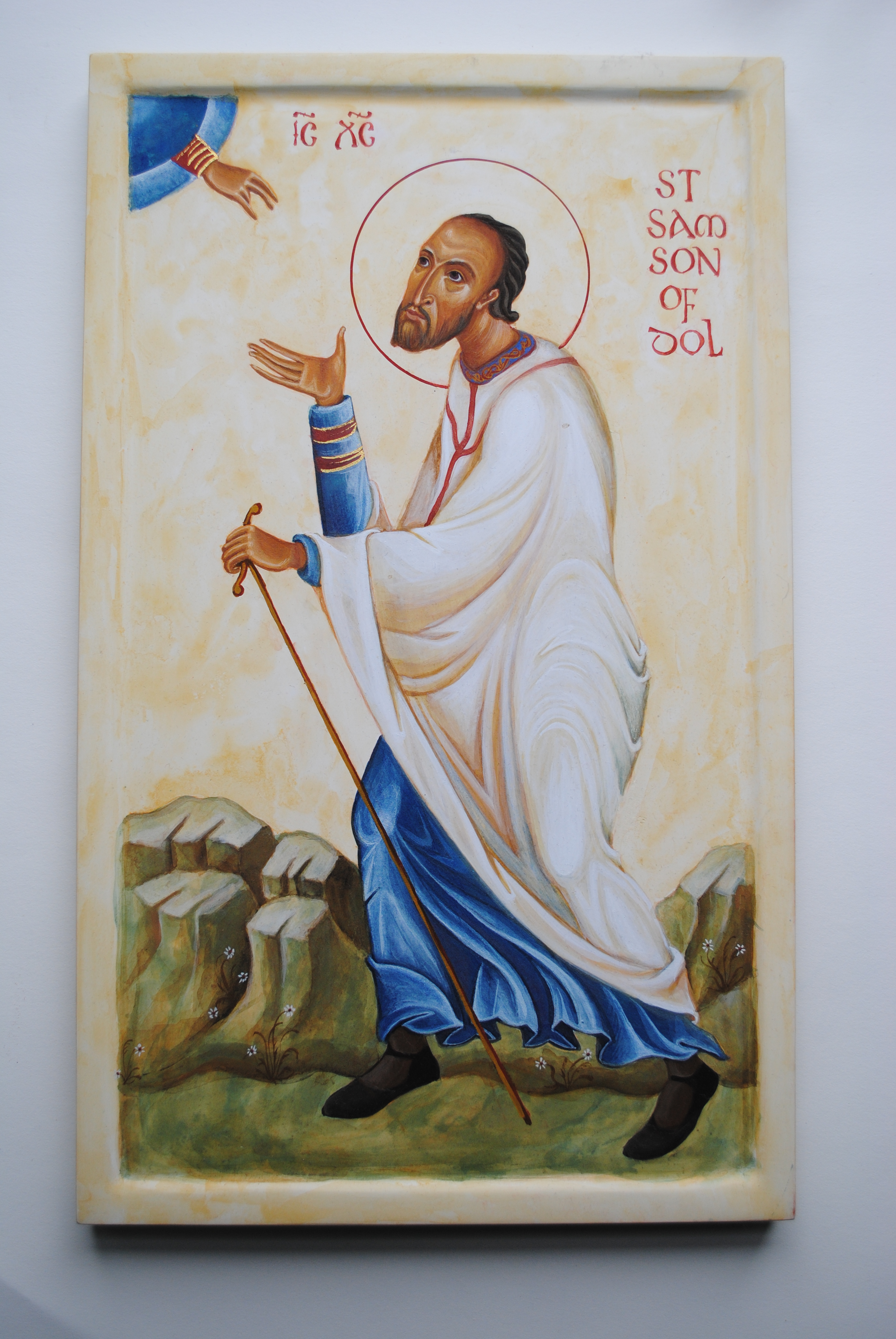
The island is connected with the welsh saint St. Samson of Dol who travelled to Cornwall, Brittany and the Channel Isles. Samson was educated by St. Illtud at the Abbey of Llanilltud Fawr (Llantwit Major) in Glamorganshire; where he was ordained a deacon and then a priest. Samson of Dol found it necessary by the Will of God to remove himself to the monastery on Ynys Byr (Caldey Island). He eventually became Abbot there and considerably established a strong community. Later in his life he chose the life of a hermit near the River Severn but, being made a Bishop, he turned to missionary work in Cernow (Cornwall) and came to the Scillies where one of the islands is named after him. He died on 28th July AD 565 and was buried in Dol Cathedral in Brittany. His ‘Life’ which survives, was written the following century. In the AD 930s, King Aethelstan acquired a number of his relics – including an arm and his crozier – which were proudly displayed in Milton Abbey (Dorset) until the time of the Reformation. The Island of Samson was inhabited until quite recently.

scilly-samson2

Old Cottage on South Hill, Samson

scilly-st samson

Tean

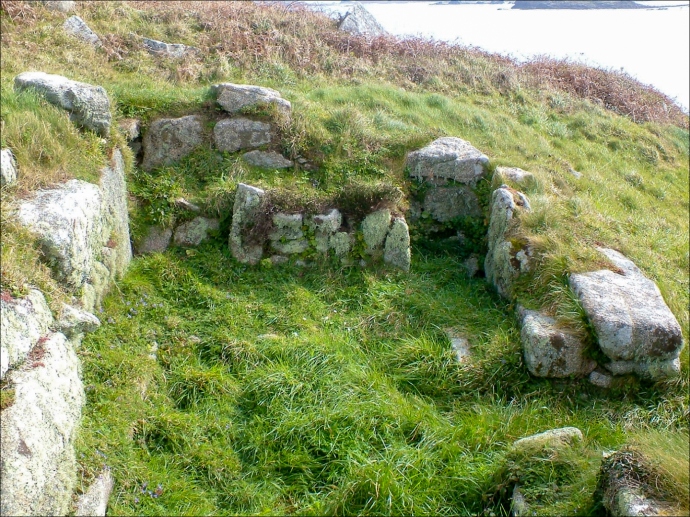
This little northern island was also inhabited until recently. The name Tean derives from the name Theona. There are ruins of her dwelling place still where once as a hermit she prayed and gave glory to the Holy and Life Giving Trinity and also remains of some celtic graves of the 6th century nearby. Recent excavations have unearthed some interesting Romano-British finds. These include an older ‘toothless’ woman whose head lies under the altar of the later built chapel, she may in fact be St.Theona, after whom the island is named.

   Tean,_Isles_of_Scilly._View_from_the_Great_Hill_-_geograph.org.uk_-_260948

Tean, Isles of Scilly. View from the Great Hill – geograph.org

scilly-tean2

Hedge Rock and Tean, Isles of Scilly

scilly-tean

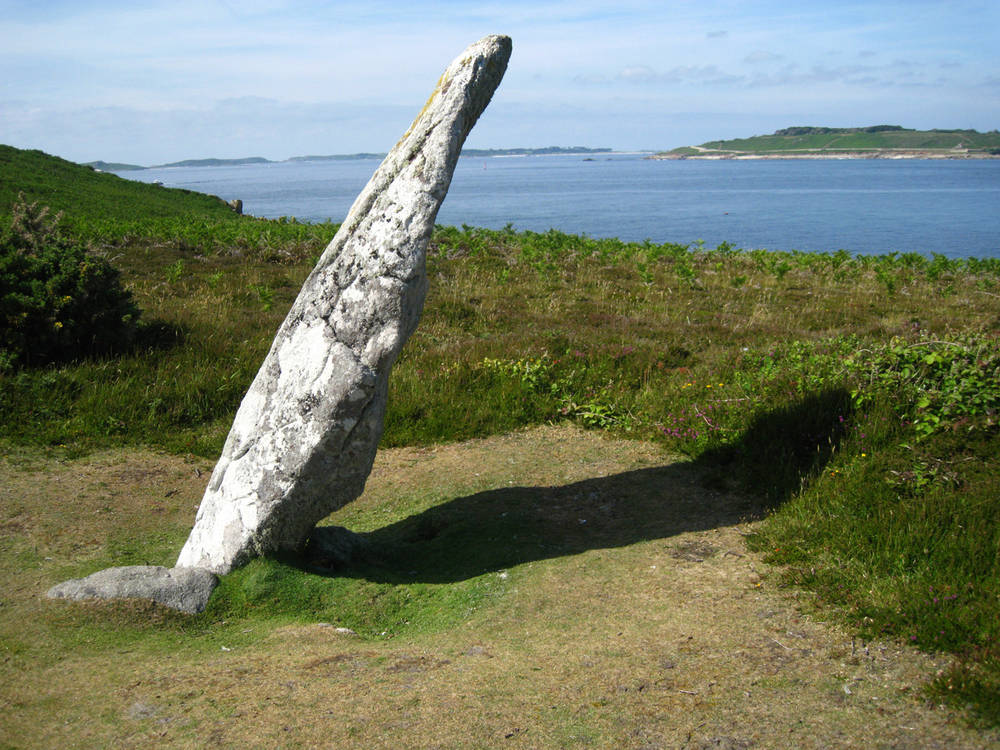
Old Man, Tean, Isles of Scilly

*

St. Helen’s

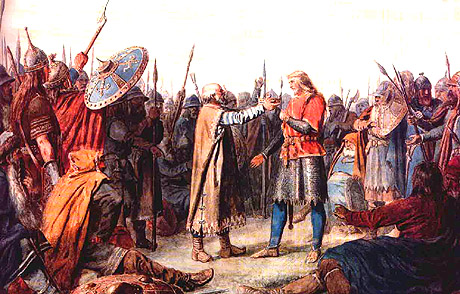
We know that this island was called St. Helen, the Blessed mother of Holy Constantine the Great, from 16th century maps but it is associated with another ancient saint, that of Elidius or St. Lide as he is also known. On the uninhabited island of St. Helen’s are the remains of St. Elidius’ Hermitage which contains an 8th century Christian monastic chapel which was active until the 11th. century. This holy place is still honoured today with local people making a Pilgrimage to the site on 1st August. There is an interesting connection between the Scilly Islands and the Christian mission to Norway. In 980 Olaf Tryggvason came to the Scilly Islands. Snori Sturluson recounts in his “Saga” that this notorious marauding Viking met Saint Elidius and heard of “the God of the Christians.” He was converted to Christianity and agreed to be baptized and all those with him. He took the faith with him returning to Norway and Iceland with “three priests and other learned men.” As King of Norway he began the process of evangelism which was continued by his successor Saint Olaf.

Peter_nicolai_arbo,_olaf_tryggvasson_king

Olaf Tryggvason, who visited the islands in 986. It is said an encounter with a cleric here, at St. Helen’s, led him to Christianise Norway

st helen

St. Helen

scilli-st helen9

St. Helen’s Viewed From The Block House. Tresco

scilli-st helen's1

On the uninhabited island of St. Helen’s are the remains of St. Elidius’ Hermitage which contains an 8th century Christian chapel

scilli-st helen2

St. Helen’s Pool

scilli-st helen's3

Early mediaeval chapel on St Helen’s

scilli-st helen4

Well known for its pest house, in which sailors infected with plague would be quarantined, St Helen’s is a prominent landmark on the Scilly coastline

scilli-st helen6

Church of St Elid on the island of St Helen’s

*

Sailing into history

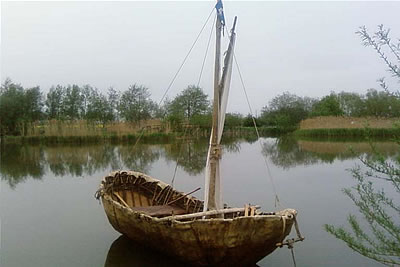
What strikes me about these saints is their adventurous and persistent spirit in Christ-their sheer delight and desire to bring Christ to every part of these Islands however small, blessing this part of God’s vineyard by their work, prayers and holiness of life. Whilst on St.Mary’s I learned from the curator of the Museum, that in August 2000, on June 28th a Breton vessel named Saint Efflam (founder of a monastery in Brittany, France. He was the son of a British prince) from an enterprise called Odysee Celtique (Celtic Odyssey) sailed into St. Mary’s harbour re-enacting ancient celtic monastic voyages-it was a Breton vessel and a reconstruction of a traditional curragh.

curragh

Curragh

The boat was constructed from a frame of hazel poles over which was stretched tar-covered canvas imitating the ox skins which would have been used originally. Whilst at sea the crew slept on the open boat and had few concessions to modern facilities during the voyage. As Amanda Martin says in her article in Scilly 2000 in “The Voyage of the Sant Efflam” such an experience was not for the faint hearted. “The whole feat requires a tremendous physical effort not to be undertaken lightly.”

These living saints give inspiration to us today by their energy and boldness for the gospel’s sake. In Christ we should imitate their humility, simplicity and calling.

*

A prayer

*

My boat is small

The ocean vast

Lord fill my sail

Maintain my mast

Christ my captain

Spirit’s power

Save me Lord

In danger’s hour.

Amen

*

These “fools for Christ” saved many because they preached Christ crucified and many believed and so they put the Christ in Scilly. Perhaps we, in this our time of God’s good grace need to make a similar Scilly Pilgrimage!

Thin Places (IV)

celtic72

*

“The Church in The British Isles will only begin to grow 

when She begins to again venerate Her own Saints

 *

(Saint Arsenios of Paros †1877)

*

Celtic Monasticism, A Model of Sanctity By Hieromonk Ambrose (Father Alexey Young) — Part IV of IV

Central to Celtic Christian culture was the Cross.

For the Celts, simplicity wasn’t so much a question of externals–like furniture, architecture, and so forth. It was something internal, and it was founded upon the phrase, “Thy will be done”. This meant God’s will, not our own. It meant dying to oneself, not having opinions and not judging others.

*

Even in the 7th and 8th centuries there were so-called Christians who were uncomfortable with the Cross of Christ and chose to ignore it, just as there are today. The Celts, however, had a particularly clear-headed understanding of the Cross. To quote Sister Benedicta Ward, a renowned scholar on the subject of the Desert Fathers as well as monasticism in the British Isles in the early Christian centuries: “The Cross was not something that made them feel better, nicer, more comfortable, more victorious, more reconciled to tragedy, better able to cope with life and death; it was rather the center of the fire in which they were to be changed.” (op.cit.)

It reminded them that they must pick up and carry their own crosses in this life and follow Christ, for dying to oneself has always been the great secret of holiness.

celtic73

Thus, these monks and nuns saw themselves as warriors of the spirit, for to die to oneself was considered a greater act of heroism than dying on a battlefield in defense of one’s tribe. “The Celtic Church was a Church of heroes…of strong” and fiercely dedicated men and women. “The old Celtic warrior spirit was alive in them, [but now] put to the service of the Gospel and the following of Christ, the High King. Today [we might] find it hard to identify many [such] warrior Christians…[with] the active virtues of courage, strength, outspokenness, decisiveness, and the ability to stand up for something.” (Joyce, op.cit.)

celtic79

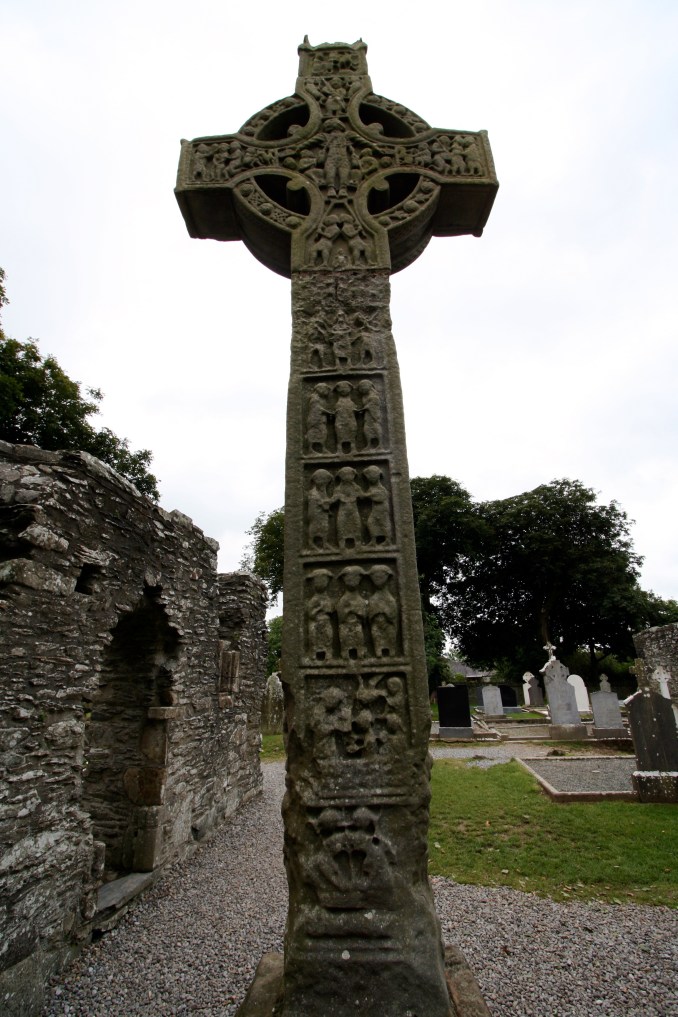
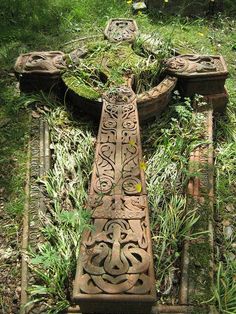
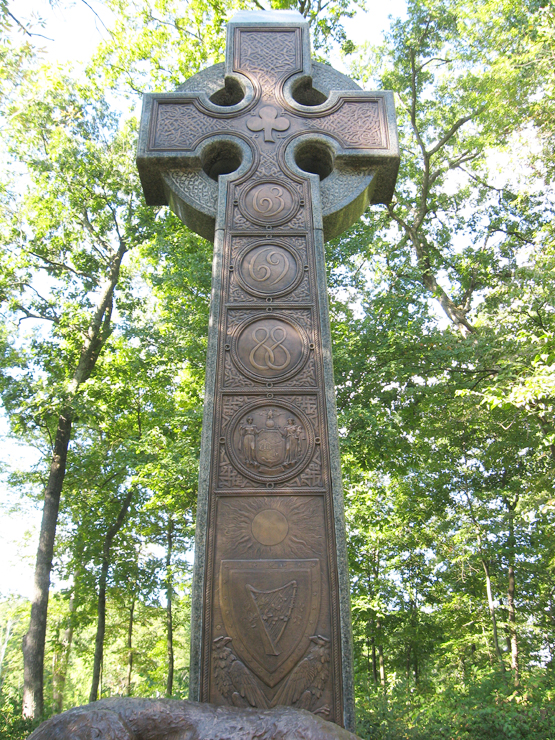
Nowhere was the Cross more loved and cherished than in the monasteries, where highly-carved and richly symbolic great “High Crosses”–some of them 15 feet and taller– were set up–many of them still standing today. These were not the suffering and bloody crucifixions found later in the West, particularly in Spain and Italy. Nor were these the serene and peaceful crosses of the Eastern Church. No, Celtic crosses were a genuine Christian expression all their own. Sometimes Christ is depicted, but often not; however, when He is shown, He is always erect, wide-eyed, and fully vested like a bishop, a great High Priest. In this form He is a symbol of victory over sin and death; He radiates invincibility.

celtic71

“The way of the cross for [Celtic Christians] was the way of heroic loyalty, obedience, and suffering. It involved study and thought, doctrine and orthodoxy, art and imagination. It was a complete, unified way of life, lived intimately with God….[Our] fragmented modern world, both secular and religious, has a lot to learn from it.” (Cavill, op.cit.)

celtic78

Saint Kevin, Hermitage of Glendalough

*

“Thou wast privileged to live in the age of saints, O Father Kevin,

being baptized by one saint, taught by another, and buried by a third.”

*

A common ascetic practice, even for the laity, was called crosfhigheall or “cross-vigil”, and it consisted of praying for hours with outstretched arms. St. Coemgen sometimes prayed in this position for days. Once he was so still, for so long, that birds came and began to build a nest in his outstretched hands.

celtic81

Scholars believe that the Celtic High Cross patterns probably came from Egypt. There are no loose ends in these patterns; this symbolizes the continuity of the Holy Spirit throughout existence–for God has no beginning and no end.

celtic66

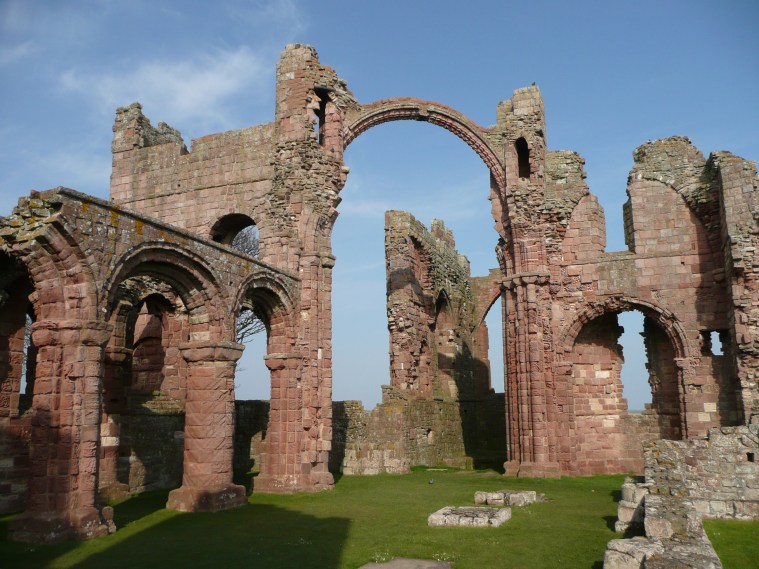
Lindisfarne Priority, Rainbow Arch

celtic77

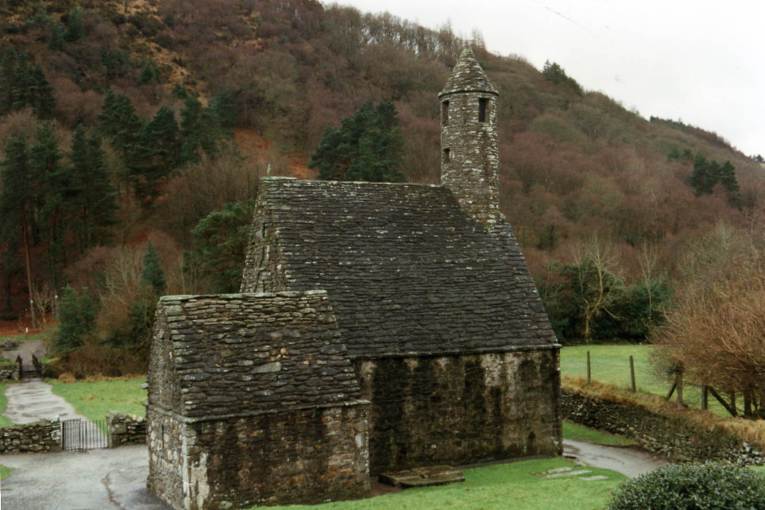
The chapel of Saint Kevin at Glendalough

An example of the love and respect they had for the Cross may be seen in an Anglo-Saxon poem, “The Dream of the Rood” (“rood” being an Old English word for “rod” or “pole”, sometimes it also meant “gallows”). In the “The Dream of the Rood,” Jesus Christ, the Second Person of the Blessed Trinity, is shone as a “serene and confident young hero…[who] prepares for battle. He strips…and climbs up on the gallows [the Tree of the Cross], intent on saving His people. He is in control, self-determining, expressing His lordship….[And] the Cross trembles at the fearful embrace of its Lord.” (Cavill, op.cit.) Listen, now, as the Cross, personified, speaks of how it raised up Christ:

“Unclothed Himself God Almighty when He would mount the Cross, courageous in the sight of all men.
I bore the powerful King, the Lord of heaven; I durst not bend.
Men mocked us both together. I was bedewed with blood. Christ was on the Cross.
Then I leaned down to the hands of men and they took God Almighty.” (Ward, Ibid.)

celtic68

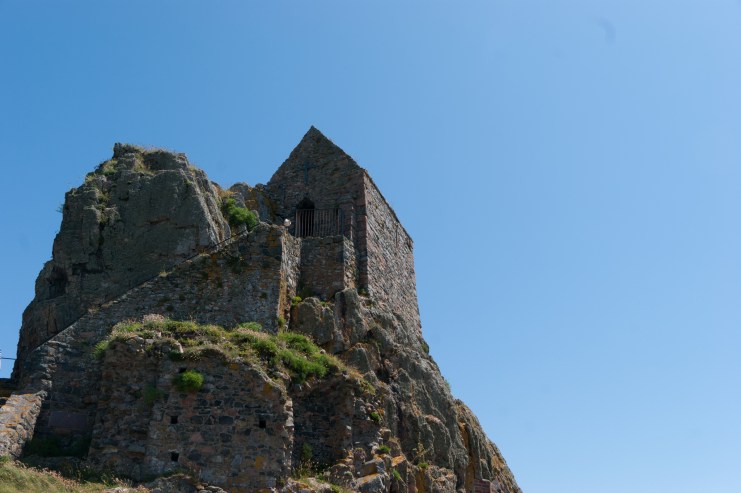
St Helier’s hermitage –Hermitage rock

The interlacing, knot-work, plaiting, weaving patterns and spiral designs, with animals and plants and saints, and scenes from Scripture, which decorate almost every surface of a Celtic High Cross, are so distinctive and profound in their symbolism that they are a study all to themselves. Today I can only point out a couple of things.

celtic84

celtic86

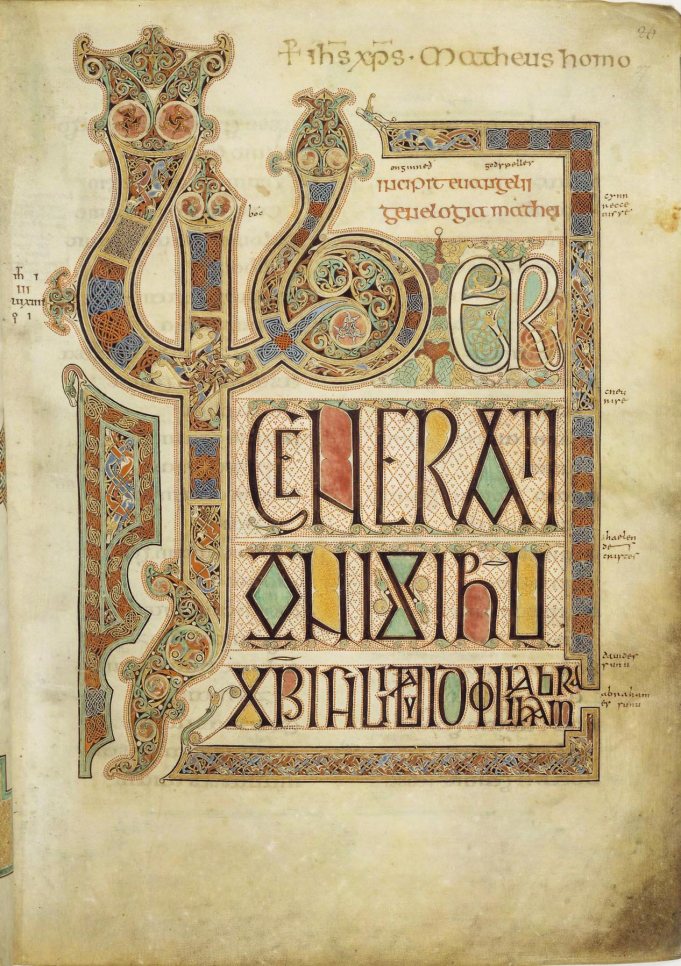
Scholars believe that these incredibly complex patterns probably came from Egypt, but also may have some Byzantine influences. It’s important to note that there are no loose ends in these patterns; this symbolizes the continuity of the Holy Spirit throughout existence–for God has no beginning and no end; only Christ is the Alpha and the Omega. The same is true of knot-work patterns, which are endless and cannot be untied. Spiral designs symbolized the Most High God Himself, the “motionless mover,” around whom all things move. Some of these are what are called “Crosses of the Scriptures” because they are decorated with panels illustrating scenes from the Bible. High Crosses possess an almost dream-like quality in their complex geometric patterns, dignified and strong, heroic and towering over men, and yet also reminding those Christians of the Christian doctrine of kenosis, the self-emptying of Christ.

celtic80

Lindisfarne Gospels 

One of main factors contributing to the eventual decline and dissolution of a Celtic monastery was when the Cross began to no longer be a focus. “If monastic life…did not have at its center the reality of the Cross, it became a source of corruption….[for] ‘Once a religious house or order cease[d] to direct its sons to the abandonment of all that is not God and cease[d] to show them the narrow way…it [sank] to the level of a purely human institution and whatever its works may be they are the works of time and not of eternity.’” (Dom David Knowles, quoted in Ward, Ibid.)

celtic87

An essential dimension was asceticism (askesis) which, for the Celtic monk consisted of a kind of martyrdom. “A homily in archaic Irish, probably dating from the last quarter of the seventh century…speaks of [this]:

‘Now there are three kinds of martyrdom, which are accounted as a cross to a man, to wit: white martyrdom, green and red martyrdom. White martyrdom consists in a man’s abandoning everything he loves for God’s sake, though he suffer fasting or labor therat. Green martyrdom consists in this, this, that by means of fasting and labor [a Christian] frees himself from his evil desires, or suffers toil in penance and repentance. Red martyrdom consists in the endurance of a cross or death for Christ’s sake, as happened to the Apostles…’

For this reason, the Celtic tradition regarded monasticism as the Army of Christ (Militia Christi) and the monk as a soldier of Christ (miles Christi). Young men, in their effort to emulate the heroism of their ancestors, entered monasteries–the “Green Martyrdom.” Instead of fighting in the Fianna (the Celtic army), they joined the Militia Christi to wage war against the evil spirits and sin.” (Fr. Gorazd Vorpatrny, op.cit.) Not surprisingly, one writer calls these Celts “Ascetic Superstars.” (Bitel, op.cit.)

*

“I should like a great lake of ale for the King of Kings;

I should like the angels of heaven to be

drinking it through time eternal!” – St. Brigit of Kildare

*

And yet, with all of this sober asceticism, the Celts never lost their native enthusiasm, exuberance, and just plain cheer, as we see in a prayer written by the wonderful 5th century Abbess, Brigit, when she exclaims: “I should like a great lake of ale for the King of Kings; I should like the angels of heaven to be drinking it through time eternal!” How could anyone fail to be charmed by such a character–a woman who was a great leader of monastics, both men and women, who was baptized by angels, got out of an arranged marriage by plucking out one of her eyeballs, and fell asleep during a sermon given by the incomparable Equal-to-the-Apostles, St. Patrick!

celtic69

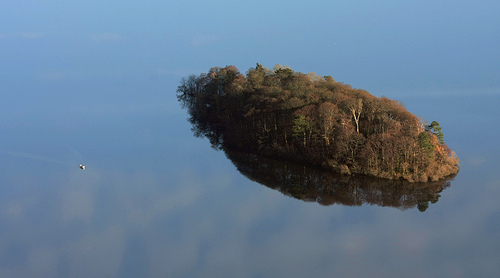
St Herbert’s Island, Derwent Water 

Finally, the Celts were Trinitarian Christians par excellence. This is partly because even before they were Christian they already thought in terms of threes. And for them–unlike most Christians today–the Trinity was very real, very alive, not something vague and theoretical. What one scholar calls a “Trinitarian consciousness” (Joyce, op.cit.) completely shaped everything about them. As another has said: “‘We are here at a central insight of Celtic theology….Christ comes not to show up or illuminate the deformity of a fallen world but rather to release a beautiful and holy world from bondage….an affirmation, difficult but possible, of [that] which is the created image of the eternal Father and the all-holy Trinity.’” (Noel Dermot O’Donoghue, quoted in Joyce, op.cit.) “To follow the spiritual world-view of the Celtic Christians is to embrace a way of life that is a real commitment to the belief that the Trinitarian God is alive in this world.” In the Celtic world, “Jesus Christ is our hero, our sweet friend….The Father is High King of heaven, a gentle and beneficent father, a wise and just ruler. The Spirit is a tangible comforter and protector ….This God is never to be reduced to the ‘man upstairs’ or anyone we can capture and box in. And yet this wonderful, mysterious God is close to us….[This] God is extremely good.” (Ibid.)

celtic85

Brothers and sisters: the sanctity of Celtic monastics is a model for us in that it combines heroism and joy in perfect and beautiful balance. For them, the heroic life was one completely dedicated to living intimately with the God-Man whom they described as “victorious,” “mighty and successful,” “the lord of victories,” a great warrior to whom they pledged undying, fearless, creative and exuberant loyalty. And yet, for all of their heroism, their monastic world-view, could be ‘summed up as the ‘Christian ideal in a sweetness which has never been surpassed.’” (Nora Chadwick, quoted by Joyce in op.cit.) To slip into their world, even for just a few moments, as we’ve done here this afternoon, is, I believe, is not just inspiring; it’s almost breathtaking.

celtic83

Just as I began my talk today with a prayer of St. Columban of Iona, I would like to conclude with another prayer from this great Celtic monastic saint:

Prayer of
St. Columban of Iona

Lord, Thou art my island; in Thy bosom I rest.
Thou art the calm of the sea;
in that peace I stay.
Thou art the deep waves
of the shining ocean.
With their eternal sound I sing.
Thou art the song of the birds; in that tune is my joy.
Thou art the smooth white strand of the shore;
in Thee is no gloom.
Thou art the breaking of the waves on the rock;
Thy praise is echoed in the swell. Thou art the Lord of my life;

*

celtic33

Source: http://www.asna.ca/angloceltic/celtic-monasticism.pdf

Also, listen to Hiermonk Ambrose (Father Alexey Young) about THE UNIQUENESS OF CELTIC MONASTICISM at http://www.asna.ca/angloceltic/

For more information on Celtic Orthodoxy, go to http://www.mullmonastery.com and follow father Seraphim’s pilgrimage and struggles to found the first Orthodox monastery in the Hebrides in over a millennium.

*

To continue our pilgrimage to the Celtic sacred sites and pilgrim routes of England, our next stop will be Scilly –pronounced “silly”–Islands! (/ˈsɪli/Cornish: Syllan or Enesek Syllan) (Introduction of the “c” may be to prevent references to “silly” men or saints!) Yet one more look at Christian faith from a Celtic perspective. The Isles of Scilly  are an archipelago off the southwestern tip of the Cornish peninsula of Great Britain, comprising  5 Major, inhabited islands,St Mary’sTrescoSt Martin’sBryherSt Agnes and 140 others. For more, go to https://orthodoxcityhermit.com/2015/11/05/scilly-pilgrimage/

Thin Places (III)

A Journey into Celtic Christianity
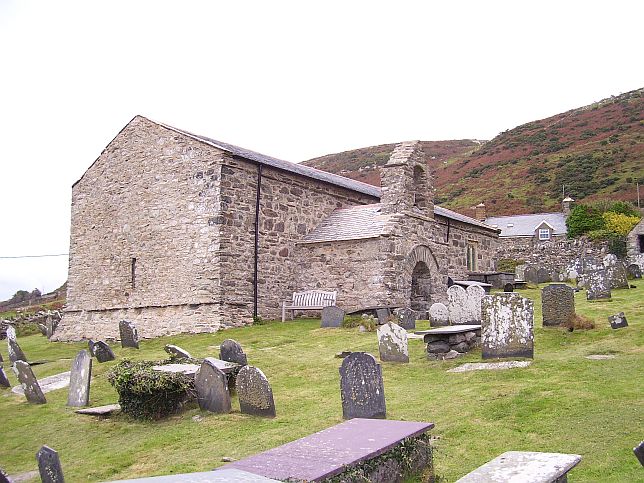
 

celtic53

Llwyngwril St Celynin

*

“The Church in The British Isles will only begin to grow 

when She begins to again venerate Her own Saints

 *

(Saint Arsenios of Paros †1877)

*


Celtic Monasticism, A Model of Sanctity By Hieromonk Ambrose (Father Alexey Young) — Part III of IV 
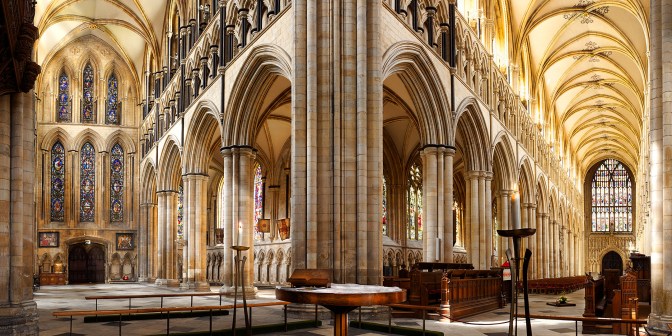
celtic75

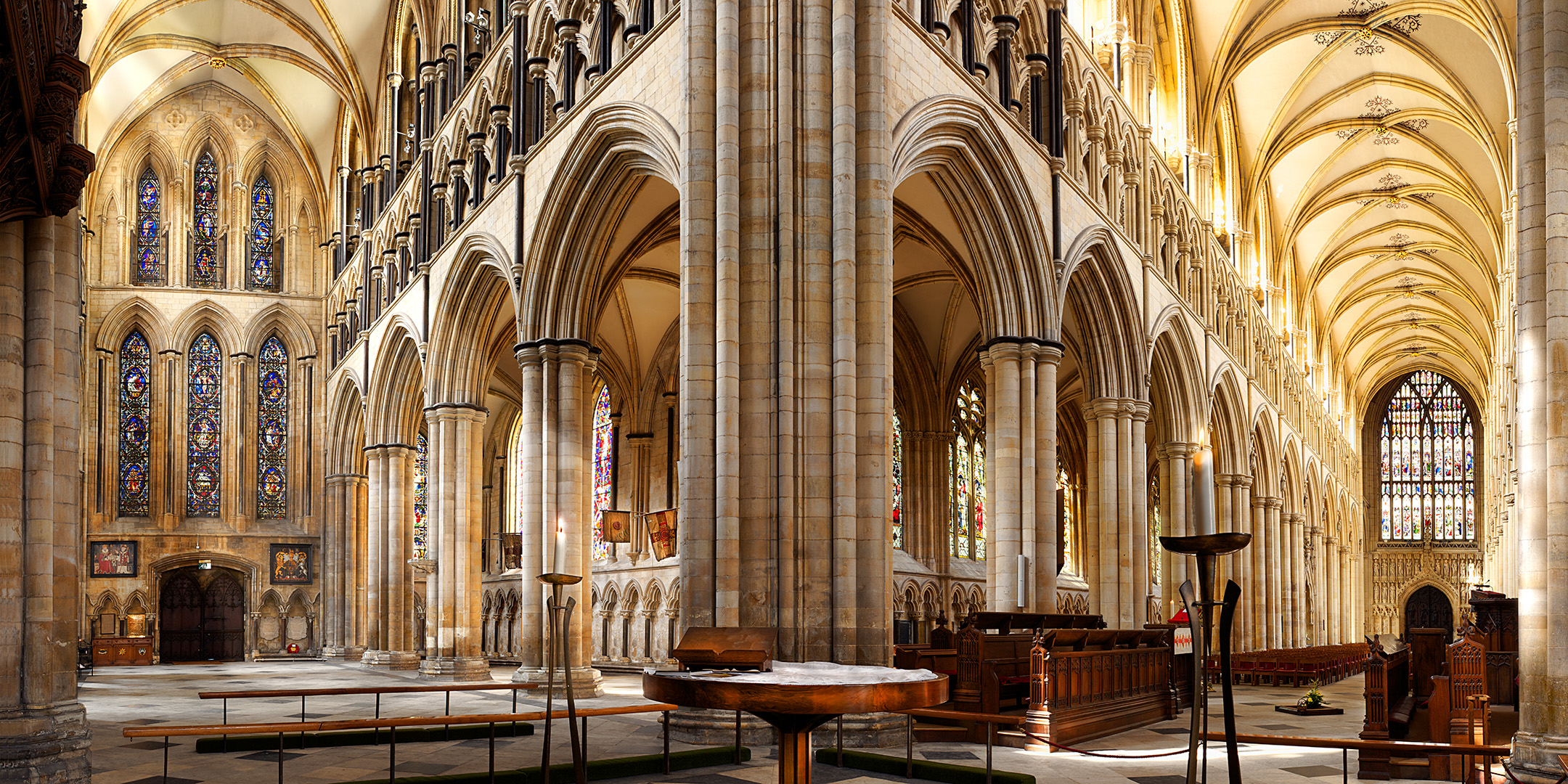
Beverley Minster, East Yorkshire, England 

St. David of Wales lived in the 6th century. He came from a monastery which had been founded by a disciple of St. John Cassian. So great is St. David that he deserves a whole lecture to himself, but today I’ll just mention him in connection with the wisdom of the Egyptian desert: he possessed the gift of tears, spoke alone with angels, subdued his flesh by plunging himself into ice cold water while reciting all of the Psalms by heart, and spent the day making prostrations and praying. “He also fed a multitude of orphans, wards, widows, needy, sick, feeble, and pilgrims.” (Edward C. Sellner, Wisdom of the Celtic Saints). The Roman Catholic scholar, Edward Sellner, adds: “ Thus he began; thus he continued; thus he ended his day. He imitated the monks of Egypt and lived a life like theirs.” (Ibid.) The same writer assures us that “because of its [the Celtic Church’s] love of the desert fathers and mothers, it has a great affinity with the spirituality of the Eastern Orthodox [today].”
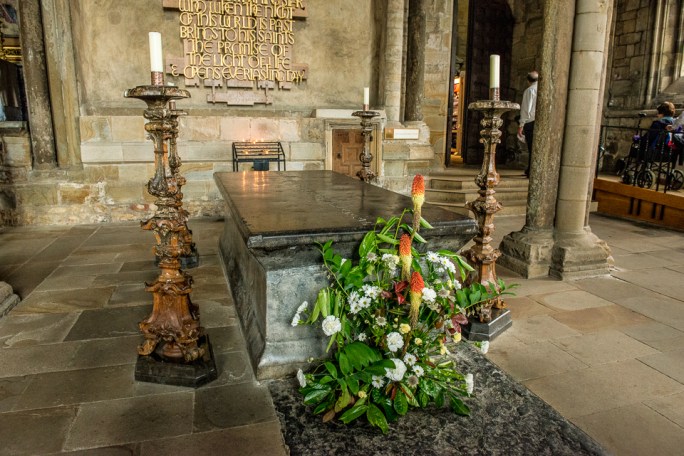
celtic43

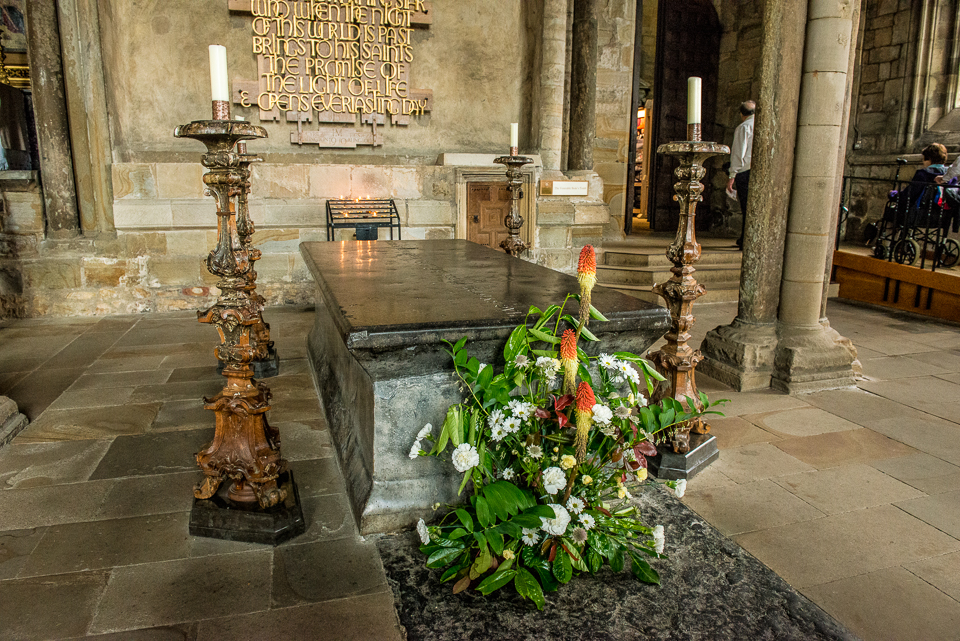
Tomb of Venerable Bede, Durham Cathedral

There are many other evidences of Eastern and Egyptian contact and influence, too numerous to list now. But in his interesting study, The Egyptian Desert in the Irish Bogs, Fr. Gregory Telepneff mentions also the fascinating interlacing knots and complex designs found on the famous standing High Crosses, which show Egyptian or Coptic influence. “Celtic manuscripts show similarities to the Egyptian use of birds, eagles, lions, and calves….In the Celtic Book of Durrow, one can find not only a utilization of the colors green, yellow, and red, similar to Egyptian usage, but also ‘gems with a double cross outline against tightly knotted interlacings,’ which recall the ‘beginnings of Coptic books.’ [Henry, Irish Art]. There is at least one instance of the leather satchel of an Irish missal and the leather satchel of an Ethiopian manuscript of about the same period which “resemble each other so closely that they might be thought to have come from the same workshop’ [Warren, Liturgy].” (Telpneff)
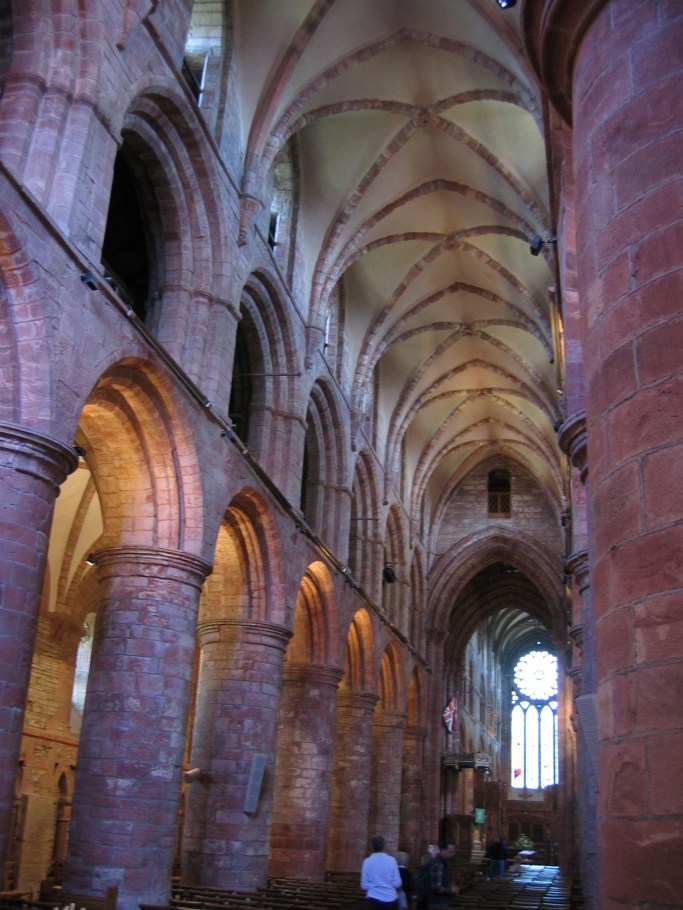
celtic46

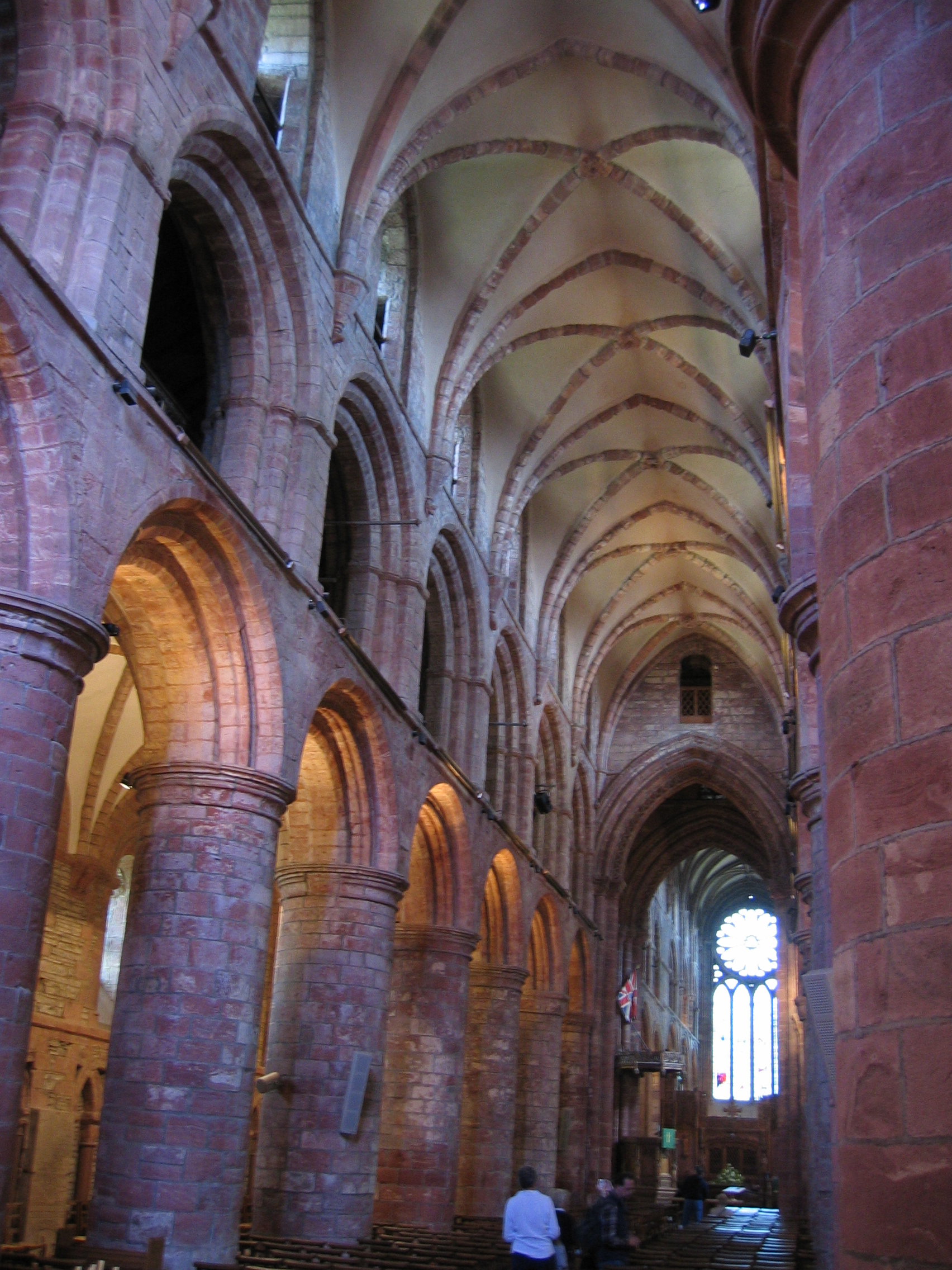
St. Magnus Cathedral Kirkwall

*

Culturally, then, I suggest that Celtic culture was a unique

and intriguing blend of Egyptian and other Middle Eastern influences

with native or indigenous cultural elements.

*
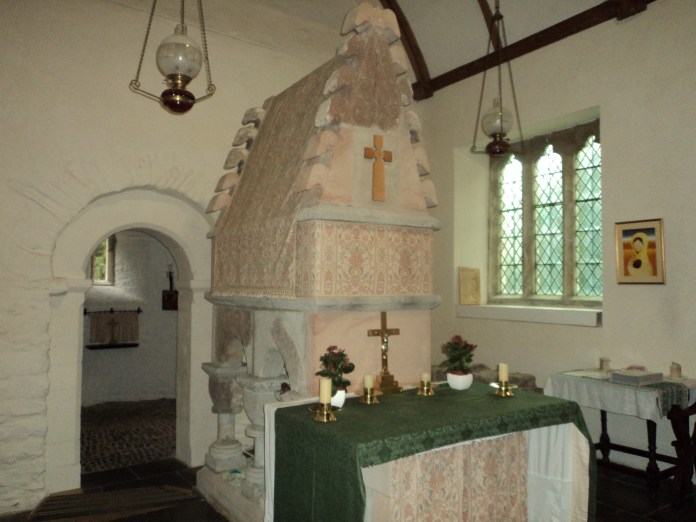
celtic41

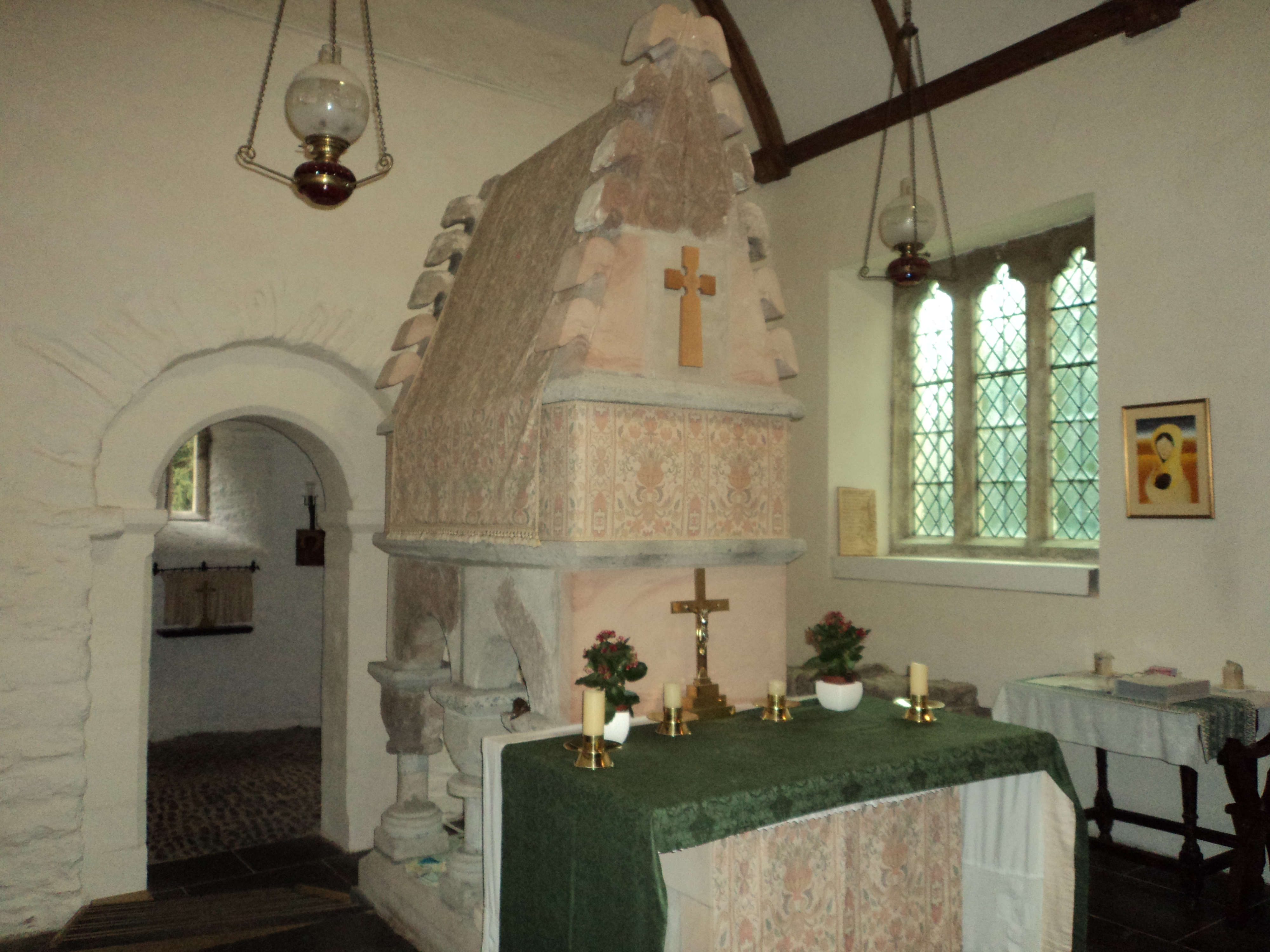
12th century Shrine of Saint Melangell

Before going further I want to say a few words about the term “spirituality.” In our time this has become a wastebasket word into which we put whatever we want the word to mean. Our English word, “spirituality”, comes from the French, and originally described someone who was clever, witty, or perhaps even mad! But our ancient Christian ancestors, whether from Russia, Europe, the Middle East, or the lands of the Celts, did not have such a concept. Certainly they did not see spiritual life as something separate from the rest of life. For them, spirituality was how they lived, how they prayed, how they worshiped God–and it was all bound up together, not separated out. Today, however, we have managed to artificially compartmentalize ourselves and our lives, making “spirituality” something that we do in addition to or separate from regular life. This has made possible a very artificial approach to the Celts.celtic42
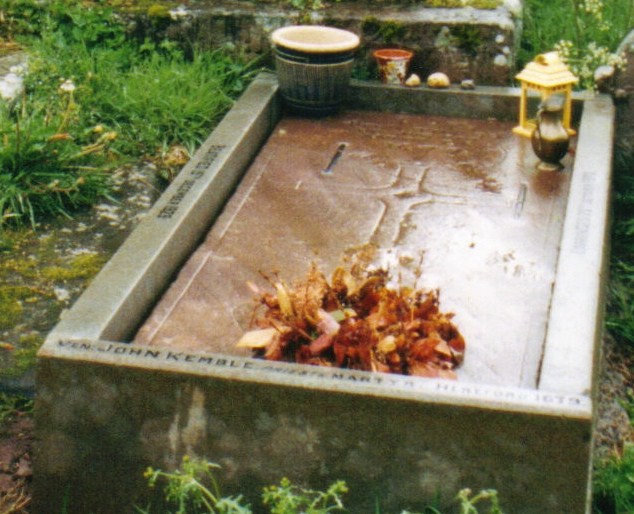
Tomb of St. John Kemble

Thomas O”Loughlin, one of the best of our present-day writers on the subject of Celtic Christianity, make the following sage observation in his book, Journeys on the Edges:

“In the last decade interest in the attitudes and beliefs of the Christians of the Celtic lands in the first millennium has swollen from being a specialist pursuit among medievalists and historians of theology into what is virtually a popular movement. In the process more than a few books have appeared claiming to uncover the soul of this Celtic Christianity in all its beauty….[Many writers] operate by offering their own definitions of ‘Christianity’ past and present, and then setting these against their definition of ‘Celt’ or ‘Celtic’. In this way they can reach the conclusion they want.”

Typical of our modern arrogance and intellectual- spiritual poverty, we project our own feeble ideas back onto a more robust and spiritually rich time, treating the world of Celtic Christianity like a smorgasbord, where we take those things we happen to already “like,” and put them together to form our own very distorted and sometimes even perverted “version” of the Celts.
celtic47

celtic48

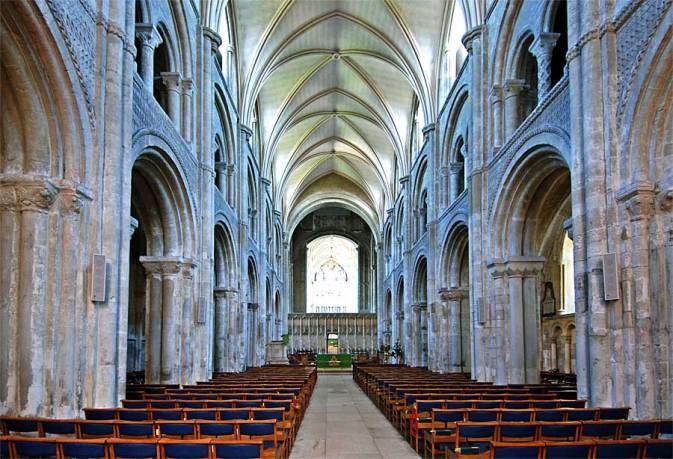
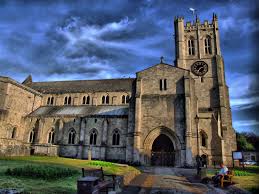
1177: Priory Church of the Holy Trinity, Christchurch, Dorset, England

An example: It is a fact that in the early Christian centuries, Ireland, Scotland and parts of Wales were never subject to Roman rule–neither the old Roman Empire nor the Church of Rome held sway over “Celts.” But some modern writers interpret this to mean that Celtic Christians, since they were “non-Roman,” were therefore anti-Roman or even anti-authority and against the idea of an organized, patriarchal Church. There is absolutely no evidence for such a conclusion, although in fact Celtic Christians did have a quite different way of organizing communities than did Christians on the continent–but this was not out of rebellion, but because their own models were from Egypt and the East, not from Europe! The simple fact is that “the Irish church had always been at the edges of Roman Christianity, [and considered to be a] a barbarian church of limited interest to the Popes.” (Paul Cavill, Anglo-Saxon Christianity: Exploring the Earliest Roots of Christian Spirituality in England) “Although the climate and situation of Britain were very different from the hot deserts of Egypt, there were principles–simplicity, prayer, fasting, spiritual warfare, wisdom, and evangelism–that were easy to translate to the communities of these isles.” (Michael Mitton, The Soul of Celtic Spirituality in the Lives of Its Saints)
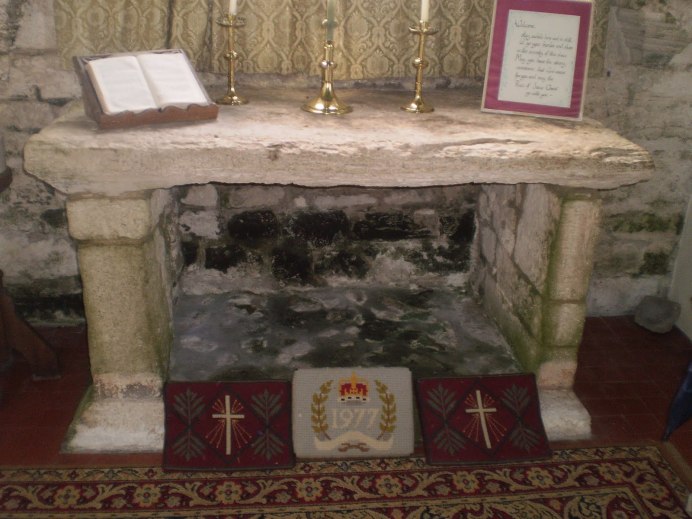
celtic45

The Shrine of St. Wite

But this means that entering into the spiritual, mental, emotional, and physical world of a Celtic Christian monk is difficult–not impossible, but difficult.

First we must realize that the Celts–had no concept of privacy or individuality such as we have today. Families did not live in separate rooms, but all together; no one thought about the idea of “compartmentalizing space” and only hermits and anchorites felt a calling to be alone in spiritual solitude with God, although monks had separate cells, just as monastics did in the Egyptian Thebaid.

The idea that people are separate individuals from the group was not only unheard-of, but would have been considered dangerous, even heretical. Self-absorption, “moods,” and being temperamental–all of these things would have been considered abnormal and sinful.

It wasn’t until the 13th and 14th centuries that people in the West started keeping journals or diaries, and there were no memoirs–also signs of individuality and privacy, of singling oneself out from the family, group, or community–nor were there actual real-life portraits of individuals, until the 14th century. (The art of realistic portraiture developed in response to the medieval idea of romance–for an accurate portrait was a substitute for an absent husband or wife.)
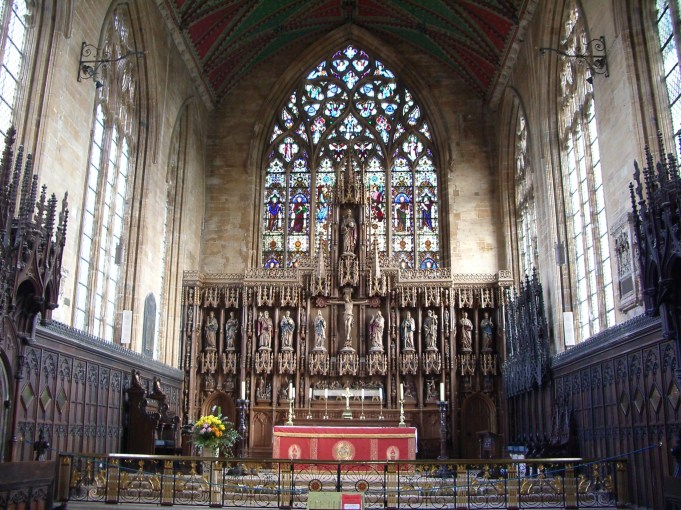
celtic50

Beverley Minster, East Yorkshire, England 

*

Celtic Christian understood, just as do

Eastern Christians, that man is saved in community;

if he goes to hell, he goes alone.

*

Furthermore, “‘the dominant institution of Celtic Christianity was neither the parish church nor the cathedral, but the monastery, which sometimes began as a solitary hermit’s cell and often grew to become a combination of commune, retreat house, mission station…school [and, in general] a source not just of spiritual energy but also of hospitality, learning, and cultural enlightenment.” (Ian Bradley, quoted in Mitten, Ibid.) It was only much later that people began to be gathered into separate parishes, and even later before bishops had dioceses that were based on geographical lines rather than just being the shepherd of a given tribe or group, “being bishops of a community, rather than ruling areas of land. The idea of ‘ruling a diocese’ was quite foreign to the Celtic way of thinking.” (Ibid.)
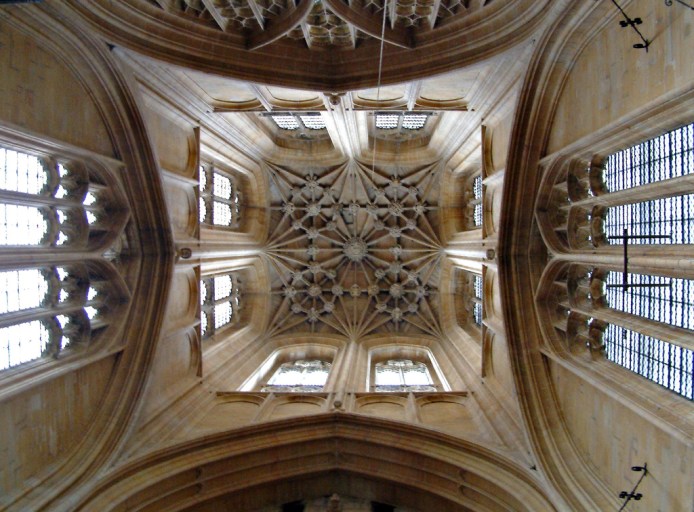
celtic52

Beverley Minster, East Yorkshire, England 

*

If you think about what all of this means in terms of how we today view ourselves, the world in which we live, and the values that we have today, you can see how difficult it’s going to be for us to enter into the world of the Celts. Today we are quite obsessive about such things as privacy and individuality, of “being our own selves” and “getting in touch with the inner man” and other such self- centered nonsense. But the Celtic Christian understood, just as did and do Eastern Christians, that man is saved in community; if he goes to hell, he goes alone.
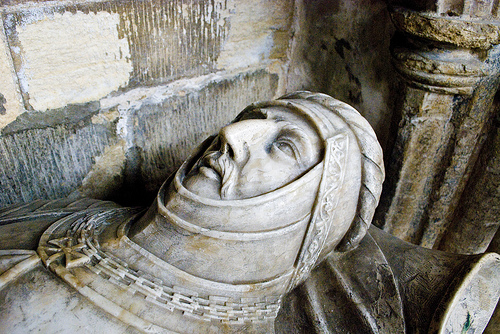
celtic51

Beverley Minster, East Yorkshire, England 

So the orientation of those Christian Celts to God and the other world was very different than the orientation of our modern world, no matter how devout or pious we may be, and this makes the distance between us and the world of Celtic monasticism far greater than just the span of the centuries. A renowned scholar, Sir Samuel Dill, writing generally about Christians in the West at this same period of time, said: “The dim religious life of the early Middle Ages is severed from the modern mind by so wide a gulf, by such a revolution of beliefs that the most cultivated sympathy can only hope to revive in faint imagination ….[for it was] a world of…fervent belief which no modern man can ever fully enter into….It is intensely interesting, even fascinating…[but] between us and the early Middle Ages there is a gulf which the most supple and agile imagination can hardly hope to pass. He who has pondered most deeply over the popular faith of that time will feel most deeply how impossible it is to pierce its secret.” (Quoted in Vita Patrum, Fr. Seraphim Rose)
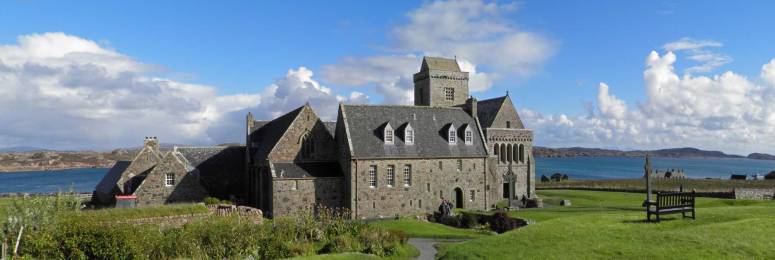
celtic61

Iona Abbey, Scotland 

But is it really “impossible”? To enter their world–the world of Celtic Christianity, which is the same as Celtic monasticism–we must find a way to see things as they did–not as we do today–; to hear, taste, touch, pray, and think as they did. And this is what I mean by the word “spirituality”–a whole world-view. We must examine them in the full context of their actual world–which was a world of Faith, and not just any Faith, but the Christian Faith of Christians in both the Eastern and Western halves of Christendom in the first thousand years after Christ. Spirituality is living, dogmatic, theology. This is the only way we can begin to understand how Celtic Monasticism can be a model of sanctity for us living today, more than a millennium after their world ceased to be. Remember, I said it would be difficult to enter their world; difficult, but not impossible… When we speak of someone or something being a “model,” what do we mean? In this instance–speaking about Celtic monasticism as a “model”–we mean something that is a standard of excellence to be imitated. But here I’m not speaking of copying external things about Celtic monasteries–such as architecture, style of chant, monastic habit, etc., which are, after all cultural “accidents.” I’m speaking of something inward, of an inner state of being and awareness. It’s only in this sense that Celtic monasticism can be, for those who wish it, a “model of sanctity.”
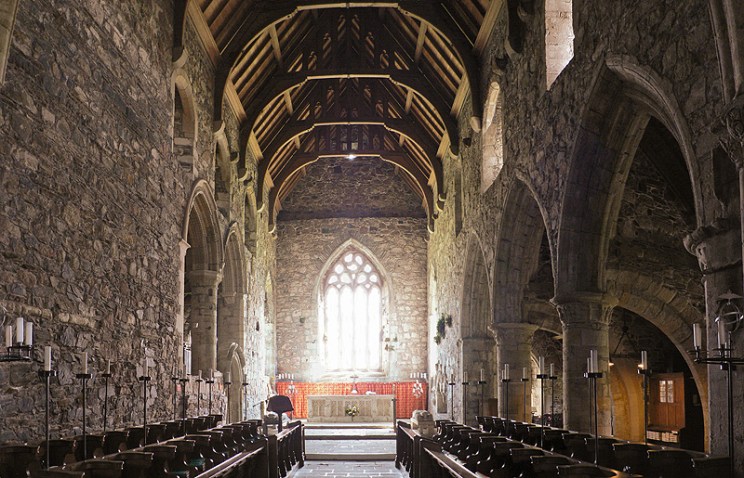
celtic60

Iona Abbey, Scotland 

But what do I mean by “sanctity”? We must be careful not to slip into some kind of vague, New Age warm “fuzzies” which are more gnostic than Christian and have more to do with being a “nice” person than encountering the Living God in this life. By sanctity I mean what the Church herself means: holiness–which is nothing more or less than imitation of Christ in the virtues, and striving to die to oneself through humility, so as to be more and more alive to Christ, successfully cutting off one’s own will in order to have, only the will of Christ, as St. Paul says in his epistle to the Galatians (2:20): “I am crucified with Christ: nevertheless I live; yet not I, but Christ liveth in me…” So, holiness means dying to oneself and especially to one’s passions, more and more, so as draw closer and closer to the Lord God Himself, through Jesus Christ, and Him crucified and risen. In addition, Celtic Christians had the concept of “hallowing” or “hallowed”–an old fashioned term that today has survived only in the unfortunate pagan holiday called “Halloween” (from “All Hallows Eve”–which began as the vigil for the Western Feast of All Souls Day and later took on vile pagan overtones). To early British Christians, something or someone that was “hallowed” was “set apart” from others and sanctified for service to God. Thus, a priest’s ordination or a monastic’s tonsuring was his “hallowing.”
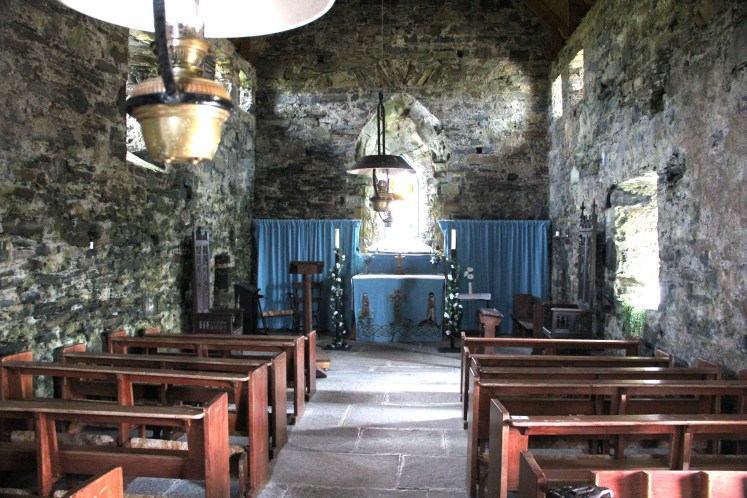
celtic63

St Moluag, Eoropaidh, Isle of Lewis 

And so, thus it was that those blessed and hallowed monastics of Celtic lands modeled forth certain principles that we can still see, study, understand, and imitate today.

The Celts were masters of Christian simplicity. Nowadays there is a movement in our culture to recover some simple basics, but the model is often that of the Quakers or the Shakers or the Amish. Perhaps that’s because those groups are easier and more attractive to imitate; I don’t know. For the Celts, however, simplicity wasn’t so much a question of externals–like furniture, architecture, and so forth. It was something internal, and it was founded upon the Lord’s Prayer–in particular the phrase, “Thy will be done”, as we find in the later commentaries of the Venerable Bede of Jarrow and Alcuin of the court of Charlemagne. This was crucial to living a simple Christian life: “Thy will be done” meant God’s will, not our own–placing absolute trust in the Providence of God for everything–one’s health, one’s finances, the size of one’s family or the size of a monastic community–everything. It meant dying to oneself, not having opinions and not judging others. This was where simplicity began, and from there it easily expressed itself in outward forms, such as not owning five tunics when just two or even one would be sufficient.
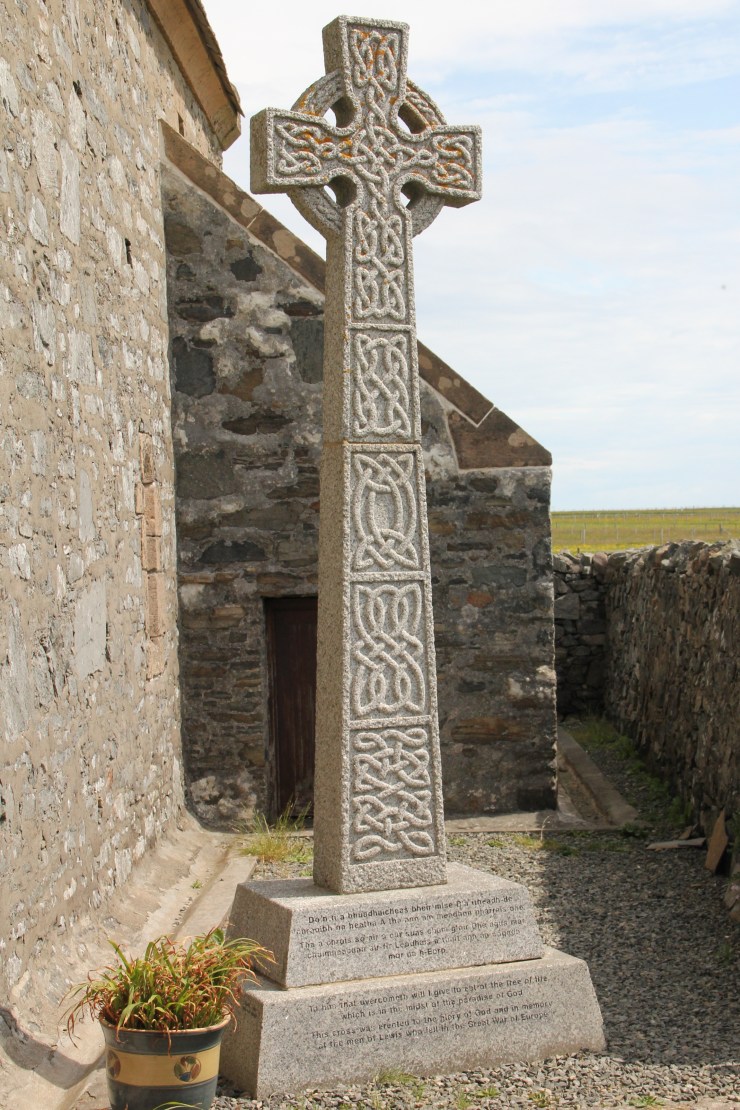
celtic64

St Moluag, Eoropaidh, Isle of Lewis

Simplicity did not necessarily mean “plainness,” as we’ll see shortly when we look at the intricate sacred art of the High Crosses. Celtic Christians were not “Plain People,” like Quakers or the Amish. But they were “Simple People,” in that they were single-minded and intensely focused on the other world and the journey through this life to God.
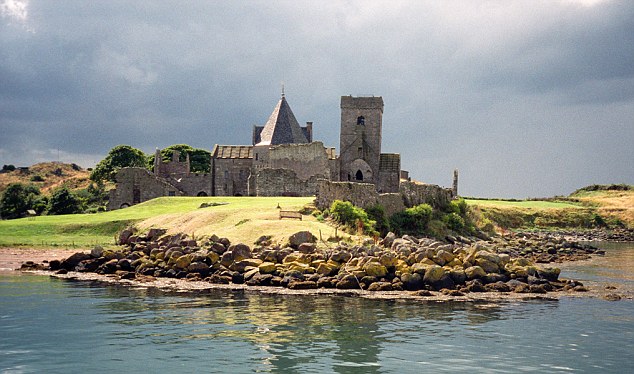
B5A2FH Inchcolm Island and Abbey Firth of Forth, Scotland

Inchcolm Island and Abbey Firth of Forth, Scotland

In common with all Christians at that time, the Celts had no concept of “private prayer” in the sense of spontaneously thinking of words or phrases to say to God. This practice belongs to a much later period in Christian history, when ideas of privacy and individualism had become more important than traditional ways of seeking God through prayer. This didn’t mean that a Celtic Christian didn’t pray outside the divine services, but for them, prayer was primarily liturgical, and this meant the Psalms. Most monks and nuns memorized the complete Psalter. Occasionally a particularly gifted monk would compose a prayer, such as the one I read by St. Columban at the beginning of this lecture. But in moments of need one remembered verses and phrases from the Psalms – such as “In my distress I cried unto the Lord, and He heard me,” from Psalm 120, and “Hide not Thy face from me, O Lord, in the day of my trouble” (Psalm 10, or”In the Lord I put my trust” (Psalm 11).

*

[To Be Continued …]

*

Source: http://www.asna.ca/angloceltic/celtic-monasticism.pdf

Also, listen to Hiermonk Ambrose (Father Alexey Young) about THE UNIQUENESS OF CELTIC MONASTICISM at http://www.asna.ca/angloceltic/

For more information on Celtic Orthodoxy, go to http://www.mullmonastery.com and follow father Seraphim’s struggles to found the first Orthodox monastery in the Hebrides in over a millennium.

For Part IV go to https://orthodoxcityhermit.com/2015/11/01/thin-places-a-journey-into-celtic-christianity-part-iv/

To follow an alternate route at our pilgrimage to the Celtic sacred sites and pilgrim routes of England, you may go to https://orthodoxcityhermit.com/2015/11/05/scilly-pilgrimage/ and visit Scilly –pronounced “silly”–Islands! (/ˈsɪli/Cornish: Syllan or Enesek Syllan) (Introduction of the “c” may be to prevent references to “silly” men or saints!) Yet another look at Christian faith from a Celtic perspective. The Isles of Scilly  are an archipelago off the southwestern tip of the Cornish peninsula of Great Britain, comprising  5 Major, inhabited islands,St Mary’sTrescoSt Martin’sBryherSt Agnes and 140 others. 

Thin Places (II)

celtic11

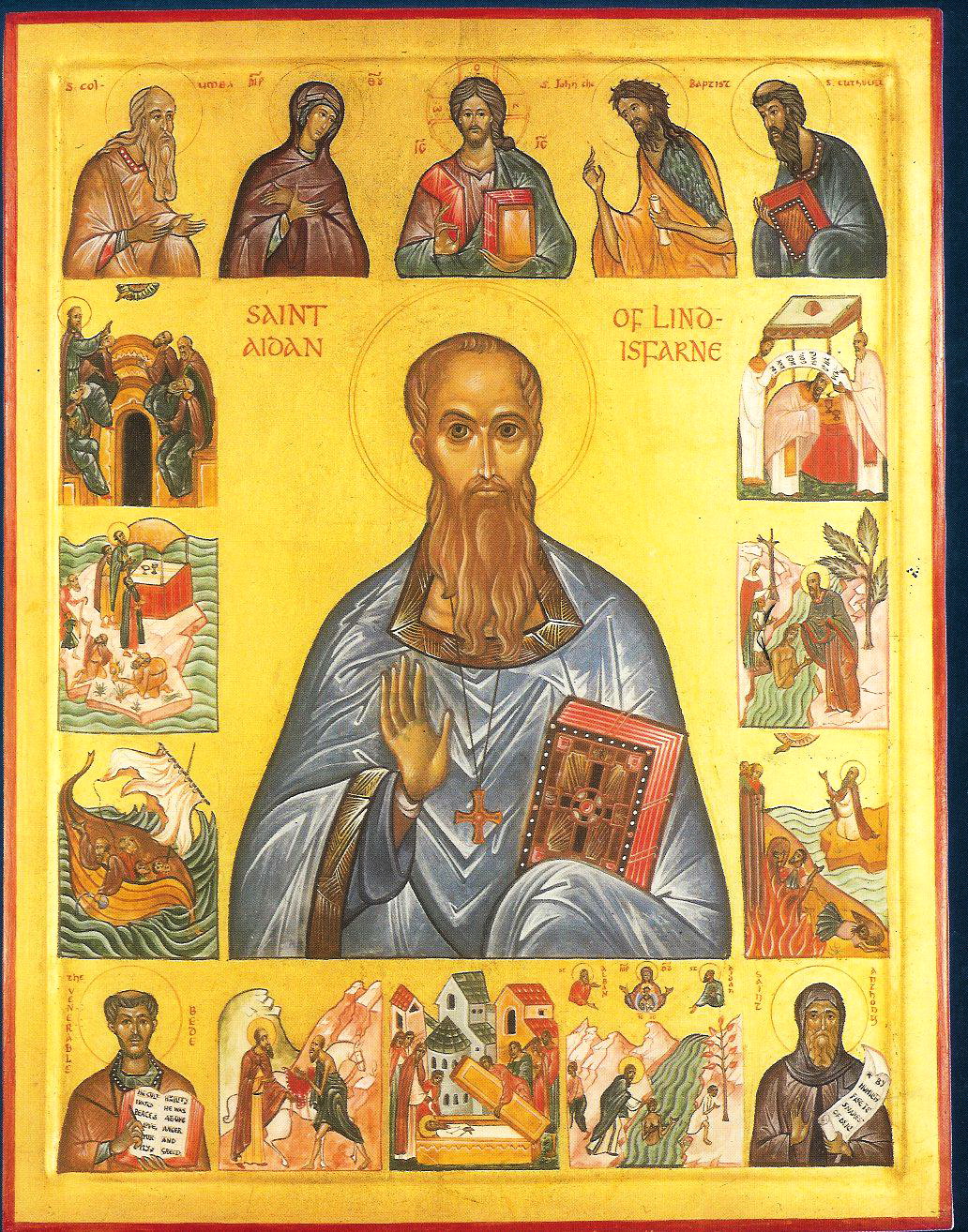
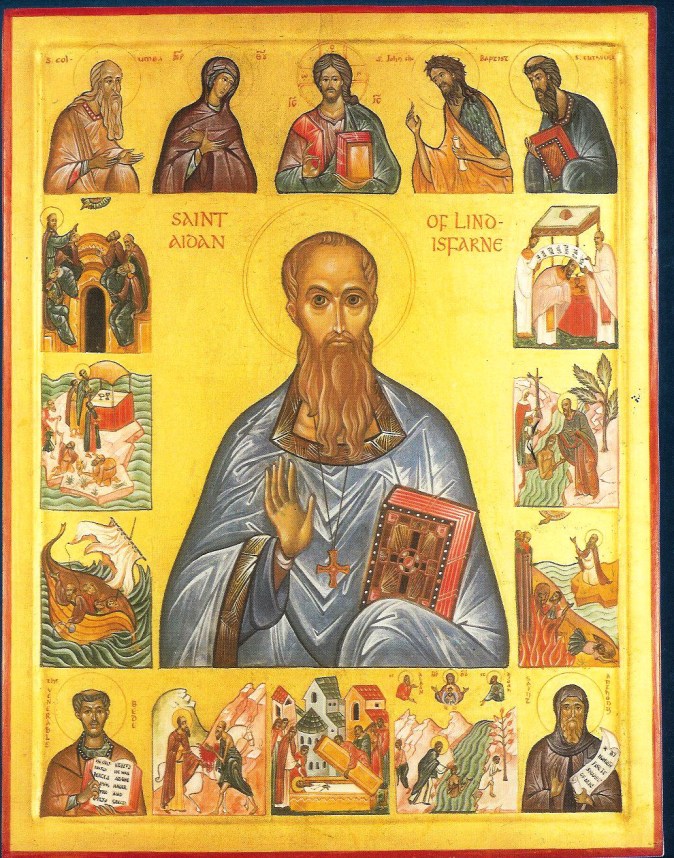
The Holy Hierarch Saint Aidan, Bishop of Lindisfarne  (651)

*

“The Church in The British Isles will only begin to grow 

when She begins to again venerate Her own Saints

 *

(Saint Arsenios of Paros †1877)

*

Celtic Monasticism, A Model of Sanctity By Hieromonk Ambrose (Father Alexey Young) — Part II of IV 

“… Monasticism appeared attractive to a warrior people who were drawn to an ascetic lifestyle. … It appealed to a marginalized people who saw the monk as one who lived on the edge of things, on the very margins of life.

celtic39

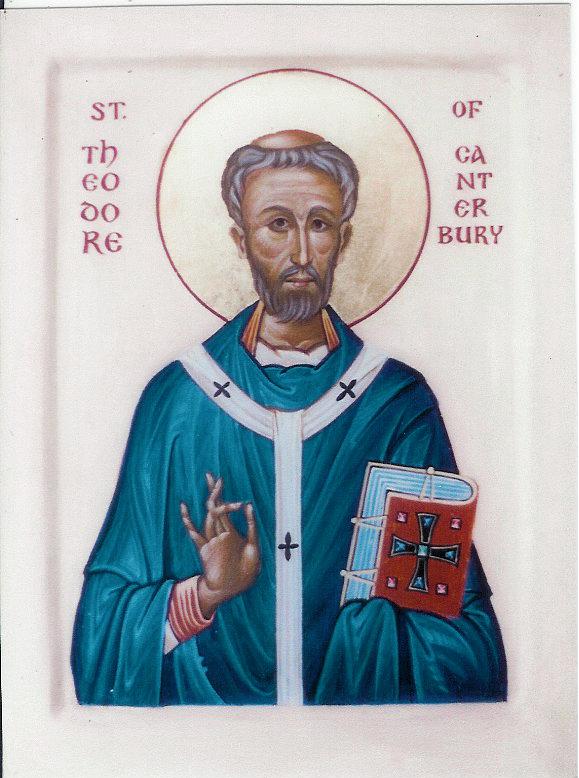
The Holy Hierarch Saint Theodore, Archbishop of Canterbury ( 690)  

Christianity softened all of this, but Celtic Christians did not lose their fierceness which, under the influence of Christ, no longer expressed itself in a lust for war, but now was channeled into Christianity as a way of life–and this they pursued with a single-mindedness rarely seen elsewhere. “Monasticism appeared attractive to a warrior people who were drawn to an ascetic lifestyle. It appealed to a marginalized people who saw the monk as one who lived on the edge of things, on the very margins of life.” (Timothy Joyce, Celtic Christianity)

celtic40

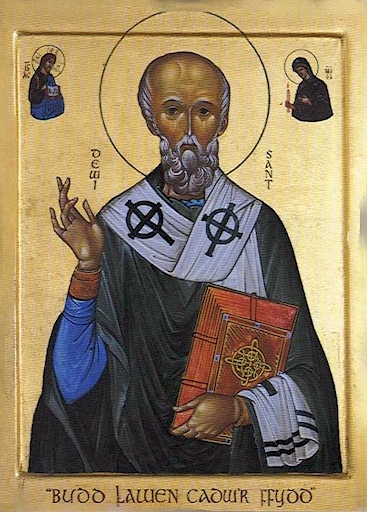
The Holy Hierarch Saint David of Wales, Bishop of Menevia Confounder of Pelagians    († 601)

We see this in the lives of monks like St. Cuthbert and St. Guthlac, who “were uncompromising solitaries and their ascetic practices aroused wonder … To go all-out for something” is a distinctive mark of Celtic Christians. (Benedicta Ward, High King of Heaven). Another example is in the life of St. Columban who, we are told, “leaped over his mother’s grieving body, which was draped across her threshold, in order to head for” a monastery. (Lisa M. Bitel, “Ascetic Superstars,” www.christianitytoday.com/ch/60h/60h022.html)

celtic7

It is perhaps not surprising then, to learn that the brave stories of the valiant and heroic King Arthur (who was an actual person) originated among the Celts and were only later picked up and modified and expanded by medieval troubadours and scribes elsewhere in Europe. These included tales of the Round Table and the noble Quest for the Holy Grail, as well as accounts of Arthur’s spiritual father, Merlin (who, by the way, was most probably a Celtic bishop named Ambrosius Merlinus, after St. Ambrose of Milan, and not a Druid priest, as used to be thought).

celtic6

As an aside, may I say that Celtic hermit life “was no walk through a nature reserve or stay at a holiday camp. The hermit had deliberately chosen to live at the limits of existence, a human person containing both heaven and earth.” (Ward, op.cit.) Speaking of his own hermit days, St. Cuthbert testified that the demons constantly “cast me down headlong from my high rock; how many times have they hurled stones at me as if to kill me. But though they sought to frighten me away by one phantasmal temptation or another, and attempted to drive me from this place of combat, nevertheless they were unable in any way to mar my body by injury or my mind by fear.” (Quoted in Ward, Ibid.)

celtic5

This account is amazingly close to the temptations suffered by St. Antony the Great in the Egyptian desert. But this is not surprising, because their Christianity– which is to say, their monastic life–was primarily influenced by and formed by the Christian monasticism of the Egyptian desert, and only incidentally from the continent of Europe. This means that Celtic Christians were more like the Byzantine or Slavic Orthodox Christians than Latin or Northern European Christians.

celtic4

Early this last summer I had an appointment with a new diabetic specialist. Dr. Jennings was very intrigued and pleased to meet “a real live monk”, “But,” he said, “you don’t look like a monk.” I said, “What do you mean, I don’t ‘look like a monk’? I have a beard and wear a black habit.” He replied, “Well, you have to realize, Father, that my only images of monks have been formed by television commercials–where the monks are all wearing brown robes, are clean-shaven, have a bald spot in the center of their heads, and are advertising either ‘Beano’ or computers.” I’m afraid this really is the popular image of monks in our culture, today. Most of these images are based upon stereotypical ideas drawn from medieval Western monasticism and applied to both Celtic and Orthodox Christian monastics: it’s assumed that we all look like Francis of Assisi, and live in great stone monasteries with cloisters. But this is not an accurate image of Celtic.

celtic1

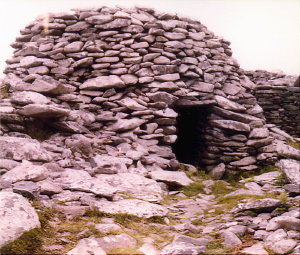
Rather, Celtic monastic communities were more a relatively modest ‘monastic village’ than a huge complex of buildings. The village had a stone wall around it to keep animals in and thieves out. Within the walls were many small huts, whether wooden buildings or crude structures of mud and wattle. Later, especially in the west of Ireland, stone buildings were erected. Remains of many “stone clochans, called ‘beehive huts’ in English, are scattered over the countryside….There is no indication that any large church buildings were ever built….” (Timothy Joyce, Celtic Christianity) “Other monks and nuns lived out their days alone….in small wood-and-mud huts; they kept a cow or two, and accepted gladly the gifts of an occasional loaf or basket of vegetables from local farmers. The desire for a solitary life and time to spend simply yearning for God…must have drifted through the hearts of even the busiest abbot in the most bustling monastery.” (Bitel, op.cit.)

celtic82

Stone clochan, Ireland 

celtic7

Monastic life was seen as an absolutely essential part of Christian life–the norm for all Christian life, not the exception–, and monks and nuns, hermits and hermitesses were the great heroes of the common people, who saw them, as St. Cuthlac put it, as “tried warriors who serve a king who never withholds the reward from those who persist in loving Him.” (Quoted in Bitel, Ibid.) Indeed, it is this quality of persistent, even stubborn heroism that particularly stamps the character of Celtic Christianity and, particularly, monastic life–for these were a people whose heroes were monks and nuns, not political leaders or other cultural figures.

celtic8

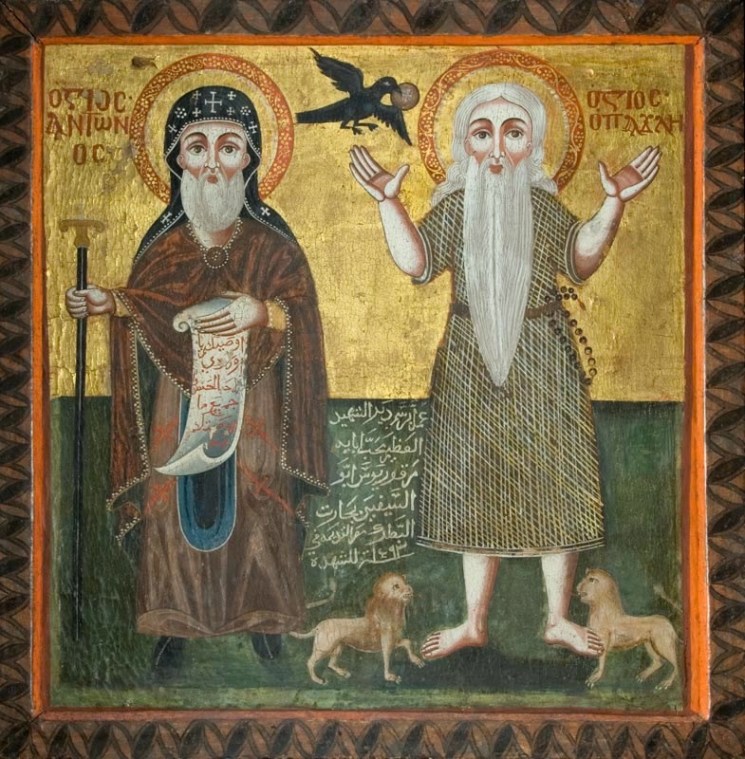
St. John Cassian, who is still carefully read and studied by Eastern Orthodox monastics today, was well known to Celtic monks. St. John had spent years as a monk in Bethlehem and Egypt–and recorded his conversations with the Egyptian Fathers–later establishing a monastery near present-day Marseilles, France. The Life of the Egyptian Father, St. Anthony the Great was translated into Latin around the year 380, and we know that this was studied by Celtic monks, who depicted St. Anthony and St. Paul of Thebes on some of the great Irish “High Crosses” (about which I’ll say more, shortly). There was phenomenal literacy and very high culture among these monks. In addition, they also learned from the monks of the Egyptian desert how to practice daily “Confession of Thoughts.” Their monastic clothing was primarily made from animal skins, so that in appearance they actually resembled St. John the Baptist out in the wilderness–a far cry from the monastics of Europe in their sometimes rather elaborate woven cloth habits.

celtic37

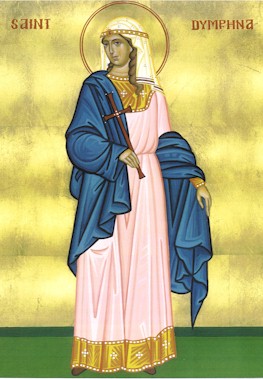
Holy Martyr Saint Dymphna, Patron Saint of Mental Illness ( 650)

Now we come to the interesting part: There are records of any number of Christians traveling to the Desert Fathers from the British Isles, and an old Celtic litany of the saints mentions seven Egyptian monks who came to Ireland and died and were buried there. Scholars believe that most of the contact between Ireland and Egypt occurred before the year 640. On an ancient stone near a church in County Cork, Ireland, there is the following inscription: “Pray for Olan, the Egyptian. Also interesting is the fact that even though there are no deserts in the British Isles, the Celts called their monastic communities diserts or “deserts.” This was particularly true of island monasteries or hermitages –those spiritual fortresses–, where the sea itself was like a desert, as an ancient poet said of St. Columban’s island hermitage:

celtic33
“Delightful I think it to be in the bosom of an isle on the peak of a rock, that I might often see there the calm of the sea…That I might see its heavy waves over the glittering ocean as they chant a melody to their Father on their eternal course.”

celtic34

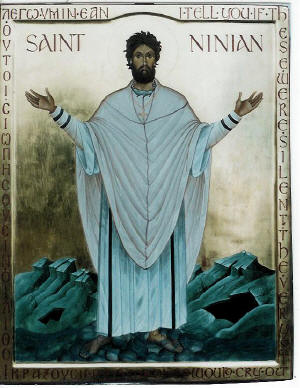
Saint Ninian Bishop of Whithorn, Apostle to the Picts († 432)

We have a wonderful description of a visit to the monks of Egypt near the close of the fourth century, written by Rufinus of Aquileia. He wrote: “When we came near, they realized that foreign monks were approaching, and at once they swarmed out of their cells like bees. They joyfully hurried to meet us.” Rufinus was particularly struck by the solitude and stillness of life among these monks. “This is the utter desert,” he observed, “where each monk lives alone in his cell….There is a huge silence and a great peace there.” (Quoted in Celtic Saints, Passionate Wanderers, by Elizabeth Rees)

celtic35
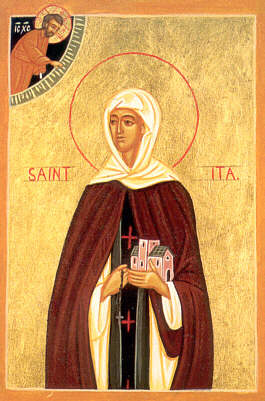
Saint Ita (Ida, Dorothy), Hermitess in Limerick, Ireland, and Foster-Mother of Saint Brendan (570)

*

[To Be Continued …]

*

Source: http://www.asna.ca/angloceltic/celtic-monasticism.pdf

Also, listen to Hiermonk Ambrose (Father Alexey Young) about THE UNIQUENESS OF CELTIC MONASTICISM at http://www.asna.ca/angloceltic/

For Part III go to https://orthodoxcityhermit.com/2015/11/01/thin-places-a-journey-into-celtic-christianity-part-iii/

To follow an alternate route at our pilgrimage to the Celtic sacred sites and pilgrim routes of England, you may go to https://orthodoxcityhermit.com/2015/11/05/scilly-pilgrimage/ and visit Scilly –pronounced “silly”–Islands! (/ˈsɪli/Cornish: Syllan or Enesek Syllan) (Introduction of the “c” may be to prevent references to “silly” men or saints!) Yet another look at Christian faith from a Celtic perspective. The Isles of Scilly  are an archipelago off the southwestern tip of the Cornish peninsula of Great Britain, comprising  5 Major, inhabited islands,St Mary’sTrescoSt Martin’sBryherSt Agnes and 140 others. 
Thin Places (I)

celtic12

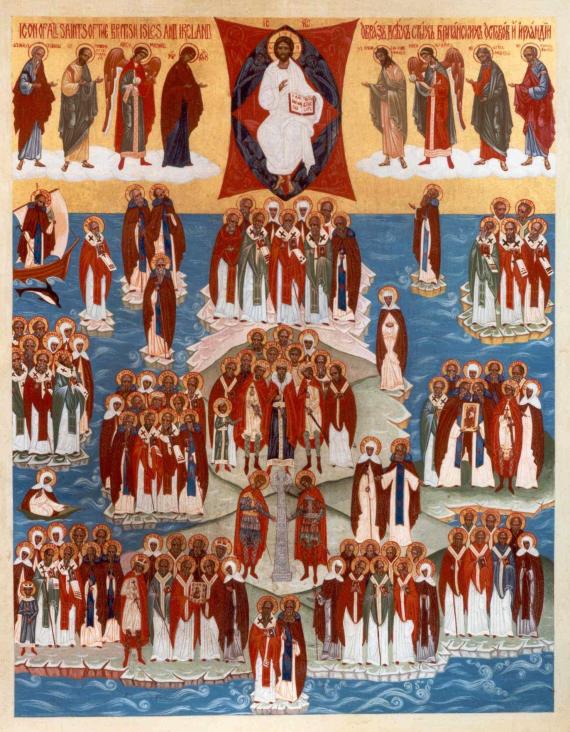
SYNAXIS OF ALL SAINTS OF THE BRITISH ISLES & IRELAND    

*

“The Church in The British Isles will only begin to grow

when She begins to again venerate Her own Saints

 *

(Saint Arsenios of Paros †1877)

*

Celtic Monasticism, A Model of Sanctity By Hieromonk Ambrose (Father Alexey Young)

A Journey into Celtic Christianity — Part I of IV 


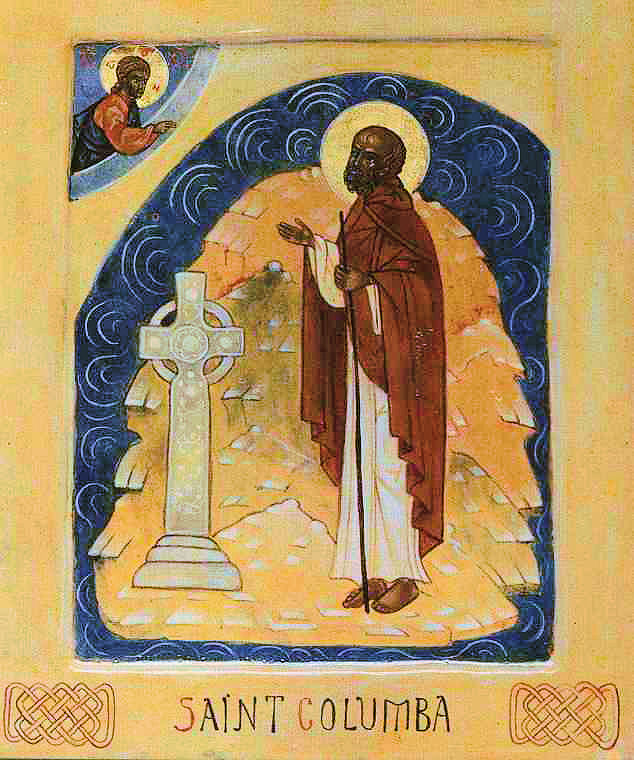
Prayer of St. Columban of Iona

Kindle in our hearts, O God, The flame of that love which never ceases,
That it may burn in us, giving light to others.
May we shine forever
in Thy holy temple,
Set on fire with Thy eternal light, Even Thy son, Jesus Christ,

Our Savior and Redeemer.

   celtic19

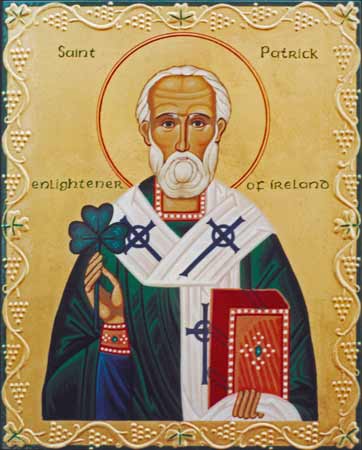
The Holy Hierarch Saint Patrick, Apostle of Ireland   ( 493)

[This week I went on a pilgrimage to the Celtic sacred sites and pilgrim routes of North England. ] With the imagery of fire and light contained in this wonderful prayer I want to move immediately to a recorded incident in the life of St. Columban, a description which shows how he himself personally experienced this “light”–which of course Orthodox Christians recognize as a vision of the Uncreated Light spoken of in Scripture and in the Holy Fathers. Here is the account:

celtic24

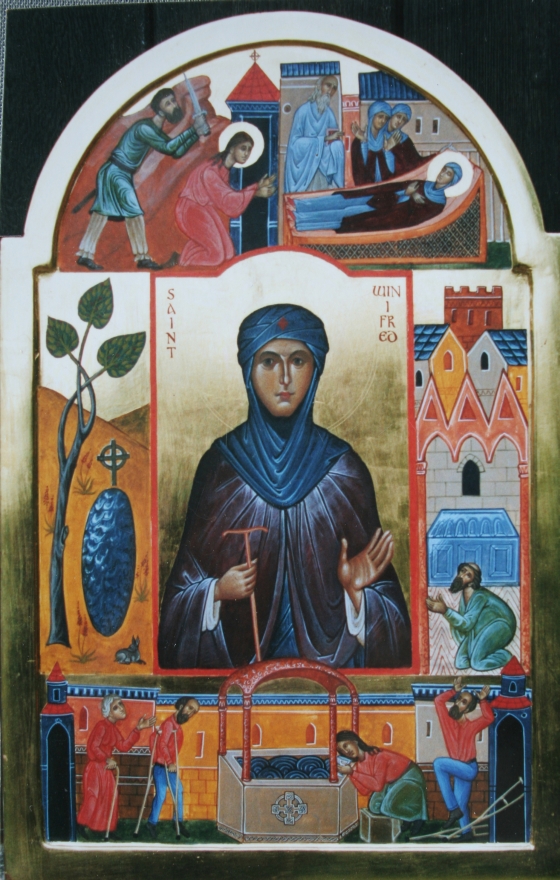
The Holy Virgin-Martyr Saint Winifred of Wales ( 650)

“One winter’s night a monk named Virgnous, burning with the love of God, entered the church alone to pray. The others were asleep. He prayed fervently in a little side chamber attached to the walls of the oratory. After about an hour, the venerable Columban entered the same sacred house. Along with him, at the same time, a golden light came down from the highest heavens and filled that part of the church. Even the separate alcove, where Virgnous was attempting to hide himself as much as he could, was also filled, to his great alarm, with some of the brilliance of that heavenly light. As no one can look directly at or gaze with steady eye on the summer sun in its midday splendor, so Virgnous could not at all bear the heavenly brightness he saw because the brilliant and unspeakable radiance overpowered his sight. This brother, in fact, was so terrified by the splendor, almost as dreadful as lightning, that no strength remained in him. Finally, after a short prayer, St. Columban left the church.

The next day he sent for Virgnous, who was very much alarmed, and spoke to him these consoling words: ‘You are crying to good purpose, my child, for last night you were very pleasing in the sight of God by keeping your eyes fixed on the ground when you were overwhelmed with fear at the brightness. If you had not done that, son, the bright light would have blinded your eyes. You must never, however, disclose this great manifestation of light while I live.’”

celtic22

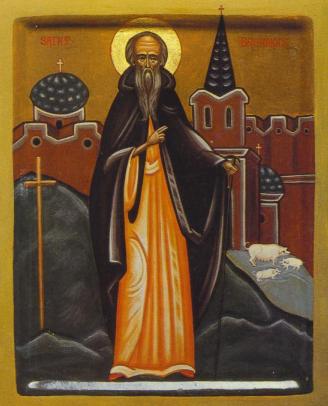
The Holy Hierarch Saint Brannoc, Abbot of Braunton, Devonshire  ( 6th c.)
 
It’s no wonder, then, that ancient writers said that, on the faces of Celtic monks who had advanced in spiritual life, there rested the glow of caeleste lumen, heavenly light.

celtic11

The Holy Hierarch Saint Aidan, Bishop of Lindisfarne  (651)

In the life of St. Adomnan we read about the following incident:

“At another time when the holy man was living in the island of Hinba, the Grace of the Holy Spirit was poured out upon him abundantly and in an incomparable manner, and continued marvelously for the space of three days, so that for three days and as many nights, remaining with a house barred, and filled with heavenly light, he allowed no one to go to him, and he neither ate nor drank. From that house streams of immeasurable brightness were visible in the night, escaping through chinks of the door leaves, and through the key-holes. And spiritual songs, unheard before, were heard being sung by him. Moreover, as he afterwards admitted in the presence of a very few men, he saw, openly revealed, many of the secret things that have been hidden since before the world began. Also everything that in the Sacred Scriptures is dark and most difficult became plain, and was shown more clearly than the day to the eyes of his purest heart. And he lamented that his foster-son Baithene was not there, who if he had chance to be present during those three days, would have written down from the mouth of the blessed man very many mysteries, both of past ages and of ages still to come, mysteries unknown to other men…”(Fr. Gorazd Vorpatrny, “Celts and Orthodoxy,” http://www.orthodoxireland.com/history/celtsandorthodox y/view)

celtic9

celtic33

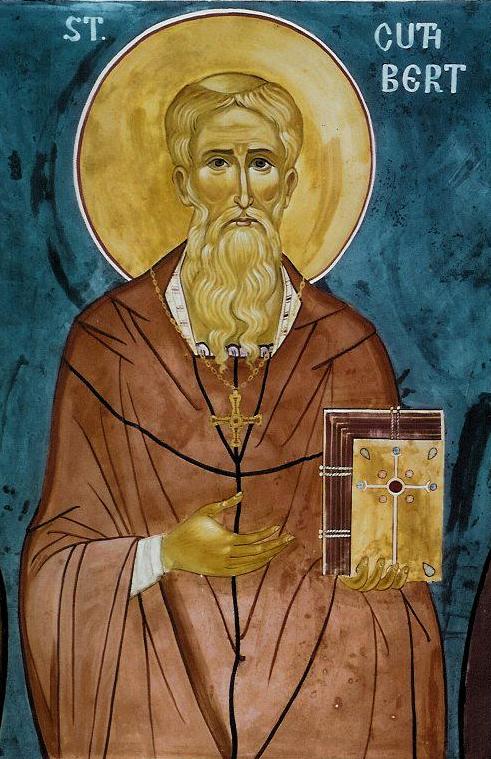
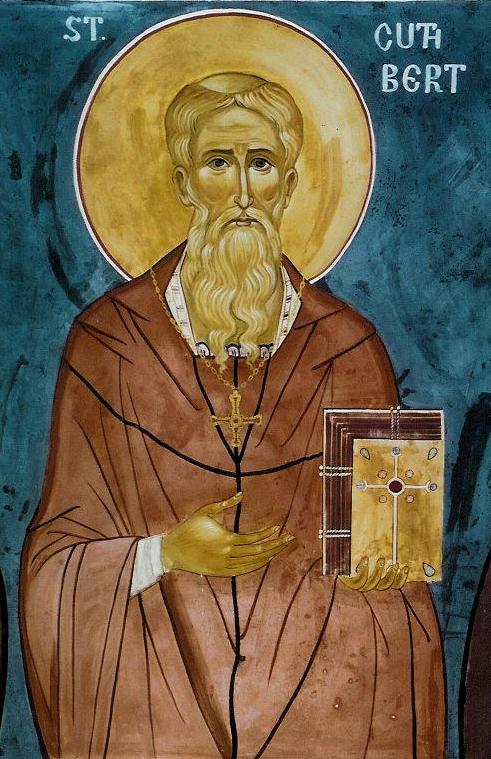
The Holy Hierarch Saint Cuthbert, Bishop of Lindisfarne († 687)

In the Introduction to his translation of the Vita Patrum: The Life of the Fathers, the Righteous Fr. Seraphim of Platina wrote appreciatively about the Orthodox saints of the pre-schism West in Gaul, but of course he could have been writing about the Celtic saints of the British Isles from exactly the same period of time.

celtic14

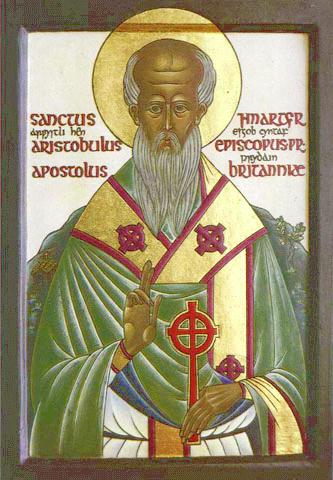
Saint Aristobulus, Apostle of Britain  (1st c)

“A touchstone of true Orthodoxy,” Fr. Seraphim wrote, “is the love for Christ’s saints. From the earliest Christian centuries the Church has celebrated her saints–first the Apostles and martyrs who died for Christ, then the desert- dwellers who crucified themselves for the love of Christ, and the hierarchs and shepherds who gave their lives for the salvation of their flocks. From the beginning the Church has treasured the written Lives of these her saints and has celebrated their memory in her Divine services.

These two sources–the Lives and services–are extremely important to us today for the preservation of the authentic Orthodox tradition of faith and piety.

The false ‘enlightenment’ of our modern age is so all-pervasive that it draws many Orthodox Christians into its puffed up ‘wisdom,’ and without their even knowing it they are taken away from the true spirit of Orthodox and left only with the shell of Orthodox rites, formulas, and customs.. To have a seminary education, even to have the ‘right views’ about Orthodox history and theology–is not enough. A typical modern ‘Orthodox’ education produces, more often than not, merely Orthodox rationalists capable of debating intellectual positions with Catholic and Protestant rationalists, but lacking the true spirit and feeling of Orthodoxy. This spirit and feeling are communicated most effectively in the Lives of saints and in similar sources which speak less of the outward side of correct dogma and rite than of the essential inward side of proper Orthodox attitude, spirit, piety.”

celtic28

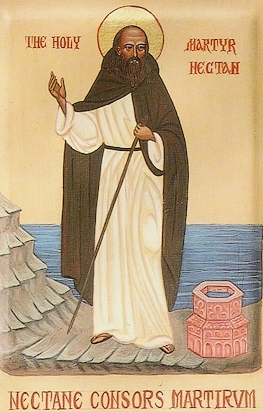
Holy Martyr Saint Nectan, Celt Hermit, Devonshire ( 6th c.)

With this principle in mind–that the lives of the saints are of critical importance if we are to understand and pass on true Orthodox Christianity to the next generation–I want to continue by defining two important terms: “Celtic” (or “Celt”) and “spirituality.”

It may come as a surprise to learn that the Celts actually never called themselves “Celts.” This word comes from the Greek Keltos, and means something like “the other” or “a stranger.” The Greeks also called these people Keltoi, which was a word the Celts did adopt because it means “the hidden ones” or the “hidden people.” In fact, the Old Irish word ceilid means “to hide or conceal.” So these people were called “Celts” by those who came into contact with them and saw them as being quite different than other tribes and peoples. And they were. In their long, pre- Christian period they were a ferocious war-loving lot who fought just for the sheer joy of fighting. “One Roman writer described Celtic men as ‘terrible from the sternness of their eyes, very quarrelsome, and of great pride and insolence’. Nor, to his dismay, did these qualities stop with the men. ‘A whole troop of foreigners [he wrote] would not be able to withstand a single one if he called to his assistance his wife, who is usually very strong.’ The Greek historian Strabo was more blunt in his assessment. ‘The whole race,’ he concluded, ‘is war mad.’” (No author given; Heroes of the Dawn: Celtic Myth)

celtic29

The Venerable Hilda, Abbess of Whitby († 680)

Monasticism appeared attractive to a warrior people who were drawn to an ascetic lifestyle. … It appealed to a marginalized people who saw the monk as one who lived on the edge of things, on the very margins of life.

*
[To Be Continued …]

*

Source: http://www.asna.ca/angloceltic/celtic-monasticism.pdf

Also, listen to Hiermonk Ambrose (Father Alexey Young) about THE UNIQUENESS OF CELTIC MONASTICISM at http://www.asna.ca/angloceltic/

For Part II go to https://orthodoxcityhermit.com/2015/10/31/thin-places-a-journey-into-celtic-christianity-part-ii/

To follow an alternate route at our pilgrimage to the Celtic sacred sites and pilgrim routes of England, you may go to https://orthodoxcityhermit.com/2015/11/05/scilly-pilgrimage/ and visit Scilly –pronounced “silly”–Islands! (/ˈsɪli/Cornish: Syllan or Enesek Syllan) (Introduction of the “c” may be to prevent references to “silly” men or saints!) Yet another look at Christian faith from a Celtic perspective. The Isles of Scilly  are an archipelago off the southwestern tip of the Cornish peninsula of Great Britain, comprising  5 Major, inhabited islands,St Mary’sTrescoSt Martin’sBryherSt Agnes and 140 others. 
Each With His Own Brush

darsane1

Can you tell the difference between Sawai Chinnawong’s Nativity painting and Nyoman Darsane’s Christ?

asian1

asian2

Although both are nonwestern, Asian Christian paintings, a western Christian could look at Chinnawong’s painting and easily tell what story it is depicting for all its Thai elements, whereas he wouldn’t really make much sense of Darsene’s work. Conversely, a Thai Buddhist might not grasp the meaning of Sawai Chinnawong’s painting, whereas the concepts/images in Darsane’s work would be familiar and easily recognizable to a Balinese.

darsane2

Sawai Chinnawong3

The difference I am alluding to is nothing other than that of two different visual contextualization art models, “the static Accommodation Model”, alias  the Kernel and Husk model, and “the dynamic Inculturation Model”, alias the Onion Model. For a full discussion go to Indigenous Christ blog at http://indigenousjesus.blogspot.co.uk/2011/02/models-of-visual-contextualization.html

*

Let us now have a closer look at Maria and Martha paintings by Darsane and Sawai Chinnawong respectively.

darsane3

Sawai Chinnawong1

Also, at the Ten Virgins parable paintings by Darsane and Sawai Chinnawong respectively.

In another instance we are drawn to the work of I Nyoman Darsane, another popular Balinese Christian artist. Darsane began with a traditional orientation. However, he then began working in more modern styles. As this developed much was written about the presence of traditional elements in his art. Darsane's work came to be described as 'contemporary.' Darsane utilizes a principle of realism in his paintings to create mythological figures or wayang that are usually seen in the Hindu world. However, these mythological figures he makes as characters from stories whose inspiration and substance is taken from the Gospel. And so emerge symbolic realist paintings like Sang pembebas (The deliverer), Sepuluh Anak Dara (the ten virgins) or the narrative of Mary and Martha.

Sawai Chinnawong2

This brings up an interesting point about the contextualization of visual art. Which model of the two should be followed in indigenous Christian visual art? And what about indigenous iconography in particular? What type of icons should be used for church worship?

Sawai Chinnawong4

Jonah by Sawai Chinnawong

abubakar1

Adam and Eve by Abubakar

To give you just an example how complicated such issues can be/become, let us now turn our attention to Abubakar’s art. “Abubakar was born in 1930 in the Palmas region of South Sulawesi. He was born to a Moslem family but was educated at a Christian School. Genesis and its stories of creation were a popular subject for his art. In 1980, he painted the temptation of Adam and Eve on canvas and later a larger series on Paradise Lost . He sees the lost paradise as the result of our own deeds and not as a punishment from God. “It is the karma of our own deeds”, he says “to lose paradise or to regain it.” He experiments with several techniques including batik, woodcut, monoprint, watercolors and wood carving. He lives in Jakarta and assists church publishing programs. ‘I still see myself as a pilgrim,” he writes. “I am still seeking after truth and beauty, and how to show God’s love in my life and my art.’ (From Asian Christian Art Organisation at http://www.asianchristianart.org/art_abubakar.html )

He Qi1

Jesus in the boat with fishermen by Chinese artist He Qi 

*

Abubakar, a self-taught artist, he often used Christian themes as the only ones adequate to express his understanding of human suffering. I personally find this last point fascinating, because Sawai Chinnawong, the Thai Christian artist discussed above, once stated that “an artist in Burma taught me that I needed to include images that are uncommon in Thai art. Buddha is never seen suffering in our iconography, but as a Christian I have to depict the suffering of Christ, which is the hardest spiritual concept for us to understand or except”.

jamini roy1

Flight into Egypt by Indian artist Jamini Roy

So suffering is a difficult thing for Buddhist/Hindu-background believers to view or portray. Eventually, Chinnawong has portrayed Christ’s suffering in both figural as well as in more abstract ways but Indigenous Jesus is correct in pondering “what would it look like if Jesus were shown truly struggling in the Garden of Gethsemane, or bloodied and hanging on the cross, or angry with the money changers?” The idea of Christ’s suffering certainly doesn’t have to be the first image that an Asian Christian artist tackles, but it is something to think about and ponder, as to how it could be represented.” (http://indigenousjesus.blogspot.gr/2012/09/a-brief-history-of-visual_24.html )

Sawai Chinnawong6

Creation by Sawai Chinnawong

My Lungs Swell Like a Ship’s Canvas

 nature1 

Listen! Can you hear? The music … I can hear it everywhere … in the wind … in the air … in the light … it’s all around us … all you have to do is open yourself up … all you have to is listen!

nature9

Have you seen August Rush (2007), this modern Oliver Twist fairy tale, where an orphaned musical prodigy uses his gift as a clue to finding his birth parents? Most critics have denounced it as “syrupy”, “sappy”,  or “melodramatic”, yet I love its music, especially the opening nature scene https://www.youtube.com/watch?v=7bCRYdLmduY and the City Rhapsody scene that  takes place when August arrives to New York and “feels” the music in city life sounds https://www.youtube.com/watch?v=N-Jf_SQaE-s   May we be blessed with such a savant-like ability to hear Music and discover Beauty, wherever, and follow them in our lives! Let us thus be deeply embedded in the Body of Christ and the Communion of Saints.

nature2

“In the house of lovers, the music never stops, the walls are made of songs & the floor dances” (Rumi)

nature6

“When I am silent, I fall into that place where everything is music”(Rumi)

nature4

Music

By Charles Baudelaire

Music, like an ocean, often carries me away!
Through the ether far,
or under a canopy of mist, I set sail
for my pale star.
Breasting the waves, my lungs swollen
like a ship’s canvas,
night veils from me the long rollers,
I ride their backs:
I sense all a suffering vessel’s passions
vibrating within me:
while fair winds or the storm’s convulsions
on the immense deep
cradle me. Or else flat calm, vast mirror …

nature11

To Music 

By Rainer Maria Rilke

Music: breathing of statues. Perhaps:

silence of paintings. You language where all language

ends. You time

standing vertically on the motion of mortal hearts.

 *

… You stranger: music. You heart-space

grown out of us. The deepest space in us,

which, rising above us, forces its way out,–

holy departure:

… pure,

boundless,

no longer habitable. …

nature3

I want to be with those who know secret things. Or else, alone. (Rainer Maria Rilke)


Anam Cara

anam1

“O Master, either bring my children with me into Your Kingdom, or else wipe me also out of Your book … I am bearing your burdens and your offences … You have become like a man sitting under a shady tree … I take upon myself the sentence of condemnation against you, and by the grace of Christ, I will not abandon you, either in this age or in the Age to Come.” (Abba Varsanuphius)

st brigid1

St. Brigid and Anam Cara

A young cleric of the community of Ferns, a foster-son of Brigit’s, used to come to her with wishes. He was with her in the refectory, to partake of food. Once after coming to Communion she strikes a clapper. “Well, young cleric there,” says Brigit, “hast thou a soulfriend?” “I have,” replied the young cleric. “Let us sing his requiem,” says Brigit, “for he has died. I saw when half thy portion had gone, that thy quota was put into thy trunk, and thou without any head on thee, for thy soulfriend died, and anyone without a soulfriend is a body without a head; and eat no more till thou gettest a soulfriend.”

st. brendan

Anam Cara (lit. “soul-friend”) originates in Celtic Orthodox monasticism where it was initially applied to a monk’s spiritual father and finds its best expression in the role of  the “Abba” or spiritual father for all faithful —whom the Greeks call “Geron” and the Russians “Starets” for all faithful.

st2

The Spiritual Father in Orthodox Christianity

by Bishop Kallistos Ware

“One who climbs a mountain for the first time needs to follow a known route; and he needs to have with him, as companion and guide, someone who has been up before and is familiar with the way. To serve as such a companion and guide is precisely the role of the “Abba” or spiritual father—whom the Greeks call “Geron” and the Russians “Starets”, a title which in both languages means “old man” or “elder”. [1]

The importance of obedience to a Geron is underlined from the first emergence of monasticism in the Christian East. St. Antony of Egypt said: “I know of monks who fell after much toil and lapsed into madness, because they trusted in their own work … So far as possible, for every step that a monk takes, for every drop of water that he drinks in his cell, he should entrust the decision to the Old Men, to avoid making some mistake in what he does.” [2]

This is a theme constantly emphasized in the Apophthegmata or Sayings of the Desert Fathers: “The old Men used to say: ‘if you see a young monk climbing up to heaven by his own will, grasp him by the feet and throw him down, for this is to his profit … if a man has faith in another and renders himself up to him in full submission, he has no need to attend to the commandment of God, but he needs only to entrust his entire will into the hands of his father. Then he will be blameless before God, for God requires nothing from beginners so much as self-stripping through obedience.’” [3]

This figure of the Starets, so prominent in the first generations of Egyptian monasticism, has retained its full significance up to the present day in Orthodox Christendom. “There is one thing more important than all possible books and ideas”, states a Russian layman of the 19th Century, the Slavophile Kireyevsky, “and that is the example of an Orthodox Starets, before whom you can lay each of your thoughts and from whom you can hear, not a more or less valuable private opinion, but the judgement of the Holy Fathers. God be praised, such Startsi have not yet disappeared from our Russia.” And a Priest of the Russian emigration in our own century, Fr. Alexander Elchaninov (+ 1934), writes: “Their held of action is unlimited… they are undoubtedly saints, recognized as such by the people. I feel that in our tragic days it is precisely through this means that faith will survive and be strengthened in our country.” [4]

st3

The Spiritual Father as a ‘Charismatic’ Figure

What entitles a man to act as a starets? How and by whom is he appointed?

To this there is a simple answer. The spiritual father or starets is essentially a ‘charismatic’ and prophetic figure, accredited for his task by the direct action of the Holy Spirit. He is ordained, not by the hand of man, but by the hand of God. He is an expression of the Church as “event” or “happening”, rather than of the Church as institution. [5]

There is, of course, no sharp line of demarcation between the prophetic and the institutional in the life of the Church; each grows out of the other and is intertwined with it. The ministry of the starets, itself charismatic, is related to a clearly-defined function within the institutional framework of the Church, the office of priest-confessor. In the Eastern Orthodox tradition, the right to hear confessions is not granted automatically at ordination. Before acting as confessor, a priest requires authorization from his bishop; in the Greek Church, only a minority of the clergy are so authorized.

Although the sacrament of confession is certainly an appropriate occasion for spiritual direction, the ministry of the starets is not identical with that of a confessor. The starets gives advice, not only at confession, but on many other occasions; indeed, while the confessor must always be a priest, the starets may be a simple monk, not in holy orders, or a nun, a layman or laywoman. The ministry of the starets is deeper, because only a very few confessor priests would claim to speak with the former’s insight and authority.

But if the starets is not ordained or appointed by an act of the official hierarchy, how does he come to embark on his ministry? Sometimes an existing starets will designate his own successor. In this way, at certain monastic centers such as Optina in 19th-century Russia, there was established an “apostolic succession” of spiritual masters. In other cases, the starets simply emerges spontaneously, without any act of external authorization. As Elchaninov said, they are “recognized as such by the people”. Within the continuing life of the Christian community, it becomes plain to the believing people of God (the true guardian of Holy Tradition) that this or that person has the gift of spiritual fatherhood. Then, in a free and informal fashion, others begin to come to him or her for advice and direction.

It will be noted that the initiative comes, as a rule, not from the master but from the disciples. It would be perilously presumptuous for someone to say in his own heart or to others, “Come and submit yourselves to me; I am a starets, I have the grace of the Spirit.” What happens, rather, is that—without any claims being made by the starets himself—others approach him, seeking his advice or asking to live permanently under his care. At first, he will probably send them away, telling them to consult someone else. Finally the moment comes when he no longer sends them away but accepts their coming to him as a disclosure of the will of God. Thus it is his spiritual children who reveal the starets to himself.

The figure of the starets illustrates the two interpenetrating levels on which the earthly Church exists and functions. On the one hand, there is the external, official, and hierarchial level, with its geographical organization into dioceses and parishes, its great centers (Rome, Constantinople, Moscow, and Canterbury), and its “apostolic succession” of bishops. On the other hand, there is the inward, spiritual and “charismatic” level, to which the startsi primarily belong. Here the chief centers are, for the most part, not the great primatial and metropolitan sees, but certain remote hermitages, in which there shine forth a few personalities richly endowed with spiritual gifts. Most startsi have possessed no exalted status in the formal hierarchy of the Church; yet the influence of a simple priest-monk such as St. Seraphim of Sarov has exceeded that of any patriarch or bishop in 19th-century Orthodoxy. In this fashion, alongside the apostolic succession of the episcopate, there exists that of the saints and spiritual men. Both types of succession are essential for the true functioning of the Body of Christ, and it is through their interaction that the life of the Church on earth is accomplished.

rublev1

Flight and Return: the Preparation of the Starets

Although the starets is not ordained or appointed for his task, it is certainly necessary that he should be prepared.The classic pattern for this preparation, which consists in a movement of flight and return, may be clearly discerned in the liyes of St. Antony of Egypt (+356) and St. Seraphim of Sarov (+1833).

St. Antony’s life falls sharply into two halves, with his fifty-fifth year as the watershed. The years from, early manhood to the age of fifty-five were his time of preparation, spent in an ever-increasing seclusion from the world as he withdrew further and further into the desert. He eventually passed twenty years in an abandoned fort, meeting no one whatsoever. When he had reached the age of fifty-five, his friends could contain their curiosity no longer, and broke down the entrance. St. Antony came out and, ‘for the remaining half century of his long life, without abandoning the life of a hermit, he made himself freely available to others, acting as “a physician given by God to Egypt.” He was beloved by all, adds his biographer, St. Athanasius, “and all desired to ‘have him as their father.” [6] Observe that the transition from enclosed anchorite to Spiritual father came about, not through any initiative on St. Antony’s part, but through the action of others. Antony was a lay monk, never ordained to the priesthood.

St. Seraphim followed a comparable path. After fifteen years spent in the ordinary life of the monastic community, as novice, professed monk, deacon, and priest, he withdrew for thirty years of solitude and almost total silence. During the first part of this period he, lived in a forest hut; at one point he passed a thousand days on the stump of a tree and a thousand nights of those days on a rock, devoting himself to unceasing prayer. Recalled by his abbot to the monastery, he obeyed the order without the slightest delay; and during the latter part of his time of solitude he lived rigidly enclosed in his cell, which he did not leave even to attend services in church; on Sundays the priest brought communion to him at the door of his room. Though he was a priest he didn’t celebrate the liturgy. Finally, in the last eight years of his life, he ended his enclosure, opening the door of his cell and receiving all who came. He did nothing to advertise himself or to summon people; it was the others who took the initiative in approaching him, but when they came—sometimes hundreds or even thousands in a single day—he did not send them empty away.

Without this intense ascetic preparation, without this radical flight into solitude, could St. Antony or St. Seraphim have acted in the same ‘degree as guide to those of their generation? Not that they withdrew in order to become masters and guides of others. ‘They fled, not, in order to prepare themselves for some other task, but out of a consuming desire to be alone with God. God accepted their love, but then sent them back” as instruments of healing in the world from which they had withdrawn. Even had He never sent them back, their flight would still have been supremely creative and valuable to society; for the monk helps the world not primarily by anything that he does and says but by what he is, by the state of unceasing prayer which has become identical with his innermost being. Had St. Antony and St. Seraphim done nothing but pray in solitude they would still have been serving their fellow men to the highest degree. As things turned out, however, God ordained that they should also serve others in a more direct fashion. But this direct and visible service was essentially a consequence of the invisible service which they rendered through their prayer.
“Acquire inward peace”, said St. Seraphim, “and a multitude of men around you will find their salvation.” Such is the role of spiritual fatherhood. Establish yourself in God; then you can bring others to His presence. A man must learn to be alone, he must listen in the stillness of his own heart to the wordless speech of the Spirit, and so discover the truth about himself and God. Then his work to others will be a word of power, because it is a word out of silence.

rublev5

What Nikos Kazantzakis said of the almond tree is true also of the starets: “I said to the almond tree, ‘Sister, speak to me of God,’ And the almond tree blossomed.”

Shaped by the encounter with God in solitude, the starets is able to heal by his very presence. He guides and forms others, not primarily by words of advice, but by his companionship, by the living and specific example which he sets—in a word, by blossoming like the almond tree. He teaches as much by his silence as by his speech. “Abba Theophilus the Archbishop once visited Scetis, and when the brethren had assembled they said to Abba Pambo, ‘Speak a word to the Pope that he may be edified.’ The Old Man said to them, ‘If he is not edified by my silence, neither will be he edified by my speech.’” [8] A story with the same moral is told of St. Antony. “It was the custom of three Fathers to visit the Blessed Antony once each year, and two of them used to ask him questions about their thoughts (logismoi) and the salvation of their soul; but the third remained completely silent, without putting any questions. After a long while, Abba Antony said to him, ‘See, you have been in the habit of coming to me all this time, and yet you do not ask me any questions’. And the other replied, ‘Father, it is enough for me just to look at you.’” [9]

The real journey of the starets is not spatially into the desert, but spiritually into the heart. External solitude, while helpful, is not indispensable, and a man may learn to stand alone before God, while yet continuing to pursue a life of active service in the midst of society. St. Antony of Egypt was told that a doctor in, Alexandria was his equal in spiritual achievement: “In the city there is someone like you, a doctor by profession, who gives all his money to the needy, and the whole day long he sings the Thrice-Holy Hymn with the angels.” [10] We are not told how this revelation came to Antony, nor what was the name of the doctor, but one thing is clear. Unceasing: prayer of the heart is no monopoly of the solitaries; the mystical and “angelic” life is possible in the city as well as the desert. The Alexandrian doctor accomplished the inward journey without severing his outward links with the community.

There are also many instances in which flight and return are not sharply distinguished in temporal sequence. Take, for example, the case of St. Seraphim’s younger contemporary, Bishop Ignaty Brianchaninov (t1867). Trained originally as an army officer, he was appointed at the early age of twenty-six to take charge of a busy and influential monastery close to St. Petersburg. His own monastic training had lasted little more than four years before he was placed in a position of authority. After twenty-four years as Abbot, he was consecrated Bishop. Four years later he resigned, to spend the remaining six years of his life as a hermit. Here a period of active pastoral work preceded the period of anachoretic seclusion. When he was made abbot, he must surely have felt gravely ill-prepared. His secret withdrawal into the heart was undertaken continuously during the many years in which he administered a monastery and a diocese; but it did not receive an exterior, expression until the very end of his life.

Bishop Ignaty’s career [11] may serve as a paradigm to many of us at the present time, although (needless to say) we fall far short of his level of spiritual achievement. Under the pressure of outward circumstances and probably without clearly realizing what is happening to us, we become launched on a career of teaching, preaching, and pastoral counselling, while lacking any deep knowledge of the desert and its creative silence. But through teaching others we ourselves begin to learn. Slowly we recognize our powerlessness to heal the wounds of humanity solely through philanthropic programs, common sense, and psychiatry. Our complacency is broken down, we appreciate our own inadequacy, and start to understand what Christ meant by the “one thing that is necessary” (Luke 10:42). That is the moment when we enter upon the path of the starets. Through our pastoral experience, through our anguish over the pain of others,’ we are brought to undertake the journey inwards, to ascend the secret ladder of the Kingdom, where alone a genuine solution to the world’s problems can be found. No doubt few if any among us would think of ourselves as a starets in the full sense, but provided we seek with humble sincerity to enter into the “secret chamber” of our heart, we can all share to some degree in the grace of the spiritual fatherhood. Perhaps we shall never outwardly lead the life of a monastic recluse or a hermit—that rests with God—but what is supremely important is that each should see the need to be a hermit of the heart.

Andrej_Rublëv_001

The Three Gifts of the Spiritual Father

Three gifts in particular distinguish the spiritual father. The first is insight and discernment (diakrisis), the ability to perceive intuitively the secrets of another’s heart, to understand the hidden depths of which the other is unaware. The spiritual father penetrates beneath the conventional gestures and attitudes whereby we conceal our true personality from others and from ourselves; and beyond all these trivialities, he comes to grips with the unique person made in the image and likeness of God. This power is spiritual rather than psychic; it is not simply a kind of extra-sensory perception or a sanctified clairvoyance but the fruit of grace, presupposing concentrated prayer and an unremitting ascetic struggle.

With this gift of insight there goes the ability to use words with power. As each person comes before him, the starets knows—immediately and specifically—what it is that the individual needs to hear. Today, we are inundated with words, but for the most part these are conspicuously not words uttered with power. [12] The starets uses few words, and sometimes none at all; but by these few words or by his silence, he is able to alter the whole direction of a man’s life. At Bethany, Christ used three words only: “Lazarus, come out” (John 11:43) and these three words, spoken with power, were sufficient to bring the dead back to life. In an age when language has been disgracefully trivialized, it is vital to rediscover the power of the word; and this means rediscovering the nature of silence, not just as a pause between words but as one of the primary realities of existence. Most teachers and preachers talk far too much; the starets is distinguished by an austere economy of language.

But for a word to possess power, it is necessary that there should be not only one who speaks with the genuine authority of personal experience, but also one who listens with attention and eagerness. If someone questions a starets out of idle curiosity, it is likely that he will receive little benefit; but if he approaches the starets with ardent faith and deep hunger, the word that he hears may transfigure his being. The words of the startsi are for the most part simple in verbal expression and devoid of literary artifice; to those who read them in a superficial way, they will seem jejune and banal.

The spiritual father’s gift of insight is exercised primarily through the practice known as “disclosure of thoughts” (logismoi). In early Eastern monasticism the young monk used to go daily to his father and lay before him all the thoughts which had come to him during the day. This disclosure of thoughts includes far more than a confession of sins, since the novice also speaks of those ideas and impulses which may seem innocent to him, but in which the spiritual father may discern secret dangers or significant signs. Confession is retrospective, dealing with sins that have already occurred; the disclosure of thoughts, on the other hand, is prophylactic, for it lays bare our logismoi before they have led to sin and so deprives them of their, power to harm. The purpose of the disclosure is not juridical, to secure absolution from guilt, but self-knowledge, that each may see himself as he truly is. [13]

Endowed with discernment, the spiritual father does not merely wait for a person to reveal himself, but shows to the other thoughts hidden from him. When people came to St. Seraphim of Sarov, he often answered their difficulties before they had time to put their thoughts before him. On many occasions the answer at first seemed quite irrelevant, and even absurd and irresponsible; for what St. Seraphim answered was not, the question his visitor had consciously in mind, but the one he ought to have been asking. In all this St. Seraphim relied on the inward light of the Holy Spirit. He found it important, he explained, not to work out in advance hat he was going to say; in that case, his words would represent merely his own human judgment which might well be in error, and not the judgment of God.

In St. Seraphim’s eyes, the relationship between starets and spiritual child is stronger than death, and he therefore urged his children to continue their disclosure of thoughts to him even after his departure to the next life. These are the words which, by his on command, were written on his tomb: “When I am dead, come to me at my grave, and the more often, the better. Whatever is on your soul, whatever may have happened to you, come to me as when I was alive and, kneeling on the ground, cast all your bitterness upon my grave. Tell me everything and I shall listen to you, and all the bitterness will fly away from you. And as you spoke to me when I was alive, do so now. For I am living, and I shall be forever.”

rublev2

The second gift of the spiritual father is the ability to love others and to make others’ sufferings his own. Of Abba Poemen, one of the greatest of the Egyptian gerontes, it is briefly and simply recorded: “He possessed love, and many came to him.” [14] He possessed love—this is indispensable in all spiritual fatherhood. Unlimited insight into the secrets of men’s hearts, if devoid of loving compassion, would not be creative but destructive; he who cannot love others will have little power to heal them.

Loving others involves suffering with and for them; such is the literal sense of compassion. “Bear one anothers burdens and so fulfill the law of Christ” (Galatians 6:2). The spiritual father is ‘the one who par excellence bears the burdens of others. “A starets”, writes Dostoevsky in The Brothers Karamazov, “is one who takes your soul, your will, unto his soul and his will…. ” It is not enough for him to offer advice. He is also required to take up the soul of his spiritual children into his own soul, their life into his life. It is his task to pray for them, and his constant intercession on their behalf is more important to them than any words of counsel. [15] It is his task likewise to assume their sorrows and their sins, to take their guilt upon himself, and to answer for them at the Last Judgment.

All this is manifest in a primary document of Eastern spiritual direction, the Books of Varsanuphius and John, embodying some 850 questions addressed to two elders of 6th-century Palestine, together with their written answers. “As God Himself knows,” Varsanuphius insists to his spiritual children, “there is not a second or an hour when I do not have you in my mind and in my prayers … I care for you more than you care for yourself … I would gladly lay down my life for you.” This is his prayer to God: “O Master, either bring my children with me into Your Kingdom, or else wipe me also out of Your book.” Taking up the theme of bearing others’ burdens, Varsanuphius affirms: “I am bearing your burdens and your offences … You have become like a man sitting under a shady tree … I take upon myself the sentence of condemnation against you, and by the grace of Christ, I will not abandon you, either in this age or in the Age to Come.” [16]

Readers of Charles Williams will be reminded of the principle of ‘substituted love,’ which plays a central part in Descent into Hell. The same line of thought is expressed by Dostoevsky’s starets Zosima: “There is only one way of salvation, and that is to make yourself responsible for all men’s sins… To make yourself responsible in all sincerity for everything and for everyone.” The ability of the starets to support and strengthen others is measured by his willingness to adopt this way of salvation.

Yet the relation between the spiritual father and his children is not one-sided. Though he takes the burden of their guilt upon himself and answers for them before God, he cannot do this effectively unless they themselves are struggling wholeheartedly for their own salvation. Once a brother came to St. Antony of Egypt and said: “Pray for me.” But the Old Man replied: “Neither will I take pity on you nor will God, unless you make some effort of your own.” [17]

When considering the love of a starets for those under his care, it is important to give full meaning to the word “father” in the title “spiritual father”. As father and offspring in an ordinary family should be joined in mutual love, so it must also be within the “charismatic” family of the starets. It is primarily a relationship in the Holy Spirit, and while the wellspring of human affection is not to be unfeelingly suppressed, it must be contained within bounds. It is recounted how a young monk looked after his elder, who was gravely ill, for twelve years without interruption. Never once in that period did his elder thank him or so much as speak one word of kindness to him. Only on his death-bed did the Old Man remark to the assembled brethren, “He is an angel and not a man.” [18] The story is valuable as an indication of the need for spiritual detachment, but such an uncompromising suppression of all outward tokens of affection is not typical of the Sayings of the Desert Fathers, still less of Varsanuphius and John.

rublev3

A third gift of the spiritual father is the power to transform the human environment, both the material and the non-material. The gift of healing, possessed by so many of the startsi, is one aspect of this power: More generally, the starets helps his disciples to perceive the world as God created it and as God desires it once more to be. “Can you take too much joy in your Father’s works?” asks Thomas Traherne. “He is Himself in everything.” The true starets is one who discerns this universal presence of the Creator throughout creation, and assists others to discern it. In the words of William Blake, “If the doors of perception were cleansed, everything will appear to man as it is, infinite.” For the man who dwells in God, there is nothing mean and trivial: he sees everything in the light of Mount Tabor. “What is a merciful heart?” inquires St. Isaac the Syrian. “It is a heart that burns with love for ‘the whole of creation—for men, for the birds, for the beasts, for the demons, for every, creature. When a man with such a heart as this thinks of the creatures or looks at them, his eyes are filled with tears; An overwhelming compassion makes his heart grow! small and weak, and he cannot endure to hear or see any suffering, even the smallest pain, inflicted upon any creature. Therefore he never ceases to pray, with tears even for the irrational animals, for the enemies of truth, and for those who do him evil, asking that they may be guarded and receive God’s mercy. And for the reptiles also he prays with a great compassion, which rises up endlessly in his heart until he shines again and is glorious like God.”’ [19]

An all-embracing love, like that of Dostoevsky’s starets Zosima, transfigures its object, making the human environment transparent, so that the uncreated energies of God shine through it. A momentary glimpse of what this transfiguration involves is provided by the celebrated conversation between St. Seraphim of Sarov and Nicholas Motovilov, his spiritual child. They were walking in the forest one winter’s day and St. Seraphim spoke of the need to acquire the Holy Spirit. This led Motovilov to ask how a man can know with certainty that he is “in the Spirit of God’:

Then Fr. Seraphim took me very firmly by the shoulders and said: “My son, we are both, at this moment in the Spirit of God. Why don’t you look at me?”

“I cannot look, Father,” I replied, “because your eyes are flashing like lightning. Your face has become brighter than the sun, and it hurts my eyes to look, at you.”

“Don’t be afraid,” he said. “At this very moment you have yourself become as bright as I am. You are yourself in the fullness of the Spirit of God at this moment; otherwise you would not be able to see me as you do… but why, my son, do you not look me iii the eyes? Just look, and don’t be afraid; the Lord is with us.”

After these words I glanced at his face, and there came over me an even greater reverent awe. Imagine in the center of the sun, in the dazzling light of its mid-day rays, the face of a man talking to you. You see the movement of his lips and the changing expression of his eyes and you hear his voice, you feel someone holding your shoulders, yet you do not see his hands, you do not even see yourself or his body, but only a blinding light spreading far around for several yards and lighting up with its brilliance the snow-blanket which covers the forest glade and the snowflakes which continue to fall unceasingly [20].

st1

Obedience and Freedom

Such are by God’s grace, the gifts of the starets. But what of the spiritual child? How does he contribute to the mutual relationship between father and son in God?

Briefly, what he offers is his full and unquestioning obedience. As a classic example, there is the story in the Sayings of the Desert Fathers about the monk who was told to plant a dry stick iii the sand and to water it daily. So distant was the spring from his cell that he had to leave in the evening to fetch the water and he only returned in the following morning. For three years he patiently fulfilled his Abba’s command. At the end of this period, the stick suddenly put forth leaves and bore fruit. The Abba picked the fruit, took it to the church, and invited the monks to eat, saying, “Come and taste the fruit of obedience.” [21]

Another example of obedience is the monk Mark who was summoned by his Abba, while copying a manuscript, and so immediate was his response that he did not even complete the circle of the letter that he was writing. On another occasion, as they walked together, his Abba saw a small pig; testing Mark, he said, “Do you see that buffalo, my child?” “Yes, Father,” replied Mark. “And you see how powerful its horns are?” “Yes, Father”, he answered once more without demur. [22] Abba Joseph of Panepho, following a similar policy, tested the obedience of his disciples by assigning ridiculous tasks to them, and only if they complied would he then give them sensible commands. [23] Another geron instructed his disciple to steal things from the cells of the brethren; [24] yet another told his disciple (who had not been entirely truthful with him) to throw his son into the furnace. [25]

Such stories are likely to make a somewhat ambivalent impression on the modern reader. They seem to reduce the disciple to an infantile or sub-human level, depriving him of all power of judgment and moral choice. With indignation we ask: “Is this the ‘glorious liberty of the children of God’?” (Rom. 8:21)

Three points must here be made. In the first place, the obedience offered by the spiritual son to his Abba is not forced but willing and voluntary. It is the task of the starets to take up our will into his will, but he can only do this if by our own free choice we place it in his hands. He does not break our will, but accepts it from us as a gift. A submission that is forced and involuntary is obviously devoid of moral value; the starets asks of each one that he offer to God his heart, not his external actions.

The voluntary nature of obedience is vividly emphasized in the ceremony of the tonsure at the Orthodox rite of monastic profession. The scissors are placed upon the Book of the Gospels, and the novice must himself pick them up and give them to the abbot. The abbot immediately replaces them on the Book of the Gospels. Again the novice take the scissors, and again they are replaced. Only when the novice him the scissors for the third time does the abbot proceed to cut hair. Never thereafter will the monk have the right to say to the abbot or the brethren: “My personality is constricted and suppressed here in the monastery; you have deprived me of my freedom”. No one has taken away his freedom, for it was he himself who took up the scissors and placed them three times in the abbot’s hand.

But this voluntary offering of our freedom is obviously something that cannot be made once and for all, by a single gesture; There must be a continual offering, extending over our whole life; our growth in Christ is, measured precisely by the increasing degree of our self-giving. Our freedom must be offered anew each day and each hour, in constantly varying ways; and this means that the relation between starets and disciple is not static but dynamic, not unchanging but infinitely diverse. Each day and each hour, under the guidance of his Abba, the disciple will face new situations, calling for a different response, a new kind of self-giving.

In the second place, the relation between starets and spiritual child is not one- but two-sided. Just as the starets enables the disciples to see themselves as they truly are, so it is the disciples who reveal the starets to himself. In most instances, a man does not realize that he is called to be a starets until others come to him and insist on placing themselves under his guidance. This reciprocity continues throughout the relationship between the two. The spiritual father does not possess an exhaustive program, neatly worked out in advance and imposed in the same manner upon everyone. On the contrary, if he is a true starets, he will have a different word for each; and since the word which he gives is on the deepest level, not his own but the Holy Spirit’s, he does not know in advance what that word will be. The starets proceeds on the basis, not of abstract rules but of concrete human situations. He and his disciple enter each situation together; neither of them knowing beforehand exactly what the outcome will be, but each waiting for the enlightenment of the Spirit. Each of them, the spiritual father as well as the disciple, must learn as he goes.

The mutuality of their relationship is indicated by certain stories in the Sayings of the Desert Fathers, where an unworthy Abba has a spiritual son far better than himself. The disciple, for example, detects his Abba in the sin of fornication, but pretends to have noticed nothing and remains under his charge; and so, through the patient humility of his new disciple, the spiritual father is brought eventually to repentance and a new life. In such a case, it is not the spiritual father who helps the disciple, but the reverse. Obviously such a situation is far from the norm, but it indicates that the disciple is called to give as well as to receive.

In reality, the relationship is not two-sided but triangular, for in addition to the starets and his disciple there is also a third partner, God. Our Lord insisted that we should call no man “father,” for we have only one father, who is in Heaven (Matthew 13:8-10). The starets is not an infallible judge or a final court of appeal, but a fellow-servant of the living God; not a dictator, but a guide and companion on the way. The only true “spiritual director,” in the fullest sense of the word, is the Holy Spirit.

This brings us to the third point. In the Eastern Orthodox tradition at its best, the spiritual father has always sought to avoid any kind of constraint and spiritual violence in his relations with his disciple. If, under the guidance of the Spirit, he speaks and acts with authority, it is with the authority of humble love. The words of starets Zosima in The Brothers Karamazov express an essential aspect of spiritual fatherhood: “At some ideas you stand perplexed, especially at the sight of men’s sin, uncertain whether to combat it by force or by humble love. Always decide, ‘I will combat it by humble love.’ If you make up your mind about that once and for all, you can conquer the whole world. Loving humility is a terrible force; it is the strongest of all things and there is nothing like it.”

Anxious to avoid all mechanical constraint, many spiritual fathers in the Christian East refused to provide their disciples with a rule of life, a set of external commands to be applied automatically. In the words of a contemporary Romanian monk, the starets is “not a legislator but a mystagogue.” [26] He guides others, not by imposing rules, but by sharing his life with them. A monk told Abba Poemen, “Some brethren have come to live with me; do you want me to give them orders?” “No,” said the Old Man. “But, Father,” the monk persisted, “they themselves want me to give them orders.” “No”, repeated Poemen, “be an example to them but not a lawgiver.” [27] The same moral emerges from the story of Isaac the Priest. As a young man, he remained first with Abba Kronios and then with Abba Theodore of Pherme; but neither of them told him what to do. Isaac complained to the other monks and they came and remonstrated with Theodore. “If he wishes”, Theodore replied eventually, “let him do what he sees me doing.” [28] When Varsanuphius was asked to supply a detailed rule of life, he refused, saying: “I do not want you to be under the law, but under grace.” And in other letters he wrote: “You know that we have never imposed chains upon anyone… Do not force men’s free will, but sow in hope, for our Lord did not compel anyone, but He preached the good news, and those who wished hearkened to Him.” [29]

Do not force men’s free will. The task of the spiritual father is not to destroy a man’s freedom, but to assist him to see the truth for himself; not to suppress a man’s personality, but to enable him to discover himself, to grow to full maturity and to become what he really is. If on occasion the spiritual father requires an implicit and seemingly “blind” obedience from his disciple, this is never done as an end in itself, nor with a view to enslaving him. The purpose of this kind of shock treatment is simply to deliver the disciple from his false and illusory “self”, so that he may enter into true freedom. The spiritual father does not impose his own ideas and devotions, but he helps the disciple to find his own special vocation. In the words of a 17th-century Benedictine, Dom Augustine Baker: “The director is not to teach his own way, nor indeed any determinate way of prayer, but to instruct his disciples how they may themselves find out the way proper for them … In a word, he is only God’s usher, and must lead souls in God’s way, and not his own.” [30]

In the last resort, what the spiritual father gives to his disciple is not a code of written or oral regulations, not a set of techniques for meditation, but a personal relationship. Within this personal relationship the Abba grows and changes as well as the disciple, for God is constantly guiding them both. He may on occasion provide his disciple with detailed verbal instructions, with precise answers to specific questions. On other occasions he may fail to give any answer at all; either because he does not think that the question needs an answer, or because he himself does not yet know what the answer should be. But these answers—or this failure to answer—are always given the framework of a personal relationship. Many things cannot be said in words, but can be conveyed through a direct personal encounter.

In the Absence of a Starets

And what is one to do, if he cannot find a spiritual father?

He may turn, in the first place, to books. Writing in 5th-century Russia, St. Nil Sorsky laments the extreme scarcity of qualified spiritual directors; yet how much more frequent they must have been in his day than in ours! Search diligently, he urges, for a sure and trustworthy guide. “However, if such a teacher cannot be found, then the Holy Fathers order us to turn to the Scriptures and listen to Our Lord Himself speaking.” [31] Since the testimony of Scripture should not be isolated from the continuing witness of the Spirit in the life of the Church, the inquirer will also read the works of the Fathers, and above all the Philokalia. But there is an evident danger here. The starets adapts his guidance to the inward state of each; books offer the same advice to everyone. How is the beginner to discern whether or not a particular text is applicable to his own situation? Even if he cannot find a spiritual father in the full sense, he should at least try to find someone more experienced than himself, able to guide him in his reading.

It is possible to learn also from visiting places where divine grace has been exceptionally manifested and where prayer has been especially concentrated. Before taking a major decision, and in the absence of other guidance, many Orthodox Christians will goon pilgrimage to Jerusalem or Mount Athos, to some monastery or the tomb of a saint, where they will pray for enlightenment. This is the way in which I have reached the more difficult decisions in my life.

Thirdly, we can learn from religious communities with an established tradition of the spiritual life. In the absence of a personal teacher, the monastic environment can serve as guru; we can receive our formation from the ordered sequence of the daily program, with its periods of liturgical and silent prayer, with its balance of manual labor, study, and recreation. [32] This seems to have be en the chief way in which St. Seraphim of Sarov gained his spiritual training. A well-organized monastery embodies, in an accessible and living form, the inherited wisdom of many starets. Not only monks, but those who come as visitors for a longer or shorter period, can be formed and guided by the experience of community life.

It is indeed no coincidence that the kind of spiritual fatherhood that we have been describing emerged initially in 4th-century Egypt, not within the fully organized communities under St. Pachomius, but among the hermits and in the semi-eremitic milieu of Nitria and Scetis. In the former, spiritual direction was provided by Pachomius himself, by the superiors of each monastery, and by the heads of individual “houses” within the monastery. The Rule of St. Benedict also envisages the abbot as spiritual father, and there is no provision for further development of a more “charismatic” type. In time, of course, the coenobitic communities incorporated many of the traditions of spiritual fatherhood as developed among the hermits, but the need for those traditions has always been less intensely felt in the coenobia, precisely because direction is provided by the corporate life pursued under the guidance of the Rule.

Finally, before we leave the subject of the absence of the starets, it is important to recognize the extreme flexibility in the relationship between starets and disciple. Some may see their spiritual father daily or even hourly, praying, eating, and working with him, perhaps sharing the same cell, as often happened in the Egyptian Desert. Others may see him only once a month or once a year; others, again, may visit a starets on but a single occasion in their entire life, yet this will be sufficient to set them on the right path. There are, furthermore, many different types of spiritual father; few will be wonder-workers like St. Seraphim of Sarov. There are numerous priests and laymen who, while lacking the more spectacular endowments of the startsi, are certainly able to provide others with the guidance that they require.

Many people imagine that they cannot find a spiritual father, because they expect him to be of a particular type: they want a St. Seraphim, and so they close their eyes to the guides whom God is actually sending to them. Often their supposed problems are not so very complicated, and in reality they already know in their own heart what the answer is. But they do not like the answer, because it involves patient and sustained effort on their part: and so they look for a deus ex machina who, by a single miraculous word, will suddenly make everything easy. Such people need to be helped to an understanding of the true nature of spiritual direction.

Contemporary Examples

In conclusion, I wish briefly to recall two startsi of our own day, whom I have had the happiness of knowing personally. The first is Father Amphilochios (+1970), abbot of the Monastery of St. John on the Island of Patmos, and spiritual father to a community of nuns which he had founded not far from the Monastery. What most distinguished his character was his gentleness, the warmth of his affection, and his sense of tranquil yet triumphant joy. Life in Christ, as he understood it, is not a heavy yoke, a burden to be carried’ with resignation, but a personal relationship to be pursued with eagerness of heart. He was firmly opposed to all spiritual violence and cruelty. It was typical that, as he lay dying and took leave of the nuns under his care, he should urge the abbess not to be too severe on them: “They have left everything to come here, they must not be unhappy.” [33] When I was to return from Patmos to England as a newly-ordained priest, he insisted that there was no need to be afraid of anything.

My second example is Archbishop John (Maximovich), Russian bishop in Shanghai, in Western Europe, and finally in San Francisco (+1966). Little more than a dwarf in height, with tangled hair and beard, and with an impediment in his speech, he possessed more than a touch of the “Fool in Christ.” From the time of his profession as a monk, he did not lie down on a bed to sleep at night; he went on working and praying, snatching his sleep at odd moments in the 24 hours. He wandered barefoot through the streets of Paris, and once he celebrated a memorial, service among the tram lines close to the port of Marseilles. Punctuality had little meaning for him. Baffled by his unpredictable behavior, the more conventional among his flock sometimes judged him to be unsuited for the administrative work of a bishop. But with his total disregard of normal formalities he succeeded where others, relying on worldly influence and expertise, had failed entirely—as when, against all hope and in the teeth of the “quota” system, he secured the admission of thousands of homeless Russian refugees to the U.S.A.
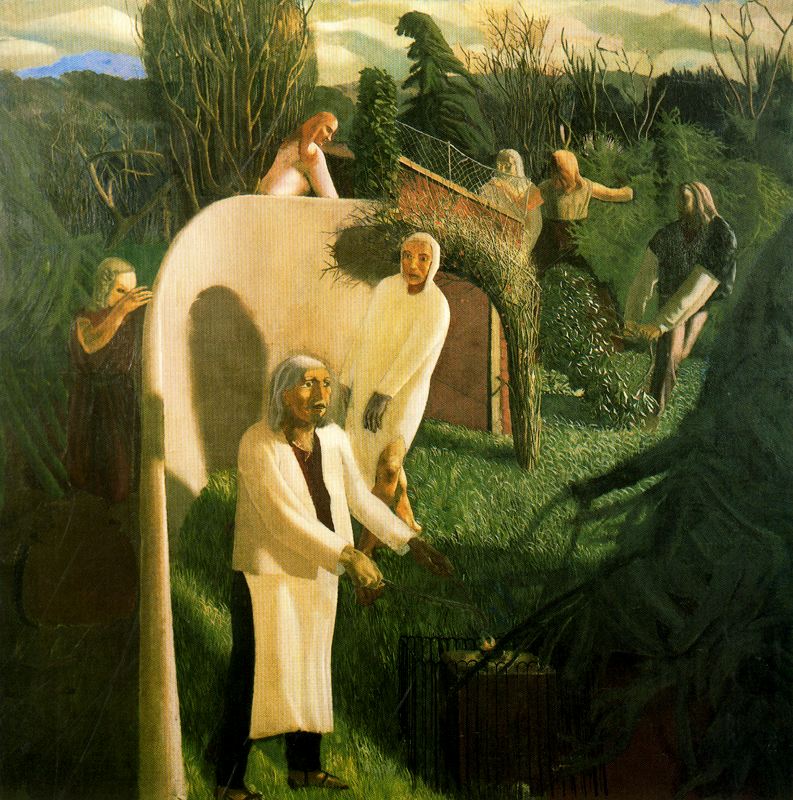
In private conversation he was very gentle, and he quickly won the confidence of small children. Particularly striking was the intensity of his intercessory prayer. When possible, he liked to celebrate the Divine Liturgy daily, and the service often took twice or three times the normal space of time, such was the multitude of those whom he commemorated individually by name. As he prayed for them, they were never mere names on a lengthy list, but always persons. One story that I was told is typical. It was his custom each year to visit Holy Trinity Monastery at Jordanville, N.Y. As he left, after one such visit, a monk gave him a slip of paper with four names of those who were gravely ill. Archbishop John received thousands upon thousands of such requests for prayer in the course of each year. On his return to the monastery some twelve months later, at once he beckoned to the monk, and much to the latter’s surprise, from the depths of his cassock Archbishop John produced the identical slip of paper, now crumpled and tattered. “I have been praying for your friends,” he said, “but two of them”—he pointed to their names—’are now dead and the other two have recovered.” And so indeed it was.
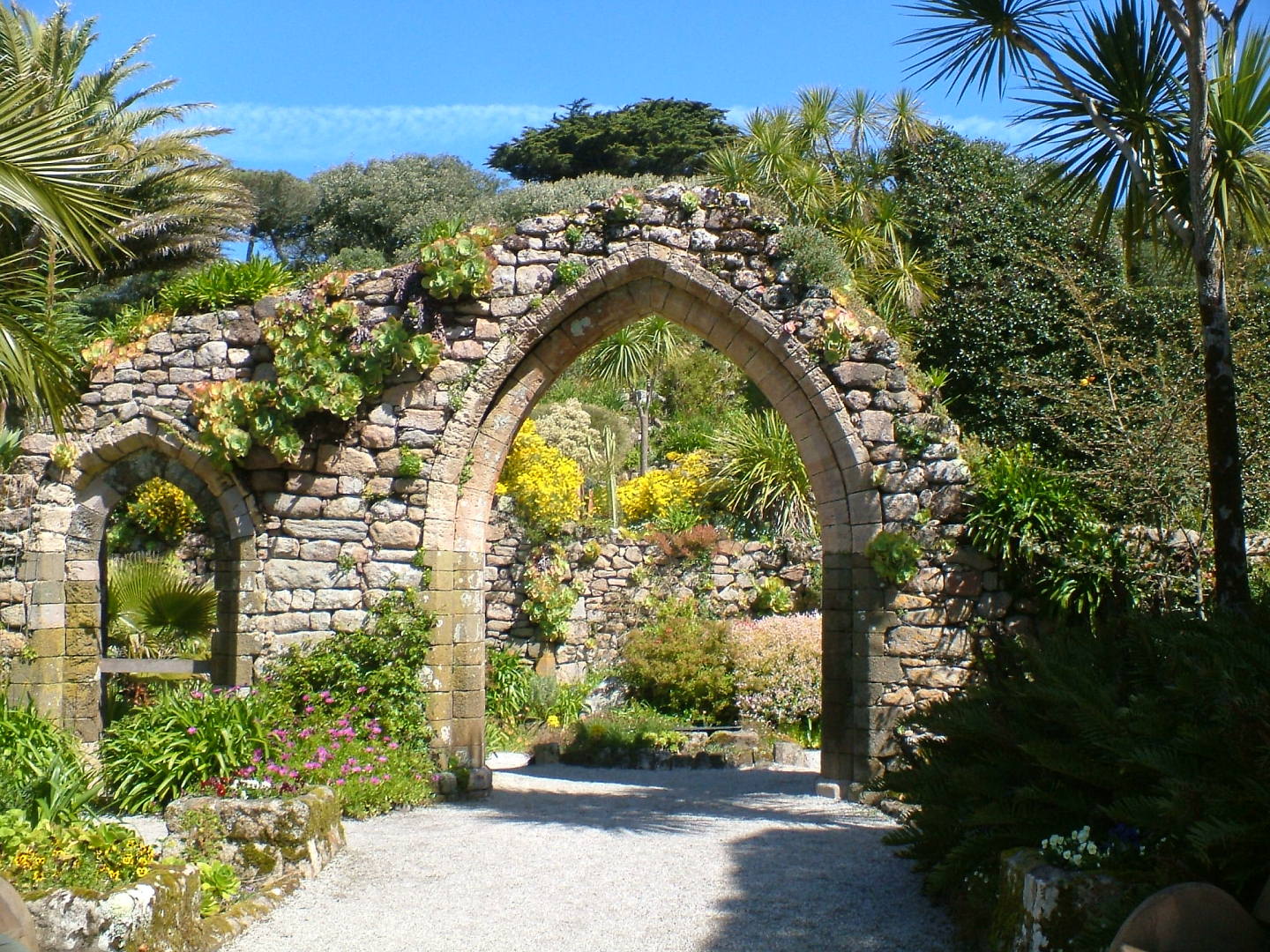
Even at a distance he shared in the concerns of his spiritual children. One of them, superior of a small Orthodox monastery in Holland, was sitting one night in his room, unable to sleep from anxiety over the problems which faced him. About three o’dock in the morning, the telephone rang; it was Archbishop John, speaking from several hundred miles away. He had rung to say that it was time for the monk to go to bed.”

*

Such is the role of the spiritual father. As Varsanuphius expressed it, “I care for you more than you care for yourself.”

*

 Source: Bishop Kallistos Ware, “The Spiritual Father in Orthodox Christianity” at http://orthodoxinfo.com/praxis/spiritualfather.aspx)
* For a non-religious, secular analysis of “anam cara” read Anam Cara and the Essence of True Friendship, by Maria Popova