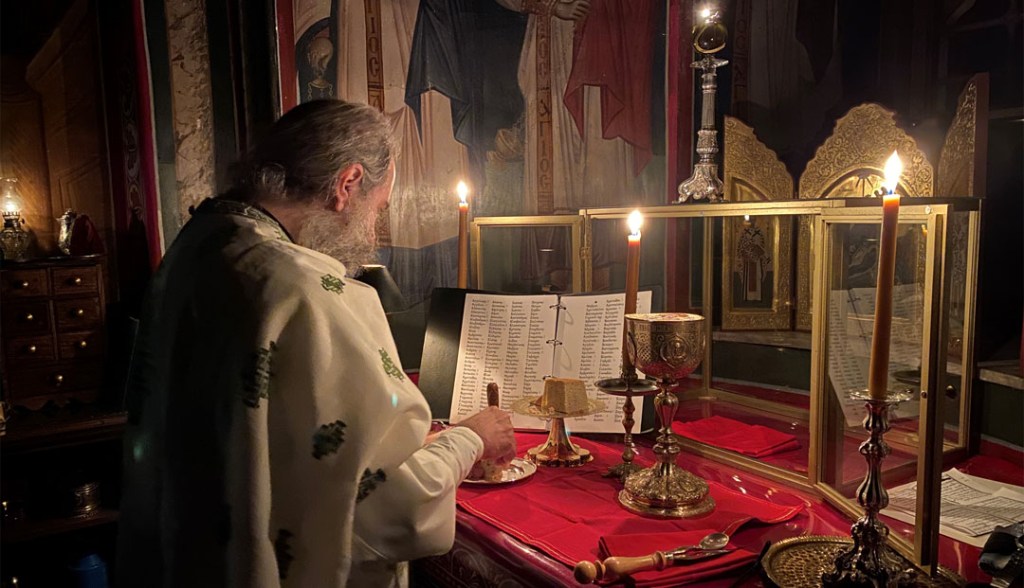
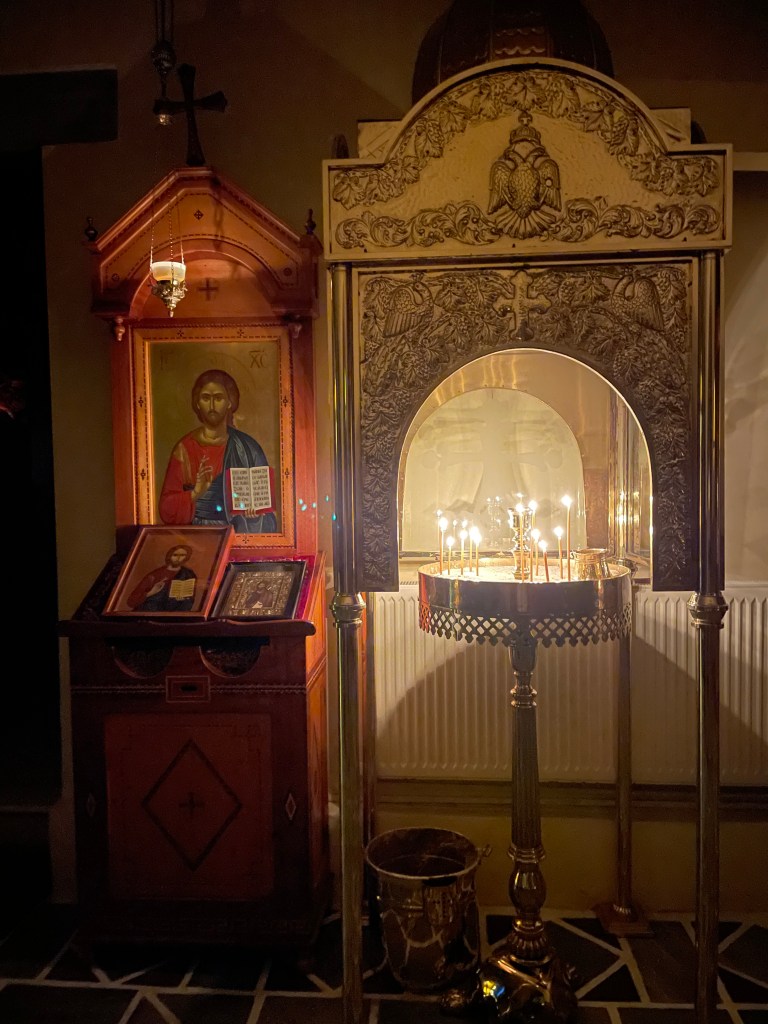
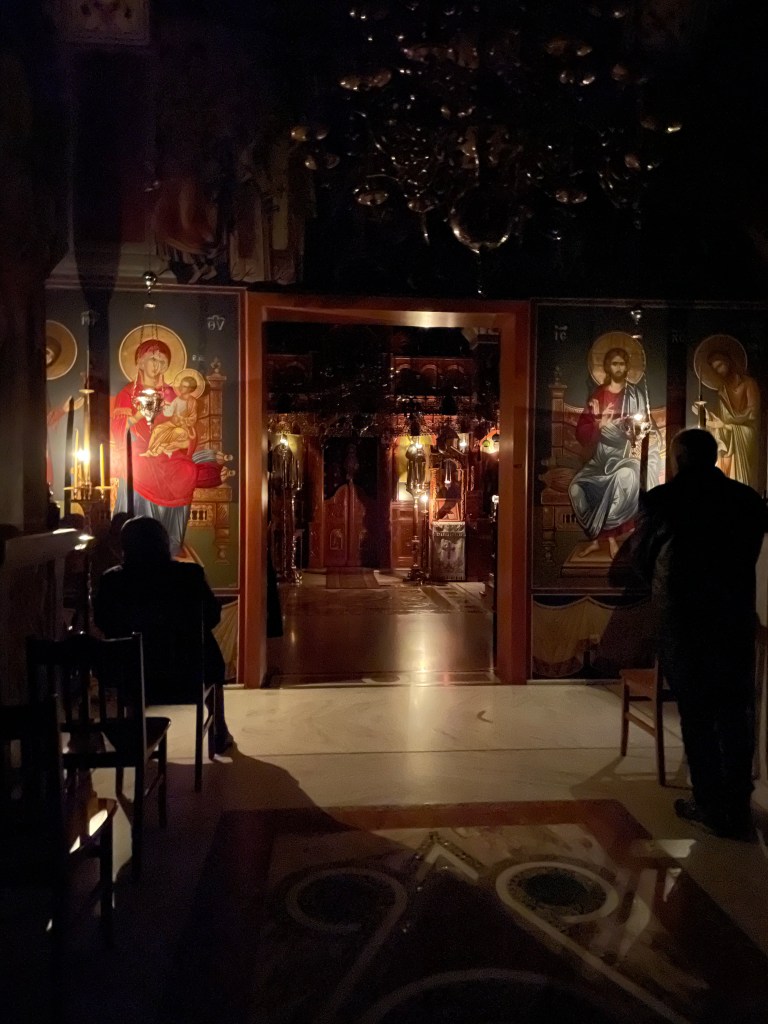
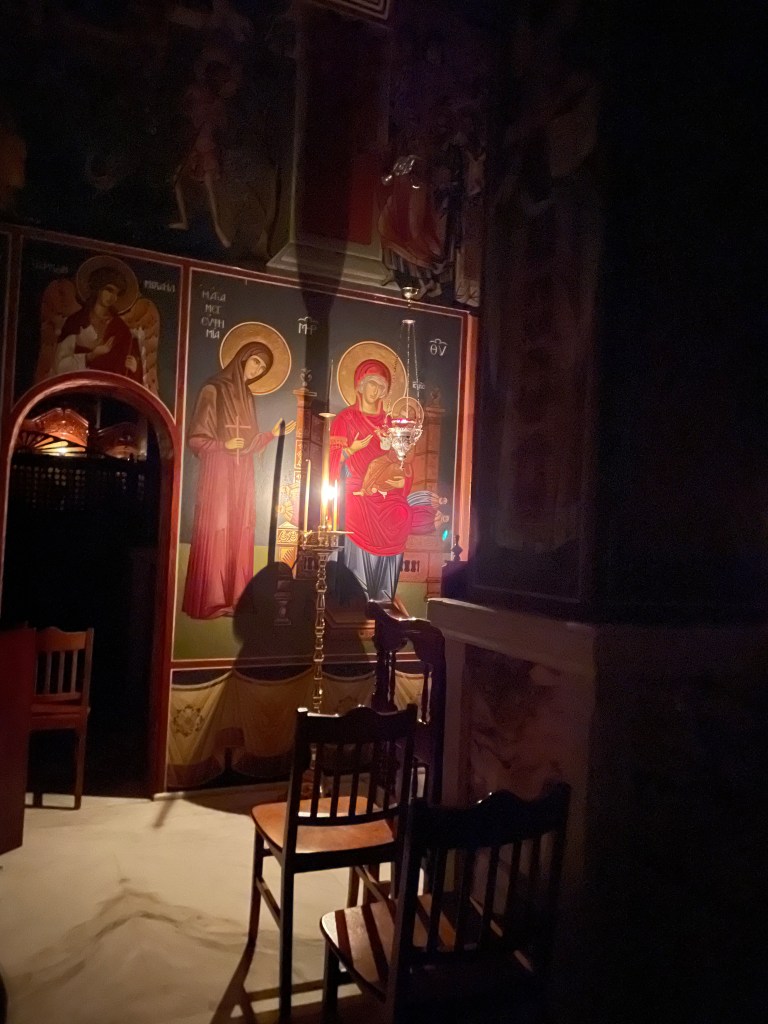
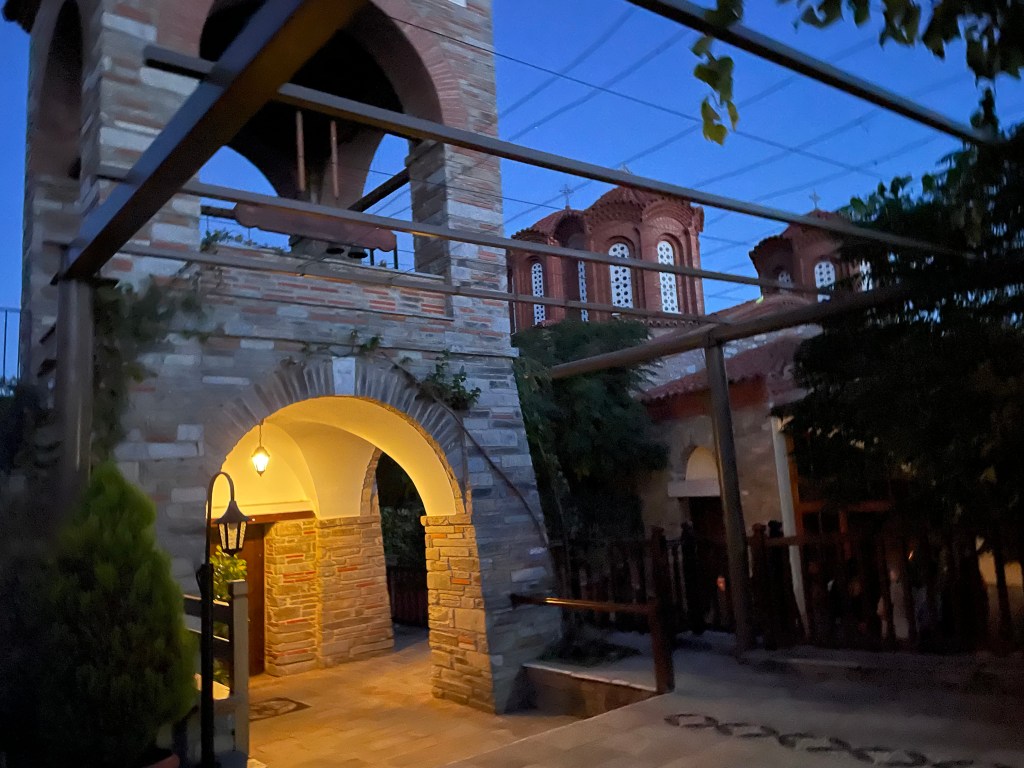
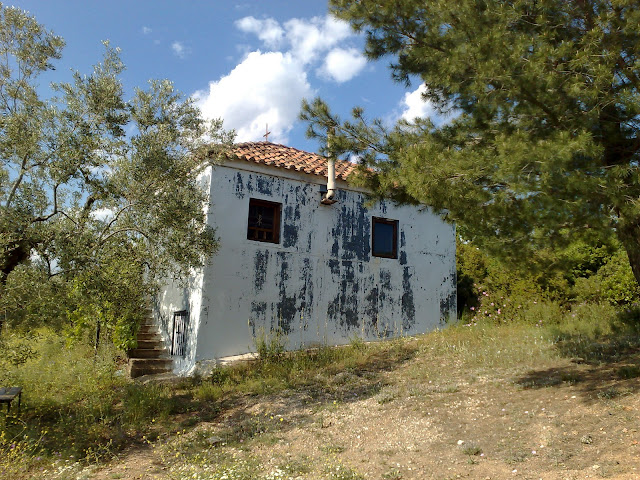
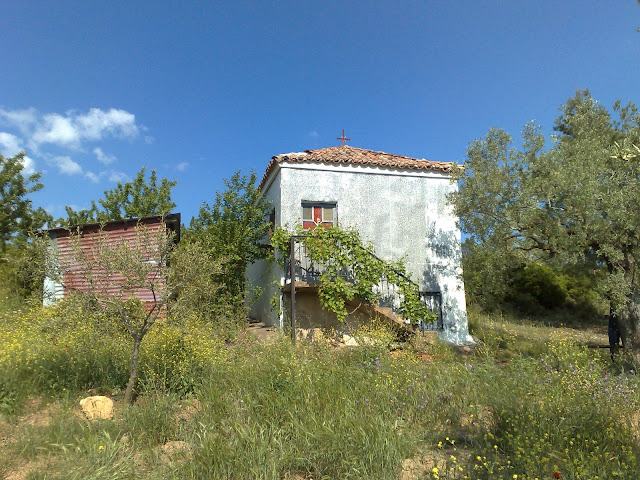
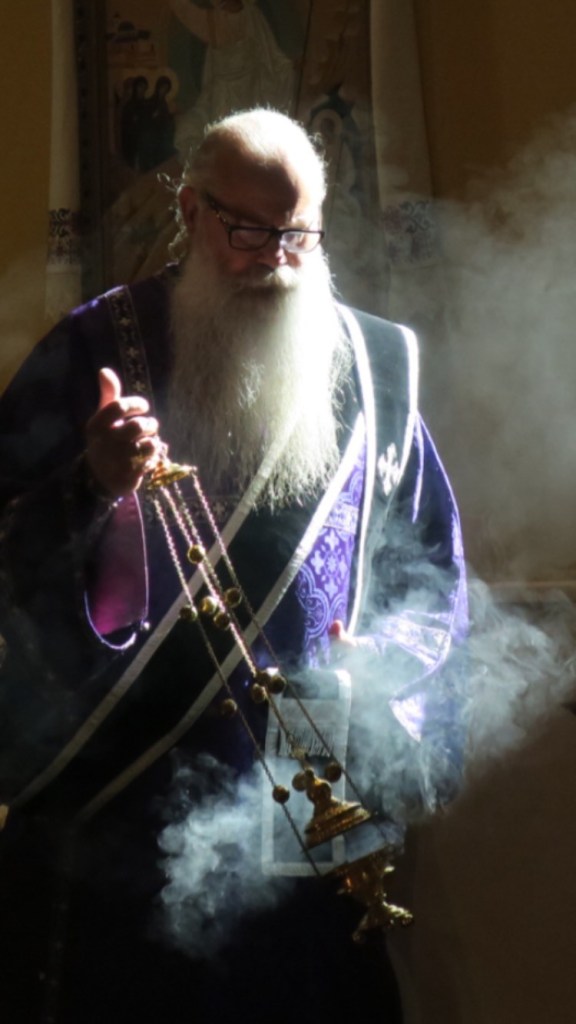
Nowadays, during the Nativity Fast, Thessaloniki has been transformed into a hub of 40 Days Liturgy, and I have been giving names of Living and Departed from all over the world. What is the power of 40 Day Liturgy? This testimony by Metropolitan of Morfou, Neofytos is worthy of heed:
“I told a certain priest, who serves in a community with few residents, to start celebrating the 40 Days Liturgy for the Nativity Fast. And the good priest told me: -But, Your Holiness, our village has few residents, we don’t even have regular chanters, how will I celebrate the 40 Days Liturgy? -Get a woman, I tell him, to say “Kyrie eleison”, “Amen”, “Grant this, O Lord” … This priest actually celebrating 40 Days Liturgy for the Nativity Fast 4 years ago. In the third year, during Christmas, he came moved and told me: “I thank you for having me celebrate 40 Days Liturgy, because you became the occasion for me for the Divine Liturgy to be not simply an “auditory experience”, (he also found chanters), not only for us to read prayers (a reading experience), but it also became a visible one. I saw it with my own eyes! —Lord have mercy, I told him. What did you see? And he said to me: -This morning I mentioned 2,000 names in the Office of Oblation (Proskomide) * When, furing the Divine Liturgy, I exclaimed “Especially for our most holy, pure, blessed, and glorious Lady, the Theotokos and ever-virgin Mary”, and the chanter outisde began to sing “It is truly meet to bless you, O Theotokos, ever-blessed and most pure, and the Mother of our God. More honorable than the Cherubim, and more glorious beyond compare than the Seraphim, without defilement you gave birth to God the Word. True Theotokos we magnify you!”, the altar, which you know is very small, began to open up, until it became a huge stadium steps. On it I saw standing all those whom I had mentioned in the Prothesis. There were also people whom I had buried in recent years, but also people from other villages, whom I knew and have in my diptychs. Indeed, I also saw the mood of each one. Sometimes I saw someone bright, sometimes sad, sometimes black, sometimes gray. There was also this one, who had died of cancer at a very young age a few years ago, and he shone so much that he spread light to those around him. Addressing all those I saw, I said to them in a low voice so that the chanter outside would not hear: -What do you want? And they all bowed slightly and said to me: -We thank you, Father, and they left.
This is the power of the 40 Days Liturgy!
* The Office of Oblation (Proskomide) has been a service of offering gifts to God in preparation for the Sacrament of Holy Eucharist or Holy Communion in the Divine Liturgy. The Office of Oblation is thus a prerequisite for the Divine Liturgy. Today, the priest conducts the Office of Oblation inaudibly during Matins behind the Altar Iconostasis (Icon Screen).
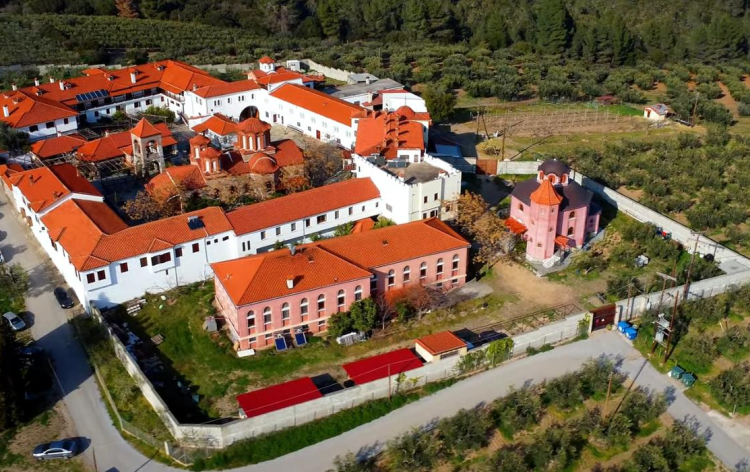
Christ is in our midst. Please forgive my absence of nearly a month, but this was a time of intensive reflection after my first ’round’ of pilgrimages to monasteries so that we could decide what to do and where to go next. By the way, this month I also visited another monastery, which was so hesychastic and hidden that I did not have the blessing to share with you anything, be it photographs or discussions with the monastics there!
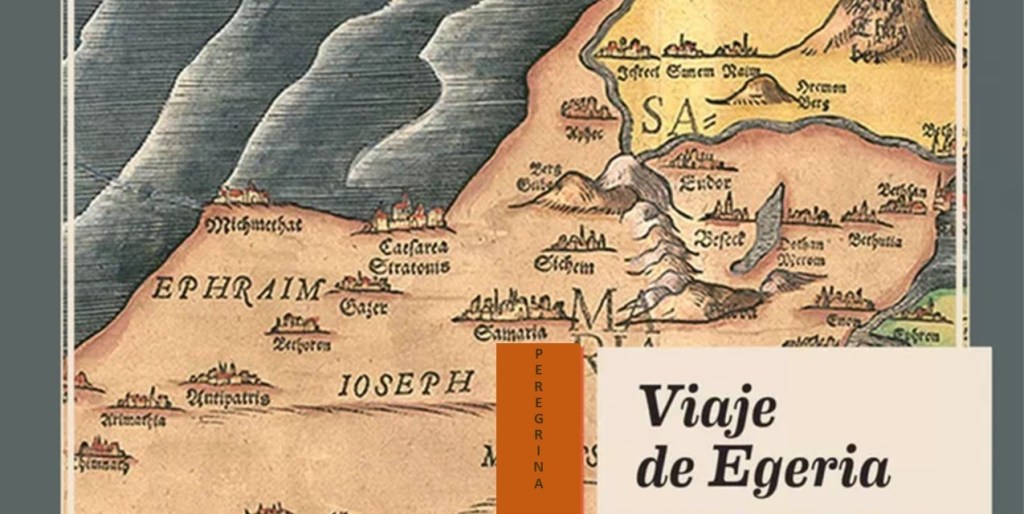
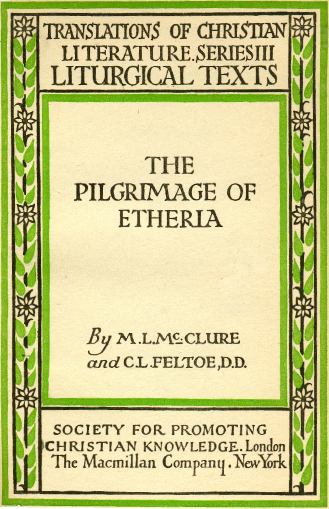
During these quiet weeks of reflection, hesychia and quiet, friends introduced me to the Travels of Egeria, alias Pilgrimage of Aetheria or Pilgrimage to the Holy Lands(Peregrinatio or Itinerarium Egeriae), the earliest extant graphic account of a Christian pilgrimage to the Holy Land about 381/2–384, from Mount Sinai to Constantinople.
Who is this Egeria, this Christian woman who took a journey lasting four years to the Middle East in the middle of the fourth century c.e. and wrote a journal of her travels?
Her manuscript lay dormant until the late 1800s. Other Latin writers made mention of her, so her accounts circulated among religious pilgrims before they were lost for centuries. Her name was Egeria (also known as Eutheria, Aetheria, and Silvia), and she was writing for other religious women who lived in Europe, perhaps on the Atlantic coast of Spain or France.
Most likely she was a nun commissioned by her community to put her curious and adventurous mind to work for the benefit of the spiritual life of her sisters. She went on pilgrimage to the most important sites of the Christian and Jewish world of her day.
Her account is one of the most valuable documents scholars have of the fourth-century world of travel, piety, early monasticism, women’s roles, and even the development of late Latin.
Her book has two parts. The first part is a travelogue and is simply her report of her pilgrimage. She tells her sisters of her visits to such hallowed and historical places as Jerusalem, Edessa, sites in Mesopotamia, Mount Sinai, Jericho, the Jordan River, Antioch, and Constantinople, and of meeting people (usually monks and mystics) serving the places.
She follows the itinerary of the people who made the places famous and prays there. Often her comments about the rustics at the sacred sites show a bit of dry humour.
Her tourist program has many other objectives, such as following the path of Moses through the desert to Mt. Sinai, her plan to visit the home of Abraham’s family (Carrhae or biblical Harran, southeast of Edessa), and her hope to go to Thomas the Apostle’s tomb in Edessa.
The travelogue is incomplete, for like any good pilgrim she concocted ever more schemes to visit other places like Ephesus to pray at the tomb of the John the “Beloved” Apostle. This part of her travels is missing from the manuscript.
The second part is more a journalistic report on the church of Jerusalem’s liturgical practices over the three years she lodged there. Her record of the practices surrounding daily life and prayer of the church is the first one that scholars have on the topic.
She also reports on how the church’s celebrations correspond to its unique location in the Holy Land. The liturgies she describes are hardly stationary ceremonies in one church location, but they involve processions from place to place according to the occasion. In addition, her descriptions are useful for historians of church architecture.
Her account allows modern readers to see things like the need for military escorts in various places of the Holy Land, the unfailing hospitality of the monasteries along the way, the road network, and the system of inns maintained by the empire.
She speaks of the monks, the nuns, and the religious laity in the Holy Land and their patterns of fasting and the instruction of the candidates for entrance into the church. Finally, she epitomises the heart of the pilgrim and shows pluck and pithiness as she describes each stage of her spiritual journey. Having done part of this pilgrimage myself, even the ascent of Sinai, I have to say how impressed I am by her fearlessness and stamina !
THE ASCENT OF SINAI
We reached the mountain late on the sabbath, and arriving at a certain monastery, the monks who dwelt there received us very kindly, showing us every kindness; there is also a church and a priest there. We stayed there that night, and early on the Lord’s Day, together with the priest and the monks who dwelt there, we began the ascent of the mountains one by one. These mountains are ascended with infinite toil, for you cannot go up gently by a spiraltrack, as we say snail-shell wise, but you climb straight up the whole way, as if up a wall, and you must come straight down each mountain until you reach the very foot of the middle one, which is specially called Sinai. By this way, then, at the bidding of Christ our God, and helped by the prayers of the holy men who accompanied us, we arrived at the fourth hour, at the summit of Sinai, the holy mountain of God, where the law was given, that is, at the place where the Glory of the Lord descended on the day when the mountain smoked.1 Thus the toil was great, for I had to go up on foot, the ascent being impossible in the saddle, and yet I did not feel the toil, on the side of the ascent, I say, the toil, because I realised that the desire which I had was being fulfilled at God’s bidding. In that place there is now a church, not great in size, for the place itself, that is the summit of the mountain, is not very great; nevertheless, the church itself is great in grace. When, therefore, at God’s bidding, we had arrived at the summit, and had reached the door of the church, lo, the priest who was appointed to the church came from his cell and met us, a hale old man, a monk from early life, and an ascetic as they say here, in short one worthy to be in that place; the other priests also met us, together with all the monks who dwelt on the mountain, that is, not hindered by age or infirmity. No one, however, dwells on the very summit of the central mountain; there is nothing there excepting only the church and the cave where holy Moses was.2 When the whole
1 Exod. xix. 18. 2 Exod. xxxiii. 22.
passage from the book of Moses had been read in that place, and when the oblation had been duly made, at which we communicated, and as we were coming out of the church, the priests of the place gave us eulogiae,1 that is, of fruits which grow on the mountain. … I began to ask them to show us the several sites. Thereupon the holy men immediately deigned to show us the various places. They showed us the cave where holy Moses was when he had gone up again into the mount of God,2 that he might receive the second tables after he had broken the former ones when the people sinned; they also deigned to show us the other sites which we desired to see, and those which they themselves well knew.
1 This word is still used in the Eastern Church for food which has been blessed by a priest, e. g. the first fruits from an orchard or a vineyard. 2 Exod. xxxiv. 4.
… From the summit of the central mountain, those mountains, which we could scarcely climb at first …From thence we saw Egypt and Palestine, and the Red Sea and the Parthenian Sea,1 which leads to Alexandria and the boundless territories of the Saracens, all so much below us as to be scarcely credible, but the holy men pointed out each one of them to us.”
This is a highly readable, exciting book, available as a full Audio Book, read by David Wales, and available online, which I strongly recommend you to have a look at, if you haven’t already.
Or, my last day at Metamorfosi monastery of Saint John the Forerunner and how Gerondas Gregorios and Mother Akylina defeated the demons’ assaults and saved my father from eternal death.
The night before my departure, I had the blessing to speak to Mother Akylina. (So far all my momentous meetings at the monasteries have mysteriously taken place the last few hours before my departure…) Mother Akylina is a very old and frail sister in her nineties, bent in two, with a very sharp, illumined nous, and with beautiful, wide azure eyes staring into eternity. Until last summer, Mother Akylina was probably the first person pilgrims met upon entering the monastery, near its book store, but recently this sister has completely “disappeared” in hesychia and is now rarely seen anywhere. Yet God in His Mercy granted an exception to me.
“The just shall flourish like the palm tree, shall grow like a cedar of Lebanon. Planted in the house of the Lord, they shall flourish in the courts of our God. They shall bear fruit even in old age, always vigorous and sturdy, As they proclaim: “The Lord is just; our rock, in whom there is no wrong.” (Psalm 92:13-16)
I always smile when I think of Mother Akylina because although she is old and bent double, she is “always vigorous and sturdy“, moves like a firefly, and her knowledge and eagerness to help sweeps you up in her enthusiasm.Indeed, she “bears fruit even in old age”.
I always listen to Mother Akylina. I feel most indebted to her because she saved my father from eternal death. Together with Gerondas Gregorios of blessed memory. It was their discernment, leading to insight, and ultimately to foresight, which wrought that amazing miracle at the end of my father’s life. Oh, what a profoundly moving experience I experienced with their prayers! Let me try to put it into words, if I can.
My father was a very good person and a conscientious doctor who honoured his calling, offered wise counselling about diet and exercise to everybody, cared deeply for his patients and helped them as much as he could. I always smile when I remember his words to his patients and us, to be sure, familyand friends: “No, you do not need any medication. You should just lose weight, exercise regularly, and your test results will improve”. Or: “No, you do not need any make-up; eat lots of fruits and veggies, and their nutrient antioxidants, vitaminsand minerals will help you get glowing skin”. Or: “Feeling stressed? Having difficulty to sleep at night? No need for any medication. Just run or walk briskly for at least one hour every day, take a cold shower at the end of your training, and then come and tell me if you still feel stressed. And if this ‘dosage’ fails, repeat as often as you can, as many times in the day! ” Or: “Never take a serious decision at night! Rest, get some sound sleep, thinkabout it clearlyand calmly, and then make up your mind in the cold light of day”. And so on and so forth …
But it was not just his words and the example he set, being himself an athlete and a tennis champion. My father, God rest his soul, also had integrity, courage, resilience, cheerfulness, empathy, respect, compassion and kindness towards everybody. Each and everyone loved my father and wanted to be near him. His only difficulty was … to believe in afterlife. After retirement, he started diligently to study the Holy Bible, day after day, the whole Old and New Testament, intrigued by my life choices, underlying the passages which made the greatest impression of him. I have kept his study Bible and am still impressed by how much he had read. Years went by like this, but my father never quite made up his mind to participate in any church sacraments, especially confession to a priest.
Then, towards the end of his life, he became a patient himself who needed doctors, as he started having some horrible nightmares of ghastly dark figures chasing and attacking him. Every night, he would fall from his bed and end up on the floor ‘beaten’, injured and shivering. All his friend doctors considered these symptoms side-effects of the medication he was taking, but they could not help him, free him from that torture, night after night.
“We can ignore even pleasure. But pain insists upon being attended to. God whispers to us in our pleasures, speaks in our conscience, but shouts in our pains: it is his megaphone to rouse a deaf world.”― C.S. Lewis, The Problem of Pain
Once, back in those days, I went to St. John the Forerunner monastery and met sister Akylina as usual at the bookstore, and she asked me about our family news. When she heard this update from my father, she looked very concerned, sharply told me to “wait here” and disappeared in a haste to meet Gerondas Gregorios. At that time, Gerondas was in absolute silent seclusion, but she was one of the very few sisters who had the blessing to “interrupt” his hesychia at her discretion.
A few minutes later, she came back in a hurry and told me Gerondas’ message to my father: “Ioanni, if you do not confess to a priest, these dark figures that chase you in your nightmares, they will chase you in reality after you die, because they are demons”.
–“But Mother, how can I say such things to my father? I do not dare. He will dismiss them. He is a doctor, he has witnessed lots of deaths at his long medical career in hospitals, he does not believe in the possibility of life after death”.
–“We insist. You should say Gerondas’ message to your father. We will all pray”.
And so, a few days later, I summoned all my courage and told my father Gerondas’ words. To my surprise, he did not dismiss them but looked at me very seriously in the eyes. He told me he needed time to reflect about all this. I am sure that this martyrdom must have been a most humbling experience for my father, who had survived all life’s odds, war, poverty, even losing his father as a young child and having to support his brethren and his young, widow mother, yet was now helpless. What a humbling experience for someone so strong to feel so powerless and helpless! We all started praying and waited … God must have been shouting in my father’s nightmares: it was indeed his megaphone to rouse his skeptic child. “Then he said to Thomas, “Put your finger here; see my hands. Reach out your hand and put it into my side. Stop doubting and believe.” (John 20:27) Another megaphone was certainly + Gerondas Gregorios’ stern warning to him.
A few months passed by, and one day, my father called me and asked me to arrange for a priest to come to hear his Confession! (By that time he could not move outside the house). As you may very well guess, I promptly arranged this with our parish priest. By God’s Providence, I was also present at his Confession. My father was a simple man and wanted to make his confession in front of us (ie. my mother and I), and eventually the priest, after hearing his Confession, covered the heads of all three of us with his epitrachelion and read the absolution prayer to us all.
From that night on, after his Confession and Holy Communion, my father’s nightmares disappeared at once and his martyrdom came to an end. He radiated peace and joy! Very soon, his health sharply declined. But there was no pain, agony or anguish in any of this. Only peace and joy! In a matter of a few weeks, my father slept peacefully in the Lord, who patiently extended the life of His child just as much as needed to save him. Glory to God! Christ is Risen!
Mother Akylina’s prayers are so powerful and targeted! So are her insights. You probably understand now why I pay such close attention to every single word she is telling me. So, I did yesterday, and I paid even more attention now because she looked “bodiless”— as if her departure to Heavens was imminent. Please forgive me for not being able to share her words since they are all about most private matters.But I can share this. It is about somebody who had just started going to Church, Confession etc and he kept telling me how his life had become so much harder since. Her words were that all this is from the Evil one to discourage him and he should not pay any attention to his suggestions. It will become harder because of the spiritual battle, but he should keep his soul in hell and despair not. And when I told her, that I cannot say anything to this person about anything really, she told me “then, pray!” Also, about a very difficult situation, a Cross, her words were: “As the Lord provides. May it be blessed. Therefore, keep silence and pray!“
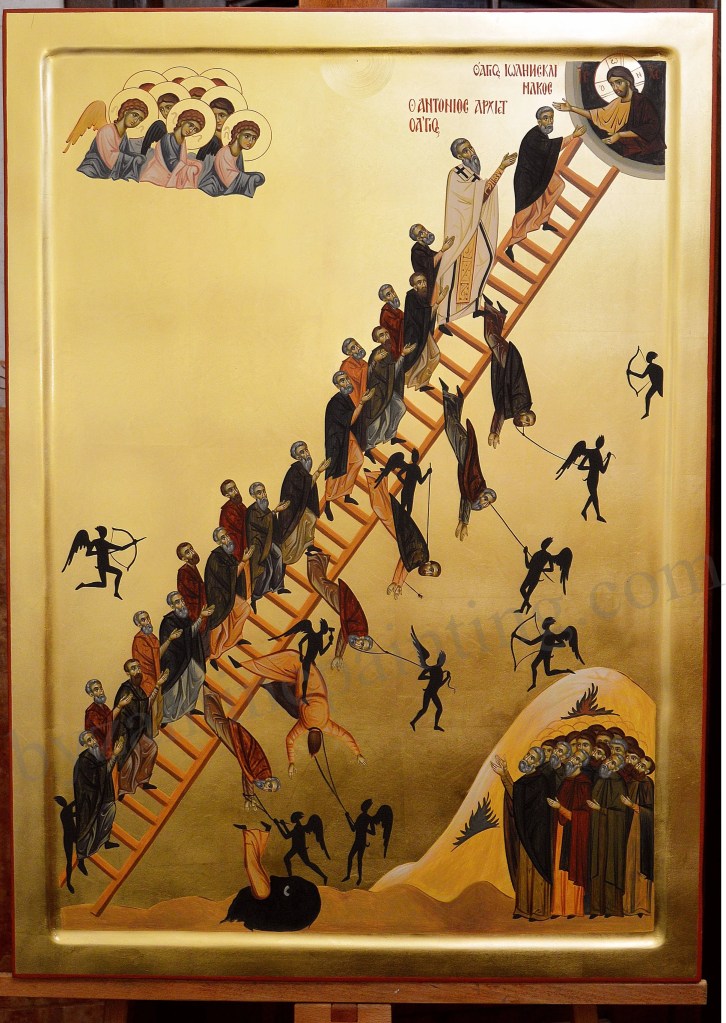
St. John Climacus, The Ladder of Divine Ascent
“Discernment in beginners is true knowledge of themselves; in intermediate souls it is a spiritual sense that faultlessly distinguishes what is truly good from what is of nature and opposed to it; and in the perfect it is the knowledge which they possess by divine illumination, and which can enlighten with its lamp what is dark in other. Or perhaps, generally speaking, discernment is, and is recognised as, the assured understanding of the divine will on all occasions, in every place and in all matter; and it is only found in those who are pure in heart, and in body, and in mouth.
The body is enlightened by its two corporeal eyes; but in visible and spiritual discernment the eyes of the heart are illumined”.
St. John of Kronstadt, My Life in Christ
“The heart is the eye of the human being. The purer it is. the quicker, farther, and clesarer it can see.”
About vigils, the Feast of the Theotokos’ Sacred Veil (Skepi) and Her Holy Protection, the power of the Psalter and the monastery’s chicken coop!
“By Fasting, Vigil and Prayer Thou didst Obtain Heavenly Gifts” (Fourth Great Lent Sunday- St. John of the Ladder , Troparion, tone 1)
Not for the faint-hearted! A most ascetic monastery, I must admit. I, for one thing, thought that I had no problem with fasting, and yet here, I realise that I am such a dainty eater! I have had enough of their plain bread, watery, fasting soups and fruit!
As to vigils, rising at ungodly [sic!] hours to chant Psalms, after two consecutive vigils, one at St Demetrios’ Feast in Thessaloniki and the other one here, at the monastery, for the Sunday Holy Liturgy, I believe that I have reached my limit. If I had any doubts (which I did not have) now I feel confident that I am not yet ready for this second step in this ladder, for this “violence” on our flesh. Not to mention the third ring, prayer …
“By Fasting, Vigil and Prayer Thou didst Obtain Heavenly Gifts”
“And from the days of John the Baptist until now the kingdom of heaven suffereth violence, and the violent take it by force.” Matthew 11:12
Oh dear! A most ascetic long weekend. I have been so food deprived, so heat deprived, and so sleep deprived—the worst part— that I cannot put it to words. I certainly need time and rest to recover from all this ascetic labour. I do feel blessed and most grateful, I am floating, but this monastery’s specifications are for angels, fleshless, holy beings. The sisters are of course lenient with us poor guests, yet even the “compromise” they bless for us is so hard for my spiritual level!I cannot even begin to imagine how it is to spend Great Lent here, with only meal a day, and what a meal …
One can”feel” their asceticism even in their etherial chanting. Indeed, an ascetic hue to the spectrum of light explored so far on my way of a pilgrim. And so “hidden”! Adding a wholly empirical dimension to the verse “our lives being hidden in Christ!” So very different to my previous two pilgrimages to Dormition monastery in Panorama and St George Karslides monastery in Sipsa. Such a humbling experience! Probably because of all this most demanding typikon, this monastery has the least pilgrims or faithful attending, even when its gates are open. As to the sisters, they humbly believe that they they are useless, lukewarm, “end of times” monastics, not honouring their calling.
Matushka Constantina is so right when she writes at her blog (Lessons from a Monastery): “Encountering monastics reminds the pilgrim that there are better Christians than himself (not that he cannot also learn this in the parish, he most certainly can, but it is an indisputable fact that one is faced with at a monastery). Hence the famous statement: “Angels are a light for monastics, and monastics are a light for the world.”[9] The monastic is simultaneously humbled and enlightened by reading the lives of the saints, just as the layman is when he compares his life with that of a monastic. … the layman makes pilgrimages to monasteries in order to draw the soul away from the distracting world and into an environment of stillness and prayer, where the atmosphere is conducive to taking stock of one’s life alongside that of a dedicated monastic, and to allow the grace of the monastery to help him see his own sinfulness.”
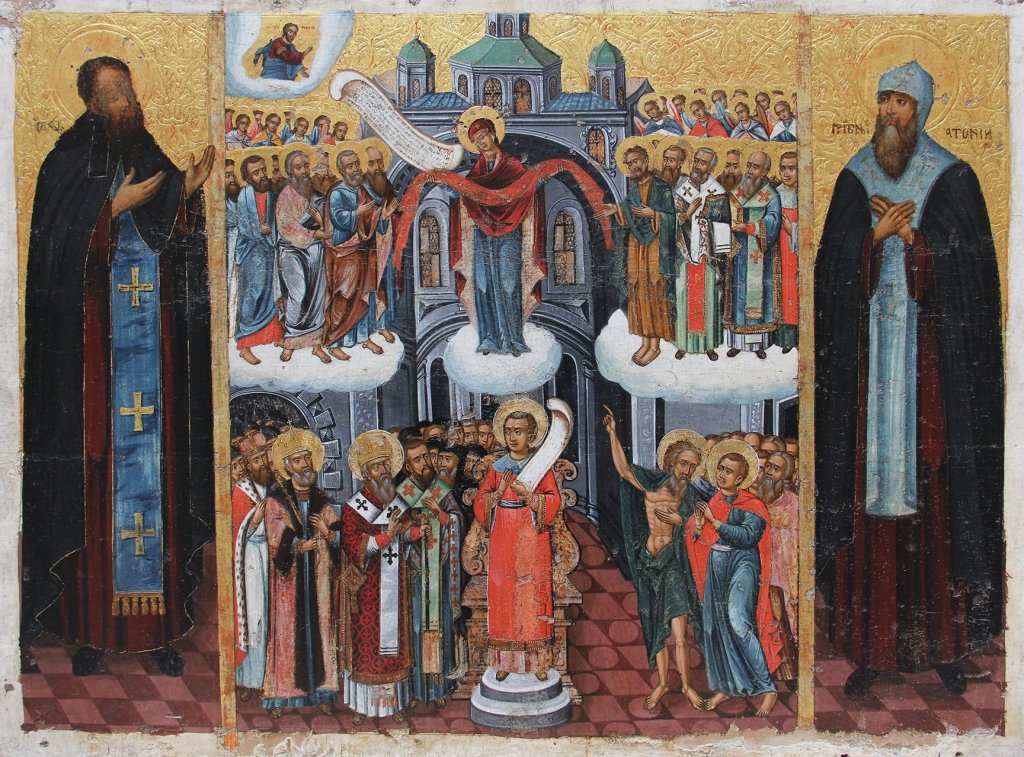
Economia is granted to me and I arrive late at the morning church service. I don’t think I could take one third consecutive vigil in a row. Today, on October 28, the Holy Orthodox Church in Greece commemorates the Holy Protection of our Most Holy Lady, the Theotokos and Ever-virgin Mary, that is, her sacred veil (skepi) kept in the treasury of the sacred temple of Blachernae; and we also remember how the righteous Andrew, the Fool for Christ’s sake, beheld it spread out above and covering all the pious.
The Feast was originally marked on October 1st, yet the Greek Orthodox church, in 1952, transferred its celebration of the Protection to October 28 in conjunction with “Okhi Day” as a testament to the rejection of European aggression and as a day of national remembrance.
Before daybreak on October 28, 1940, the Italian ambassador to Greece, representing Italian dictator Benito Mussolini, went to Greek general Ioannis Metaxas with an ultimatum. Italy wanted full control of Greece to occupy “strategic locations”; otherwise it would brutalise the country.General Metaxas shouted “Okhi!” meaning “No!” Thus, Greece was plunged into the Second World War, as Italy burst through, and then Nazi Germany eventually, wreaking havoc and horrors on the Greek people.
Both dates recognise the Ever-virgin’s constant defence for all the faithful, all over theworld, whenever we prayerfully seek her protection and shelter in distress and strife. It goes without saying that we must ask the Theotokos to extend her protection and intercession every day of our life.
A holy, sacred place, an agios topos
St Paisios, the spiritual founder and father of this monastery, +Gerondas Gregorios, St Paisios spiritual child, founder and spiritual father of the monastery, and +Gerondissa Euphemia
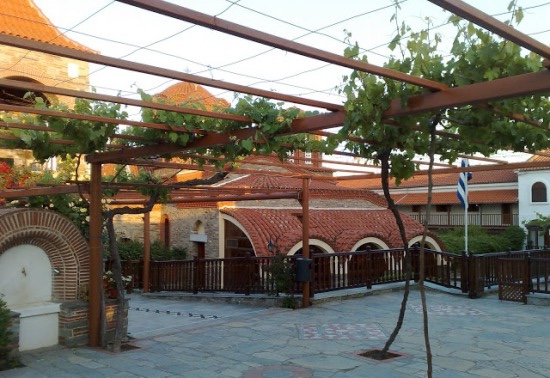
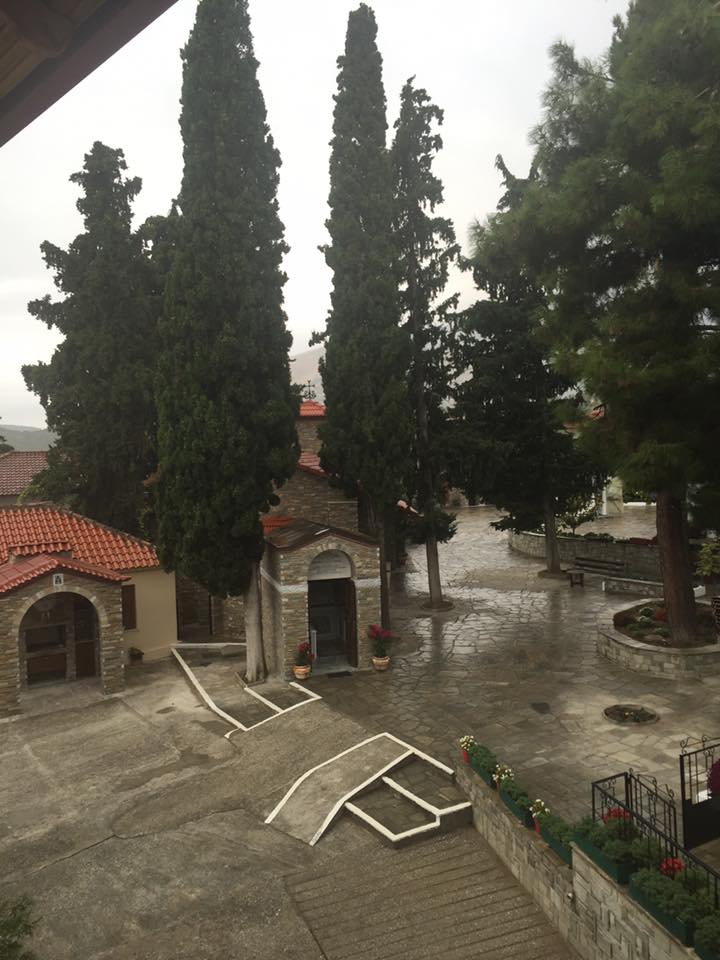
Everything is holy in the grounds of a monastery. It is an agios topos, a holy, sacred place. The prayers of the monastics, the saints that dwell within, the angels that protect it, its chapels and the temple of God in its grounds, all these sanctify the place. “And Moses said, I will go near and see this great sight, why the bush is not consumed. And when the Lord saw that he drew nigh to see, the Lord called him out of the bush, saying, Moses, Moses… loose thy sandals from off thy feet for the place whereon thou standest is holy ground” (Exodus 3: 3-5). All monasteries I have visited so far feel holy, sacred places, yet this monastery seems the most etherial, otherworldly of all.This holiness permeates all its grounds.
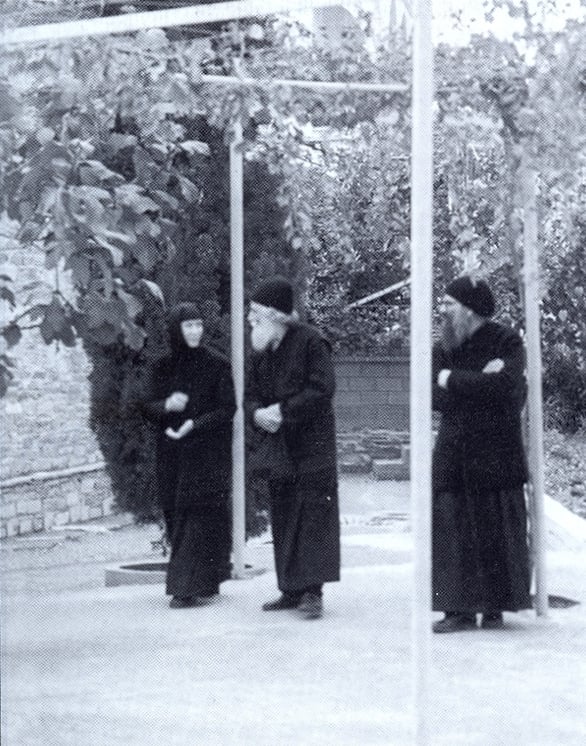
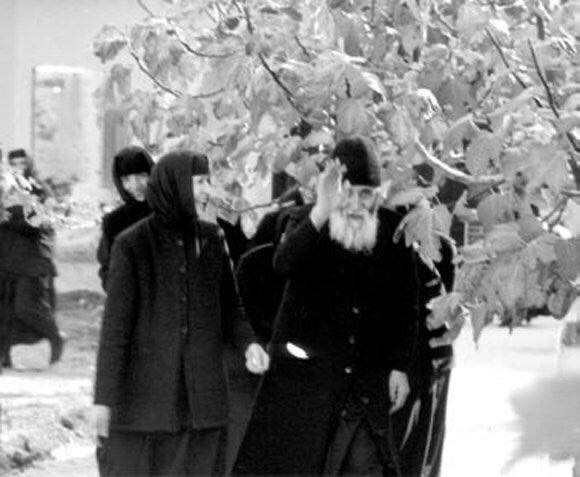
St Paisios, + Gerondissa Euphemia and Sister Paisia, looking at the camera behind Gerondissa. I had the privilege to spend quite some time during my stay here with Sister Paisia.
11 For He will give His angels charge over you, to guard you in all your ways. 12 Upon their hands they will lift you up, lest you strike your foot against a stone. 13 You will tread upon the lion and cobra, trample the young lion and serpent. (Psalm 91:11-13)
Let me share with you a story which a sister here told me about the power of the Psalter, transfusing holiness …
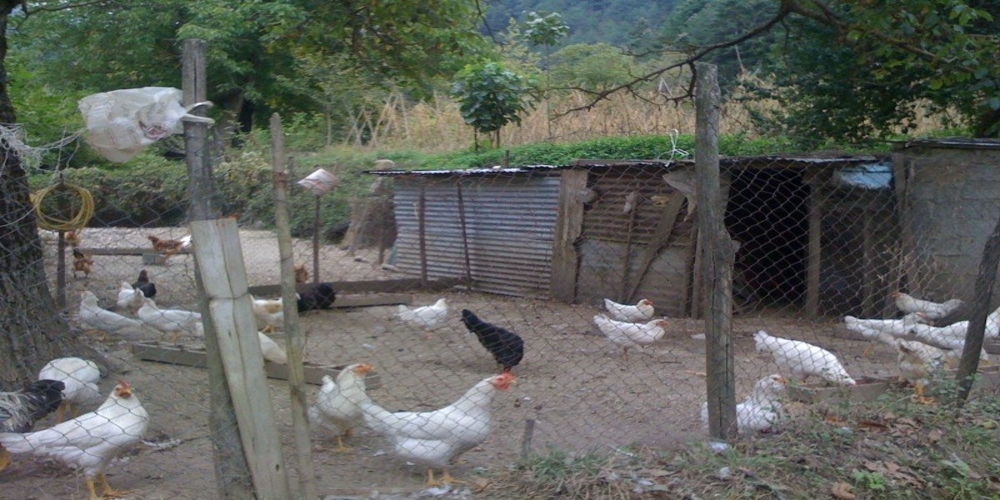
… even to their chicken coop!
This is what the monastery’s chicken coop looks like. You can tell that it is unprotected from the top and sadly the sisters had many problems with hawks attacking and snatching their chickens. The sisters would take turns, one after another, every hour, to protect their chickens, to no avail really, until Sister T. appeared, a frail, old sister …
This sister hada particular affection for the Psalter. Rather than recite the kathismata in her cell, she got the blessing from Gerondissa to sit on her chair inside the chicken coup grounds and recite the psalter there, together with the chickens. She kept doing this every day, for two years before reposing in the Lord.
These two years, all hawk attacks suddenly ceased! Not only this, but even after her sleep in the Lord, for 16 years counting until now, no hawk has attempted a single attack on the chicken! Amazing! For 16 years going! So, the sisters have stopped guarding the chicken coop and chasing predators away. The sister who told me this story, added that Gerondas Gregorios of blessed memory, after this sister’s sleep in the Lord, wondered how long her psalter protection will last. Well, it lasted 16 years and going! This frail, old sister with the particular affection for the Psalter died a holy death on an Easter night, after receiving Holy Communion at the Pascal holy Liturgy. Glory to God for all things!
Sadly, the time for my departure has arrived, but I am not leaving alone. I have to drive two university students first to the church of St. Demetrios, and then one of them to the airport for Cyprus. Glory to God for all things! What an amazing synodeia! The family of one of these two students I am offering this drive has 10 children (!), her father is a priest and a teacher, and their mother comes from a family of … 13 children! They have all moved from Athens to Metamorfosi and build their house here to live next to the monastery, together with all their nephews, children and grandchildren.
How many stories have I heard on the way!What a joy and a privilege to be together with these young people! How fast time flies! A few decades ago, other pilgrims drove me back to Thessaloniki, to spare me the buses, the walking and the long hours of waiting. Now it is my turn to return the favour. Glory to God for all things!
Somereflections on “hiding” and “hiddeness” in God, on holy obedience, on the force of the preposition ‘in’, and lovely, amplifying words by George Herbert, my favourite metaphysical poet(1593 – 1633), in his poem‘Colossians 3:3’
Eothinon VII
Mode grave
“Ἰδοὺ σκοτία καὶ πρωΐ… Lo, darkness and early dawn. And why, Mary, are you standing by the grave, your mind full of darkness? Why do you seek where Jesus has been laid? But see the disciples running together, see how they have realised the Resurrection from the grave clothes and the napkin, and have remembered the Scripture concerning this. With whom and through whom we too have believed and sing your praise O Christ, the Giver of Life.”
*
“For you have died, and your life has been hidden with Christ in God.” (Col 3:3)
*
It is probably my first ever Sunday Holy Liturgy at about 02:00!! Other than Easter Sunday of course. Only “one worth comes to mind with the chanting,…ethereal! I meant word but indeed it is worth in the true sense of a noun … the level at which someone or something deserves to be valued or rated.”
I feel surrounded by angels, not monastics. These sisters never sleep! They pray all the time and they are hidden from the world.
I kneel to receive the blessing of Gerondissa Mariam before Holy Communion and she tells me that she has read my note and gives me her blessing to come as often as I want, unconditionally… What a gift!Such undeserved mercy and graciousness!
Inside the church, other than the sisters and the priest, it is only the five of us, fellow pilgrims. How strange for a Sunday Holy Liturgy even in a monastery, let alone a parish in the world, to be so “empty” at the Sunday Holy Liturgy!
After the dismissal of the Liturgy, silently we retire to our cells for some rest and hesychia, and then proceed to the morning common meal where we eat while listening to a sister reading Saint Gregorios Palamas’ homily on Nestor. Then Gerondissa Mariam takes the floor and offers a homily on the mystery of holy obedience to our spiritual father: (Just in case, we had missed that key point in all the sisters’ words yesterday: that Holy Obedience is the “one thing needful … that good part which shall not be taken away” ,Luke 10:41–42).
“St Nestor first received the blessing from his spiritual father, St Demetrios in the prison “bath-house” where he was chained, and then contested and defeated Lyaeus. This is so revealing of the power of holy obedience. St Demetrios blessed Nestor and in fact told him that he would be victorious but would then be martyred. Receiving the Saint’s blessing and sealing himself with the sign of the precious Cross, Nestor presented himself in the arena, and prayed, “O God of Demetrios, help me!” –“Ο Θεός του Δημητρίου βοήθει μοι”, uniting his will with that of his spiritual father, and ultimately with God’s Will.
Straightway he engaged Lyaeus in combat, and much to everyone’s surprise, the stripling novice smote Lyaeus with a mortal blow to the heart, leaving the former boaster lifeless upon the earth, and defeating the previously undefeated imperial champion. Nestor thus stroke a blow against idolatry. Many of the spectators believed that “the God of Dimitrios” had, indeed, helped him. This infuriated Galerius, who must have suffered considerable loss of face, and he ordered the decapitation of the young man. See the fruit of holy obedience? This we must all imitate!”
Our morning common meal comes to an end, prayers are said, and all nuns swiftly disappear back to their cells to pray, other than the very few ones whose obedience are the guests. No visitors yet, as the monastery gates are still closed and will open up only much later in the afternoon.
If yesterday it was the silence of the monastery which struck me, that true hesychasm, today it was the mystery of its hiddeness which permeated me.Certain experiences are so difficult to express in words.
The rest of the morning is spent in silent strolls, the Jesus prayerand quiet conversations with a few nuns around us, “pondering the mystery of “hiddeness” in our heart” (Luke 2:19). A different ‘spiritual surgical procedure’ in the “Antechambers of paradise”.
St. Paul says that “our true life is hid with Christ in God” (Col. 3:3). Such a rich verse that apophatically speaks of theosis, true mysticism!The sisters humbly admit that these lines are beyond their understanding.
It is this preposition “in” that makes all the difference. I don’t believe that there is a God, intellectually; I believe in God empirically. I believe you….or should I say …I believe in you. What force this has! “I believe in one God ….”
+ Gerondas Gregorios’ cell outside the monastery
Let us now see how George Herbert, a favourite metaphysical poet of mine, expands these Bible words ‘Our life is hid with Christ in God’, taken from St. Paul’s letter to the Colossians and how these words are themselves hidden within this poem. Pay attention also to how he personalises the words– ‘our’ is changed to ‘my’.
Colossians 3:3′
My words and thoughts do both express this notion, That Life hath with the sun a double motion. The first Is straight, and our diurnal friend, The other Hid, and doth obliquely bend. One life is wrapped In flesh, & and tends to earth: The other winds towards Him, whose happy birth Taught me to live here so, That still one eye Should aim and shoot at that which Is on high: Quitting with daily labour all My pleasure, To gain at harvest an eternal Treasure.
Isn’t this beautiful? As in many of his poems, Herbert uses pattern and shape to explore his theme. The expanded line runs diagonally through the poem, creating a tension which is only resolved in the final line. Double meanings help to create the tension. On the one hand, we live our everyday, earthly lives. On the other hand, we live our eternal, heavenly lives. Our life ‘wrapt in flesh’ pulls us down to earthly things: the upward movement ‘winds towards Him’. Christ himself experienced a double motion. Not only did he come down to earth from heaven in his human birth, but he was raised to heaven in his resurrection.
As in other poems by Herbert, ‘sun’ and ‘Son’ are punned. The movement of the sun is used to shine light on the movement of the Son of God. For the sun has a double motion – we are most familiar with its daily east to west motion, ‘our diurnal friend’. However the sun moves annually from west to east, and this pattern was illustrated by an oblique or diagonal band around the globe. ‘It doth obliquely bend’.
There is a hidden quality to the ways in which people live out their faith in God, for there is a hidden quality in the way God is active in the lives of people. We do not always recognise God’s purposes and ways of working in the world. We do not see the whole until the end, but for Herbert, the treasure to be found during earthly and eternal life is Christ.
The day is coming to a close. At long last, the monastery is full of pilgrims, even if briefly. Vespers follow, coffee, and social time for everybody. Then obediences for us in the kitchen, washing and tidying. The kitchen seems to be always the busiest area in any “home” 🙂
“Be silent, all flesh, before the Lord,” exclaims the prophet Zechariah (Zech 2:13).
Upon entrance, silence envelops me. Abruptly, I am separated from the tumult, noise, busyness and endless distractions of the outside world.
“Peace, be still!” Jesus orders the wind of noise, confusion and tumult to cease in the midst of our own storms and turmoil.
I feel separated from other people, all people, too! Is anybody here?! What a contrast to last night’s feast! There, at the vigil in St. Demetrios church, in Thessaloniki, an amazing Resurrectional experience unfolded in a packed church! So many holy chalices all around the Royal Doors! So many people receiving Holy Communion and then, at the dismissal of the holy liturgy, flooding the streets outside the church. Here, I am all alone — the silence of the heart! And what a deafening, thundering silence that is!
“When the Lamb opened the seventh seal, there was silence in heaven for about half an hour.” (Rev. 8:1)
Yet, how can it be that a monastery of more than 50 sisters plus novices and postulants look and feel so uninhabited, so “desolate”! Am I really all alone here? ...
“Let us love silence till the world is made to die in our hearts.” St. Isaac of Syrian
Sister Elizabeth approaches and welcomes me. She gently inquires about my news. This sister was coordinating my endless faxes to Gerondas when I was at the UK and sending his replies. She knows everything about me! Her question: “Have you got a spiritual father now?”
This question will become a refrain during my brief stay here, asked by all sisters who spend some time with me. In fact, a refrain addressed not only to me, but to all pilgrims and visitors here. It is not that the sisters are not concerned with/about our problems and sorrows, but our obedience to a spiritual father seems of paramount importance and the key to everything. Even if with his guidance and help, our problems are eventually not “solved”.The mystery of holy obedience. “Obedience shows love for Christ. And Christ especially loves the obedient” (St. Porphyrios,Wounded by Love, p. 25).
Saint Simeon the New Theologian wrote the following to one of his spiritual children: “We conceived you through teaching, we underwent labour pains through repentance, we delivered you with much patience and birth pangs and severe pain and daily tears” (Epistle 3, 1-3).
Barsanuph’s soul-stirring prayer makes the immense love of a spiritual father for his spiritual children more palpable: «Behold, here am I and the children that You gave to me; protect them in Your Name, shelter them with Your right hand. Lead us to the harbor of Your Will and inscribe their names in Your book… Lord, either include my children along with me in Your Kingdom, or erase me also from Your Book… » (Nicodemus of the Holy Mountain, “Book of Barsanuph and John”, Response 99).
Reciprocally, in this mystery of Christ, the spiritual child should place everything at his Father’s feet, with humility and filial trust. Saint Basil the Great urges us to “not keep any movement of the soul secret, but to bare whatever is hidden in the heart” (“Oroi Kata Platos” – Conditions breadthwise, 26, ΒΕΠΕΣ 53, 184). Nothing should be concealed from our spiritual father. That is the only way our sins are forgiven by God. We are freed of the burden of guilt. We uproot our passions. And the spiritual father thereafter guides us safely through our spiritual life.There is simply no other way!Our goal is not simply to manage/ solve all our problems here on earth, but “receive the end of your faith—the salvation of your souls”. (1 Peter 1:9)
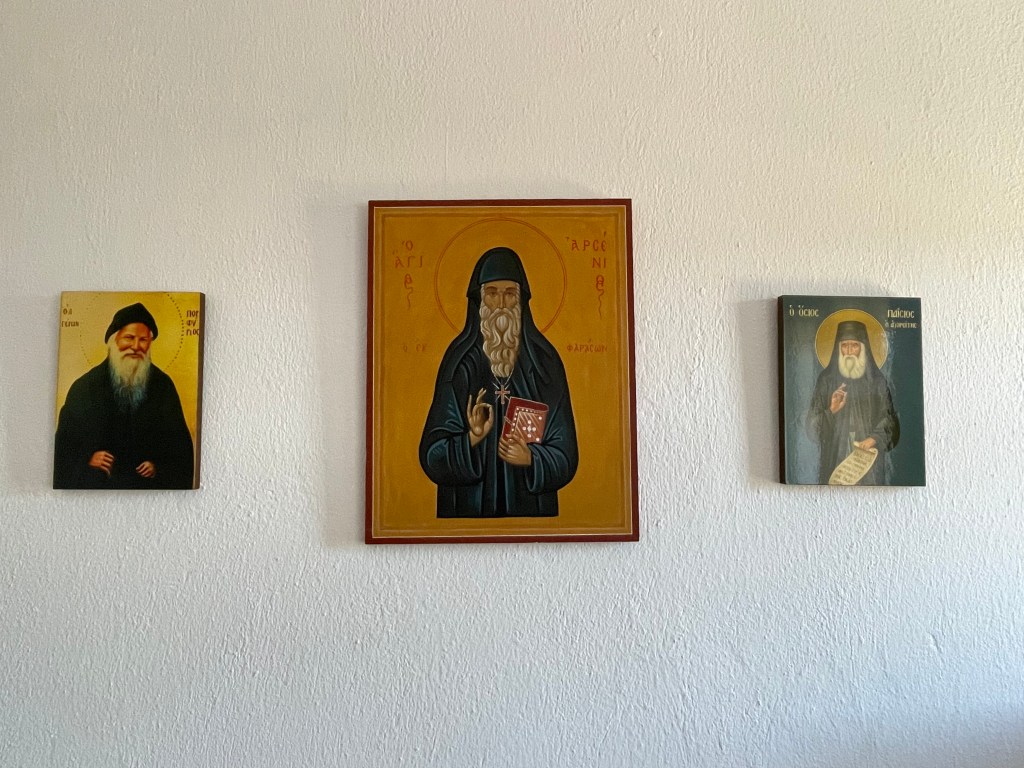
Other sisters soon join us for a minute to welcome me and hear the news about St Demetrios’ vigil in his church –it is after all his feast today– but they quickly disappear. Not a minute of idle or small talk. I am shown to my St Paisios, St Arsenios and St Porfyrios (!) cell, and there is still some free time until our common meal at 15:00 to take a quiet walk inside the monastery or … sit in my cell.
Inside my cell
“A brother came to Scetis to visit Abba Moses and asked him for a word. The old man said to him, ‘Go, sit in your cell, and your cell will teach you everything.’“
God calls each one of us in silence and invites us to go into our inner “room,” shut the door and pray to our Father in secret, assured that He will answer our prayer (Mt 6:6). It is only in this silence and stillness that we can listen to Him, hear His “still small voice” (1 Kings 19:11-13). The quiet water of Siloe flows without noise or sound, “goes softly’ (Is. 8:6).
Gradually, the guests house starts to get filled: two young ladies, university students, in their early twenties, settle in, then another one arrives, this one still in high school, with fond memories of +Elder Gregorios treating her with candies and hugs, and finally a young engineer who attended at the nearby Ormylia monastery a service of monastic tonsure.
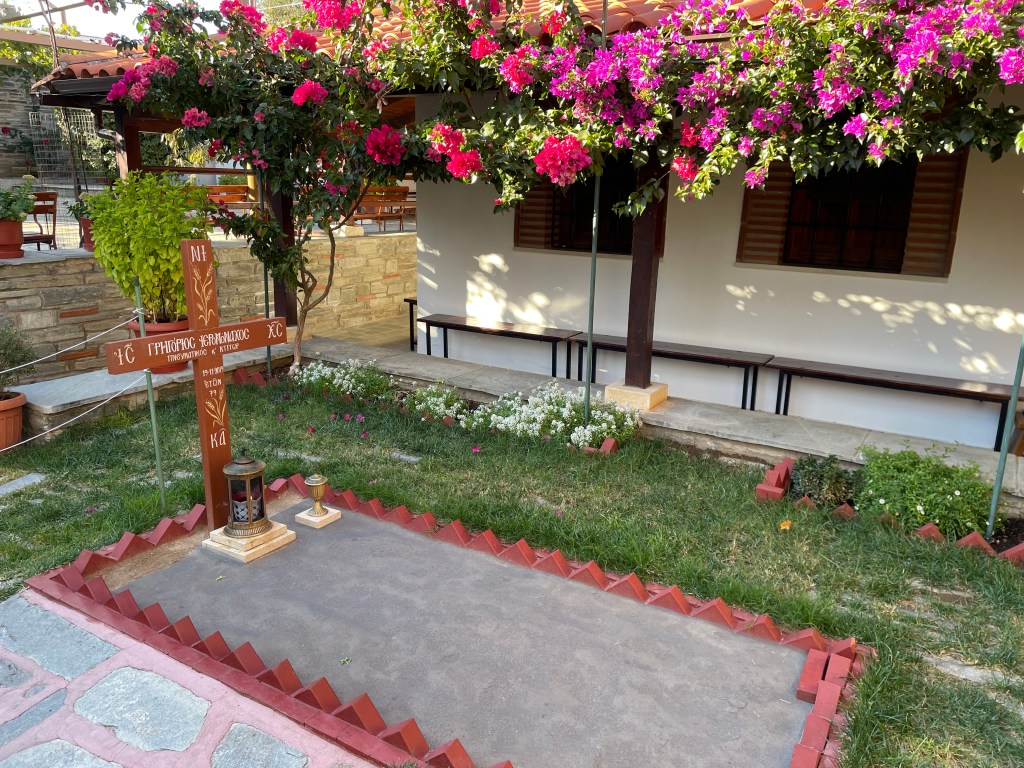
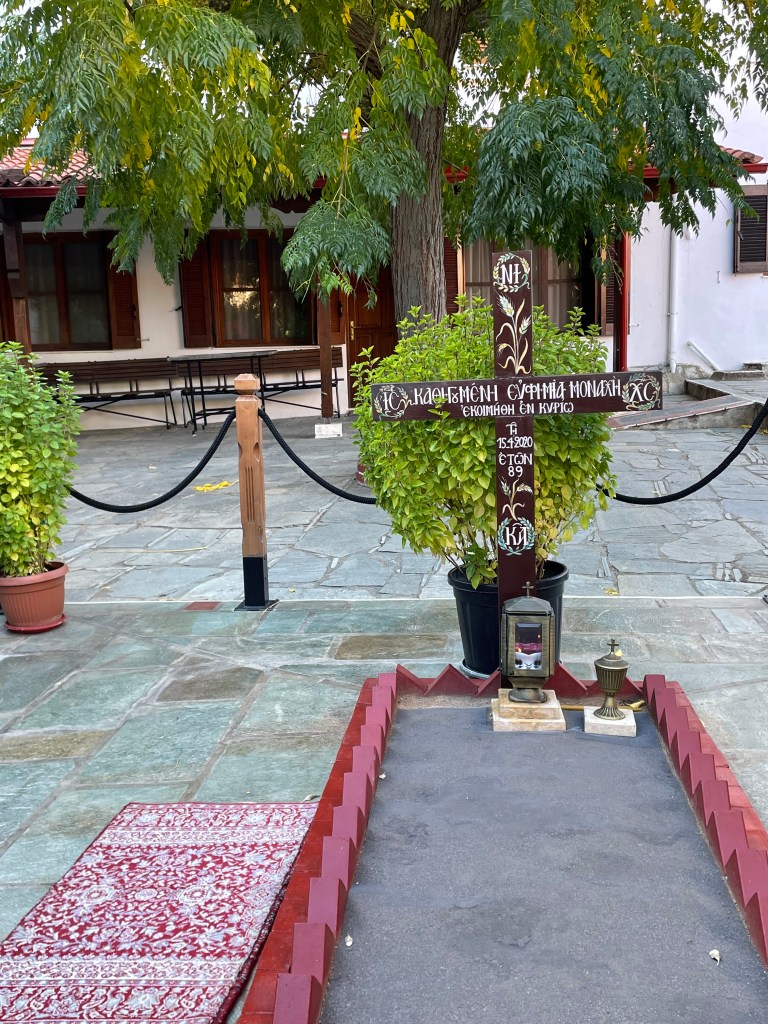
Gerondissa Euphemia’s grave (+15 April 2020, 88 years old). She was the first Abbess of the monastery and fell asleep in the Lord shortly after Gerondas Gregorios’ departure to Heaven (19 Νοεμβρίου 2019).
Bells ring and the common meal with the sisters begins, with a reading of Saint Gregory Palamas’ homily on St Demetrios. Our meal is a very ascetic one, as we are all preparing for Sunday Holy Communion.
We retire very early in our cells. The Sunday service will be a vigil from 23:00 to 03:00!
At the insistence of Sister Elisavet, I prepare a brief note for Abbess Mariam. Briefly, I share my news and ask her blessing. No questions or requests. Only her blessing to allow me to stay here longer and more often. –Which was one of the things +Gerondas Gregorios had always urged me to do, Sister Elisavet points out to me …
I give the note to the sister in charge of the guests’ house, pray and wait. After all, our vigil will begin very soon.
*
“Do not be afraid that there will be no fruit when all dies down; there will be! Not everything will die down. Energy will appear; and what energy!” St. Symeon the New Theologian
“Silence is the sacrament of the world to come” — St Isaacthe Syrian
This year, I had the privilege to attend Saint Demetrios “Holy Week” in his church in Thessaloniki. The services here are very different from the ones all over the world; they are unique. Listen to a few recordings from this year’s Easter Vigil of Saint Demetrios in his church and further down, have a look at a few hymns from the Holy Week of St. Demetrios.
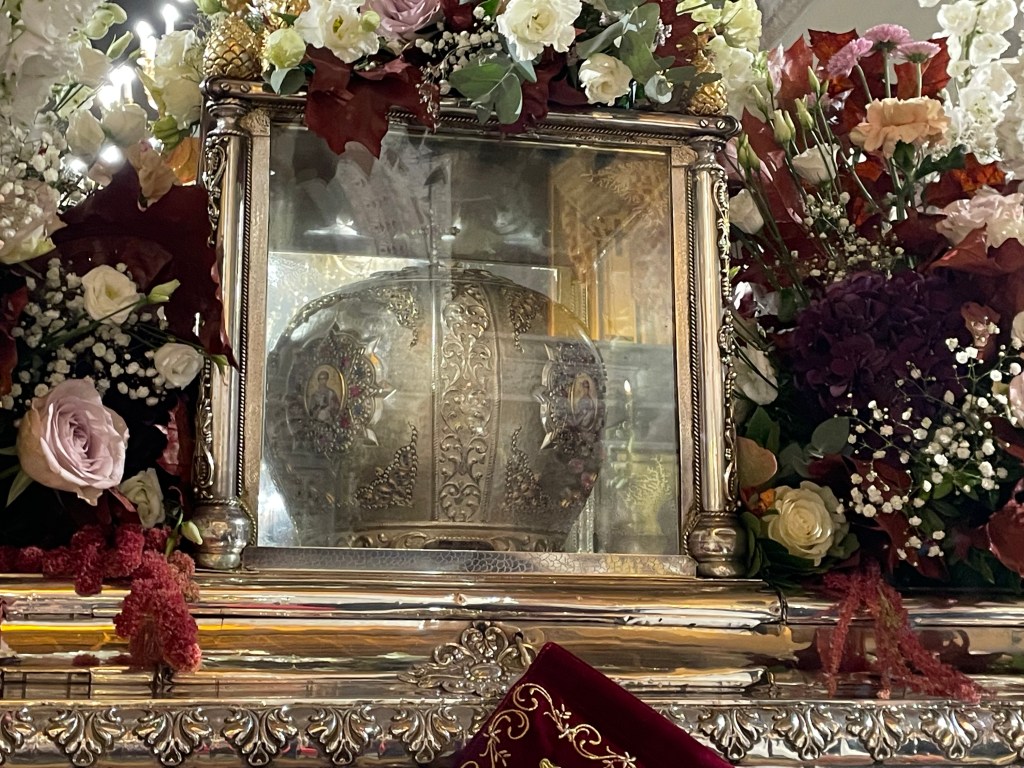
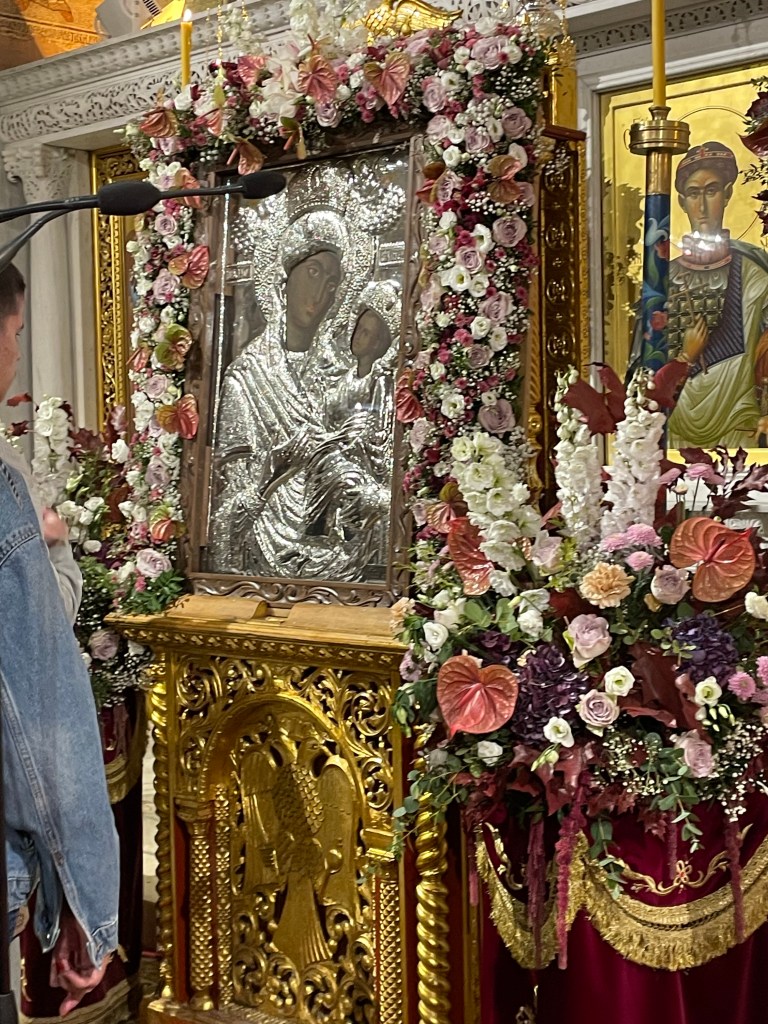
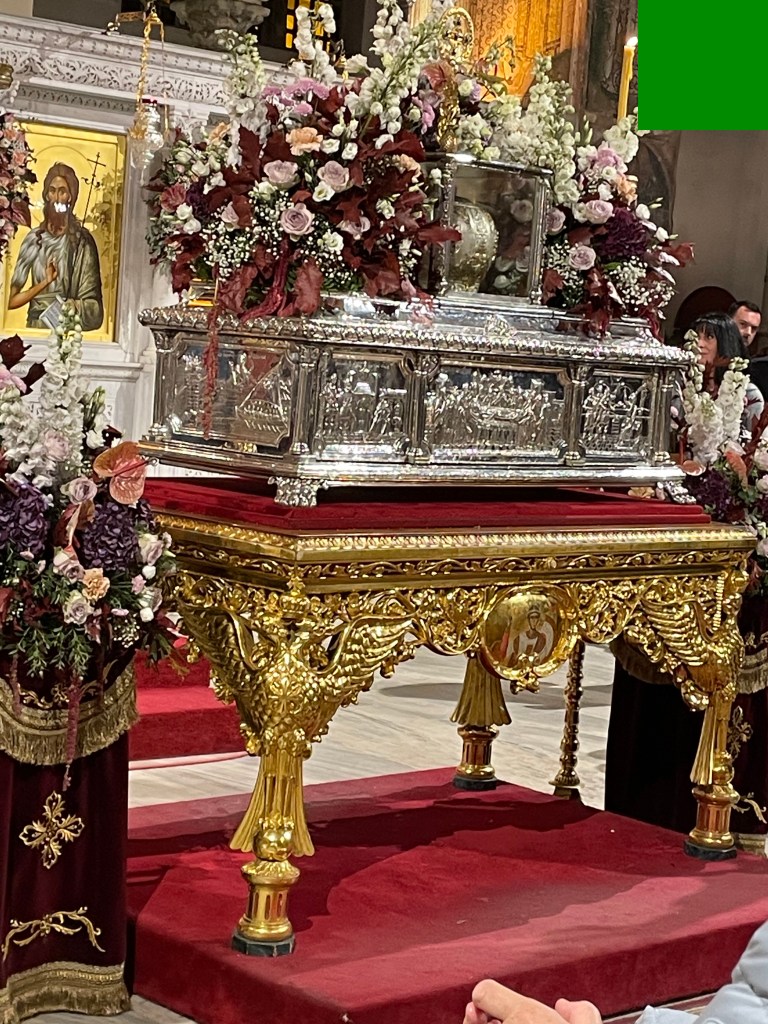
St Demetrios and Panagia Faneromeni 🙏 The Panagia Faneromeni icon, from the the island of Evia has arrived as part of the extended celebrations of Thessaloniki’s patron, St. Demetrios the Great Martyr and Myrrh-streamer, whose feast falls on October 26, 2024.Every year, a different miraculous icon of the Theotokos arrives.
The love and devotion towards St. Demetrios the Great Martyr and Myrrh-streamer from the Orthodox faithful of Thessaloniki is truly immense. Though to some it may seem a bit extreme, St. Demetrios has worked countless wonders both for the city of Thessaloniki, and for all the Orthodox faithful throughout the world. In praise of Christ Who strengthened him in his martyrdom, and in honour and thanksgiving to this great Wonderworker, various hymnographers have composed hymns beyond those of the standard Menaia in praise of St. Demetrios.
Many of these hymns comprise the so-called “Holy Week of St. Demetrios”. This is a collection of pre-festal hymns from various sources in honour of the Saint, and are generally modelled after and grouped correspondingly to the days of Holy Week (i.e. the Passion and Resurrection of Christ). Thus, they begin on October 19th (“Palm Sunday”) and proceed to the feast of St. Demetrios on October 26th (“Pascha”). Many of the hymns have been written by St. Symeon of Thessaloniki (+1429), so we can see how this is an old and established tradition of this local Orthodox Church.
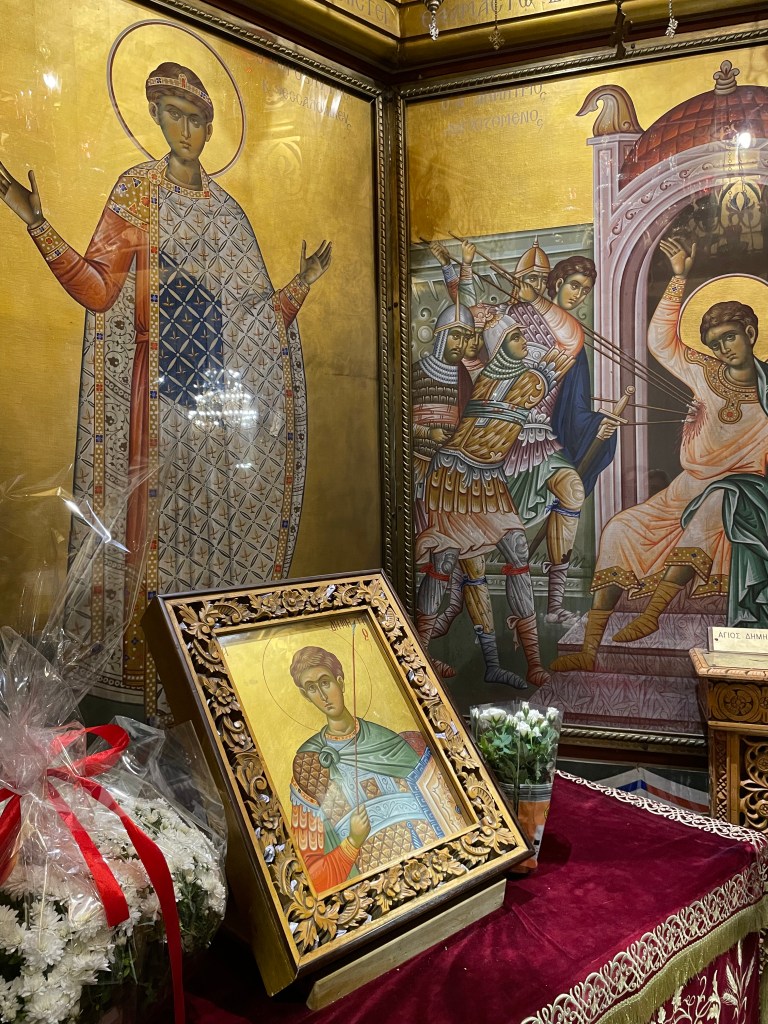
What a paradox! What a marvel! The thrice-blessed Demetrios is pierced by a lance for the sake of Christ….
The martyrdom of the Saint is compared to the passion of Christ. We even find this in the hymnography of the Menaion. In the Doxastikon, for example, of the Stichera of Vespers, we chant: “Rejoice, you who were pierced in your members, your blessed passion is spiritually reenacted for us like Christ;” and in the Doxastikon of the Liti, we chant: “Your undefiled side, was pierced all-revered one, imitating the One who was pierced on the wood.” Saint Symeon of Thessaloniki in the 14th century wrote of the feast of Saint Demetrios: “This bright day is an image of the resurrection of the Saviour.” Saint Philotheos Kokkinos calls the martyrdom of Saint Demetrios: “An imitation of Christ (“Christomimito”).
Professor John Foundoulis is primarily responsible for the modern revival of the special liturgical honour of Saint Demetrios, with the publication of the services in The Holy Week of Saint Demetrios. On the basis of two 15th century codices, originating from Thessaloniki, but also from other manuscripts, he reconstructed the order and content of the pre-festal services of the seven days that precede the feast of Saint Demetrios. Of course, the days of the “Holy Week of Saint Demetrios” are not the same as the days of the same name in the calendar. For example, Holy Monday of the Holy Week of Saint Demetrios is always October 20th, regardless of which day the current year’s calendar shows, and October 26th is Easter Sunday, even if the calendar shows Thursday, as this year’s feast.
This predominance of Easter and the other days of Holy Week in the services of Saint Demetrios, I have found profoundly moving. But what made the most lasting impression on me was the vigil for his feast: St. Demetrius “Easter Sunday”.
Like Easter Sunday, the priests begin with a procession, carrying the Saint’s icon all around the church, proceeded with a Gospel reading in front of the Royal Doors, and a variation of the well-known melody of “Christ is Risen” is chanted lots of times, with words adapted to St. Demetrios’ martyrdom, while bells are ringing. Easter Matins follow, where the canon of the Saint is chanted, based, in melody and verses, on St. John Damascene’s Paschal Canon.
What follows are some recordings from the vigil, and if any of my readers want more recordings, please do not hesitate to contact me.
Apolytikion of St Demetrios
Great have you been found/ / in time of peril/ a great champion/ For all the world/ As you emerged the victor in routing the barbarians/ For as you brought to naught the boasts of Lyaios/ imparting courage to Nestor in the stadium/ in like manner, holy, great Martyr Demetrios/ invoke Christ God for us/ that He may grant us His great mercy.he side of the Savior, which was fearsomely pierced, made passage for the noble and godly-wise thief.he side of the Savior, which was fearsomely pierced, made passage for the noble and godly-wise thief.
St. Dimitrios Resurrection Bells and procession of his icon
St. Demetrios ‘Christ is Risen’ variation–“Χριστού την δόξαν μαρτυρεί/ πηγάζων εκ πλευράς τα μύρα/ ο μάρτυς Δημήτριος ˙/ αυτόν μεγαλύνομεν». “St Demetrios bears testimony to Christ’s Glory/ gushing myrrh at his side/ him do we glorify”
“Easter” Matins canon for St Demetrios —
The full services for the Holy Week of St. Demetrios (in Greek) are available online here: http://analogion.com/forum/showthread.php?t=14355. Below are a few hymns from the Holy Week of St. Demetrios. They are beautiful, compunctionate and theological works by two Fathers of our Church, in praise of such a great role model and servant of Christ, St. Demetrios. May he intercede for us all, and heal us of the passions of body and soul!
The Holy Week Services of St. Demetrios the Myrrh-streamer
Doxastikon of the Praises in the Plagal of the Second Tone (of Palm Sunday of St. Demetrios)
By St. Symeon of Thessaloniki
Before the days of his passion, the champion being in prison, the holy Nestor approached him and said to him: “O glorious one, how will I be able to conquer the terrible Lyaios?” He encouraged him, saying: “Go to that stadium, and you will find me fighting with you, interceding for you to the Lord, and make the sign of the cross, and in the midst of the battle cry: O God of Demetrios help me! And you will defeat him.
Kontakion in the Plagal of the Fourth Tone (of Holy Monday of St. Demetrios)
As a second Jacob, you wrestled with your enemy, and as the chaste Joseph who ruled over the passions, we honour you, O martyr, for you were not a slave to sin or to error, and you, O blessed one Demetrios, received grace for your struggle and an incorruptible crown.
Kontakion in the Second Tone (of Holy Tuesday of St. Demetrios)
Your nous trampled upon the enemies, and you dissolvedall of their deceits; you were granted victory from above, O most-praised Martyrs, and cry out together: ‘How good and pleasant it is to be numbered with Christ’.
Oikos
In the heavens, O Christ, dwell Demetrios and Nestor, and they are arrayed by you in divine light. Hasten speedily to me, who walk in the darkness of ignorance, to heal the passions, O only Immortal One, and grant me the garment of incorruption, that being arrayed in white, I might praise their light-bearing feast, and cry to You, O Lord: How good and pleasant it is to be numbered with Christ.
Kontakion in the Fourth Tone (for the Holy Wednesday of St. Demetrios)
By St. Romanos the Melodist
Victory-bearing champion of the Immortal Master, mighty soldier of the King of Glory, O Demetrios, we the faithful praise you, saying: You have done well, to grant life everlasting.
Oikos
Which should I hymn, O martyr Demetrios? Your pre-struggles? Your struggles? Your post-struggles? All three I am compelled to praise. First, your pure way of life, second, your struggles, third, your many miracles which you have worked and continue to work from your tomb. Therefore, each of the faithful approaches your living relic in faith, reaping as from Paradise, life everlasting.
Doxastikon of the Stichera in the Eight Tones (of Holy Friday of St. Demetrios)
First Tone
Our thrice-perfect protector, O greatly-glorified Demetrios, the abyss of martyrdoms, the unfading flower, the fragrant apple, the vine which brings the fruit of the various graces of the Spirit,
Second Tone
Your name is wondrous through all the earth, for the grandeur of your miracles has reached the heavens above.
Third Tone
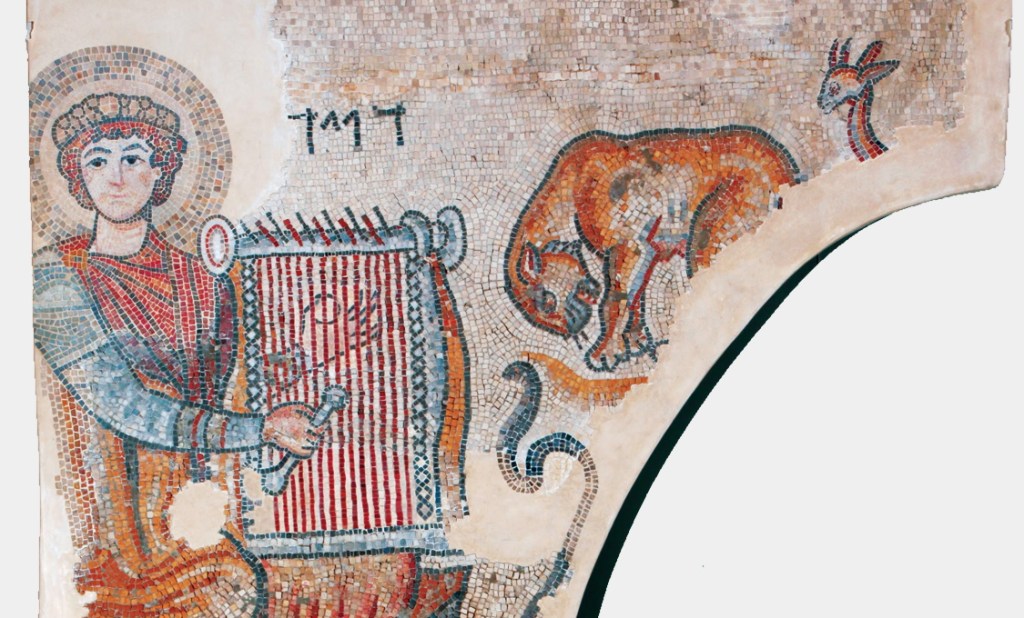
I sing to you at this time with the instrument of David, for you imitated the God-man Word of the all-exalted Father, as His close servant.
Fourth Tone
For though you did not ascend the cross, your most clean body was pierced, and was shown forth as consumed.
Plagal of the First Tone
And now we praise your precious passion, for though formerly Eden was guarded by the fiery sword,
Plagal of the Second Tone
The side of the Saviour, which was fearsomely pierced, made passage for the noble and godly-wise thief.
Grave Tone
Because of thus, your name is wondrous through all the earth, and the greatness of your glory is magnified from the ends of the world.
Plagal of the Fourth Tone
Therefore, protecting your mother land, you look upon the Thessalonians, and they are sheltered by you from all types of continuous trials.
Kontakion in the Second Tone (for the Holy Saturday of St. Demetrios)
By St. Symeon of Thessaloniki
Desiring Christ, the incorrupt and living, you were run through with spears and killed, and thrown in a well, and were not buried, not being granted your holy tomb. You poured forth myrrh, and grant grace to those who cry out: This is the body of the all-pure Demetrios, in whom Christ was glorified, Who lives, having risen on the third day.
Oikos
When He Who holds all things in His palm was crucified, creation praised Him. When this zealous Demetrios was crucified by spears, and in eros stretched out his hands, and accepted piercing in his side, he was rendered as dead, and consigned to the well, and as the sea poured forth a never-emptying river of myrrh, and granted streams of wonders, healing the souls and bodies of many, and put to end all error, and Lyaios is shamed, and with Christ who granted myrrh to the faithful, we cry out: This is the body of the all-pure Demetrios, in whom Christ was glorified, Who lives, having risen on the third day.
Ode I of the Canon in the First Tone. (of Holy Pascha of St. Demetrios) It is the day of Resurrection…
It is the day of resurrection, the slaughter of Demetrios, for the error falls, and the Church of Christ is radiantly resurrected, and greets in joy, and cries out to God a joyous ode.
Let us all purify ourselves, and gather, arrayed in white, at the relics of Demetrios, which shine. And beholding them as we have heard, to the martyr let us say: Rejoice.
Truly the heavens declare the glory of God, and the faithful glorify the work of His hands, the firmament hymns the martyr, the work of the hands of God, and because of this rejoices.
Such silence and peace at the Monastery of St John the Forerunner, Chalkidiki! Another colour and spiritual hue in the rich tapestry of monastic visits
For years, here,Gerondas Gregorios of blessed memory offeredhis prayers with tears and his never-to-be-forgotten spiritual guidance. My rebirth in Christ ((John 3:4), my new life literally started here about 40 years ago.
Off to my next pilgrimage, then, on this year’s three-day public holiday for Thessaloniki: 26 Sat, +St. Demetrius, 27 Sun and 28 Mon: Ohi, national holiday.I can’t wait!
Back in 2019, I undertook the same pilgrimage of mine, and precisely on the same dates and days!
More recently, my own spiritual father visited this monastery just last year.
May it be a refreshing and strengthening experience in His Mercy!
At the recommendation of my spiritual father, I have been watching two exceptional documentaries on monastic life: Athos – Mount Athos Monks’ Republic Documentary and The Good Struggle: Life In A Secluded Orthodox Monastery. Interestingly enough, I found all their insights pertinent not only to monastics, but to laymen too. What truly struck a chord in my heart was their emphasis on the transience and ‘futility’ of our ‘ordinary’ lives, and a remarkable miracle entitled “Christ is Risen”, the first documentary records.
Athos,the first documentary is exceptional partly because for the first time, a filmmaker was given access to all forms of monastic life on the holy mountain (ie. cenobitic monasteries, sketes and monastic cells).
The Good Struggle, the second documentary, is about a monastic community thriving within the confines of a Greek Orthodox Christian monastery, high up in the mountains of Lebanon. The documentary offers rare insight to their almost silent way of life.
What I found most moving in both documentaries is the “school of philosophy” in the Gerondes’ own words: the insights into the monks’ burial place, their bones eventually stored in a separate charnel house, within the consecrated grounds of the cemetery (20:06–21:28 and 1:25:38—1:28:10 — first documentary), or under the church (23:35–24:36 –second documentary).
“So we can always pray for them and join them. This is due to the church’s belief that those who depart are not removed from us, but we are always connected through prayer. We don’t see them but they are connected to us through prayer. They pray for us and we pray for them. We always visit them to encourage ourselves that death is not a calamity but a meeting with the Lord Jesus Christ. We honour and greet them because they have done the good struggle and God has accepted them in His Kingdom.”
So moving and at the same time so sobering for “our [vain] affection for earthly things”! “And once again I looked with attention on the tombs, and I saw the bones therein which of flesh were naked; and I said, … Where is the pleasure in life which is unmixed with sorrow? … All things are weaker than shadow, all more illusive than dreams; comes one fell stroke, and Death in turn, prevails over all these vanities.… All is dust, all is ashes, all is shadow. … Like a blossom that wastes away, and like a dream that passes and is gone, so is every mortal into dust resolved… ” (St. John of Damascus, Orthodox Funeral Service Troparia)
*
Christ is Risen! He is Risen Indeed!
*
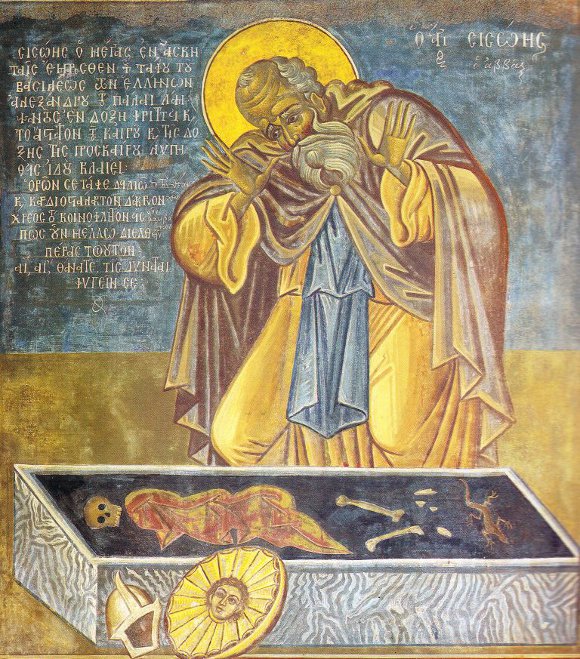
(*) “Sisoes, the great ascetic, before the tomb of Alexander, king of the Greeks, who was once covered in glory. Astonished, he mourns for the vicissitudes of Time and the transience of glory, and tearfully declaims thus: ‘The mere sight of your tomb, dismays me and causes my heart to shed tears, as I contemplate the debt we, all men, owe. How can I possibly stand it? Oh Death! Who can evade you?’
Nothing had prepared me for what happened today at the monastery. Mother Porfyria had texted me back at night that, God willing, we would meet briefly today, sometime before we leave. In turn, I had texted my spiritual father for his prayers to help me discern what to discuss with her in these precious, few minutes. His reply: “Let Christ decide. He will be there with you”.
And yet, nothing had prepared me for what happened today at the monastery. I remember that this is what I had told you at my first monastery pilgrimage, at Panorama Dormition Monastery, but this time the spiritual experience was far more powerful, overwhelming I would say.
Such beautiful chanting in Church! Listen to a recording of sisters chanting Matins, Semantron and Bells:
After the Holy Liturgy, I went straight to St George Karslidis cell and chapel, open to the faithful only on Feast Days and Sundays, thinking that Mother Porfyria would rest a bit after these long church services, before venturing out in the public. She is so loved by the sisters and all the faithful that there is always a long queue following her wherever she is going. Here one feels what joyful obedience out of love is.
Saint George Karslides cell
And then, it happened! When I emerged out of St George Karslidis cell, I saw her! but what did I see?! I saw Gerondissa climbing up the stairs of the guests’ house in a hurry and ‘frantically’ searching for me everywhere, checking the guests’ living room, and ignoring everybody else! I rushed towards her and asked her to forgive my disappearance, but I thought she might rest a bit. Are you kidding me? Mother Porphyria rest a bit? How little do I still know her! No sleep, no rest, no ease, no break-fast, no coffee, nothing for her sake, only burning herself as a candle, always full of love and humility, always ready to sacrifice everything for her ‘neighbour!
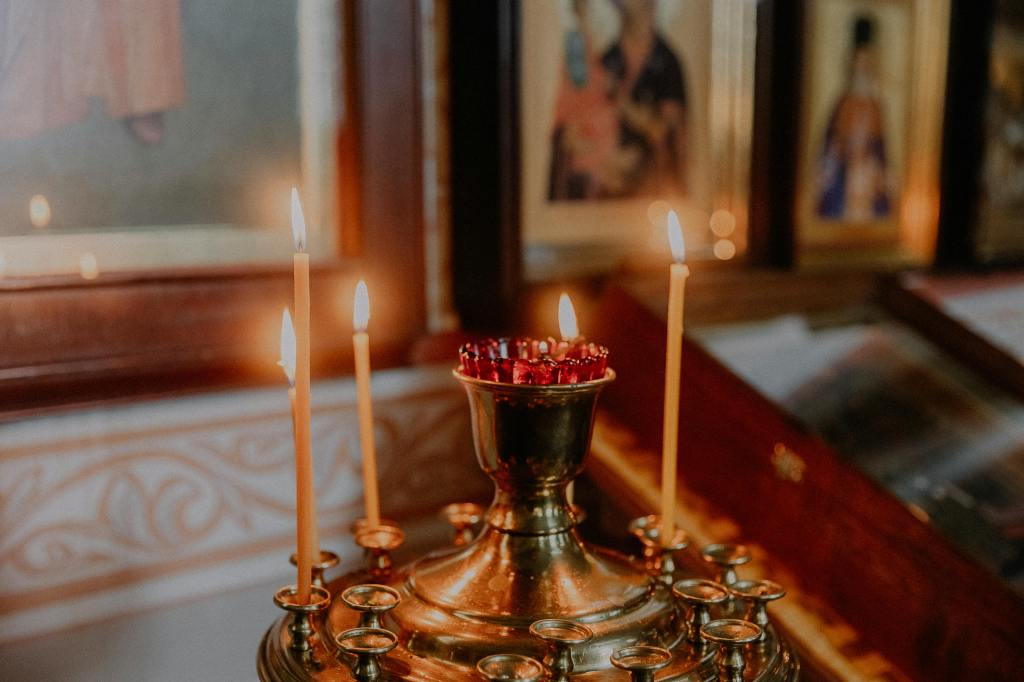
If we burn ourselves up as a candle, we become lights in the world.
It was so embarrassing for me! I must have scandalised all the pilgrims and the sisters in the monastery! First this frantic search, and then this grabbing me and ‘pushing’ me further and further behind the inner gates, since pilgrims and sisters never stopped approaching her, literally disappearing and returning after half an hour! Half an hour?! So, the Abbess disappeared for half an hour at the monastery’s busiest visitors’ time, after the Sunday Holy Liturgy, with the monastery literally packed, overflowing with people?!
What’s more, not for 5 min but for half an hour, all alone, listening to her precious spiritual counsel! What a blessing! And what a profound spiritual encounter ours was! Mother Porphyria reflected on our “common” Way of the Cross, dating back to 1988, at our visit to Sipsa monastery, both of us lay persons then, both of us spiritual daughters of + Gerondas Gregorios. Such a beautiful synaxis after so many years! She insisted how our first meeting sealed our future in God’s unfathomable Providence. Back at this time, she was exploring various monasteries with the desire to become a nun, while I was visiting various monasteries for my spiritual growth, before my graduate studies and work at the States. This first meeting dates back to the Pentecost Feast of 1988. Our 36 years anniversary in her words!
Providence brought us to the same monastery, with the blessing of +Gerondas Gregorios, and the following amusing misunderstanding happened then: because I arrived earlier than Mother Porphyria, the sisters at Sipsa monastery thought that I was the one interested to become a novice. So they offered me a single room to have more “space” and privacy to pray. When Mother Porphyria arrived, the sisters understood their mistake but because they did not want to upset me and have me change room, they left me all alone, at peace, and accommodated Mother Porphyria in a double room. Of course, I was clueless about all this, and when I met her, later in the day, at the services and the meals, she did not give anything away. To this day, she finds all this very funny!
Glory to God for all His gifts, especially our fellow travellers in the Way! Mother Porphyria stressed how important is to be always grateful, how God loves those who are grateful. Our faith and life is literally eucharistic. Glory to God for all things were Saint John Chrysostom. last words as he died in exile in the year 407. The word “Eucharist” is derived from the Greek word eucharistia, meaning ‘thanksgiving. This term originated in the 1st or 2nd century A.D. as early Christians commemorated Christ’s Last Supper with thanksgiving. Such thanksgiving inspires and empowers us to act in humble, loving, compassionate ways, with empathy and in service to others.
She also told me that gratitude and total surrender to God will make us fools for Christ and full in His Joy. Galatians 2:20 speaks to the profound change that occurs when we surrender to God: “I have been crucified with Christ and I no longer live, but Christ lives in me. The life I now live in the body, I live by faith in the Son of God, who loved me and gave himself for me.” And then, the greater the trials and tribulations, the greater our Joy will be. Mother Porphyria told me that this was a key teaching of Gerondas Gregorios of blessed memory to his spiritual children.
She then added that when we are ‘crucified’ wherever God’s Providence has placed us, then our martyrdom, and especially our prayers during our martyrdom, transfuses our crucifiers with His love. And this is such a blessing to offer to the world because sadly there are lots of people who rebel against God’s boundless Love and refuse to accept it and then share it. But the key to become such a channel for God’s Love is the will to be crucified and our gratitude for all our crosses. There is simply no other way!
God is indeed doing something wonderful. If we burn ourselves up as a candle, we become lights in the world. These are my spiritual Father’s words.
“Just as the oil and wick burn in the vigil lamp, submissive to our will, so let our souls also burn with the flame of love in all our sufferings, always being submissive to God’s will”, St. Nikolai Velimirovich.
This burning, of course, hurts, but Christ, our Bridegroom, bore the heaviest Cross of all: All our crosses plus only He knows what more …
Then Mother Porfyria moved on to some very private matters for herself and myself, which obviously I cannot share. All I can say is that her words were overpowering. A bit too powerful and profound for my spiritual level … standing in awe before the Burning Bush… We have been meeting all these years, but never before had she administered such a “deadly blow” on me! She has always been supportive and kind, wiping my tears, but this time was “only” “tough love”. Days later, and I find myself still reeling… Very tough love…
When I shared these words with my spiritual father, he told me: “Indeed tough love but which bolsters faith in an uncomfortable way”. And it was not so much her words, but the Holy Spirit through her words. Such a powerful presence! Even now, days later. Palpably so…My eyes have opened a little bit to the price our spiritual fathers and mothers “pay” when we ask for their prayers.
Please forgive me for not being able to share further our private discussion. And also forgive me if I cannot put her holy wisdom into words. Days later, I listened to a homily from Essex Monastery, which emphasises the same point: “The Taste of Death is a Prelude to Resurrection Life” How Elders burn themselves up to offer light and “how their spiritual children can make them prophets [ie. prophetic lights] with their holy obedience”, in Saint Sophrony’s own words. But I repeat, it is one thing to just listen to these holy words, and another thing the holiness of the speaker to be transfused to your heart and nous. “… and a great multitude of people … came to hear Him and be healed of their diseases … for power went out of Him and healed them all” (Luke 6: 17-19).
One thing I can certainly share is Mother Porfyria’s insistence on the power of the Psalter in spiritual warfare, which she also stressed at a group discussion with the faithful, at the monastery courtyard, shortly after our private discussion: “The Psalms of the prophet David – the sacred Psalter – are an age old weapon, an effective cure against fear, terror, and demonic forces.”
Mother Porfyria’s insistence on the power of the Psalter, reminded me of another homily, by Metropolitan Neophytos of Morfu this time, about a holy ascetic of our times, Elder Theodoros the cave-dweller from Agiofarango, Crete (†2016), about the power of the Psalter:
“If you were to ask me to tell you what I learned after so many years in the desert, I would simply answer this: the power of the Psalter. If I were to start my life over, I would struggle to do one thing: memorize the Psalter. This is the womb of noetic prayer. This is the fertile soil where the seed of prayer thrives. It scourges the demons. When I was reading the Psalter during my vigils, a demon came, roaring like a wild boar in my ear, especially when I said the verse, “Let God arise and let his enemies be scattered, and let those who hate him flee before him…” (Ps 68:1 (67 LXX)) and the verse that says, “…for You are my Lord and my God”. He was in a rage, grabbing me by the throat and choking me. He tried to mess up my words so that I wouldn’t say it.”
Saint Paisios of Mount Athos reveals a similar experience of his about the power of the Psalter:
“How much consolation I find with the Psalter! That hour and a half when I read the Psalter, I see it as the most positive help to the world… The Psalter is divinely inspired, it was written with divine illumination, this is why it is so potent, so deep in meaning… With the Psalter I feel like rejoicing…I was pounding the devil with a cannon. During the day I pounded him with the Psalter, at night with prayer.”https://www.orthodoxwitness.org/the-power-of-the-psalter
Mother Porphyria also urged the faithful that flocked around her to cense, ie. offer incense to, not only our icons, immediate environment and people near us, but also God’s creation!, those afar, our families at school, our colleagues at work, our families and friends away, all over the world … She told us that is what Fathers have told her and insisted on this. So, we must sense and cense … since before we offer incense we must sense them.
If we burn ourselves up as a candle, we become lights in the world.
What I find most moving, though, are not her words to me or to all the faithful huddling up near her, but the prayer and the Holy Spirit she transfused us through her words.
Like the other sister with a charisma from God at Panorama Dormition monastery, who offered me 5 minutes of her time before I left the monastery. When she told me, for example, to focus on the Holy Liturgy “which is Everything” in Saint Sophrony’s of Essex words, or the Jesus prayer, she transfused the energy of the Jesus prayer to me, and for some hours and days after this, the Jesus prayer would not stop echoing in my heart. Likewise, when Mother Porphyria spoke to us about the power of the Psalter, she transfused this energy, and from there on, for some days, all I could do was to recite the Psalter…
St. Justin Popovich
“To be Orthodox means to have the God-man Christ constantly in your soul, to live in Him, think in Him, feel in Him, act in Him. In other words, to be Orthodox means to be a Christ-bearer and a Spirit-bearer.”