Belonging to Neither and Both

Belonging to Neither and Both In the Middle Between the World and Monasticism From the Letters of St. Ambrose of Optina

An Elder’s Correspondence to his Spiritual Daughter Caught Between the World and the Monastery (*)

January 3, 1879

In our last letter of December 14, you wrote that you cannot find any books applicable to your situation. You say that all books discuss monasticism, and that you are not a nun but are simply living near a monastery. In response I would say this to you: the Gospel teaching is given to everyone in common, and everyone is obliged to fulfill it. Monasticism stemmed from the desire to live exactly according to the Gospel teaching. This is terribly difficult amidst the noise of the city and the cares of life in the world, which hinder such a precise fulfillment of the Gospel teaching, even though everyone is called to this. Monastics are distinguished from laymen in that the latter are permitted to live in a state of matrimony, while the former choose to remain unmarried. Read more often the Gospel of Matthew, from the beginning of the fifth chapter to the end of the tenth, and try to live according to what is written there. Then your life will be marked by harmony, and you will find peace of soul.

January 11, 1879

Peace to you and God’s blessing, and a strengthening towards good. On January 3 I briefly wrote to you that monastic life by no means differs from the Gospel teaching, and that those living in the world differ from monastics only as concerns their married state. About married people, however, St. John of the Ladder writes that they are like those whose hands and feet are bound with fetters. Although even these can walk the path of righteousness, it is only with difficulty; they often stumble and fall and become sorely wounded as a result. The unmarried–and particularly monastic–state offers greater facility in the fulfillment of the Gospel teaching. It is for this reason that monasticism was established by the Holy Fathers.

You are now in the middle, between the world and monasticism (*). The middle path is everywhere approved, and for you–both on account of your upbringing and your weak constitution–it is in many ways appropriate. Only try to live according to the Gospel commandments. Above all, judge no one about anything, so that you yourself will not be judged …..

In my letters I’ve always had one aim –to dispel your misconceptions about monasticism and spiritual life in general, which you formed while still living in the world. You have perhaps heard it said that even apparently correct theory does not always coincide with practice. One’s own experience, when it follows the experience of spiritual people in the past, is a good instructor, provided we check our life against the Biblical and patristic teaching.

You laid for yourself and your life a rather strange foundation: I wanted so, I thought so, I intended so… You are not the only one; many desire a good spiritual life in the simplest form. Few, however, (they are rare, in fact) fulfill their good desires in actuality; they are those who hold tightly the words of Holy Scripture: “We must through much tribulation enter into the kingdom of God” (Acts 14:22), and who, entreating the help of God, try to bear the griefs and illnesses and various discomforts visited upon them without murmuring, always keeping in remembrance the words of the Lord Himself: If thou wilt enter into life, keep the commandments. (Matt. 19:17)

And the most important of these commandments are: “Judge not and ye shall not be judged; condemn not, and ye shall not be condemned: forgive, and ye shall be forgiven” (Luke 6:17). Besides this, those who want to be saved must bear in mind the words of St. Peter Damascene, that salvation is accomplished between fear and hope…

To live in a simple hut without humbling oneself will not lead to any good. It is better for someone who is weak in soul and body to live in a comfortable cell and to humble himself, blaming and reproaching himself for such comfortable and spacious quarters. Only few, and those possessing a strong constitution, can without harm lead an austere life, and endure cold and hunger and dampness and sleeping on the ground. According to the words of St. John Damascene, those who are weak in body derive more profit from humility and thanksgiving than from physical labors and podvigs to which they are unequal.

You are adversely affected by the harsh words of such people who, in your opinion, should speak differently. St. John Climacus writes that God providentially leaves some flaws even in spiritual people so as to bring them to humility.

If you wish to set yourself on a firm path toward salvation, try above all to pay heed to yourself alone, and leave everyone else to God’s Providence and their own will, and don’t concern yourself with instructing anyone. Not in vain is it said: Each man begetteth himself shame or glory according to his deeds. This will be most beneficial, meat conducive to salvation, and, what’s more, more peaceful.

From the Letters of St. Ambrose of Optina

(*)  *Sigh* It is so me …

See also Marriage or Monasticism? and Sanctifying the Single Life

When Tumultuous Work Raises its Din

When Tumultuous Work Raises its Din


Back in the UK, amidst Autumn Busy-ness, in search of Quiet

*

“Swim, O my nous, in the sweetest tranquility!” (Blessed) Elder Joseph the Hesychast

*

When the heart is hard and parched up,

Come upon me with a shower of mercy.

When grace is lost from life,

Come with a burst of song.

When tumultuous work raises its din on all sides,

Shutting me out from beyond,

Come to me, my lord of silence,

With thy peace and rest.

When my beggarly heart sits crouched,

Shut up in a corner,

Break open the door, my king,

And come with the ceremony of a king.

When desire blinds the mind

With delusion and dust, O thou holy one,

Thou wakeful one, come

With thy light and thy thunder.

(Gitanjali-Song Offerings, 39, by Rabindranath Tagore)

Near-Death and Afterlife Stories in a True Crown Jewel


dryvouno29dryvouno28dryvouno27dryvouno26dryvouno25dryvouno24dryvouno23dryvouno22dryvouno21dryvouno20dryvouno19dryvouno18dryvouno17dryvouno16

Dryovouno Monastery, Near-Death and Afterlife Stories

dryvouno15dryovouno14dryovouno13dryovouno12dryovouno11dryovouno10dryovouno9dryovouno7dryovouno6dryovouno5dryovouno4dryovouno3dryovouno2dryovouno1


Father Stephanos of the Monastery of Transfiguration (Metamorfosi tou Sotiros) in Dryovouno speaks very little, mainly with his eyes.

*

Mother Theologia: “How little do we think of death, although he is so near to us!” commenting on a yet another sudden, unexpected death.

*

Laokratia told us about a dream: “My friend’s late young son, who had suffered a sudden and violent death through a road crush, appeared in his father’s dream in tears, standing before a closed gate, telling him that ‘they’ do not allow him in. His father, a very faithful man, promptly met Elder Iakovos Tsalikis and told him his dream. By the grace of God, the elder, having a pure nous, was deemed worthy to see the souls of people at the time they were leaving the earth and ascending towards heaven. Elder Iakovos asked him if his son was blaspheming God, and the father sadly admitted so. Then, Elder Iakovos promised to pray for his son, and he also advised him to do alms in his son’s name, fast and pray to the Lord so He will grant him rest”. The poor father made a prostration and obeyed the elder, and after 40 days, he saw again his son in his dream, this time radiant with joy, in front of an open gate, thanking him and telling him that ‘they’ had allowed him in!”

*

Sister Gregoria: “I just received a message from a friend who had to undergo a difficult operation and she told me that it all went well but that it was St. Luke Bishop of Simferopol and Crimea, the Blessed Surgeon who operated her! In the operating room she felt that she was dying. She started ascending and watched the surgeon and the nurses trying to revive her unconscious body. Then she met ‘somewhere in the air’ St Luke. To be sure she could not really interpret what was happening to her as it was taking place. Still she understood that he reassured her that he would take over as the surgeon was clearly in an impasse. Then she started moving in the reverse direction, got into her body again and found herself in the hospital, having had the surgery performed, with doctors standing around her, looking at her puzzled. But who was this St Luke she had met? It took her a few hours to find out that her mother, a very devout woman, had placed a little icon of his underneath her pillow, just before the operation started!”

*

Sister Ioanna:”Yesterday at midnight, while I can finishing the writing of an icon and adding the dedication, I realised that although I could write the mother’s name easily, there was no way I could add her late son’s name. I started praying and in the Spirit I ‘saw’ that the mother was in a very good spiritual state, but her son was not at all well and needed our prayers. She felt that God had granted rest to the mother’s soul, but they should do alms in the son’s name and pray to the Lord so He will grant him rest”.

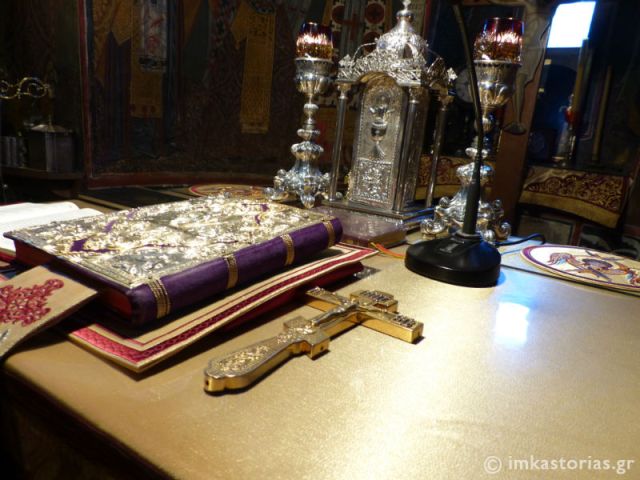
We arrived at the Monastery of the Transfiguration (Metamorfosi tou Sotiros) in Dryovouno on its Feast  day. We were a group of faithful, Mother Theologia and some nuns from the nearby Monastery of the Assumption, Dormition (Koimiseos tis Theotokou) of Mikrokastro. What stunning Beauty confronted us!


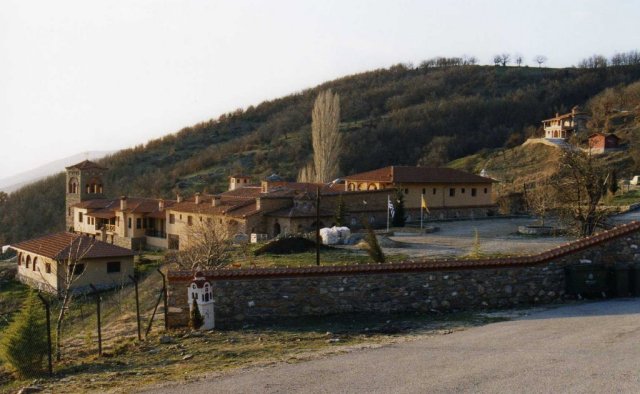
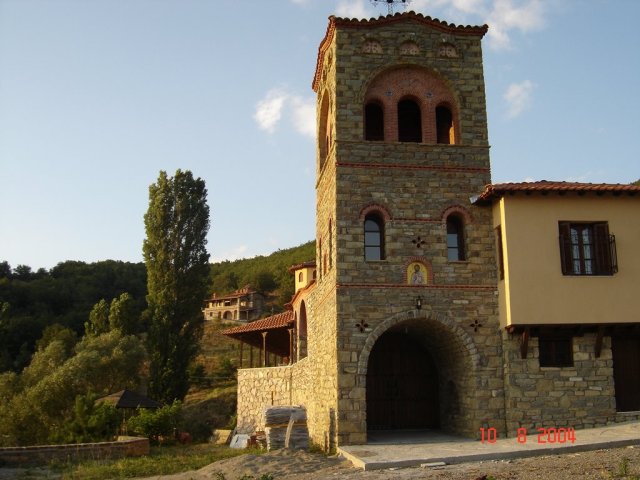
This male monastery is located a few kilometers above Dryovouno, at a secluded area. Its foundation goes back to 1592, while the murals were completed in 1652, by painter Nikolaos from Linotopi while the narthex in particular is the work of Argyris Kriminiotis.


Kosmas Aitolos arrived here and, after preaching, treated the monks who had been taken ill due to an epidemic. He fetched water from a nearby spring, blessed it, and gave it to the monks to drink, who were then cured. This water has been considered holy ever since and a chapel devoted to saint Kosmas has been constructed at the spring. St. Kosmas received from God the gift of prophecy.


At wartime, the monastery offered valuable services to the local population. It served as storage for ammunition and as base for various chieftains. This is where Dimitrios Feraios, Kapetan Vardas and Pavlos Melas resorted to.


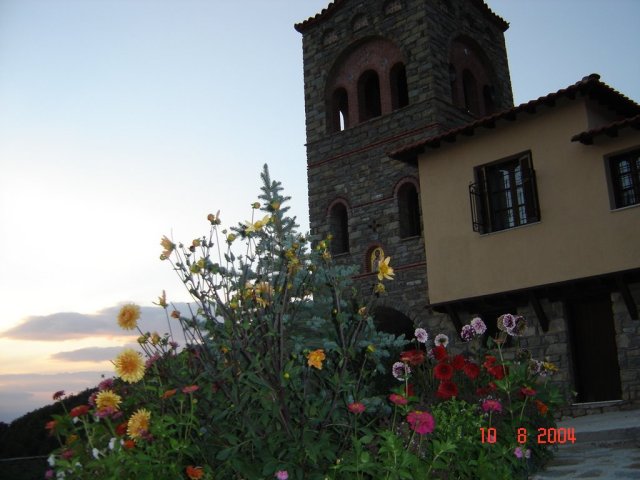
In 1943 it was set on fire by Italians along with its historic records. Its renovation began in 1996, the prime mover being Archbishop Stefanos Rinos with the personal efforts of monks and believers. The parvis offers a sense of tranquility and a spectacular view to Voio and Kastoria.


It is Your Turn Now!

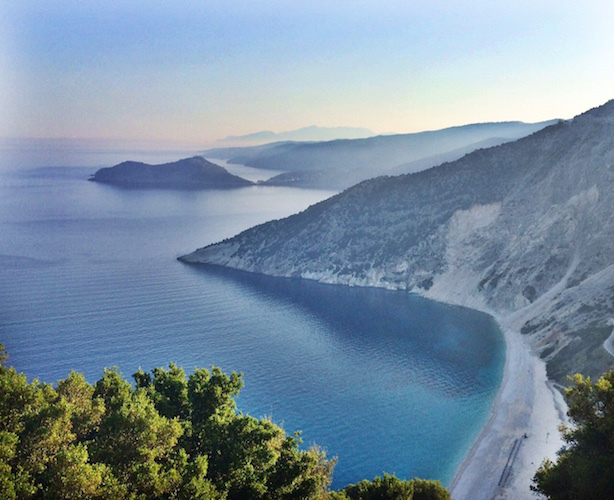
 Happy New Church Year! New Beginning Wishes from Cephallonia, a Story of Repentance, a Rumi Sufi poem, a robin singing and the little city hermit’s name day  ☺️

kef1

Myrtos Beach

kef5.jpg

kef6

kef7

Monastery of Agios Gerassimos

kef2.jpg

Fiskardo, Kefalonia

kef4.jpg


It Is Your Turn Now!

Transform your inner pearl.

It is your turn now,

You waited, you were patient.

The time has come,

For us to polish you.

We will transform your inner pearl

Into a house of fire.

You’re a gold mine.

Did you know that,

Hidden in the dirt of the earth?

It is your turn now,

To be placed in fire.

Let us cremate your impurities.

By Rumi

alchemist.jpg

A Story of Repentance

We knew virtually nothing…I had come to make my confession for the first time in my life. Shortly beforehand I had become a Christian by the grace of God. I had no deeper knowledge either of Christianity or of the church – who could have taught me? I and my newly-converted girl friend, both in the same position, learned what to do by imitating our old women, who zealously preserved the Orthodox faith and practices. We didn’t know anything. But we had something which in our day should perhaps be treasured more than knowledge: a boundless trust in the church, belief in all its words, in every movement and demand. Only yesterday we had rejected all authority and all norms. Today we understood the deliverance that we had experienced as a miracle. We regarded our church as the indubitable, absolute truth, in minor matters just as much as in its main concern. God has changed us and given us childhood: ‘Unless you become as children, you will not enter into the kingdom of heaven.’

I only knew that it was necessary to go to confession and to communion. I knew that both confession and communion were high sacraments which reconcile us with God and even unite us with him, really unite us with him in all fullness, both physical and spiritual. I was formally baptized by my unbelieving parents as a child. Whether they did that out of tradition or whether someone had persuaded them to do it, I never discovered from their explanations. Now at the age of twenty-six I had decided to renew the grace of baptism.

confession.jpg

Like a hardened crust

I knew that the priest himself – the well-known confessor Father Hermogen – would ask me questions and guide my confession. Then the day before I read a little booklet in order to prepare myself for confession, I discovered that I had transgressed all the commandments of the Old and New Testaments. But quite independently of that it was clear to me that the while of my life was full of sins of the most varied kind, of transgressions and unnatural forms of behavior. They now pursued me and tormented me after my conversion, and lay like a heavy burden on my soul. How could I have not seen earlier how abhorrent and stupid, how boring and sterile sin is? From my childhood my eyes had been blindfolded in some way. I longed to make my confession because I already felt with my innermost being that I would receive liberation, that the new person which I had recently discovered within myself would be completely victorious and drive out the old person. For every moment after my conversion I felt inwardly healed and renewed, but at the same time it was as though I was somehow covered with a crust of sin which had grown around me and had become hard. So I to longed for penance, as if for a wash. And I recalled the marvellous words of the Psalm which I had recently learned by heart: ‘Purge me with hyssop, and I shall be clean: wash me and I shall be whiter than snow.’


confession5

The experience of a miracle

And so my turn came. I went up, and kissed the gospel and the cross. Of course because I felt dismay and apprehension, I was afraid to say that I was confessing for the first time. Father Hermogen began by asking,

‘When did you last fail to go to church? What festivals have you deliberately neglected?’

‘All of them,’ I replied.

Then Father Hermogen knew that he was dealing with a new convert. In recent times new converts have come into the Russian church in large numbers, and they have to be treated in a different way.

He began by asking about the most terrible, the ‘greatest’ sins in my life, and I had to tell him my whole biography: a life based on pride and a quest for praise, on arrogant contempt for other people. I told him about my drunkenness and my sexual excesses, my unhappy marriages, the abortions and my inability to love anyone. I also told him about the next period of my life, my preoccupation with yoga and my desire for ‘self-fulfillment’, for becoming God, without love and without penitence. I spoke for a long time, though I also found it difficult. My shame got in the way and tears took away my breath. At the end I said almost automatically: ‘I want to suffer for all my sins, and be purged at least a little from them. Please give me absolution.’

Father Hermogen listened to me attentively, and hardly interrupted. Then he sighed deeply and said, ‘Yes, they are grave sins.’

I was given absolution by the grace of God: very easily, it seemed to me: for the space of several years I was to say five times a day the prayer ‘Virgin and Mother of God, rejoice’, each time with a deep prostration to the ground.

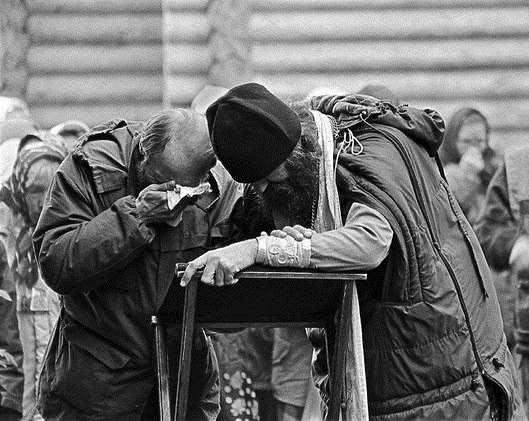
This absolution was a great support to me through all the following years. Our sins (the life of my newly-converted friend was hardly different from my own) somehow seemed to us to be so enormous that we found it hard to believe that they could disappear so simply, with the wave of a priest’s hand. But we had already had a miraculous experience: from the nothingness of a meaningless existence bordering on desperation we had come into the Father’s house, into the church, which for us was paradise. We knew that with God anything is possible. That helped us to believe that confession did away with sin. And the starets also said, ‘Don’t think about it again. You have confessed and that is enough. If you keep thinking about it you are only sinning all over again.’ (Tatiana Goricheva, a member of the “intelligentsia” and a Soviet-era dissident, Talking About God Is Dangerous)

Repentance and the Orthodox Sacrament of Confession

It Is Your Turn Now! 

*

“It is later than you think! Hasten, therefore, to do the work of God.”

+ Fr. Seraphim Rose, Fr. Seraphim Rose: His Life and Works

*

“When someone makes a decision, he is really diving into a strong current that will carry him to places he had never dreamed of when he first made the decision.” (The Alchemist)

confession2

Happy New Year!

* September 1st is the start of a new liturgical in the Orthodox Church

and

the little city hermit‘s name day 😊 


Cephalonia-Ithaka Pilgrimage

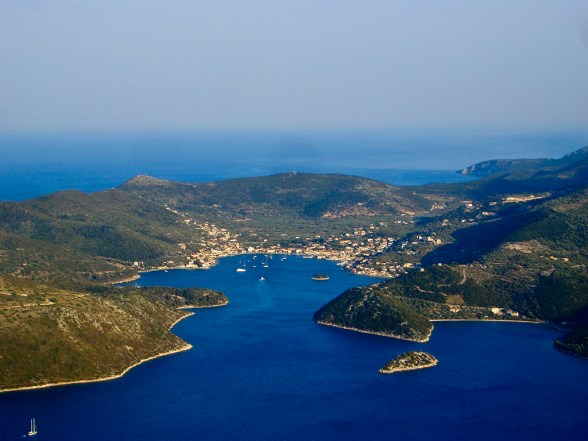
On my way  to this summer’s last pilgrimage: Cephalonia-Ithaca for the Dormition Feast

orthodox-city-hermit-and-cephalonia-ithaka-dormition-fast4

orthodox-city-hermit-and-cephalonia-ithaka-dormition-fast1orthodox-city-hermit-and-cephalonia-ithaka-dormition-fast2orthodox-city-hermit-and-cephalonia-ithaka-dormition-fast3


Apologies for being offline through August 31st.

May our Lady bless us and may the Lord keep us in the palm of His Hand until we meet again!

*

“Sister Begona Miguel of the Huelgas Monastery says:

“San Juan de La Cruz teaches us that silence has its own music; it is silence that enables us to see ourselves and the things around us.

‘I would like to add that there are words that can only be said in silence, odd as that may seem. To compose their symphonies, the great geniuses needed silence – and they managed to transform this silence into divine sounds. Philosophers and scientists need silence.

‘In the monastery, at night, we practice what we call The Great Silence.

‘In the absence of speech we can understand what lies beyond.” (Paulo Coehlo blog, In the Huelgas Monastery)

*

Therefore, it is time for the little city hermit to embark on yet another quest for stillness and silence. This blog takes a vacation, returning by the end of August, where I will start making preparations for my return trip to the UK.

You are always welcome to browse the ARCHIVES on the right.

Enjoy the rest of your summer.

With lots of love and poor prayers

The little city hermit

Father’s Love Letter

Father’s Love Letter

My Child,

You may not know me,
but I know everything about you. 

Psalm 139:1

I know when you sit down and when you rise up. 
Psalm 139:2

I am familiar with all your ways. 
Psalm 139:3

Even the very hairs on your head are numbered. 
Matthew 10:29-31

For you were made in my image. 
Genesis 1:27

In me you live and move and have your being.
Acts 17:28

For you are my offspring. 
Acts 17:28

I knew you even before you were conceived. 
Jeremiah 1:4-5

I chose you when I planned creation. 
Ephesians 1:11-12

You were not a mistake,
for all your days are written in my book. 

Psalm 139:15-16

I determined the exact time of your birth
and where you would live. 

Acts 17:26

You are fearfully and wonderfully made. 
Psalm 139:14

I knit you together in your mother’s womb. 
Psalm 139:13

And brought you forth on the day you were born. 
Psalm 71:6

I have been misrepresented
by those who don’t know me.

John 8:41-44

I am not distant and angry,
but am the complete expression of love. 

1 John 4:16

And it is my desire to lavish my love on you. 
1 John 3:1

Simply because you are my child
and I am your Father. 

1 John 3:1

I offer you more than your earthly father ever could. 
Matthew 7:11

For I am the perfect father. 
Matthew 5:48

Every good gift that you receive comes from my hand. 
James 1:17

For I am your provider and I meet all your needs. 
Matthew 6:31-33

My plan for your future has always been filled with hope. 
Jeremiah 29:11

Because I love you with an everlasting love. 
Jeremiah 31:3

My thoughts toward you are countless
as the sand on the seashore.

Psalms 139:17-18

And I rejoice over you with singing. 
Zephaniah 3:17

I will never stop doing good to you. 
Jeremiah 32:40

For you are my treasured possession. 
Exodus 19:5

I desire to establish you
with all my heart and all my soul. 

Jeremiah 32:41

And I want to show you great and marvelous things. 
Jeremiah 33:3

If you seek me with all your heart,
you will find me. 

Deuteronomy 4:29

Delight in me and I will give you
the desires of your heart. 

Psalm 37:4

For it is I who gave you those desires. 
Philippians 2:13

I am able to do more for you
than you could possibly imagine. 

Ephesians 3:20

For I am your greatest encourager. 
2 Thessalonians 2:16-17

I am also the Father who comforts you
in all your troubles. 

2 Corinthians 1:3-4

When you are brokenhearted,
I am close to you. 

Psalm 34:18

As a shepherd carries a lamb,
I have carried you close to my heart. 

Isaiah 40:11

One day I will wipe away
every tear from your eyes. 

Revelation 21:3-4

And I’ll take away all the pain
you have suffered on this earth.

Revelation 21:3-4

I am your Father, and I love you
even as I love my son, Jesus.

John 17:23

For in Jesus, my love for you is revealed. 
John 17:26

He is the exact representation of my being. 
Hebrews 1:3

He came to demonstrate that I am for you,
not against you. 

Romans 8:31

And to tell you that I am not counting your sins.
2 Corinthians 5:18-19

Jesus died so that you and I could be reconciled. 
2 Corinthians 5:18-19

His death was the ultimate expression
of my love for you. 

1 John 4:10

I gave up everything I loved
that I might gain your love. 

Romans 8:31-32

If you receive the gift of my son Jesus,
you receive me. 

1 John 2:23

And nothing will ever separate you
from my love again.

Romans 8:38-39

Come home and I’ll throw the biggest Feast
Heaven has ever seen.

Luke 15:7

I have always been Father,
and will always be Father.

Ephesians 3:14-15

My question is…
Will you be my child? 

John 1:12-13

I am waiting for you. 
Luke 15:11-32


Love, Your Father
Almighty God

*

Father’s Love Letter

God's Love Letter

Are You Afraid?

seagull1


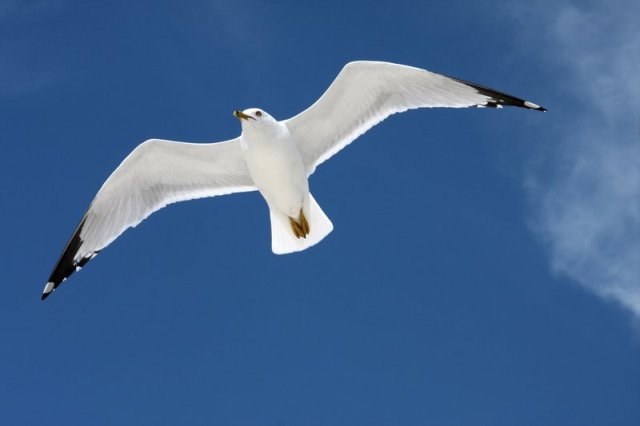
Are you Afraid? Yesterday I took a long walk by the promenade. It was dusk, and the tired sun sparkled gold across the ripples of a gentle sea. The sea was basking in an orange sunset. Watching the seagulls’ gliding and soaring was mesmerising. I just stopped and let it sink deep into my heart . It brought such peace, freedom and joy to me! No video can do justice to the Beauty of their flight!


I was reminded of Jonathan Livingston Seagull‘s daring before challenges. His Yes to Life:


“You have the freedom to be yourself, your true self, here and now, and nothing can stand in your way”.”

Are You Afraid?

How diametrically different to J. Alfred Prufrock‘s neurotic cowardice, futile death-in-life and paralysing procrastination:

“…To lead you to an overwhelming question …
Oh, do not ask, “What is it?”
And indeed …
There will be time … for a hundred indecisions,
And for a hundred visions and revisions … which a minute will reverse.
Do I dare
Disturb the universe?
 … Have the strength to force the moment to its crisis?
… And in short, I was afraid.
Surely “the mermaids” will not sing to him. “… Till human voices wake us, and we drown.” “Let the dead bury their dead” (Luke 9:60)

Are You Afraid?

“But the cowardly … –they will be consigned to the fiery lake of burning sulfur. This is the second death.” (1. Revelation 21:8)
 “And there we saw the giants, the sons of Anak, which come of the giants: and we were in our own sight as grasshoppers, and so we were in their sight. (Numbers 13:13)
“How do you say Yes to everything?”
[Interview with Mother Gabrielia (1897-1992), a 20th century saintly Greek Orthodox]

Three things we need in life: first, Faith; second, Faith; third, Faith. 

“I say yes because I believe that if it is not for my good God will make it so that the No will come from the very one who invited me.

Today I am ninety years old–may you live so long! I read again and again and again in the Gospels, and I see something strange. Jesus Christ comes and says to the Apostles, “Leave now what you have and follow Me.”

Now, if they said, “And who are you? Why should we lose what we have? Why should we lose our profit? Where will you take us? What will you do with us?”—if they had said that, what would have happened? They would have remained in darkness.

They said Yes to the Unknown who came and said, “Throw all that away!” Why? Because they believed in God, and they waited for the One who would say to them, “Come!” And that was the beginning.

Because if we say No, what will happen? . . . One or the other: If you believe, you will walk on the water like St. Peter. If you are scared–Bloop! Nothing else.

… He said to us, “Why do you worry? … Even the hairs of your head are numbered!” Why worry? Faith is lacking. May we have faith.


Are You Afraid?


In Love, For Love, and By Love: Missionary Series IV

Families on Mission Vs. Single Missionaries


Families on Mission Vs. Single Missionaries

RTE: How has it been having your family in the mission field?

FR. LUKE: When my wife and I first went to Albania, many people thought that it was going to be very dangerous and that our children would suffer: “You are going to deprive your children of all the benefits of life in America.” Contrary to that expectation, we feel that our three children who were raised in the mission field were immensely blessed by the experience of learning another culture and language. They always appreciated what they had in America when they went back, but they also appreciated their mission home in Albania, which they thought of as their “real” home.

*

They’ve grown up with a very different world-view. They appreciate things that they would never think twice about if they had grown up in America. During our first years in Albania, we didn’t have running water every day. So, the kids learned to appreciate it. When we had water, we’d say, “Thank God for water. It’s great to have it.” During different periods, for months at a time, the electricity is off about five hours a day; in winter, maybe seven or eight hours. So they got excited when the electricity came on. Or, if we did have electricity, the tension was often so low that we couldn’t do something as simple as watch a video. I remember on one of our visits to the U.S., they wanted to watch a video, and came to my wife saying, “Mommy, if there’s enough tension can we watch television?” They still flip the switch to see if the electricity is working.

Families on Mission Vs. Single Missionaries

Next to our house in Albania we had a very tiny shop, nine by fifteen feet, with all different types of food – this was where we did most of our shopping. Once, when we were about to go back to America, my son Paul asked his mother, “In America, will they have shops as big as Uncle Soorie’s?” We laughed. It was beautiful to see how they were exposed to a different way of life. We lived in Tirana, the capital of Albania, and we were constantly exposed to beggars, poor people who came to our house every day asking for help. It was wonderful for our children to see this, day in and day out. They got used to getting things for the beggars, answering the door and coming and saying, “Oh, so-and-so is here.” We got to know these people by name, we visited their homes. When you live in suburban America you aren’t even exposed to them unless you go downtown. Many of these beggars truly became friends, and our kids loved them. They loved playing with them and saw them as human beings, not as beggars.

Families on Mission Vs. Single Missionaries

Another blessing of raising children in the mission field is community, both the indigenous Albanian community, the wonderful local people that were part of our life, and our co-missionaries who themselves had numerous children. At one time we had fifteen missionary children in the field, and they created such bonds of love and friendship. They weren’t exposed to the busyness, to the constant activities that American children are involved in. Their lives were very simple, and very fulfilled.

*

Neither my wife nor I have any sense of their being deprived, and one of our greatest regrets in leaving Albania after ten and a half years is that we have left at a time when our children are still young, and we are not sure how much they will remember. We often talk about going back into missions when they are a little older so that they not only remember, but can participate more fully. Even though they were young, we tried to get the idea across that they themselves were missionaries, that they needed to be witnesses. To whatever degree they could participate in our different activities, they did.

Families on Mission Vs. Single Missionaries

RTE: Growing up with cultural diversity must not only teach what is universal in human nature, but how to deal with differences early on.

FR. LUKE: Right. We Americans, unfortunately, are quite isolated from the rest of the world. The universal business language is English, so we think we can get anywhere speaking English. Having only Canada to the north and Mexico in the south, we aren’t exposed to many different cultures and languages and this is a great loss for us. It’s so enriching to be around the diversity found in a mission field, and to learn to see beauty in such diversity. One thing I tried to get across to the Kenyans, and later to the Albanians, was, “Sure, in America we have things that are nicer than in Kenya or Albania, but you have many aspects of your culture and life that we Americans can envy. Family connectedness, the support you have for one another, hospitality – how beautiful these things are! Don’t ever lose these aspects of your culture and think, ‘We want to become western, or American, because America is better in everything.’ There are certain things you can adopt from America that are beautiful, but don’t lose the beauty and richness that you have in your own tradition.”

*

Hospitality was something that always left the greatest imprint on me. I could travel to the poorest village in Africa and they would put on a feast. It was their responsibility to show love and hospitality to guests. It is the same in Albania. I don’t know who is more hospitable, the Albanians or the Kenyans, but they would put anyone in the West to total shame. Having almost nothing, they share whatever they have with whoever comes.

Families on Mission Vs. Single Missionaries

RTE: An American seminarian at Holy Cross Seminary told me about a depressed acquaintance who called one night, feeling suicidal. The seminarian invited him to come to the seminary for a few days for a change of scene and to be in a calm atmosphere. He agreed and the seminarian made the arrangements and cleaned an empty dorm room so that he could have his own space. The day his friend moved in, one of the Greek-born seminarians found out what was happening and insisted that the man take his own room, which contained his books and belongings, icons that were prayed in front of, and was a real home. The Greek seminarian slept in the hall on a couch outside the door so he could check on him through the night. The American seminarian said, “You know, I was so pleased that I’d found him his own space where he could have some privacy, where he could put his own things up – but actually what he needed was to be taken into someone else’s home and taken care of. I didn’t get it until I saw it.”

FR. LUKE: Yes, this virtue of hospitality is something missing in our American way of life. As missionaries, my wife and I saw hospitality as one of the greatest ways to express God’s love to the people. We wanted our home to always be open to people. We married right at the beginning of our time in Albania and it is interesting to think that my wife and I slept in our house alone perhaps three months out of the first five years of our marriage. We always had people coming, numerous people staying for months at a time. Our open home was a hallmark of our ministry. Even after the children started coming and we didn’t have as many overnight guests, we always had an open-door policy. There were people at our house every day. One of the difficult counter-cultural adjustments in coming back to America on sabbatical was that although we lived on campus at a seminary, no one came to visit. We lived there for four months and maybe a handful of people came to our house. And even when people came, they’d say, “I’m just here for a minute, I’ve got to run…” They’d stay briefly and then go on with their day.

Single Missionaries

Families on Mission Vs. Single Missionaries

RTE: We’ve been speaking here of missionary families. What opportunities are there for unmarried men and women? And in view of cultural differences, are single women limited as missionaries? What part do they play on a mission team?

FR. LUKE: The mission in Albania offers a good response to this question.

Families on Mission Vs. Single Missionaries

During the years I served there, of the 20-25 missionaries we had at any one time, we had a nice mix – usually about eight monastics, eight married missionaries, and six or seven single missionaries. Of the two dozen missionaries, about half were men and half were women. Also, about eight were clergy, and the rest laity. The unmarried missionaries played an important role in the overall outreach of the Church. In Albania, we had single missionaries who headed up our medical clinic, our elementary school, our post-secondary professional institute, as well as our development and emergency relief office. We also had single missionaries who taught at our seminary, who taught English in a variety of contexts, taught catechism, worked in administration, and who participated in our university ministry, among other things.

Families on Mission Vs. Single Missionaries

The Body of Christ has a need for everyone – men or women, married or unmarried. It is the same for the mission field. In fact, when a missionary team has a variety of members, it makes the overall witness that much more effective. Some people will relate well to a monastic. Others feel more comfortable with a married priest. Some prefer to approach a mother, or a married woman. Still others will listen to a single man or woman. All are part of one body, offering a unified witness. So there are surely opportunities for the monastics, the married, and the unmarried! In some countries, it isn’t appropriate for men to approach women and talk with them in public. Such societies need women missionaries, and this means both married and single women.

*

In the Protestant world of missions, single women really weren’t encouraged, or even allowed, in the mission field until the 1800’s. By the 1900’s, women outnumbered men as missionaries. Today, women far outnumber men, and this includes many single women. Women had to overcome many obstacles and prejudices before being allowed to serve in a variety of capacities, and this may be the same for the modern Orthodox missionary movement.

*

RTE: Do you have any specific counsel for unmarried missionaries?

FR. LUKE: My advice for single men or women is that they must be ready for some additional challenges. The loneliness of a new culture, the challenges of entering a new country, the frustrations of learning a language, and the normal difficulties and disappointments of the mission field can be overwhelming. As a married missionary, you have your spouse to support and comfort you; the monastics may be living in community and have another type of support; but the single missionary can feel the loneliness and frustration in a magnified manner. A single person has to be ready for these added challenges. He or she needs to be a strong person, and also be able to find support in time of need. Their co-missionaries need to be sensitive to this extra burden, and try to reach out to them.

Families on Mission Vs. Single Missionaries

One way to help overcome these additional struggles would be for single missionaries to live in community, either with other missionaries of the same sex, one of the missionary families, or even with an indigenous family. Living with a family of the country can be one of the fastest ways to learn the language, culture, and ways of the host country. Of course, other challenges may arise as cultures clash and one’s privacy may be lost.


The Importance of Being in a Place

split23


In an early comedy sketch show on the radio, much loved by Metropolitan Kallistos, one of the characters Seagoon finding another character Eccles in a coal cellar asks: “What are you doing here?” Eccles replies “Everybody’s gotta be somewhere!” Eccles portrayed as a rather silly youth, has a special talent for taking things he hears literally, but in so doing often shows a profound insight.

*

From a slightly later vintage, some may remember Robin’s song from the T.V. Muppet Show. In innocent reflection he sings:”
Halfway down the stairs is a stair where I sit.
There isn’t any other stair quite like it.
I’m not at the bottom, I’m not at the top.
So this is the stair where I always stop.

*

The original version of “King Lear” (1605), William Shakespeare contains the line: “Jesters do oft prove prophets”; from where we gain the expression ”many a true word is spoken in jest.” The fool, whilst seen to be a jester, has his place in the plot, pointing to a truth which the “wise in their own eyes” fail to see. (Isaiah 5:21)

*

A hermit was once asked by a visitor “What do you do?” The hermit answered ”I live here!” The old English words “dwell” and “abide” for “live “conveys the sense of remaining fully in a state of stability. An embryo dwells in the mother’s womb, growing and being nourished in the darkness until the time of birth.
On meeting someone for the first time we often ask” What do you do?” as if someone is defined by their job or status! Our Lord did not judge people by what they did but he had empathy with who they were and had insight into the potential of what they could become. We are not “Human doings “we are “Human Beings.”

*


In order to “be,” to be fully in the present moment, to be fully alive, fully aware, we need to have stability of place. Constant movement is not good for the spirit. With too much movement we become like children who spin round and round and when they stop they are dizzy and fall over. Much could be said about the work/ life balance in today’s society but sufficient to say that we need to be aware of the limits and integrity of our mind, body, spirit and the heart.


*

Place is the dimension of revelation. God appeared to Moses on Mount Sinai, Christ revealed His Divinity on Mount Tabor, St John received the Revelation of the Apocalypsis in the Cave on Patmos. From the beginning God has given us a place to be: Genesis 2:15 ” Then the Lord God took the man and put him in the garden of Eden to tend and keep it. “The place where we live is both the place of our daily routine and our spiritual life. Our daily duties are not separate from our spiritual life. Prayer is not separate from work. Our Icon Corner is the Church in the home and becomes the centre of our being in that place.


*


The saints were made holy in their cells, in caves, on islands, in trees, on platforms in the sky, in their places where God broke into their lives. One senses the holiness of places that are infused with prayer and built by ascesis. Go to the cave of St John in Prislop Monastery in Romania, visit the underground cell of St Gerasimos on Kefalonia, row across Derwentwater to St Herbert’s Island- you will find the grace of God.


*


Even when their bodies are separated from the souls, the grace remains in both. Their soul is apprehended invisibly. St John of Damascus says that “the holy relics of the saints, their icons, their graves, are full of grace which their souls and bodies had whilst on earth.” Since men and women are composed of soul and body, both need theosis, both need a place to be. Even when their bones have disappeared the place where they lived has become holy-sanctified- a place of refreshment for our spirit.


*

Like Eccles we have to be somewhere- but not anywhere! If we are in the wrong place then we will have no peace until we find the right place. God has given each of us a place to be.
Fr. Jonathan

How Often Should We Receive Holy Communion?

holy-communion-1


How Often Should We Receive Holy Communion? A Story

Probably the one thing that I found most puzzling during my Romanian monasteries pilgrimage is their attitude towards Holy Communion. All the days of the Suzana monastery retreat, during the Holy Liturgy nobody in the church received Holy Communion, other than the priest, not even any of the nuns, nobody! This is probably the only thing I did not like about ‘Romanian’ Orthodoxy , and I am not really sure if this attitude of theirs is an appropriate interpretation of the Fathers’ teachings.


In Greece, at the US, at the UK, everywhere I have been and I can remember having participated in Holy Liturgy, when the priest takes up the holy Cup, he proceeds to the Royal Doors, raises the holy Cup, and ‘issues an ‘order’: “Approach with the fear of God, faith, and love.” It feels so strange to listen to this in a Romanian church and immediately proceed to “Save, O God, Your people and bless Your inheritance”, with the priest lifting the holy Cup and saying: (Blessed is our God.) “Always, now and forever and to the ages of ages. Alleluia”, while NOBODY in church has received Holy Communion! I repeat NOBODY! Who is the priest blessing then?


What is the point of all Pre-Communion and communion hymns, recited and chanted, nonetheless? So, during an ordinary day, this part of the Holy Liturgy, “The servant of God (Name) receives the Body and Blood of Christ for forgiveness of sins and eternal life” is blatantly omitted! Are they then re-writing the text of St Chrysostom’s Holy Liturgy? And what about: “We have seen the true light; we have received the heavenly Spirit; we have found the true faith, worshiping the undivided Trinity, for the Trinity has saved us.” Why bother chant this, when NO ONE, I repeat NO ONE receives Holy Communion!


What is then the point of chanting “Let our mouths be filled with Your praise, Lord, that we may sing of Your glory. You have made us worthy to partake of Your holy mysteries. Keep us in Your holiness, that all the day long we may meditate upon Your righteousness. Alleluia. Alleluia. “, if NO ONE partakes of the Sacrament? And is this canonical for the meaning and existence of the Church as Christ’s mystical Body that only the priest partakes of the Sacraments? I am certainly open to suggestions and other pinions, but isn’t this ‘exclusive’ treatment of the priest distinctively non-Orthodox, possibly reminiscent of a Roman Catholic influence?


I found even more puzzling the fact that instead of the Body and Blood of Christ, the faithful are ceremoniously offered at the end of the Eucharist Holy Water and Antidoron instead ! [ie. antidoron (Greek: Ἀντίδωρον, Antídōron) is ordinary leavened bread which is blessed but not consecrated and distributed in Eastern Orthodox Churches]. In all Greek monasteries I have been, Holy Water and Antidoron are offered daily at the end of Matins [ie. Morning Prayers Service] to everybody, certainly not at the end of Holy Liturgy. Lest I be misunderstood let me add here that this custom is strictly observed on days when no Eucharist follows. For surely why on earth would there be Antidoron and Holy Water at the end of Orthros if one is going to partake of the Holy Communion, or even if they wouldn’t? Antidoron (instead of the gifts) is given out after communion, and after the liturgy is completed as a blessing from the celebrant priest. To offer it after Matins would break the fast for the Liturgy. But when no Holy Liturgy follows, then they offer it as a gift and a blessing for the day. But what a confusion with what is going on in a Romanian Holy Liturgy! It really feels as if the Romanians have kept the text of the Holy Liturgy, but re-invented some of its ‘events’, the ‘happenings’, its ‘conclusion’ indeed!
 

Sadly (as far as I am concerned) such an attitude is observed everywhere, not just in a ‘strict’ monastery environment, but in all Romanian parishes. This would never happen in Greece, indeed COULD NOT, and maybe in all other orthodox countries I have visited. I am told by the abbess that even nuns, whose lives are dedicated to prayer, normally receive Holy Communion only once a month (!) and only during major feasts (!), unless they ask for a ‘special’ blessing to receive Holy Communion as an exception (!), because they feel a very deep urge and need. Lay people need to make their confession immediately preceding each Holy Communion, 1 or 2 days before at the latest, to the extent that a priest will not offer Holy Communion  to them at all, even if they want to; he may even refuse them Holy Communion, because he suspects the faithful has not offered properly his Confession before. Interestingly enough, no priests were available, even though we were in the church, to listen to anybody’s confession, should someone decided to ‘go by the rules’, and confess in order to receive Holy Communion.


I remember having a particular conversation with a Romanian priest, very close to me, like a spiritual father or godfather, asking him if I am allowed to receive Holy Communion here at the monastery, reassuring him that I had confessed to my spiritual father 9-10 days before the trip. I received the following very sobering answer: “Mmm, I am not sure. So many days have lapsed. I will have to ask him to see what he thinks right.” (Sigh) Oh dear, but surely we are NEVER worthy of Holy Communion, even if just an hour has lapsed from our last Confession!


In the end, I did receive Holy Communion, right before I left Romania, holding a lit candle, following the Romanian style. Again I was the only one to receive Holy Communion in a packed church, full of faithful reverently praying, bowing, making prostrations, kneeling. The ‘exception’ was made for me because the priest who knew me explained my ‘situation’ to the Romanian priest and allowed me to receive Holy Communion because I was traveling that day, as a special blessing and protection.