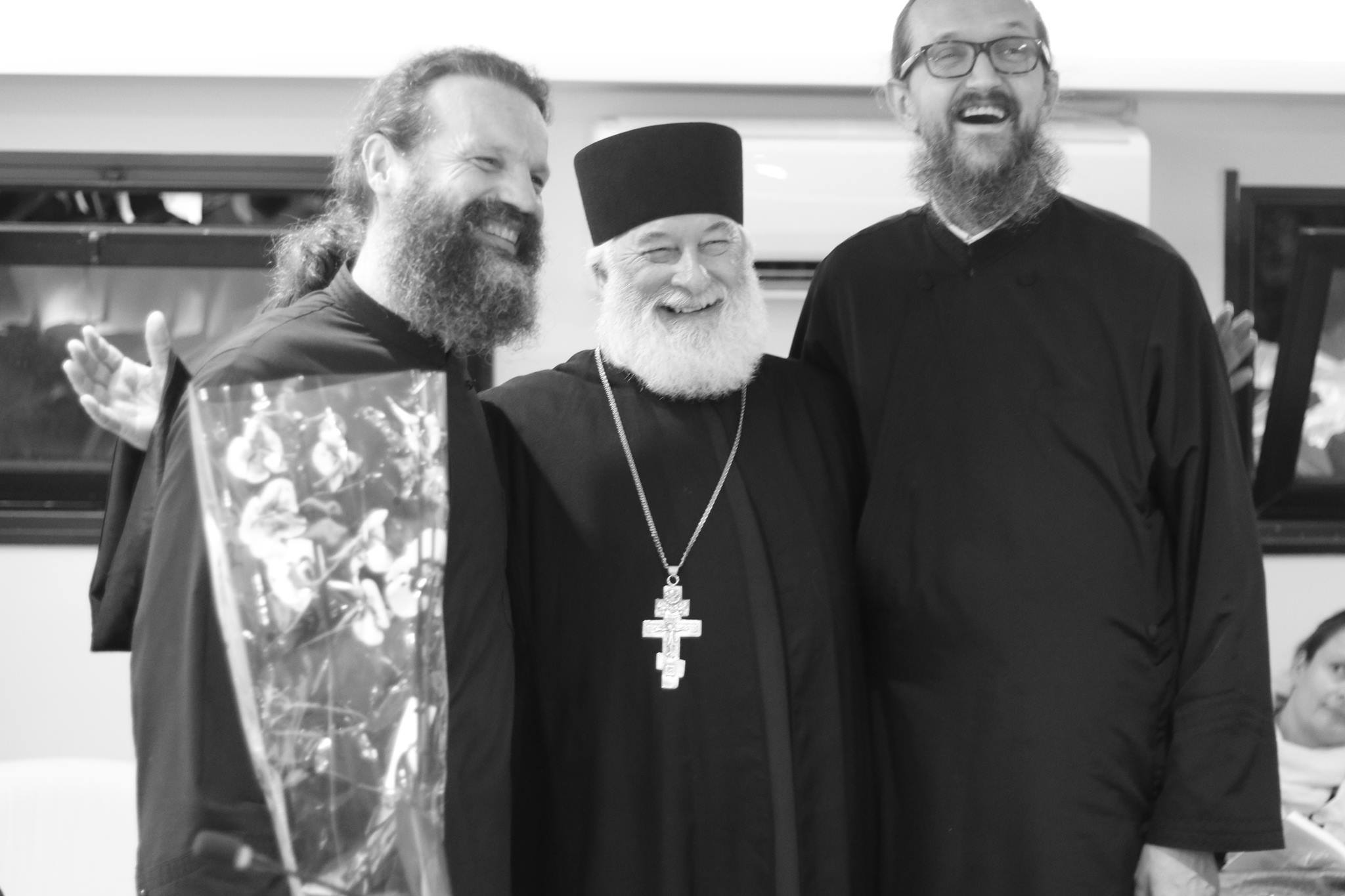
A Man of God

The Portrait of a Spiritual Father
A Man of God, Father Symeon Kragiopoulos, The Theologian and the 'Liturgical' Being

In Memoriam

+ Father Symeon Kragiopoulos

“It is with some trepidation that I set pen to paper to record -what? What can one write about a personality whose holiness and spiritual wisdom stretched over many decades, who was shepherd to thousands of souls, saving them from destruction and bringing them into ‘a place of verdure’? About the comforter, the advisor, the father, the refuge of every soul in pain and every confused thought? About the last person who walked and strove in the ascetic life with the holy fathers whom God was pleased to give our generation, those who died to live, because, in living they were dead to the world. ‘so that the world may live’ through Christ, to Whom he brought it through his way of life, his teaching and his prayers? What can one say about a man who rivalled Saint Païsios in his humility, Saint Porfyrios in his discernment, Father Sophrony in his wisdom and Elder Iakovos in his love?

Considering all the above, when I was asked by the spiritual children and heirs to the holy legacy of Elder Symeon to write something In Memoriam, I initially declined for fear that I would not be able to paint a proper picture of him in words, that I would diminish his spiritual stature by not being able to render, even faintly, what the late father really was. What only made me agree to write was the fact that I’d known him for almost half a century and that our relationship was not merely one of spiritual fatherhood, but also one of close friendship. So, with the proviso that I will mention only my personal experiences,  let me begin. (*)

A Man of God

In September of 1969, I’d just taken up a position at the University of Thessaloniki. I visited the Pournaras bookshop, which was at that time not merely a place for selling books but somewhere where colleagues could meet. It was a reference point, you might say. Browsing through the new books spread out on the counter, I heard someone ask Panayiotis Pournaras. ‘I’ve heard that there’s a new professor at the university. A Mister Galitis. Do you know him?’ I turned and saw a pleasant-looking figure, a priest with a red beard, a tranquil look about him, kindly eyes and a bright smile, just at the moment when Panayiotis was pointing to me, ready to make introductions. We chatted for a while and I was impressed by his interest in the new books and also by how well he was up in theological matters. He was following the current theological situation, which was hardly common among priests dedicated to their pastoral work.

I saw Fr. Symeon shortly afterwards at the headquarters of the Metropolis. He’d been appointed a member of the Supervisory Committee of the Seminary, where he’d been Director. The Chairman of the Supervisory Committee, a highly placed cleric, with all the exuberance he could command behaved towards Fr. Symeon with excessive familiarity, with his teasing and slightly ironic and disdainful manner, which made me, at least, feel awkward.  But Fr. Symeon was undisturbed and behaved like an ‘altar-boy’. He made an obeisance and remained silent. My discomfort then became admiration for the wonder of humility.

The Theologian and the ‘Liturgical’ Being

Fr. Symeon’s office in Saint Theodora’s was in the right wing, on the first floor. He asked me to visit him there, which I often did, most gladly. He came to my office, too, but not so often because he couldn’t leave the School much. I recall with nostalgia our long discussions on spiritual, theological and ecclesiastical matters. He was a profound anatomist of the soul and, at the same time, an erudite theologian with rare learning, which he was always trying to increase. He discussed well, had a clear mind, breadth of spirit and a particular sharpness. He would grasp a subject quickly and was comfortable even talking about secular education.

Later, he began vigils at Saint Theodora’s. At one of these he had the joy of tonsuring one of his spiritual children. Fr. Symeon was the person who introduced this new form of vigil, which did not last all night, but covered two or three hours before midnight, and about an hour after, with a half-hour homily. In this way, people who were working and couldn’t get to a liturgy in the morning and for whom an all-night vigil would have been too much had the chance to participate in liturgical life. This practice found many admirers and is now popular in many parts of Greece and abroad.

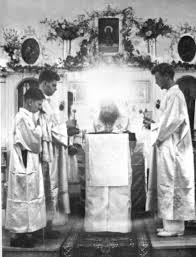
Every liturgy Fr. Symeon served was a real and literal initiation into the sacrament. It was solemn, neither drawn out nor hurried, without highlights, but not monotonous. At first, he didn’t have chanters. Anybody who could would do their bit. Even I chanted on occasion. These first impromptu chanters usually sang poorly and this created the impression that Fr. Symeon actually wanted this: low profile, no special effects. This would encourage contrition. A friend of mine told me off once when I departed from this ‘rule’.  But soon proper chanters began to appear and the cultivation of music became part of the whole training the people acquired by being close to the blessed Elder.

*

At church … twice as healed

At church, man is freed from the demonic influence

and the traps the devil sets.

At church, man is healed.

These are not just words. It’s the truth.

The sacrament of the Anointing of the Sick

is for the healing of our illnesses.

If we are not healed,

we don’t need to be healed,

that’s why we aren’t.

If you take it this way, you are already healed.

You know very well that an illness which lingers

and doesn’t go is precious.

Whatever needs to go, God will take away.

Whatever doesn’t need to stay, God will take away

be it an illness or demonic influence.

And for whatever stays on and hurts us

we pray to God.

We should pray many a time,

time and again should we beg,

not only for deliverance from soul illnesses

and the demonic influence

but also for deliverance from body illnesses, as well.

Let us pray to God for everything time and again.

Not because God needs us to pray to him again and again.

We need to do this again and again,

because, precisely, God wants to see our faith.

Man, especially today,

gets used to something by repeating it,

learns something by reapeating it.

If you pray time and again

–you need to do this–

and God doesn’t relieve you of your illness, know that:

either you have not shown

as much faith as He wants and expects from you,

or that the illness should not go

because it is necessary.

If you take your illness issue according to God,

then, by it remaining,

you feel twice healed.

If He heals you, you are healed once.

If the illness lingers,

you feel healed twice.

Because both when time comes

 will you be healed from your illness

and until the right time comes to be healed

will your soul be healed, too.

Your inner person will be healed,

this person who suffers from illness,

from the leprosis of sin.

The same goes for all mental illness

and whatever else hurts us.

If man sees all his issues

within the providence of God,

he will feel such a relief,

as if all his problems are solved.

Because in God

all is resolved!

Holy Hesychasterion “The Nativity of Theotokos” Publications.

Archimandrite Symeon Kragiopoulos


 (*) This tribute was written by Professor Georgios Ant. Galitis and offered to the faithful in the Holy Trinity Monastery, Panorama, at the end of the 6 months Memorial Service for Fr. Symeon. The poetry/homilies excerpts are from orthodox path.org

(To be continued)


Christians of Comfort


fr-symeon1

Annual Memorial Service of Father Symeon Kragiopoulos

Last month in Greece, I had the blessing to attend Church services at both the women’s Monastery of the Nativity of the Theotokos  and at its twin ‘brother’, the men’s Monastery of the Holy Trinity, at Panorama, the suburbs of my hometown, Thessaloniki.  Elder Symeon Kragiopoulos was their spiritual father and abbot. He  passed away last year, at 6:00 a.m. on September 30, 2015, but even after a year, his presence is still felt everywhere in both monasteries.

He was known throughout as a true elder and teacher. I would like to acknowledge here his zeal, patience, kindness and loving example. He has been in so many ways a spiritual signpost of the faith for my own journey through the desert. What an authentic, uncompromising, and yet gentle, loving, kind, compassionate contemporary Elder, what a  heaven-endowed, grace-filled rock of Faith and consolation, a true voice in the wilderness in our times of apostasy! Oh I have been so blessed to hear him preach in my youth, probe into the Niptic Fathers and the Bible, and have attended for years his church services, especially ‘his’ vigils, and his famous silent assemblies, dedicated to the Jesus Prayer, when I was not studying or working abroad.  I even had the blessing to spend invaluable, private time with him as a spiritual father, helping me prepare for my postgraduate studies, work and life at the U.S.A.

In recent years he largely kept silence due to his failing health but he was known throughout as a God-bearing elder and teacher of the true faith. Throughout his life-long ministry, culminating in the prayerful silence of his final, ‘hermit’ years, Elder Symeon has been a rare gift of God, especially for us Thessalonians. In so many respects, Thessaloniki will never be the same after his humble, God-fearing ministry, and we can never thank enough God for the blessing of walking along the Way with such a venerable Elder by our side. His tomb is already a pilgrimage site, and his spiritual children kneel and pray there for hours for his guidance, fully aware that now he is closer to us in the Holy Spirit. Whenever I read his books, or listen to his recorded homilies, the joy and jubilation of Resurrection warms my heart and tears are streaming from my eyes, for the Venerable Elder who was our staff, for the Man of God whom we knew and loved and in whom we placed, after God, so many of  our hopes. We felt so loved and so safe in his presence!

The elder leaves behind many soul-profiting words, and the faithful invariably testify to a presence in Holy Spirit of the Elder, even while ‘simply’ reading or listening to his homilies:

Like the deep sea…

Spiritual work happens secretly in the heart. Externally, let everything else threaten us, like the sea: the wind blows, waves rise. But deep down it’s all quiet, peaceful, serene.

This is how a man who trusts in God lives. There might be a wild rage out there, but deep down nothing hinders the soul from having mystical communion with God, mystical love for God. Quietly and mystically, in a special way that the heart perceives, the Lord is whispering: “Don’t be afraid. I am here. Keep walking this path. Keep loving Me, keep believing in Me, keep following Me.”

It’s not enough to suffer myriad things in life. When, though, you believe in God and accept all these—whatever it is that happens to you—accept all these gladly, for the love of God, God will make a saint out of you.

Man will find all, but after he has lost all, after he has deprived himself of all. It matters greatly for a man to deprive himself of the most beautiful, the best, the most innocent, the purest things, which the Lord Himself has deprived himself of.

It matters greatly for man to deprive himself of things because he loves God.


We run to the Lord with pain 

However, we know that we have a Saviour, we know that Christ came to earth. Then we start to understand what it means that he came to save us, and we run to the Saviour. We run to the Lord with pain, with prayer, with a cry, with faith, with hope and a firm conviction that the Lord will accept us and will save us. The Lord wants us to approach things exactly like this. This is not our own daring or our own boldness. He wants us to act just like that, to entrust ourselves in this way, and for this reason he gave us promises. So someone does this work, and little by little the decay of his soul, that lies in the subconscious and the unconscious, emerges.

* * *

Self-worship lives and reigns …

For us to have right communion with Christ, it is necessary that our entire soul becomes conscious, that it comes into the light, into the grace of God, and that nothing remains in darkness. However, no matter how much someone believes, no matter how much he, every day, makes a new start in the true life and struggles to give himself and devote himself to God, he must realize this vital point: that within him, the ego, pride, and selfishness, live and rule. This self-love, this self-worship, lives and reigns. Therefore, man must become humble: every day, he must increase in humility. We have many things, many realities from our everyday life that help us with this work.

He who truly loves humility, and desires to become humble, begs God for this. In this way, in the beginning, and imperceptibly –later perhaps more truly—he starts, little by little, to feel this, the emptying of the soul from the ego, from selfishness, from the idol which we have installed within us. And so if one is completely humbled, he surrenders himself to God and is devoted to him—meaning that every day he makes a new beginning, from which the whole object of his soul will finally come into the light of God—in truth, man will arrive at this state which the Lord promises to us.

           But what is this state?

The Lord didn’t come simply to die Himself. Rather, He said that we will also die with Him. And in the same way that He Himself resurrected, we will also be resurrected. Whatever Christ is after the resurrection, this man also becomes when he is united to Christ. He is not simply a good man who thought up some good things. Christian means little Christ. In the end, Christ will make each one of us whatever He is himself. He does not simply advise us from the outside, but enters into us and takes us into Himself. We are united and become like unto Him. Even from this life we become like unto Christ, but this will become complete in the next life.

I pray this for all of us.


Christians of comfort

We are Christians of comfort. That’s why the Lord will let us struggle a lot.

Don’t expect salvation with certainty, unless all comforts are abolished in you.

Our whole Christian mentality functions wrongly.  On the one hand, we want to avoid suffering. On the other, we take great care not to lose or deprive ourselves of anything. And we “walk” in the wrong manner.

In the long run, whether we like it or not, we will have suffering. And indeed, when we have a fake impression that we are enjoying the goods of this world, our life is often like hell.

***

These words, and many more can be found here.


Memory Eternal, dearest pappouli! May we meet you in Heaven!

*  *  *

In the following days, I am going to present a tribute to Father Symeon, together with excerpts from his homilies and a few recordings, for those of you who are hearing about this venerable elder here for the first time. Even if the recordings are in Greek, I trust the spirit of this man of God can be felt through and richly bless us all.


Fountains in the Desert

Book launch by En Plo Publications in Athens

   fathers.jpg

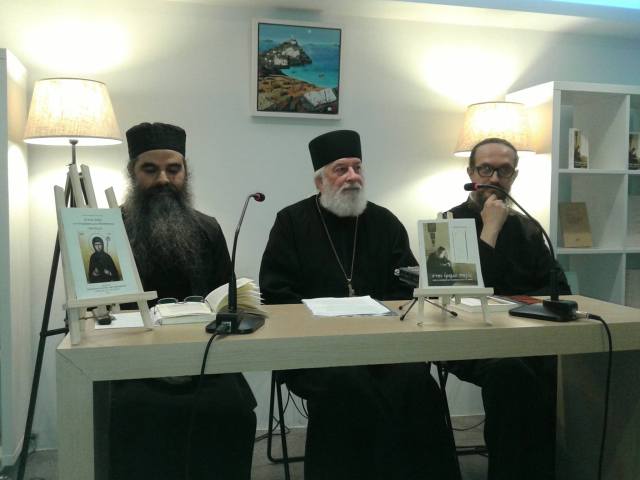
This event has been a most humbling experience! The ethos of the two panel speakers, Hieromonk Chrysostomos of Koutloumousiou Monastery, Mount Athos, and Fr. Bogdan-Konstantin Georgeskou, and that of the author himself, Fr. Jonathan Hemmings, permeated all the events. Such love and humility, especially in the face of various trials and tribulations, the least being an airline strike (!) impacting with its last-minute flight cancellations our speakers’ trips, felt like a rare blessing in “the apostasy of our times”. Fr. Seraphim’s Rose warning “Do not be deceived !” “It is later that you think, hasten therefore to do the work of God” is a favourite motto of  Father Jonathan, his spiritual grandchild.

The book presentation proved to be a Panorthodox Synaxis, truly ecumenical! So many Greek, Romanian and English Orthodox friends turned up. En Plo Bookstore was packed out! The occasion provided everybody with the grace of fellowship.

icon7

Hieromonk Chrysostomos, the first panelistsummed it all aptly in the opening sentence of his presentation: “I have not come here to introduce or recommend the book, which needs no such thing, as this is evident to anyone who begins to read it, but I have come here, all the way from Mount Athos, to meet its author!” 

Because “cradle Orthodox” have so much to learn from “Orthodox converts“! (One of the ‘ironies’ of this event was that in the many conversations which followed with priests, academic theologians and lay people, Father Jonathan, himself a ‘convert‘, had to repeatedly ‘defend’ Orthodoxy from ‘cradle Orthodox‘ faithful, from their disillusionment, doubts, and confusion about ‘their’ faith).

For Hieromonk Chrysostomos presentation, “Monasticism as Unity and Overcoming Divisions” go to http://www.pemptousia.gr/video/ierom-chrisostomos-koutloumousianos-monachismos-ine-i-enotita-ke-i-ipervasi-ton-diereseon/

A vignette of the occasion which was indelibly marked in my heart was the author himself, in front of the audience in the packed room, all quiet during Hieromonk Chrysostomos’ presentation, deeply immersed in prayer, bending in humility his head, radiant, otherworldly, silent, and yet so eloquent, so full of the Holy Spirit amidst all this noise and praise in the crowded building. And I write ‘building’, because both floors were packed, and people were also waiting outside the book store too!

The long queue of the author’s spiritual children at the end of the book launch, their love and gratitude was such a heartwarming experience on its own! “And they shall come from the east, and from the west, and from the north, and from the south, and shall sit down in the kingdom of God.” (Luke 13:29) So many memories, of his life and ministry, of his works and his deeds, of love, which will continue in them and in their families. Father Jonathan was himself visibly moved to be with his spiritual children and dearest supporters of the ‘crucified’ Community of the Holy and Life Giving Cross in Lancaster, England and meet new friends in Christ and make further ‘connections’ in the Holy Spirit with those who are part of Christ’s extended family.


book launch.jpg


The two panel speakers’ presentations were outstanding, and the author impressed the audience with his profound humility, his love for everybody, his wise words, the purity of ‘his’ Orthodoxy, his poetry and his knowledge of the Greek language:

“It is with a profound sense of thanksgiving that in humility I thank you for publishing “Fountains in the Desert.” It is the product of a long lived admiration for those who found the desert to be a treasury of blessings. I have simply woven my own experiences into this mystical landscape. Any worth in it springs from the overflowing love of God for me, a prodigal, and to those whose zeal, patience, kindness and loving example have been spiritual signposts of the faith for my own journey through the desert.

Such salvation is experienced when one is thirsty for the Truth and the saints who Christ sends, provide the living water from which one drinks deeply of the sparkling fresh fountains of our Orthodox Christian faith. I wish to recognise in particular the heaven endowed, grace-filled influences of His Eminence Metropolitan Antony of Sourozh, Archimandrite Barnabas of New Mills, Archimandrite David of Walsingham, Archpriest Michael Harper and Hieroschemamonk Ambrose ( formerly Fr.Alexey Young) the spiritual son of Blessed Seraphim Rose, who chrismated me .

The Apostle Paul writes to the Christians at Ephesus:

Ephesians 5:2

“Walk in the way of love just as Christ loved us and gave Himself up for us as a fragrant offering and sacrifice to God.”

When we drink deeply from these sparkling springs and living waters of Orthodoxy, there is an inevitable outpouring of love to sustain us in our journey and an inexpressible joy to share this life giving water with others who thirst after truth. This is the life of the Church, to share the Gospel.

Luke 13:29


29 And they shall come from the east, and from the west, and from the north, and from the south, and shall sit down in the kingdom of God.

So we have much to do- because for to those who have been given much, much is expected. We rejoice with those returning to the Orthodox Church. We weep with those who find themselves exiled from their lands. We are warmed by the fact that so many of our parishes are microcosms of Pentecost with faithful being welcomed from all over the world regardless of nationality. We thank God that we witness strength of faith and growth in His Church and we ask empowerment for the apostolic mission set before us to bring God’s love to a hungry and thirsty world.

The glory of God is revealed in joy. The mercy of God is experienced in suffering. The grace of God is discovered in fellowship. The power of God is realised in miracles. The love of God is manifested in mission. Our dialogue is with heaven, even in the deserts of our cities where we encounter ourselves, the evil one and God. Christ only speaks one language and that is the language of love for His creation. May His love give voice to our faith.” (excerpts from the author’s presentation)

*

Fr. Jonathan‘s interview following the booklaunch has been videotaped by pemptousia.com and will appear shortly.

*

The Orthodox Christian Parish of the Holy and Life ­Giving Cross at Lancaster (United Kingdom) belongs to the Antiochian Orthodox Christian Archdiocese of the British Isles and Ireland, is a relatively small parish led by Fr. Jonathan, but with faithful from more than half a dozen nationalities, a ‘crucified’ parish, literally ‘on the move’ for over 20 years. After 20 years of using borrowed premises (a quite typical situation for ‘convert’ Orthodox parishes at the UK), they are renting a former Anglican church St Martin’s of Tours Church from Friday to Sunday evening, in order to serve the needs of the Orthodox Christians in the Lancaster area.  To this end, they are making an appeal to raise funds to cover the rent and other needs of the Church on a permanent basis. Apart from your much needed prayers, you can find information on how to contribute to their fund raiser here. The proceedings from this Greek translation of the book or the English original will be likewise used to cover basic needs of the Church. The Holy and Life ­Giving Cross at Lancaster is a lively parish which enjoys Christian fellowship, having meals together and taking part in pilgrimages to Orthodox monasteries, churches, ancient Christian sites and other worship places (photos), produce a newsletter each month with their news and spiritual food for thought, and is engaged in a number of holy tasks.

When Demons Speak

 At St. Gerasimos’ Feast

St. Gerasimos of Cephalonia Feast Litany Miracles 


St. Gerasimos the New Ascetic of Kefallonia (+1579) is known as a renowned healer of the mentally ill and a grace-filled exorcist of the demon possessed. They flock to his holy shrine which contains his incorrupt relics to receive healing. His nickname is “Kapsalis” (“the burning one”), after the desolate place of Kapsala on Mount Athos, where the Saint lived as an ascetic.The demons cry out: “Kapsalis, you have burned us.”


An eye-witness: “When the priest was performing the Holy Unction, a demon-possessed woman was screaming in convulsions: ‘Is it not enough that the old priest that stays here doesn’t leave me in peace day or night, and today you with the oil, the two of you will burn me?’ As soon as she was anointed, the demon was so shaken that the woman fell down unconscious but she was freed by the grace of the Saint.”


Another: I happened to be traveling in Kefallonia during the feast of St. Gerasimos. When I arrived at the monastery, loud screams were coming from the demon possessed in the church, saying: “You are burning me, Gerasimos. You are burning me Kapsali.” Everyone understood in the church that there was a spiritual battle going on around them at that moment that they could hear but not see.


The Saint ‘Gets Up’!


A most solemn moment, as the Saint is ‘allowed’ in the vertical position

only during his Feast and Litany.

And His Litany

“As the sun you emerge from Your church Gerasimos, and with heaven’s angels you ascend the heights”.


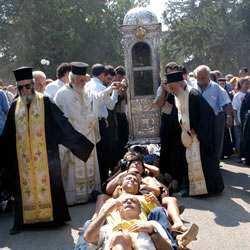
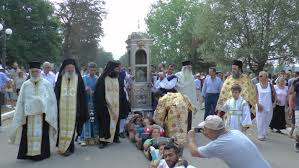
On Aug 16 the Saint’s relics are carried in an upright position in a procession for 500 metres. The procession starts at the church and proceeds down a wide road lined with poplars as far as a spreading plane tree where there is a well which is said to have been dug by the Saint himself.


Tradition has it that Omala valley exclusively receives His Blessing. Many times it was attempted to remove Him from here, without success. A little further down on the road to Troianata, the location is called “podoria” and it is the place from where He could be moved no further. He would become heavy.


Among the procession, the Saint is in the middle, raised high, untouched by time, in His clerical robes which like His body did not perish in the grave.


“A five-branch plane tree and a deep well you left for us Gerasimos as an eternal sign”


He will rest at the Well that He dug, under the shade of the plane tree – The water in the Well will overflow and the leaves of the plane tree will thrush to greet The Master.


Hours before the litany begins, people struggle to secure a position to lay down anywhere along the procession’s way so that the Saint may pass over them. The Litany  is the peak of hope for miraculous healings.


St. Gerasimos of Cephalonia Feast Litany Miracles


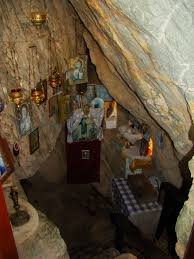
The older church containing the relics of St. Gerasimos is built directly over his cave and pilgrims are welcome to descend the ladder and squeeze through the tiny floor-level entrance that leads into the cave.

St. Gerasimos of Cephalonia Feast Litany Miracles


This August the Lord granted me the special blessing to take part in all this. An indelible pilgrimage for both the profound mourning that was searing my heart and the healing ointment of forgiveness that is still working wonders in my life.


Living Waters


desert3


Isaiah 43:19

19 Behold, I will do a new thing,

Now it shall spring forth;

Shall you not know it?

I will even make a road in the wilderness

And rivers in the desert.


John 4:10

10 Jesus answered and said to her, “If you knew the gift of God, and who it is who says to you, ‘Give Me a drink,’ you would have asked Him, and He would have given you living water.”


John 7:38

38 He who believes in Me, as the Scripture has said, out of his heart will flow rivers of living water.”


John 19:34

34 But one of the soldiers with a spear pierced his side, and forthwith came there out blood and water.

*

Listen!


A person’s response to God’s offer of salvation is a matter of engaging the will, faith and action.

Without the will there is no movement,

Without faith there is no direction,

Without action there is no reward.


To discover Living Water requires us knowing:

Whose open Hand provides this blessing and treasure

What is it’s measure

and

Where to find it flowing?


We must start by digging for water in the caverns of the heart.

If the ground is rocky, we must dig in silence with the sharp adze of patience.


Listen carefully!

Do your hear something?


If our ground is hard, we must soften it with mercy and repentance:

For the soil of pride can only be removed through meek dependence

On God.


Listen!

Do you hear the drip of water on stone?


We must not simply remove the weeds which are the fruits of the passions,

we must excavate each day with persistence

since familiar habits possess a stubborn resistance;

whereas the humus of humility is the place to locate compassion.


In this way, we may even lead in order to serve.

Leading the way to build a viaduct for the King of Glory

Order our service to others by constructing a conduit for Christ.


Dig therefore with wisdom,

Dig with discernment,

Dig with love,

Whilst guarding the heart at all times with diligence.


Listen!

Do you hear water flowing?


Because at the time appointed,

At the opportune moment,

We who are disjointed

are healed and

Sealed with the Holy Spirit.


God opens the flood gates of our hearts

With His own master key of humility,

To become a channel of His grace.


Just listen to that sound!


The sound of Living waters;

an ocean wave, a mighty river in flood, a cascading waterfall

a fountain of benediction;

heard by earth’s sons and daughters

To become for all a Life- Giving spring, welling up to Eternity.


Work hard then each day and dig!

Listen, work, dig deep

head bowed with sweat and tears,

extinguishing fears of death, awakening life from sleep,

exchanging salt waters for sweet

to greet Living waters.


Many rich and powerful men would pay dearly to see the Lord or His Most Pure Mother, but God does not appear in riches, but in the humble heart… Every one of the poorest men can be humbled and come to know God. It needs neither money nor reputation to come to know God, but only humility.

(St. Silouan the Athonite, Writings, I.11,21)


By Fr. Jonathan Hemmings


desert9


Marriage or Monasticism?

Possible Alternatives

In Pursuit of Wholeness and Holiness

Musings On Marriage and Monasticism

A Conversation at a Parish

*

St. Athanasius: “There are two forms of life and states of life. One is the usual life for mankind, married life; the other is the angelic and Apostolic life of which there is no higher, virginity or the monastic state.” (The Law of God)

Aidan: Other than Marriage and Monasticism, both Sacraments blessed with special church Services, is “Mere” Chastity/ Celibacy in the World truly ‘blessed’ by the Orthodox Church?


Alexandra: In a very literal sense, the Church indeed blesses ONLY marriage and monasticism through specific ceremonies. Some Fathers even count monastic tonsure as a sacrament! Of the 8th Day. Obviously, there is something special about being married or being a monastic, a sacramental bond which is not present in single people living in the world.


Peter: Christ and St Paul commended the single life. Is there any Church canon against being single?


Stephen: I have personally known widowed and single priests who have chosen not to become monastics, but live in a chaste life in the world, serving a parish and working in the chaplaincy with the most vulnerable members of society. I have also known of young people who are not called to marriage and live a celibate life in the world much as many early Christians did before there were any monasteries. And I have also met with people who would have liked to become nuns or monks but their lives’ circumstances (eg. care of children after a divorce they did not seek, ailing parents etc.) are not favorable and have had to do the best they can into the world.


Alexandra: But what gives structure and hierarchy in their lives? Who are they obeying to? Who are they cutting their own will from day to day? Isn’t it that for their spiritual health, people need to be channeled into an accountable way of life?


Peter: I think the important thing is not whether you are tonsured as a monk or not. Many people who are tonsured and are formally monks and nuns, in reality are no better than old bachelors and spinsters, for they do not live, feel and think like monks. On the contrary, a person living chastely in the world and serving God under the guidance of a good spiritual father may be a monk or a nun at heart. God judges not the formal status of a person, but his or her inner life.


Parish Priest:  People do not easily fit into a specific mold, and making a Patristic dictum into an ideology would be inadvisable, especially for pastoral reasons. It would be highly irresponsible for a priest to pressure all the single people in his parish to either get married or enter a monastery.


Aidan: But isn’t this celibate life self-centred, obeying their own will and whims? Can these people ever be in good standing with the Church? Monastics are accountable to their Abbot/Abbess. Monastics have obediences and responsibilities to their monastery and their abbot/abbess. Similarly, the cross of the married life is a pretty burdensome one. Husbands and wives have obediences and responsibilities in their families and their parishes.  Where is the cross of obedience for such individuals? Singles has no identifiable obediences or responsibilities beyond themselves. It would seem that such a state would almost certainly result in self-will as a guiding principle.

*

St Theophan the Recluse: “So you made up your mind once and for all to dedicate your life to serving the Lord and not to have anything to do with worldly life. May God graciously accept this sacrifice and bless your good decision! . . . Adapt to that kind of life within yourself, not by a change of outward ways, but of the inward order. Now you may completely refuse all amusements and stay more at home in solitude, engaged in some occupation . . . Implant a little more deeply the conviction that the way of life you have chosen is blessed by God. It was sanctioned by the Savior in the saying about eunuchs for the Kingdom of Heaven’s sake. He gave it preference when he said of Mary . . . that she had chosen the better part . . . You see clear examples of it in the person of many Prophets and Apostles . . . Female and male virgins were a fixture in Christ’s Church even in apostolic times; they have been in the Church ever since and will continue to be in it . . . For this kind of life is not alien to our nature [as Fr David has said], and is favoured by the spirit of belief in Christ.” (From The Spiritual Life)

*

Peter: Speaking from experience unmarried do have responsibilities  and obediences, even as adults we are bound to honour our parents and some have chosen the single life to care for sick parents or grandparents, along with providing all the necessities of life.  If active in faith there will be church responsibilities sometimes much more than the married take on due to the time being available to do things, and obedience to a spiritual father or confessor. So, it seems we have all the ‘benefits’ of living in the world but also many drawbacks for there is no helpmate (which is after all one of the key reasons for marriage: to do ‘it’ together).  The single individual has many responsibilities but they tend to be more nebulous and less organised than those who are married or monastics; this does not mean that they are less, they are just different.  There are those who have reached theosis in the unmarried state, such as St Xenia of Petersburg who lived as a devout widow without ever entering a monastery.


Stephen: The Church has certainly had saints who were unmarried and not monastics and who lived in the world chaste lives, dedicated to God, without entering a monastery. They led lives of service, “giving themselves to the service of their brothers and sisters in hospitals, poor-houses, and hospices.” and making their room as one of a monastic cell. If the Church has declared such people to be saints, surely their glorification is the highest blessing the Church can bestow.


Peter: And other than just labeling them ‘single’ or ‘married’ or ‘monastics’, we should rather ask “why?” Why is he/she married? Why is she/he single? Ask yourself are you fasting for a healthy diet or to control your passions?


Parish Priest: I spoke to a hieromonk about this topic, and he said that while marriage and monasticism were the two common paths to salvation, single people in the world could also live God-pleasing lives. He clarified that the decision to remain unmarried was a matter of individual circumstances and with the blessing of a spiritual father.


Stephen: There is no rule that the single life is not blessed. The person living the single life may not be able to give a vow of not owning property, but could, with the blessing of his or her spiritual father, give a vow of celibacy and of obedience (to the spiritual father).


Aidan: So, it seems that the Church has established two avenues opened by the Spirit of God – namely the marriage and the monasticism. There are also some solitarily trails also engraved by the spirit of God.

*

St Silouan the Athonite: In the last days there will be many with the monastic spirit living in the world as a witness to the Faith, neither married, nor having taken the monastic vows, but single, yet monastics at heart.

*

See also Sanctifying the Single Life and Belonging to Neither and Both


Waiting and Watching

 No, NOT this kind of nightmarish waiting, this living death.
But this:
waiting and watching orthodox church
*
Some years ago a close family friend passed away in a nursing home. She spent the last months of her life in what appeared to be a state of semi-consciousness, rocking back and forth in her chair and muttering to herself, “Waiting, waiting…”. We never did learn just what she was waiting for, other than death. She was, though, a fervent and faithful Christian, and her “waiting” seemed very much akin to “watching.”

Her Protestant background gave her little in the way of initiation into “spiritual warfare.” Yet instinctively—by grace—she understood what that struggle was about. She had seldom read writings of the Church Fathers, so she had little in the way of a vocabulary to express the inner meaning of “waiting.” Nevertheless, she seemed fully aware that the word does not imply what we usually think it does: an inactive state of expectation for something to come, something that is not yet present or available. It describes, rather, a pathway that leads toward fulfillment of that expectation. Insofar as it is grounded in “watchfulness,” the act of “waiting” is an inner dynamic of the heart or soul, which offers us immediate experience of the object of our most fervent longing. This our friend understood. And it seemed to transform her days and months of waiting into a true pilgrimage.

Waiting and Watching Old Age Depression Pilgrimage

As it is used in patristic tradition, “watchfulness” implies an inner attentiveness or vigilance. It requires wariness in the face of attacks from both within and without, from our worst inner impulses and from the onslaught of demonic temptations. Accordingly, watchfulness is a key element in spiritual warfare.

The eighth century ascetic writer Hesychios of Sinai composed a remarkable treatise on “watchfulness and holiness,” included in the Philokalia. He begins with this description:

“Watchfulness is a spiritual method which, if sedulously practiced over a long period, completely frees us with God’s help from impassioned thoughts, impassioned words and evil actions. It leads, in so far as this is possible, to a sure knowledge of the inapprehensible God, and helps us to penetrate the divine and hidden mysteries. It enables us to fulfill every divine commandment in the Old and New Testaments and bestows upon us every blessing of the age to come. It is, in the true sense, purity of heart…”.

This is an extraordinary statement that at first reading seems highly improbable. According to Hesychios, watchfulness or spiritual attentiveness can liberate us from destructive thoughts, words and deeds; it makes it possible for us actually to know the unknowable God and the “mysteries” of the spiritual world; it equips us to respond with perfect obedience to all of the biblical commandments; and it conveys to us—in the here and now—“every blessing of the age to come.”

*

We bury our seeds and wait,
Winter blocks the road,
Flowers are taken prisoner underground,
But then green justice tenders a spear (Rumi)

Waiting and Watching

If the personal experience of this holy monk enabled him to make such a remarkable affirmation, it is only by virtue of the key phrase, the key reality: “with God’s help.” If watchfulness, termed also “noetic stillness” or “guarding of the heart,” can lead in this life to such a state of beatitude, it is only because God wages spiritual warfare on our behalf. The rewards of that struggle—freedom from destructive passions, knowledge of God, and every eternal blessing—are not our doing. They are not the result of our own initiative or spiritual power. They are a gift, wholly gratuitous and unmerited. They require on our part only an attitude of repentance, an inner openness to grace, and the desire to share, now and forever, in God’s own holiness.

*

Old men ought to be explorers

Here and there does not matter

We must be still and still moving

Into another intensity

For a further union, a deeper communion

Through the dark cold and empty desolation,

The wave cry, the wind cry, the vast waters

Of the petrel and the porpoise. In my end is my beginning.

( T. S. Eliot, “East Coker,” from *The Four Quartets*)

*

For most of us, whether we are conscious of it or not, life consists essentially in “waiting.” The hyper-activism that characterizes the life of most Western societies today, distracts us enough from what is essential, that we have lost touch with the real meaning and value of being alive. We are “waiting for Godot” rather than for “the one thing needful.” To acquire that “one thing,” however, we need to shift our focus, reacquire a sense of genuine value (and civility), reorganize our priorities, and reject the artificial virtues society inculcates in us: aggressive competition, perfectionism, status, and material gain. We need to discover once again the truth that the wealthiest among us is the monk who has renounced every possession and obtained the “glorious liberty of the children of God.” We need to find peace and happiness not in the marketplace or in accumulating “stuff,” but in assuming the inner struggle of attentiveness, of watchfulness, which alone leads to “every blessing of the age to come.”

Some day we may well find ourselves sitting in a nursing home or some equivalent, rocking back and forth, and waiting. For many people of any age, that is a description of their daily existence, whether at the office, or at home, on the playing field or in the trenches. Their waiting can be filled with boredom or anxiety, or with a gnawing conviction that their personal ambitions are meaningless and their hopes empty and vain. To people like this (and it may be a temptation for all of us) waiting can easily lead to despair.

Waiting with watchfulness, though, can become a pilgrimage. It can take us on an inner journey that leads us through the rough places of passions and temptations and on to every blessing of the world to come. All it requires is an attitude of repentance, an unquenchable thirst for those blessings—and an abundance of help from God.

Fixing Our Eyes On What Is Unseen….

Very timely blog post, by a Missionary in Nepal, for the little city hermit, whose journey of faith has truly led him places he never dreamed of going, led him to do things he would never believed possible, and to be used of Him in ways unimaginable. To his shame, he often gets discouraged …

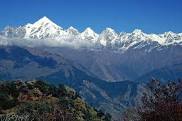
missionary blog faith in God Divine providenceThis morning as I was walking the kids to the bus stop, I caught a brief glimpse of the mountains, but then moments later they were no longer visible. When I got back to the house, I went up on the roof and there they were, just peeking out from above the clouds.

And I realized something.

The mountains are always there. They are.

But most of the time they are invisible to the human eye. Covered with smog and clouds. Yet they are there.

Then I was reminded that isn’t that just like God. He’s always there, but most times we can’t see Him because “life” covers Him up, kind of like the clouds.

Even more so His plans for our lives.

Every now and then He gives us a glimpse of what is next. Just a little view. Then when we can no longer see, He says follow Me…

View original post 374 more words 

Fixing our eyes on what is unseen….

Very timely blog post for a little city hermit whose journey of faith has truly led him places he never dreamed of going, led him to do things he would never believed possible, and to be used of Him in ways unimaginable. To his shame, he often gets discouraged.

mandylynncarpenter's avatarmandylynncarpenter

himalayasThis morning as I was walking the kids to the bus stop, I caught a brief glimpse of the mountains, but then moments later they were no longer visible. When I got back to the house, I went up on the roof and there they were, just peeking out from above the clouds.

And I realized something.

The mountains are always there. They are.

But most of the time they are invisible to the human eye. Covered with smog and clouds. Yet they are there.

Then I was reminded that isn’t that just like God. He’s always there, but most times we can’t see Him because “life” covers Him up, kind of like the clouds.

Even more so His plans for our lives.

Every now and then He gives us a glimpse of what is next. Just a little view. Then when we can no longer see, He says follow…

View original post 375 more words

Sanctifying the Single Life


st-john-maximovichNowadays so many people, so many friends and acquaintances of mine, especially middle-aged, are disappointed, drained, left alone with children, empty and lonely (both in and out of relationships), feeling robbed. What are we to do with our lives in order to avoid self-centered ends and the spiritual abyss?  Marriage and monasticism most certainly lead to the most intimate communion with the Creator and fellow creature and fulfill their promises: the soul can still be purified through either of them. They restore the soul’s appetitive drive to its divine orientation. The roads are narrow, their gates straight, but they lead to the deification of the soul. But maybe this path is not open to us — yet? — for a variety of reasons and circumstances. So WHAT  is to be done?


Apparently, there is also a third way.  Jesus Christ teaches that certain people are called by God to the single life.


And I say to you: whoever divorces his wife, except for sexual immorality, and marries another, commits adultery. The disciples said to Him: “If such is the case of a man with his wife, it is expedient not to marry.” But He said to them: “Not all people can receive this saying, but only to those to whom it is given. For there are eunuchs who have been so from birth, and there are eunuchs who have been made so by men, and there are eunuchs who have made themselves eunuchs for the sake of the kingdom of heaven. He who is able to receive this, let him receive it.”  (Mt 19:9-12)


The apostle Paul elaborates on Jesus’ teaching.


It is well for a man not to touch a woman. But because of the temptation to immorality each man should have his own wife and each woman her own husband… I say this by way of concession, not of command. I wish that all were as I myself am. But each has his own special gift from God, one of one kind and one of another.


To the unmarried and the widows I say that it is well for them to remain single as I do. But if they cannot exercise self-control, they should marry. For it is better to marry than to be aflame with passion… And unto the married I command, yet not I, but the Lord, Let not the wife depart from her husband: But and if she depart, let her remain unmarried or be reconciled to her husband: and let not the husband put away his wife. … Only let every one lead the life which the Lord has assigned to him, and in which God has called him. (See 1 Cor. 7)


The single calling

The single life is a calling. It is a way of life which is given by God.  A person, certainly a Christian person, does not choose to be single or to be married. He or she rather discovers the way of life which the Lord provides within the conditions of his or her existence. People really only chose to receive, or to reject, what has been given them. They do not determine it.


There are any number of reasons why a person may be single. They range from the sense of having a positive calling to the celibate life for religious purposes, to the plain fact of being unmarried without one’s own conscious choice, and perhaps even against it, just because this is the way that things have happened to work out. Whatever the reason for one’s being single and however mysterious or ambiguous, willed or unwilled the causes for one’s being in this state, at some point in our adult life each of us must accept the form of life which is ours and consciously offer it to the Lord, freely and voluntarily, for the sake of the love of God and neighbor.


Sanctifying the single life

The single life is sanctified the way every life is sanctified: by perfecting it according to God’s will. The first task of the single person according to God’s teaching as revealed by Jesus Christ and the apostles, martyrs and saints of the Christian Church, is that of maintaining and developing one’s sexual chastity.


The single person who says “yes” to God and to his or her calling to the single life automatically says “no” to all forms of physical, sexual activity with the opposite sex, with one’s own sex and with oneself. This is so because sexual actions other than the conjugal act of married love destroy the wholeness and integrity of one’s being through the dissipation of one’s spiritual and physical energies. No matter how loving, fulfilling and pleasurable they may at first appear to be, sexual commitments without the totally faithful commitment of unending love in marriage – with all of the responsibilities and obligations for inter-personal communion and the pro-creation and protection of human life which this involves – cannot but result in dissatisfaction, disappointment, despondency and despair. this is so because human persons are made in the image and likeness of God who is Love, and as such can find fulfillment and happiness only in ways of living and acting which express and image His own.


A hard saying

The teaching about sexual purity in the single life is a difficult one. When many people hear it they are moved to say what Christ’s disciples said when they heard other of His teachings: Lord, this is a hard word. Who can hear it? Who then can be saved? And the Lord’s answer is always the same. He said that His teaching has to be hard because “the gate is narrow and the way is hard that leads to life, and those who find it are few”, adding as well the fundamental point  that as far as His teaching is concerned, “with human being it is impossible, but with God all things are possible”, particularly to those who believe. (See Jn 6:60; Mt 7:13-14; 17-21; Lk 18:27; 35)


Like all forms of Godly life and behavior, the single life of celibate chastity is a way of the Cross. It is a way of sacrifice and suffering which alone brings joy and happiness to a human being.


Conditions for perfection

For the single life to be perfected according to God’s will, with the preservation of sexual purity as its heart and foundation certain conditions must be fulfilled. First of all there must be firm spiritual discipline for the sake of a lively interior life. The single person must have a rule of prayer which is diligently kept, with the reading and pondering of wholesome and edifying words and images. Great attention must be given to keep oneself free of all thoughts and images which lead to spiritual and physical defilement and disintegration. The “spouse” and “life partner” for the single person in the most direct and specific way must be the Lord himself.


The single person must also have a firm rule of external life and behavior. Capricious and willful actions, things done without order or form, but just as they happen to come up, must be avoided at all costs. Forms of responsibility and accountability to others must be found and fulfilled with conscious obedience. This is especially true for those who do not have such natural obligations as, or example, the care of elderly or infirm parents or relatives, or duties within a religious community.


The single person must also be committed in a formal way, in obedience, to a spiritual father, which can be a priest or a hieromonastic. Some might say that such conditions are necessary for all who are living a human life according to God’s will, whether or not they happen to be single. This is true. But these conditions are particularly necessary for the single person precisely because of their single state in a world which renders them particularly vulnerable to self –centeredness and loneliness on the one hand, and lack of commitment and accountability on the other, with the additional cross of often being misunderstood and taken advantage of by those around them because of their single status.


Christ and the Saints

It is common in the modern world to think that one cannot be fulfilled as a human being in the single state, especially if living a sexually continent and chaste life. The claim is that without sexual activity and intimacy, a human person is diminished and even distorted in his basic humanity. If this is true, then the Christian faith as understood and practiced by the Orthodox, and by millions of other Christians, is wholly false.


The Lord Jesus Christ was single and celibate, yet He was the most perfect human being who ever lived, the Son of God and God Himself in human form. Jesus’ mother Mary, though legally married, remained a virgin her entire life. John the Baptist, whom Jesus called the greatest man ever born of woman, was clearly a chaste celibate according to the Gospels. So was the apostle and evangelist John. So was the apostle Paul who, as we have seen by his own report was single at the time of his conversion and ministry. Indeed, the calendar of Orthodox Church saints is filled with single people who are praised and honored for their chastity and devotion to God and their neighbors. In this perspective it is clearly the Christian conviction that being single is conducive to the highest and most perfect for of fulfillment possible to human beings: the life of sanctity . (Source: St. Luke’s Orthodox Mission)


See also: Marriage of Monasticism? and Belonging to Neither and Both