Choice (I)

sad1

“Lord, let me come and join you in that land which beckons me, in those fields that I love.”

“No, it is in this town that you must meet me.”

“Lord, I long for the sun and the wilde flowers over there.”

“I only have this black sky and these thorns to give you.”

“But Lord, there is only noise and smoke here.”

“There is something else as well; there is sin.”

“Lord, I would so like to see again the blue water that you knew!”

“Here, hearts are sick and souls are dying in darkness.”

“Lord, I could perhaps stay if you entered into my heart, if you took my hand. But when I see these streets […] my whole being revolts and escapes in thought over there. Must I therefore still stay here, with my sadness and my solitude?”

“My child, is it so difficult to decide? And to walk where I walk?”

*

Lev Gillet, “Sunday Letters”, ‘Lev Gillet, A Monk of the Eastern Church’ by Elisabeth Behr-Sigel, p231

* Specially dedicated to my spiritual father

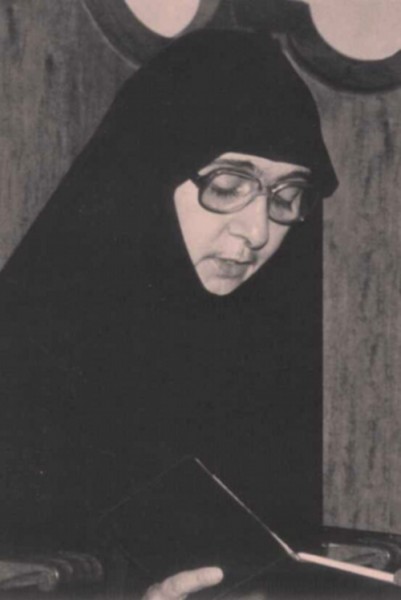
Eldress Theosemni: a Quiet and Hidden Ascetic

The life of the beloved Eldress Theosemni is a Synaxarion account of perfection in self-emptying and martyric asceticism in silence and humility. Her personage and her venerable example cannot be appreciated through the description and listing of her virtues, for it is impossible to explain, through words, the balance and grace of a person who spoke through her silence.
By the Nun Theoxeni, Abbess of the Holy Monastery of Chrysopigi, Hania, Crete

The Eldress Theosemni, Anastasia-Aristea Dimtsa in the world, was born in Larissa in the year 1938, the third child of pious parents. When she was just four years old, she lost her father and the care of the family fell to its newly widowed mother, who was from Eastern Romylia and was wholly dedicated to God.

Gerontissa-Theosemni-01-e1328726848748

From the time she was a child, she received profound love from Christ and the Church, and she would hasten to attend the services and all-night vigils with a zeal that was unusual for her age. She also participated with great zeal in the youth activities at church and, from a very early age, expressed her desire to serve as a missionary.

She studied at the Red Cross’s School for Nursing, from which she graduated with highest honors. She chose this path out of zeal to serve humans in pain.

In 1966 she became a nun at Meteora. It is widely agreed that her monastic path was a model of obedience and asceticism. Unforeseen difficulties arose at that time, at the beginning of her monastic path, with which she dealt prudently, quietly, and humbly.

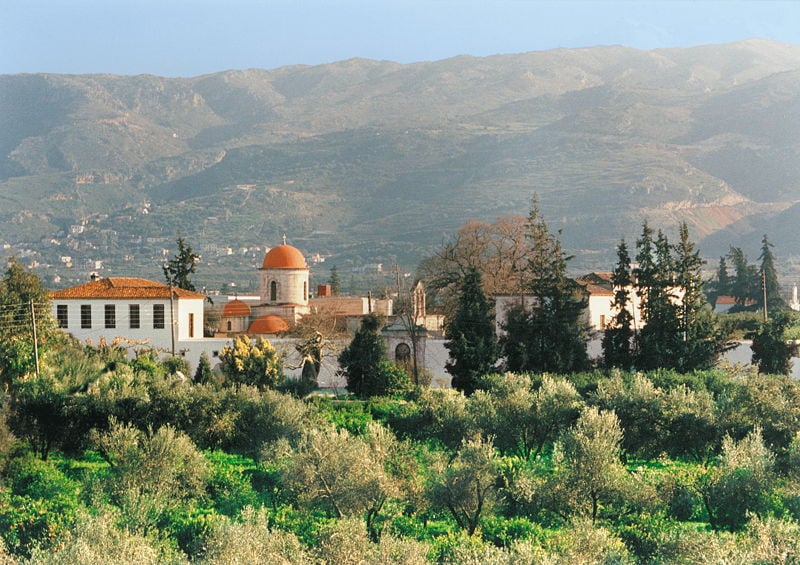
In 1976, Eldress Theosemni went to Hania (Crete) with two other nuns and, with the blessing of his eminence Metropolitan Irenaeus of Kydonia and Apokoronos, she took on the reconstruction, from its foundation, of the ruined Chrysopigi Monastery. Over the course of twenty-four years she worked in silence, with perfect self-renunciation. Her spiritual presence and her ascetic example encouraged many souls to dedicate their lives to the Bridegroom Christ, and she led them and established them in the Lord.

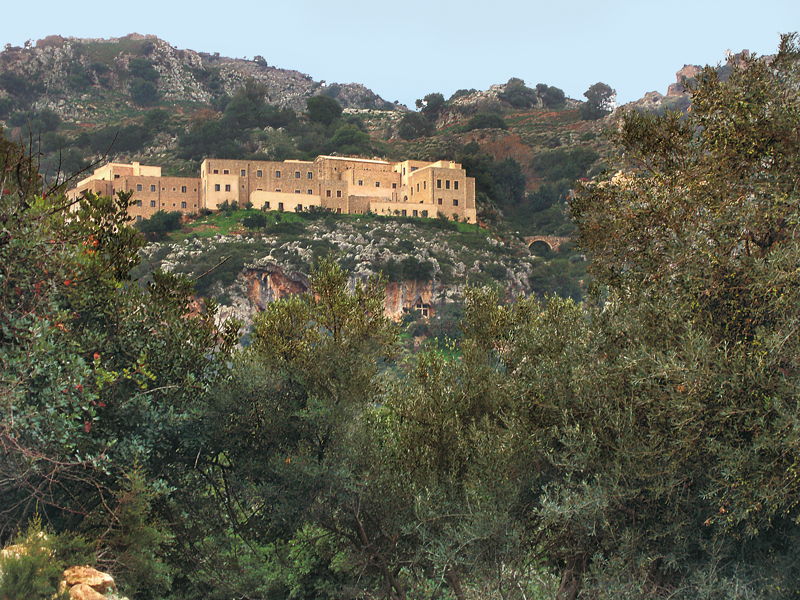
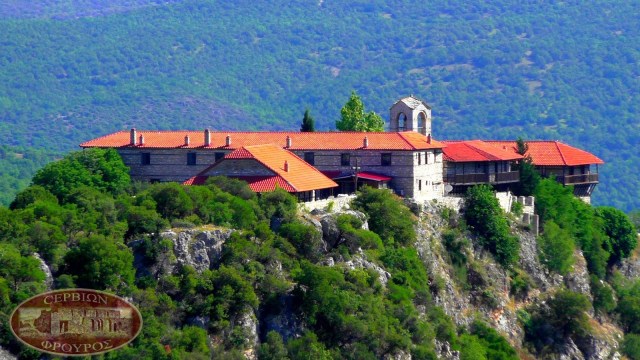
The abbess was an ascetic, a lover of struggle, and prudent. She restored the Holy Monastery of Chrysopigi from ruins, along with its miraculous icon of the Life-Giving Spring, and gave the monastery a spiritual foundation. She also restored the neighboring monastic dependency, the Monastery of St. Kyriaki. In her final years, she sought a more deserted place for the sisterhood. She established the Monastery of the Transfiguration on a rock, under the fatherly care of the venerable Elder Porphyrios.

At the age of forty-eight she became seriously ill with cancer and was miraculously cured by Elder Porphyrios, who had an especial love and respect for her. Ten years later, her sickness returned to her, during the four final years of her life. She accepted her sickness with great courage and perseverance, immense patience, gentleness, and deep peace, unceasingly fulfilling her duties until her final breath.

Her end was a blessed one, as her life had been. She fell asleep in the Lord on the 31st of May 2000, at the age of sixty-two.

Quiet and Hidden
Eldress Theosemni was a model nun, according to the teachings of the Fathers. In everything she did, she combined gifts that are seldom given, with great capability, on both the theoretical and the practical level. She was hard working and energetic, but simultaneously ascetic and hesychastic. By nature quiet and reserved in her relations with people, she was able to hide her great gifts and virtues even from the people around her, and to ascribe successes to others. Although she was very mature, organized, methodical, clever, and observant, she always managed to ascribe the result of any work to everyone involved, as though it was wholly a team effort. In this way, she taught the sisters not to seek after personal glory.

“That which moves me more than anything else,” she would say, “is the example of the Panagia. Her humility, obedience, and silence. An angel went and told her that she would give birth to Christ, God, and all she said was, ‘Behold the handmaiden of the Lord.’ She didn’t say anything else. Only obedience. And she was hidden. My prayer is that we will acquire these virtues….”

The Eldress never believed in her many spiritual gifts. She was marked by a profound humility, not just simple “humble words,” or pietistic comeliness.

She managed the monastery’s affairs without any discord. She had the discernment to know which sister should undertake any given job, or a particular responsibility, and made use of the talents of all. In whichever place or job in the monastery she provided oversight, she was observant enough to know what needed to be fixed or improved, and this always took place with propriety and with a quiet explanation.

The Eldress herself took care of various jobs in the monastery, and did not limit herself to just the fulfillment of the duties of the abbess. She made good use of her time with remarkable creativity.

A3

The Holy Monastery of Chrysopigi in Hania, which the Eldress Theosemni renovated and where she quietly worked for twenty-four years

When she realized that some aspect of the monastery’s work was running behind or was unsuccessful, she got involved herself, without getting upset or uptight, and with her remarkable simplicity saying, “let’s have a look, sisters, with patience, at what other way we can do this….” And, of course, she always found a solution.

The Eldress had immeasurable respect for all of the sisters, and no one ever heard her speak in an offensive manner. Unless she was asked, she did not counsel anyone, and only infrequently would she give her nuns unsolicited counsel. And when she did, she would censure herself, saying that she was not worthy to teach.

Humble, Merciful, and Ascetic
Let us have a humble spirit. May we be careful to never see the sins of others, only our own sins. We, however, want to fix other people, but don’t want to fix ourselves. Eh…does this happen, though? No, we don’t fix ourselves! Our brother is not to blame for whatever happens, our spiritual condition is to blame. It’s this condition of ours that upsets us, which makes us judgmental, which causes us to get angry. We mustn’t blame others for these things. The causes are within us. If we ever do or think something good, let us not regard it as our own achievement, but the achievement of God. And let us say, “You, my God, You gave it to me. It’s yours and You allowed it and gave me the strength to do it.” In this way, we chase thoughts of vainglory far from us.

She had the spiritual gift to administer and direct  the sisterhood without getting upset, without raising her voice, without having to check up on, or to threaten by giving her nuns a rule of penance. She generally did not give rules of penance. If she did it on occasion, she was very sad about it, which is why she would be the first to fulfill the rule of penance that she had given to the sister. As abbess, she never accepted special attention or honor.

The Eldress was exceedingly merciful. She loved and honored, without distinction, people in need and in difficult situations. No one left the monastery with empty hands. She did not even overlook those who, for whatever reason, were not able to make it all the way to the monastery. She experienced such great joy when she gave, that she felt like she should be the one giving thanks. “We mustn’t ask anything from people,” she would say, “but we should give them everything.”

The Eldress loved to hide within the sisterhood. She would generally not appear to visitors, especially when large groups would visit the monastery. She always sought to remain far from crowds. While she shared in the people’s pain, and would pray a great deal for their problems, she systematically avoided social contact with them. “This,” she would say, “is the work of the guest master,” and in this way she taught the nuns not to seek social relations and conversations with pilgrims, whether acquaintances or relatives. She would say, characteristically, that “the spiritual life of the monastic progresses through isolation and silence.”

She carefully examined every part of the monastic life and did not ignore anything as though it were unimportant or too detailed. She never allowed herself to make changes, remaining always faithful to the spirit of the Fathers. It is characteristic that she never gave a blessing for a loosening of the fasting regulations unless such a loosening was indicated in the Orologion. Even when she was sick, she kept the fasting rules precisely. On one occasion, she found herself outside of the monastery at the very beginning of Great Lent, for radiation therapy, and she still kept the first three days of Lent with precision [a complete, strict fast], and then had the first round of radiation therapy on Wednesday afternoon of the first week of Lent, after the Presanctified Liturgy.

During her whole period of sickness, despite the insistent requests of the sisters, she never asked for any specific kind of food, but accepted with thanks whatever food she was offered.

“As monastics, we must practice asceticism. We shouldn’t eat until we’re full. We should arise from the dinner table and be hungry; in any case, this is what we promised. Even Christ practiced asceticism. He ate little, he had only one tunic. And He taught his disciples not to have anything. Let us do the same. Asceticism: in food, in sleep, in standing for long periods. Let’s try to do these things and we’ll see what a blessing we have.”

The blessed Eldress Theosemni never protested for anything, to anyone. She regarded martyrdom and being crushed as part and parcel of the monastic life, with the certainty that God allows trials for our salvation.

A2

The Transfiguration, the new monastery that was built under the fatherly oversight of Venerable Porphyrios

Full of Love and Untiring Prayer
The Eldress would always cover over the failings of others, she never blamed anyone and never judged, criticized, or complained about someone who had done her wrong or had slandered her. She forgave and loved all people from her heart, effortlessly, which is why everyone felt at ease with her, despite her serious and careful demeanor. For her part, she did not feel as though she was doing anything more than fulfilling the obligations of a nun.

Let us have love. When we reproach someone, we don’t love them. They will only understand through love, not through being gloomy, angry, and judgmental. We’re mistaken if we think that other people have wronged us. The problem is within us. Only let sweet words come from our lips. And if we don’t have anything to say, a smile suffices. Let’s gift others with our smile, with our love. When we don’t love our brethren, we don’t love Christ. It’s no good for us to say we love Christ if we don’t love our brethren.

Humility is to make excuses for our brethren in all things and for all things. The humble person cuts off her own will.

Once, near the end of her earthly life, reference was made to instances where she made remarkable sacrifices and was particularly humble, and she responded laconically, “Sisters, let’s not transform our daily duties into some kind of achievement, if we have at some time, by the grace of God, done something….”

The Eldress struggled for the salvation of the whole world. She prayed unceasingly for the known and unknown, small and large, Christian and non-Christian, for all people.

Most of our prayer should be for the world. We should pray, “Lord, Jesus Christ, have mercy on me,” but this “me” should refer to the whole world. If we pray for others, God gives us more grace than He would have if we were just praying for ourselves. And whatever good things we ask on behalf of others, God also gives to us. Let’s say the prayer continuously. This softens the soul. It makes it soft, so that it loves all people. All people seem good to it and nothing upsets it.

She was once walking down a street in London, after a visit with a professor of oncology, who had just told her that the mass in her lung had returned and that she would have to undergo more therapy. She was thoughtful and, in answer to the question posed by the sister who was with her, as to whether she was upset by the problem of her health, she answered, “No, I have left this concern completely to God. What I was thinking about just now, and it’s for this that I’m concerned, are those young children we met on the corner who were begging. I noticed that they were pale and their hands… oh, my… how their hands were! I feel terrible. I’m afraid that they’re taking drugs. And that girl, how beautifully she played guitar and sang! She also could have sung….”

Patient in Her Sickness
Her serious long-term sickness was a source of pain for everyone else, but not for her. While she suffered, no one noticed any sadness or disappointment on her face or in her words because of the bodily trials and pains she suffered and endured. She continued her life with psychical strength, remarkable patience and meekness, courage and boldness, endless faith and obedience to the will of God. She continuously transmitted to everyone the joy and hope of communion with Christ, and the strength of the foretaste of eternal gifts, which her blessed soul experienced already in this life.

“Let us hymn and glorify God in trials,” she would say, “Let’s not be beggars and only ask things from God, ‘Give me, why won’t you give it to me?’ May our lips be used to glorify God. Let’s not be sullen and self-absorbed. Let’s say a ‘Glory to Thee, oh God!’ We must not forget.”

And referring to her own sickness:

My sisters, don’t be saddened that I’m sick. Think that whatever God gives is for our good. Whatever He allows is for our salvation. Whatever this is…and let us thank Him. Do you know what joy and what peace comes from thanking Him for all things, and from glorifying Him? Submit everything to God. This is the work of a nun: prayer for everything, for everyone. Haven’t you heard what Fr. Porphyrios said, “With joy, leave all things to God.” Let us have our minds constantly on Christ. This is the only way we will be patient in our sorrow and in whatever trials come to us.

The peace that exuded from Eldress Theosemni’s face gave comfort to the insecurities of everyone and her peaceable speech was therapeutic for the souls of those who listened to her. Her whole life was a harmony of spiritual vision, teachings, and action. The Eldress incarnated the humility of the holy Fathers, which is why people near her experienced peace and an otherworldly joy, the same kind that we sense when we are near Saints.

Her Repose
While still in this life, the blessed Eldress had already truly lived the foretaste of heavenly blessedness in silence and humility, and through her repose reconciled people with death. The people that came to Chrysopigi from Crete, from Greece, and from overseas, to pay their last respects and to venerate her relics, all witnessed to the same experience: they described the sweetness and absence of fear that they felt before her relics.

The two days that preceded her burial were a touching experience, full of blessings for everyone, not only for those that knew and loved her, but also for the whole Church. Parents who had lost young children in tragic accidents described with tears how, for the first time, they felt comforted. Others touched their infants to her, as they would to the relics of the Saints. Children both young and old approached her coffin and touched her again and again without fear, for they saw her smiling, as she had unceasingly smiled even when in pain.

The funeral of the blessed Eldress was uncommon. It was a triumphant funeral service, a revelation for everyone, a tangible revelation of the mystery of sanctity. There was no despair and sadness, but victory over death, the joy of the Resurrection. A young person said, “It’s like Holy Friday when we bury Christ with the certainty of tomorrow’s resurrection.” Everyone felt that the reposed Eldress Theosemni had passed to heavenly blessedness from a life in which she had had a foretaste of, and had grown accustomed to, the joyful feeling of immortality. She had experienced this to such an extent that she was able to communicate psychical comfort and the overcoming of sorrows to everyone, along with the reality of the approach of eternity.

The blessed Eldress Theosemni departed in light from the present life, during which she had lived within the perspective of the future age. Her grave had become a source of consolation, hope, and an education in eternal blessedness, not only for the nuns of her monastery, but also for all of the pilgrims, known and unknown, who thronged from near and far. And a story, well-known to the Church, was repeated: of how a person who lived in obscurity and silence became a preacher, an inspirer, and an initiate, not of human words and actions, but of the mystery of eternity.
 

Source: Pemptousia

What I Wish I Had Known


wisdom2

Thirty-nine years ago I left this campus with gifts similar to yours. Like you, I have been blessed to have studied under some of the greatest Orthodox theologians of the time. Like you, I enjoyed or endured a community that was sometimes supportive and at other times challenging. I forged friendships with peers that would sustain me for a lifetime. Like you, I experienced some of both Crestwood’s and New York’s air, accents and crowds. And like you, my time at St. Vladimir’s came with the responsibility to live among God’s people and fulfill my royal priesthood with the added responsibilities that come with the knowledge and understanding gained here.

As difficult as my mission was to be, ministering to people of different generations, from varied ethnic and socio-economic strata, from hippies to Babbas, your challenge is greater. In addition to dinosaurs of my generation, you will live among post-modernists who imagine themselves to be the center of the universe, and who believe themselves to be self-contained, needing no “other” for fulfillment. You will minister to people for whom truth is, at best, relative. For many, including baptized Orthodox Christians in our pews, people believe themselves to be self-sufficient, needing no other, and, amazingly enough, “no other” includes God.

I must confess, I came to seminary confident that I knew quite a bit about my faith and parish life. I had served in the altar from a very young age, had been an officer of our teen group, and had served as a member of the choir and parish council. Every semester I realized I knew less and less, and today I am the least confident in my grasp of theology. I am committed, however, to an understanding that this is indeed the process of education, particularly when encountering the ultimately unknowable. In any case, we serve as best we can, striving to be faithful to God and the complex people that we serve.

Are you ready to commence your lives as churchmen and women? Let me share what I wish I knew when I started my church life some forty years ago.

From this holy place, I went forth with gifts that included relationships with holy mentors. These men and women loved God and loved His Church, and almost all of them have now gone to their rest. For a while, at least, they were available to me. I remember offering a lecture on human sexuality at an Orthodox clergy conference, with Frs. John Meyendorff, Thomas Hopko and Paul Lazor in the audience. That was a memorable, yet intimidating, day for me. Somehow, at least for a day, these mentors had become something like peers. This is not to say that I can claim to be a theologian, but we are all church workers, and as such, they were willing to be for a while in the audience. They had no obligation to offer their validations, but they accepted me as a fellow churchman and were willing to sit on the other side of the desk. Today, dear graduates, our relationships change, as you are no longer seminarians but co-servants in Christ’s ministry. You would do well to maintain your relationships with those who have shared themselves with you these past days.

Among the gifts I received from this place were studies in Scripture, history, canon law, liturgical theology, liturgics, music, pastoral care and dogmatics. When in class, I thought that these subjects would be helpful as background, never realizing how I would need to call upon these lessons daily and directly to meet real pastoral needs, defend our teachings, and answer honest questions from parishioners. As I reflect, I wish I had done more of the readings.

Among the gifts, too, were relationships with peers, which today I value in equal measure with those of the mentors, and with my studies. The men and women with whom I studied side-by-side would help me understand what is normal in my own development as a churchman, and offer support and perspective to help me problem-solve, adjust to married life and grow as a person. Do the work you need to do in order to keep these relationships alive. You will need them in the future.

All of these gifts I have used over the last thirty-nine years as I endeavored to meet my needs as a person, the needs of my family, and the needs of God’s people, among whom my bishop sent me to live as his representative. I was to serve them by tending to the corporate prayer; showing them God’s compassion in confession and counsel; providing hospitality that demonstrated God’s love; sharing time with them, showing God’s caring for them; and journeying with them as we grew up, or at least aged together.

Thirty-nine years ago I was twenty-four years old and serving a parish as a priest. Some of you will serve God in the Church as priests or deacons, other as leaders, and still others as counselors. Sometimes the witness of one who is not ordained is more powerful, because people can’t think that you are witnessing because it is your “job” as a clergyman. In any case, all of us who have been gifted with our encounters at this holy place will serve God’s people and be judged by how we represent God. This, I contend, is despite our varied roles and capacities. Because you have been here, God will use you within His royal priesthood to meet the needs of His people.

Today I wish to call your attention to the uniqueness of our vocation: unique, because each of us will be used by God differently. This is so because of the experiences that we brought with us when we came here. It is also true because of the uniqueness of our life-journeys, which will include different people, circumstances and challenges. I strongly urge you to embrace your age. Don’t be a father at age 25 to a 70-year-old. Be like a son who has been to seminary and comes with much to learn and much to share. Win them over as persons, and let them use you and your holy relationship to encounter God. Come on “too big,” and they will run away, or cut you in half! Allow yourself to have fun with all the kinds of wonderful characters that God has called to live in His Church.

I can’t say that every moment of my life was fun- packed and glorious. I can’t even say that my time here at this sacred place and thirty-three years in the parish was always fun. But the joy of witnessing God’s work in the lives of my family, parish and community from the inside was spectacular. Life in the Church allows us to see God working as closely as if we were on the stage of an improv, seeing the plot made up and unfold before our eyes. Such is our life as churchmen and women. How blessed it is to be constantly in the epicenter of God’s work, and able to see it, too.

Friends – and I call you friends because I share with you honestly what is on my mind and in my heart – I paid a lot of attention to keeping balance in my life. Balance, and setting appropriate priorities, are achieved only by deliberate and consistent work. Work to monitor and control your time, energy, and resources. It is an effort to order the use of these gifts deliberately, and with a vision of our goals, charge, and mandates. Work to identifying our real needs and meet them. In my opinion, our priorities must be set in the same order that God through His Church gives us His gifts.

Now, this is not to say that if a parishioner is dying and in need, you should go fishing. Rather, be sure to use your flexibility as the manager of your own time to meet both needs, not foregoing your own priorities. You can visit the hospital, or arrange for another priest to make the visit before your trip. Use your flexibility to make up for missed family obligations when the schedule of Church priorities is beyond your control. Too often, we teach people to have unreasonable expectations of us; then we get frustrated when we can’t meet them. We need to gently and firmly teach, teach and teach. Fighting is different from teaching, and fighting is not productive. We must gently model and teach what is reasonable, fair and holy.

The first sacrament for all Christians is baptism. In this sacrament we are initiated into the Church and enter into an intimate relationship with God from inside the body of Christ. So my first priority is my relationship with God and my needs to maintain and nurture that relationship. This includes time for prayer, including listening to God through study and quietness as well as sabbath or regular rest. It also includes maintaining the varied relationships with other people that I need to be fed and stay healthy. Let me ask you, what can I offer my wife and family if I am compromised by not being right with God? It is somehow a gift to my family to model a healthy relationship with God and to receive the truth and inspiration that comes from God through prayer, reading and relating to mentors, peers and protégés.

The second sacramental and liturgical dance around the Gospel Book is that of marriage. Marriage is a gift that keeps on giving, and keeps on taking. Successful marriages are dynamic and developing. We become more and more united with each other and God as we succeed in becoming more and more vulnerable, open, honest and intimate. God has given us each other to find Him. This takes lots of work, as we praise God together and meet the challenges He gives us in our lives. When we model making our spouses and families a priority, we better serve the parishioners who are learning more from our lives as examples, than from our preaching and teaching. We serve our parishioners better when we take better care of our families and ourselves.

Thirdly and lastly, before our funerals, some process around the Gospel book in their ordinations. Here I will loosely include those of you who will successfully avoid formal ordination, but will nevertheless serve God through the Church in other capacities. We do well to remember that priesthood is not a job, but a life. We live among God’s people as examples, teachers, coaches, friends, confidants and servants. All real leadership and power in the Church is in serving. In serving, you will be given by those you serve trust and authority. In serving, you will prove your authenticity as a churchman or Christian. In serving, you will influence others and God will work. In serving, you will fulfill your vocation and enjoy the joys of a blessed life. By witnessing to others, you will see God work in their lives and in your own. This is awe-inspiring; be open to this awe. It is a gift from God and will strengthen your faith and feed you in your own journey.

Among our personal needs, which we meet so that we can meet the needs of others, are prayer, continued study and the three kinds of relationships I have described: those with mentors, peers and protégés. It is said that everyone needs a Paul, Bartholomew and Titus. We need mentors, who can offer us support from their experience and help us learn how to make use of our gifts. Mentors teach us how to avoid common pit-falls, and help us learn our roles. We also need peers, who can remind us that our labor is difficult, especially in these quickly changing times. We need protégés, who can challenge us to grow by understanding what God is doing in our lives and giving language to feelings and thoughts. Protégés challenge us to live honestly and deliberately.

Americans are notorious for not doing the work it takes to develop, nurture and keep relationships. Your parishioners will complain to you about how lonely they feel. When you organize events to bring them together, they will in great numbers not come. People seem to assume that friendships should just happen. Today’s technological world is isolating and friendships take lots of work.
It is reported that most Americans, excluding spouses, will go to their graves without more than 1.5 meaningful relationships. It is essential for us to work at our relationships to have balance and health. Please, do that work.

Secondly, it is important to lead with confidence, based on your role as leaders in the Church as defined by the bishop who sent you to live among the people. If you fight for your position, it will be understood that your position is up for negotiation. Instead firmly, patiently and lovingly teach about the roles we live in the Church for the benefit of the people and community. A favorite analogy for me is that the world is playing tag. If you chase them, they will run. If you stand still, they will be able to stop running and eventually listen. Approach each soul with all of the respect due a complex creature in the image and likeness of the ultimately unknowable God. If you don’t push, they will eventually follow. If you try to sell, they will not buy. A mentor told me once that the priest never wins a fight. If he prevails over another person he gets an enemy that needs to win back his dignity, and if he loses the skirmish, he loses credibility. We need to reframe our disputes so that everyone can win. Sometimes we can put off a discussion long enough for everyone to save face. To be more efficient, sometimes we treat people as if they were all the same. This shows little respect for the person. When you show respect to your parishioner, you counter he effects of the world and the surprised parishioner will begin to release the anger that he carries from being disrespected in and by the modern world.
Brothers and sisters, you represent the Church for the faithful and, as social creatures, those you serve want – no, need the love and acceptance of their Church community. You represent God, whom your parishioner fears is angry and far away. I am convinced that the hostility people have toward their church leaders comes from the basic fear of rejection. So afraid are they of rejection, that they protect themselves with animosity, distance, resistance and anger. Ultimately, the priest and church leaders will stand over their lifeless bodies and proclaim even if their life had been worth living. Church leaders are imagined to have great power, so in return, some do all kinds of things to protect themselves. In such challenging moments, be kind. Be patient. Be loving, and wait. They will grow or leave. In my service to the Church, I have successfully outlived every parish member that ever gave me trouble.
When faced with challenges, ask critical questions, like, What is true? What is real? What is fair? and, What is holy? The adage that “what we need most, we learned in kindergarten,” has merit. Seminary is helpful, too, but we do well when we simplify and remain honest with God and those we serve. That is your priesthood, the priesthood of everyone baptized into Christ: to be with God before man and man before God. That is your Christianity. As Church leaders, you will teach by example, sometimes with words, but always by living with and within the community.

Thirty-nine years ago, I began a life in the church harvesting fruits that others had planted and pruning trees that would bear fruit for you to harvest. It brings me great joy to see that God’s call is still being heard. By being here today, and by your willingness to serve, you validate my choice to work in this ministry. You have made a wonderful choice. You will see God working in the lives of the people you serve. You will see His healing, restoration and forgiveness in the lives of those you live among. You will share an intimacy with parishioners that no one else has an opportunity to enjoy. You will be stretched, challenged and sometimes even rejected, yet here the adage is true: that which does not kill us will make us stronger. God will minister to your pain Himself, and you will mature. You will learn what joy comes after sorrow, and your faith will grow. My dear brothers and sisters, if I had to do it all again, I would choose the same in a heartbeat. You have chosen well to study here and you have chosen well to serve the Lord, our God.

*His Grace Bishop John offered this address at the 2017 Commencement of St. Vladimir’s Orthodox Theological Seminary in Yonkers, NY. Bishop John is an alumnus of St. Vladimir’s.

Faros Tou Kosmou — Lighthouse of the World

roma1

roma2

Fr. Athenagoras — “2-2” (*) Roma Missionary

roma3

Dendropotamos — Thessaloniki

roma4

roma5

roma6

roma7

“Our bus trip back to Thessaloniki was long.  Thankfully, it provided us opportunities to rest and or simply to enjoy fellowship with one another.   With great skill and after a delicious lunch in Kalambaka, we returned to our hotel to check-in, only to return to the bus to depart for the Church of St. Nectarios in Dendroportamou, which would be an experience that many of us would not soon forget.

… Much of our group arrived in Dendroportamou, just outside the courtyard of the magnificent Church dedicated to and seeking the intercession of St. Nectarios.  This Church was stunning and built by the poorest of the poor in an essentially crime ridden, cutoff western region of the city that has approximately 3,000 families, 2,000 of these families being Roma.    As their name suggests, they have roamed from place to place from country to country, carrying little, but often inheriting a ghetto laden with crime.  Their city here is no different.

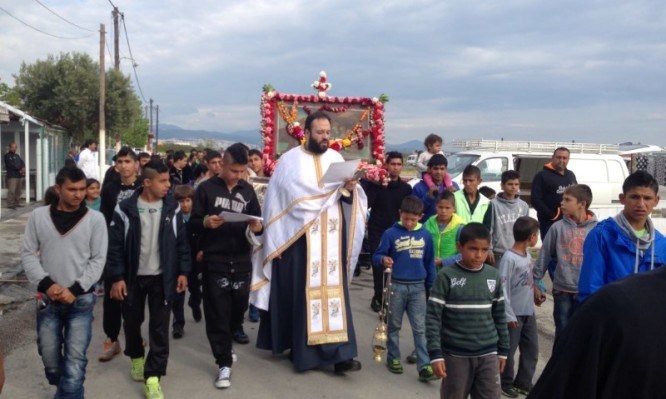
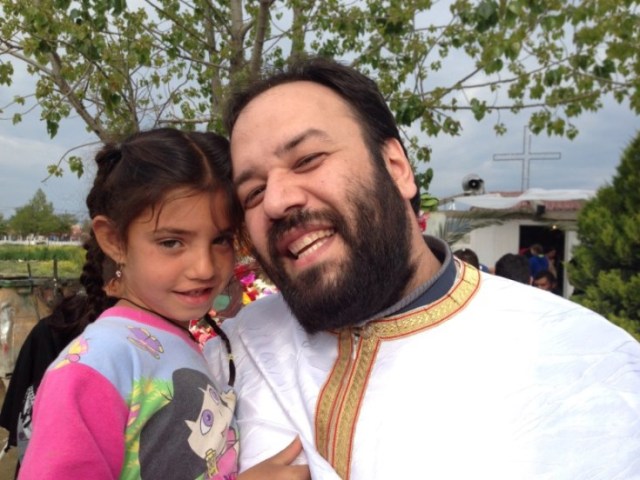
What is different in this community though is the presence of extreme joy, a joy that radiates from the Sanctuary, through the nave and far beyond the confines of this Parish!  Of course, this joy is ultimately founded in our Lord and Savior Jesus Christ.  Here though, where the vast majority of the community was not welcomed to the Church and unable to find joy – Christ – amidst the crime, the poverty, and the hopelessness, simply because they were “Roma”, joy came to their community some ten years ago and it came in the form of a youthful, humble and ever smiling priest with a vision to serve, Fr. Athenagoras.

A moment of prayer, essentially a parade through town, legos, dinner and a concert with dancing was what our night with hold.  And, all with the poorest of the poor or more correctly, the richest of the rich since they have found a joy in the person of Christ that transforms every worldly woe and lament.

We arrived outside the Church of St. Nectarios and were very warmly greeted by a handful of individuals, including Fr. Athenagoras.  Although Fr. Dean and I saw Fr. Athenagoras at the Clergy Laity Congress this past summer in Nashville, it has been some six years since I visited his beautiful parish.  We followed Fr. Lazarus who also serves this parish, proceeding through the narthex and into the nave where we venerated a Holy Relic of St. Nectarios. 

roma8.jpg

Once seated in the Church, we chanted the apolytikion of St. Nectarios and then Fr. Athenagoras began to share a bit with us about this special place – his joys, his ministry, his beautiful community of the Romas.  Again, I think each of us was extremely touched by his words and the intentions of his ministry.  It wasn’t until we departed the Church that we realized the true impact of this blessed soul.


As we departed the Church, walking to the elementary school that was built but two years ago, we passed home and businesses along the way.  Waves, cheers, smiles…all as the neighbors saw Fr. Athenagoras.  I can only compare the experience to being in a parade or with a celebrity.  People weren’t running up for autographs though, but greeting him with hugs and asking for his blessing.  And, as the neighbors came forth to the streets, we were continually welcomed and cheered as we worked our way to the school!

Upon arriving at the school, we were again welcomed with cheers and claps, simply greeted with great joy by the parents and the children of Dendroportamou! Up to the third floor we went to watch a brief, moving video detailing the life of the Roma children; not simply the great obstacles and adversities that should characterize their lives, but also sharing some of the blessings that they’ve found in and around the Church the St. Nectarios.  One of the young men then shared his story, specifically with the robotics team, which led us to the room across the hallway.

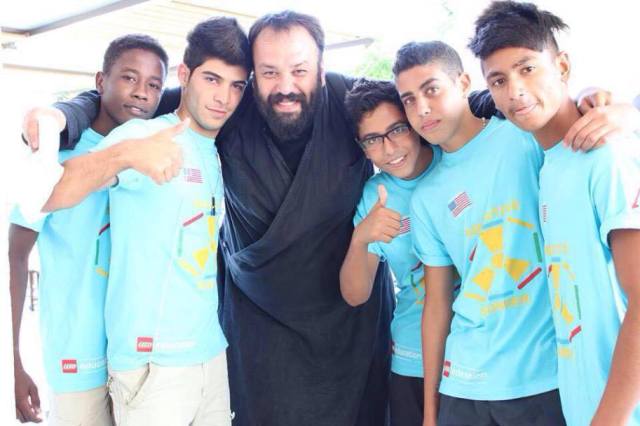
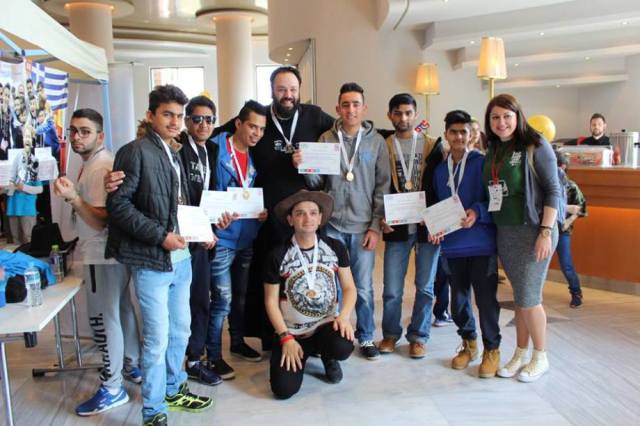
In this room, packed with children and all of us, three children discussed their involvement and leadership with the robotics team.  Their peers confirmed the joys of teamwork, creativity, opportunity, logic, and, in the end, freedom to be more than they or others ever thought that they could be!  Testament to this is the fact that their team took first place in all of Greece and 16th place in the international competition in the United States this past year (out of 160 teams).  Who would have ever thought a group of Roma children, destined for poverty and crime, would have so embraced Christ, one another, and robotics.


The robotics team provides an explanation of their work

The robotics team provides an explanation of their work

Father Athenagoras surrounded by his Roma children

Father Athenagoras surrounded by his Roma children


The music went on for some time and it was outstanding.  Before we knew it, most of us were up clapping our hands and dancing with the children.  Fr. Athenagoras was then summoned to the floor with cheers as he offered some vocal support on one of the songs.  And, when the song was over, Father was embraced by no less than fifteen children, all of whom have such a deep love and appreciation for him, his ministry, and the hope that both he and the Church has given to them.

I don’t think there was a dry eye in the room.  Had he asked us for anything, it would have been given twofold.  Even as we made an offering to Father in support of the children, he suggested that we simply take the experience with us, learn of their needs and do as we are able.  Both Fr. Dean and I agreed that this was unacceptable, so with two against one, we left a donation and agreed to prayerfully consider and share whatever needs are discerned, especially as they begin to construct a new facility that will accommodate more children.

I neglected to mention that Fr. Athenagoras is a celibate priest. He however doesn’t live alone. If I’m not mistaken, his small home in the neighborhood has over ten children leaving there! He has adopted several and houses even more, because this is the Gospel of Christ, this is our Faith, this is incarnate love.

Upon saying our good-byes, we assured one another that we would be in contact soon.  God-willing, we will also be able to promote a forthcoming full length film on the Roma of Dendroportamou, directed by a young man who has followed their story for the past three years.  He’ll be moving to San Francisco for six months while on a Fulbright scholarship to complete his film, debuting it at both the San Francisco and the Los Angeles Film Festivals next year.

Oh, and did I mention that the next robotics competition will be at Lego Land in Carlsbad 2017?  Let’s hope that we can welcome some of these families to our Parish and also travel to support them as they compete for their next trophy!

May our Lord, through the intercessions of St. Nectarios, continue to bless, inspire and strengthen Fr. Athenagoras and those who serve with him, softening the hearts and providing love and hope to the children and families of Dendroportamou.

We will return to Thessaloniki in the evening to meet Fr. Athenagoras, the founder of Faros Too Kosmou, http://www.farostoukosmou.gr a ministry of the Parish of St. Nectarios of Dendroporamou that serves the at risk children of the Roma community.


* “2-2” –> 2 m 2cm is Fr. Athenagoras’  height 🙂


Sources: Istologio and PILGRIMAGE TO NORTHERN GREECE & CYPRUS BLOG


How to Communicate with Departed Loved Ones


Our Thoughts Determine Our Lives: The Life and Teachings of Elder Thaddeus of Vitovnica (Part 4/6)

In the fourth part of the video interview, Elder Tadej talks about how to communicate with departed loved ones and how to help them.


Elder Tadej:
“Can we get into contact with our loved ones who passed away?
As soon as we start to think about them we establish communication.
Those who have noble, peaceful and quiet spirit converse sometimes during their sleep with the souls they want to get into contact with. They get everything they wish. They ask something and a deceased person can answer their question.
We are not only related to the material world but also to the spiritual world… If one is focused, meek and humble, it happens.
If you feel very sorry for somebody who passed away and you pray for him [her], then he gains a lot in spiritual life, he receives energy. You give your life for somebody you are concerned about, you would like him or her to be fine.
You send them energy, divine energy, and you are connected with them…
We are all connected with divine energy but we don’t think about it and don’t pay attention.
We are not far away from each other.
We are so close.

What should we ask people who died, what do they tell us, how do we look like to them?
They ask us for help.
When they pass over to eternity they can’t pray for themselves any longer, they can pray only for us…
When the end of somebody’s life comes, he loses the right to pray for himself… because the time given to him for his repentance has expired.
Other people can pray for him and that is accepted by God.


Entering Hell

 hell3

With Prayer 

The cycle of prayers assaulting Hades reaches a climax on the day of Pentecost. On the evening of that Sunday, the faithful gather for Vespers. During that service, they kneel for the first time since Pascha. And in that kneeling, the Church teaches them the boldness of prayer, the cry of human hearts for God’s solace and relief. Three lengthy prayers are offered, the third of which completes and fulfills the prayers that began so many weeks before in the Soul Saturdays:

Priest: … O Thou Who didst descend into Hades, and demolish the eternal bars, revealing an ascent to those who were in the lower abode; Who with the lure of divine wisdom didst entice the dragon, the head of subtle evil, and with Thy boundless power bound him in abysmal hell, in inextinguishable fire, and extreme darkness. … Who also, on this all-perfect and saving feast, dost deign to receive oblations and supplications for those bound in Hades, and grantest unto us the great hope that rest and comfort will be sent down from Thee to the departed from the grief that binds them. (edited for length)


Source: Father Stephen Freeman Glory to God for All Things — excerpted

The Priest Who Did Not Want to Serve the Divine Liturgy

divine-liturgy-as-it-truly-is

This is something that is happening at every service, though we may not have eyes to see…it is happening!!!

“There was once a priest who did not want to serve the liturgy because it was a cold winter day.

The temperature was 10 degrees below zero and the priest knew that the only person who was likely to come to the service was the chanter. The priest had no idea about the Church’s teaching on the presence of the Triumphant Church and how the Divine Liturgy benefits the living and the departed. With difficulty he forced himself to go to church. On the way to church he kept wishing that the chanter would not come so that he would not have to serve and go home. However, the chanter did come.

The priest did the Prothesis (or Proskomedia, the service of preparing the holy gifts) in a hurry and began the Divine Liturgy. Shortly after, some bishops, priests, monks and nuns and some lay people arrived. Most of them sat in the choir section and began to chant so beautifully that the priest forgot about how cold and lonely he was earlier. His whole body was warm and his whole being was all a flame…. When he did the small entrance he noticed that the church was full of people – most of them familiar – he did not pay much attention and just continued with the Divine Liturgy. …

To find out what happened next during that Liturgy, go to …

Source: The Priest Who Did Not Want to Serve the Divine Liturgy

Holy Monastery of Zavorda of Saint Nikanor

Za1.jpg


It is the Day of Resurrection! Let us be radiant, O people! Pascha! The Lord’s Pascha! For Christ our God has brought us from death to life, and from earth unto heaven, as we sing triumphant hymns!


Holy Monastery of Zavorda of Saint Nikanor

After about 80 years the Holy Monastery of Zavorda of Saint Nikanor seems that it will once again revive its old and religious and historical splendor.
 
It has been reported that 8 hieromonks, until now, have immediately expressed their interest to continue their asceticism in the historic Monastery in Grevena.
 
In this case they will re-establish the avaton, which prohibits females from entering the Monastery.
 
The avaton of Zavorda Monastery was abolished in the year 2000 by the late Metropolitan Sergios of Grevena, and from that time no hieromonks lived there in asceticism.
 
Zavorda Monastery was founded in 1534-1535 by Saint Nikanor and dedicated to the Transfiguration of Christ. It is famous for its icons of exceptional artistic quality and hosts the grave of Saint Nikanor.
 

zaborda-2

zaborda-3

zaborda-4

zaborda-5

zaborda-6

zaborda-7

zaborda-8

zaborda-9

zaborda-10

zaborda-11

zaborda-12

zaborda-13

zaborda-14

zaborda-15

zaborda-16

zaborda-17

zaborda-18

zaborda-19

zaborda-20

zaborda-21

zaborda-1

The Angel cried to her who is full of grace: Rejoice, pure Virgin! And again I say, Rejoice! Thy Son has risen on the third day from the grave. Shine, shine, O New Jerusalem, for the glory of the Lord has risen upon thee. Now dance for joy and be glad, O Zion! And thou, pure Mother of God, rejoice in the rising of Him Whom thou didst bear.

Monastic Tonsure

ΚΟΥΡΑ ΔΥΟ ΝΕΩΝ ΜΟΝΑΧΩΝ ΣΤΗΝ Ι. ΜΟΝΗ ΑΓ. ΝΙΚΑΝΟΡΟΣ ΖΑΒΟΡΔΑΣ

20170301_12393120170301_12511020170301_13135420170301_13181220170301_13200220170301_13242220170301_13270920170301_13281220170301_13355920170301_13373520170301_13531220170301_143749


*The Paschal Canon was composed by the great Saint and Father of our Church, Saint John Damascene and is described as the most glorious of all hymns in the Orthodox Church; it has been called the Queen of canons because it exclaims the richness of Orthodox theology surrounding this great and holy feast.


Therefore Go, Οὖν

light2

“Our Easter joy is offered in order to be shared with others. … A pious custom among Orthodox Christians is to share with others the light of Christ the moment their candle is lit. This sharing of Christ’s Light highlights the duty of the faithful to evangelise, to spread the Evangelion (Ευ-Αγγέλιον), the Good News of our Lord’s Resurrection, like the Apostles. Our resurrected Lord said: “All authority in heaven and on earth has been given to me.”  And He added:  “Therefore go and make disciples of all nations” (Matthew 28:18-19). Πορευθέντες οὖν.

So, there is one consequence, one “therefore”, one “οὖν”: Don’t limit yourselves to your own personal salvation and joy; you have a holy responsibility to spread this Evangelion to all those who ignore this Truth. This Hope must not be kept hidden, must not be confined to only one community. This Hope is for all peoples, for the renewal of all mankind.” (Archbishop Anastasios of Albania, Easter Message 2017)

light1

Glory to God for All things

This Akathist, also called the “Akathist of Thanksgiving,” was found among the effects of Protopresbyter Gregory Petrov upon his death in a prison camp in 1940. The title is from the last words of Saint John Chrysostom as he was dying in exile. It is a song of praise from amidst the most terrible sufferings attributed to Metropolitan Tryphon of Turkestan.


Kontakion 1

Everlasting King, Thy will for our salvation is full of power. Thy right arm controls the whole course of human life. We give Thee thanks for all Thy mercies, seen and unseen. For eternal life, for the heavenly joys of the Kingdom which is to be. Grant mercy to us who sing Thy praise, both now and in the time to come. Glory to Thee, O God, from age to age.

Ikos 1

I was born a weak, defenseless child, but Thine angel spread his wings over my cradle to defend me. From birth until now Thy love has illumined my path, and has wondrously guided me towards the light of eternity; from birth until now the generous gifts of Thy providence have been marvelously showered upon me. I give Thee thanks, with all who have come to know Thee, who call upon Thy name.

Glory to Thee for calling me into being
Glory to Thee, showing me the beauty of the universe
Glory to Thee, spreading out before me heaven and earth
Like the pages in a book of eternal wisdom
Glory to Thee for Thine eternity in this fleeting world
Glory to Thee for Thy mercies, seen and unseen
Glory to Thee through every sigh of my sorrow
Glory to Thee for every step of my life’s journey
For every moment of glory
Glory to Thee, O God, from age to age

Kontakion 2

O Lord, how lovely it is to be Thy guest. Breeze full of scents; mountains reaching to the skies; waters like boundless mirrors, reflecting the sun’s golden rays and the scudding clouds. All nature murmurs mysteriously, breathing the depth of tenderness. Birds and beasts of the forest bear the imprint of Thy love. Blessed art thou, mother earth, in thy fleeting loveliness, which wakens our yearning for happiness that will last for ever, in the land where, amid beauty that grows not old, the cry rings out: Alleluia!

Ikos 2

Thou hast brought me into life as into an enchanted paradise. We have seen the sky like a chalice of deepest blue, where in the azure heights the birds are singing. We have listened to the soothing murmur of the forest and the melodious music of the streams. We have tasted fruit of fine flavour and the sweet-scented honey. We can live very well on Thine earth. It is a pleasure to be Thy guest.

Glory to Thee for the Feast Day of life
Glory to Thee for the perfume of lilies and roses
Glory to Thee for each different taste of berry and fruit
Glory to Thee for the sparkling silver of early morning dew
Glory to Thee for the joy of dawn’s awakening
Glory to Thee for the new life each day brings
Glory to Thee, O God, from age to age

Kontakion 3

It is the Holy Spirit who makes us find joy in each flower, the exquisite scent, the delicate colour, the beauty of the Most High in the tiniest of things. Glory and honour to the Spirit, the Giver of Life, who covers the fields with their carpet of flowers, crowns the harvest with gold, and gives to us the joy of gazing at it with our eyes. O be joyful and sing to Him: Alleluia!

Ikos 3

How glorious art Thou in the springtime, when every creature awakes to new life and joyfully sings Thy praises with a thousand tongues. Thou art the Source of Life, the Destroyer of Death. By the light of the moon, nightingales sing, and the valleys and hills lie like wedding garments, white as snow. All the earth is Thy promised bride awaiting her spotless husband. If the grass of the field is like this, how gloriously shall we be transfigured in the Second Coming after the Resurrection! How splendid our bodies, how spotless our souls!

Glory to Thee, bringing from the depth of the earth an endless variety of colours, tastes and scents
Glory to Thee for the warmth and tenderness of the world of nature
Glory to Thee for the numberless creatures around us
Glory to Thee for the depths of Thy wisdom, the whole world a living sign of it
Glory to Thee; on my knees, I kiss the traces of Thine unseen hand
Glory to Thee, enlightening us with the clearness of eternal life
Glory to Thee for the hope of the unutterable, imperishable beauty of immortality
Glory to Thee, O God, from age to age

Kontakion 4

How filled with sweetness are those whose thoughts dwell on Thee; how life-giving Thy holy Word. To speak with Thee is more soothing than anointing with oil; sweeter than the honeycomb. To pray to Thee lifts the spirit, refreshes the soul. Where Thou art not, there is only emptiness; hearts are smitten with sadness; nature, and life itself, become sorrowful; where Thou art, the soul is filled with abundance, and its song resounds like a torrent of life: Alleluia!

Ikos 4

When the sun is setting, when quietness falls like the peace of eternal sleep, and the silence of the spent day reigns, then in the splendour of its declining rays, filtering through the clouds, I see Thy dwelling-place: fiery and purple, gold and blue, they speak prophet-like of the ineffable beauty of Thy presence, and call to us in their majesty. We turn to the Father.

Glory to Thee at the hushed hour of nightfall
Glory to Thee, covering the earth with peace
Glory to Thee for the last ray of the sun as it sets
Glory to Thee for sleep’s repose that restores us
Glory to Thee for Thy goodness even in the time of darkness
When all the world is hidden from our eyes
Glory to Thee for the prayers offered by a trembling soul
Glory to Thee for the pledge of our reawakening
On that glorious last day, that day which has no evening
Glory to Thee, O God, from age to age

Kontakion 5

The dark storm clouds of life bring no terror to those in whose hearts Thy fire is burning brightly. Outside is the darkness of the whirlwind, the terror and howling of the storm, but in the heart, in the presence of Christ, there is light and peace, silence: Alleluia!

Ikos 5

I see Thine heavens resplendent with stars. How glorious art Thou radiant with light! Eternity watches me by the rays of the distant stars. I am small, insignificant, but the Lord is at my side. Thy right arm guides me wherever I go.

Glory to Thee, ceaselessly watching over me
Glory to Thee for the encounters Thou dost arrange for me
Glory to Thee for the love of parents, for the faithfulness of friends
Glory to Thee for the humbleness of the animals which serve me
Glory to Thee for the unforgettable moments of life
Glory to Thee for the heart’s innocent joy
Glory to Thee for the joy of living
Moving and being able to return Thy love
Glory to Thee, O God, from age to age

Kontakion 6

How great and how close art Thou in the powerful track of the storm! How mighty Thy right arm in the blinding flash of the lightning! How awesome Thy majesty! The voice of the Lord fills the fields, it speaks in the rustling of the trees. The voice of the Lord is in the thunder and the downpour. The voice of the Lord is heard above the waters. Praise be to Thee in the roar of mountains ablaze. Thou dost shake the earth like a garment; Thou dost pile up to the sky the waves of the sea. Praise be to Thee, bringing low the pride of man. Thou dost bring from his heart a cry of Penitence: Alleluia!

Ikos 6

When the lightning flash has lit up the camp dining hall, how feeble seems the light from the lamp. Thus dost Thou, like the lightning, unexpectedly light up my heart with flashes of intense joy.After Thy blinding light, how drab, how colourless, how illusory all else seems. My souls clings to Thee.

Glory to Thee, the highest peak of men’s dreaming
Glory to Thee for our unquenchable thirst for communion with God
Glory to Thee, making us dissatisfied with earthly things
Glory to Thee, turning on us Thine healing rays
Glory to Thee, subduing the power of the spirits of darkness
And dooming to death every evil
Glory to Thee for the signs of Thy presence
For the joy of hearing Thy voice and living in Thy love
Glory to Thee, O God, from age to age

Kontakion 7

In the wondrous blending of sounds it is Thy call we hear; in the harmony of many voices, in the sublime beauty of music, in the glory of the works of great composers: Thou leadest us to the threshold of paradise to come, and to the choirs of angels. All true beauty has the power to draw the soul towards Thee, and to make it sing in ecstasy: Alleluia!

Ikos 7

The breath of Thine Holy Spirit inspires artists, poets and scientists. The power of Thy supreme knowledge makes them prophets and interpreters of Thy laws, who reveal the depths of Thy creative wisdom. Their works speak unwittingly of Thee. How great art Thou in Thy creation! How great art Thou in man!

Glory to Thee, showing Thine unsurpassable power in the laws of the universe
Glory to Thee, for all nature is filled with Thy laws
Glory to Thee for what Thou hast revealed to us in Thy mercy
Glory to Thee for what Thou hast hidden from us in Thy wisdom
Glory to Thee for the inventiveness of the human mind
Glory to Thee for the dignity of man’s labour
Glory to Thee for the tongues of fire that bring inspiration
Glory to Thee, O God, from age to age

Kontakion 8

How near Thou art in the day of sickness. Thou Thyself visitest the sick; Thou Thyself bendest over the sufferer’s bed. His heart speaks to Thee. In the throes of sorrow and suffering Thou bringest peace and unexpected consolation. Thou art the comforter. Thou art the love which watches over and heals us. To Thee we sing the song: Alleluia!

Ikos 8

When in childhood I called upon Thee consciously for the first time, Thou didst hear my prayer, and Thou didst fill my heart with the blessing of peace. At that moment I knew Thy goodness and knew how blessed are those who turn to Thee. I started to call upon Thee night and day; and now even now I call upon Thy name.

Glory to Thee, satisfying my desires with good things
Glory to Thee, watching over me day and night
Glory to Thee, curing affliction and emptiness with the healing flow of time
Glory to Thee, no loss is irreparable in Thee, Giver of eternal life to all
Glory to Thee, making immortal all that is lofty and good
Glory to Thee, promising us the longed-for meeting with our loved ones who have died
Glory to Thee, O God, from age to age

Kontakion 9

Why is it that on a Feast Day the whole of nature mysteriously smiles? Why is it that then a heavenly gladness fills our hearts; a gladness far beyond that of earth and the very air in church and in the altar becomes luminous? It is the breath of Thy gracious love. It is the reflection of the glory of Mount Tabor. Then do heaven and earth sing Thy praise: Alleluia!

Ikos 9

When Thou didst call me to serve my brothers and filled my soul with humility, one of Thy deep, piercing rays shone into my heart; it became luminous, full of light like iron glowing in the furnace. I have seen Thy face, face of mystery and of unapproachable glory.

Glory to Thee, transfiguring our lives with deeds of love
Glory to Thee, making wonderfully Sweet the keeping of Thy commandments
Glory to Thee, making Thyself known where man shows mercy on his neighbour
Glory to Thee, sending us failure and misfortune that we may understand the sorrows of others
Glory to Thee, rewarding us so well for the good we do
Glory to Thee, welcoming the impulse of our heart’s love
Glory to Thee, raising to the heights of heaven every act of love in earth and sky
Glory to Thee, O God, from age to age

Kontakion 10

No one can put together what has crumbled into dust, but Thou canst restore a conscience turned to ashes. Thou canst restore to its former beauty a soul lost and without hope. With Thee, there is nothing that cannot be redeemed. Thou art love; Thou art Creator and Redeemer. We praise Thee, singing: Alleluia!

Ikos 10

Remember, my God, the fall of Lucifer full of pride, keep me safe with the power of Thy Grace; save me from falling away from Thee. Save me from doubt. Incline my heart to hear Thy mysterious voice every moment of my life. Incline my heart to call upon Thee, present in everything.

Glory to Thee for every happening
Every condition Thy providence has put me in
Glory to Thee for what Thou speakest to me in my heart
Glory to Thee for what Thou revealest to me, asleep or awake
Glory to Thee for scattering our vain imaginations
Glory to Thee for raising us from the slough of our passions through suffering
Glory to Thee for curing our pride of heart by humiliation
Glory to Thee, O God, from age to age

Kontakion 11

Across the cold chains of the centuries, I feel the warmth of Thy breath, I feel Thy blood pulsing in my veins. Part of time has already gone, but now Thou art the present. I stand by Thy Cross; I was the cause of it. I cast myself down in the dust before it. Here is the triumph of love, the victory of salvation. Here the centuries themselves cannot remain silent, singing Thy praises: Alleluia!

Ikos 11

Blessed are they that will share in the King’s Banquet: but already on earth Thou givest me a foretaste of this blessedness. How many times with Thine own hand hast Thou held out to me Thy Body and Thy Blood, and I, though a miserable sinner, have received this Mystery, and have tasted Thy love, so ineffable, so heavenly.

Glory to Thee for the unquenchable fire of Thy Grace
Glory to Thee, building Thy Church, a haven of peace in a tortured world
Glory to Thee for the life-giving water of Baptism in which we find new birth
Glory to Thee, restoring to the penitent purity white as the lily
Glory to Thee for the cup of salvation and the bread of eternal joy
Glory to Thee for exalting us to the highest heaven
Glory to Thee, O God, from age to age

Kontakion 12

How often have I seen the reflection of Thy glory in the faces of the dead. How resplendent they were, with beauty and heavenly joy. How ethereal, how translucent their faces. How triumphant over suffering and death, their felicity and peace. Even in the silence they were calling upon Thee. In the hour of my death, enlighten my soul, too, that it may cry out to Thee: Alleluia!

Ikos 12

What sort of praise can I give Thee? I have never heard the song of the Cherubim, a joy reserved for the spirits above. But I know the praises that nature sings to Thee. In winter, I have beheld how silently in the moonlight the whole earth offers Thee prayer, clad in its white mantle of snow, sparkling like diamonds. I have seen how the rising sun rejoices in Thee, how the song of the birds is a chorus of praise to Thee. I have heard the mysterious mutterings of the forests about Thee, and the winds singing Thy praise as they stir the waters. I have understood how the choirs of stars proclaim Thy glory as they move forever in the depths of infinite space. What is my poor worship! All nature obeys Thee, I do not. Yet while I live, I see Thy love, I long to thank Thee, and call upon Thy name.


Glory to Thee, giving us light
Glory to Thee, loving us with love so deep, divine and infinite
Glory to Thee, blessing us with light, and with the host of angels and saints
Glory to Thee, Father all-holy, promising us a share in Thy Kingdom

Glory to Thee, Redeemer Son, who hast shown us the path to salvation!
Glory to Thee, Holy Spirit, life-giving Sun of the world to come
Glory to Thee for all things, Holy and most merciful Trinity
Glory to Thee, O God, from age to age

Kontakion 13

Life-giving and merciful Trinity, receive my thanksgiving for all Thy goodness. Make us worthy of Thy blessings, so that, when we have brought to fruit the talents Thou hast entrusted to us, we may enter into the joy of our Lord, forever exulting in the shout of victory: Alleluia!

(repeat Kontakion 13 and Alleluia three times)

Ikos 1

I was born a weak, defenseless child, but Thine angel spread his wings over my cradle to defend me. From birth until now Thy love has illumined my path, and has wondrously guided me towards the light of eternity; from birth until now the generous gifts of Thy providence have been marvelously showered upon me. I give Thee thanks, with all who have come to know Thee, who call upon Thy name.

Glory to Thee for calling me into being
Glory to Thee, showing me the beauty of the universe
Glory to Thee, spreading out before me heaven and earth
Like the pages in a book of eternal wisdom
Glory to Thee for Thine eternity in this fleeting world
Glory to Thee for Thy mercies, seen and unseen
Glory to Thee through every sigh of my sorrow
Glory to Thee for every step of my life’s journey
For every moment of glory
Glory to Thee, O God, from age to age

Kontakion 1

Everlasting King, Thy will for our salvation is full of power. Thy right arm controls the whole course of human life. We give Thee thanks for all Thy mercies, seen and unseen. For eternal life, for the heavenly Joys of the Kingdom which is to be. Grant mercy to us who sing Thy praise, both now and in the time to come. Glory to Thee, O God, from age to age.