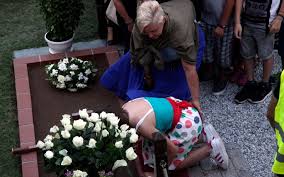
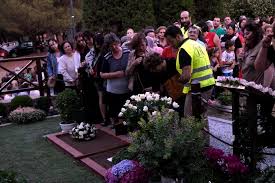
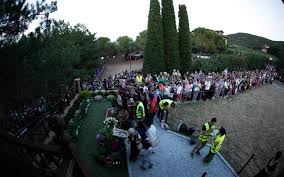
I may be on a pilgrimage in Romanian monasteries, but St Paisios’ the Athonite, my patron Saint‘s, presence is strongly felt all over Romania. Plenty of icons of his and books with his services and spiritual counsels in all monasteries and churches I have been so far! I truly regret having to leave this week of all weeks Greece, but thanks be to God, while this was going on inside Souroti monastery church on July 12, and this outside the church, near his tomb
Much longer queues than in 2013 … every year longer! The Lord is glorified in His saints!
the faithful all over in Romania were holding Vigils and praying Akathists and Supplication canons, asking for his prayers.
Wherever I go, the moment Romanians realise that I am Greek and my home town is near Souroti, they start asking for my telephone number and email, so that I can make arrangements and help them go and venerate his tomb.
Just in case you missed it, this is a beautiful documentary (in Russian with English subtitles) about the life of St. Paisios the Athonite and his years spent on Mount Sinai in Egypt.
And another one:
And yet another one by the Patriarchate of Moscow (a film documentary of six episodes with total duration of 5 hours on the holy life and work of Saint Paisius of Mount Athos):
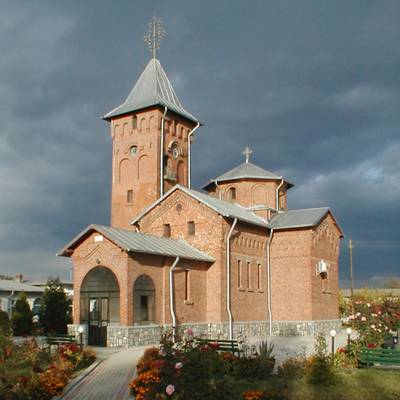
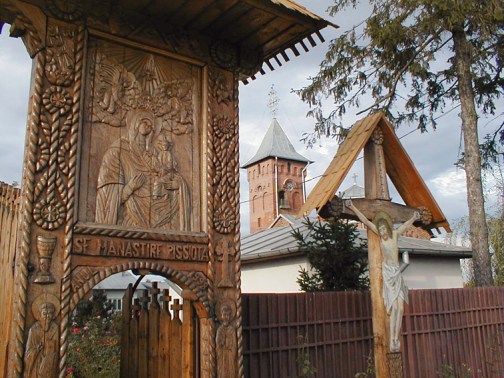
The monastery of Pissiota, located in Poienarii Burchi, was built between 1928 and 1929 by Nicolae Pissiota (1860-1940), a great man of culture, and his wife, Zoe Pissiota (1868-1940), on the estate bought from the family of General Gheorghe Angelescu (1850-1923), an important name in the 1877 war.
The first record of the village of Poienarii Burchi dates back to 21st September 1594, on the former „Poeana” estate of Lady Stanca, the wife of Michael the Brave. The village was dedicated by Lady Stanca to the Simonopetra monastery of Mount Athos, in 1594. The original document is kept at the Archives of the State in Bucharest.
The engineer Nicolae Pissiota, of Macedonian origin, born in Greece and settled in Walachia, had a huge fortune that allowed him to build this place of worship. The church was designed by the architect Ioan Giurgea – a harmonious combination between Italian Renaissance style and the Byzantine elements that are specific to Romanian churches.
Famous names were called to decorate the church: Costin Petrescu (1877-1954), the one that painted the interior frescoes of the Romanian Athenaeum, or the Cathedral of Alba Iulia, and his apprentice, Gheorghe Eftimiu.
The portraits of the patrons and of the Patriarchs Miron Cristea and Justinian Marina were done by the painter Vasile Rudeanu (in 1956). The iconostasis is carved in rosewood and cherry wood, brought from Greece, creating a balance between sensitivity and detail, influenced by Italian art.
The furniture was carved of oak wood, with ethnic motifs, by the sculptor Anghel Dima, in 1928, the author of Mihai Eminescu’s sculpture in front of the Romanian Athenaeum. The floor is made of red Carrara marble; underneath the church lie the marble crypts where the patrons and their families are buried. Inside the church there are icons and silver icon lights, in Brancoveanu style, as well as triodyons, Pentecostarians and hymn books.
The defining religious element in the Holy Monastery of Pissiota is the Icon of the Holy Virgin with the Child – miracle-working icon. The icon is painted on oak wood, against a background of Byzantine brocade, signed by the famous painter Gheorghe Eftimiu, the apprentice of the great Costin Petrescu.
For two decades after the opening, between 1928 and 1948, the monastery was a monk monastery. In 1948, the Patriarch Justinian Marina transformed it into a monastery of nuns, and this is how it remained until 1962, when it was discontinued. In 1993, after 31 years in ruin, the monastery resumed its community life.
Currently, the monastery is inhabited by 23 nuns and a priest; prayer is in harmony with work, as there are tailoring workshops where priestly vestments and clothes are made, allowing people to add the little money they have for the restoration of the monastery.
People are so beautiful it hurts. We all have this beauty in us, this otherworldly potential to be so much more than what we settle for. At times, this awareness is the only thing that makes sense of this senseless existence, its very foundation, the star calling us forward, the purpose of this flesh. Most of the times, though, it makes life ever more painful, because it throws light upon the dark truths we have spent a lifetime learning to ignore.
Someone’s asked in an email from where I get the strength to keep going. The raw answer is: fear. Fear and desperation and the knife-like breath of death I see slowly and implacably eating me from the inside, consuming the beauty within myself, the beauty within you. I look in the mirror and I see a caged animal, waiting in line to be sacrificed. I live with the awareness that none of the breaths I’ve taken, none of the things I’ve felt and done have life within themselves.
The most painful thing I live with, the heaviest weight I carry is the total, perfect knowledge that there is no memory here to preserve even the slightest trace of our sparks of life.
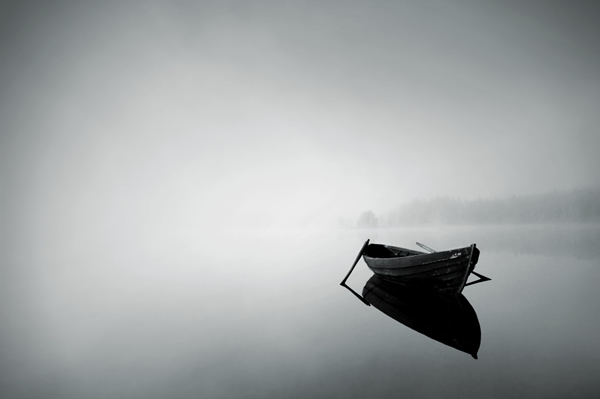
I look in the mirror and I see nothing that will survive death. I stare at this nothingness and life becomes a desperate attempt to outrun death. At times, this turns into pure isolation, and no island can be far enough; no darkness thick enough to cover me. Other times, for very few and rare moments, this turns into white silence. A bright blanket of silence that covers my mind like rarefied air. Up there, in those rarefied clouds, floating high above death, there is Rest, there is Peacefulness.






 ORTHODOX CHRISTIAN FAITH AND LIFE