Ultimatum

death-painting.jpg

No, my father will not be ‘spared’ in the end. Like all of us. The final diagnosis is terminal cancer. The prognosis chillingly blunt. It is just that God said Not yet! Biopsy confirmed adenocarcinoma. The liver findings are metastases. The location of the primary carcinoma will be found from results which we will have on Monday. Possible locations: colon, pancreas, … No point to operate, we already have metastases.Life expectancy: very uncertain since we still do not know location of primary cancer but MAYBE 6 – 12 months …

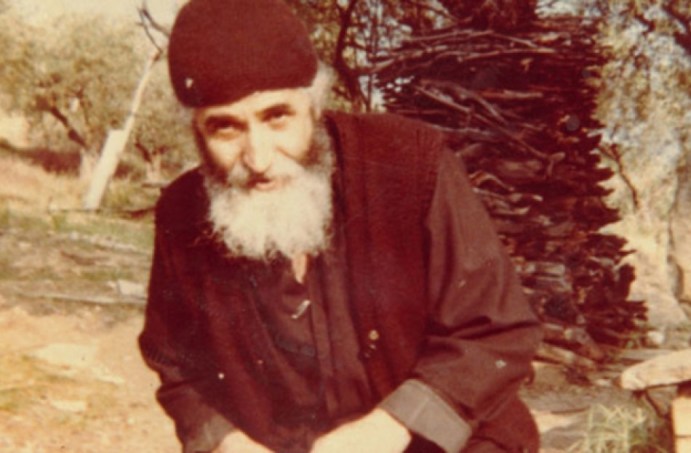
Glory to God for all things! Surely God is not our Servant. We are His. Likewise, our will is not to be done. But His. His Love and Providence has shone and is still shining, again, so brilliantly, through this life’s trial that my heart is moved to Doxology, leaping with Joy and joining  St. Paisios of Mount Athos at  his ‘Crazy’ Beatitudes. Not the least of such blessings was my father’s conscious decision, before this crisis escalated, to approach the sacrament of Holy Confession for the first time in his life at the age of 86 (!) This was a decision which caught all of us by surprise! All but the spiritual fathers who have been praying all their lives for this.  My father accordingly prepared, confessed and partook of the Holy Communion. Glory to God for all things! 

3.jpgDetail from Descent into Hades

*Pay attention to the heart-rending detail of Christ’s crucifixion wound on the hand. Metropolitan Anthony of Sourozh, or what it Lev Gillet, once commented that these crucifixion wounds are to remain in Jesus Resurrected Body to Eternity as a token of His Love and Sacrifice.

 2.jpg

Ossuary in Dionysiou Monastery – Mount Athos

Written c. 750 .A.D.
“Media vita in morte sumus ; quem quaerimus adjutorem, nisi te Domine, qui pro peccatis nostris juste irasceris? Sancte Deus, sancte fortis, sancte et misericors Salvator, amarae morti ne tradas nos.”
“In the midst of life we are in death: of whom may we seek for succour, but of thee, O Lord, who for our sins art justly displeased? Yet, O Lord God most holy, O Lord most mighty, O holy and most merciful Saviour, deliver us not into the bitter pains of eternal death.”

What is a Christian end to life?

When Breath Becomes Air


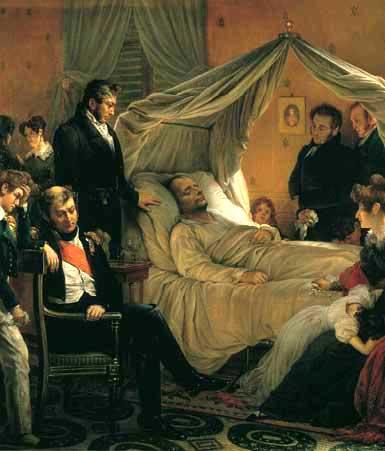
Final Hours and Death in Western Painting, Byzantine chanting and iconography, end of life care/ palliative care and … in my life.

The blog post which follows is  painfully relevant to me. I have seen some of this first-hand, and I do have very elderly and frail, ailing parents, nearing death and requiring constant one-on-one nursing care. Even for a poor ‘hermit’ as I am, their impending death is a difficult emotional time. The ‘bodies’ of both my parents, simultaneously, especially though my father’s, prepare themselves for the final days of life. Thank God they have both gone to Confession before and received Eucharist! Just in time! I believe my father is nearer to the ‘end’ than my mother and he will be the first to go. I am most impressed by his calmness and humility in accepting his “body’s process of ‘shutting down’, which will end when all the physical systems cease to function”. I am deeply moved by my father’s tender care to make sure we are all well, his attempts to resolve whatever is unfinished of a practical nature, and his silent seeking permission from us, family members to “let go.””. His eyes are so eloquent! He tries to hold on, even though this brings him a prolonged discomfort, in order to be assured that those left behind will be all right.

I have often felt these days that a family’s ability to reassure and release the dying person from this concern is the greatest gift of love they can give at this time. Saying Good-bye is also so important, so prolonged, so heart-rending, so personal! These last days are typically spent laying in bed with him and holding his hand, in tears.

“O my sweet springtime, O my sweetest Child, where has all Thy beauty gone?” (The Lamentations of the Tomb)

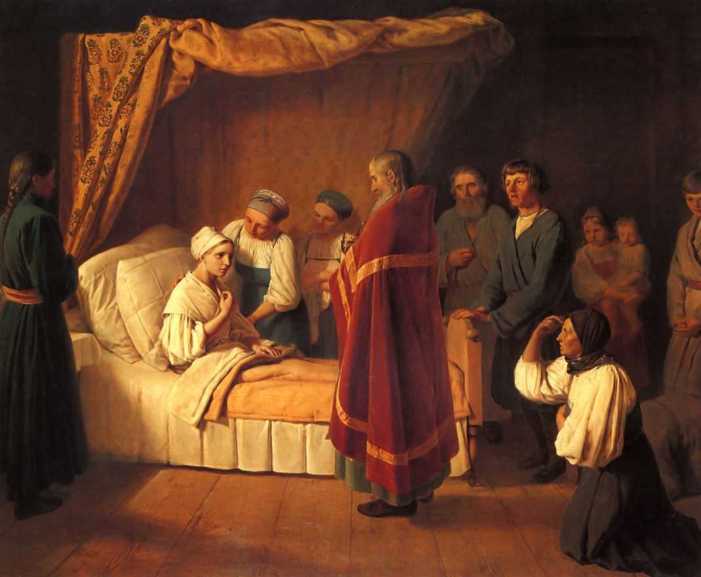
Alexey_Venetsianov_25

Administration of the Eucharist to a dying person (painting by 19th-century artist Alexey Venetsianov)

-1

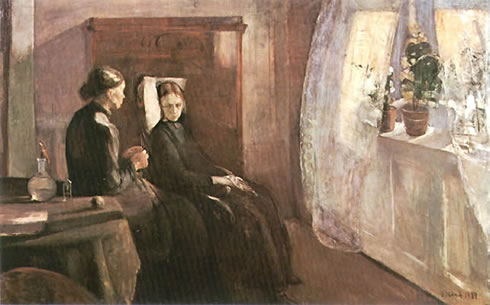
This painting didn’t have the Expressionism Style. The girl in this painting is dying and Munch used light colors instead of a dark palette.

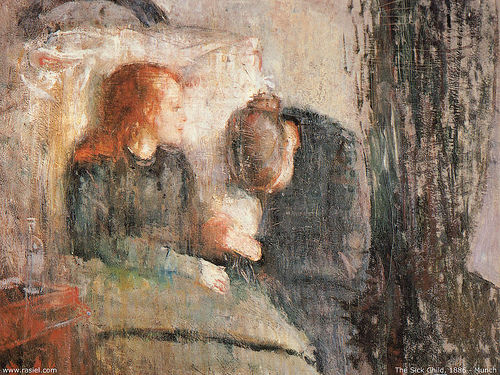
dying_child1.jpg

“Dying Child” by Edvard Munch. Everything in this painting is saturated in suffering, except the dying girl, who is fragilely posed (in repose) in a way that is heartbreaking.

595

‘Dying Well’

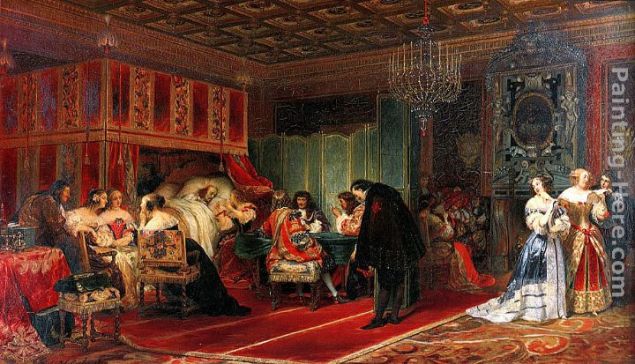
Cardinal Mazarin Dying.jpg

Paul Delaroche Cardinal Mazarin Dying

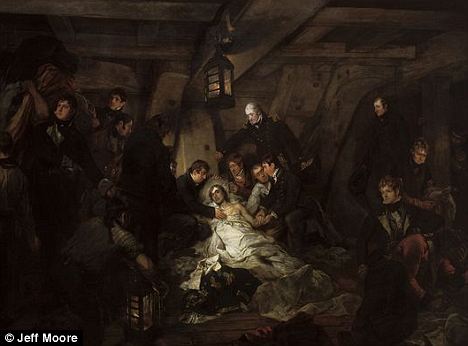
article-1285847-09FE7377000005DC-699_468x346

The famous picture by Arthur William Devis showing a dying Nelson


IngresDeathOfDaVinci

The Death of Leonardo da Vinci is an 1818 painting by the French artist Jean Auguste Dominique Ingres


elderly woman looking outIn the old days, she would be propped up on a comfy pillow, in fresh cleaned sheets under the corner window where she would in days gone past watch her children play. Soup would boil on the stove just in case she felt like a sip or two. Perhaps the radio softly played Al Jolson or Glenn Miller, flowers sat on the nightstand, and family quietly came and went. These were her last days. … spent with familiar sounds, in a familiar room, with familiar smells that gave her a final chance to summon memories that will help carry her away. …

You see, that’s how she used to die.

The essay is entitled “I Know You Love Me; Now Let Me Die” I saw it on Facebook, handed around the way that we do everything from meatloaf recipes to the greatest speeches in history, with the result that everything has the same value.

But considering the topic, I feel like this one deserves to come with a big label that says, “Read this. It actually matters.” The physician author of this article has first-hand knowledge of just what death looks like in the modern hospital room or elderly care facility. He approaches it from the medical professional’s point of view, and considers what happens to the theoretical dying woman whose gentler, old-fashioned death he sketched above. But these days …

Empty-hospital-bed-scale-300x200She can be fed a steady diet of Ensure through a tube directly into her stomach and she can be kept alive until her limbs contract and her skin thins so much that a simple bump into that bed rail can literally open her up …. She can be kept alive until her bladder is chronically infected, until antibiotic resistant diarrhea flows and pools in her diaper so much that it erodes her buttocks. The fat padding around her tailbone and hips are consumed and ulcers open up exposing the underlying bone, which now becomes ripe for infection.

I know these aren’t pretty things to talk about. But I have seen some of this first-hand; I think quite a lot of people my age have. When my father-in-law was in decline, he received end-of-life care that went on for about three years. When I blogged about it back in March 2014, in spite of the excellent hospice care Charles received, I had to ask:

Is this really the best we can do for Greg’s dad? Charles is on “palliative care,” and so the only medical concern is limiting suffering. But is an unsuffering death really possible? And if it is, am I wrong to think that it’s just not what I would want for myself?

… if it were my time to go, and I could see that it would be this creeping, sanitized kind of yearlong journey with caretakers trying to keep every little thing operating as if I were just a collection of little things … would I be just crazy to say that I’d like to opt out? …Wouldn’t I rather have a short end punctuated by intense focus than a protracted fugue state with no intensity and no humanity?

We go through it with our elderly parents and we have no way to change the current practices. But I hope that by the time I get there, enough of us will have spoken up to say that just because we CAN keep bodily functions going at maximum cost with maximum artificiality doesn’t mean we SHOULD. Because we aren’t just pumps and springs and tubes — we’re human beings made in the image of God.

We pray for “a Christian end to our life — painless, blameless and peaceful.” But what does that really look like? Can’t we see out our days better in the quiet corner that the author places his patient in than in the sterile, hopeless hospital beds that most of us are bound for?

What is “a Christian end to our life?” I really want to know.

Source: This Side of Glory

The Ill, the Weak And The Mortal

MY ‘LESSER’ VERSIONS: The Ill, the Weak And The Mortal,

Or, In Search of True Personhood

2

All my life I have been surrounded by family members, suffering with one of the forms of dementia and psychiatric disorders. Rare is the time that I meet someone who doesn’t have a loved one likewise. I hope this blogpost by Father Seraphim Aldea can be of some help, even for a brief moment. May God’s love and strength protect us all …


3


I have seen people die. I have seen people suffer. I have seen the anguish in their eyes. Most times, it comes from a combination of fear of the weak beings they have become, and regret for the strong being they once were. Fear of turning into something we no longer recognise as ourselves, and regret for losing something we perceived as our ‘correct’ selves.

We only think of ourselves as ‘whole’ when we fit into a wellness norm fed by the idolatric attitude we have for the society we are part of. This society – here and now – tells me that I am all right when I am healthy; therefore, I am my ‘proper’ version, I am my ‘correct’ self, I am who I am supposed to be only when I am healthy. This society tells me that illness and sadness and all forms of weakness are wrong; therefore, I am no longer my ‘proper’ version when I am ill – my ‘correct’ self has become corrupted, infested, compromised.

IMG_5323

But society changes its mind, because it is empty, devoid of meaning, and – like any form without substance – it takes in whatever substance fits its purpose. To be healthy once meant to be chubby and live the sort of life that gave you gout. To be your true self meant at different times to die young, to suffer from melancholia, and to kill yourself in the name of honour. Things have changed. Today (and mostly here, in the West), we worship the healthy, strong, optimist being. Anything else is not properly human.

The implications are the same, though: only when we fit these norms we think of ourselves as being ‘ourselves’. Whatever does not fit these norms is not part of us, it is us being ‘someone else’, a lesser version of myself, an amputated, decayed version of myself, which either has lost things proper to my true self (‘I cannot move anymore’) or has taken over and incorporated things that are alien to my true self, things from the outside, things that entered my true self and diseased it (illness; sadness; death).

We have this perfect version of who we are supposed to be, and we define our happiness depending on the level of conformity to that ideal. We replace the living being that we are – changing, evolving and discovering oneself from all perspectives, including the ‘negative’ ones (illness; old age) – with the immobile poster-like image of the ‘healthy young man’. There is not much difference in essence between the tyranny of this healthy young idol and other tyrannies we have seen in the recent past: the arian man of the second world war, the new man of communism, the jihad man of terrorism. They all want to eradicate what they perceive as corrupted, lesser versions of humanity.

In some way, the tyranny of our idol is even more violent, because we not only enforce it upon others, but we internalise it and we end up inflicting it upon ourselves. A Nazi criminal could never become a Jew himself; his idol never reflected its hatred against himself. We, on the other hand, we all shall as some point feel weak, we all shall get sick, we all shall become old and face the reality of our mortality. To shy away from these ‘lesser’ versions of ourselves, to reject and to fight against them is to reject and fight against ourselves. To run away from them is to run away from myself. To fear and hate them is to fear and hate myself.

Source: The Mull Monastery Blog

Rage, Rage At the Dying of the Light

Or, The Hollow Gaze Of a  Beast

holoow3

I am beginning to think that I am secretly a bear. I definitely have the social skills of one. I am as voluble as a bear during hibernation, and as attached to my room as a bear to its cave. In all honesty, I am continuously amazed anyone still wants to talk to me given how bad I am at keeping in touch. The simple reality is that I function in a state of amazement. I have rewritten this paragraph so many times; I can find no better way to describe this. I function like a stunned being. I go through the motions I see in other people; I do what it takes to be functional in this world. But deep down, I am paralysed.

I once saw a huge bull being taken to the slaughterhouse. I was in my monastery in Moldavia at the time. The animals know. The know perfectly well that behind that big door there is death. Many of them go wild, and desperation takes over. Some times, their hearts fail and they collapse, so they have to be dragged inside. I remember this bull: a huge, beautiful animal. I remember its stare. Its muscles had completely frozen; there was no movement at all – not a blink, not a sound. At the centre of that heard of bellowing animals, fighting to escape death, I remember that hollow, frozen gaze as the bull was pushed by three men towards the gate, inside the slaughterhouse.

Icon 1

I function very much like that stunned animal. When I look in the mirror (which I purposely try not to do) I recognise that gaze. There is something of that in everyone. Often times, I switch off as people talk to me about their holidays and homes and plans. I switch off and I try to recognise that frozen gaze in their eyes: beyond the noise, beyond the superficial glitter of life, that hollowness is always there. It is imprinted in us. It is part of what makes us who we are, part of what makes us human.

I suppose this is my apology for failing to always keep ‘on schedule’ with posting here, recording our podcasts and so on. I am sorry. I am aware I should be doing more, especially as many of you continue to support the monastery even through these periods of silence. Perhaps you feel something. Perhaps you yourselves recognise something in this silence.

I have prayed to make sense of this desperation. I live with a perfect hope that we shall all survive the slaughterhouse, but this hope comes with an equally perfect awareness of the hollowness of this life. I have prayed to make sense of this. I have also prayed that I loose neither the hope, nor the desperation; living with both creates an intense tension, and that tension feeds my heart. I have an intuition that this tension will lead me to Life.

If I have learned something so far, it is that I must protect and treasure this life, because the seed of Life is buried in it. The hollowness of this life, its senselessness, its pain have taught me that I myself can only get as far as the gate of the slaughterhouse. If there is any hope to make it beyond that gate, if there is any hope to survive it, it does not come from me. I cannot be my own saviour. I cannot be anyone’s saviour. This is a tough lesson to learn and impossible to fully accept without the grace of God. I am nothing without a Saviour. It is a tough lesson, but we cannot run away from it. Horrid as it feels, this is the foundation of all our hope.

Just think how different things could have been, had Adam stared into his own hollowness and accepted it, instead of collapsing at the feet of the devil. Had Adam accepted this truth, had he accepted that he cannot be his own saviour, has he reached out for a Saviour, this world would have known a different history. Perhaps this is the point of it all: to learn the lesson Adam has not; to stare into the hollowness of our being and not despair, to not collapse as he did, because we know that a Saviour has taken on the form of this hollowness and lifted it up to Life.

http://www.mullmonastery.com/monastery-blog/the-hollow-gaze-of-a-beast/

holllow6

The Hollow Men by T.S. Eliot

Mistah Kurtz – he dead.

A penny for the Old Guy

I

We are the hollow men
We are the stuffed men
Leaning together
Headpiece filled with straw. Alas!
Our dried voices, when 
We whisper together
Are quiet and meaningless
As wind in dry grass
or rats’ feet over broken glass
In our dry cellar

Shape without form, shade without colour, 
Paralysed force, gesture without motion;

Those who have crossed
With direct eyes, to death’s other kingdom 
Remember us – if at all – not as lost
Violent souls, but only
As the hollow men 
The stuffed men. 

Picture

 
IIEyes I dare not meet in dreams
In death’s dream kingdom
These do not appear: 
There, the eyes are
Sunlight on a broken column 
There, is a tree swinging
And voices are 
In the wind’s singing 
More distant and more solemn 
Than a fading star.Let me be no nearer
In death’s dream kingdom 
Let me also wear
Such deliberate disguises
Rat’s coat, crowskin, crossed staves
In a field
Behaving as the wind behaves
No nearer – 

Not that final meeting 
In the twilight kingdom

Picture


III

This is the dead land
This is cactus land
Here the stone images
Are raised, here they receive
The supplication of a dead man’s hand
Under the twinkle of a fading star.

Is it like this
In death’s other kingdom 
Waking alone
At the hour when we are
Trembling with tenderness
Lips that would kiss
Form prayers to broken stone. 

Picture


IV

The eyes are not here
There are no eyes here
In this valley of dying stars
In this hollow valley
This broken jaw of our lost kingdoms

In this last of meeting places 
We grope together
And avoid speech
Gathered on this beach of this tumid river

Sightless, unless
The eyes reappear
As the perpetual star
Multifoliate rose
Of death’s twilight kingdom
The hope only
Of empty men. 

Picture


V

Here we go round the prickly pear
Prickly pear prickly pear
Here we go round the prickly pear
At five o’clock in the morning. 

Between the idea
And the reality
Between the motion 
And the act
Falls the Shadow

For Thine is the Kingdom 

Between the conception
And the creation 
Between the emotion 
And the response
Falls the Shadow

Life is very long

Between the desire
And the spasm 
Between the potency
And the existence
Between the essence
And the descent
Falls the Shadow

For Thine is the Kingdom 

For Thine is
Life is
For Thine is the

This is the way the world ends
Not with a bang but with a whimper. 

holoow3

Because I Could Not Stop For Death


People are so beautiful it hurts. We all have this beauty in us, this otherworldly potential to be so much more than what we settle for. At times, this awareness is the only thing that makes sense of this senseless existence, its very foundation, the star calling us forward, the purpose of this flesh. Most of the times, though, it makes life ever more painful, because it throws light upon the dark truths we have spent a lifetime learning to ignore.

Someone’s asked in an email from where I get the strength to keep going. The raw answer is: fear. Fear and desperation and the knife-like breath of death I see slowly and implacably eating me from the inside, consuming the beauty within myself, the beauty within you. I look in the mirror and I see a caged animal, waiting in line to be sacrificed. I live with the awareness that none of the breaths I’ve taken, none of the things I’ve felt and done have life within themselves.

The most painful thing I live with, the heaviest weight I carry is the total, perfect knowledge that there is no memory here to preserve even the slightest trace of our sparks of life.

I look in the mirror and I see nothing that will survive death. I stare at this nothingness and life becomes a desperate attempt to outrun death. At times, this turns into pure isolation, and no island can be far enough; no darkness thick enough to cover me. Other times, for very few and rare moments, this turns into white silence. A bright blanket of silence that covers my mind like rarefied air. Up there, in those rarefied clouds, floating high above death, there is Rest, there is Peacefulness.


Source: Father Seraphim –The Mull Monastery at http://www.mullmonastery.com/uncategorized/someones-asked-in-an-email-from-where-i-get-the-strength-to-keep-going/

Beating Christmas (and Life) Blues

IMG_2657

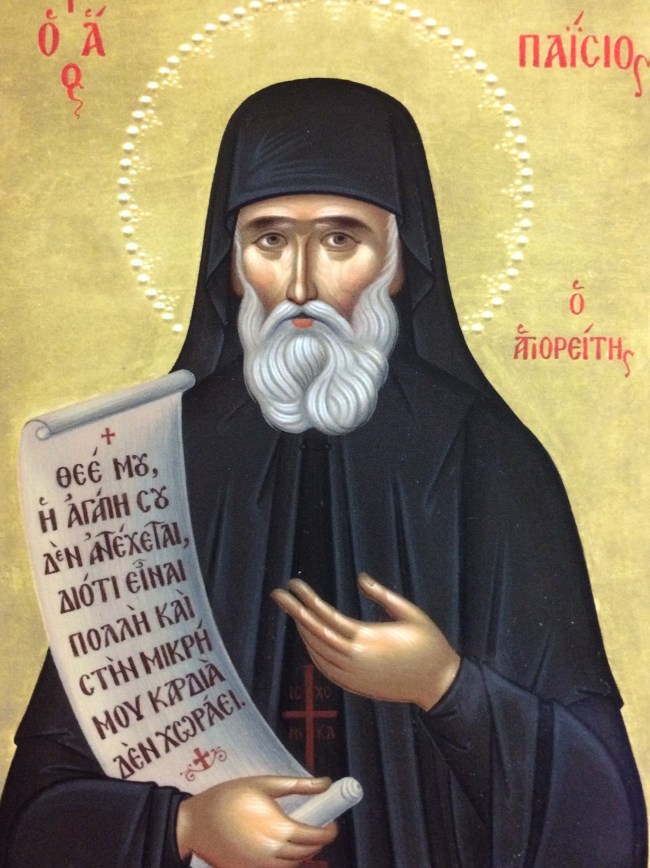
“My God, I cannot ‘stand’ your Love, because It is Immense and there is no place for It in my small heart ” (Translation of the scroll)

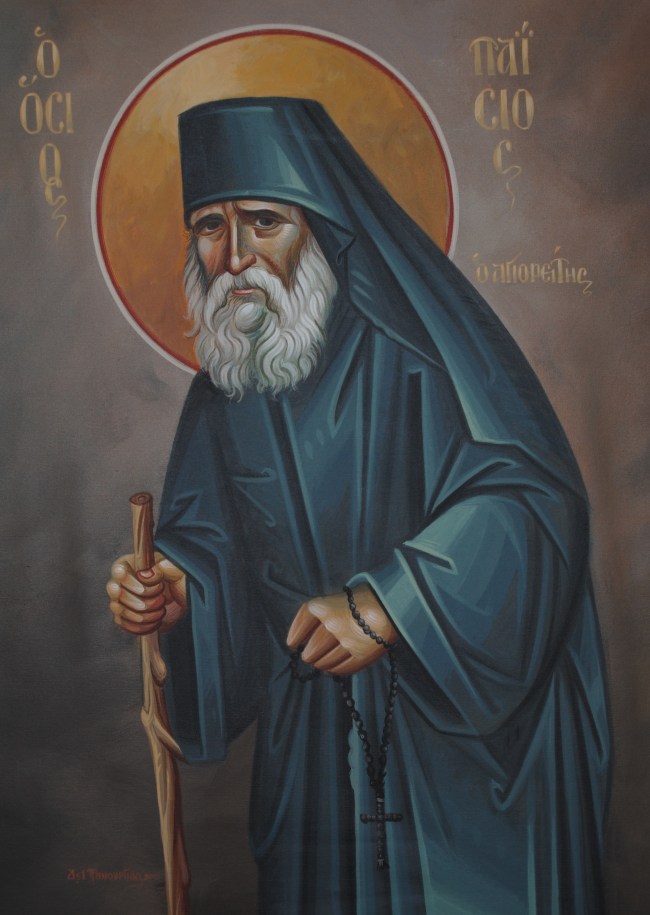
  1. Blessed are those who love Christ more than all the worldly things and live far from the world and near God, with heavenly joys upon the earth.

  2. Blessed are those who manage to live in obscu­rity and acquired great virtues but did not acquire even a small name for themselves.

  3. Blessed are those who manage to act the fool and, in this way, protected their spiritual wealth 
 

DSC_0364DSC_0366

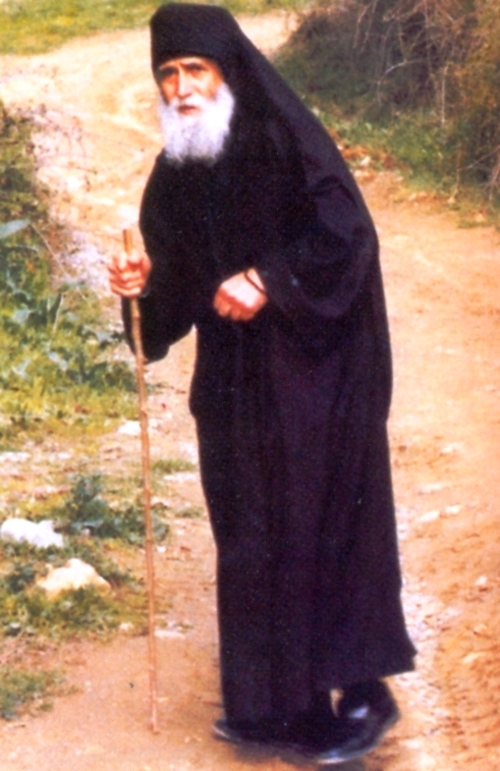
4. Blessed are those who do not preach the Gospel with words, but live it and preach it with their silence, with the Grace of God, which betrays them.

  5. Blessed are those who rejoice when unjustly ac­cused, rather than when they are justly praised for their virtuous life. Here are the signs of holiness, not in the dry exertion of bodily asceticism and the great number of struggles, which, when not carried out with humility and the aim to take off the old man, create only illusions.

  6. Blessed are those who prefer to be wronged rather than to wrong others and accept serenely and silently injustices. In this way, they reveal in practice that they believe in “one God, the Father Almighty” and expect to be vindicated by Him and not by human beings who repay in this life with vanity.
 

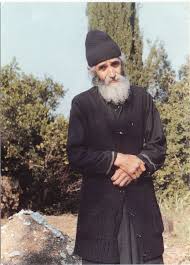
st paisios15.jpg

7. Blessed are those who have been born crippled or became so due to their own carelessness, yet do not grumble but glorify God. They will hold the best place in Paradise along with the Confessors and Martyrs, who gave their hands and feet for the love of Christ and now constantly kiss with devoutness the hands and feet of Christ in Paradise.

  8. Blessed are those who were born ugly and are de­spised here on earth, because they are entitled to the most beautiful place in Paradise, provided they glorify God and do not grumble.

  9. Blessed are those widows who wear black in this life, even unwillingly, but live a white spiritual life and glorify God without complaining, rather than the mis­erable ones who wear assorted clothes and live a spot­ted life.

gerontas-paisios


10. Blessed and thrice blessed are the orphans who have been deprived of their parents’ great affection, for they managed to have God as their Father already from this life. At the same time, they have the affection they were deprived of from their parents in God’s savings bank “with interest”.

  11. Blessed are those parents who avoid the use of the word “don’t” with their children, instead restraining them from evil through their holy life – a life which chil­dren imitate, joyfully following Christ with spiritual bravery.

  12. Blessed are those children who have been born “from their mother’s womb”(Mt. 19:12) holy, but even more blessed are those who were born with all the inherited passions of the world, struggled with sweat and up­rooted them and inherited the Kingdom of God in the sweat of their face (Cf. Gen. 3:19).
 

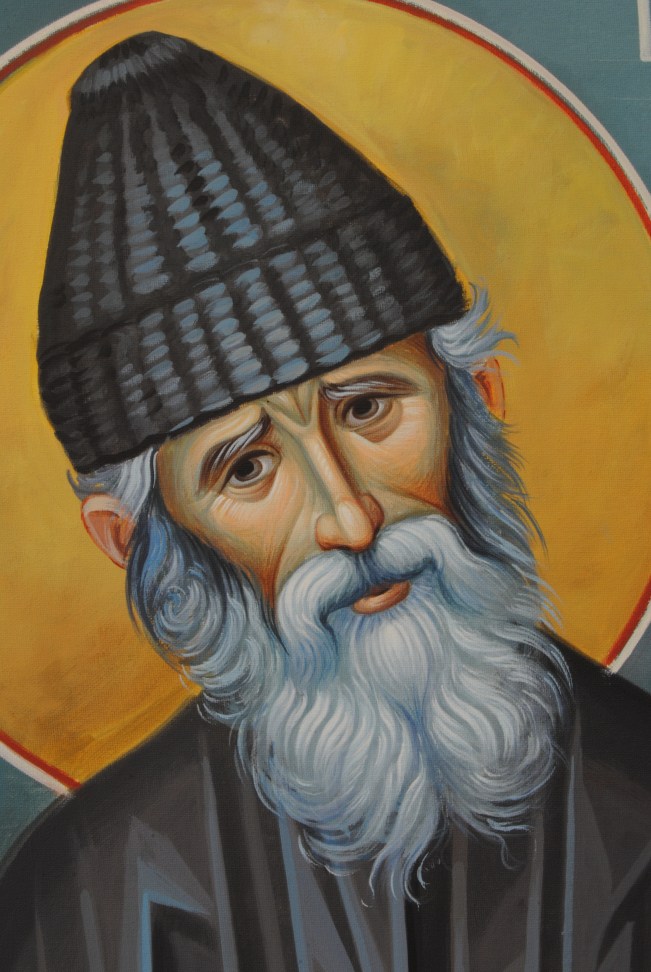
st paisios10

13. Blessed are those children who lived from in­fancy in a spiritual environment and, thus, tirelessly ad­vanced in the spiritual life.

Thrice blessed, however, are the mistreated ones who were not helped at all (on the contrary, they were pushed towards evil), but as soon as they heard of Christ, their eyes glistened, and with a one hundred and eighty degree turn they suddenly made their soul to shine as well. They departed from the attraction of earth and moved into the spiritual sphere.

  14. Fortunate, worldly people say, are the astronauts who are able to spin in the air, orbit the moon or even walk on the moon.

Blessed, however, are the immaterial “Paradise-nauts”, who ascend often to God and travel about Paradise, their place of permanent abode, with the quickest of means and without much fuel, besides one crust of bread.

15. Blessed are those who glorify God for the moon that glimmers that they might walk at night.

More blessed, however, are those who have come to understand that neither the light of the moon is of the moon, nor the spiritual light of their soul of them­selves, but both are of God. Whether they can shine like a mirror, a pane of glass or the lid of a tin can, if the rays of the sun do not fall on them, it is impossible for them to shine.



CSC_0054xζDSC_0035


16. Fortunate, worldly people tell us, are those who live in crystal palaces and have all kinds of conven­iences.

Blessed, however, are those who have managed to sim­plify their life and become liberated from the web of this world’s development of numerous conveniences (i.e. many inconveniences), and were released from the frightening stress of our present age.


 17. Fortunate, worldly people say, are those who can enjoy the goods of the world.

Blessed, however, are those who give away every­thing for Christ and are deprived even of every hu­man consolation for Christ. Thus it is that they man­age to be found night and day near Christ and His di­vine consolation, which many times is so much that they say to God: “My God, Thy love cannot be en­dured, for it is great and cannot be fit within my small heart”.

  18. Fortunate, worldly people say, are those who have the greatest jobs and the largest mansions, since they possess all means and live comfortably.

Blessed, however, according to the divine Paul, are those who have but a nest to perch in, a little food and some coverings99• For, in this way, they’ve managed to become estranged from the vain world, using the earth as a footstool, as children of God, and their mind is con­stantly found close to God, their Good Father.

st paisios15

  19. Fortunate are those who become generals and government ministers in their head by way of heavy drinking (even if just for a few hours), with the world­ly rejoicing over it.

Blessed, however, are those who have put off the old man and have become incorporeal, managing to be earthly angels with the Holy Spirit. They have found Paradise’s divine faucet and drink from it and are con­tinually inebriated from the heavenly wine.

  20. Blessed are those who were born crazy and will be judged as crazy, and, in this way, will enter Paradise without a passport.

Blessed and thrice blessed, however, are the very wise who feign foolishness for the love of Christ and mock all the vanity of the world. This foolishness for Christ’s sake is worth more than all the knowledge and wisdom of the wise of this world.


I beg all the Sisters to pray for God to give me, or rather take from me my little mind, and, in this way, se­cure Paradise for me by considering me a fool. Or, make me crazy with His love so I go out my self, outside of the earth and its pull, for, otherwise my life as a monk has no meaning. I became externally white as a monk. As I go I become internally black by being a negligent monk, but I justify myself as one unhealthy, when I hap­pen to be so; other times, I excuse myself again for be­ing ill, even though I am well, and so I deserve to be thoroughly thrashed. Pray for me.


May Christ and Panagia be with you,

With love of Christ, Your Brother, Monk Paisios

(“Timiou Stavrou”, December 2, 1972).


“Woe to you that are full now, for you shall hunger.
“Woe to you that laugh now, for you shall mourn and weep.
“Woe to you, when all men speak well of you, for so their fathers did
to the false prophets… (Lk. 6:24-30)
“The Beatitudes” with Elder Paisios of the Holy Mountain (Taken from the Elder’ Sixth Epistle

“…

Sister Abbess Philothei, Your blessing,

Today, a kind of craziness took hold of me and I took the pencil, as does the madman who writes his outbursts on the wall with charcoal, and I sat down to write my own things on paper like one crazed, and, again, like a lunatic, to send them to you in writ­ing. I am doing this latter craziness out of much love for my Sisters, that they might be edified, even if only a little.

The reason for the initial craziness was five let­ters, one after the other, from various parts of Greece on a variety of subjects. While the events described were great blessings of Godthose who wrote to me had fallen into despair because they dealt with them in a worldly way. 

After replying accordingly to their letters, I took the pencil like a madman, as I have said, and wrote this epistle. I believe that even a fifty-cent piece from your journeying brother will be something toward a flint for each one of the Sisters so as to light a little candle in her cell and offer her doxology to our Good God.

I feel great joy when every Sister, with her particu­lar cross carries out the equivalent struggle with philo­timo. 

It is a small thing to give to Christ a heart equal in size and as luminous as the sun out of gratitude for His great gifts, and especially for the particular honour He showed us monks by conscripting us with personal sum­mons to His Angelic Order.

A great honour also belongs to the parents who were thus made worthy of becoming related to God. Unfor­tunately, however, most parents do not realize this and, instead of being grateful to God, are infuriated etc., for they see everything in a worldly way, like those people I mentioned earlier, who became the reason for me to take the pencil and write everything that follows. …”