“One day a tiny tear appeared on a cocoon. One man was watching the butterfly trying to push her body through the opening. The struggle lasted for hours. Then it looked as though every activity had ceased. It looked as though the butterfly had done all it could and could not move any further. The man took a pair of scissors and opened up the cocoon. The butterfly moved out easily yet her body and her wings looked withered.
The man continued watching. He was waiting for her to flap her wings, hoping they would slowly grow, strengthen and become able to lift the butterfly to the air.
Yet, the butterfly went through her entire life moving painfully and slowly, harboring a wasted body and withered wings. She never managed to fly away.
What this kind man could not understand was that the restricted space in the cocoon and the struggle the butterfly waged served to force the liquids in her body to move towards her wings, so that she would be able to fly away as soon as she would get out.
Sometimes we too need this kind of struggle.
If we go through life without facing any troubles, we will be wasting away. We would not be as strong as we could be. We would never be able to ‘fly away’.
I have asked for strength…
I faced trouble so that I could become stronger
I have asked for wisdom…
I was given riddles to solve
I have asked for a good life…
I was given a brain and a healthy body so that I could work
To a person who had to choose between suicide and begging
St. Velimirovich letter
29 December 2016
You write that all your worldly goods were sold off to a third party. When you found yourself out on the street with nothing and nobody, you headed to the cemetery, bent on killing yourself. You had no doubts or second thoughts about this. Exhausted by the vexations, you lay down on your parents’ grave and fell asleep. Your mother appeared to you in your sleep and berated you, saying that in the Kingdom of God there were plenty of people who had been beggars, but not a single one of those who had done away with themselves. That dream saved you from suicide. Your beloved mother really did save you, by God’s providence. You began to beg and to live off begging. And you’re asking if, by doing so, you’re transgressing God’s law.
Take courage. God gave the commandment: ‘Don’t steal’. He didn’t give any commandment ‘Don’t beg’. Begging without any real need is stealing, but in your case it isn’t. The general and emperor Justinian was left blind in his old age, with no possessions or friends. He would sit, blind, outside the courtyard of the throne and beg for a little bread. As a Christian, he didn’t permit himself to consider suicide. Because, just as life’s better than death, so it’s better to be a beggar than a suicide.
You say that you’re overcome with shame and that your sorrow’s deep. You stand at night outside the coffee-shop that used to be yours and ask for money from those who go in and out. You remember that, until recently, you were the owner of the coffee-shop and now you don’t dare go in even as a customer. Your eyes are red from weeping and lamentation. Comfort yourself. God’s angels aren’t far from you. Why are you crying about the coffee-shop? Haven’t you heard of the coffee-shop at the other end of Belgrade where it says: ‘Someone’s it wasn’t; someone’s it won’t be’? Whoever wrote those words was a true philosopher. Because that’s true of all the coffee-shops, all houses all the castles and all the palaces in the world.
What have you lost? Something that you didn’t have when you were born and which isn’t yours now. You were the boss, now you’re poor. That’s not loss. Loss is when a person becomes a beast. But you were a person and have remained so. You signed some papers for certain of your prominent customers and now your coffee-shop’s in the hands of a stranger. Now you look through the window and see everybody laughing, just the way they used to, and you’re wandering the streets with tears in your eyes and covered in shame. Never fear, God’s just. They’ll all have to answer for their misdeeds. But when they attempt to commit suicide, who’s to say whether the merciful Lord will allow their mothers to appear to them from the other world in order to keep them from the crime? Don’t consider them successful even for a moment. Because you don’t know how they’ll end up. A wise man in ancient Greece said: ‘Never call anybody happy before the end’. It’s difficult to be a beggar? But aren’t we all? Don’t we all depend, every hour of every day, on the mercy of Him Who gives us a life to lead? Now you’ve got an important mission in the world: to engage people’s attention so that they remember God and their soul and to be charitable. Since you’re forced to live in silence, delve into your soul and talk to God through prayer. The life of a beggar’s more heroic than that of a boss. ‘For gold is tested in the fire and accepted people in the furnace of humility’ (Sir. 2, 5). But you’ve already demonstrated heroism by rejecting the black thought of suicide. This is a victory over the spirit of despondency. After this victory, all the others will be easy for you. The Lord will be at your side.
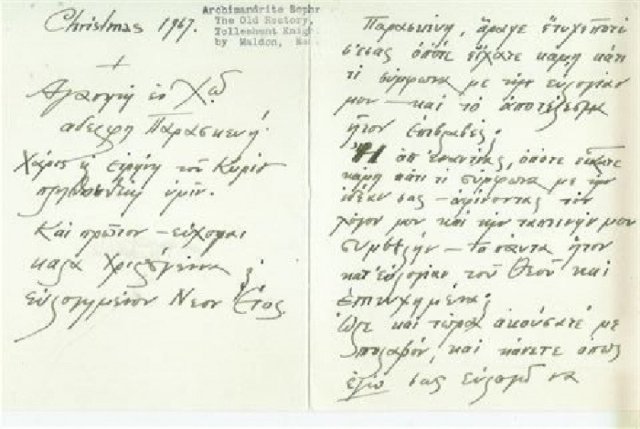
Paraskevi, who out of sheer humility does not wish to reveal her full name, was among the first spiritual children of Elder Sophrony, during the time of her studies in England. She sent us a copy of two handwritten scripts by the blessed Elder.
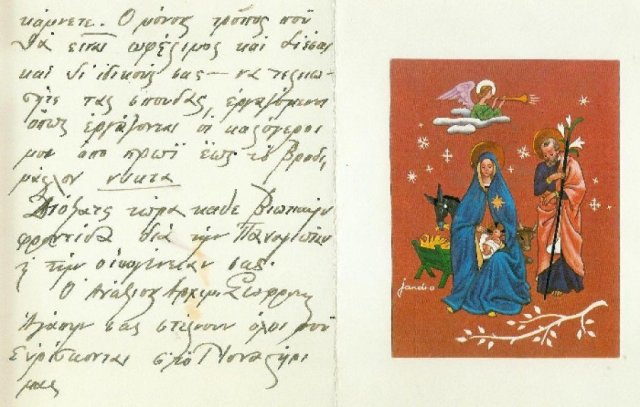
A good wish card which the blessed Elder sent during Christmas 1967, when Paraskevi was going through some difficult times because of the illness of a close relative.
The outside of the card
The Christmas wish card (handwritten):
Archimandrite Sophrony
The Old Rectroy,Tolleshent Knight
by Maldon, Essex
Christmass 1967,
+
Dear beloved in Christ, Sister Paraskevi.
May the Lord’s grace and peace be abundant in you. Let me first wish you Merry Christmas and a blessed New Year!
Paraskevi, has it ever happened to do something according to my blessing and it turned out harmful? Or has it happened that you did something according to your mind and not according to my humble advice that it was successful and in accordance with God’s providence? Therefore, now you must listen to me, the old fool, and do as I give you the blessing to do. The only beneficial way for you and your relatives is to finish your studies and work at the same time, as my monks do from morning till the evening. Get rid of any worry for X and your family.
The unworthy Arch. Sophrony.
You have the love of all who are at out monastery.
***
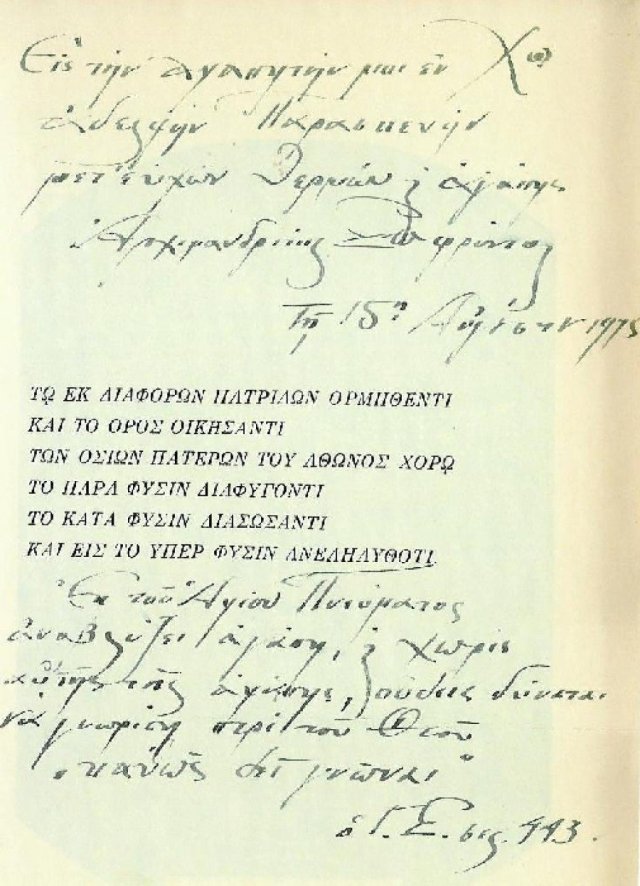
Handwritten inscription by the Elder on the 15th August 1975, when he sent her his book, St Silouan the Athonite
On the bookSt Silouan the Athonite(handwritten):
To my beloved in Christ sister Paraskevi with warm wishes and love
Arch. Sophrony
15th August 1975
Printed in Caps:
Hailing from various countries
And retreating to the Mountain,
Among the holy fathers of Mount Athos,
Escaping the unnatural
And safeguarding the natural
Rising to that which is beyond nature
Again, by hand of Elder Sophrony:
From the Holy Spirit gashes out love, and without it no one is able to know God ‘as He must be known’.
E.S. p. 443
(Note: E.S. refer to Elder Silouan, not yet recognized as a Saint at the time)
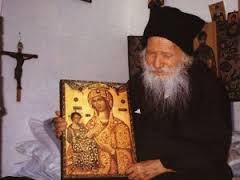
While at the Holy Skete of Kavsokalyvia on Mt. Athos, the Elder Porphyrios had given orders for his grave to be dug.
Through a spiritual child of his, he dictated a farewell letter of advice and forgiveness to all his spiritual children.
Here is the letter as it was sent to us from the Holy Convent of the Transfiguration of the Savior. It is dated June 17, 1991. It was found amongst the monk’s garments that were laid out for his burial on the day of his departure. It indicates his profound humbleness.
My dear spiritual Children,
Now that I am still in charge of my faculties, I want to give you some advice.
Ever since I was a child, I was always in sin. When my mother sent me to watch the animals on the mountain, (my father
had gone to America to work on the Panama Canal for us his children, because we were poor), there, where I shepherded
the animals, I slowly read, word by word, the life of St. John the Hut-dweller and I loved St. John very much.
I said a lot of prayers, like the young child that I was, twelve or fifteen years old, I don’t remember too well. I wanted
to follow his example. So, with a lot of difficulty, I secretly left my parents and came to Kavsokalyvia on the Holy Mountain.
I became obedient to two elders, the true brothers, Panteleimon and loannikios.
They happened to be very devout and full of virtue, I loved them very much and because of that, with their blessing,
I gave them absolute obedience. That helped me a lot. I also felt great love for God and got along very well.
However, because of my sins, God allowed me to become ill, and my elders told me to go to my parents in my village
of St. John, Evia. Although I had sinned a lot from when I was a small child, when I returned to the world I continued
to commit sins which, today are very many. The world, however, thought highly of me, and everyone shouts that I’m a saint.
I however, feel that I am the most sinful person in the world. Of course, whatever I remembered I confessed, and I know God
has forgiven me. But now I have the feeling that my spiritual sins are very many and I ask all those who have known me
to pray for me, because, for as long as I lived, I humbly prayed for you, too. Now that I’m leaving for heaven, I have the
feeling that God will say to me, “What are you doing here?” I have only one thing to say to him, “I am not worthy of here, Lord,
but whatever your love wills, it’ll do for me.” From then on, I don’t know what will happen. I however, wish for God’s love to act
I always pray that my spiritual children will love God, Who is everything, so that He will make us worthy to enter His earthly
uncreated Church. We must begin from here. I always made the effort to pray, to read the hymns of the Church, the Holy Scriptures
and the Lives of the Saints. May you do the same. I tried, by the grace of God, to approach God and may you also do the same.
I beg all of you to forgive me for whatever I did to upset you.
Hieromonk Porphyrios Kavsokalyvia, June 4/17 1991
And
That phone ring 🙂 At 14:35′ onwards 🙂 This Elder was sought after by the whole of Greece and all mankind. His whole life was dedicated in service to the faithful. I imagine that phone never stopped ringing, just as pilgrims never stopped coming. A saint receives everyone, that is his vocation. May we have his blessing! +2 Dec.
How a priest left the priesthood and his wife, and remarried, and other stories
In writing about this subject I have both fear and compassion: fear because of my lack of qualification to make a sophisticated analysis. Yet being aware of growing trust in the field within the Church, I am stirred with compassion in concern for the Orthodox faithful. So this is not a sophisticated analysis, but I will share some thoughts for consideration on this subject, most of which are quotations from others. It must be noted, however, that the final conclusion is meant to be a general statement and is not meant to be an absolute for each person.
Archimandrite Sophrony teaches that just as in the Liturgy during the Cherubic Hymn the priest prays, “No one is worthy” [that is, to perform the Divine Liturgy], so also no one is capable of being a spiritual father. He further explains that this is so because a spiritual father is a co-worker with God in the creation of immortal gods. Here, of course, his is implying our call to deification. He, and others that I have conversed with on this subject, have stressed the fact that a spiritual father must be a man of prayer. Although it is necessary to be familiar with the ascetic tradition of the Church, and things that one has read may come to mind, above all a spiritual father must be seeking God’s help through prayer. So now, let me go on to share a few thoughts for consideration:
I posed the following question to a Father from Athos who wished to remain unidentified (He was a doctor before becoming a monastic): “I have run across priests in the Church who rely much on modern psychology in their counseling. Is it possible for us to turn to psychology?” He answered:
“We trace the teachings of our holy fathers back to the fourth century but psychology has its roots only back to the 16th or 17th century in the non-Orthodox West. In psychology they do discover some things that are useful but our fathers already knew these things for over a millennium. In the West there is a problem: it is believed that the thoughts and mind are one. However, according to the teaching of the Orthodox Church the mind and thoughts are not one, but two; and the mind must be cleansed of wrong thoughts that pass through it.”
The development of psychology can be traced to problems in Western Christianity in reference to salvation. In Catholicism salvation is a black and white systematic observance of rules and the performance of good works. This is said to give each person their own merit towards the salvation of one’s soul. In Protestantism salvation is thought to be only a matter of a confession of faith. And it is believed therefore that your name is written in the Book of Life. But in Orthodoxy salvation is a process of working to cleanse the inner man. In this process there are three stages of grace, the first is that of cleansing, the second enlightenment, and the third perfection which is rare. We must repent and become cleansed of our wrong thoughts and sins, and then the mind can become enlightened by receiving thoughts of God.
Psychology evolved in the West because Christians in the West do not understand the need of cleansing the thoughts. The thoughts that go through one’s mind can drive one to a state of mental illness, and so psychology tries to keep the mind occupied with other things in order to avoid this. Psychologists can therefore sometimes be helpful in keeping someone from going further into mental illness, but psychology cannot actually heal the soul.
In reference to this something was said by a novice at my former monastery. He quoted a relative of his who works as a psychologist and has written books in this field. His relative commented: “We psychologists are like a sponge. We soak up people’s problems but we cannot heal them.”
When I was a deacon, a young man who visited our monastery had just received a bachelor’s degree in psychology. I asked him: “Is it a good idea for me as a spiritual father to study some psychology for this ministry?” He answered: “No, you will learn nothing new for your spiritual ministry, and it will not help you to correct their errors.”
One priest told me of a friend of his who suggested he read a book on psychology. This man told him that although everything in the book was not proper teaching, there were some good points. This priest said this man was indeed very perceptive in what he saw. However he noticed a change in this man’s way of thinking from having read the book. He became very skeptical, and through deductive reasoning, sought proofs and systematic explanations for matters of faith. He sought to analyze and give rational explanations for mysteries of faith which cannot be subject to this. As a result of this, his simple faith was harmed.
I know a former priest who at one time was very enthusiastic about a parishioner who was a psychologist and whose forte was group therapy. He introduced this practice at his parish and began reading books on psychology. He had personal struggles in his marriage and as a result of his reading in psychology, he concluded that what he needed was a real relationship with a “good” woman. He wound up leaving the priesthood and his wife, and remarried.
In a conversation with Bishop Basil Rodzianko (a large section in the popular book Everyday Saints is dedicated to him) he commented: “Both the Church and psychology agree that guilt will drive a man crazy. In the Church we deal with this through repentance but in psychology they try to use other methods”
Someone I am acquainted with and who spent some time at Holy Transfiguration Monastery at Elwood City, Pennsylvania, told me the following: “I was having some difficulty with anger, and our chaplain, Fr. Roman, was away. I told a visiting priest of my struggle. He said I needed to go through the past and heal the inner child. This priest thought therapy would be helpful. When Fr. Roman returned I asked him if I should do this and he replied, “No, you will only give tools to the demons.”
I believe Fr. Roman was concerned about reintroducing old temptations and breaking open old wounds. I learned from a psychologist that their aim in this is to remove stumbling blocks from the past which can cause abnormal behavior. This brings up a question: Which approach is the best? I will offer some reflections and let the readers decide for themselves.
Speaking of recalling the past brings to mind a letter of the 20th century elder, Fr. John of Valaamo. Concerning memory he writes:
“Imagination and memory are one inner sense. Sometimes the memory of former events hits us on the head like a hammer. At such time concentrated prayer is needed, and patience too. Our memory must be filled by reading the Holy Gospel and the writings of the Holy Fathers; in other words, the mind should not be idle. Former events must be replaced by other thoughts, and gradually the former recollections will be crowded out and the melancholy will pass. In one heart two masters cannot live together. (Christ is in our Midst, Letters from a Russian Monk, p. 30)”
Something else says with some relation to this:
“When I visited St. John the Baptist Monastery in England I had the blessing of speaking with Fr. Sophrony. I had questions written down which the Abbot, Fr. Kyril, read to him ahead of time. When we sat down to talk Fr. Sophrony first asked me: “Where did you study psychology?” I was amazed to hear him say that, and it is true that I did have one semester of psychology in college, for which I had an avid interest. He felt I was over-examining and over-analyzing myself. He stated: There are some who have done this and have become saints (I think he had St. John Climacus in mind who in his Ladder of Divine Ascent examined the passions and spoke of the action of virtue in detail) and Father continued: “This was not the way for St. Silouan and this is not the way for us. The way for me is straight ahead.”
Let me comment on the words: “The way for me is straight ahead.” St. Seraphim has said that the aim of Christian life is to acquire the grace of the Holy Spirit. We do need to be aware of our faults and confess them. But rather than trying to examine and fix everything that appears to be wrong with us, we should go straight ahead and seek to acquire the grace of the Holy Spirit. As we grow in the grace of God the hold that the passions have on us will lessen. All our weaknesses and sicknesses of soul will also become easier to bear. The above mentioned words of the Elder John of Valaamo are quite applicable if we replace the word “memory” with “soul” and “melancholy” with “passions, etc.”:
“Our memory [or soul] must be filled by reading the Holy Gospel and the writings of the Holy Fathers; in other words, the mind should not be idle. Former events must be replaced by other thoughts, and gradually the former recollections will be crowded out and the melancholy [or passions etc.] will pass. In one heart two masters cannot live together.”
Psychology has a different approach. One hieromonk who studied at St. Tikhon’s commented: “Psychology is a secular form of Eastern religion. Psychologists try to put all the parts in the right place.” They can even appear to perfect that which according to the image of God is in one’s self. But, Fr. Sophrony comments, concerning those who experience some state of perfection in Eastern religion: “The God of all is not in this.”
In conclusion I leave you with a comment by Archimandrite Sophrony: “Psychology is not profitable for those in the Church. A spiritual father helps those who come to him because he has gone through similar struggles and has learned from what he has suffered.”
By Father Gregory The Greek Archdiocese Metropolis of Denver, St. Arsenius Hermitage, “Spiritual Fatherhood and Modern Psychology: Thought for Consideration”, Panagia Quick to Hear
St. Athanasius: “There are two forms of life and states of life. One is the usual life for mankind, married life; the other is the angelic and Apostolic life of which there is no higher, virginity or the monastic state.” (The Law of God)
Aidan: Other than Marriage and Monasticism, both Sacraments blessed with special church Services, is “Mere” Chastity/ Celibacy in the World truly ‘blessed’ by the Orthodox Church?
Alexandra: In a very literal sense, the Church indeed blesses ONLY marriage and monasticism through specific ceremonies. Some Fathers even count monastic tonsure as a sacrament! Of the 8th Day. Obviously, there is something special about being married or being a monastic, a sacramental bond which is not present in single people living in the world.
Peter: Christ and St Paul commended the single life. Is there any Church canon against being single?
Stephen: I have personally known widowed and single priests who have chosen not to become monastics, but live in a chaste life in the world, serving a parish and working in the chaplaincy with the most vulnerable members of society. I have also known of young people who are not called to marriage and live a celibate life in the world much as many early Christians did before there were any monasteries. And I have also met with people who would have liked to become nuns or monks but their lives’ circumstances (eg. care of children after a divorce they did not seek, ailing parents etc.) are not favorable and have had to do the best they can into the world.
Alexandra: But what gives structure and hierarchy in their lives? Who are they obeying to? Who are they cutting their own will from day to day? Isn’t it that for their spiritual health, people need to be channeled into an accountable way of life?
Peter: I think the important thing is not whether you are tonsured as a monk or not. Many people who are tonsured and are formally monks and nuns, in reality are no better than old bachelors and spinsters, for they do not live, feel and think like monks. On the contrary, a person living chastely in the world and serving God under the guidance of a good spiritual father may be a monk or a nun at heart. God judges not the formal status of a person, but his or her inner life.
Parish Priest: People do not easily fit into a specific mold, and making a Patristic dictum into an ideology would be inadvisable, especially for pastoral reasons. It would be highly irresponsible for a priest to pressure all the single people in his parish to either get married or enter a monastery.
Aidan: But isn’t this celibate life self-centred, obeying their own will and whims? Can these people ever be in good standing with the Church? Monastics are accountable to their Abbot/Abbess. Monastics have obediences and responsibilities to their monastery and their abbot/abbess. Similarly, the cross of the married life is a pretty burdensome one. Husbands and wives have obediences and responsibilities in their families and their parishes. Where is the cross of obedience for such individuals? Singles has no identifiable obediences or responsibilities beyond themselves. It would seem that such a state would almost certainly result in self-will as a guiding principle.
*
St Theophan the Recluse: “So you made up your mind once and for all to dedicate your life to serving the Lord and not to have anything to do with worldly life. May God graciously accept this sacrifice and bless your good decision! . . . Adapt to that kind of life within yourself, not by a change of outward ways, but of the inward order. Now you may completely refuse all amusements and stay more at home in solitude, engaged in some occupation . . . Implant a little more deeply the conviction that the way of life you have chosen is blessed by God. It was sanctioned by the Savior in the saying about eunuchs for the Kingdom of Heaven’s sake. He gave it preference when he said of Mary . . . that she had chosen the better part . . . You see clear examples of it in the person of many Prophets and Apostles . . . Female and male virgins were a fixture in Christ’s Church even in apostolic times; they have been in the Church ever since and will continue to be in it . . . For this kind of life is not alien to our nature [as Fr David has said], and is favoured by the spirit of belief in Christ.” (From The Spiritual Life)
*
Peter: Speaking from experience unmarried do have responsibilities and obediences, even as adults we are bound to honour our parents and some have chosen the single life to care for sick parents or grandparents, along with providing all the necessities of life. If active in faith there will be church responsibilities sometimes much more than the married take on due to the time being available to do things, and obedience to a spiritual father or confessor. So, it seems we have all the ‘benefits’ of living in the world but also many drawbacks for there is no helpmate (which is after all one of the key reasons for marriage: to do ‘it’ together). The single individual has many responsibilities but they tend to be more nebulous and less organised than those who are married or monastics; this does not mean that they are less, they are just different. There are those who have reached theosis in the unmarried state, such as St Xenia of Petersburg who lived as a devout widow without ever entering a monastery.
Stephen: The Church has certainly had saints who were unmarried and not monastics and who lived in the world chaste lives, dedicated to God, without entering a monastery. They led lives of service, “giving themselves to the service of their brothers and sisters in hospitals, poor-houses, and hospices.” and making their room as one of a monastic cell. If the Church has declared such people to be saints, surely their glorification is the highest blessing the Church can bestow.
Peter: And other than just labeling them ‘single’ or ‘married’ or ‘monastics’, we should rather ask “why?” Why is he/she married? Why is she/he single? Ask yourself are you fasting for a healthy diet or to control your passions?
Parish Priest: I spoke to a hieromonk about this topic, and he said that while marriage and monasticism were the two common paths to salvation, single people in the world could also live God-pleasing lives. He clarified that the decision to remain unmarried was a matter of individual circumstances and with the blessing of a spiritual father.
Stephen: There is no rule that the single life is not blessed. The person living the single life may not be able to give a vow of not owning property, but could, with the blessing of his or her spiritual father, give a vow of celibacy and of obedience (to the spiritual father).
Aidan: So, it seems that the Church has established two avenues opened by the Spirit of God – namely the marriage and the monasticism. There are also some solitarily trails also engraved by the spirit of God.
*
St Silouan the Athonite: In the last days there will be many with the monastic spirit living in the world as a witness to the Faith, neither married, nor having taken the monastic vows, but single, yet monastics at heart.
No, NOT this kind of nightmarish waiting, this living death.
But this:
*
Some years ago a close family friend passed away in a nursing home. She spent the last months of her life in what appeared to be a state of semi-consciousness, rocking back and forth in her chair and muttering to herself, “Waiting, waiting…”. We never did learn just what she was waiting for, other than death. She was, though, a fervent and faithful Christian, and her “waiting” seemed very much akin to “watching.”
Her Protestant background gave her little in the way of initiation into “spiritual warfare.” Yet instinctively—by grace—she understood what that struggle was about. She had seldom read writings of the Church Fathers, so she had little in the way of a vocabulary to express the inner meaning of “waiting.” Nevertheless, she seemed fully aware that the word does not imply what we usually think it does: an inactive state of expectation for something to come, something that is not yet present or available. It describes, rather, a pathway that leads toward fulfillment of that expectation. Insofar as it is grounded in “watchfulness,” the act of “waiting” is an inner dynamic of the heart or soul, which offers us immediate experience of the object of our most fervent longing. This our friend understood. And it seemed to transform her days and months of waiting into a true pilgrimage.
As it is used in patristic tradition, “watchfulness” implies an inner attentiveness or vigilance. It requires wariness in the face of attacks from both within and without, from our worst inner impulses and from the onslaught of demonic temptations. Accordingly, watchfulness is a key element in spiritual warfare.
The eighth century ascetic writer Hesychios of Sinai composed a remarkable treatise on “watchfulness and holiness,” included in the Philokalia. He begins with this description:
“Watchfulness is a spiritual method which, if sedulously practiced over a long period, completely frees us with God’s help from impassioned thoughts, impassioned words and evil actions. It leads, in so far as this is possible, to a sure knowledge of the inapprehensible God, and helps us to penetrate the divine and hidden mysteries. It enables us to fulfill every divine commandment in the Old and New Testaments and bestows upon us every blessing of the age to come. It is, in the true sense, purity of heart…”.
This is an extraordinary statement that at first reading seems highly improbable. According to Hesychios, watchfulness or spiritual attentiveness can liberate us from destructive thoughts, words and deeds; it makes it possible for us actually to know the unknowable God and the “mysteries” of the spiritual world; it equips us to respond with perfect obedience to all of the biblical commandments; and it conveys to us—in the here and now—“every blessing of the age to come.”
*
We bury our seeds and wait,
Winter blocks the road,
Flowers are taken prisoner underground,
But then green justice tenders a spear (Rumi)
If the personal experience of this holy monk enabled him to make such a remarkable affirmation, it is only by virtue of the key phrase, the key reality: “with God’s help.” If watchfulness, termed also “noetic stillness” or “guarding of the heart,” can lead in this life to such a state of beatitude, it is only because God wages spiritual warfare on our behalf. The rewards of that struggle—freedom from destructive passions, knowledge of God, and every eternal blessing—are not our doing. They are not the result of our own initiative or spiritual power. They are a gift, wholly gratuitous and unmerited. They require on our part only an attitude of repentance, an inner openness to grace, and the desire to share, now and forever, in God’s own holiness.
*
Old men ought to be explorers
Here and there does not matter
We must be still and still moving
Into another intensity
For a further union, a deeper communion
Through the dark cold and empty desolation,
The wave cry, the wind cry, the vast waters
Of the petrel and the porpoise. In my end is my beginning.
( T. S. Eliot, “East Coker,” from *The Four Quartets*)
*
For most of us, whether we are conscious of it or not, life consists essentially in “waiting.” The hyper-activism that characterizes the life of most Western societies today, distracts us enough from what is essential, that we have lost touch with the real meaning and value of being alive. We are “waiting for Godot” rather than for “the one thing needful.” To acquire that “one thing,” however, we need to shift our focus, reacquire a sense of genuine value (and civility), reorganize our priorities, and reject the artificial virtues society inculcates in us: aggressive competition, perfectionism, status, and material gain. We need to discover once again the truth that the wealthiest among us is the monk who has renounced every possession and obtained the “glorious liberty of the children of God.” We need to find peace and happiness not in the marketplace or in accumulating “stuff,” but in assuming the inner struggle of attentiveness, of watchfulness, which alone leads to “every blessing of the age to come.”
Some day we may well find ourselves sitting in a nursing home or some equivalent, rocking back and forth, and waiting. For many people of any age, that is a description of their daily existence, whether at the office, or at home, on the playing field or in the trenches. Their waiting can be filled with boredom or anxiety, or with a gnawing conviction that their personal ambitions are meaningless and their hopes empty and vain. To people like this (and it may be a temptation for all of us) waiting can easily lead to despair.
Waiting with watchfulness, though, can become a pilgrimage. It can take us on an inner journey that leads us through the rough places of passions and temptations and on to every blessing of the world to come. All it requires is an attitude of repentance, an unquenchable thirst for those blessings—and an abundance of help from God.
Very timely blog post, by a Missionary in Nepal, for the little city hermit, whose journey of faith has truly led him places he never dreamed of going, led him to do things he would never believed possible, and to be used of Him in ways unimaginable. To his shame, he often gets discouraged …
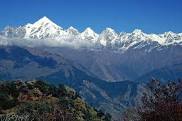
This morning as I was walking the kids to the bus stop, I caught a brief glimpse of the mountains, but then moments later they were no longer visible. When I got back to the house, I went up on the roof and there they were, just peeking out from above the clouds.
And I realized something.
The mountains are always there. They are.
But most of the time they are invisible to the human eye. Covered with smog and clouds. Yet they are there.
Then I was reminded that isn’t that just like God. He’s always there, but most times we can’t see Him because “life” covers Him up, kind of like the clouds.
Even more so His plans for our lives.
Every now and then He gives us a glimpse of what is next. Just a little view. Then when we can no longer see, He says follow Me…
Nowadays so many people, so many friends and acquaintances of mine, especially middle-aged, are disappointed, drained, left alone with children, empty and lonely (both in and out of relationships), feeling robbed. What are we to do with our lives in order to avoid self-centered ends and the spiritual abyss? Marriage and monasticism most certainly lead to the most intimate communion with the Creator and fellow creature and fulfill their promises: the soul can still be purified through either of them. They restore the soul’s appetitive drive to its divine orientation. The roads are narrow, their gates straight, but they lead to the deification of the soul. But maybe this path is not open to us — yet? — for a variety of reasons and circumstances. So WHAT is to be done?
Apparently, there is also a third way. Jesus Christ teaches that certain people are called by God to the single life.
And I say to you: whoever divorces his wife, except for sexual immorality, and marries another, commits adultery. The disciples said to Him: “If such is the case of a man with his wife, it is expedient not to marry.” But He said to them: “Not all people can receive this saying, but only to those to whom it is given. For there are eunuchs who have been so from birth, and there are eunuchs who have been made so by men, and there are eunuchs who have made themselves eunuchs for the sake of the kingdom of heaven. He who is able to receive this, let him receive it.” (Mt 19:9-12)
The apostle Paul elaborates on Jesus’ teaching.
It is well for a man not to touch a woman. But because of the temptation to immorality each man should have his own wife and each woman her own husband… I say this by way of concession, not of command. I wish that all were as I myself am. But each has his own special gift from God, one of one kind and one of another.
To the unmarried and the widows I say that it is well for them to remain single as I do. But if they cannot exercise self-control, they should marry. For it is better to marry than to be aflame with passion… And unto the married I command, yet not I, but the Lord, Let not the wife depart from her husband: But and if she depart, let her remain unmarried or be reconciled to her husband: and let not the husband put away his wife. … Only let every one lead the life which the Lord has assigned to him, and in which God has called him. (See 1 Cor. 7)
The single calling
The single life is a calling. It is a way of life which is given by God. A person, certainly a Christian person, does not choose to be single or to be married. He or she rather discovers the way of life which the Lord provides within the conditions of his or her existence. People really only chose to receive, or to reject, what has been given them. They do not determine it.
There are any number of reasons why a person may be single. They range from the sense of having a positive calling to the celibate life for religious purposes, to the plain fact of being unmarried without one’s own conscious choice, and perhaps even against it, just because this is the way that things have happened to work out. Whatever the reason for one’s being single and however mysterious or ambiguous, willed or unwilled the causes for one’s being in this state, at some point in our adult life each of us must accept the form of life which is ours and consciously offer it to the Lord, freely and voluntarily, for the sake of the love of God and neighbor.
Sanctifying the single life
The single life is sanctified the way every life is sanctified: by perfecting it according to God’s will. The first task of the single person according to God’s teaching as revealed by Jesus Christ and the apostles, martyrs and saints of the Christian Church, is that of maintaining and developing one’s sexual chastity.
The single person who says “yes” to God and to his or her calling to the single life automatically says “no” to all forms of physical, sexual activity with the opposite sex, with one’s own sex and with oneself. This is so because sexual actions other than the conjugal act of married love destroy the wholeness and integrity of one’s being through the dissipation of one’s spiritual and physical energies. No matter how loving, fulfilling and pleasurable they may at first appear to be, sexual commitments without the totally faithful commitment of unending love in marriage – with all of the responsibilities and obligations for inter-personal communion and the pro-creation and protection of human life which this involves – cannot but result in dissatisfaction, disappointment, despondency and despair. this is so because human persons are made in the image and likeness of God who is Love, and as such can find fulfillment and happiness only in ways of living and acting which express and image His own.
A hard saying
The teaching about sexual purity in the single life is a difficult one. When many people hear it they are moved to say what Christ’s disciples said when they heard other of His teachings: Lord, this is a hard word. Who can hear it? Who then can be saved? And the Lord’s answer is always the same. He said that His teaching has to be hard because “the gate is narrow and the way is hard that leads to life, and those who find it are few”, adding as well the fundamental point that as far as His teaching is concerned, “with human being it is impossible, but with God all things are possible”, particularly to those who believe. (See Jn 6:60; Mt 7:13-14; 17-21; Lk 18:27; 35)
Like all forms of Godly life and behavior, the single life of celibate chastity is a way of the Cross. It is a way of sacrifice and suffering which alone brings joy and happiness to a human being.
Conditions for perfection
For the single life to be perfected according to God’s will, with the preservation of sexual purity as its heart and foundation certain conditions must be fulfilled. First of all there must be firm spiritual discipline for the sake of a lively interior life. The single person must have a rule of prayer which is diligently kept, with the reading and pondering of wholesome and edifying words and images. Great attention must be given to keep oneself free of all thoughts and images which lead to spiritual and physical defilement and disintegration. The “spouse” and “life partner” for the single person in the most direct and specific way must be the Lord himself.
The single person must also have a firm rule of external life and behavior. Capricious and willful actions, things done without order or form, but just as they happen to come up, must be avoided at all costs. Forms of responsibility and accountability to others must be found and fulfilled with conscious obedience. This is especially true for those who do not have such natural obligations as, or example, the care of elderly or infirm parents or relatives, or duties within a religious community.
The single person must also be committed in a formal way, in obedience, to a spiritual father, which can be a priest or a hieromonastic. Some might say that such conditions are necessary for all who are living a human life according to God’s will, whether or not they happen to be single. This is true. But these conditions are particularly necessary for the single person precisely because of their single state in a world which renders them particularly vulnerable to self –centeredness and loneliness on the one hand, and lack of commitment and accountability on the other, with the additional cross of often being misunderstood and taken advantage of by those around them because of their single status.
Christ and the Saints
It is common in the modern world to think that one cannot be fulfilled as a human being in the single state, especially if living a sexually continent and chaste life. The claim is that without sexual activity and intimacy, a human person is diminished and even distorted in his basic humanity. If this is true, then the Christian faith as understood and practiced by the Orthodox, and by millions of other Christians, is wholly false.
The Lord Jesus Christ was single and celibate, yet He was the most perfect human being who ever lived, the Son of God and God Himself in human form. Jesus’ mother Mary, though legally married, remained a virgin her entire life. John the Baptist, whom Jesus called the greatest man ever born of woman, was clearly a chaste celibate according to the Gospels. So was the apostle and evangelist John. So was the apostle Paul who, as we have seen by his own report was single at the time of his conversion and ministry. Indeed, the calendar of Orthodox Church saints is filled with single people who are praised and honored for their chastity and devotion to God and their neighbors. In this perspective it is clearly the Christian conviction that being single is conducive to the highest and most perfect for of fulfillment possible to human beings: the life of sanctity . (Source: St. Luke’s Orthodox Mission)
Dryovouno Monastery, Near-Death and Afterlife Stories
Father Stephanos of the Monastery of Transfiguration (Metamorfosi tou Sotiros) in Dryovouno speaks very little, mainly with his eyes.
*
Mother Theologia: “How little do we think of death, although he is so near to us!” commenting on a yet another sudden, unexpected death.
*
Laokratia told us about a dream: “My friend’s late young son, who had suffered a sudden and violent death through a road crush, appeared in his father’s dream in tears, standing before a closed gate, telling him that ‘they’ do not allow him in. His father, a very faithful man, promptly met Elder Iakovos Tsalikis and told him his dream. By the grace of God, the elder, having a pure nous, was deemed worthy to see the souls of people at the time they were leaving the earth and ascending towards heaven. Elder Iakovos asked him if his son was blaspheming God, and the father sadly admitted so. Then, Elder Iakovos promised to pray for his son, and he also advised him to do alms in his son’s name, fast and pray to the Lord so He will grant him rest”. The poor father made a prostration and obeyed the elder, and after 40 days, he saw again his son in his dream, this time radiant with joy, in front of an open gate, thanking him and telling him that ‘they’ had allowed him in!”
*
Sister Gregoria: “I just received a message from a friend who had to undergo a difficult operation and she told me that it all went well but that it was St. LukeBishop of Simferopol and Crimea, the Blessed Surgeon who operated her! In the operating room she felt that she was dying. She started ascending and watched the surgeon and the nurses trying to revive her unconscious body. Then she met ‘somewhere in the air’ St Luke. To be sure she could not really interpret what was happening to her as it was taking place. Still she understood that he reassured her that he would take over as the surgeon was clearly in an impasse. Then she started moving in the reverse direction, got into her body again and found herself in the hospital, having had the surgery performed, with doctors standing around her, looking at her puzzled. But who was this St Luke she had met? It took her a few hours to find out that her mother, a very devout woman, had placed a little icon of his underneath her pillow, just before the operation started!”
*
Sister Ioanna:”Yesterday at midnight, while I can finishing the writing of an icon and adding the dedication, I realised that although I could write the mother’s name easily, there was no way I could add her late son’s name. I started praying and in the Spirit I ‘saw’ that the mother was in a very good spiritual state, but her son was not at all well and needed our prayers. She felt that God had granted rest to the mother’s soul, but they should do alms in the son’s name and pray to the Lord so He will grant him rest”.
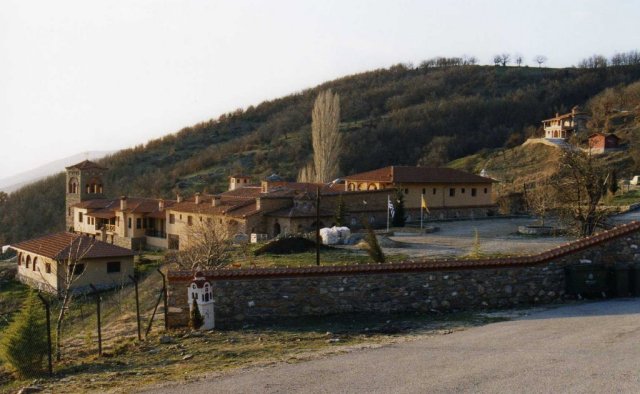
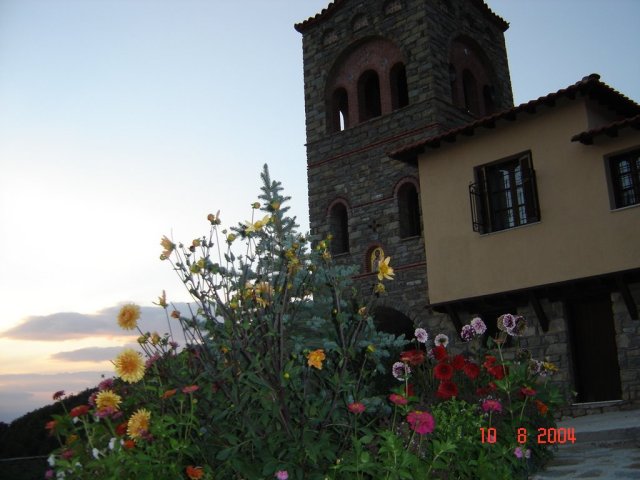
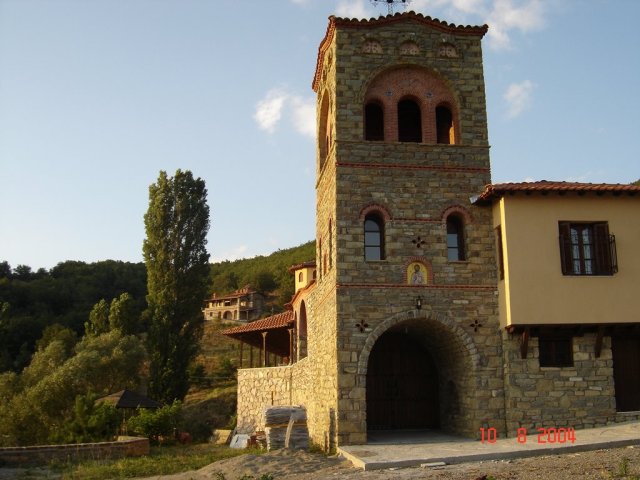
We arrived at the Monastery of the Transfiguration (Metamorfosi tou Sotiros) in Dryovouno on its Feast day. We were a group of faithful, Mother Theologia and some nuns from the nearby Monastery of the Assumption, Dormition (Koimiseos tis Theotokou) of Mikrokastro. What stunning Beauty confronted us!
This male monastery is located a few kilometers above Dryovouno, at a secluded area. Its foundation goes back to 1592, while the murals were completed in 1652, by painter Nikolaos from Linotopi while the narthex in particular is the work of Argyris Kriminiotis.
Kosmas Aitolos arrived here and, after preaching, treated the monks who had been taken ill due to an epidemic. He fetched water from a nearby spring, blessed it, and gave it to the monks to drink, who were then cured. This water has been considered holy ever since and a chapel devoted to saint Kosmas has been constructed at the spring. St. Kosmas received from God the gift of prophecy.
At wartime, the monastery offered valuable services to the local population. It served as storage for ammunition and as base for various chieftains. This is where Dimitrios Feraios, Kapetan Vardas and Pavlos Melas resorted to.
In 1943 it was set on fire by Italians along with its historic records. Its renovation began in 1996, the prime mover being Archbishop Stefanos Rinos with the personal efforts of monks and believers. The parvis offers a sense of tranquility and a spectacular view to Voio and Kastoria.


















 ORTHODOX CHRISTIAN FAITH AND LIFE