The Womb and the Tomb


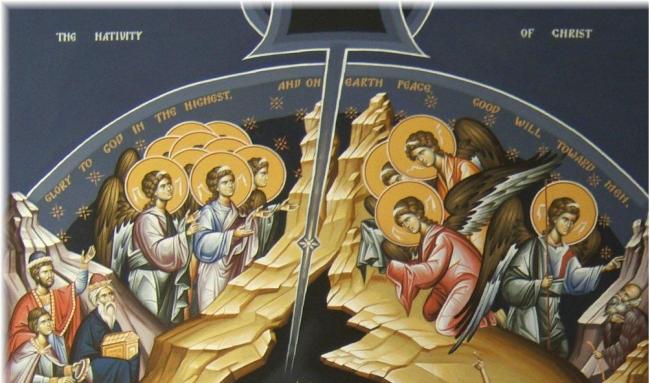
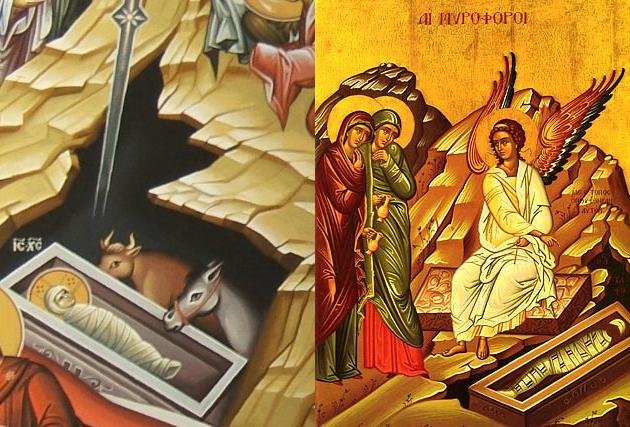
Icon of the Nativity compared with the Icon of the Resurrection

Left: Christ in the manger; Right: the Empty Tomb

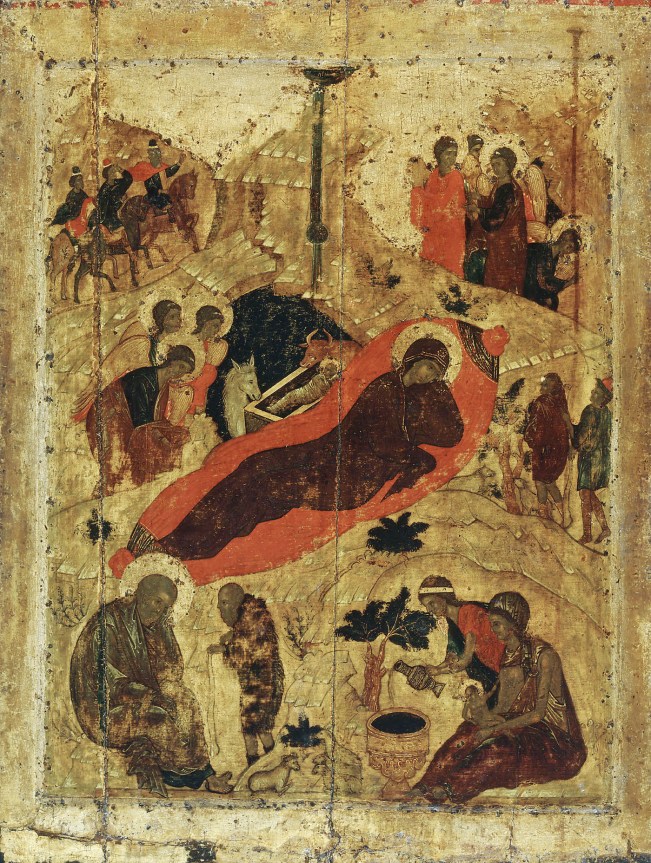
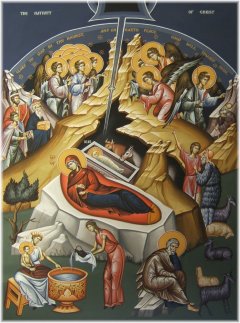
No description of the Nativity Icon would be complete without mention of Jesus’ appearance in the manger.

It should be never forgotten that Jesus came to us in order to die – this was known by Him, at least, from the very beginning. Therefore, in Iconography, the manger in the Nativity Icon deliberately resembles a stone coffin, the swaddling clothes resemble a burial shroud, and the cave itself can even be said to prefigure Christ’s tomb.

With the side-by-side comparison shown above of the Icon of the Nativity with the Icon showing the Myrrh-bearing women discovering Jesus’ empty tomb, no more words are necessary. (1)

The Passion of Nativity

… Let us look more closely at the child in the relief.  “His tight swaddling clothes are evocative of burial wrappings.  In the byzantine tradition, there is an intentional connection between the swaddling clothes of the infant in a Nativity icon and the burial clothes of the Epitaphios (epi– upon; taphos- grave or tomb) icon which is venerated and anointed during Great Friday Vespers.  Also on Great Friday, the “soma” icon on the crucifix is taken down from the cross and shrouded in identical wrappings before it is processed and reposed in the sanctuary.”

nativity1

“…Note, as well, that the “manger” is a cave, a small hollow in a rock formation that mirrors Jesus’ tomb in the gospels.  In many icons, Jesus’ cradle is a stone box.  Who would lay a child in a coffin? What macabre motive would make an artist paint a baby as a mummy and give him a tomb as his nursery?  Indeed, the motive is not macabre, but joyful and eschatologically triumphant: we only understand the significance of the incarnation if we hold it in tension with Jesus’ saving death; we may not separate the two.  This also reminds us that the liturgical year commemorates events in the life of Jesus but it never parses the paschal mystery.”

nativity18

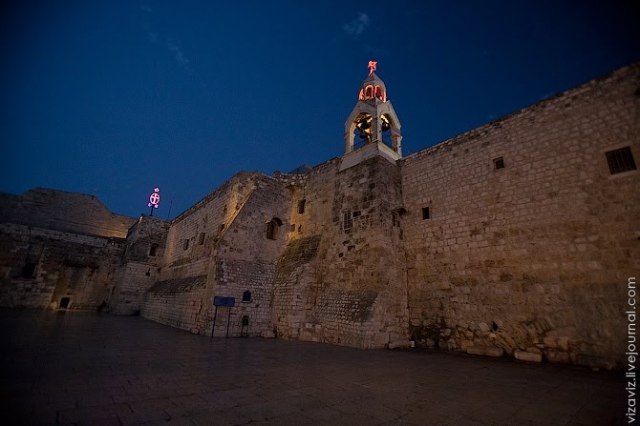
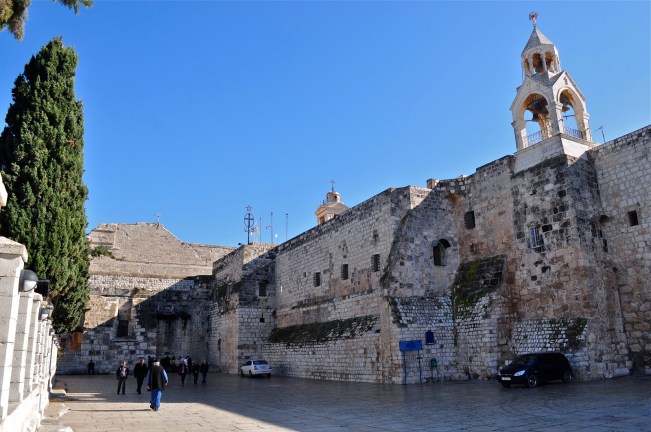
Basilica of the Nativity in Bethlehem 

The Church of the Nativity in Bethlehem is one of the oldest continuously operating churches in the world, and the oldest in the Holy Land (founded in 325)

nativity15.jpg


A virgin womb, conceiving thee, revealed thee;
a virgin tomb, receiving thee, concealed thee.

We glorify her from whom thou didst receive a beginning in time,
and we honour him that ministered to the end of thine earthly life for our sakes,
asking that through their prayers, O merciful Saviour,
we might be deemed worthy of thy Kingdom of the Heavens.

Theotokion on the Praises for the Feast of St. Joseph of Arimathea
Appendix to the July Menaion, Holy Transfiguration Monastery


nativity12

Church Of The Nativity Bethlehem Stable

All the eschatological themes of the Advent season converge in the Nativity tableau and are carried forward into Christmas.  This should not surprise us.  The birth of Christ and his salvific death form the cosmic fulcrum upon which the beam of human history rests, with creation and eschaton at each end.  In a nativity icon this is super concentrated.  Incarnation and eschaton are so ingeniously and inextricably intertwined that we might not even read “passion” in what is written in the icon unless we understand the symbolic significance of the iconographic elements.  The best known example of this is the gifts of the wise men: while gold and frankincense represent Jesus’ kingship and priesthood, respectively, myrrh, used for embalming, is a symbol of his death.

nativity10


When I look at a Nativity icon and I see a child embraced by death, and embracing death, I have at least an inkling of what Rilke was, perhaps, trying to convey in the first Duino Elegy:

“For beauty is nothing but the beginning of terror, which we are still just able to endure, and we are so awed because it serenely disdains to annihilate us.” (2)


(1) Posted on by 

(2) Posted at https://memoriadei.wordpress.com/2010/12/17/the-ox-the-ass-and-the-passion-of-the-nativity/

The Ass and the Ox

nativity1

Nativity of the Lord” Andrei Rublev 1405, Cathedral of the Annunciation, Moscow

As of today, I thought I might begin to concentrate on certain details of the Nativity iconography and explore their symbolism and theological significance in order to prepare my cave (a hermit as I am 😊) to receive the Word in the flesh.  My starting point will be a symbolic (and typological) analysis of the ox and the ass figures in the nativity iconography.

Generally speaking, the presence of any animals in the Nativity icon is in addition to any symbolic meaning a theological statement of restoration. It reminds us, I think, that all creation worships God ( the stars and the sun and even the dumb animals). That which was brought about by Adam’s transgression meant that the dominion he was given in Genesis over the birds of the air, the fish of the sea and the animals on the land was corrupted, made incomplete and he started eating that which was originally meant for companionship. When the Word who becomes flesh  is born, He who made Heaven and Earth and all that is in it,  it is only fitting that representatives of His creation are there to worship and adore the mystery of the Incarnation.

 
Revelation 5:13                
And I heard every creature in heaven and on earth and under the earth and in the sea, and all that is in them, saying, “To him who sits on the throne and to the Lamb be blessing and honor and glory and might forever and ever!” 
nativity5

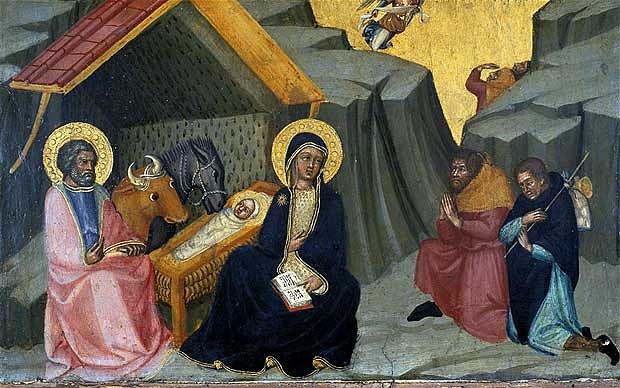
Specifically now to the ox and the ass. “These two manger animals are ubiquitous in Nativity images.  They peer over the new-born Christ child in wonderment, usually with their muzzles close to the child, as if to warm him with their breath.  Their significance should be plain: The ass carries Jesus into Egypt, away from the murderous Herod who, like Pharoah, orders the slaughter of infants.  (The flight into Egypt in Matthew’s gospel is the first of many Jesus/Moses parallels.)  Later, the ass will carry him into the holy city of Jerusalem to the acclaim of the crowd: “Hossana!  Blessed is he who comes in the name of the Lord.” The ass who greets the Lord at his birth is the same ass who bears him into Egypt and carries him to his death at Jerusalem where he is hailed as “king of Israel” but crucified as a common criminal.  The red ox stands as a stark and basic  symbol of Hebrew cultic sacrifice.” (1)

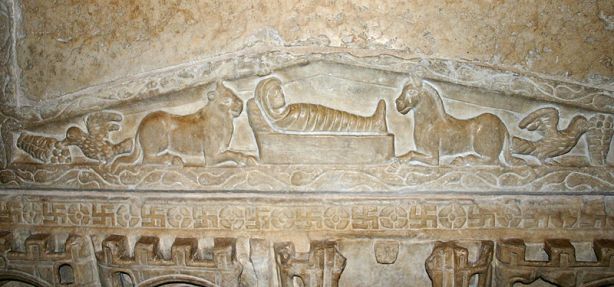
There is no ass or ox in the Biblical narratives of the birth of Christ.  Yet, besides the Christ Child himself, the ass and the ox are the most ancient and stable elements in the iconography of the nativity.  In fact the earliest example of a nativity known to us contains only the swaddled Christ in the manger flanked by the ox at his head and the ass at his feet.  David Clayton, on the New Liturgical Movement blog, has written a detailed piece on the subject, and I will go through the basics while adding a few more aspects he does not mention.

nativity6

Nativity scene on a 4th century sarcophagus from Italy

When reading comments on the nativity (for example in Ouspensky’s “The Meaning of Icons”) one finds that the inclusion of this detail is a reference to the prophecy of Isaiah:

The ox knows his owner, and the ass his master’s crib: but Israel has not known me, and my people have not understood.

nativity4

Some apocryphal texts have the ass and the ox worshiping the Christ child, such as the gospel of pseudo-Matthew:

Therefore, the animals, the ox and the ass, with him in their midst incessantly adored him. Then was fulfilled that which was said by Habakkuk the prophet, saying, “Between two animals you are made manifest.”

nativity7

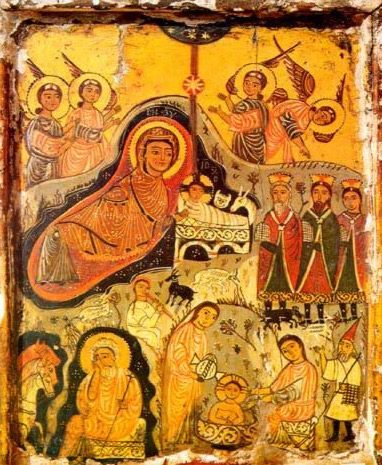
The Nativity – Icon in the Monastery of St. Catherine
[Many thanks to Bill M. for the link and drawing attention to the look on the ox’s face 😊 The icons of St Catherine’s, being isolated and in dry desert conditions meant that their icons have survived remarkably well, making it is a treasure of pre-Iconoclast iconography] (2)

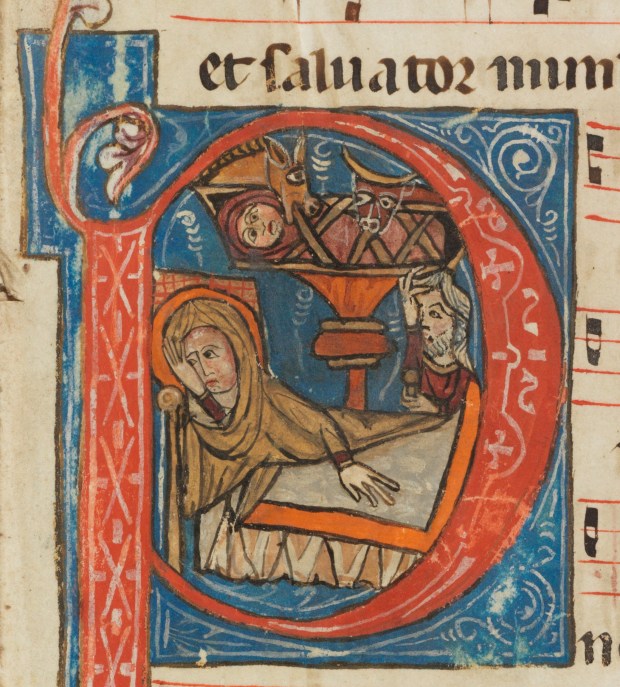
nativity9.jpgFreiburg, Couvent des Cordeliers / Franziskanerkloster, MS 9, fol. 11r. 

What though is the relationship between the ox and the ass, why are these animals paired together so?  We will often read that traditionally, the ox is seen as Israel, and the ass is seen as the Gentiles.  This comes from a very important distinction about the two animals.  The ox is a “clean” animal, and the ass is an “unclean” animal according to dietary proscription in the Old Testament.

Mixing the clean and the unclean is related very tightly to the mixing of Jews and Gentiles.  The clearest example of this is in St-Peter’s vision of the clean and unclean meats placed together, which signify the entry of Gentiles into the body of the Church.  Indeed there is a Mosaic law which I have never seen quoted in relation to the Nativity Icon, but which seems to hold one of the keys to the ass and the ox:

Thou shall not plow with an ox and an ass yoked together.

What is proscribed, the yoking of the clean and unclean, the bringing together of the “inside” and “outside” can only be accomplished without sin by the Christ, the incarnation of the Logos.  In fact, even St-Paul following this tradition, uses the same imagery to warn Christians not to be “yoked” with unbelievers.

nativity6

This brings out another meaning, which is related to the incarnation and its relation to universality of the Church.  The ass is a beast of burden, a “mindless” strength which was created to “carry” .  In this respect, the ass is a symbol of corporality itself.  One should not be surprised that the symbol of the unclean and “outer” is analogical to fallen corporal existence and sensuality. This can be seen so strongly in the hesychastic tradition in its relationship between the heart and the senses.  The “outer” part, corporality, the senses, the Gentile, are related to the garments of skin, which we have discussed before, and this periphery can be seen as protecting but also carrying what is precious, like the shell of the ark…

nativity3.jpg

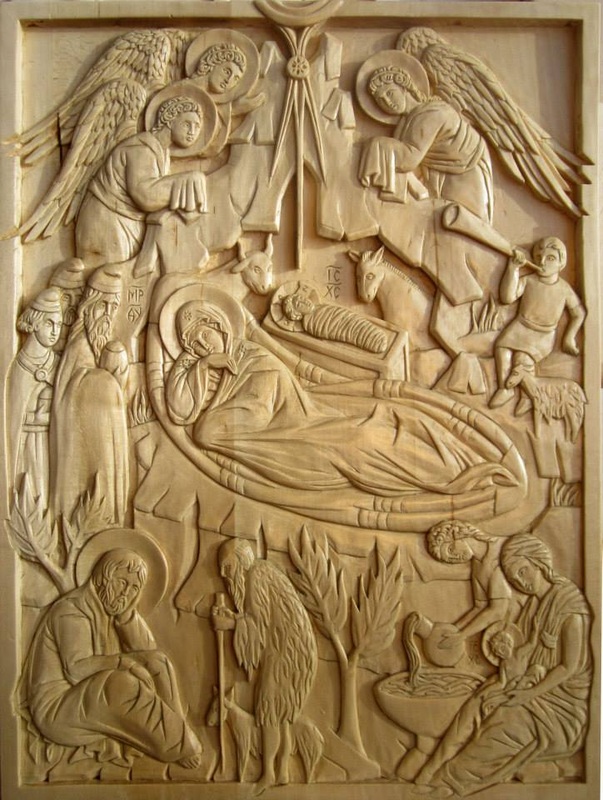
Icon of the Nativity carved in linden by Jonathan Pageau

It therefore follows naturally that stories such as the talking ass of Balaam are seen as prefigurations of the incarnation in sources as early as St-Irenaeus, or that it is so important for Christ be found riding an ass (even in later Rabbinical Judaism, the ass and colt of Zecharia’s prophesy are seen as representing the Gentiles) .  These Old Testament images, like the joining of the ass and the ox in the icon of the Nativity, are symbolic of the joining of extremes, the union of the spiritual and corporal, the clean and unclean, the inside and outside and ultimately the uncreated and created in the person of our Lord Jesus Christ. (3)


On Earth As It Is In Heaven ❧

To forget this Beauty is to lose sight of the Heavenly Kingdom. Above all we must learn to desire Beauty. It was not for theology or propriety that the Byzantines so adorned their temples. It was for Beauty. In Beauty lies Truth, and by it we show our Love for God.

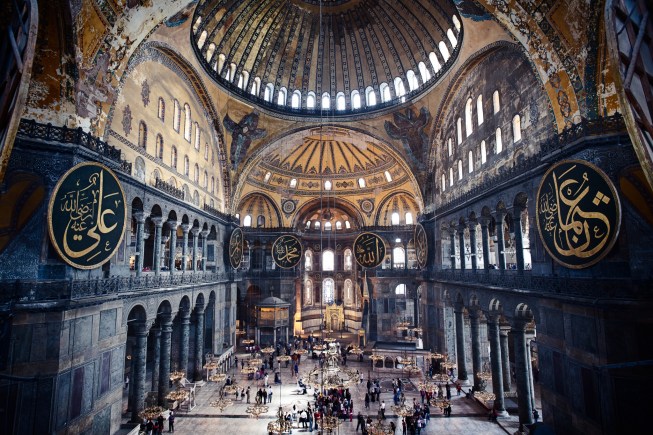
Hagia Sophia Interior (Ayasofya) - Istanbul

‘GOD DWELLS THERE AMONG MEN’

In 988, emissaries of Prince Vladimir of Kiev visited Hagia Sophia. They famously remarked, “only this we know, that god dwells there among men.” This statement highlights the attitude towards holy temples that was universal among ancient religions – that a god actually lived in the temple. Christianity has moved away from this belief, but Orthodoxy retains it as a liturgical concept. In an Orthodox church, Christ and the saints are present among the faithful. Prayers are directed towards their icons, not towards the sky. …


church1

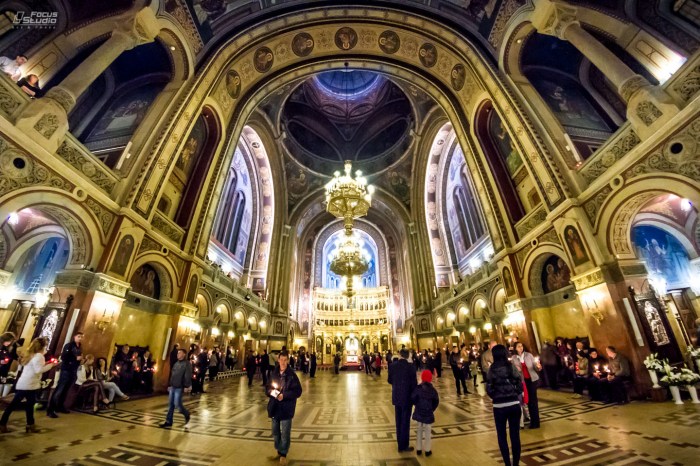
… This is a great difference from Western architecture. A Gothic church is a monument offered up to God. It is an attempt by man to order and beautify all that exists in creation. It points upward to God the Father who is outside of it, and prayers are directed likewise. in contrast, an Orthodox church is introverted. The interior represents Heaven, and to enter it is to step into the New Jerusalem. God dwells there among men, and they have no need of the sun, neither of the moon, for the Glory of God illumines it (cf. Revelation 21 : 23).

church19


Light pours into a Gothic church through great decorated windows. Broken into dazzling colors, it overwhelms the materiality of the walls. The stonework itself magnifies the effect, as it is thin and delicate, and carven with most delicate tracery. The weight of the stone is denied. The worshipper is at once conscious of the awesome radiance and power of the light without and the tenuous structure of the material within. The light beautifies the structure by dematerializing it, even until the stone itself looks like rays of light.

church3


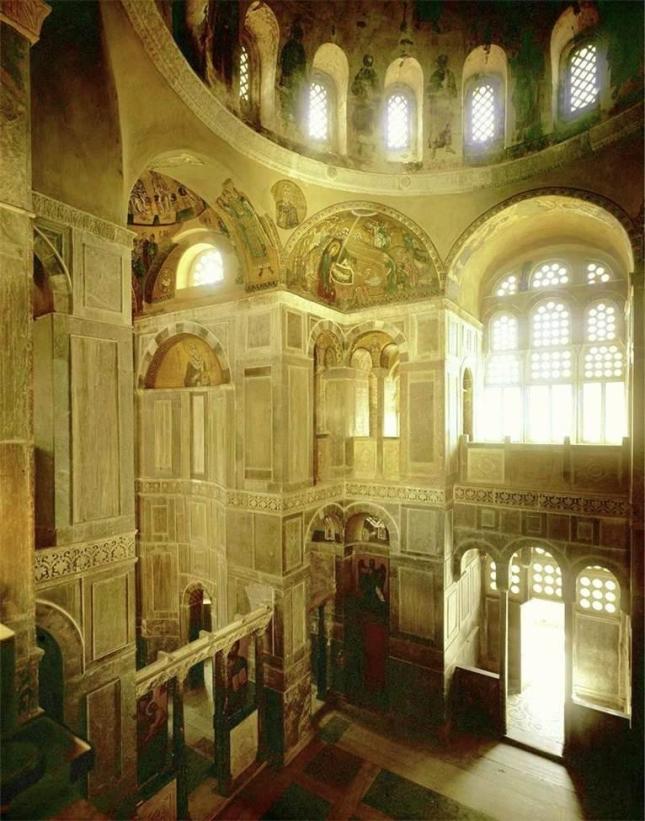
The walls of an Orthodox church are immensely thick and strong. The windows are small and up high, set deeply into the openings. The light is seen reflected off the thickness of the wall, rather than directly from the windows. In some Byzantine churches the window is translucent alabaster or marble, so that the light seems to glow from within the wall itself. Gold mosaics or bright frescoes play the light from many surfaces. Polished lamps and inlaid furniture reflect highlights from every direction. Deep aisles or side chapels behind arches appear as mysterious shadows in the distance, which make the church look brighter by the rich contrast. This is mass transfigured by light. It is the same light as in the icons, holy and all- pervading, the Uncreated Light which emanates from god to his creation. The stone and plaster glow from within. They do not seem transitory, but more real. Walls and piers seem as silent and as still as ancient mountains. They are bathed with the Light of Christ, and are sustained and strengthened by it as we are.

… A church building is the structure and organization of all the icons within it. As a unified edifice, these make up a single integrated icon which encompasses all the history and theology of the Church. The organization of the icons broadly follows three architectural axes.

The first axis is west to east. This is the liturgical axis. The narthex repre- sents the fallen world, and is used for preparation and exorcisms, for judg- ment is at the gates of heaven. The nave represents the redeemed world, or the Church, where the faithful gather among the saints for the worship of god. The sanctuary represents highest heaven; the altar is the throne of god and his tomb. (1)

church7

The second axis is vertical and can be understood as hierarchical. The Pantocrator is at the top of the dome with hands outspread, embracing the universe he created. Below are angels in their appropriate ranks, followed

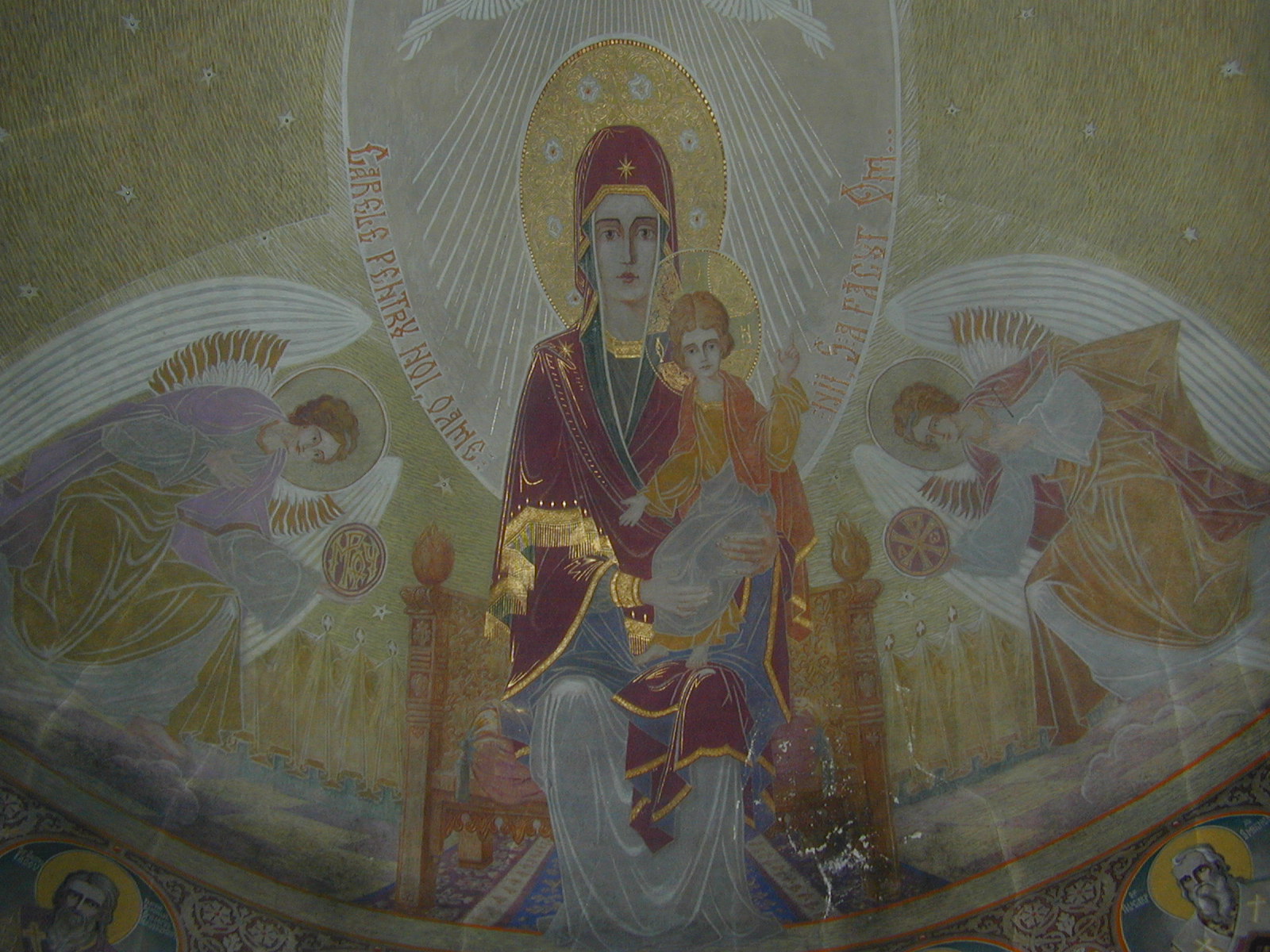
 by the evangelists, representing the beginning of the church, and then the saints in their tiers below. To the medieval mind, hierarchy meant freedom; it was the mark of identity and security. This axis and hierarchy exist also in the iconostasis as a miniature version of the same concept. The vertical axis has another interpretation which is the approach of god and man. The dome, most brightly lit and filled with angels, is heaven. It touches the nave at the pendentives, where the evangelists are painted, because they record the meeting of god and man. alternately, some churches have four great feasts which are theophanies at the pendentives, for the same reason. The Theotokos of the sign in the apse represents the Church reaching back up to god. Christ appears in the sign before her, emphasizing that by the Incarnation He is already with Her.

church10

The third axis is circular and horizontal, the interplay of icons cycling around the nave and relating to one another across it. This axis often por- trays the flow of time, although it can express many other relationships as well. The great feasts may be ordered chronologically around the nave, or specific feasts may be combined or face one another to highlight theological connections. In a large church there may be hundreds of biblical and historical scenes, and their placement with respect to one another and to the principal feasts can suggest almost limitless depths of interpretation.

Historically, church builders have struggled with the interplay of these three axes. …

church12

THE TEMPLE AS COSMOLOGY

… Of all forms, the cube and the dome are the most sacred and universal in architecture. The cube or square represents the earth, while the dome symbolizes the sky. It was ever the desire of the Romans to combine these forms and represent the universe. They achieved this at Hagia Sophia. The square nave has the most water-like pavement in the world. Sheets of wavy blue-gray marble flow from the altar like the river of the water of life from the Throne of God. Rows of columns rise from the banks like trees. Amazingly, the builders abandoned the thousand-year-old tradition of the Classical orders, and crafted a new type of capital which looks like the fronds of palms blowing in the wind. The arches above the capitals are decorated similarly. The whole nave is like a walled garden of unimaginable scale, the very image of Paradise.


church15


ISLAM VS. CHRISTIANITY — MOSQUE VS. ORTHODOX TEMPLE


church21


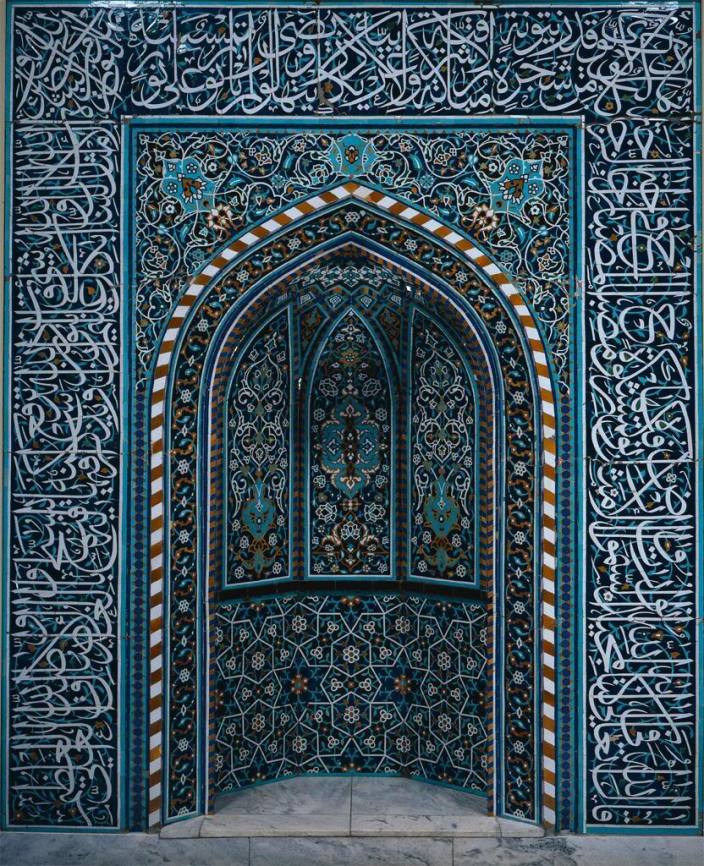
In Islam they build mosques that have the quality of jewel boxes. They are ornamented with a tremendous richness and regal splendor, but are completely devoid of anything iconographic, anything representational. They seem like abstract spaces, as does the Muslim worship within these spaces — the bowing down toward a mihrab, which is, in and of itself, nothing, but only an abstract architectural gesture that indicates the direction of Mecca. And of course, the Islamic faith emphasizes that man is very low and that God is very high, and that, really, the two do not meet; they surely do not meet in the sense that they meet in Christianity. So regardless of how beautiful a mosque may be, mosque architecture has never sought to convey an impression that God is within the mosque. It only conveys the impression that man has attempted to dignify himself by beautifying the mosque to an extent that man might be found worthy to kneel before God (because, of course, one only kneels in a mosque). So, if it is true that the emissaries of St. Vladimir attended services in an Orthodox Church, a Catholic Church, and in a mosque, I think it’s very appropriate that they would have observed that only in the Orthodox Church does it seem that God dwells with men. The very specific and deliberate attempt of Orthodox liturgical art is to convey that impression, and this is, of course, the fundamental gospel of Christianity.

church20

… A good modern building flooded with white light can be beautiful and people will often call such a building uplifting or inspiring. But we need to remember that the purpose of liturgical architecture, of an Orthodox church, is not to uplift and inspire but to make us mindful of the presence of God and the saints. Traditional architecture does this iconographically by revealing the beauty of the uncreated light shining through the saints, through the icons, and by suggesting the veil of mystery and the cloud of witnesses around the altar. For this iconographic technology to be effective requires a certain dim and mysterious light so that the reflections of light off of the gilded icons can be seen as brilliant and even supernatural in the setting of a dark church. A church that is flooded with natural light robs the icons of their ability to shine more brightly than the sun.

church11

*

(1) For the full article “ON EARTH AS IT IS IN HEAVEN ❧ Form and Meaning in Orthodox Architecture by ANDREW GOULD, go to http://nwbstudios.com/articles/On-Earth-As-Heaven.pdf

(2) For excerpts of the article “Mass Transfigured by Light”: The Iconic Vision of an Orthodox Church and ANDREW GOULD’s interview, featured in the current issue of Road to Emmaus Journal, go to http://www.orthodoxartsjournal.org/andrew-gould-featured-in-road-to-emmaus-journal/

The Art of Spiritual Reading

An Introduction to the Art of Reading God’s Word accompanied by some of the most beautiful medieval manuscripts

Top 10 Most Beautiful Medieval Manuscripts

Black Hours (M. 493 › Morgan Library & Museum)

The Black Hours is a product of unequalled luxury. All 121 vellum folios are stained in black. To make the writing stand out against the dark background, only white lead and opaque paints were used for the miniatures, and gold and silver ink for the script. Only three of these black parchment manuscripts survive to this day.
*


WE BELIEVE THAT THE SCRIPTURES constitute a coherent whole. They are at once divinely inspired and humanly expressed. They bear authoritative witness to God’s revelation of Himself – in creation, in the Incarnation of the Word, and the whole history of salvation. And as such they express the word of God in human language. We know, receive, and interpret Scripture through the Church and in the Church. Our approach to the Bible is one of obedience.

We may distinguish four key qualities that mark an Orthodox reading of Scripture, namely

Top 10 Most Beautiful Medieval Manuscripts

Prayerbook of Claude de France (MS M. 1166 › Morgan Library & Museum)

In the words of Roger Wieck, curator of manuscripts at the Morgan Library: “An artistic triumph…” The personalized prayer book of the French queen Claude de France enchants us especially by its delicate paintings in a charmingly small format of 69 x 49 mm, and even more so by the unusual wealth of illustration it contains.

*

Reading the Bible with Obedience

FIRST OF ALL, when reading Scripture, we are to listen in a spirit of obedience. The Orthodox Church believes in divine inspiration of the Bible. Scripture is a “letter” from God, where Christ Himself is speaking. The Scriptures are God’s authoritative witness of Himself. They express the Word of God in our human language. Since God Himself is speaking to us in the Bible, our response is rightly one of obedience, of receptivity, and listening. As we read, we wait on the Spirit.

But, while divinely inspired, the Bible is also humanly expressed. It is a whole library of different books written at varying times by distinct persons. Each book of the Bible reflects the outlook of the age in which it was written and the particular viewpoint of the author. For God does nothing in isolation, divine grace cooperates with human freedom. God does not abolish our individuality but enhances it. And so it is in the writing of inspired Scripture. The authors were not just a passive instrument, a dictation machine recording a message. Each writer of Scripture contributes his particular personal gifts. Alongside the divine aspect, there is also a human element in Scripture. We are to value both.

Each of the four Gospels, for example, has its own particular approach. Matthew presents more particularly a Jewish understanding of Christ, with an emphasis on the kingdom of heaven. Mark contains specific, picturesque details of Christ’s ministry not given elsewhere. Luke expresses the universality of Christ’s love, His all-embracing compassion that extends equally to Jew and to Gentile. In John there is a more inward and more mystical approach to Christ, with an emphasis on divine light and divine indwelling. We are to enjoy and explore to the full this life-giving variety within the Bible.

most beautiful medieval manuscripts lindisfarne gospels

Lindisfarne Gospels (Cotton MS Nero D IV › British Library)

The Lindisfarne Gospels doesn’t need many words of introduction: it’s one of the finest works in the unique style of Hiberno-Saxon or Insular art, combining Mediterranean, Anglo-Saxon and Celtic elements.

*

Because Scripture is in this way the word of God expressed in human language, there is room for honest and exacting inquiry when studying the Bible. Exploring the human aspect of the Bible, we are to use to the full our God-given human reason. The Orthodox Church does not exclude scholarly research into the origin, dates, and authorship of books of the Bible.

Alongside this human element, however, we see always the divine element. These are not simply books written by individual human writers. We hear in Scripture not just human words, marked by a greater or lesser skill and perceptiveness, but the eternal, uncreated Word of God Himself, the divine Word of salvation. When we come to the Bible, then, we come not simply out of curiosity, to gain information. We come to the Bible with a specific question, a personal question about ourselves: “How can I be saved?”

As God’s divine word of salvation in human language, Scripture should evoke in us a sense of wonder. Do you ever feel, as you read or listen, that it has all become too familiar? Has the Bible grown rather boring? Continually we need to cleanse the doors of our perception and to look in amazement with new eyes at what the Lord sets before us.

We are to feel toward the Bible with a sense of wonder, and sense of expectation and surprise. There are so many rooms in Scripture that we have yet to enter. There is so much depth and majesty for us to discover. If obedience means wonder, it also means listening.

Hours of Jeanne d’Evreux (Acc., No. 54.1.2 › Metropolitan Museum of Art) 

All miniatures are in demi-grisaille, a painting technique using mainly shades of grey and coloring for the figures’ face and hands. The surprising amount of details that can be fit in such small space is outstanding.

*

We are better at talking than listening. We hear the sound of our own voice, but often we don’t pause to hear the voice of the other person who is speaking to us. So the first requirement, as we read Scripture, is to stop talking and to listen – to listen with obedience.

When we enter an Orthodox Church, decorated in the traditional manner, and look up toward the sanctuary at the east end, we see there, in the apse, an icon of the Virgin Mary with her hands raised to heaven – the ancient Scriptural manner of praying that many still use today. This icon symbolizes the attitude we are to assume as we read Scripture – an attitude of receptivity, of hands invisibly raised to heaven. Reading the Bible, we are to model ourselves on the Blessed Virgin Mary, for she is supremely the one who listens. At the Annunciation she listens with obedience and responds to the angel, “Be it unto me according to thy word” (Luke 1:38). She could not have borne the Word of God in her body if she had not first, listened to the Word of God in her heart. After the shepherds have adored the newborn Christ, it is said of her: “Mary kept all these things and pondered them in her heart” (Luke 2:19). Again, when Mary finds Jesus in the temple, we are told: “His mother kept all these things in her heart” (Luke 2:5l). The same need for listening is emphasized in the last words attributed to the Mother of God in Scripture, at the wedding feast in Cana of Galilee: “Whatsoever He saith unto you, do it” (John 2:5), she says to the servants – and to all of us.

In all this the Blessed Virgin Mary serves as a mirror, as a living icon of the Biblical Christian. We are to be like her as we hear the Word of God: pondering, keeping all these things in our hearts, doing whatever He tells us. We are to listen in obedience as God speaks.

Westminster Abbey Bestiary

Westminster Abbey Bestiary (Ms. 22 › Westminster Abbey Library)

Out of all the Bestiaries, the Westminster is considered to be one of the most beautiful and richly decorated bestiaries in the world, and is full of all kinds of incredible descriptions, legends and myths.

*

Understanding the Bible Through the Church

IN THE SECOND PLACE, we should receive and interpret Scripture through the Church and in the Church. Our approach to the Bible is not only obedient but ecclesial.

It is the Church that tells us what is Scripture. A book is not part of Scripture because of any particular theory about its dating and authorship. Even if it could be proved, for example, that the Fourth Gospel was not actually written by John the beloved disciple of Christ, this would not alter the fact that we Orthodox accept the Fourth Gospel as Holy Scripture. Why? Because the Gospel of John is accepted by the Church and in the Church.

It is the Church that tells us what is Scripture, and it is also the Church that tells us how Scripture is to be understood. Coming upon the Ethiopian as he read the Old Testament in his chariot, Philip the Apostle asked him, “Understandest thou what thou readest?” And the Ethiopian answered, “How can I, unless some man should guide me?” (Acts 8:30-31). We are all in the position of the Ethiopian. The words of Scripture are not always self-explanatory. God speaks directly to the heart of each one of us as we read our Bible. Scripture reading is a personal dialogue between each one of us and Christ – but we also need guidance. And our guide is the Church. We make full use of our own personal understanding, assisted by the Spirit, we make full use of the findings of modern Biblical research, but always we submit private opinion – whether our own or that of the scholars – to the total experience of the Church throughout the ages.

The Orthodox standpoint here is summed up in the question asked of a convert at the reception service used by the Russian Church: “Do you acknowledge that the Holy Scripture must be accepted and interpreted in accordance with the belief which has been handed down by the Holy Fathers, and which the Holy Orthodox Church, our Mother, has always held and still does hold?”

We read the Bible personally, but not as isolated individuals. We read as the members of a family, the family of the Orthodox Catholic Church. When reading Scripture, we say not “I” but “We.” We read in communion with all the other members of the Body of Christ, in all parts of the world and in all generations of time. The decisive test and criterion for our understanding of what the Scripture means is the mind of the Church. The Bible is the book of the Church.

godescalc-evangeliary

Godescalc Evangelistary (Ms. Nouv. acq. lat. 1203 › Bibliothèque Nationale de France)

Why is this manuscript so important? In the words of Godescalc himself:

Golden words are painted [here] on purple pages,
The Thunderer’s shining kingdoms of the starry heavens,
Revealed in rose-red blood, disclose the joys of heaven,
And the eloquence of God glittering with fitting brilliance
Promises the splendid rewards of martyrdom to be gained. 

*

To discover this “mind of the Church,” where do we begin? Our first step is to see how Scripture is used in worship. How, in particular, are Biblical lessons chosen for reading at the different feasts? We should also consult the writings of the Church Fathers, and consider how they interpret the Bible. Our Orthodox manner of reading Scripture is in this way both liturgical and patristic. And this, as we all realize, is far from easy to do in practice, because we have at our disposal so few Orthodox commentaries on Scripture available in English, and most of the Western commentaries do not employ this liturgical and Patristic approach.

As an example of what it means to interpret Scripture in a liturgical way, guided by the use made of it at Church feasts, let us look at the Old Testament lessons appointed for Vespers on the Feast of the Annunciation. They are three in number: Genesis 28:10-17; Jacob’s dream of a ladder set up from earth to heaven; Ezekiel 43:27-44:4; the prophet’s vision of the Jerusalem sanctuary, with the closed gate through which none but the Prince may pass; Proverbs 9:1-11: one of the great Sophianic passages in the Old Testament, beginning “Wisdom has built her house.”

These texts in the Old Testament, then, as their selection for the feast of the Virgin Mary indicates, are all to be understood as prophecies concerning the Incarnation from the Virgin. Mary is Jacob’s ladder, supplying the flesh that God incarnate takes upon entering our human world. Mary is the closed gate who alone among women bore a child while still remaining inviolate. Mary provides the house which Christ the Wisdom of God (1 Cor. 1:24) takes as his dwelling. Exploring in this manner the choice of lessons for the various feasts, we discover layers of Biblical interpretation that are by no means obvious on a first reading.

The Grimani Breviary

Grimani Breviary (Ms. Lat. I, 99=2138 › Biblioteca Nazionale Marciana) 

A monumental witness to the splendor of Flemish art produced during the Renaissance. Perhaps an outstanding features of this manuscript is the choice of motifs, which alternate between religious and lay themes.

*

Take as another example Vespers on Holy Saturday, the first part of the ancient Paschal Vigil. Here we have no less than fifteen Old Testament lessons. This sequence of lessons sets before us the whole scheme of sacred history, while at the same time underlining the deeper meaning of Christ’s Resurrection. First among the lessons is Genesis 1:1-13, the account of Creation: Christ’s Resurrection is a new Creation. The fourth lesson is the book of Jonah in its entirety, with the prophet’s three days in the belly of the whale foreshadowing Christ’s Resurrection after three days in the tomb (cf. Matthew 12:40). The sixth lesson recounts the crossing of the Red Sea by the Israelites (Exodus 13:20-15:19), which anticipates the new Passover of Pascha whereby Christ passes over from death to life (cf. 1 Corinthians 5:7; 10:1-4). The final lesson is the story of the three Holy Children in the fiery furnace (Daniel 3), once more a “type” or prophecy of Christ’s rising from the tomb.

Such is the effect of reading Scripture ecclesially, in the Church and with the Church. Studying the Old Testament in this liturgical way and using the Fathers to help us, everywhere we uncover signposts pointing forward to the mystery of Christ and of His Mother. Reading the Old Testament in the light of the New, and the New in the light of the, Old – as the Church’s calendar encourages us to do – we discover the unity of Holy Scripture. One of the best ways of identifying correspondences between the Old and New Testaments is to use a good Biblical concordance. This can often tell us more about the meaning of Scripture than any commentary.

In Bible study groups within our parishes, it is helpful to give one person the special task of noting whenever a particular passage in the Old or New Testament is used for a festival or a saint’s day. We can then discuss together the reasons why each specific passage has been so chosen. Others in the group can be assigned to do homework among the Fathers, using for example the Biblical homilies of Saint John Chrysostom (which have been translated into English). Christians need to acquire a patristic mind.

Morgan-Crusaders-Bible

Morgan Crusader Bible (Ms M.638 › Morgan Library & Museum; Ms Nouv. Acq. Lat. 2294 › Bibliothèque Nationale de France; Ms Ludwig 16 83. M.A. 55 › Getty Museum)

In this manuscript history is depicted in great detail, without any text and recalls the Creation of the world, the Righteous Wars and the deeds of the most important characters of the Old Testament. The Crusader’s Bible fascinates through its rich and refined gold embellishment which comes to enhance the luminosity of the colors.

*

Christ, the Heart of the Bible

THE THIRD ELEMENT in our reading of Scripture is that it should be Christ-centered. The Scriptures constitute a coherent whole because they all are Christ-centered. Salvation through the Messiah is their central and unifying topic. He is as a “thread” that runs through all of Holy Scripture, from the first sentence to the last. We have already mentioned the way in which Christ may be seen foreshadowed on the pages of the Old Testament.

Much modern critical study of Scripture in the West has adopted an analytical approach, breaking up each book into different sources. The connecting links are unraveled, and the Bible is reduced to a series of bare primary units. There is certainly value in this. But we need to see the unity as well as the diversity of Scripture, the all-embracing end as well as the scattered beginnings. Orthodoxy prefers on the whole a synthetic rather than an analytical approach, seeing Scripture as an integrated whole, with Christ everywhere as the bond of union.

Always we seek for the point of convergence between the Old Testament and the New, and this we find in Jesus Christ. Orthodoxy assigns particular significance to the “typological” method of interpretation, whereby “types” of Christ, signs and symbols of His work, are discerned throughout the Old Testament. A notable example of this is Melchizedek, the priest-king of Salem, who offered bread and wine to Abraham (Genesis 14:18), and who is seen as a type of Christ not only by the Fathers but even in the New Testament itself (Hebrews 5:6; 7:l). Another instance is the way in which, as we have seen, the Old Passover foreshadows the New; Israel’s deliverance from Pharaoh at the Red Sea anticipates our deliverance from sin through the death and Resurrection of the Savior. This is the method of interpretation that we are to apply throughout the Bible. Why, for instance, in the second half of Lent are the Old Testament readings from Genesis dominated by the figure of Joseph? Why in Holy Week do we read from the book of Job? Because Joseph and Job are innocent sufferers, and as such they are types or foreshadowings of Jesus Christ, whose innocent suffering upon the Cross the Church is at the point of celebrating. It all ties up.

A Biblical Christian is the one who, wherever he looks, on every page of Scripture, finds everywhere Christ.

Wiener-Genesis

Vienna Genesis (Codex Theol. Gr. 31 › Österreichische Nationalbibliothek)

It is the most ancient purple manuscript surviving today. The fragment of the Genesis (from the Greek Septuagint translation) is compiled in golden and silver ink, on a beautifully purple-dyed calfskin vellum. Each page contains a lavish miniature depicting the text, for a total of 48 well-preserved images.

*

The Bible as Personal

IN THE WORDS of an early ascetic writer in the Christian East, Saint Mark the Monk: “He who is humble in his thoughts and engaged in spiritual work, when he reads the Holy Scriptures, will apply everything to himself and not to his neighbor.” As Orthodox Christians we are to look everywhere in Scripture for a personal application. We are to ask not just “What does it mean?” but “What does it mean to me?” Scripture is a personal dialogue between the Savior and myself – Christ speaking to me, and me answering. That is the fourth criterion in our Bible reading.

I am to see all the stories in Scripture as part of my own personal story. Who is Adam? The name Adam means “man,” “human,” and so the Genesis account of Adam’s fall is also a story about me. I am Adam. It is to me that God speaks when He says to Adam, “Where art thou?” (Genesis 3:9). “Where is God?” we often ask. But the real question is what God asks the Adam in each of us: “Where art thou?”

When, in the story of Cain and Abel, we read God’s words to Cain, “Where is Abel thy brother?” (Genesis 4:9), these words, too, are addressed to each of us. Who is Cain? It is myself. And God asks the Cain in each of us, “Where is thy brother?” The way to God lies through love of other people, and there is no other way. Disowning my brother, I replace the image of God with the mark of Cain, and deny my own vital humanity.

In reading Scripture, we may take three steps. First, what we have in Scripture is sacred history: the history of the world from the Creation, the history of the chosen people, the history of God Incarnate in Palestine, and the “mighty works” after Pentecost. The Christianity that we find in the Bible is not an ideology, not a philosophical theory, but a historical faith.

Then we are to take a second step. The history presented in the Bible is a personal history. We see God intervening at specific times and in specific places, as He enters into dialogue with individual persons. He addresses each one by name. We see set before us the specific calls issued by God to Abraham, Moses and David, to Rebekah and Ruth, to Isaiah and the prophets, and then to Mary and the Apostles. We see the selectivity of the divine action in history, not as a scandal but as a blessing. God’s love is universal in scope, but He chooses to become Incarnate in a particular comer of the earth, at a particular time and from a particular Mother. We are in this manner to savor all the uniqueness of God’s action as recorded in Scripture. The person who loves the Bible loves details of dating and geography. Orthodoxy has an intense devotion to the Holy Land, to the exact places where Christ lived and taught, died and rose again. An excellent way to enter more deeply into our Scripture reading is to undertake a pilgrimage to Jerusalem and Galilee. Walk where Christ walked. Go down to the Dead Sea, sit alone on the rocks, feel how Christ felt during the forty days of His temptation in the wilderness. Drink from the well where He spoke with the Samaritan woman. Go at night to the Garden of Gethsemane, sit in the dark under the ancient olives and look across the valley to the lights of the city. Experience to the full the reality of the historical setting, and take that experience back with you to your daily Scripture reading.

Then we are to take a third step. Reliving Biblical history in all its particularity, we are to apply it directly to ourselves. We are to say to ourselves, “All these places and events are not just far away and long ago, but are also part of my own personal encounter with Christ. The stories include me.”

Betrayal, for example, is part of the personal story of everyone. Have we not all betrayed others at some time in our life, and have we not all known what it is to be betrayed, and does not the memory of these moments leave continuing scars on our psyche? Reading, then, the account of Saint Peter’s betrayal of Christ and of his restoration after the Resurrection, we can see ourselves as actors in the story. Imagining what both Peter and Jesus must have experienced at the moment immediately after the betrayal, we enter into their feelings and make them our own. I am Peter; in this situation can I also be Christ? Reflecting likewise on the process of reconciliation – seeing how the Risen Christ with a love utterly devoid of sentimentality restored the fallen Peter to fellowship, seeing how Peter on his side had the courage to accept this restoration – we ask ourselves: How Christ-like am I to those who have betrayed me? And, after my own acts of betrayal, am I able to accept the forgiveness of others – am I able to forgive myself? Or am I timid, mean, holding myself back, never ready to give myself fully to anything, either good or bad? As the Desert Fathers say, “Better someone who has sinned, if he knows he has sinned and repents, than a person who has not sinned and thinks of himself as righteous.”

Have I gained the boldness of Saint Mary Magdalene, her constancy and loyalty, when she went out to anoint the body of Christ in the tomb (John 20:l)? Do I hear the Risen Savior call me by name, as He called her, and do I respond Rabboni (Teacher) with her simplicity and completeness (John 20:16)?

Reading Scripture in this way – in obedience, as a member of the Church, finding Christ everywhere, seeing everything as a part of my own personal story – we shall sense something of the variety and depth to be found in the Bible. Yet always we shall feel that in our Biblical exploration we are only at the very beginning. We are like someone launching out in a tiny boat across a limitless ocean.

“Thy word is a lamp unto my feet, and a light unto my path” (Psalm 118 [119]:105).

*

Lectio Divina  is a four-part way of reading Scripture:
Lectio. Read. God is speaking, so I listen intently to what he says.
Meditatio. Engage. God is speaking to me, so I listen personally.
Oratio. Pray. God is speaking to me, so I listen personally and reply personally in prayer.
Contemplatio. Live. God is speaking to me, so I listen personally and reply in prayerful living.

*

By Bishop Kallistos Ware: “How to Read the Bible” at http://orthodoxeurope.org/page/11/1/4.aspx#obedience


Source: MEDIEVALISTS.NET, “Top 10 Most Beautiful Medieval Manuscripts” http://www.medievalists.net/2015/10/03/top-10-most-beautiful-medieval-manuscripts/
An Icon Making An Icon!

Christ Pulls St-Peter from the Waters. Jonathan Pageau

Christ Pulls St-Peter from the Waters. Linden and gilding. 4′ x 5′. Carved by Jonathan Pageau.

Since I began icon carving full time 4 years ago now, I had a secret list of the things I wanted to make, certain objects and images that were dear to me.  To my own joy and surprise, I have been progressively checking off items from that list with ongoing commissions, making even those objects and icons I did not think could find patrons such as complex reliquarieswedding crownsopus sectile icons or the image of the Holy prophet Jonah.

One of the images I had secret hope of making is Christ pulling St-Peter out of the water. For those who have read some of my writings one can quickly see how it encompasses so much of my vision of the incarnation, of death, resurrection and the pastoral reminder on where to focus our eyes when advancing into the chaotic world.  So last year, when a patron commissioned this icon at a size of 4’ x 5’ for St. Peter Orthodox Church in Bonita Springs, Florida, I was ecstatic.   This is the biggest icon I have carved to date.

In working out the drawing for the icon carving, I based the composition on my favorite version of this event, a 12th century mosaic from Sicily.

peter-drowning2

Many details are different, but the basic composition is the same. I reduced the size of the boat to make it less overwhelming and to fully have St-Peter under the boat.  I also wanted to make sure we could see at least the eyes of all the Apostles.  I changed Christ’s left hand so that instead of holding a scroll, it was placed in a position suggesting the upcoming motion, the rising of St-Peter.  I also added a few details, such as a dragon head on the boat and I changed the shape of the mast and sail to suggest a Chi-Ro.
Drawing process of St-Peter on water

One of the things that kept changing as I worked on the drawings was just how deep Peter was in the water.  The priest of the parish, fr. Hans Jacobse, commented that he really wanted the water to be high up on his body to give that sense of sinking, but this created some challenges for me because I still wanted us to see St-Peter.  Wood is generally opaque to say the least. In the mosaic version, there is wonderful use of transparency and so I began pondering just how it could be possible to at least suggest transparency in wood.

Final scaled drawing. The level of water on St-Peter will still change in the final carving.

Icon in process, attempting to find ways to show the transparency of water.

I wanted the composition of the water to say something about the event and so beyond suggestions of transparency to show that St-Peter is actually in the water, I also designed it so to have a wave wrapping around his right foot in an image of the Psalms:

The cords of death entangled me; the torrents of destruction overwhelmed me. The cords of the grave coiled around me; the snares of death confronted me. (Psalm 116:3)

The water under Christ’s feet in contrast seems to shoot out from under them, organized by their contact with them. I gilded some of the water to add to this sense of the organizing and transfiguring effect Christ has on creation.

IMG_1319

IMG_1320

Visually, I was looking forward to taking further the experimentation in carving water I had begun in my icon of Jonah. I wanted to create a sense of almost overwhelming movement which would contrast with the vigorous yet safe relationship established between Christ and St-Peter. Christ holds St-Peter by a firm grip, reminding us of the grip Christ has on Adam in the icon of the resurrection. Their gazes are fixed on each other, Peter with a hint of surprise and Christ with calm compassion.

IMG_1317

IMG_1321

IMG_1318

When Christ appears to the Apostles floating at sea, the waters are rising in a tempest. Christ approaches them above the flood, mastering the chaos, the chaos of the primordial waters, the chaos of the passions, of doubt, of all that is in the world of death. St-Peter is the only one to dare walk out with Christ, but because of this boldness, when peering into the storm he panics and sinks. Which one of us has not experienced this? We can imagine St-Peter crying out:

Save me, O God, for the waters have come up to my neck. I sink in the miry depths, where there is no foothold. (Psalm 69: 1,2)

But the face of Christ appears to him through the waves and his hand reaches to catch him. We can hear St-Peter confess:

He lifted me out of the slimy pit, out of the mud and mire; he set my feet on a rock and gave me a firm place to stand. (Psalm 40:2)

This is St-Peter, the son of Jonah, both the stable “rock” and the one who sinks, the bold fisherman who finds the gold coin in the fish’s mouth, but also that one in constant danger of being swallowed by the sea.

This is his story repeated over and over in the Gospels, the story of the one who recognized Jesus as Christ then immediately called out by Christ to “get behind me Satan”, the one who tells Christ he will never deny him then deny him three times as the three days of Jonah in the fish, the three days of Christ in the grave. To meditate on this cycle in the story of St-Peter is to pierce so many mysteries of the Church, so many signs of the times and so many cycles in our own lives.

What is the end of this, what is the end of this story? When Christ appears to the disciples on the Sea of Galilee after his resurrection (John 21), it is the same sea in which St-Peter sank when attempting to walk on water. St-Peter recognizes his Lord on the land, and this time he does not walk on the water. This time his boldness leads him to dive into the deep, to put on his garment and voluntarily plunge, then to be asked three times by Christ: “Peter, son of Jonah, do you love me?” It is not when we walk on the water that we are closest to Christ, but it is when our boldness serves humility. It is when our boldness leads us to die that we are closest to the image of Christ. What impossible thoughts to consider, what scandal it is to fathom such things?

Coming back to our icon, we can say without hesitating that the image of St-Peter being pulled out of the waters is an image of our salvation in so many ways, and I find great joy in having made it.  I hope it will be a blessing for the parish to which it is headed.

IMG_1328

IMG_1327

IMG_1325

IMG_1324


Process of Icon Carving


11216208_1034801319877257_8246492179151514650_o (1)

885642_1035012216522834_2520325151194419110_o

10835272_1037492579608131_5789311249143712612_o

10915106_1045760318781357_6860956537237390303_o

1512254_1048973031793419_3333873536351898288_o

1401985_1066397040051018_9109354896291323811_o

11010944_1069297396427649_4612781722797446725_o

10854886_1124019347622120_4514934908847813528_o

CommentsAndrew Gould A masterpiece of the highest order. Astonishing! My favorite detail is the Viking-like prow on the ship – a pagan monster fleeing the sanctification of the waters. And a bit of an iconographic curiosity – a wood carving depicting a wood carving.” John Tkachuk  An icon making an icon!

Source: Icon Carving of Christ Pulling St-Peter from the Water by  Orthodox Arts Journal http://www.orthodoxartsjournal.org

St. Petersburg’s Jaw-Dropping Wonder

Ana Paula Hirama, Flickr

Al and Marie, Flickr

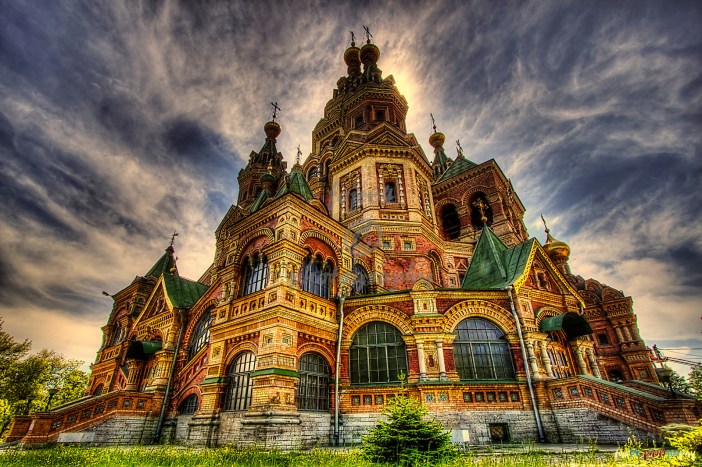
You know the Sistine Chapel and the Notre Dame in Paris, but do you know the Church of the Savior on Spilled Blood? Because it’s one of the most beautiful churches in the whole world. Located in St. Petersburg, Russia, Church of the Savior on Spilled Blood is a Russian Orthodox church that was built in the late 19th century under the direction of the Russian imperial family. It is built on the site where Emperor Alexander II was fatally injured in March of 1881. It is full of bright colors, twisting spires, and floor to ceiling icons.

Here’s what it looks like on the outside:NoPlayerUfa, Wikipedia

And if you walk inside and look up, here’s what you see:

Saint-Petersburg orthodox theological academy, Flickr

See what I mean about being jaw-droppingly beautiful??

And yes, this place really exists.

Unfortunately, it is not used as a full-time church. During the Bolshevik Revolution in 1917, the church was looted and damaged. The Soviet government closed the church in the 1930s. It suffered further damage during WWII.

Since 1970s, it has been used as a museum, even after a major restoration of the church in the 1970s, ’80s, and ’90s.

But it can still inspire people’s faith with its beauty!

Here are more pictures of both the exterior and interior. Enjoy!

Saint-Petersburg orthodox theological academy, Flickr
Ana Paula Hirama, Flickr
Justin Kaplan, Flickr
grizzlee9129, Flickr
Saint-Petersburg orthodox theological academy, Flickr
Ana Paula Hirama, Flickr
jaime.silva, Flickr
Diego Sáez Contreras, Flickr

Source: http://www.churchpop.com/2015/09/02/the-jaw-dropping-wonder-of-st-petersburg-the-church-of-the-savior-on-spilled-blood/

Mundi Peregrinatione

Explore in 360 degrees the Sistine Chapel, the Church of the Holy Sepulchre, and many more – all online.

http://www.vatican.va/various/cappelle/sistina_vr/index.html

Christians have been making pilgrimages to holy sites and churches around the world for centuries. Can’t make a pilgrimage? Here’s the next best thing!

Some tours are embedded on this page, while others can be found with the link provided.

Enjoy!

1) Sistine Chapel – Vatican City

 Maus-Trauden / Wikipedia
Maus-Trauden / Wikipedia

Built in the 15th century and painted in the 16th century, the Sistine Chapel is one of the great artistic masterpieces in the world. Michelangelo painted the ceiling and the Last Judgement fresco, while the frescoes on the other walls were painted by a number of other artists. Among other things, the Sistine Chapel serves as the location for conclaves of Cardinals that elect new popes.

This one can only be viewed on the Vatican website, so click on the picture or on the link to check it out.

LinkStart the tour!

http://www.vatican.va/various/cappelle/sistina_vr/

http://www.vatican.va/various/cappelle/sistina_vr/

2) Church of the Holy Sepulchre – Jerusalem

Jorge Láscar / Flickr

Located in Old Jerusalem, the Church of Holy Sepulchre is venerated by Christians for containing within its space what is believed to be the places of Jesus’ death, burial, and resurrection – which makes it pretty important! The original church was built in the 4th century under Constantine but has endured several rounds of extensive damage and restoration since.

LinkStart the tour! (here’s another virtual tour of the same place)

http://www.holysepulchre.custodia.org/default.asp?id=4098

http://www.holysepulchre.custodia.org/default.asp?id=4098

3) St. Basil’s Cathedral – Moscow, Russia

michael clarke stuff / Wikimedia Commons

Not to be confused with the Kremlin (which is nearby), St. Basil’s Cathedral was built in the 16th century on orders from Ivan the Terrible and served as a Russian Orthodox cathedral for centuries until it was confiscated and forcibly secularized in the late 1920s by the Soviet Union. It remains property of the Russian government today and is used as a museum.

LinkStart the tour! (Note: the virtual tour can take a little bit of time to load.)

http://en.ria.ru/infographics/20110903/166323377.html

http://en.ria.ru/infographics/20110903/166323377.html

4) Basilica of St. Peter – Vatican City

Public Domain / Wikipedia

This great wonder of the world was built in the 16th century in the midst of the Protestant reformation, replacing the aging church that had stood on that site since the 4th century. The largest church in the world, it is built on top of what is believed to be the grave of St. Peter, the first pope.

LinkStart the tour!

http://www.vatican.va/various/basiliche/san_pietro/vr_tour/Media/VR/St_Peter_Altar/index.html

http://www.vatican.va/various/basiliche/san_pietro/vr_tour/Media/VR/St_Peter_Altar/index.html

5) Church of the Nativity – Bethlehem, West Bank

young shanahan / Flickr

Church of the Nativity is located on the place that Christians have traditionally believed that Jesus was born. The first church was built in the 4th century under Constantine but was destroyed by fire and then rebuilt in the 6th century. Since then it has gone through numerous restorations, additions, etc. Roman Catholic, Greek Orthodox and Armenian Apostolic representatives run and maintain the current church.

LinkStart the tour!

http://www.bethlehem.custodia.org/default.asp?id=455

http://www.bethlehem.custodia.org/default.asp?id=455

6) Cathedral of St. Paul, National Shrine of the Apostle Paul – St. Paul, MN

Jeremy Noble / Wikimedia Commons

Atop the highest hill in the Twin Cities (with the Minnesota state capital just a bit lower down the street!), the St. Paul Cathedral is everything you’d expect of a beautiful European cathedral – except that it’s in the U.S.! It’s the third largest completed church in the U.S., and the fourth tallest. Built in the early 20th century, it is a co-cathedral with the Basilica of St. Mary (see #6) for the Catholic Archdiocese of St. Paul/Minneapolis.

https://www.google.com/maps/@44.9469453,-93.1090568,3a,75y,262.12h,114.8t/data=!3m7!1e1!3m5!1sU1_gbXFY_AG2EOYw2_51-Q!2e0!3e2!7i13312!8i6656?hl=en-US

7) Basilica of St. Mary – Minneapolis, MN

Beatrice Murch / Wikimedia Commons

Built in the early 20th century, the Basilica of St. Mary was the first church designated a basilica in the U.S., and serves as a co-cathedral with the Cathedral of St. Paul for the Catholic Archdiocese of St. Paul/Minneapolis.

https://www.google.com/maps/@44.9731394,-93.2863352,3a,75y,357.32h,90t/data=!3m7!1e1!3m5!1si0wv1yLqYgqL0xnh6PB72w!2e0!3e2!7i13312!8i6656?hl=en-US

8) Canterbury Cathedral – Canterbury, England 

Hans Musil, Wikipedia

When was Canterbury Cathedral built? That’s a hard question to answer, since different parts of the current structure were built, torn down, rebuilt, added on, etc over nine centuries, from the 10th to the 19th, with the site having been used as a cathedral since the 6th century. During the Protestant reformation in the 16th century, the Church of England took control of the church from the Roman Catholic Church.

LinkStart the tour!

http://www.canterbury-cathedral.org/visit/tour/

9) Exeter Cathedral – Exeter, England

WyrdLight.com / Antony McCallum / Wikipedia

Built from the 12th century to the 15th century, Exeter Cathedral serves as the seat of the Anglican bishop of Exeter. Among its large collection of relics, the church has what is supposedly the Burning Bush, as well as part of a candle used by an angel in Christ’s tomb. Like the Canterbury Cathedral, Exeter Cathedral was originally a Roman Catholic cathedral, but was acquired by the Church of England in the 16th century.

LinkStart the tour!

http://www.peterstephens.co.uk/virtual_tours/exeter-cathedral/2012/virtualtour.html

10) St. Patrick’s Cathedral – New York City, NY

Mr. Kjetil Ree / Wikimedia Commons

Directly across the street from Rockefeller Center in the middle of New York City, St. Patrick’s Cathedral was built in the 19th century when midtown wasn’t as populated, and its large size dominated the area. Construction began in 1858, paused during the Civil War, and was finished in 1878. Further work was done in the early 20th century, and it was named a National Historic Site in 1976. It is currently used as the seat of the Catholic Archbishop of New York.

https://www.google.com/maps/@40.7586705,-73.9765313,3a,75y,111.35h,82.11t/data=!3m7!1e1!3m5!1sE_1fHJcwaJp2kITv5ZMA-A!2e0!3e2!7i13312!8i6656?hl=en-US

11) Cathedral Basilica of Our Lady of Chartres – Chartres, France

Olvr / Wikipedia
Olvr / Wikipedia

Built mostly in the 13th century, Chartres Cathedral is the latest of at least five churches that have stood in its location. Amazingly, most of the stained glass in the church is original. Among its many boasts, the church claims to have the Sancta Camisa, the tunic worn by the Blessed Virgin Mary at the birth of Jesus. It is still the seat of the Catholic bishop of Chartres.

LinkStart the tour!

http://mappinggothic.org/archmap/media/buildings/001000/1107/panos/1107_vr_00004.swf

12) Basilica of the National Shrine of the Immaculate Conception – Washington D.C.

AgnosticPreachersKid / Wikipedia

Located on the campus of Catholic University of America in Washington D.C., the Basilica of the Shrine of the Immaculate Conception “is the largest Catholic church in the United States, the largest church of any kind in the western hemisphere, the eighth largest church building in the world, and the tallest habitable building in Washington, D.C.” Construction began in 1920, but wasn’t completed until 1961 due to the Great Depression and WWII. Even so, significant additions have been made as recently as 2012. In addition to a beautiful array of images of the Blessed Virgin Mary from different cultures, the basilica houses the papal tiara of Pope Paul VI.

LinkStart the tour!

http://www.nationalshrine.com/site/c.osJRKVPBJnH/b.5842239/k.A7C7/Virtual_Tour_360.htm

Source: 12 Amazing Virtual Tours of the World’s Most Spectacular Churches

http://www.churchpop.com/2014/08/10/12-amazing-virtual-tours-of-the-worlds-most-spectacular-churches/

Beauty Spirit Matter: The Theology of An Icon

richyoungruler In-Depth Insights Into The ‘Writing’ of An Icon

“… This spring, I received an email from an American client which left me both intrigued and slightly anxious. Would I like to paint a new icon depicting Christ’s interaction with the Rich Young Ruler described in each of the Synoptic Gospels? Yes, of course!

*

… I had heard this story before of course – it is the moment when Christ says “it is easier for a camel to pass through the eye of a needle than for a rich man to enter Heaven”. Like many Christians I was both baffled by the imagery but also struck by a few words in the sentence before, when we hear “Christ looked at the young man and warmed to him”. Does this mean that before this moment, Christ had not felt warmth – or love – for this rich young person? What changed for Christ in that moment that it is marked in the gospel? My client was very clear that THIS was the moment to be shown in the icon – that second when we are told how Christ felt agape for this person who had approached him with such an important question.  In our correspondence, he said “The wealthy need a savior too, and they know it. Their spiritual position is precarious even if not their social and logistical position.”

*

image1

Initially I drew the figure of Jesus sitting – traditionally he would sit and the crowd would gather and sit around his feet. However, my client suggested both should be standing – this was a dynamic interaction between Christ and the Young Ruler, rather than a more simple ‘teaching’ scene. As we are told in the Gospel of St Mark:

As He was setting out on a journey, a man ran up to Him and knelt before Him, and asked Him, “Good Teacher, what shall I do to inherit eternal life?” And Jesus said to him, “Why do you call me good? No one is good except God alone. You know the commandments, ‘Do not murder, Do not commit adultery, Do not steal, Do not bear false witness, Do not defraud, Honor your father and mother.’” And he said to Him, “Teacher, I have kept all these things from my youth up.”  Looking at him, Jesus felt a love for him and said to him, “One thing you lack: go and sell all you possess and give to the poor, and you will have treasure in heaven; and come, follow Me.”  But at these words he was saddened, and he went away grieving, for he was one who owned much property.

*

And Jesus, looking around, said to His disciples, “How hard it will be for those who are wealthy to enter the kingdom of God!” The disciples were amazed at His words. But Jesus answered again and said to them, “Children, how hard it is to enter the kingdom of God!  It is easier for a camel to go through the eye of a needle than for a rich man to enter the kingdom of God.” They were even more astonished and said to Him, “Then who can be saved?” Looking at them, Jesus said, “With man it is impossible, but not with God; for all things are possible with God.”

*

Christ is ever so slightly taller, as He is mature in body and of course His Divine Nature. He is clothed traditionally, with the red robe of His human nature adorned by the blue outer garment of His Divinity. He is shown with a clear, compassionate expression – with His right hand He blesses and I chose that His left hand should be open, extending towards this young man who has come seeking His teaching on life and how to be saved. It is not a begging, not a pleading – it is an open, loving invitation to the young man (and all of us). “Here, take my hand, and I will lead you into Paradise”. He is shown not quite standing, not quite moving – Christ was about to leave at the end of a long time answering, telling parables, teaching. Yet He hesitates, having heard the direct question and honest response of this wealthy young man.

image3

image5

The Young Ruler is, obviously, dressed very differently. My client and I discussed at length how we could show his material prosperity and how that should be illustrated. Garish colours? Gold and jewels? Furs even? It was very tempting to have some real ‘fun’ with this ensemble, to communicate just how extravagant his wealthy behaviour had become. And yet there is nothing intrinsically wrong with his wealth – it is a fact of his life, like brown hair or a straight nose. I felt that although he was rich, he was not intrinsically ‘bad’ or even tasteless  …

image4

I sat down and gazed at the form of the young man. I had spent hours drawing him, over and over, until I got the combination of supplication, enquiry and so on, combined with the transformed nature of the icon as right as I could. I knew that I wanted him to be bright. Yet as I sat there, I knew that, underneath the almost turquoise terre verte I wanted for his robe, there must also be a deep layer of azurite – the same as Christ’s robe. Here was a young man who wants to be saved, who wants to be with Christ – and yet he already is with Christ, and he already partakes of that Divinity in his person by virtue of being human and therefore already formed in God’s likeness and image. I had to find a way to show that all humanity, whether rich or poor, is a part of God’s likeness and that his wealth was no bar to this – if only he (and we) can recognise it.

*

This led to a slightly different choice for his cloak – the inner red, which grabs our attention here, and on his delicately shod feet is a genuine (and poisonous) vermillion. This is the most intense colour I ever use and it certainly grabs attention. Who other than a very rich person would travel with such impractical, highly decorative garments? His shoes illustrate that he does not have to walk for miles; he rides a fine horse or is perhaps carried on a litter. His cloak is sewn with pearls and yet they would not help protect him from weather; this is all about displaying status, like designer labels in our day perhaps. His hem and crown are both gold, as is the decorative panel on his cloak. However, you might be wondering why I didn’t use real gold, as there is lots of gold leaf on the background of the panel.

image6

Gold, in an icon, is not used to depict the metal gold on this earth (or not solely that). In this instance, the gold in background is a 23 ½ carat gold leaf, double layered over a red clay base. As simply put as possible, the gold is the presence of the unseen God “in whom we live and move and have our being”. He is closer to us than our own breath and yet cannot be seen with eyes. This gold is a reminder of that presence and part of the ‘transfigured reality’ that icons show us.

*

When gold is used on a garment, it is not to show itself but the light of divinity transforming material, fabric, garments, just as Christ’s robes were transfigured on Mt Tabor; the Light of God transforms the very matter around us as far as we are able to see it. So the lines of gold on the robe of the Virgin Mary, the lines of gold on the robe of an infant Christ etc., all are signs of the indwelling of God possible within His good creation when it is transmuted by His presence and in the fullness of its potential reality.

The crown, hem and cloak are therefore painted with a bright Italian yellow ochre to illustrate the decorative nature of his garments but not their essence. They are finely figured in the Byzantine style of the 12th-13th centuries and, I hope, communicate how wealthy this person would have been to wear such finery.

image7

…. Behind Christ, there is in the distance a waterfall – He is the life-giving water which not only quenches all who thirst but is so essential for life in the hot, desert country where this icon will live. Around Christ’s feet, there are a few native plants from the Colorado region as well – Columbine, blanket flower and a reference to Christ as the vine.

*

There is also an element of ‘sacred geometry’ involved. Between the figures, one can see the shape of a chalice. There is a Communion taking place between Christ and this rich young ruler, similar to the Eucharist celebrated daily in churches throughout the world. A similar chalice shape exists in the Rublev Holy Trinity, which I was studying at the time.

*

I was sad to complete this icon. I am always reluctant to let them go, having been blessed by spending so many hours in prayer with them and getting to know the Saints or the passage of the Gospel in this case. But I am more delighted than I can say to know that it is going to be shared with so many who wish to bring the Gospel and good news of Christ’s love to more in the community and that it will be so well cared for, and prayed with. I should perhaps say I feel sad, but also immensely blessed.”

For the complete article “A New Icon Composition: Christ and the Rich Young Ruler” by Katherine Sanders • October 9, 2015 • Orthodox Arts Journal go to http://www.orthodoxartsjournal.org/a-new-icon-composition-christ-and-the-rich-young-ruler/

Draganescu Sistine Chapel

boca12

boca9   

   boca4 

 boca16

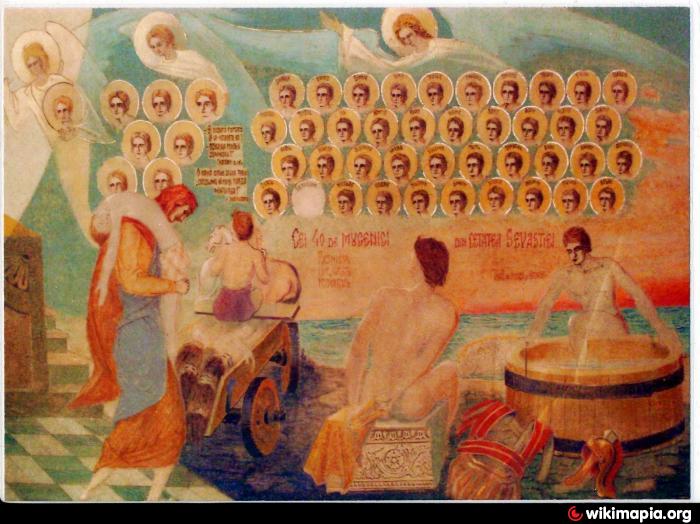
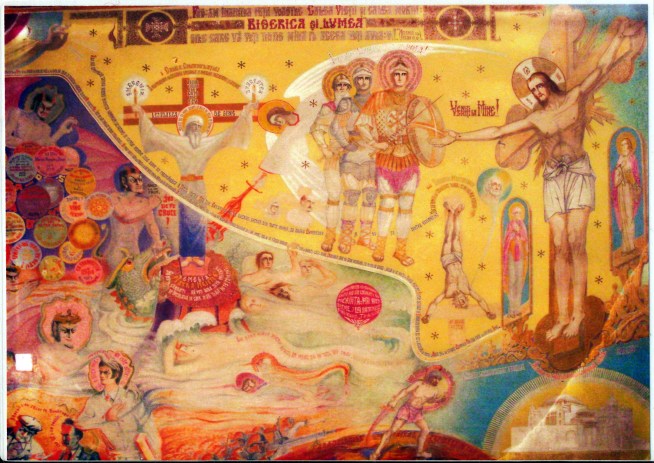
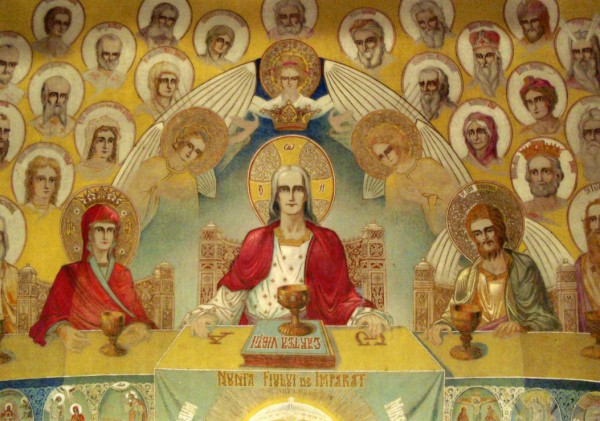
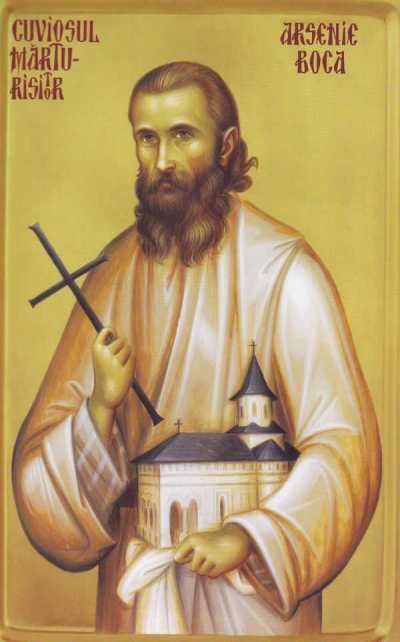
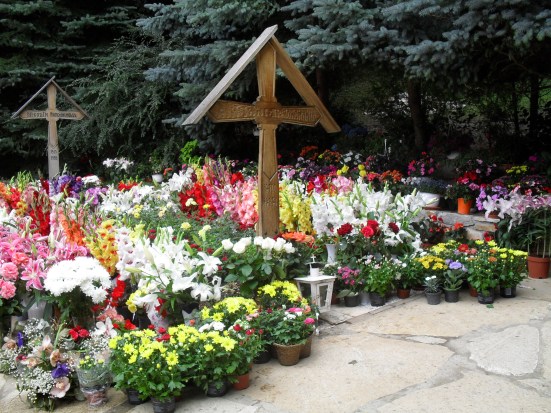
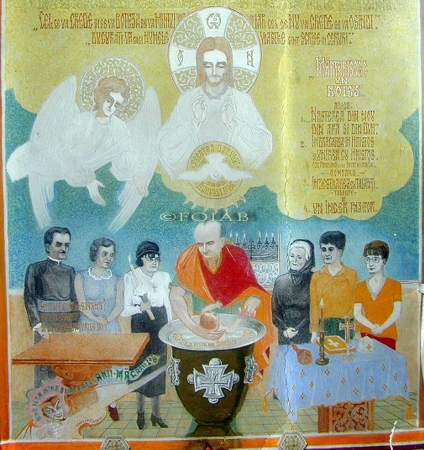
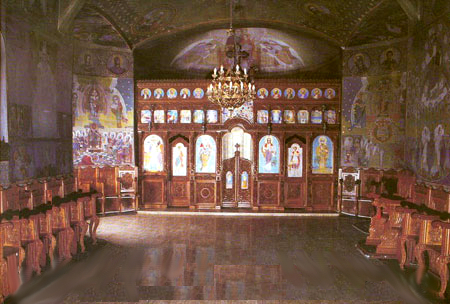
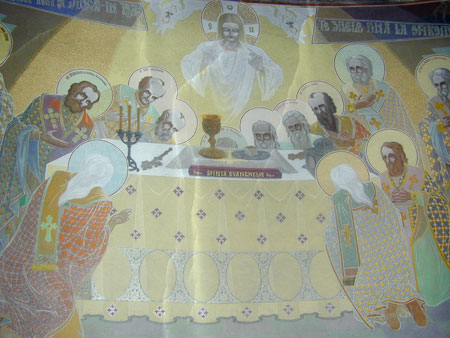
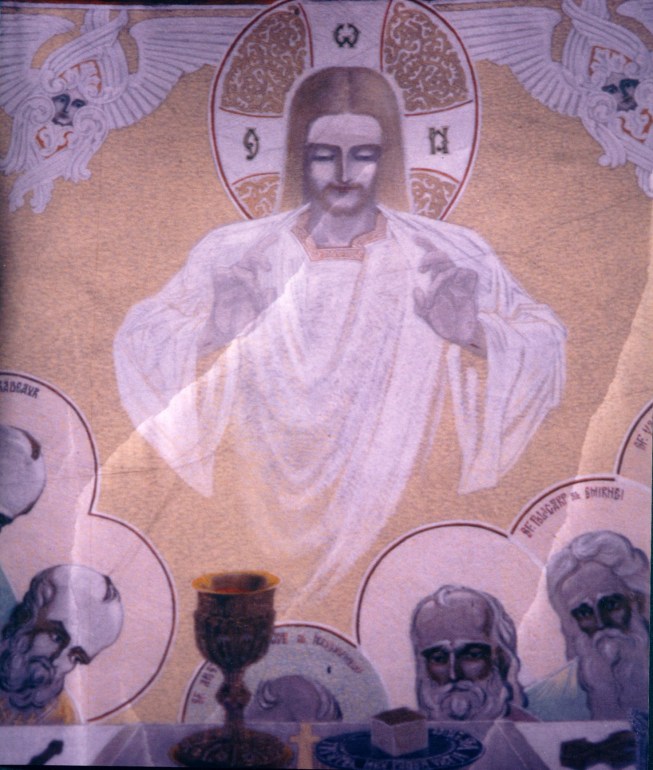
The Romanian Orthodox Church is considering a Romanian monk persecuted by the communists and known as the “saint of Transylvania” for sainthood. … Boca, who became a monk in 1940, was harassed by the Securitate secret police, detained and did forced labor on the Black Sea Canal, a notorious labor camp where tens of thousands of political prisoners worked in the 1950s. In 1959, he was banned from leading worship and the Prislop monastery, where he is now buried, was converted into a retirement home. He was forced to retire from the church in 1968 and spent 15 years painting religious images and icons in the small church of Draganescu in southern Romania. The church’s interiors are now considered among the most beautiful in the country. Elder Arsenie Boca reposed in the Lord in early 1989, a month before Romania’s anti-communist revolt, aged 79. Though he is not yet canonized, Elder Arsenie’s grave, located in Prislop Monastery, is visited by tens of thousands of pilgrims every year, where many miracles occur. One miracle which everyone can see is that the flowers over his grave never die or wither , neither in the hot summer or the frigid winter.

st arsenie boca 

 arsenie3

For his amazing life, the  documentary “Fr. Arsenie Boca – Man of God” is a MUST.  “His colleagues at the Theological Academy of Sibiu named him ‘The Saint’, he is considered a founding father of the Romanian Philokalia by father Dumitru Staniloaie, who thought of him as an unparalleled phenomenon of Romanian monasticism.

*
Sought after and followed by thousands of believers eager to quench their spiritual thirst from his inexhaustible spring of serenity; legendary for his prophesying and healing gifts, painter of souls and painter of churches, man of culture, philosopher of sciences and religion, father Arsenie Boca was, just like Saint Basil as depicted by him in his essential work The Path of the Kingdom.

*

A disciple calmly walking across the stormy seas, an unmoving pillar against the troubled waves, a man among people, providing guidance and strength with otherworldly serenity, unflinching in the belief that God alone is ruler of our world. An unequaled personality, a magnet for thousands of people in all walks of life, and also a target for suspicion for the authorities of his day, who failed to understand the source of his exceptional power to gather people around him.” 

*

As one person interviewed in this documentary says: “Fr. Arsenie made Christ transparent to us.” He still does. His presence in the midst of us after his passing is a reminder of the proximity of Heaven. This film is an opportunity to (re)discover it for ourselves. https://www.youtube.com/watch?v=ptbTap5NHqw

 boca8  

 boca27

  boca15      

*

The Sistine Chapel of the Romanians: the Draganescu Church

Father Arsenie Boca lived in Draganescu for 20 years and in 1968 he began painting the parish church, a work that took him more than 15 years. As he wasn’t allowed to celebrate service, some of the priests who visited the church over the years claim that Arsenie Boca has actually painted the sermons he delivered at Sambata de Sus.

*

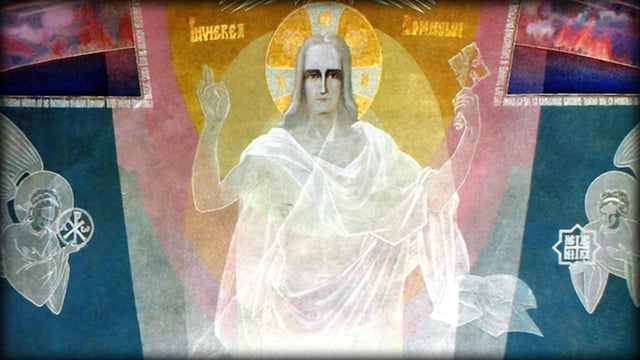
Rainbow colors reverberating in frescoes, light flowing from Christ’s Resurrection, Heaven trickling down through the painting brush, that’s the way the murals painted by Orthodoxy beacon Arsenie Boca at the “St. Nicholas” Church of the Draganescu town – Giurgiu County can be translated and rendered into metaphor. …

 boca6 

 boca7

boca22 

 boca13

Prophetic Artist in Shackles

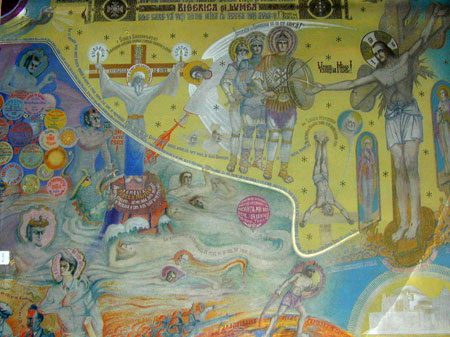
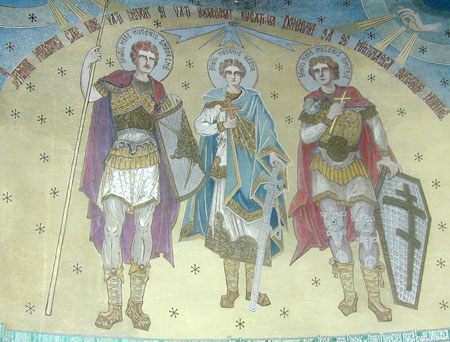
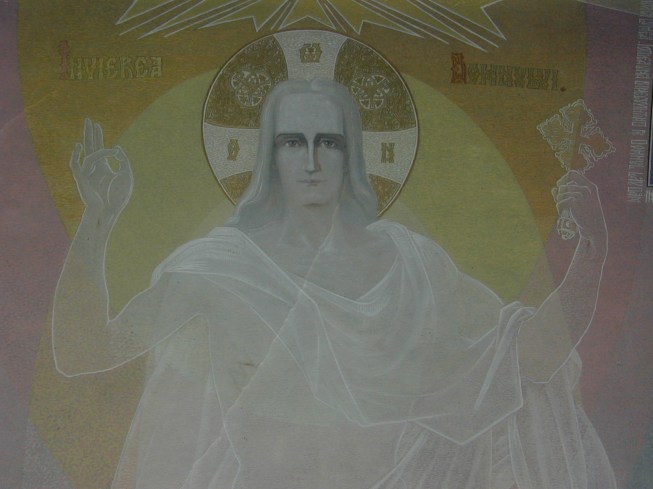
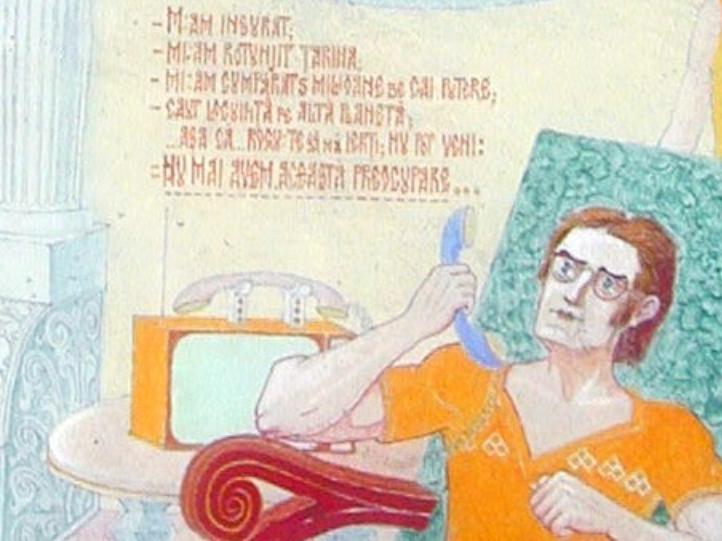
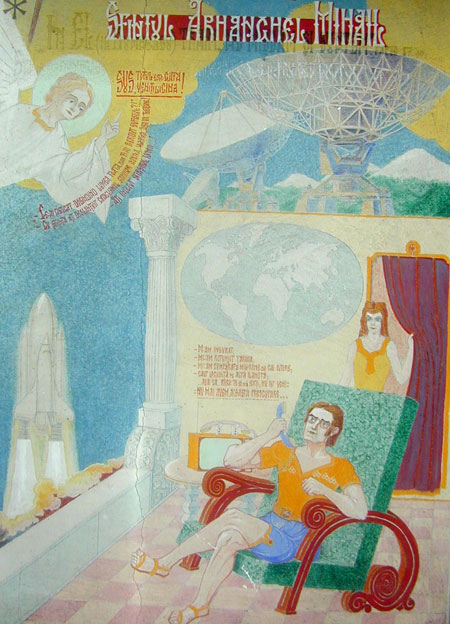
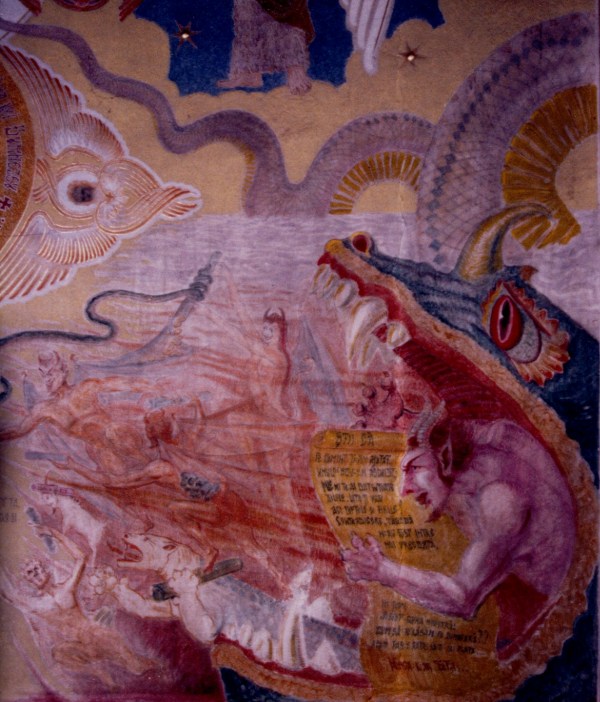
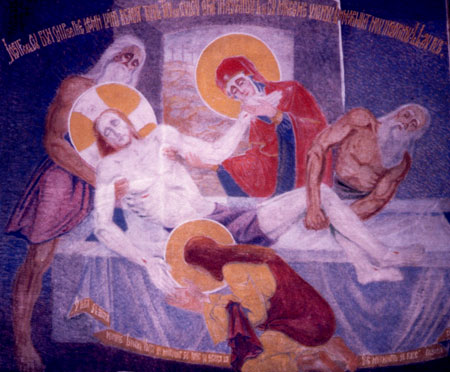
His frescoes are diaphanous, and the images are accompanied by metaphors referring to people’s weaknesses and sins, by aphorisms, quotations from the Holy Scripture, sometimes by teachings of the Father and biblical scenes: the Resurrection, a picture of hell, the Group of the Righteous. The paintings are said to have a visionary, prophetic content, as it is known that Father Arsenie Boca had the gift of spiritual far-sight: one of the scenes, two tall buildings engulfed in flames, is said to allude to the 9/11 attack on the Twin Towers, not to mention those where items like a cell phone, a space shuttle, satellite dishes, all unusual things in that period, appear.

boca14

boca2

For his paintings, the art documentary “Picturi ale pr. Arsenie Boca pe biserica din Drăgănescu” at https://vimeo.com/82791105 is a MUST. Also, go to http://www.themidlandhostel.com/the-sistine-chapel-of-the-romanians-the-draganescu-church/ and http://www.agerpres.ro/engleza-destinatie-romania/2014/11/22/destination-romania-the-draganescu-church-swathed-in-father-arsenie-boca-s-prophetic-paintings-18-04-37 and watch a short art film “Father Arsenie Boca, one of Romania greatest Saint”  at https://www.youtube.com/watch?v=5r6ZX8M8vwY

boca23

boca11   

 boca5

Morning prayer by Arsenie Boca
Lord Jesus Christ, help me let go of myself today, as I can create great problems from small and insignificant issues, and this way, caring for myself, I will lose You.

*
Lord Jesus Christ, help me so that the prayer of Your Holy name will wander (work) through my mind more than lightning on the sky, so that I stay clear of even the shadow of bad thoughts as, look, I am sinning every minute.
*
Lord, coming secretly amongst people, have mercy upon us, because we stumble as we are walking in the dark. Our temptations are closing the eyes of our mind, forgetfulness has become like a wall amongst us, turning our hearts to stone and all together have made the prison cell in which we keep You crippled, starving and naked, wasting our days.
*

Lord, coming secretly amongst people, have mercy upon us and set fire to this prison cell, light up the love in our hearts, burn the thorns of our temptations and make our souls bright.

*

Lord, coming secretly amongst people, have mercy upon us, come and live within us, together with the Father and the Holy Spirit. The Holy Spirit prays through us with unspoken sighs, when word and mind don’t have the power.

*
Lord, coming secretly amongst people, have mercy upon us, because we don’t realise how imperfect we are and how close You are to our souls; and how distant we become through our sins. Shine Your light over us, so that we see light through Your eyes and live eternally through Your life. Our light and joy, praise be to You!

Amen!

 *

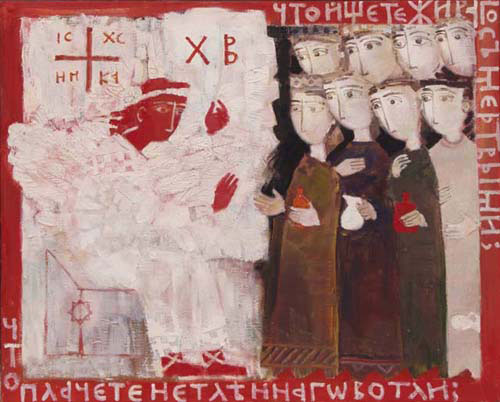
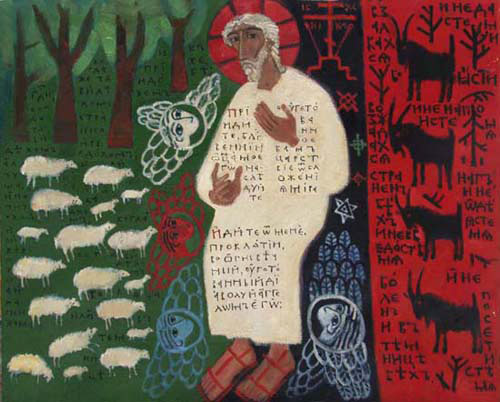
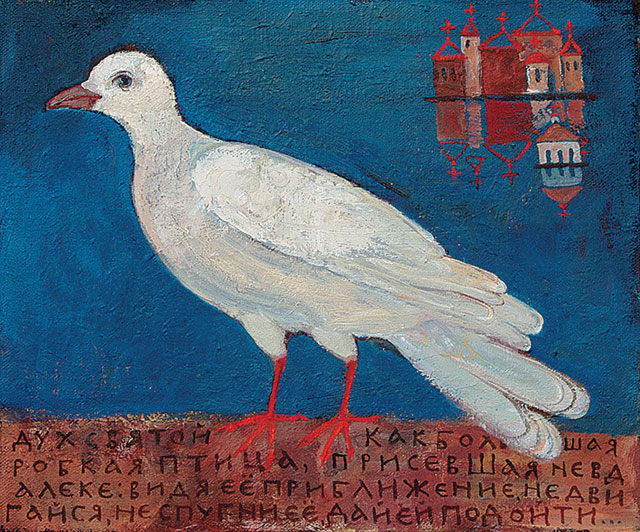
Through the Eyes of a Child

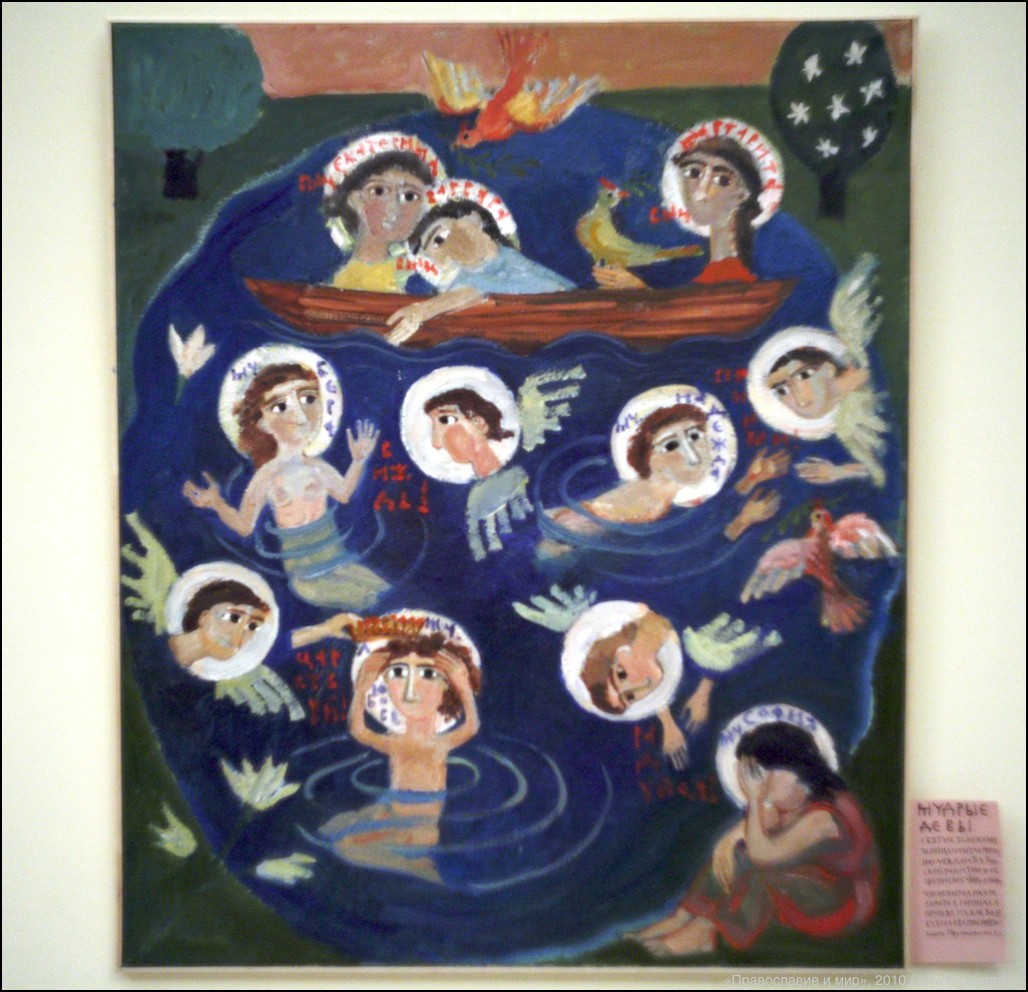
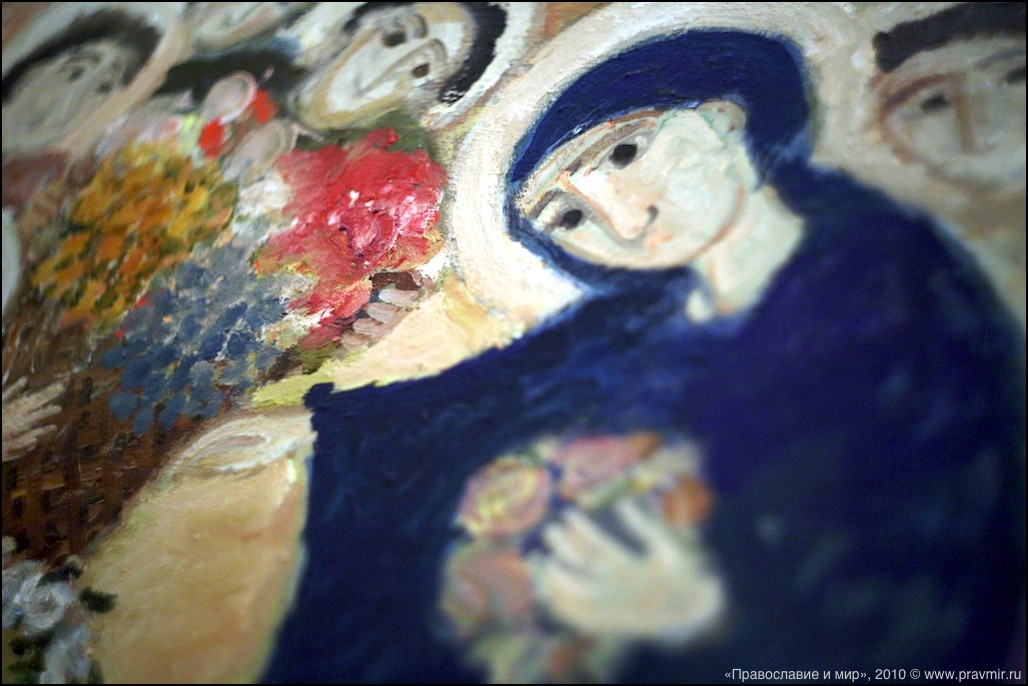
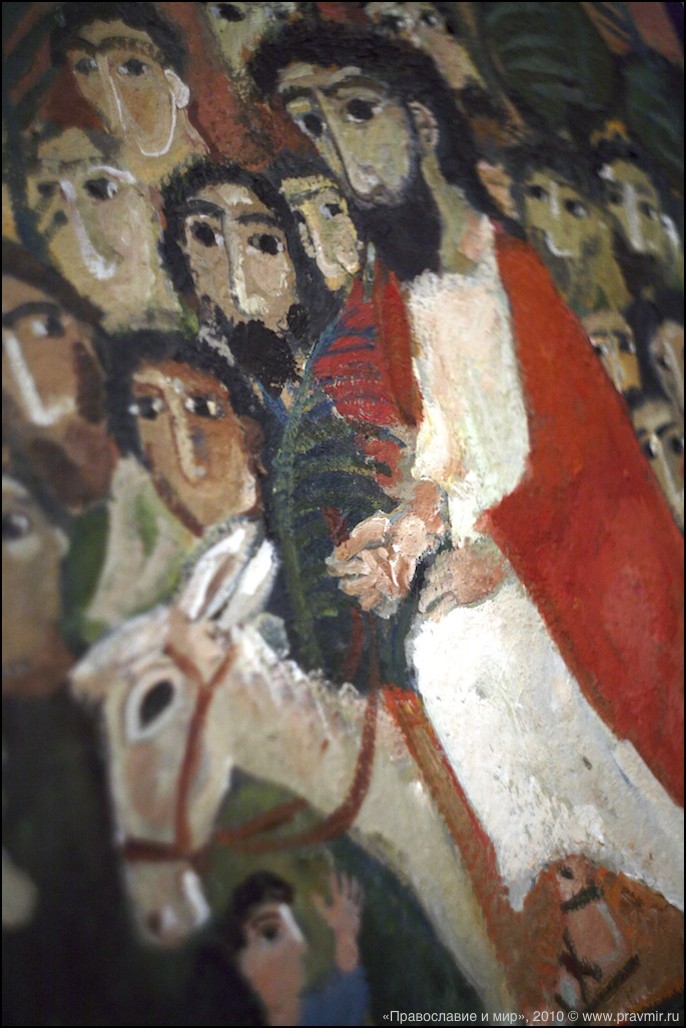
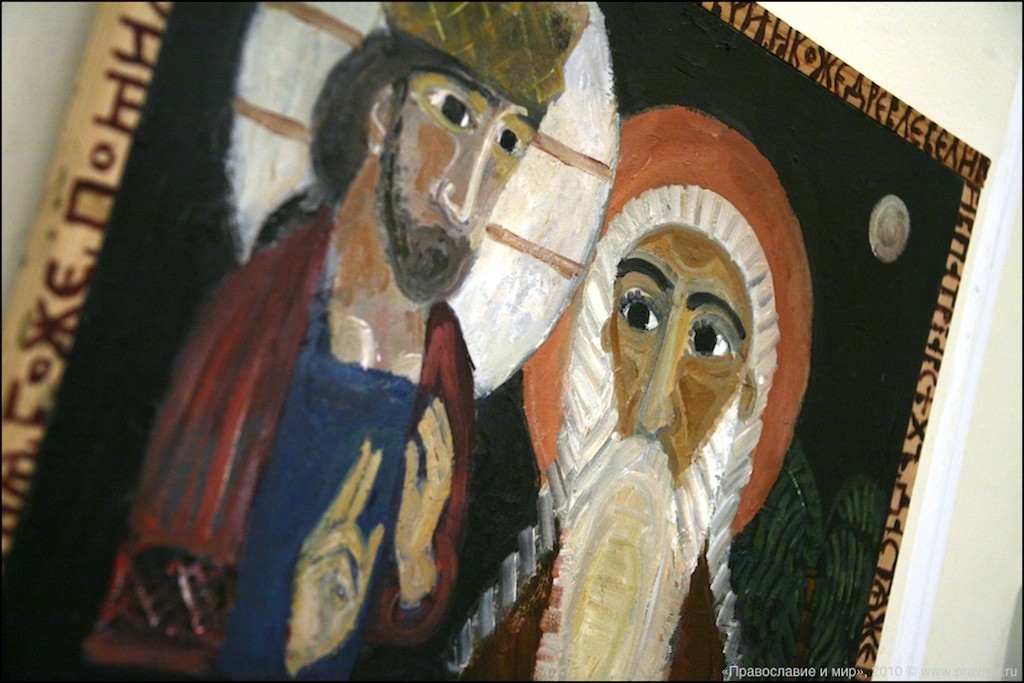
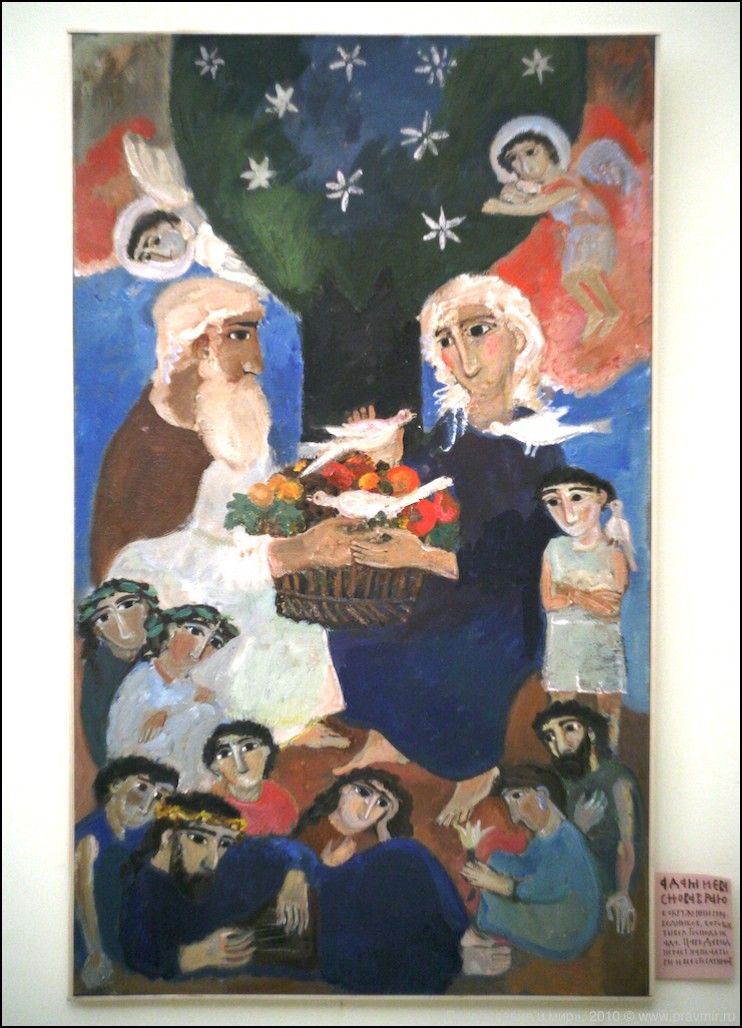
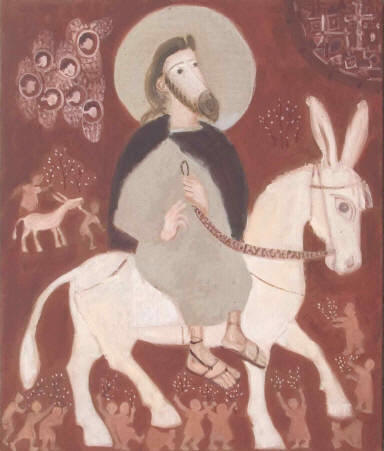
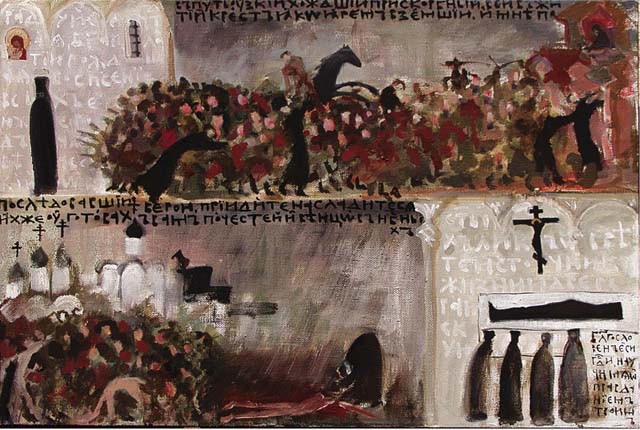
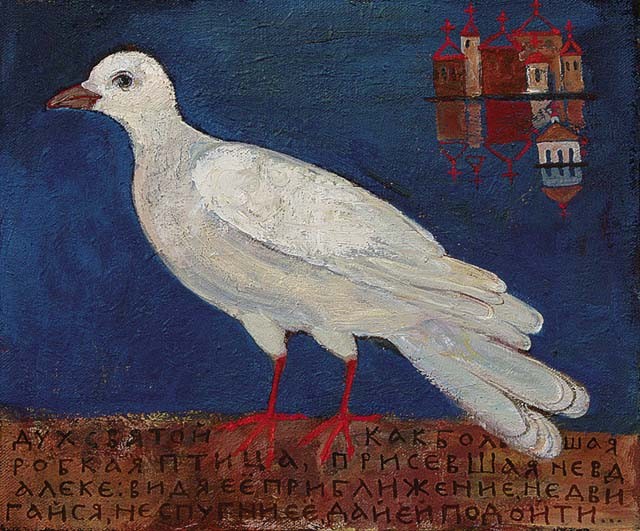
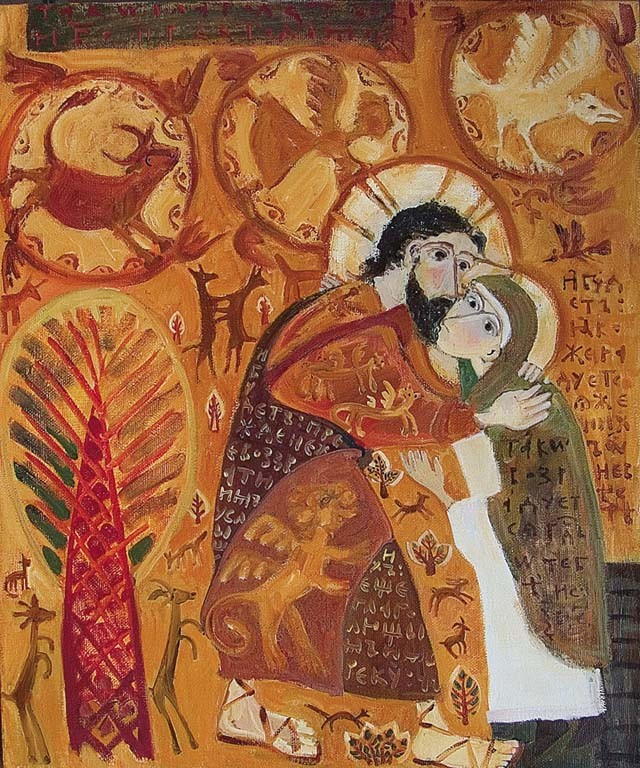
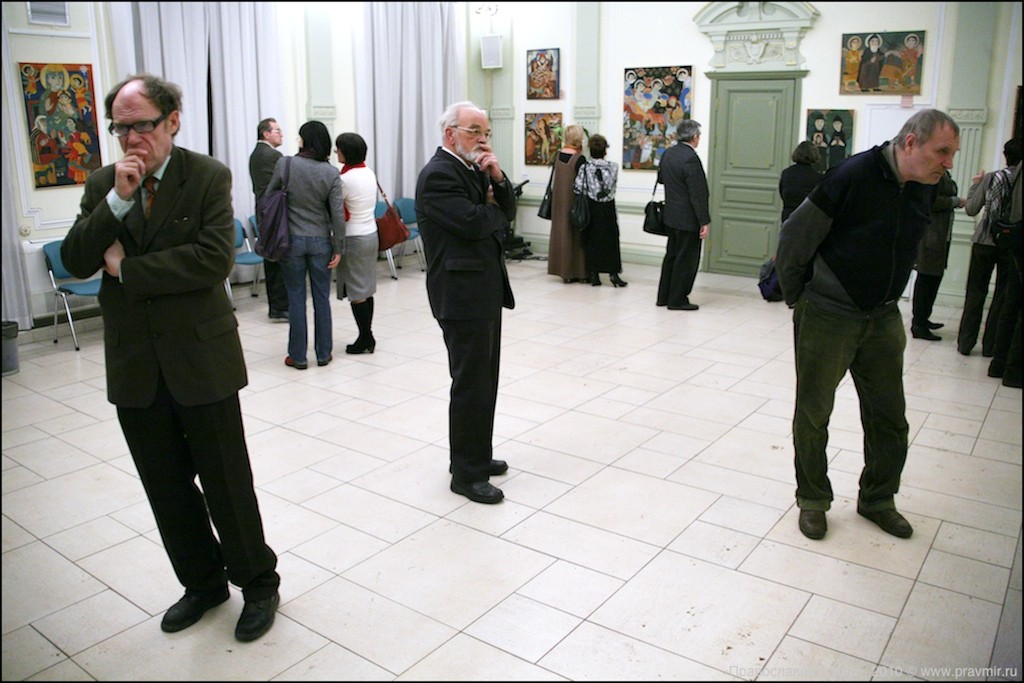
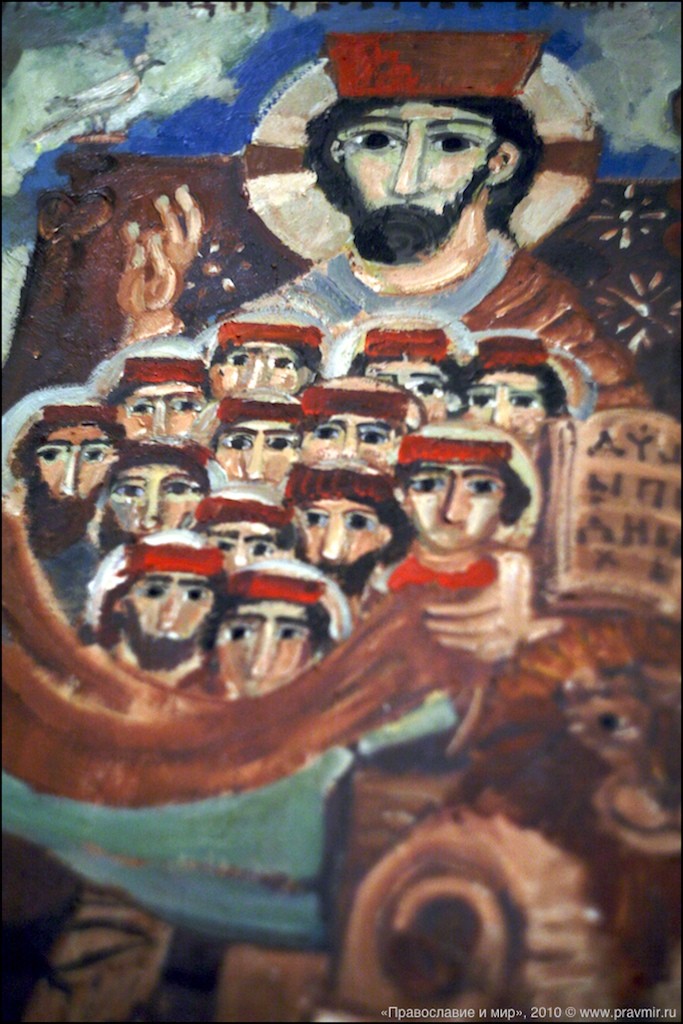
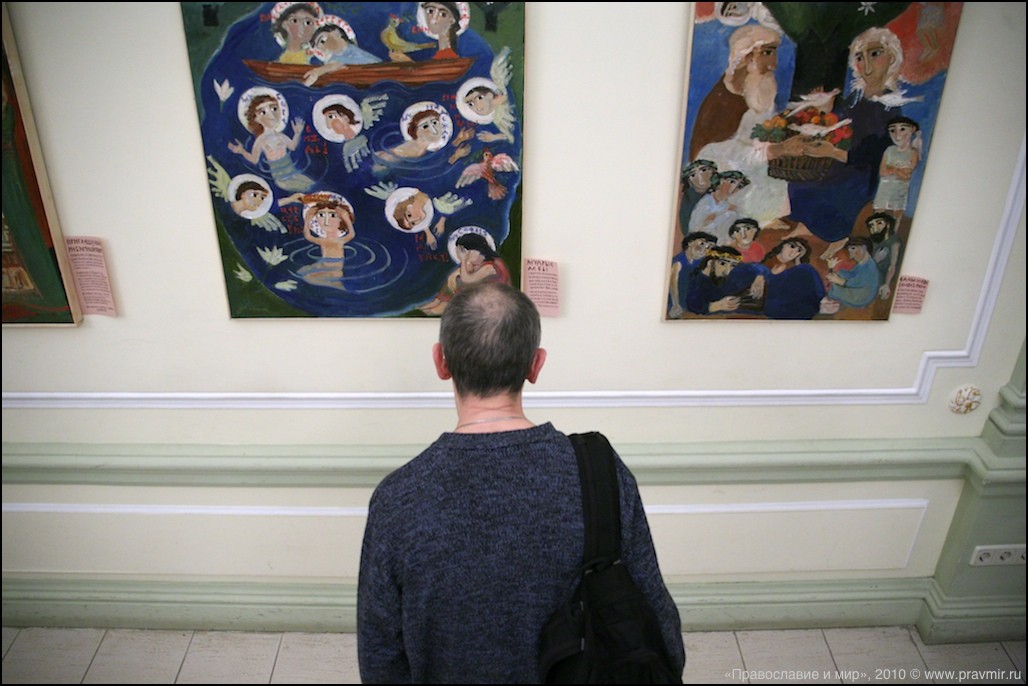
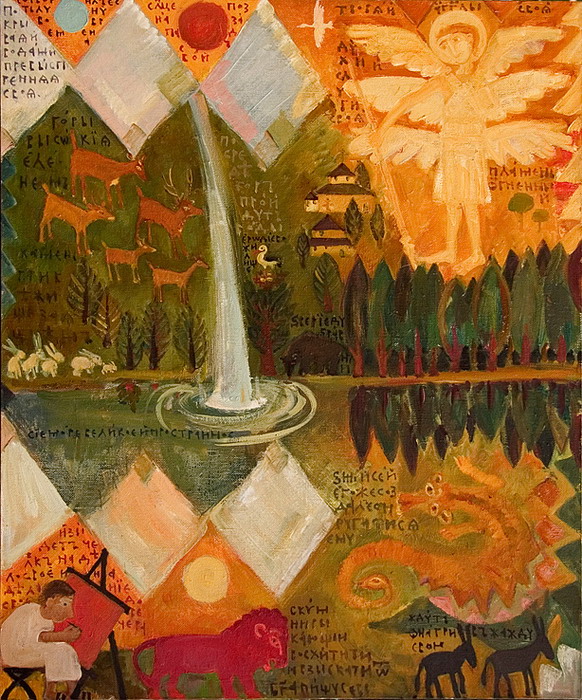
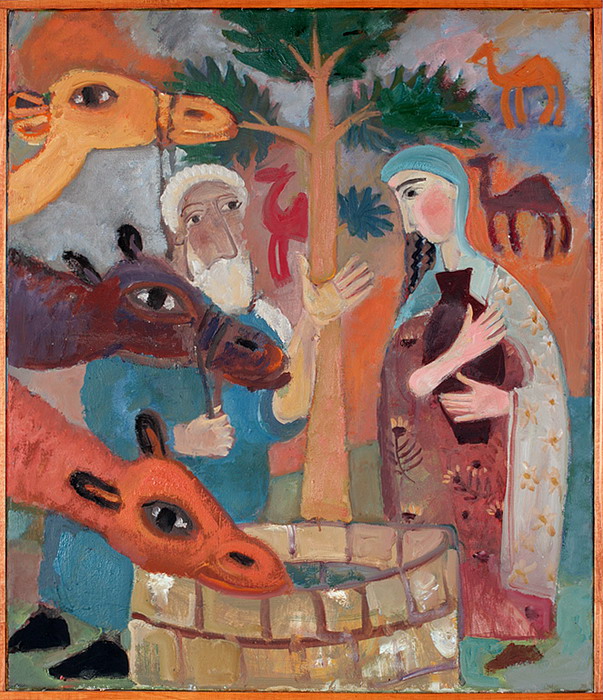
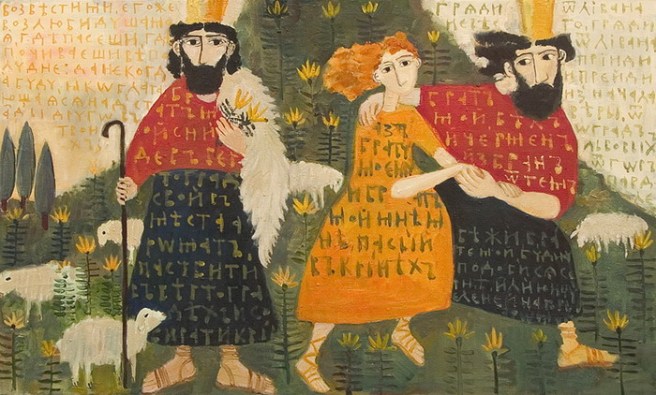
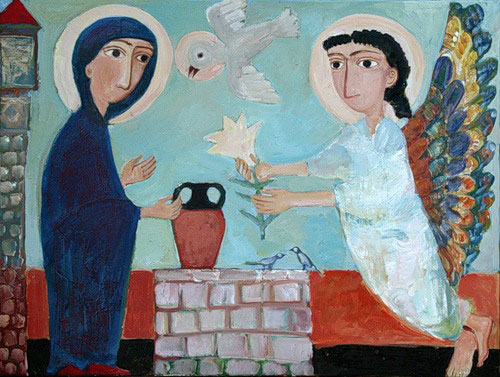
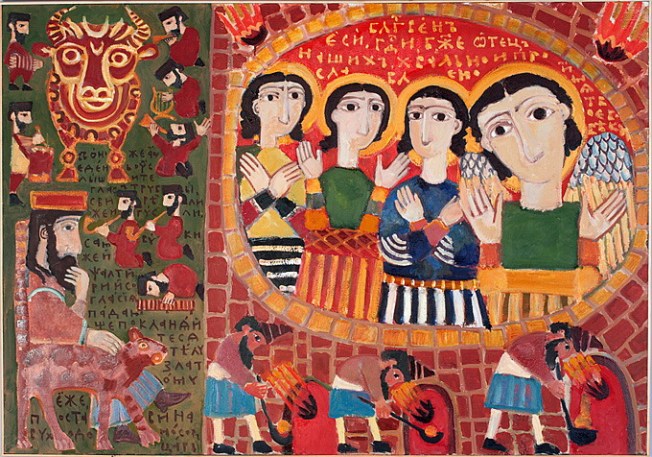
 “The quiet art of Helen Cherkasova seems simple at first sight – simple even to the naivete. And for much it is true if we imply by naivete pure natural sources and the belief in the clear divine spring of any real creative act.  As usual, dimensions of her works are not great. Nevertheless, some of them bear evident epic traits that are inherent to such monumental arts as mosaic or fresco.” (William Meiland, March, 1998)
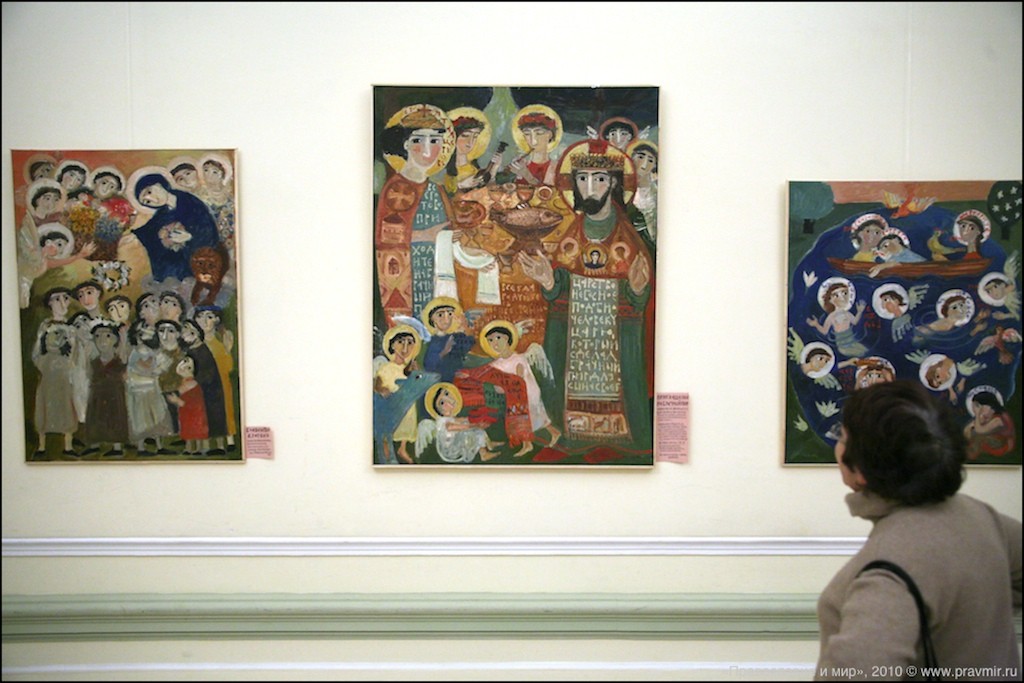
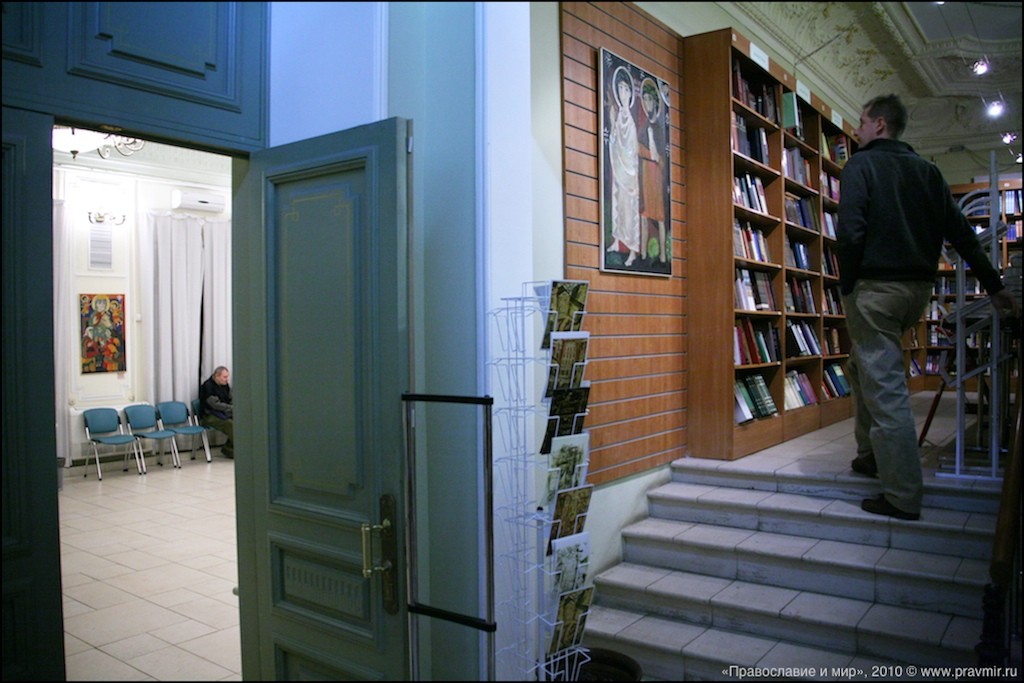
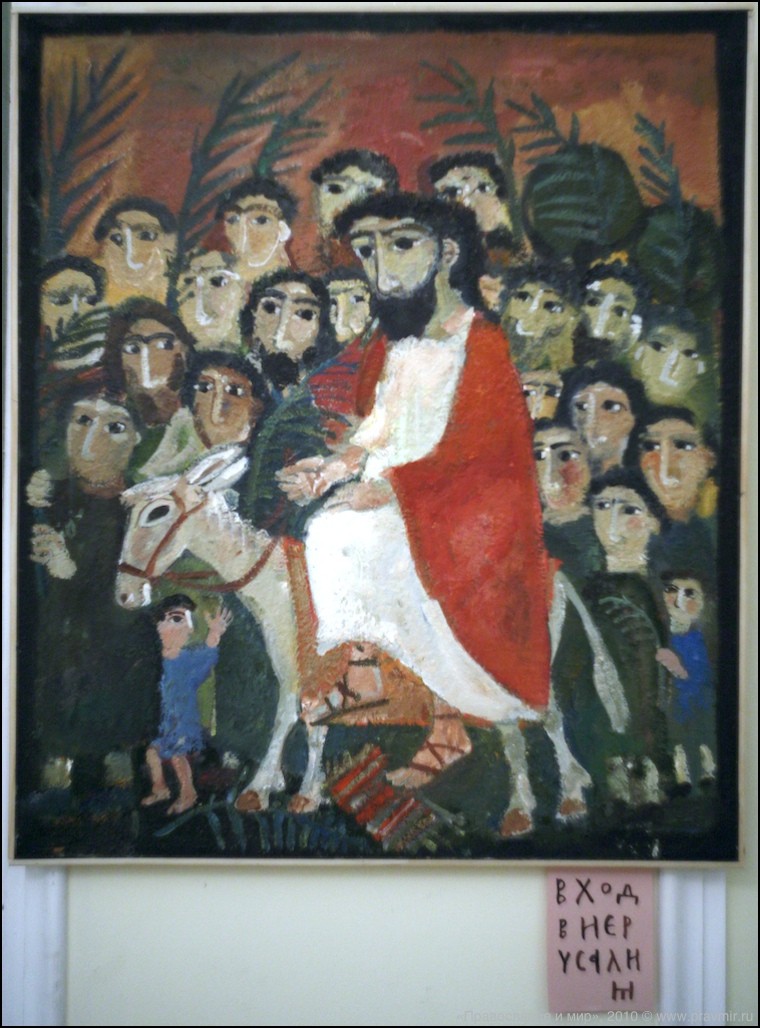
Helena Cherkasova was born in Moscow in 1962. Finished art school in Moscow. Painted icons for orthodox churches. Now she paints by oil landscapes, still lifes and compositions mainly with religious topics. Participant of exhibitions in Russia and abroad. Lives and works in Moscow.

Lord’s Entrance into Jerusalem

Nativity

Blessedness of the meek

Wise virgins

The kingdom of heaven is like unto leaven, which a woman took, and hid in three measures of meal, till the whole was leavened.

Psalm 127

Prayer for rain

cherk_20

Angel speaks to the myrrh-bearin women

cherk_14

cherk_12

cherk_5

cherk_4

cherk_3

A monk

b_70

smokv

rai010

PC249278
Lord’s Entrance into Jerusalem
memra05

memra04

kraski
793614

the Tsar’s family

kolimpiade
Letters of St. John Chrysostom to Olimpiada
iliin
Prophet’s Eliah’s day

cherk_39

b_65

cherk_36

b_69

St. Seraphim of Sarov

b_68

Prince Igor’s murder

b_66

A bird from Heaven

b_64
The righteous soul enters Heaven

Matushki and cats

Matushki and cats

icon1

“103rd Psalm”

icon2

“Eleazar and Rebekah”

( the Old Testament story of the marriage of Isaac)
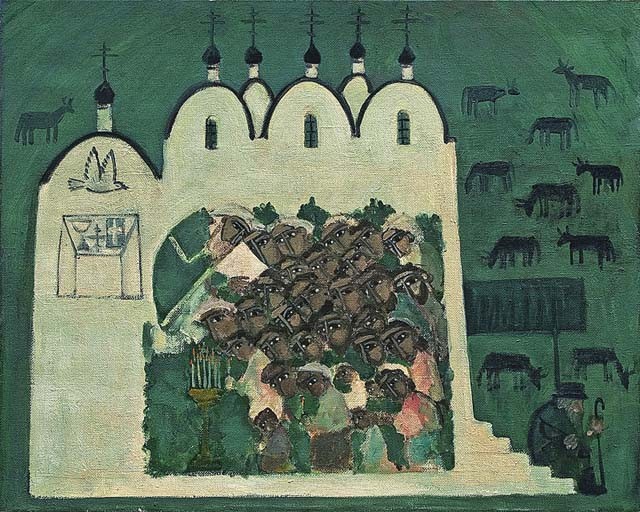
icon3

“Song of Songs”

icon18

Annunciation

icon4

“Teens in the furnace” Daniel

icon5

“As the deer pants for streams of water, so my soul pants for you, O God!”  “Psalm 41”

icon6

“Nativity”

icon7

“The Holy Family”

icon9

“Marriage at Cana”

converted PNM file

Another option of the marriage at Cana

converted PNM file

Healing the Demoniac of the Gadarene

converted PNM file

“Healing the Blind”

icon12

“The storm on the lake”(Mk . 4 , 35-41 )

icon13

Doubting Thomas ( Jn. 20 , 24-29 )

OLYMPUS DIGITAL CAMERA

“Adam and Eve in paradise again”

icon22

Way of the Cross

icon26

The Resurrection of Christ

icon23

Last (Final) Judgment — Day of Judgment

icon25

The entry of a righteous soul in paradise

icon28

The Holy Spirit – a timid bird

Photos by Michael Moiseev
Source: Pramvir