How an icon of Prophet Elijah (20th July) was a revelatory moment for Fr Jonathan Hemmings in his conversion to Orthodoxy
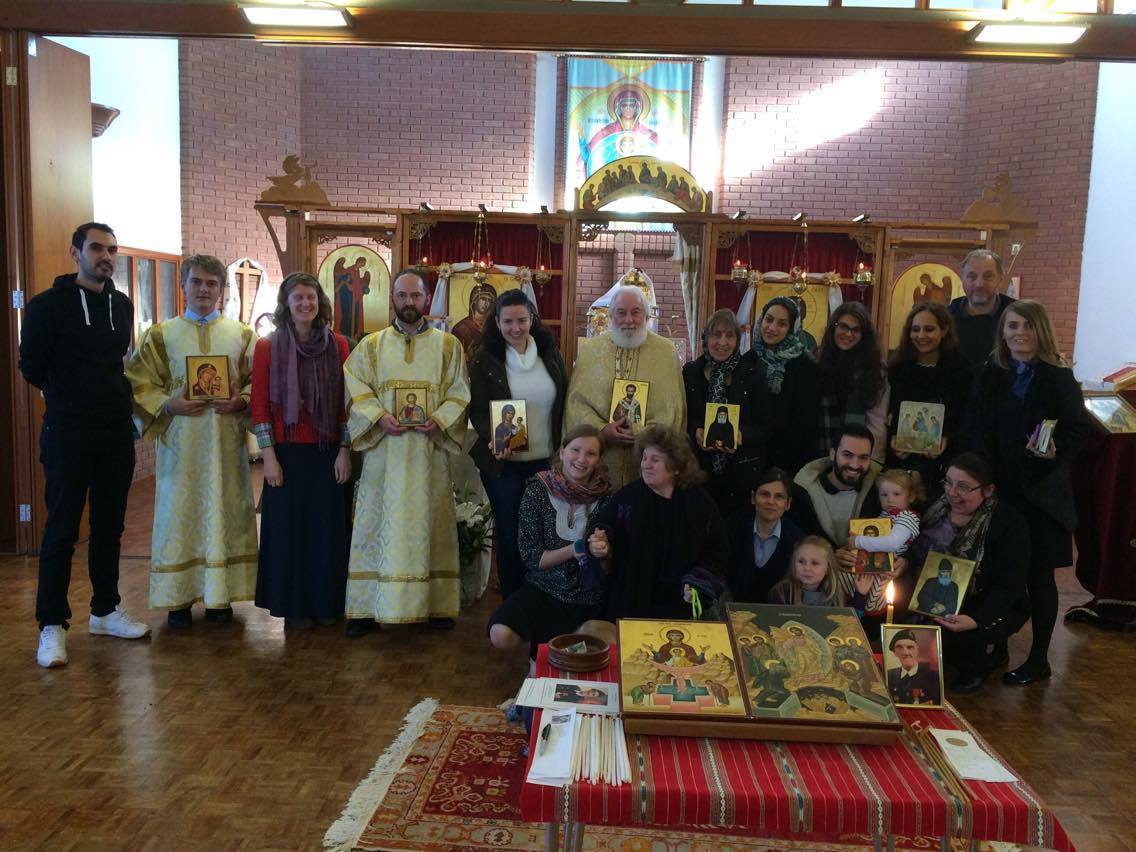
The grace bearing nature of Icons within Holy Orthodoxy means that we encounter a window into heaven. The veneration of an icon is the expression of the love we have for our Lord and Saviour, His most Holy Mother and His sanctified family, the righteous who foretold His coming and the saints who followed His example; it is the physical expression and consequence of our belief in the communion of saints. We venerate the prototype who is worthy and who in turn prays for us. The grace that is given to each Icon, which in its very formation and writing is the fruit of prayer rather than art, brings us to a deeper understanding of our own salvation.
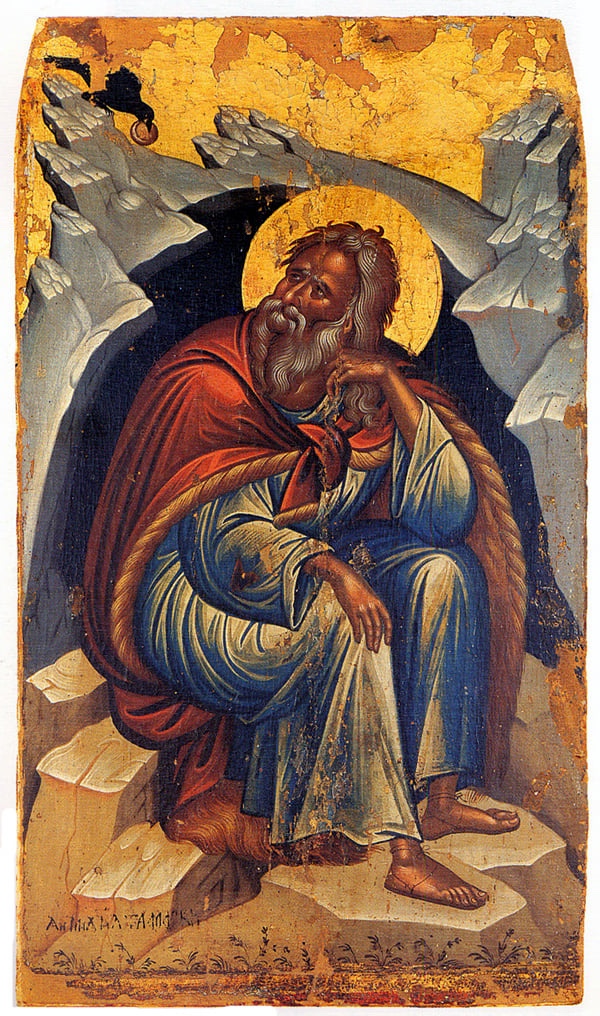
I remember some years ago on the feast of the St. Elijah (Elias) looking at the Icon of the Prophet. I had read the story of this bold ambassador of God’s word as a student of the Old Testament years before; how he dared to speak the word of God to his own people who were following other gods and how he earned the wrath of the evil Queen Jezebel and her 400 hundred prophets of Baal. Exhausted by his labours the righteous prophet seeks refuge in a cave. There God sustains him through commanding ravens to feed his servant. The Icon of the prophet shows him in a cave with a black bird with food in his beak coming to feed the prophet. 1 Kings 17:2-6 (New King James Version) 2Then the word of the LORD came to him, saying, 3“Get away from here and turn eastward, and hide by the Brook Cherith, which flows into the Jordan. 4And it will be that you shall drink from the brook, and I have commanded the ravens to feed you there.” 5So he went and did according to the word of the LORD, for he went and stayed by the Brook Cherith, which flows into the Jordan. 6The ravens brought him bread and meat in the morning, and bread and meat in the evening; and he drank from the brook.
This for me, as I looked at the Icon was a revelatory moment. Exhausted spiritually, these words came back to me with great force for I too was hungry for spiritual food which was to be found in the East and God sent black robed priests from the west to come and feed me and others so that we could be strengthened and sustained.
With faith in Christ and hope in the resurrection, we share news of the repose of Archpriest James Bernstein, an alumnus of St Vladimir’s Seminary. Fr James fell asleep in the Lord in the morning hours of June 17, 2024, surrounded by his family.
The Very Rev. A. James Bernstein was born in Lansing, MI on May 6, 1946, and was raised in a conservative Jewish family in Queens, NY. A teenage chess champion, Fr James had a dramatic conversion experience at the age of sixteen after reading the New Testament. His spiritual journey included a number of twists and turns: he was chapter president of Inter-Varsity Christian Fellowship at Queens College, helped found the Jews for Jesus ministry in San Francisco, was a staff member of the Christian World Liberation Front in Berkeley, served as a pastor of an Evangelical Orthodox Church near Silicon Valley, and in the 1980s was received into the Eastern Orthodox Church. Fr James went on to attend St Vladimir’s Seminary and graduated with a Master of Divinity (M.Div.) degree in 1989. He was ordained to the holy priesthood the year prior.
Fr James’ priestly ministry took him to the state of Washington, where he was assigned pastor of St Paul Antiochian Orthodox Church in Brier. He served there for more than twenty-five years before retiring in 2017. During his parish ministry he also authored numerous works through Ancient Faith Publishing and was a contributor to the Orthodox Study Bible: New Testament and Psalms (Thomas Nelson, 1993). Probably his most famous book is SURPRISED BY CHRIST: My Journey from Judaism to Orthodox Christianity. 2008. (Is in 4th printing). And what a book it is! Mesmerising! I especially enjoy the Audiobook version where one can listen Father himself reading his book.
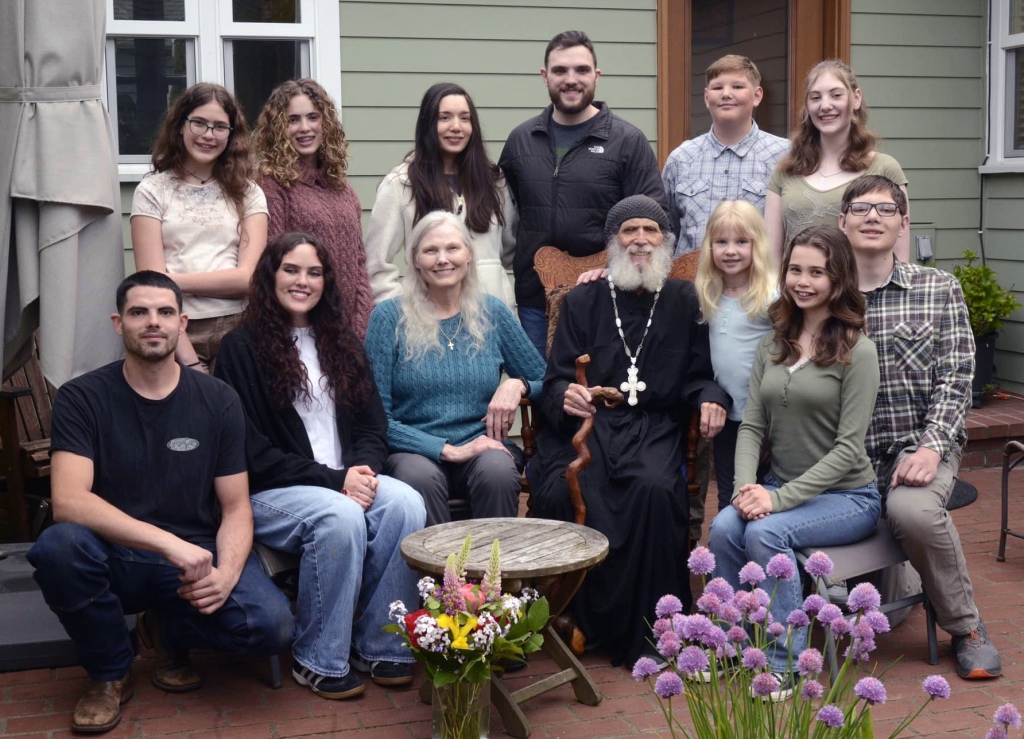
Fr James with some of his children and grandchildren
Fr James is survived by his wife, Kh. Martha (Bonnie); children Kh. Heather (Fr David) Sommer, Holly Bernstein, Peter Bernstein, and Mary (James) Curry; grandchildren John (Audrey), Nicholas, Ephramia, Elizabeth, and Irene Sommer; Violet Bernstein; and Noah, Levi, Lina, and Sarah Curry.
Funeral information may be found on the Antiochian Archdiocese website, here.
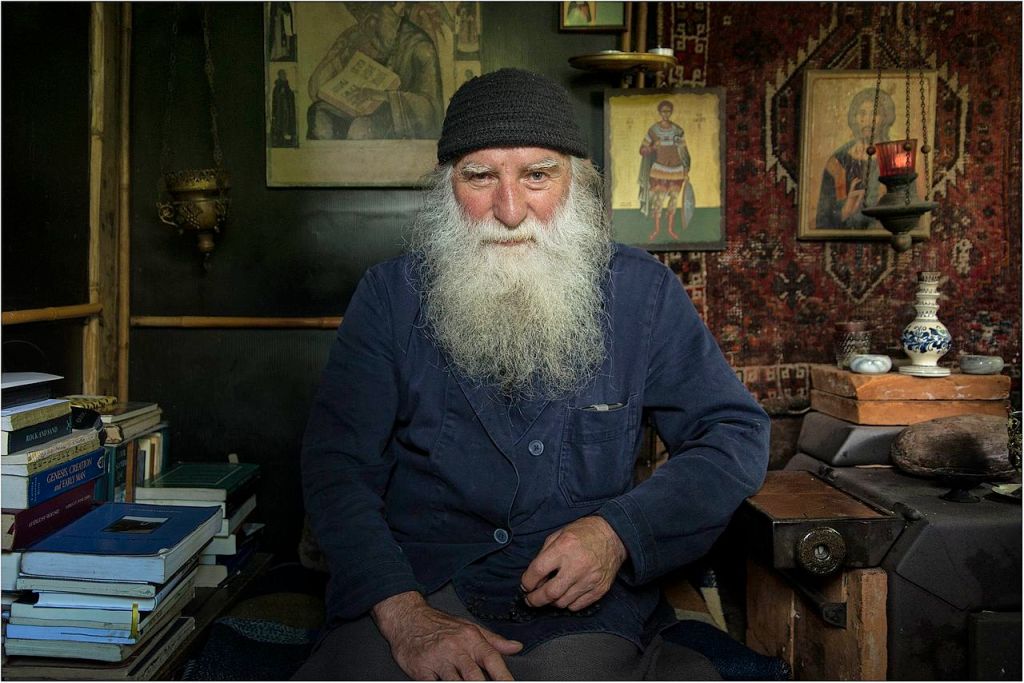
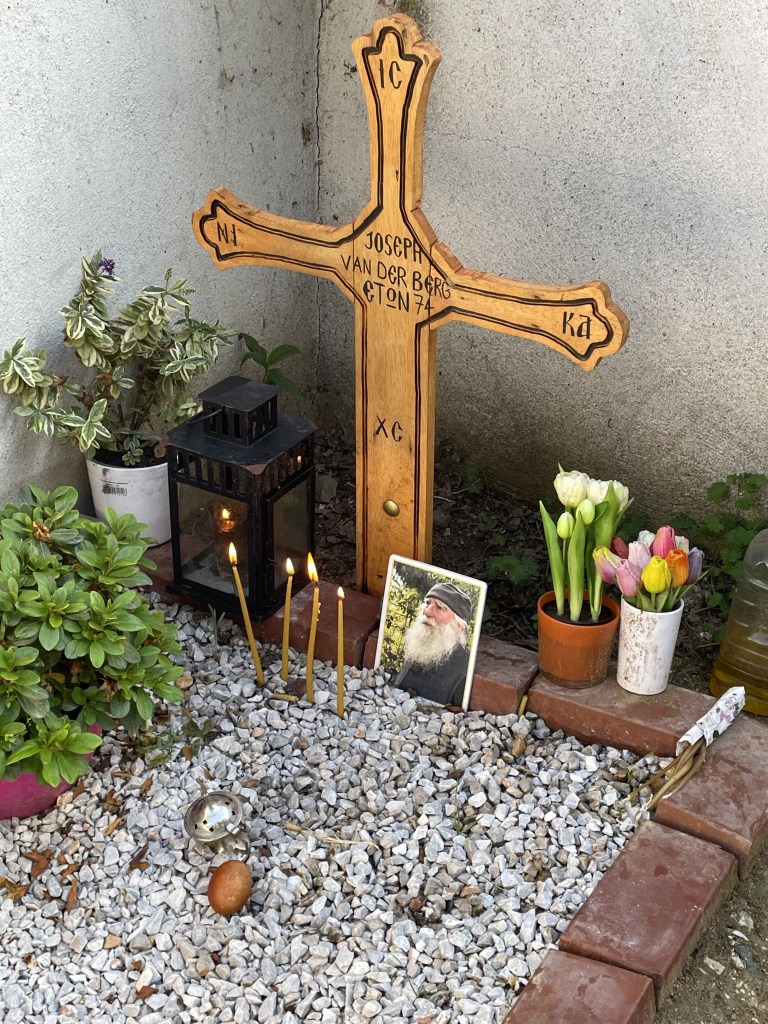
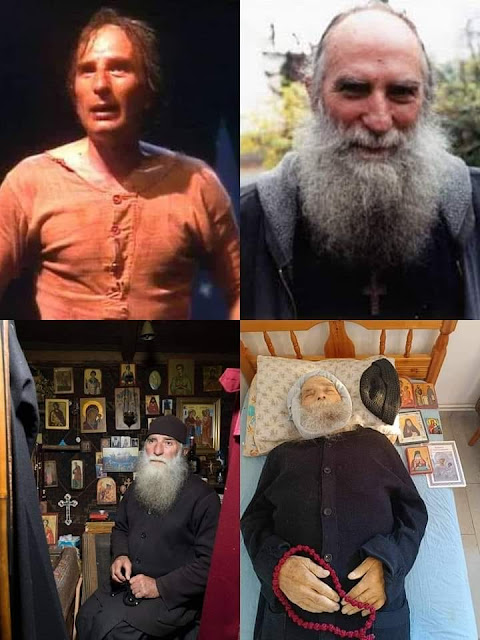
Yesterday, Saturday, June 1st, some friends from St. George Metochion took me to a pilgrimage to various hermitages outside Thessaloniki, near Ossa, where valiant Mothers lead ascetic lives, all alone, together with God, in the mountain wilderness. Surrounded by all these hermitages is the Transfiguration of Our Saviour Orthodox Monastery, in Sochos, a male monastery I have always wanted to visit for the last 12 months, since Josef Van den Berg has reposed there at 74, after an amazing meta-noia, conversion to God. (+ Oct. 16, 2023)
On Friday, October 13th 2023, the famous Dutch actor and puppeteer, Jozef Van den Berg, turned Orthodox Christ hermit reposed in the Lord at the age of 74 at Holy Transfiguration Monastery in Sochos, where he went to live the last few months of his life on earth, due to his failing health. His funeral was held on Tue 17th at the same Monastery and he was buried there. It was a blessing to light a candle and pray at his grave.
Jozef, who was born in Beers of the Netherlands on the 22nd of August 1949, was a very well known actor in the 1970’s and 1980’s in the Netherlands. He was initially an atheist and married with four children. Later, he began a successful career as a wandering puppeteer for children. Then he made his own performances in the theater, for children and adults. Van den Berg travelled the world, from Australia to Canada. In the 1980’s, Jozef Van den Berg played in his last play “Enough Wait” for his brother who was seriously ill and was in a wheelchair. On September 14, 1989, he would bring that performance to the De Sing but then something very special happened.
Let me begin a little earlier. On September 12th, 1989 was the Belgian première of Genoeg Gewacht at Antwerp [Belgium is a predominantly Dutch-speaking country]. That afternoon, Van den Berg had an encounter with God, as he described it later on. Sitting in his dressing room, he wrote a letter he wanted to use that night for the first time in his play. God asked him this question by his own pen: “Why don’t you ever see that I cannot come because I’m already here?” On September 12, 1989 he still played the premiere, which later turned out to be his very last show. Van den Berg was – according to his own words – being called by God, and had to answer that.
Before the evening show on September 14th, 1989 at De Singel Arts Center in Antwerp, he took his Bible and asked God what to do. He opened the Bible at the following words: “Go away from their midst and separate yourself” (II Cor. 6:17).
Before the beginning of the play he said to his audience:
“I will try to explain it to you. I hope that you have one thing for me and that is respect for my decision. I will never play again. I have approached a reality which cannot be played anymore. I have searched for a tremendously long time; have been everywhere. Eventually I came to the conclusion, and this conclusion, I have to admit, is that the seeker seeks but he is found. That’s why tonight is the last time I’m on stage. You don’t believe me, but that’s the deceitful side of theater. Therefore, ladies and gentlemen, for this man, for Christ only, have I searched for this peace I wanted. And I know that it is so, and I quit this profession. For me, it’s over. I seek reality. I can’t say things that are not true for me anymore. I wish you a good day. I go. May you all go well. The money you paid can be given back at the box office.”
The audience was stunned. Was this real or was it theater? A deadly silence followed, and the theater audience reacted emotionally. Thus, on September 1989 at 7:55 pm, the theater career of Joseph Van den Berg came to an end.
That night was the beginning of an extraordinary conversion and odyssey. His quest led him to Maldon (Essex), Athens and the Holy Mountain of Athos, to further find out how he had to continue his road with God. His children and wife had difficulties understanding his conversion, and he was left all alone. Alone with God! Jozef gave up everything, job, fortune, family, everything, started living like a beggar, and eventually converted to Orthodox Christianity a year later, after paying visits to Elder Sophrony in Essex, Elder Porphyrios in Athens and Elder Paisos in Mount Athos.
An important event preceeded his conversion: a woman he knew from the Gurdjieff movement died in a serious traffic accident, and she had pointed out that she wanted to be buried in the Orthodox way. This happened on August 17th at Eindhoven. There, he heard the Trisagion for the first time in Dutch. That’s where he began to see that Gurdjieff wasn’t right.
At the end of September 1989 he went to the Greek Orthodox Monastery of Saint John the Baptist at Maldon, Essex, England, where he talked with Elder Archimandrite Sophrony, and he confirmed the experience God had given him and urged him to repentance. Elder Sophrony told him that he cannot sustain God’s Love if he does not endure the furnace of repentance. At the beginning of January 1990 he had a very important meeting in Athens with the Greek Elder Porphyrios. This last one too confirmed the experience God had given him in Antwerp, and he told him that he has to now to become an Actor of Christ. Saint Porfyrios urged him not to betray Christ and turn down His calling. He was then sent by Father Porphyrios to the Holy Mountain of Athos, where he had a meeting with Father Paisios, who too blessed him.
Back to Netherlands, with the blessing of three saints, things evolved in a different way than expected, everything started going seriously wrong as all three Saints had “warned” him, and he got in more and more trouble on all fronts. He couldn’t sleep anymore and became over-tired. In the middle of this crisis, on June 18, 1990, he asked a priest in order to be accepted into the Orthodox Church. Months passed by in “dead-ends” and “walls” were raised all around him.
During the night of the 1st to the 2nd of June, he realized that he was left alone, and on June 2nd, 1991 he attended the Divine Liturgy at the [small Orthodox] Monastery of the Holy Prophet Elias at St. Hubert. That’s where he left what was left of his money on the collection plate. “Lord, from now on, You have to take care of me. I totally surrender.” There, Archimandrite Pachom read from the Gospel of that Sunday of All Saints: “He that loves father or mother more then me, is not worthy of me: and he that loves son or daughter more then me, is not worthy of me. And he that takes not his cross, and follows after me, is not worthy of me. He that finds his life, shall lose it: and he that loses his life for my sake, shall find it” (Matthew 10:37-39). Two hours later, after the Liturgy, he went straight to the Orthodox Monastery of the Nativity of the Theotokos near Asten, where he stayed for 19 days, and where he left his Mercedes Combi, because it didn’t want to start again. For him. It started for his brother a day later!
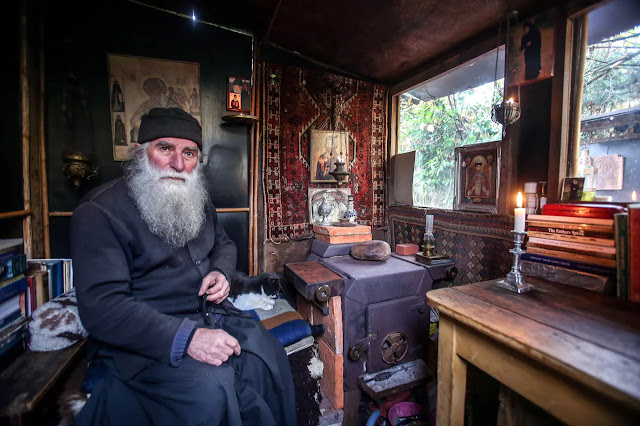
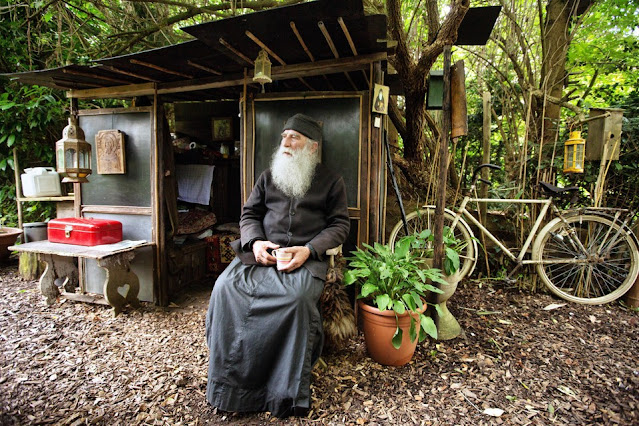
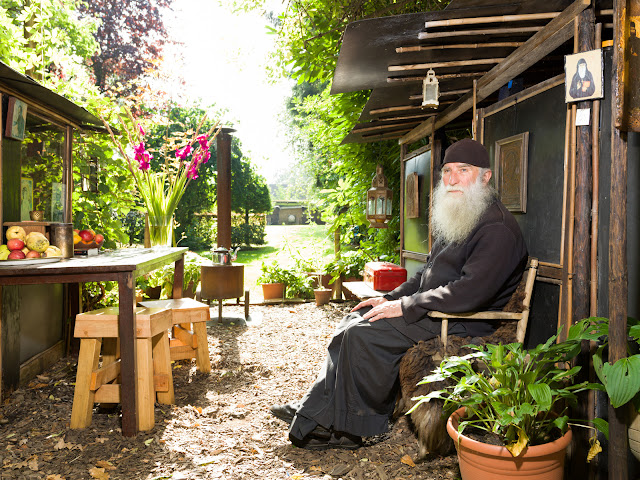
His only question was: “How does God want me to shape my calling?” Slowly, peace returned to him. From July 1991, Jozef Van den Berg started living as a hermit, first in the bicycle shed of the town hall in Neerijnen, later in a self-built chapel in the backyard of a fellow villager. There were four poles close to the quince tree, and Joseph understood from this that he had to build the “Pull-Up” under the quince tree. With this “messenger”, he built a small chapel of 2 by 1.5 meters, which still stands today. He prayed and received people every day. He lived on whatever people brought him. He had no connection to any utility whatsoever. Eventually, there was a toilet in the castle garden, which Joseph and his guests could use, and the last few years he hasd a mobile phone for emergencies.He obviously received a lot of a media due to his lifestyle since then…
In the end, he left Neerijnen in August 2023 and traveled to Sochos in Greece, where he reposed on the 13th 2023 at the age of 74 in the Greek Orthodox Transfiguration Monastery.
More about this monastery and its founder and spiritual father, Archimandrite Ioannikios Kotsonis, the theologian and poet, the spiritual son of Saint Porfyrios in the next blogpost.
“On Friday July 12, Dr. Edward Hartley died in a nursing home after a week-long decline, ending a long a fruitful life in Christ. I lost a friend and parishioner, and many people lost someone who was a great gift to them from God.
Dr. Edward Hartley, with his wife Vivian, was the founder of St. Herman of Alaska mission in Surrey, B.C. He was an Anglican, born in Nova Scotia, Canada, who came out to British Columbia to begin a medical practice here. He met and eventually married Vivian Robertson, and together they had three children. More significantly, over the years they had many more spiritual children. I have lost count of their godchildren. Dr. Hartley and Vivian decided that they should join the Orthodox Church in a time when such a course of action was so difficult as to look a bit crazy. There were no English-speaking Orthodox missions in the Vancouver area in that time, and so they joined the local OCA church which worshipped in Slavonic and spoke Russian. A far-sighted bishop in the parish welcomed them, and they learned to cope with Slavonic, becoming members of the Russian OCA parish. Vivian learned to sing in Slavonic as part of the choir, and Dr. Ed (as he was known) read the Epistle in English after it had been read in Slavonic.
They had the sense and foresight to see that raising their children in a Russian church in the Vancouver area was not the path of wisdom, and so they received the blessing from their bishop to begin a mission in English, worshipping in a chapel they built in their backyard. Those were difficult years, with one step forward and one step back. I came to their little backyard mission in 1987 when there were about fifteen people there on a Sunday. They had no stipend available for a priest, and no other building. Their priest would have to find a secular job to support himself and his family while the mission grew. But they all had enthusiasm and commitment, and the parish slowly grew.
Dr. Ed was a man of humour, zeal, and effervescence. He was always ready with a joke and a smile. When I would phone his house he answered the phone often by saying, “Greetings and hallucinations—I mean greetings and salutations!” In all the years I was his parish priest I never recall him frowning or being in a bad mood. He wanted to convert absolutely everybody to Orthodoxy, and his home was an open house, a place of welcome and kindness. I may add that his wife Vivian and his children shared in his kind and zealous spirit. Vivian reposed in 2013, but his children are still faithfully serving the Lord, being wonderful chips off the old paternal block.
Dr. Hartley breathed his last at 2.28 p.m. this last Friday, and stepped into the Kingdom, doubtless escorted by a multitude of angels. The following Sunday at St. Herman’s was a busy one. We baptized an infant, a child of South Asian and East Indian-Caribbean descent. We baptized the Anglo-Canadian husband of one of our Russian ladies. We baptized another adult North European/Canadian convert. We also received by chrismation the Armenian mother-in-law of one of our Romanian immigrants. Before the baptisms, a lady who was a longtime friend of the Hartleys was finally entered into the catechumenate, joining a young Ethiopian catechumen. Dr. Hartley would have been pleased by all this, since he wanted everyone to become Orthodox, regardless of their upbringing or national identity. I would like to think that the Lord allowed him to peak down into the nave of his old parish, and rejoice in the work in which he and Vivian had been so instrumental in bringing to birth.
Dr. Ed will be missed by all who had been privileged to know him. He was one a pivotal generation who was prepared to work and sacrifice to join the Orthodox Church in a day when the cost for doing so was very high. If conversion to Orthodoxy is now somewhat easier, this owes much to Dr. Ed and those of his generation who were prepared to pay the price and hold the door open for us. Our debt of gratitude to him and those like him is very great.”
A friend recommended this book and its author last Sunday, and I have no words to describe the experience! I am half-way through the book and still reeling from the shock of the reading experience, chapter after chapter. And I believed that “The Gurus, the Young Man, and Elder Paisios” by Dionysios Farasiotis was scary… Nothing had prepared me for this. Klaus Kenneth, emotionally and physically abused by family and priests, a gang leader at 12, a terrorist at 22 and a junkie at 25; then, a Buddhist monk, a Hindu mystic and an occultist in Central America, and this is only a chapter in his life. In his sincere search for escape from rejection and abuse, Klaus found himself on an odyssey that took him around the world several times, lured him into a vortex of pleasure and power, and initiated him into the great philosophies and religious traditions of our times. Having tried it all, and reaching the very brink of the abyss of despair and the desire for nonexistence, Klaus encounters the One whom he had never thought to look for, the One that he had always discounted: the great I AM, the God of Love and healing, the God of regeneration and eternal life.
“Do not fear!” “In my Name you will always be stronger!”
“To this day, I have never again experienced fear or doubt, and certainly no real despair.”
In that whirlwind of spiritual seeking, in all this frenetic searching for something more in his words, I believe he elaborated on his darker moments a little too much. I understand that he was trying to make his life an open book, but some of his experiences of power that he gained from Satan could serve as a temptation to readers. Eventually, Mr. Kenneth made right with God and we learn that he ultimately became an Orthodox Christian. At least, “The Gurus, the Young Man, and Elder Paisios” is written with more restraint. I am honestly not sure if that is a book to be recommended, as the first part of his book reads like a visit to Hell in graphic detail. Or, like “the difficult road out of hell”. It has honestly scared me. I mean, it is certainly most encouraging that after his conversion and Christ’s promise to him “Do not fear!” “In my Name you will always be stronger!”, Klaus “to this day, has never again experienced fear or doubt, and certainly no real despair.” Yet, the reading is not for the faint-hearted. Half-way through the book, I am certainly looking forward to his extended talks with Elder Sophrony. In fact, it was under the guidance and prayers of Elder Sophrony that this version of his book came to be published, so who am I really to voice any objections for certain parts which I have found disturbing … Have you read this book and what are your views?
Another thing which I made me uneasy was all this personal, Confession tone of the narrative, something that one does not find in Orthodox discourse where a person’s personal experiences are not the centre of the discourse, but the church experience instead. This personal tone may be quite common in Protestant discourse but not in Orthodox. However, if we approach all this with positive thinking, there is so much for us to profit. Yes, Klaus Kenneth may be extreme, but so is Elder Sophrony, and so many other Saints.
For an interview with the writer, go to Journey to Orthodoxyhere and for his precious talks with Elder Sophrony here.
Kalo Paradeiso! Kali Synandisi! [Greek wishes on a funeral] May you enter Paradise! May we meet again there!
October 10, 2017 Acts 11:22-24 22 Then news of these things came to the ears of the church in Jerusalem, and they sent out Barnabas to go as far as Antioch. 23 When he came and had seen the grace of God, he was glad, and encouraged them all that with purpose of heart they should continue with the Lord. 24 For he was a good man, full of the Holy Spirit and of faith. And a great many people were added to the Lord.
“It is with gladdening sorrow that we have composed and dedicated this issue of the Stavronian to our beloved elder Barnabas, founder of the Parish of Holy and Life-Giving Cross and Normandy veteran. Our brother Barnabas peacefully fell asleep in the Lord at 21:40, October 10, three days before his 94th birthday. He was not alone when he passed into God’s keeping. Apart from the angels that attended his repose, members of the Parish, his spiritual family, were there as well as his own family were at his bedside. He was holding my hand when he breathed his last breath. He received Holy Unction the same morning. He even drew energy to make the sign of the cross. We asked him for a word from the Lord and he said “Love”! It was a holy repose with the faithful holding lighted candles. I thank God that he entrusted to me the unworthy priest this holy soul and brave soldier of Christ as an example of the Christian life. As a founder of the Orthodox Community of the Holy Cross he will remain forever inour prayers. May angels take him to his just reward in the Heavenly Kingdom of Our Lord Jesus Christ. May his memory be eternal. Christ is Risen!”
Fr. Jonathan
*
HEAVEN: FROM PROTESTANTISM TO ORTHODOXY
A Westerner Looks East for the Truth
ByBarnabas Dickinson
“When God the Holy Spirit says ‘Do something, you jolly well do it, or else…’,but what? Our loving Saviour had some stern words about lukewarmness, about turning back, having put one’s hand to the plough. … During the years of strife in the Church of England over this matter, pressure groups formed on both sides of the divide, and I attended rallies of the opposition in the Blackburn diocese. …What happens next? What do we do? Where do we go? What is our place in the Church? Speeches and discussion led nowhere… People were bewildered, defeated, hurt. Then, for me, God the Holy Spirit took a hand. Right at the end, in the question and answer session, a priest I did not know [ie. Father Jonathan Hem-mings] said very simply, ‘If anyone is wondering where to go’, they should be aware that Orthodox Church services in English are becoming available’, or words to that effect. Option (7) had come out of the blue, completely unexpected, and when the rally broke up for a cup of tea, I approached him. …
… One Saturday in the Spring of 1995, Fr Jonathan took me to the railway station for my train back to Chorley. He said to me, ‘It’s decision time’. The Patriarch of Antioch, who had taken personal oversight of this English group in May 1995, and the Holy Synod, had decided to accept us into membership of the Orthodox Church. ‘Are you coming, or are you not?’ Father Jonathan said. I said that I would …Grass did not grow under our feet, and quite soon, on Wednesday of Bright Week I was received into the Church, along with half a dozen others, including Fr Jonathan, now a lay member of the Church, having resigned his Anglican priesthood after Easter Day; eastern and western coincided that year. Our baptism in the Church of England was accepted as valid, having been in the threefold Name, and we were chrismated at the hands of Father Alexey, with Holy Oil consecrated by the Patriarch. For the first time I received the true Body and Blood of our Saviour. Now, twenty six years later I would not be anywhere else.
Thanks be to God for bringing Fr Jonathan into my life, and for all things. Lord Jesus Christ, Son of God, have mercy on me a sinner.”
Barnabas’ icons have been bequeathed to our parish. Barnabas’ legacy of icons by the hand of Dimitrios Hakim perfectly compliment the parish icons by the same artist.
To find out more about Barnabas, a most dear father to this poor little city hermit, please have a look at the November Stavronian which this month is dedicated to our beloved elder and co founder of the Church of the Holy Cross, Stanley ( Barnabas) Dickinson at http://www.orthodox-lancaster.org.uk/newsletter
*Dedicated to a soul who is struggling, entangled in this net, in a deadly embrace. Buddhism wants you to empty yourself. Our faith is about filling yourself with Christ. When you empty yourself, the demons enter. With love and poor prayers
Impossibility of Aloneness
I’m an Orthodox Christian living in Homer, Alaska and experienced Jesus Christ in the Himalayas, in India.
I listen to the heartbeat of rain outside…
Cold, Alaskan fog blowing in off the bay, emerald hills now that autumn is here and summer chased away into the mountains. But a milky white fog spreads over the bay like a silken ghost. I used to visit Trappist monasteries, back when I was Catholic, at the beginning of high school, and searching for a relationship of love. I read plenty of philosophy then to know that knowing isn’t enough, that having a realization in the mind is entirely different from experiencing a revelation of the heart.
I spent two birthdays in the Himalayas…
Traveling along gravel roads that drop deep into icy gulches where the Ganges river rages below not yet packed with the filth and mud and newspapers of villages, not yet carrying remainders of Indians in her current, I found Christ found me. It’s a difficult and strangely compelling atmosphere to confront oneself, – – India, – – sandwiched with black corpses, white snow, pagan fires and virulent animals.
I took a bus north from Delhi. It was crowded, tight and cramped, flies buzzed between my face and the windows smeared with brown slime. It’s so polluted in Delhi, so much coffee-colored smoke, so much steam that you really can’t see the sun. You saw it, a rising orange-reddish ball burning over the horizon fifteen minutes in the morning, but then fifteen minutes slouching back down again, an exhausted head over the mountains.
I grew up Catholic but turned to Buddhism when introduced to a self-hypnosis class at my Catholic high school, experimenting with meditation and ‘mindfulness.’ I experienced serious symptoms of manic depression then, partially because I’d consciously turned away from the Judeo-Christian God, and also because life at home was very, very difficult for me. I grew anxious and got into extremely self-destructive habits, and so Buddhism seemed a perfect door to address – or not address – my turning from God and family, and focusing my energy toward dissolving into a Void, a dissolving bubble on an endless and personless river, Tathāgatagarbha. The element that got me is to dissolve my desire, and abandon my selfhood, in order to avoid suffering. But desire doesn’t seem so bad, especially when it is for love, which requires more than one person, and thereby voids any notion of abandoning self, – – and to love, to truly love, is to give, which may require sacrifice, and suffering – –
So Tibetan Buddhism kept coming up, because the meditation helped calm my anxieties and depression, and because the culture proved highly engaging, what with all her colorful flags, her skulls, and metaphysical explanations of things, – – but what is left, when ‘I’ disappear, and there is no one else for whom a relationship of the heart can exist? Not to mention, what did the experiences of the Gospels, the Cloud of Witnesses, the Holy Church, amount to? I knew nothing of Orthodoxy when I reached into the closet of Buddhism, but in light of it, now, what does it all add up to?
Joseph in Gangotri, where he met Christ in a cave.
Mindfulness worked as far as cleansing the window, the mind, is concerned, which is important, but then many of its doctrines, – and I explored countless doctrines, – really stop here. Clear sky. But what it did not do, and could not, really, is orient me toward the sun, and the warmth of the sun, and the sunlight – – all religions seem to contain some seed of truth, but fail in witnessing to the Triadic God…and all my destructive habits, and relationships, and every mantra, and yoga, all of which I’ve had my fill…this is how Christ brought me to Him.
Back to the story, I’m in Delhi, on a bus. And after an hour or two of sitting in that cramped, stuffy and urine-soured air you hear the front breaks release, the bus finally stretching her arthritic joints and creak slowly forward. She rolls, head first, toward the busy main road. For fifteen minutes we cough and pop down the road, away from my filthy, but greatly lovable refuge of Manju Ka Tilla, a sort of Tibetan refugee camp criss-crossed with telephone wire, wet and narrow alleyways packed with dogs and diapered babies, and polio. Cobblestone streets and bakeries, copper trinkets and arms, this is the first place on earth I met leprosy, and her sister polio. The beginning of my spiritual warfare.
I usually saw them together, these two, – polio and leprosy – crowding in around a barrel of fiery rags, in the crayon-black darkness hands like chewed-up bread, teeth pencil yellow and cracked. I see a boy attacked by a skinny, vicious-looking dog with long, wet fur and crazy eyes – it looks like a red and yellow fox, – – a tangle of fur and blood and whimper. The taxi cab drivers, waiting on their afternoon customers near the stinking, feathered dumpsters launch after the monster in a terrible raid of madness and darkness. They chase the thing down with bricks loosened from neighboring grocery store steps leaving the boy warm and wet with his own blood, a hound’s tooth broken off inside his leg.
Here is suffering, and personhood, and sacrifice…
He looks young but his face shows no signs of innocence. His dark eyes follow me as I run a few feet away to pick up a bottle of water, then return. We look at each other. His long, dangling arms and fingers started rubbing the area of skin that have broken open and gush a strange, purple fluid.
Wet, mossy feet and the bitter odor of trash hang in the air. Cows streaked with vomit pick through spoiled food and milk cartons nearby at the dumpsters. He waits for a doctor but one never arrives. I don’t know what else to do. The boy looks through me, limping into an alley and disappearing in the terrible darkness.
I will live here a total of five and a half months. I will have arrived here practicing Buddhism and Hinduism for eleven years, and leave Christian…
I thought maybe I’d join a Buddhist monastery, or be discovered by wise sage in the mountains, spend the rest of my life in the Himalayas experiencing exotic mystery and enlightenment. I read dozens of sutras by various Buddhas, had an underlined and well-worn copy of the Bhagavad-Gita and Upanishads, and was reading all the California guys, Bhagavan Das, Ram Das, Krishna Das, and even met most of them, all the 60s ‘hippy’ idols who dropped acid and flew to India to go ‘find the guru.’ I read Be Here Now and did the whole drug scene, but despite all the colorful statues and marijuana and tantra, no matter how ‘empty’ I became, there wasn’t enough and I sensed…how can I say this…something was wrong.
I worked as a wilderness guide for at-risk youth in the sage deserts of Idaho. Teaching primitive skills, meditation and mantra, and working with psychologists to develop methods of emotional and behavioral therapy – – I was chased by a wolf, I killed a rattlesnake. And while out there, – this is in the middle of my life before Christ, – – toward the end of it, actually, – – I began experiencing strange things – not only while traveling through India, but before that, and not only me, but my girlfriend. We saw, and everyone involved with this recipe of mantra, meditation, yoga, – and a lot of it sober, – – we saw shadows and demons, experienced trembling and ungodly anxiety and fear. So I knew something was strange, something was going on. It is not all opinion, all belief, for if I have freewill, and exist outside the body, – and I had plenty experiences where I knew I was more than my body, – – and this is one of the things that helped me dismiss and eventually leave the bag of eastern religions, – in addition to God’s grace, – – that if I am more than my body, and I have free will, and can choose to either accept or reject love, then others can too, and this brought up the issue of good versus evil, of right and wrong.
Was what I was doing, right? Who was I following? Are these things, these deities, just archetypes, and if not, if they are ‘real,’ are they ‘good?’ It like jumping into an ocean and realizing there are many different things floating around in there, harmless creatures, some of them beautiful, and some, in fact, that will attack you, that are poisonous, and the astral life, the spiritual life, is like that. Very quickly, once I got to India, I understood this. And was scared.
The boy with the watermelon disease, his head swollen on a piece of cloth outside my guest room door, a cloud of black flies wriggling over an empty ribcage and hollow eyes, a human Jack-O-lantern, his mother’s long brown arm rung with silver jewelry begging for rupees.
So why did I leave a supportive and beautiful girlfriend behind in Oregon to experience this? I was beginning to mend my relationship with my parents, gain more confidence, and had read Way of the Pilgrim a number of months before, but it was with all my California stuff, and I never saw any relation to that and Orthodoxy, never once asked, where is a church that deepens one’s relationship with the living, loving, Truth? Where truth is a Person, as I’d later read from Father Seraphim Rose?
I’d head up to the mouth of the Ganges River, to Gangotri, – – into a mountain. On my 28th birthday, I listened to the heartbeat of the wind on the cliffs, on the water, and experience not a realization of the mind, though that did happen, sure enough, but only once the heart was struck by a sort of cherubim’s sword in my heart, experiencing a revelation occurring in meeting the living God, Jesus Christ, and myself peeling away from itself.
What can I say?
After Baptism Into the Holy Orthodox Church
Everything I’d learned, practiced, experienced for all of eleven years poured out from my head, in one ear and out the other, replaced by their approximate Christian terms, fulfilled, actually, and I knew reincarnation is impossible through the resurrection, because I am a self, a soul, and I knew karma is impossible because it operates independently of ‘God’ and there is Divine Intervention, I’ve witnessed it, and experienced it. In the cave, a joyous ache in my heart, and in the cave, no more aloneness, no more aloofness. In the Himalayas, and I mean immediately, like I was zapped, I really met Christ, and was dumb for a moment, and in Eternity I saw in my heart the Person of God as Christ, and I could never, ever be alone. Maybe I’d FEEL alone, sure, (doubtful) but I ought to remember, the impossibility of aloneness. Maybe that should be the title of this letter.
So what happened after? I picked up a Bible and read the thing in a guest house back in Dharamsala, over 12 hours away, and then I’d return to America, after the shaking bus trips and gargantuan ceremonies of burning bodies and yellow and black gods and goddesses, and and I’d fall into the lap of the Orthodox Church, in Eugene, and, I’m only skimming over it now, due to time constraints, and I’d visit St Anthony’s Monastery, in Arizona, and all the monasteries and churches in between, long enough to fill a book, and pray to St Herman who could, by his intercessions, bring me straight to Spruce Island, and to where, kneeling before his relics, find home. In Homer. There is more, but I’ll write later. So much has happened to my heart. Forgive me for rambling, and going on. May the Father of Lights enlighten us, and have mercy on us. Amen.
“It is one thing to believe in God, and another to know Him.” + St Silouan
Editors Note: Joseph Magnus now lives in Port Townsend, Washington. He is a writer of children’s books and helps the Father Lazarus Moore Foundation. To visit his blog and read more of his poetry, short stories, and other writings, visit here: Servant of Prayer
In the absence of an Orthodox church nearby would you be prepared to pray at home rather than pray with the heterodox?
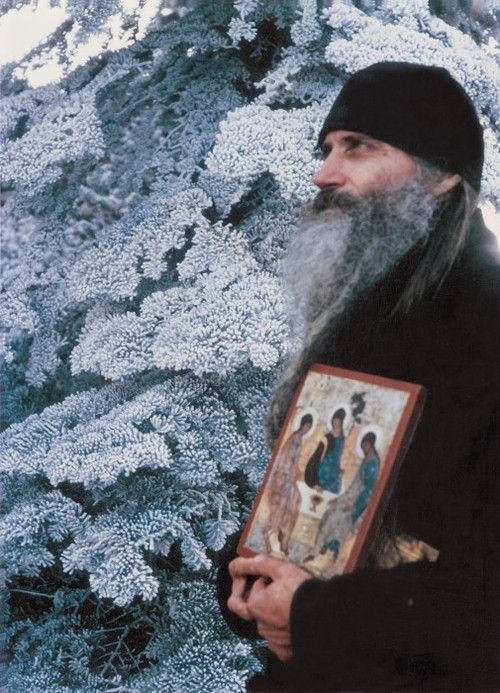
Father Seraphim Rose holding an icon of the Holy Trinity
Orthodoxy means “true glory” or “true faith.” We Orthodox think very highly of the word. Or do we? When it comes down to it, does Orthodoxy actually matter all that much to us (as it should)? Orthodox Christians in the west find themselves living among many different Christianities and it can sometimes be tempting to think that notwithstanding some of the more obvious differences, (icons, the Theotokos, fasting, worship, for example), all these Christian traditions share much the same faith as us. If you are of this opinion, then I am sorry to have to disappoint you, but it just isn’t true at all. How so?
I am going to consider this issue by looking at a case study which reveals the damage that heresy can do in our personal lives, our relationships and even to the society and world that we live in. It is a fictional story, but quite typical.
John and Mary go to an Evangelical Anglican Church. John is Orthodox (Greek tradition). Mary is Anglican. This is her second marriage, being a young widow with one teenage son (Ian, 15) still living at home. She now has two children with John, daughters, aged 5 and 7. John would prefer to go to his local Greek Church but his wife is a committed Anglican, and their children, although baptised in the Orthodox Church (with the exception of Ian), prefer the “lively worship songs”, as they put it, which are included in the church’s family service. Ian is very involved in the local youth group and is thinking eventually of becoming an Anglican minister. Does Orthodoxy then matter to John? Well, yes, but only in a remote nostalgic sort of way. It is some years now since he has attended Divine Liturgy, the last time was at Pascha in 2008. His stepson, Ian, will have nothing to do with what he considers to be the “stuffy incomprehensible worship” at his stepdad’s church which he has visited once, just after his stepfather’s marriage.
Ten years later ….
Neither John nor Mary now regularly attend the Anglican Church. John still hasn’t been back to the Orthodox Church since Pascha 2008 and Mary doesn’t like the new Vicar who is a woman. Mary is quite a conservative evangelical believer who maintains that a woman should not be in a place of authority within the Church over men. (This is the evangelical doctrine of the”headship of the male.”) Her two daughters, now 15 and 17 still attend on their own and are very active in the youth group. Ian, who shares his mother’s conservative outlook, has also left the church, disagreeing with what he believes to be the Anglican Church’s tolerance of homosexual partnerships. He has started attending a very conservative Baptist church that teaches pure Calvinism, in particular, the doctrines known as TULIP (from the first letter of each doctrine), namely:-
Total Depravity – As a result of Adam’s fall, all humanity, is dead in sins and therefore damned. Humanity’s nature is corrupt and utterly incapable of godliness.
Unconditional Election – Because man is dead in sin, he is unable to initiate a response to God; therefore, from eternity God elected certain people to salvation and others to damnation. Election and predestination are unconditional; they are not based on man’s response because man is unable to respond to God, nor does he want to.
Limited Atonement – Because God determined that certain people should be saved as a result of His unconditional election, He determined that Christ should die for the elect alone. All whom God has elected, and for whom Christ died, will be saved but the rest will be damned to hell for all eternity; again as determined by God’s sovereign will.
Irresistible Grace – Those whom God elected He draws to Himself through irresistible grace. God makes man willing to come to Him. When God calls, man responds. Man cannot choose to love God by his own choice and freedom.
Perseverance of the Saints – The precise people God has elected and drawn to Himself through the Holy Spirit will persevere in faith to the end. None whom God has elected will ever be lost; they are eternally secure even though they may sin grievously after election.
Although Ian is a pious and committed believer these doctrines trouble him. He begins to doubt that he is one of the elect, chosen by God for salvation. His sinful life (he occasionally resorts to prostitutes) troubles him greatly but his church tells him that he is unable to make any right choice and save himself. Ian enters a very dark period of depression, made much worse by the impact of these heresies on his mental health. His fragile relationship with his atheist girlfriend disintegrates. He seeks medical help for a latent depression which has now become the full blown clinical variety.
Five years further on, the two daughters are now at the same university, one just about to graduate but they have been unable to find an evangelical church they like nearby, so they have stopped attending church on the grounds that they believe in Christ and are saved, so what’s the point? Back home John and Mary now lead thoroughly secular lives. John sometimes thinks wistfully of his childhood back in Cyprus when he used to attend church with his Nana but this seems to him a very distant idealised time now. He hopes, nonetheless, that his wife or children will respect his wish for an Orthodox funeral if he dies first.
So, did Orthodoxy matter to John? Well yes, particularly earlier on, but for most of his adult life only in a nominal sort of way. He had certainly not been catechised in his youth and his grasp of the faith, therefore, had always been somewhat tenuous. Did Anglican evangelicalism then strike him as being similar to Orthodoxy? Well yes, mostly. He only saw differences in the worship style which often set his teeth on edge. Let’s face it. He attended the evangelical Anglican Church for the sake of his wife and family. When they stopped going, so did he. There is only one God after all and this was just a different way of being a Christian, it seemed to him. He did lament his stepson’s involvement in the Calvinist church because he could see how its refusal of human freedom and choice, its dark doctrines of divine election to salvation or damnation, did not feel right to him, but he couldn’t really say why.
Did Mary his wife ever consider Orthodoxy when the lady Vicar arrived? Well, no, why should she? Her husband rarely spoke of his childhood faith and she concluded that it could not have meant much to him in that case, so why should she consider it? John and Mary now spend a conventional Sunday together as most couples do in their street, getting up late, going to the gym occasionally, shopping at B&Q, taking a drive into the countryside; just the usual and normal things everyone does nowadays. Both still consider themselves as Christians, but obviously not of the fanatical sort whom they blame, quite rightly, for destroying Ian’s piece of mind. As for the two girls, well they eventually graduated and now have families of their own. Churchgoing, however, has become completely alien to all their families with the rest.
So, does Orthodox Christianity matter to you? Does it matter enough for you to find out about it in more depth? Does it matter enough for you to practice it as faithfully as you can, notwithstanding the distractions of modern life? Does it matter enough for you to stay loyal to this faith no matter what challenges are presented to it by both family life and society as a whole?
And here’s the challenging question …
In the absence of an Orthodox church nearby would you be prepared to pray at home rather than pray with the heterodox?
I understand that you are on the way to becoming Orthodox. I know nothing about you, beyond the fact that you are English.
Before we go any further, there is one point I should make clear. I have not been told why you are about to convert, but I assure you there is no point whatsoever if it is for negative reasons. You will find as much “wrong” (if not more) in Orthodoxy as in the Anglican or Roman Churches.
So – the first point is, are you prepared to face lies, hypocrisy, evil and all the rest, just as much in Orthodoxy as in any other religion or denomination?
Are you expecting a kind of earthly paradise with plenty of incense and the right kind of music?
Do you expect to go straight to heaven if you cross yourself slowly, pompously and in the correct form from the right side?
Have you a cookery book with all the authentic Russian recipes for Easter festivities?
Are you an expert in kissing three times on every possible or improper occasion?
Can you prostrate elegantly without dropping a variety of stationery out of your pockets?
OR…..
Have you read the Gospels?
Have you faced Christ crucified? In the spirit have you attended the Last Supper – the meaning of Holy Communion?
AND….
Are you prepared, in all humility, to understand that you will never, in this life, know beyond Faith; that Faith means accepting the Truth without proof. Faith and knowledge are the ultimate contradiction –and the ultimate absorption into each other.
Living Orthodoxy is based on paradox, which is carried on into worship – private or public.
We know because we believe and we believe because we know.
Above all, are you prepared to accept all things as from God?
If we are meant, always, to be “happy”, why the Crucifixion? Are you prepared, whatever happens, to believe that somewhere, somehow, it must make sense? That does not mean passive endurance, but it means constant vigilance, listening, for what is demanded; and above all, Love.
Poor, old, sick, to our last breath, we can love. Not sentimental nonsense so often confused with love, but the love of sacrifice – inner crucifixion of greed, envy, pride.
And never confuse love with sentimentality.
And never confuse worship with affectation.
Be humble – love, even when it is difficult. Not sentimental so called love – And do not treat church worship as a theatrical performance!
I hope that some of this makes sense,
With my best wishes, Mother Thekla (sometime Abbess of the Monastery of the Assumption, Normanby)
(*) Sir John Tavener the composer
Mother Thekla, who died on Aug. 7, 2011 at aged 93, was the last surviving nun to have occupied the enclosed Orthodox Monastery of the Assumption in North Yorkshire, but became better known to the wider world as the spiritual muse of the composer Sir John Tavener.Mother Thekla wrote the following letter in 2009, when she was 91 years old. You can read more about her here.
Was there a pillar and ground of truth beyond man-made organizations and belief systems? Searching online for mystical Christianity, I stumbled across a series of videos by Ted Nottingham, a former pastor of the First Christian Church (Disciples of Christ) who had converted to the Orthodox Church. His videos on Original Christianity pointed toward the ancient traditions of the Christian faith, the mystic monks of Mount Athos, and the Jesus Prayer. He talked about Eastern Orthodox spirituality as the unbroken link with Christ and the Apostles. Could this really be the original Christianity I was seeking? In all of my spiritual searching, why hadn’t I heard about Eastern Orthodoxy before? Maybe I had already walked right past it without looking, blind yet thinking I could see. Thus began my turning east toward the Orthodox Church.
I read Nottingham’s book “Written in our Heart: The Practice of Spiritual Transformation” and his translation of “The Prayer of the Heart: The Foundational Spiritual Mystery at the Core of Christ” by Father Alphonse and Rachel Goettmann. I began praying the Jesus Prayer,
“Lord Jesus Christ, Son of God, have mercy on me,”
invoking the divine presence. I watched the documentary “The Ancient Church” narrated by Stephen Baldwin as well as talks from Metropolitan Kallistos Ware and the Greek Orthodox Archdiocese. Other videos that I found helpful included talks by Father Barnabas Powell, Father John Behr, and Sister Vassa. But I realized that I needed more than just books and videos to truly connect with the ancient faith. I needed to find a living community.
Living in the San Francisco Bay Area, I discovered several Orthodox Churches in the area, including one here in my town of Walnut Creek, as well as in nearby Orinda, Berkeley, Concord, and Oakland. Where to begin? I had no idea which church might be the best one to check out just to see how the services were conducted. I was concerned that some Orthodox churches might be more ethnically based or conducted in foreign languages. As an African American who only speaks English, I wanted to find a place where I would feel welcome. What I didn’t realize at the time was that I had already visited an Orthodox Church when my wife and I attended a Greek Festival at Ascension Greek Orthodox Cathedral in Oakland several years prior. At that time, I thought I already had all the answers to my spiritual life and was not interested in learning anything about the Orthodox way of worship. But I enjoyed the delightful Greek food. Little did I know that I would be back again for something much greater than spanakopita and baklava.
I reached out to Father John Peck at JourneytoOrthodoxy.com for guidance. I also connected with Presbytera Judith Irene Matta at Descent of the Holy Spirit Orthodox Christian Mission in Santa Maria, CA as well as to Ted Nottingham with Inner Work for Spiritual Awakening. All were helpful in recommendations. Fr. John Peck connected me with Father Michael Anderson at Saint Christina of Tyre Orthodox Church in Fremont, CA. He also recommended the books “Light From the Christian East” by James Peyton and “Orthodox Spirituality” by Metropolitan of Nafpaktos Hierotheos.
Although Fremont was a bit of a distance (about 40 miles) from my home, I appreciated the meetings with Fr. Michael who showed me the inside of church and gave me some additional insights and referrals to other Orthodox churches in the area. He encouraged me to read “The Didache” which provided a short overview of early Christian tradition as taught around the first century. Fr. Michael recommended listening to Ancient Faith Radio podcasts, especially those from the late Father Thomas Hopko, of Saint Vladimir Seminary. He also suggested the Russian film “Ostrov,” a moving story (with subtitles) about a fool for Christ.
As I left my meeting with Father Michael in Fremont, I got a call from Father Marin State of the Saint Demetrios Greek Orthodox Church in Concord, CA. We scheduled a meeting for the following week. As I entered the nave of the St. Demetrios, I looked up at the Christ Pantocrator icon on the domed ceiling and wept in awe and repentance. After a long silence, Father Marin led me through the Lord’s Prayer. He welcomed me to return anytime and encouraged me to continue the journey with faith and humility. He recommended the documentary, “Mysteries of the Jesus Prayer” as well as videos from Frederica Mathewes-Green on her website Frederica.com. Meanwhile, I visited the beautiful Holy Virgin Cathedral in San Francisco where I prayed for God’s guidance and venerated the relics of Saint John Maximovich. I also purchased my first icons and prayer rope at the Holy Virgin Cathedral bookstore.
Presbytera Irene Matta from Descent of the Holy Spirit Orthodox Christian Mission sent me several books, including writings by Father John Rominides, Archbishop Lazar Puhalo, and Fr. George Metallinos along with many words of insight and encouragement.
Through Ted Nottingham I was referred via Fr. Philip Tolbert of Santa Rosa to Fr. Tom Zaferes at Ascension Cathedral in Oakland, CA. Father Tom invited me to attend Divine Liturgy the following Sunday. He also suggested the book, “Wounded by Love” by Elder Porphyrios. Ascension Cathedral is high up in Oakland Hills overlooking the San Francisco Bay. The service was moving, stunning to my senses as scents and sights of the heavenly realms surrounded me. Although the majority of the members were of Greek descent, the congregation was large and diverse enough for me to feel comfortable. Several people greeted me after the service and introduced me to other members.
I continued to attend Divine Liturgy services and met with Fathers Tom Zaferes and Ninos Oshana for biweekly Orthodox Faith Classes and Bible studies. Even though I had read the Bible from cover to cover several times in the past and had attended many studies during my years as a Protestant, I realized that Orthodox Christianity was something very different. Instead of seeing the church as a legal system with a get out of jail free card to stay the wrath of an angry judge, I began to see the church as a more like a hospital to heal the sick and brokenhearted, always welcoming us back to the open arms of a loving Father. I began to prepare for baptism into the church with prayer and fasting. I read “The Way of a Pilgrim,” “Desert Fathers,” and “The Philokalia.” I continued to say the Jesus Prayer throughout the day,
“Lord Jesus Christ, Son of God, have mercy on me.”
I was heading home.
The week leading up to my Baptism was spent with much prayer and fasting (right after Thanksgiving weekend). I was experiencing self-reflection, repentance, and unworthiness. Friday (the night before) my wife and I attended the Ascension Cathedral Christmas concert, lifting my spirits. My feelings beforehand including anticipation and humility. I made a Life Confession with Father Tom just before the baptism, which was a relief of unburdening. The “exorcism” stage in the narthex of the church was the most emotional as I experienced waves of repentance and remorse washing away and renewed commitment to Christ as I affirmed the Creed, The Symbol of Faith.
The following morning was my first communion where I went up with lighted candles with my Godfather, Athanasius. The overall experience left me with a deep sense of peace and homecoming, resting in God’s grace. I am grateful for having found the ancient faith of the Eastern Orthodox Church and look forward to diving deep within its depths. I know that I have a long way to go. I trust that He who began a good work in me will be faithful to complete it.
My Big Greek Orthodox Baptism: I was received into the Orthodox Church by Holy Baptism on December 3, 2016. Here is the video:










 ORTHODOX CHRISTIAN FAITH AND LIFE