Melancholy, Sadness, Anxiety


Melancholy, sadness, anxiety

Melancholy, sadness, anxiety

 by Elder Porphyrios

The crucial thing is to enter the Church – to unite with our fellow beings, with everyone’s joys and sorrows, to feel them as our own, to pray for all, to ache for their salvation, to forget about ourselves, to do everything for others, like Christ did for us. In the Church we become one with every sorrowful, aching and sinful person. Nobody should want to be saved alone, without the salvation of others. It is wrong for one to pray for himself to be saved. We must love others and pray that no one be lost; that everyone enters the Church. This is what matters. And it’s with this desire that one should leave the world to go to the monastery or the desert.

In the Church, which has the mysteries that save, there is no desperation. We may be extremely sinful. However, we confess, the priest reads the prayer over us and so we are forgiven and we move towards immortality, without any anxiety, without any fear.

Whoever lives in Christ, becomes one with Him, with His Church. He lives something crazy! This life is different to human life. It’s joy, light, gladness, an uplift. This is the Church’s life, the Gospel’s life, God’s Kingdom. “The Kingdom of God is within you” (Luke 17:21). Christ comes in us and we are in Him. And just like a piece of iron placed in fire becomes fire and light; outside the fire, again it turns to dark iron, darkness.

The ones blaming the Church for its representatives’ mistakes, aiming supposedly at helping in its correction, are greatly mistaken. They don’t love the Church. Nor, Christ to be sure. We love the Church; when in prayer we embrace every part of it and we do as Christ does. We sacrifice ourselves, remain alert, do everything, just like Him, the One “who, when He was reviled, did not revile in return; when He suffered, He did not threaten” (1 Peter 2:23).

We need to pay attention to the basic part too. We need to live the mysteries, especially the mystery of Holy Communion. It’s in these that Orthodoxy is found. Christ is offered to the Church through the mysteries and primarily through Holy Communion.

For many, however, our religion is a struggle, agony and anxiety. For this reason  many “religious” people are considered unhappy, because others see their bad state. Indeed, if one is unable to see the depth of the religion and does not live it, the religion ends up a sickness and a terrible one. So terrible, that one loses control over his actions, becomes weak-willed and powerless, is in agony and under stress and behaves under the influence of an evil spirit (meaning demonic energy). He does prostrations, cries, shouts, is supposedly humble, and all this humility is a satanic act. For some of these people the religion is like a type of hell. In church they do prostrations, make the sign of the cross, they say “we are sinners, unworthy,” and as soon as they get out, start blaspheming all things holy when someone annoys them just a little. It is obvious that there is a demon in the middle.

In reality, Christianity transforms a person and heals him. The most important prerequisite, however, for someone to perceive and distinguish truth is humility. Egoism darkens one’s mind, confuses him, leads him into deception, into heresy. It is very important for one to comprehend the truth.

All the confused are going to the heretical groups – confused children of confused parents.

Often, neither toil, nor repentance, nor the sign of the cross attract grace. There are secrets. The most important one is to avoid forms and go to the substance. Everything that happens must happen with love.

When you don’t live with Christ, you live in melancholy, in sadness, in stress, in grief. You don’t live correctly. So then many anomalies appear also in the body. The body gets affected, the endocrinous glands, the liver, the spleen, the pancreas, the stomach. You are told: “In order to be healthy, you must have some milk in the morning, an egg, butter and a couple of rusks.” And yet, if you live correctly, if you love Christ, you are just fine with an apple and an orange. The greatest of all medicine is to offer oneself in devotion to Christ. Everything gets healed. Everything functions properly. God’s love transforms all; it alters, it sanctifies, it corrects, it changes, it modifies everything.

Love for Christ is unlike anything else. It doesn’t end, you can’t have enough of. It transmits life, gives strength, grants health, it keeps giving…and the more it gives, the more one wishes to fall in love. Whilst human love may wear one out, drive him crazy. When we love Christ, all other loves recede. Other loves have a saturation point…Love for Christ doesn’t have one. Carnal love has a saturation point. Jealousy, complaining or even murder may follow. It may convert to hate. Love in Christ does not deteriorate. Worldly love can be maintained for a little while and then it slowly fades, whereas divine love keeps growing and deepening. Any other love may bring a person to despair. Yet divine love, raises us to God’s domain, gives us serenity, joy, completion. Other pleasures tire while this one you can’t have enough of. It’s an insatiable pleasure, that no one ever gets tired of. It’s the utmost of goods.

When you love Christ, despite all your weaknesses and their conscious acknowledgment, you still have the certainty that you have overcome death, because you reside in the communion Christ’s love.

We need to feel Christ as our friend. He is our friend. He confirms this Himself when He says: “You are my friends…” (John 15:14). We need to look at Him and approach Him as a friend. Do we fall? Do we sin? We should run to Him with feelings of familiarity, in love and trust; not in fear of punishment but in courage granted by the sense of friendship. And say to Him: “Lord, I did it, I fell, forgive me”. But at the same time we need to feel He loves us, and tenderly accepts us with love and forgives us. We need not be separated by sin from Christ. When we believe that He loves us and we love Him, we will not feel estranged and divided, even when we sin. We have secured His love and no matter how we may behave, He loves us.

The Gospel surely states symbolically that the unjust will be found where there is “crying and gnashing of teeth”; this is what it’s like away from God. And from the neptic Fathers of our Church many speak of fear of death and hell. They say: “always bear death in mind”. If we examine those words deeply, they create a fear of hell. As man tries to avoid sin, he brings those thoughts to mind so that his soul gets overrun by the fear of death, hell and the devil.

They all have their meaning, time and occasion. Fear, as a concept, is good during the first stages. It is for beginners, for the those in whom their old self still lives. The beginner, not having been refined yet is retained from evil by fear. And fear is necessary while we are still material and succumbed. But this is a stage, a low degree of relationship with the divine. We take it in as a transaction so that we can win Paradise or escape hell. If we cross examine it, it indicates self-interest, benefit. I don’t like this way. When man advances and enters into God’s love, what need is there for fear? Whatever he does, he does so from love, and this is of so much more value. Becoming good due to fearing God and not out of love is of little value.

Whoever wants to become a Christian must first become a poet. If the soul gets crushed and becomes unworthy of Christ’s love, Christ ceases relations, because Christ doesn’t want ‘unrefined’ souls next to Him.

Let nobody see you, nobody understand your gestures of devotion towards the divine. Do everything in private, in secrecy, like the ascetics. Remember what I told you about the nightingale? It chirps in the woods. In silence. As if someone is listening, praising? What beautiful chirping in the wilderness! Have you seen the way their larynx puffs up? That’s what happens to him who falls in love with Christ. If they love, “their throat puffs up, they are taken up, their tongue can’t stop”. They go into a cave, a dale and live God in secret, “silent sighing”.

Scorn passions, do not preoccupy yourselves with the devil. Turn to Christ.

Divine grace teaches us our duty. To attract it, we need love, yearning. God’s grace needs divine love. Love is enough, to get us into the right ‘shape’ for prayer. Christ will by himself pore over our heart, as long as He can find some things that please Him: good intention, humility and love. Without these we cannot say, “Lord Jesus Christ have mercy on me”.

Even the smallest grumbling against your neighbor negatively affects your soul and you are unable to pray. When the Holy Spirit finds the soul in this state, it does not dare approach.

We need to ask that God’s will is done; this is the most beneficial, the safest for us and for those we pray for. Christ will grant us everything abundantly. When there is even just a little egoism, nothing happens.

When God won’t give us what we persistently ask for, He has His reason. God has His secrets too.

If you aren’t obedient (to a spiritual father) and have no humility, the prayer (that is, Lord Jesus Christ have mercy on me) won’t take effect and there is even the fear of delusion.

Let not the prayer (Lord Jesus Christ have mercy on me) become tedious work. Pressure may bring about a reaction internally, may do harm. Many people have gotten sick through the prayer because they pressed themselves. Certainly, you can do it, when it becomes tedious work, but it’s not healthy.

It’s not necessary to particularly focus to say the prayer. You don’t need to put effort into it when you have divine love. Wherever you are, on a stool, on a chair, in a car, anywhere, in the street, at school, in the office, at work you can say the prayer, “Lord Jesus Christ have mercy on me”, softly, without pressure, without strain.

What’s important in prayer is not the duration but the intensity. Pray even just for five minutes, but given to God with love and yearning. Someone may pray all night, yet this 5 minutes of prayer be superior. It’s a mystery, but that’s the way it is.

A person of Christ makes prayer out of everything. He turns difficulty and sorrow into a prayer. Whatever happens to him, he immediately says: “Lord Jesus Christ…”. Prayer benefits in all, even the simplest things. For example, do you suffer insomnia; do not think of sleep. Get up, go outside, come back into the room, fall back into your bed as if for the first time, without thinking if you will sleep or not. Concentrate, say the doxology and then three times “Lord Jesus Christ…” and in this way you will fall asleep.

Everything is inside us, instincts and all, and are asking for fulfillment. If we don’t fulfill them they will take their revenge, unless we redirect them elsewhere, towards the higher, towards God.

You don’t become holy hunting down evil. Forget about evil. Look towards Christ and He will save you. Instead of standing outside the door to drive away the enemy, ignore him. Is evil coming this way? Gently let yourself go the other way. Meaning, is evil coming to attack you, give your internal strength to the good, to Christ. Plead: “Lord Jesus Christ, have mercy on me”. He knows how to have mercy on you, in what way. And when you are filled with good, you won’t turn to evil anymore. You will become good by yourself, with God’s grace. How can evil find any ground anymore? It disappears!

Does a phobia or disappointment get a hold of you? Turn to Christ. Love him in simplicity, with humility, without demands and He will free you.

Do not choose negative ways to correct yourselves. You don’t need to be afraid of the devil, or hell, or anything. They create a reaction. I too have a little experience in those things. The point is not to sit, to beat or strain yourselves to improve. The point is to live, to study, to pray, to advance in love, in Christ’s love, in the Church’s love.

Leave all your weaknesses so that the opposing spirit (the devil) won’t become aware of it and immerse you and hold you down in grief. Do not make any effort to free yourselves from them. Strive in gentleness and simplicity, without strain and anxiety. Do not say to yourselves: “Now I will strain myself, I will pray to obtain love, to become good, etc”. It’s not good to strain and beat yourself in order to become good. In this way you will only react more. Everything must happen in a soft way, freely and with no rush. Neither should you say: “God free me from it,” for example, from anger, or sadness. It’s not good to think and/or pray about a particular passion. Something takes place in our soul and we get more tangled up. Dash yourself to overcome the passion and you will see that it will entwine you, grasp you and you won’t be able to do anything.

Freedom cannot be won, if we do not free ourselves internally from confusion and the passions.

This is what our Church is, this is our joy, this is everything for us. And this is what man today is looking for. And he takes poison and drugs so that he can enter joyous worlds, but fake joy. He feels something at that particular moment but the next day he feels torn. One thing scrapes him, eats him up, smashes him, burns him. While the other, that is being given to Christ, enlivens him, gives him joy, makes him enjoy life, feel strong, magnificence.

The ability to sanctify your soul is a great art. One can become holy anywhere. Even in Omonia (the main square in Athens) one can be sanctified, if he wants. You can become saints at work, no matter what it is – in calmness, patience and love. Each day make a new beginning, a new mood, enthusiastically and with love, prayer and silence – not with stress and a heavy heart.

Work vigilantly, simply, gently, without anxiety, joyfully and gladly, in a good mood. Then divine grace comes.

All unpleasant things, that remain in your soul and make you stressed, can become a reason for worshipping God and so stop hurting you. Trust in God.

There is no need in trying hard and strain yourselves. All your effort should be focused on gazing at the light, attaining the light. In this way, instead of turning to grief which is not of God’s Spirit, you should turn yourselves to praising God.

Grief shows that we don’t entrust our life to Christ.

When communication with Christ takes place simply, softly, under no pressure, it causes the devil to flee. Satan won’t flee from pressure, strain. He distances himself from calmness and prayer. He retreats when he sees the soul ignore him and turn to Christ with love. He cannot take disregard because he is arrogant. But the evil spirit understands it when you push yourselves, and it fights you. Don’t bother with the devil, don’t even ask that he flee. The more you ask that he flee, the more he will entangle you. Ignore the devil. Do not fight him directly. When you stubbornly fight against the devil, he attacks you back like a tiger, a wildcat. When you shoot bullets at him, he throws back a grenade. When you throw a bomb at him he shoots back a missile. Don’t look at evil. Look into God’s arms, fall into His arms and move on.

A humble person is conscious of his inner state, and no matter how ugly it is, he does not lose his personality. He does not lose his balance. The opposite happens with the egoist, the one who has feelings of inferiority. In the beginning he resembles a humble person. But if one tempts him just a little, he loses his peace, gets irritated, gets upset.

When a person lives without God, without peace, without trust, in anxiety, depression, hopelessness, he develops physical and psychological illnesses. Psychological illness, neurological illness, discord are demonic states. It is also demonic to speak as though humble. It is called a feeling of inferiority. Real humility does not speak out, does not pretend to be humble, that is to say: “I’m a sinner, unworthy, the least of all…”. A humble person is afraid that they may fall into vainglory. God’s grace does not draw near that. In contrast, God’s grace can be found where there is real humility, divine humility, perfect trust in God, dependence on Him.

The vainglorious person alienates his soul from eternal life. Ultimately, egoism is complete foolishness! Vainglory makes us hollow. When we engage in showing off, we end up completely empty. We must do whatever we do to please God; selflessly, without vainglory, without pride, without ego, without, without…

Our soul must not rebel and say: “why did God do this thing, why did He do the other thing that way, couldn’t He have done it differently?” All this indicates internal small-heartedness and reaction. It shows the big opinion we have of ourselves, our pride and our great ego. Those “whys” greatly torture a person, create what people call “complexes”. For example, “why should I be so tall?” or – the opposite – “very short?”. It remains inside. And one may pray and stay awake (to do so), but get the opposite result. And he may suffer and exasperate himself pointlessly. Whilst with Christ, with grace, it all disappears. There remains this “something” deep down, meaning “why,” but God’s grace overshadows man and while the root may be a complex, a rosebush grows over it with beautiful roses, and the more one waters it through faith, love, patience and humility, the more evil loses its power and ceases to exist; that is, it doesn’t disappear, but it withers. The more the rosebush isn’t watered, the more it withers, dries up, disappears and thorns grow out of it instead.

We tempt God when we ask something of Him, but our life is far from God. We tempt Him when we ask for something but our life is not in accordance with His will – that is, (we ask for) things against God: stress and anxiety on one hand, but on the other we entreat Him.

Your spiritual father may tell you: “How I would have liked to be in a quiet place,  free from all other affairs and to hear about your life right from the beginning, from when you felt yourself; all the things you can remember and the way you dealt with them, not only the unpleasant but also the pleasant, not only your sins but also the good. Successes and failures. Everything, everything that is part of your life”.

I’ve applied this type of general confession many times and have seen miracles happen. During the time you speak to the confessor, divine grace comes to relieve you from all your ordeals and wounds and psychological traumas and guilt; because, as you are speaking your confessor sincerely prays for your deliverance.

Let us not go back to the sins that we have confessed. The remembrance of sins wounds. Did we ask for forgiveness? It’s over. God forgives everything through confession. I also believe that I sin. I’m not in the right path. But whatever bothers me I pray about; I don’t keep it inside me. I go to my spiritual father. I confess it, it’s over! Let us not turn back and talk about what we did not do. The important thing is what we will do now, from this moment on.

Desperation and disappointment is the most terrible thing. It’s Satan’s trap, to make a person lose his eagerness for spiritual things and bring him to desperation.

Almost all disease is due to the lack of trust in God and this causes stress. Stress is caused by the abolishment of religious feelings. If you don’t feel love for Christ, if you don’t occupy yourselves with holy matters, you will surely fill up with melancholy and evil.

Something that can also help the depressed is an occupation, interest for life. The garden, plants, flowers, trees, the country, a walk outdoors, a hike, all this can bring a person out of idleness and create other interests for him. They act like medicine. Occupying oneself with art, music, etc is very beneficial. But I attach the greatest value to the Church, to studying the Holy Scripture, to the services. By studying God’s word, one is healed without being aware of it.

Let us not lose hope, or be in a rush, nor judge according to superficial or external things. If, for example, you see a nude or lewdly dressed woman, don’t remain on the external image, but enter deep, into her soul. She may be a very good soul that has existential questions, that she may be manifesting through her extreme appearance. She has internal strength, the strength of projection, she wants people to look at her. However, in ignorance, she has twisted things. Imagine if she were to meet Christ. She would believe, and turn all this ardour to Christ. She would do everything to attract God’s grace. She would become a saint.

Often, through our anxiety and fears and poor spiritual state, without knowing or wanting, we can hurt other people, even if we love them very much, like a mother her child for example. A mother can transmit to a child all her stress regarding his life, his health, his progress, even without talking to him directly or showing what she feels. This love, this natural love may hurt him at some point. This does not happen, however, with Christ’s love, which is connected to prayer and the holiness of someone’s life. This love sanctifies a person, pacifies him, because God is love.

Source (greek):
Life and Words, pub. Holy Monastery of Chrisopigi of Chania
2003
Elder Porphyrios

Translate by: Holy Monastery of Pantokrator

  • A word of caution: all spiritual Mothers and Fathers I have encountered in my pilgrimages, with one mind, conclude that pride is the root of all our disorders. More specifically: if someone is proud and he is a lay person, he ends up having ‘psychological’ / ‘psychiatric’ problems; if he is a monk/ nun, he/she will end up ‘possessed’.  May the Lord have mercy on all of us!

Orthodox Icons

The Phenomenon of the Orthodox Icon: A Theological Perspectivekalo1

On the first Sunday of Great Lent the church commemorates the “Triumph of Orthodoxy” which is also known as the Week of Orthodoxy. This feast originated in the 9th. The iconoclasm heresy originated in the 8th century in present day Greece and very quickly spread throughout the Christian world. Christians were persecuted for painting, venerating and simply having the holy icons. In fact, many were martyred, imprisoned and killed.

kalo2

The seventh Ecumenical Council (787) reaffirmed the need and importance of venerating icons. However, persecutions continued until 843 when a pious empress  supported the final triumph of Orthodoxy over the iconoclasm heresy. Since then, a special service was created in honor of this victory in orthodox cathedrals when a bishop is present on the first Sunday after the start of the Great Lent.

Many people were ready to give up their lives while defending the holy icons. So what is an icon? What is its meaning? All of these questions are answered in a talk with Father Sergious, who is in charge of the icon-painting studio and icon painting school at St. Elisabeth Convent.

What is an icon and how can one describe an icon using only three words? 

kalo3

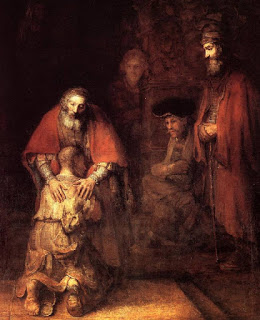
The first word is “picture”. Since an icon is indeed a picture of a person, a human. Nevertheless, not every picture is an icon. Initially it can be very difficult to establish the necessary requirements for a picture to be referred to as an icon and to determine what is and what is not an icon. For example, if we take The Return of the Prodigal Son by Rembrandt, the painting is essentially not an icon.

However, the painting expresses a theological and very profound love of God towards man in comparison to some of the more contemporary images of the same biblical event. Of course, according to the church canons we cannot place this painting into the iconostasis of the church or serve and venerate it. Still, from the point of view of a “picture” there is a definite and concrete theological perspective that the painting does indeed contain.

kalo4

Very often in the fragments of icons, mosaics, or frescoes one could see emperors, empresses, as well as rich donors praying in from of the Lord or the Mother of God. What is more interesting is that the image is created in accordance with the church canons.

This is because even the most “correct” and canonical icons can include images of regular, earthly and secular people. Such people are not the center of the icon because Christ is and must be the center but these people are still be depicted as they are turned to Christ. So even the most plain and regular person has the right to be pictured. Even if he or she is still alive. From this, you can see that an icon is much more complex than originally perceived.
An icon is a picture, along with the presence of the Image of God, but this Image cannot be captured, it cannot be grasped by any human logic and it cannot be contained in any amount of words or paragraphs which say which icon has this “image” and which does not.

kalo5

If an icon is present then God is present as well.

“The idea of a New Testament icon, as interpreted by the Holy Fathers, is to properly express, clearly explain as much as possible through artistic expression, the truth of God’s incarnation. The image of Jesus is the image of God. (L. Ouspensky “Theology of the Icon”)

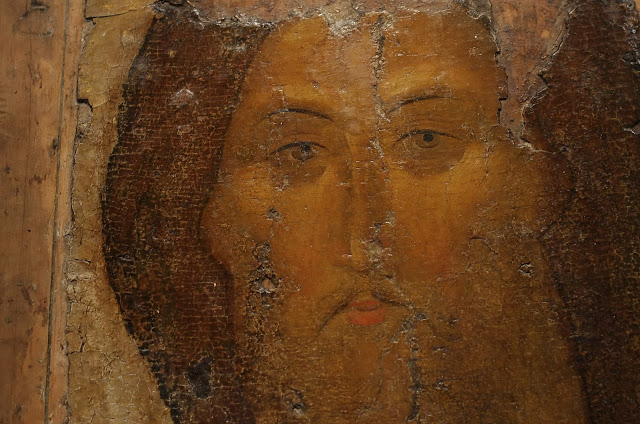
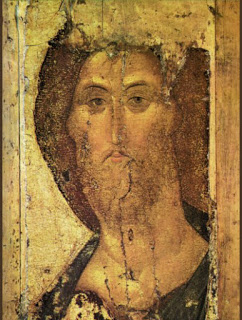
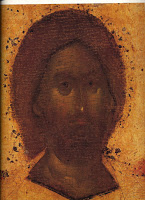
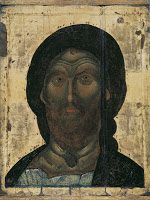
If we take this quote and look at the icon of Christ from the Zvenigrod Deesis – an image that is undoubtedly an icon, then we can conclude that here the icon expresses the dogmatic truth of incarnation with extreme precision and fullness that is not easily accomplished. There can be no argument here and I think that while looking at the image one can start to assert that if such an icon exists, then there is a God (Father George Florensky said something very similar: “If there is an icon of the holy Trinity then there is a God.)

kalo6

The height of such artistic expression, that is presented to us, also prompts us to think that masterpieces cannot reach such levels alone, without  God and the acknowledgement of his existence. Here, while looking at this icon (Christ from the Zvenigrod Deesis) the incarnation of God is expressed with such emphasis that you do not always see in contemporary icons. Icons may have all the canonical aspects, gold leaf plating and other features but you do not always see the most important aspect, the truth of our Lord’s incarnation  –  is not there.

kalo7

An Uncontainable Combination

Everyone knows that artistic forms of expression existed long before the time of Christ. Ancient art forms are still unattainable…but these masterpieces generally depicted secular, human beauty which was often very generic, distant and cold. For example, take the image of Aphrodite. The image is one of beauty and harmony but at the same time, she is not alive, not real and therefore very distant to the everyday person. These art forms either depicted false idols or gods and the beauty was rather fictional and unattainable rather than being real and personal.

Christ comes into the world that appears to be beautiful but also deceitful at because the world that our Savior comes into is filled with sin. Christ is able to show us true beauty. Beauty that is very human in one sense and one that each one of us can feel. That same beauty is also filled with the Devine. An icon is also a phenomenon and a true wonder of the world because it processes the Devine and at the same time is made up of earthly materials such as wood and paint. Even the person who paints the icon is typically an ordinary human being and not always a saint.

kalo8

You see, in a way an icon repeats this unique paradox – where the uncontainable and combinable is combined, the same way as it is in Christ. It is difficult to imagine God and Man in one. It is hard to comprehend because everything human is always limited in understanding and miniscule but everything related to God is grand and uncontainable. The icon also connects the Devine and the human aspects and we in turn can see its beauty, its phenomena and its complexity. Once again, since we can not explain God in a few paragraphs we cannot in the same way explain an icon and its mystery. This is why we need to look further and more in depth. The ability to understand and interpret an icon comes with the experience of every individual meeting with God and their individual connection to their Maker. This is because our entire life is a path towards meeting the Lord and so our closeness to God is proportional to our ability to feel the beautiful mystery of the icon.

kalo9

We need each other

It is almost as if all the iconographers are in essence doomed: when we sit with our paintbrushes and we feel a colossal pressure of sin, our personal and that of the rest of the world. It is difficult for us because we need to depict the Truth of our Lord’s incarnation. Maybe people no longer need this Truth. It is very important to have people in this world who are in need of this truth and the Image of God. If we have people like that then we will still be able to do something. Even if we are “overeducated” and we have the most ideal sketches in front of us:  We will not be able to do anything.

kalo10

Why did Andrei Rublev paint icons the way he did?

It is because in his time people needed God. People could not live without God. This was his real inspiration that enabled him to depict Christ. Only this. It was not his personal talent, which without a doubt he did possess as an artist. Moreover, he was quite talented, may I add.  Nevertheless, along with the talent there was a desire to be with God. In addition, if we can talk to people about God, show them the true beauty of the icon, maybe this might help people get back to the one main beauty – which we see in Christ.

kalo11
This is why we have a very serious duty and responsibility in front of others.

kalo12

kalo13

kalo14

Holy and Life-Giving Cross, Orthodox Parish, Lancaster, UK


DSC00591

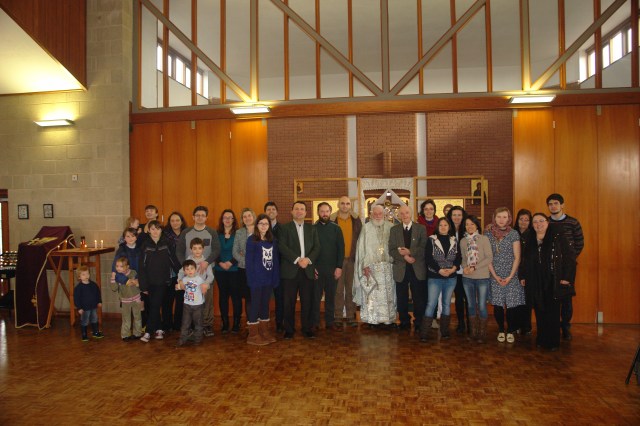
The First Holy Liturgy in the new Temple of the Orthodox Christian Parish of the Holy and Life-Giving Cross at Lancaster (United Kingdom)


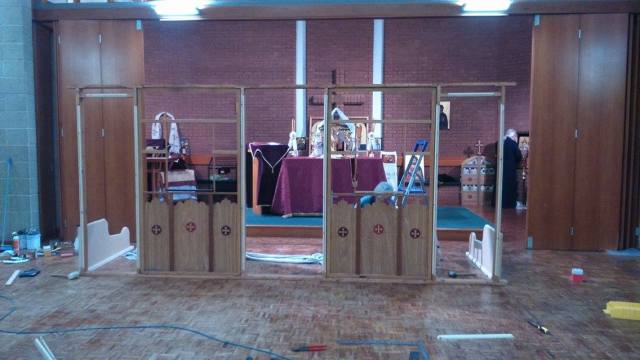
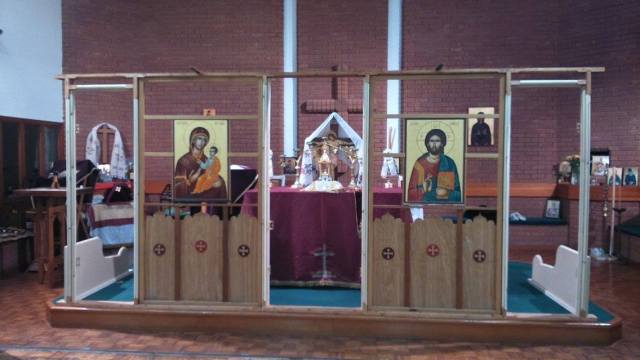
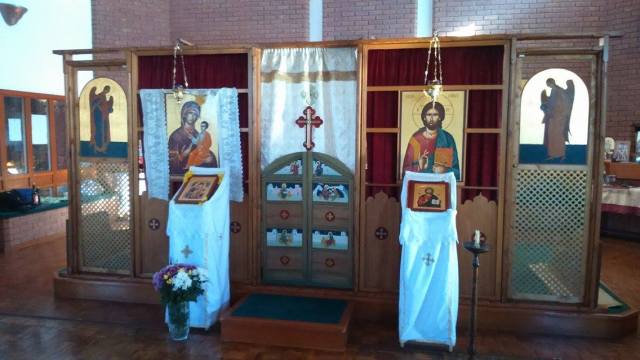
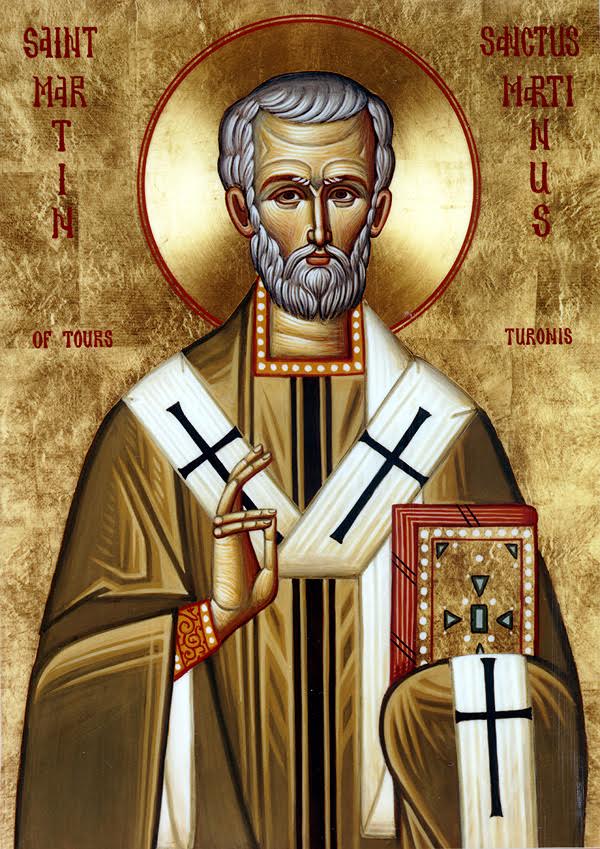
During my last visit at the UK I had the blessing to witness the opening of a new Temple at the St Martin of Tours’ Church, Braddon Close, Westgate, Lancashire for the Holy Cross Parish. Before my arrival on 9th March, the faithful had already set up the Church of St Martin , installed the Iconostasis, and it was beginning to look very much like an Orthodox Church already.

Have a look at more photos of the making of the iconostasis (a combined effort of an Englishman’s carpentry and Antiochian iconography!) 😃

icon1icon2icon3

Glory to Thee o Lord, Glory to Thee! I have come to intimately know this warm Stavronian community with faithful from more than half a dozen nationalities (!) for two years and they have ever since become a part of my heart. They helped me so much during a time in need then, in Lancaster that I feel there is no way I can ever repay their prayerful support and practical help at that time.

aidan

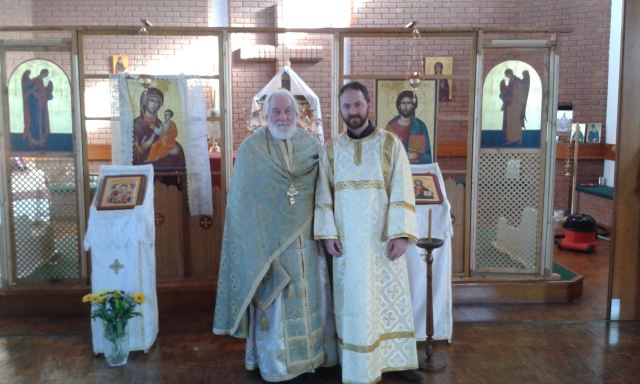
Fr. Jonathan Hemmings and Server Trevor Wearing

This Parish serves the liturgical and pastoral needs of Orthodox Christians studying and teaching at Lancaster University, from Greece and Cyprus and in more recent years from Romania and Russia. Yet far from it, this parish is not ‘too ethnic’ at all, but inter-national and ecumenical in the correct sense of the world; one may also encounter British people who have converted to Orthodoxy. A genuine “one holy, catholic and apostolic Church”, dedicated to the Life-Giving Cross, and from what I have witnessed there during my brief stay and from all subsequent long visits, I have come to the conclusion that this dedication, like all dedications or patron, has an intimate relationship with the Community and those belonging to it. Their dedication and service to the Holy and Life Giving Cross is hard, narrow and steep but it is a glorious path

holy cross10

33.jpg

Back in 2014, this was the nearest church I could go during my stay at Lancaster University, so I began attending church services there. Everything was so different from our ordinary churches in Greece! To begin with, for each and every Holy Liturgy we have had to “build”, furnish and dismantle the “Church” (!) to give it some semblance of Orthodox character and creedal symbolism.” For 20 (!) years!!!  Quite an extraordinary experience for a Greek who can choose which parish to go every Sunday, since there are plenty in every neighbourhood. And yet, somehow, this ‘fragile’, “weak thing of the world to confound the things which are mighty”; this base thing of the world, and thing which is despised’ , yet God hath chosen, yea, and this ‘thing which is not’, to bring to nought things that are” (cf. 1 Cor. 1:27-28), this church which could be ‘contained’ in just three pieces of luggage, was more powerful, holy and alive than all others I have been to here in Greece!

I vividly remember the awe I have repeatedly experienced there during the Sacraments of the Holy Unction and Baptisms where plain olive oil acquired through prayers a heavenly fragrance and was literally transformed! Or, icons during services began streaming myrrh (ie. a sweet-smelling oily substance). Or, the icons and secondary relics that I was offered as a present started to produce a sweet-smelling fragrance in my hotel room. But this was not the only surprise that the Lord had at store for me.

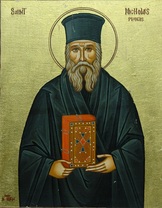
planas1

St. Nicholas Planas by Dimitrios Hakim

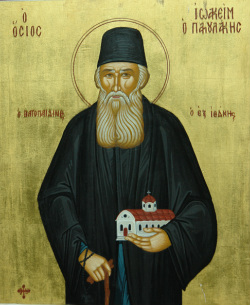
st ioakim.jpg

St. Joachim of Ithaca by Dimitrios Hakim

For the whole autumn semester, I regularly attended Services there, read their newsletter each month with their news and spiritual food for thought, studied their translations such as St. Lioba’s or St. Joachim’s life and enjoyed their book publications, most notably Fountains in the Desert, based on the sayings of St Antony. I also got acquainted to Celtic Saints and Celtic Orthodoxy— so Constantine the Great  was not (only) a Greek Saint but was acclaimed as emperor by the army at Eboracum (Modern-day York) 😃?! — and venerated the icons and holy relics of St. Nicholas Planas and St. Joachim of Ithaca that this parish is blessed to have. Can you imagine this? Venerating for the first time Greek Saints’ relics in Great Britain ?!

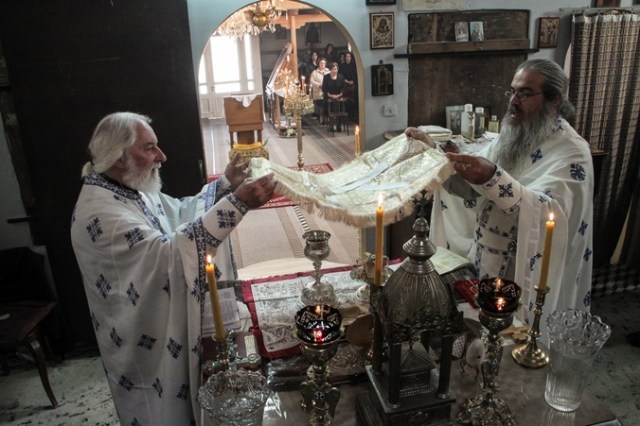
holy cross5

Fr. Jonathan (left) embracing the aer with Fr. Theodosios (right) during the Holy Liturgy 
in the Church of St. Nicholas in Ithaka, Greece.

Most importantly, these months I  and enjoyed their fellowship, having meals together and taking part in pilgrimages to Orthodox monasteries, churches, ancient Christian sites and other worship places (photos). To get a taste of their fellowship, listen to the Holy Cross choir chant the Orthodox Psalm (135) “O Give thanks unto the Lord”, while looking at their photos, most of which come from our pilgrimage to St. Herbert’s Island, Derwentwater, UK. St. Herbert is an important Orthodox Saint in the area.

To my immense surprise my brief stay there served as the catalyst for the re-discovery of the Orthodox faith, a mystical Baptism for which I am infinitely grateful to them. While there, I have been most impressed by the spirit of prayer and the presence of God at the celebration of the Divine Liturgy at the University chapel and the spirit of ecumenical fellowship. Isn’t it an irony that the Holy Spirit chose to lead me ‘back’ to my cradle faith through a convert spiritual father ?! By the end of my stay there I knew my heart had chosen ‘them’ as my spiritual family, and everything had changed from ‘their’ to ‘our’. Thanks be to God I had discovered my spiritual oasis-retreat- fountain in the desert-home-pearl of great value! The Holy and Life-Giving Cross parish has become a ‘thin’ place for me! I had become a Stavronian myself!  😊

Last Easter, I felt that I had to celebrate Easter at Lancaster and what a Holy week we all had then! Our pilgrimage too during Bright Week to meet Fr. John Musther Of Cumbria at his church-home was an unforgettable experience!

holy cross5

“The Church in The British Isles will only begin to grow when she begins to again venerate her own Saints”  (Saint Arsenios of Paros †1877)

ab

 And now, at long last, after 20 ‘crucified’ years, of using borrowed premises and enduring numerous hardships and trials, the Orthodox Community of the Holy and Life Giving Cross , has finally found a building for a Temple that will serve the needs of the Orthodox Christians in the Lancaster area.

IMG_9500

Sunday of the Orthodoxy and St. Cuthbert’s Day’,  one of England’s most beloved Wonderworking saints once greatly venerated here — Sancte Cutbertus ora pro nobis!

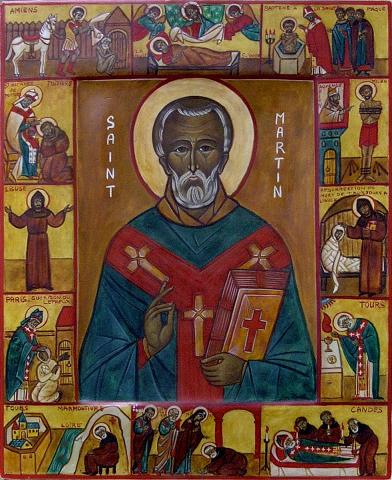
This new Temple seems to be a blessing from Father Jonathan’s spiritual grandfather, Blessed Seraphim Rose, who had a special love for the Celtic Saints, and St. Martin of Tours in particular.

st martin7

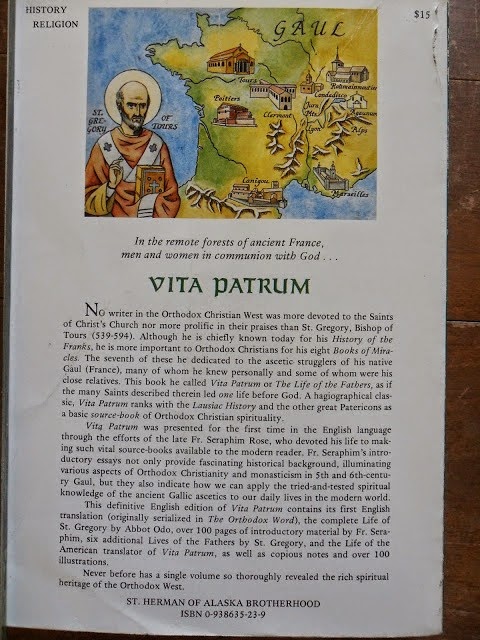
Cf. The prologue to Vita Patrum written by him:

“And then, even as the news of the phenomenon of Egyptian monasticism was still spreading through the West, the West produced its own ascetic miracle: St. Martin of Tours.  Even before his death in 397, his manuscript Life was being circulated in Gaul, Spain, Italy, and elsewhere in the West, revealing him as a monastic Father and wonderworker in no way inferior to the desert Fathers in the East.”


vita patrum1


Another spiritual ‘coincidence’ seems to be at stake. While reading St. Martin’s vita a certain incident attracts our attention,

“CHAPTER III.   Christ appears to St. Martin.

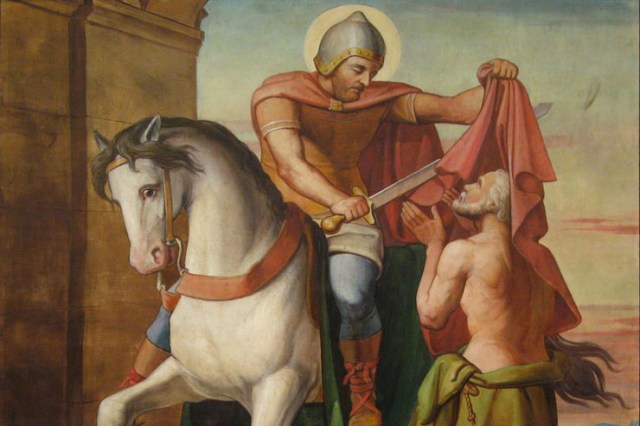
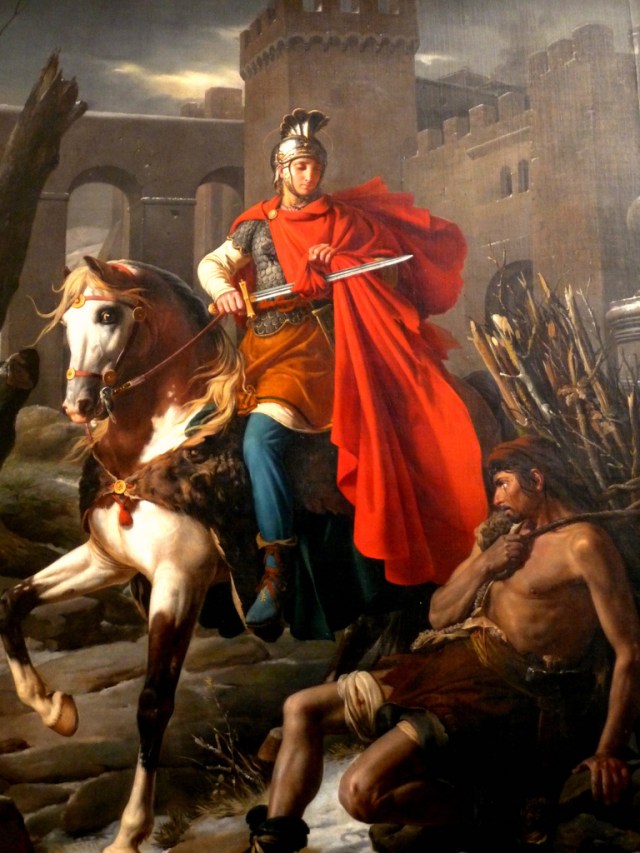
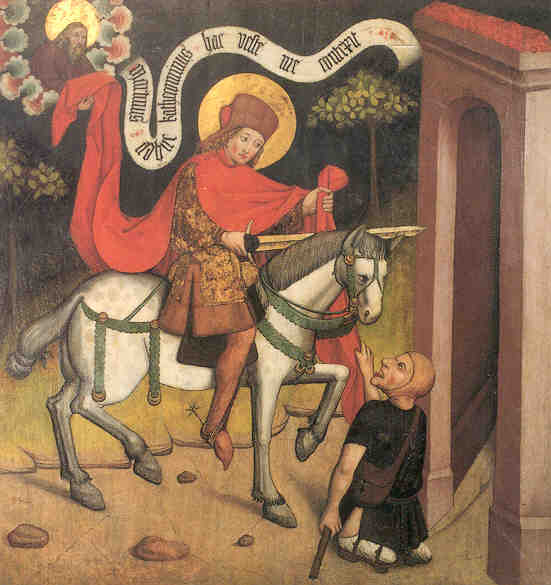
ACCORDINGLY, at a certain period, when he had nothing except his arms and his simple military dress, in the middle of winter, a winter which had shown itself more severe than ordinary, so that the extreme cold was proving fatal to many, he happened to meet at the gate of the city of Amiens[8] a poor man destitute of clothing. He was entreating those that passed by to have compassion upon him, but all passed the wretched man without notice, when Martin, that man full of God, recognized that a being to whom others showed no pity, was, in that respect, left to him. Yet, what should he do? He had nothing except the cloak in which he was clad, for he had already parted with the rest of his garments for similar purposes. Taking, therefore, his sword with which he was girt, he divided his cloak into two equal parts, and gave one part to the poor man, while he again clothed himself with the remainder. Upon this, some of the by-standers laughed, because he was now an unsightly object, and stood out as but partly dressed. Many, however, who were of sounder understanding, groaned deeply because they themselves had done nothing similar. They especially felt this, because, being possessed of more than Martin, they could have clothed the poor man without reducing themselves to nakedness. In the following night, when Martin had resigned himself to sleep, he had a vision of Christ arrayed in that part of his cloak with which he had clothed the poor man. He contemplated the Lord with the greatest attention, and was told to own as his the robe which he had given. Ere long, he heard Jesus saying with a clear voice to the multitude of angels standing round — “Martin, who is still but a catechumen, clothed[9] me with this robe.” The Lord, truly mindful of his own words (who had said when on earth — “Inasmuch[10] as ye have done these things to one of the least of these, ye have done them unto me”), declared that he himself had been clothed in that poor man; and to confirm the testimony he bore to so good a deed, he condescended to show him himself in that very dress which the poor man had received.

st martin2

st martin4

Your mercy toward the poor man without clothes gained you, O Martin,

The vision of Christ, who said to the angels

‘Martin has clothed Me with this garment.

Have mercy on us who are poor

And who have no good works to clothe ourselves,

And pray to the Lord of the Universe

That He have mercy on our souls. (St. Martin of Tours Troparion, Tone 4)

st martin6


st martin8

“The Charity of St. Martin” 

Likewise, this Holy Cross community have been given the use of the residence for half week, for Fridays, Saturdays and Sundays! 😃

In a sense, Divine Providence and the Communion of Saints is brought into our (sic!) acquisition of the Church!

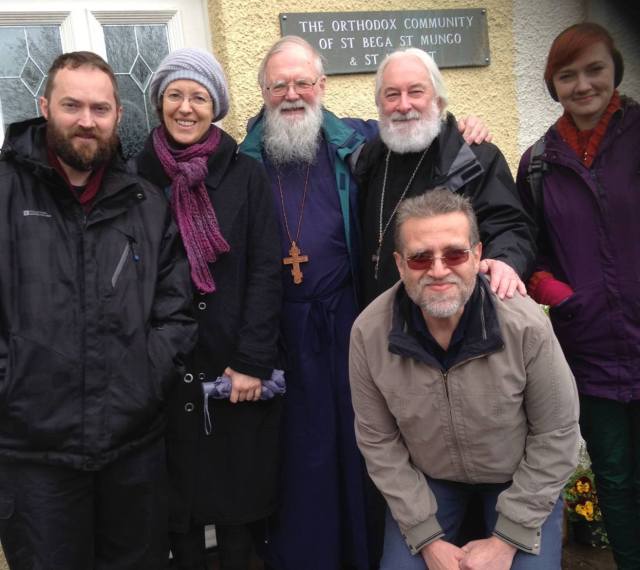
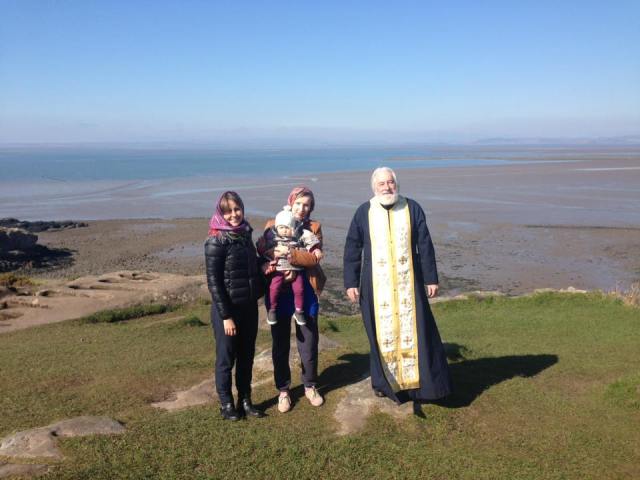
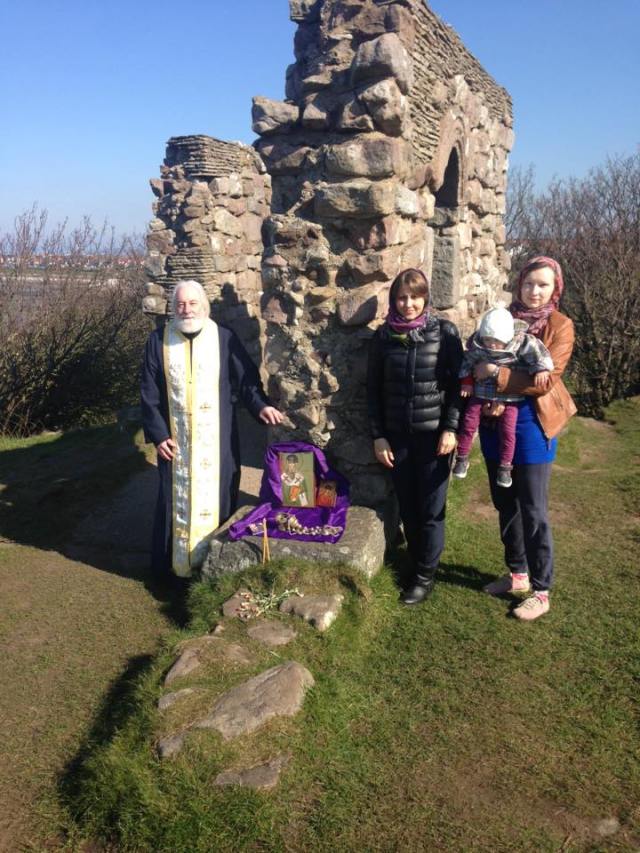
On St. Patrick’s Day, Father Jonathan Hemmings and five Stavronians made a pilgrimage to Heysham to St Patrick’s Chapel and Monastery at Heysham. Have a look at this lovely photo with the Faithful. Not only five though! Plus a host of angels and some onlookers- a group of five young people totally unrelated to the Stavronian community or the Orthodox Church asked if they could have a photo taken with the Icon of St Patrick!

st patrick2st patrick10

St. Patrick2.jpg

Heysham is where the great Saint Patrick crossed to Ireland to spread Christianity there. Father Jonathan is chanting St. Patrick’s Lorica (The Breastplate) ! Events like this are really important so that we reconnect with Britian’s Orthodox past. This pilgrimage brings tears to my eyes as I remember a pilgrimage, together with Father Jonathan, which took place 2 years ago. Such fond memories to treasure!


The Easter news of the Holy Cross parish are:

  • “We are doubly blessed to receive at Great and Holy Week a hand crafted Icon, a comb and a prayer rope that belonged to St Paisios and Reliquary for containing these holy relics. We will also have on loan  for Holy Week a piece of his clothing from another Monastery in Greece. Those from other Orthodox Parishes who wish to come to venerate these secondary holy relics of St Paisios should contact Jonathan so that we may offer appropriate hospitality.”
  • “We are blessed to welcome again the Byzantine St Anysia Choir from Thessalonika for Pascha who came last year to embellish our worship with their beautiful singing.

For more information about the Orthodox Christian Parish of the Holy and Life ­Giving Cross at Lancaster   visit their website http://www.orthodox-lancaster.org.uk and their Facebook group https://www.facebook.com/groups/126074338184/?fref=ts

St. Martin2


“The Church in The British Isles will only begin to grow when she begins to again venerate her own Saints”  (Saint Arsenios of Paros †1877)


Weakness at the Beginning of Lent

depression10

I am tired. I feel tired and afraid, with no control over anything. At my best moments, I realise that this is a gift – the gift of awareness, of truth. Because the truth is we are never in control over anything. We invent little worlds (our group of friends; our family; our parish; our monastery) over which we may claim some sort of dominion. We invent silly games (our careers, the rules of our society) which we can win. We upgrade or downgrade these games carefully, so that we are never pushed beyond what we feel we can control.

depression6

But look up, look beyond the borders of these silly little kingdoms where we rule. Lent is a horrid period. Year by year, Lent is when some force within me pushes me out of my comfort zones, and I find myself in a lions’ den, face to face with the beasts, utterly unprepared to fight, totally helpless, fully aware that the only possible outcome is to be slaughtered.

This is nothing new. This happens every year. Yet, I somehow survive, because the same Force that pushes me out of my self-created kingdoms, out of my self-created games – that same Force saves me from those wild beasts at the last moment.

depression7

And this changes everything.

Perhaps I should not share this with you. Perhaps it would help the monastery more if I kept my weakness to myself and pretended to be someone I am not. This would be the proper thing to do – but I have never tried to be proper; I have never cared to replace my honest, weak self with the false image of a man who is in control. Those who play this game are one step away from a type of suicide – not to allow yourself to be seen, to cover yourself under the expectations of others, to betray the feeble, yet precious being that you are out of fear that you will not stand up to the standards of others… This is the definition of hell, the betrayal of one’s deepest, most intimate self. I don’t want to leave this world having played a respectable part, yet knowing that who-I-am was never visible. What can be worse than to go though life as someone else?  What bigger failure than to sell out your own self?

depression8

If you don’t live as yourself – weak and fallen, as you are – how can you love? Whose love is it that you feel? With whose love do you embrace the world around you? Whose good deeds and whose sins are your good deeds and your sins? When you hide yourself under an image, you basically step aside and die – all that is left is the image you created. It is this image – not yourself – who loves and hates, who lives and dies. You will never experience love – your love – until you own up to your true self. You will never experience life – not even death, ultimately – until you settle down in your own life and accept yourself as you are. I don’t mean this in the sense of ‘this is who I am and there is no reason to change’, but in the sense of ‘this is who I am, this is the real starting point of any change’.

depression9

No healing is possible. No repentance is possible. No prayer is possible, until the heart that heals, repents and prays is your sinful, fallen, yet beating heart. False images do not have hearts. False images do not love. Most painful than all, false images will never reflect Christ, because there is nothing false in Christ, nothing common between Life and void. Prayer begins with pain at one’s fallen nature; it grows out of this pain, and its flowers bloom out of it.

By Father Seraphim Aldea


St. Patrick’s Breastplate

St. Patrick2

Today’s post is dedicated to the St. Patrick, Bishop of Armagh and Enlightener of Ireland. Born a Briton, yet one of Ireland’s most beloved patron saint. St. Patrick pray for us!
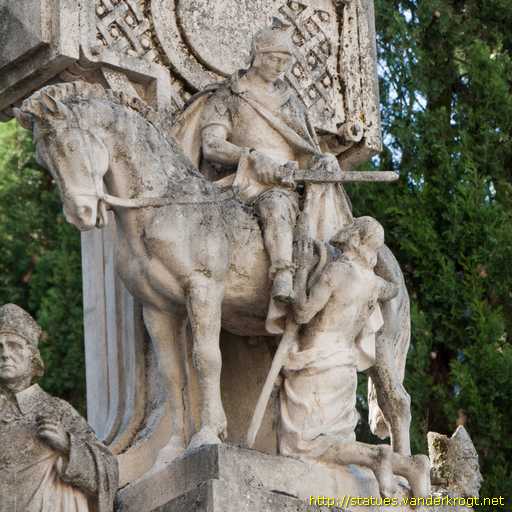
Prayers, Confessio and Traditional Customs follow.

st patrick1

Let us pray, especially today, with St. Patrick’s powerful prayer, St. Patrick’s Breastplate, also known as The Lorica of Saint Patrick. I have always experienced awe and gratitude at its incantation, especially after knowing its tradition: St. Patrick wrote it in 433 A.D. for divine protection before successfully converting the Irish King Leoghaire and his subjects from paganism to Christianity. The term breastplate refers to a piece of armor worn in battle. Lorica means breastplate in Latin. The story of this prayer is that Patrick and his followers used this most beautiful prayer to protect themselves from the people who wanted to kill them as they travelled across Ireland. It is also called the Deer’s Cry (Fáed Fíada) because their enemies saw, not men, but deer!

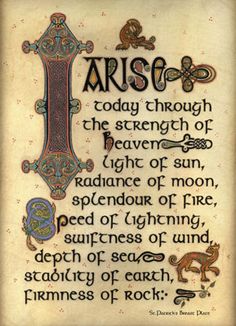
Lorica of Saint Patrick

I arise today
Through a mighty strength, the invocation of the Trinity,
Through a belief in the Threeness,
Through confession of the Oneness 
Of the Creator of creation. 

I arise today 
Through the strength of Christ’s birth and His baptism, 
Through the strength of His crucifixion and His burial, 
Through the strength of His resurrection and His ascension,
Through the strength of His descent for the judgment of doom.

I arise today
Through the strength of the love of cherubim,
In obedience of angels,
In service of archangels,
In the hope of resurrection to meet with reward,
In the prayers of patriarchs, 
In preachings of the apostles,
In faiths of confessors,
In innocence of virgins,
In deeds of righteous men. 

I arise today
Through the strength of heaven; 
Light of the sun,
Splendor of fire,
Speed of lightning,
Swiftness of the wind,
Depth of the sea, 
Stability of the earth,
Firmness of the rock. 

I arise today
Through God’s strength to pilot me;
God’s might to uphold me, 
God’s wisdom to guide me, 
God’s eye to look before me, 
God’s ear to hear me, 
God’s word to speak for me, 
God’s hand to guard me, 
God’s way to lie before me, 
God’s shield to protect me, 
God’s hosts to save me 
From snares of the devil, 
From temptations of vices, 
From every one who desires me ill, 
Afar and anear, 
Alone or in a mulitude. 

I summon today all these powers between me and evil,
Against every cruel merciless power that opposes my body and soul, 
Against incantations of false prophets,
Against black laws of pagandom,
Against false laws of heretics,
Against craft of idolatry, 
Against spells of women and smiths and wizards,
Against every knowledge that corrupts man’s body and soul. 
Christ shield me today 
Against poison, against burning, 
Against drowning, against wounding,
So that reward may come to me in abundance.

Christ with me, Christ before me, Christ behind me,
Christ in me, Christ beneath me, Christ above me, 
Christ on my right, Christ on my left, 
Christ when I lie down, Christ when I sit down, 
Christ in the heart of every man who thinks of me, 
Christ in the mouth of every man who speaks of me, 
Christ in the eye that sees me, 
Christ in the ear that hears me. 

I arise today
Through a mighty strength, the invocation of the Trinity,
Through a belief in the Threeness,
Through a confession of the Oneness
Of the Creator of creation

Salvation is of the Lord.

Salvation is of the Lord.

Salvation is of Christ.

May Thy Salvation, O Lord, be ever with us.

St. Patrick (ca. 377)

st patrick3

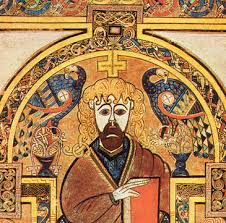
The Book of Kells, detail The Lorica of St. Patrick

* For the whole Book of Kells, Ireland’s greatest cultural treasure and the world’s most famous and beautiful medieval manuscript, an illuminated manuscript Gospel book in Latin, containing the four Gospels of the New Testament together with various prefatory texts and tables, free to view online, go here http://www.tcd.ie/Library/news/2013/03/book-of-kells-now-free-to-view-online/

Let us also prayerfully study today St. Patrick’s  most inspiring Confessio, a semi-autobiography, written as a labor for God, explaining the story of his life to inspire others to believe and turn their lives to God.

‘My name is Patrick…

I am a sinner, a simple country person, and the least of all believers. I am looked down upon by many.

My father was Calpornius. He was a deacon; his father was Potitus, a priest, who lived at Bannavem Taburniae.

His home was near there, and that is where I was taken prisoner.

I was about sixteen at the time. …

Continue reading the words of St Patrick…

Read, listen and see more about Patrick and his heritage: a novel, his first biographies, Patrick in art, articles, audio and more special features.

Finally, let us explore some traditional St. Patrick’s Day customs, here, and here.


In Step With Sts. Patrick and Gregory of Tours

Happy St. Patrick’s Day! Today I feel most joyous! It is St. Patrick’s Day and my spiritual great grandfather Seraphim Rose of Blessed Memory had a special love for this Saint. Two beloved Saints together! Their prayerful presence is so intensely felt! I May we have their intercessions! God is glorified in His saints! St Patrick pray for us!
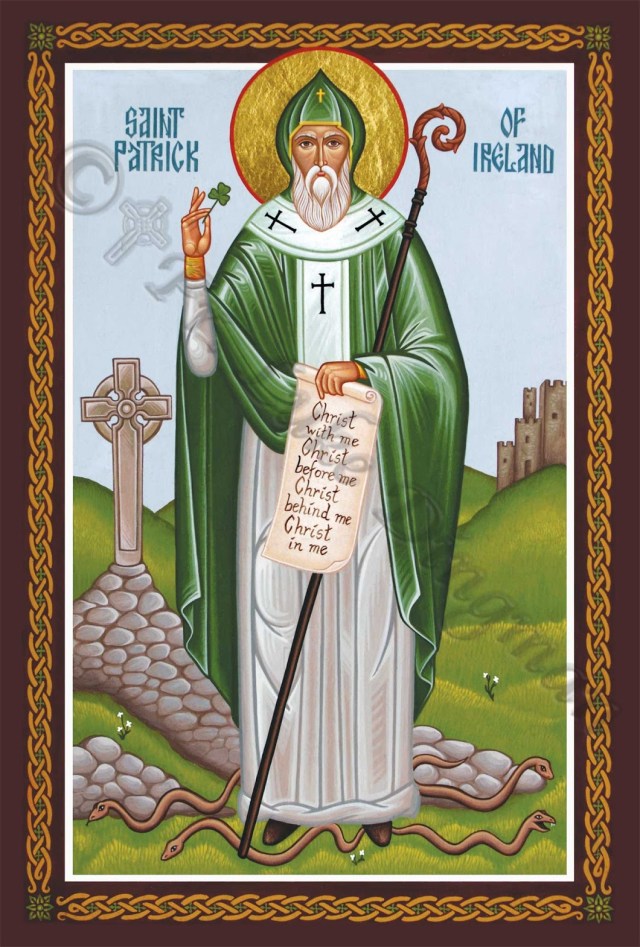
st patrick4

“In San Francisco there was one who got on fire with the idea of the Jesus Prayer. He began adding prayer to prayer, and he finally came to, in the morning, 5,000. Right in the middle of the world, in the middle of the city, in the morning, before doing anything else, before eating, he was able to say 5,000 Jesus Prayers on the balcony, and he felt wonderfully refreshed and inspired. It happened one morning that somebody else came out right underneath the balcony and began busying himself and doing something while this person was saying his last thousand, and it so happened that this person was so put out by this that he ended up by throwing dishes at him! How can you deal with a person occupying himself with the spiritual life, with the Jesus Prayer, when all of a sudden, while he is saying it, he is able to start throwing dishes?” (excerpt from Fr. Seraphim’s talk on St. Patrick’s day, see below for the full text)

A Homily by Fr. Seraphim Rose of Platina

EDITOR’S NOTE: As an example of Fr. Seraphim’s simple, down-to-earth approach to spiritual life, we present here a faithful transcription of one of his “unprepared” recorded talks. It was given on St. Patrick’s day, March 17, 1977, to monks and pilgrims at the St. Herman of Alaska Monastery. 

1. A PERSPECTIVE ON ST. PATRICK

THE CONFESSION OF ST. PATRICK [or here] is a very simple document about how he planned to serve God and a few of the trials and sufferings he went through. From what St. Patrick writes, we see that in his lifetime he did not have the universal glory that surrounds him today. He apparently did miracles and many people had great respect for him, but he still had difficulties with bishops and church people, and there was controversy over whether he was doing things the way he should be doing them. This shows us that even those who later become quite glorious have to go through—in their own lifetimes—the same struggles that each one of us must go through; and it’s not seen until the end whether a person even saves his soul.

It is extremely important that we look at St. Patrick, not from the point of view of glory in the eyes of men, but as he is: that is, spiritually—his spiritual worth. It is of absolutely no significance that today everybody wears green on his day. When I was going to school, you had to do something to anyone who didn’t wear green—tie him up or something. It was obvious that those who did this had no idea of what St. Patrick meant, or what kind of Orthodox saint he was; it was just that the general opinion had been formed in society that he was very important. Gradually he is deprived of all religious meaning, and in the end the honoring of his memory becomes something close to superstition, some kind of a totally meaningless ritual. Of course, this is not what we should look at St. Patrick for. He was a burning apostle of Christ, and because he was close to God, and because God chose him, he was able to convert the whole of Ireland’s people.

All of us are very inspired by lives like his, and this makes one want to do something oneself. What can one do? The inexperienced convert gets the idea: “Oh! I’ll go to Ireland and do something.” Of course, it will not work out. It will not be like St. Patrick because it could only be done once. In a small way it is possible to imitate him, but in general such literal imitations do not work out. We should look to lives like that of St. Patrick for some kind of inspiration or guidance as to what we can do ourselves in our own conditions.

What is realistic? What can we do to be burning with that same apostleship in the conditions we have today? We look around, and we see that there does not seem to be too much of the inspiring phenomena of St. Patrick’s era: whole countries being converted, great monastic revivals, great movements towards Orthodoxy. On the contrary, we look around and see things which may very easily make us discouraged. One asks why there are no great apostles like St. Patrick today. Of course, it is very realistic historically. There was an age of apostles, there was an age when whole peoples were unconverted and apostles were sent out to them. Today, virtually the whole world has heard about Christ, and there are very few totally pagan peoples left who are not getting the Word preached to them. In Africa, as we continue to hear, the Orthodox Gospel is being preached to those wild tribes, from one country to the next, in East and Central Africa. But in most places, the peoples of the world have become rather weary, tired, worn out people who once heard of Christianity and have now got bored with it. It is very difficult to inspire oneself with that. Here and there are a few converts who find that Christianity is something fresh, that it is not the same as the ordinary idea of it. Nevertheless, not too much is very inspiring when you look around the world, from the point of view of Orthodoxy.

Slemish_mountain_County_Antrim

Slemish, where St. Patrick lived as a slave in his youth


2. THE CONDITIONS OF MODERN LIFE

There are, of course, definite reasons for this. The conditions of the world today are quite different from what they were in the past. The whole phenomenon of the apostasy, of the falling away from the truth, means that people do not know how to accept the Gospel freshly. They have already heard about it and have been inoculated against it. Therefore, very few of them—when they hear the message of Orthodoxy—come.

Another thing in the air today that is different from earlier times is this “Mickey Mouse” atmosphere. It is the lack of seriousness that one sees in the air, in just everyday customs. For example, when people part, they say, “Take it easy”—the sort of thing that indicates: “Relax, take it easy, there’s nothing important going on. Just go along with whatever happens.” We used to say things like: “God be with you.” “Goodbye” even comes from the word “God”.

The young people of today are very much absorbed in the whole fantasy world of television. “Mickey Mouse’s” place is even called Disneyland, Disney World. Our whole spiritual and sober outlook is affected by this—even religious views. There is a very sincere fundamentalist Protestant in Florida who has a big parcel of land right next to Disney World, and who is going to make a replica of the Temple of Jerusalem, in order to attract the people going to Disney World to come over there for a spiritual thing, on the same level. They’ll be saying “ah! ” and “ooh! “—It will be the same thing as all the fairy castles they saw in Disney World. This whole atmosphere—this unreal, movie-type atmosphere is very much in, not only the air, but our very homes. It affects the whole seriousness of life, the way children are brought up—though children are obviously not brought up anymore. The whole idea of bringing them up, of raising them in a certain mold, is gone now. They just raise themselves, go into whatever influences are around, and the result is something very unserious. This is the chief reason why, when young people become independent, so many of them simply go crazy and get involved with various wild religions and drugs, why they run into crime and all kinds of mad things. In childhood they never had down-to-earth contact, either with spiritual life or simply with the seriousness of living from one day to the next. That is one of the chief things that makes our times different and much more difficult for spiritual efforts.

Another thing is all the modern conveniences which surround us and which, without a doubt, depersonalize and cause people to be less concerned for each other, more concerned about things, gadgets. The very idea of the telephone means that you can instantly have contact with someone for the sake of a message—nothing personal about it. If you have to go to great lengths to get to him, your soul is different than it would be if you just had to dial a number. All this makes our times different and very unfavorable to any kind of spiritual activity such as apostleship, missionary activity, leading just an ordinary spiritual life, monastic life and the rest.

Something else also is in our air which we Orthodox Christians have to be mindful of, and that is the weight of tradition. If we accept all that the Church hands down to us simply as something already accomplished, something given to us without our effort, as if it is just there and we can take it for granted—this already deadens us spiritually, because everything that is high must be fought for, must be struggled for. That is one reason why modern conveniences only depersonalize. The whole effort to make everything more convenient takes away the element of struggle, which is the fabric, the fiber of life.

With all these things in view, the whole of modern life becomes extremely oppressive. For a long time now, as far back as William Butler Yeats, seventy-five years ago or so, everything in the modern age had been accomplished and done, all the seeds had been sown. The twentieth century can add almost nothing of its own. It has only put into effect that which has already been sown in the eighteenth and nineteenth centuries. The result was that there was nothing more to do. Everything is done, it’s hopeless. As William Butler Yeats, a sensitive Irish poet, expresses it in his poem The Second Coming:

Turning and turning in the widening gyre
The falcon cannot hear the falconer;
Things fall apart; the centre cannot hold;
Mere anarchy is loosed upon the world,
The blood-dimmed tide is loosed, and everywhere
The ceremony of innocence is drowned;
The best lack all conviction, while the worst
Are full of passionate intensity.

Surely some revelation is at hand;
Surely the Second Coming is at hand
The Second Coming! Hardly are these words out
When a vast image of Spiritus Mundi
Troubles my sight: somewhere in sands of the desert
A shape with lion body and the head of a man,
A gaze blank and pitiless as the sun,
Is moving its slow thighs, while all about it
Reel shadows of the indignant desert birds.
The darkness drops again; but now I know
That twenty centuries of stony sleep
Were vexed to nightmare by a rocking cradle,
And what rough beast, its hour come round at last,
Slouches toward Bethlehem to be born?

This is a kind of factual view of life: the worst people are simply immersed in evil deeds and the best people are going frantic, because there is no more spirituality left, there is nothing left to strive for, everything is taken away, materialism is triumphing, there is no hope for the world, and “the beast slouches toward Bethlehem to be born”—the vision of Antichrist. The world is going hopelessly down and there is no hope of getting out.

3. THE TIMELESS SPIRITUAL LIFE

All of this is the negative side we see surrounding us today, and it is a very real part of the atmosphere we breathe every day. On the other hand, we have the Orthodox Christian revelation; that is, the revelation of God to His Church. It has come down to us now these two thousand years, very richly, with many testimonies of Scriptures and Holy Fathers, giving us a definite spiritual outlook, a definite spiritual law of life. The spiritual life and its aim do not change from one time to the next. In fact, we know that from the very beginning, from the time when the Gospel was first preached until now, there are being gathered out of the world citizens of one kingdom, all going towards the heavenly kingdom. All these citizens will speak the same language, and know each other, because they have gone through the one, same Orthodox life, the same spiritual struggle, according to the laws of spiritual life.

The Holy Fathers spoke about the latter times as times of great weakness, in which there would not be the great signs which were performed in the early times of the apostles and in the desert by the first monks, when thousands of miracles were being worked, great Fathers were raising people from the dead, many supernatural events were occurring; and these very Holy Fathers said that this dazzling age of miracles would fade away, and in the end there would be almost nothing at all like that. In fact, those who would be saving themselves would seem totally indistinguishable from everybody else, except that they would somehow keep alive the struggle against all these temptations. Just keeping alive the spark of the true Christian Faith, without making miracles, without doing anything out of the ordinary, would already make them, if they endured to the end, as great as or even higher than those great Fathers who worked miracles.

Therefore, in our times, it seems that outward activity for Orthodox Christians is greatly limited in comparison with past times. It seems that way. Still, the inward spiritual activity must be just as possible for those who are willing to struggle. And, in fact, we look around us and we see rather spectacular examples in our century: St. John of Kronstadt, who worked thousands of miracles, probably more miracles than anyone in the history of the Church; St. Nectarios in Greece, a very humble person, in complete disgrace as a bishop, but a wonder-worker especially after his death; and our own Archbishop John [Saint John of San Francisco, glorified in 1994], who lived and actually walked our very soil and passed within forty miles of here many times, undoubtedly blessing all this area, especially with the icon of the Kursk Mother of God. And so it’s obvious, in looking at these people and realizing they are spiritual giants, that it is possible to do something even in our evil times.

st patrick-ireland

St. Patrick, using the shamrock to teach about the Holy Trinity

4. AWARENESS

This brings us to some of the practical considerations concerning the qualities needed for being spiritually creative and fruitful. There are a few important things which come to mind. One thing is that we must see things the way they are; that is, not go off blind, acting blindly without knowing what’s going on in the world. We must be aware that there is such a thing as apostasy, that there are many different kinds of people who call themselves Christians, that they are acting in different ways and some of them are definitely in conflict with each other and with us, and that it can’t be that all of them are right and are on the right path. We can see historically how many different kinds of errors, wrong views, wrong kinds of actions got mixed in with Christian faith. We see the frightful modern revolutionary movement; that is, the movement totally away from religion, aiming towards a great world empire of atheism, a foreshadowing of which is seen in Communism. This is not just among the unbelievers or among those who don’t believe in the Orthodox way, but even among Orthodox people. We look around and see that many Orthodox people are simply, totally worldly and do not think about the higher side of their Faith. They take it for granted. “It’s all automatic. That’s what has been handed down. There’s always a priest somewhere. If he’s not in this town, he’s in the next one. He has sacraments and Holy Communion. We just go to him and get what we need and that’s all…. You go home and you’re satisfied…”

By reading and getting a historical perspective, we see that in past ages this was not considered enough, even by ordinary laymen. They were constantly doing things out of the ordinary. They were getting up very early in the morning. Every village had daily services. At four or five o’clock in the morning, Matins would begin. The people woke up and they went to church every morning, and again to Vespers in the evening. We take many, many Lives of Saints, and we read how they heard the church bell when they were children. If the child was very zealous for God, he would be the first one up in the morning and he would wake the parents up and get them ready for church. If the father could not go because he had to work in the fields, the child would get the mother up and they would go to church. Sometimes he went by himself. The whole atmosphere was penetrated with churchliness. And now, we see worldliness. Very seldom can one find a place where even daily services are celebrated in the world. People have grown unaccustomed to the idea that there is supposed to be an everyday church, everyday church services.

This, then, is one of the very great things which we see in front of us: this worldly attitude of people who are themselves in the Church. We must look at it realistically and see it the way it is: apostasy, error, evil, demonic activity and worldliness such as never before in the history of the world. These things are all anti-spiritual, anti-Orthodox. They lead down; and if anyone follows these paths, they do not lead one to salvation.

Then, once having done this—that is, having looked at things the way they are and been realistic about them—one must learn to fight on the right battlefields. The whole spiritual life is struggle. One must learn to know where one must fight, what one must do. This is extremely important, because it is very easy in the beginning stage to go totally off, by picking up and reading a book that talks about spirituality, hesychasm, and so on.

5. IMITATION SPIRITUALITY

Bishop Theophan the Recluse [+1894], when quoting some of the Holy Fathers, deliberately omitted many of the passages which dealt with the physical sides of prayer. He did this knowing that—even in his time, the 19th century—many people would take those physical aspects as the end and begin imitating without getting the essence. Therefore he just left those writings out of his published works. Now, however, many of them are being published in English and you can read how you are supposed to sit on a stool with your head down, etc. People begin to imitate; they begin to think “this is it! “—and it is a matter of fact that if you fast for a long time and do certain exercises, you begin to have all kinds of things happen to you. But that is not spiritual life. It is almost guaranteed, on the contrary, that it is the activity of demons. The spiritual life is much more serious, much more down-to-earth, and therefore that is not the place where you are supposed to find it first of all.

Usually one can spot people who are not serious and are imitating. We even have a story from the early history of our brotherhood…. In San Francisco there was one who got on fire with the idea of the Jesus Prayer. He began adding prayer to prayer, and he finally came to, in the morning, 5,000. Right in the middle of the world, in the middle of the city, in the morning, before doing anything else, before eating, he was able to say 5,000 Jesus Prayers on the balcony, and he felt wonderfully refreshed and inspired. It happened one morning that somebody else came out right underneath the balcony and began busying himself and doing something while this person was saying his last thousand, and it so happened that this person was so put out by this that he ended up by throwing dishes at him! How can you deal with a person occupying himself with the spiritual life, with the Jesus Prayer, when all of a sudden, while he is saying it, he is able to start throwing dishes?

This means that inside of him the passions were free, because he had some kind of deceived idea or opinion that he knew was right for himself spiritually.  He acted according to his opinion, but not soberly, not according to knowledge; and when the opportunity came, the passions came out.  In this case it is more profitable not to say those 5,000 Jesus Prayers, but to do something else that is spiritual.

This, then, is not where we should be fighting the battle.  We should begin fighting the battle right on the level of awareness, by being aware that we are surrounded by worldly forces.  We must fight them by keeping our minds constantly up rather than down; that is, having in mind heavenly things.  (I will explain shortly what is involved in this). For all practical purposes, in our times this means that we will have to be a little crazy; that is, we will not be in step with what ordinary church people are doing. We will be considered a little, at least a little, out of the ordinary, or even crazy.  This is an absolutely essential thing.  I’ll come back to this theme.

st patrick's grave

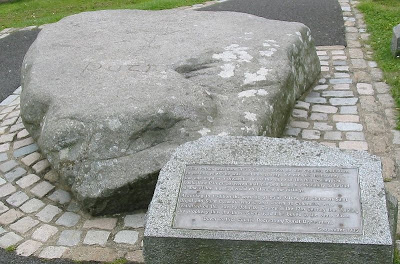
The purported grave site of St. Patrick in Downpatrick

6. LOOKING UPWARD

The Holy Scriptures, the writings of the Holy Fathers, the examples of Saint’s lives, the services of the Church—all these things have to do, not with worldliness in our daily life, but with conducting us to heaven. By looking above to these things, we are enabled to have zeal; that is, to see that there is something above this routine of worldliness, which is very boring, discouraging, and leads nowhere. But these higher things—these services, tales of people who have come back from the dead, Lives of Saints, writings of the Holy Fathers, Holy Scriptures, the interpretations of the Holy Fathers on passages of Scripture, which are very profound sometimes—these things always make us very zealous, if we have a spark of love for God within ourselves. We want ourselves to be living in such a state and to be going to heaven. But this zeal,  by itself, must be of such a kind that it does not come just in a spurt and then eventually fade away. It must be of such a kind that it will last. This means the zeal must be tempered by something deeper, and that something deeper is what St. Seraphim calls determination; that is, zeal that is constant and keeps going—a sort of constant point for your whole life. It keeps you going even when you’re discouraged, because you see that there is something above towards which you are striving, and which does not depend upon your moods or your opinions. It is something which must be your constant possession. It is your determination to get to heaven. And this determination, or rather this zeal which becomes determination, must be constant, so that it will not go up and down and burn out.

In everything that happens, we must look at the higher side, that is, the spiritual side; because if we are sometimes looking at the higher side and sometimes at the lower side, we will be up and down. And the lower side is so powerful, operating even through what we saw in the life of St. Patrick in the golden age of Christianity: even through bishops, through those who are supposed to be the very ones leading the flock to heaven. They can be contrary, because they are human beings also. They can be actually discouraging, keeping people away from that goal; in our times, of course, it is even worse.

Therefore, if we are sometimes looking above and sometimes below, if we are going one foot forward, one foot back, and then one foot forward and two feet back, we will simply not get to the gate of heaven. We must be at all times where we are in some way looking at the spiritual reality. I have an interesting quote from Abba Dorotheos of Gaza which we read just recently in church, and which gives a little hint about this. He says: “It is good, O brethren, as I always tell you, to place your hope for every deed upon God, and to say nothing happens without the will of God. Of course, God knew that this was good and useful and profitable, and therefore He did it, even though this matter also had some outward cause. For example, I could say that inasmuch as I ate food with pilgrims and forced myself a little in order to play the host to them, (that is, he overate) therefore my stomach was weighed down, and there was a numbness caused in my feet, and from this I became ill. I could also cite various other reasons for one who seeks them. For one who seeks them there is no lack of them. But the most sure and profitable thing is to say: in truth, God knew that this would be more profitable for my soul, and therefore it happened in this way. For out of everything which God creates, there is nothing of which it can be said that it is not good. For in the beginning He created all, and behold, they were all very good. And so no one should grieve over what happens, but in everything he should place his hope in God’s Providence, and be at ease.”*

7. FINDING THE REAL CAUSES

There is a very interesting book from the same period of Abba Dorotheos (the sixth century) by St. Gregory of Tours, History of the Franks, which is all about the life at the court of that time and religious people. There are very many interesting lives of Saints in it, as well as the lives of the kings. The kings of that time were particularly unedifying spectacles. They were constantly poisoning each other. The women were even worse…. There was one Brunehild and her sister Fredegund. They were trying to get their sons and grandsons on the throne, and what they didn’t do to get them there! They were dragging people by horse’s tails and killing them off, and lying and cheating and fantastic things—very uninspiring. But this bishop, St. Gregory, was there and was writing a history of this people, writing in such a way that it actually comes out very inspiring. Behind everything there is a meaning. St. Gregory is constantly on the lookout for comets, earthquakes, and such things. When a king does something wrong, there is an earthquake nearby, or if he goes and kills a person or a whole village unjustly, then there is a famine: and St. Gregory always sees that God is looking out. There is always something spiritual whenever something happens—a comet is seen, the king dies, etc. There is always a connection between what happens in the world and the moral state of the people. Even when the moral state is very bad, all the constant earthquakes and famines and everything else remind us that it is the wrong way to behave, and inspire people to behave correctly. Nowadays, the historians say that this is a horribly outmoded way of looking at things, that it is very “quaint” and “naive” and unsophisticated, and that of course nobody can think like that now. They think it’s very cute, in fact, to look at this after all these centuries and to see how people used to think. “But of course,” they say, “we serious historians are looking for the real causes.” By real causes they mean what a person ate and what it caused his feet to do and so forth. The Christian point of view, however, is that these are not the real causes, but the secondary causes. The real cause is the soul and God: whatever God is doing and whatever the soul is doing. These two things actualize the whole of history, and all the external events—what treaty was signed, or the economic reasons for the discontent of the masses, and so forth—are totally secondary. In fact, if you look at modern history, at the whole revolutionary movement, it is obvious that it is not the economics that is the governing factor, but various ideas which get into people’s souls about actually building paradise on earth. Once that idea gets there, then fantastic things are done, because this is a spiritual thing. Even though it is from the devil, it is on a spiritual level, and that is where actual history is made; all the external things mean nothing.

Thus St. Gregory is actually looking at history in the correct way, because he sees that there is a first cause, which is what God does in history and how the soul reacts to it, and that the secondary cause is ordinary events. Therefore, whenever he sees some great event like a comet or an eclipse, he tries to give it meaning. At one point, in telling of a strange sign that was seen in the sky over Gaul, he says in all simplicity, “I have no idea what all this meant.”** Of course, from the scientific point of view we know that we can predict these things, that they are caused by the shadow of the moon and so forth; but from St. Gregory’s point of view, why does God choose to frighten us like this? What is the moral meaning of it? He was constantly looking above, not below.

8. CONSTANT CHEERFULNESS

Our whole modern outlook is to look below to find the causes, the secondary causes. The whole Christian outlook is to look above, and that is why such people as St. Gregory as we can see by reading their writings and their lives—are constantly cheerful. This does not mean that they are overly happy, but rather that they are in a state of deep happiness, because they are constantly looking above and keeping in mind, with determination and constancy, to get to a certain place, which is heaven, and thus they see all the details in the world in that light. If what they see has to do with evil, with the nets of demons, with worldliness, with boredom, with discouragement, or just with ordinary details of living, all that is secondary and is never allowed to be first. In fact, we are told by the Holy Fathers that we are supposed to see in everything something for our salvation. If you can do that, you can be saved.

In a pedestrian way, you can look at something like a printing press which does not operate. You are standing around and enjoying yourself, watching nice, clean, good pages come out printed, which gives a very nice sense of satisfaction, and you are dreaming of missionary activity, of spreading more copies around to a lot of different countries. But in a while it begins to torture you, it begins to shoot pages right and left. The pages begin to stick and to tear each other on top. You see that all those extra copies you made are vanishing, destroying each other, and in the end you are so tense that all you can do is sort of stand there and say the Jesus Prayer as you try to make everything come out all right. Although that does not fill one with a sense of satisfaction (as would watching the nice, clean copies come out automatically), spiritually it probably does a great deal more, because it makes you tense and gives you the chance to struggle. But if instead of that you just get so discouraged that you smash the machine, then you have lost the battle. The battle is not how many copies per hour come out: the battle is what your soul is doing. If your soul can be saving itself and producing words which can save others, all the better; but if you are producing words which can save others and are all the time destroying your own soul, it’s not so good.

9. DAILY SPIRITUAL INJECTIONS

Again, in everything one must be looking upward, and not downward, at the kingdom of heaven and not down at the details of earthly life. That is, the details of earthly life must be second, and this looking upward must be with zeal, determination and constancy. Constancy is something which is worked out by a spiritual regime based upon wisdom handed down from the Holy Fathers—not mere obedience to tradition for tradition’s sake, but rather a conscious assimilation of what wise men in God have seen and written down. On the outward side, this constancy is worked out by a little prayer, and we have this basic little prayer in the church services which have come down to us. Of course in different places they are performed according to one’s strength, more or less.

Constancy involves also a regular reading of spiritual texts, for example at mealtime, because we must be constantly injected with other-worldliness. This means constantly nourishing ourselves with these texts, whether in services or in reading, in order to fight against the other side, against the worldliness that constantly gnaws at us. If for just one day we stop these other-worldly “injections,” it is obvious that worldliness starts taking over. When we go without them for one day, worldliness invades—two days, much more. We find that soon we think more and more in a worldly way, the more we allow ourselves to be exposed to that way of thinking and the less we expose ourselves to other-worldly thinking.

These injections—daily injections of heavenly food—are the outward side, and the inward side is what is called spiritual life. Spiritual life does not mean being in the clouds and saying the Jesus Prayer or going through various motions. It means discovering the laws of this spiritual life as they apply to one in one’s own position, one’s situation. This comes over the years by attentive reading of the Holy Fathers with a notebook, writing down those passages which seem most significant to us, studying them, finding how they apply to us, and, if need be, revising earlier views of them as we get a little deeper into them, finding what one Father says about something, what a second Father says about the same thing, and so on. There is no encyclopedia that will give you that. You cannot decide you want to find all about some one subject and begin reading the Holy Fathers. There are a few indexes in the writings of the Fathers, but you cannot simply go at spiritual life that way. You have to go at it a little bit at a time, taking the teaching in as you are able to absorb it, going back over the same texts in later years, reabsorbing them, getting more, and gradually getting to find out how these spiritual laws apply to you. As a person does that, he discovers that every time he reads the same Holy Father he finds new things. He always goes deeper into it.

10. PRESERVING ZEAL

If one has all this in mind, having the possibility of constant spiritual nourishment, then one must say that it is not true that the whole church situation is hopeless today and that one can do nothing. In fact, the possible activities for today are quite surprising and unexpected. What might come out, we don’t know, but there are all kinds of possibilities. We should always learn to expect what is the unexpected, to be prepared for something that might not have been the same way just a little while ago, but that is still within the possibility of true Christianity. This is only done by looking up and not down. We have right in front of us an example of somebody who was like that constantly, and that’s our Archbishop John. It is obvious that he was constantly in a different world. He himself, I recall once, gave a sermon on the spiritual life, the mystical life, in which he said: “We have no such thing as some of the later saints of the Latin Church who were sort of up in the clouds—some kind of a realm of sweetness and light and pink clouds—that’s prelest. All of our sanctity is based upon having your feet straight on the ground, and, while being of the earth, constantly having the mind lifted upward.” It’s obvious that Archbishop John was himself like that. He would come from time to time to our shop next to the Cathedral [in San Francisco], and would always have something new and inspiring to say. He would come with a little portfolio, and would open it up and say, “Look! Here is a picture of St. Alban and here is his Life.” He had found it somewhere. He was collecting these things: the lives of Romanian saints and all kinds of different things which were very inspiring and had nothing to do with everyday business or the administration of the diocese. In fact, some said he was a bad administrator, but I don’t know. I doubt it, because I know that whenever anyone wrote him a letter, that person always got a reply back in the language he wrote it in, within a very short time; therefore, when it came to things like that, he was very, very careful. But the first thing he was careful about was being constantly in the other world, constantly inspired and constantly living by that. The opposite of this is to make even the Church into some kind of business, to be looking at only the administrative side or the economic side or the lower, worldly side. If you do that long enough, you will lose the spark, you will lose the higher side. Archbishop John gave us the example of constantly looking up, constantly thinking of the higher things. In the end, the deeper you get into this, the more you see that there is nothing else possible. If you are an Orthodox Christian, you can do this and have people call you crazy or say that you are a little bit touched, or something like that; but still you have your own life—you lead it and you get to heaven. The alternative is to be bogged down in this boring world, which is totally overrun by machines and conveniences and opinions. You would be surprised at how these, opinions about what is right and what is wrong, what is the way to act and so forth, have no contact with reality. It even happens that there is a certain opinion in the air—I’d say it is universal among church people if they ever stopped to think about it—that of course, when you come to church you must be warm, because you cannot think about church services and prepare yourself for Communion when you have to think about cold feet. People tell us this. “It’s a very great draw back,” they say. “You cannot go and have cold feet and expect to have any spirituality come out.” This happens to be an opinion, and it’s totally off. The Holy Fathers have been living throughout the centuries in all kinds of conditions; and, though there is no deliberate plot of torturing oneself with cold feet—still, this is something which helps to make one a little more sober about the spiritual life, perhaps to help one to appreciate what one has, and not to just take for granted that one is going to be comfortable and cozy and that’s it. In our time, if one undertakes anything in the Church, and does not have in mind to be looking constantly to the heavenly realm, one will lose the spark of zeal, the interest in doing spiritual things, and will become worldly. Worldly means dead, spiritually dead.

st patrick6.jpg

11. THE MIND OF THE FATHERS

It is very difficult in our times to be looking to heaven, because of all the weight, the dead weight of worldliness which lies upon us. If one applies oneself constantly, however, one can begin to do it. Even with a little bit of struggle, if applied constantly, one begins to form for oneself a whole different viewpoint, a whole different way of looking at life, a whole different possibility for action. Any kind of spiritual activity that is to come out of our world today, any kind of Orthodox missionary activity, apostleship, etc., must be on the basis of such a view of things. It must be based on looking first at what God wants, first at what is the higher side, first at what the Holy Fathers think, and only then looking down at the practical means one has to use, at money problems, and even at things like sicknesses, because they are all sent for our good, and we have to find how to bring the good out of them. If one does not do that, one is weighed down, especially in our days. If a person is in a place of leadership, such as a priest in a parish, and if he is going to look back and look first at the people, he will see that 99% of them are going to drag him down, because they have their problems and passions, confessions weigh him down, and so on. If this side becomes too important for him, it simply drags him back and he cannot lead them to heaven. Of course, a pastor or any kind of spiritual leader must be leading to heaven first himself and then the others, by looking first to the other world. We don’t have to imagine what that other world is like or have opinions about it, because we have the whole treasury—much of which is now available in English—of the writings of the Holy Fathers. Recently we have had such great fathers as Bishop Ignatius Brianchininov (+1867), who was one of the sharpest ones to speak about the apostasy, and also one of the greatest ones to speak about the Holy Fathers. We must get into their language, into their way of looking at things, because that is Orthodoxy. Orthodoxy, of course, does not change from one day to the next, or from one century to the next. Looking at the Protestant and Roman Catholic world, we can see that certain spiritual writings get out of date. Sometimes they come back into fashion again, sometimes they go out. It is obvious that they are bound up with worldly things, which appeal to people at one time, or rather to the spirit of the times. This is not so with our Orthodox holy writings. Once we get into the whole Orthodox Christian outlook—the simply Christian outlook—which has been handed down from Christ and the apostles to our times, then everything becomes contemporary. You read the words of someone like St. Macarius, who lived in the deserts of Egypt in the 6th century, and he’s speaking to you now. His conditions are a little different, but he’s speaking right to you now, in the same language; he’s going to the same place, he’s using the same mind, he has the same temptations and failings, and there’s nothing different about him. It’s the same with all the other fathers from that time down to our century, like St. John of Kronstadt (+1908). They all speak the same language, one kind of language, the language of spiritual life, which we must get into. When we do that, we can save ourselves; and, as St. Seraphim says, “When you acquire the Spirit of Peace, the Holy Spirit, you can save thousands around you.” It is not for us to calculate whether thousands around us will be saved. It is only for us to acquire the Holy Spirit, and what God will do with that is His doing.

We have yet to expect in our times many surprising things, so we should not have the opinion that it is too late to do anything, everything is stuck, nobody cares, the world is collapsing…. All that is opinion, and opinion is the first stage of prelest (deception). Therefore we should free ourselves from being stuck in opinions, and should look at things freshly, i.e., according to the spiritual life. Father Nicholas Deputatov, who is obviously one who has much love for the Holy Fathers, has read their writings, underlined them and written them out in books. He says: When I get in a very low mood, very discouraged and despondent, then I open one of my notebooks, and I begin to read something that inspired me. It is almost guaranteed that when I read something which once inspired me, I will again become inspired, because it’s my own soul that was at one time being inspired, and now I see that it was something which inspired me then and can nourish me now also. So it’s like an automatic inspiration, to open up something which inspired me before.

Thus, when we think of someone like St. Patrick, our attitude should not be merely: “Aha, that was a long time ago, that was inspiring; but now—well, what’s the use?” On the contrary, in the activity of St. Patrick we should see the activity of a contemporary person, of a soul who was burning with zeal and love for God. He has gone to that country where we are to be citizens, if only we will strive. We are all of the same nationality, the Christian race. St. Patrick’s life should be for us a contemporary thing, something which applies to us today. Whatever inspiration we can take from it, is for us right now. And however much fruit this bears, depends on how much we love God and how much opportunity there is. The inspiration is ours for free.

Endnotes

* The Counsels of Abba Dorotheos, chapter 12 (translated from the Russian version by Fr. Seraphim Rose).

** The History of the Franks, V, 23.

St. Patrick2


Troparion — Tone 3

Holy Bishop Patrick, / Faithful shepherd of Christ’s royal flock, / You filled Ireland with the radiance of the Gospel: / The mighty strength of the Trinity! / Now that you stand before the Savior, / Pray that He may preserve us in faith and love!

Kontakion — Tone 4

From slavery you escaped to freedom in Christ’s service: / He sent you to deliver Ireland from the devil’s bondage. / You planted the Word of the Gospel in pagan hearts. / In your journeys and hardships you rivaled the Apostle Paul! / Having received the reward for your labors in heaven, / Never cease to pray for the flock you have gathered on earth, / Holy bishop Patrick!
God is glorified in His Saints! St Patrick pray for us!

First Week of Great Lent at a Monastery

lent1.jpg

First Week of Great Lent at a monastery

I couldn’t agree more! A pilgrimage to a monastery is always such a blessing, an  experience to treasure for life. Especially during Great Lent, and more so during the First Week of Great Lent. I feel so blessed behind its gates, either in the stillness of my cell, engaged on finishing a book about St. Paisios,  or in the hesychia of its temple in the long, penitential Lenten services.

penitents2

Repentance, Penitential Canon,Romanian Academy Library

penitents1

Humility penitents


Striving to Live a Christ-centered Life: Five Reasons to Visit a Monastery By Matushka Constantina Palmer

Introduction: Journeying by boat to visit their beloved spiritual father, , Constantine Palamas – the father of St. Gregory – suddenly realized he and his family had forgotten to bring food with them for the monastery. While his wife and five children looked on, he raised his voice in prayer and put his hand into the sea; immediately he caught a massive fish. Taking it out of the water, he glorified God for the miracle. Out of his great admiration and respect for the monastic life, Constantine Palamas worked a miracle so that his family would not arrive at the monastery empty-handed. In this way, and in countless others, he instilled in the hearts of his children a firm love for and reverence of monasticism.

This practice of going out into the wilderness to seek a word from a holy monastic is a tradition well established in the Church as early as Christ’s own times. St. John the Forerunner was the first monk, and people sought him out, as St. Andrew of Crete testifies: “The Forerunner of grace dwelt in the desert and all Judea and Samaria ran to hear him.”[1] He, like many of our prophets before him, preached amendment of life ….

Source: Five Reasons to Visit a Monastery

The Struggle of Great Lent – Ι


At this time we’re entering the great spiritual arena of the blessed Great Lent. Holy and Great Lent is a time of compunction, for repentance, for tears, for a change in ourselves, for a new stage in the spiritual life. Like an affectionate mother caring for her children, us Christians, the Church has designated this time of Lent as dedicated to the struggle, in order to help its children fight harder, to purify themselves, draw closer to God and to counted worthy of celebrating the great day of the radiant Resurrection.

lent

Christians, especially monks, have always paid particular attention to this spiritual arena and have thought it especially sacred, because it’s a period which envisages both spiritual and bodily struggles. There’s the struggle of fasting, the struggle of vigils, the struggle of purification and the struggle to fulfill one’s spiritual duties which are many more than at other times of the year. There’s a spiritual “defragmentation” and people pay greater attention to the voice of their conscience in order to correct what they’ve maybe neglected and to improve spiritually.

The Church assists us but with penitential hymns and services, as well as with teachings, to oil us up for the fight for the purification of our souls.

We have the penitential evening Divine Liturgies of the Presanctified Gifts. The Presanctified is extremely beneficial. It’s Cherubic Hymn is full of spirituality, contemplation, angelic presence. That’s why we should come to these liturgies during Great Lent with even greater compunction. We who consume the Body and Blood of Christ must be so pure and clean, so straight in body and soul for divine grace to have its effect. For this reason we must lead very careful lives. Both n our cells and in church we must wet our face with tears so as to wash our souls and be worthy to take communion. Of course, the devil often makes us wanting in compunction, me more than anyone. Which means we can’t have tears and we often have bad thoughts. Bad thoughts and the sinful images that accompany them must be rejected as soon as they make their appearance. And when we have wicked thoughts or our soul is cold towards one of the brethren, let’s not approach the God of lover, Who is so pure and holy.

Throughout this period, at every service in Great Lent, we say the prayer of Saint Efraim the Syrian, whish is as follows: “Lord and Master of my life, do not give me the spirit of sloth, inquisitiveness, lust for power or idle talk, but give rather the spirit of sobriety, humility, patience and love to me, your servant. Indeed, Lord King, grant me to see my own errors and not to judge my brother, for you are blessed to the ages of ages. Amen”.

With these words, the saint wishes to make us understand very clearly, that, apart from other virtues we need to take special care with the last case, that of self-censure and of criticism of our bothers and that without love for our fellow human beings there’s no chance of making even the slightest progress towards our spiritual purification. If we don’t pay attention to our thoughts, our words and our heart, there’s no benefit in fasting. Fasting is of benefit when it’s combines with love for our neighbour and when we don’t criticize others. When we don’t criticize our fellows and instead criticize ourselves, then we’re marked by love for others and love for our soul, concern for purification and the fulfillment of the great commandment, that of love of God and one’s neighbour. Love for God and for our fellows  are the two great virtues which support the whole of the spiritual structure, because if they are absent, they others cannot take form. “God is love and those who live in God in love have God living in them, too” (I. Jn. 4, 16).

Another issue which demands that we push ourselves as hard as possible is prayer We should pray in the name of Christ, without neglecting any opportunity and without any waste of time. In the personal vigil in our cell, we should push ourselves, shouldn’t let sleep overcome us, nor neglect nor idleness; we should engage willingly I spiritual matters. As soon as we wake up, prayer should take first place then our rule, our prayer-rope, study and the contemplation of God. We should go to church with great readiness and so get the best results from our presence in the arena.

Apart from this, fasting together with bodily exertion helps as regards the forgiveness of sins. “Behold my humility and my efforts and forgive all my sins”. When we labour with the fast, with kneeling, with prayers, with an effort from our heart and mind, this Godly exertion is holy and is richly rewarded by God, because it make people worthy of the crown of glory and honour. The demons fear the fast greatly, because it lays them low. “This kind [of demon] will not depart other than with prayer and fasting”, said the Lord (Math. 17, 21). This is why the holy fathers always began any Godly task with a fast. They considered a fast to be very powerful and that the Holy Spirit does nor overshadow people when they’re replete with food and their stomachs are full. And any Christian who desires purification has to start from this foundation which is fasting, prayer and vigilance. When these three are combined, then people have acquired great stature.

In olden times, the fathers had a holy custom. On the eve of Lent, they would leave the monasteries and go deeper into the desert, where they lived in great asceticism until Lazarus Saturday, when they returned in order to celebrate Palm Sunday all together. Some would take a few of the basic essentials as far as food was concerned, others would eat only green plants, in order to struggle more fiercely in the desert. Thereafter they would spend all the days on Great Week together in church, existing on a piece of fried rusk and a few nuts a day. We were given the blessing and the grace of knowing ascetic people who spent not only Great Lent in fasting and spiritual struggle.

Our departed elder, Elder Iosif the Cave-Dweller (he used to live in caves, which is where I met him), kept a very strict fast during Great Lent. And, of course, he imposed it on us, too. From Monday to Friday, five days of the week there was no food, except a handful of flour, from which we made a batter with just water. That was it. A little plate every twenty-four hours. And, at the same time, hard work lifting loads on our back during the day and the whole night hundreds of prostrations and hours of prayer. And all of this in order to purify the inner person, to make it cleaner, more honourable in the eyes of God, in order to acquire boldness before God and be able to pray for the whole world. Because the world, people everywhere, needs the prayers of the saints, particularly those of ascetics. Saint Anthony the Great supported the whole world with his prayers.

By Elder Ephraim of Arizona, a living legend, a priest-monk for almost 60 years, who has served as an elder for more than 50 years. He was a disciple of Elder Joseph the Hesychast of Mount Athos and lived in monastic obedience to him for 12 years until his Elder’s repose in 1959. He is the spiritual guide of several monasteries on Mount Athos and Greece, and has founded several (20 and going!) monasteries in the United States. He resides in Arizona at St. Anthony’s Greek Orthodox Monastery.


 For those who cannot understand Greek, please do not despair 😃, as there is a translator in English, and Greek and English sessions alternate throughout the video.

Source: Pemptousia

[To Be Continued]


Do Not Turn Away Thy Face From Your Child

icon6

Kalo Stadio!

“Kalo Stadio!” is a traditional monastic greeting in Greek as we begin Great Lent. Literally it means “Good stadium!” The hymns of the season tell us that now we are entering “the arena of the virtues” where we will do battle.  By their prayers, may we contend well.


Do not turn away thy face from your child, because  I am distressed. Please answer my prayer quickly, take care of my soul, and redeem her.

This was my great grandfather’s, Seraphim’s Rose of Blessed Memory favourite Lenten hymn, and they would always see him secretly wipe tears while chanting it.

*

Saint Luke, Bishop of Simferopol and Crimea, the Blessed Surgeon once literally experienced our Saviour’s turning away of His face from him, when he prayed with tears in front of His icon, doubting and complaining in his heart against the Lord. He had been ‘informed’ in prayer before that his (first) exile would soon been brought to an end, yet the days would pass without any news or change. Why was God’s promise delayed to him? “Suddenly, I saw Christ in the icon, turning away His face from me. Scared, despaired, I dared not look at the icon anymore. ‘With my tail between my legs’ I left the altar and entered the … chapel. …I started reading the Epistles, the first excerpt that came to my eyes. Unfortunately I cannot remember the excerpt, but it wrought an amazing result. I found in it … my impertinence to grumble against God, and my lack of understanding. I was also reassured that I will indeed be freed, impatient that I was. I returned to the altar and saw with joy that Christ was looking again at me with his kind eyes full of Joy and Light. Wasn’t this a miracle?” (Saint Luke, Autobiography,  Voyages a Travers la Suffrance).


Likewise, St. Luke’s wife, experienced something similar  on the eve of her wedding! “In Chita, I married a nurse who had previously worked in Kiev’s military hospital, and her nick name was ‘Saint’. Two doctors before me had asked her to het married to them, but she had refused, because she had taken an oath of chastity. In accepting to marry me, she broke her vow. The night before the Sacrament of our marriage, in the church that Decembrists [ie. Russian rebels led by Russian army officers  in a protest against Nicholas I‘s assumption of the throne] had built, while she was praying in front of Christ’s icon, she suddenly had the impression that the Lord was indeed turning His face away from her, and that His Face kept disappearing from the icon! This was obviously a reminder of her vow. Since she did not keep it, the Lord intended to punish her unsparingly, harshly, by upsetting her with an unbearable, pathological jealousy. (Saint Luke, Ibid)

*

Arise, O my soul, O my soul, why sleepest thou? The end draweth near, and thou shall be confounded.  Arise, therefore, from thy sleep, and Christ our God, who is in all places and filleth all things, shall spare thee.

*

Saint Romanos the Melodist or the Hymnographer (Greek: Ῥωμανὸς ὁ Μελωδός, often Latinized as Romanus or Anglicized as Roman), was one of the greatest of Greek hymnographers, called “the Pindar of rhythmic poetry”. He flourished during the sixth century, which is considered to be the “Golden Age” of Byzantine hymnography. Of his other Kontakia, one of the most well-known is the hymn, “My soul, my soul, why sleepest thou…” which is chanted as part of the service of the “Great Canon” of St. Andrew of Crete on the first and fifth Thursday of Great Lent.

*

Lenten Prayer Of St. Ephrem The Syrian

O Lord and Master of my life!
Take from me the spirit of sloth,
faint-heartedness, lust of power, and idle talk.

But give rather the spirit of chastity,
humility, patience, and love to Thy servant.

Yea, Lord and King! Grant me to see my own errors and not to judge my brother, for Thou art blessed unto ages of ages. Amen.

*

Have a Blessed Great Lent everyone! Kalo Stadio!!  Good fight in the spiritual arena!! May the Lord bless our struggle in the ‘arena’! May our Lord never turn His face away from us! 


Incorrupt Relics in Texas

dmitri.jpg

Archbishop Dmitri of Dallas

aaaa

St. John the Russian

Could there be another incorrupt hierarch in America? Archbishop Dmitri of Dallas appears to be incorrupt. Read the news here. You can read about other incorrupt holy hierarchs in America here, her…

Source: May God be Glorified: Incorrupt Relics in Texas

 111_1

To the Eastern Orthodox Church, incorruptibility continues to be an important element for the process of glorification. An important distinction is made between natural mummification and what is believed to be supernatural incorruptibility. There are a great number of eastern Orthodox saints whose bodies have been found to be incorrupt and are in much veneration among the faithful. These include:

111_1

“For centuries, and in monasteries especially, it has been observed by the Church that often only one or two bodies, among many buried in the same place, remain incorrupt. This would have no meaning, were it not for the fact that, through such long-term empirical observation, it has also been ascertained that these incorrupt bodies, as well as skeletal remains bearing a certain color or fragrance, are almost always those of individuals who lived exceedingly and exceptionally virtuous lives. The supernatural phenomenon which we acknowledge, then, is not the incorruptibility or exceptional quality of remains as such, but the virtuous lives to which these attributes attest. Likewise, when we venerate relics, we are not venerating the miracle of bodies that do not decay (indeed, there are instances in Church history where the bodies of corrupt people have remained whole after death); rather, we approach relics, whatever their state of incorruption, out of awe for the virtues that once adorned these precious remnants of the human body. Relics, like Icons, are, of course, Grace-bestowing; but ultimately they serve to lift us up and beyond their material form to the Saints who bequeathed them to the Church. Their final reality is understood only by those who attain to this communion with the Saints, which is ultimately communion with Christ Himself, to Whom the Saints have been joined and Whose majesty and power they reflect.” (Source: Orthodox Christian Information Centre)

aaaa2.jpg

St Gerasimos of Kefalonia