Bede’s World

Yesterday, I met Fr. John Nankivell at my hometownduring a pilgrimage in Greece! He spoke in fluent Greek! What a kind, gentle, most erudite Father, with such a fine sense of humour! May we have his blessing! Below follows a most interesting (and subversive) interview of his on Early Christianity in the British Isles.

BEDE’S WORLD: EARLY CHRISTIANITY IN THE BRITISH ISLES

Fr. John Nankivell, pastor of the Greek Orthodox Church of the Nativity of the Mother of God in Walsall, West Midlands, spent over thirty years teaching chemistry and religious studies before retiring as principal of Joseph Chamberlain College in Central Birmingham to take on a full-time ministry. His first book, Saint Wilfrid, on Wilfrid of York was published in 2002, and he has served as chaplain on a number of occasions to the annual Friends of Orthodoxy on Iona pilgrimage. In co-operation with other West Midlands parishes, the Church of the Nativity of the Mother of God houses the St. Theodore of Canterbury Study Centre, running theology courses that lead to University of Wales [Lampeter] qualifications.

RTE: Fr. John, you’ve written a fascinating book on St. Wilfrid and the world he lived in. While Venerable Bede portrays him as an able advocate of the seventh-century universal Church, modern accounts of “Celtic” versus “Roman” Christianity seem far more ready to cast him as a villain. Wouldn’t we be right, though, in saying that Wilfrid, in the eye of the storm, and Bede, our chief observer, are two pivotal figures in any discussion of early Christian Britain?

FR. JOHN: There are so many exceptional figures from the sixth and seventh centuries on these islands that it is difficult to isolate one or two of them. Without Bede, ‘the first scientific genius of the Germanic people,’ as R.W. Southern calls him, we would, of course, know very little about any of them.

His homilies on the Gospels stand beside those of St. Gregory the Great as a monument of patristic writing. He was a monk and a scholar. But his scholarship was the servant of his love for the truth and the Gospel. This is why his writings were of such value to the missionaries from these lands to Germany. And it is why they endure as devotional reading to this day.

St. Wilfrid left no writings. Like Bede, he was a devout monk, whose greatest joy was to pray continuously in his cell, singing the psalms. But his abilities and his times required of him a life of ceaseless activity as a bishop, an abbot, a missionary, and someone at the forefront in dealing with matters of Church order and organization. One physical monument he has left to our day is the crypt at Hexham. It gives us some idea of his great buildings at York and Ripon, which would have inspired generations of Christians. His foundation work as a missionary in Sussex and Frisia inspired his successors and lives on in their continuing Christianity. The great monasteries he founded in central and northern England were centres of the Christian life for generations. His Vita, the first Anglo-Saxon ‘biography,’ remains an inspiration to those modern Orthodox Christians who seek to establish and nurture the faith in our multi-ethnic, multi-faith and often hostile world. But there are so many gigantic figures from these times: Columba, Aidan, Theodore, Finan, Cuthbert….

RTE: Before we delve into the world of Venerable Bede and St. Wilfrid, perhaps we should begin at an earlier point. The notion of an Orthodox Celtic Christianity co-existing in pre-schism England alongside a more “continental” model has been embraced by quite a number of Orthodox believers over the past decades. Who were the original peoples we think of as Celts, and where did they live?FR. JOHN: As I understand it, the term “Celtic” was first used in the eighteenth century to refer to language groups. In this linguistic sense, both the inhabitants of Ireland and the inhabitants of Britannia (the “British”) were people whom we now speak of as “Celtic” folk. They were bound together by similarities in language, in which there were two distinct strands: the Gaelic Goedelic branch, and the Brythonic. The Irish and the Scots (who are Irish in origin) use the Gaelic, and the Welsh, Cornish and Bretons (of Brittany in France) use the Brythonic form.

Many people know that it was the Celts of Asia Minor, the Galatians, for whom St. Paul wrote his Epistle. There were also Celts in Galicia in northwest Spain, which had connections with the British Church. There are still many place names referring to Celts in central and western Europe: Gaul itself, Gallia, and the Pays de Galles, the French name for Wales. The name Gall (Celtic) turns up all through Europe – even today the Turkish football team Galatasaray owes its name to the Galatians.

Dates are complicated though, as there were large movements of Celtic peoples before the Romanization of Britain. No one knows when they arrived on these islands, but it was a long time before the Christian period of Venerable Bede and St. Wilfrid. Here in England we had the native British, the Irish (the Scotti) both in Ireland (Hibernia) and in northern Britain, and the Picts further north. The term Scotti came eventually to refer only to the Irish settled in north Britain. When these Scots were eventually united with the Picts, the whole area became known as Scotland.

The Picts may or may not have been Celtic. We don’t know what their language was. About the Picts themselves, very little is known, and nearly every assertion made about them is open to challenge. Their lands were never part of the Roman Empire, and the great walls of Antoninus and Hadrian were built to keep them at bay.

So, when the Romans came here to Northumbria where Bede later lived, the peoples they found were these British peoples. Although the Romans obviously structured the local government around their own cities, they also accommodated these tribal areas and some of the British names were kept by the incoming Anglo-Saxons, such as Bernicia and Deira, the two parts of Northumbria.

Roman Britain

RTE: Many of us have an idea of Roman and post-Roman Britain as being cut off from the rest of Europe, and rather wild.FR. JOHN: This is a common idea, but it’s not true. From 63 BC to 410 AD the Roman roads were open and well-traveled, and Britain was solidly a part of the Empire. A couple of hundred years ago there was a view that once the Romans withdrew, society fell into shambles and chaos under Pictish invasions. In fact, there’s evidence for marauding Picts, and also marauding Germans. There is good evidence that the British invited the Germanic tribes to help them fight the Picts in the north, and that is one way in which they came. But, there is a lot of debate about this, and some speculation that Germanic peoples came not only as military mercenaries, but also as agricultural settlers, motivated by rising sea levels which forced them to look for new land.

Of course, the Roman troops themselves were multi-ethnic, and many of them would have retired here. They would have been pensioned off with land, and married local British women. Along Hadrian’s wall you have evidence of all the religious life that was current in Rome at that time, quite substantial Mithraic temple remains, as well as Christian elements.

RTE: When the Romans withdrew in 410, did Christianity leave with them, or was there a recognizable tradition left?

FR. JOHN: Not only were things left, but Christianity was well-established.

The Romans had been in Britain about 500 years. We don’t know when Christianity arrived here, but it was certainly aided by the fact that this was part of the Roman Empire, and there is no reason to believe that it was very different from any other part of the Roman Empire, or much further behind in its Church development. We simply don’t have the names of those very early Christians and missionaries; we can’t say that a certain person is the “Apostle to Britain.” Of course, by Orthodox tradition, Aristobulus, one of the seventy disciples of the Lord, is given that title in the Orthodox Menaion, but we don’t have British sources for this, nor does Bede refer to it. It is a Greek Orthodox tradition.

RTE: Then St. Alban, the first martyr of Britain, would be one of our earliest known Christians?FR. JOHN: Yes. Some date St. Alban as early third century, some as mid-third century, some as a victim of the early fourth-century Diocletian persecutions.

A case can be made for each of the three dates, as there was an early Christian persecution in the 220’s, then the 251 Decian persecutions centered in northern Africa, followed by Diocletian’s. The weight of scholarly opinion shifts back and forth over the most likely date of Alban’s martyrdom. Presently, the later date seems to be favoured.

We also have Julian and Aaron, the martyrs of Caerleon, in what is now south Wales, who are mentioned by Bede as being martyred in the same persecution as St. Alban. Some people take the fact of the name Aaron to suggest a Jewish presence here, saying that Christianity may have come through the Jewish communities, as it did in much of the rest of the Roman Empire, but the only evidence for this is the name.

The real archaeological and historical evidence for early Christianity begins in the third century, and there are important fourth-century finds. The archaeological work that has been done in the past fifty years has very much increased our knowledge.

What is certain is that by the time of the Council of Arles in 314 there were three British bishops. We don’t know where these bishops came from, although it is possible that one came from York. We can say, though, that by the early fourth century, shortly after Constantine embraced Christianity, there was probably a full ecclesiastical and diocesan structure here, most probably based on the twelve Roman provinces.

In Ireland things were more complex and unclear. In the fifth century Pope Celestine sent Palladius to be bishop of the Irish. He appears to have been active in the South. At the same time, the Briton, St. Patrick, carried out his work in the North. By the sixth century there was an extensive and vigorous series of monasteries, around which the Church was largely organized. According to Bede, the bishops were under the authority of the abbots, and this has led some to assert that Ireland had no diocesan structure.

There were probably differences across the country, and a full traditional structure came into being only over a long period.

Evidence of Early Christianity in Britain

St. Bede
St. Bede

RTE: When you speak of archaeological evidence for early Christianity, what has been found?FR. JOHN: There are some very important things in the British Museum. From Lullingstone, a village south of London, the museum now has Christian frescoes from a house church. These excavations show an active and growing Christian community; the frescoes portray figures standing in prayer, and the Chi-Rho in plaster. It’s in an amazing state of preservation and has been moved to the British Museum.

Another important find was from Hinton St. Mary, in Dorset, a fourthcentury mosaic: the Lord with the Chi-Rho, also now in the British Museum. Other work has been done, for example, at the site of one of the main Roman cities, Uriconium in Shropshire near the Wrekin. Wrekin itself is a British pre-Roman name. It was one of the four or five largest cities in Britain and, although there is not much left above ground, recent surveys seem to show major building having been undertaken in the fourth century – either a large basilica or a Roman building turned into a basilica, which suggests the presence of an important British bishop in the fourth century.

The written evidence is actually later, in the fifth to sixth centuries. One of our earliest sources is Gildas (+c. 570), called the Wise by the Church, who is commemorated in several western Orthodox calendars. As an historical source Gildas is very frustrating because his chief concern is to berate the Christians of his time. He was a British author writing for a British audience – in Latin, of course, which was the written language of communication. Most of his work consists of Old Testament quotations, including quite a lot from the Prophet Jeremiah, that Gildas freely applies to the kings of his time, saying what terrible people they are and how destruction will come upon them. He also attacks the bishops, and the impression you get from Gildas is of a wellestablished, middle-aged, flabby church that needs sorting out. So it seems to have been a long established church by the fifth or sixth century.

St. Aidan.
St. Aidan.

Bede says that his History of the English Church and People is an attempt to give good examples of good men to improve us, so there is much there to admire, but in a private letter to Egbert, the Bishop at York, two or three years before Bede’s death, Bede, like Gildas, speaks of a similar sort of corruption and lack of interest on the part of some of the clergy for their people. This was a major source of concern for Bede, and when he writes to the bishop all these things come out. He doesn’t wash his own era’s dirty linen in public, but he makes use of Gildas’ in his history.So there was an established British Church rather early, but when we talk about what it “was like,” we are talking about a church that was the same in fundamentals as the Gallic Church or the Spanish Church, the Italian Church, or the Church in Asia Minor… What was the difference between them? What was the difference, for example, between Irenaus of Lyons and anyone else in the Christian world? Obviously there were distinctive characteristics about Irenaean theology and his link with Asia Minor, but it was all part of the universal Church.

Another thing about the British Church that shows the extent to which things had developed, was the response to the Pelagian[1] heresy. Pelagius (the only British person to turn up in early patristic literature) spent much of his time in Rome, and in fact I think it’s Jerome that talks about him being “stuffed with Irish porridge,” which has misled some into thinking that he was Irish. Bishop Germanus of Auxerre in Burgundy (+448) was sent to Britain twice to help sort out the heresy. British representatives had participated in earlier councils, as well as in the reaction to the heresy, so Britain was obviously part of the main-stream Christian world.

RTE: You have said that Bede’s History of the English Church and People is so rich that it can be read over and over again, and is our basic text for the period. By Bede’s lifetime, were the original British inhabitants still there, had they been pushed out, or did they simply intermarry with the new Angle and Saxon settlers?

FR. JOHN: The Germanic peoples settled in Britain in the fourth, fifth and sixth centuries, from tribal groups that had settled along the coasts of Scandinavia, North Germany, and the Netherlands. They came first as mercenaries and economic migrants, but increasingly as adversaries and invaders. The Welsh, Scots and Irish called them Saxons or “Sassenachs”.

The rest of the world now knows their descendants as the English. Angles and Saxons formed the major groups and “Anglo-Saxon” is the term generally used to refer to them.

In the mid-nineteenth century there was a view, sparked by a quote of Gildas about the “ferocious Saxon,” of militarily superior Germanic peoples coming in and driving the local people (the British) west into Cornwall and Wales, leaving the Angles and Saxons (the “English”). There was bitter warfare between the Anglo-Saxons and the British, and many of the British who fled before the Northumbrian sword would have seen their churches taken over by the newly converted English. Even when both the British and the Anglo-Saxon (“English”) kingdoms were Christian, there are late seventh-, early eighth-century letters showing that they so distrusted each other that they wouldn’t eat off of the same plates.

There was also a general British move westwards to the mountain fastnesses to live separately, but the situation was more complex than this. There was probably a much stronger British presence left in Northumbria than is usually assumed, and Bede himself may be partly responsible for this under-representation of the British in the development of the Church. Although he consistently attacks them for failing to evangelize the English, there is every evidence to show that the Anglo-Saxon tribes were steadily being Christianized, but we don’t know by whom. All that Bede tells us about the Hwicce people of the Severn valley, for example, is that Wilfrid consecrated Oftfor as their bishop at Worcester. So, if they weren’t yet Christian, why did they need a bishop? This is one area where the silent evidence is very strong for a British Christian presence, strong enough to lead to the conversion of the incoming Angles.

Bede leaves us with the impression that the British were pretty much gone, and that the British churches had been taken over by the English Anglo-Saxons, as they were baptized. My guess is that there were British still around and that there had been a lot of intermingling. There is also some evidence that some of the British, including a bishop, were going to Galicia. This may have been on pilgrimage, but there were also people emigrating because of the Anglo-Saxon presence.

Formative Missions and Early Liturgies

RTE: So, in the sixth to seventh centuries in which Bede is writing, it seems we have a few very visible missionaries: St. Augustine of Canterbury sent by Pope Gregory the Great from Rome to southern Britain, and St. Paulinus who, as part of that same mission, baptized in Northumbia as well; St. Columba who left Ireland to found his monastery on Iona off the west coast of Scotland, and whose disciple, St. Aidan of Iona, in turn founded the great monastery at Lindisfarne on the east coast; and St. Wilfrid, who having received his monastic formation under Aidan, went to Rome and brought back more of the practices of the world-wide Church, founding influential monasteries in Northumbria and later becoming a bishop himself.

St. Cuthbert
St. Cuthbert

FR. JOHN: Yes, and it’s important to remember that these were all strands of one intermingled Church culture. The Irish Aidan, for example, arrived in Northumbria without a knowledge of Anglo-Saxon, and in the early days the Anglo-Saxon King Oswald (who had been exiled on Iona) would interpret for him. In time, the Irish became bilingual and some of the English monks became fluent in Irish. Many Angles, including St. Chad of Mercia and his brother, St. Cedd, who brought Christianity to Essex, retained a great love for Irish ways and carried Ionan Christianity well beyond the boundaries of Northumbria. Wilfrid, who is often portrayed as an opponent of the Irish, is a more complex example of the same tradition.There is really almost nothing in the first 700 years that we can point out now that is specifically Irish or British, other than individuals. If you pick any passage from one of Bede’s sermons, for example, without knowing who had written it, you could be reading any of the Greek or Latin fathers.

Another remarkable Northumbrian Angle was St. Benedict Biscop, who was a great traveler to the Mediterranean world, where he collected books, icons, and relics for his monasteries at Wearmouth and Jarrow, Bede’s own monastery. He persuaded both cantors and icon painters to come to Northumbria and teach his monks, and Biscop created one of the West’s great libraries at Jarrow, where Bede, among others, gained encyclopedic knowledge. St. Wilfrid not only went to Rome, but was also the first missionary to Frisia (northern Holland), and his disciple St. Willibrord came after him to establish Christianity there. A century later the well-known St. Boniface of Crediton was active in Germany. There would be a huge demand for manuscripts from Bede’s Jarrow monastery by the Germans, and Boniface himself wrote saying, “Please send these, I need them.” They used Bede’s History quite extensively, and there is speculation about what its importance would have been in the Christianization of the Germanic peoples. Some of these manuscripts still exist and seem to have been done in haste, with mistakes in spelling, etc.

RTE: It’s quite common for Orthodox to speak of missionaries having consistently translated the gospels and service books into local languages, but, that wasn’t the tradition in the West, was it? There wasn’t a written British, Welsh, Breton, or Irish ecclesiastical language. The liturgy and services would have all been in Latin.

FR. JOHN: Yes, always in Latin. The many small scraps of British liturgical manuscripts that we have from those early centuries are all in Latin, and probably all follow the Roman usage. They are very recognizable: “Let us lift up our hearts,” “And with thy spirit,” “Sanctus, sanctus, sanctus…” There is nothing here that is different or distinctive. They were part of the family of early western liturgies. The earliest fairly complete liturgical manuscript we have is from the eighth century.

In studying these fragments, liturgiologists may find small differences, but it is the same with our English Orthodox liturgies now. From place to place in the English-speaking world, we have small divergences of usage or expression, but there is nothing that shows a distinctive theology. We have no records of liturgical differences or of discussions about local usages, which indicates that, liturgically, everything was settled.

The earliest bit of non-Latin writing that we have is from the eighthcentury Lichfield Gospels. It is in Welsh. There is speculation that this manuscript originated in South Wales at Llandeilo Fawr, which means “the great holy place of St. Teilo,” and was probably a church. It is called Llantwit Major in English. St. Teilo had a big school there; he was contemporary with St. David of Wales, late fifth-early sixth centuries. The book is called the Lichfield Gospels because it is presently in Lichfield, England.

Seventh-Century Ireland

RTE: And what was the relationship of the Irish to the British, Anglo- Saxons, and the Picts at this time?FR. JOHN: The Irish influence in seventh-century Northumbria was profound. The relations between Ireland and Britain go back to the earliest use of the seaways between Ulster and Argyll, between Wexford and southwest Wales, but this influence went both ways and we know that the early British (and this includes the area that is now Wales) were quite significant as missionaries, particularly along the coast of Ireland in the fourth and fifth centuries. We don’t have many details about their actual activity, but we do have names from the dedication of churches. The best-known British missionary is St. Patrick, the deacon’s son snatched by pirates from Britain and sold into slavery in fifth-century Ireland, who later returned as a free man intent on winning his pagan masters for Christ. The evidence of early churches named after certain saints links St. Patrick with Ulster and northeast Ireland. We also know of St. Patrick’s connection with Gaul, and interestingly, near St. Germanus’ relics in Auxerre, France, is an early fresco that the local people like to believe is Bishop Germanus blessing St. Patrick. In fact, there are some textual links between the two.

There were also Christians in the south of Ireland from early times. In 431 the Pope sent Bishop Palladius from Gaul to Ireland to organize an already existing church. Church dedications link this mission with Wicklow and with southwest Wales; it’s from Britain that the southern Irish had received their Christianity and learned their Latin.

Having received their faith from Britain, the Irish church became the most flourishing part of western Christendom in the sixth century. People came to Ireland from all over Europe to pray and study in the numerous monasteries, and Irish missionaries carried the faith across Europe, particularly to the Germanic kingdoms that had come into being after the collapse of Roman rule.

The great missionary movement from Ireland began in the sixth century.

The most famous examples of this are the two saints Columbanus and Columba, both named after the dove and noted for their ascetic life, but both men of authority and deep learning. Columbanus’ mission was to the Franks of Gaul and the Lombards of north Italy; Columba’s to the Picts.

St. Wilfrid
St. Wilfrid

One of the reasons St. Columba left Ireland in 563 and founded his monastery on the tiny island of Iona, off Mull, was to be a missionary to the Picts, whom St. Ninian, working from Whithorn (now southwest Scotland) had first preached to in the fourth century. In fact, Columba was going to an existing Irish kingdom, Dalriata, of which Iona was a part. Next to it was a British kingdom, Strathclyde, and north of that was the Pictish Kingdom, both southern and northern Picts. By the mid-seventh century, the Picts were Christian, and as southern Pictland was part of Northumbria for a time, St. Wilfrid served as bishop for Picts in the north of his diocese.Columba’s Iona became the centre of a major monastic commonwealth stretching from north Ireland, where daughter monasteries were founded at Derry, Durrow, Tiree in the Hebrides, Pictland and Northumbria. In 616, half a century after its foundation, the Northumbrian Prince Oswald came to live at Iona, and by Wilfrid’s time, there was no need to travel to Ireland, as Oswald had invited the Irish Aidan to Northumbria and it was at Aidan’s monastery at Lindisfarne that Wilfrid was first instructed in monasticism.

Besides the followers of Columba, such as Aidan and Cuthbert in Lindisfarne and Northumbria, there were already south Irish missionaries in Britain, such as St. Fursey in East Anglia, who were independent of Iona.

But, East Anglia was also influenced by clergy from Gaul, Northumbria, and Mercia and of course, the British, who are overlooked in all of the literature.

RTE: Authors who support the idea of very distinct differences between Celtic Christianity and that of the rest of England and the continent, often cite Egyptian and Coptic influences on art and monasticism in Christian Ireland. What do you think of this?

FR. JOHN: I think the evidence for artistic influence from the eastern Mediterranean is clear, and to be expected from the importance of the searoutes we discussed earlier on. The swirls on the cover of St. Cuthbert’s pocket Gospel book, buried with him in his coffin, are often linked with Coptic design. Monasticism had its origins in the wilderness of Palestine and the deserts of Egypt, and spread out from there. The influence of St. Athanasius’ life of St. Antony in its Latin translation was crucial in the spread of the monastic ideal to the West. Doubtless there were direct connections between the monastics of the East and the Irish, as there were with southern Gaul, for example. This is rather a point of similarity between Irish traditions and those of the Continent, than of distinctiveness.

RTE: In your book on St. Wilfrid, you mention several very influential Northumbrian women. Did the role of women in Northumbria and Ireland differ from the rest of the Church?

FR. JOHN: Women were of the utmost importance in the Church of seventhcentury Britain. I tried to bring this out in the book on St. Wilfrid. Queen Eanfled was very much St. Wilfrid’s spiritual mother in his formative years, and continued to influence him throughout her life. Queen Bertha probably did as much to bring the Gospel to the Germanic people of Kent as did Augustine. The role of these powerful queens in the policy of the newlyformed Anglo-Saxon kingdoms was substantial. Better known, of course, is St. Hilda, whose monastery at Whitby was a training ground for future clergy, including bishops; she was very much a teacher of the teachers. There are other examples of such ‘double’ monasteries, that is both a monastery for women and one for men, under the joint direction of an abbess. And it was always an abbess, not an abbot. These occurred in the Frankish areas of the continent. Other examples of such important women leaders were St. Mildred on the isle of Thanet in Kent, and St. Milburgha in Shropshire. This leadership role of women seems to have been a particular feature of the Anglo-Saxon and other Germanic Christians. They also played an important part in the Anglo-Saxon missions to Germany.

RTE: What can we say about the early Church in the area that is now Wales?

FR. JOHN: We know of St. Samson, St. Beuno, St. David, St. Illtyd and St. Petroc, and others who were active in Wales, Cornwall and Brittany (northern France) in the sixth to seventh centuries. When the Anglo-Saxon pagans arrived in Britain, they found a well-established British church with its bishops, martyrs, monastics, missionaries, its hermitages, monasteries, parish churches, liturgical traditions, relics and iconography.

This we discussed earlier. Increasingly, the centre of gravity of the ancient British church shifted towards the West. There was little Anglo-Saxon influence on Wales and Cornwall. But, as I said before, the British presence in ‘England’ continued.

Orthodox Rome

Lastingham Crypt
Lastingham Crypt

RTE: In your writing and talks you identify seventh- and eighth-century Rome as part of the Byzantine world, and have remarked that Rome was actually holding Orthodoxy in a purer form than in the East, where iconoclasm was steadily taking root. This is something to ponder, that Rome was guarding the Orthodox tradition…FR. JOHN: …as Rome always had to. Most of the heresies were eastern inventions, weren’t they? Rome might not have been as inventive as eastern Christendom, but it held a clear Orthodox traditional position.

Going back for a moment to the previous century, St. Augustine of Canterbury had come in 597, sent by St. Gregory the Great (+603). Gregory was an important and major figure, who reformed the whole of northern Italy after the Lombard invasions. Virtually all of Europe was under Germanic influence: the Lombards in north Italy, the Anglo-Saxons and Jutes in Britain, the Franks in France, and the Visigoths in Spain. Following the Lombard invasions came famine and plague; everything fell apart. It was St. Gregory, as pope of Rome and of patrician background, who was able to bring about the revival of Italy – through the movement of grain, the feeding of the people, the rebuilding of cities and churches. He not only gave all of his family wealth for this physical revival, but he took a very active interest in the liturgical and monastic life of Rome and the development of the Church’s mission.

The Persian invasions of the Holy Land (they took Jerusalem in 614) led to a large number of Syrian, Palestinian and Greek exiles seeking refuge in Rome, where they established monasteries and other institutions. Rome became a place of great ethnic and linguistic diversity, with a variety of liturgical and ecclesiastical traditions.

Also, 621 marked the flight of Mohammed from Mecca to Medina, which was the beginning of Muslim influence. Within a decade of his death, Muslims had moved through the Middle East and North Africa. This is when many Christians, including Theodore of Tarsus, the Syrian monk whom the pope named the first archbishop of Canterbury, fled to Italy. In 641 a Greek from Jerusalem became pope, and many of the popes of the following century were also Greek or Syrian. There were quite important Greek and Syrian monasteries in Rome at this time, and Greek elements were introduced into the Roman liturgy.

There were also theological exiles in Rome from the East. In his attempts to reconcile the Monophysite Christians of Egypt and gain their support in his conflicts with the Persians and Arabs, Emperor Heraclius involved himself in theology by attempting to impose an unorthodox, compromise doctrine known as Monothelitism[2] on the Church. He persecuted the doctrine’s opponents, such as the great theologian of the seventh century, Maximus the Confessor, and many of them also made their way to Rome. The Lateran Council of 649 in Rome dealt with the question of Monothelitism, which was condemned in 681 in Constantinople by the Sixth Ecumenical Council.

Many of the seventh-century popes used their position to create impressive churches, such as St. Pancras. St. Peter’s was refurbished and great secular buildings like the Senate house were converted into churches. Much of the architecture and iconography of these new buildings was the work of Byzantine artists, and the city took on an appearance not unlike Ravenna and Constantinople.

When Wilfrid went to Rome in 702-3 to plead his case over his uncanonical deposition, he appeared in front of Pope John, a Greek. The Greek fathers of the council discussed the charges in Greek, in proceedings lasting over seventy sessions and four months. His appeal to Rome was fitting.

If Wilfrid had been in Asia Minor, he would have appealed to Constantinople; a bishop in his position in Syria would have appealed to Antioch. Protestant historians who posit an early British church independent of Rome and castigate Wilfrid for seeking to bring Britain into subservience to the pope are as far from the mark as those Roman Catholics who use Wilfrid’s appeal to Rome as evidence for a full-blown doctrine of papal primacy in the seventh century.

There was a unity of practice and understanding in the seventh century that’s difficult for us to appreciate now. It was possible for someone holding the office of bishop to be an Irishman in Gaul, a Syrian in Rome, or a Greek in Britain. For instance, Bishop Agilbert, a Frank who became a bishop in Gaul, then went to Ireland to study the Scriptures. From Ireland he went to England as bishop to the kingdom of the West Saxons, and later returned to Gaul to accept the bishopric of Paris, which he held from 664 until his death. His life is an example of the rich diversity of Christian influence on Britain – Irish, Gallic, Frankish, and Roman.

Agilbert was also the bishop who ordained Wilfrid to the priesthood in his own monastery at Ripon and brought him to the fore at the meeting often called the Synod of Whitby in 664.

The Synod of Whitby

Escomb Church
Escomb Church

RTE: That brings us to the Synod itself, which seems to be what most contemporary writings about a Celtic church call its “death knell.” What were the real differences between the Irish-British-Welsh churches and the Roman or Anglo-Saxon usage that were settled at the Council?FR. JOHN: They were two of the three things that Augustine of Canterbury had brought up at his meeting with the British bishops: the dating of Easter and the form of the monastic tonsure – that is, the way in which monks cut their hair after taking their vows. The completion of baptism by the bishop, probably meaning chrismation, was the third thing, but that was not raised at Whitby. The dating of Easter was by far the most serious issue.

In regards to chrismation, what is fairly clear from the texts we do have from the West, and in the Byzantine rite for baptism, is that virtually all of the churches allowed the priest to administer chrismation, in fact they expected it to be so. But Rome was distinct in saying that the sacrament should be given by the bishop.

RTE: As it remains today. A Catholic bishop administers confirmation parish by parish, to groups of young people around age 12-14.

FR. JOHN: Yes. The Anglicans follow this as well, and it’s quite easy to see how this came about. No bishop could attend every baptism, so they had to split the sacrament and put the chrismation off until he came around. Over the centuries, it was pushed further and further back.

That was the third point and interestingly, at the Synod of Whitby where the first two practices were decided, this third question was not even mentioned. Yet, we find Cuthbert, who is often claimed as an honorary Celt, going around and completing baptisms following the Roman practice. Ireland itself didn’t change to the Roman confirmation practice until the eleventh or twelfth centuries. This is another instance where the divisions between the “Celtic” and “Roman” contingents were not so clear-cut.

The main purpose of the Synod of Whitby was to resolve the question of the date of Easter. It was important that the unity of the Church should be particularly clear on the most important festival of the year. As it was, those who followed the “Irish” calendar – and they included King Oswy of Northumbria and the monastics of Lindisfarne and Whitby, whom his father King Oswald had brought from Iona – could be celebrating the Resurrection, while those who followed the “Roman” date, including Oswy’s queen, Eanfled, were still keeping the Lenten fast. This was bad for the unity of the Church, but it also caused political disunity in Northumbria.

Oswy summoned both political and religious leaders to the Synod, as Constantine and other Christian rulers had before him.

Bede gives us a rather full account of the proceedings, with St. Wilfrid acting as spokesman for the universal “Roman” date kept by the Church throughout the world, and St. Colman, Bishop of Northumbria, for the “Irish” date, which traditionally had the authority of the Apostle and Evangelist John, and was used by the northern Irish, St. Columba, and the Iona monastics. (Although, even within the “Irish” usage, there were a variety of observances.) Interestingly, this was not the practice of all of the Irish. The southern Irish had already changed to the universal Church dating of Easter. St. Wilfrid did not deny the sanctity of Columba, nor did he think that the Ionan way of keeping Easter was seriously harmful if they were unaware of the rest of the Church’s unanimity in observing the universal date. Once they were aware, however, that they alone were keeping another date, they should acquiesce.

Whitby Abbey
Whitby Abbey

Most of those on the “Irish” side agreed to use the universal date of Easter, including St. Cuthbert, St. Hilda, St. Bosa, Sts. Cedd and Chad. Only Bishop Colman and his monks (both English and Irish), out of loyalty to St. Columba and their tradition, could not submit to the decision and left for Ireland. This wasn’t a matter of ethnicity, but of where people stood on the calendar question.It wasn’t an issue after that. Even the northern Irish, to whom Colman and his monks went after leaving Northumbria, voluntarily changed their practice within fifty years. Iona itself adopted the universal dating of Easter in 716 and Whitby was only resurrected as an issue by Protestant reformers at the time of the Reformation.

It’s extraordinary how people now get so worked up about the Synod of Whitby. It would be understandable if it were about something fundamental, like the sermons that have gone on in Durham in recent years, with an Anglican bishop speaking of the Resurrection as “a conjuring trick with bones.” This is an important divergence from the fundamentals of the Faith, but how a monk cuts his hair is not.

RTE: Orthodox Christians who see the Council of Whitby as an Armageddon that stifled a great spiritual tradition often don’t know that after the Russian Revolution in 1917, one of the conditions set by the newly independent state of Finland to recognize Orthodoxy as one of its national churches, was that the Finnish Orthodox would exclusively use the Gregorian calendar.

FR. JOHN: Which is a radical change because the Gregorian calendar is now in conflict with Nicea, although that wasn’t done deliberately. Still, once or twice a decade, Pascha celebrated according to the Gregorian calendar falls either on or before the Jewish Passover, not after, as the Nicean Council decreed it must. Pascha must follow the Old Passover. It cannot coincide or precede it. Moving Pascha to the Gregorian calendar was a fundamental change, it broke the ancient practice of the Church, whereas Whitby brought all into unity.

The Idea of a Celtic Church

RTE: Why do you think people are so drawn to this idea of a Celtic church that had a separate, almost otherworldly, existence? Is it because we live in a technological age that we long for a more wholesome and natural way of life?FR. JOHN: I think there is a lot in that, and if you read the Frenchman Ernest Renan and the Englishman Matthew Arnold, they make a radical distinction between the Celts and the Anglo-Saxons – the Celt being nature-loving, mystical, spiritual and the Anglo-Saxon being organized, efficient and technocratic.

They even talk about industrialization, but from the standpoint of their own nineteenth-century anti-industrialization movement, which they project back onto these two peoples. What’s even more bizarre, of course, is that St. Cuthbert is always presented as a great representative of the Celtic tradition, but in fact, he was an Englishman, an Anglo-Saxon…

RTE: …who was quite in agreement with the Synod of Whitby.

FR. JOHN: Yes. And Aidan, on the other hand, who was one of the “real Celts” from Iona, was running around the peninsula organizing: converting kings, baptizing people, setting up churches, like any good “Anglo-Saxon.”

If you adhere to this notion of “Anglo-Saxon” versus “Celtic” Christianity, then you also have to decide what to think about Irish and British Christianity. Are they, or are they not the same thing? There was a definite relationship between Britain and Ireland but the Irish practices weren’t always the same as the British, but they were both Celts…. So what is this “Celtic Christianity?” It’s a confusing and not very helpful term. Neither the Irish/Scotti, nor the British/Welsh/Bretons would have ever thought of themselves as belonging to a “Celtic church” that was somehow separate from the rest of the Church.

So this is partly unclear thinking, and partly a creation of Anglican reformers in the sixteenth century who had to demonstrate a pre-Roman Church in Britain of which they were the continuation, in order to show that the medieval Catholic period had been a disruption of that. So Wilfrid, who was the spokesman for the Orthodox Easter at Whitby, was seen as “Roman” and demonized. The Celtic overlay came later.

RTE: A strong affinity with nature, and a less austere, more “warm-hearted” approach often glosses our modern view of the Celtic-speaking monks, but when one reads the early penitentials and monastic rules, there was also a rigorous asceticism – monks standing in prayer through the night up to their necks in ice-cold water, arduous fasting and strict penance for sin.

And, their prayers and poetry often seem to be a request for protection against the forces of nature. It wasn’t an endless summer.

FR. JOHN: Yes. Some of the earliest poetry we have is British, from the eighth, ninth, tenth centuries, although it could be based on something earlier.

In this, there is a strong emphasis on nature, on the Incarnation and the Resurrection, all of which makes them particularly close to the Fathers of the East. But, there is nothing in the documents up to the time of Bede that tells us much about them. As you say, we have these monastic rules which are very austere, and say traditional sorts of things about humility and so on, just as you would find in the sayings of the Egyptian desert fathers. Also, you had the centrality of the office, and above all, the psalms.

In many monasteries and hermitages the entire psalter was said twice a day, often from memory.

All of these things differ from this modern view that they were rather relaxed about rules. Nor, of course, was St. Cuthbert, who is often held up as a prototype Celtic monk. In Bede’s life of Cuthbert, Bede describes his very firm treatment of the monks when he becomes abbot of Lindisfarne.

He expected the monks to follow a much stricter rule than they had up to that time and there was a great deal of animosity towards him because of the changes he was demanding. When things got very fierce in the chapter meeting, he just got up and walked out. And he did that every day – walked out of the meeting – until they capitulated. Although there is a great emphasis on his hermit life, he was quite an attentive abbot.It’s a little upsetting to find our own Orthodox people taking these passionate and one-sided views. It doesn’t really matter if a saint is Celtic, British, Anglo-Saxon, Roman, Greek or Syrian, if there is something in his life we can learn from. There’s a new book out, The Lost Saints of Britain by Ian Thompson, about the “Celtic” saints who have been lost because of the nasty Anglo-Saxons and a horrible Greek named Theodore who tried to destroy the Celtic tradition!

And why was it so important in this new book to vilify St. Wilfrid, for example, to the extent of putting a special appendix, a psychoanalysis saying he suffered from sexual repression as evidenced by his cold baths? Even if it were true, does this mean that everyone who takes a cold bath is repressed? The greatest cold bather was Cuthbert, standing up to his neck in freezing water. So did many of the Irish ascetics and one of the Jarrow monks who stood in the Tyne with ice floating around him.

RTE: Could you say a bit more about this horrible Greek? We often miss the point that possibly the greatest archbishop of Canterbury was neither British nor Roman, but a Syriac-speaking monk from Antioch – a highly educated and saintly eastern Church Father.

FR. JOHN: Theodore was born in Tarsus, educated in Antioch, probably studied in Constantinople and later emigrated to Rome after the Persian invasions. He was sixty-six or sixty-seven when he was sent by the pope to be the archbishop of Britain, and he died twenty-one years later. He was the expert in the west on Monothelitism.

The Lateran Council that dealt with the Monothelite heresy, had been called in 649, and the Pope assembled evidence from all over the western world. He asked Theodore to draw up a statement of faith for the council. He set up a famous school in Canterbury that Bede is very complimentary about, where he taught Greek and Latin.

We have fragments of some of his learned biblical commentaries and analysis. We are sure they are his because they were written by someone writing in Latin as a second language, who knew Syriac and the eastern Christian world. His geographical and horticultural notes about the Near East are unmistakable.

He had great authority with the Anglo-Saxon kings, and he created a diocesan structure here, to properly attend to people’s spiritual needs. In his twenty- one years as archbishop, he created a diocesan structure so well-tuned to the diverse cultural and geographical realities of the country that many of the dioceses he created remain in place to this day. He was the first primate of England to hold councils of the whole church to establish an ordered and common pattern of life in all the disparate kingdoms of the land.

RTE: And taking into account what Gildas, and later Bede in his letter to the bishop, said about the state of the Church, perhaps this was necessary.

FR. JOHN: Yes. Of course, you can also find evidence for some for the things people sometimes criticize, because Archbishop Theodore was trying to bring about a uniform ecclesiastical practice among these small kingdoms and diverse peoples, and there were quite strong rules and canons.

RTE: Going back to claims for a distinctly separate Celtic church, I remember Dr. Tarek Mitri, an Orthodox professor from Lebanon, saying that while we seem to be growing more alike in our tastes and preferences on a global level, we are actually breaking down into smaller and smaller groups as a way to locate ourselves, and this often results in a search for ambiguous “roots” or identities. For instance, now in the Balkans, there are ethnic groups which are trying to reconstruct their histories to reflect what they would like to believe about themselves.

FR. JOHN: And, of course, the internet makes it possible to create a substantial community of one or two thousand people without actually meeting them. Some people inhabit that world.

RTE: Also, after Protestant reformers minimized prayer to the Mother of God and the saints and prohibited the veneration of relics and prayers for the dead, it is understandable that some contemporary Protestants feel the need to compensate for this lost spiritual contact by emphasizing the “warm-hearted” and “green” aspects of early British and Irish Christianity.

We often don’t realize that early texts such as Bede’s History of the English Church and People, or the Life of St. Columba by Adamnan, are richer and more satisfying than what has been written about as “Celtic” in the past fifty years. Going back to these contemporary writings is a tonic, like refreshing oneself with the Gospel after a spell of cloudy theology.

FR. JOHN: I think you have touched on another very important source for these romantic views of the ‘Celtic church.’

RTE: Yet it is difficult to completely renounce this sense of “differentness” that many of us have felt in what we’ve thought of as the Celtic church.

Although the romantic view has been overstated, can you sum up the truly distinctive characteristics of Christianity in Celticspeaking lands?

FR. JOHN: I think most of them have arisen in our discussions: a love of the monastic life with all its rigours, its discipline, and its harmony with the created world; the centrality of a life of prayer, based on the psalms; a commitment to the spreading of the faith; an emphasis on the Incarnation and the Resurrection of our Lord; a devotion to learning; and a creative and open artistic imagination that was able to develop a rich harmony of its own traditions with those of the wider Christian world.

But I think that if one dips into those great illuminated manuscripts, they show the unity and harmony of the northern Christian world in Bede’s time. For instance, some of the wellknown “Celtic” pages in the Lindisfarne Gospel are not Irish, but Anglo- Saxon, and the monks producing these illuminated manuscripts in monastery workshops would have known and included earlier Christian styles, such as in the Roman mosaics along Hadrian’s Wall.

There was also a strong seventh-century Mediterranean influence on the texts that I mentioned earlier; some of this influence was from Rome and Gaul, and some from Middle Eastern and North African exiles who had gathered in Rome. Also, you’ve got the strange depictions of animals, elongated dogs and other creatures that are quite distinctly Germanic, and the threelegged, so-called, triskeles that are Irish. There was mutual influence here. There is uncertainty about where many of these manuscripts actually originated.

The Book of Kells could have come from a Northumbrian workshop via Iona. It contains an icon of the Mother of God that is pure Byzantine. So, in all these illuminated manuscripts you have the Romano-Greek Mediterranean influence, the Germanic influence, and the Irish influence, all beautifully synthesized. That is the reality and the beauty of the Church in this country – it had all of these elements.

30 / 03 / 2009

[1]Pelagianism: A heresy constructed by Pelagius, a fifth -century British lay ascetic, and Celestius, a priest, who denied the inheritance of the sin of Adam by his descendants, considering that each man is born innocent, and only thanks to moral freedom does he fall into sin. Pelagianism was condemned at the Third Ecumenical Council, along with Nestorianism.
 
[2]Monothelitism: Monothelitism was a softened form of Monophysitism. While acknowledging two natures in Christ, the Monothelites taught that in Christ there was only one will – namely the Divine will. Adherents of the doctrine included several patriarchs of Constantinople who were later excommunicated (Pyrrhus, Paul, Theodore) and Honorius, Pope of Rome. The teaching was rejected as false at the Sixth Ecumenical Council.

Princess Turned Nun

Princess Turned Nun: Life of Princess Ileana of Romania then Mother Alexandra
Ileana as a young woman

Princess Ileana

Ileana as a young woman

‘But I felt I had to stand on my own feet and learn the hard way, for the hard way is the only way. I know from bitter experience where it leads to, to lean on others. It is only when one has learned to stand on one’s own feet, when one has found a solid foundation, that it is wise or good to accept help.’ (I Live Again)

Here’s an unconventional life:  A princess, great-grand daughter of Queen Victoria of England and Czar Alexander II of Russia, twice divorced (!), founder of the European equivalent of the Girls’ Scouts, gives up her pampered princess life to found and direct the first English-language Orthodox monastery in rural Pennsylvania.  Although she passed away in 1982, her life still inspires, serving as a testament to the attractiveness of the ascetic life that Orthodox theology encourages.  Her worldly name was Princess Ileana of Romania, but her tonsured name was Alexandra, eventually she became known as Mother Alexandra as the igoumeni, Abbes, Mother Superior of the Monastery of the Transfiguration in Ellwood City, Pa.

Princess Ileana

    Princess Ileana of Roumania as a teen

a real beauty in body and soul Princess Ileana of Romania

A real beauty in body and soul Princess Ileana of Romania

principesa Printesa_Ileana_de_Romania

Ileana of Romania as a young child

Ileana of Romania as a young child

Princess Ileana Red Cross

Ileana with her work in the Red Cross during the War

In my opinion, Princess Ileana’s story is a A Blessed Life of Extremes on so many levels. I have personally found Bev. Cooke’s narrative chronicle Royal Monastic: Princess Ileana of Romania: The Story of Mother Alexandra, a most fascinating account of the life of one of the twentieth centuries most unheralded, yet fascinating, persons. Mother Alexandra, formerly Princess Ileana of Romania, lived through two world wars, the communist takeover of her country, and finally saw its liberation. She lived a life of royalty and privilege, yet knew poverty, encountered opulent materialism, yet lived as an Orthodox nun founding a monastery in Pennsylvania in the later years of her life, married twice (!), yet became nun! Mother Alexandra’s experiences were varied and deep to the extent few others can claim. She was, by birth, related to some of the most powerful and historically significant people in modern history, yet never sought celebrity status. If you seek an inspirational biography, read this thrilling tale of love and loss, danger and rescue, sacrifice and reward. For all her shortcomings and ‘falls’, Mother Alexandra’s life stands in so many ways as a beacon of faith and holiness for women of all times and nations to follow. 

Life & Adventures: Birth and early life

Ileana was born in Bucharest on 5 January 1909, the youngest daughter of Queen Marie of Romania and King Ferdinand I of Romania. Although it was rumored that Ileana’s true father was her mother’s lover, Prince Barbu Ştirbey, the king admitted paternity. Ileana had four older siblings: CarolElisabeth – later Crown Princess of Greece, Princess Maria – later Queen of Yugoslavia – and Nicholas. Her younger brother Mircea was also claimed to be the child of Prince Ştirbey even though the king also claimed to be his father.

Girl Guiding

Before her marriage, Ileana was the organizer and Chief of the Romanian Girl Guide MovementLater Princess Ileana was involved in Guiding in Austria and served as president of the Austrian Girl Guides[1][2] from 1935 until Girl Guiding and Scouting were banned in 1938 after the Anschluss.

Other achievements

Ileana was the organizer of the Girl Reserves of the Red Cross, and of the first school of Social Work in Romania.

She was an avid sailor: she earned her navigator’s papers, and owned and sailed the “Isprava” for many years.

Before King Michael’s abdication

Marriage

In Sinaia on 26 July 1931, Ileana married the Archduke Anton of Austria, Prince of Tuscany. This marriage was encouraged by Ileana’s brother, King Carol II, who was jealous of Ileana’s popularity in Romania and wanted to get her out of the country.[3] After the wedding, Carol claimed that the Romanian people would never tolerate a Habsburg living on Romanian soil, and on these grounds refused Ileana and Anton permission to live in Romania.[3]

After her husband was conscripted into the Luftwaffe, Ileana established a hospital for wounded Romanian soldiers at their castle, Sonneburg, outside Vienna, Austria. She was assisted in this task by her friend Sheila Kaul. In 1944, she and the children moved back to Romania, where they lived at Bran Castle, near Brasov.[4] Archduke Anton joined them but was placed under house arrest by the Red Army. Princess Ileana established and worked in another hospital in Bran village, which she named the Hospital of the Queen’s Heart in memory of her beloved mother Queen Maria of Romania.

After exile

After Michael I of Romania abdicated, Ileana and her family were exiled from the newly Communist Romania. They escaped by train to the Russian sector of Vienna, then divided into three parts. After that they settled in Switzerland, then moved to Argentina and in 1950, she and the children moved to the United States, where she bought a house in Newton, Massachusetts.

The years from 1950 to 1961 were spent lecturing against communism, working with the Romanian Orthodox Church in the United States, writing two books: I Live Again, a memoir of her last years in Romania,[5] and Hospital of the Queen’s Heart, describing the establishment and running of the hospital. [For an introduction to her memoir go here and for the full text here.]

On 29 May 1954, Ileana and Anton officially divorced and she married secondly in NewtonMassachusetts, on 20 June 1954, to Dr. Stefan Nikolas Issarescu (Turnu-Severin, 5 October 1906 – Providence, 21 December 2002).
In 1961, Princess Ileana entered the Orthodox Monastery of the Protection of the Mother of God, in Bussy-en-OtheFrance. Her second marriage ended in divorce in 1965. On her tonsuring as a monastic, in 1967, Sister Ileana was given the name Mother Alexandra. She moved back to the United States and founded the Orthodox Monastery of the Transfiguration in Ellwood City, Pennsylvania, the first English language Orthodox monastery in North America. She was the third female descendant of Queen Victoria to become a Mother Superior in a convent of her own foundation. She served as abbess until her retirement in 1981, remaining at the monastery until her death.

She visited Romania again in 1990, at the age of 81 in the company of her daughter, Sandi.

In January 1991, she suffered a broken hip in a fall on the evening before her eighty-second birthday, and while in hospital, suffered two major heart attacks. She died four days after the foundations had been laid for the expansion of the monastery.

book tour photo I live again

Ileana on book tour with memoir “I Live Again”

For more photographs about this extraordinary woman and her amazing story of courage and conviction go here.

An Associated Press article about Mother Alexandra

FORMER ROMANIAN PRINCESS FINDS LIFE IS RICHER AS A NUN


motheralexandra motheralex2

“I did my duty as princess. And now I’m doing my duty as a nun.”
The Rev. Mother Alexandra

By Marcia Dunn
Associated Press Writer

ELLWOOD CITY—Her family jewels are gone and her castle is property of the Communist state, but Romania’s Princess Ileana believes her life is blessed in far greater, grander ways.

The princess, 79, has found peace as the Rev. Mother Alexandra, one of 12 nuns who share food, work and prayer at an Orthodox monastery in rural Western Pennsylvania.

“One’s objects stand in the way,” she said. “I’m freer and richer spiritually, and mentally, too, I hope.”

The nun of 27 years has long since buried her royal roots as founder of The Orthodox Monastery of the Transfiguration, the, first English-speaking Orthodox monastery in the United States.

But vestiges of those days remain, even at the monastery.

Portraits of her parents, Romania’s King Ferdinand and Queen Marie, hang in the living room of the A-frame house she shares with another nun.

Gold and silver icons dating back to the 15th century fill a corner of her bedroom. Antique icons also decorate the monastery’s small, candlelit chapel as do crosses and triptychs, some of which she brought from Europe.

A small, gold container on a bed stand holds her most precious possession, a handful of Romanian soil snatched during her escape from Russian Communism in World War II. She wants it buried with her.

“There’s a big gap between then and now. So much has happened in between,” Mother Alexandra said.

“It’s been different so many times over,” she said. “But you see, one lives day by day, doesn’t one? So that really it becomes a sequence of its own and you take it as it comes. Thank God, I always had a really strong faith that carried me through everything.”

She refuses to compare her regal and- religious lifestyles.

“There is no, point,” she said. “I did my duty as a princess. And now I’m doing my duty as a nun.”

Her superiors, nonetheless, are impressed by her example.

“As a person, as an individual, I have admiration because even not having a position, she could have had a social life, which would be much more in keeping with other people of her background,” said Bishop Nathaniel Popp, 47, head of the Romanian Orthodox Episcopate of America.

“Instead of saying she was a princess who became a nun, I think it was more she was a nun coming through the life of a princess,” he said.

Although just a child during the German invasion of World War I, Princess Ileana accompanied her mother, the queen, from hospital to hospital, administering to Romania’s wounded and hungry. By World War II, her parents were dead, her older brother, Carol, had ascended the throne, one sister had become queen of Yugoslavia and another queen of Greece.

Princess Ileana lived in a castle near Vienna, wife of an archduke of Austria and mother of six.

Fearful of the Nazi regime, Princess Ileana and her family moved in 1944 to Romania. There, she set up hospitals and did what she could for her suffering compatriots despite Russia’s growing threat.

On Dec. 30, 1947, her nephew, King Michael, forced by the Communists to abdicate. The next week, Princess Ileana and the rest of the royal family were exiled.

Princess Ileana immigrated with her family to Switzerland then Argentina before settling in 1950 in the United States, a move that ultimately led to divorce. To support her children, she sold her diamond and sapphire tiara, lectured about life behind the Iron Curtain, and wrote the autobiography “I Live Again.”

In 1961, after her children were grown, the 52-year-old princess became a postulant. She ended a second marriage to do so.

“In my heart, I have always wanted to become a nun,” she said. “But there was so much to be done in Romania when I was young.”

Princess Ileana took the monastic vows of stability, obedience, poverty and chastity in 1967 and, with that profession, became Mother Alexandra. Later that year, she put up a trailer on 100 acres of farmland outside Ellwood City and began building an English-speaking monastery for Orthodox women of all ethnic backgrounds.

Even though she has stepped down as the monastery’s abbess, Mother Alexandra’s work goes on. She oversees construction of a new complex to accommodate more activities and the growing number of women drawn to the cluster of redwood buildings on a hill.

Her royal background, surprisingly, has helped her cope with the austerity of monastic life: two-hour prayer sessions three times a day, black habits and headdress, renunciation of the temporal world and ail its trappings.

“As a royal person, you have to be very disciplined,” she said. “From the beginning of your life, you are a public person. You belong to the country. Your own personal amusement does not play any part. Your duty comes first.

From that point of view… I’ve watched the other sisters, the struggles they have I don’t. For me, it isn’t difficult.

What is difficult for her is dealing with the strangers who periodically show up at monastery, hoping for a glimpse of a real-life princess.

“It’s my cross I have to bear,” she said, sighing.

To her sisters in spirit, she is just another nun.

“We live quite equally here,” said the Very Rev. Mother Christophora, the monastery’s abbess.

“Each of us has a background and a past. It’s there and you think about it occasionally,” said the 34-year-old abbess, a former alcoholism counselor from Lopez, Sullivan County. “But most of the time, we’re just getting along, surviving, loving our faith. Of course, that’s the way it should be. We should leave our past behind.”

“Mother Alexandra is a nun, sure. She’s in the garden, in the flowers, digging like everybody else,” said the Rev. Roman Braga, 65, the monastery’s chaplain.

Although she treasures her secular past, Mother Alexandra has no desire to resurrect it by visiting Romania, even if she could. Her passport, British because of her House of Hanover ancestry, is stamped: “You have no right to return.”

“I couldn’t bear to see everything that my parents did, we all did and worked for, destroyed,” she said.

Still, there are times, especially around Romania’s National Day on May 10, when her heart longs for the land she left behind.

“I’ll always be homesick,” she said. “I think that’s an illness of which one is never cured. You accept it like one accepts anything else.

“Besides, what I’m homesick for doesn’t exist anymore. That’s the tragedy.”

Source: Greek American Girl

Monastic Tonsure


tonsure.jpg

Every monastic calling is a falling asleep, like that which Adam underwent. God does this to us, and simultaneously pierces our side, next to our heart. This is the meaning of the corresponding verse [Genesis 2 :21] God takes our heart, our will, our dreams, our hopes, our everything and He offers us His Church as the New Eve. He is telling us that from now on, our body and our future is owned by the Church!

Gerondas Aimilianos

Genesis 2 :21
And the Lord God caused a deep sleep to fall on Adam, and he slept; and He took one of his ribs, and closed up the flesh in its place. 22 Then the rib which the Lord God had taken from man He made into a woman, and He brought her to the man.


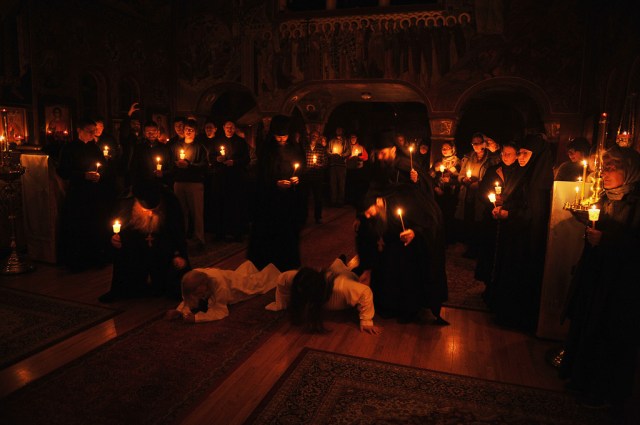
On Friday March 30 2012 after the Matins service Riassaphore monks Laurence and Dionysios were tonsured to the Lesser Schema by Archimandrite Luke. At the end of Matins they entered the Altar were they received the blessing of the Abbot and then proceeded to venerate the holy icons. During the First Hour they put on white gowns as one does when they are to be baptized and when the service finished they were led by the hieromonks of the monastery to the middle of the Church were they prostrated themselves to the ground three times during which the choir sung the sessional hymn after the Third Ode of the Canon from the Prodigal Son “Thy fatherly embrace hasten to open to me, for like  the prodigal have I spent my life. Disdain not a heart now impoverished O Savior, Who hast before Thine eyes the inexpressible riches of Thy mercies. For to Thee, O Lord, in compunction I cry: Father, I have sinned against Heaven, and before Thee”.

When they reached the front of the ambon the Abbot signaled them to get up and read the prayers of the tonsure and  exchanged in a dialog questions and answers as to the purpose of coming to the  monastic life.  Below are some of the exchanges that took place:

Question: Why hast thou come hither, Brother, falling down before the Holy Altar and before this Holy Assembly?
Answer: I am desirous of the life of asceticism, Reverend Father.
Question: Of thine own willing mind comest thou unto the Lord?
Answer: Yes, God helping me, Reverend Father.
Question: Not by any necessity, or constraint?
Answer: No, Reverend Father.
Question: Dost thou renounce the world, and the things belonging to the world, according to the commandment of the Lord?
Answer: Yes, Reverend Father.
Question: Wilt thou endure all the strain tribulation belonging to the monastic life, for the Kingdom of Heaven’s sake?
Answer: Yes, God helping me, Reverend Father.

Fr. Laurence was tonsured with the name of St John  of St. Fransisco and and Fr. Dionysios received the name of St. Seraphim of Sarov. May our Lord help the newly tonsured monks to live steadfastly their monastic vocation  by a “pure and virtuous life” so that their life becomes a light to the world.

Archimandrite Luke counseled the newly tonsured monks to become imitators of the lives of the saints whose names they received and to struggle in humility enduring all afflictions for the salvation of their souls. At the end of this very moving service everyone went up to the newly tonsured monastics and greeted them with the traditional greeting, “What is your name father?” to which they replied  “sinful monk John and Seraphim” and all wished them many years and God’s blessing in their struggles.

Source: Holy Trinity Monastery


Visited by God

Jeanne Harper, Visited by God: The Story of Michael Harper’s 48 Year-long Ministry (Aquila Books, 2013), 146 pages.

Visited by God is the extraordinary spiritual journey of an extraordinary Spiritual man – Michael Harper. I think that I would not be missing the mark to say that Michael Harper was the leader of the Charismatic renewal in England and many other parts of the Globe. Beginning as an Anglican chaplain under John Stott at All Souls Church, Langham Place, London, his journey finally culminated in his introducing an authentically British Orthodoxy as Dean of a new Antiochian Orthodox Deanery with English-speaking parishes all over the country.

His journey was a long and often ‘very difficult’ and testing one. In some ways I can liken it to the journey of St. Paul in that he depended solely on the Holy Spirit to lead him and lead him the Holy Spirit did! It all began in 1962 when Michael was visited by God while studying St Paul’s two prayers in his Epistle to the Ephesians. He ‘saw’ the Church as God saw her – broken by divisions and untended wounds.

It was almost from that very moment that Michael’s God-given mission for unity in the Church began. But there were many in the Anglican Church who opposed this renewal and together with Pentecostalism the movement was dismissed as over-emotionalism and therefore unacceptable. Inevitable disputes and arguments occurred but this did not deter Michael. On the contrary his detractors spurred him on! He continued to go wherever in the world there were people hungry for the power to live what they believed.

One might come to the conclusion that Michael’s journey as leader of the Charismatic renewal movement would result in a very broad liberality but when the Church of England’s General Synod of 1975 passed the motion allowing women into the priesthood, Michael felt more than just stirrings of discontent. Jeanne Harper describes Michael’s anguish which led to a most difficult and painful decision – to leave the Church of England – whom he called his foster mother, so faithfully had she cared for him and led him to his real mother, Orthodoxy.

Jeanne describes how he was led by the Holy Spirit to the Orthodox Church and in 2000 Michael founded the English-speaking Antiochan Orthodox Parish of St. Botolph’s near Liverpool Street, London. At the same time Michael was appointed as a director of the Institute for Orthodox Christian Studies Cambridge. And in 2005 he was elevated to Archpriest.

The silken thread of a spider is spun from behind him as he moves forward to spin his web. The spider cannot see his work until he looks back and then the pattern of his web with all its links is revealed. Looking back over the web of Michael Harper’s life one thing is clear – from the very beginning Michael’s journey had a pattern and this pattern was a pure reflection of God’s will in his life. Once this was achieved Michael was taken in 2010 and lives in constant joy and prayer along with the saints in glory.

Jeanne Harper shares this God given Spirit filled journey of her husband with the reader and in so doing cannot fail to make us all yearn for the presence of the Holy Spirit to touch and lead all our lives.

And let us not lose this opportunity.

Reviewed by David Suchet CBE

* Last but not least, the concluding chapter “The British Antiochian Orthodox Deanery Mission” is written by Fr. Jonathan Hemmings, one of the priests of the Deanery, whose parishes are strategically spread over England and are to be found in Ireland, north and south. The Dean who succeeded Father Michael, is Father Gregory Hallam, whose vibrant parish is in Manchester. Fr. Jonathan Hemmings ministers in Lancaster at the Orthodox Church of the Holy and Life Giving Crossworshipping at St Martin of Tours, Westgate. He writes the following chapter on the story of the Deanery and its missionary vision.

On the Forty Days of Lent


THE FIFTEENTH INSTRUCTION. ON THE HOLY FORTY DAYS OF LENT

deacon2


Abba Dorotheos

In the Law it is written that God commanded the sons of Israel to give a tenth part of all they had acquired during each year, and thereby bring a blessing upon all their deeds. With this in mind, the Holy Apostles established and committed to us as a help and benefaction for our souls something yet greater and more exalted–that we should set apart a tenth portion of the very days of our lives and devote them to God. Thereby might we also receive a blessing for all our deeds, and yearly cleanse the sins we have committed over the course of the whole year. Thus discerning, they have sanctified for us out of the 365 days of the year these seven weeks of Holy Great Lent.
So they set apart these seven weeks; but later the Fathers deemed it wise to add yet another week: first of all, so that those wishing to initiate themselves in the ascesis of the fast over the course of this week might accustom themselves to it and prepare themselves for it; and secondly, in order to render honor to the number of days of the Great Fast which our Lord Jesus Christ fasted. For after subtracting Saturdays and Sundays from the eight weeks we have forty days; the fast on Great Saturday is particularly honored, because it is most sacred, and the only Saturday throughout the year on which a fast it kept.
Seven weeks minus Saturdays and Sundays make thirty-five days, then to this is added the fast of Holy and Great Saturday and half of the Bright and Light-bearing night; thus we have thirty-six and a half days, which equals exactly a tenth part of the 365 days of the year. For the tenth part of three hundred is thirty, the tenth part of sixty is six, and a tenth part of five is one-half (of the Bright Day). So, as we have said, there are thirty-six and a half days–the tenth portion of the whole year which, as I have said, the Holy Apostles have sanctified for us for repentance and the cleansing of the sins of the whole year.

So blessed, O brethren, is he who preserves himself well in these holy days as he should. For though it might happen that being human we sin out of infirmity or negligence, still God has given these holy days in order that, striving with heedfulness and humility of wisdom, we take care for ourselves and repent for all of our sins, and we will be cleansed of the sins we committed during the whole year. Then our souls will be delivered from their weight, and we will arrive at the Holy Day of the Resurrection cleansed, receive Communion of the Holy Mysteries uncondemned, having become new through the repentance of the Holy Fast. In spiritual rejoicing, with God’s help, we will celebrate the entire Holy Pentecost season–for the Pentecost season, as the Holy Fathers say, is the repose and resurrection of the soul. This is signified by our not kneeling during whole Holy Pentecost season.

Thus he who desires during these days of Lent to be cleansed of the sins he has committed over the course of the whole year should first of all refrain from eating much food, for the lack of limitation in food, as the Fathers say, gives birth to every evil in man. … However we must not limit our temperance to food, but refrain also from every other sin. Just as we fast with our stomachs, we should fast also from every other sin; just as we fast with the belly, we should fast also with the tongue, restraining it from slander, from lying, idle-talking, from belittlement, from anger, and in a word, from every sin that is performed by the tongue. We must likewise fast with the eyes, that is, not look at vain things, not give freedom to our eyes, not look at anyone shamelessly and without fear. The hands and feet should also be constrained from every evil deed. Having fasted, as St. Basil the Great says, by a favorable fast, removing ourselves from all the sins of all of our senses, we shall attain to the holy day of the Resurrection, having become as we have said, new, pure and worthy of Communion of the Holy Mysteries. …

deacon7.jpg

Now the Powers of Heaven Minister Unseen with Us

Great Entrance During Presanctified Liturgy


Holy Trinity Seminary Choir sings “Now the Powers of heaven minister unseen with us. Lo, the King of glory enters in. Lo, the mystical Sacrifice, fully accomplished, is borne on high” during Pre-sanctified Liturgy .

PRIEST: (Standing before the icon of Christ) Almighty Lord, You have created all things in wisdom. In Your inexpressible providence and great goodness You have brought us to these saving days, for the cleansing of our souls and bodies, for control of our passions, in the hope of the Resurrection. After the forty days You delivered into the hands of Your servant Moses the tablets of the law in characters divinely traced. Enable us also, O benevolent One, to fight the good fight, to complete the course of the fast, to keep the faith inviolate, to crush underfoot the heads of unseen tempters, to emerge victors over sin and to come, without reproach, to the worship of Your Holy Resurrection. For blessed and glorified is Your most honorable and majestic name, of the Father, the Son and the Holy Spirit, now and forevermore. –

See more at: http://lent.goarch.org/prayers/presanctified.asp#continue


deacon1

Communion during Great Lent

The Liturgy of the Presanctified Gifts, informally the Presanctified Liturgy, is a liturgical service for the distribution of the Holy Gifts on the weekdays of Great Lent. Because Great Lent is a season of repentance, fasting, and intensified prayer, the Orthodox Church regards more frequent reception of communion as especially desirable at that time. However, the Divine Liturgy has a festal character not in keeping with the season. Thus, the Presanctified Liturgy is celebrated instead; the Divine Liturgy is only performed on Saturdays and Sundays. Although it is possible to celebrate this service on any weekday of Great Lent, the service is prescribed to be celebrated only on Wednesdays and Fridays of Lent, Thursday of the fifth week of Lent (when the Great Canon of St. Andrew is read), and Monday to Wednesday of Holy Week. 


His Life In Christ: Pilgrimage To The Holy Places Of St. John Of Krostandt — Part II

KUREMÄE, ESTONIA Pühtitsa Dormition Convent

Pühtitsa’s Dormition Convent in the Republic of Estonia is situated near the village of Kuremäe (Stork-mount) between Lake Peipus and the Gulf of Finland, not far from the Russian border. It is located on a site known as Puhitsetud, meaning “blessed” or “sacred” in Estonian, and has its own unique story that inspired the monastery’s founding and St. John’s spiritual and material help.

Byzantine-Russian Orthodoxy was probably the earliest form of Christi- anity in Estonia, with the baptisms of native Seto and Rus peoples occurring in the 11th-12th centuries, and the first Christian church constructed around the same time in Yuryev (now Tartu) (1). In Revel (Tallinn) the Russian Church and cemetery of St. Nicholas was established decades before its earliest written documentation in 1371, when it was described as being situated “between the Oleviste (Church of St. Olaf, King of Norway) and the town wall”. Viking-era hoards have been found in the region, as Estonia was not only on a trade route, but the site of frequent wars between the Estonians and their Swedish, Danish and German neighbors. By 1228 Estonia was a principality of the Holy Roman Empire, and over the next centuries found its territory divided and re-divided between the Poles, Swedes and Danes, with much of the population subjected to Lutheranism at the Reformation. Coming again under imperial Russian rule in the 18th century, Estonia declared its independence in 1920, retaining its sovereignty until invaded by the Soviets in 1939-40, when it was incorporated into the USSR. Twenty-five percent of the population was deported or listed as casualties of World War II. The Republic of Estonia finally obtained its sovereignty in 1991.


blog6

Pühtitsa Convent of the Dormition, Estonia.


Pühtitsa Convent was founded on the site of a late 16th-century appearance of the Mother of God to Lutheran shepherds from the nearby village of Kuremäe. The hill where she appeared had been considered a holy place from pre-Christian times, and when they climbed to the summit, the shepherds who had witnessed the appearance found an icon of the Dormition hidden in the fissure of a tree. As Protestants, they no longer venerated icons, but they told their story and gave the icon to local Russian Orthodox, who built a small wooden chapel on the site. The chapel was destroyed several times by Lutheran Swedes, but each time the icon was saved and the chapel rebuilt by native Orthodox who held fast to their miraculous image.

Seventeenth-century Lutheran records preserve the complaints of Protestant pastors about the existence of these Orthodox chapels, and Swedish authorities occasionally resorted to military force to destroy them. Accord- ing to Estonian historian Jaanus Plaat, “In 1699, the Jõhvi pastor reported that people came to the ‘great heretical party’ held in August [the Feast of the Dormition], from several parishes and even from Russia.ii During decades of Lutheran iconoclasm, the icon was intermittently sent to the town of Narva for safekeeping until 1818, when a wooden church dedicated to St. Elijah was built in nearby Vasknarva and the icon was transferred there. Ties between the settlements remained close, however, and an annual thirty-kilometer procession was held on the Feast of the Dormition to carry the icon from Vasknarva to the Pühtitsa chapel. According to Metropolitan Kornelius of the Estonian Church, “The [19th-century] procession was onerous. There was no proper road from the village of Vasknarva to Pühtitsa, only a narrow path that went through marshes and forests. The locals said that people went in single-file and waded through mud up to their knees. They took turns carrying the icon, pressing it to their chests.”

The tradition continues today, with a procession from Vasknarva to Püh- titsa a few days before Dormition, usually on the 26th of August. A later version of the original wooden chapel now stands in the same spot under the great oak outside the monastery gates, and the icon is enshrined a few hundred meters away in Pühtitsa Monastery’s Dormition Church. Petitions continue to be answered and healings occur five hundred years after the icon’s finding, and a second Dormition procession with the icon is held every August 15/28 from the church to the holy healing spring at the bottom of the hill for a moleben, and then back to the church.

blog7

Chapel with old oak where the Pühtitsa Dormition Icon was found.


Estonia was remanded to Russian control in 1721 after the Great Northern War, and in 1888 the Russian Orthodox Church sent a nun from Kostroma’s Ipatiev Monastery to found a convent in Kuremäe. Overriding objections from local German Lutheran landowners, Prince Sergei Shakhovskoy, the governor-general of Estonia, sponsored the foundation, which was formally established in 1891 as the Pühtitsa Convent of the Dormition of the Mother of God. The convent’s main church was designed and built by Mikhail Preobrazhensky in the Russian Revival style. There are six other churches in the monastery, which today resembles a small village.

After the Russian Revolution the newly independent Estonian government confiscated much of the monastery’s farm land, and at the outset of World War II Estonia was occupied and annexed to the USSR. Although monasteries were closed throughout the Soviet Union, and in World War II a German concentration camp for Russian, Estonian, Jewish and other prisoners was set up on monastery territory, Pühtitsa was not closed. It is nothing short of a miracle that throughout the persecution and vicissitudes of the Russian Revolution, Estonia’s annexation by the USSR, and two world wars, Pühtitsa was one of the very few Russian monasteries to have a continuous monastic presence throughout the 20th century. Thus it is a double treasure for pilgrims, for it is one of a few Russian women’s convents, and the only one associated with St. John of Kronstadt, to have an unbroken tradition from before the Russian Revolution.

blog8

St. John of Kronstadt and the Founding of Pühtitsa Convent

Saint John not only nurtured the convent’s founding, but often came himself to help form the spiritual and community life of the sisters. They in turn trusted him implicitly. As one sister relates, “Even after his repose, when his memory was reviled under a dark cloud of Soviet misinformation, there was not a single cell, or hardly a home in the nearby village where a portrait of “dear Batiushka,” as the sisters called him, did not hang next to the icons.”


Saint John’s commemoration days—Oct.19/Nov.1 (his birthday and translation of the relics of his patron saint, St. John of Rila) and Dec. 20/Jan.2 (the day of his repose)—were celebrated as monastery feastdays even before his canonization.(2) Monastery and farm work came to a halt, and after Divine Liturgy and a panikhida (memorial service) for Fr. John, a festive trapeza of baked fish, mushroom and potato piroshky, and sweet rolls baked in the archpastor’s memory was provided for the sisterhood, monastery workers, and guests. Panikhidas for Fr. John and Blessed Xenia of St. Petersburg were served at other times as well, and when the monastery experienced sorrows and difficulties, help always arrived through their intercession.

Walking up the hill towards the monastery entrance, there is a tiny wooden chapel under an old oak tree to the right, which Fr. John called the “Oak of Mamre” and next to which he loved to pray. The chapel commemorates the 16th-century finding of the monastery’s great treasure on this site—the miracle-working Dormition Icon of the Mother of God. In the archway (the “Holy Gates”) leading into the monastery, the pilgrim is welcomed with frescoes of the finding of the miraculous Dormition icon and of St. John of Kronstadt.

The view from the Holy Gates opens onto Dormition Church, built with the blessing of Fr. John. Returning from the holy spring one day together with Abbess Barbara, he pointed to the monastery, saying, “Matushka Barbara, look at what a beautiful church we have on top of the hill.” The new church, which he saw as if it already existed, eventually replaced the original small monastery church dedicated to the Smolensk Icon of the Mother of God.(3)

blog9

The holy treasure of the monastery, the miracle-working icon of the Dormition miraculously found in the 16th century, is given central place in the cathedral. As in the time of St. John of Kronstadt, on the Feast of the Dormition August 15/28, an assembly of hierarchs, clergy, sisters, and thousands of pilgrims still process with the icon from the church to the holy spring at the bottom of the hill.

Another icon in the Dormition church associated with St. John is a beautiful miracle-working Vladimir icon of the Mother of God, painted on Mt. Athos as a gift and blessing for Pühtitsa monastery in honor of the fortieth anniversary of Fr. John’s ordination to the priesthood in 1895. The large icon (175 x 105 cm.) required a decree from Tsar Nicholas II for its transfer from the Holy Mountain. The cathedral is also graced with a second icon painted on Mt. Athos, at the Russian monastery of Saint Panteleimon in 2000. The icon depicts St. John of Kronstadt and was given by the monastery brotherhood as a blessing for Pühtitsa convent.


A fourth highly-prized icon, the Pühtitsa Icon of the Mother of God “At the Spring”, is also connected to the archpastor. In 1894, one of Pühtitsa’s sisters painted the icon as a gift for Father John’s name day, portraying the 16th-century appearance of the Mother of God. The icon was presented by the sisters with the inscription, “To Archpriest Father John (Ilyich) Sergiev, the work of painters from Dormition Convent on the Holy Mount, Estlyand Province, October 19, 1894.” Father John kept the icon until his repose, after which it was cared for by a pious couple in St. Petersburg, and finally by a nun from the then-closed Convent of St. John of Rila in St. Petersburg, also founded by Fr. John. During those dark decades, the nun guarding the icon had a dream in which the Mother of God instructed her to return the image to Pühtitsa. This only became possible after the nun’s death in 1946, when the icon was received with great reverence by the sisters.

In 2006, to commemorate the appearance of the Mother of God and the finding of the icon, His Holiness Patriarch Alexei II established the feast of the Pühtitsa Icon of the Mother of God on June 18/July 1, which is celebrated annually at the monastery with ever-growing numbers of pilgrims. On the eve of the feast, an akathist is sung antiphonally by two choirs and after morning liturgy the icon is carried in procession to the site where the Theotokos appeared in the 16th century.

Remembering Saint John

According to the older generation of nuns, when Fr. John came to the convent the sisters decorated the belfry and the guesthouse with colored lanterns. The train from St. Petersburg would arrive at the nearby station at 2:00 AM, and the entire sisterhood along with pilgrims would wait for their spiritual father at the gate, where he was greeted with the ringing of church bells. As he approached, the sisters would begin the Lenten stichera, “Behold, the Bridegroom Cometh at Midnight”. Always “cheerful, shining and infinitely benevolent,” Fr. John would step out of his carriage and bless each person awaiting him, then accompanied by the sisters he would first go to church to serve a moleben before the Dormition icon, and only then retire to his cell for a short rest. By 4:00 am the sisters had gathered in church for the midnight office, and two hours later Father John would arrive to start Matins, always reading the canon aloud himself. After hearing confessions he would celebrate the liturgy, and give Holy Communion to the sisters.


Although Fr. John reposed before the Dormition Church was completed, he did participate in the 1895 hierarchical consecration of the nearby trapeznaya Church of Saints Simeon and Anna and served many liturgies for the sisters. One monastery tradition holds that once as Fr. John was preparing the holy gifts for liturgy during the Proskomedia, he cut his finger. When it bled, he prophesied: “This monastery will stand to the end of the ages; blood will be shed for Christ on this mountain, there will be martyrs.” He later predicted both world wars and everything that would happen to the monastery. “Hold to the grass, the enclosure will save,” he said to the first sisters.

Father John also frequently visited the small church dedicated to St. Sergius of Radonezh, built in 1895 over the tomb of the monastery’s first patron, Prince Sergei Shakhovskoy, where he served panikhidas in the presence of the Duke’s wife, Elizaveta Dmitrievna.

St. John’s Memorial Room

A short walk from Dormition Church and across from the trapeznaya is a hospice housing elderly and ill sisters. On the second floor are three small rooms, dedicated to the history of Pühtitsa Convent and containing a number of Fr. John’s personal belongings. As the pilgrim enters the first of these quiet light-filled rooms, the door creaking on its hinges, a standing wardrobe to the right displays two of Fr. John’s podrazniks, one a blue velvet and the other an off-white linen podraznik for summer. The cabinet is dominated, however, by a large black wool fur-lined winter ryasa, so heavy that it is difficult to lift. Much of Fr. John’s ministry was on foot or in sledges or open horse-drawn cabs, and such warmly-lined ryasas were indispensable to avoid frostbite in the bitter cold of northern Russia. Next to the cabinet is a portrait of Fr. John wearing the same ryasa.

blog14

Gatehouse, Pühtitsa Convent.


Other of St. John’s possessions on display include small personal items such as portraits, letters, a cane, icons, and a carefully-kept Gospel. Here also is his archpriest’s mitre, pectoral cross and the Nativity vestments in which he served at Pühtitsa, as well as a cross presented to him by Tsar Nicholas II.

Father John deeply loved Pühtitsa. “Kiss this land,” he would say, “it has been blessed by the appearance of the Theotokos.” Eventually Fr. John sent over fifty of his spiritual daughters to the monastery to live under the guidance of the Mother Superior Varvara and her successor Abbess Alexia. According to the monastery chronicle, he would often send them off with the exhortation, “Go to Pühtitsa, it is just three steps away from the Heavenly Kingdom.” The third Pühtitsa abbess, Rev. Mother Joanna (Korovnikova), was Fr. John’s goddaughter and the daughter of his church warden at St. Andrew’s Cathedral who had come to Pühtitsa as a young girl. One of the museum’s books inscribed by St. John reads: “To the pious maiden Anna Alexeevna Korovnikova with a blessing. Archpriest John Sergiev. October 1, 1890.”

In 2008, for the 100th anniversary of the repose of St. John of Kronstadt, the monastery issued its first in-house Russian publication, Pühtitsa Convent and its Protector, the Righteous Saint John of Kronstadt. Drawn heavily from the monastery Chronicles, the book recounts Fr. John’s visits to the convent, including passages of his letters to the convent’s first two abbesses, and the memoirs of sisters who knew him.

From the first days of the monastery’s existence the sisters provided for themselves and the pilgrims with their own hands by farming and raising animals. They participated in the monastery’s construction, and as the sisterhood grew, Pühtitsa eventually supported a community of lay medical nurses (Sisters of Mercy), a free clinic, pharmacy, an orphanage, and a school where girls could be educated to age eighteen. Father highly appreciated the labor of the sisters, and held them up as an example to others, saying: “The sisters in Pühtitsa are walking towards the Heavenly Kingdom with huge steps”. In later years, walking around the monastery cemetery where the first nuns were already buried, Fr. John would take off his hat and bow first to one side, and then to the other, saying to the sisters: “You have many relics resting here!”

Father John guided, instructed, and healed the sisters through his prayer. He concerned himself with their everyday needs as well as spiritual guidance, and his letters to the first abbesses often ended with such instructions as, “I am sending 500 rubles to buy flour and provisions… and am asking you to take care to provide good nutrition.”

Statue of St. John of Kronstadt in house-museum garden.

blog11


Sister Lyudmila’s Healing

Next to the wardrobe in the memorial room is a small chair on which Fr. John sat one day when he healed a novice close to death, a story that her spiritual daughter, Nun Ioasipha (Malyarova) repeated for sisters and pil- grims until her own repose in 1990:

My eldress, Nun Lyudmila (Kulikova), who entered the monastery at the age of 16 in 1892, used to recall her miraculous healing by Fr. John from a deadly disease. As a young novice, Sister Lyudmila was given the obedience to bring bricks by boat from the village of Skamya two kilometers from the monastery on the Narova River. Once, after loading the bricks, she slipped getting into the rowboat and fell into the icy water of the river. It was October and the water near the shore had already begun to freeze. Wet and chilled through, it took her several hours to get back to the monastery, and from the exposure she developed a consumptive lung condition. She was admitted to the hospital, but soon sent home with the words: “Prepare her for the long journey.” Father John arrived at the monastery shortly after, and Mother Superior Alexia asked him
to bless the sick novice. She was carried to the abbess’ quarters, and Fr. John sorrowfully shook his head: “What a sick girl, what a sick girl”.

Without turning his gaze away, he touched her chest and drew his fingers together as if gathering up the edges of a piece of fabric. Lamenting and praying, he touched another spot on her chest as if he was closing up invisible wounds, and then blessed the novice, saying simply, “Thank God, you will live and live long!” With the blessing of Fr. John, Lyudmilla was carried to church, where she lay behind the harmonium listening to the service. By the end of vigil she was able to sit up, and during the morning liturgy the sisters helped her to approach Holy Communion. After Fr. John gave her Holy Communion, she was able to walk to her cell without help.


blog10

St. John of Kronstadt.


The following year, the abbess went to Revel (Tallinn), taking Mother Lyudmila to be checked by the doctor who had predicted her death.
He was very surprised to see his patient recovered and after examining her X-rays, shook his head saying: “I do not understand this at all. You were sure to die. Your lungs were laced with holes, but some mighty hand repaired it…. A great miracle was accomplished for you.” Mother Lyudmila lived until 1966, dying peacefully at the age of 90.

Schemanun Sergia: Childhood Healing

Schemanun Sergia (Andreeva), who was born in 1900, also told the story of her wondrous recovery from a severe illness through Fr. John’s prayers: “As a child my family lived in Finland, and when I was five, I broke my leg. It was a complex fracture and although my parents took me to different doctors who did what they could, the leg remained weak. After a year I could hardly move, even with crutches. From Finland we went to Fr. John of Kronstadt, who sat me on a little chair. My mother cried out, ‘Father, heal her leg!’ Father moved his hand three times along my injured leg and said, ‘She will walk, but she will not be completely healthy’. Then he brought a prosphora and gave it to me. I was very glad about Father’s gift of prosphora, and we returned home consoled. On the way back, I hardly needed the crutches, and when we arrived home I began walking slowly by holding to the walls. To the great surprise of my parents, I began walking without the crutches and even running. When I turned eighteen Father John blessed me to join the monastery.”

Sister Sergia spent almost seventy years in the monastery at different obediences including caring for the farm animals and as a choir director for the monastery. Before her repose in 1985 she was tonsured into the Great Schema.

Father John spiritually strengthened the community with each visit, and as he wrote to Mother Alexia, the second abbess, “I pray God that in Pühtitsa, with the protection of the Heavenly Queen, there will be a blossoming of truth, sanctity and piety amongst the sisters.”

That God did protect the monastery was demonstrated during a visit of a local commissar during the years of Soviet occupation. Telling villagers that he was going to arrest the abbess “and drag her out tied to my horse,” he arrived at the monastery hostile and belligerent. The abbess came out and received him calmly, upon which he demanded food and drink. The commissar drank so much that he left without doing anything, and on the way home the unfortunate man fell from his horse in his drunken stupor and was himself dragged on the ground until dead.

Former Abbess Varvara with young pilgrim.


blog13


After World War II, the monastery managed to stay afloat through the last difficult decades of the Soviet period. From 1968 to 2011 the sisterhood flourished under the capable hand of Abbess Varvara, who drew many young Russian and Estonian nuns after the fall of Communism. Today, guided by Pühtitsa’s eighth abbess, Rev. Mother Filareta, pilgrims continue to be moved by the legacy and spiritual protection of St. John of Kronstadt, and the sisters apply to him the words of another luminous 20th-century wonderworker, St. John Maximovitch: “Tell the people, even though I died, I am alive!”

DIRECTIONS:

To reach Pühtitsa Monastery by public transport, take a plane or train to Tallinn, Estonia. From Tallinn’s central bus station at Lastekodu 46, there is a direct bus to Kuremäe, the village outside the monastery, once a day on Monday and Friday. On other days you can take a bus from Tallinn to Johvi, and then local bus 116 to Kuremäe, which makes the round trip several times a day. Tell the driver you want to get off as close as possible to Pühtitsa Monastery.


(1) Yuryev is illustrative of the multi-cultural history and Orthodox influence in Estonia: the first documented record of the area was made in 1030 by chroniclers of Kievan Rus when Yaroslav I the Wise, Prince of Kiev and son of St. Vladimir the Great, built a fort there and named it Yuryev after his own patron saint, St. George. Yaroslav I had strong ties with Scandinavia as he had been in exile at the court of the first Swedish Christian King, Olof Skötkonung, and had married Olof’s daughter Ingegard. Ingegard in turn became St. Anna of Novgorod.

(2) St. John of Kronstadt was formally canonized by the Holy Synod of the Russian Orthodox Church in 1990. He had previously been recognized as a saint by the hierarchs of the Russian Orthodox Church Outside of Russia in 1964. His feast days are Oct.19/Nov.1 (his birthday and translation of the relics of his patron saint, St. John of Rila) and Dec. 20/Jan.2 (the day of St. John of Kronstadt’s repose).

(3) Another famous icon, that of the Pühtitsa icon of the Smolensk Mother of God gave its name to the original convent church and was highly venerated by St. John and the sisterhood. It still occupies a prominent place in the newer Dormition Cathedral. The foundation of Dormition Cathedral was laid by St. John, but he did not live to see its completion.

Source: Road to Emmaus Vol. XV, No. 1 (#56)


 [To Be Continued]

His Life In Christ: Pilgrimage To The Holy Places Of St. John Of Krostandt — Part I

blog3


A century after his repose, the great archpriest St. John of Kronstadt remains an iconic figure: a man of ferocious dedication to God who was graced with a deep and miraculous prayer life, yet manifested a radical sympathy for the poor that still astounds with its creative and vigorous solutions. After an impoverished childhood in Russia’s remote Archangelsk region and seminary in St. Petersburg, Fr. John Sergiev was assigned to the tumultuous naval port of Kronstadt, where he not only served daily liturgy and prayed long into the night, but actively worked to alleviate the spiritual and material needs of each person he met. A support for Russia’s tsars, clergy, merchants, students, paupers and monastics, he interceded for and assisted everyone who approached him: Russian or foreigner, Christian, Moslem, Jew, or agnostic.

photo11

Archangelsk and St. Petersburg

photo1photo2photo5photo6photo7photo8photo10

Arkhangelsk, northern pearl of Russia

Saint John’s wisdom comes to us today through his candid written reflections in My Life in Christ (*) and through his intercession, but for the pilgrim fortunate enough to visit Russia and Estonia, there is also a substantial material legacy of his life and ministry, preserved and newly restored through the selfless labors of many contemporary Orthodox. These holy places are an alternative form of iconography, another form of the “stones crying out,” that they, too, have been touched by grace.

photo22photo23photo24photo25photo26photo27photo28photo29

St. Petersburg, The Venice of the North


These restored and accessible sites of St. John’s life and labors include the Monastery of St. John the Theologian for women, founded by St. John in his native village of Sura in the Archangelsk region in the far north of Russia; Pühtitsa Convent of the Dormition in the Republic of Estonia, which he nurtured and shepherded through its first decades; St. John’s much-venerated relics in the famous women’s monastery of St. John of Rila in St. Petersburg, Russia; the site of his own Church of St. Andrew in nearby Kronstadt where he served throughout his priestly life—along with a second even larger Kronstadt church, the Navy Cathedral of St. Nicholas, for which he initiated the building and laid the foundation; and finally, Fr. John’s own home, a second-floor apartment in Kronstadt where he lived with his wife Elizabeth for a half century until his repose in 1908.


ARCHANGELSK REGION, RUSSIA

photo4photo3photo9

The village of Sura

Sura Monastery of St. John the Theologian

The village of Sura on the upper reaches of the Pinega River, in the Arch- angelsk region of northern Russia, is the birthplace of St. John of Kronstadt. Sura is one of the most ancient villages of the native Chud people, and even today has both pagan activity and Old Believer influences. In the only autobiographical sketch composed by St. John, and published in an 1888 issue of the magazine Sever (North), he describes his early childhood:

I am the son of a churchman from the village of Soursk, district of Pinezhsk, province of Archangelsk. From very early childhood, as early as I can remember, at the age of four or five, perhaps even earlier, my parents taught me to pray and by their religious frame of mind made me a religiously-minded boy. At home, in my sixth year, Father brought me a primer, and Mother began to teach me the alphabet; but reading and writing came to me with great difficulty, which was the cause of no little sorrow to me. I just couldn’t master the identity between our speech and writing; in my time reading and writing were not taught as it is now: we were all taught ‘Az’ (for ‘A’), ‘Boukee’ (for ‘B’), Vedi,’ etc., as if ‘A’ were one thing and ‘Az’ a different thing. For a long time did this wisdom elude me, but having been taught by Father and Mother to pray, grieving over my failures in studies, I prayed fervently to God, so that He would grant me understanding—and I remember how, suddenly, it was as if a veil were lifted from my mind, and I began to comprehend studies well. When I was ten I was taken to the Archangelsk parish school. My father, naturally, received a very small salary, so that it must have been terribly difficult to live. I already understood the real position of my parents, and for this reason my inability at school was indeed a calamity. I thought little of the significance my studies would have on my future, and grieved especially over how Father was needlessly spending his last means to support me.


Left in Archangelsk completely alone, I was deprived of my parents and had to arrive at everything myself. Among the boys of my age group in class, I did not find, nor did I seek, support or assistance; they were all more able than I, and I was the last pupil. Anguish took hold of me. Then it was that I turned for help to the Almighty, and a change took place in me. In a short time I moved forward to such an extent that I ceased to be the last pupil. The further I went, the better and better I became in my studies, and by the end of the courses was among the first transferred to the seminary, which I finished first in 1851 and was sent to the Petersburg Academy on a full scholarship…

archaic20archaic21

Father John returned to Sura throughout his life, and after his ordination established a six-year grammar school for the village children. In 1899 he founded an informal women’s community, first comprised of a wooden church dedicated to St. John the Theologian and a few monastic cells. This was followed by a beautiful stone church dedicated to St. Nicholas, and after Fr. John’s repose, the Dormition Cathedral, built in 1915, about which he correctly prophesied that the church would be built but that no one would serve in it.

aaa.jpg

St. Nicholas wooden church (1687), Zachachie, Archangelsk (Arkhangelsk) region

bbb.jpg

Church of St John the Theologian, Plesetsk, Arkhangelsk Region

The monastery began with two nuns: Barbara, the superior, and Riassaphore Nun Angelina with thirty-three novices that Fr. John had blessed to live in the newly opened community. On July 20, 1900, the wooden church was consecrated in Fr. John’s presence and in the fall of the same year the community was officially recognized. Father John instructed the novices through his own teaching and sent them for preparation to the Leushino Convent under the well-known Abbess Thaisia, who directed over 700 nuns! Several letters still survive from Fr. John to Abbess Thaisia about the reception of the novices.(1)

blog2

St. John with Abbess Thaisia, late 19th century.

Settling at the site of the monastery, the sisters assisted in the construction work and gardening; they later recalled the particularly hard labors of those early years and the savagely cold winters. In the early 1900s the monastery opened a podvoriye, a city outpost in Archangelsk and a second in St. Petersburg that would later become the famous Karpovka Ioannavsky Monastery where Fr. John would be buried.
leushino1
Mother Superior Taisiia on the Veranda
leushino2leushino3
Leushinskii Monastery, Leushino, Russian Empire

The convent priest was Fr. Dimitri Fedosikhin, formerly a train engineer who was healed by Fr. John after a revolutionary bombing of his train had left him near death. Father John later encouraged him to accept the priesthood, and Fr. Dimitri became rector of the Archangelsk cathedral and the last spiritual father of the Sura women’s monastery. The Sura convent was closed on Dec. 8, 1920 by the local Soviet and the sisters dispersed, arrested and exiled. The newly built Dormition Church was turned into a club, and St. Nicholas Church destroyed. In 1920 Fr. Dimitri was arrested along with 140 other Orthodox, including a number of the nuns, who protested the closing of the monastery. He was sentenced to five years in the gulag camps and the remaining nuns were dispersed and exiled.

On returning to Arkhangelsk in the spring of 1925, Fr. Dimitri petitioned for the reopening of the cathedral, which had been closed after his departure. His request went unanswered and on Pascha he opened the church and served on his own initiative. He was re-arrested, sentenced to three more years in the camps and a further five-year exile in Kazakhstan. In Kazakhstan, he and his wife were tonsured as monastics and he was secretly consecrated to the episcopate as Schema-bishop Peter. On his return from exile Fr. Dimitri traveled from place to place, confessing and serving liturgy for his spiritual children, until he was arrested for the third time in 1941 and sent to the camps again, from which he never returned.


blog3

St. John with Sura relatives, 1890.


On Oct. 31, 1994, the archbishop of Archangelsk blessed the formation of the revived St. John the Theologian Convent in Archangelsk. The initial attempt to regain the property and buildings was unsuccessful, however, and the community relocated to the village of Yershovka, where they organized a new monastery, also dedicated to St. John the Theologian. A local committee of clergy and laypeople, meanwhile, continued to press for the return of the Sura monastery territory and eventually succeeded. In October 2012, the Holy Synod passed a resolution reopening the Sura convent, and naming Nun Mitrofania (Mikolka) as abbess. A new community of sisters has formed at Sura and begun restoration of the badly damaged buildings.

Future plans include rebuilding the churches and cells, a home for orphaned girls, a domicile for the elderly, a Sunday school, and the revival of local handicrafts. The ruined Dormition church is now being restored, a house-church dedicated to St. John has opened in Sura, and the monastery welcomes pilgrims, most of whom visit from the well-known Monastery of St. Artemy of Verkola, about thirty-five miles away. Pilgrim accommodations will be made available as the monastery is revived.

In the summer of 2013, a cross procession/pilgrimage voyage was held in honor of the 185th anniversary of St. John of Kronstadt’s birth. The aim of the event was not only the restoration of pilgrimage to the shrines of the Russian north, but to attract attention to the Sura Convent of St. John the Theologian. Participants in the cross procession sailed 2,000 kilometers along the Neva River, through Lake Ladoga, the Svir River, Lake Onega, the White Sea to Archangelsk, and further down the North Dvina and Pinega Rivers to the village of Sura. This was the same route that St. John would have taken on his own visits to Sura. Prayer services and processions involving local churches and parishioners were held during the frequent stops.

neva-riverLake_Ladoga_-_superior_mirage_2LakeLadoga3

valaamladoga1ladoga2ladoga3

Neva River and Lake Ladoga

lake1lake2lake3LakeLadoga3

Svir River and Lake Onega

photo40photo42photo43

White Sea to Archangelsk

photo40photo41photo44

North Dvina and Pinega Rivers

DIRECTIONS:

Getting to the Sura Ioannovsky Monastery is not terribly difficult if you have the time, but neither is it for the faint-hearted. From Moscow to Archangelsk is about 1200 km (21 hours by train). From St. Petersburg it is 25 hours by train. From Archangelsk, take a second train (running every other day) several hundred kilometers to the town of Karpogory. From Karpogory, there may be an infrequent bus to Sura, but the best option is to hire a taxi or private car. Sadly, the river steamboats that St. John customarily took to Sura from St. Petersburg were discontinued after the Russian Revolution.

blog4

St. John of Kronstadt with wife, Matushka Elizabeth.

Source: HIS LIFE IN CHRIST, Road to Emmaus Vol. XV, No. 1 (#56)

(1 ) Abbess Thaisia’s memoirs of her conversations with St. John of Kronstadt are included as an appendix to: Abbess Thaisia of Leushino: The Autobiography of a Spiritual Daughter of St. John of Kronstadt, St. Herman of Alaska Press, Platina, CA, 1989.The following “Conversations” provide an intimate, realistic glimpse into the life of a magnificent Saint of God, showing us his endearing, human side, and then calling us beyond the earth to the eternal realm in  which his soul constantly abided. We give thanks to God that God that Abbess Thaisia was able to record so precisely these soul-saving talks. It was not in vain that the Lord gifted her with an almost photographic memory! Both her Autobiography and the “Conversations” are fascinating and soul-saving readings!

*

My Life in Christ: Extracts from the Diary of Saint John of Kronstadt


For the 2nd Part, go to His Life In Christ: Pilgrimage To The Holy Places Of St. John Of Krostandt — Part II


On the Silent and Invisible Warfare


e

Way of the Ascetics 

By Tito Colliander


Chapter One: On a Resolute and Sustained Purpose


IF you wish to save your soul and win eternal life, arise from your lethargy, make the sign of the Cross and say:

In the name of the Father, and of the Son and of the Holy Ghost. Amen.

Faith comes not through pondering but through action. Not words and speculation but experience teaches us what God is. To let in fresh air we have to open a window; to get tanned we must go out into the sunshine. Achieving faith is no different; we never reach a goal by just sitting in comfort and waiting, say the holy Fathers. Let the Prodigal Son be our example. He arose and came (Luke 15:20).

However weighed down and entangled in earthly fetters you may be, it can never be too late. Not without reason is it written that Abraham was seventy-five when he set forth, and the labourer who comes in the eleventh hour gets the same wages as the one who comes in the first.

Nor can it be too early. A forest fire cannot be put out too soon; would you see your soul ravaged and charred?

In baptism you received the command to wage the invisible warfare against the enemies of your soul; take it up now. Long enough have you dallied; sunk in indifference and laziness you have let much valuable time go to waste. Therefore you must begin again from the beginning: for you have let the purity you received in baptism be sullied in dire fashion.

b

Arise, then; but do so at once, without delay. Do not defer your purpose till “tonight” or “tomorrow” or “later, when I have finished what I have to do just now.” The interval may be fatal.

No, this moment, the instant you make your resolution, you will show by your action that you have taken leave of your old self and have now begun a new life, with a new destination and a new way of living. Arise, therefore, without fear and say: Lord, let me begin now. Help me! For what you need above all is God’s help. . Hold fast to your purpose and do not look back. We have been given a warning example in Lot’s wife, who was turned into a pillar of salt when she looked back (Genesis 19:26). You have cast off your old humanity; let the rags lie. Like Abraham, you have heard the voice of the Lord: Get thee out of thy country, and from thy kindred, and from thy father’s house, into a land that I will show thee (Genesis 12:1). Towards that land hereafter you must direct all your attention.

a

Chapter 2: On The Insufficiency Of Human Strength


THE holy Fathers say with one voice: The first thing to keep in mind is never in any respect to rely on yourself. The warfare that now lies before you is extraordinarily hard, and your own human powers are altogether insufficient to carry it on. If you rely on them you will immediately be felled to the ground and have no desire to continue the battle. Only God can give you the victory you wish.

This decision not to rely on self is for most people a severe obstacle at the very outset. It must be overcome, otherwise we have no prospect of going further. For how can a human being receive advice, instruction and help if he believes that he knows and can do everything and needs no directions? Through such a wall of self-satisfaction no gleam of light can penetrate. Woe unto them that are wise in their own eyes, and prudent in their own sight, cries the prophet Isaiah (5:21), and the apostle St. Paul utters the warning: Be not wise in your own conceits (Romans 12:16). The kingdom of heaven has been revealed unto babes, but remains hidden from the wise and prudent (Matthew 11:25).

We must empty ourselves, therefore, of the immoderately high faith we have in ourselves. Often it is so deeply rooted in us that we do not see how it rules over our heart. It is precisely our egoism, our self-centeredness and self-love that cause all our difficulties, our lack of freedom in suffering, our disappointments and our anguish of soul and body.

d

Take a look at yourself, therefore, and see how bound you are by your desire to humour yourself and only yourself. Your freedom is curbed by the restraining bonds of self-love, and thus you wander, a captive corpse, from morning till eve. “Now I will drink,” “now I will get up,” “now I will read the paper.” Thus you are led from moment to moment in your halter of preoccupation with self, and kindled instantly to displeasure, impatience or anger if an obstacle intervenes.

If you look into the depths of your consciousness you meet the same sight. You recognize it readily by the unpleasant feeling you have when someone contradicts you. Thus we live in thralldom. But where the Spirit of the Lord is, there is liberty (11 Corinthians 3:17).

How can any good come out of such an or biting around the ego? Has not our Lord bidden us to love our neighbour as ourselves, and to love God above all? But do we? Are not our thoughts instead always occupied with our own welfare?

No, be convinced that nothing good can come from yourself. And should, by chance, an unselfish thought arise in you, you may be sure that it does not come from you, but is scooped up from the wellspring of goodness and be stowed upon you: it is a gift from the Giver o life. Similarly the power to put the good thought into practice is not your own, but is given you by the Holy Trinity.

f

Chapter Three: On The Garden Of The Heart

THE new life you have just entered has often been likened to that of a gardener. The soil he tills he has received from God, as well as the seed and the sun’s warmth and the rain and the power to grow. But the work is entrusted to him.

If the husbandman wishes to have a rich harvest, he must work early and late, weed and aerate, water and spray, for cultivation is beset by many dangers that threaten the harvest. He must work without ceasing, be constantly on watch, constantly alert, constantly prepared; but even so, the harvest ultimately des wholly on the elements, that is, on God.

The garden that we have undertaken to tend watch over is the field of our own heart; the harvest is eternal life.

Eternal, because it is independent of time and space and other external circumstances: it is the true life of freedom, the life of love and mercy and light, that has no bounds whatever, and for just that reason is eternal. It is a spiritual life in a spiritual dominion: a state of being. It begins here, and has no end, and no earthly power can coerce it; and it is to be found in the human heart.

Persecute yourself, says St. Isaac of Syria, and your enemy is routed as fast as you approach. Make peace with yourself, and heaven and earth make peace with you. Take pains to enter your own innermost chamber and you will see the chamber of heaven, for they are one and the same, and in entering one you behold them both. The stairway to the kingdom is within you, secret in your soul. Cast off the burden of sin and you will find within you the upward path that will make your ascent possible.

The heavenly chamber of which the saint speaks here is another name for eternal life. It is also called the kingdom of heaven, the kingdom of God, or quite simply, Christ. To live in Christ is to live in eternal life.

c

Chapter Four: On the Silent and Invisible Warfare

NOW that we know where the battle we have just begun is to be fought, and what and where our goal is, we also understand why our warfare ought to be called the invisible warfare. It all takes place in the heart, and in silence, deep within us; and this is another serious matter, on which the holy Fathers lay much stress: keep your lips tight shut on your secret! If one opens the door of the steam bath the heat escapes, and the treatment loses its benefit.

Thus say nothing to anyone of your newly conceived purpose. Say nothing of the new life you have begun or of the experiment you are making and experiences you expect to have. All this is a matter between God and you, and only between you two. The only exception might be your father-confessor.

g

This silence is necessary because all chatter about one’s own concerns nourishes self-preoccupation and self-trust. And these must be stifled first of all! Through stillness one’s trust grows in Him who sees what is hidden; through silence one talks with Him who hears without words. To come to Him is your endeavour, and in Him shall be all your confidence: you are anchored in eternity, and in eternity there are no words.

Hereafter you will consider that everything that happens to you, both great and small, is sent by God to help you in your warfare. He alone knows what is necessary for you and what you need at the moment: adversity and prosperity, temptation and fall. Nothing happens accidentally or in such a way that you cannot learn from it; you must understand this at once, for this is how your trust grows in the Lord whom you have chosen to follow.

Still another piece of information the saints offer on the way: you should see yourself as a child who is setting out to learn the first sounds of letters and who is taking his first tottering steps. All worldly wisdom and all the skills you may have are totally worthless in the warfare that awaits you, and equally without value are your social standing and your possessions. Property that is not used in the Lord’s service is a burden, and knowledge that does not engage the heart is barren and therefore harmful, because it is presumptuous. It is called naked, for it is without warmth and fosters no love. You must thus abandon all your knowledge and become a dunce in order to be wise; you must become a pauper in order to be rich, and a weakling if you wish to be strong.

‘For they shall see God’: Elder Eusebios Vittis (+2009)

Toward the last years of his life, I had the blessing to speak with him in private and pray together. Elder Eusebios, the mystic, the poet, the Seer of God, as they called him! This Meeting burns still in my heart!  May we have his blessing!” (Little city hermit)
 *

“Prior to his [ie. Elder Eusevios] death he was sought after by many souls seeking comfort and consolation. I, though unworthy, was  granted the blessing of not only meeting him but hearing a homily he gave and of speaking with him very briefly in private. The memory of his soft hands and piercing eyes have remained forever in my heart.

Since my feeble words cannot properly convey his holiness, nor his pure and all-consuming love for Christ our God, I have taken the liberty of copying a translation of one of his poems for our spiritual benefit. It was translated by a fellow-student of mine, Michael Tishel. May God grant him many blessings for his effort in bringing the inspiring writing of a contemporary saint to the English-speaking world!

Before the Crucified One by Elder Evsevios Vittis (+2009)                                                                                                     Translation © by M. Tishel taken from his blog One Pilgrim to Greece…

O soul, you who are weary and saddened by many things that, out of politeness, you would rather not mention. Instead, you hold them within you, not wanting to offend, hurt or scandalize any other soul around you–from near or far. You, o restless soul, who search for peace, run to the Crucified One, the Sweet Jesus; kneel before Him with contrition. Tell Him the following words with courage, slowly, purely, and honestly, and with steadfast faith that you will be heard:

O Lord my Jesus, meek and humble in heart, I wholeheartedly beg and beseech You:

Release me from the desire to be admired by others.
Release me from the desire to be loved by others.
Release me from the desire to be sought out by others.
Release me from the desire to be honored by others.
Release me from the desire to be praised by others.
Release me from the desire to be preferred by others.
Release me from the desire to give advise to others.
Release me from the desire to be commended by others.
Release me from the desire to be cared for by others.

Release me from the fear that they will humiliate me.
Release me from the fear that they will scorn me.
Release me from the fear that they will reject me.
Release me from the fear that they will slander me.
Release me from the fear that they will forget me.
Release me from the fear that they will offend me.
Release me from the fear that they will suspect me.

***

Lord, grant me to desire that others be loved more than me.
Lord, grant me to desire that others be esteemed more than me.
Lord, grant me to desire that the good view of others increase, and that my own decrease.
Lord, grant me to desire that others be put to use more than me.
Lord, grant me to desire that others be praised more than me.
Lord, grant me to desire that others be remembered, and not me.
Lord, grant me to desire that others be preferred and chosen over me.
Lord, grant me to desire that others make progress in virtue more than me, if of course I could achieve something like that on my own.

O soul, you who art hurt and wounded by that which you have inflicted on yourself, if the Lord hears you–and He will hear you if your prayer is genuine, honest, fervent and comes from the depths of who you are–

–how much peace will reign in your heart!
–how much serenity will take root inside of you!
–how much tranquility will be painted on your face!
–and amongst all of the events of your life, how many blissful moments will you experience, both large and small!

Don’t forget, beloved soul, that most of the offenses that we experience stem from the exaggerated concept that we have of ourselves. They have their beginning when we overestimate what we do and offer, with the hidden intention of increasing our status in the world, however possible.

The greatest thing in the world is to be forgotten by everyone, except by those who we love and who love us (even if we find that those who we love very much do not respond in like manner). Maybe you think, blessed soul, that your love for others is greater than theirs is for you. How can you truthfully measure this? The Holy Spirit through the Apostle says: ”owe no man anything, except to love one another“ (Romans 13:8). In other words, your debt is always unpaid! So how are you so bold as to make demands as if you’d paid it? Love, therefore, without waiting for some sort of response. Love the following truth, and carry it in your heart: that anything, except for our ”debt“, creates within us

restlessness, instead of joy,
agitation, instead of peace,
anxiety, instead of certainty,

Don’t ever forget this!
Let’s allow this attitude, therefore to be implanted within us. Let’s not stop walking this road. Let’s not allow prideful thoughts to trick us, such as the following:

I could be doing something else, much more important than what I am doing,

It is a thought, seduced by deceptive aspirations, desires and unfounded zeal to leave our everyday work, as we quite ridiculously want our virtuousness to blossom more than that of our neighbor’s.

Rather, let us keep busy with what we are doing, because that is what God has given us to do.

Let us occupy ourselves by doing it as best as we can.

This means, in short, to do it
with clarity.
with energy.
with joy.
completely.

This is how the Elder looked the two times I met him, like a little angel.

May we have his blessing!”

September 24, 2011 by matushka constantina